Since the initial work conducted by Guimelli and Deschamps (Reference Guimelli and Deschamps2000) on the mute zone of social representations (SR), the question of this social phenomenon has aroused interest and led to subsequent research. These works have focused on two areas of research: theoretical and methodological. This second area will constitute the main focus of this contribution. In this perspective, we will rely on the SR of the Gypsy community. Indeed, apart from the work carried out by Guimelli and Deschamps (Reference Guimelli and Deschamps2000), one can notice that this object has been tackled through several studies. For example, Mamontoff (Reference Mamontoff2008) conducted a study based on the question of the link between the SR of work of the Gypsy community and the practices adopted by this group. Moreover, the same author focused part of her work on the SR of the identity of this specific group, particularly through the question of the link between settlement practices and the transformation of the SR of the Gypsy identity Mamontoff (Reference Mamontoff1996). Otherwise, in line with the works conducted about the relationships between majority and ethnic minority, Perez, Moscovici, and Chulvi (Reference Pérez, Moscovici and Chulvi2007) showed that despite a positive image, the Gypsy minority is the target of an ontologization process. These results allow to consider that part of the SR of the Gypsy community could be composed of negative content. Such content could therefore be censored by individuals and groups, a phenomenon that led Guimelli and Deschamps (Reference Guimelli and Deschamps2000) to hypothesize the existence of a mute zone in the representational field.
The mute zone of SR can be defined as “a specific subset of cognitions, which, whilst being available, would not be expressed by the participants in standard conditions of production” (Guimelli & Deschamps, Reference Guimelli and Deschamps2000, p. 53). Thus, to highlight the fact that under some conditions, individuals may not express all that they think about particular objects, Guimelli and Deschamps (Reference Guimelli and Deschamps2000) suggest manipulating the contexts of expression. To this end, they use a technique called “substitution” which is directly derived from the identification paradigm (Jellison & Green, Reference Jellison and Green1981). This technique consists in varying the context of expression by creating two verbal associative task situations. In the first case, individuals have to express themselves from their own point of view (i.e., as they think), whilst in the second case, they have to express themselves as others would (e.g., as the French in general would do). The results obtained by means of this procedure show that under the substitution instruction context, the expression of counternormative elements is facilitated. Indeed, when instructed to answer “normally”, for example, Gypsies are considered as nomads and/or musicians. By contrast, when participants are asked to answer as the French in general would do, Gypsies are presented as thieves (64% in a substitution context vs. 26% in a “normal” context). Thus, with regard to various objects of studies such as “Gypsies” (Guimelli & Deschamps, Reference Guimelli and Deschamps2000), “Insecurity” (Deschamps & Guimelli, Reference Deschamps, Guimelli, Beauvois, Joule and Monteil2004), “Maghrebins” (Abric, Reference Abric and Abric2003), “Islam” (Flament, Guimelli, & Abric, Reference Flament, Guimelli and Abric2006), “the Muslim community” (Guimelli, Lo Monaco, & Deschamps, Reference Guimelli, Lo Monaco and Deschamps2010), “the Woman at work” and “Male/female work” (Flament et al., Reference Flament, Guimelli and Abric2006), “Alcohol” (Lo Monaco et al., Reference Lo Monaco, Lheureux, Chianèse, Codaccioni, Halimi-Falkowicz and Cano2009), it is under this context of substitution that some opinions, beliefs or attitudes, which are not usually expressed under the so-called “normal” conditions, appear. From a theoretical viewpoint, as suggested by Guimelli and Deschamps (2000, p. 53) this is a social desirability effect related to the salience of a tolerance norm in self-presentation which leads participants to mask their negative opinions.
Another way to reveal social desirability issues related to negative opinions has been explored by means of the normative decontextualization technique (Flament et al., Reference Flament, Guimelli and Abric2006; Lo Monaco & Guimelli, Reference Lo Monaco and Guimelli2011; Lo Monaco et al., Reference Lo Monaco, Lheureux, Chianèse, Codaccioni, Halimi-Falkowicz and Cano2009). Directly inspired by previous research on the well-known experimenter effect (e.g., Anderson, Silver, & Abramson, Reference Anderson, Silver and Abramson1988; Campbell, Reference Campbell1981; Davis, Reference Davis1997; Fazio, Jackson, Dunton, & Williams, Reference Fazio, Jackson, Dunton and Williams1995; Finkel, Guterbock, & Borg, Reference Finkel, Guterbock and Borg1991; Gilbert & Hixon, Reference Gilbert and Hixon1991; Schuman & Converse, Reference Schuman and Converse1971; Stangor, Swim, Van Allen, & Sechrist, Reference Stangor, Swim, Van allen and Sechrist2002; Sudman & Bradburn, Reference Sudman and Bradburn1974), the experimental manipulation is no longer focused on variations of the instruction but on the presentation of the experimenter. Indeed, Gilbert and Hixon (Reference Gilbert and Hixon1991) and Stangor et al. (Reference Stangor, Swim, Van allen and Sechrist2002) have already used this variable. Therefore, in relation to these previous results, one can follow Abric for whom normative decontextualization works by constructing a mediating event (interview) to facilitate the expression of counternormative positions when interviewer and respondent are characterized by the same group membership while inhibiting expression of these aspects when the respondent perceives the interviewer as dissimilar, or even as opposite. For example, concerning the SR of Islam, Flament et al. (Reference Flament, Guimelli and Abric2006) have manipulated both the presentation of the experimenter and the instruction. The manipulation of these independent variables allowed the authors to reveal a unique dimension called “masking to unmasking” by means of a Guttman effect in the principal component analysis (Flament et al., Reference Flament, Guimelli and Abric2006; Flament & Milland, Reference Flament, Milland and Abric2003, Reference Flament and Milland2005; Gaymard, Reference Gaymard2006; Lo Monaco & Guimelli, Reference Lo Monaco and Guimelli2011). This analysis showed that, on the basis of the answers to 10 Likert scales related to the SR of Islam, the four experimental conditions resulting from the combination of the two manipulated variables were hierarchized along this dimension. Then, the most favourable condition concerning masking strategies was characterized by the combination of a dissimilar interviewer with a “normal” context of expression while the most favourable condition concerning unmasking was characterized by the combination of a similar interviewer with a substitution context of expression.
All these studies contributed significantly to identifying conditions and objects related to social desirability issues.
However, since the work carried out by Guimelli and Deschamps (Reference Guimelli and Deschamps2000) we should highlight the fact that other research has proposed new methodologies and new ways of interpretation, sometimes competing ones. In this regard, it can be observed that a debate has arisen around the question of issues related to the use of the substitution technique. Indeed, following the studies conducted by Guimelli and Deschamps (Reference Guimelli and Deschamps2000) and Deschamps and Guimelli (Reference Deschamps, Guimelli, Beauvois, Joule and Monteil2004), an alternative interpretation of the effects of the substitution instruction in terms of social comparison has been proposed by other authors (Chokier & Moliner, Reference Chokier and Moliner2006; Chokier & Rateau, Reference Chokier, Rateau, Rateau and Moliner2009). It should be also noted that, at the same time, the interpretation of the decrease in normative pressure has been maintained (Flament et al., Reference Flament, Guimelli and Abric2006; Guimelli et al., Reference Guimelli, Lo Monaco and Deschamps2010; Lo Monaco et al., Reference Lo Monaco, Lheureux, Chianèse, Codaccioni, Halimi-Falkowicz and Cano2009; Lo Monaco & Guimelli, Reference Lo Monaco and Guimelli2011). Finally, the work conducted by Flament and Milland (Reference Flament and Milland2010) on the comparison of the two competing interpretations favoured the interpretation in line with the reduction in normative pressure.
It is important to specify that the conditions for this debate are based on the participant being led to express him/herself as members of a wider group would do and it is for this reason that the social comparison has been considered as a way of interpreting the effects of the substitution instruction. Nevertheless, the literature reveals another context manipulation that allows us to go beyond this debate, in that the participant is led to fill in the questionnaire always according to his/her own point of view and never as the French would do, as is the case for the substitution technique Footnote 3 . This context has been used for a long time outside the field of the study of SR but it has been drawn on in research topics very closely related to the questions tackled by work on the mute zone of SR. Indeed, it concerns the inhibition or, on the contrary, the facilitation of the expression of socially undesirable content. In this regard, we can point to the work carried out on the expression of prejudice towards African-Americans (Stangor et al., Reference Stangor, Swim, Van allen and Sechrist2002), or even on the fact of whether or not to report our drink-driving behaviour, (Lajunen & Summala, Reference Lajunen and Summala2003). In that perspective, the differences between the private and the public context of expression which it highlights reveal a strategy in terms of impression management (e.g., Goffman, Reference Goffman1959; Kuran, Reference Kuran1995; Lajunen & Summala, Reference Lajunen and Summala2003). Lo Monaco (Reference Lo Monaco and Guimelli2008) considered the manipulation of this context as a promising area of research within the theoretical framework of the mute zone of SR. It should be also noted that these predictions have been confirmed in the recent work conducted by Hidalgo (Reference Hidalgo2012). Thus, in accordance with Hidalgo (Reference Hidalgo2012), Lajunen and Summala (Reference Lajunen and Summala2003), and Stangor et al. (Reference Stangor, Swim, Van allen and Sechrist2002) one can expect a masking strategy of counterternormative opinions which could be more pronounced in a public context of expression than in a private one.
Considering these different aspects, the results obtained by Guimelli and Deschamps (Reference Guimelli and Deschamps2000) on the Gypsy community offer an object of study that allows to work on counter-normative opinions. Moreover, it provides base line to seize the variations in the expression of the participants following the context manipulations. Therefore, the aim of the present study is threefold. Indeed, firstly, we will focus on the manipulation of a different context of expression which is free from the debate concerning the substitution instruction. Secondly, to go further and in line with previous research, this study will also manipulate the experimenter status (Flament et al., Reference Flament, Guimelli and Abric2006; Hidalgo, Reference Hidalgo2012; Lo Monaco et al., Reference Lo Monaco, Lheureux, Chianèse, Codaccioni, Halimi-Falkowicz and Cano2009; Lo Monaco & Guimelli, Reference Lo Monaco and Guimelli2011). Thirdly, the data will be analyzed through a pluri-methodological approach (Apostolidis, Reference Apostolidis and Abric2003; Denzin, Reference Denzin1978). Indeed, such a way to proceed could allow us to highlight the reliability of the expected effects.
Method
Overview
In the present study, we used a hierarchical evocation task (Abric, Reference Abric and Abric2003) to identify the SR of the Gypsy community among 240 students.
Two independent variables were manipulated, the context (public vs. private) and the experimenter status (Gypsy experimenter vs. non-Gypsy experimenter). The results will be presented in four steps following a methodological triangulation procedure (Apostolidis, Reference Apostolidis and Abric2003; Denzin, Reference Denzin1978). Firstly, using prototypical analysis, we will focus on the frequencies and the average importance attributed to the words associated with the Gypsies from the perspective of the general sample, and at the level of the various experimental conditions (i.e., public/Gypsy experimenter; public/non-Gypsy experimenter; private/Gypsy experimenter; private/non-Gypsy experimenter).
Then, with the aim of identifying the results linked to the word association task with greater accuracy, we used a discursive corpus of sentences that participants were asked to produce in order to clarify the words or phrases which they had associated with the word “Gypsy”. These sentences, obtained on the basis of what we suggest calling “semantic contextualization”, will be analysed via a lexicometric analysis using the Alceste program (Reinert, Reference Reinert1993). As part of a third step, using correspondence factor analysis (CORR. F. A., Benzécri Reference Benzécri1976; Cibois, Reference Cibois1983; Deschamps, Reference Deschamps and Abric2003; Lo Monaco & Guimelli, Reference Lo Monaco and Guimelli2008; Lo Monaco, Piermattéo, Guimelli, & Abric, Reference Lo Monaco, Piermattéo, Guimelli and Abric2012), we will compare these experimental conditions on the basis of the frequencies of word associations (Deconchy & Deschamps, Reference Deconchy and Deschamps2006). Finally, we will focus on the attitudinal valence of the associated words with a view to highlighting the masking/unmasking phenomenon on the basis of the results of previous research (e.g., Flament et al., Reference Flament, Guimelli and Abric2006; Gaymard, Reference Gaymard2006; Lo Monaco & Guimelli, Reference Lo Monaco and Guimelli2011; Lo Monaco et al., Reference Lo Monaco, Lheureux, Chianèse, Codaccioni, Halimi-Falkowicz and Cano2009). To do this, we will carry out a contrast analysis (Rosenthal, Rosnow, & Rubin, Reference Rosenthal, Rosnow and Rubin2000).
Population
240 students (166 women, M age = 22.30; SD = 3.60) from a French university were asked to fill in a questionnaire. Subjects were randomly divided amongst four experimental conditions defined by a factorial combination of the context (private vs. public) and the experimenter status (non-Gypsy experimenter vs. Gypsy experimenter).
Procedure
Verbal association task
Participants were asked to fill in a hierarchal evocation questionnaire (Abric, Reference Abric and Abric2003). This method is based on free association which, according to Abric (1994, p. 66) “is a fundamental technique for collecting the content of social representations”. This remark is also supported by the large number of studies conducted on different types of objects (e.g., de Rosa, Reference de Rosa1988, Reference de Rosa1993; Deschamps & Guimelli, Reference Deschamps and Guimelli2002, Reference Deschamps, Guimelli, Beauvois, Joule and Monteil2004; Deschamps, Paez, & Pennebaker, Reference Deschamps, Paez and Pennebaker2001; Di Giacomo, 1981, Reference Di Giacomo, Doise and Palmonari1986; Guimelli & Deschamps, Reference Guimelli and Deschamps2000; Le Bouedec, Reference Le Bouedec1984; Lo Monaco et al., Reference Lo Monaco, Lheureux, Chianèse, Codaccioni, Halimi-Falkowicz and Cano2009; Lo Monaco & Guimelli, Reference Lo Monaco and Guimelli2008; Marková et al., Reference Marková, Moodie, Farr, Drozda-Senkowska, Erös, Plichtová and Mullerová1998; Moscovici, Reference Moscovici1976; Piermattéo, Lo Monaco, Guimelli, & Brel, Reference Lo Monaco, Piermattéo, Guimelli and Abric2012; Wagner, Valencia, & Elejabarrieta, Reference Wagner, Valencia and Elejabarrieta1996).
Participants were asked to associate four words or phrases with the object of SR under study (i.e., the Gypsies). Then, they were asked to rank the four words or phrases from the most important (1) to the least (4). As a consequence, it was possible for each word or phrase associated with the inductor to be characterized by a value corresponding to its average importance in the representational field. Thus, it was possible to cross the average mean with its frequency to be able to formulate hypotheses about the central or peripheral status of the words or phrases (Abric, Reference Abric and Abric2003; Ernst, Delouvée, & Roland-Lévy, Reference Ernst-Vintila, Delouvée and Roland-Levy2011; Gaymard, Reference Gaymard2006). Following this second step, we asked participants to estimate the positive versus negative character for each one of the answers associated with the inductor. This assessment was conducted using a 7-point Likert scale from 1 (absolutely negative) to 7 (absolutely positive). Proceeding in this way presents the advantage of highlighting potential contradictions in participants’ responses. Indeed, such contradictions are often able to reveal the specificities of the internal organization of the representational field and can be very useful for understanding the logic guiding of this organization (Guimelli & Deschamps, Reference Guimelli and Deschamps2000; Lo Monaco & Guimelli, Reference Lo Monaco and Guimelli2008; Tavani, Reference Tavani2012).
In order to improve the contextualization of the words or phrases associated by the participants, they were asked to formulate four sentences on the basis of the four words or phrases associated with the inductor. This way of proceeding is directly inspired by the previous work conducted by Guimelli (Reference Guimelli1996, Reference Guimelli and Abric2003) within the framework of the basic cognitive schemes model. However, in this study we decided to go further by asking the participants to specify the meaning of their association within a specific semantic context in order to faciliate the thematic analysis following all verbal association tasks. In our opinion, this technique, that we suggested calling “semantic contextualization”, would improve the objectivity of the thematic analysis and provide a corpus of sentences for a lexicometric analysis of the data.
Context manipulation
In the present study, the context variable refers to two specifc contexts related to the answers given by the participants, a private context and a public one. The private context consists of assuring participants that their answers will remain anonymous. They are also asked to place their completed questionnaire into a closed envelope before giving it back to the experimenter in order to ensure real confidentiality. In contrast, in the direct public context participants do not complete the questionnaire by themselves. Effectively, as in the previous studies by Blanchard, Crandall, Brigham, and Vaughn (Reference Blanchard, Crandall, Brigham and Vaughn1994), Blanchard, Lily, and Vaughn (Reference Blanchard, Lilly and Vaughn1991), Monteith, Deenen, and Tooman (Reference Monteith, Deneen and Tooman1996), Plant and Devine (Reference Plant and Devine1998), Sechrist, Swim, and Stangor (Reference Sechrist, Swim and Stangor2004), and Stangor et al. (Reference Stangor, Swim, Van allen and Sechrist2002), the experimenter reads the questions and response procedures to the participants who have to give their answer orally to the former who completes the questionnaire herself. This direct public context (as opposed to the anticipated public context described by Lambert et al., Reference Lambert, Payne, Jacoby, Shaffer, Chasteen and Khan2003) also required that participants revealed their first name, last name and their student ID number as a way of increasing the visibility of their answers.
Manipulation of the experimenter status
This variable, linked to the presentation of the experimenter, includes 2 modalities: same ethnic origin (Parisian, i.e., non-Gypsy) and different ethnic origin (Gypsy).
In the experiment conducted by Flament et al. (Reference Flament, Guimelli and Abric2006), this aspect was manipulated by means of the physical appearance related to the ethnic membership of the experimenter. Indeed, in the works conducted on SR of Islam, Flament et al. (Reference Flament, Guimelli and Abric2006) asked the experimenter, who declared her name to be Yamina in the specific experimental conditions, to wear a headscarf. In the present study, appearance could not be manipulated, or only with great difficulty, so we focused on manipulating the information given to the participants.
Therefore, before presenting the questionnaire to the participants, in the “non-Gypsy” condition, the experimenter pretended to be a Parisian named Laure Durand, conducting research on the social image of Gypsies as part of her social science studies. In the “Gypsy” condition, the same experimenter pretended to be a Gypsy named Carmen Flores conducting research on the social image of Gypsies as part of her social science studies.
Results
Hierarchical Evocations
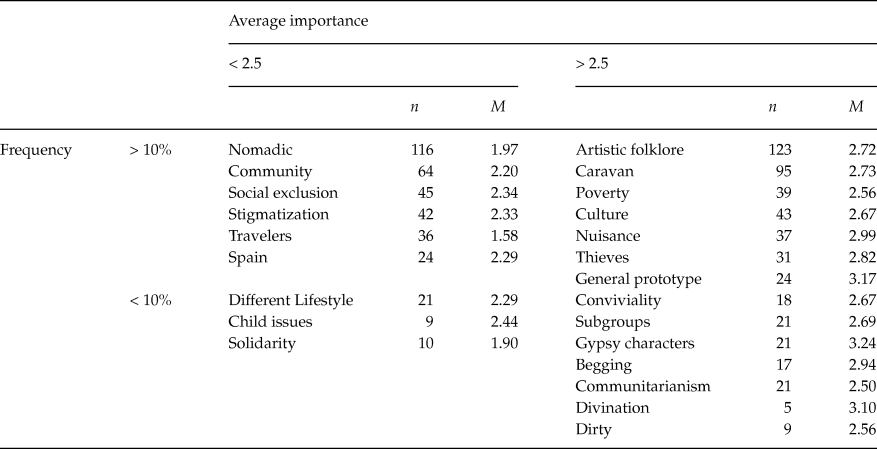
On the basis of the associated and ranked words, we proceeded to perform a prototypical analysis using a cross-table which included the frequency and average importance criteria of induced words (cf. Table 1).
General results in terms of frequency and average importance associated with the categories of word reported by the participants

Firstly, concerning the analysis of the words produced by the participants, two sub-categories seem to be distinguishable among the elements characterized by both a high frequency and importance. The first sub-category seems to refer to the different terms characterizing this group and its lifestyle (e.g., “Nomad”, “Community”, “Travellers”), whereas the second one seems to describe the way in which this group is perceived by society (e.g., “Social exclusion”, “Stigmatization”). These elements which potentially constitute the central core of the SR of Gypsies (Abric, Reference Abric and Abric2003) refer to a representational content focused on descriptive aspects. Nevertheless, although these elements seem to be rather “neutral”, those composing the first periphery (i.e., elements characterized by both high frequency and low importance) are more negative (e.g., “poverty”, “nuisance” and “thieves”).
In the second periphery (i.e., elements characterized by both low frequency and low importance), some negative elements are also associated (e.g. “Mendicancy”, “Communitarianism”, “Dirty”).
Finally, the contrasted elements (i.e., elements characterized by low frequency and high importance which refer to the possible existence of sub-groups among the population) include words related to children’s issues and to the distinctive lifestyle which characterizes the Gypsies and also the theme of solidarity.
To conclude this first analysis, we note that the majority of the induced words collected are more or less in line with the representational content observed by Guimelli and Deschamps (Reference Guimelli and Deschamps2000). However, some differences can be noted concerning in particular the presence of elements underlining the stigmatization of this population among the potentially central elements of this SR. Nevertheless, it seems difficult to take this comparison with Guimelli and Deschamps' work further as our study draws on an experimental design involving two independent variables. Despite everything, the term “Thefts”, which was one of the most salient and focusing elements in the work of Guimelli and Deschamps (Reference Guimelli and Deschamps2000), is highlighted once again within the framework of this study under the form “Thieves”. To be brief, and given the illustrative character of this element, we propose to present the different experimental conditions by focusing on it (cf. Table 2).
Frequencies and average importance associated with the word “thief” according to the experimental condition

Note: The first number refers to the frequency while the number in parentheses refers to the average importance.
Lexicometric Analysis
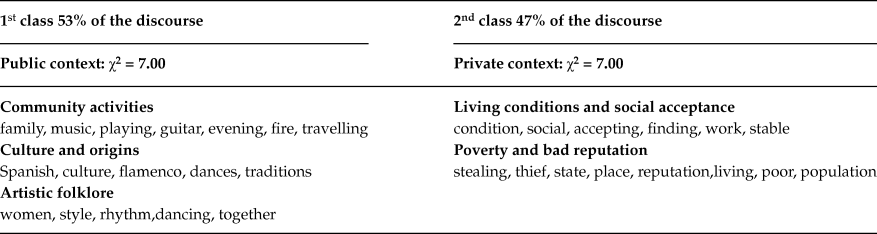
On the basis of the sentences written by the participants to explain the words related to the word association task, we conducted an automatic content analysis using the Alceste program (Reinert, Reference Reinert1993). As part of this analysis this discursive content was organized in accordance with the four experimental conditions that compose this study. The results highlight two stable lexical classes related to our inductive word: “Gypsies”.
As we can see in Table 3, the first class represents 53% of the total content produced by the participants and refers to the culture and the folklore associated with the gypsy community. The content composing this class is significantly related to the public condition, χ2(1) = 7.00, p < .01, and is therefore, more specifically mentioned when participants give their answers in this experimental condition. Effectively, in such a public context of expression, the participants, who are asked to express themselves on the theme of the Gypsies, seem to produce answers that can be considered as descriptive or even normative, referring to the practices, cultural habits and community functioning that characterize this group.
Themes and words associated with the two classes composing the sentences related to the word association task

This first class is composed of three sub-themes. The first one concerns community activities and relates to terms that compose a content widely based on the Gypsies’ artistic values and their festal activities. The two other categories refer respectively to the culture and to the Spanish origins of the Gypsies and also to the artistic folklore of this group.
The second class represents 47% of the total content and refers principally to the social context in which Gypsies live and to the way in which they are perceived by society. Unlike the first class, this one is significantly linked to private conditions of expression, χ2(1) = 7.00, p < .01, and seems to principally relate to negative aspects characterizing the Gypsies. We can also establish a link between these results and the categories observed in connection with the analysis of the word association task. More precisely, this class is characterized by terms such as “thieves”, χ2(1) = 6.00, p < .05, “stealing”, χ2(1) = 8.00, p < .01, and “poor”, χ2(1) = 12.00, p < .001, terms that, for the majority, compose the peripheral system of the SR of Gypsies for the whole sample of participants.
This analysis emphasises the impact of the manipulation of the context of expression on the discourse of the participants. It thus appears that the private context favours the expression of the negative aspects of the Gypsies. Moreover, these results confirm the thematic analysis of the free associations and highlight the value of contextualizing the participants’ answers.
Correspondence Factor Analysis (CORR. F. A.)
All the associations were submitted to a CORR. F. A. (Benzécri, Reference Benzécri1976; Deschamps, Reference Deschamps and Abric2003; Guimelli & Deschamps, Reference Guimelli and Deschamps2000; Lo Monaco & Guimelli, Reference Lo Monaco and Guimelli2008; Mouret, Lo Monaco, Urdapilleta, & Parr, 2013). This factorial analysis highlights the differences in terms of frequencies of association relative to the independent variables. It gives access to a summary of the data by revealing a particular structure. It also enables the identification of the most significant factorial axes (Deschamps, Reference Deschamps and Abric2003; Doise, Clémence, & Lorenzi-Cioldi, Reference Doise, Clemence and Lorenzi-Cioldi1993). The axes are composed of the different modalities of the independent variables. Finally, it emphasizes the correspondences between the modalities of the independent variables and the words or phrases associated by the participants.
Our analysis was based on word categories (N = 22) created a posteriori according to a principle of semantic proximity (these word categories were used in the framework of the hierarchical associations analysis).
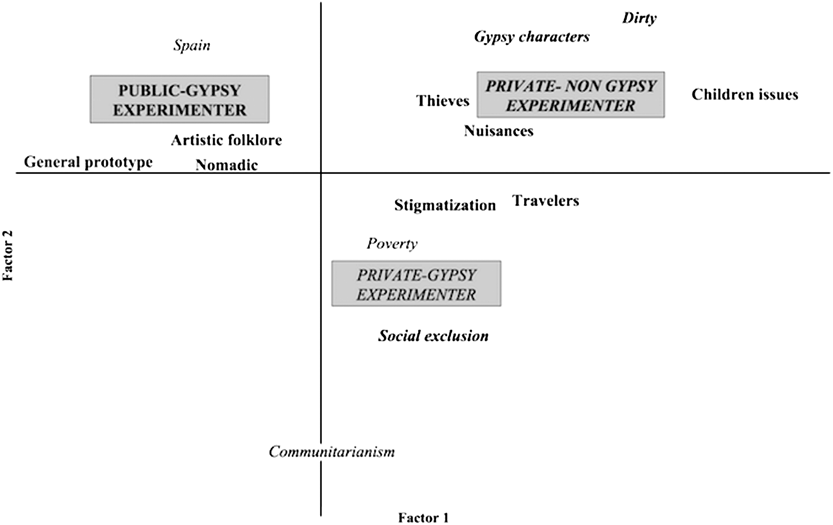
We then performed the CORR. F. A. using as independent variables the different experimental conditions (i.e., public-non-Gypsy; private-non-Gypsy; public-Gypsy; private-Gypsy; Deconchy & Deschamps, Reference Deconchy and Deschamps2006). In order to decide whether an observation (i.e., a word or phrase) contributed to the formation of a factor, we considered the recommendations formulated by Deschamps (Reference Deschamps and Abric2003) and used in previous and recent works on SR (Lo Monaco & Guimelli, Reference Lo Monaco and Guimelli2008; Lo Monaco et al., Reference Lo Monaco, Piermattéo, Guimelli and Abric2012; Mouret et al., Reference Mouret, Lo Monaco, Urdapilleta and Parr2013) in termes of contribution by factor (CF) Footnote 1 . The two first factors represented 86.20% of inertia (i.e., Factor 1 = 59.62%; Factor 2 = 26.58%). The variables which contribute to the formation of the first factor are the “private-non-Gypsy” and the “public-Gypsy” conditions: CF (private-non-Gypsy) = .46 + CF (public-Gypsy) = .33, thus a total contribution of 79% for the formation of factor 1. Factor 2 is formed by the contribution of the “private-non-Gypsy” and the “private-Gypsy” conditions: CF (private-non-Gypsy) = .27 + CF (private-Gypsy) = .52, thus a total contribution of 78% for the formation of factor 2. We observe (cf. Figure 1) Footnote 2 specific correspondences between the “private-non-Gypsy” experimental condition and the following observations: “social exclusion”, “thieves”, “dirty” and “Gypsy-characters”.
Graphical representation of the results obtained by means of the CORR. F. A. concerning factors 1 and 2.
Note: Grayed blocks refer to the experimental conditions. “ Experimental conditions” contribute to the formation of Factor 1; “Experimental conditions” refer to the experimental conditions which contribute to the formation of Factor 2; “ Experimental condition ” refer to the experimental conditions which contribute to the formation of both Factors 1 and 2. “Observations” refer to the observations which contribute to the formation of Factor 1; “Observations” refer to the observations which contribute to the formation of Factor 2; “ Observations ” refer to the observations which contribute to the formation of both Factors 1 and 2.

The assignment of observations on the two factors shows the impact of the manipulated variables on the production of the participants. One can observe a contradiction in particular between the “public-Gypsy” and “private-non-Gypsy” conditions. These two conditions are characterized by divergent content related to associative logic consistent with our hypotheses. Thus, in a public context and faced with a Gypsy experimenter, participants provided a stereotypical view of this group with descriptive aspects. In this case, Gypsies are presented as travellers, of Spanish origin and characterized by a culture, an artistic folklore and a specific appearance (i.e., “general prototype”). On the other hand, when participants answered in a private context and faced with a non Gypsy experimenter, they express terms related to nuisances caused by Gypsies (e.g., perceived danger, problems caused, and the fact that they take advantage of the system) and the fact they are victims of stigmatization. It appears that participants were more able to express counternormative content when they were placed in conditions which aimed at promoting the expression of such points of view. Indeed, in the “private-non-Gypsy” condition, participants mentioned “thieves” significantly more frequently (37.93%) than in the “public-Gypsy” condition (24.14%), χ2(1) = 3.95, p < .05. Moreover, participants mentioned the element “dirty” significantly more frequently in the “private-non-Gypsy” condition (54.55%) than in the “public-Gypsy” condition (9.09%), χ2(1) = 46.53, p < .001.
The CORR. F. A. thus highlights the results observed by means of the qualitative analysis of the sentences. However, more relevant to our study is the fact that by means of the CORR. F. A. it was possible to reveal the cross-effect of the independent variables. In this perspective, the CORR. F. A. allows us to confirm the differences observed between the experimental conditions within the framework of the prototypical analyses by highlighting the significant differences in terms of frequencies of association.
Attitudinal Valence of the Beliefs Associated With Gyspsies
In order to highlight the results obtained by means of the CORR. F. A. concerning the experimental conditions, we focused on the average attitudinal scores related to the associations produced by the participants (cf. Table 4). As a reminder, the participants were asked to assess their associations by means of 7-point Likert scales (from 1 = very negative to 7 = very positive). Such a measure enables us to clarify the meaning of the associations by asking the participants to take a position on their own production. On the basis of such assessments, the different experimental conditions were submitted to a contrast analysis (Rosenthal et al., Reference Rosenthal, Rosnow and Rubin2000). Consequently, on the basis of previous works including a similar design (Flament et al., Reference Flament, Guimelli and Abric2006; Gaymard, Reference Gaymard2006; Lo Monaco & Guimelli, Reference Lo Monaco and Guimelli2011; Lo Monaco et al., Reference Lo Monaco, Lheureux, Chianèse, Codaccioni, Halimi-Falkowicz and Cano2009) the different experimental conditions were ordered as follows: private-non-Gypsy; private-Gypsy; public-non-Gypsy; public-Gypsy. We hypothesized a linear sequence ranging from the experimental condition which was the most favourable for the expression of counternormative aspects to the experimental condition which was the most favourable for the expression of normative content. According to Rosenthal et al. (Reference Rosenthal, Rosnow and Rubin2000), in order to show a linear effect, we must observe a significant linear contrast and not significant quadratic and cubic ones.
Average importance and standard deviation related to attitudes regarding associated words according to experimental conditions

Note: The first number refers to the mean while the number in parentheses refers to standard deviation.
The analyses revealed a significant effect of the general model concerning the ordering of the experimental conditions, F(3, 235) = 5.19, p < .01, η p ² = .06. In this regard we obtained a significant linear effect, t(238) = 3.69, p < .001, d = 0.48. Otherwise, neither the quadratic contrast, t(238) = 1.19, p = .23, d = 0.15, nor the cubic one, t(238) = 0.62, p = .53, d = 0.08, reached the conventional threshold of significance. Considering these results and the experimental conditions, it seems possible to conclude a linear order of the experimental conditions as follows: private-non-Gypsy > private-Gypsy > public-non-Gypsy > public-Gypsy.
Nevertheless, despite the observed linear effect, one cannot ignore the proximity between the means relative to the “private-Gypsy” and “private-non-Gypsy” conditions. Thus, it seems that in a private context, the evaluation of the associated beliefs did not depend on the status of the experimenter. Otherwise, the linear effect indicates that the associated beliefs are more positively evaluated in a public context of expression especially when the experimenter is presented as a Gypsy.
Discussion
On the basis of these results, the emergence of cross-cutting trends can be observed across all the analyses we conducted. Effectively, we observe a rather regular presence of positive and negative elements concerning the Gypsies among the participants' answers. Thus, beyond a great deal of descriptive and normative content such as the categories “nomadic”, “community”, “solidarity” or “conviviality”, other categories like “thieves”, “dirty” and “nuisances” could be noticed. These different categories of content appear within the framework of the prototypical analysis but also at the level of the qualitative analysis of the sentences supplied by the participants in order to contextualize their answers, thus providing us with clues which would help improve the objectivity of the facilitating the categorization of the associated words. This qualitative analysis allowed us to distinguish two classes. The first one is related to content that could be considered as descriptive and/or normative while the second one is composed of a more negative content. This distinction confirms the results of the prototypical analysis and the relevance of the categorization carried out on the basis of the words associated by the participants.
Here we can see that more than 13 years after the study conducted by Guimelli and Deschamps (Reference Guimelli and Deschamps2000), the SR of the Gypsies is still characterized by the presence of normative and counternormative content. Therefore Gypsies could still be considered as a “sensitive object”. As these authors have highlighted, the presence of such counternormative content entails the use of specific methodologies with a view to collecting those elements which are less likely to be found in standard conditions of questioning. Thus, the methodologies that we employed, and more specifically, the variation of the context of expression, led us to update this content. We thus note, as we have mentioned above in the text, the presence of the terms “thieves” and “dirty”, terms that were also observed by Guimelli and Deschamps (Reference Guimelli and Deschamps2000). However, despite these similarities that stress the relative stability of the SR (Guimelli, Reference Guimelli1988; Moscovici, Reference Moscovici1976), the presence of counternormative elements is far less noticeable within the framework of the present study, at least in relation to the frequencies of associated words. Although the hypothesis of an evolution of the social context in a way that strengthens a non-discrimination norm could hardly be ruled out, it seems more plausible to consider that such a difference between the results of these studies could be the consequence of the use of different methodologies in order to gather counternormative content. However this last hypothesis does not necessarily imply that the manipulations of the context of expression or the normative decontextualization are less effective than the substitution technique. Effectively, these two techniques are characterized by a fundamental difference that consists of putting the participant in a situation where he has to answer in his own name, as opposed to the substitution technique. It seems therefore, reasonable to think that, the normative pressure leads participants to inhibit the expression of counternormative content, these techniques are more threatening as they increase the involvement of the participant with regard to his own expression. The consequence of this difference may therefore be the reduced presence of counternormative content. However, these techniques have the advantage of gathering content that conveys what participants have in mind more accurately than the substitution technique which could lead to the collection of a potentially wrong appraisal of the social norms that characterize another group of people as mentioned in the literature on pluralistic ignorance (see Miller, Monin, & Prentice, Reference Miller, Monin, Prentice, Terry and Hogg2000; Prentice & Miller, Reference Prentice and Miller1993).
Still, we also notice that these two methodologies are not equivalent in terms of their efficacy and it was mostly the manipulation of the context of expression that led us to observe differences in the answers given by the participants. In this respect, the pluri-methodological stance adopted in the present study allowed us to show the impact of this variable in the course of the many analyses we performed. Indeed, we observe variations in the mention of the word “thieves” in terms of frequency (i.e., prototypical analyses), or in terms of the differentiation of the two classes (i.e., lexicometric analysis) or in terms of a stronger correspondence with specific experimental conditions (i.e., CORR. F. A.) and finally, in terms of a contradiction between attitudinal valences on the linear effect (i.e., contrasts analyses). However, the second variable we manipulated did not achieve the same success. This limited effect may be explained by the operationalization of this variable. Effectively, the experimenter has to present herself as a Parisian girl or as a Gypsy according to the experimental conditions. It is therefore possible that some observable clues (e.g., her way of expression, dressing, etc.) could have contributed to lowering the credibility of this manipulation. Otherwise, unlike the experimental induction conducted by Flament et al. (Reference Flament, Guimelli and Abric2006) which was based on the ethnic membership of the experimenter characterized by several physical aspects, within the framework of this study it was quite difficult to proceed in such a way. Thus, we cannot be as sure as these authors were about the categorization of the experimenter as a Parisian or a Gypsy student.
Nevertheless, all the research conducted in the area of the study of the mute zone of SR and particularly that which has drawn on this kind of methodology has highlighted a more significant effect of the context of expression (e.g., substitution technique) compared to normative decontextualization once the two variables are used together. Nevertheless, despite this limited impact of the “normative decontextualization” variable, the congruity with the initial results of Guimelli and Deschamps (Reference Guimelli and Deschamps2000) and the strong regularity of the results observed in the multiple analyses we conducted, emphasise the dual value of manipulating the context of expression as part of the collection of content in relation to sensitive objects and the updating of the results related to these objects.
From these positive aspects stems one of the main limitations of this study. Effectively, by conducting research on the same object studied by Guimelli and Deschamps (Reference Guimelli and Deschamps2000) 13 years earlier, and by using rival techniques to the substitution technique, it would be possible to consider that a direct comparison of these techniques within the framework of the same study would have been more relevant. However, as the use of the same object by Guimelli and Deschamps (Reference Guimelli and Deschamps2000) seemed more appropriate for demonstrating the efficacy of the variables that were manipulated, the aim of this study is not to compare these techniques with the substitution technique.
Indeed, as indicated above, these techniques are fundamentally different from the substitution technique in that they don't involve individuals in the same way and that they favour collections of a different nature, more related to what individuals have in their own mind than to their perception of the norms of how the object is perceived. So, these techniques are characterized by their own advantages and flaws, and are to our point of view, not directly comparable.
Nevertheless it would be interesting to combine these collection techniques. Indeed, this study opens the way to other experiments which would allow us to support these reflections by combining, for example, manipulation of the context of expression with the substitution technique. Such developments will help to further knowledge on techniques that aim to collect counternormative content. Moreover, such techniques are not limited to the field of SR. Indeed, numerous sensitive objects are studied outside of the conceptual and methodological framework of this field, as in the case, for example, of opinion surveys. Within such a framework, the use of manipulation of the context of expression could lead to a better knowledge of the way individuals regard a sensitive object and to a better prediction of their standpoint.