Implications
γ-aminobutyric acid has shown to increase dry matter intake in both monogastric and ruminant animals. Addition of 140 mg/day rumen-protected γ-aminobutyric acid enhanced dry matter intake, probably by regulating mRNA abundance of cholecystokinin-2 and GABA-B receptors and then serum cholecystokinin content.
Introduction
Central injection of γ-aminobutyric acid (GABA) receptor agonists stimulates feed intake in sheep (Girard et al., Reference Girard, Seoane and Matte1985). It is reported that baclofen (GABA-B agonist) may alleviate the inhibitory effect of exogenous peripheral cholecystokinin (CCK), a peptide hormone that plays important roles as gastrointestinal hormone and neurotransmitter, on dry matter intake (DMI) in rats (Ebenezer, Reference Ebenezer1995), indicating that GABA and CCK may have associative effects on DMI. Moreover, motility in duodenum can be inhibited by activating GABA-A receptor, or be activated by stimulating GABA-B receptor (Fargeas et al., Reference Fargeas, Fioramonti and Bueno1988). In contrast, motility in ileum can be activated by stimulating GABA-A receptor, or be restrained by activation of GABA-B receptor (Ong and Kerr, Reference Ong and Kerr1982). The reduced motility of gastrointestinal tracts may cause inhibited digestion and lower DMI (Xing and Chen, Reference Xing and Chen2004).
Dietary GABA, instead of injection of GABA or its receptors, may increase DMI and milk protein yield in dairy cows, and the increased DMI seemed to be related to CCK metabolism (Wang et al., Reference Wang, Liu, Wang, Liu and Ferguson2013). However, it is questionable if dietary GABA may inhibit CCK synthesis of type I cells, a kind of specialized endocrine cells that produce and secrete hormones, in the duodenum and ileum. Thus, the objective of the current study was to investigate the effects of dietary rumen-protected GABA on DMI, average daily weight gain (ADG), serum variables (CCK and GABA) and mRNA abundance of the related genes in duodenum and ileum of growing lambs.
Material and methods
Animals, feeds and experimental design
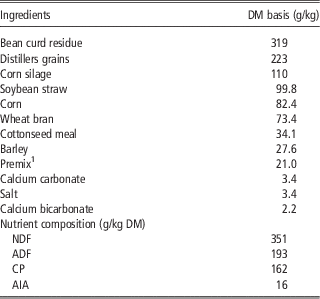
A total of 24 male Huzhou lambs, weaned at the age of 50 days, with an initial BW of 13.5 kg (s.d. 2.09), were used. All the lambs were divided into four block of six based on their BW, six lambs within a block were allocated to three pairs, which were then assigned randomly to three treatments with addition of rumen-protected GABA at levels of 0, 70 and 140 mg/day, respectively. The rumen-protected GABA was used because the unprotected GABA was quickly degraded within the rumen (Wang et al., Reference Wang, Liu, Wang and Liu2010) and non-protected GABA had little effect on feed intake and lactation performance in transition cows (Wang et al., Reference Wang, Liu, Wang, Liu and Ferguson2013). The procedure for preparation of the rumen-protected GABA was described elsewhere (Wang et al., Reference Wang, Liu, Wang and Liu2010). Each pen of two lambs was kept in an individual pen (2.5×2 m) and bedded on steel frame during the feeding trial lasting for 6 weeks. All the lambs were fed a total mixed ration (TMR) twice a day at 0700 and 1530 h, and had free access to drinking water. In brief, the TMR was prepared by cutting and blending the individual feed ingredients listed in Table 1, and then fed to the sheep in each pen. The daily amount of GABA was mixed with 1 g of corn and fed in two equal portions by top-dress feeding to individual sheep, to ensure that both lambs in the pen consumed the correct dose of GABA.
Ingredients and composition of the experimental basal diet

DM=dry matter; AIA=acid insoluble ash.
1 Formulated to provide (per kilogram of DM): Co, 200 mg; Cu, 15 000 mg; I, 600 mg; Fe, 8000 mg; Mg, 100 000 mg; Mn, 30 000 mg; Se, 200 mg; Zn, 40 000 mg; vitamin A, 4 000 000 IU; vitamin D, 400 000 IU; vitamin E, 8000 IU.
Sampling procedures and measurements
DMI and ADG
The amount of feed given was calculated to allow 10% orts. Feed offered and refused were recorded for three consecutive days (2nd, 3rd and 4th days) weekly, to determine DMI. Nutrients compositions are listed in Table 1. The lambs were weighed on days 0, 14, 28 and 42 of the trial. Data were used to calculate ADG (mean of ADG for the period of days 0–14, 14–28 and 28–42). All measurements were conducted at 0630 h before feeding.
Composition of the TMR and feces
The TMR samples were collected from each feeding on 2nd, 3rd and 4th days weekly. The samples were dried in an air-forced oven at 60°C for 48 h and then ground for later analysis of dry matter (DM, Association of Official Analytical Chemists, 1997, method 930.15) and CP (Association of Official Analytical Chemists, 1997, method 928.08). Contents of NDF and ADF were expressed inclusive of residual ash (Van Soest et al., Reference Van Soest, Bobertson and Lewis1991; Association of Official Analytical Chemists, 1997, method 973.18). Apparent digestibilities of nutrients were estimated using acid insoluble ash (AIA) as an internal marker based on the concentration of AIA in the diet and feces, where AIA was determined. Fecal samples of each pen were collected on the 4th day biweekly, and then composited to be analyzed for chemical composition.
Serum variables
Blood samples were collected from the neck vein at 1100 h on days 14, 28 and 42 of the trial period, respectively, and then centrifuged at 3000×g for 10 min to collect serum. Serum samples were stored at −20°C for later analysis of contents of GABA and CCK as the methods described elsewhere (Wang et al., Reference Wang, Liu, Wang, Liu and Ferguson2013).
Slaughter trial and sampling
One animal of each pen was electrically stunned and slaughtered. Intestinal sections (3 cm for each section) from the duodenum and ileum were washed with double distilled water. The epithelium was separated from the underlying muscle layers and stored in liquid nitrogen until analyzed.
RNA extraction and determination of mRNA abundance
Total RNA was isolated from duodenum and ileum mucosa according to TRIzol reagent (Invitrogen, Life Technologies, Carlsbad, CA, USA). Reverse transcription reactions (20 μl) consisted of 16 μl total RNA, 1 μl of RNAse inhibitor (Promega, Madison, WI, USA), 1 μl dNTPs (Sigma, St. Louis, MO, USA) and 2 μl of 5× M-MLV RT reaction buffer (Promega) were used to get cDNA. The optimal reverse transcription procedure was 20°C for 5 min, followed by 42°C for 60 min and then 70°C for 5 min. Reactions were immediately stopped by putting reaction system on ice. The cDNA was stored at −20°C for real-time PCR.
Real-time PCR was performed with ABI PRISM 7700 sequence detection system (ABI Biosystems, Foster City, CA, USA) according to optimized PCR protocols. A total volume of 20 μl PCR reaction system was composited by 10 μl SYBR Green PCR Master Mix, 2.0 μl primer (1.0 μl forward and 1.0 μl reverse), 2.0 μl cDNA template and 6 μl sterile super-stilled water. The following protocol was employed for the PCR reaction: denature at 95°C for 3 min, 42 cycles of amplification (94°C for 30 s, 51°C for 30 s, 72°C for 60 s) and finally extension at 72°C for 7 min. The C
t
value was recorded and the relative expression level (
 $${\rm 2}^{{{\minus}\Delta \Delta C_{t} }} $$
) was calculated for determination of related mRNA abundance. Primers used in the current study are given in Supplementary Table S1.
Statistical analysis
All data were analyzed using repeated measures by PROC MIXED model (SAS Release 6.12, 1988). Treatment, pen (sheep for variable at slaughter) within treatment, block and sampling time were included in the model as main effects and treatment×time was included as the interaction. Linear and quadratic effects of treatment were tested for DMI, ADG, serum contents of GABA and CCK, and gene expression related with GABA and CCK using orthogonal polynomial contrasts, respectively. Data are presented as the least squares mean, and differences were considered significant at P<0.05.
Results and discussion
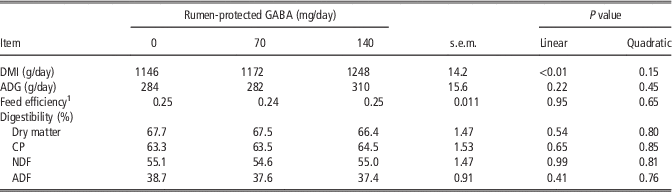
Addition of GABA increased DMI of the lambs linearly (P<0.01, Table 2). The ADG and feed conversion efficiency did not differ among treatments (P>0.05), though the lambs fed 140 mg/day rumen-protected GABA grew faster (numerically, by 9.1%) than others. We acknowledge that low replication may account for insufficient power to detect differences in growth rate.
Effects of dietary rumen-protected γ-aminobutyric acid (GABA) on dry matter intake (DMI), average daily weight gain (ADG), feed efficiency and nutrients digestibility in growing lambs

1 Feed efficiency=ADG/DMI.
Dietary GABA had no effect on digestibility of DM, CP, NDF and ADF (P>0.05, Table 2). The rumen degradation rate of rumen-protected GABA used in the current study was about 15% (Wang et al., Reference Wang, Liu, Wang and Liu2010). Thus, the released GABA in rumen may have been about 10.5 or 21 mg/day in lambs fed 70 or 140 mg/day rumen-protected GABA, respectively. Unprotected GABA had limited effects on rumen pH, volatile fatty acids (acetate, propionate and butyrate) and ammonia-nitrogen concentrations (unpublished). Thus, dietary rumen-protected GABA did not exert significant effect on nutrients digestibility.
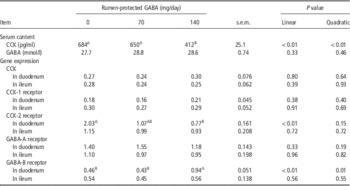
Serum CCK content decreased (linear, P<0.01 and quadratic, P<0.01), while serum GABA was not affected by GABA (P>0.05, Table 3). The mRNA abundance of CCK in duodenum and ileum was not decreased (P>0.05, Table 3), indicating that the decreased serum CCK contents may be attributed to the less CCK synthesis and release by type I cells in the mucosal epithelium of the systems other than the small intestines. The quadratic effect (P<0.01) of dietary GABA on serum CCK content indicated that higher dietary GABA may be needed for inhibiting effect on CKK synthesis.
Effects of dietary rumen-protected γ-aminobutyric acid (GABA) on the mRNA abundances of cholecystokinin (CCK), its receptors and GABA receptors in epithelium of duodenum and ileum in growing lambs

A,BValues with different superscripts are significantly different (P<0.01).
As shown in Table 3, addition of GABA did not affect mRNA abundances of all the related genes in ileum (P>0.05), but decreased the mRNA abundance of CCK-2 receptor (linearly, P<0.01) and increased the GABA-B receptor in duodenum (linear, P<0.01 and quadratic, P=0.01). Ong and Kerr (Reference Ong and Kerr1982) observed that GABA-A and GABA-B receptors had different responses to type of GABA or their receptor agonists. In the current study, the GABA-B receptor in the duodenum seemed to be more sensitive to dietary GABA than GABA-A receptor did. Activation of GABA-B receptor by GABA-B agonist could increase food intake in rats (Ebenezer, Reference Ebenezer1995), while intake-inhibitory effect induced by CCK was highly related with activation of type A CCK-1 receptor in rats (Moran et al., Reference Moran, Ameglio, Schwartz and McHugh1992). Thus, the depressed expression of CCK-2 receptor gene and up-regulated expression of GABA-B receptor gene in duodenum may contribute to the increased DMI in sheep induced by GABA in the current study. However, how dietary GABA regulated the CCK secretion by type I cells is unclear from the current work and warrants for further study.
Conclusion
Dietary addition of rumen-protected GABA linearly increased DMI but did not affect ADG in growing sheep. The increased DMI induced by higher level of GABA may be attributed to the enhanced expression of GABA-B receptor gene, and the decreased expression of CCK-2 receptor gene in duodenal mucosa.
Acknowledgments
This study was supported by the grant from the China Agriculture Research System (CARS-37). The authors thank Pangda Sheep Farm for providing and caring the sheep. All the members of Institute of Dairy Science, Zhejiang University (Zhejiang, China) are acknowledged for their assistance in sampling.
Supplementary material
To view supplementary material for this article, please visit http://dx.doi.org/10.1017/S1751731114002651