Listeners recognize words present in the speech signal effortlessly and with few errors, and this despite the fact that the speech signal is inherently variable. A word is never uttered twice in exactly the same way, and shows acoustic–phonetic differences both within and between speakers. Within the same individual, variation can occur as a function of the phonological context, speaking rate, or emotional state, among other factors. Between speakers, variation can occur as a result of differences in gender, age, or shape of the vocal tract. Another important source of variation between speakers, which is currently at the heart of numerous investigations, comes from dialectal accent. For example, the word mauve “mauve” is pronounced [mov] in standard French, while it is pronounced [mɔv] in southern French. How southern French speakers process the standard French variant [mov] in comparison to their own variant [mɔv] is precisely the question under investigation in the present study. Crucially, here, we examined the processing of dialectal variants when the two forms are not contrastive and map onto the same semantic representation.
The traditional view of spoken word recognition assumes that a single variant is associated to each word in the mental lexicon. In this class of models, words are associated with abstract phonological representations consisting in strings of discrete symbols that do not include details about how these words are pronounced (Cohort Model, Marslen-Wilson & Warren, Reference Marslen-Wilson and Warren1994; Marslen-Wilson & Welsh, Reference Marslen-Wilson and Welsh1978; TRACE, McClelland & Elman, Reference McClelland and Elman1986; Shortlist, Norris, Reference Norris1994). Assuming that in southern French, the [o] and [ɔ] vowels are treated as different realizations of the same phoneme, a single abstract representation would be associated to the [mov] and [mɔv] variants. Although, within such a framework, we cannot ascertain which is the underlying representation of the word mauve in the southern French speakers’ mental lexicon, we assume for the current reasoning that is the one that corresponds to the southern French speakers’ pronunciation, namely, /mɔv/. In such a view, the standard French pronunciation [mov] could in principle lead to the recognition of the word mauve (i.e., /mɔv/ in southern French speakers), because the input [mov] due to its similarity with /mɔv/ causes strong activation of the word mauve (see Marslen-Wilson & Warren, Reference Marslen-Wilson and Warren1994). Nonetheless, models such as TRACE (McClelland & Elman, Reference McClelland and Elman1986), in which activation level is determined by the overall amount of overlap between input and word form representations, also predict some processing cost for dialectal variants as long as a single variant is associated to each word. In such a case, there is not a perfect match between the input and the stored representations, which in turn causes less activation on the intended words, thus delaying the moment where the word recognition threshold is reached. Of importance, all other things being equal, this processing cost in case of a single-variant storage should be comparable to that engendered by an arbitrary mismatch between the abstract word-form stored in memory and the speech input (e.g., the nonword form [mœv] for the word /mɔv/).
In contrast, another viewpoint assumes that the different variants for a given word are stored either in an abstract way, as in the abovementioned models (see also Ranbom & Connine, Reference Ranbom and Connine2007), or in the form of detailed acoustic traces (Goldinger, Reference Goldinger1998; Hintzman, Reference Hintzman1986, Reference Hintzman1988; Pierrehumbert, Reference Pierrehumbert2001). In an abstractionist view of spoken word recognition, the [mov] and [mɔv] variants of the word mauve could be represented in the southern French speakers’ mental lexicon provided that the [o] and [ɔ] vowels are treated as belonging to different categories by southern French speakers. Southern French speakers’ representation of the /o/-/ɔ/ contrast would be helpful, because these speakers are regularly exposed to standard French through the media and through their interactions with speakers from other regions, and in some cases the [o] and [ɔ] standard French pronunciations refer to two different words (e.g., [kot] meaning côte “hill” and [kɔt] meaning cote “rating” in standard French). Episodic models (Goldinger, Reference Goldinger1998; Hintzman, Reference Hintzman1986, Reference Hintzman1988; Pierrehumbert, Reference Pierrehumbert2001) of spoken word recognition propose a view of the mental lexicon that is opposed to the abstractionist approach. These models assume that the lexicon consists of multiple episodic traces including perceptual and contextual details associated to each individual occurrence of a word, thus inevitably encoding dialectal variation. In these models, southern French speakers, being regularly exposed to standard French, would have acoustic traces corresponding to both [mɔv] and [mov] pronunciation variants. As a result, and whatever the precise format (abstract vs. detailed) in which words are stored, the hypothesis of a multiple-variant storage predicts that the standard form [mov] and the southern form [mɔv] should be effective at activating the intended word mauve in southern French speakers. In the former case, the two abstract representations associated to the word mauve in southern French speaker (i.e., one corresponding to the standard French variant /mov/ and the other to the southern French variant /mɔv/) would be fully activated by the inputs [mov] and [mɔv], respectively. In the latter case, as each word is associated to multiple acoustic traces encoding fined-grained acoustic/phonetic information, both inputs [mov] and [mɔv] should find a good match in this vast collection of exemplars leading thus to successful recognition.
A large number of studies on dialectal variation have examined the perception of phonemic contrasts that do not occur in the speakers’ dialectal variety (e.g., Conrey, Potts, & Niedzielski, Reference Conrey, Potts and Niedzielski2005; Dufour, Nguyen, & Frauenfelder, Reference Dufour, Nguyen and Frauenfelder2007; Ingram & Park, Reference Ingram and Park1997; Janson & Schulman, Reference Janson and Schulman1983; Labov, Karan, & Miller, Reference Labov, Karan and Miller1991; Zhang, Samuel, & Liu, Reference Zhang, Samuel and Liu2012). As it has been repeatedly found for foreign contrasts (e.g., Best, McRoberts, & Sithole, Reference Best, McRoberts and Sithole1988; Miyawaki et al., Reference Miyawaki, Strange, Verbrugge, Liberman, Jenkins and Fujimura1975; Näätänen et al., Reference Näätänen, Lehtokoski, Lennes, Cheour, Huotilainen, Iivonen and Alho1997; Trehub, Reference Trehub1976; Werker, Gilbert, Humphrey, & Tees, Reference Werker, Gilbert, Humphrey and Tees1981; Werker & Tees, Reference Werker and Tees1984), discrimination is often poorer for nonnative dialectal contrasts than for native dialectal contrasts, despite the fact that listeners adapt rather well to dialectal variation (e.g., Maye, Aslin, & Tanenhaus, Reference Maye, Aslin and Tanenhaus2008). In an electrophysiological study, Conrey et al. (Reference Conrey, Potts and Niedzielski2005) have examined the perception of the American English ɪ/ε (pin/pen) contrast by both merged-dialect speakers for whom [ɪ] and [ε] no longer form a phonemic contrast and unmerged-dialect speakers for whom [ɪ] and [ε] are contrastive. The authors found event-related potential differences between merged-dialect and unmerged-dialect speakers on a late positivity component that was smaller in magnitude in the merged-dialect speakers than in the unmerged-dialect speakers. In a series of studies, Dufour and colleagues (Dufour et al., Reference Dufour, Nguyen and Frauenfelder2007; Dufour, Nguyen, & Frauenfelder, Reference Dufour, Nguyen and Frauenfelder2010; Dufour, Nguyen, Pattamdilok, & Frauenfelder, 2016) examined how southern French speakers perceive the word-final /e/-/ε/ contrast. This contrast exists in standard French but not in southern French, which only has the close-mid /e/ vowel in this position. For example, the words épée “sword” and épais “thick” are pronounced [epe] and [epε], respectively, by standard French speakers, whereas they are both pronounced [epe] by southern French speakers. Dufour et al. (Reference Dufour, Nguyen and Frauenfelder2007, Reference Dufour, Nguyen and Frauenfelder2010, Reference Dufour, Nguyen, Pattamadilok and Frauenfelder2016) observed that southern French speakers treated word forms like [epe] and [epε] as homophones in a primed lexical decision task. In addition, these difficulties with dialectal contrasts have been shown to extend to a second language in early bilinguals, at least in AXB discrimination and lexical decision tasks (Larazza, Samuel, & Oñederra, Reference Larraza, Samuel and Oñederra2016, Reference Larraza, Samuel and Oñederra2017).
Difficulties with nonnative dialectal variants have not, however, been systematically observed. Sumner and Samuel (Reference Sumner and Samuel2009) have examined the processing of –er final words (slender) produced by speakers of General American English (GA) with a full –er (slend[ɚ]), and by speakers of the New York City dialect (NYC) of English who produce r-less variants of these words (slend[ɚ]). Form and semantic priming experiments were conducted. The results of the form priming experiment revealed that both GA final r-full primes (slend[ɚ]) and NYC final r-less primes (slend[ə]) facilitated responses to both GA final r-full targets (slend[ɚ]) and NYC final r-less targets (slend[ɚ]) in NYC dialect participants. Some difficulties in the processing of dialectal variants were observed in GA participants. For these listeners, priming effects were observed only on GA final r-full targets (slend[ɚ]), but not on NYC final r-less targets (slend[ə]). Because, on the one hand, NYC participants are exposed to the GA dialect through literacy, education, and media and, on the other hand, GA participants are much less frequently exposed to the NYC dialect, the authors suggested that experience with the different variants could be critical in allowing listeners to process multiple forms equally. The results of the semantic priming experiment confirmed this claim, and showed that GA final r-full primes (slend[ɚ]) facilitated responses to semantically related targets (thin), regardless of the listener’s dialect. They also showed that NYC final r-less primes (slend[ə]) facilitated the recognition of semantically related targets (thin), but only for participants with experience with the NYC dialect. For GA participants with little experience with the NYC dialect, NYC final r-less primes (slend[ə]) were ineffective at activating the semantically related targets (thin). All together, these findings suggest that experience with dialectal variants plays a major role in the ability of listeners to process them efficiently.
French provides another interesting case in which successful perception of dialectal variants has been reported. In addition to the /e/-/ɛ/ contrast in open final syllables that exists in standard French but not in southern French (see above), Dufour et al. (Reference Dufour, Nguyen and Frauenfelder2007) were also interested in the /o/-/ɔ/ contrast. Whereas standard French establishes a contrastive distinction between /o/ and /ɔ/ (e.g., côte “hill” /kot/ vs. cote “rating” /kɔt/), southern French is said to have one back mid-vowel phoneme only, whose phonetic realization as a mid-high [o] or mid-low [ɔ] is entirely governed by the structure of the carrier syllable: it is mid-high in open syllables and mid-low in closed syllables. In addition, the two vowels also differ in duration, as the mid-high one tends to be longer than the mid-low one. Thus, in southern French, both “côte” and “cote” are pronounced with the mid-low and shorter variant ([kɔt]). In spite of this, Dufour et al. (Reference Dufour, Nguyen and Frauenfelder2007) showed that the word forms [kɔt] and [kot] were treated as being distinct by southern French speakers in a long-term repetition priming paradigm. As a result, and in contrast to what observed with /e/ and /ɛ/ minimal pairs of words (see above), members of /o/ and /ɔ/ minimal pairs of words were not treated as homophones by southern French speakers. According to Dufour et al. (Reference Dufour, Nguyen and Frauenfelder2007), this is due to the fact that the /o/-/ɔ/ contrast is a particularly well-established standard French phonological feature, which southern speakers have in their receptive phonological knowledge of standard French, even if these speakers do not use this contrast in their own regional variety. Moreover, because this neutralization is specific to the south of France, southern French speakers are inevitably exposed to the /o/ standard French dialectal variant through the media and through their interactions with speakers of other French regions, which allow them to distinguish the standard French variant from their own variant.
The sensitivity to the /o/-/ɔ/ contrast when occurring in minimal pairs of words is at first sight well ascertained in southern French speakers, and these speakers have likely lexically encoded the minimal pairs of words based on the /o/-/ɔ/ contrast with the respective meaning associated to each word. However, consider the word mauve “mauve” pronounced [mɔv] by southern French speakers. The standard French variant [mov] does not refer to any word other than mauve, and thus refers to exactly the same meaning as the southern French variant [mɔv], namely, the name of a color. One question that remains open is whether the standard French variant [mov] and the southern French variant [mɔv] of the word mauve are functionally equivalent during spoken word recognition. In contrast to Dufour et al. (Reference Dufour, Nguyen and Frauenfelder2007), here, we do not use minimal pairs of words, and thus the standard French variant refers to exactly the same word as the southern French variant. There is at first sight no necessity for southern French speakers to encode the two forms as distinct lexical representations because these forms create no ambiguity in the meaning of the words. Hence, if we succeed to demonstrate here that the standard French variant is effective at activating the intended word in the absence of lexical ambiguity, this would constitute another strong demonstration that exposure to dialectal variants leads to the creation of distinct lexical representations, even if they are associated to the same meaning. Moreover, this would constitute an extension to Sumner and Samuel’s (Reference Sumner and Samuel2009) findings to the French language, thus bringing converging evidence for multiple-variant storage across languages.
We used the cross-modal semantic (associative) priming paradigm, which is a well-established method for investigating the online processing of phonological variants and, in particular, for probing the amount of lexical activation caused by production variants (e.g., Larraza et al., Reference Larraza, Samuel and Oñederra2017; Snoeren, Segui, & Halle, Reference Snoeren, Segui and Hallé2008; Sumner & Samuel, Reference Sumner and Samuel2009). If the standard French /o/ and the southern French /ɔ/ variants are lexically encoded in the southern French speakers mental lexicon, the two forms [mov] and [mɔv] should be effective in priming the associated visual target word VIOLET “purple.” In contrast, if only one variant is stored, namely, the southern French variant /mɔv/, differential priming effects on the target word VIOLET could be observed between the standard French variant [mov] and the southern French variant [mɔv]. In particular, we can expect a greater priming effect triggered by the southern French variant [mɔv] in comparison to the standard French variant [mov]. The amount of priming engendered by words such as mauve, which are subject to dialectal variation, was compared to the amount of priming caused by words such as gomme “eraser,” whose pronunciation remains constant across French regions, and which are pronounced with [ɔ], namely, [gɔm], by both southern and standard French speakers. In particular, for these words, the same amount of priming on the associated visual target word CRAYON “crayon” should be observed whether gomme is pronounced by a standard or southern French speaker. Note that words whose pronunciation remains constant across French regions were tested for two main reasons. First, because we used a between-participant design for the variable speakers (standard, southern), these words for which no modulation in the semantic priming effect as a function of the speaker are expected, and allowed us to ensure that any differential priming effect as a function of the speaker for the words subject to dialectal variation is not due to uncontrolled characteristics of our two groups of participants. Second, if, by contrast, the two dialectal variants prove to be as effective at activating the intended words, we also wanted to show that the words subject to dialectal variation behave exactly as words without dialectal variation, and this in order to strengthen any conclusion that dialectal variation related to the /ɔ/ vowel pronunciation in southern French speakers has no negative impact on spoken word recognition.
EXPERIMENT 1
Method
Participants.
Seventy southern French speakers (18–40 years of age) took part in the experiment and were each paid 10 € for their participation. All reported no hearing or speech disorders and normal vision or corrected-to-normal vision. Before running the experiment, we ensured through a reading task that all the participants pronounced the mid-back rounded vowel as /ɔ/ in closed syllables, as expected in the southern French variety. Production control was made by a trained phonetician. Thirty-four of the participants were exposed to the standard French speaker, and the remaining 36 were exposed to the southern French speaker.
Materials.
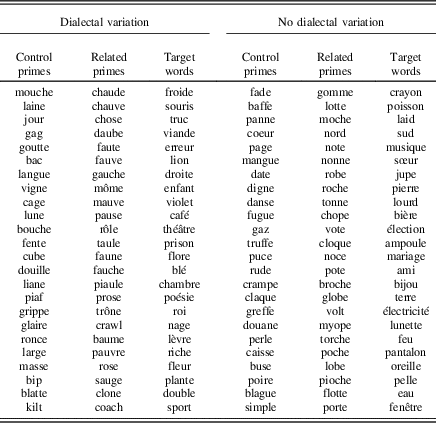
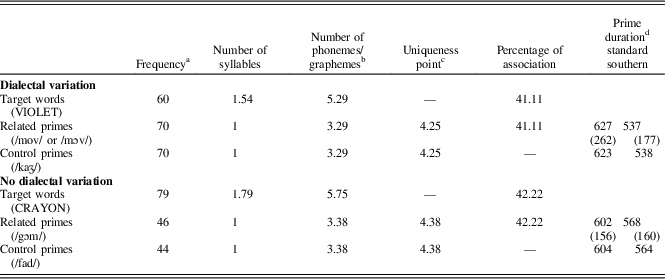
Forty-two monosyllabic words of type mauve whose vowel is pronounced [ɔ] by southern French speakers and [o] by standard French speakers were selected from VoCoLex, a lexical database of the French language (Dufour, Peereman, Pallier, & Radeau, Reference Dufour, Peereman, Pallier and Radeau2002). Another 43 monosyllabic words of type gomme whose vowel is pronounced [ɔ] by both southern and standard French speakers were also selected. In order to select the associated target words, the 85 words were then presented to 31 participants who were instructed to write down the first word that came to their mind upon written presentation of each of the words. Only 24 words of type mauve and 24 words of type gomme that were associated to a target word (e.g., VIOLET for mauve and CRAYON for gomme) with a percentage of agreement equal to or greater than 20% were kept for the experiments, and served as related primes. The two types of prime (with and without dialectal variation) were matched for number of phonemes, uniqueness point, and type frequency. Finally, 48 other words serving as control primes and having no relation with the associated target words were selected. The control and related primes were matched for number of phonemes, uniqueness point, and type frequency. Our final set of stimuli was thus composed of 48 target words. Half of them were paired with a related prime of type mauve and the other half were paired with a related prime of type gomme, and all target words were paired with a control prime. The characteristics of the prime and target words are summarized in Table 1, and the prime–target pairs are given in Appendix A.
Characteristics of the prime and target words (mean values)

Note:
a In number of occurrences per million.
b Number of phonemes for the auditory primes; number of graphemes for the visual targets.
c The phonemic position at which the auditory word primes can be reliably identified.
d Vowel durations for the related prime are given in parentheses.
All of the primes were recorded by both a southern (from Marseille) and a standard French (from Dijon) female speaker, in a sound-attenuated room, and digitized at a sampling rate of 44 kHz with 16-bit analog-to-digital recording. Note that the primes pronounced by the standard French speaker have longer durations than the primes pronounced by the southern French speaker, and this for both the words with, F (1, 23) = 46.13; p<.001, and without, F (1, 23) = 9.00; p<.01, dialectal variation. The difference in the speaking rate for the words subject to dialectal variation (90 ms vs. 34 ms), F (1, 46) = 10.44; p<.01, may be due to the intrinsic difference in duration between mid-high [o] and mid-low [ɔ] vowels. As Table 1 indicates, there was a significant difference between our speakers only for the words with dialectal variation, F (1, 23) = 144.69; p<.001, but nor for the words without dialectal variation, F (1, 23) = 0.29; p>.20.
Because each target word was paired with two different primes (related and control), and because no subject was to be presented with the same target twice, two experimental lists were created. Each list included the 48 target words; half of them were preceded by a related prime, and the other half by a control prime. The lists were counterbalanced in such a way that each target was preceded by the two types of prime across the lists. To avoid that only primes containing /o/ and /ɔ/ be associated with semantically related target words, 24 other associated prime–target words, taken from Ferrand and Alario’s (Reference Ferrand and Alario1998) association tables (e.g., bras /bʁa/ “arm” – JAMBE “leg”), were added to each list as filler trials. To achieve a low proportion of related prime–target pairs of 20% and thus to reduce the likelihood that participants anticipate the target words when hearing the primes, 168 filler prime–target word pairs without any relation (e.g., mer /mɛʁ/ “sea” – SALADE “salad”) were also added to each list. For the purpose of the lexical decision task, 240 target nonwords were also included in each list. The target nonwords were created by changing one letter of words (CHAVILLE from CHEVILLE “ankle”) not previously used. Among the 240 target nonwords, 48 were preceded by a “related” prime that was semantically associated with the word from which the nonword was derived (i.e., the prime zèbre /zɛbʁ/ “zebra” for the nonword target RAYUVE derived from RAYURE “stripe”). The associates for the construction of these “pseudo” related nonwords were also taken from Ferrand and Alario’s (Reference Ferrand and Alario1998) association tables. The 192 other target nonwords were preceded by an unrelated prime that had no relation with the word from which the nonword was derived (i.e., the prime stade /stad/ “stadium” for the nonword COUBURE derived from COUTURE “sewing”).
Procedure.
The participants were tested individually in a quiet room. Stimulus presentation and recording of the data were controlled by a PC running the E-Prime software (version 2.0, Psychology Software Tools). The primes were presented over headphones at a comfortable and audible sound level, and remained constant across participants. At the acoustic offset of the primes, the targets were displayed on the middle of the screen until the participant’s response. Participants were asked to decide as quickly as possible whether the target was a word or a nonword. Word responses were made with the dominant hand. The participant’s response and the onset of the prime of the following trial were separated by a 2-s silence. Each participant was tested in one experimental list only and heard the primes pronounced by either the southern French speaker or the standard French speaker. The participants began the experiment with a block of 20 practice trials.
Results and discussion
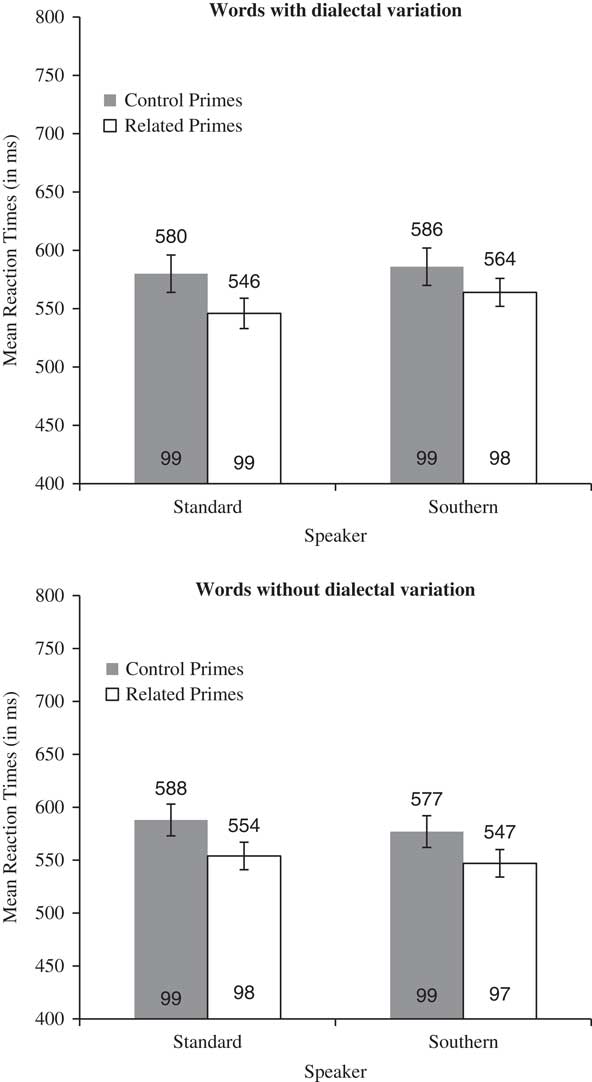
Reaction times (RTs) were analyzed using the linear mixed-effects model, treating participants and target words as crossed random factors, using the statistical software R (R Development Core Team, 2007) and the package lme4 (Baayen, Davidson, & Bates, Reference Baayen, Davidson and Bates2008; Bates & Sarkar Reference Bates and Sarkar2007). RT analysis was performed on correct responses, thus removing 50 (1.5%) data points out of 3,360. For the model to meet the assumptions of normally distributed residuals and homogeneity of variance, a log transformation was applied to the RTs (Baayen & Milin, Reference Baayen and Milin2010) prior to running the models. The models were run on the totality of the correct RTs, namely, 3,310 data points. The mean RT and percentage of correct responses in each condition are presented in Figure 1. Note that accuracy reached 98.5% on average and did not reveal any significant priming effects, so we will not discuss it further.
Mean reaction times (in ms) and standard errors for the control and related primes as a function of the speaker (standard, southern) and for words (a) with and (b) without dialectal variation in Experiment 1. Percentages of correct responses are shown below the bar for each condition.

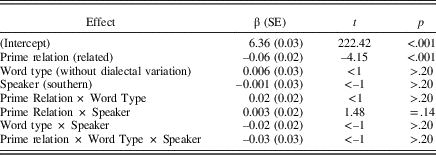
We first tested a model including speaker (standard, southern), word type (with dialectal variation, without dialectal variation), prime relation (related, control), and their interactions as fixed effects, and participants and target words as random intercepts, plus random participant slopes for within-participant factors (i.e., prime relation, word type) and random target word slopes for within-item factors (prime relation, speaker; see Barr, Levy, Scheepers, & Tily, Reference Barr, Levy, Scheepers and Tily2013). The baseline was the performance on the target words used in the with-dialectal-variation condition and pronounced by the standard French speaker in the control prime condition. The results of the most complex model are summarized in Table 2. They revealed an effect of prime relation only, with words used in the with-dialectal-variation condition and pronounced by the standard French speaker leading to faster responses in the related prime condition than in the control prime condition. No other fixed effect was significant. This initial model was then simplified by excluding each nonsignificant fixed effect, thus retaining only prime relation as fixed effect. It also had participants and target words as random intercepts, as well as random slopes for both participants and target words. Model comparison using the log-likelihood ratio test revealed that the more complex model did not fit the data significantly better than the simpler model (χ2 = 8.20, p = .77), thus confirming that no other effect than prime relation explains our data, and thus contribute to improving the model. In this simpler model, prime relation was again highly significant (t = –5.87; p<.0001) with RTs on target words shorter when preceded by related primes in comparison to control primes.
Summary of the most complex mixed-effects model for Experiment 1; the intercept represents words with dialectal variation pronounced by the standard French speaker in the control prime condition

To summarize, only a simple effect of prime relation was observed and this regardless of the type of words (with and without dialectal variation) and the way words were pronounced (with southern or standard French accent). Hence, the results of this experiment suggest that the standard French variant is as effective as the southern French variant at activating the intended words in southern French speakers, and that dialectal variation in the way the /ɔ/ vowel in closed syllables is pronounced does not hinder successful word recognition.
EXPERIMENT 2
The results of Experiment 1 clearly indicate that, in southern French speakers, the standard French variant [mov] for the word mauve facilitates the processing of the associated target word VIOLET in the same way as the speakers’ own variant [mɔv] does. Such a finding is particularly interesting as it suggests that the two variants [mov] and [mɔv] are functionally equivalent in southern French speakers, even if the /o/-/ɔ/ contrast in closed syllables is neutralized in favor of /ɔ/ in their productions. Before discussing the theoretical implications of this finding, we present a second experiment that we conducted to ensure that the standard French variant [mov] was not treated like a “nonword” by southern French speakers. There are demonstrations in the literature that spoken word recognition is relatively tolerant to any deviation in the words’ surface form and that, under certain circumstances, one phoneme mismatch between the input and the underlying word does not preclude lexical activation (e.g., Connine, Blasko, & Titone, Reference Connine, Blasko and Titone1993; Marslen-Wilson, Moss, & van Halen, Reference Marslen-Wilson, Moss and van Halen1996). In Experiment 2, we thus compared the amount of lexical activation triggered by the standard French variant [mov] to that triggered by a nonword like [mœv], which also differs from the southern French prononciation [mɔv] by one feature.
Method
Participants.
Fifty-eight southern French speakers (18–40 years of age) took part in the experiment and were paid 10 € for their participation. None had taken part in Experiment 1. All reported no hearing or speech disorders and normal vision or corrected-to-normal vision. Before running the experiment, we ensured through a reading task that all the participants pronounced the mid-back rounded vowel as /ɔ/ in closed syllables, as expected in the southern French variety. Again, production control was made by a trained phonetician. Thirty of these participants were tested on the nonword primes, and the remaining 28 were tested on the word primes in their standard French variant. Note that we used a between-participants design for the prime lexicality factor, to avoid repetition of the target words across experimental lists. Indeed, it was the same target words that were primed by either word or nonword primes.
Materials.
The same 24 related prime–target pairs involving words subject to dialectal variation (e.g., mauve /mov/ – VIOLET) were reused, as well as the corresponding control prime words (e.g., cage /kaʒ/ “cage” – VIOLET). To construct the related nonword primes, the [o] vowel of the related word primes was replaced by the [œ] vowel (e.g., [mœv] for [mov]). The [œ] vowel was chosen because it differs from the southern French pronunciation [ɔ] by only one phonetic feature (i.e., front vs. back), as this is the case for the standard French variant [o] (i.e., aperture). The primes were recorded by a standard French female speaker only. The mean duration of the prime words was 644 ms and that of the nonwords 677 ms, F (1, 46) = 2.51; p = .12. The vowels were in average longer in the prime words (266 ms) than in the prime nonwords (227 ms), F (1, 46) = 7.84; p<.01. Again, this difference in vowel duration is likely due, at least in part, to the intrinsic difference between the mid-high [o] and the mid-low [œ] vowels.
For both the word and the nonword primes, two experimental lists were constructed. The lists included the 24 target words, half of which were preceded by the related primes and the other half by the control primes. The lists were counterbalanced in such a way that each target was preceded by the two types of prime across the two lists. To avoid that only primes containing /o/ or /œ/ be associated with a semantically related target word, 12 other associated prime–target words (e.g., bras /bʁa/ – JAMBE) taken from Experiment 1 were added to each list as filler trials. To achieve a proportion of related prime–target pairs of 20%, 84 filler prime–target word pairs without any relation (e.g., mer /mɛʁ/– SALADE “salad”) were also taken from Experiment 1 and added to each list. For the purpose of the lexical decision task, 120 target nonwords used in Experiment 1 were also included in each list. Among the 120 target nonwords, 24 were preceded by a “related” prime (i.e., the prime zèbre /zɛbʁ/ for the nonword target RAYUVE derived from RAYURE). The 96 other target nonwords were preceded by an unrelated prime (i.e., the prime stade /stad/ for the nonword COUBURE derived from COUTURE).
Procedure.
The procedure was the same as in Experiment 1. Each participant was tested on one experimental list only and heard the primes in either their standard French version or a nonword version. The participants began the experiment with a block of 10 practice trials.
Results and discussion
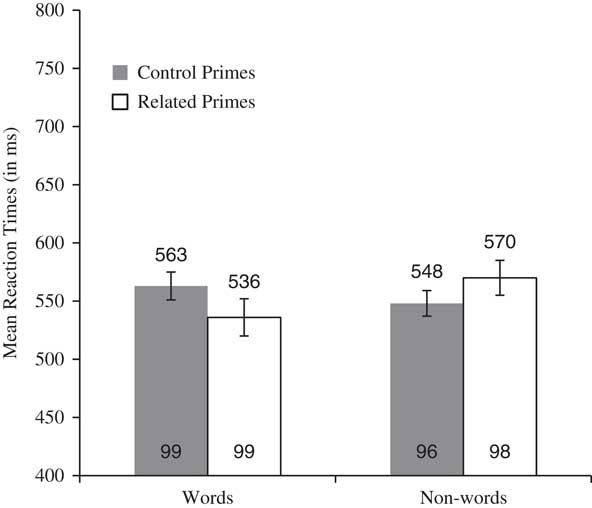
As in Experiment 1, RTs were analyzed using the linear mixed effects model and the package lme4 (Baayen et al., Reference Baayen, Davidson and Bates2008; Bates & Sarkar, Reference Bates and Sarkar2007). RTs analysis was performed on correct responses, thus removing 28 (2%) data points out of 1,392. Two outliers (RTs = 3194 and 4947 ms) were also excluded from the analysis. For the model to meet the assumptions of normally distributed residuals and homogeneity of variance, a log transformation was then applied to RTs (Baayen & Milin, Reference Baayen and Milin2010). The models were run on 1,362 data points. The mean RT and percentage of correct responses in each condition are presented in Figure 2. Note that accuracy reached 98% on average and did not produce significant priming effects. So we will not discuss it further.
Mean reaction times (in ms) and standard errors for the control and related primes as a function of the type of primes (word, nonword) in Experiment 2. Percentages of correct responses are shown below the bar for each condition.
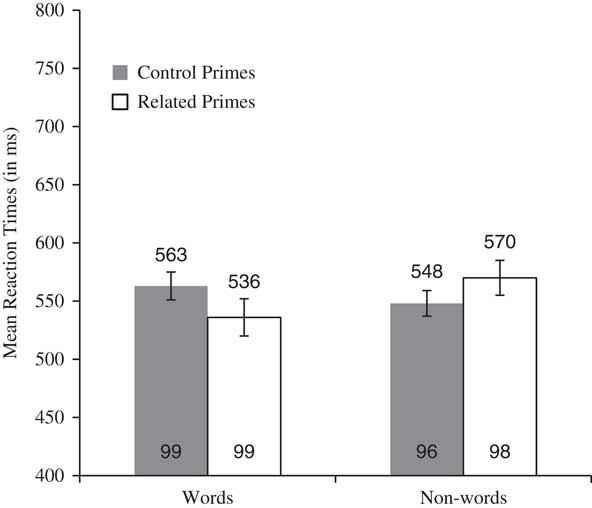
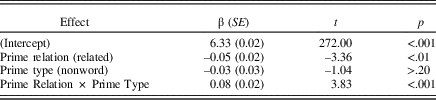
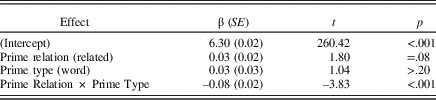
We first tested a model including prime type (word, nonword), prime relation (related, control), and their interaction as fixed effects, and participants and target words as random intercepts, plus random participant slope for the within-participant factor prime relation and random target word slopes for the within-item factors prime relation and prime type (see Barr et al., Reference Barr, Levy, Scheepers and Tily2013). Note that this is this model that we reported because it fits better the data than a simpler model without the interaction between prime relation and prime type as a fixed effect, χ2 (1) = 13.93, p<.001. The baseline was the performance on the target words preceded by prime words in the control prime condition. The model results are summarized in Table 3. They revealed an effect of prime relation, with target words preceded by prime words responded to more quickly in the related prime condition than in the control prime condition. The model also yielded a significant two-way interaction between prime type and prime relation. To understand the nature of this interaction, the model was releveled such that performance on the target words preceded by prime nonwords in the control prime condition was the baseline. The model results are summarized in Table 4. The results of the releveled model indicate that the effect of prime relation failed to reach significance. Hence, the two-way interaction between prime relation and prime type was due to significant priming effect when words are used as primes but not when nonwords are used as primes.
Summary of the most complex mixed-effects model for Experiment 2. The intercept represents prime words in the control condition.

Summary of the most complex mixed effects model for Experiment 2 after releveling; the intercept represents prime non-words in the control condition

GENERAL DISCUSSION
In this study, we examined how speakers of a given dialect process input that is different from their own dialect. In particular, we were interested in the processing of the standard French /o/ variant in closed syllables by southern French speakers, whose phonemic repertoire only has /ɔ/ in such syllables. Using the semantic cross-modal paradigm, we asked whether the variant [mov] of the word mauve as produced by standard French speakers triggers the same amount of lexical/semantic activation in southern French speakers as their own variant [mɔv] does. The results of Experiment 1 revealed no modulation of the semantic priming effect as a function of the dialect of the speakers (standard vs. southern French) that have produced the stimuli. In particular, southern French participants showed facilitation in the processing of the associated target word VIOLET whether the word prime mauve was pronounced by a standard French speaker (i.e., [mov]) or a southern French speaker (i.e., [mɔv]). We also showed that words of type mauve, which are subject to dialectal variation, behave exactly in the same way as words of type gomme, which are pronounced with [ɔ] by both southern and standard French speakers, and for which no modulation in the magnitude of the priming effect as a function of the speaker’s dialect was found. Finally, in Experiment 2, we replicated the priming effect found with the standard French variant [mov]. More crucially, we found that the standard French variant [mov], which differs from the southern French variant [mɔv] by one phonetic feature only, is processed differently by southern French speakers than a nonword such as [mœv], which also differs from the southern French variant [mɔv] by one phonetic feature only, such a nonword failing to prime the associated target word VIOLET. Note that the lack of a priming effect with nonwords like [mœv] is not in accordance with previous studies showing semantic priming effects, albeit smaller to that observed when the intended words are used as primes, with a minimal deviation (i.e., one feature mismatch) between a prime and the intended word (Connine et al., Reference Connine, Blasko and Titone1993; Marslen-Wilson et al., Reference Marslen-Wilson, Moss and van Halen1996). This discrepancy is likely due to the fact that monosyllabic nonwords with a medial mismatch were used in the present study whereas studies that reported semantic priming effects with nonwords often used disyllabic words with a mismatch on the initial phoneme of the words (e.g., vather for father in Connine et al., Reference Connine, Blasko and Titone1993; pomaat for tomaat “tomato” in Marslen-Wilson et al., Reference Marslen-Wilson, Moss and van Halen1996). In this latter case, as the mismatch occurs on the first phoneme, there is sufficient bottom-up evidence after it in favor of the intended words, which likely causes strong activation of the target word during prime processing, thus leading to a semantic priming effect (see Frauenfelder, Scholten, & Content, Reference Frauenfelder, Scholten and Content2001).
Together, the results of the present study indicate that the standard French /o/ and the southern French /ɔ/ variants are functionally equivalent in southern French speakers, even if the /o/-/ɔ/ contrast is neutralized in favor of /ɔ/ in these speakers’ productions. The effectiveness of dialectal variants at activating the intended words was demonstrated with forms that are not contrastive and map onto the same semantic representation. Let us now discuss how we can account for the present findings.
A first account would be to consider that only a single variant of a given word, likely /mɔv/ for the word mauve in southern French speakers, is stored in the mental lexicon. Such an account could be compatible with abstractionist models of spoken word recognition as long as the sounds belonging to the different variants are not contrastive in the southern French speakers’ representations. A well-known model assuming abstract representations is the TRACE model of McClelland and Elman (Reference McClelland and Elman1986). This model assumes three levels of representations interconnected by excitatory links and consisting in feature, phoneme, and word levels. The amount of activation of a given word is determined by the degree of match with the input. As a result, within this model, the word form /mɔv/ is fully activated by the input [mɔv] because there is a perfect match between the information presents in the speech signal and the abstract representation stored in the mental lexicon. Within this framework, a single variant storage account can also explain the semantic priming effect observed when the standard French pronunciation [mov] is used as prime. Because the two vowels /o/ and /ɔ/ differ by one phonetic feature only, a framework assuming the storage of a single variant in architecture similar to that of TRACE also predicts activation of the word form /mɔv/ when the input is [mov]. However, such a model also predicts more activation on the word /mɔv/, and so a greater semantic priming effect triggered by the southern French variant [mɔv] than by the standard French variant [mov] because there is a greater match in the first than in the latter case. This was not what we found. More important, this framework also predicts that dialectal variants should behave as an arbitrary variant such as [mœv] that has exactly the same amount of overlap with the word /mɔv/. Again, this is not what we observed as, all other things being equal, no priming effect was observed with [mœv] whereas significant priming effect was observed with the [mov] dialectal variant. Hence, the observations that a dialectal variant is as effective as the speaker’s own variant at activating the intended word, and that the dialectal variant, in contrast to an arbitrary variant, did not hinder the intended word recognition process, challenge a view of spoken word recognition in which only one variant for a word is stored.
An attempt to reconcile our study with a single-variant storage account would be to assume that there is only one single representation for each word, and that our results merely reflect rapid adaptation to the standard French pronunciations. There is a growing body of evidence that participants adapt very quickly to the peculiar pronunciations of the speaker used in the experiments (e.g., Dahan, Drucker, & Scarborough, Reference Dahan, Drucker and Scarborough2008; Maye et al., Reference Maye, Aslin and Tanenhaus2008; Norris, McQueen, & Cutler, Reference Norris, McQueen and Cutler2003, Trude & Brown-Schmidt, Reference Trude and Brown-Schmidt2012). For example, Dahan et al. (Reference Dahan, Drucker and Scarborough2008) exposed American listeners to spoken words from a speaker of an American English dialect in which the vowel /æ/ is raised to /ɛ/ before /g/ (bag pronounced [bɛg]) but not before /k/ (back pronounced /bæk/). In a variant of the visual world paradigm, participants viewed a screen with four words presented orthographically: an –ag word (i.e., bag), an –ak word (i.e., back), and two unrelated words, and heard one of the words. The participants were instructed to click on the word they heard, and their eye movements on written words were recorded. Before exposure to the –ag words, the –ack words were subject to a competition effect in that back an bag were equally fixated until the /k/ of back was heard. However, after exposure to the –ag words pronounced with /ɛ/, the –ack words were no longer subject to a competition effect, in that –ag words were no longer considered once the /æ/ vowel of the –ak words was heard. Hence, these results clearly showed rapid adaptation to speaker’s specific pronunciations that guides online spoken word recognition. An account for our results in terms of rapid adaptation to the standard French variant supposes that at least one exposition to the French standard /o/ variant is required so that our participants dynamically adjust either the way in which vowels are categorized at a prelexical level of processing or their lexical representations or yet the prelexical to lexical mapping (see Dahan et al., Reference Dahan, Drucker and Scarborough2008; Maye et al., Reference Maye, Aslin and Tanenhaus2008, for discussion on adaptation mechanisms). Whatever the precise mechanism by which rapid adaptation occurs, such an account predicts that the effectiveness of the standard /o/ variant at activating the intended words would develop over the course of the experiment, so that a greater priming effect should be observed at the end of the experiment in comparison to the beginning of the experiment. To test this claim, we conducted additional analyses in which RTs to control and related trials were analyzed for each participant according to their position in the experimental list such that the first trial was labeled “Time Window 1” and the last trial “Time Window 2.” In Experiment 1, the magnitude of the priming effect observed with the standard French speakers was 45 ms at the beginning of the experiment and 44 ms at the end of the experiment. In Experiment 2, it was respectively 39 ms and 16 ms. In neither of the two experiments did we find a significant interaction between prime type and time window. Hence, this post hoc observation, that the semantic priming occurs on the first related trial, makes unlikely that our findings are due to rapid adaptation to the peculiar pronunciations of the speaker used in the experiment.
A second account assumes that multiple variants of a given word are stored in the mental lexicon. In accordance with our findings, this kind of models predicts that all variants of a word should be effective at activating the intended words because lexical representations exist that correspond to the different pronunciation variants. Such models also predict that a dialectal variant should be more effective at activating the intended words than an arbitrary variant, because in the first case the pronunciation variant should better match a lexical representation. Of course, under this hypothesis, we assume that listeners have already been exposed to the dialectal variant, and due to that prior exposure, the dialectal variant has already been encoded in the lexicon. For example, in exemplar-based models of spoken word recognition (Goldinger, Reference Goldinger1998, Pierrehumbert, Reference Pierrehumbert2001) every encountered instance of a word is encoded in the lexicon, and word recognition consists in finding the nearest match in a vast collection of detailed acoustic traces. These models thus assume lexical acoustic traces corresponding to both surface forms [mov] and [mɔv] for the word mauve, thus encoding their respective spectral and durational properties. Listeners could exploit the spectral and durational cues present in the surface forms to activate the exemplars corresponding to each variant, and both surface forms should be equally effective at activating the intended word. Within this multiple-variant storage account, another viewpoint assumes that the different variants for a given word are stored in an abstract way (Marslen-Wilson & Warren, Reference Marslen-Wilson and Warren1994; Marslen-Wilson & Welsh, Reference Marslen-Wilson and Welsh1978; McClelland & Elman, Reference McClelland and Elman1986; Norris, Reference Norris1994; Ranbom & Connine, Reference Ranbom and Connine2007) rather than in the form of detailed acoustic traces encoding fine-grained acoustic/phonetic information. As a result, in this type of models, dialectal variants are stored as individual representations in the speaker’s mental lexicon, and southern French speakers would have two separate abstract representations for the word mauve, one corresponding to the standard French pronunciation /mov/ and the other to the southern French pronunciation /mɔv/. Both inputs [mov] and [mɔv] would fully activate their corresponding abstract lexical representation, thus accounting for the efficient processing of the two pronunciation variants. Further research thus has to tease apart between the storage of variant in a form of acoustic traces encoding fined-grained acoustic/phonetic information or in an abstract way encoding phonological contrast.
Note that, to account for our results, we make the strong assumption that the regular exposure to standard French has led to the creation of multiple lexical representations for word such mauve in southern French speakers. We could rather argue, based on the same reasoning as before regarding rapid speaker adaptation, that past exposition (before the experiment) to standard French variants has either changed the way that the southern French speakers categorize the /o/ and /ɔ/ vowels at a prelexical level of processing, with the two vowels falling in the same phonetic/phonological category, or has rendered more flexible the mapping between prelexical and lexical representation for regular variation (e.g., see Gaskell & Marslen-Wilson, Reference Gaskell and Marslen-Wilson1996, for assimilated word forms), so that regular and frequent deviations in the speech signal are tolerated. Nonetheless, past studies help us to discard these two alternatives accounts (Dufour et al., Reference Dufour, Nguyen and Frauenfelder2007; Dufour, Brunellière, & Frauenfelder, 2013). First, Dufour et al. (Reference Dufour, Brunellière and Nguyen2013) have shown that the two vowels /o/ and /ɔ/ are not confounded at a prelexical of processing. Second, Dufour et al. (Reference Dufour, Nguyen and Frauenfelder2007) observed in a long-term repetition priming experiment that members of minimal pairs of words found in standard French like côte “hill” /kot/ versus cote “rating” /kɔt/ did not prime between them, as we would have expected if the standard French pronunciation [cote] activates the word form /cɔt/ in southern French speakers due to more flexibility in the prelexical/lexical mapping. Hence, the better explanation for our results appears to be in terms of multiple lexical representations for a given word.
As we have just discussed, models assuming that pronunciation variants are stored in the mental lexicon, either in the form of multiple detailed acoustic traces or in the form of several abstract representations, can easily account for the efficient recognition of dialectal variants, provided that listeners have already been exposed to these variants. Because this neutralization is specific to the south of France, we believe that the effectiveness of the standard French /o/ variant at activating the intended word in southern French speakers is due to regular exposition to this variant via the media and/or interactions with speakers of other French regions, which allows southern French speakers to process and represent this variant efficiently. Such a claim is compatible with Sumner and Samuel’s (Reference Sumner and Samuel2009) findings showing that NYC dialect speakers who systematically produce r-less variant of –er final words, but who are regularly exposed to GA, have no difficulty in the immediate and long-term processing of GA final r-full variants. Hence, it appears again that experience with a dialectal variant is a critical factor in the ability to represent and process it effectively. Our study extends Sumner and Samuel’s (Reference Sumner and Samuel2009) findings to the French language, thus suggesting that the cognitive mechanism underlying dialectal processing is in large part universal and not language specific.
To conclude, our study provides new evidence for efficient processing of dialectal variants during spoken word recognition, even if these variants are not part of the speaker’s own productions. This study thus suggests that it is not because a speaker does not produce a word form that he/she is necessarily a bad perceiver of this word form. As we mentioned before, even if these variants are not part of the speaker’s own productions, they are part of the French reference phonemic repertoire and thus are familiar to the southern speakers. Further work could thus be conducted using the same kind of paradigm to examine how a less familiar but known variant, that is, the southern French variant [mɔv], is processed by standard French speakers, and by examining whether the degree of exposure, and thus the degree of familiarity with the southern French variant, lead to differential priming effects. In addition, variant frequency effects could be examined by presenting the two variants in isolation and by examining whether there is a difference in the speed of processing of the two variants in favor of the speaker’s own variant (see Connine, Reference Connine2004; Connine, Ranbom, & Patterson, Reference Connine, Ranbom and Patterson2008; Racine, Bürki, & Spinelli, Reference Racine, Bürki and Spinelli2014). Finally, at a more theoretical level, we believe that our findings are in accordance with models assuming the storage of multiple variants. Further research will also have to examine the precise format in which dialectal variants are encoded in memory.
ACKNOWLEDGMENTS
This work was supported by the Labex Brain and Language Research Institute (Grant ANR-11-LABX-0036) and has benefited from support from the French National Agency of Research (ANR), under the project title “Investments of the Future” A*MIDEX (Grant ANR-11-IDEX-0001-02). This research was also supported in part by the Erasmus Mundus Action 2 program MULTI of the European Union (Grant Agreement 2009-5259-5).
APPENDIX A
PRIME AND TARGET WORDS USED IN EXPERIMENT 1