INTRODUCTION
Countries with abundant natural resources underperform economically, politically, and socially (Frankel Reference Frankel2012; van der Ploeg Reference van der Ploeg2011; Wenar Reference Wenar2016). The exact nature of this “resource curse” or “rentier-state” effect is debated, with some arguing that what matters is the quality of existing institutions (Brunschweiler and Bulte Reference Brunschweiler and Bulte2008; Menaldo Reference Menaldo2016). Others suggest that the resource curse is entirely “political” and that better governance could transform “the curse” into blessings (Collier Reference Collier2010). Many, however, see access to unearned income as a major disincentive for rulers to embark on social and political reform because they would have no incentive to undermine their discretionary power (Acemoglu and Robinson Reference Acemoglu and Robinson2012; Bueno de Mesquita and Smith Reference Bueno de Mesquita and Smith2011; Vadlamannati and de Soysa Reference Vadlamannati and Soysa2016). Indeed, institutions, values, norms, and beliefs can be manipulated by rulers to gain legitimacy and to delegitimize reformers (Grim and Finke Reference Grim and Finke2007; Toft Reference Toft2007). Due to a coincidence of history and geology, much oil production happens in a region also dominated by Islam and historical legacies that are thought to be alien to liberal values and democratic governance. Does oil wealth, thus, create a distinct Middle Eastern effect in political matters, such as rights and freedoms for citizens, above the effects of Islam with which oil wealth and the Middle Eastern location are tightly connected? We examine the relative effects of oil, Islam, and the Middle Eastern region on religious freedom. Current debates largely highlight the problem as a religious one, but we argue that “rentier politics” in oil-rich states may matter more?Footnote 1 The question is not just “academic” but eminently valuable for current policies aimed at reforming resource wealthy countries, not to mention the urgent need for gaining a better understanding on how Islam effects political outcomes.
Using the latest available data on freedom of religion, we estimate the relative effects of oil wealth, Islam, and the MENA (Middle East and North Africa) region on the extent of religious freedoms. Consistent with the “resource curse” idea, oil has a robustly negative effect on religious freedom, controlling for a host of relevant factors, such as income, regime type, conflict legacies and regional effects, including the effect of being non-Western. While Muslim dominance is also statistically significant in many specifications along with oil, these effects lose statistical significance when regional effects are computed, suggesting that majority Muslim populations outside the Arab region do not suffer any more restrictions on the freedom of religion compared with countries dominated by other religious and non-religious groups. Moreover, Muslim dominance increases “cultural and academic freedom” and reduces ethnic exclusion and discrimination, which is inconsistent with the view that Islamic countries are unusually problematic and hostile to basic liberal values. Quite surprisingly, the MENA region conditions the effect of oil production positively on religious freedom. These conditional effects suggest that oil-rich monarchies in the Arab region have marginally better rights than do some non-oil producers, such as Jordan, Israel, and Morocco, but it is more the case that oil producers elsewhere are much worse, such as in Central Asia. Muslim dominance seems to reduce the adverse effects of oil on religious freedom, suggesting that Islam and oil do not necessarily form a “nasty alliance.” These results suggest that institutional legacies might condition the effects of oil in different directions, supporting arguments of others (Gurses Reference Gurses2009). The independent effect of oil on religious repression, however, is robust to a host of alternative data, models, and operationalization.
THEORY
Why Repression of Religion?
The question of oil's effects on societal development, particularly democratization and political violence are highly contested (Brunschweiler and Bulte Reference Brunschweiler and Bulte2008; Gurses Reference Gurses2009; Menaldo Reference Menaldo2016; Norris Reference Norris2011; Ross Reference Ross2012). Some argue that the real culprit for socio-political and economic failure, particularly of the oil-rich Middle East is Islam and deep institutional factors that precede the importance of oil (Donno and Russett Reference Donno and Russett2004; Fish Reference Fish2011; Lust Reference Lust2011; Norris Reference Norris2011). These scholars see Islam's attitude toward women as particularly salient, especially regarding the question of democratization. Consider, however, that Muslim Tunisia elected 27% women into their new parliament while the United States Congress contains only 17% women (Fisher Reference Fisher2012). Curiously, rarely do we attribute high levels of misogyny in India or Japan to religion, or the ability of these societies to manage a high degree of democracy.
Indeed, Gurses (Reference Gurses2009) shows that oil and Islam's effect on democratization is highly contingent on other factors, and that in many majority-Muslim societies, oil-based development enhances modernization among an emerging middle class. Many previous arguments, particularly arguments about rentier states base their analyses on how oil changes structures of economies, which in turn regulate social outcomes, such as the change in values among individuals. We move away from the structural arguments and focus instead on how oil and Islam might affect religious repression due to incentives that rulers face about whether to reform, regardless of structural factors. The regulation of religion can tell us much about more encompassing social control by rulers because religious institutions can be powerful “idea mills” and organizational platforms of dissent against states (Stark and Bainbridge Reference Stark and Bainbridge1996). The rights of minorities, including religious rights, were far bigger issues in the democratization processes witnessed in Britain, the rest of Europe, and in the United States, long before such issues as women's empowerment in politics (Kukathas Reference Kukathas, Madsen and Strong2003). Indeed, absolutist control of populations often hinged on religious rights and freedoms.
The freedom of religion is a fundamental human right enshrined in Article 18 of the United Nation's Universal Declaration of Human Rights. States, however, restrict the rights of religious minorities and grant special status to some religions, often controlled in various ways by the State. These practices happen through formal laws and regulations and through more informal means. We focus on religious restrictions for many reasons, mostly because the regulation of religion is a powerful tool given religion's encompassing influence over citizens and the organizational means through which religion might threaten political authority. The Cingranelli and Richards database on religious freedom that we utilize is described in the following manner.
[Freedom of Religion] indicates the extent to which the freedom of citizens to exercise and practice their religious beliefs is subject to actual government restrictions. Citizens should be able to freely practice their religion and proselytize (attempt to convert) other citizens to their religion if it is done in a non-coercive, peaceful manner.Footnote 2
While Islam has had a troubled relationship with other religions, its connection to radicalization is relatively recent. Indeed, Iranians elected a moderate socialist as their first prime minister. The state of Saudi Arabia, with its radical brand of Salafist Wahhabism, only came into being in 1930, already after the discovery of oil by the colonial powers that governed the region. Although Islamic mores and values handed down from the past share many of the current features, anthropologists have argued that, historically, Islam has been flexible, adapting to the cultural and political values of the areas that it penetrated (Geertz Reference Geertz1968). The rise of radical Islam is often thought to be endogenous to Islamic theology, but can the actual problem of radicalization and fundamentalism lie in other, more exogenous factors, such as oil wealth and the geo-political struggles between superpowers in the area? Consider that Iran and Saudi Arabia, the two largest oil producers in the Middle East, might be characterized as “theocratic” regimes that instrumentalize their own brands of religious ideology to gain politically at home and abroad. Hypothetically, at least, it is not a given that the Iranian brand of Islam or even Saudi Islam necessarily has to be fundamentalist, and Iranian history teaches that it might have been very different absent the geo-politics of oil involving the interests of the United States (Bill Reference Bill1988).
While most religions of the world have their own schisms and splits leading to sectarianism, the Sunni-Shia split within Islam might have gained added salience given the more secular geo-strategic nature of Saudi-Iranian domestic and foreign political interests, often with superpower geo-political interests superimposed on regional ones. Moreover, the rise of radical Islam can be traced to Arab nationalism and regional geo-political tensions involving the Israeli-Palestinian conflict as well anti-American, anti-Western sentiments that have facilitated religious leaders to outbid each other and escalate religious animosities (Toft Reference Toft2007). In other words, the exogenous regional geo-politics of the MENA region driving “religiously-motivated” conflict should be separated from any endogenous effects of Islam on social outcomes, such as religious freedom.
A Muslim Curse?
Culturalists explain socio-political outcomes through the lenses of deep determinants, such as beliefs, world views, and widely-shared attitudes endogenous to faiths (Fish Reference Fish2011; Harrison and Huntington Reference Harrison and Huntington2000; Norris and Inglehart Reference Norris and Inglehart2004; Weber Reference Weber1950). Culture persists more than other factors, they argue, and it determines outcomes more than do formal institutions and structures. Modernization theorists, argue contrarily, that economic growth and development changes traditional values and mores through structural change, and that culture changes with changing times and circumstances, particularly through institutional innovation and secularization (Jackman and Miller Reference Jackman and Miller2005; Lipset Reference Lipset1994). The question of Islam is discussed widely in terms of its resistance to secularization and hostility to liberal democratic values (Fish Reference Fish2002; Pipes Reference Pipes2015). Islam is apparently inimical to secularization because of its extreme social conservatism, for example, exemplified by attitudes toward women's rights and the rights of minorities (Fish Reference Fish2011). However, while religious institutions are based in the distant past, many Muslim-dominated societies, such as Turkey, Indonesia, Malaysia, and Bangladesh, have managed reform. Could factors such as oil and more recent legacies, such as colonial rule, matter more than Islamic tradition? The uncertainties associated with Islam and political outcomes, however, are nowhere more apparent than in one of the clearest annunciations of Islam's effect on social peace in the “clash of civilizations” thesis offered by Samuel Huntington. According to him, Islamic values are distinct from the West and hostile to liberal values of freedom and tolerance (Huntington Reference Huntington1997).
Norris and Inglehart (Reference Norris and Inglehart2004) disagree with Huntington by claiming that the important schism between these civilizations is not related to democratic values. They state on the contrary that positive attitudes toward democracy are prevalent also outside the borders of the West and among individual Muslims. They claim that the decisive difference lies in the differing values related to gender roles, family, and sexuality. In developed countries attitudes toward issues associated with these topics have undergone a transformation in the wake of industrialization, leading to more liberal views. Such a transformation has not taken place in developing countries. Instead, local cultural practices and religious mores continue to have a strong influence over values and attitudes. Others too argue that the real problem is not Islam's anti-democratic values but the tribal values associated with the Arab-speaking region (Stepan and Robertson Reference Stepan and Robertson2003). Yet again, some others suggest that the MENA region suffers a democratic deficit because of the rise of Islamists, who are feared by progressive segments of the population, who shun democracy to keep radicals out of government (Lust Reference Lust2011).
While Islam's effects on social attitudes favorable to democracy are relevant to this study, the issue of Islam's attitude toward other religions has a direct bearing, albeit less discussed in the literature. It is not entirely clear why the ability of majority Muslim countries to democratize is predicated on attitudes toward women or sexuality? The East Asian cultures, such as Japanese culture, could be viewed as hostile to women's rights, but these attitudes have not hampered the practice of democracy there. Poor countries, such as India, Bangladesh, and Pakistan have managed democracy despite pervasive gender inequalities and large Muslim populations. Indeed, Donno and Russett (Reference Donno and Russett2004), contrary to Fish (Reference Fish2002) report no effect of women's empowerment on democratization. We focus, thus, on the regulation of religion as perhaps a more valid indicator of social regulation, which might be inimical to conditions favoring political liberalization, but one that has a direct bearing also on the issue of Islam versus oil in predicting political reform. If Islam is particularly hostile to other religions and minority rights, then it should show up on a measure such as religious freedom, which is a more salient aspect of how conducive a society might be to liberalization of politics and for undertaking other social reforms.
Some find that there is little support for notions of freedom of religion among majority Muslim countries, particularly among advocates of Sharia, also called political Islam (An-Naim Reference An-Naim2009; Kuran Reference Kuran2004). Jonathan Fox (Reference Fox2016) surveys religious freedom across the world and finds majority-Muslim countries to have the worst record in terms of minority-religious rights, and this was particularly true for the Mid-East region. He fails, however, to examine the potentially important intervening role of petroleum, which is associated with majority Muslim countries in the North Africa and Middle East region (Fox Reference Fox2016).
Strict restriction on the freedom of religion in Islam can be justified by referring to certain passages of the Qur'an and Islamic teaching that encourage a hostile approach toward perceived apostates. In particular, conversion away from Islam is severely punished and considered a threat to the entire religious and political community (Little, Kelsay, and Sachedina Reference Little, Kelsay and Sachedina1988). Yet scholars also show that there are countervailing traditions within Islam that justify freedom of religion. Islam is tolerant, particularly of Christianity and Judaism, and that the Qur'an views Islamic truths as self-evident rather than something that must be forced on others. Such perspectives have, for example, informed Pakistan's support of Article 18 of the Human Rights Declaration when it was ratified in 1948 (Little, Kelsay, and Sachedina Reference Little, Kelsay and Sachedina1988; Rehman and Breau Reference Rehman and Breau2007). Moreover, intolerance of other religions is not just something we see in majority Islamic countries, but even industrialized democracies, such as Russia, Hungary, and Poland, as well as majority Buddhist countries, such as Sri Lanka, Thailand, and Burma, also show high levels of religious intolerance and persecution. Are majority Muslim countries, however, in double jeopardy because many of them are also oil producers?
An Oil Curse?
Many argue that oil produces a “resource curse” that affects social, economic, and political outcomes (Ross Reference Ross2012). The “rentier state” arguments suggest that oil allows rulers the luxury of staying in office rather than making progressive policies that increase the chances of economic development and democratization. Michael Ross (Reference Ross2012) argues that oil, rather than Islam, explains the democratic deficit in the Middle East and elsewhere. He dismisses Fish's (Reference Fish2002) argument about the connection between Islam and the attitude toward women in the democratization debate by connecting with the oil curse. He argues that since oil emasculates industrial development and structural change, women do not gain rights. Both lower rights for women and the lack of pressure for democratization, thus, might be explained as consequences of oil-led development. Indeed, there is strong empirical evidence to suggest that oil-wealthy rulers use political repression to stay in office and stave off reform (Basedau and Lay Reference Basedau and Lay2009; de Soysa and Binningsbø Reference de Soysa and Malmin Binningsbø2009; Wenar Reference Wenar2016). Others, however, have shown that the effect of oil on democratization is contingent on other factors. Keeping in line with structural arguments about why oil may matter to reduce the chances of democracy, Gurses (Reference Gurses2009) argues that rather than rentier backwardness, oil wealth could lead to state-led modernization of societies, such as we have seen in several of the oil-rich Gulf states, thereby increasing the chances of democratization.
We argue that the regulation of religion is also applicable in terms of the oil curse, not only as a structural feature associated with the lack of industrialization, although these factors are also at play, but because access to oil wealth forms the motive and the opportunity for states/rulers to institute repressive structures and secure control over revenue. Reforms that would allow alternative voices over the use of oil threaten a ruler's control over enormous wealth. Apart from repression, an oil-wealthy ruler has an incentive to build a minimum-winning-coalition that would allow him to control people at minimum cost. As some sociologists of religion, including some economic theories of religion suggest, there is a market for religions, which in less restrictive environments will lead to multiple entrants catering to the varying tastes of people (Ianaccone Reference Ianaccone1998; Stark and Bainbridge Reference Stark and Bainbridge1996; Stark and Finke Reference Stark and Finke2000). Thus, political authorities can grant monopolies to their advantage to restrict entrants in return for loyalty. Restrictive regulation of religion can be seen as a specific kind of political repression, which Henderson defines as “… the use or threat of coercion in varying degrees applied by the government against opponents or potential opponents to weaken their resistance to the will of the authorities” (Henderson Reference Henderson1991, 121). By granting strict religious monopolies, thus, an oil-wealthy ruler can control society and keep his winning coalition small and increase his “selectorate” given that he could very easily replace disloyal religious leaders with loyal ones.
Sebastien Peyrouse (Reference Peyrouse2010) demonstrates just how this mechanism of social control works by examining former Soviet Republics. Despite claiming to have distanced themselves from the oppressive methods of their past communist regimes, many of the former Soviet republics in Central Asia have placed severe restrictions on organization and practice of minority religions simply as a control device. Peyrouse (Reference Peyrouse2010, 135–137) shows that these restrictions are particularly targeted at religions introduced in recent years. Such minorities are perceived as a potential threat to the established rules and norms because they might contest the regime's legitimacy as a moral authority. Catering to only a set few religious leaders and solidifying monopolies fits with “selectorate” theory where it is desirable for a dictator to keep a small coalition of key supporters happy (Idem, 140–142). Religious organization allows mobilization in a regularized manner. Religious institutions, thus, have far greater reach via pulpits and the institutional measures for organizing dissent because of the commitment and connectedness of congregations (Stark and Finke Reference Stark and Finke2000). Controlling religion offers rulers a form of soft power (Dorsey Reference Dorsey2016).
For an incumbent regime, repression is one important tool for staying in power, or enforcing policy decisions (Poe Reference Poe, Carey and Poe2004). By making use of this tool, rulers hope to decrease the influence of perceived threats as well as strengthen their own position and those of supporters (Bueno de Mesquita and Smith Reference Bueno de Mesquita and Smith2011). Repression of minority opinion allow rulers to suppress dissent that may target economic interests of a regime as well as those of supporters (Henderson Reference Henderson1991). These arguments provide a top-down-explanation for why governments repress religious groups. Religious groups that offer teachings that do not conform with the ideology of the sitting regime could be perceived as a threat and source of disloyalty, even heresy. Access to oil wealth has allowed regimes in states such as Saudi Arabia and Iran to use religious dogma as a critical tool of social control, which they also use in their geo-political struggles throughout the Middle East and elsewhere.
A Middle Eastern Curse?
To complicate matters, much of the world's oil is located within a region of the world that also contains most of the world's majority-Muslim states. Many of the countries in the region also share the historical legacies of the Ottoman empire, where Islamic law and particular styles of bureaucratic governance became institutionalized, which apparently explains how the West diverged from the Islamic world to forge ahead in economic, technological, and social terms (Kuran Reference Kuran2004). Timur Kuran (Reference Kuran2004) argues that the inflexibility of legal codes and structures as well as the humiliation felt because of the West's dominance in political and cultural terms, has led to the rise of Islamists, who dream of resurrecting a great historical past based on Islamic law and traditions. In addition, Islamists have gained support from ordinary people due to the formation of the state of Israel and the plight of the Palestinians, compounded by the view that their rulers, who have access to enormous riches from oil and other resources, have sold out their inheritance to Western nations — “the infidel.” As some argue, fear of radical Islamism taking hold lead the largely Westernized elite and middle classes to reject democratization and impose religious restrictions on fundamentalist brands of Islam (Lust Reference Lust2011). Thus, Islam, oil and the rise of Islamism in the MENA region may also combine in a nasty cocktail of repression and political failure. Any effect of either Islam or oil needs to be parsed out from the effect of their connection with the MENA region, which contains many non-Muslim-dominant countries, such as Lebanon, Jordan, and Israel, as well as non-oil producers, such as Jordan, Israel, Lebanon, and Morocco.
HYPOTHESES
Much of the Muslim world, through a coincidence of history and geology, is rich in oil resources. By testing how oil matters for religious repression above the effects of Islam and the cultural factors common to the region allows us to assess the power of the resource curse argument on socio-political outcomes. Our main hypotheses, thus, are as follows:
H1:
Oil-producing countries have lower religious freedoms than non-oil producing countries independently of Muslim dominance and the MENA region.
H2:
Muslim-dominance has lower religious freedoms, independently of oil production and the MENA region.
H3:
The MENA region has lower religious freedom independently of oil production and Muslim dominance.
DATA AND METHOD
Our main dependent variable is the degree of religious freedom in a society, both in terms of legal rights on the books as well as a state's actual respect for these rights in practice. These data are presented in the Cingranelli and Richards (CIRI) human rights dataset. The data are coded on the basis of information from United States Department of State's (USDS) Country Reports on Human Rights Practices and Amnesty International's annual reports on human rights practices (Cingranelli and Richards Reference Cingranelli and Richards1999). For us, the actual practices of state's actions in terms of repression is more important than what is allowed in practice, since many states are insincere about their commitments (Neumayer Reference Neumayer2005). For comparison, we also use the Varieties of Democracy project's (VDEM) religious freedom measure, which is coded by country experts and others that answer specific questions about the nature of religious repression and the rights of religious association (Coppedge et al. Reference Coppedge, Lindberg, Skaaning and Teorell2015). These data measure “to which extent individuals and groups have the right to choose a religion, change their religion, and practice that religion in private or in public as well as to proselytize peacefully without being subject to restrictions by public authorities.”Footnote 3 While there are other data on state discrimination of religious minorities (Fox Reference Fox2000), we rely on the CIRI and VDEM data, which are positively correlated (r = 0.54), although they show considerable variation between them.
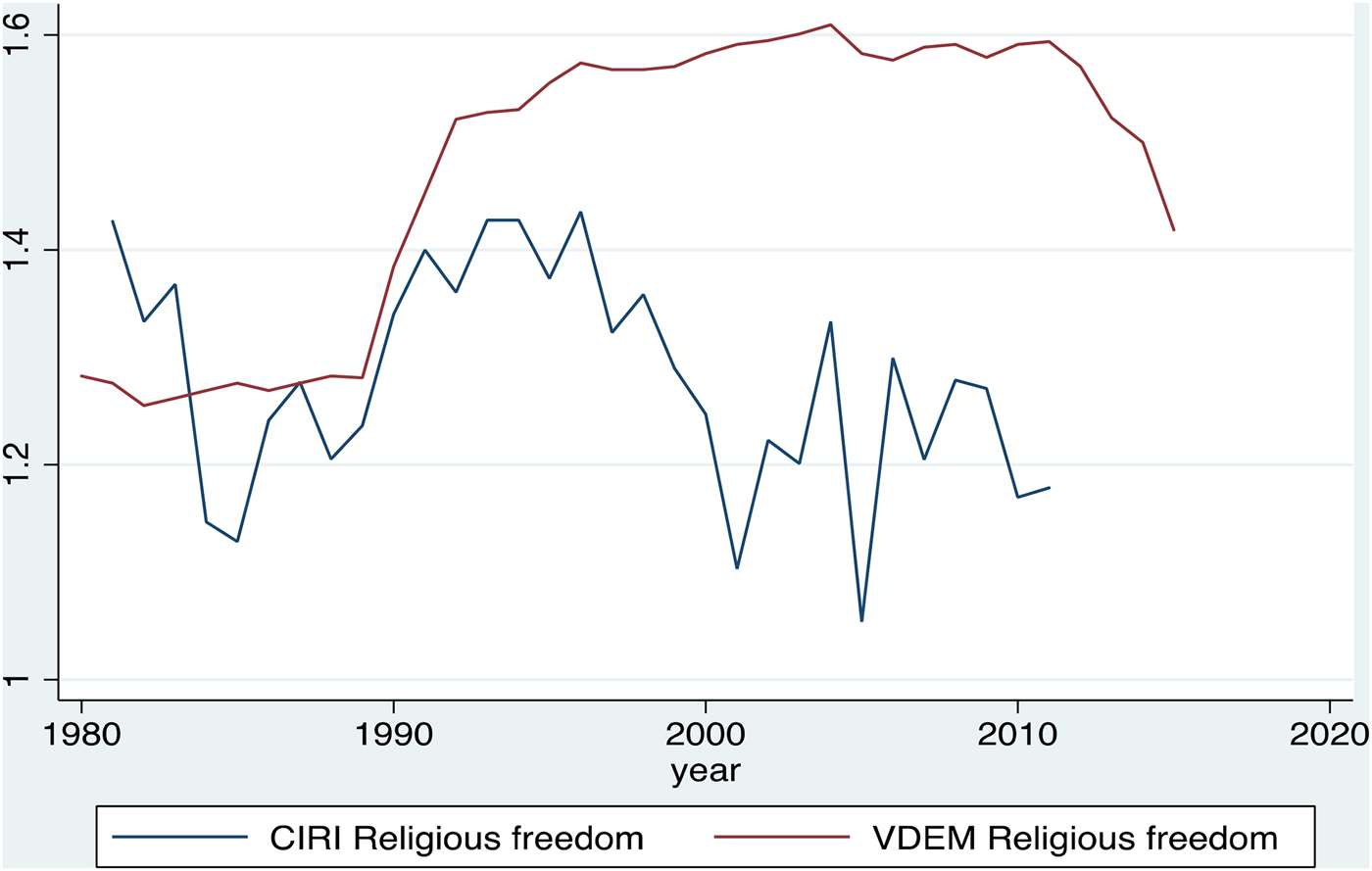
The CIRI religious freedom variable is coded as a three-point scale from 0 to 2 where 0 indicates that government regulation of religion is severe and widespread, 1 indicates that regulation is moderate, while 2 means that such practices are practically absent. The VDEM data are scaled on a four-point basis, where 0 indicates that no freedom of religion exists all the way up to 4 where there is complete freedom of religion. The difference between 2 and 3 in the VDEM is somewhat vague, which prompts us to rely more on the CIRI coding, but we create a three-point ordinal scale with the VDEM data by collapsing scores between 0 and 2 as 0, scores between 2 and 3 as 1 and scores between 3 and 4 as 2. Figure 1 displays the trends in the two measures of religious freedom. As seen there, the CIRI data shows a lot more variance over time than does the VDEM, which is most likely due to the CIRI data being more sensitive to real-world violations, which are likely to be tracked more closely by Amnesty and the USDS country reports from year to year. Moreover, a few of the small Gulf monarchies, such as the UAE (United Arab Emirates) and Bahrain, are missing in the VDEM data. In any case, we also use VDEM's academic and cultural freedom as well as two measures of ethnic exclusion and discrimination as dependent variables (Cederman, Wimmer, and Min Reference Cederman, Wimmer and Min2010).
(Color online) Trends in the CIRI and VDEM religious freedom measures, 1980–2013.

We utilize ordered probit regression on a time-series cross-sectional data set. The ordered probit regression allows variables on an ordinal level to be used as a dependent variable and takes into account the “ceiling” and the “floor” effects of such variables (Winship and Mare Reference Winship and Mare1984). We use time fixed effects to account independently for trends in religious freedom that may correlate with trends in any of our independent variables as well as capture any time-specific effects due to coding rule changes etc. We cluster our regressions on units (countries), where we assume non-independence within clusters but independence across. By clustering, our estimates are robust to heteroscedasticity and serial correlation (Wiggins Reference Wiggins1999). When we test the alternative dependent variables, namely the VDEM's cultural freedom and Cederman, Wimmer, and Min's (Reference Cederman, Wimmer and Min2010) ethnic exclusion and discrimination variables, we use Ordinary Least Squares because these variables are continuous measures that are normally distributed. We compute Newey-West standard errors that are robust to heteroscedasticity and autocorrelation (Newey and West Reference Newey and West1987).
Our main independent variables are oil rents per capita and a dummy variable capturing whether a country produces oil. Following Ross (Reference Ross2012) we use oil per capita to avoid bias from endogeneity since oil per GDP (Gross Domestic Product) is affected by other factors, such as growth, the quality of institutions etc. The denominator GDP is also likely affected by a host of unmeasured factors, which then affects the ratio, capturing dependence rather than abundance. We obtain oil rents per capita from the World Bank's World development indicators online database (WDI).Footnote 4 Since the WDI presents the data as oil rents per GDP, we convert to per capita terms by computing total rents and then dividing this by total population. Our preferred variable, however, is an oil producer dummy, which allows us to relax the assumption that oil matters only after some threshold value. Thus, we compute a dummy variable taking the value 1 if a country produces more than 1% of GDP and 0 if not. Since the World Bank's rents data might be subject to several biases, we compare the World Bank's oil rents per capita with data on oil and gas production per capita collected by Michael Ross and Paasha Mahdavi.Footnote 5 These two variables are highly correlated (r = 0.92), which is comforting. Our results are broadly similar when using the alternative oil production data.
Our second main independent variable is the percentage of the population that is Muslim. We use data on religions presented by the Pew-Templeton Global Religious Futures Project.Footnote 6 The data on religious percentage of the majority religion is collected for 2010. We use this value on the assumption that the share of the majority religion remains quite stable over time (Fearon Reference Fearon2003). To avoid the problem of perhaps missing small changes that may occur to this time-invariant variable, we create a dummy variable that captures Islamic dominance using a Muslim population of 75% or more as a cut-off. This variable takes the value 1 if a country's Muslim population is 75% or more and 0 if not. Using the cut-off at 50% and above made little difference to the basic results. This data does not distinguish between different denominations within the world religions, therefore the study might miss relevant differences between various subsets of Islam. Seeing as most arguments are levelled against Islam, we do not see this as a major problem. In robustness tests, we use several alternative ways of measuring countries dominated by Muslims. We follow others by adding a dummy variable capturing membership in the Organization of Islamic Cooperation (de Soysa and Nordås Reference de Soysa and Nordås2007) as well as a discrete variable taking the value 1 if a country is a member of the Arab League, and zero if not. The membership data were gathered from the official websites.Footnote 7
Our third main independent variable is the North African and Middle East (MENA) region. These data were taken from Fearon and Laitin (Reference Fearon2003) and covers 21 countries. We added Sudan, Bahrain, and Qatar to Fearon and Laitin's list since they include only countries with inhabitants above 1 million.Footnote 8 The correlations among our three main independent variables are presented in Table 1. As seen there, the highest correlation is between Muslim dominance and the MENA region, which is r = 0.50, but the correlations between the MENA region and oil producers (r = 0.30) as well as the MENA region and Muslim dominance (r = 0.17) are low. These correlations suggest that all three x variables can be used in a single model without problems associated with multicollinearity.
Bivariate correlation between the main independent variables, 1980–2013

We use a simple set of control variables in order to avoid the “kitchen sink” approach, which can make interpretation of results very difficult and unnecessarily complicated (Achen Reference Achen2005). We essentially add four control variables. First, we enter the level of development measured as per capita GDP in current dollars obtained from the WDI.Footnote 9 This variable is logged to reduce skewness. Per capita income might obfuscate the effect of oil and is generally a catchall variable that also measures the degree of industrialization and the quality of institutions. These factors could affect religious freedom independently of our main variables of interest. Next, we add regime type separated into democracies and autocracies. Since oil, Islam, and the MENA region supposedly affect regime types, we add these as controls (Norris and Inglehart Reference Norris and Inglehart2004). We construct our regime type variables using the Polity IV data, which measures regime type on a sliding scale from 10 to -10 (Gurr and Jaggers Reference Gurr and Jaggers1995).Footnote 10 We create dummy variables capturing democracy by assigning the value 1 if the Polity scale is above 6 and 0 if not. Similarly, we create a strict autocracy measure taking the value 1 if the Polity scale is below -6 and 0 if not. Democracies ostensibly allow religious freedom as part of basic freedoms, whereas autocracies typically do not (Grim and Finke Reference Grim and Finke2007). Finally, we add a measure of armed violence in the model since governments facing rebellion are likely to repress rights, and many government in the MENA region, that are Muslim, and have oil are likely to be affected by violence (de Soysa and Neumayer Reference de Soysa and Neumayer2007). Using the Uppsala Armed Conflict Data, we add civil war incidence defined as a conflict between a state and rebel group that has reached at least 25 deaths in a single year (Gleditsch et al. Reference Gleditsch, Wallensteen, Eriksson, Sollenberg and Strand2002). Using this data, we generate a variable also measuring the years of peace since the last civil war beginning the count in 1946. We believe these two measures adequately account for the threat situation of a government that would require limitation of rights regardless of the condition of our main variables of interest. The inter-correlations among all variables and the descriptive statistics are presented in the appendix.
RESULTS
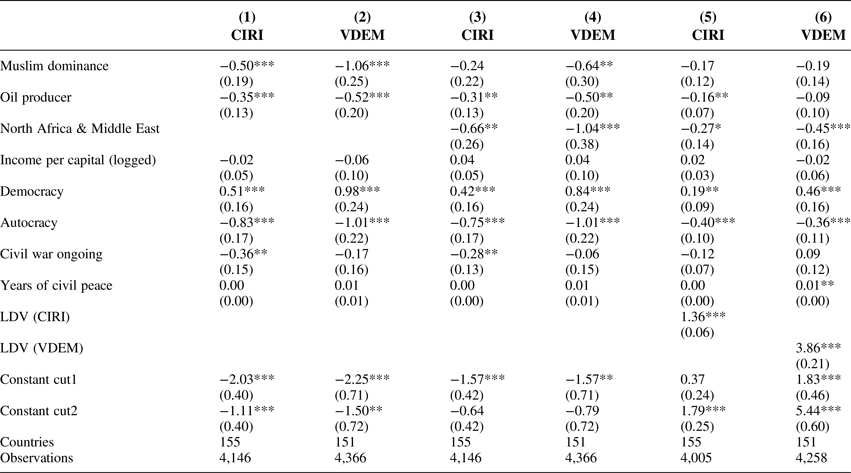
Table 2 column 1 presents our first set of results using the CIRI religious freedom data as the dependent variable.Footnote 11 As seen there, Muslim dominance and oil producers predict lower rights, results that are statistically highly significant. By contrast, per capita income has no significant effect, while democracy is positive and statistically highly significant as expected. Strict autocracy is negative and highly significant, which also is expected as is the negative effect of civil war. Substantively, moving from a non-Muslim dominant country to Muslim dominance reduces religious freedom by 63% of a standard deviation of religious freedom. Similarly, going from a non-oil producer to an oil producer decreases religious freedom by 44% of a standard deviation of religious freedom. The substantive effect of being an oil producer, thus, is roughly equal to having a civil war. These preliminary results suggest that Muslim dominance matters, even above the effects of oil.
The relative effects of oil, Islam, and the Mid-East region on religious freedom, 1980–2013

Robust standard errors in parentheses. ***p < 0.01. **p < 0.05. *p < 0.1. Time fixed effects computed.
In column 2, we test the same specification using the VDEM religious freedom data. As seen there, again, both Muslim dominance and oil production reduce religious freedoms. The control variables remain roughly the same except that civil war is now statistically not significantly different from zero. In column 3, we switch again to the CIRI religious freedom, but add the MENA regional dummy. Now, the effect of Muslim dominance washes out, while the effect of oil remains negative and statistically significant. The effect of the MENA dummy is statistically highly significant and negative on religious freedom. Substantively, the effect of being from the MENA region is even larger than the effect for gaining full democracy. In column 4, when we switch to the VDEM religious freedom data, all three of our main independent variables are negative and statistically significant. The effect of being from the MENA region is substantively the strongest effect. In columns 5 and 6, we add lagged dependent variables for both CIRI and VDEM data. As seen there, Muslim dominance is not significant when testing the CIRI data, but oil retains its statistical significance. In column 6, both variables lose statistical significance while only the MENA dummy matters. Using a Lagged Dependent Variable can soak up all the variance, which might be problematic, but what matters seems to be whether one uses the CIRI data compared with the VDEM data. As discussed above, the data series show some differences (Figure 1), but we prefer the CIRI data based on Amnesty and USDS reporting, which is likely to be sensitive to events on the ground as opposed to simply biases stemming from rights on the books alone, which may influence some expert coding.
Taking the results in Table 2 in total suggests that both Islam and oil matter independently of the controls, but only oil seems to survive the addition of the MENA region. Using the CIRI data, oil seems to be more robustly associated with religious freedom than Muslim dominance, particularly when the MENA region is accounted in the model. The MENA region has the most robust effect on lower religious freedom. Thus, there is support in Table 2 for H1, which is that oil production lowers religious freedoms regardless of religion and the MENA region. There is weaker support, however, for H2, suggesting that Islam should affect religious freedom more than oil production and the MENA region, particularly when the CIRI data are used. Thus, there is good support in the data for hypotheses 1 and 3, but the results suggest rejecting H2.
Next, we test the effect of oil production and Muslim dominance among countries outside the MENA region to assess even more stringently for the effects of oil over Muslim dominance.
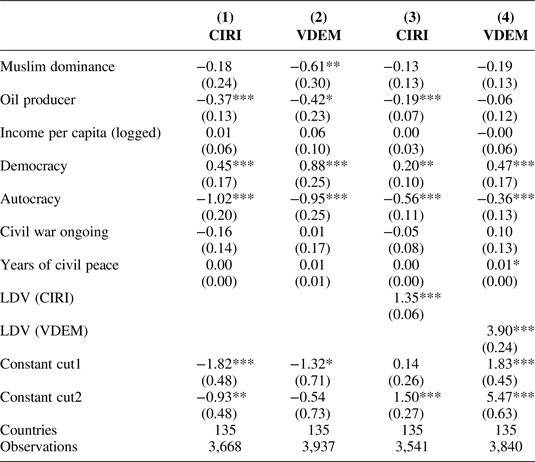
In Table 3, we test only a sample of non-MENA countries. As seen there, in column 1, when the CIRI data are used as the dependent variable, oil clearly trumps the effects of Islam. In Columns 2 when VDEM is the dependent variable, however, oil and Muslim dominance matter independently of each other and all the controls. Again, the CIRI data and VDEM differ in terms of how Muslim dominance matters, but both find oil to matter negatively. In columns 3 and 4, when the LDV is used, oil still matters negatively, suggesting that its effect is robust, albeit the effect is statistically significant only when the CIRI data are used.
The relative effects of oil and Islam on religious freedom excluding the North Africa and Middle East Region, 1980–2013

Robust standard errors in parentheses. ***p < 0.01. **p < 0.05. *p < 0.1. Time fixed effects computed.
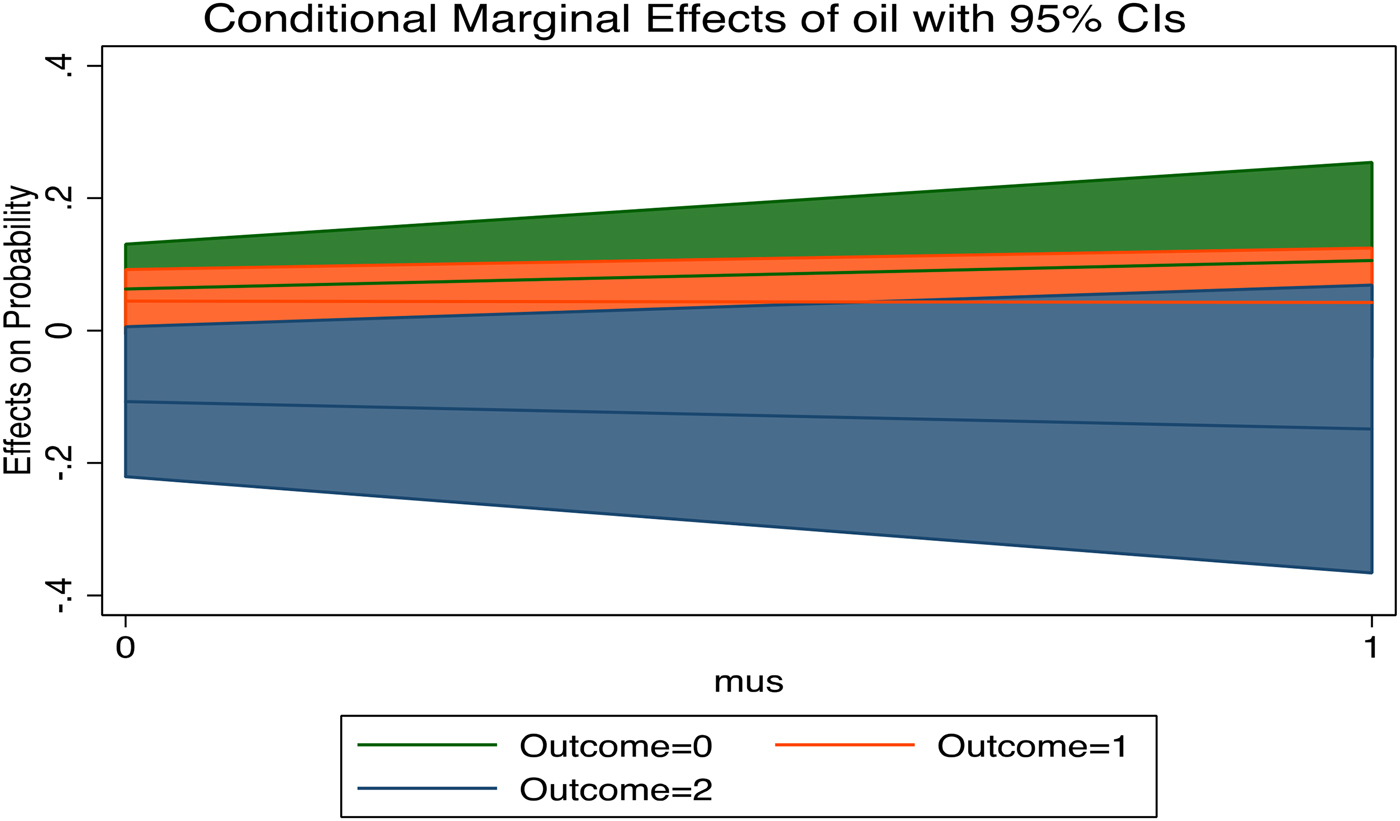
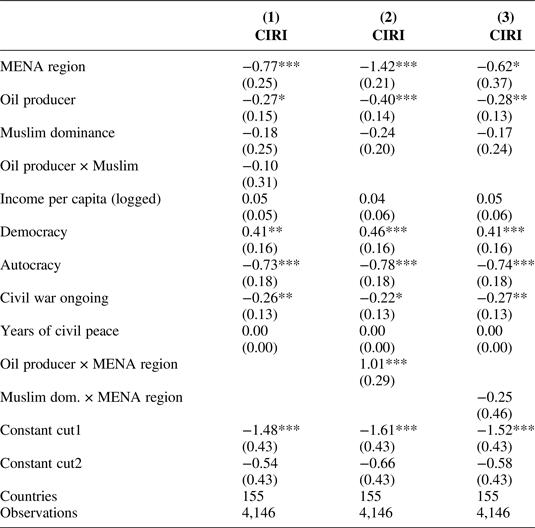
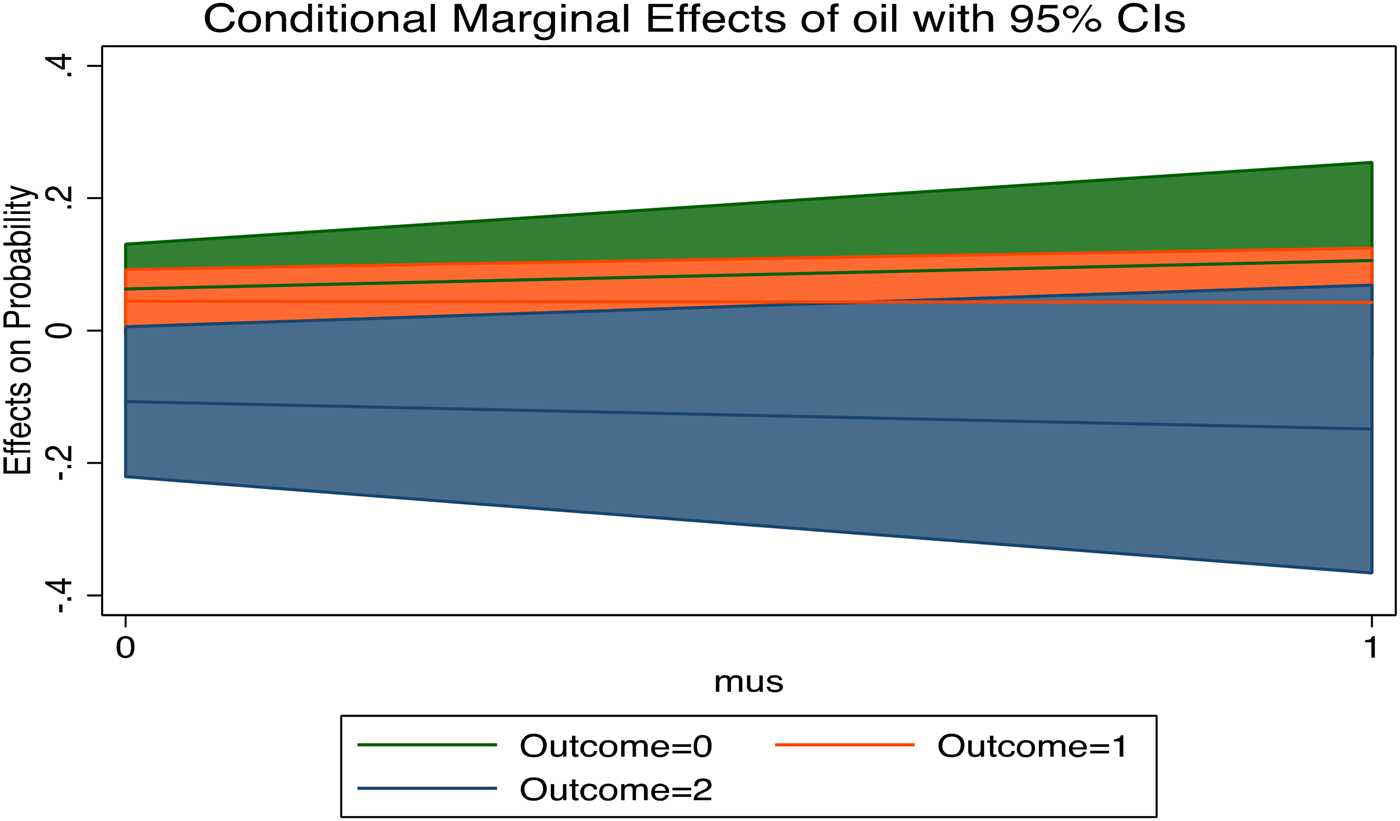
To test the Islam versus oil effects further, we rely on conditional effects to reveal how oil and Islam and the region might matter in terms of forming jointly harmful effects on religious freedom. If oil and Islam matter, then the MENA region faces a “double jeopardy.” Table 4, column 1, contains the conditional effects between oil and Islam holding the MENA region constant together with the other controls. As seen there, there is no statistically significant effect of the interaction term. In other words, Muslim dominance among oil producers are no more likely to be repressive religiously than oil producers in general and other types of religions. It is generally not easy, however, to interpret the coefficients of interactive terms alone (Ai and Norton Reference Ai and Norton2003), therefore, we examine the margins plots (Figure 2). The margins plots display the effects of the conditional terms in three colors marking the points of the dependent variable, with the bands denoting the level of significance at the 95% confidence interval. The color blue is the highest level of religious freedom at 2 on the ordinal scale. As seen there, the conditional effect of oil and Islam is slightly negative, but statistical significance is weak. Indeed, as the results in Table 4 shows, the independent effect of oil, or when oil is at Muslim dominance equals zero, is negative and statistically significant. This result suggests that the effect of oil rather than religion, even after the MENA region is controlled, is what matters for religious freedom.
(Color online) Marginal effects of the conditional relationship between oil producers and the share of the population Muslim on religious freedom at three different points of the ordinal scale.
Interactive effects of oil producers, Islam, and the Middle East region on religious freedom, 1981–2011

Robust standard errors in parentheses. ***p < 0.01. **p < 0.05. *p < 0.1. Time fixed effects computed.
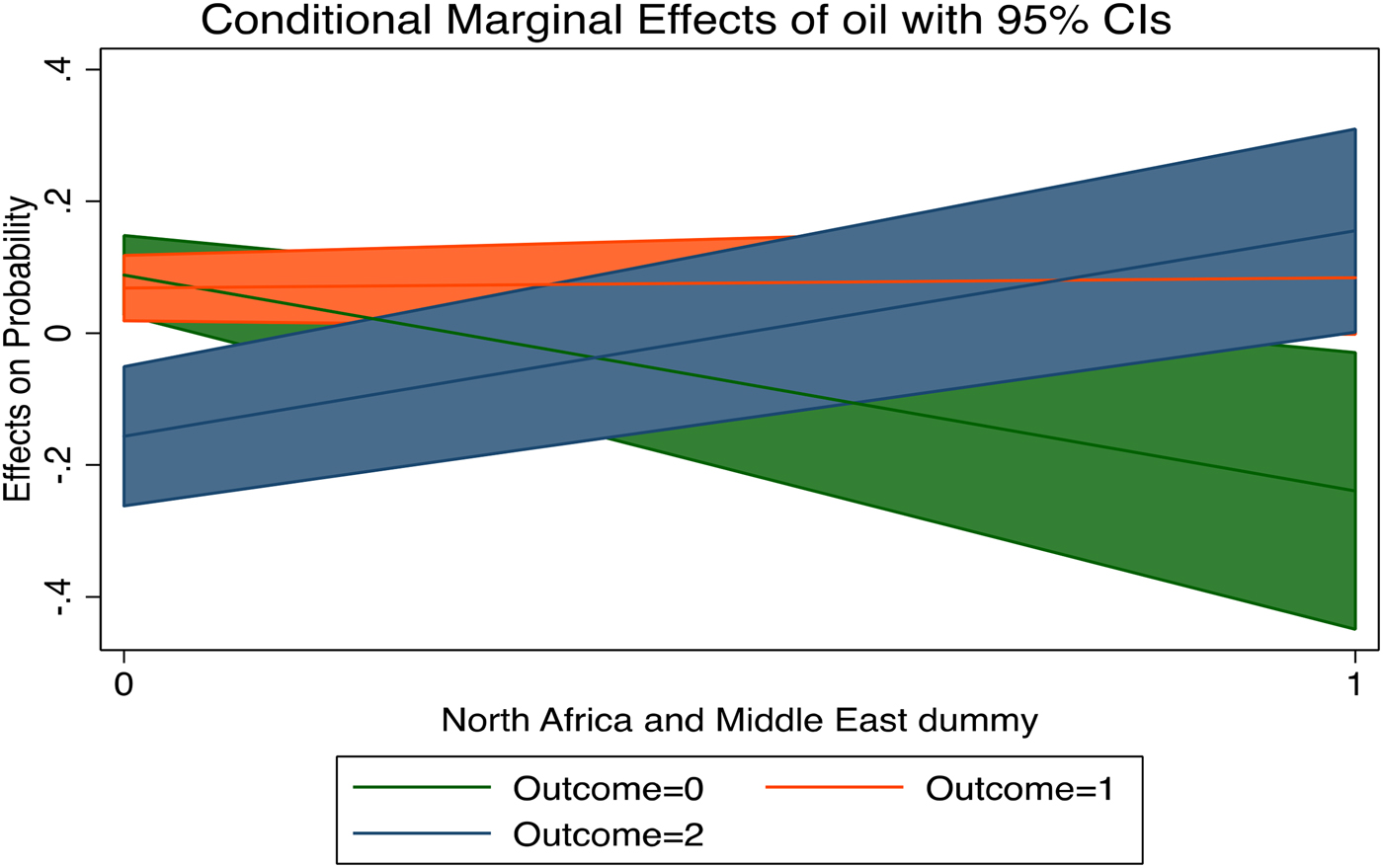
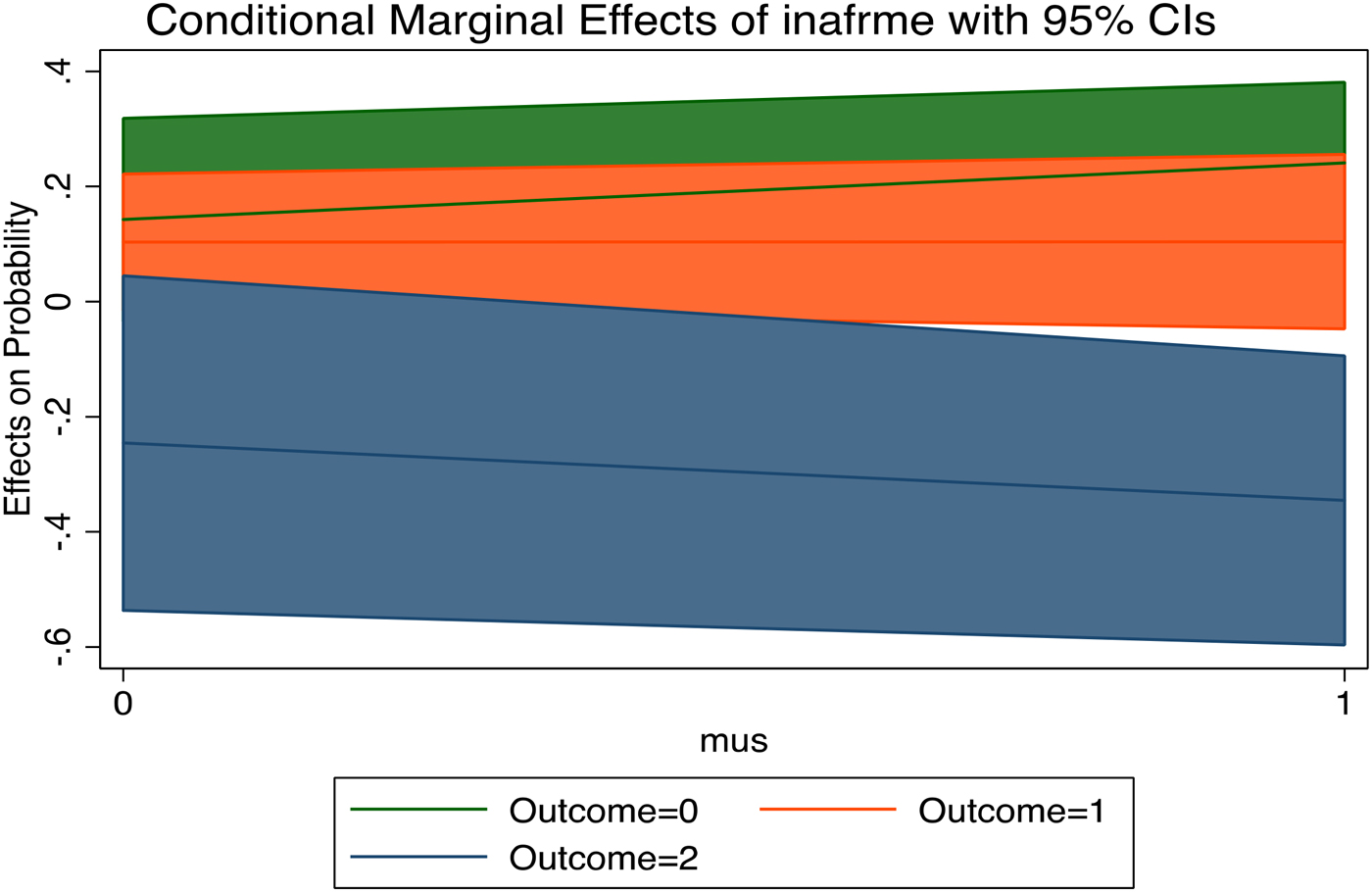
Table 4, column 2 displays results of the conditional effect of oil production and the MENA region. This time, the conditional effect is statistically highly significant and positive. Oil producers in the MENA region increase religious freedom, whereas oil in other areas reduces religion freedom. Oil at MENA region zero, or oil in regions that are non-MENA, associates negatively and statistically highly significantly with religious freedom. Interestingly, while both variables independently predict lower freedom of religion, together they associate with increased freedom. The margins plots show the relationship clearly (Figure 3). On closer examination of why oil producers in the MENA region might have positive effects, we discover that many of the small Gulf monarchies, such as the UAE, Bahrain, Kuwait, and Oman show relatively higher scores on religious freedom than do non-oil exporters, such as Jordan and Morocco, but the issue is that oil exporters outside the region, such as in Central Asia, have much lower scores on religious freedom. The conditional effects are added evidence that oil matters negatively independently, and that oil's effects on political outcomes might be conditional on important institutional factors. We suspect the importance of imported labor as well as the security of tenure of the small monarchies allows some religious freedom compared with oil exporters elsewhere. Moreover, some of these Sunni kingdoms have large Shia populations, such as in Bahrain, which suggests that they may be marginally more tolerant when it comes to religious freedoms. Finally, in column 3, we enter the interaction between Muslim dominance and the MENA region. This effect is slightly negative but statistically not significant (Figure 4). These results do not support the view that the MENA region and Islam form a particularly dangerous alliance for religious freedom.
(Color online) Marginal effects of the conditional relationship between oil producers and the Mid-East region on religious freedom at three different points of the ordinal scale.

(Color online) Marginal effects of the conditional relationship between % Muslim and the Mid-East region on religious freedom at three different points of the ordinal scale.

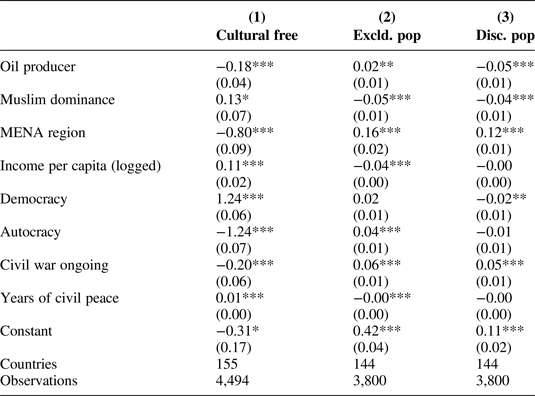
Next, in Table 5, we change our dependent variables to capture dimensions of social control that are not necessarily only about religion, but they relate importantly to liberalization and the chances of democracy. In column 1, we test the effect of Muslim dominance and Oil production on the VDEM data's “freedom of cultural expression,” which includes academic and press freedoms measured in various ways. As seen there, oil production has a negative effect that is strongly significant, while the effect of Muslim dominance is weakly positive. Substantively, moving from a non-oil producer to becoming an oil producer would decrease cultural freedom by 12% of a standard deviation of cultural freedom. Notice that VDEM's religious freedom was far less favorable to Islam, whereas the opposite is now true. Nevertheless, oil production and the MENA region are unambiguously negative independently of each other, which supports the proposition that rulers of oil wealth fear openness of the public sphere. Muslim dominance outside the MENA region is positively associated with academic and cultural freedom, results resembling those reported above when religious freedom is examined.
The effects of oil, Islam, and Middle East region on the extent of academic and cultural freedom, political exclusion, and political discrimination of ethnic minorities, 1970–2010

Standard errors in parentheses. ***p < 0.01. **p < 0.05. *p < 0.1. Time fixed effects computed.
In columns 2 and 3, we test ethnic exclusion from state power and discrimination of an ethnic group(s), data collected by Cederman, Wimmer, and Min (Reference Cederman, Wimmer and Min2010). Again, oil production is associated with greater exclusion while Muslim dominance shows greater inclusion. Substantively, becoming an oil producer increases the share of the ethnic population excluded from state power by roughly 10% of a standard deviation of exclusion. In column 3, rather surprisingly, both oil production and Muslim dominance show lower discrimination, independently of the MENA region and other controls. The MENA region is strongly associated with less freedom and greater discrimination, but Islam and oil are not. Perhaps, oil wealthy rulers face less dissent because of their ability to buy off and repress potential dissenters among specific ethnic groups. However, these results too suggest that a country dominated by Muslims might not necessarily be rigidly antithetical to liberal values, such as the practice of discrimination and political exclusion of minorities.
Next, we conduct a series of robustness tests to eliminate any possibility of spuriousness of our main findings. Since Christianity is often juxtaposed with Islam in both academic and popular discourse, we enter a term capturing Christian dominance in our basic model testing religious freedom.Footnote 12 Interestingly, Christian dominance is statistically not significant, independently of Muslim dominance and all other religious affiliations including atheists. Next, we run our results without the regime type variables and the peace variables. The basic results remain unchanged — oil production and the Middle East region matter while Muslim dominance does not. Our results, thus, are not dependent on the inclusion of regime type. Next, we enter a term capturing the degree of religious fractionalization within a country.Footnote 13 It could be that historic discrimination in the oil rich Middle East has made this area relatively homogenous and therefore intolerant of other religions. Religious fractionalization, as expected, is associated positively with freedoms, a result that is statistically significant, but the basic results on oil, Muslim dominance, and the Middle East region reported above remain unchanged.
Western culture that is largely secular is often contrasted with other cultures for being tolerant and permissive. We enter a term capturing the Western industrialized countries (Western Europe, North America, Oceania, and Japan).Footnote 14 Surprisingly, there is no statistically significant effect of the Western industrial countries relative to the Middle East and all other regions when it comes to state regulation of religion, independently of all the other controls. Next, we enter a term flagging all former Soviet States, many of which are oil producers and are likely to have vestiges of anti-religious discrimination. While former Soviet states have less religious freedom, results which are statistically significant, the basic results on oil and the Mid-East region hold. We also enter a term flagging membership in the Arab League and the Organization of Islamic Cooperation since many of these states are oil producers and majority Muslim countries, whose international politics might be affecting their behavior internally. Interestingly, the effect of the Arab League dummy and the Organization of the Islamic Conference dummy are positive and statistically significant on religious freedom, net of all the controls.
Next, we enter the level of external tensions a country might be facing. A country with external enemies might restrict freedoms for citizens. These data are collected by a risk agency that advises international business and is a measure of diplomatic tensions with foreign countries including the presence of armed violence (International Country Risk Guide 2014). The level of international tension has no effect on government regulation of religion and does not alter our basic findings on our main independent variables. We enter a variable capturing the degree of the control of corruption in a society as yet another proxy of strong institutions and the quality of governance (International Country Risk Guide 2014). Control of corruption is not statistically significantly related to religious freedom and the effect of oil and the Mid-East region uphold. Finally, we enter a demographic variable identifying the so-called “youth bulge” in Middle Eastern countries, often thought to be a source of instability (Paasonen and Urdal Reference Paasonen and Urdal2016). We enter two variables capturing the share of youth in the population; namely, the population share of individuals between the ages of 15 and 19 and 15 and 30.Footnote 15 Surprisingly, in both instances, the share of the youth population shows a positive effect on religious freedom, and our main variables of interest remain unchanged.
Despite alternative models and sample size, our basic results on oil do not change. In summary, the results suggest that oil's effect on state regulation of religion in ways that reduce religious freedom are independent of Muslim dominance of a society and from geographical effects of being in the Middle East region. The effects are not just statistically significant but also substantively large. A majority Muslim community does not have more religious repression than others, particularly when the entire Middle Eastern region is controlled in the model, although specifications without the inclusion of the MENA region show that Muslim dominant countries have less religious freedoms than others. It is notable, however, that Christian-dominant countries also do not seem to tolerate respect for the religious rights of others compared with all other belief systems, which suggests that religion may not regulate political matters to the extent that culturalists believe. Oil's effect might also be contingent on other factors. For example, in the MENA region, many oil producers tend to have marginally better rights for religions than several oil-producing countries in other regions, such as in Central Asia, and even some non-oil-producing countries in the regions, such as Israel, Jordan, and Morocco. The effect of oil, thus, on political outcomes in many cases is likely to be contingent on many other factors, such as geo-political and historical legacies.
CONCLUSION
There is considerable debate about the exact nature of how Islam affects political outcomes. By a strange twist of historical and geological fate, majority-Muslim countries could be cursed by oil and inherited institutions attached to Islamic culture and values because many Muslim-dominant countries also contain oil and are located in the Middle East. Some argue that oil wealth is special because it creates structural conditions conducive to retarding democracy (Mahdavy Reference Mahdavy and Cook1970; Ross Reference Ross2012). Others have examined how Islam rather than oil might explain cultural conditions inimical to democratization, particularly in terms of attitudes toward women and minorities (Fish Reference Fish2002; Norris Reference Norris2011). We revisit this issue by examining whether religious freedoms around the world are better predicted by oil wealth rather than the cultural conditions associated with Islam and the MENA region. We argue that rulers manipulate religion to control potential dissent because religion can be a potent source of organization. Rulers with access to oil wealth would want to prevent challenge of their discretionary rights, keeping their winning coalitions small. Granting religious monopoly legitimizes positions of power and reduces the costs of political survival. We test several structural and institutional factors, including a highly significant Middle Eastern region dummy, all of which fail to displace the independent effect of oil, although the MENA region has a strong effect on religious repression independently of oil and Muslim dominance.
While Muslim dominance is also associated with religious repression in many specifications, this result holds largely when the regional dummy for the MENA countries is absent in the models. What then about the Mid-East region matters, independently of oil wealth and Islamic dominance? Since we find that Western countries, where institutions supposedly favor individual rights and protect religious freedom, are no different from other regions, the institutional argument for why religious regulation is a function of institutions rather than other factors, such as access to oil wealth, might not be entirely valid. The strong independent effect of the Middle Eastern region might be explained best by a cocktail of interdependent factors based on history, geo-politics, Islamic-Arab nationalisms, and the rise of political Islam, including the influence of the competing theocracies of Iran and Saudi Arabia related to their strategic geopolitical ambitions in the region.
As some scholars, such as Gurses (Reference Gurses2009), have suggested, oil wealth might allow industrialization and thereby structurally affect the chances of democratization and possibly modernize a middle class, but one might need to look beyond structural factors alone. Access to oil wealth allows rulers to instrumentalize religion as a device for controlling society. Our results suggest that rather than structural factors alone — since variables such as per capita income were largely not statistically significant — it is the agency of rulers and elites that might matter most, since agents build institutions. Institutional reforms are consciously undertaken, not fixed “truths” that stand inviolable and constant amidst all political struggles (Acemoglu Reference Acemoglu2005). Oil wealth, however, can more easily create the incentives that provide the motive and opportunity for agents to continue the institutions that keep them comfortably in power (Bueno de Mesquita and Smith Reference Bueno de Mesquita and Smith2011; Diamond Reference Diamond2008). Religious regulation by states, as we have examined here, is one part of the repressive apparatus that rulers of oil wealth seem to manipulate to their advantage, but as sociologists of religion, such as Stark and Finke (Reference Stark and Finke2000) suggest, these monopolies will invariably face radical challenge, something that we may already be witnessing in the case of the Middle East in the guise of political Islam and other movements. Future studies might usefully examine the complex geo-political factors associated with oil to see how nationalist and religious forces mobilize against their states in the Middle East region and the ultimate outcomes of these mobilizations in terms of democratization and retrenchment. Despite much popular and academic polemics, however, there is little evidence suggesting that Muslim dominance of a society increases repression. In fact, Muslim dominance seems to reduce the chance of minority exclusion and discrimination outside of the MENA region, results at odds with strong culturalist claims about the effects of Islam on values.
APPENDIX
Correlation Matrix

Descriptive Statistics