


The relevance of measuring local food flows
The aim of this paper is to present and discuss a new approach for assessing a city's food supply from the nearby region. The focus on local food supply has become increasingly important in recent years due to the continued globalization of the food system. More and more people are becoming aware of the problems that the globalized food system brings with it: it contributes to about 30% of the total environmental impact of private consumption of people in industrialized countries by consuming natural resources, polluting them and threatening biodiversity on agricultural land (Jungbluth et al., Reference Jungbluth, Itten and Stucki2012). Also the work situation of people within the food sector is not always satisfactory, and is often characterized by long working hours and low wages (BMEL, 2019). In addition, many people have no regular access to healthy and sustainably produced food, whereas concurrently obesity becomes increasingly prevalent. At the same time, small- and medium-sized agricultural and processing enterprises face growing economic problems; the continuous trend toward ever larger operations in agriculture, processing and sale of food is an expression of the economic squeeze in which many actors find themselves (McMichael, Reference McMichael2009). This globalized food system, combined with an increasing share of urban population, leads to ever stronger alienation of producers and consumers, and the food system becomes disembedded from any territorial context (Wiskerke, Reference Wiskerke2009; Wiskerke and Viljoen, Reference Wiskerke, Viljoen, Viljoen and Wiskerke2012).
In reaction to the challenges and the perceived alienation of the globalized food system more and more consumers turn to the ‘regional’ and the ‘local’ (Wiskerke, Reference Wiskerke2009). At the same time, city planners and administrations discover the growing importance of cities in food policy. Since the turn of the millennium an increasing number of planners and scientists have become concerned with the question of what role(s) cities (can) play for a sustainable transformation of the food system (Pothukuchi and Kaufman, Reference Pothukuchi and Kaufman1999; Morgan, Reference Morgan2009; Morgan and Sonnino, Reference Morgan and Sonnino2010; Sonnino, Reference Sonnino2016). The increasing importance of cities in food policy is justified not only by the growing number of urban populations, which already account for about 75% of the population in industrialized countries (United Nations, Department of Economic and Social Affairs, Population Division, 2019), but also with the opportunities that a local political level offers. The local level of a city makes it easier to start a dialog between the different policy sectors and administrative units, as links between the departments are shorter (Cohen and Ilieva, Reference Cohen and Ilieva2015; Moragues-Faus and Morgan, Reference Moragues-Faus and Morgan2015). Thus, the formation of a comprehensive food policy can be supported, potentially breaking up established structures of so-called ‘silos’—silos in which different policy sectors and administrative units each take care of only specific, limited parts of the food system (e.g., agriculture; health; and education) (Moschitz, Reference Moschitz2018). Cities and their governments have recognized their new role in creating food policies and making their food systems more sustainable by signing the Milan Urban Food Policy Pact in October 2015 (MUFPP, 2015). In addition, food policy councils have emerged in many places connecting civil society initiatives, consumer interest and city administrations. Their overall aim is to make the nutrition of a city more sustainable and to involve diverse actors from society, market and politics to achieve this goal.
Although sustainability of the urban food system is not determined solely by the origin of the food, for many actors this aspect is a starting point for dealing with food or designing a food policy. In the re-localization of food supply, they see a possibility to (re)connect with the actors of the whole value chain and thus to be able to negotiate about the quality of the food, giving food an identity and in that way counteract the increasing globalization and anonymization of the markets (Wiskerke, Reference Wiskerke2009). Thereby, the definition of ‘local’ or ‘regional’ or the ‘region’ remains vague (Blotevogel, Reference Blotevogel and Brunn1996 quoted in Pizzera, Reference Pizzera2015; Ilbery and Maye, Reference Ilbery and Maye2005). There are no clear criteria, and depending on the interest and goals of the actors, as well as their attitudes, the ideas about what a region is or what ‘local’ means vary. Depending on the context in which persons or companies live and work, they interpret ‘region’ as a defined geographical unit, a cultural space or an economic area. But ‘regional’ can also mean that proximity is established through direct relationships based on social interactions (Hinrichs, Reference Hinrichs2016; Brunori et al., Reference Brunori, Galli, Barjolle, Vvan Broekhuizen, Colombo, Giampietro, Kirwan, Lang, Mathijs, Maye, De Roest, Rougoor, Schwarz, Schmitt, Smith, Stojanovic, Tisenkopfs and Touzard2016). None of these interpretations of ‘region’, however, include a definition of particular product qualities. These are often implicitly connected by consumers with a regional product, but as long as the ‘region’ is defined only as an address of origin from a certain radius, there is the danger that regionality becomes an end in itself and cannot fulfill the expectations placed in it (such as production and processing qualities, economic and social relations and reduced environmental pollution) (Ermann, Reference Ermann2006).
The question of the regional supply of a city is not addressed by agricultural or urban statistics. There are no easily available statistical figures for the question of where the food of a particular city comes from (as opposed, e.g., to national import statistics). Against the background of regional supply structures as a possible entry point into a further debate on the transformation of the food system, it becomes relevant to obtain figures and structural information about this regional supply system to inform possible policy developments (Carey, Reference Carey2011). This paper presents a systematic approach with which such basic data can be obtained. The analysis and interpretation of these data can support the debate on the re-embedding of cities into their territorial context. The development of the new approach, which we coined the ‘city food flow analysis’, is based on the following research questions: (i) What amount of food is produced in a defined region around a city? (ii) How high is the share of regional food in the total consumption in the city? (iii) How does the regional food reach the consumers in the city?
In the following, we contribute an overview of already existing approaches and studies in this area and provide a short overview of the situation of food policies in Germany, before presenting the city food flow analysis method developed by us in the fourth section. In section ‘City food flow analysis of two German cities’, we illustrate the application of the method using two example cities. We then discuss critical aspects and necessary decisions, and clarify the implications these have for the application of the method. We conclude with an outlook on the role the new approach can play in better understanding regional food systems and possible further developments of the method.
Literature review of regional food supply
In recent years, several studies have contributed to the discussion on regional food supply of cities, looking into regional production, consumption patterns and distribution structures. We can identify four main foci of research, whereas some studies touch on more than one of them.
A first group of studies assess the self-sufficiency of a particular city or region by comparing the agricultural production with the actual food requirement of a particular region (e.g., Delaware Valley Regional Planning Commission, 2010; Griffin et al., Reference Griffin, Conrad, Peters, Ridberg and Tyler2015; Kremer and Schreuder Reference Kremer and Schreuder2016; Le Noe et al., Reference Le Noe, Billen and Garnier2017), thereby building on agricultural statistics of defined political-administrative units (e.g., Carey Reference Carey2011; Morrison et al., Reference Morrison, Nelson and Ostry2011; Sali et al., Reference Sali, Corsi, Mazzocchi, Monaco, Wascher, Van Eupen and Zasada2014). Food requirements of the city's population are based on the average dietary style of a region or country. In this context, various authors have coined the terms ‘local self-reliance’, ‘regional self-reliance’ or ‘community self-reliance’ (Morrison et al., Reference Morrison, Nelson and Ostry2011; Grewal and Grewal, Reference Grewal and Grewal2012; Griffin et al., Reference Griffin, Conrad, Peters, Ridberg and Tyler2015; Horst and Gaolach, Reference Horst and Gaolach2015; Santini et al., Reference Santini, Miller and Dubbeling2018). As an example of such a focus, Schwarzl and Weiß (Reference Schwarzl and Weiß2017) show that the quantities of vegetables consumed by the population of the city of Vienna could be completely supported by produce from the region. But as a rule, the agricultural businesses in a region do not produce the whole range of food demanded by the regional population, but they specialize in certain products. In the Vienna region, for example, there is a surplus of peas, carrots or white cabbage, whereas not enough salad, beetroot and courgettes are grown (Schwarzl and Weiß, Reference Schwarzl and Weiß2017). A further example is the study by Jansma et al. (Reference Jansma, Sukkel, Stilma, Van Oost and Visser2012), who examined which part of the population of the city of Almere could be supplied with food from the Almere Oosterworld area, resulting in a share of 20% of the population that could be supplied with food from this region.
A slightly different focus is taken by a group of studies that investigate how much agricultural land would be needed to supply a city with food from the region. According to Carey (Reference Carey2011), the city of Bristol could meet its demand for meat and dairy products from a radius of about 80 km. Zasada et al. (Reference Zasada, Schmutz, Wascher, Kneafsey, Corsi, Mazzocchi, Monaco, Boyce, Doernberg and Sali2017) determined how much agricultural land would be needed to completely supply the inhabitants of Berlin, Milan, Rotterdam and London with food. The authors found that neither for Rotterdam, Milan or London was the surrounding region able to completely supply the inhabitants with sufficient food. The situation looks different in Berlin, which is surrounded by agricultural and mainly arable land. The fact that, in theory and based on the existing agricultural areas, Berlin could supply itself purely with regional products is confirmed by Hönle et al. (Reference Hönle, Meier and Christen2016). Moser and Lüscher (Reference Moser and Lüscher2013) have examined the food requirements of the city-region of Basel, Switzerland, and showed the area required to supply the city with food. In this and the other studies mentioned, the resulting land demand extends far into the catchment areas of other cities of which the food requirement is not taken into account. These city-regions could accordingly feed themselves from the surrounding area, but at the expense of local food supply of other cities in the same region, who would need to derive their food from elsewhere (Zasada et al., Reference Zasada, Schmutz, Wascher, Kneafsey, Corsi, Mazzocchi, Monaco, Boyce, Doernberg and Sali2017).
A third focus found in research studies builds on the analysis of actual agricultural production and food requirements, adding scenarios to optimize the regional food supply and demand. A major question in this context is how the agricultural area required to feed one person could be reduced by changing the average diet (Moser and Lüscher, Reference Moser and Lüscher2013; Joseph, Reference Joseph2016; Cardoso et al., Reference Cardoso, Domingos, De Magalhaes, De Melo-Abreu and Palma2017). Joseph (Reference Joseph2016) determined the varying land requirements for feeding the population of the city of Hamburg, Germany, with different scenarios regarding types of production and diets. She concluded that the city's food demand could be met within a radius of 100 km, but only if meat consumption was reduced. This scenario foresees that three quarters of the food would originate from organic production. Also Moser and Lüscher (Reference Moser and Lüscher2013), for the city-region of Basel, Switzerland, modeled the requirement for agricultural land based on an alternative nutrition style, including a significantly lower proportion of animal products and associated lower requirement for grassland. The limiting factor in their case, however, is the lack of available arable land and related difficulty in producing sufficient arable crops in the region. Cardoso et al. (Reference Cardoso, Domingos, De Magalhaes, De Melo-Abreu and Palma2017) considered the situation of the city of Lisbon and how different scenarios would impact the regional self-reliance. In addition to scenarios with altered diets, they also included scenarios regarding climate and soil quality to calculate the production of the region. Finally, Grewal and Grewal (Reference Grewal and Grewal2012) addressed the question of how the use of fallow land for food production could increase regional self-sufficiency using the example of the city of Cleveland.
A last group of studies focuses on the structures of distribution channels. Their interest stems from the increasing relevance of food traceability, regulations and monitoring systems in relation to securing public health (Opara, Reference Opara2003; Ahumada and Villalobos, Reference Ahumada and Villalobos2009), paralleled by a growing consumer interest in the origin of food (e.g., Marsden et al., Reference Marsden, Banks and Bristow2000; Bätzing and Ermann, Reference Bätzing and Ermann2001; Renting et al., Reference Renting, Marsden and Banks2003; Ilbery and Maye, Reference Ilbery and Maye2006; Delaware Valley Regional Planning Commission, 2010; Abatekassa and Peterson, Reference Abatekassa and Peterson2011; Carey, Reference Carey2011; Miller et al., Reference Miller, Holloway, Perry, Zietlow, Kokjohn, Lukszys, Chachula, Reynolds and Morales2016). Such studies often start from the perspective of regional food production, and ask where and how this food is distributed—often through niche markets, such as farmers' markets (Lyson et al., Reference Lyson, Gillespie and Hilchey1995; Marsden et al., Reference Marsden, Banks and Bristow2000; Brown, Reference Brown2002; Payne, Reference Payne2002; Gillespie et al., Reference Gillespie, Hilchey, Hinrichs, Feenstra, Hinrichs and Lyson2007; Brown and Miller, Reference Brown and Miller2008; Smithers et al., Reference Smithers, Lamarche and Joseph2008; Brinkley, Reference Brinkley2017). Gillespie et al. (Reference Gillespie, Hilchey, Hinrichs, Feenstra, Hinrichs and Lyson2007) have shown that the number of farmers' markets in the USA has multiplied in the last few decades, reversing a long-term decline. About a third of the market-traveling farmers in the USA sell their products exclusively through this sales channel (Payne, Reference Payne2002). In general, direct marketing approaches such as farmers' markets or farmers' shops are in direct competition with established retail businesses. Ilbery and Maye (Reference Ilbery and Maye2006) examined the supply chains of local products in five different sales channels (farm shops, butchers, caterers, specialist shops and supermarkets). They were able to show that one difficulty in marketing local products is related to the strong competition between these actors with regard to the marketing of such products. Brinkley (Reference Brinkley2017) investigated the farm networks in Chester County, showing that farms primarily market their products via wholesale distribution and through farmers markets within a radius of over 50 km.
There are only a few studies that take a consumers' perspective and investigate the actual origin of all food consumed in specific cities or regions. In a review of US-American publications, Horst and Gaolach (Reference Horst and Gaolach2015) name the lack of data availability as the reason. In a few studies, transport statistics were used to track the flow of food products. Billen et al. (Reference Billen, Barles, Chatzimpiros and Garnier2012) have used transport and production statistics to investigate how the city of Paris is supplied with grain, animal products, fruit and vegetables and how this catchment area has changed in the last 200 yr. The study benefits from transport statistics compiled in France not only for imported products, but also for the transport of goods between regions (Billen et al., Reference Billen, Barles, Chatzimpiros and Garnier2012). The authors showed that 54% of the products (measured by protein content) came from the regions in the water catchment area of the river Seine, and that the product groups studied were transported over an average distance of 660 km in 2006 (Billen et al., Reference Billen, Barles, Chatzimpiros and Garnier2012). Also Karg et al. (Reference Karg, Drechsel, Akoto-Danso, Glaser, Nyarko and Buerkert2016) investigated the transport routes to identify the region producing the foodstuffs sold in the cities Tamale (Ghana) and Ouagadougou (Burkina Faso). They found that ~30% of the demand for plant-based food products originate from a perimeter of 50 km in Ouagadougou, whereas in Tamale, they travel only 30 km on average. A further example is the study by Bätzing and Ermann (Reference Bätzing and Ermann2001), who, based on statistics on regional agricultural production and on surveys of processing companies in the district of Neumarkt in Bavaria, Germany, investigated what proportion of regionally produced food (milk, meat and cereals) is actually also processed and sold in the region. They were able to relatively precisely investigate the quantity of products processed in the region. The actual distribution and retail of the products processed in the region, however, could only be roughly estimated. The estimations show that for all investigated products, the regional production covers <5% of the food requirements of the region. The authors attribute this to the fact that there are insufficient facilities for processing the regional products—a finding confirmed in other studies that conclude that the complexity of logistics of regional food supply chains makes it difficult to increase their efficiency (Miller et al., Reference Miller, Holloway, Perry, Zietlow, Kokjohn, Lukszys, Chachula, Reynolds and Morales2016).
In summary, so far, there are numerous studies studying the food production in specific (city) regions. However, little research has been carried out on the question of what proportion of regional food is actually consumed in a region or a city and what processing and distribution channels exist for regional agricultural products and foodstuffs. As a consequence, urban actors dealing with regional food policy measures do not get a clear answer to the question of how much of the actual consumption in their city is covered by products from the surrounding region. At the same time, more and more political decision makers in urban areas, including small towns, become interested in increasing regional food supply. To identify possible intervention points and to design relevant measures, these actors need a better understanding of the supply chains and the processing structures of the products. In most cases, however, the information basis is lacking. In the following, we present a newly developed methodology that closes this gap.
Local food policies in Europe and Germany
In Europe, food policy has so far mainly been understood as agricultural policy, and this is regulated at the European level, with national and regional (in Germany: the Federal States) level implementation (European Union, 2020). Only recently, initiatives have started to discuss a comprehensive food policy, such as the ‘Food 2030’ initiative of the Directorate General on Research and Innovation (European Union, 2017) and the ‘Farm to Fork strategy for Sustainable food’ of the European Commission (European Commission, 2020). In parallel, the International Panel of Experts on Sustainable Food Systems (IPES-Food) initiated a political debate on creating a common food policy in Europe arguing for a governance reform that takes account of the cross-sectoral nature of food systems (De Schutter Reference De Schutter2019). The Food 2030 initiative, which was inspired by the Milan Urban Food Policy Pact, assigns cities an important role in shaping future food policy in Europe (European Union, 2019). We currently observe an increased political interest in comprehensive food policies, and, connected to that, cities that see a role for themselves in implementing such policies. In Germany, local food policies are characterized by bottom-up initiatives of citizens, such as founding food councils (neu.ernaehrungsraete.org) or sporadic actions of local governments (Baldy, Reference Baldy2019). (Baldy and Kruse, Reference Baldy and Kruse2019) have shown how smaller cities start introducing local food policies, mainly by initiating participation processes that integrate different local food actors whereas maintaining a neutral role to mediate between diverging economic and social interests. The main areas of food related activities of cities are education and public food procurement, with the latter being regulated through national and EU public procurement regulations. The network of ‘organic cities’ ‘Netzwerk deutscher Biostädte’ (www.biostaedte.de) works on these areas, promoting organic food production, distribution and consumption by increasing the share of organic food in public canteens, supporting local organic food producers and lobbying for more policy support for the organic sector. Backed by EU regulations, cities can determine shares of organic produce in public food procurement, but with regard to local food, the situation is more complicated and possibilities limited. For instance, it is prohibited to define a maximum radius from which to source food, whereas demanding ‘seasonal’ food is allowed (Netzwerk deutscher Biostädte, 2017). Still, some cities find creative ways to increase collaboration with local food suppliers, e.g., by defining short delivery times for supplying additional menus.
Against this background that described how cities are engaging in local food policies, we now present the city food flow analysis method as a way to improve understanding of the actual situation and potential for local food supply of a city.
The city food flow analysis method
The city food flow analysis consists of four steps: (1) the definition of the object of investigation; i.e., the delimitation of the city whose consumption we are studying, the definition of what we call ‘regional’ for the study, and finally the definition of the food products or product groups we wish to study. (2) The survey of agricultural production in the region concerning the food product (groups) identified. (3) The calculation of consumption volumes in the city, specified by food product (group) studied. (4) The analysis of the effective consumption of regional food in the city, including the sales structures (Fig. 1).
Flow chart of city food flow analysis method.

In the following, we describe each step of the city food flow analysis, which we performed for two German small towns in the federal state of Baden-Württemberg. We also discuss practical aspects and limitations in the implementation.
Step 1: definition of the object of investigation
For the city food flow analysis three investigation units have to be defined:
(a) The cities as places of consumption: the delimitation of the urban area follows the usual local administrative unit and can sometimes include a number of sub-communities.
(b) The region as a place of production: the definition of the ‘region’ is more complex. Since there are no clear and generally valid definitions of ‘regional’ in the sense of regional food, one must decide on a suitable definition of the region for the study at the beginning of the analysis. This process should involve all relevant actors (e.g., city administration, civil society stakeholders and market players) and in particular the clients who commissioned the study. To take account of the complexity of the concept of regions (see above) and the feasibility of the analyses, the following two criteria are taken into account: first, the ‘region’ should be coherent with the economic region and with the emotional and cultural identification of the population. Secondly, statistical data on agricultural production must be available as a basis for estimating the production potential in the region with reasonable effort and the necessary accuracy.
(c) Food products to be analyzed: finally, the food or food product groups to be considered in the analysis must be defined. Here, too, it makes sense to consult the relevant actors and the clients. It should be noted that only raw products and not highly processed products can be analyzed in this type of analysis. However, food, which has only been processed to a limited extent, such as cheese and bread are conceivable. A good starting point for the decision on relevant foods is a statistic on the per capita consumption of different foods in the respective country. In addition, the specific regional relevance (in terms of regional production) can be taken into account if the region is known, for example, for the cultivation of a certain vegetable variety or certain fruits (e.g., asparagus or strawberries; wine).
Step 2: survey of regional production potential
By ‘regional production potential’ we mean the food that can potentially be produced in the region, based on current agricultural production. We do not take into account whether there are actually enough processing plants in the region to process the primary products and distribute them regionally. We also do not take into account which agricultural production would theoretically be possible in the region due to the cultivation conditions; in this consideration we refer exclusively to the current actual agricultural production.
The basis for the calculation of the regional production potential are the available statistics of the statistical offices of the Federal Government and the Länder (Federal States), which contain data from the survey of agricultural structures and the main agricultural census at the county level, in particular for utilized agricultural areas. A subsidiary approach is used for the data on the quantity produced. Wherever possible, regional data or statistics at the county level are used. If no data are available at this level or if they do not have the required quality (accuracy, delimitation, etc.), we use data from the federal state or, in a further step, the national level. Where no statistical data on cultivated areas and/or produced volumes are available, data are estimated on the basis of interviews with experts from (regional) agricultural offices. The following describes our calculations of the different product groups:
(a) Plant products: vegetables, fruit and bread. To calculate the production potential of vegetables (including potatoes) and fruit, the areas under cultivation in the region are multiplied by the average yields. For the calculation of the potentially regionally produced bread, we take into account that only a share of the regionally produced wheat and rye is actually used for bread production.
(b) Eggs. The calculation of potentially regionally produced eggs is performed by multiplying the number of laying hens kept in the region with the average laying performance. The total quantity produced in tons is calculated from the number of eggs, assuming an average weight of 63 g per egg. The share of egg production used in the production of egg products and not marketed as fresh eggs is not taken into account.
(c) Milk and cheese. The amount of milk potentially produced regionally is calculated from the number of dairy cows kept and the average annual milk yield, taking into account the proportion of milk actually delivered to dairies. Different products are then produced in the dairies. The shares of milk for the various products can be determined by interviewing regional dairies or by (regional) statistics on the use of raw milk.
(d) Meat. Since slaughter statistics are usually not available for the relatively small study regions, the following steps are taken to estimate the (potential) quantities of meat produced in the region per animal category: (i) on the basis of the figures of the annual slaughter and slaughter weight statistics and the livestock surveys at the national level, the ratio of total annual slaughter (domestic animals only) to livestock on the reference date is calculated. (ii) This ratio, which represents a national average, is multiplied by the number of livestock in the region on the reference date; the number thus calculated represents the assumed number of animals slaughtered per year in the region. (iii) The average slaughter weight per animal category is calculated from the same slaughter numbers and weight statistics. (iv) Two corrections follow: to estimate only the quantities actually marketable as meat, the proportion of bones, tendons and rind (17% for cattle; 18% for pigs) is subtracted. In studies focusing on marketable but unprocessed fresh meat (no sausages and other meat products), the share of fresh meat in total meat production must be taken into account. This can be done through surveys of butchers or derived from regional statistics on the use of meat. A value of 32% applies to Germany (Wiegmann et al., Reference Wiegmann, Eberle, Fritsche and Hünecke2005).
Step 3: calculation of total food consumption in the city
By (food) consumption, in this study, we mean the amount of food purchased in cities by end consumers through various channels for home and out-of-home consumption. Food losses at the household level are not taken into account. One could calculate the total food consumption based on statistics on the average consumption of a person. The disadvantage of such figures is that they are usually not available at a regional level and are often incorrect due to the survey methods (household surveys). We therefore use scanner data, which is regularly collected by a market research institute from the various sales locations; for our purpose, we used data for the federal state Baden-Württemberg from the year 2016 (GfK, 2016). These include the sales figures for all products examined, broken down according to single companies in the following sales channels: supermarkets and discounters, specialist shops, organic food retailers, weekly markets/direct marketers and other retail outlets. Based on the number of branches of each of the companies, the average product sales per branch are calculated. This figure is then multiplied by the number of branches in the city of interest. To estimate sales via restaurants, surveys with a sample of restaurants (40% of the total) are carried out, and the average consumption of products is used to extrapolate the consumption of the non-interviewed restaurants.
Step 4: calculation of effective regional consumption and sales channels
To calculate the effective regional consumption, i.e., the volumes or shares of food of regional origin consumed in the cities studied, we conduct surveys of the companies that offer the products selected for the study. The data collected at the level of the final selling point is complemented and verified by data collected from primary and secondary suppliers such as slaughterhouses, industrial bakeries, vegetable traders, dairies, wholesale trade, etc. The cooperation with local experts as well as the consultation of available statistics is helpful for this business overview. We deliberately do not survey consumers directly, as previous studies have shown that they often misjudge the actual proportion of products with specific characteristics in the food they buy (Niessen, Reference Niessen2008; Stolz et al., Reference Stolz, Bodini, Stolze, Hamm and Richter2009). In addition, consumers are often unable to understand from which region a particular food originates due to the lack of declaration on the products.
The companies surveyed include all points of sale in the urban area where consumers can buy food: food retailers, specialist shops (butchers' shops, bakeries and organic food retailers), weekly and special markets, direct marketing from the farm, as well as gastronomy subdivided into restaurants and canteen kitchens. Where relevant, suppliers and processing companies from which the various shops and restaurants purchase their goods are added to complement the information. The share of regional products in non-surveyed businesses is derived from the mean value of the regional share in the enterprises surveyed. If the enterprises are highly diverse, it makes sense to divide them into categories according to their focus, size and area of economic activity. In our study, this concerned (1) catering companies with different categories for price segment and type of cuisine and (2) bakeries with categories for size and spread of branches. In the case of companies that sell products both to end consumers and to catering, processing or other retail companies (e.g., bakeries that supply restaurants), it is important only to record the quantities that go directly to the end consumer to ensure that these are not recorded twice.
The surveys used in steps 3 and 4 are available in the Supplementary material.
By synthesizing the results of the four steps mentioned above, the city food flow analysis illustrates relevant findings for the local food supply of cities: regional production potential and potential regional self-reliance, actual consumption of regional products and effective regional self-reliance, as well as relevance of the different sales structures. The next section illustrates the implementation of the method and how these findings can be used.
City food flow analysis of two German cities
In the following, we present the results of the city food flow analysis, which we have prepared for the cities Leutkirch and Waldkirch (Moschitz and Frick, Reference Moschitz and Frick2018). These are two small towns (about 20,000 inhabitants) situated in Southern Germany. Figure 2 shows the location of the two cities, as well as the surrounding region, including its land cover. The demarcation of the cities is in each case the municipality with its inhabitants. The ‘Region Leutkirch’ comprises seven administrative districts; the ‘Region Waldkirch’ comprises 11 administrative districts. Figures 3 and 4 provide an overview of the distribution of major land use types in both regions.
Location of ‘Region Waldkirch’ and ‘Region Leutkirch’ with its land cover. Land-use coverage data from CORINE (2018).

Major land use types in the region Waldkirch (Statistisches Landesamt Baden-Württemberg, 2010).

Major land use types in the region Leutkirch (Statistisches Landesamt Baden-Württemberg, 2010).

The products included in the investigation are: pork, beef, poultry, drinking milk, hard and semi-hard cheese, soft and fresh cheese, butter, eggs, (fresh and loose) bread and rolls, potatoes, asparagus, tomatoes, carrots, onions, strawberries, apples and table grapes. The selection of the examined products is based on their high relevance in the average diet of the German population (DFHV, 2015; Statistisches Bundesamt Wiesbaden, 2016). An exception is fruit and vegetables, where the specific regional relevance (in terms of regional production) was also taken into account (strawberries, asparagus and table grapes). Citrus and tropical fruits were excluded.
A first result of our study—based on steps 1–3 of the methodology (definition of the region; determination of the agricultural production potential and calculation of the total consumption in the city)—is the potential regional self-reliance of the investigated cities. This shows to what extent the cities could be supplied with products from the region. Table 1 shows (in the first row per city) the potential regional self-reliance for selected products from different food categories in Leutkirch and Waldkirch. According to the study, both cities could largely supply themselves with products from the region; in the Leutkirch region, for example, apples are produced to the extent of around 560% of the demand. In the case of milk, the volume produced is almost ten times as high as the demand. It is noticeable that the potential regional self-reliance in Leutkirch is significantly higher for almost all the products presented than in Waldkirch. This can be attributed to the fact that there is more agricultural land available per inhabitant in the Leutkirch region (3300 m2 compared to 1400 m2 in the Waldkirch region).
Comparison of the parameters ‘potential regional self-reliance’ and ‘consumption of regional products’ and the resulting ‘effective regional self-reliance’ of selected products in Leutkirch and Waldkirch

Step 4 of the method serves to find out which share of each of the consumed products actually comes from the region. To this end, a survey was conducted among the companies selling the investigated products. This resulted in a survey of 102 companies in Leutkirch and 88 companies in Waldkirch, of which about half in each city are catering companies. The response rate in both cities varied between 40% for restaurants and 100% for supermarkets, whereas none of the discounters in either city agreed to be interviewed. As a proxy for estimating the share of regional products in these discounters, the assumption was made that this rate is 50% lower than that in the traditional food retail trade (supermarkets), due to even stronger centralized purchasing structures. In Table 1, the second row (‘consumption of regional products’) shows the results for selected products. Across all company categories, the share of products of regional origin in total consumption varies between 0 and 71% depending on the product and city. The share of apples, bread, eggs and beef (not shown in Table 1) is particularly high (>30%) in both cities, and in Waldkirch also for asparagus, strawberries and potatoes.
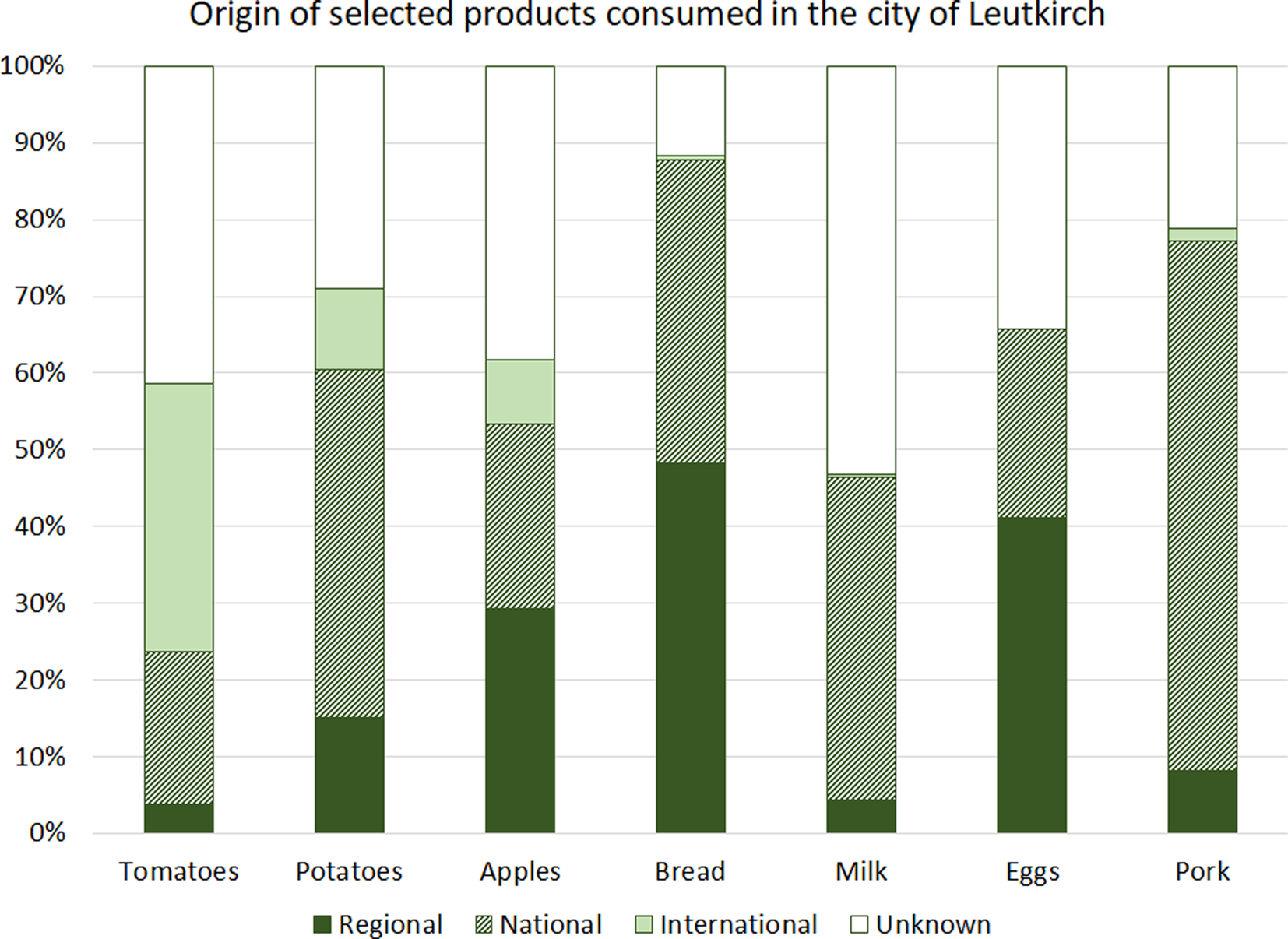
Step 4 of the city food flow analysis allows an in-depth analysis of the origin of the various products by providing a holistic overview of regional shares in consumption. Figures 5 and 6 show this origin (proportions) of selected products for the two the cities. A distinction is made between regional, national and international origin. Since we received no information from the discounters, there is a large proportion of unknown origin (white part of the columns). The Leutkirch figure clearly shows that relatively high proportions of bread, apples and eggs are consumed from regional origins, and that tomatoes, for example, are often produced abroad. In Waldkirch, in addition to apples and eggs, also potatoes are consumed to a high share from regional origins.
Origin of selected products in the city of Leutkirch.
Origin of selected products in the city of Waldkirch.

Beyond this more general overview of origins of food, our analysis allows us to examine the shares of regional products in more detail. Different sales channels have different relevance for different regional products, and this relevance differs between cities. Figure 7 shows, using potatoes and apples as examples, that regional vegetables and fruit are largely marketed via weekly markets and farm shops, with this sales channel playing a more important role in Waldkirch than in Leutkirch. For marketing of regional pork, specialist shops play an important role and, especially in Leutkirch, gastronomy.
Relevance of sales channels for the marketing of regional potatoes, apples and pork in Waldkirch and Leutkirch.

In addition to regional production, actual regional consumption and the role of individual sales channels, the city food flow analysis provides information on factors that determine the proportion of consumption of regional food. The potential regional self-reliance (top row in Table 1), which is often presented as the final result in other studies, provides a first indication. However, this figure does not provide any information as to what proportion of the agricultural products produced in the region are also processed in the region and are available for the regional sales market. Table 1 therefore compares the actual consumption of regional products with the potential regional self-reliance. The ‘effective regional self-reliance’ (last line in Table 1) is derived from this, i.e., this figure shows to what extent the potential of regionally produced products is actually exploited for consumption.
Our new approach of city food flow analysis illustrates one possible approach to explaining the effective regional self-reliance, since the role of the different sales channels is analyzed in detail and the processing and distribution structures in particular are included in the analysis. The first explanatory approach that the analysis can provide concerns the relevance of processing structures in the region: the important role of Leutkirch's gastronomy in the sales of regional meat is supported by the existence of a butcher's shop, which is specialized in regional meat and which particularly supplies the restaurants. A different example is the case of milk and milk products in the same region. Here, the processing businesses (i.e., dairies) are too large for regional milk to be traced. Another explanation for differences between potential and effective regional self-reliance can be found in the structure and characteristics of the sales channels to end consumers. The decision-making structures and the importance decision makers attach to regional products in the individual sales channels play a major role in the design of the product range. Thus, independently managed food markets, even if they are affiliated to larger chains, have more scope for purchasing individually. They can purchase a larger part of their assortment decentrally from regional producers in comparison with centrally organized supermarkets and discounters, which obtain most products from a central distribution platform. Such independently managed food markets can be found in Waldkirch, but not in Leutkirch, which explains the comparably high importance of supermarkets in the former. The third explanatory approach concerns the existence of sales channels such as specialist shops, (weekly) markets and farm shops, specialized in marketing regional products. Direct marketing plays a central role especially for fruit and vegetables, as has been shown for apples, strawberries and asparagus. Such structures can be found in both cities, whereas they are even more frequent in Waldkirch.
Critical reflection of the city food flow analysis
The aim of the methodology presented here is to collect and analyze regional food flow data to increase our understanding of the local food system. This is the basis for changing framework conditions and negotiating with involved actors to make a city's food system more sustainable. The quality of the method must therefore be assessed by the extent to which the results obtained provide a sound basis for such a discussion. This also requires understanding of the underlying assumptions embedded in the method. In the following, we therefore discuss some considerations that should reveal how the nature (and in part, the quality) of the findings from the city food flow analysis are influenced by decisions made by actors and researchers. These decisions have implications for the implementation and results of the analysis, not least for the availability of data, and influence the individual steps and the effort for data collection and analysis.
First of all, it must be clarified with which goal a city food flow analysis should be undertaken. If a city wants to analyze its entire ‘shopping basket’, many products have to be included and the effort of the analysis increases accordingly. Also, a very detailed analysis with high accuracy can only be achieved with very high effort, because every single food flow has to be analyzed. If it is more about the possibility of influencing the local production of certain products, the analysis can be restricted to locally available products. When the interest lies in a basic understanding of food supply structures, it may be useful to include a wide range of foods without going into depth.
After this fundamental clarification of the objective, as mentioned in the section ‘The city food flow analysis method’, the first decision that must be taken is to define the study region, i.e., the city as the place of consumption and the region in which the food is produced. In smaller cities, it is easier to survey a high proportion of companies in the food chain, which increases the reliability of the results. In the studies presented here, we were able to survey 100% of the supermarkets, 40% of the restaurants and about 50% of the specialist shops. In larger cities, such high response rates will be difficult or can only be achieved with a very high effort in data collection. The definition of the region, which is used for the definition of ‘regional product’, is made taking into account both economic criteria and a cultural–emotional component. Applying these criteria involves accepting certain trade-offs. People in a city often think of ‘regional’ in a very narrow sense, only considering a very small region. From the point of view of the market players, especially in processing, distribution and trade, such a narrow definition is often far too small to be integrated in a functioning economic activity. The value chains along which the market players operate and have to work economically extend over a larger region. Furthermore, both consumers and market players usually define ‘regional’ as the place of agricultural production without considering the place of production of the required inputs, e.g., animal feed or fertilizers. Another challenge is the availability of statistical data. For regions that are too small, these are usually not available; moreover, they are usually available following administrative borders, which in turn are not always in line with the perceived definition(s) of ‘region’. Depending on the situation, these incongruities can lead to a significantly higher effort in data collection, for example, if the data of many smaller administrative units have to be summed up instead of having access to the data of a larger area already aggregated in the statistics. In the end, the definition of ‘region’ needs to consider the views and requirements from different stakeholders, while respecting formal limitations from statistics etc.
Another decision, which impacts the significance of the analysis, is about the products to be investigated. If a small number of unprocessed products are chosen, you will be able to go into more detail than if you look at the total basket of goods, which covers the entire food consumption of the population and includes a large number of ingredients within processed products. Here, too, one must consider the statistical data available for the chosen study region, food production and consumption. The data situation (i.e., availability) becomes more complex if processed products are included in the analysis. Even for simply processed products, such as bread or cheese, not all data on production quantities are available at the corresponding level; here one may have to resort to statistical data at a higher level. In our study, for example, it was not possible to identify exactly how much of the milk delivered to the dairies is processed into cheese and other products because we did not receive any data from the dairies. For this reason, we used values from a study that had investigated this for the entire federal state.
In summary, on the basis of our experience in applying the city food flow analysis, we can derive some conclusions that are important for achieving the best possible results: first, early involvement of relevant actors increases the probability of obtaining good data. Relevant actors are entrepreneurs from production, processing plants, supermarkets and other businesses, as well as restaurateurs. On the other hand, representatives of trade associations can also be useful partners, as they can communicate with their members and thus increase the acceptance of the study and the willingness to provide data. Wider networking with different occupational groups and thus also population groups is also a good opportunity to prepare the discussion with the broader population. Secondly, the validity of the data can be increased by data triangulation. This means, for example, interviewing restaurateurs' suppliers to increase the accuracy of the data. A similar approach can be used for specialist shops, e.g., when mills are asked about their supply to bakeries in the city, and bakeries about the origin of the flour used. The representatives of the associations mentioned above also play an important role here, as they can check the plausibility of the preliminary results of the analysis and thus validate them.
Finally, however, it should be noted that the (partly insufficient) availability of data is also a result in itself. In the case of milk, where dairies collect raw milk from catchment areas that are larger than the study region, and where the final product is a composition of raw milk produced by different producers, it is almost impossible to trace the actual origin of the final product. Our study thus showed a connection between the size of the catchment area of a dairy on the one hand, and the resulting difficult or even impossible traceability of the origin of the final milk product. From this, we can conclude that adapted processing structures would be needed for a traceable regional supply of milk. Similarly, we did not receive any data from the discounters on the origin of the food and were only able to make estimates of their role in the regional food supply of the cities. With regard to school catering, we found that it is difficult to obtain all the necessary data if school catering is organized supra-regionally. In our study on Leutkirch, it was not possible to obtain precise information on the quantities and origin of all food in the school menus, as the caterer is a large company producing far away. This limits the scope for influencing menu design. Our analysis has made this incomplete information visible; and this finding points to the fact that a structural change would be necessary for a change in menu design.
Discussion and conclusion
In the concluding section, we summarize what we believe the method developed can contribute to better understanding local food supply systems in a city, what distinguishes it from previous methods and what further developments are conceivable (or useful).
Most previous studies on the regional supply of a city consider the area needed for supplying a city with food without considering the structures of processing and distribution (e.g., Moser and Lüscher, Reference Moser and Lüscher2013; Hönle et al., Reference Hönle, Meier and Christen2016; Joseph, Reference Joseph2016; Cardoso et al., Reference Cardoso, Domingos, De Magalhaes, De Melo-Abreu and Palma2017; Zasada et al., Reference Zasada, Schmutz, Wascher, Kneafsey, Corsi, Mazzocchi, Monaco, Boyce, Doernberg and Sali2017). By applying the city food flow analysis methodology presented here, we learn much more. It allows a deeper insight into the details of the regional food production and supply of a city. It makes it possible to determine the actual food flows from a region into a city and at the same time understand the production, processing, sales and consumption network of a region. This has so far only been attempted by Bätzing and Ermann (Reference Bätzing and Ermann2001).
Our example of applying this method has shown once more that production and consumption in today's food system are largely decoupled from each other. What is produced in the region has little or no effect on local consumption. In Leutkirch, more than twice as much agricultural production area per capita is available than in Waldkirch, and thus for most products a clearly higher potential for a regional food supply would exist. However, higher production potential correlates with higher regional consumption for only a few of the studied products. Even in an identified milk-producing region such as the Allgäu, it is difficult to impossible to consume milk produced regionally in a city such as Leutkirch. The processing structures have grown to a size that makes clear traceability and thus identification as ‘regional’ impossible. This confirms the problem of data availability already mentioned in earlier studies (Carey, Reference Carey2011; Horst and Gaolach, Reference Horst and Gaolach2015) in increasingly complex logistic structures (Miller et al., Reference Miller, Holloway, Perry, Zietlow, Kokjohn, Lukszys, Chachula, Reynolds and Morales2016).
The city food flow analysis does not only enable a detailed analysis of the structures, but also provides valuable building blocks for further discussions on how a city wants to feed itself: actors are named, limitations and potentials for regional supply are identified and thus possible starting points for a more sustainable design of a city's food supply are found. The specific type of data collection, namely numerous interviews with the relevant actors instead of model calculations based on statistical data, initiates processes that connect actors from the market, politics and society. These processes, this bringing together of actors that have so far mostly operated separately from each other, is advantageous for a further discussion on the sustainability of a city's food system. They can form the basis for further cooperation between the actors. The decisive factor is the willingness of central actors to participate in a survey and their effective ability to provide data. Early involvement of relevant actors enables them to help shape the specific research question and thus forms the basis for further discussions and the development of ideas for improving a city's sustainable regional food supply. Beyond pure competition (Ilbery and Maye, Reference Ilbery and Maye2006), new market relations can emerge and trust between the actors (Jarosz, Reference Jarosz2000; Abatekassa and Peterson, Reference Abatekassa and Peterson2011) can be strengthened. For example, the city of Freiburg, for which the first city food flow analysis was carried out, used the results of the study to approach companies along the value chain with positive examples and on this basis to initiate further development toward sustainability. And also in the city of Leutkirch programs were initiated which promote specific actors (e.g., regional producers) in their role for a stronger regional supply of the city. In addition, the publication of such studies and the public debate on the findings provide an opportunity to raise public awareness for the issue. In addition to producers and food industry actors, the demand of consumers in the city also plays a central role. Such public debates in society are therefore urgently needed if we are to move from a policy that sees food and nutrition as a problem of agricultural production alone to a comprehensive food policy. Our approach offers a change of perspective away from ‘food = agriculture’ to a perspective based on consumption and from there on questions of production and all intermediary steps. These cannot be solved with an agricultural policy (for rural areas) alone. With an urban population share of 75%, cities can take on a pioneering role in these processes; here many ideas can be tested and experimented with in a limited (and thus easily accessible) area. A comprehensive urban food policy could consider topics such as health, shopping behavior, food preparation and production in a holistic way and develop (city)region-specific solutions.
A further development of the methodology presented would be useful, above all, with regard to a better integration of aspects of sustainability, since a regional supply does not in itself say anything about the actual level of sustainability of food. This could be undertaken for example, by inquiring not only about the geographical origin of the products, but also whether they are produced in conventional or organic agriculture. However, since exact data are not necessarily available at the regional level, this would in turn include estimates and also increase the effort involved in the stakeholder surveys (above all in gastronomy and grocery stores). If a sustainability analysis of regional supply is added, it will again be very relevant to involve all stakeholders in the discussion to define common goals and fields of action for greater sustainability. By showing the connection between production and consumption patterns and by highlighting the relevance of the various market actors, the city food flow analysis provides a sound basis for the further debate.
Supplementary material
The supplementary material for this article can be found at https://doi.org/10.1017/S1742170520000150.
Acknowledgements
The research was funded by the Federal Ministry of Education and Research (BMBF—Bundesministerium für Bildung und Forschung) within the program Research for Sustainable Development (FONA—Forschung für Nachhaltige Entwicklung; Grant Number 01UR1614A).



