

Introduction
Spatial soil heterogeneity is the major cause of variation in crop fertilizer needs across agricultural landscapes. Soil attributes of importance for soil fertility are dependent upon several natural soil forming processes as well as the historical and current management practices and climatic conditions. Thus, spatial variation in crop yield is the result of spatial and/or temporal variation in edaphic (i.e. soil-related, e.g. organic matter, texture, nutrients etc.), biological (e.g. microorganisms, nematodes etc.), anthropogenic (e.g. irrigation management, leaching efficiency, soil compaction etc.), topographic (e.g. slope, elevation, aspect etc.) and meteorological (e.g. temperature, rainfall, wind etc.) factors (Corwin, Reference Corwin2013). To date, a variety of in situ and on-the-go sensors have been developed to monitor the spatial and temporal variation in soil physical and chemical properties, crop yield and quality, and topography. Data generated from these sensors can be mapped and integrated into decision-making algorithms when implementing site-specific application of fertilizers, irrigation, soil amendments etc. However, less emphasis has been placed on the spatial heterogeneity of soil biological organisms, despite their importance for understanding soil biogeochemical phenomena (Ettema and Wardle, Reference Ettema and Wardle2002).
Soil microorganisms mediate the decomposition of organic materials, nutrient cycling, soil pollutant degradation, and the formation and stability of soil structure (Pankhurst et al., Reference Pankhurst, Doube and Gupta1997). They can also be viewed as soil quality indicators because they adapt to changes in their environment, such as stress due to drought, flooding, substrate shortages and contaminants, and respond rapidly to soil management and land use practices (Doran and Zeiss, Reference Doran and Zeiss2000). Hence, understanding the spatial variability of soil microbial activity is critical to the development of site-specific management practices.
The ultimate goal of this research is to develop a means to characterize intra-field variability of soil biological health and to identify locations where site-specific management of soil biota might improve the profitability and sustainability of crop production. Specifically, the objective was to observe spatial variability of soil micro organisms across an agricultural landscape and relate these observations to soil physical and chemical properties. Another goal was to develop low-cost instrumented systems for assessing soil biological activity in situ.
Materials and Methods
Measuring soil biota using bio-film growth surfaces
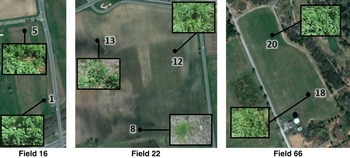
The first study was conducted at three agricultural fields (Field 16, 22 and 66) of the Macdonald Campus Farm, McGill University, Ste-Anne-de-Bellevue, QC, Canada. A mix of alfalfa and brome grass was grown in each field. Prior to the experiment, a DUALEM-21S (DUALEM, Inc., Milton, Ontario, Canada) electromagnetic induction sensor along with a real-time kinematic (RTK) level global navigation satellite system (GNSS) receiver AgGPS 542 (Trimble LLC, Sunnyvale, California, USA) was used to map apparent soil electrical conductivity (ECa) and field topography. Twenty locations in three fields were chosen to represent the entire range of ECa, field topography, including slope and topography wetness index (TWI), and present soil series found in these fields. Out of these twenty points, the locations with the most diverse ECa are shown in Figure 1.
Examples of proximal site images along with the aerial imagery of the three experimental fields in Ste-Anne-de-Bellevue, Quebec, Canada.

Soil samples were collected from the 0–20 cm layer (topsoil) between the alfalfa rows. These samples underwent soil testing for chemical properties (including mineral nitrogen) as well as particle size analysis, soil moisture and organic matter content. For determination of soil biological properties, three sets of polyethylene terephtalate plastic films (Omnia Plastica, Busto Arsizio, Italy) were placed in the rhizosphere zone of the crop. Films were 1×5 cm2 in dimensions and were surface sterilized with 70% ethanol. A set of films was collected three, six and nine days after installation. Population sizes of different groups of microorganisms (bacteria: Bacillius, Azotobacter, Enterobacter, Flavobacterium, Pseudomonas, Rhizobium; fungi: Ascomycota and Zygomycota) were determined according to established protocols (Kordyum et al., Reference Kordyum, Shpylova, Moshynets, Adamchuk-Chala, Irodov and Andriyenko2009; Kopylov, Reference Kopylov2010; Tichonovich and Provorov, Reference Tichonovich and Provorov2011). For total nitrogen-fixing bacteria, population sizes were determined by dilution plating onto Ashby N-free sucrose medium and Dobereiner N-free malate semi-solid medium. For Bacillus, Hino and Wilson N-free liquid medium was used, and a N-free semisolid malate enrichment medium was used for Azotobacter, Kaseras medium with congo red for Enterobacter, Eshbi medium with glucose medium for Flavobacterium, N-free apple agar medium for Pseudomonas and Jensen’s medium for Rhizobium. Enumeration of bacterial colonies was done using the transmission electron microscopy (TEM) using a TESLA BS-540 microscope (Tescan, Brno, Czech Republic).
The aliquots were cultured for fungus on malt agar (MA), Czapek-Dox Agar (CDA), and potato dextrose agar (PDA) media (Kopylov, Reference Kopylov2010). Each morphologically unique fungal colony was sub-cultured on PDA medium and the fungal mycelium was used for DNA isolation. DNA was extracted using the method described by Kopylov, Reference Kopylov2010. PCR amplification of fungal small-subunit rDNA (16 S rRNA gene) was carried out using species-specific primer sets. The PCR product was purified and the 16 S rRNA nucleotide sequence was determined by Applied Biosystems 3130 Genetic Analyzer (Thermo Fisher Scientific, Massachusetts, USA).
The Basic Local Alignment Search Tool (BLAST) distributed by the National Center for Biotechnology Information (NCBI, Bethesda, Maryland, USA) was then used to identify the closest matches between the derived 16 S rRNA gene query sequences and those contained in the GenBank database.
The rate of microbial growth on the film surfaces was then estimated and related to soil physical and chemical properties as well as vegetation coverage. At the time of the installation of the film, proximal digital imagery of each site was taken and vegetation coverage was determined using the excess green index (Woebbecke et al., Reference Woebbecke, Meyer, Von Bargen and Mortensen1992).
Soil respiration measurement systems
Since the bio-film was laborious and expensive and since the microbial populations consist of active and dormant cells at various life stages, it would be more useful to develop a high-density measurement system to assess the near-surface soil biological activity. This led to the next investigation to develop a portable instrumented system to measure soil respiration. Soil respiration measurement is a good indicator of microbial activity in environmental studies of contaminated sites and, less often, in agricultural applications. There exist various methods for measuring and quantifying soil respiration, mostly relying on carbon dioxide detection.
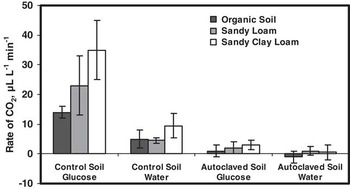
In a study described by Kaur et al. (Reference Kaur, Adamchuk, Whalen and Ismail2015), a low-cost Non Dispersive Infrared (NDIR) CO2 Engine® K30 (SensorSenseAir, Delsbo, Gävleborg, Sweden) was used. The glucose solution was added to the soil surface and sensor response was linked to the change of CO2 concentration under constant pressure inside the chamber. One of the experiments used to evaluate this method was to compare sensor response when measuring unaltered soil and autoclaved soil while adding water with, and without, glucose.
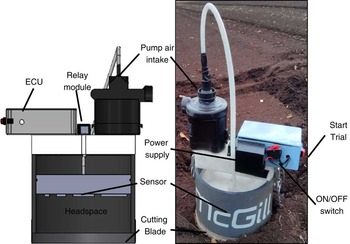
As an alternative to substrate induced respiration, another instrumented system, Rapid Soil CO2 Analyzer (RSCA), was developed using the same NDIR CO2 sensor (Figure 2). It was aimed at providing a faster alternative to closed static chambers and a less expensive option than the closed dynamic and open chambers (Reumont and Adamchuk, Reference Reumont and Adamchuk2016). The working principle shifted from passive air diffusion inside the chambers to forced extraction by the creation of negative pressure in the headspace. The RSCA reads and logs short-term point-source measurements of CO2 concentrations, temperature, humidity, and pressure in the headspace, as well as the location and time from the start of the trial.
Prototype Rapid Soil CO2 Analyzer (RSCA) system.

The current version of the RSCA was built using a 20.3-cm diameter 15.6-cm high cylinder. The exterior of the cylinder was fitted at the bottom with a 2.5 cm metal cutting blade for soil penetration and seal. A delrin plastic wheel was installed and sealed 7.5 cm from the bottom of the PVC cylinder to create an enclosed headspace inside the chamber. The delrin plate was used to mount the CO2 sensor. In addition, the system was equipped with a DHT11 (Aosong Electronics Co., Ltd, Tenhe Town, Guangzhou, China) air temperature and relative humidity sensor, a Paralax ping ultrasonic sensor (Parallax, Inc., Rocklin, CA, USA) measuring actual head space, and a BMP-180 pressure sensor (Robert Bosch GmbH, Gerlingen, Germany). The headspace of the chamber also houses a fan for air mixing as well as a sampling tube for air sampling. An 8-mm tube linked the headspace and the air pump (Intexcorp, Long Beach, California, USA). This allowed for the creation of negative pressure inside the headspace. The electronic control unit (ECU) integrated with a GPS chip was used to control the measurement cycle, record sensor data as well as the geographic coordinates. During each measurement cycle, CO2 sensor response was modeled as the first-order response system and the estimated increase in CO2 concentration was linked to the combination of factors affecting the accessible soil-air enriched with CO2 released through the activity of soil microorganisms.
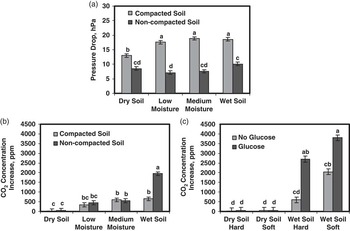
A number of tests were undertaken. As an example, a controlled experiment was carried out to determine the ability of RSCA to distinguish changes in CO2 stores in soil pores affected by soil water content, compaction and the addition of glucose. Thus, four large containers were filled with almost 200 kg of sandy loam soil. These containers represented four treatment combinations: dry and compacted, dry and non-compacted, wet and compacted and wet and non-compacted. After the initial set of measurements using RSCA, a glucose solution was added to stimulate biological activity and the same set of measurements was repeated.
Results
Measuring soil biota using bio-film growth surfaces
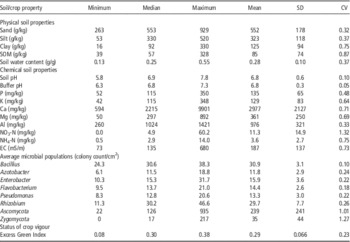
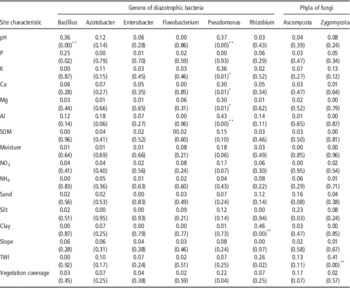
As shown in Table 1, the 20 locations in three agricultural fields presented diverse soil conditions in terms of physical, chemical and biological characteristics. However, relationships between microbial population and soil/plant properties were insignificant (Table 2). Relatively weak correlations were found for Bacillius (with pH), Pseudomonas (with pH and other cations, and Al), and Rhizobium (with percent clay). Through a more detailed location-by-location analysis, it was observed that relatively low field areas susceptible to water ponding (e.g., sampling location 8) had generally weaker vegetation coverage, as well as a lower number of bacteria colonies. The opposite trend was observed in well-drained medium texture soils (e.g., sampling location 12), which also had healthy, vigorous plant growth and high vegetation coverage.
Descriptive statistics of all sampling sites

Coefficient of determination and p-value (in parenthesis) for simple linear regressions between microorganism population increase and measured site characteristics

* p<0.01, ** p<0.001
Soil respiration measurement systems
According to Figure 3, substrate-induced respiration can also be an effective means to identify soil with relatively low biological activity. Naturally, adding water to dry soil intensifies soil respiration. However, the presence of glucose intensifies the soil respiration significantly. Also, it should be noted that soil organic matter interacts with the effect of substrate induced respiration and will need to be considered as a co-factor in future analysis.
Results of substrate induced soil respiration measurement approach using three soil types. Error bars indicate standard deviation.

Figure 4 illustrates the results of RSCA evaluation. It can be seen that soil compaction caused resistance to the RSCA’s ability to extract soil air, which was indicated by the increase in pressure drop. This was relatively consistent across different levels of soil moisture. Soil moisture was one of the key factors related to a significantly higher increase in CO2 concentration. As expected, this increase was further enhanced after the addition of substrate (glucose). Using the three-way ANOVA, all individual factors as well as the moisture × compaction and moisture × glucose interactions were found to be significant at p<0.05. The compaction × glucose interaction and the three-way interactions of moisture × compaction × glucose were not significant (p>0.05).
Results of RSCA evaluation, including a) mean pressure drop for the four moisture levels for each of the two compaction levels, b) mean CO2 concentration increase for the four moisture levels for each of the two compaction levels, and c) mean CO2 concentration increase for the wet and dry treatments at both compactions levels (hard and soft) and with or without added glucose. Means sharing the same letter do not differ significantly at the 95% confidence level based on the Tukey mean comparison method.

Conclusion
Spatial and temporal variability of soil biological health related to the dynamics and activity of microorganisms is of growing interest to the precision agriculture community. Our studies confirm that soil microbial abundance changes significantly across an agricultural landscape and is correlated to several factors that are traditionally included in decision-making tools for site-specific crop management. Because of the complexity of interactions between physical, chemical and biological processes, modeling these dynamics is a very difficult task. As a short term solution, our proposition is to map soil respiration using either extracted soil air or a substrate induced approach. The experimental results to date show that the prototype system responds to the expected effects of the imposed treatments. Field scale mapping using our prototype Rapid Soil CO2 Analyzer is the next step in this research.
Acknowledgements
This research was supported in part by funds provided through the National Science and Engineering Research of Canada (NSERC) Discovery Grant, Agriculture and Agri-Food Canada (AAFC) Agricultural Greenhouse Gases Program (AGGP), and Science and Technology Center in Ukraine (STCU).