Anomalous single coronary artery from the pulmonary artery is a very rare congenital anomaly and life-threatening condition including myocardial infarction, ischemia, congestive heart failure, and sudden death in infants. Anomalous single coronary artery from the pulmonary artery has high mortality rates and poor surgical outcome despite advanced surgical techniques. We report a rare case of an anomalous single trunk coronary arteries arising from pulmonary artery in an infant.
Case report
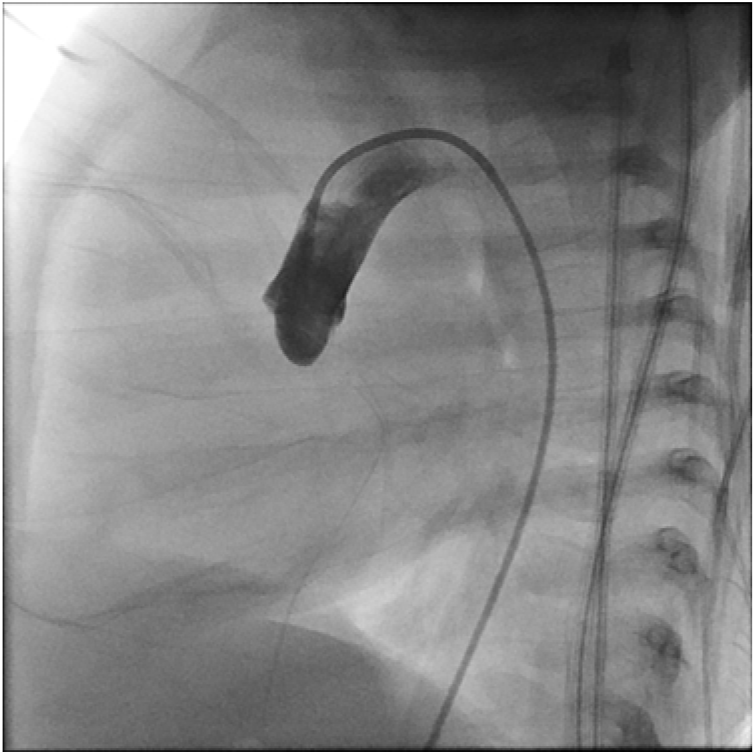
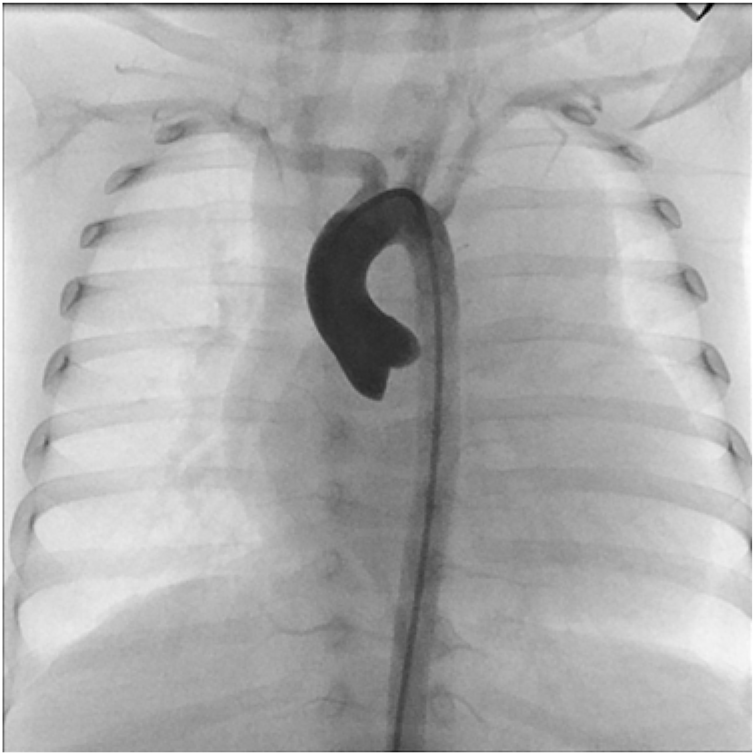
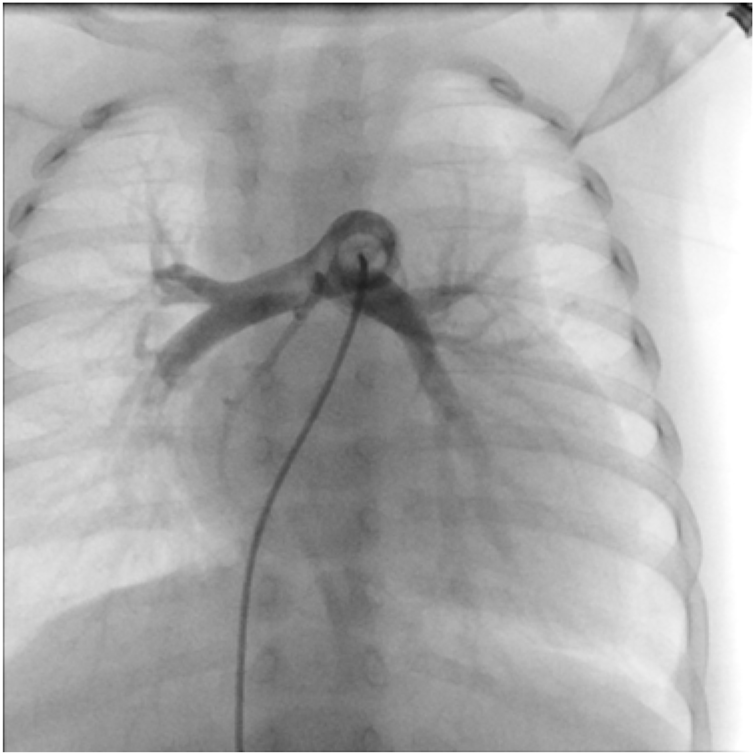
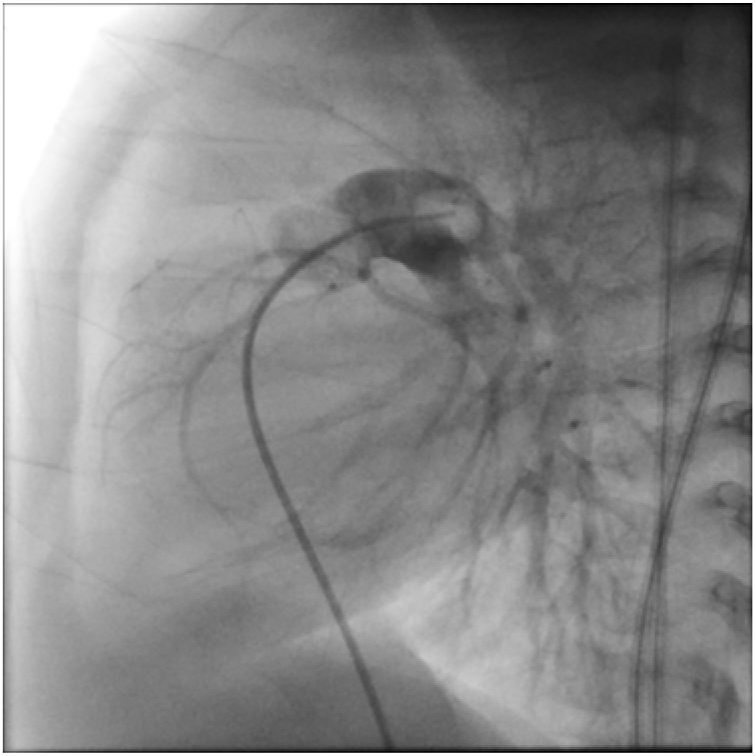
A 4-month-old female infant was referred to our department with the symptoms of poor/interrupted feeding, vomiting, and shortness of breath. She had history of cough and diagnosed with acute bronchiolitis in another centre. In physical examination, the patient had mild cyanosis and congestive heart failure with tachypnea, hepatomegaly, weak arterial pulses, gallop rhythm, and III/VI systolic ejection murmur best heard at the apical area. The chest radiograph showed gross cardiomegaly. On echocardiography, dilatation and severe systolic dysfunction of left ventricle, severe mitral regurgitation, and increased echogenicity of papillary muscle and endocardium were observed. Left main coronary artery was seen between the aorta and pulmonary artery and looked like originated from the pulmonary artery. She was transferred to ICU with a prediagnosis of anomalous left coronary arteries origin from pulmonary artery. Fluid resuscitation with inotropes was started. On the second day of admission, after the improvement of the general condition of the patient partially, coronary angiography was performed. She had a mean pulmonary pressure of 33 mmHg on right heart catheterisation and the aortography showed no coronary arteries clearly originated from the aortic sinus. (Figs 1 and 2) On pulmonary artery angiogram, anomalous origin of the single trunk coronary arteries was noted, arising from the proximal right pulmonary artery. (Figs 3 and 4) Surgical correction with reimplantation of the single trunk coronary arteries into the aorta was performed at fourth day of the admission. The right pulmonary artery was reconstructed with bovine pericardium. Weaning from the cardiopulmonary bypass was unsuccessful and required extracorporeal membrane oxygenation and inotropic support. On post-operative echocardiographic follow-up, there was no improvement in left ventricular function. She showed no recovery and died on day 49 of the extracorporeal membrane oxygenation.
Lateral aortic angiography showing no coronary orifice.

Aortic root angiogram in anterior posterior view showing no coronary orifice.

Anomalous single trunk coronary artery arising from right pulmonary artery.

Pulmonary angiography in lateral view.

Discussion
Anomalies of the coronary arteries are a very rare condition in the paediatric population, seen in 0.2–1.4% of in the general population. Reference Grabowski, Karolczak, Zacharska-Kokot, Madry and Pajak1 Among the abnormal origin of coronary arteries from pulmonary artery, anomalous single trunk coronary artery from the pulmonary artery is the least seen group in which both left and right coronary artery originate from pulmonary artery as a single ostium. Reference Heifetz, Robinowitz, Mueller and Virmani2,Reference Januszewska, Kehl and Malec3 Anomalous origin of coronary arteries from pulmonary arteries are usually sporadic anomaly, but may present with other congenital heart defects as single ventricle physiology, atrial septal defects, ventricular septal defects, coarctation of aorta, tetralogy of Fallot, or pulmonary atresia. Reference Heifetz, Robinowitz, Mueller and Virmani2–Reference Kayalar, Burkhart, Dearani, Cetta and Schaff5 It may be asymptomatic or presenting with poor feeding and insufficiency in weight gain in the first days of neonatal period. Reference Machovec, Taicher, Jaquiss and Hill6 Symptoms can be seen with pulmonary vascular resistance fall with the increase in shunt to the lung and cause of coronary stealing. Reference Machovec, Taicher, Jaquiss and Hill6 Anomalous single coronary artery from the pulmonary artery causes myocardial ischemia, ventricle systolic dysfunction, arrhythmia, and sudden cardiac death in infancy. Association with another lesions affects the onset time of symptoms, survive, and prognosis of patients. Reference Heifetz, Robinowitz, Mueller and Virmani2,Reference Santoro, di Carlo and Carotti4 To see the findings of impaired ventricular systolic function, cardiomegaly and various degree of atrioventricular valve failure in the echocardiography and anomalous coronary artery from the pulmonary artery should be considered in the neonatal periods. Reference Karimi, Hulsebus and Lutin7 CT angiography, MRI, or coronary angiography should be performed in cases suspected of anomalous coronary artery from the pulmonary artery with echocardiography. Reference Grabowski, Karolczak, Zacharska-Kokot, Madry and Pajak1 Coronary arteries cannot be visualised with aortic root contrast injection in the coronary angiography, and anomalous single coronary artery from the pulmonary artery is diagnosed when a single orifice of coronary arteries is seen with the pulmonary artery contrast injection. Urgent surgical coronary artery reimplantation should be planned immediately after diagnosis. Prostaglandin and inotropic support may be initiated for the stabilisation of patient in the neonatal period until surgery. Reference Karimi, Hulsebus and Lutin7 In the follow-up period after surgical correction, stenosis or thrombotic problems should be evaluated. Reference Grabowski, Karolczak, Zacharska-Kokot, Madry and Pajak1
In our patient, we suspected coronary anomaly on echocardiographic findings and decided to perform coronary angiography for definite diagnosis. After angiography proven diagnosis, she underwent surgery, but due to late presentation and impaired systolic function, extracorporeal membrane oxygenation was needed after the surgical correction. These coronary anomalies are known to have higher mortality rates inspite of advanced surgical techniques and procedures. Unfortunately, our patient showed no recovery and died on day 49 of the extracorporeal membrane oxygenation.
Author ORCIDs
Yasemin Donmez 0000-0002-4689-5888
Acknowledgements
None.
Financial Support
None.
Conflicts of Interest
None.
Ethical Standards
The authors assert that this report consents with the ethical principle of the declaration of Helsinki.