Introduction
Total anomalous pulmonary venous drainage is a rare congenital cardiac anomaly characterised by the abnormal connection of the pulmonary veins, which typically connect to the left atrium, to the right atrium, or its tributaries.Reference Zhu, Qi and Jin1 Despite advances in relevant surgical techniques, diagnostic accuracy, and perioperative management, there has historically been limited improvement in total anomalous pulmonary venous drainage-related morbidity and mortality rates.Reference Schulz, Wu and Ishigami2–Reference Shi, Zhu and Chen6
Pulmonary venous obstruction emerged as primary causes of late mortality following surgical repair of total anomalous pulmonary venous drainage.Reference Xia, Ma and Ge3,Reference Yong, Yaftian and Griffiths5,Reference Sughimoto, Miyaji and Oka7,Reference Yanagawa, Alghamdi and Dragulescu8 The incidence of pulmonary venous obstruction, the most severe complication after surgical repair of total anomalous pulmonary venous drainage, has been reported between 5 and 18%.Reference Zhu, Qi and Jin1,Reference Xia, Ma and Ge3,Reference Morozov, Movsesyan and Latypov9 Emerging surgical repair methods, characterised by less manipulation of the pulmonary veins and the application of primary pericardial anastomosis, have contributed to the decrease in the incidence of recurrent pulmonary venous obstruction, reducing reoperation and mortality rates.Reference Schulz, Wu and Ishigami2,Reference Shi, Zhu and Chen6,Reference Shi, Zhu and Wen10 Nevertheless, mortality rates associated with total anomalous pulmonary venous drainage, which range from 9 to 30% depending on the general health status of neonates, are still far above acceptable levels.Reference Schulz, Wu and Ishigami2,Reference Xia, Ma and Ge3,Reference Yong, Yaftian and Griffiths5,Reference White, Ho and Faerber11,Reference Harada, Nakano and Oda12
Considering the high pulmonary venous obstruction rates after surgical repair of total anomalous pulmonary venous drainage using conventional repair techniques, the Toronto Group proposed a new sutureless repair technique.Reference Shi, Zhu and Chen6,Reference Caldarone, Najm and Kadletz13,Reference Kalfa, Belli and Bacha14 The primary technical advantages of sutureless repair technique are considered the avoidance of mechanical stimuli to individual pulmonary veins and lateralisation of the suture line away from the confluence edge of the pulmonary veins.Reference Shi, Zhu and Wen10,Reference Lo Rito, Gazzaz and Wilder15 However, while some studies have reported that using sutureless repair technique for total anomalous pulmonary venous drainage leads to better surgical outcomes, others have not found a significant difference between sutureless repair technique and conventional repair techniques.Reference Shi, Zhu and Chen6,Reference Lo Rito, Gazzaz and Wilder15–Reference Yun, Coles and Konstantinov18 While several studies.Reference Schulz, Wu and Ishigami2,Reference Yong, Zhu and d’Udekem4,Reference Sughimoto, Miyaji and Oka7 have compared these techniques, most are limited by small sample sizes, heterogeneous total anomalous pulmonary venous drainage types, or varying surgical expertise levels, leading to conflicting results in literature. Our study addresses this knowledge gap by providing a comprehensive analysis of both techniques from a high-volume centre with standardised surgical approaches and systematic follow-up protocols. Despite advances in surgical techniques, there remains limited comparative data on outcomes between conventional and sutureless repair approaches, particularly regarding post-operative complications and long-term results. This study addresses this knowledge gap by analysing a decade of surgical outcomes, providing valuable insights into the relative efficacy of these techniques.Reference Zhu, Qi and Jin1
In view of the foregoing, this study was carried out to assess and compare the morbidity, particularly pulmonary venous obstruction, and mortality outcomes of conventional repair technique and sutureless repair technique in children with total anomalous pulmonary venous drainage.
Materials and methods
Ethical statement
This study was designed as a retrospective single-centre study. The study protocol was approved by the local ethical committee (Decision No: 2022.04.27). The study was conducted in accordance with the principles outlined in the Declaration of Helsinki. Due to the retrospective design and unanimity of data, written informed consent could not be obtained from the patient’s legal guardians.
Population and sample
The study population consisted of consecutive children who underwent surgical treatment for isolated total anomalous pulmonary venous drainage using conventional repair technique or sutureless repair technique at the University of Health Sciences, Mehmet Akif Ersoy Thoracic and Cardiovascular Surgery Training Research Hospital, Department of Cardiovascular Surgery, Istanbul, Turkey, between 2012 and 2022. Patients with incomplete data, patients who underwent combined total anomalous pulmonary venous drainage, and patients with single ventricles and additional complex cardiac anomalies were excluded from the study.Reference Schulz, Wu and Ishigami2 In the end, the study sample consisted of 99 patients. The patients included in the sample were divided into two groups according to the surgical repair technique applied to them: those who underwent conventional repair technique (Group C, n = 58) and those who underwent sutureless repair technique (Group S, n = 41).
Surgical technique
The surgical procedures were performed using blood/crystalloid cardioplegia for cardiac arrest. Moderate hypothermia (28.9 ± 3.5°C) was preferred during conventional repair technique to provide extended safe circulatory arrest times and enhanced neuroprotection during complex anastomoses. Mild hypothermia (33.5 ± 1.1°C) was utilised during sutureless repair technique, as the technique allows shorter bypass times and the wider surgical field of the sutureless technique reduces the need for deeper cooling.Reference Xia, Ma and Ge3,Reference Harada, Nakano and Oda12
In conventional repair technique, a direct side-to-side anastomosis was performed between the pulmonary venous confluence and the left atrium after careful dissection of the pulmonary veins.Reference Schulz, Wu and Ishigami2,Reference Xia, Ma and Ge3,Reference Zhang, Ou and Zhuang16,Reference Lacour-Gayet19 The anastomotic line was placed at the edge of the pulmonary venous confluence. For sutureless repair technique, the posterior pericardium was left intact around the pulmonary venous confluence, and an atriopericardial anastomosis was created by suturing the left atrial wall to the pericardium approximately 2–3 mm away from the edge of the pulmonary veins, avoiding direct suture placement on the veins themselves.Reference Xia, Ma and Ge3 The decision as to which of conventional repair technique or sutureless repair technique would be used in the patients was at the attending physician’s discretion.
Data collection
Patients’ demographic characteristics, that is, age, gender, and weight, pre-operative clinical findings, that is, saturation and need for intubation, and echocardiographic findings, that is, ventricular dysfunction, fractional shortening, and pulmonary artery pressure were obtained from the hospital’s information system and recorded. Pre-operative pulmonary venous obstruction was diagnosed based on echocardiographic evidence of elevated Doppler gradients (>2 mmHg) across the pulmonary veins and/or structural narrowing identified on CT. Post-operative pulmonary venous obstruction was defined similarly, incorporating echocardiographic assessment during the first post-operative week and before discharge. Imaging findings obtained via CT as well as invasive catheterisation characteristics, that is, anatomical details of the cardiac structures, including pulmonary veins and obstructive pathology of pulmonary veins, and the subtypes of total anomalous pulmonary venous drainage determined according to the criteria described by Chowdhury et al.Reference Chowdhury, Malhotra and Kothari20 were recorded.
Intraoperative details were noted, including duration of surgery, and post-operative outcomes, that is, complications, need for interventions, and length of hospital stay. Post-operative complications that developed within 30 days of surgery or before discharge from the hospital were considered early/in-hospital complications.Reference Schulz, Wu and Ishigami2,Reference Li, Meng and Zhang21 Post-operative pulmonary venous obstruction was defined as echocardiographic evidence of mean pressure gradient >4 mmHg across the pulmonary venous pathway, or flow velocity >2 m/s at the pulmonary venous anastomosis site, confirmed by clinical symptoms of pulmonary venous congestion when present.Reference Xia, Ma and Ge3,Reference Kalfa, Belli and Bacha14
Echocardiographic examinations were performed to evaluate the severity of pulmonary venous obstruction, pulmonary hypertension, and the degree of insufficiency in the mitral and tricuspid valves as part of the first-week examination of all patients who survived the surgery.
Pulmonary venous obstruction was defined based on the clinical and echocardiographic findings described previously. The diagnosis of pulmonary hypertension was performed if the mean pulmonary arterial pressure was more than 25 mmHg.Reference Xia, Ma and Ge3
Similarly, we also noted the rate of early/in-hospital mortality during the first post-operative 30 days.
Statistical analysis
The study’s primary outcome was the rate of early/in-hospital complications in Groups C and S. The comparison of the groups regarding survival outcomes was the secondary outcome.
In this study, we examined the morbidity and mortality outcomes of children undergoing conventional repair technique and sutureless repair technique for total anomalous pulmonary venous drainage. Our approach to statistical analysis focused on evaluating these outcomes with respect to various factors such as surgical technique employed, demographic characteristics, and post-operative complications. We utilised a combination of statistical tests to assess the distribution and significance of our findings. Continuous variables that followed a normal distribution were described using mean and standard deviation, while those not adhering to normality were reported as medians with their respective ranges. Categorical variables were summarised as frequencies and percentages.
For the comparative analysis, continuous variables were tested for normality using Shapiro–Wilk test. Mann–Whitney U test was used for non-normally distributed continuous variables, while Pearson’s chi-square and Fisher’s exact tests were applied for categorical variables. Notably, the Fisher–Freeman–Halton extension of the Fisher’s exact test was applied to assess the differences in categorical outcomes across more than two groups, which was particularly relevant for our multifaceted analysis.
Statistical analyses were performed using Jamovi (Version 2.3.28, The Jamovi Project, 2023, https://www.jamovi.org) and JASP (Version 0.19.2, Jeffreys’ Amazing Statistics Program, 2024, https://jasp-stats.org). This choice of software allowed us to conduct a detailed and precise analysis, adhering to a significance level of p ≤ 0.05 to discern statistically meaningful differences.
Our analysis showed similar morbidity and mortality outcomes for paediatric total anomalous pulmonary venous drainage patients treated with either conventional repair technique or sutureless repair technique.
Post hoc power analysis was performed using G*Power 3.1.9.7 software for post-operative pulmonary venous obstruction rates (21.2% versus 19.0%). With our sample size of 99 patients (Group C = 58, Group S = 41), α = 0.05, and effect size of 0.022, the achieved power was 95% for detecting differences between groups using Fisher’s exact test.
Results
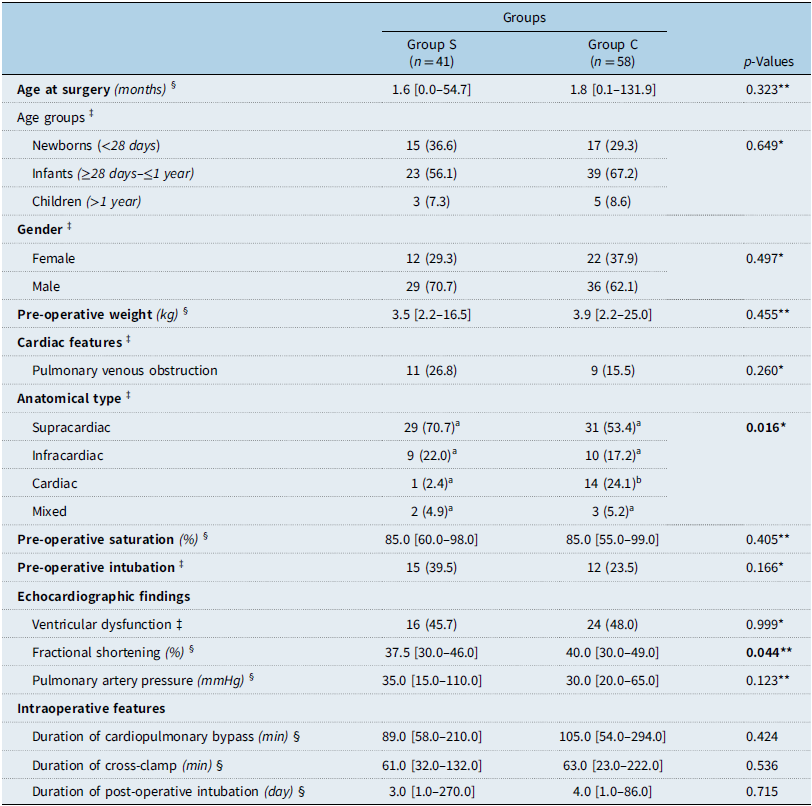
The study sample consisted of 99 children, 58 in Group C and 41 in Group S. The median age of Group C was 1.8 months, and Group S was 1.6 months. There was no significant difference between the groups in age (p = 0.323), age groups (p = 0.649), and gender (p = 0.497). The rate of pulmonary venous obstruction was higher, albeit not significantly, in Group S than in Group C (26.8% versus 15.5%, p = 0.260). Supracardiac total anomalous pulmonary venous drainage, observed in 53.4% and 70.7% of the cases in Group C and Group S, respectively, was the most common type of total anomalous pulmonary venous drainage in the sample. There was a significant difference in anatomical total anomalous pulmonary venous drainage types between the groups (p = 0.016). The post hoc analysis revealed that the significant difference in anatomical total anomalous pulmonary venous drainage types between the groups resulted from the rate of patients with cardiac total anomalous pulmonary venous drainage being significantly higher in Group C than in Group S. There was no significant difference between the groups in other baseline clinical characteristics (p > 0.05) (Table 1).
Demographics and baseline clinical characteristics and intraoperative features of the study groups

Note: The ‡ symbol denotes data presented in number and percentage format (n (%)), indicating categorical variables. The § symbol signifies values presented as median and range [Minimum–Maximum], used for continuous variables. Statistical significance across groups is evaluated using. *Pearson’s chi-square/Fisher–Freeman–Halton tests for categorical data, and. **Mann–Whitney U test for continuous data. Distinct superscripts (a, b) within the same row signify statistical differences between groups, whereas identical superscripts indicate no statistical difference.
The distribution of patients’ pre-operative echocardiographic and imaging findings by the study groups is given in Table 1. There was a significant difference in the fractional shortening values between the groups (p = 0.044). The median pulmonary artery pressure was 30.0 mmHg in Group C and 35.0 mmHg in Group S (p = 0.123).
There was no significant difference in perioperative metric data, including duration of cardiopulmonary bypass, aortic cross-clamping, and post-operative intubation, between the groups (p > 0.05)
There was no significant difference in perioperative metric data between the groups. Median cardiopulmonary bypass time was 105 minutes in Group C versus 89 minutes in Group S (p = 0.424), and median cross-clamp time was 63 minutes versus 61 minutes, respectively (p = 0.536). Post-operative pulmonary venous obstruction occurred in 21.2% of Group C versus 19.0% of Group S patients (absolute difference: 2.2%, p = 0.809) (Table 1).
The comparison of patients’ post-operative echocardiographic findings by the study groups revealed that the rate of pulmonary venous obstruction was higher, albeit not significantly, in Group C than in Group S (21.2% versus 19.0%, p = 0.809). There was also no significant difference in the distribution of the post-operative pulmonary venous obstruction between the groups (p = 0.359) (Fig. 1). The other echocardiographic findings, including pulmonary hypertension, mitral and tricuspid insufficiency, were similar in the groups (p = 0.404, p = 0.743, and p = 0.116, respectively).
This histogram illustrates the degree of pulmonary venous obstruction (PVO) in two post-operative groups (Group S and Group C) during the first week, showing the distribution of mild, moderate, and severe PVO with corresponding patient numbers and percentages for each group.

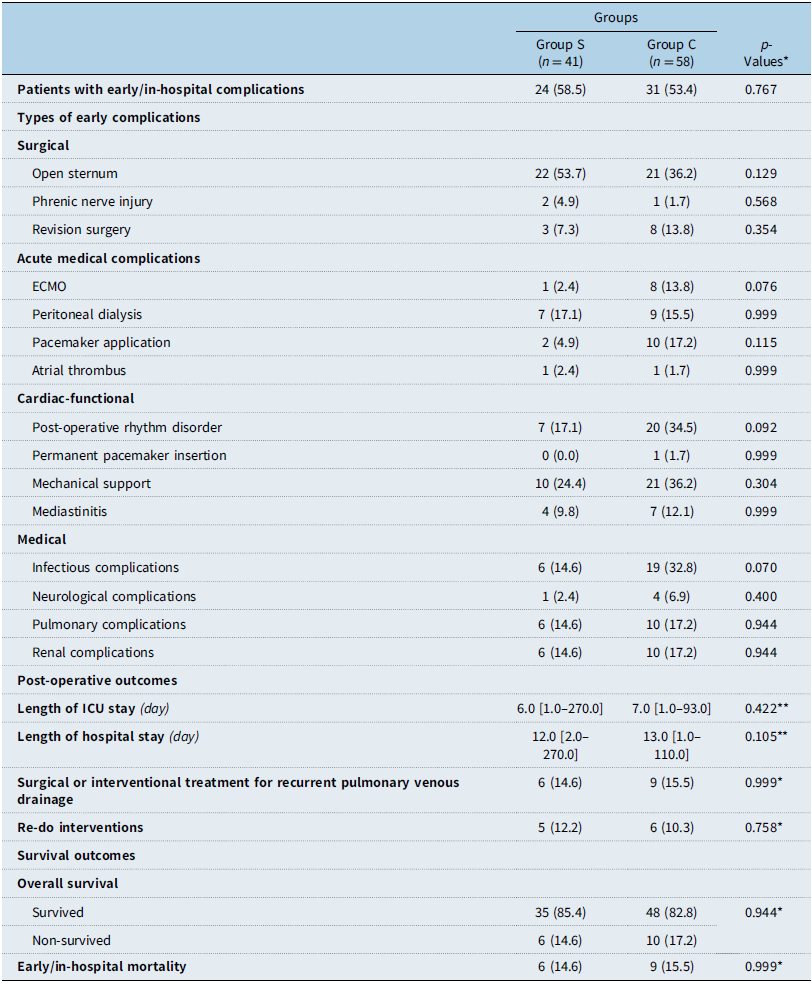
The rates of early/in-hospital complications were 58.5% and 53.4% in Groups S and C. Although the proportion of patients with early/in-hospital complications was higher in Group S than those in Group C, the difference was insignificant (p = 0.767). There was no significant difference in distribution of early/in-hospital complications between the groups (p < 0.05) (Table 2).
Distribution of post-operative early/in-hospital complications and survival outcomes

Note: The data are expressed in number and percentage format (n (%)) to illustrate the prevalence of each complication type within the groups. The statistical analysis for identifying significant differences between groups is conducted using the. *Pearson’s chi-square, Fisher’s exact, or Fisher–Freeman–Halton tests, which are appropriate for comparing categorical data across the study groups, thus facilitating a comprehensive understanding of the incidence and types of complications following surgery. The length of stays in the ICU and hospital are expressed as median and range [Minimum - Maximum], analysed using the. **Mann–Whitney U test.
The groups were similar regarding the lengths of ICU and hospital stay, and post-operative interventions (p > 0.05). The mortality rate was higher, albeit not significantly, in Group C than in Group S (17.2% versus 14.6%, p = 0.944).
Discussion
In this retrospective analysis of 99 children who underwent total anomalous pulmonary venous drainage repair, we found comparable outcomes between conventional and sutureless techniques in terms of mortality and post-operative complications. Our analysis demonstrated that despite variations in total anomalous pulmonary venous drainage types and intraoperative management strategies between groups, both techniques achieved similar safety and efficacy profiles. These findings contribute to the ongoing debate regarding optimal surgical approach for total anomalous pulmonary venous drainage repair, particularly given recent literature suggesting potential advantages of sutureless repair technique in reducing post-operative complications. These findings align with recent debates in the literature regarding the optimal surgical technique, where some studies report advantages with sutureless repair technique while others demonstrate comparable outcomes between techniques, suggesting that surgical approach selection may need to be individualised rather than standardised across all cases.Reference Lo Rito, Gazzaz and Wilder15,Reference Thanh, Giau and Huong22,Reference Qiu, Liao and Xiao24
In a systematic review and meta-analysis, Thanh et al.Reference Thanh, Giau and Huong22 concluded that sutureless repair technique is a superior technique, as it reduces the risks of early mortality, overall mortality, post-operative pulmonary venous obstruction, and reoperation rates more than conventional repair. Similarly, several other studies reported lower post-operative pulmonary venous obstruction rates using sutureless repair technique for total anomalous pulmonary venous drainage compared to conventional repair technique.Reference Lo Rito, Gazzaz and Wilder15,Reference Qiu, Liao and Xiao24 In parallel, Shi et al.Reference Shi, Zhu and Chen6,Reference Shi, Zhu and Wen10 reported significantly higher post-operative pulmonary venous obstruction rates in children with total anomalous pulmonary venous drainage, except for newborns and children with intracardiac total anomalous pulmonary venous drainage, with the use of sutureless repair technique compared to the use of conventional repair technique.
In contrast, a study that used MRI to diagnose the long-term prevalence of pulmonary venous obstruction in surgically repaired total anomalous pulmonary venous drainage patients found no significant difference between conventional repair technique and sutureless repair technique in the risk of post-operative pulmonary venous obstruction.Reference Tremblay, Yoo and Mertens17 Again, several other studies found no significant difference between two techniques in terms of post-operative mortality, pulmonary venous obstruction, and reoperation rates.Reference Zhu, Qi and Jin1,Reference Yanagawa, Alghamdi and Dragulescu8,Reference Shentu, Shi and Zhang23 Along these lines, Zhu et al.Reference Zhu, Qi and Jin1 found no significant difference between conventional repair technique and sutureless repair technique in terms of length of ICU stay and post-operative pulmonary venous obstruction rate, suggesting that both techniques have comparable short-term post-operative outcomes. In comparison, we also found no significant difference between two techniques in terms of post-operative outcomes. However, it is important to note that including patients with all types of total anomalous pulmonary venous drainage might have acted as a confounding factor. Therefore, large-scale prospective studies are needed to determine the optimum surgical treatment for total anomalous pulmonary venous drainage.
It has been reported that sutureless repair technique effectively decreased the post-operative pulmonary venous obstruction rate.Reference Xia, Ma and Ge3,Reference Shi, Zhu and Chen6 Post-operative pulmonary venous obstruction of varying severity, particularly after the repair of total anomalous pulmonary venous drainage, has been reported in approximately 7 to 21% of the patients.Reference White, Ho and Faerber11,Reference Caldarone, Najm and Kadletz13–Reference Lo Rito, Gazzaz and Wilder15,Reference Tremblay, Yoo and Mertens17,Reference Kai, Xiaoyang and Jinghao25 In comparison, in this study, approximately one-fifth of the patients treated with either sutureless repair technique or conventional repair technique developed pulmonary venous obstruction. Unlike some other studies,Reference Tremblay, Yoo and Mertens17 the fact that we did not find any advantage of sutureless repair technique over conventional repair technique may be due to the differences between the characteristics of the patient populations of this study and those studies.
Given its challenging anatomical and physiological features, it has been suggested that intracardiac total anomalous pulmonary venous drainage is the total anomalous pulmonary venous drainage type with the poorest post-operative outcomes.Reference Lacour-Gayet26 In parallel, various studies reported intracardiac total anomalous pulmonary venous drainage as a significant risk factor for post-operative pulmonary venous obstruction.Reference Shi, Zhu and Chen6 On the other hand, a study on patients with different types of total anomalous pulmonary venous drainage did not find any significant difference between the patients in terms of post-operative outcomes, regardless of the type of surgical technique used to repair total anomalous pulmonary venous drainage.Reference Li, Meng and Zhang21 While we did not categorise post-operative outcomes by the anatomical type of total anomalous pulmonary venous drainage, we advocate that sutureless repair technique can be applied to all total anomalous pulmonary venous drainage patients, considering the anatomical diversity of total anomalous pulmonary venous drainage.
Zhang et al.Reference Zhang, Ou and Zhuang16 reported that sutureless repair technique improved the survival and post-operative pulmonary venous obstruction rates compared to conventional repair technique, particularly in patients with pre-operative pulmonary venous obstruction. They found no significant difference in efficacy between the two techniques in patients without pre-operative pulmonary venous obstruction. However, they found that conventional repair technique was a poor risk factor for mortality and post-operative pulmonary venous obstruction after adjusting for the type of total anomalous pulmonary venous drainage and pre-operative pulmonary venous obstruction. In comparison, in this study, since there was no significant difference between the study in pre-operative and post-operative pulmonary venous obstruction rates, we did not analyse the impact of pre-operative pulmonary venous obstruction on the surgical outcomes of the two techniques. As a matter of fact, in a systematic review and meta-analysis, Thanh et al.Reference Thanh, Giau and Huong22 suggested using sutureless repair technique as the primary approach in treating total anomalous pulmonary venous drainage patients, regardless of pre-operative pulmonary venous obstruction.Reference Thanh, Giau and Huong22
Warm surgery with full-flow warm perfusion and warm blood cardioplegia has been used in cardiovascular surgery to overcome the adverse side effects of hypothermic perfusion. Shorter cardiopulmonary bypass time, spontaneous defibrillation following aortic declamping, and more stable haemodynamics in the post-operative period resulted in a shorter time to extubation and a shorter ICU stay were reported as the significant benefits of warm surgery.Reference Durandy27 In this context, using moderate hypothermia in Group S may be considered a confounding factor when comparing the outcomes. However, there was no significant difference between the groups. Therefore, this approach may be regarded as a safe modification for the surgical treatment of total anomalous pulmonary venous drainage in children.
Limitations of the study
The study’s primary limitations were its retrospective and single-centre design and the possible selection bias towards one procedure. Although our post hoc power analysis showed adequate statistical power (95%) for detecting differences in pulmonary venous obstruction rates, larger multicentre studies would be valuable to validate our findings across different populations. While our study included all types of total anomalous pulmonary venous drainage, analysing outcomes for specific anatomical variations may yield different results. The relatively small sample size precluded meaningful subgroup analyses by total anomalous pulmonary venous drainage type (supracardiac, cardiac, infracardiac, and mixed). Future multicentre studies with larger cohorts should analyse outcomes separately for each anatomical variant, as certain total anomalous pulmonary venous drainage subtypes might benefit more from one surgical approach. Future investigations focusing on individual total anomalous pulmonary venous drainage subtypes may help clarify subtype-specific outcomes and guide tailored surgical strategies based on anatomical morphology. The study’s limitations may also include the changes or modifications in the operative techniques, perioperative management, and imaging methods during the long study period that could not be wholly documented and controlled for statistical analyses. Besides, the differences in intraoperative management, such as the use of moderate versus mild hypothermia between groups, may have influenced the outcomes, even there no significant differences were noted. In this study, we included all total anomalous pulmonary venous drainage types. Lack of stratification based on total anomalous pulmonary venous drainage type might mask potential differences between conventional repair technique and sutureless repair technique.
These limitations underscore the need for larger, multicentre, prospective studies. Particularly, our study was limited by the lack of long-term follow-up data beyond the early post-operative period, which could provide crucial information about late pulmonary venous obstruction development and reoperation rates. Future studies should incorporate extended follow-up periods of at least 5 years to better understand the long-term outcomes and durability of both surgical approaches in total anomalous pulmonary venous drainage repair.
Conclusions
In conclusion, we determined that using conventional repair technique or sutureless repair technique for surgical treatment in children with total anomalous pulmonary venous drainage did not lead to a significant difference in associated mortality rates and post-operative complications, challenging the prevailing notion that one method may be superior to the other in all clinical scenarios. Improving the prognosis of children affected by total anomalous pulmonary venous drainage depends on continuing to improve our understanding of the pathophysiology of total anomalous pulmonary venous drainage and surgical techniques for repair of total anomalous pulmonary venous drainage. Large-scale, multicentre prospective studies are needed to validate these findings and establish optimal surgical strategies across diverse patient populations.
Data availability statement
The data supporting the findings of this study are available from the corresponding author, upon reasonable request. The data are not publicly available due to privacy restrictions but are available from the authors upon reasonable request and with permission of Istanbul Mehmet Akif Ersoy Thoracic and Cardiovascular Surgery Training and Research Hospital.
Acknowledgements
We would like to extend our gratitude to the Company and the editors at the Model Statistics CRO and Clinical Trials Center (www.modelistatistik.com) for their invaluable assistance with statistical analysis.
Author contribution
KG: Conceptualising, data curation, methodology, writing – original draft, writing – review and editing; HK and BY: Writing – review and editing; OY: Writing – review and editing, and formal analysis; GK: Formal analysis and writing – original draft; SH and ISO: Writing – original draft and writing – review and editing.
Kübra Gözaçık took the lead in conceptualising and designing the study, drafting the initial manuscript, and overseeing its revisions. Hacer Kamalı and Batuhan Yazıcı critically evaluated the manuscript from an intellectual standpoint, making significant contributions to the writing process. Okan Yıldız aided in enhancing the study through critical revisions and data interpretation. Gökhan Karakoç carried out the statistical analyses, crafted the findings section, and played a pivotal role in shaping the outcomes of the study. Sertaç Haydin and İsmihan Selen Onan offered contributions in manuscript writing and critical evaluations. All authors have endorsed the final version as presented and are committed to taking responsibility for all aspects of the work.
Financial support
This research was supported by internal resources of Istanbul Mehmet Akif Ersoy Thoracic and Cardiovascular Surgery Training and Research Hospital, and it received no specific grant from the public, commercial, or not-for-profit sectors.
Competing interests
None declared.