Introduction
Mice are commonly used experimental models in biomedical research, and are advantageous because of their relatively small size, short reproductive cycle, and most importantly, their high degree of homology with humans. There are numerous specialized strains of mice available for research purposes that are used to achieve valuable results in the particular field of interest. To serve these purposes, a large number of strains and substrains of the laboratory mouse have been developed throughout the world. Sophisticated tools for genetic manipulation, including transgenics and gene targeting have become well established procedures in the mouse, leading to a fast and continuously growing number of new mouse models.
The maintenance of a strain of mouse and ensuring the ability to make it available to the scientific community requires a strict breeding regime that can become a financial burden, even for large institutions with adequate funding. Alternatively, cryopreservation offers the means to maintain mouse strains in the smallest space available, thereby reducing the financial burden and time required for their maintenance (Whittingham et al., Reference Whittingham, Leibo and Mazur1972; Tada et al., Reference Tada, Sato and Yamanoi1990; Dinnyes et al., Reference Dinnyes, Wallace and Rall1995; Nakagata et al., Reference Nakagata, Ueda and Yamanouchi1995; Nakagata, Reference Nakagata2000, Reference Nakagata2011; Mochida & Ogura, Reference Mochida and Ogura2010). The use of cryopreservation to aid in the preservation of a mouse strain could involve freezing either mouse gametes, in which the strain would be revived through in vitro fertilization (IVF), or freezing mouse embryos, such that the strain would be reestablished after recovering the embryos and transferring them into pseudopregnant-recipient females. One limitation to these approaches is the fact that the mice typically need to be euthanized when harvesting gametes or embryos, resulting in an unnecessary waste of resources, particularly for strains with low fecundity, or in the rare instance of infertile strains. To overcome this limitation, we set out to establish a comprehensive system for mouse strain conservation, using a system that focused on natural mating, sperm cryopreservation and assisted reproductive technology.
Materials and methods
Animals
ICR, BDF1, C57BL/6 mice were obtained at 5 to 6 weeks of age from Shanghai Laboratory Animals Center (Shanghai, China). Green fluorescent protein (GFP) mice that were on a C57BL/6 background were bred at the Department of Laboratory Animal Sciences, Shanghai Jiao Tong University School of Medicine. All animals were maintained in accordance with the Animal Care Guidelines for Use of Animals of Department of Laboratory Animal Sciences, Shanghai Jiao Tong University School of Medicine, China.
Reagents
Pregnant mare serum gonadotropin (PMSG) and human chorionic gonadotropin (hCG) were purchased from Tianjin Animal Hormone Factory (Tianjin City, China) and the second hormone factory of Ningbo City (Ningbo City, China) respectively. All other chemicals were obtained from Sigma-Aldrich Chemical Co. (St. Louis, MO, USA) unless otherwise stated.
Experimental design
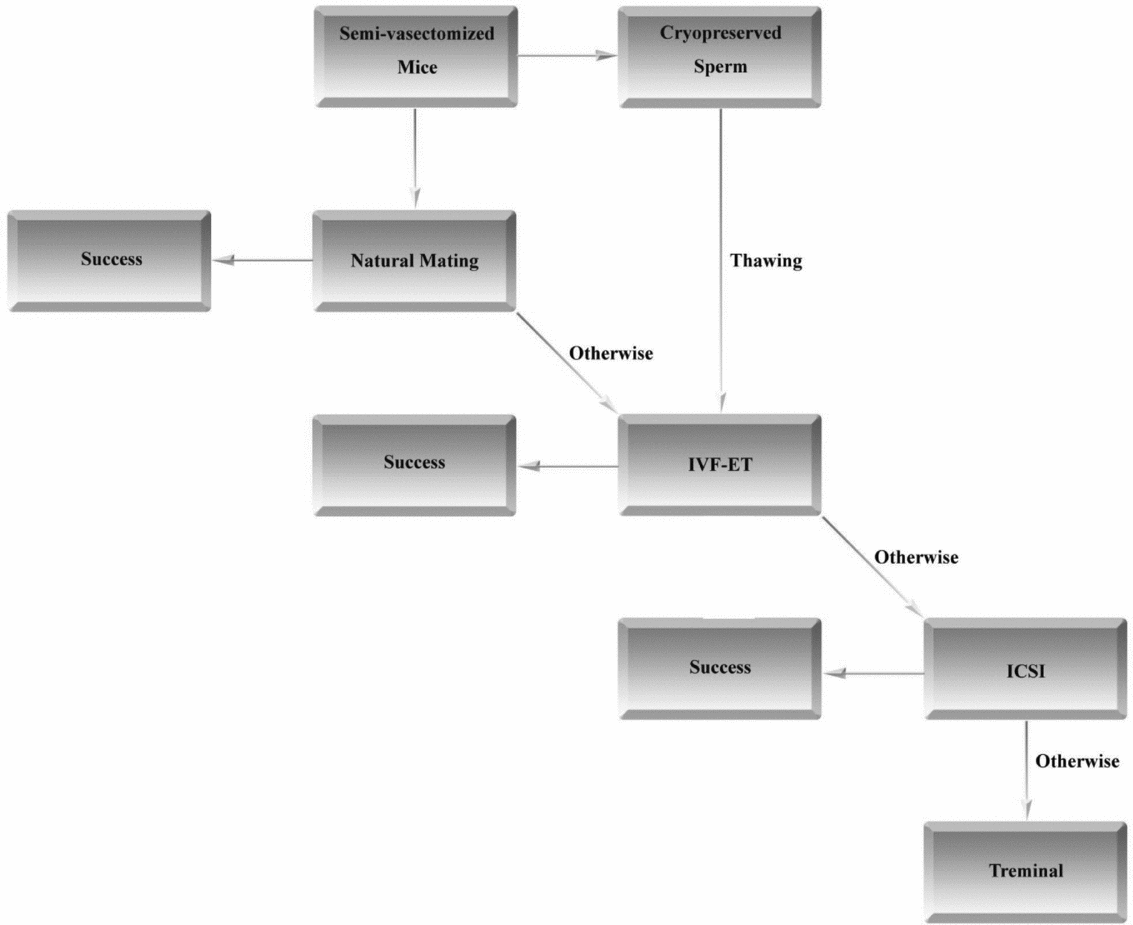
The experimental design is shown in schematic form in Fig. 1. Briefly, in the first step, all four strains of male mice were semi-vasectomized and fresh epididymal sperm was collected for cryopreservation. Then, the semi-vasectomized mice were naturally mated for breeding. If the semi-vasectomized males were able to impregnate females and produce offspring by natural breeding, then no further action was taken for that strain. Otherwise, if the semi-vasectomized males were sterile the cryopreserved sperm from that strain was used for IVF, or ICSI if the IVF did not work. All embryos obtained from IVF and ICSI were transferred into pseudopregnant female mice to produce live offspring and thus preserve the strain.
Experimental design. Firstly, the male mice were semi-vasectomized and their fresh epididymal sperm were collected for cryopreservation. Then the semi-vasectomized mice were naturally mated for breeding. If a satisfactory outcome was obtained from natural breeding, no further action was taken for that strain of mouse. Otherwise, the cryopreserved sperm from that strain was used for IVF, and in the event of IVF failure, cryopreserved sperm were then used for ICSI.

Semi-vasectomy of male mice
The ICR, BDF1, C57BL/6 and GFP male mice were anesthetized with 200–240 mg avertin (2–2-2 tribromoethanol, Sigma-Aldrich) per kg body weight by intraperitoneal injection and semi-vasectomized according to Nagy's protocol (Nagy et al., Reference Nagy, Gertsenstein, Vintersten and Behinger2003). In brief, the mice were placed on their back to expose their abdomen, and the area was cleaned with 70% ethanol. The skin was then opened with fine dissection scissor to make a 1.5-cm transverse incision across the abdomen; a similar-sized transverse incision was then made in the abdominal wall. Once the vas deferens was found on one side, it was pulled out of the abdomen with a pair of watchmaker's forceps and removed by cauterization. During the same procedure the cauda epididymis was also collected for sperm cryopreservation. Finally, the testis was carefully put back inside the body cavity and the skin was closed with wound clips. A second group of ICR male mice were vasectomized at both sides, which were used for preparing pseudopregnant female mice.
Collection and cryopreservation of mouse sperm
The cryopreservation of mouse sperm was performed as described with little modification (Tada et al., Reference Tada, Sato and Yamanoi1990; Nakagata et al., Reference Nakagata, Ueda and Yamanouchi1995; Nakagata, Reference Nakagata2000). The cryoprotective agent (CPA) was made using the following recipe: 18 g of raffinose was dissolved in 100 ml of pre-warmed water at 60°C, and then 3 g of dehydrated skim milk (Difco, Becton Dickinson, Franklin Lakes, NJ, USA) was added. This solution was then centrifuged at 13,000 g for 15 min and the supernatant was filtered through a 0.22-μm pore size filter for aliquoting and storage at –20°C.
The cauda epididymides obtained from semi-vasectomized mice were placed on a piece of filter paper and cleaned of fat and blood under a dissecting microscope, they were then transferred into a 500-μl droplet of CPA in a Petri dish. Five or six incisions were then made on the epididymides with a pair of watchmaker's forceps and micro-spring scissors. The dish was then put on a hot plate at 37°C for 5 min. During this time, the dish was carefully shaken every minute to disperse sperm from the epididymides into the CPA. The contents of the epididymides suspended in complete Freund's adjuvant (CFA) were collected in a sperm straw (Cryo Bio System, Lille, France) in the following order: 10 mm of human tubal fluid (HTF, Millipore), 10 mm of air, 10 μl of sperm suspension. Four sections of air and sperm were collected per straw, and then the open side of the straw was sealed with an impulse sealer. Finally, the samples were put on a Styrofoam float in a cryobiological container with liquid nitrogen. After 10 min, they were quickly immersed into the liquid nitrogen for long-term preservation.
Natural mating of semi-vasectomized mice
The four strains of semi-vasectomized mice were ready for mating 10 to 14 days after surgery. Each male was set-up with two females of the corresponding strain to obtain sperm plugs for timed-mating, and 3 weeks after mating the results of pregnancy and liver-born offspring were checked. The strains that could not be successfully bred naturally were used for IVF and ICSI.
IVF of cryopreserved sperm
The IVF method we used was similar to that described by Ostermeier et al. (Reference Ostermeier, Wiles, Farley and Taft2008). In detail, three females injected with PMSG and hCG were euthanized and the contents of their oviducts transferred into a drop of HTF. The ampullae were tore and egg clutches were released into a single fertilization dish and then the thawed sperm were added. The fertilization dishes were incubated in HTF for 4–6 h at 37°C in a 5% CO2 in air atmosphere, the eggs were then washed to remove the excess of sperm and transferred into Potassium Simplex Optimized Medium (KSOM, Millipore) medium for overnight culture until embryo transfer.
Intracytoplasmic injection (ICSI) of cryopreserved sperm
For those strains of mice in which natural breeding and IVF failed, the thawed spermatozoa were temporally incubated in KSOM medium at 37°C under 5% CO2 in air. One-microlitre aliquots of the suspension were placed in droplets of 10% polyvinyl pyrolidone (PVP)–HEPES-buffered CZB solution in a micromanipulation chamber. ICSI was performed as described (Wakayama et al., Reference Wakayama, Whittingham and Yanagimachi1998; Jiang et al., Reference Jiang, Zhu, Zhu, Sun and Chen2005). Briefly, the sperm head was separated from the tail by applying several piezo pulses to the neck region and the head was then injected into an oocyte. After 10 min of recovery at room temperature, the oocytes were cultured in KSOM medium until embryo transfer.
Embryo transfer
Pseudopregnant ICR mice were used as recipients of embryos obtained by IVF and ICSI. Specifically, blastocysts were transferred to a day 2.5 pseudopregnant mouse that had been previously mated with a vasectomized male. Six to 10 embryos were transferred into each oviduct. At day 18.5 of gestation, the offspring were naturally born or delivered by cesarean section.
Results
Natural mating results of semi-vasectomized mice
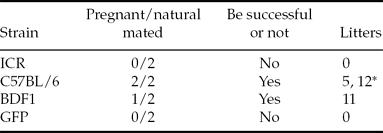
Among all four strains studied, only BDF1 and C57BL/6J could be naturally bred following semi-vasectomy (Table 1). Both C57BL/6J females were pregnant after natural breeding, giving birth to litters of five and 12 offspring. Only one of the two BDF1 female mice gave birth, yielding a litter of 11 offspring.
Natural mating results of semi-vasectomized mice
* Two surrogate mothers gave birth to five and 11 C57BL/6 offspring, respectively.
IVF results of cryopreserved ICR and GFP mouse sperm
Semi-vasectomized ICR and GFP mice were unsuitable for natural breeding, therefore we attempted to preserve these strains using cryopreserved sperm for IVF (Table 2). In total, 20 ICR blastocysts were obtained by IVF and transferred into pseudopregnant females, yielding six liver-born offspring. No embryos were obtained from GFP mice using IVF.
IVF results of cryopreserved BDF1 and GFP mouse sperm

ICSI results of cryopreserved GFP mouse sperm
Semi-vasectomized GFP mice were unable to be bred naturally, and IVF from cryopreserved sperm failed in these mice. As such, cryopreserved sperm was used for ICSI, producing 21 blastocysts which were transferred into pseudopregnant females and generating 11 live-born offspring (Table 3).
ICSI results of cryopreserved GFP mouse sperm
Discussion
Until recently, the only way to reliably maintain a mouse line was through continuous natural breeding and cryopreservation of gametes/embryos; however, compared to conservation by natural breeding, cryopreservation of gametes or embryos is becoming the best choice for strains which could be economically preserved and removed from animal facilities, this approach also safeguards against disease, fire, genetic contamination, and many other catastrophes (Landel, Reference Landel2005). Furthermore, for mouse strains with low fecundity or in use at a large-scale, it is not easy to expand colonies to meet breeding or research needs through conventional breeding and/or pure cryopreservation. Therefore, we designed this study to try to establish a new comprehensive system for conserving mouse strains.
Using this approach, we semi-vasectomized males from four strains of mice (BDF1, C57BL/6, ICR and GFP), we were able to show that some male mice (BDF1 and C57BL/6) remain fertile after semi-vasectomy and can continue to be used for natural breeding and the production of healthy offspring. Despite the removal of only one cauda epididymis, this result suggests that the development and spermatogenesis of the opposite testis is affected by semi-vasectomy, which resulted in male infertility in two of the four strains we studied (ICR and GFP mice).
For those strains in which natural breeding fails, the next step in our system is to use cryopreserved sperm for IVF. Using this approach we were able to obtain embryos and live-born offspring from one of the two strains tested (ICR). Previous studies have reported a significant difference in reproductive success between different strains of mice using cryopreserved sperm for IVF, perhaps because of the strain-dependent susceptibility to sperm damage by freezing (Lu et al., Reference Lu, Tang, Liu, Xie, Xue and Xu2003). Furthermore, one study has shown that compared with those of the hybrid control, the motility and progressive motility rates of inbred sperm diminish after cryopreservation (Sztein et al., Reference Sztein, Farley and Mobraaten2000). In this regard, the one strain of mice that failed IVF was the GFP mice, which were in an inbred C57BL/6 background, perhaps explaining the occurrence of IVF failure in this strain.
In accordance with our proposed system, those strains which are unable to be maintained by natural breeding after semi-vasectomy or through IVF, were successfully rescued using ICSI. Our experience with ICSI shows that the fertilization rate of cryopreserved sperm is not affected by cryoprotectants and can reach 90% (data not shown), and that healthy offspring can be obtained after embryo transfer. Previous studies have shown that the frozen sperm without CPA and even freeze-dried sperm are capable of producing normal embryonic development and offspring after injection into oocytes, and therefore can be used to preserve and transport genetic resources (Ward et al., Reference Ward, Kaneko, Kusakabe, Biggers, Whittingham and Yanagimachi2003; Jiang et al., Reference Jiang, Zhu, Zhu, Sun and Chen2005).
It is well known that cryopreservation of mouse spermatozoa as a strategy for mouse strain cryopreservation is an attractive one, given the amount of material that can be obtained (~3 × 10⁷ sperm/male) and the ease of the freezing protocol itself. However, we acknowledge that this approach has the disadvantage, compared with embryo cryopreservation, that only the haploid genome is being frozen and thus more breeding of reconstituted mice may be necessary if more than one mutation and/or transgene is involved.
In summary, this study established a relatively safe measure for mouse species conservation, which systematically combined conventional breeding, gamete/embryo cryopreservation and assisted reproductive technologies. We believe that this approach should be considered and applied for mouse model preservation at research centers globally.
Acknowledgements
The study was supported by the grants from the National Natural Science Foundation of China (11ZR418800). This manuscript was proofread by an English speaking professional with science background at Elixigen Corporation.