INTRODUCTION
The family Tetraodontidae comprises about 20 genera and at least 121 species of puffer. The genus Torquigener (Whitley, 1930) is represented by 19 species (Froese & Pauly, Reference Froese and Pauly2010) that typically inhabit tropical waters. One species of this genus, viz. T. hypselogeneion (Bleeker, Reference Bleeker1852) has long been known to occur in the coastal waters of India (Day, Reference Day1878; Talwar, Reference Talwar1991). Tetrodon florealis (Cope, Reference Cope1871) has also been reported from the Pondicherry coast (Mishra & Krishnan, Reference Mishra and Krishnan2003), based on the descriptions of Indo-Australian Archipelago fish (De Beaufort & Briggs, Reference De Beaufort and Briggs1962). However, this record now appears to be erroneous. Now it is assumed that, in addition to T. hypselogeneion, there is another Torquigener species present along the Indian coast. The authors came across ten specimens belonging to the above genus. This genus is characterized by having a nasal organ covered by a small sac with two openings, a distinctly raised chin, terminal mouth and a raised skin fold along the lower side of the caudal peduncle. Out of the ten specimens collected from the Kalpakkam coast of Tamil Nadu State (south-east India, 12°33′N 80°11′E; Figure 1) during July 2008, only one was preserved. The present specimen (ZSI F-10573/2, 1 ex., 62.5 mm standard length) was collected by Sudeepta Biswas and is in the National Zoological Collections, Zoological Survey of India.
Map of Kalpakkam coast indicating the location (marked as *) from where specimens were collected.

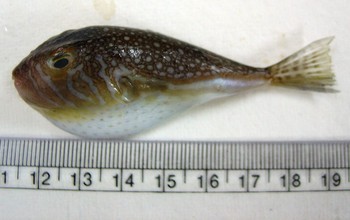
A close examination of this specimen, following the recent works of Hardy (Reference Hardy1983, Reference Hardy1984) indicates it to be Torquigener brevipinnis (Regan, Reference Regan1903) (Figure 2), which has not previously been recorded from the coastal waters of India. The specimen was frozen and subsequently preserved in formalin. Morphometric measurements were taken by dial calliper. The preserved specimen was used for all measurements. A systematic account of the species is presented in this paper.
Torquigener brevipinnis (Regan, Reference Regan1903).

Tetrodon brevipinnis (Regan, Reference Regan1903), Proceedings of the Zoological Society, London 2, 300 (type locality: Sulawesi [Celebes], Indonesia).
Torquigener brevipinnis, Hardy, Reference Hardy1984, Pacific Science 38, 127.
DESCRIPTION
It has an elongated body, almost flattened ventrally, tapering posteriorly to a narrow caudal peduncle. The mouth is small, terminal; lips are thin, covered with many tiny papillae. Chin is prominent. Nasal organ is a short erect papilla set in a low depression well before eye, with two separate openings. Pre-nasal snout length is 28% of head length. Eyes are somewhat elongated, moderate in size. Lower border of eye is well above level of mouth corner. Horizontal diameter of eye is 32% of head length. Least width of inter-orbital region is 14.4% of head length (5.76% of standard length). Anterior margin of gill opening has a few short spines. Distance between posterior edges of eye to dorsal corner of gill opening is 32.8% of head length. Body width at pectoral fin bases is 25.63% of standard length. Length of caudal peduncle is about 25.6% of standard length. Least depth of caudal peduncle is 7.52% of standard length. Dorsal fin has 8 rays, elongated and pointed ranged from anterior to anus. Its height is 20.8% of standard length while base of dorsal fin is 5.44% of its height. Anal fin has 7 rays; elongated and pointed, with base about 25% of its height. Pectoral fin has 15 rays. It has a truncated caudal fin with 11 rays and its length is 28% of standard length. Ventro-lateral part extends from behind chin to caudal fin. Lateral line is distinct. Antero-dorsal branch surrounds the eye and it almost meets at midline anterior to nasal organ. Body spines are small, two-rooted and they are sparse dorsally and moderately dense ventrally. About 18–19 spines are located across the belly on a line between two pectoral fin bases.
Body colour is brown dorsally, with small, round or oval, pale yellowish spots, outlined by very small brownish dots. A yellowish brown band runs from the pectoral fin to the caudal fin base that forms lower boundary to the spotted dorsal region. It is creamy-white on ventral side. Cheek traversed by three slightly oblique, narrow, creamy-white bands, one from below nostril, second from below anterior edge of eye and third from anterior to gill opening. A similar inverted U-shaped band is present below posterior part of eye. Dorsal, anal and pectoral fins are hyaline. Caudal fin with dark brown blotches on rays appear like the presence of six vertical bands. Colours as well as markings are usually lost on preservation.
COMPARISON
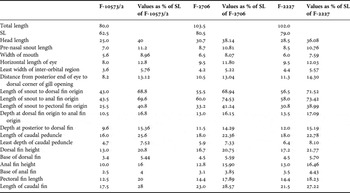
The National Zoological Collection, Zoological Survey of India, Kolkata preserves two specimens described by Sir F. Day as T. hypselogeneion (F-2706 and F-2227). A comparison of the measurements between the above two specimens (F-2706 and F-2227) and that of the present one (ZSI F-10573/2) are presented in Table 1. In both F-2706 and F-2227, the caudal peduncle length was 22.36 to 22.78, body width at pectoral fin bases 22.23 to 23.41 and caudal fin length 27.21 to 28.57% of standard length; horizontal diameter of eye ranged 30.94 to 33.33, pre-nasal length of snout 28.33 to 29.82 and distance from hind edge of eye to dorsal corner of gill opening was 34.20 to 39.64% of head length. These morphometric characters mostly resemble that of the present species, T. brevipinnis, as described above. In addition, T. hypselogeneion is known to have a colourless caudal fin, while in Day's description for F-2706 and F-2227 the presence of ‘about seven vertical bands most distinct in its upper lobe’ were indicated, which also matches with T. brevipinnis. The presence of ‘three to five vertical bars under eye’ is not diagnostic for T. hypselogeneion, and so the two specimens described by Sir F. Day seem to match more closely with T. brevipinnis than T. hypselogeneion. Colour comparisons of the present specimen with those examined by Sir F. Day were not possible, due to the age of the earlier preserved specimens. Since several literature records are based on confused species identity, the occurrence of T. hypselogeneion along the Indian coast requires recent voucher material.
Morphometric comparison between specimens preserved in the National Zoological Collection, Zoological Survey of India (F-10573/2 is present specimen; F-2706 and F-2227 are older specimens) (measurements in mm). SL, standard length.

DISCUSSION
The current specimen represents the first record of T. brevipinnis from the Indian coast. However, as species of similar appearance can be confounded, it is possible that the specimens collected by Sir F. Day were erroneously ascribed as T. hypselogeneion (the oldest known species of this genus (Bleeker, Reference Bleeker1852)) and may represent T. brevipinnis. Similarly, it is worth noting that another similar species, T. florealis, described from the Central Pacific (Cope, Reference Cope1871), was combined by Day (Reference Day1878) along with T. hypselogeneion. However, this species, T. florealis, was later assigned to Sphoeroides hypselogeneion (Bleeker, Reference Bleeker1852) by Fowler (Reference Fowler1928).
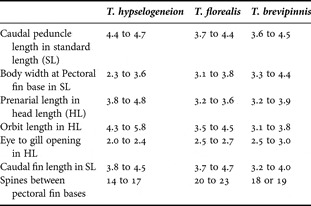
In order to avoid misidentification, we mention typical morphometric features of T. hypselogeneion. It has a shorter caudal peduncle, wider body, smaller eye, shorter snout and a wider space between posterior end of eye to dorsal corner of gill opening than T. brevipinnis and T. florealis. Further, T. hypselogeneion have fewer spines on the belly between the pectoral fins and only 1 or 2 small spines (versus 4 to 7 in the other species) on the anterior margin of the gill opening. Moreover, T. florealis can be distinguished from T. brevipinnis by the presence of a broad lateral band comprising about 14 brownish-orange blotches, more rows of spines ventrally between the pectoral fin bases, absence of an inverted U-shaped creamy-white band below the eye. A comparison of these three species is given in Table 2 (Hardy, Reference Hardy1983, Reference Hardy1984).
Morphometric comparison (range measurements in mm) between Torquigener brevipinnis with T. hypselogeneion and T. florealis.

Torquigener hypselogeneion is widely found in the Indo-West Pacific (Smith & Heemstra, Reference Smith, Heemstra, Smith and Heemstra1986). Nevertheless, many records need to be treated with caution due to potential confusion in their identification (Hardy, Reference Hardy1983). Torquigener florealis is known to be available from Hawaii to Japan and from the East China Sea. Torquigener brevipinnis have been recorded from Australia, Indonesia, Japan, New Caledonia, Papua New Guinea and The Philippines (Gloerfelt-Tarp & Kailola, Reference Gloerfelt-Tarp and Kailola1984; Alcala & Cabanban, Reference Alcala and Cabanban1986; Kailola, Reference Kailola1991; Matsuura & Tyler, Reference Matsuura, Tyler and Séret1997). Together with T. brevipinnis, other species such as T. pleurogramma and T. flavimaculosus which have been reported from the Red Sea and adjacent waters, (Hardy & Randall, Reference Hardy and Randall1983) could have been wrongly assigned as T. hypselogeneion by Sir F. Day. However, T. pleurogramma differs in having a solid dark brown lateral band, darker saddle like marks on back and several dark, narrow vertical bands on cheek. Torquigener flavimaculosus also differs due to the absence of ‘about seven vertical bands most distinct in its upper lobe’ and presence of a series of small, yellowish spots on sides of body and broad bands of small irregular brownish spots on sides of head. With this, the confusion is narrowed down to two species, i.e. T. hypselogeneion and T. brevipinnis, which can easily be distinguished from each other through their morphometric characters given in Table 2. In the light of the above facts, it is concluded that this forms the first report of T. brevipinnis from the Indian coastal waters.
ACKNOWLEDGEMENTS
The second author is grateful to the Director, Zoological Survey of India, Kolkata for providing permission and facilities. He is also grateful to the Officer-in-Charge, Marine Fish Section, Z.S.I., Kolkata for constant encouragement. The first and third authors are grateful to the Director, IGCAR for constant encouragement and support. Also they are grateful to the Station Director, MAPS for giving necessary permission.