Paraboea (C.B.Clarke) Ridl. is one of the largest genera in the family Gesneriaceae. Since its last taxonomic revision (Xu et al., Reference Xu, Burtt, Skog and Middleton2008), the genus has been expanded to include Phylloboea Benth. and Trisepalum C.B.Clarke (Puglisi et al., Reference Puglisi, Middleton, Triboun and Möller2011), and several newly described species (Chen et al., Reference Chen, Möller, Shui and Zhang2008; Kiew, Reference Kiew2010; Chen et al., Reference Chen, Möller, Zhang and Shui2012; Kiew, Reference Kiew2012; Triboun & Middleton, Reference Triboun and Middleton2012; Xu et al., Reference Xu, Huang, Wei, Tan and Liu2012; Triboun, Reference Triboun2013; Wen et al., Reference Wen, Hong, Chen, Zhou and Wei2013; Puglisi et al., Reference Puglisi, Suddee, Triboun and Middleton2015; Triboun & Middleton, Reference Triboun and Middleton2015; Guo et al., Reference Guo, Lu, Liu and Xu2016; Wen & Wei, Reference Wen and Wei2016). Most of the c.130 species of Paraboea are lithophytes on limestone, and only a few are adapted to different types of substrate (Puglisi et al., Reference Puglisi, Suddee, Triboun and Middleton2015). The genus is most diverse in Thailand, where c.75 species are found, but the overall distribution also includes Myanmar, China, Vietnam, Laos, Cambodia, Malaysia, Indonesia and the Philippines.
The close dependence of Paraboea on karstic habitats poses serious conservation concerns for many of the species, as limestone formations are severely threatened, particularly by the cement industry and deforestation (Clements et al., Reference Clements, Sodhi, Schilthuizen and Ng2006). The new species presented here was discovered in the forested area within the boundaries of Mahidol University, Kanchanaburi Campus, on a limestone outcrop, and is so far known only from the type collection.
Paraboea fimbriata C.Puglisi & Phutthai sp. nov.
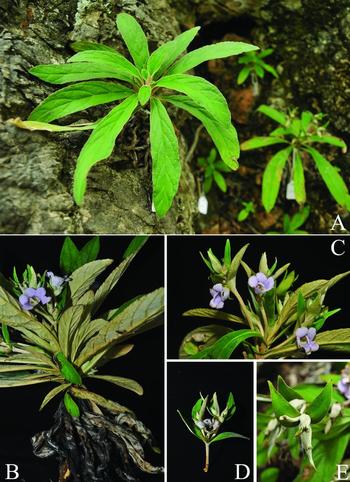
Paraboea fimbriata is most closely related to the group of species previously ascribed to the genus Trisepalum C.B.Clarke, characterised by the tripartite calyx, the campanulate corolla and the linguiform stigma. It differs from all other species of Paraboea in having fimbriate, lilac corolla lobes, and relatively long and lanceolate calyx lobes. – Type: Thailand, Kanchanaburi, Sai Yok District, Mahidol University (Kanchanaburi Campus), 5 x 2015, Puglisi, C., Karaket, P., Phutthai, T. & Prasopsin, S. CP404 (holo SING; iso BKF, E, Mahidol University [Kanchanaburi] Herbarium). Fig. 1 .
Paraboea fimbriata C.Puglisi & Phutthai. A and B, Habit; C and D, inflorescence; E, capsule. Photographs by T. Phutthai.

Lithophytic, caulescent perennial herb, to 30 cm tall, branching from the nodes. Stem and floral axes with fine, long, woolly, pale brown hairs, and additional eglandular hairs seemingly calcified. Leaves opposite, tightly arranged along the stem, sessile or with winged petioles forming small auricles at the node; older leaves persistent at the lower nodes. Mature leaves 5–17 × 2–3.5 cm; lamina usually oblanceolate, sometimes lanceolate or elliptic, base attenuate, apex acute, margin irregularly entire to lightly serrate, secondary veins usually inconspicuous above, raised beneath; upper surface of lamina mid to dark green, hirsute with eglandular hairs; lower surface of lamina brownish white with a layer of fine, long, woolly, pale brown hairs, and additional eglandular hairs, seemingly calcified, similar to the indumentum on the upper surface. Inflorescences axillary compound cymes, numerous. Bracts large, never inconspicuous, narrowly elliptic or lanceolate, coloured as leaves, apex acute, sessile; basal inflorescence bracts 3.5–3.8 × 1.1–1.2 cm, individual cyme bracts 2.2–2.6 × 0.8–0.9 cm. Peduncles 2–4 cm long, indumentum as on stem; pedicels 0.1–0.3 cm, covered in the same woolly hairs. Calyx 11–15 mm long, tripartite, with the lower two lobes almost completely divided (fused portion 0.1–0.3 mm long) and the upper three almost entirely fused (fused portion 11–12 mm), inside green, hirsute in upper two-thirds and glandular in lower third, outside covered in long, fine hairs and therefore appearing whitish brown; lobes 2.5–4 mm wide, lanceolate, apex acute and reflexed (not visible in herbarium specimens). Corolla yellow and fleshy at base, inside and out, then becoming uniformly lilac; tube c.13 mm, upper lip c.11 mm, lower lip c.11.5 mm; lobes round-elliptic, with margin fimbriate and obtuse to rounded, upper lobes c.6 × 7 mm, lateral lobes c.6 × 8 mm, ventral lobe c.6 × 8.5 mm. Stamens 2, filaments 4–5 mm long, c.1.5 mm diameter, strongly bent, attached to the corolla base, white at base, purple-white at apex; anthers c.2.5 × 4.5 mm, strongly divergent; staminodes 2, c.1 mm long, attached c.1.5 mm from the corolla base. Ovary densely covered in long, thin, white indumentum, c.7 mm long, c.3 mm diameter, style not enantiostylous, c.8 mm long, stigma linguiform. Fruit a dehiscent capsule, 3–4 cm long.
Proposed IUCN assessment
Critically Endangered [CR B1 ab(iv) + B2 ab(iv)]. This species is known only from the type collection. The type locality is a limestone formation in a secondary forest patch, within the boundaries of a university campus, which is likely to undergo development in the near future. No further collections have been made of this very distinctive species in the surrounding area.
Paraboea fimbriata belongs in the group of species previously ascribed to the genus Trisepalum C.B.Clarke, now a synonym of Paraboea (Puglisi et al., Reference Puglisi, Middleton, Triboun and Möller2011), characterised by the tripartite calyx and the linguiform stigma. Among these species, Paraboea fimbriata is the only one with fimbriate corolla lobes. The combination of lilac corolla lobes and a bright yellow throat is also highly unusual in the group, therefore making Paraboea fimbriata a very distinctive species. Two other trisepaloid species are known from Kanchanaburi Province: Paraboea glabrescens (Barnett) C.Puglisi and P. strobilacea (Barnett) C.Puglisi. Paraboea fimbriata differs from P. glabrescens in having hirsute leaves and a much tighter inflorescence (versus leaves glabrescent and inflorescence extended in P. glabrescens), and from P. strobilacea in the narrower leaves with a woolly indumentum on the lower surface (versus leaves ovate, with indumentum restricted to the veins and margin in P. strobilacea).
Acknowledgements
The authors wish to thank Mr Preecha Karaket and Mr Suphat Prasopsin for assistance in the field, and the Forest Herbarium (Bangkok) and Mahidol University (Kanchanaburi Campus) for providing logistic support.