In the aftermath of natural disasters, survivors often report being in need of assistance, including emotional, informational, and tangible support.Reference Kaniasty and Norris 1 - Reference Platt, Lowe and Galea 2 Such assistance could come in the form of network support, defined here as support from family members, friends, and neighbors. Disaster survivors might also benefit from non-network support, defined as assistance outside of one’s network, such as from community-based, non-profit, and government organizations, or emergency personnel. Many disaster survivors do not receive sufficient support, however, as evidenced by reports of persistent difficulties repairing damaged property, accessing insurance monies, and securing adequate post-disaster housing.Reference Peacock, Van Zandt and Zhang 3 - Reference Tuason, Güss and Carroll 4 The challenges faced by disaster survivors are compounded by the burden of mental health problems that can persist for several years after disaster exposure.Reference Paxson, Fussell and Rhodes 5 - Reference Wen, Shi and Li 6
Insight into the characteristics of disaster survivors who receive network and non-network support, and those who do not receive each form of support, could help inform efforts to prepare for disasters and intervene in their aftermath via targeted outreach efforts. One method to explore the factors predictive of network and non-network support is to have disaster-affected individuals forecast the type of support they would receive in a future disaster scenario. Prior research has used this method to prompt disaster-affected individuals to forecast various aspects of a future disaster, including their emotional response and personal risk, and have found them to be more accurate in their predictions than unaffected individuals.Reference Siegrist and Gutscher 7 - Reference Weinstein, Lyon and Rothman 8 Thus, an advantage of investigating anticipated support among disaster survivors is that they might have a more realistic view on what forms of support they would receive than those who have not experienced a disaster.
Asking disaster survivors to anticipate a future disaster scenario would also help address limitations of the literature on post-disaster social support.Reference Kaniasty and Norris 1 The majority of this research has focused on perceived support, that is, the view that the persons in one’s network could be depended upon to provide assistance in times of need, rather than received support, that is, the actual assistance provided. In seminal work, Kaniasty et al explored received support in the aftermath of several disasters and documented several significant demographic predictors of support, including younger age, female sex, married status, white race, and higher education.Reference Kaniasty, Norris and Murrell 9 - Reference Kaniasty and Norris 11 This research has also documented that received support was significantly associated with disaster exposure, such that survivors who experienced more exposure to disaster-related traumatic events and stressors received more support.Reference Kaniasty and Norris 10 - Reference Norris and Kaniasty 13
Although the extant literature has therefore provided insight into the demographic characteristics and disaster-related exposures that are associated with received support, a notable limitation to the existing research on received support is that investigators have rarely differentiated between network and non-network support. In one exception, Kaniasty et al differentiated between 2 forms of network support—support from kin and non-kin—and found that higher education was associated with non-kin support only, whereas disaster-related losses were associated with both sources of support among flood-exposed older adults.Reference Kaniasty, Norris and Murrell 9 , Reference Kaniasty and Norris 12 Other studies have either asked general questions about received support without specification of the source,Reference Platt, Lowe and Galea 2 , Reference Norris and Kaniasty 13 or have created composite scores that combine network and non-network support,Reference Kaniasty and Norris 10 and therefore provide limited information about the characteristics of disaster survivors who might be without network and non-network assistance.
A further limitation of the literature on post-disaster received support is a lack of data on the communities in which participants reside. Disaster researchers have increasingly integrated community-level data in their studies, and have shown that community characteristics, including indicators of economic and social resources, are associated with post-disaster mental health.Reference Frankenberg, Nobles and Sumantri 14 - Reference Wind and Komproe 15 No published study to our knowledge has explored community-level predictors of post-disaster support, however. Therefore, although the extant literature has shed light on which communities might be in need of mental health services, less is known about community-level factors that shape the broader range of post-disaster needs. Such insights could inform public health intervention efforts to boost community resilience in preparation for and in the aftermath of major disasters.
In the current study, we drew on a population-based sample of Hurricane Sandy survivors and asked them about which sources of network and non-network support they would depend on in a future disaster scenario. We explored predictors of anticipated network and non-network support, including demographic characteristics, disaster exposure, post-disaster mental health, and community resources among this sample of disaster survivors.
Methods
Participants and Procedures
Data were collected through telephone interviews with a stratified random sample of adults (age 18 and older) living in Sandy-affected neighborhoods in New York City at the time of the hurricane. The initial sampling frame consisted of 2 sampling zones: Zone 1 included census tracts in which 50% or more of the area was inundated with floodwaters; Zone 2 included census tracts in which some, but <50%, of the area was inundated and/or that were adjacent to tracts from Zone 1. 16 Half of the participants were recruited from each of the 2 zones and, within each zone, half through address-based sampling and half through random-digit dialing of cellular phones with a geographic screening to approximate residence in 1 of the zones. Additional details about the sampling frame and participant recruitment can be found elsewhere.Reference Lowe, Sampson, Gruebner and Galea 17 The overall response rate for the survey was 29%, 18 which is consistent with other population-based disaster studies.Reference Galea and Tracy 19
In total, 500 participants completed the survey 25-28 months post-disaster. Participants provided demographic information and completed measures of disaster-related stressors, post-traumatic stress (PTS), depression, and anticipated network and non-network support in a future disaster scenario. Of the 500 participants, 443 (88.6%) provided their pre-disaster address, which was necessary for the collection of community-level data. An additional 34 participants were excluded in the current study due to missing data on one or more of the variables included in the analysis. The final sample consisted of 409 participants (81.8% of the original sample) living in 307 census tracts at the time of the hurricane. The Institutional Review Board from Columbia University approved the study, and participants gave oral consent.
Measures
Anticipated Network and Non-Network Support
To assess anticipated support in the case of a future disaster, participants were asked to imagine that there has been another disaster and respond to how much they would depend on support from 6 sources in the first 3 post-disaster days, with response options not at all, somewhat, and a great deal. Two sources of network support were included: “household members,” and “people in my neighborhood.” The remaining items assessed non-network source of support: “non-profit organizations, such as the American Red Cross or Salvation Army,” “local organizations, such as school, church or temple, community center, or neighborhood groups,” “fire, police, or emergency,” and “county, state, or federal government agencies, including those that are supposed to help you during an emergency such as FEMA.” Participant responses were coded as 1 if they reported that they would depend on each form of support somewhat or a great deal and 0 if they responded not at all. Counts of sources of network and non-network support were then computed.
Demographic Characteristics
The following demographic characteristics indicative of access to social and economic resource were included in the analysis: age in years; sex (female=1; male=0); race (black=1, all others=0); Hispanic ethnicity; level of education (high school education or less=1, all others=0); employment (whether the participant was employed at the time of the interview); parent status (whether the participant was a parent living with a child under 18 years old at the time of the hurricane); whether the participant was married or cohabiting with a partner at the time of the interview; and whether the participant lacked insurance coverage.
Disaster Exposure
Participants completed inventories of disaster-related traumatic events and stressors, with items drawn from other epidemiological surveys in the aftermath of major hurricanes.Reference Galea, Brewin and Gruber 20 , Reference Tracy, Norris and Galea 21 Disaster-related traumatic events included: (a) whether the participant had been injured, (b) whether a close friend or family member had been injured, and (c) whether a close friend or family member had been killed, each as a direct result of the hurricane or its aftermath. Disaster-related stressors included: (1) whether the participant was displaced from his or her pre-disaster home for over a week; (2) whether the participant went without electricity, heat, or water for over a week; and (3) whether there was damage to the participant’s pre-disaster home. Counts of affirmative responses on each inventory were computed, each ranging from 0 to 3.
Post-Disaster Mental Health
Measures of disaster-related PTS and depression were included as indicators of post-disaster mental health. Past month disaster-related PTS, as defined in the fifth addition in the Diagnostic and Statistical Manual of Mental Disorders 22 was assessed with the 20-item PTSD checklist (PCL-5).Reference Weathers, Litz and Keane 23 Participants rated the extent to which they were bothered by each PTSD symptom in reference to the hurricane (eg, “repeated, disturbing memories of Hurricane Sandy,” “avoiding memories, thoughts, or feelings related to Hurricane Sandy”) over the past month from 0 (not at all) to 4 (extremely). Responses were summed to create a PTS severity score, ranging from 0 to 80. The PCL-5 has been demonstrated as having strong internal consistency, test-retest reliability, and convergent and discriminant validity.Reference Blevins, Weathers and Davis 24 Cronbach’s α of internal consistency (α) was 0.93 in the current study.
Depression was assessed using the 9-item Patient Health Questionnaire (PHQ-9).Reference Kroenke and Spitzer 25 Participants indicated how often over the past 30 days they had been bothered by each symptom (eg, “feeling down, depressed, or hopeless”) from 0 (not at all) to 3 (nearly every day), and a severity score was computed as the sum of all items, ranging from 0 to 27. Previous studies have found the PHQ-9 to have excellent internal consistency, test-retest reliability, and construct validityReference Kroenke, Spitzer and Williams 26 (α=0.88).
Community-Level Resources
Two indicators of community resources were included in the study. First, as a marker of social resources, we included the percentage of residents living alone within the census tract, drawn from the 2008-2012 American Community Survey (ACS) 5-year estimates. 27 Based on prior individual-level research showing negative associations between living alone and social capital,Reference Phongsavan, Chey and Bauman 28 communities with more residents living alone were assumed to have lower social capital. Second, we included the percentage of residents who were unemployed within each tract, also drawn from the 2008-2012 ACS 5-year estimates, as a marker of economic resources.
Data Analysis
Prior to analyses to fulfill study aims, a series of preliminary analyses was conducted. First, we assessed for differences between the 409 participants who were included in the analysis and the 91 who were dropped due to missing data using Bonferroni-corrected analysis of variance and χ2 tests. Second, we computed descriptive information for all variables included in the analysis. Third, we examined bivariate relationships between all study variables using correlations for within-level variable pairs, and multilevel regression, with participants nested in census tracts, for between-level variable pairs (ie, those that included 1 individual-level and 1 community-level variable).
To fulfill our study aims, we conducted multilevel ordered logistic regression analyses, with demographic characteristics, disaster exposures, post-disaster mental health, and community characteristics predicting anticipated network and non-network support, and with participants nested in census tracts.
Data management and analyses assessing differences between included and dropped cases were completed in SPSS 21.0. 29 All other analyses were conducted in Mplus 7.1.Reference Muthén and Muthén 30 Analyses were weighted to adjust for disproportionate sampling probabilities introduced by the sampling design and to correct for demographic differences between the sample and population.
Results
Preliminary Analyses
In the analyses assessing differences between participants included in the analysis and those dropped due to missing data, we found that the former had significantly higher levels of depression (t[169.36]=−3.33, P=0.001, equal variances not assumed). No other significant differences were detected.
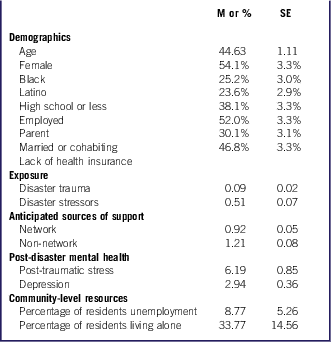
Table 1 lists descriptive statistics for the analytic sample. As shown, participants on average reported 0.92 (SD=0.05) anticipated sources of network support, and 1.21 (SD=0.08) anticipated sources of non-network support.
Descriptive Statistics for Variables Included in the Study

n=409 participants living in 307 census tracts at the time of Hurricane Sandy.
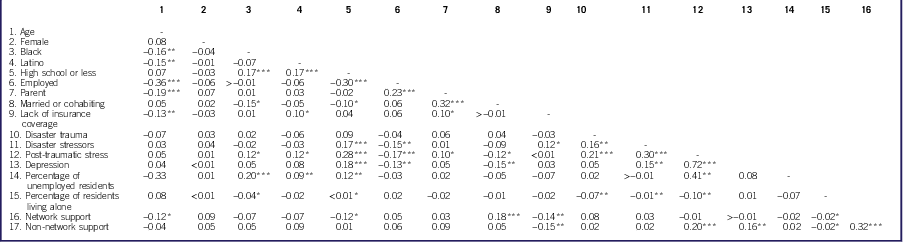
The results of bivariate analyses are shown in Table 2. Lacking insurance coverage and residence in a community wherein fewer persons lived alone were significantly associated with less anticipated network and non-network support. More anticipated network support was uniquely associated with being married or cohabiting, whereas older age and having a high school education or less were uniquely associated with less anticipated network support. More anticipated non-network support was uniquely associated with higher PTS and depression. Additionally, the two forms of support were significantly correlated with each other, such that those who anticipated more sources of network support also anticipated more sources of non-network support.
Bivariate Associations Between Study Variables

n=409 participants living in 307 census tracts at the time of Hurricane Sandy. Bivariate relationships were computed using correlation analysis for within-level variables pairs and multilevel regression analysis for between-level variable pairs.
*P<0.05, **P<0.01, ***P<0.001.
Multilevel Regression Analyses
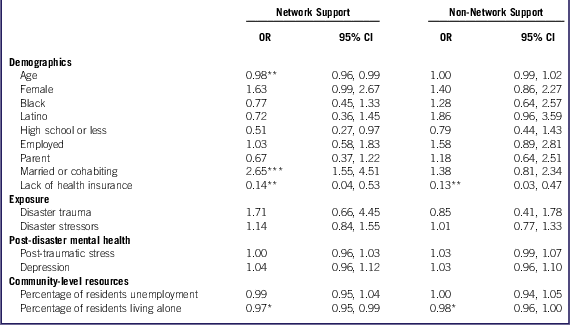
The results of multilevel ordered logistic regression analyses predicting anticipated support are shown in Table 3. As in the bivariate analysis, being married or cohabiting was significantly associated with more anticipated network support, whereas older age, having a high school education or less, lacking health insurance, and residence in a community wherein more persons lived alone were associated with less anticipated network support. In contrast, only lack of health insurance and residence in a community wherein more persons lived alone remained significantly associated with less anticipated non-network support.
Results of Multilevel Ordered Logistic Regression Analysis Predicting Anticipated Sources of Support

n=409 participants living in 307 census tracts at the time of Hurricane Sandy.
*P<0.05, **P<0.01, ***P<0.001.
Discussion
We surveyed a population-based sample of disaster survivors about their anticipated network and non-network support in a future disaster scenario. We found that anticipated network and non-network support were significantly associated, such that participants who anticipated more network support also anticipated more non-network support. We also found that network and non-network support shared 2 significant predictors in multivariable models. Specifically, participants lacking health insurance and residing in communities wherein more persons lived alone anticipated receiving significantly less network and non-network support than their counterparts. Married or cohabiting participants anticipated significantly more network support, whereas older participants and those with a high school education or less anticipated significantly less network support.
Our results regarding demographic predictors of anticipated support are congruent with those of previous studies that found married participants received more post-disaster support, and older participants and those with lower education received less post-disaster support.Reference Kaniasty, Norris and Murrell 9 - Reference Kaniasty and Norris 11 A unique contribution of the current study was our finding that these characteristics were limited to network support. It is therefore possible that unmarried, older, and less educated persons are able to compensate for their lack of network support by seeking out support from non-network sources. Nonetheless, our findings suggest the need for efforts to bolster the social support networks of at-risk demographic groups to help prepare for disasters, as well as to target these populations in post-disaster outreach efforts.Reference Mathbor 31 , Reference Walsh 32
Our results also suggest the vulnerability to a lack of post-disaster support both from network and non-network sources among persons lacking health insurance coverage and residing in communities wherein more people live alone. Notably, no existing study on post-disaster support to our knowledge has looked at the role of insurance coverage, although prior research has linked a lack of health insurance to a lower likelihood of post-disaster mental health service utilization.Reference Velden, Yzermans and Kleber 33 Lack of health insurance could indicate a general risk for not receiving adequate services to meet post-disaster needs. One possible reason for this enhanced risk could be that these survivors’ lack of resources could serve as barriers to seek out support, particularly from non-network sources. In this vein, in a study of Hurricane Ike survivors with unmet mental health service needs, lack of insurance coverage was a significant predictor of resource barriers, including the perceived lack of knowledge, time, transportation, and finances to secure services.Reference Lowe, Fink and Norris 34 Another possibility is that lack of insurance coverage could prevent residents from having pre-existing relationships with non-emergency medical providers, whom they might otherwise contact for non-network assistance during a disaster and its aftermath. Although future research is needed to understand why survivors without insurance might not receive non-network support, this finding suggests the need for non-network sources to increase awareness of available free and low-cost services and to provide services at mutually convenient locations and times, when possible.
Our findings regarding the percentage of community members living alone is consistent with previous research conceptualizing living alone at the individual-level to be a marker of lower social resources.Reference Phongsavan, Chey and Bauman 28 In this case, the findings suggest that persons living in communities with lower social resources are less likely than those in communities with higher social resources to receive both network and non-network post-disaster support, increasing their vulnerability to adverse outcomes.
To shed additional light on this topic, future research should develop more comprehensive measures of network and non-network support, for example including friends and extended family members and having participants specify whether sources of support were from in or outside of their neighborhoods. Researchers should also consider separately exploring forms of assistance that could reflect both network and non-network support, such as assistance from schools and faith-based organizations. A related research direction would be to examine the interplay between different forms of support over the post-disaster period, for example whether response efforts targeting non-network or combined sources of support (eg, assistance to community- and faith-based organizations and schools) ultimately increase survivors’ received support from network members. Researchers could also explore the perceived acceptability of different forms of network and non-network support, for example whether there is demographic variability in survivors’ comfort with support from the federal or local government versus other sources. Taken together, these research directions could yield important insights for targeted post-disaster interventions to protect at-risk populations from adverse outcomes.
The results of this study should be interpreted in light of at least 4 limitations. First, participants’ projections of support in the case of a future scenario are not substitutable for their reports of actual support received. It is worth noting, however, that disaster-affected individuals have been found to more realistically forecast disaster scenarios than others,Reference Siegrist and Gutscher 7 , Reference Weinstein, Lyon and Rothman 8 and that a previous study found that pre-disaster anticipated support was significantly associated with post-disaster received support.Reference Kaniasty, Norris and Murrell 9 Second, although we controlled for PTS and depression, participants’ current functioning could have nonetheless biased their assessments of anticipated support. Third, the findings might not be generalizable to the aftermath of other disasters, to Sandy survivors from different geographic locations, or to survivors assessed at different post-disaster time points. Fourth, participants included in the analysis had significantly higher depression than those who were dropped due to missing data, although it is unclear how this could have influenced the pattern of results.
Conclusions
These results provide preliminary evidence of the factors that shape receipt of different sources of support in the aftermath of disasters. The findings suggest that survivors lacking insurance and residing in communities wherein more persons live alone might be less likely to receive assistance than their counterparts and therefore would be appropriate targets for post-disaster outreach efforts. Further research that explores this topic in greater depth, for example examining the interplay between different forms of support, could yield additional insights on how to strengthen communities to protect against the adverse consequences of disasters.
Funding
This research was supported by the Office of the Assistant Secretary for Preparedness and Response of the United States Department of Health and Human Services (HITEP130003-01-00, HITEP150031-01-03).