Introduction
Mediterranean ecosystems are fire-prone habitats where a large number of species have evolved traits related to their regeneration after fire occurrence. Many plant species rely exclusively on seed germination for persistence after fire, and therefore, their seeds are usually tolerant or favoured by fire-cues such as the heat shock associated with fire occurrence (Luna et al., Reference Luna, Moreno, Cruz and Fernández-González2007; Moreira et al., Reference Moreira, Tormo, Estrelles and Pausas2010; Kazancı and Tavşanoğlu, Reference Kazancı and Tavşanoğlu2019). Physical seed dormancy is one of those traits which can be understood as an adaptation or an exaptation (Bradshaw et al., Reference Bradshaw, Dixon, Hopper, Lambers and Turner2011; Keeley et al., Reference Keeley, Pausas, Rundel, Bond and Bradstock2011; Jaganathan, Reference Jaganathan2015) but that, in any case, must be favourable in environments with recurrent fires. Physical seed dormancy (PY) is present in a large number of species from the Mediterranean shrublands (Baskin et al., Reference Baskin, Baskin and Li2000; Hudson et al., Reference Hudson, Ayre and Ooi2015). Among these species, Cistaceae is a plant family representative of PY in the Mediterranean (Thanos et al., Reference Thanos, Georghiou, Kadis and Pantazi1992), where Cistus species often dominate poor soils, forming wide shrublands in perturbed sunny areas especially after fire occurrence (Allen, Reference Allen and Woodward2009).
PY is imposed by a hard coat that prevents seed imbibition until the testa becomes permeable due to some factor(s), such as the heat shock produced during a fire. Cistaceae possess a chalazal plug, a specialized structure in the seed coat that, during the PY break, is pushed slightly into the seed and forms a circular opening (oculus) through which the seeds imbibe water (Gama-Arachchige et al., Reference Gama-Arachchige, Baskin, Geneve and Baskin2013; Geneve et al., Reference Geneve, Baskin, Baskin, Jayasuriya and Gama-Arachchige2018). Additionally, exposure to dry heat also causes cracks in the outer coat layers (Aronne and Mazzoleni, Reference Aronne and Mazzoleni1989; Ma et al., Reference Ma, Cholewa, Mohamed, Peterson and Gijzen2004; Black et al., Reference Black, Halmer and Bewley2006). Consequently, after a fire a high abundance of seedlings of Cistaceae and other species with PY is observed (Arianoutsou and Margaris, Reference Arianoutsou and Margaris1981; Clemente et al., Reference Clemente, Rego and Correia1996; Ferrandis et al., Reference Ferrandis, Herranz and Martínez-Sánchez1999; Moreno et al., Reference Moreno, Zuazua, Pérez, Luna, Velasco and de Dios2011).
Fire has been the most studied environmental stimulus in Cistaceae species, and quite a lot of investigations have focussed on the effects of heat shock on the breaking of PY and subsequent seed germination (Thanos et al., Reference Thanos, Georghiou, Kadis and Pantazi1992; Valbuena et al., Reference Valbuena, Tárrega and Luis1992; Herranz et al., Reference Herranz, Ferrandis and Martínez-Sánchez1999; Valbuena et al., Reference Valbuena, Luis-Calabuig, Tárrega, Trabaud and Prodon2002; Pérez-García and González-Benito, Reference Pérez-García and González-Benito2012; Luna et al., Reference Luna, Chamorro and Pérez2019). However, the role of other environmental factors such as water availability, temperature or light has often been overlooked due to a focus on fire as the driving force of recruitment in these systems.
Temperature and light are among the most important environmental factors controlling the timing of germination (Pons, Reference Pons and Fenner2000; Probert, Reference Probert and Fenner2000), which is critical for guaranteeing seedling establishment by avoiding the harsh environmental conditions. Germination in Mediterranean environments, when compared to other global ecosystems (Baskin and Baskin, Reference Baskin and Baskin2014), is favoured at relatively low temperatures between 15 and 20°C (Thompson, Reference Thompson1970; Bell et al., Reference Bell, Rokich, McChesney and Plummer1995; Luna et al., Reference Luna, Pérez, Torres and Moreno2012). These temperatures are related to the rainfall period in autumn when germination often occurs (Espigares and Peco, Reference Espigares and Peco1993; Céspedes et al., Reference Céspedes, Torres, Urbieta and Moreno2012; Chamorro et al., Reference Chamorro, Luna and Moreno2017a). Early germination ensures appropriate root development to help plants withstand the harsh summer drought (De Luis et al., Reference De Luis, Verdú and Raventós2008). Likewise, the response of seeds to light can control the timing of germination in the field, a decisive factor for survival of the seedlings as well as for growth and fitness in subsequent life stages (Donohue et al., Reference Donohue, de Casas, Burghardt, Kovach and Willis2010). Germination under dark conditions allows seeds to germinate while buried in the soil, where moisture conditions are better than on the soil surface. On the other hand, a light requirement for germination is an efficient mechanism for gap detection and allows seeds to detect disturbed areas where competition by established plants is reduced (Pons, Reference Pons and Fenner2000). Additionally, the response of a seed to light depends on other environmental factors, such as temperature. Therefore, a seed may be light-requiring at one temperature but not at another. This is because the effect of light on germination generally involves control by the phytochrome (Pfr), and the responsiveness of seeds to light is related to the number of Pfr receptors available, which are controlled, among other conditions, by temperature (Yan and Chen, Reference Yan and Chen2020).
Despite the importance of these two environmental factors controlling seed germination, studies on light and temperature in Mediterranean species are still limited (Ghaderi-Far et al., Reference Ghaderi-Far, Coşgun, Değirmenci, Tüysüz, Ülgen and Tavşanoğlu2021). Thus, there is only a handful of valuable studies about their effects on seed germination in several Cistus species (Roy and Sonié, Reference Roy and Sonié1992; Thanos and Georghiou, Reference Thanos and Georghiou1988; Trabaud and Renard, Reference Trabaud and Renard1999; Pérez-García and González-Benito, Reference Pérez-García and González-Benito2012). Overall, it is observed that most hard-seeded species are able to germinate under a wide range of temperatures in light as well as in darkness once the seed becomes permeable (Baskin et al., Reference Baskin, Baskin and Li2000; Baskin and Baskin, Reference Baskin and Baskin2014). However, in the case of Cistus, the effect of temperature on seed germination has been analysed only for several species, most of them without prior scarification and consequently showing very low germination percentages (Vuillemin and Bulard, Reference Vuillemin and Bulard1981; Thanos and Georghiou, Reference Thanos and Georghiou1988; Corral et al., Reference Corral, Pita and Pérez-García1990; Pela et al., Reference Pela, Gerasopoulos and Maloupa2000). Additionally, the effect of temperatures was analysed only under one light regime, usually under dark conditions. The effect of light on seed germination has been analysed for five Cistus species, with consistent results of neutral response to light although with some disagreements in relation to light quality (Roy and Sonié, Reference Roy and Sonié1992; Thanos et al., Reference Thanos, Georghiou, Kadis and Pantazi1992; Thanos and Georghiou, Reference Thanos and Georghiou1988; Keeley et al., Reference Keeley and Baer-Keeley1999; Pela et al., Reference Pela, Gerasopoulos and Maloupa2000). Furthermore, the effects of temperature on seed germination may depend on light, for example, the photoinhibition described at high temperature to avoid drought or temperature damage in some Australian species (Bell et al., Reference Bell, Rokich, McChesney and Plummer1995). However, despite the relevance of the joint effects of both factors, to our knowledge, there are no studies that take into account the combined effects of light and a range of temperatures on seed germination of Cistus species.
In this investigation, we compared the germination response of eight Cistus species in a range of temperatures under dark and light conditions. This study aims to better understand the germination ecology of a set of species, determining the isolated and combined effects of temperature and light after a heat shock, which would simulate fire occurrence. Specifically, we wondered if final germination was affected by temperature and light factors, and especially if the effect of light was temperature-dependent. Fire opens a narrow window free of competitors, where success depends on being the first to germinate (Verdú and Traveset, Reference Verdú and Traveset2005; De Luis et al., Reference De Luis, Verdú and Raventós2008). According to this argument, species from fire-prone areas should germinate immediately after fire, regardless of the environmental conditions present. Consequently, these species are expected to have a broader tolerance to environmental factors such as temperature, light or water, which should become less important as germination controls. We would expect the germination of Cistus species to occur in a wide range of temperature and light conditions once PY is broken, which would allow for an early germination, provided that water is sufficiently available (Luna and Chamorro, Reference Luna and Chamorro2016).
Material and methods
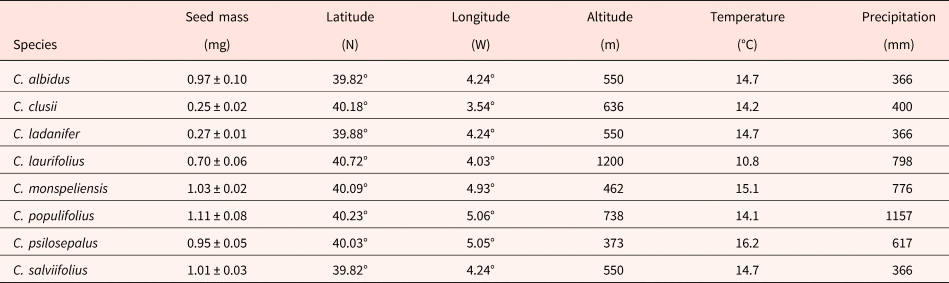
We studied the germination of eight Cistus species: Cistus albidus L., Cistus clusii Dunnal, Cistus ladanifer L., Cistus laurifolius L., Cistus monspeliensis L., Cistus populifolius L., Cistus psilosepalus Sweet and Cistus salviifolius L. These species are abundant in western Mediterranean shrublands, especially after fire occurrence (Allen, Reference Allen and Woodward2009). Seeds were collected in the Central Iberian Peninsula (Table 1). The climate is Mediterranean, with mean annual temperatures between 11 and 15°C and mean annual precipitation between 400 and 1,200 mm. Fruits were collected from at least 50 individuals during the summer at the moment of seed dispersal. Then, seeds were cleaned and separated in sets of 25 seeds in small cardboard boxes. Seed lots were stored in dark conditions in the laboratory until the start of the experiment the next spring. Seed dry weight for each species was estimated by weighing four lots of 25 seeds (Table 1).
Seed dry mass, geographic coordinates, altitude, mean temperature and mean annual precipitation at each location where seeds of the studied Cistus species were harvested

Cistus species are characterized by hard seed coats (Thanos et al., Reference Thanos, Georghiou, Kadis and Pantazi1992) that impose physical seed dormancy. Consequently, prior to germination treatments, each replicate of 25 seeds was exposed in open cardboard boxes to a single heat shock of 100°C for 10 min in an air-forced oven to break PY. This temperature and time are commonly found in Mediterranean shrubland fires (Moreno et al., Reference Moreno, Zuazua, Pérez, Luna, Velasco and de Dios2011; Céspedes et al., Reference Céspedes, Torres, Urbieta and Moreno2012) and was the optimal temperature for breaking seed dormancy of most of the studied species (Thanos et al., Reference Thanos, Georghiou, Kadis and Pantazi1992; Pérez-García and González-Benito, Reference Pérez-García and González-Benito2012; Luna et al., Reference Luna, Chamorro and Pérez2019).
The effects of light and temperature were analysed through a factorial experiment. Five replicates, of 25 seeds each, were used per treatment and species. Seeds were germinated in plastic Petri dishes (5.5 cm in diameter) over two filter papers moistened with 1.2 ml of distilled water. Petri dishes were sealed with parafilm to prevent desiccation. Seeds were incubated at different temperatures such as 10, 15, 20, 25 and 30°C in five temperature and humidity-controlled chambers (Model G-21, Ibercex). Seeds in the light treatments were incubated under a photoperiod of 12 h (white light at 110.2 ± 4.2 μmol m−2 s−1 provided by Philips TL-D/54 fluorescent tubes), and germination was recorded every 3 d. For the treatments in darkness, Petri dishes were wrapped in aluminium foil and germination was recorded once, after the 1-month incubation period.
At the end of the experiment, ungerminated seeds were checked for viability using a cut test. Those firm seeds with white endosperm were considered as viable, while mushy seeds with brown endosperm or affected by fungi were considered not viable. Although only the Tetrazolium test provides certainty about the viability of seeds with white firm endosperm, other authors have already proved the validity of the cut test for different species (Ooi et al., Reference Ooi, Auld and Whelan2004). According to unpublished data, the cut test is also a good procedure for estimating the viability of the seeds studied in the present research since there is a strong relationship between seed viability estimated by cut and Tetrazolium tests (r = 0.98). Germination percentages were corrected by viability, that is, germination percentages were estimated in relation to viable seeds.
For each species, main effects and interaction of light and temperature on final germination were tested by means of generalized linear models (GLMs). Based on the error structure, we used a binomial error distribution and logit link function for final germination. When temperature treatment effects were significant, pairwise comparisons among treatments were performed using the Bonferroni correction. All statistical analyses were performed using SPSS Statistics version 19.0 (SPSS, Chicago, IL, USA).
Results
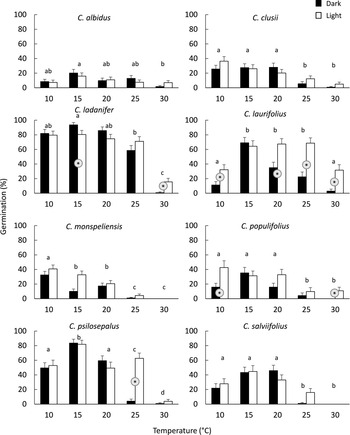
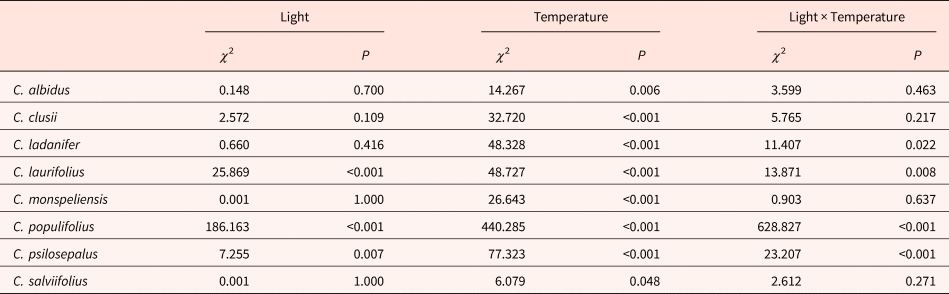
The temperature factor had a statistically significant effect on seed germination of all species at a significance level of P < 0.05 (Table 2). Germination occurred over the whole range of temperatures studied (10–30°C) except for C. monspeliensis and C. salviifolius that do not germinate at 30°C. Germination mostly decreased under the highest temperature treatments for all species (25 and 30°C) (Fig. 1). Despite these general patterns of germination, each species showed particular responses to temperature treatments. Overall, seeds germinated to the highest percentage at temperatures between 10 and 20°C, but for some species, like C. monspeliensis or C. psilosepalus, the optimal germination temperatures were 10 and 15°C, respectively. In the cases of C. laurifolius and C. psilosepalus, germination was lower at 10°C.
Germination percentages in relation to the total number of viable seeds (mean and standard errors) incubated under continuous darkness (black bars) or 12 h diurnal light photoperiod (white bars) at different constant temperatures (10, 15, 20, 25 and 30°C). Previously to incubation, seeds were exposed to a heat shock of 100°C for 10 min. Different lower-case letters show significant differences for seed germination (P < 0.05) between temperature treatments based on pairwise comparisons with the Bonferroni correction after GLM analysis. Asterisks show significant differences between dark and light treatments.

Results from the GLM for main effects of light and temperature treatments and their interactions on final germination percentages

Light significantly increased the germination of C. laurifolius, C. populifolius and C. psilosepalus (Table 2). Additionally, a significant interaction between light and temperature emerged for these three species and C. ladanifer (Supplementary Fig. S1 and Table S1). Under the unfavourable temperature treatments, germination of these four species was increased by light (Fig. 1). In particular, germination at 30°C was significantly promoted by light for C. ladanifer, C. laurifolius and C. populifolius. Germination at 10°C was significantly light enhanced for C. laurifolius and C. populifolius. Additionally, germination of C. ladanifer was favoured at 15°C and darkness (Fig. 1).
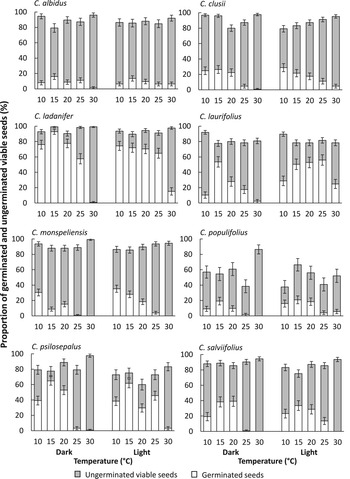
Most species did not reach germination percentages above 50% despite their high levels of seed viability (Fig. 2). In general terms, seed viability was elevated, except for C. populifolius, which showed mean values below 60%. Although the lowest percentages of germination occurred at 25 and 30°C, the viability of seeds incubated at these temperatures remained high (Fig. 2).
Proportions of germinated and ungerminated viable seeds (mean and standard errors) are shown in white and grey bars, respectively, for the eight Cistus species studied. The whole bar represents the total number of seeds and, therefore, the proportions of germinated seeds are not corrected by viability.

Discussion
This study evidences that both light and temperature emerge as environmental cues determining the germination of the studied Cistus species once physical seed dormancy is released. All species were able to germinate under a wide range of temperatures, which would support the expected broad tolerance to environmental factors needed for immediate colonization after a perturbation. However, despite this ability to germinate under different temperatures, seeds showed specific requirements and preferred conditions for germination. Light and temperature must help seeds to sense the appropriate conditions for germination and subsequent seedling establishment. These environmental cues act as a signal input recognized by plants and, converted to internal cues, further activate signal interaction among endogenous phytohormones, which in turn regulate physiological processes in seeds (Matilla, Reference Matilla2020). In addition to temperature and light, post-fire germination of Cistus species appears to be controlled by water (Luna and Chamorro, Reference Luna and Chamorro2016). After fire, when meteorological conditions are suitable, germination occurs mainly during the first post-fire year. However, when environmental conditions are not appropriate, for instance with scarce water availability, seeds must remain in the soil seed bank, while germination is delayed to the following years (Moreno et al., Reference Moreno, Zuazua, Pérez, Luna, Velasco and de Dios2011). Seeds can remain in the soil seed bank after fire occurrence because water availability is not enough to allow germination (Chamorro et al., Reference Chamorro, Luna, Ourcival, Kavgaci, Sirca, Mouillot, Arianoutsou and Moreno2017b) or maybe, because PY break cannot be completed. In some species, PY break occurs in two steps (Baskin and Baskin, Reference Baskin and Baskin2014), the first is a pre-conditioning step that makes the seeds sensitive to dormancy-breaking and the second, the actual dormancy-breaking step, during which the water-gap opens and allows water to pass into the seed (Jaganathan, Reference Jaganathan2015). Therefore, seeds would not complete PY break if after fire occurrence they are kept for a long time under unappropriated conditions for germination such as summer conditions and/or lack of water (Jayasuriya et al., Reference Jayasuriya, Baskin and Baskin2008; Rodrigues Junior et al. Reference Rodrigues-Junior, Baskin, Baskin and Garcia2018; Luna, Reference Luna2020). Future investigations should include the interactions among temperature, light and water, yet unexplored, which must control post-fire germination timing.
Temperature had a significant effect on seed germination for all species. Like other species from Mediterranean environments, germination of Cistus species is favoured by temperatures around 15°C. Vuillemin and Bulard (Reference Vuillemin and Bulard1981) found the optimum germination temperature for C. albidus and C. monspeliensis at 17°C. Thanos and Georghiou (Reference Thanos and Georghiou1988) also noticed that Cistus incanus ssp. creticus and C. salviifolius germinated between 10 and 25°C. Finally, although Pérez-García and González-Benito (Reference Pérez-García and González-Benito2012) did not find a significant response to temperature for C. albidus, C. crispus, C. ladanifer, C. populifolius and C. salviifolius, seeds were not previously scarified and consequently germination percentages were very low. Germination of shrub species in regions with a Mediterranean climate is promoted between 15 and 20°C (Thompson, Reference Thompson1970; Thanos and Georghiou, Reference Thanos and Georghiou1988; Bell et al., Reference Bell, Rokich, McChesney and Plummer1995; Luna et al., Reference Luna, Pérez, Torres and Moreno2012). This pattern of germination has probably evolved associated with the avoidance of germination during the summer drought period while favouring it during the rainfall period.
We found that germination of only one species, C. laurifolius, was lower at 10°C, with optimum germination at warmer temperatures between 15 and 25°C. This preference for relatively higher temperatures can be explained since this species lives at higher altitudes; therefore, warmer temperatures must guarantee the process when winter is concluded (Giménez-Benavides et al., Reference Giménez-Benavides, Escudero and Pérez-García2005; Fernández-Pascual et al., Reference Fernández-Pascual, Jiménez-Alfaro and Bueno2017; Picciau et al., Reference Picciau, Pritchard, Mattana and Bacchetta2019).
Germination of all species was inhibited by the highest temperatures. When seeds are imbibed at a temperature above optimum, the germination is often inhibited, which is called thermoinhibition (Hills and Van Staden, Reference Hills and Van Staden2003). In other cases, this restriction of germination is the result of secondary dormancy induction, which is known as thermodormancy. Nevertheless, in the present study, we cannot establish whether the decrease of germination at high temperatures is due to thermoinhibition or to thermodormancy and additional research should shed light on this issue. In dark conditions, a decreased germination was observed at lower temperatures than under light conditions. Similar results were found for Lavandula stoechas (Ghaderi-Far et al., Reference Ghaderi-Far, Coşgun, Değirmenci, Tüysüz, Ülgen and Tavşanoğlu2021), which were explained in terms of thermoinhibition for seeds incubated in light since seeds were able to germinate after being transferred to the optimum temperature. Thermoinhibition and thermodormancy are of ecological importance in the determination of the appropriate seasonal timing for seed germination because delayed germination at high temperatures has a protective role for seedlings against summer temperatures.
Germination of half of the studied species was also determined by light, especially in interaction with temperatures. Germination at optimal temperatures was quite similar under dark and light conditions. However, at supra-optimal temperatures, germination was enhanced under light regime. Although most of the few articles published on the subject suggest that germination of Cistus is not influenced by light, the studies have been developed under optimal temperatures for germination. Light did not have any effect on the germination of C. incanus or C. creticus (Thanos and Georghiou, Reference Thanos and Georghiou1988; Thanos et al., Reference Thanos, Georghiou, Kadis and Pantazi1992; Keeley and Baer-Keeley, Reference Keeley and Baer-Keeley1999) or of C. albidus or C. monspeliensis (Roy and Sonié, Reference Roy and Sonié1992), but germination was checked only at one optimal temperature. Light quality can also determine seed germination. Thanos and Georghiou (Reference Thanos and Georghiou1988) did not observe an effect of light quality on the germination of C. incanus ssp. creticus. However, Roy and Sonié (Reference Roy and Sonié1992) found that despite the seeds of C. albidus and C. monspeliensis germinated equally well in darkness as in light, they germinated worse under light with a low red/far-red ratio, similar to that provided by the vegetation cover.
The impact of light on germination generally involves control by the photoreversible pigment Pfr (Pons, Reference Pons and Fenner2000), whose active form regulates the synthesis of gibberellin (GA) promoting germination (Toyomasu et al., Reference Toyomasu, Kawaide, Mitsuhashi, Inoue and Kamiya1998; García-Martínez and Gil, Reference García-Martínez and Gil2002). Under light conditions, germination at high temperatures reaches higher levels than under dark conditions. This can be explained by the fact that temperature affects GA concentration and therefore phytochromes may have temperature-dependent effects on germination. The levels of the active form of Pfr influence germination by affecting its upper temperature limit (Fielding et al., Reference Fielding, Kristie and Dearman1992). Among phytochromes, Pfr A plays an important role in promoting germination at warmer temperatures, Pfr E is important for germination at colder temperatures and Pfr B is important to germinate across a range of temperatures (Heschel et al., Reference Heschel, Selby, Butler, Whitelam, Sharrock and Donohue2007). The upper temperature limit for germination may be established by Pfr levels of phytochromes A and B, and a threshold may exist around 25°C (Heschel et al., Reference Heschel, Selby, Butler, Whitelam, Sharrock and Donohue2007) such as the one found in the present study.
Soil is an efficient insulator against external environmental conditions like temperatures and light. Soil effectively restricts light to the upper 4 or 5 mm (Tester and Morris, Reference Tester and Morris1987) and decreases temperature variability (Sviličić et al., Reference Sviličić, Vučetić, Filić and Smolić2015). Consequently, when the weather is hot, lower temperatures must be reached at deeper dark soil conditions. Hence, germination at 25 or 30°C in darkness would correspond to higher temperatures near the soil surface. Therefore, inhibition of germination in darkness and high temperatures, like 25 or 30°C, would protect seedlings from facing more extreme external conditions after growing aboveground. Germination in light and high temperatures would represent the situation on the soil surface, where seedlings would not undergo a strong environmental shift from germination to establishment. Bell et al. (Reference Bell, Rokich, McChesney and Plummer1995) also found a significant interaction between temperature and light on native species from Western Australia. However, contrary to our results, they found that highest germination was achieved under dark conditions, being light inhibition more apparent with high temperatures (Bell et al., Reference Bell, Rokich, McChesney and Plummer1995). This was explained as a mechanism to avoid surface germination under the disadvantageous warmer conditions of the first rains of late autumn for seedling establishment. Maybe, the strategy for the establishment of Cistus and other hard-seeded species is quite different after fire occurrence and implies fast regeneration once water availability is enough (Luna and Chamorro, Reference Luna and Chamorro2016).
In the present study, all species had viable seeds that remained ungerminated no matter what the combination of incubation conditions were, which would be related with the dormant state of these seeds. In some species, low germination percentages were found for all incubation temperature treatments, which may indicate that the applied heat shock could have not been enough to break their PY and, therefore, germination responses to treatments would be less intense than expected. In consequence, such low germination percentages could mask the isolated and combined effects of treatments on seed germination. Nevertheless, the heat shock used in the present study was enough to break PY of those species analysed in previous research (Luna, Reference Luna2020), which reveals that different temperature thresholds for breaking PY may be needed according to the variability in PY levels. Seed dormancy confers the ability to survive in adverse environments such as those that are arid, hot or cold. Indeed, plants in environments associated with frost and/or drought are more likely to have some form of dormancy than species in more benign environments (Jurado and Flores, Reference Jurado and Flores2005). Seed dormancy allows these species to spread out the risk of extinction along time through a bet-hedging strategy, which would guarantee the persistence of a population. In this way, it would ensure the germination of a fraction of seeds from the seed bank, while another portion remains there, available to germinate at another time (Philippi and Seger, Reference Philippi and Seger1989; Ooi et al., Reference Ooi, Auld and Denham2009).
In conclusion, our study demonstrates that temperature and light have isolated and combined effects on seed germination of the studied Cistus species after PY break. When temperature is optimal for germination light is not so important, and it occurs in darkness as well as in light. However, under less favourable temperatures, the requirement of light for germination increases. New research, including more species and achieving a more efficient breakage of PY, should further the study of the interaction between both factors and help in clarifying whether the lack of germination is a result of thermoinhibition or thermodormancy.
Supplementary material
To view supplementary material for this article, please visit: https://doi.org/10.1017/S0960258522000149.
Acknowledgements
We thank Ángel Velasco, Sinesia I. Palomo and Rocío Peces for their technical support. We thank four anonymous reviewers for their helpful comments and suggestions. This study was supported by the PRESFIRE project (SBPLY/19/180501/000130) and the University of Castilla-La Mancha.
Conflicts of interest
The authors declare none.