This article aims to explain the dynamics of pension politics in South Korea (hereafter Korea) with particular attention to the role of the public bureaucracy. Since the introduction of the national pension scheme in 1988, there have been two major reforms – one in 1999 and the other in 2007. Much has been written about the 1999 reform, when the pro-welfare coalition, including civic groups and welfare ministries, played an important role in countering the pressure for a radical restructuring from both economic ministries and the World Bank (Kim and Kim Reference Kim and Kim2005; J. Yang Reference Yang2004). Although the 1999 reform contained some retrenchment – that is, a reduction in the benefit level – it has been generally regarded as a victory for the pro-welfare coalition because the redistributive aspect of the social insurance pension was preserved and its coverage was expanded to all self-employed workers. Yet, less than 10 years after that significant reform, the government implemented another critical reform in 2007 which was viewed as a major retrenchment.
From these events, two questions arise: first, who were the main actors in the policy-making process in 2007? Second, what were the key factors that enabled the main actors to bring about such changes? Accounts of the 1999 reform seem to be less successful in explaining the 2007 retrenchment. In the 1999 reform, welfare bureaucrats were depicted as somewhat passive actors in the pro-welfare coalition. Interestingly, however, they were at the heart of the 2007 reform process. While previous research on pension politics in Korea has focused on the period around the 1999 pension reforms, Weiss (Reference Weiss1977) and Sabatier (Reference Sabatier1988) argue that in public policy research the focus on short-term decision-making could mislead policy analysis. Moreover, a time frame of at least a decade would be appropriate in order to obtain an accurate picture. This article will examine the nature of the dynamics of pension politics from before the 1999 reform to the 2007 reform and will pay close attention to the interaction between welfare bureaucrats and other political actors in the process of pension expansion and retrenchment.
This research will first review previous studies of the role of public bureaucracy in policy-making. In the main analysis, attention will be paid not only to the role of public bureaucrats but also to the changing interaction between bureaucrats and political parties or civic groups. The article will argue that in the late 1990s, public bureaucrats, particularly economic bureaucrats, suffered from a lack of expertise and a loss of legitimacy due to the severe financial crisis and underwent a political realignment with the introduction of the Kim Dae-Jung government in 1997. Afterwards, however, the bureaucrats’ expertise increased and they played a leading role in implementing the second major reform in 2007.
This research adopts comparative historical analysis as its key method (Mahoney and Rueschemeyer Reference Mahoney and Rueschemeyer2003). Comparative historical analysis has three key features: revealing ‘causal configurations that produce major outcomes of interests’; analysing ‘historical sequences over time’; and enabling ‘systematic and contextualized comparisons of similar and contrasting cases’ (Mahoney and Rueschemeyer Reference Mahoney and Rueschemeyer2003: 11–13). By comparing and contrasting three pension reforms over time, the article attempts to examine the role of bureaucrats and their interaction with other actors and institutions in producing a specific reform. Data was primarily collected through expert interviews and document analysis. The main resources were governmental documents, reports from relevant research institutes, parliamentary documents and reports from the mass media. In addition, interviews with key policy actors were analysed to confirm and support the evidence.Footnote 1
Why are Bureaucrats Involved in Pension Reforms?
The earliest attempts to explain the development of social policy were the ‘industrialism thesis’, in which the development of the welfare state was seen as the product of new human needs, with extra economic resources generated by industrialization (Wilensky Reference Wilensky1975), and the neo-Marxist account, in which the welfare states existed to contribute to capital accumulation (O'Conner Reference O'Conner1973). Both views have been criticized for the functional and deterministic nature of their explanations of welfare state developments (Gough Reference Gough2000). By contrast, the power–resources theory, in which the force is the struggle between politics and the market, has been widely supported by empirical studies (Korpi Reference Korpi1985). For example, Myles (Reference Myles1984) maintains that class-mobilized power has a strong effect on pension development.
However, according to Pierson (Reference Pierson1996), these theories explain the ‘old politics of welfare’ – welfare expansion – rather than the ‘new politics of welfare’ – welfare retrenchment. Pierson asserts that a different logic should be applied in the era of welfare retrenchment, since the shrinking of class-mobilized power cannot explain the resilience of welfare state programmes in the 1980s and the 1990s. Instead, he focuses on policy legacy with embedded interests – for example, political popularity – and path-dependent developments. This account has been strengthened and enhanced by theoretical developments, such as veto players and blame-avoidance politics, and supported by a number of empirical tests (Bonoli Reference Bonoli2000). Instead of focusing on one specific actor, the argument pays attention to the interaction and the institutional position of each policy actor in the institutional matrix.
The two accounts, both the logic of expansion and retrenchment, are powerful tools for understanding welfare and pension reforms. Yet, it is questionable whether they could also explain welfare reform in the Korean context. Power–resources theory is unlikely to be a proper candidate. Although there are left-wing political parties and trade unions in Korea, class-based politics is scarce and the role of these actors in policy-making has been less visible than that of other actors. By contrast, the ‘new’ politics of welfare and historical institutionalism have been adopted or modified to explain welfare reforms in Korea and other East Asian countries, emphasizing path-dependent developments (Aspalter Reference Aspalter2002), but questions still remain. In particular, the history of Korean welfare institutions, including pensions, is short, especially when compared to pensions in other industrialized democracies (Y. Choi Reference Choi2008). Specifically, welfare institutions are still at an early stage of the ‘trodden path’, a stage when contingent or external events could easily change the developmental trajectory. This approach might be useful for explaining resilience, but it might not be appropriate for a country such as Korea, which has never achieved a full-fledged welfare state.
Thus, an alternative account should be able to explain the early stage of pension developments but should not be confined to the story of welfare expansion. As introduced earlier, the national pension scheme is still in the early stages and has expanded its coverage to all workers. At the same time, there have been two downsizing reforms. Between 1999 and 2007 these reforms resulted in a significant reduction of the income replacement rate from 70 per cent to 40 per cent, based on a 40-year contribution. Therefore, the bipolar reforms – expanding coverage on the one hand, and reducing benefit on the other hand – need to be explained. There are a few alternatives, such as policy ideas, but the role of civil servants requires more attention for the following reasons (Hwang Reference Hwang2007; Kwon Reference Kwon2003).
First, previous studies on welfare expansion, other than the theories mentioned above, point out the importance of public bureaucracy in pension development. For example, Heclo argues in his work, Modern Social Politics in Britain and Sweden (1974), that state administrators are the most persistent and substantial influence in the process of development, compared to other political actors and socioeconomic variables (Heclo 1984). The argument for the importance of bureaucrats has been developed by state-centred theorists such as Skocpol (Reference Skocpol1985) and Orloff (Reference Orloff1993). They claim that the structure and the capacity of public administration, together with political capacity, have been the most important factors in the policy-making process. In addition, it is argued that bureaucrats intrinsically tend to expand their territory, which could also explain the expansion of welfare.
Then, can state-centred theories also explain policy-making in the era of welfare retrenchment? While some argue that there is little reason to believe that public bureaucrats are important in retrenchment, others indicate that the literature on welfare retrenchment neglects the importance of bureaucrats (Marier Reference Marier2005, Reference Marier2008; Pierson Reference Pierson1996). Although it is true that studies that adopt the new institutionalism discuss the role of ministries and bureaucrats in policy-making – for example, as veto players or in the context of policy coalition – they tend to focus more on politicians or interest groups rather than bureaucrats. While politicians are the main players in credit-claiming or blame-avoidance politics, emphasis is also given to the path-dependent nature of policy institutions created by a set of political actors. However, as a policy (such as pensions) matures, it is hard to fully understand its details without detailed technical knowledge and skills (Heclo Reference Heclo1978), and assessing the necessity of the policy reform could require complex econometrics or projections (Marier Reference Marier2005). In situations where politicians and other actors are unsure of the outcome of a policy, bureaucrats are likely to influence it (Dahlstroem Reference Dahlstroem2009). For this reason, Marier (Reference Marier2005), Schiller (Reference Schiller2009) and Dahlstroem (Reference Dahlstroem2009) insist that the role of ministries and bureaucrats deserves more study, since they could play a decisive role in the process.
Another important reason why the role of bureaucrats requires close attention lies in the nature of East Asian states, which have been labelled as the developmental states. Numerous scholars, from both Western and East Asian countries, have undertaken research on the area's conspicuous economic success. A common agreement among them is on the role of the developmental state, led by Johnson's work, MITI and the Japanese Miracle (Reference Johnson1982; see also Haggard Reference Haggard1988). In key policy-making processes, the major features of the developmental state can be summarized as autonomy of the state (vis-à-vis interest groups) and bureaucratic autonomy. In effect, governments in East Asia exercised control over key sectors, and economic growth was regarded as an important tool for legitimizing the political power of the authoritarian government before the 1990s. In this context, bureaucrats – particularly those in the economy and finance ministries, who were the elites of Korean society – had enormous power over both business and society, whereas welfare bureaucrats were relatively weak. In Taiwan, welfare bureaucrats were so weak that they could not form their own ministry (Ku Reference Ku1995). Even after democratization, economic bureaucrats at the Taiwanese Council for Economic Planning and Development openly defied President Chen's plan to extend tax-based old-age allowances instead of social insurance in 2000 (Lin Reference Lin2005).
The arguments of ‘productivist welfare capitalism’, in which social policy is shaped by the need of economic growth, offer a clear explanation of the characteristics of the Korean welfare regime in this period (Holliday Reference Holliday2000). As will be discussed later, the introduction of public pensions in the 1970s and the 1980s came from a productivist motive, as the government intended to mobilize a large sum from pension funds for the benefit of the heavy-chemical industry (Shin Reference Shin2003). In this process, the role of the bureaucrats was far more important than that of other actors, including politicians, labour unions and civic groups, not only in terms of political power but also in terms of professional knowledge. Strong economic development also supported the legitimacy of bureaucrats and their policy. Although democratization and unprecedented socioeconomic change since the late 1980s have started to undermine developmentalism and the power of bureaucrats, the role of bureaucrats is highly likely to affect the later developments and reforms of social policies, including pensions.
Previous studies, however, have warned that bureaucrats should not be regarded as a homogeneous entity. They argue that public bureaucracy is heterogeneous, and different ministries could have different interests and positions on a particular policy. In the literature on the welfare state, many scholars have investigated the dynamics between finance ministries and welfare ministries (Marier Reference Marier2005). In the developmental phase of public pensions, welfare bureaucrats, unlike finance ministries, tend to support a universal public pension (Shinkawa Reference Shinkawa2005). In the retrenchment phase, Müller (Reference Müller2003) observes that the ministry of finance, normally driven by neoliberal economists, tends to support radical market-friendly pension reforms, whereas welfare ministries are likely to support the status quo and to oppose structural reforms. Similarly, J. Yang (Reference Yang2004) argues that welfare bureaucrats aim to secure the institutions of the original pension plan because they have a strong interest in retaining their jurisdiction of the pension system. Shinkawa (Reference Shinkawa2005) also states that welfare bureaucrats in Japan even resist changing the financing method from social insurance to tax-based financing. By contrast, finance ministries attempt to reduce the negative effect of pension financing on the economy and thus tend to favour radical restructuring. Therefore, this research will closely examine the changing interaction between different public bureaucrats as well as the interaction between bureaucrats and other political actors.
Expertise, Legitimacy and Institutional Positioning
There has certainly been much research on bureaucracy in public policy-making, but the general tendency is to understand the role of the bureaucracy in the context of its relationship with other political institutions. Apart from the new institutionalist approaches and the advocacy coalition framework, much of the focus of the studies on bureaucracy, particularly from the US, is primarily on political control of bureaucracy – that is, whether or not or how Congress controls bureaucracy (Huber et al. Reference Huber, Shipan and Pfahler2001; Waterman et al. Reference Waterman, Rouse and Wright1998). Yet a systematic analysis of the sources of bureaucratic power has been largely neglected. One of the important reasons for this in the US is ‘the decline of politics-administration dichotomy’ (Eisner and Meier Reference Eisner and Meier1990), which is not the case in Korea.
Among the existing literature, Meier's study (1987) specifically discusses the sources of bureaucratic power. He divides the sources into external sources and internal sources. External sources consist of various political support, including public opinion, clientelist support and support from other political elites, whereas internal sources are composed of knowledge, cohesion and leadership. Meier's analysis offers some important insight, but it needs to be modified in this study. For example, the internal cohesion of bureaucracy – that is, the commitment of the members of the bureaucracy – is less important in the Korean context. Modifying Meier's study and based on previous literature, this research proposes three possible sources of bureaucratic power.
The first source is expertise or knowledge in formulating a policy model. As Dahlstroem (Reference Dahlstroem2009) argues, in democratic countries, when policy issues are highly complex and uncertain, bureaucrats are likely to become crucial actors. Compared to other actors, they are persistent actors – that is, policy planner/coordinator/implementing actors – which enables them to build expertise and knowledge about certain policy areas. Thus, Schiller (Reference Schiller2009) argues that ‘the degree of (expertise) monopolization matters a great deal’; if bureaucrats rely on external actors for expertise, their influence would be significantly weaker. This factor can be even more important in pension reforms since understanding demographic change and pension schemes requires a substantial amount of technical knowledge, particularly as the scheme matures. More specifically, the number of political actors who can judge whether a pension reform would be effective is likely to decrease as pension schemes mature. In this sense, it would be important to analyse who has the necessary expertise in the course of pension reforms.
The second source is legitimacy in mobilizing political support, which is similar to the external sources suggested by Meier (Reference Meier1987). In order for bureaucrats to fully utilize their expertise in policy-making, they need to take into account another crucial factor: their legitimacy. Legitimacy could come either from politicians (Dahlstroem Reference Dahlstroem2009), particularly from the president in the Korean context (Kwon Reference Kwon2003), or from the people (Marier Reference Marier2005). When the people trust bureaucrats more than they trust politicians, as is the case in most Western European countries (Marier Reference Marier2005), bureaucrats could exercise significant leverage in policy-making. Conversely, if bureaucrats do not have the trust of politicians in power or the public's trust, it would be very difficult for them to be influential. In this case, they are more likely to seek cooperation or to establish coalitions to build ‘a common understanding’ by bringing together actors who have legitimacy (Schiller Reference Schiller2009). Expertise comes from within the bureaucracy, whereas legitimacy comes from the relationship with outside actors. Yet, expertise and legitimacy are not mutually exclusive terms. Expertise might be useless without legitimacy and, conversely, legitimacy without expertise cannot last long. However, legitimacy could survive without expertise under an authoritarian government, and expertise cannot always grant legitimacy to public bureaucrats if they lose the trust of actors who have political power.
The final source of bureaucratic power is ‘institutional positioning’, which identifies where actors are located in the complex political configuration of a policy issue. Although it is not difficult to imagine that actors with more expertise and legitimacy would occupy the central position in the institutional setting, bureaucrats tend to have many tools to help them maintain the status quo of a policy without relying on expertise and legitimacy. A pension reform process normally includes complex and numerous political institutions, such as ministries and pension reform committees that include representatives from social groups, political parties in the national assembly, and so on. Therefore, the role of bureaucrats can be constrained to a large extent by legal and institutional structures: the hierarchy of the ministries, especially how the relationships between the economic ministries and welfare ministries are constructed; whether the jurisdiction over the pension system is distributed among ministries or monopolized by one institution; the legal status and membership of a pension reform committee; who controls the pension funds; and how distant political parties are from the ministries (Immergut Reference Immergut, Anderson and Schulze2006; J. Yang Reference Yang2004).
It is difficult to provide a clear-cut measure of to what extent actors would need expertise, legitimacy and advantageous institutional positioning to accomplish their reform goal. This current research, however, argues that it is important to understand the three sources in figuring out the dynamics of pension policy-making with regard to the role of bureaucrats. In the following sections, we will examine how these three sources have influenced the role of bureaucrats and their interactions with other political actors in pension policy-making.
The Development of The National Pension Scheme: Pension Reforms In Korea Before 2007
Introducing the National Pension Scheme: The Role of Economic Bureaucrats in Introducing the Institution
The first attempt to introduce the national pension scheme was the National Welfare Pension Scheme in 1973, mainly led by economic bureaucrats at the Economic Planning Board and the Ministry of Finance and their advisory institute, the Korean Development Institute. Yet, because of economic stagnation, the implementation of the system was postponed several times and it did not come into effect until the 1986 National Pensions Act (W. Kang Reference Kang1992). The 1988 national pension scheme maintained a structure favourable to achieving its initial goal, the accumulation of capital. First, the funded system required 20 years of contributions before the pensioner could obtain entitlement to the pension benefit, and this maximized the fund's reserves. Secondly, the national pension scheme had a relatively wide coverage in that it covered firms with 10 or more employees. By comparison, both the industrial accident compensation insurance scheme, introduced in 1964, and the health insurance scheme, introduced in 1977, initially covered only firms with 500 or more employees. The wide cover of the national pension scheme was expected to generate a large fund within a short time (W. Kim Reference Kim2008). Thirdly, although welfare bureaucrats at the Ministry of Health and Welfare (MOHW) were responsible for operating the system, it was the Ministry of Finance that held the funds in order to make it possible to divert them to economic policy.
In the preparation period, welfare officials and welfare experts developed their own ‘social security’ pension model, which aimed to enhance social security rather than economic growth. While the growth model supported by economic bureaucrats stressed the function of the pension system as being to promote economic growth, the social security model contained a relatively high benefit level and emphasized income redistribution. Yet, the welfare bureaucrats’ proposals were hardly reflected in the final National Welfare Pension Law (W. Kim Reference Kim2008). The primary reason why economic bureaucrats played a key role in introducing the national pension scheme was their relative expertise. Compared to the Committee for Social Security, which developed the pension model of the welfare bureaucrats, the Korean Development Institute was acknowledged to be the home of Korea's best brains (C. Choi Reference Choi1991). Another important reason was the higher status of economic bureaucrats; this status was generated by their institutional positioning and legitimacy in the policy-making process. In the Korean developmental state, the power of economic bureaucrats was not limited to economic policy. For example, the Economic Planning Board, the stronghold of the state, controlled not only economic policy but also other policy areas, such as social policy. Furthermore, the board earned the trust of the president and the public since it helped to achieve rapid economic growth.
Pension Reform in 1999: The Expansion of Institutions and a Change of Power in the Bureaucratic System
The 1999 pension reform was the first comprehensive pension reform under a democratic government in Korea. The main issues in the reform were to ensure the long-term financial stability of the pension fund and to expand its coverage to the self-employed in urban areas. Two distinctive arguments competed in the reform process. On the one hand, economic bureaucrats and their advisers adhered to the growth model and tried to prevent the negative economic effects that could be caused by the financial instability of the fund. Their proposed reform model was to restructure the national pension scheme fundamentally. The benefit level would be radically reduced and the scheme split into the two parts: the basic pension and an earnings-related pension, which would eventually be privatized. On the other hand, the policy coalition of welfare bureaucrats and the welfare experts of civic movements pursued the development of the social security model by proposing the extension of the current pension to urban areas, with a marginal reduction of the benefit level (Noh Reference Noh2004).
Both models were supported by different but solid professional bodies. The first model had its own logic and policy coherence, as it was intellectually supported not only by economic experts, who pointed out the fundamental financial problem of the unbalanced structure between the benefit level and the contribution rate, but also by the World Bank. By contrast, the second model was supported by experts from the Ministry of Health and Welfare and also from civic movements (Y. Kim 2004). This model was partly based on the pension reform model of the International Labour Organization. Therefore, both groups were able to build professional and consistent pension reform models (W. Kim Reference Kim2008).
While expertise on pension reforms was not a factor differentiating the two groups, there was a significant change in terms of the legitimacy of the economic bureaucrats and welfare bureaucrats (J. Yang Reference Yang2004). Two major events occurring in 1997 and 1998 significantly affected the legitimacy of economic bureaucrats. First, the financial crisis in November 1997 undermined national confidence in economic growth, which had been the source of the economic bureaucrats’ legitimacy. The crisis was blamed on the lack of skill of the economic bureaucrats. This resulted in the decline in public and political support as well as in trust for economic bureaucrats. Secondly, the pro-welfare Kim Dae-Jung government was inaugurated in February 1998, the first opposition party in Korean history to win an election. Kim Dae-Jung's government was sceptical about the growth-oriented national economic strategy and aimed for a balance of economic growth and human welfare. These two changes resulted in the loss of political support for economic bureaucrats from both the politicians and the people.
The weakening of the legitimacy of economic bureaucrats was accompanied by the strengthening of political support for welfare bureaucrats. Still, the welfare bureaucrats could not attain the power they needed in policy-making by themselves. While they required professional knowledge to complement their reform ideas, they also sought coalition partners who could implement the reform successfully. For this purpose, welfare bureaucrats relied on the support of pro-welfare scholars and civic movements in the reform process, particularly the People's Solidarity for Participatory Democracy (J. Yang Reference Yang2004). While pro-welfare scholars and civic groups who supported the president's ideas on welfare realized their policy ideas through joining various pension reform committees, welfare bureaucrats took advantage of coalitions to gain expertise and legitimacy from the president and the public.
Also in the institutional positioning sphere, there was a major change in the power relationship between economic bureaucrats and welfare bureaucrats in social policy-making. Democratization in the late 1980s and the expansion of business contributed to the shrinking of the developmental features of the Korean state (Y. Choi Reference Choi2008). The closure of the Economic Planning Board in 1995 was one example. It resulted in the loss of the superior position held by economic ministries in the social policy decision-making process; this provided the best chance for the welfare ministries to improve their jurisdictional power.
Unlike in the 1973 National Welfare Pension Act, in 1999 the welfare officials were able to press their positions with these more favourable conditions. While the structure of the national pension scheme was maintained instead of undergoing radical reform, there was an expansion of the existing system to universal coverage. With this reform, the formal expansion of the national pension scheme was completed. In addition, by taking over responsibility for managing pension funds from the economic ministry, the welfare ministry became a major power that controlled most aspects of pension policy.
The Pension Reform Process In 2007: Securing Institutions
After the 1999 reform had been carried out, its limitations soon became apparent. The first limitation was associated with the function of the social security system, especially the expansion of pension coverage. The pro-welfare coalition in 1999 expressed the optimistic view that the reform would lead to the expansion of practical pension coverage to the self-employed and employees working at small firms (Y. Kim 2004). However, according to a survey conducted in 2002, despite the legal expansion of the coverage, 39 per cent of the workforce did not pay pension contributions (Seok Reference Seok2002). As a result, the pessimistic view emerged that the national pension scheme could not effectively eliminate poverty among older people. Secondly, the ever-increasing population of older people became a crucial threat to the the stability of pension financing. According to the Korean National Statistical Office (KSNO), as the total fertility rate was down to 1.17 in 2002, the pension funds would be exhausted by 2039, compared to the 2050 date calculated in 1998 (Korean National Statistical Office 2002). It was therefore argued that a new reform was essential to address these problems.
First Attempt: The Activities of the Development Committee of the National Pension and Building Pension Reform Models
Against this background, the primary concern of the welfare ministry was to secure the current system by reducing financial instability rather than strengthening social security for older people (President's Committee of Advisers on Policy and Planning 2007). This seemed to be the result of not only a general bureaucratic attitude but also a deep attachment to the concept of the accumulating pension fund. The size of the fund in 2002 reached about 15 per cent of GDP and was expected to be about 35 per cent of GDP in 2035, which could influence the Korean economy in many respects (National Pension Development Committee 2003). Therefore, welfare bureaucrats wanted to maintain the current system and to achieve further accumulation of the pension fund by improving the financial balance of the scheme.
The standpoint of the ministry was well reflected in the reform proposals made by the National Pension Development Committee working between March 2002 and May 2003. The creation of the committee was required by the 1999 reform, and the main goal was to ensure the institutional and financial stability of the national pension scheme (Y. Yang Reference Yang2011). Many people from the previous coalition with the welfare ministry, such as civic groups, joined the committee, but in practice it was structured in favour of the ministry's initiatives. This was for two prime reasons. First, since the committee was originally established as the advisory body for the welfare minister, the ministry had a substantial power over the selection of the members and the organization of the committee. Second, the committee members were too diverse to reach a consensus easily. The committee was composed of 61 representatives from government ministries, newspapers, civic movement groups, research institutes, academia and labour and employer groups. Given these conditions, it would seem logical to expect that the ministry, which could influence a majority of committee members, would be much stronger than other voices in the committee (Marier Reference Marier2008).
When the committee submitted its final report on the new pension reform, it seemed to represent exclusively the voice of the ministry. On the one hand, the committee focused on the necessity of retrenchment reform, namely financial stability, whereas it neglected the issue of the large uncovered population. Based on the population projection, the committee claimed that the national pension scheme would be transformed into a pay-as-you-go system and the contribution rate would reach 30 per cent in 2050 and 39.1 per cent in 2070. On the other hand, it hardly mentioned the issue of how to cope with poverty among older people in the future, nor the problem of contribution avoidance (National Pension Development Committee 2003).
The committee considered three different options for reform (National Pension Development Committee 2003). First, the income replacement rate would be 60 per cent, as it had been before, but the contribution rate would rise from 9 per cent to 19.85 per cent. Second, the income replacement rate would be reduced to 50 per cent and the contribution rate would rise to 15.85 per cent. Finally, the income replacement rate would be reduced to 40 per cent but the contribution rate would be raised by 11.85 per cent. The committee failed to reach a compromise but they proposed all three options to the welfare minister, noting that the second option had the support of the majority of the committee. The ministry confirmed that the majority supported the second option as the official government reform model, and proposed a pension reform act based on that option in October 2003.
Welfare bureaucrats on the committee failed to build a consensus for the reform model, but the model with majority support was able to get sufficient support from experts and officials within the government. Nevertheless, the pension reform legislation failed to be introduced since the largest opposition party at the time, the Grand National Party, stood strongly against it. This conservative-oriented party criticized the proposed reform for neglecting the large number of older people who were excluded from pension benefits, and proposed an alternative bill containing fundamental changes to the pension structure. According to the Grand National Party proposal, the entire population aged 65 and over should be entitled to a flat-rate benefit set at 20 per cent of the income of the average insured person (Yoon Reference Yoon2004).
Although neither of the proposals was enacted, the importance of the attempt at reform should not be overlooked. Most of all, two main reform models were built. The first one, proposed by the welfare ministry through the committee, can be labelled the ‘institutional security’ pension model, focusing not on social security or economic development but on institutional sustainability by simply reducing the benefit level and increasing the contribution rate.Footnote 2 The second model was the social security model, aiming to expand the actual coverage by adopting a new basic pension together with reducing the benefit level of the national pension scheme. This model was supported by those who argued for structural change of the pension scheme in the 1999 reform. However, this model did not include privatizing the national pension scheme and gained strong support from the largest opposition party as an electoral pledge.
The first attempt at reform taught an important lesson to the welfare bureaucrats who attempted to introduce the pension reform legislation between late 2004 and early 2006 (President's Committee of Advisers on Policy and Planning 2007: 77). It is difficult to carry out a pension reform without at least the partial acceptance of the reform model by the opposition party. From the viewpoint of welfare bureaucrats, the failure of the legislation to pass was caused by a legislative blockade by the opposition party together with the inactivity of the ruling party. Bureaucrats had to realize that political parties as well as civic groups are important actors in the policy-making process. Consequently, they learned the necessity of cooperating with the ruling party and compromising with the opposition party to achieve pension reform.
Interestingly, progressive academics and civic groups, which had been at the centre of policy-making during the 1999 reform, did not play an important part at this time. They seemed to suffer from a crisis of expertise and legitimacy. First of all, to counter the committee's report warning about the depletion of the pension fund, academics and civic groups could not produce a single agreed proposal, unlike in 1999. Some insisted on preserving the current system with minor adjustments and others argued for fundamental reforms – for example, the introduction of a Swedish-style notional-defined contribution system. Their seemingly lethargic attitude to financial projection might reflect their lack of expertise in the increasingly complicated pension scheme. Also, welfare bureaucrats and the government successfully strengthened their legitimacy and expertise by using progressive academics from civic groups; this could have been a blow to the civic groups because they directly or indirectly lost their political neutrality. Due to these factors, civic groups were left behind in the 2007 reform process.
Second Attempt: Policy Coalitions between Parties in the National Assembly
After the first attempt at reform, welfare bureaucrats actively cooperated with the political parties. Accordingly, the pension reform discussion moved to the National Assembly. The politicization of the pension reform process was accelerated by two other factors. First, when the opposition party made the basic pension one of their 50 key campaign promises in the 2004 April National Assembly election, it became one of the hot issues during the election (Dongailbo 2004). Also, there was a surge in the anti-national pension scheme movement in 2004, triggered by worries about the depletion of the pension fund. This movement demonstrated the fundamental public distrust of the management of the pension fund (Segyeilbo 2004) and also became a major electoral issue.
The first political compromise took place in June 2006, when the welfare ministry announced a new pension reform proposal in order to persuade opposition parties and to gain people's support for the reform. The ministry maintained the key framework of its old institutional security model: reducing the income replacement rate to 40 per cent and raising the contribution rate to 12.9 per cent. In addition, the ministry partially accepted the Grand National Party's idea of a tax-financed flat-rate benefit (Health and Welfare Committee 2006a, 2006b). With this move, the ministry successfully persuaded the ruling party, the Uri Party, to support the plan, except for the issue relating to raising the contribution rate (Kang Reference Kang2006).
Under these circumstances, political parties formed an alliance on policies. A proposal was agreed between the Grand National Party and the Democratic Labour Party, the minority opposition party. According to this proposal, the income replacement rate of the national pension scheme would be gradually reduced from 60 per cent to 40 per cent, while more than 80 per cent of the elderly population would receive a basic pension benefit of a 5 per cent income replacement of the average insured under the national pension scheme within the short term, and 10 per cent in the long term (President's Committee of Advisers on Policy and Planning 2007: 107). This first proposal by the two opposition parties was replaced by another agreed between the biggest parties, the Uri Party and the Grand National Party; it maintained the 9 per cent contribution rate, reduced the income replacement rate to 40 per cent and provided a basic old age pension of 10 per cent income replacement of the average insured under the national pension scheme (President's Committee of Advisers on Policy and Planning 2007: 111). Through the negotiating process, the parties’ positions gradually converged and, finally, the Pension Reform Act was passed by the National Assembly in 2007.
As the major pension issue has changed, the policy coalition has been restructured. After the 1999 reform, the welfare ministry successfully enhanced professionalism in the management of the national pension scheme. For example, it reconstituted one of its think tanks, the National Pension Research Institute, in 2004. This agency evaluated the management of the national pension scheme and had the exclusive ability to conduct financial projections. With the support of this agency and others, the welfare ministry proposed the reform act based on realistic financial estimates.Footnote 3 As a result, the Roh administration and the ruling party eventually accepted the plan.
In respect of legitimacy, the welfare bureaucrats could obtain political support from the president and the ruling party for a ‘social investment strategy’. Unlike the Kim Dae-Jung administration, which aimed at the overall expansion of the welfare policy, the Roh government supported selective expansion of the welfare system, influenced by the ‘social investment strategy’ of the European welfare states. The Roh government drew a distinct line between social insurance, which was defined as a financially consuming system, and social service and active labour market policy, which were investment friendly. Then the government argued that ‘prior to an expansion of investment in social policy of social investment, the expenditure of financial consuming social policy should first be minimized’ (Joint Workgroup of Private and Public Experts 2006). Therefore, the objective of pension reform was to secure the institution through rationalization or retrenchment rather than through expansion of the social security system.
In terms of institutional positioning, welfare bureaucrats were in a mixed position. As a result of the 1999 reform, the welfare bureaucrats could successfully strengthen their power over the pension system compared to the economic ministries, including the control of pension fund management. They administered the Pension Reform Committee, which carried out long-term financial projections and prepared reform proposals. On the other hand, as the pension policy began to be politicized, the competition of policy ideas between political parties became severe. As a consequence, the legislative functions of the National Assembly were not fully controllable by the bureaucrats. This situation required the welfare bureaucrats to adopt strategies of active persuasion and partial compromise with the opposition party (Financial Valuation Committee of Nation Pensions and the Improvement Committee of National Pensions 2008: 65).
In contrast, a new coalition for strengthening the social security system was formed. Despite being a conservative party, the Grand National Party consistently argued for the adoption of the universal basic pension to strengthen economic security in old age, claiming that the major aim of pension reform should be the extension of pension coverage. Indeed, in the 2004 National Assembly election and again in the 2007 presidential election, the Grand National Party made the introduction of the basic pension one of its key campaign promises and insisted on ‘social security’, as distinct from the ‘institutional security’ of the welfare ministry. Moreover, another opposition party, the Democratic Labour Party, also let its voice be heard in the compromise process in the National Assembly. Yet, it seemed problematic that neither party had sufficient expertise. Their reform models relied on a limited number of scholars, and their advocates did not have any direct evidence from professional research institutions. It was very difficult for the opposition parties to defend themselves and to argue against the government, which claimed that the basic pension was not a financially feasible option.
Furthermore, the opposition was also restricted in its ability to mobilize political support. The model was adopted officially by the Grand National Party but failed to get broad popular support among politicians, even in opposition parties. Indeed, the Grand National Party's pension reform model was adopted as an election promise, but public awareness of the issue was still relatively low compared to other issues at that time. Since the political popularity of the Democratic Labour Party, another coalition member, was less than 10 per cent of the whole population, it was difficult for it to gain significant support from the people.
Finally, however, the Grand National Party took advantage of its institutional positioning in the National Assembly. Despite its lack of expertise and legitimacy, the Grand National Party could block unilateral legislation by the ruling party and the welfare ministry, and force them to compromise. As a result, although in 2007 the welfare bureaucrats had a superior position in all aspects of expertise, legitimacy and institutional positioning compared to other actors, they had to listen to the other actors, particularly the opposition parties, in order to pass the reform legislation.
These characteristics of pension politics were reflected in the reform results. The major results of the reform were to reduce the income replacement rate to 50 per cent in 2008 and to 40 per cent by 2028, by maintaining the contribution rate of 9 per cent. In addition, as a result of a political compromise, the basic old-age pension was newly introduced. The basic old-age pension was designed to cover 70 per cent of over-65s from the beginning, but the benefit level was only 5 per cent of the income replacement rate of the average insured of the national pension scheme. This amount was not sufficient to offset the dramatic cut in benefit levels in the 2007 national pension scheme reform.
Expenditure on the national pension scheme, as a share of GDP, was projected to be 7 per cent in 2050 before the reform, but after the reform, it was projected to decrease to 5.5 per cent in 2050 (Financial Valuation Committee of Nation Pensions and the Improvement Committee of National Pensions 2008: 65). This positive effect on public finance will, however, be offset almost completely, since the basic old-age pension is expected to account for 1.4 per cent of GDP in 2028, if its benefit level rises as planned from 5 per cent to 10 per cent by 2028 (Committee for the Integration of the National Pension Scheme and Basic Old Age Pension 2008: 8). In this sense, the main aim of the 2007 retrenchment reform was not to reduce the burden on the Treasury from old-age income security. The Ministry of Health and Welfare chiefly aimed to enhance the institutional and financial stability of the national pension scheme. From the institutional perspective, the problem of the expansion of the actual pension coverage, which was one of the most important issues in the reform, was not solved by the structural changes in the national pension scheme, but by accepting the basic old-age pension as a supplement to the current system. Indeed, an improvement in the long-term financial stability of the national pension scheme led to a further increase in the pension fund. Due to the retrenchment reform, the year that the pension funds will run out has now been delayed from 2047 to 2060 (Financial Valuation Committee of Nation Pensions and the Improvement Committee of National Pensions 2008: 60).
Revisiting The Role of Bureaucrats: An Emerging ‘Push and Pull’ Effect?
In Korea, three key pension reforms have been implemented with different purposes. One of the main motives behind the introduction of the national pension scheme in 1988 was capital accumulation rather than social security. By contrast, the 1999 reform, the universalization of the national pension scheme, can be seen as resistance to the structural pension reform proposed by the World Bank and neoliberal economists. Again, the 2007 reform was intended to secure the financial sustainability of the national pension scheme by drastically cutting the benefit level.
While it is undeniable that bureaucrats have played a crucial role in policy-making throughout these processes, it is clear that the focus of recent literature has shifted away from the role of bureaucrats in social policy-making. In some research, bureaucrats are described as more passive than other actors, such as civic groups and political leaders. However, from this analysis – not only in the 1999 expansion reform but also in the 2007 retrenchment reform – bureaucrats, though limited, attained their major reform goals by associating as well as competing with other political actors. In the retrenchment reform, the welfare bureaucrats originally aimed for the maintenance of their jurisdiction by preserving the existing pension system. Strengthening their expertise on pensions, they played the most active role, not only as planners, but also as negotiators in the process.
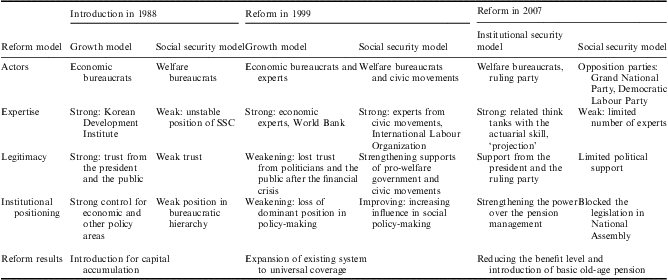
Through the comparative historical analysis of pension reforms, this study shows that the three concepts – expertise, legitimacy and institutional positioning – can be useful in explaining the role of bureaucrats in pension policy-making. Table 1 summarizes the findings of the article with regard to the three concepts. Economic bureaucrats supporting the growth model were superior to welfare bureaucrats in terms of expertise, legitimacy and institutional positioning in the introduction of the national pension scheme in 1998. However, after the change of government and the financial crisis, welfare bureaucrats could strengthen their position by forming a coalition with civic groups which had better expertise and legitimacy than other actors. As a result, the bureaucrats successfully produced the social security model in 1999. In the 2007 reform process, the superior role of welfare bureaucrats was confirmed again, but in a much more independent way. This can be understood by looking at the strengthened position of welfare bureaucrats in all the three aspects. Opposition parties taking advantage of their institutional positioning partially achieved their aim by introducing the basic old-age pension. Consequently, in the 2007 pension reform, welfare bureaucrats, who had won the support of the president and the ruling party, were able to maintain their jurisdiction through securing the institution of the national pension scheme.
Comparative Historical Analysis of Pension Reforms

The findings of the study accord with the existing literature on the role of economic and welfare bureaucrats. In particular, as examined in Shinkawa's study (2005), while welfare bureaucrats tend to support the social security model, the universalization of public pensions, they are likely to resist any structural change and to stick to the social insurance model in a retrenchment phase. It should not be overlooked, however, that the political parties emerged as key players in the policy-making process. Unlike previous reforms, the 2007 pension reform was raised as an important issue in the election and in pension politics, driven by political parties, which seem to have been an important factor in the process.
What, then, are the implications of these three sources for further pension reforms in Korea? Will the power of welfare bureaucracy maintain its status as it is now? There are two factors that might influence the role of welfare bureaucrats in pension politics. First, the bureaucrats continue to develop their expertise on the national pension scheme in many respects, but they have been criticized for their lack of expertise in the management of the national pension scheme funds. As the pension fund becomes the single most significant fund in the Korean financial market, there have been strong calls to change the governing structure of the pension fund to bring in more financial expertise, instead of the ‘social consensus’ type of governing structure that is currently in place. Second, the political parties that emerged as key players in the 2007 pension reform, together with existing civic groups, are likely to restrain the power of the welfare bureaucrats in pension politics. Interestingly, as Heclo (Reference Heclo1974: 94) observes, there is a ‘push and pull’ effect in the relationship between democratic politics and bureaucrats, whereby there are more issue-conscious groups in pension politics, whereas pension policy-making is moving ‘further and further away from the nontechnical, nonspecialist understanding of the ordinary citizen and politician’. Therefore, the future of pension reform and politics will depend on how effectively the welfare bureaucrats deal with the challenge of professionalism and legitimacy as well as how they form policy coalitions with other actors.
Acknowledgements
This work was supported by the National Research Foundation of Korea Grant funded by the Korean Government (MEST) (NRF-2011-330-B00128).