INTRODUCTION
Over the past two decades, artisanal and small-scale mining (ASM) – low tech, labour-intensive mineral extraction and processing – has expanded rapidly in many corners of sub-Saharan Africa. Whilst there is some debate over the precise role this sector of industry plays in the environments where it is now widespread, there is broad agreement in the literature that it is one of the most important rural non-farm activities in the region today. Most of the people found working in ASM communities across sub-Saharan Africa are subsistence farmers who have ‘branched out’ in order to obtain supplementary incomes. Based on recent estimates, there could be upward of 10 million people employed directly in ASM in the Democratic Republic of Congo, Ghana, Tanzania and Mozambique alone.
In these countries and a number of other rural stretches in sub-Saharan Africa, ASM is largely ‘poverty-driven’, providing immediate income relief to scores of impoverished families. The evidence in support of this is overwhelming: over the past two decades, countless studies (e.g. Fisher Reference Fisher2007; Banchirigah Reference Banchirigah2008) have emerged which capture how ASM, by generating direct employment and spawning downstream industries, has brought stability to scores of fragile, impoverished rural localities. This has led to calls (e.g. Siegel & Veiga Reference Siegel and Veiga2009; Maconachie & Hilson Reference Maconachie and Hilson2011) for donors and host governments to formalise the sector and provide assistance to its operators. But in a region of the world – sub-Saharan Africa – where smallholder agricultural development has long been the centrepiece of rural economic development strategies, the idea that a supported ASM sector could alleviate significant hardship has, not surprisingly, encountered some resistance in policymaking circles. This is particularly unfortunate for Sahelian communities, where, because of harsh climatic conditions and short growing seasons, any agricultural-led poverty alleviation strategy is bound to have a limited impact. In these arid localities, a large number of which are remote and disconnected from large commercial centres and country capitals, an infusion of more dynamic rural development strategies is desperately needed.
Nowhere has this been more evident than in Northern Ghana, where a combination of decades of neglect from government, repeated application of inappropriate development interventions and an eroded agricultural base, has caused significant poverty. This area of the country has long been victimised by outmigration, struggling mightily to retain the human resource base needed to catalyse development. Over the past decade, however, its socioeconomic landscape has changed dramatically, in large part because of the rise – and some cases, re-surfacing – of small-scale gold mining. The sector's activities have provided a much-needed economic boost in the region, generating earnings for numerous impoverished farm families, which now find themselves in a position to purchase crucial agricultural inputs and by doing so, have managed to increase production on their plots and improve their food security situations dramatically. Perhaps most importantly, the emergence of ASM has reduced outmigration and in some cases, has even attracted numerous skilled and semi-skilled people from other areas of the country. The development catalysed by a booming ASM sector has put many Northern Ghanaian localities in a position to consider medium-term development plans for the first time.
The purpose of this article is to critically reflect on what impact, developmentally, a more supported and formalised ASM sector could have in Ghana's impoverished Northern Territories. The analysis draws upon pilot research carried out in the township of Kui in Bole District in the Northern Region of the country, where vast quantities of gold have been discovered and worked over the past 10–15 years. After briefly reviewing the literature on livelihood diversification in rural sub-Saharan Africa and ‘locating’ ASM in this body of scholarship, the paper explores how the emergence of subsistence gold panning in Kui and surrounding towns has changed the socio-economic dynamics of Northern Ghana. Whilst ASM activities have provided a much-needed – and largely unanticipated – economic boost in localities such as Kui, in the short-term, the launch of an ASM-led poverty development strategy in Northern Ghana may be highly unrealistic, given the radical change in policy mindset that would be required to engineer such a move.
LIVELIHOOD DIVERSIFICATION IN ARID AFRICAN ENVIRONMENTS
The burgeoning literature on livelihood diversification in rural sub-Saharan Africa tells so much yet reveals so little. On the one hand, the series of reviews produced on the subject in the 1980s and 1990s (e.g. Bryceson Reference Bryceson1996; Ellis Reference Ellis1998) offer a glimpse of the breadth of economic activity found in many rural stretches of the region at the time, illustrating how selected households responded to major economic and political changes. In addition to helping to dispel the commonly held belief that ‘everyone in Africa wants to farm’, this body of literature identified some important non-farm activities into which rural families have ‘branched out’; put forward possible motivations for diversification, disaggregating these drivers into a series of ‘push’ and ‘pull’ factors; and speculated on the impacts diversified income portfolios have had on households.
On the other hand, these critiques proved to be little more than timely reminders of a phenomenon – rural livelihood diversification – that has engulfed the region for decades. Most simply rehash many of the key observations made by leading African anthropologists in the 1950s, 1960s and 1970s. They convey very generic messages, despite drawing upon experiences from a wide range of countries, including Malawi, Uganda and Burkina Faso, each of which has unique socio-economic characteristics and cultural dynamics. In fact, this body of literature is littered with numerous ambiguities, generalisations and inconsistencies, and provides very little fresh insight on the livelihood diversification phenomenon in rural sub-Saharan Africa today. This is a cause for concern: with the effects of debilitating structural adjustment programmes having finally been recognised, the issue of livelihood diversification in sub-Saharan Africa – and more broadly, the adaptation strategies of the region's rural households – has started to gain some traction in policymaking and donor circles. An incomplete and unrepresentative body of scholarship, therefore, runs the risk of misinforming policy and development interventions aimed at lifting vulnerable rural groups out of poverty.
These shortcomings become clear when attempting to diagnose – even at a superficial level – why families elect to ‘branch out’ into non-farm activities in localities such as Kui. Perhaps the most significant problem is the acute shortage of reliable baseline demographic information on hand: the census data fail to provide an accurate overview of population movements, as well as details about the livelihood strategies and preferred rural non-farm activities of ‘diversified’ households. For example, the information used in a landmark study on rural livelihood diversification in Southern Mali (Abdulai & CroleRees Reference Abdulai and CroleRees2001) was collected more than five years prior to publication, during the 1994/95 and 1995/96 farming seasons. A similar study on rural livelihood diversification carried out in neighbouring Burkina Faso published nearly a decade earlier (Reardon et al. Reference Reardon, Delgado and Malton1992) also made use of old survey data gathered over four harvest years (1981/82–1984/85). Even many of the recent livelihood studies carried out in locations not too far from Kui itself (see e.g. Yaro Reference Yaro2006; Laube et al. Reference Laube, Schraven and Awo2012) fall short of providing a representative picture of local livelihood dynamics. These studies, though important, also present outdated information which, if used by policymakers, could yield inappropriate poverty alleviation strategies.
This leads to a second area of concern: namely, failure to recognise ASM's significance, economically, in sub-Saharan Africa. Despite fast becoming the most important non-farm activity in many rural stretches of the region, ASM is barely acknowledged in the literature on livelihood diversification (e.g. Bryceson Reference Bryceson1996; Ellis Reference Ellis1998; Barrett et al. Reference Barrett, Reardon and Webb2001). This body of scholarship has not yet created a ‘space’ for this activity. Sub-Saharan Africa is today the location of a vibrant ASM sector, which provides direct employment to tens of millions of men, women and children (International Labour Organization (ILO) 1999). Over the past 10–15 years, however, it has experienced meteoric growth, which could help to explain its absence from many of the early landmark reviews of livelihood diversification in the region, as well as its continued understated importance in the more recent literature on the subject. Referring back to the aforementioned studies, in the Sikasso Region of Mali, which harbours the study locations where Abdulai & CroleRees (Reference Abdulai and CroleRees2001) claim that ‘the primary activities of households … include farming, dominated by the production of coarse grain (sorghum, millet and maize), rice, cotton and livestock (mainly cattle)’ (p. 440), there are now over 200,000 artisanal gold panners (Keita Reference Keita2001); there are today hundreds of thousands of small-scale gold miners found in sections of the Sahelian, Sudanian and Guinean zones of Burkina Faso (Gueye Reference Gueye2001; Jaques et al. Reference Jaques, Zida, Billa, Greffie, Thomassin and Hilson2006) where Reardon et al. (Reference Reardon, Delgado and Malton1992) carried out their research; and, sandwiched between the Kassena-Nankana, Bongo and Bolgatanga Districts, where Yaro (Reference Yaro2006) and Laube et al. (Reference Laube, Schraven and Awo2012) collected detailed survey data on farmers’ livelihoods, is Talensi-Nabdam District, home to a small-scale gold mining population of over 20,000 men, women and children (Hilson Reference Hilson2010).
A third shortcoming is that there is no real sense in this literature of where diversification is most critical to the survival of rural Africans. As indicated, the research undertaken on this subject to date draws upon experiences from a range of populations facing very different circumstances, including individual households in semi-arid environments such as Niger and Burkina Faso (e.g. Batterbury Reference Batterbury2001; West Reference West2009); the nomadic communities of East Africa (e.g. Little et al. Reference Little, Aboud and Lenachuru2009); and groups inhabiting lush landscapes with lengthy growing seasons (Ellis & Bahiigwa Reference Ellis and Bahiigwa2003; Bigsten & Tengstam Reference Bigsten and Tengstam2011). At each location, a family's decision to diversify is governed by unique sets of factors. The economic impact of any move, as well as the importance of doing so, also varies depending upon location. Yet, the literature does little more than disaggregate drivers for diversification into broad categories of ‘push’ and ‘pull’ factors, in turn, painting a very homogeneous picture of what is clearly a dynamic issue. Using seasonality as an example, Ellis (Reference Ellis2000) casts light on how different the context for diversification can be for two categories of people:
… diversification that obeys different opportunities in different seasonal labor markets does not require risk as an explanatory argument for its occurrence. For example, an opportunity to take temporary employment in a mango juicing plant at the peak of the mango harvesting season does not need to be predicated on the risk status of the household to make sense as a diversification option … To take another extreme example, a farm household producing a single annual crop of maize would effectively gain its entire annual income at the time of the maize harvest. (p. 58–59)
For localities such as Kui, which has a savannah-type climate and therefore limited agricultural potential, harbours few established industries and is disconnected from Ghana's major urban centres, most movement into ASM is likely to be of a ‘distress-push’ nature. These are situations where, ‘in the face of incomplete insurance markets, income diversification is viewed as a household strategy to minimise income variability and ensure a minimum level of income’ (Wouterse & Taylor Reference Wouterse and Taylor2008: 626), and/or where ‘mounting [environmental] pressures’ in the form of ‘low rainfall amounts, high rainfall variability, high temperatures, aridity and droughts … force pastoralists to diversify their livelihood portfolios beyond their traditional reliance on livestock’ (Wren & Speranza Reference Wren and Speranza2010: 752). The rich body of literature on livelihood diversification in Sahelian environments certainly provides some idea of the circumstances underpinning individual employment-related decisions in localities such as Kui. As Elmqvist & Olsson (Reference Elmqvist and Olsson2006: 168) explain, ‘Drylands comprise some of the most dynamic regions of the world and diversification can be imperative for the livelihoods and survival of the population’. In these settings, there is little disputing that poorer households have the most to gain from diversification (after Thornton et al. Reference Thornton, Boone, Galvin, BurnSilver, Waithaka, Kuyiah, Karanja, Gonzalez-Estrada and Herrero2007). With crops being so vital to the survival of the household, here, most movement into other activities takes place during the dry season (Elmqvist & Olsson Reference Elmqvist and Olsson2006).
The generic conclusions drawn on the drivers and implications of rural livelihood diversification in sub-Saharan Africa have, in recent years, sparked some critical debate in the literature, a large share of which has focused on pastoral communities and/or Sahelian-type environments such as Kui. One of the more significant observations was made by Pedersen & Benjaminsen (Reference Pedersen and Benjaminsen2008: 44), who asked: ‘while diversification of livelihoods might be a good idea for most rural African households … under what conditions is it good advice?’ The authors question whether, in the case of certain pastoralist groups, diversification is capable of alleviating family-level hardship altogether, pointing out that the costs of combining different modes of livelihood are large and potentially too much to overcome for an individual household. These circumstances, they further argue, potentially make the specialisation of production units and trade a more viable option. Drawing upon research conducted in four different pastoral communities in Southern Africa, Thornton et al. (Reference Thornton, Boone, Galvin, BurnSilver, Waithaka, Kuyiah, Karanja, Gonzalez-Estrada and Herrero2007) reached similar conclusions, using their findings to underscore ‘the importance of understanding different households’ objectives and attitudes’, as well as to argue that whilst ‘all the case studies can be looked at within a common analytical framework, no common household model can be applied across all sites and all household types, as the objectives associated with livestock management range from profit maximisation to the sociocultural and steadfastly noneconomic’ (p. 470). These observations reinforce claims made earlier: of the importance of not drawing sweeping conclusions about the drivers of livelihood diversification in rural sub-Saharan Africa, and the need to assess situations on a case-by-case basis, something which, to date, scholars have failed to do.
Such analyses have helped to contextualise one significant issue a number of scholars have explored – albeit, rather superficially – which has application to Kui and other ASM settings: the ability of households to diversify their income portfolios. There is now a vibrant debate in the literature on ‘barriers to entry’, the consensus being that poorer households are far more challenged when it comes to diversifying. The topic was initially covered in some level of detail by Barrett et al. (Reference Barrett, Reardon and Webb2001), who observed that ‘poorer households haven't the resources to overcome the skills and capital entry barriers that enable the farm and skilled non-farm strategy to yield such high rates of real return and to keep entry rates low’ (p. 377). Several scholars (e.g. Smith et al. Reference Smith, Barrett and Box2001; Fabusoro & Sodiya Reference Fabusoro and Sodiya2011) openly support this position. The discussion on ‘barriers to entry’ builds upon the debate on access to resources, which Berry (Reference Berry1989: 41) first examined at length:
People's ability to generate a livelihood or increase their assets depends on their access to productive resources and their ability to control and use resources effectively. Access depends, in turn, on participation in a variety of social institutions, as well as on material wealth and market transactions … Since pre-colonial times, Africans have gained access to land, labour, and capital for agricultural production both through exchange and through membership and status in various social units. Rights to occupy, hunt, administer or cultivate land, for example, were often contingent on membership or status in a compound, descent group or community.
For ASM, however, with there being so many people who stand to benefit from its growth, access to resources – at least in the case of sub-Saharan Africa – is rarely an issue, at least in the conventional sense. This is especially the case in arid localities such as Kui, where there are few economic opportunities.
GOLD, SUBSISTENCE AGRICULTURE AND TRANSITIONAL LIVELIHOODS IN NORTHERN GHANA: THE CASE OF KUI
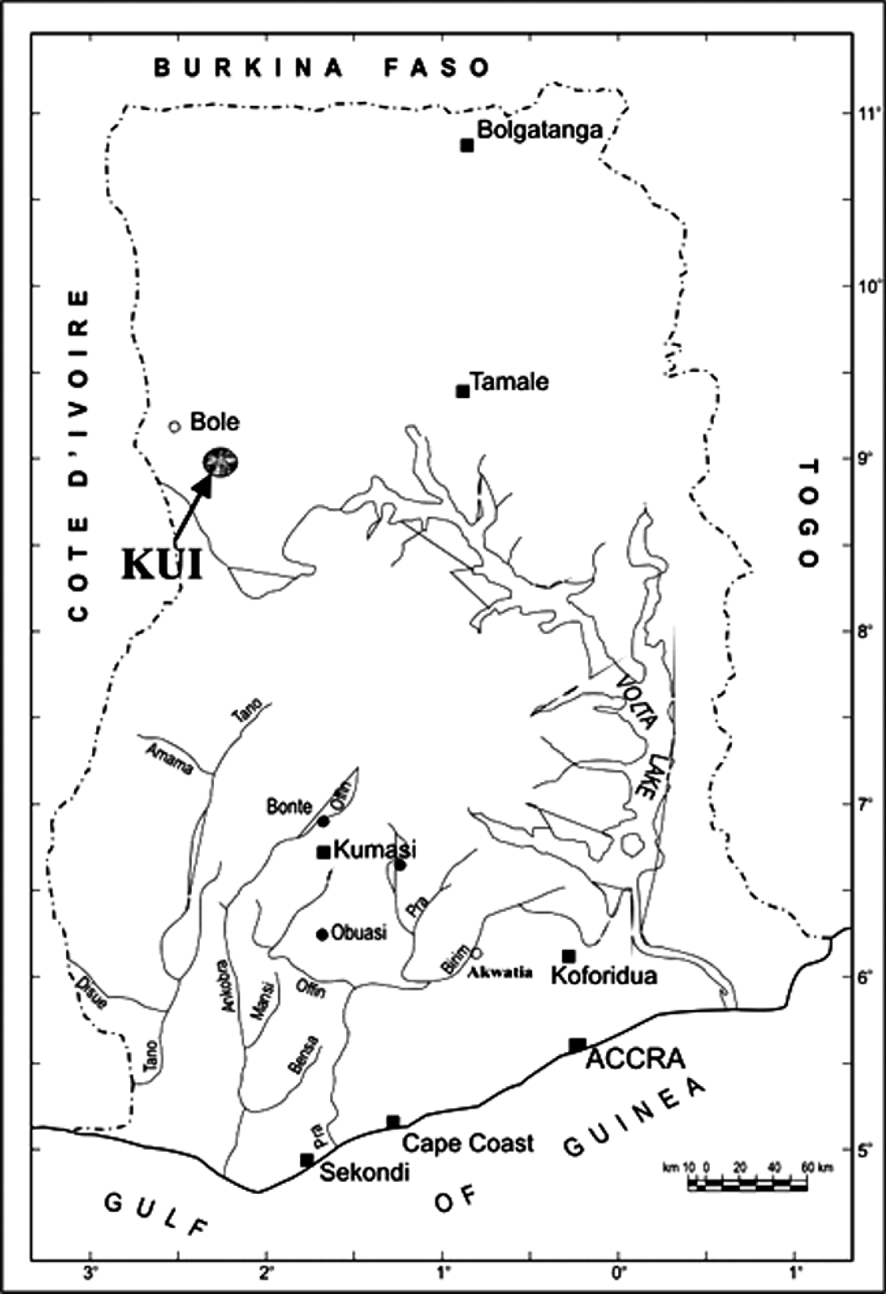
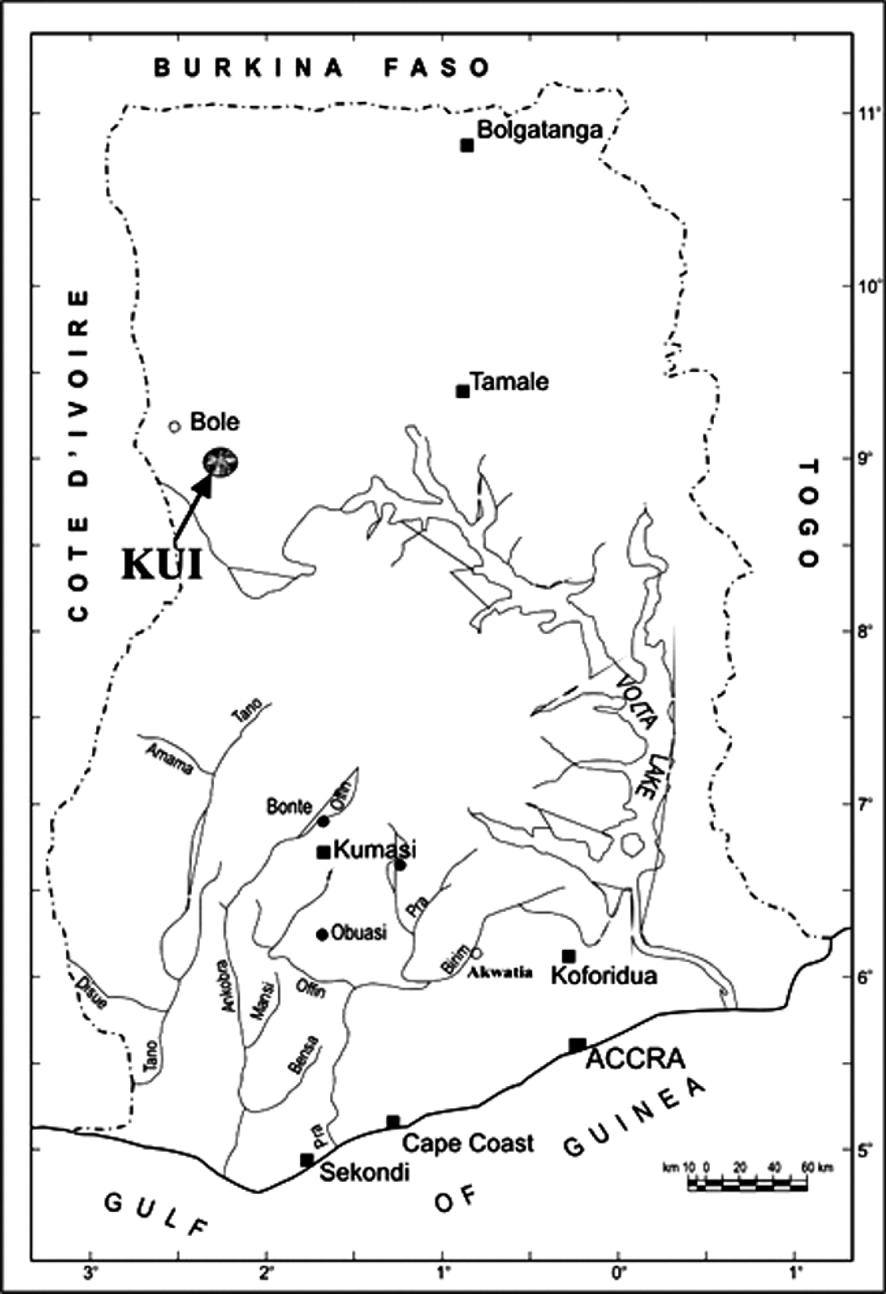
A combination of factors has, in Rostovian terms, prevented Northern Ghana from meeting the requisite pre-conditions for ‘take-off’. The recent discovery – and in some cases, ‘re-discovery’ – of gold, however, has changed its fate dramatically. In many towns in Northern Ghana, ASM has facilitated a radical reorientation of livelihoods, providing a much-needed source of hope to scores of subsistence farm families, in the process helping to stabilise hitherto fragile economies. The case of Kui, a village located in the town of Tinga in Bole District of the Northern Region of the country (see Figure 1), captures the essence of this transformation.
Location of Kui, Bole District, Northern Region.
Kui has a savannah climate. Its landscape is characterised by scattered shrubbery, withering trees, parched waterbodies and rampant bush fires, conditions typical of environments with extended dry seasons. Most of the village's 7000 occupants consider themselves ‘farmers first’, although these harsh climatic conditions have long confined their production to a subsistence level. The emergence of small-scale gold mining over the past four years, however, has improved economic prospects in the town considerably, helping to nourish farming activities; spawned a series of downstream trades such as blacksmithing and welding; and catapulted many families on to a trajectory of earning previously unimaginable. To broaden understanding of these dynamics and the growing importance of ASM in Kui more specifically, interviews were conducted with families based in the town, using a snowballing technique. Overall, 130 individuals were interviewed, including the Kui Wura Footnote 1 and three community ‘elders’. Of the 126 people interviewed from the general populace, 86 were male and 40 were female, a balance which is fairly representative of the gender ratio in Kui (60% male, 40% female). The modal age of respondents was 20–30 years (64% and 50% of females and males, respectively, were in this age bracket), a reflection of the current population pyramid of the town, where close to 80% of inhabitants are migrants under the age of 30. This section of the paper reports preliminary findings from this research. The analysis captures how ASM is bringing positive change to the lives of many families in Kui, in the process providing a glimpse of what a formalised and supported artisanal gold mining economy could deliver, economically, to many of Ghana's impoverished northern townships.
Rural livelihood diversification in Northern Ghana: historical dimensions
When the events of the past century are taken to account, it becomes clear why the emergence and resurgence of ASM activity in Northern Ghana is potentially a ‘blessing’. To gain a better appreciation of what impact this activity could have in impoverished towns such as Kui, it is instructive to first review these events.
Few areas of sub-Saharan Africa have been impacted by climatic conditions, developmentally and economically, as much as Northern Ghana; an unproductive agricultural base, along with a sparse population, has inhibited its growth considerably. As explained by Plange (Reference Plange1979a: 5), during the decades following country independence in 1957, social scientists and policymakers began to recognise this: that the ‘relative underdeveloped and backward character’ of Northern Ghana was, indeed, a result of a combination of ‘natural processes’. Poor soil quality, lengthy dry seasons and a lack of natural resources in particular were recognised at the time as having a crippling effect on Northern Ghanaian ‘peasants’. But the glaring developmental needs of Ghana's North continued to be ignored, in large part because – rather ironically – of these very reasons: that because it is resource-poor and under-populated, and was seen to have few economic prospects, the region should not receive priority aid.
This view emerged during the British colonial period. It was set in motion in policy by Sir Frederick Hodgson, Governor of the Gold Coast from 1898 to 1900, who was quoted as saying:
I cannot too strongly urge the employment of all available resources of the Government upon the development of the country south of Kintampo … I would not at present spend upon the Northern Territories – upon in fact the hinter-land of the Colony – a single penny more than is absolutely necessary for the suitable administration and the encouragement of the transient trade. (Kimble Reference Kimble1971: 533–4)
Subsequent governors of the Gold Coast Colony continued to exercise an isolationist policy toward the Northern Territories. Notable among these was Sir Hugh Charles Clifford, who, during his tenure (December 1912–April 1919), advanced a number of arguments ‘against expenditure for economic development in the Northern Territories’, including that the population was not ‘having regard to the area it inhabits’; transport to towns and cities was challenging and expensive; and that northern towns offer no ‘natural advantages’ for agricultural production over the colony's more populous, more accessible Southern Territories (Ladouceur Reference Ladouceur1979: 46).
Years of neglect have produced what the World Bank recently labelled Ghana's ‘North–South poverty divide’. The effects of decades of dismissing the developmental needs of the Northern Territories, which became visibly obvious long before country independence in 1957, posed a challenge to Kwame Nkrumah's Government. Reflecting on this problem over four decades ago, Plange (Reference Plange1979a: 13) pointed out that ‘By the end of 1950, the north trailed behind the southern region both in terms of commerce, population enrolled in schools, as well as population with some education, and in other areas of social services, the region was also largely neglected’. Independence, however, would bring very little change. As explained by Yaro (Reference Yaro2010), the Nkrumah Government passed the Administration of Land Act, 1962 (Act 123), with consequential Executive Instruments 87 and 109 of 11 July 1963, which vested all northern lands in the president (i.e. made them public lands). These laws granted Nkrumah ready access to the north at a low cost, and enabled land to be appropriated, without compensation, to accommodate the state's ‘vision’ of rural development, a policy which would benefit influential people more than poor peasants. The move made in 1992 to transfer control of all lands in the north to traditional authorities, has failed to bring poverty to a halt. In fact, it appears that the situation has worsened: statistics reveal that between 1992 and 2006, the number of poor dropped by 2 million in Ghana's Rural South but increased by 0·9 million in its Rural North (World Bank 2011).
Ghana's censuses capture the seriousness and breadth of the poverty plaguing its Northern Territories. The data, however, are heavily outdated, which makes identifying specific livelihood diversification patterns difficult. As indicated, drawing conclusions about the motives behind rural livelihood diversification from obsolete data will almost certainly yield inappropriate policy interventions. There is little disputing that the country's most recent Ghana Living Standards Survey (Ghana Statistical Services 2008) paints a broad and accurate overview of the demographics of the impoverished North. But at the same time, it fails to provide the information needed – specifically, data on peoples’ lives, attitudes toward employment and survival strategies – by policymakers and donors to lift individual families out of poverty. Another important issue that has been overlooked is clarification of how persistent poverty has affected peoples’ mindsets. Decades of neglect have put many rural families in the North of Ghana in perpetual ‘survival mode’. Generations of hardship brought about by a lack of economic development and harsh climatic conditions seem to have conditioned Northerners to prioritise food production, which, at times, has delayed their entrance into the wage economy.
This is particularly evident in the country's Northern Region, where Kui is located. Here, food accounts for 65·2% of household expenditure (second only to the Volta Region) and, although 92% of its rural families produce maize, only 27% sell any (Ghana Statistical Services 2000, 2008). In Kui itself, as indicated, there is a sense that people consider themselves ‘farmers first’, and that despite its growing currency as an income-earning activity, ASM is still viewed largely as a complementary livelihood activity. This message was conveyed during a number of interviews: 64% of those consulted identified farming as their preferred occupation. However, all indicated that harsh climatic conditions, an extended dry season and a lack of agricultural inputs have left people with little choice but to prioritise ASM activity when it comes to securing wages. The story told by one interviewee, ‘Awudu’, summed up the reasoning behind Kui's rapidly changing livelihood dynamics:
I love farming more than galamsey.Footnote 2 However, the monetary rewards are better and faster with ASM, hence the shift. For farming, I have to wait for almost a year before getting money.
The message relayed in interviews was that ASM has become the principal income-earning activity in Kui, overtaking farming, which for most of the town's families, is no longer perceived as a reliable source of disposable earnings. It is rather mainly undertaken solely to supply food for the household. This even appears to be the case with the Tinga Wura, who explained in an interview that despite having a large farm, he harvests strictly to satisfy the needs of his household, and that ASM is his main source of ‘ready-cash’.
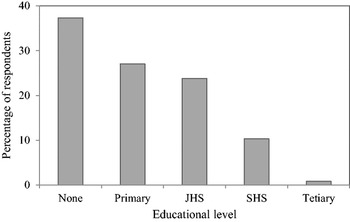
With there being so few other viable sources of employment available in Kui and adjacent localities, ASM has – almost by default – become the inevitable and unavoidable end destination for scores of people who, in other settings, would have likely gained educational qualifications. Among those surveyed, 37% reported that they had never been enrolled in an educational institution, 50% had a basic level of education, and only 10% and 0·8%, respectively, had high school and tertiary education (Figure 2). This mirrors the general trend captured by the most recent Ghana Livings Standards Survey (Ghana Statistical Services 2008), which revealed at the time of surveying that in the country's three northern regions (Northern Region, Upper East Region and Upper West Region), less than 70% of children aged 6–11 are attending school. Most individuals interviewed cited financial constraints as the main reason behind their decision to end their schooling after primary school or Junior Secondary School (JSS). At present, however, a combination of low-skilled ASM work and smallholder farming is proving to be the perfect tonic for alleviating hardship in a town made up of ‘early school leavers’ and where there are few other viable employment alternatives (Figure 2). Moreover, and as will also be explained, this ‘mix’ of activity could help bring to a halt out-migration, which for decades, has deprived the North of Ghana of the skill-base needed to ‘kick-start’ development.
Educational levels of respondents.

Livelihood diversification in Kui
How have subsistence families in Kui and surrounding villages managed to ‘branch out’ into ASM so easily? As indicated earlier, the general message presented in the literature is that poor rural African families wishing to diversify their livelihood portfolios simply lack the financial muscle to do so (Barrett et al. Reference Barrett, Reardon and Webb2001; Wouterse & Taylor Reference Wouterse and Taylor2008). Experiences in the ASM sector, however, tell a very different story. Reflecting on the case of alluvial diamonds, Snyder (Reference Snyder2006: 950) pointed out, perhaps slightly exaggeratedly, that ‘to mine alluvial diamonds, a pick, shovel, sieve, and sweat are usually the only requirements’. In fact, the belief that moving into ASM is a relatively straightforward process has long resonated in policymaking circles. Many donors now also share this view, most notably the World Bank, which takes the position that ‘[ASM] offers a livelihood choice for many people in fragile, rural economies (where other employment options are limited) because the barriers to entry are low, requiring relatively limited financial, educational, and technological investment’ (World Bank 2005: 12). Recent research (e.g. Banchirigah Reference Banchirigah2008; Maconachie & Hilson Reference Maconachie and Hilson2011) suggests that this is indeed the case: that ASM provides a host of skilled and unskilled employment opportunities.
This assumes, however, that mineral rights and/or land rights are of little consequence in the settings where activities take place. Neither appears to be an inhibiting factor in Kui. Whilst the Ghanaian Government has designated the town a ‘no-go’ area for small-scale mine licensing because it falls within the catchment zone of the Bui Dam,Footnote 3 numerous families have taken advantage of a low regulatory and police presence to undertake unlicensed small-scale gold mining and processing alongside their farming activities.Footnote 4 Here, securing access to gold-mineralised land does not appear to be very difficult. It was explained during an interview with one community ‘elder’ that a transaction can be made ‘by verbal application to the elders [of the community]’, who will conduct an interview to determine the motive for land acquisition; this, it seems, is a formality. Once mining commences, operators are expected to pay a small royalty to the Kui Wura.
A movement into ASM in Northern Ghanaian communities such as Kui bodes well for all parties involved. For the most part, local families have embraced the idea of ‘branching out’ into ASM because it is seen as a low-risk income-earning option and a perfect complement to the subsistence farming activities they have no intention of abandoning. The message relayed during interviews with residents was that the ASM activity now prevalent in the town has enabled them to retain their ‘farm-first’ lifestyles which, again, is important culturally, as well as psychologically, given the food security issues many have long faced. In line with the reasoning of the Kui Wura, most of the individuals interviewed reported that a movement into ASM activity was essential to the survival of their farms: the extra wages earned from the move are used to acquire crucial agricultural inputs such as insecticides and fertilisers. This symbiosis, however, even applies to those who do not have diversified livelihood portfolios – namely, individuals who undertake either farming or ASM. Many of the people interviewed who engage solely in the former explained that they have forged partnerships with miners, who provide them with badly needed capital for their farms. It was explained that agreements of this nature have yielded larger harvests, the proceeds from which are shared. Table 1 provides a summary of the occupational details of those surveyed.
Employment details of individuals surveyed

Unlike in the South of Ghana, where many people see ASM as a destructive activity, in Northern villages such as Kui, movement into the sector is viewed very positively. The evidence points to there being two reasons why the Kui Wura and village elders would embrace a move into ASM. The first is that there is little chance of it overtaking farming as the main livelihood activity in Kui because climatic conditions restrict production and ultimately, relegate it to a ‘complementary’ position in this context. The knowledge that ASM has its limitations has helped to alleviate concerns about the industry potentially eroding the township's ‘farm-first’ culture. It was explained during interviews with elders that even the vast majority of individuals who have migrated to Kui over the past three years purposely to engage in ASM have had little choice but to add agriculture to their livelihood portfolios or to forge partnerships with local farmers. As the long dry season and low water availability prevents processing of large tonnages of ore at any given time, a number of miners, not wishing to remain idle, now spend a significant amount of time preparing farms for harvest.
The second reason is that ASM seems to be readily integratable into the typical Northern Ghanaian household, the organisational dynamics of which Al-Hassan & Poulton (Reference Al-Hassan and Poulton2009) discuss at length. In all three Northern regions of the country, a ‘household’ is a complex extended family unit, focused on a ‘compound’, where the head (typically male) lives with his wife/wives, sons and extended family. Functioning on the basis of there being ‘strength in numbers’, the compound helps to buffer against household poverty in the sparsely populated sections of Northern Ghana: during very short rainy seasons, it has the advantage of being able to rapidly mobilise labour on the household food plot. It also is set up so that junior members (young males and females) of the extended family are able to engage in other economic activities – which, in the case of Kui, is typically ASM – when they are not needed by the household head on the food plot. During the course of the fieldwork, numerous junior household members were seen digging and washing gold, the revenues from which presumably fed back into the compound system, further nourishing the family food plot, economically.
Curbing migration and promoting education
Apart from providing individual households with a much-needed source of supplementary income, the evidence points to ASM being able to catalyse economic growth by curbing migration, a problem which, again, has plagued and inhibited development in the North of Ghana since the colonial period. In fact, in Northern Ghanaian towns such as Kui, the emergence of ASM has, rather unexpectedly, fuelled in-migration. This could prove integral in restoring a skills-base which, in all three of Ghana's northernmost regions, has deteriorated over the course of the past century. During this time, scores of skilled residents and youth have migrated south in search of more remunerative employment.
The exodus began in the early 1900s, when the British Colonial Government turned to the North which, as Plange (Reference Plange1979b: 672) explains, it saw at the time ‘as a labour reserve’ from which to source manpower for various development initiatives in the South, including an array of public works, railway construction projects along the coast, agricultural projects across the Western Region and Ashanti Region, and large-scale gold mines in the towns of Obuasi and Tarkwa. The North–South migration was initially seasonal but soon became permanent, marked by the launch of recruitment campaigns by chiefs and government officers for the mines, and the rapid growth in demand for labour on cocoa farms, ‘the remarkable growth’ of which in the Ashanti Region during the colonial period is attributed ‘in a large measure, to labour supplied from the Northern Territories’ (Ladouceur Reference Ladouceur1979: 48). This stymied the North's development:
Conclusively, there was a depletion of the young and able-bodied population, with a direct impact on the productive capacity of house-holds and communities, gradually creating the need for some cash to complement the diminishing returns in subsistence productivity. The onus then was on the outgoing migrant to send a remittance so that the family could survive more comfortably. (Plange Reference Plange1979b: 672)
But few funds ever reached migrants’ villages of origin. Whilst returning workers brought savings with them, as Ladouceur (Reference Ladouceur1979: 49) explains, ‘[these] earnings were meager in the first place and expenses in the South were high, and [therefore] little remained when the men reached home’. With insufficient monies available to even invest in subsistence agriculture, Northern Ghanaian towns have long struggled to reduce outmigration, which again, has ‘drained the North of its youngest and most able-bodied men, who … therefore [have not been] available for development in the Territory itself’.
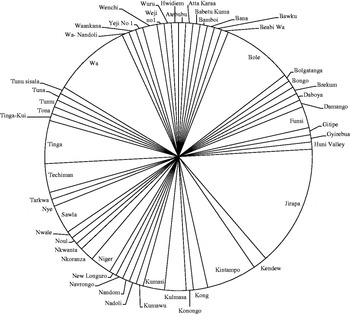
The emergence of ASM has – rather unexpectedly – not only helped to reduce migration from the North of Ghana but has also attracted numerous people to many of its remote, semi-arid localities such as Kui. Over 92% of people interviewed in Kui claimed to be migrants, a large share of whom originate from other (larger) northern localities such as Jirapa, Bole, Wa and Bolgatanga (Figure 3). Most of these migrants explained that they had moved to Kui to secure employment in the locality's growing ASM sector. Awumbila & Tsikata (Reference Awumbila and Tsikata2007) were the first to critically examine the impact of ASM-induced migration on Northern Ghanaian localities, reflecting on findings from community-level survey work undertaken in gold processing and extraction areas of Talensi-Nabdam District near Bolgatanga, the capital of the country's Upper East Region:
Whereas sponsors, buyers, and to some extent ghetto owners tend to be migrants from outside the region and in the case of sponsors and buyers could include other nationals such as Lebanese and Burkinabes, the workers at the lower scale (loco boys, kaimen and shanking ladies) tend to be locals. Even among the mine workers, the dynamiters and chisellers who required some expertise in mining tend to be southerners, while the loco boys, kaimen and shanking ladies, requiring no specific training and earning the lowest returns, tend to be mainly locals … Miners with requisite training and skills could move between various mining roles … (Awumbila & Tsikata Reference Awumbila and Tsikata2007: 7)
The authors are somewhat critical of this migration, arguing how it has ‘resulted in technology transfer but also reproduced certain patterns of labour relations which were disadvantageous to locals’. But since undertaking this research, the dynamics of Talensi-Nabdam's ASM operations have changed considerably. More recent research since carried out in the locality (Hilson Reference Hilson2010, 2012) has revealed that presently, all of the mine concession owners operating in the main gold mining area, Yale or Yele, are indigenous to the area; these ASM activities, which employ more than 20,000 people, have spawned a series of downstream industries, including equipment repair and transportation services; and most importantly, hundreds of ‘loco boys’Footnote 5 have acquired skills, steadily moving up the mine labour-hierarchy into more well-paid positions and in the process, improving their quality of life.
Origins of people living in Kui.

Much of the same appears to be unfolding in Kui. Significantly, migrants who were the beneficiaries of mine technology transfer in towns such as Talensi-Nabdam have brought with them this knowledge, which has proved integral in expanding gold extraction and processing activities in the locality. There was considerable optimism among interviewees that ASM could ‘normalise’ the locality's population dynamics to the point where the Bole District Assembly could be in a position to allocate more funds toward the resuscitation of defunct local educational facilities.
This, however, will by no means be straightforward; restoring the foundation for education in Kui promises to be an onerous task. The source of this problem can also be traced back to the colonial period, specifically to Guggisberg's tenure as Governor of the Gold Coast. Whilst Guggisberg's administration did raise the teaching standards of the colony considerably, it further alienated the North and other marginalised areas of present-day Ghana through its bottom-up strategy for primary educational development (Bening Reference Bening1990). Specifically, a policy emphasising quality and selective expansion would exclude much of Northern Ghana, which, because of its low population density, received few teachers and educational facilities (Akyeampong et al. Reference Akyeampong, Djangmah, Oduro, Seidu and Hunt2007). As explained by Thomas (Reference Thomas1974), when, in 1921, the chief commissioner forwarded requests for schools to be constructed at Bawku, Zuarungu, and Sandema and Bole (where again, Kui is located), he was told by Guggisberg himself that this was not possible on account of there being no money and that the priority at the time was developing a new school at Achimota in Accra. The Nkrumah Government attempted to address the problem by launching a special scholarship scheme (from primary to tertiary), which covered tuition fees, boarding, lodging, supplies and transport, specifically for children in the North (Akyeampong et al. Reference Akyeampong, Djangmah, Oduro, Seidu and Hunt2007). Whilst this, and subsequent efforts aimed at bridging the country's North–South educational gap, have had some impact, the divide remains significant. In the Northern Region today, there are 100,000 children aged 12–14 who are not in school, and only 15% of its young boys and girls in the ‘poor’ quintile finish their primary education compared with the national average of 42% (Casely-Hayford & Ghartey Reference Calsey-Hayford and Ghartey2007). There is an educational foundation on which to hinge efforts in the form of the Capitation Grant, a landmark initiative which effectively abolished school fees at state schools, from kindergarten through to JSS.Footnote 6
The challenge, therefore, lies in changing the mindsets of – likely discouraged and disengaged – residents in underdeveloped Northern Ghanaian localities about formal education. In Kui itself, schooling would likely have little impact on its current occupants, few of whom have finished primary school. Most of the interviewees who indicated that financial constraints have prevented them from completing or furthering their education explained that they have no time for schooling: that the priority now is supporting their families. But a change in attitude towards education amongst current residents would certainly benefit the next generation of Kui's inhabitants (these people's children) whose fate will be heavily determined by action taken today. As indicated, a vibrant ASM sector has provided economic stability to low-skilled families in Kui and in the process, helped to improve their food security dramatically. The research confirmed that many ASM-farm families in Kui now find themselves in a – what was once a previously unthinkable – position to critically reflect on the value of an education for their children, which bodes well for the locality's future.
The story of one interviewee, ‘Kate’, was particularly revealing, and fairly representative of the experiences of interviewees. After the death of her husband, Kate assumed control of the household, which has required her to manage ASM activities, something that the family has been involved in for more than five years. She has managed to accumulate enough money to send her children to private schools far superior to the local deteriorated facilities covered by the Capitation Grant. Her children live in Bole, where they attend school, whilst she resides in Kui, where she carries out ASM work. She does not want her children to live in Kui; nor does she want them to be miners. Such selflessness among family heads – namely, the willingness to make sacrifices to put children in as best a position as possible to access a quality education – will be needed if Northern Ghanaian localities such as Kui are to develop. Most people interviewed shared similar stories, explaining how the revenue generated from ASM has facilitated access to a suite of educational options for their children. The low percentage of young boys and girls engaged in ASM in Kui (less than 2% of its ASM workforce is below the age of 15) could be a sign that the mindset toward education is changing.
To summarise, the research undertaken in Kui thus far suggests that ASM could catalyse significant growth in Northern Ghana. The sector is providing numerous Northern Ghanaian societies with a platform for development that the colonial administration neglected to establish and which subsistence agriculture carried out in harsh climatic conditions is incapable of mobilising – at least on its own. The challenge now is to reorient policy to better reflect ASM's growing importance in the North of Ghana.
DISCUSSION AND CONCLUSION: OVERHAULING AN ANTIQUATED POLICY AGENDA
The findings reported in this paper, generated from pilot research conducted in the locality of Kui, demonstrate that the emergence of ASM in Northern Ghana is providing a much-needed economic boost in many of its deprived areas. These findings reinforce the – mainly understated and often implied – position of a number of scholars (e.g. Awumbila & Tsikata Reference Awumbila and Tsikata2007; Hilson Reference Hilson2010) on the importance of ASM in arid, sparsely populated sections of the North of Ghana: that it is alleviating hardship and providing incomes which are helping to nourish subsistence agriculture and in the process, improving food security. The ASM sector has fast become a focus in the livelihoods of tens of thousands of families in rural stretches of Northern Ghana, helping to establish a foundation for development that has long been missing. Whilst there is certainly ample evidence that underscores ASM's importance here and elsewhere in sub-Saharan Africa, policymakers and donors have yet to embrace the idea that activities can have a positive impact on local economic development. Continued clinging to antiquated ideas, including the belief that the sector is populated exclusively by rogue entrepreneurs looking to ‘get rich quick’, has proved to be a formidable barrier to ASM's inclusion in donor programmes.
For ASM in villages such as Kui to be supported by the government, significant change would need to be made in three areas, the first being the general policy stance toward the industry in the country; this would need to be radically overhauled. Since 1989, there has been a licensing system in place for ASM but it has proved highly inappropriate for the poverty-driven groups which mostly populate the sector. Rather than providing empowerment and security of tenure, the system has further marginalised informal operators, requiring the prospective licensee to make a number of costly payments; wait significant periods of time for decisions on applications; and effectively ‘kick-start’ the process himself/herself, which requires numerous – often costly – visits to various ministries in Accra (Hilson & Potter Reference Hilson and Potter2005; Tschakert & Singha Reference Tschakert and Singha2007). The response of the Ghanaian Government to general concerns voiced by officers at the International Labour Organization (ILO) over a decade ago about the inadequacies of ASM licensing in sub-Saharan Africa has been lukewarm at best.Footnote 7 The government has simply not fixed what is clearly a bureaucratic licensing system for ASM; nor does it even acknowledge that it is much of a problem, despite the burgeoning body of evidence which points to the sector being largely poverty-driven countrywide, populated by people who lack the finances and logistical means to travel to Accra and make costly payments for licences (e.g. Amankwah & Anim-Sackey Reference Amankwah and Anim-Sackey2003; Banchirigah Reference Banchirigah2008; Hilson Reference Hilson2010).
It seems inexplicable how little, despite this evidence, the Ghanaian Government's position on and approach to managing ASM has changed over the past two decades, a period during which even large donors such as the World Bank and various departments of the United Nations have softened their stances considerably toward the sector and have started to embrace the idea that it is often poverty-driven. It could be a case that policies remain heavily disconnected from the realities on the ground because of institutional memory. Many of the government officials who now occupy senior-level positions in Accra and are charged with, inter alia, making decisions on applications for licences and crafting policies for the sector, were field officers 15–20 years ago, a time when ASM was largely populated by individuals looking to ‘get-rich quick’. This view has been shaped heavily by the Brazilian garimpeiro gold rushes in the early 1980s and the more recent diamond-fuelled wars in the likes of Sierra Leone; the idea of the sector being poverty-driven had not yet gained currency in policymaking and donor circles. It may, therefore, be a case of these officials having moved into senior-level positions without witnessing or having taken the time to diagnose for themselves why ASM populations have mushroomed over the past decade. Scholars (e.g. Hilson & Potter Reference Hilson and Potter2005; Banchirigah Reference Banchirigah2006) have since demonstrated that the rapid increase in the country's ASM population at this time was linked heavily to the hardship and unemployment that surfaced under structural adjustment and reform, the impact of which was still being debated two decades ago. The occupation of senior-level government posts by such individuals could explain why antiquated views about unlicensed ASM – including it being a ‘menace’ to society, populated by criminals and led by individuals who deliberately evade regulationsFootnote 8 – continue to resonate strongly in local media and policymaking circles.
The second area in need of change is the approach being taken to alleviate rural poverty, which is perhaps even more antiquated than ASM policy. The challenge here is twofold. First – and indeed the most significant change needed – ASM must start receiving priority policy treatment in the country's rural poverty alleviation strategy. There were signs, nearly a decade ago, that such change was on the horizon, following publication of Ghana's first Poverty Reduction Strategy Paper (PRSP), An Agenda for Growth and Prosperity. The document states, unequivocally, that ‘Current mining laws tend to disproportionately favour large-scale mining enterprises’ and that in order ‘To address this apparent imbalance, measures will be put in place to expand the scope and increase the support to the small and medium scale sub-sector with the view to making it the predominant means of exploiting minerals in the long term’ (International Monetary Fund (IMF) 2003: 91). It was one of the most comprehensive policy statements conceived in response to the ILO's call for legislation (for ASM) to be more ‘even-handed’ (ILO 1999). But very little progress has since been made on this front. In fact, the policy stance toward ASM has regressed: in the country's most recent PRSP (IMF 2006), Growth and Poverty Reduction Strategy (GPRS II) (2006–2009), the sector is not even mentioned. The discussion on mining in this document focuses exclusively on mechanised large-scale activity, praising the efforts made up to the time of its publication to bolster foreign investment in exploration and mining projects. It states that ‘Growth in the mining sub-sector [of Ghana], particularly gold, was largely due to substantial infusion of capital from both local and external sources aided by the stable environment created by the institution of policies that have insulated earnings and costs from foreign exchange controls’, a clear indication of the country's hitherto large-scale mining policy bias.
The additional challenge relates to refocusing rural development strategies altogether. Most advocate intensified support to subsistence agriculture as the solution to the country's rural poverty problem. Notably, GPRS II (IMF 2006) champions ‘Agriculture as a Basis for Economic Growth and Structural Transformation’ on the basis of it being ‘the highest contributor to GDP and provid[ing] employment for over 60 per cent of the population’, with the view that ‘growth in the sector will impact directly on growth of the economy as well as employment’ (p. 23). In a number of localities across rural sub-Saharan Africa, however, families are ‘branching out’ of smallholder farming because it is incapable of sustaining them on its own, economically. Even if plans to intensify support to smallholder farming were to materialise, how do host governments and donors expect rural subsistence families to compete in a liberalised agricultural market? Under reform, access to resources and expertise has also proved challenging for smallholders across the region: crucial inputs such as fertilisers are no longer subsidised, and most support services have been systematically dismantled or privatised (after Crisp & Kelly Reference Crisp and Kelly1999). Using data on agriculture's contribution to GDP and estimated employment figures in the sector to justify a farm-first strategy to rural development is highly questionable because they fail to provide the complete picture. As Banchirigah & Hilson (Reference Hilson2010) explain, the former were never intended as a measure of quality of life, although it is continuously used in this fashion, and the latter are more likely an indication of the number of people engaged as opposed to employed in farm activities. Using these data to inform rural development strategy can potentially paint an inaccurate picture of a rural setting and yield inappropriate policy interventions. But with sub-Saharan Africa-wide initiatives, notably the African Union's New Partnership for African Development (NEPAD), being heavily underpinned by the same ideas, implementing a radically re-orientated rural development agenda in which ASM receives greater priority and smallholder agriculture is de-emphasised, could prove challenging in Ghana.
The third and final area in need of change is the development strategy of Northern Ghana itself. Localities such as Kui have little chance of escaping poverty and developing unless more dynamic policies and interventions are designed and implemented. The Ghanaian Government seems to recognise that the poverty plaguing the North is in need of immediate attention, indicating, in the country's inaugural PRSP (IMF 2003) that:
Five out of ten regions in Ghana had more than 40% of their population living in poverty in 1999. The worst affected being the three northern savannah regions (the Upper East, Upper West and Northern Regions). Nine out of ten people in the Upper East; eight out of ten in Upper West, seven out of ten in Northern Region … (p. ii)
It goes on to suggest that to correct this problem, funding priorities must change because ‘Expenditure has continued to be biased against development of the rural environment and has failed to ameliorate disparities between north and south’ (p. 2). As a solution to the problem, however, the Ghanaian Government has also called for the intensification of support to rural families, failing to recognise how climatic conditions limit what can be achieved in the area of agricultural production and how families are transitioning out of farming. In Kui and surrounding areas, there are numerous community development projects being undertaken, some of which are listed on the Bole District website.Footnote 9 But the developmental impact of these efforts, which include the construction of community centres, the dissemination of agricultural implements and the construction of a rural technology facility, is bound to be negligible because few target the root of the poverty problem plaguing the district. This oversight extends beyond government circles. Even many of the NGOs that supposedly have a strong presence in the very Northern communities in need of assistance and where ASM has rapidly overtaken farming as the primary income-earning activity are also lobbying for a blueprint of agriculture-led growth. Notable among these is SEND-Ghana, an NGO established in 1998 which seeks to ‘accelerate the socio-economic development of the Savannah belt through strategic investment in resource development’.Footnote 10 In line with the Government's vision of the country's Northern Territories, the NGO is working to develop a ‘Forested North’ by 2030, where ‘agricultural production is modernised and oriented towards a larger market’.
It may be unrealistic to expect any change to take place in the aforementioned three areas in the short term. But as evidence underscoring ASM's importance in Ghana's rural economy and the inappropriateness of poverty alleviation strategies in its Northern Territories begins to mount, the government and donors will no doubt be pressured to revise its policy approach. If poverty in rural Northern localities such as Kui is to be tackled effectively, more innovative solutions will be needed. The problem in Ghana is that, over the past 20–30 years, whilst the dynamics of communities have changed dramatically, rural development strategy has remained static: since enacting its Vision 2020 nearly two decades ago, the same agriculture-led development approach to rural poverty has dominated the policy agenda, innovatively repackaged in successive PRSPs. Moreover, the country's flagship Ghana Living Standards Survey has failed to generate any new data, failing abysmally to capture how the dynamics of deprived rural communities have changed during this period. One of the most significant oversights is failure to acknowledge the growing importance of ASM in many rural areas of the country, and how for tens of thousands of families, it is now a primary income-earning activity.
Although – and especially in the case of the North of the country – a revamped poverty alleviation strategy which prioritises support for ASM would clearly have a greater developmental impact in the current environment, this would take some time to legitimise and launch. Given the lack of commercial interest in its arid landscape, the North of Ghana would be the ideal setting to implement an ASM-led development strategy. As the case of Kui has shown, in Northern Ghana, the movement into ASM has alleviated significant hardship at the household level. Perhaps more importantly, ASM seems to have bolstered the economies of many Northern localities by helping to reduce the migration that has crippled the Northern Region, Upper West Region and Upper East Region of the country for generations. Specifically, a rapidly expanding ASM sector has helped to stabilise the populations of Northern Ghanaian towns such as Kui, putting many District Assemblies (local government) in a position to plan ‘generationally’ for the first time. Continuing to downplay ASM's importance in Northern Ghana would be counterproductive.