Introduction
Discussions of optimal types of spoken and written input for language learning have traditionally focused on the relative merits of authentic and linguistically simplified spoken and written texts. I will argue that elaborated input and, in particular, modified elaborated input, constitute better options, with tasks, not just texts, functioning as important input sources. Modified elaborated input, potentially coupled with bimodal presentation, has many positive features, especially, but not only, for programs seeking to increase students' opportunities for enhanced incidental learning.
Genuine (authentic) input
‘Authentic’ is an umbrella term for a wide variety of ‘found’ samples of genuine target language use not originally intended for language learning or teaching. Authentic texts are spoken or written records of real-world communication among native or non-native speakers. Authentic texts may include anything from telephone conversations, TV interviews, weather forecasts, You Tube videos, academic lectures, and movies to email correspondence, newspaper articles, novels, short stories, scientific journal articles, and Shakespeare plays. Such texts were not spoken or written in conformity with any particular linguistic guidelines or vocabulary list.
So-called ‘authentic’ materials like these have been fashionable for many years in some language teaching circles, their use often assumed to produce a ‘communicative’ classroom. Widdowson (Reference Widdowson, Fanselow and Crymes1976) rightly problematized ‘authentic’, however, pointing out that a text may be genuine, in the sense of not originally having been produced for language teaching, but its use in a course book or classroom lesson may not be authentic, or, I would add, communicative. For example, a teacher may record and transcribe segments of a radio news broadcast or undergraduate economics lecture, and then, with key information bits deleted, present written excerpts to students, whose job it is to fill in the missing words or phrases as they listen to the recording. The original radio broadcast and lecture were genuine, but the classroom activities based upon them were not authentic. Outside language classrooms, people listen to news broadcasts or attend lectures for the information they contain.
Aside from whether or not such contrived classroom activities as filling gaps in written transcripts are useful for language learning (which they may be), the problem is that, especially in foreign language settings, they are often the only experience students have with news broadcasts, newspaper articles, university lectures, etc. They may never, for example, listen to progressively more complex versions of broadcasts, perhaps simply to be more informed or to write a research paper, yet those are typical real-world uses for listening to news broadcasts outside the classroom.
In what follows, spoken or written texts originally produced by native or non-native speakers for everyday communicative purposes, not as pedagogic material for language learning, will be referred to as ‘genuine’, and the uses to which such texts are put in the language classroom as ‘authentic’ or ‘inauthentic’. The question is, even when their uses are authentic, how valid are genuine texts as sources of input for language learning?
Krashen (Reference Krashen1985) drew attention to the need for input to be comprehensible to be usable, highlighting the importance for language development of naturally occurring items ‘one step ahead’ of a learner's current developmental stage, or ‘i + 1’ (both metaphors). Pienemann (Reference Pienemann1984, Reference Pienemann, Pienemann and Kessler2011) had a system for measuring and explaining stages in second language (L2) development, so could predict precisely how far new forms could be in advance of a learner's current abilities to be processable and, therefore, constitute potential intake. An obvious problem with genuine texts for language teaching (LT) is that most are produced for native speakers (NSs) or advanced non-native speakers (NNSs), not for learners. Because the input they provide has not been negotiated for meaning by learners, it will usually be psycholinguistically inappropriate, or only accidentally appropriate, for them. Parts will be linguistically too simple (i – 10), and (more often) other parts too complex (i + 50) to be processed. Because they are impossible to process, they will fail as learnable targets in Pienemann's sense – certainly for some students on a given day, and sometimes for all students. Many a teacher (myself included) has been forced to turn cartwheels and waste a lot of limited classroom time in an effort to make institutionally mandated, inappropriately complex (simplified or genuine) dialogs or reading passages comprehensible for students who were simply not ready for them. The devices to which teachers resort to increase comprehensibility (schema building, vocabulary pre-teaching, visual aids, translation, grammatical explanations, vocabulary glossing, etc.) are precisely those that make classroom use of genuine (or any other) texts inauthentic.
In sum, genuine texts present learners with rich input, and with examples of how the target language is really used by NSs (and potentially, NNSs). The obvious problem is that, except when employed with very advanced students, genuine texts will be linguistically overwhelming and usually constitute psycholinguistically inappropriate input for language learning.
Simplified input
Simplified texts, the second popular option, typically take the form of graded readers and the dialogs and reading passages found in course books produced by professional materials writers expressly for the purpose of LT. Some such texts actually merit the name ‘simplified’, as they are, indeed, adapted, linguistically simpler versions of genuine texts. In many cases, however, simplified texts are themselves originals, written that way from the get-go, so strictly speaking, linguistically simple, not simplified. In either case, adhering to fairly strict guidelines stipulated by commercial publishers, and/or based on materials writers' or teachers' (variable) intuitions, they are created using only those linguistic forms, verb tenses, grammatical structures, lexical items, and collocations thought appropriate for learners of a given L2 ‘proficiency level’ or who are ‘up to Book 2, lesson 10’.
Occasionally, vocabulary choices may also be influenced by a materials writer sampling from a specified range in a word frequency list. When teachers produce simplified materials for their own lessons, shortening genuine texts and removing low frequency words are the two most common modifications they make, although using their intuitions as the basis for the modifications can lead to considerable variation in the end-product (Crossley, Allen, & McNamara, Reference Crossley, Allen and McNamara2012; Green & Hawkey, Reference Green and Hawkey2012). The advent of electronic corpora offers a more rigorous alternative. A free on-line text adaptation tool classifies texts using sentence length and their conformity with vocabulary lists designated by China's national English curriculum standards for five proficiency levels, telling teachers which low frequency words to remove to conform to the level concerned (Jin & Lu, Reference Jin and Lu2017).
The widespread use of linguistic simplification in course books is in no small part due to the fact that almost all commercially published pedagogic materials embody a grammatical syllabus. Contrived samples of the target language in the form of dialogs and reading passages are popular because they can be seeded with multiple examples of the ‘structure of the day’. The linguistic control afforded by limiting input to instances of that new structure, surrounded by recycled, supposedly already learned, items, together with the vocabulary specified for a given level, means that input can be provided that is ‘just about comprehensible’ for learners, given their current proficiency level.
Problems with defining and measuring proficiency aside, simplified texts lack psycholinguistic credibility. To focus on language as object and attempt to teach a language structure by structure in the order listed in an externally imposed linguistic syllabus is to disregard much of what has been learned from 50 years of research in classroom, naturalistic, and mixed environments (for reviews, see, e.g., Long, Reference Long, Long and Doughty2009; Ortega, Reference Ortega, Long and Doughty2009). It is to ignore such well-documented phenomena as developmental sequences (whose stages cannot be skipped), processing constraints, backsliding, U-shaped behavior, hypothesis testing, non-categorical acquisition, autonomous syntax, lengthy periods of form–function mapping, and the non-linearity of development. Believing that what you teach, when you teach it, is what students learn is to forget Corder's (Reference Corder1967) conclusion 50 years ago that there is such a thing as the learner's internal syllabus, or that, as Rutherford (Reference Rutherford, Rutherford and Sharwood-Smith1988) pointed out, second language acquisition (SLA) is not a process of accumulating entities.
Since learners are usually grouped for instruction on the basis of their performance on some sort of proficiency test, not an interlanguage-sensitive diagnostic measure, classes tend to be psycholinguistically heterogeneous. This means that the chances are slim that a particular learner will be ready to learn a new structure on the day prescribed by a distant textbook writer who has never met the student concerned. The likelihood that the structure will be psycholinguistically appropriate for a whole class on the same day is vanishingly small. As demonstrated by Pienemann (Reference Pienemann1984), the reality is that what learners can process determines what they can (not necessarily will) learn, and what they can learn determines what teachers or textbook writers can teach.
From a pedagogic standpoint, the need to write graded readers, dialogs, and reading passages that obey more or less strict linguistic guidelines means that the language of textbook dialogs and reading passages is often stilted. Learners are presented with examples of what Widdowson (Reference Widdowson1972) called target language usage (What am I wearing? You're wearing a sweater), not use. The texts are intended to show the inner workings of the code, not how the language is used for communication. They do not reflect what NSs would really say or write because they contain an abnormal number of instances of a new grammar point, as stipulated by the grammatical syllabus, a limited sub-set of verb tenses and grammatical patterns, and a stripped-down lexicon, all deemed appropriate for the ‘proficiency level’ concerned on the basis of intuition. The combination of artificially high frequencies of the structure du jour and Present-Practice-Produce (PPP) means that many dialogs are thinly disguised drills.
David: Good morning, Dr. Jones.
Jones: Good morning David. How are you today?
David: I am much better, thank you.
Jones: Did you take your pills?
David: Yes, I did. I took one after breakfast, and one after dinner.
Jones: Did you exercise every day?
David: Yes, I did, I walked three miles every morning.
Jones: Very good. Did you get plenty of rest?
David: Yes, I did. I slept for eight hours every night.
Jones: That's very good, David. Come again next week. Did you make an appointment?
David: Yes, I did, for next Friday morning at 10:15.
Jones: Good. Ok, I will see you next Friday at 10:15.
David: Thank you, Dr. Jones. Good bye.
Jones: Good bye, David.
Whereas real conversations are marked by open-endedness, implicitness, and intertextuality, there is a tendency for textbook writers to produce stand-alone dialogs (and reading passages) with a beginning, a middle, and an end, containing all the information needed for the inevitable comprehension questions, and no more. Did David take the pills? How many pills did he take? When did he take them? Did David exercise? And so on. (For detailed examples and discussion, see Long, Reference Long2015, pp. 169–204.) Little or nothing is left unstated, and allusions are rare. The Blands of Potters Bar greet one another, say something banal that includes several models of the structure du jour, and take their leave. Even in the hands of the most skillful materials writers, the end-product can be painful, and the resulting classroom interaction reminiscent of Becket on a bad day (Dinsmore, Reference Dinsmore1985). The artificiality is increased by the fact that materials writers' intuitions are the basis for the texts they write, and every study that has looked at the issue (e.g., Cathcart, Reference Cathcart1989; Williams, Reference Williams1988; Bartlett, Reference Bartlett and Long2005; Granena, Reference Granena2008) has found materials written that way differ markedly from real speech, a problem exacerbated when unfamiliar specialist discourse domains are involved.
Constantly recycling the same grammatical patterns and limited set of vocabulary items results in impoverished input, which is counter-productive from an acquisition perspective. Acquisition potential is sacrificed for comprehensibility, in the interest of which, the language used is mostly limited to what students already know. That is largely achieved by excluding what would often be the appropriate items in genuine target language use because they fall outside those permitted at the current level, making the appropriate items difficult to acquire. Comprehensibility is needed, but language acquisition from the input should not be sacrificed for the comprehensibility of specific texts, which learners will never encounter again outside the classroom.
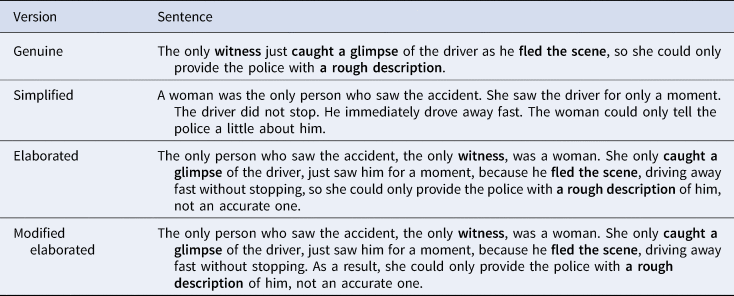
Tables 1.1 and 1.2 juxtapose genuine and simplified versions of the same short text. Due to space limitations, the original is just a tiny fragment. (For longer, more realistic examples, see Long, Reference Long2015, pp. 248–299.)
Traffic accident sentences

Descriptive statistics for the traffic accident sentences

* MVs, main verbs and modals.
Note: The genuine version consists of a single sentence with 26 words, and 4 main verbs and modals (MVs): caught, fled, could, provide.
The only witness just caught a glimpse of the driver as he fled the scene, so she could only provide the police with a rough description.
The simplified version features five shorter, less syntactically complex sentences, with an average of 7.8 words and 1.4 MVs:
A woman was the only person who saw the accident. She saw the driver for only a moment. The driver did not stop. He immediately drove away fast. The woman could only tell the police a little about him.
The series of short, choppy sentences creates an irritating, breathless, staccato effect, and can make processing for meaning harder. The intra-sentential linker, so, has been lost, and with it, the explicit marking (an example of redundancy) of the causal relationship between the driver fleeing the scene and the woman's inability to provide the police with anything more than a rough description. This, too, can make comprehension harder, as the causality is now left to inference on the reader's part. There is unnatural repetition of full noun phrases (driver driver, woman woman) instead of target-like pronominalization and anaphoric reference (driver he, woman she). Examples of genuine NS language use (catch a glimpse, fled the scene, provide a rough description, bolded in Table 1.1 to make tracking them easier) are lost, replaced by higher frequency, less informative, unnatural-sounding items with less precise meanings (saw for only a moment, immediately drove away fast, tell (the police) a little about him). Comprehensibility has been improved, no doubt, but of a text that has been bled of semantic detail and realistic models of target language use. Fortunately, genuine and simplified texts are not the only options.
Elaborated input
Research in the 1970s showed how NSs modified the structure of NS–NNS conversation – so-called foreigner talk discourse (FTD) – to establish and maintain comprehensibility for NNSs with low L2 proficiency. One of the findings (Long, Reference Long1980, Reference Long1983a) was that while NSs made some quantitative (and only very rarely, qualitative, ungrammatical) changes to the language they used, e.g., by employing shorter utterances and favoring yes/no or or-choice over wh questions, modifications of the interactional structure of conversation were more pervasive and more important. In other words, comprehensibility was achieved not so much by simplifying the input as by changing the ways communicative talk was accomplished. The task was simplified, the input elaborated.
NSs use a wide variety of devices for the purpose of input elaboration (Chaudron, Reference Chaudron1982; Long, Reference Long1983b), including (not a complete list) slower speech rate, relinquishing topic control, making new topics salient, reversion from subject-predicate to topic-comment/theme-rheme (given before new information) constructions, preference for a here-and-now over a there-and-then orientation, matching order of mention to chronological sequence of events, decomposing complex topics into their component parts, eight types of repetition (exact and semantic, partial and complete, self and other), one-beat pauses before and/or after key information-bearing words, clarification requests, comprehension checks, confirmation checks, lexical switches, synonyms, antonyms, and informal (non-dictionary-type) definitions. All these are quantitative, not qualitative differences, as use of each device is also employed in talk among NSs, but much less so.
For example, instead of avoiding certain grammatical constructions and low frequency (albeit appropriate) lexical items and collocations, as is the practice in simplified texts, most of those items would be used, but the added difficulty compensated for through input elaboration, including use of noticeably more intentional redundancy than occurred in talk with NS interlocutors. This is different from genuine texts, where the items appear without compensatory devices to facilitate comprehension, and different from simplified texts, where many unknown items are avoided as a short-cut to improved comprehensibility, impeding acquisition in the process.
If use of a word unknown to the NNS resulted in a breakdown in communication, NSs might switch to a synonym, a paraphrase, or an informal definition. Crucially for acquisition, they often returned to the original word, its meaning now at least partially understood by the NNS, immediately afterwards. By way of illustration, the following exchange (data from Long, Reference Long1980), involving an unknown word, ‘ironing’, and repair via an informal definition, occurred between a female NS with considerable foreigner talk experience and a young Brazilian man with very limited knowledge of English. Separated by a screen, their task was to find as many differences as they could between two versions of a picture in five minutes. One had version A, the other version B.

On other occasions, faced with the need to use a lexical item they realized was likely to be unknown to the hearer, NSs, especially experienced foreigner talkers, might offer the synonym first in an effort to preempt conversational trouble, and then, comprehension established, supply the word they originally had in mind. Illustrating this (lines 35–36) and several other interactional modifications, the following excerpt is from later in the same conversation.

These exchanges were like many others in the data. They occurred incidentally during genuine communicative use of the L2, when 32 NS–NNS dyads worked on a series of six one-way and two-way tasks of various kinds. The conversations were not language lessons, yet either approach – in the first case (lines 3–4) repair, in the second (lines 36–37) preemption, of a breakdown – might reasonably be considered close to ideal ways for NNSs to learn the meaning of new lexical items. In each case, the Brazilian NNS encountered the new form in context, not as an unknown word he had no use for in a vocabulary list, devoid of context, as might well have occurred in a traditional foreign language lesson. He was focused on the message, attending closely to what his interlocutor said next, motivated to understand and communicate because the task was interesting and fun, with an outcome at stake. The initial breakdown alerted him to a gap, or hole, in his lexicon, a condition shown to increase learning (De Vos, Schriefers, & Lemhofer, Reference De Vos, Schriefers and Lemhofer2018a). The help was duly provided, again in a meaningful context. Many additional encounters with the target items would no doubt be required before they were learned to a reliable productive level, but the process of recognizing new forms and mapping them to their meanings and uses had begun, memorably and painlessly.
The excerpt contains examples of some of the other devices, all building redundancy into the input, that NSs and advanced NNSs commonly use to facilitate comprehension by low proficiency NNS interlocutors. They include a clarification request (lines 30–31), and confirmation checks (lines 33, 35, and 36). The clarification request simultaneously provides a partial recast of the learner's ungrammatical a woman drinking and man drinking (lines 28–29), albeit with a switch to the more easily chunk-learnable pronoun form she's, in she's drinking (line 30). It would be tempting, but since no pre-test data were available, unjustified, to interpret the learner's she's drinking (line 32) as learning from the recast, especially as it could simply be an echoic response.
Tables 1.1 and 1.2 show what happens when the same NS baseline sentence about the traffic accident is elaborated:
The only person who saw the accident, the only witness, was a woman. She only caught a glimpse of the driver, just saw him for a moment, because he fled the scene, driving away fast without stopping, so she could only provide the police with a rough description of him, not an accurate one.
There is now a rather alarming total of 54 words in two unwieldy sentences averaging 27 words and 3.5 MVs. The total word count is twice that for the genuine version, and the syntactic complexity over twice that of the simplified version. The increase in word count is a direct result of various kinds of input redundancy, which, by definition, result from elaboration. For example, informal definitions via appositional phrases and whole clauses have been added to facilitate understanding of the (bolded) unknown lexical items and collocations. The bolded items were examples of genuine NS target language use lost in the simplified version, but now retained. Thus, ‘(T)he only person who saw the accident immediately precedes the only witness; She only caught a glimpse of the driver is immediately followed by just saw him for a moment, and fled the scene by driving away fast without stopping. Help with the meaning of ‘rough’ in a rough description is offered by the added contrast, not an accurate one. These changes, and their results, are typical for elaborated versions of genuine input. Traditional readability formulae, e.g., Flesch-Kincaid, which attach considerable importance to average number of syllables per word and words per sentence, sometimes indicate that elaborated versions of texts are suitable for students several grade levels higher, rather than simplified versions, and sometimes higher even than the genuine originals. Due to the redundancy deliberately built into them, the verbosity and unwieldy nature of some utterances or sentences means that elaborated versions of texts require learners to read or listen to considerably more input in the same amount of time in controlled laboratory studies than groups exposed to simplified or genuine versions. Despite that disadvantage, NNSs in most research comparing the comprehensibility of spoken and written texts have been found to understand elaborated versions almost as well as simplified versions, and both significantly better than genuine versions.
Early studies (e.g., Kelch, Reference Kelch1985; Long, Reference Long, Gass and Madden1985) tended to be limited in two ways. Some compared NS baseline (genuine) versions of spoken or written texts with only one kind of modified version, others with a modified version that combined simplification and elaboration, thereby precluding isolation of the relative advantages of each. Brown (Reference Brown1987) obtained a clear advantage for elaboration alone, however, and in a review of the literature, Parker and Chaudron (Reference Parker and Chaudron1987) carefully distinguished simplification and elaboration devices and suggested that the research findings to that point suggested advantages for elaboration, albeit not unambiguously so. Results were clearer, however, in a study by Yano et al. (Reference Yano, Long and Ross1994) which compared multiple-choice comprehension scores for 483 Japanese university undergraduates randomly assigned to one of three groups, each allowed the same amount of time to read either the genuine, simplified or elaborated versions of 13 texts, ranging in length from a short paragraph to two pages. Scores on the same 30-item multiple-choice comprehension test were highest for the simplified texts, but not statistically significantly higher than those for the elaborated versions, while scores for both were statistically significantly higher than those for the genuine versions. This was despite the elaborated versions being 16% more complex in words per sentence, 60% longer overall, and their (grade 12) readability nearly one grade level harder than that for the genuine texts, and 125% more complex in words per sentence, 50% longer overall, and six grade levels harder in readability than the (grade 6 readability) simplified versions. Suggestive of deeper processing, performance on inference items (drawing conclusions about facts not stated directly in the passages) was best among students who had read the elaborated versions. Those results, including the interaction of text type and question type, were replicated in a study of 180 Korean high school EFL students at two proficiency levels by Oh (Reference Oh2001), and in research with 197 fourth-semester American students of Spanish by O'Donnell (Reference O'Donnell2009). (For a detailed review of a number of other studies with similar findings, see Long, Reference Long2015, pp. 255–259.)
The Yano et al. (Reference Yano, Long and Ross1994), Oh (Reference Oh2001) and O'Donnell (Reference O'Donnell2009) studies showed that elaborative modifications were as successful in improving comprehension as simplification, and did so without sacrificing unknown lexical items. A small-scale follow-up study (Long & Ross, Reference Long, Ross and Tickoo1993) further showed that the informational content in the genuine version of one of the 13 passages (about Catfish) used by Yano et al. was also much better preserved (100%) in the elaborated than in the simplified version, where a considerable amount of information was lost. That result needs replication, but similar findings were obtained in an early laboratory English as a second language study (Lynch, Reference Lynch1987) and in a quasi-ethnographic study in Arctic classrooms in which Inuktituk children were being taught content subjects in English (Mackay, Reference Mackay1986, Reference Mackay1993). The finding has potentially important implications for the increasing number and variety of educational programs around the world (bilingual, foreign and second language immersion, task-based language teaching (TBLT), content and integrated language learning (CLIL), English as medium of instruction (EMI), etc.) in which much language learning is accomplished incidentally, the L2 serving as the medium of instruction rather than, as in most traditional programs, the object of study. It suggests that whereas simplified input tends to bleed semantic content, elaborated input does not, so is unlikely to dilute curriculum content over time (see, also, Al-Thowaini, Reference Al-Thowaini2018; Long, Reference Long2018; Long, Al-Thowaini, Al-Thowaini, Lee, & Vafaee, Reference Long, Al-Thowaini, Al-Thowaini, Lee and Vafaee2018). The findings are positive from an acquisition perspective, too, as they mean that NS models of target language use need not be sacrificed on the altar of comprehensible input.
Modified elaborated input
As noted, despite its overall advantages, input elaboration also has some undesirable side-effects, in particular, excessive utterance or sentence length. These were preserved in the experimental studies to ensure that the comprehensibility of pure forms of the three versions, genuine, simplified, and elaborated, were compared. When designing pedagogic materials, however, ‘purity’ is not an issue. It is easy to provide teachers and learners with the advantages of elaborated input while eliminating the readability problem. In most cases, all that is required is to split unwieldy utterances or sentences into shorter ones, and where needed, add intra- or inter-sentential linking expressions to strengthen any vulnerable semantic relationships among the resulting parts:
The only person who saw the accident, the only witness, was a woman. She only caught a glimpse of the driver, just saw him for a moment, because he fled the scene, driving away fast without stopping. As a result, she could only provide the police with a rough description of him, not an accurate one.
Two sentences with an unwelcome average of 27 words and 3.5 MVs in the elaborated version become three sentences with an acceptable 18.6 words and 2.3 MVs in the modified elaborated version. All the important examples of native language use (witness, catch a glimpse, flee the scene, rough description, etc.), lost in the simplified version, are again retained, and the causal relationship between the driver fleeing and the witness only being able to provide a rough description is marked explicitly by addition of the inter-sentential connector as a result. Modified elaborated input exposes learners to nativelike L2 use, increases comprehensibility by retaining the redundancy and other features typical of elaboration, and restores normal sentence length and reasonable syntactic complexity. Just as training wheels are removed from bicycles as children learn to balance, or crutches replaced by a walking cane as an athlete recovers from a broken leg, the cane subsequently discarded, so the devices employed to achieve elaboration are gradually removed as learners’ proficiency increases, eventually giving way to genuine texts for advanced students.
Two further comments are in order. First, while over a dozen studies have been published comparing the relative comprehensibility of genuine, simplified, and elaborated spoken or written texts, to the best of my knowledge, the first study comparing the effects of modified elaborated texts and the other three types is only now underway (Kobayashi Hillman Reference Kobayashi Hillmanin progress). Where comprehensibility is concerned, a favorable outcome for modified elaborated versions can safely be predicted, but an additional vocabulary learning advantage for modified elaborated input is less certain. The effects of text type on incidental vocabulary learning from written input in a study by Kim (Reference Kim2003, Reference Kim2006) were mixed. On the other hand, there are grounds for optimism in the findings of a statistical meta-analysis of 32 studies using spoken input (De Vos, Schriefers, Nivard, & Lemhofer, Reference De Vos, Schriefers, Nivard and Lemhofer2018b), which showed large effect sizes for vocabulary gains through meaning-focused word-learning activities. Adults outperformed children, and interactive learning tasks were more effective than non-interactive ones.
Second, the evolution of modified elaborated input was traced from genuine, through elaborated, to modified elaborated (with simplified input compared along the way). This was done to clarify the differences among the four types. Except in the case of teaching language for specific purposes (LSP), however, it is usually not necessary to find genuine texts, elaborate them, and then modify the elaborated versions, which would be a very time-consuming process. With just a little practice, preferably assisted initially by an experienced materials writer, it is perfectly possible to write elaborated texts (like simplified ones) from the get-go – at least for the early and intermediate levels of ‘general’ courses, and the same is true for modified elaborated spoken input. Just as in the studies of NS–NS conversation and FTD, the crucial requirement is that the focus be on communication through the L2, not on the L2 code itself. The easiest way to create that condition, and thereby ensure that modified elaborated input is produced, is for materials writers and classroom teachers to recognize a variety of relevant sources of input. Those include teacher speech and input from classmates, and not just static texts, but language use surrounding the performance of dynamic tasks. Then, just as caretakers effortlessly and instinctively modify the way they talk to infant children, so, after some simple training, materials writers and classroom teachers can produce appropriate modified elaborated input for L2 learners, including students learning subject matter or to perform tasks in the L2.
The problem is not solved so easily in LSP courses, unfortunately, where teachers may not have much content knowledge in the target discourse domain, and worse, assume their intuitions will suffice. As noted earlier, studies have shown how unreliable intuitions can be, even in such familiar areas as buying a cup of coffee and tourism, let alone in diplomacy, architecture, biomedical engineering, legal contracts, or air traffic control. Basturkmen (Reference Basturkmen2017) reported findings from a study in Spain that included interviews with experienced English for special purposes (ESP) teachers about their need for occupation-specific materials. It was clear that the ESP teachers (who are likely to be more aware than most of the need for specialized materials) were well-intentioned and willing to put in the effort, but lacked the training in materials writing or adaptation. For example, one stated that they knew enough about English for tourism because ‘everyone has been to a travel agent and been on a flight’ (2017, p. 11). Another recognized that genuine texts were too difficult for her students, so usually read the text, made it shorter and changed difficult words. Such linguistic simplification is self-defeating, of course.
In cases like these, depending on the target tasks identified by a needs analysis for particular groups of LSP students (academic, occupational, vocational training, etc.), it may be necessary for the materials writer or the classroom teacher to start with genuine spoken or written discourse samples from the domain of interest (university lectures, lab reports, textbooks, legal contracts, training manuals, etc.) and proceed directly to modified elaborated versions. Needless to say, there are many options for how that is best done, and by whom, including collaborations between language teachers and subject-matter specialists. In my view, materials writing is highly skilled work that should not be assumed to constitute an expected part of teachers' expertise or duties, any more than physicians are expected to manufacture the drugs they prescribe.
Enhanced incidental learning and bimodal input
For increasing numbers of school-age children and most adults, a functional command of a new language is more important than knowing about the L2 grammar. For many academic, occupational, and social survival tasks, especially those requiring listening or spontaneous speaking, learners depend primarily on their implicit knowledge – L2 knowledge they have but do not know they have, i.e., knowledge without awareness, akin to people's knowledge of their native language. Implicit knowledge is the result of incidental L2 learning – picking up parts of a language without intending to, as a by-product of doing something else, such as reading a newspaper, watching TV, living overseas in an immersion setting, or working in the L2 on a problem-solving task. Infants learn most of their first language (L1) that way, picking it up without awareness of doing so, by experiencing L1 use while observing their environment or playing.
I have argued elsewhere (Long, Reference Long2017) that while it is important to increase classroom opportunities for incidental learning, there is insufficient time, and usually, insufficient input for classroom language learning by older children and adults to be accomplished purely implicitly, and far too many items for them all to be learned explicitly, either, of course. Simply exposing learners to comprehensible input and relying on inductive learning to do the rest is to assume, wrongly, that the power of incidental learning, especially instance learning, remains as strong in older learners as it is in young children. Instance learning is crucial whenever arbitrary form–meaning or form–function relationships are involved, as with such things as gender marking of nouns, and especially with vocabulary items and collocations, which together make up a large component of advanced levels of L2 ability long after most of the grammar has already been mastered.
How, then, can incidental learning be improved? A focus on form is one option. Many studies and two statistical meta-analyses (Norris & Ortega, Reference Norris and Ortega2000; Goo et al., Reference Goo, Granena, Novella, Yilmaz and Rebuschat2015) have found it to be almost as efficient as a grammar-based diet of focus on forms, i.e., lessons in which the primary focus is on language as object. Focus on form, moreover, comes without the psycholinguistically ill-timed presentation of learning targets, linguistic simplification, Presentation-Practice-Production, and boring lessons typical of focus on forms. Focus on form works fairly well, in other words. Can the same results be achieved through even less intrusive means, however, specifically through enhanced incidental learning?
As the name indicates, ‘enhanced incidental learning’ (for discussion, see Long, Reference Long2017) refers to an internal process in the mind of the learner. It is related to, but not the same as, input enhancement (Sharwood Smith, Reference Sharwood Smith1993), which is an external act by a third party, such as bolding, underlining, or italicizing words in written input, or stress, pauses, and increased volume in speech. Input enhancement also differs in that it is typically an attempt to promote conscious noticing (conscious awareness) of the target items. Enhanced incidental learning is intended to increase unconscious detection, and thereby, the efficiency of the incidental learning process, without necessarily raising learning to the level of conscious awareness at all.
Conscious noticing, or even explicit instruction, may be optimal for non-salient linguistic targets, e.g., errors with such items as English prefixes in- and un- (*undmissable, etc.), but can perception at the level of unconscious detection work with adults for vocabulary and collocations, at least, and possibly for perceptually salient grammatical issues, like negation or adverb placement? Is it necessary, or just facilitative, to help learners notice a new form and establish a first representation in long-term memory – not to teach it in the traditional understanding of the term, but so that the representation thereafter serves as a selective cue that primes the learner to attend to and perceive subsequent instances in the input during implicit processing? Ellis (Reference Ellis2005) identifies what he calls ‘the general principle of explicit learning in SLA: changing the cues that learners focus on in their language processing changes what their implicit learning processes tune’ (Reference Ellis2005, p. 327). A dissertation study by Borro (Reference Borroin progress) of Chinese speakers’ incidental learning of Italian collocations will provide crucial evidence on this issue.
How can incidental learning be enhanced, i.e., sped up and generally made more efficient? The four kinds of input discussed thus far are the main options available, but the effectiveness of simple exposure to genuine, elaborated, or modified elaborated input can probably be improved in several ways. One variant worthy of consideration is bimodal input, which research to date suggests is a viable form of enhanced incidental learning. In this context, ‘bimodal’ usually refers to input presented in oral and written form simultaneously, as when a learner reads a story while listening to a recording of it being read aloud by someone else, e.g., in an audiobook. Other options include a combination of oral and visual, as when someone watches a video, written and visual, e.g., a silent movie with sub-titles, and (tri-modally) oral, written and visual, e.g., a movie with sound and sub-titles. Studies by Webb, Newton, and Chang (Reference Webb, Newton and Chang2013), and Malone (Reference Malone2018), among others, have obtained promising results for bimodal (oral and written) input, but more research is needed, including bimodal presentation of modified elaborated input.
In addition to increased learning potential, bimodal input offers a major practical advantage for the materials designer or classroom teacher. Increasing the input frequency of target items is well-established as a reliable way of facilitating faster learning of lexis and collocations, but manipulating frequency is labor-intensive, requiring the writing of new materials; bimodal presentation does not require that. Even if more desirable new ‘foreigner talk discourse’ versions are recorded (another example of unobtrusively enhanced incidental learning), they are quick and easy to produce, and do not involve producing new written texts. Recordings can simply use slow pace, with salience added to specific vocabulary items or collocations, e.g., through stress and one-beat pauses before and/or after key information-bearing items, with or without corresponding changes to the written version (italics, bolding, capitalization, color, etc.) Kobayashi Hillman's dissertation study (Reference Kobayashi Hillmanin progress) is the first to compare incidental vocabulary learning (in spoken L2 Japanese) through the four input types discussed above. To the best of my knowledge, however, no study has yet looked at incidental learning through bimodal presentation of elaborated or modified elaborated input.
Summary, conclusions, and needed research
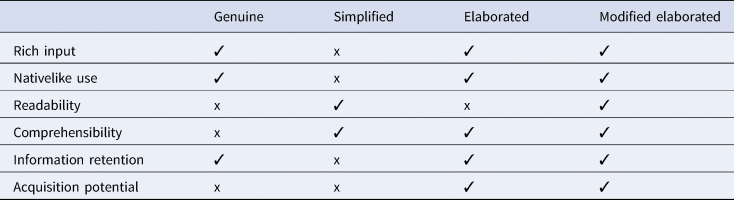
Genuine and simplified texts constitute the most common types of input for LT, but elaborated and modified elaborated input are better options. They are easily produced using many of the same devices NSs employ spontaneously to improve comprehensibility and sustain conversation with NNSs of limited L2 ability. They offer rich input, models of nativelike language use, improved comprehensibility, greater retention of information, and greater acquisition potential. Modified elaborated texts are also superior to elaborated texts in terms of readability. Genuine and simplified input offer some of those benefits, but not all of them (see Table 2). Elaborated and modified elaborated texts reflect three of ten methodological principles of TBLT (see Long, Reference Long2015, pp. 300–328) – MP3: Elaborate input, MP4: Provide rich input, and MP5: Encourage inductive ‘chunk’ learning.
Positive features of four types of input for language teaching

Empirical studies comparing two or more of the four types of input have produced four main findings: (1) Simplified and elaborated versions of spoken and written texts are both significantly better comprehended by NNSs than genuine versions; (2) simplified versions tend to be slightly better comprehended than elaborated versions, but not significantly so; (3) much of the information in genuine texts is lost in simplified versions, but almost all of it is retained when input is elaborated. This is a potentially important finding for immersion, CLIL, EMI, and other kinds of content-based programs; (4) probably because it allows deeper processing, elaborated input appears to facilitate inferencing beyond meanings stated directly in a text. The empirical evidence for (1) and (2) is fairly strong. Findings (3) and (4) depend on fewer studies.
Despite its advantages, modified elaborated input is unlikely to become the norm for pedagogic materials overnight. The financial and political power of commercial publishers is reflected in their preference for easily implemented, easily marketed, and highly profitable grammar-based materials, suggesting that simplified input will remain the staple diet for most learners for years to come. Gradual change can be expected, however, as course designers and classroom teachers become better acquainted with the alternatives and the research behind them. Meanwhile, whatever transpires in the world of commercial publishing, teacher speech will naturally tend toward modified elaborated input in TBLT and other communicative classrooms, as well as in programs like immersion, CLIL, and EMI, where the primary focus is on meaning, and content is taught through the medium of the L2. That is because the tendency to elaborate input, not simplify it, is instinctive whenever NSs need to communicate with young children learning their L1 or adults with limited command of their L2. With some simple guidance and a little practice, scripted modified elaborated input, too, can be produced for classroom use by materials writers and teachers. This becomes more difficult when specialized discourse domains are involved, whereupon collaboration with content specialists will usually be required.
Elaborated and, especially, modified elaborated, input have considerable potential for language acquisition and for subject-matter teaching through a new language. Much work remains to be done, however, with research, or in some cases more research, needed to answer several questions, including the following: (1) What is the language learning and subject-matter learning potential of the four types of input? (2) What kinds of training are most effective for professional materials designers and teachers wishing to produce modified elaborated pedagogic materials? (The same question applies to production of other kinds of input and LT materials, of course, but is rarely asked. A notable exception and useful starting-point is the innovative work by Johnson (Reference Johnson2003) on the role of expertise in designing language teaching tasks.) (3) How can normal procedures for producing modified elaborated input be adapted to produce materials for languages for specific purposes? (4) Can students be trained to better exploit the advantages of modified elaborated input, perhaps by learning to recognize the function of explicit markers of appositional phrases, such as i.e., that is to say, in other words, and put another way (see Derwing, Reference Derwing1996), or without such markers, the function of appositional phrases, informal definitions, and other forms of semantic repetition? (Bimodal presentation could be especially valuable here, with prosodic changes used to help learners recognize common forms of elaboration in written input.) (5) Can the effectiveness of elaborated or modified elaborated input be increased if linked with bimodal or tri-modal presentation? Early studies of bimodal presentation (e.g., Webb et al., Reference Webb, Newton and Chang2013; Malone, Reference Malone2018) have produced encouraging results for vocabulary learning. (6) More fundamentally, as some findings of the statistical meta-analysis by De Vos et al. (Reference De Vos, Schriefers, Nivard and Lemhofer2018b) suggest, is it the case that, like bimodal presentation, choosing the right kinds of input offers a way of improving enhanced incidental learning of grammar, vocabulary, or collocations?
Michael H. Long is Professor of SLA at the University of Maryland. He has served on the Editorial Boards of Studies in Second Language Acquisition, TESOL Quarterly, Language Teaching Research, Linguistic Approaches to Bilingualism, Instructed Second Language Acquisition, and other journals, and was co-editor of the Cambridge Applied Linguistics Series for its first 20 years. Author of over 100 journal articles and book chapters, recent publications include The handbook of second language acquisition (Blackwell, 2003), Second language needs analysis (CUP, 2005), Problems in SLA (Erlbaum, 2007), The handbook of language teaching (Wiley-Blackwell, 2009), Sensitive periods, language aptitude, and ultimate L2 attainment (Benjamins, 2013), and Second language acquisition and task-based language teaching (Wiley-Blackwell, 2015). In 2009, he was awarded a doctorate honoris causa by Stockholm University for his contributions to the field of SLA. In 2017, he received a lifetime achievement award from the International Association for Task-Based Language Teaching.