Introduction
More than half a century after the introduction of the term “successful aging” (SA), no universal operationalization nor standardized metric of SA has emerged (Depp and Jeste, Reference Depp and Jeste2006). In an era where the focus of aging research was on losses, Rowe and Kahn first differentiated between “usual” aging, i.e. functioning well, but with a high risk for disease and disability, and “successful” aging, i.e. demonstrating a high level of functioning across several domains, acknowledging the substantial heterogeneity of health trajectories in later life (1987). This precipitated an important paradigmatic shift, catalyzing increased research into alternatives to linear deterioration in old age. However, despite outlining the framework for a SA model, they did not operationally define SA (Rowe and Kahn, Reference Rowe and Kahn1987).
The absence of a consensus definition of SA has encouraged a diverse array of measures, which has inhibited the advancement of SA research, limiting the generalizability, and confounding descriptors of SA studies. Many of the same concerns facing SA models were experienced in the operationalization of frailty; for example, using components of the model, such as disability, as a predictor in some studies and as an outcome in others (Sternberg et al., Reference Sternberg, Wershof Schwartz, Karunananthan, Bergman and Mark Clarfield2011). Several reviews of SA literature (Phelan and Larson, Reference Phelan and Larson2002; Depp and Jeste, Reference Depp and Jeste2006; Bowling, Reference Bowling2007; Hung et al., Reference Hung, Kempen and De Vries2010) note the varying conceptualizations of SA, highlighting the prominent theoretical underpinnings upon which the constructs are founded, namely biomedical and psychosocial.
Although theoretically dissimilar, biomedical and psychosocial concepts are not mutually exclusive; multidimensional theories of SA, utilizing components of both biomedical and psychosocial theories, exist (Baltes and Baltes, Reference Baltes and Baltes1990; Glass, Reference Glass2003; Bowling and Dieppe, Reference Bowling and Dieppe2005; Bowling, Reference Bowling2007; Young et al., Reference Young, Frick and Phelan2009; Hung et al., Reference Hung, Kempen and De Vries2010; Pruchno et al., Reference Pruchno, Wilson-Genderson and Cartwright2010). Such models suggest a shift towards a more holistic view of SA away from biomedically focused unidimensional physiological models to more subjective aspects of the aging process.
In isolation, unidimensional biomedical and psychosocial perspectives are argued to be incomplete conceptualizations of SA (Baltes and Baltes, Reference Baltes and Baltes1990; Glass, Reference Glass2003; Bowling and Dieppe, Reference Bowling and Dieppe2005). Biomedical theorists suggest that psychosocial measures may be misleading indicators due to the plasticity of the human psyche and the subjective reporting of SA (Baltes and Baltes, Reference Baltes and Baltes1990). Conversely, psychosocial theorists suggest that avoiding disease and maintaining physical functioning is an unrealistic prospect (Bowling and Dieppe, Reference Bowling and Dieppe2005) and that a biomedical focus in SA inhibits research and public policy (Glass, Reference Glass2003).
Psychosocial conceptualizations have been expanded to incorporate lay perspectives of SA, largely derived from exploratory qualitative research (Phelan and Larson, Reference Phelan and Larson2002; Bowling, Reference Bowling2006; Hung et al., Reference Hung, Kempen and De Vries2010). Lay theories bridge the gap between biomedical and psychosocial theories, providing highly contextualized and practically relevant information with regards to pressing issues for the elderly, such as anticipating areas of social duress and demand (Bowling, Reference Bowling2006).
The conceptualizations of biomedical and psychosocial SA have produced operationalizations implementing correspondingly dissimilar metrics. Rowe and Kahn's (Reference Rowe and Kahn1987) model of SA proposes SA as the avoidance of disease and disability, maintaining physical functioning and actively engaging in life necessitating biomedical metrics, e.g. Activities of Daily Living (Katz et al., Reference Katz, Downs, Cash and Grotz1970), Mini-Mental State Examination (Folstein et al., Reference Folstein, Folstein and McHugh1975), to measure these phenomena. Conversely, psychosocial models emphasize aspects of life satisfaction, well-being, social engagement, and personal resources (Bowling and Dieppe, Reference Bowling and Dieppe2005), necessitating psychometrics capturing these phenomena, e.g. Resilience Scale (Wagnild, Reference Wagnild2003).
Previous reviews of SA provide overviews of the concept of SA (Bowling, Reference Bowling2007), comparisons of academic and lay views of SA (Hung et al., Reference Hung, Kempen and De Vries2010), lifestyle factors promoting SA (Phelan and Larson, Reference Phelan and Larson2002), as well as identify predictors and operational definitions of SA (Depp and Jeste, Reference Depp and Jeste2006). The aim of this review is to identify extant quantitative operational definitions of SA in order to determine unique and complementary methods and whether it would be possible to harmonize these into a single approach. This is accomplished through updating and augmenting the operational definition component of the review by Depp and Jeste (Reference Depp and Jeste2006), broadening the scope of the search strategy, increasing the number of databases to be searched, augmenting the temporal span of the search, including non-English articles, and eliminating methodological exclusion criteria (as per Harden et al., (Reference Harden2004)).
Methods
Search strategy
A systematic review of the literature across PubMed, PsycInfo, ISI Web of Knowledge, EmBase, and the Cumulative Index of Nursing and Allied Health Literature (CINAHL) databases was conducted. The search strategy included “successful aging” along with seven SA-related terms: robust aging, optimal aging, positive aging, healthy aging, productive aging, effective aging and aging well. These phrases were used with both “aging” and “ageing” spelling conventions, put in quotations, and linked via the Boolean operator “OR.” Where possible, a wildcat operator, i.e. “*” was inserted as a suffix to capture all permutations of the phrase. Furthermore, where possible, in a given database, non-human studies were excluded. An example of the search input for the phrase “successful aging” in PubMed is as follows: “successful* aging” OR “successful* ageing.” This search is processed by PubMed as: successful* aging (All Fields) OR “successful* ageing”(All Fields) AND “humans”(MeSH Terms). This process was repeated across the six aforementioned databases using the seven SA-related phrases. Relevant articles referenced in the captured studies were also included. Searches were initially conducted between May 31 and June 7, 2011 and then updated on March 23, 2013; all literature published before March 23, 2013 was eligible for inclusion.
Study inclusion
Peer-reviewed original articles providing an operational definition of SA were included. Theoretical definitions provided in the absence of an operational definition were excluded, e.g. a study only discussing Rowe and Kahn's (Reference Rowe and Kahn1987) model would not be included; however, a study employing metrics to capture the constructs of Rowe and Kahn's (Reference Rowe and Kahn1987) model would be. Studies discussing SA-related terms without specific reference to SA were also excluded.
As the intent was to provide a comprehensive review of operational definitions of SA, studies were neither excluded nor weighted based on study characteristics or methodological rigor, as there is no established methodology for quality assessment of construct reviews (Harden et al., Reference Harden2004).
Data extraction
Abstract review was conducted (TDC, AMP, and JP) to identify relevant articles for full-text extraction. Disagreements regarding inclusion were resolved by discussion. No language restrictions were made; non-English articles were translated by multilingual associates and staff at the Cambridge Institute of Public Health. Information regarding the authors’ operational definition(s) of SA were extracted, notably the components of the definition, any scales/measures employed and the threshold at which participants were deemed to be successfully aging. When studies posited several models of SA or varying cut-offs, the most inclusive, i.e. multidimensional, and/or the highest cut-off levels were recorded.
Synthesis
Components from included studies were categorized into broader SA constructs (physiological, well-being, engagement, personal resources, extrinsic factors) according to the metric employed and/or author's descriptions of the intended phenomena to be captured. These overarching constructs were synthesized using a meta-ethnographic framework. Meta-ethnography is an interpretivist method of synthesizing themes derived from several qualitative studies (Noblit and Hare, Reference Noblit and Hare1988). In this instance, instead of themes from qualitative interviews, phenomena intended to be captured by the various metrics were treated as themes and were synthesized into overarching constructs.
In cases where authors published several papers using the same operational definition, these operationalizations were counted as one definition. Studies utilizing a self-report measure of SA, e.g. “How successfully do you think you are aging?,” were excluded from the synthesis of broader SA constructs as these operationalizations did not provide information regarding the constituent components of SA.
Results
Included studies
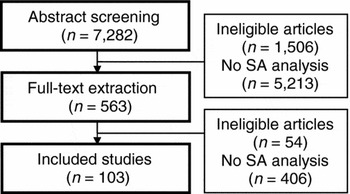
The search strategy identified 7,282 articles. Title and abstract screening eliminated 6,719 articles and full-text screening eliminated 460 articles, 103 studies met inclusion criteria. Eleven of the 103 studies used previously identified operational definitions and a further eight posited only a single-item self-report SA measure, excluding these 19 studies from further analysis. Several studies posited multiple operational definitions; 105 operational definitions across 84 studies were used in the examination of constituent components of operational definitions of SA (Figure 1).
Inclusion flowchart: screening process for study inclusion.

Study characteristics
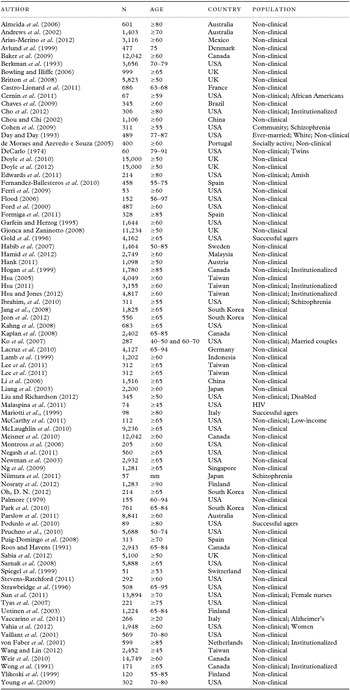
The number of studies (n) was highest in the USA (n = 43), followed by Canada (n = 8) and the UK (n = 8), and were primarily conducted with non-clinical populations. The sample size ranged from 51 to 5,000, with a mean of 2,507 (SD 3,651; median 1,140). The minimum age for inclusion of study participants varied from ≥20 to ≥90 (Table 1). The majority of studies (70.2%, 59) employed SA as an outcome; however, 22.6% (n = 19) studies described models of SA, 6.0% (n = 5) employed SA as an experimental group and a single study (1.2%) employed SA as a predictor. The vast majority of included studies were published in English, save for Fernandez-Ballesteros et al. (Reference Fernandez-Ballesteros Garcia2011) and Oh (Reference Oh2012).
Study characteristics

nm = not mentioned.
Operationalizations of SA
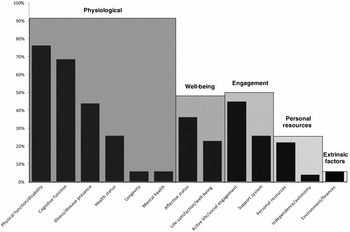
Of the 105 operational definitions, across 84 included studies using unique models, 92.4% (n = 97) included physiological constructs (e.g. physical functioning), 49.5% (n = 52) engagement constructs (e.g. involvement in voluntary work), 48.6% (n = 51) well-being constructs (e.g. life satisfaction), 25.7% (n = 27) personal resources (e.g. resilience), and 5.7% (n = 6) extrinsic factors (e.g. finances) (Figure 2).
Percentage of studies capturing each SA component, by construct.

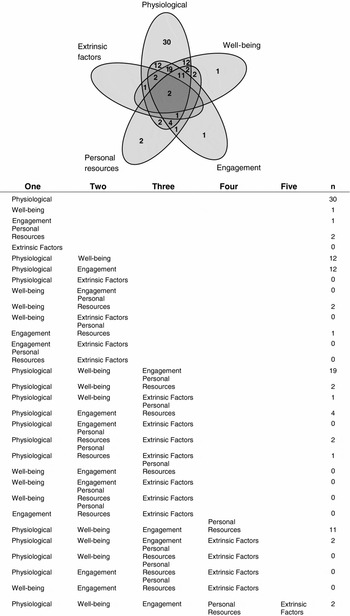
The number of constructs included in each of the operational definitions of SA varied from one to five (mean 2.2, median 2, SD 1.1). Thirty-four definitions consisted of a single construct, 28 of two constructs, 27 of three constructs, 13 of four constructs, and two of five constructs (Figure 3). The most common construct permutations among operational definitions were single construct – physiological (n = 30), three construct – physiological, well-being, engagement (n = 19), construct – physiological, engagement (n = 12), and two construct – physiological, well-being (n = 9).
Frequency of studies identifying SA constructs: a Venn diagram and table of the number of studies containing each of the combinations of the five SA constructs.

The physiological construct was operationalized in 76.2% (n = 80) of studies using physical functioning/disability, in 68.6% (n = 72) using cognitive functioning, in 43.8% (n = 46) using presence of illness/disease, in 25.7% (n = 27) using health status, in 5.7% (n = 6) using longevity, and in 5.7% (n = 6) using mental health. The well-being construct was operationalized in 36.2% (n = 38) of definitions using affective status, and in 22.8% (n = 24) using life-satisfaction/well-being. The engagement construct was operationalized in 44.8% (n = 47) of definitions using active/life/social engagement and in 25.7% (n = 27) studies using support system. The personal resources construct was operationalized in 21.9% (n = 23) of definitions using resources (i.e. resilience, coping, etc.), and in 3.8% (n = 4) studies using independence/autonomy. The extrinsic factors construct was operationalized in 5.7% (n = 6) of definitions using environment/finances.
Self-rated SA was reported as a constituent component of a multicomponent operationalization of SA in three studies and as a single item measure in eight studies.
Prevalence of SA
Sixty-nine studies (including duplicate models) quantified the percentage of “successful agers.” These studies identified 115 separate groups of successful agers, based on the operational definitions in combination with geographic and temporal breakdowns of these definitions. The percentage of successful agers ranged from 0.4% to 91.7%, with a median of 23.1% and an unweighted mean of 28.3% (SD 20.1%; 95% CI 24.6–32.0%). Of the 109 groups that used researcher defined SA cut-offs (n = 65), an average of 26.0% (SD 21.0%; 95% CI 22.1–29.9%) of participants were identified as successful agers. In contrast, of the six studies that used self-rated SA scores, an average 71.3% (SD 18.6%; 95% CI 56.4–86.2%) of participants were identified as successful agers. Models using a single construct (and reporting the percentage of successful agers; n = 27) identified an average of 32.5% (SD 21.6%; 95% CI 24.4–40.7%) of participants as successfully aging, two construct models (n = 22) identified an average of 33.4% (SD 22.4%; 95% CI 24.0–42.8%), three construct models (n = 15) an average of 20.2% (SD 16.2%; 95% CI 12.0–28.4%), and four construct models (n = 8) an average of 23.3% (SD 30.3%; 95% CI 2.3–44.3%). None of the models that captured five constructs reported the percentage of successful agers.
Conclusions
This review highlights the profound heterogeneity in the operationalization of SA. Current definitions have used varied permutations of the five SA constructs (physiological, well-being, engagement, personal resources, and extrinsic), as identified in this review. Operational definitions ranged from strictly biomedical, employing physiological metrics, to strictly psychosocial and lay models, emphasizing life-satisfaction and well-being. Numerous multidimensional operationalizations, utilizing components of several perspectives, were also identified. Categorization of successful and usual agers varies across definitions and heterogeneous bifurcations suggest that dichotomizing successful versus usual agers within the framework of a unidimensional model of SA is unrealistic.
As highlighted by the review, SA definitions have a shared commonality in the assertion that SA is vastly more complex than mere survival, including a mastery or maintenance of functioning across a number of constructs, such as social, cognitive, and emotional (Glass, Reference Glass2003). The five constructs, and quantifying metrics, identified in the current review capture many of the dimensions suggested by proponents of multidimensional models (Baltes and Baltes, Reference Baltes and Baltes1990; Glass, Reference Glass2003; Bowling and Dieppe, Reference Bowling and Dieppe2005; Pruchno et al., Reference Pruchno, Wilson-Genderson and Cartwright2010).
The difficulty in dichotomizing SA is highlighted by the profound heterogeneity of SA prevalence. Depending on the definition, individuals could be classified as successfully aging or not. In addition to the metrics and cut-offs chosen to dichotomize SA, the sample population itself may influence SA prevalence. For example, marked differences may exist in the mobility of community dwelling and institutionalized individuals. Differences in the definition of SA and the cut-offs chosen to classify successful agers make cross-study comparison difficult and limit research in the field of SA.
A further area of disparity in SA prevalence was the nearly three-fold increase in self-rated SA prevalence in comparison to researcher-defined SA prevalence. The plasticity of the human psyche may manifest itself in the subjective reporting of intrinsic states, such as SA, resulting in higher subjective ratings than objective ratings. Additionally, what laypersons deem to be SA may differ from what researchers deem to be SA, which may contribute to the disparity between objective and subjective reports of SA. Demographic influences must also be taken into consideration, for example, the influence of culture; different cultures may not value the same components of SA equally and/or have different conceptualizations of SA. Further work is required to assess the practical implications and application of SA thresholds across samples (e.g. clinical vs. population based), populations with different demographics (e.g. culture, SES status), and between self-rated and researcher-driven SA.
The majority of methods for the operationalization of SA included physiological constructs, as highlighted in biomedical models. However, continued focus on purely biomedical models of SA has been described as inhibiting the advancement of SA conceptualization (Young et al., Reference Young, Frick and Phelan2009). This is due, in part, to the impracticality of elderly individuals aging in perfect physical condition. Indeed, studies with centenarians indicate that this operationalization is not feasible (Andersen-Ranberg et al., Reference Andersen-Ranberg, Schroll and Jeune2001; Bowling and Dieppe, Reference Bowling and Dieppe2005). Inclusion of subjective components of psychosocial constructs has also been met with criticism. However, such constructs have been included in a large proportion of all SA operationalizations. When used in isolation, subjective components may lead to a misleading representation of SA due to individual biases (Baltes and Baltes, Reference Baltes and Baltes1990). However, augmenting objective components with subjective components provides a more holistic conceptualization of SA.
In several studies, operationalizations of SA have permitted individuals with a chronic disease to be classified as successfully aged. These studies identify successful agers in populations traditionally deemed unable to successfully age, e.g. schizophrenia (Ibrahim et al., Reference Ibrahim, Cohen and Ramirez2010) and HIV (Malaspina et al., Reference Malaspina2011). These definitions highlight the complexity and heterogeneity of SA and of the individuals demonstrating SA. As a result of these more holistic and inclusive definitions of SA, the implications for improving the lives of a broader spectrum of individuals is possible.
There are numerous public and personal implications for a multidimensional continuous concept of SA. The current study reveals the difficulty in dichotomizing SA, an issue further complicated by characteristics of the sample population. From a public health and policy perspective, the use of a multidimensional model affords a greater opportunity than unidimensional models to identify areas of deficiency. As highlighted by Sternberg et al.'s (Sternberg et al., Reference Sternberg, Wershof Schwartz, Karunananthan, Bergman and Mark Clarfield2011) review of frailty, operational definitions that are the most relevant and applicable to the specific research question should be chosen. It is not possible for a large proportion of the population to age without disease, whether clinically manifest or not (Bowling and Dieppe, Reference Bowling and Dieppe2005); therefore, individuals dubbed “usual” agers are excluded from further analysis into the characteristics of a SA phenotype. This is an inhibiting factor in the conceptualization of an overarching SA model. Through the identification of the specific dimensions in which individuals are not successfully aging, intervention programs can be implemented to augment one's overall SA.
If researchers intend to implement prospective SA interventions, consensus definitions of SA will be needed including specific constructs that are generalizable and practically relevant, i.e. linked to relevant public health outcomes. As revealed in the current review, cross-study comparisons are virtually impossible, limiting the generalizability and practical applicability of results from SA studies. There are both theoretical and practical motivations for the development of consensus definitions of SA: for intervention development and identification of strategies for the promotion of SA with population aging. Therefore, it is imperative that collaborative efforts are made by researchers, for example, via consensus conference, towards feasible operationalization(s) of SA. However, as the current review highlights, reconciling this profound heterogeneity will be a challenging prospect and will require a shift from unidimensional to multidimensional framing of the concept of SA.
Conflict of interest
None.
Description of authors’ roles
The review and search protocol was planned by TDC, BS, and CB; TDC conducted the primary paper review and data extraction; AMP and JP conducted a second, independent screen of the papers; and TDC wrote the paper, which was edited and reviewed by AMP, JP, BS, and CB.
Acknowledgments
The authors thank Martin Theaker, Tae Hoon Kim, David Brehme, and Yu-Tzu Wu for providing assistance in the translation of non-English papers.