Introduction
Non-fatal self-harm and completed suicide are major causes of morbidity and premature death worldwide. Population suicide rates vary substantially between countries. In Sweden in 2008, the rate per 100000 was 18.7 in males and 6.8 in females. These figures are higher than those in, e.g. the UK 2009 (10.9, 3.0), Spain 2008 (11.9, 3.4), and the USA 2005 (17.7, 4.5), but lower than in, e.g. Slovenia 2009 (34.6, 9.4), the Russian Federation 2006 (53.9, 9.5), and Japan 2009 (36.2, 13.2) (WHO, 2013). There is a substantially increased risk of a later completed suicide in those who have self-harmed (Harris & Barraclough, Reference Harris and Barraclough1997), both in short- and long-term perspectives (De Moore & Robertson, Reference De Moore and Robertson1996; Tejedor et al. Reference Tejedor, Diaz, Castillon and Pericay1999; Suokas et al. Reference Suokas, Suominen, Isometsa, Ostamo and Lonnqvist2001; Jenkins et al. Reference Jenkins, Hale, Papanastassiou, Crawford and Tyrer2002; Owens et al. Reference Owens, Horrocks and House2002; Suominen et al. Reference Suominen, Isometsä, Suokas, Haukka, Achte and Lönnqvist2004; Cooper et al. Reference Cooper, Kapur, Webb, Lawlor, Guthrie, Mackway-Jones and Appleby2005; Tidemalm et al. Reference Tidemalm, Långström, Lichtenstein and Runeson2008). Gender differences have also been found; suicide rates are higher in males but relative risks v. general population controls higher in females (Hawton et al. Reference Hawton, Zahl and Weatherall2003; Suominen et al. Reference Suominen, Isometsä, Suokas, Haukka, Achte and Lönnqvist2004; Cooper et al. Reference Cooper, Kapur, Webb, Lawlor, Guthrie, Mackway-Jones and Appleby2005). The risk of a later suicide in self-harmers is also affected by type of mental disorder at the initial self-harm episode (Tidemalm et al. Reference Tidemalm, Långström, Lichtenstein and Runeson2008), type of method used (Runeson et al. Reference Runeson, Tidemalm, Dahlin, Lichtenstein and Långström2010; Bergen et al. Reference Bergen, Hawton, Waters, Ness, Cooper, Steeg and Kapur2012), and repeated self-harm (Nordentoft et al. Reference Nordentoft, Breum, Munck, Nordestgaard, Hunding and Laursen Bjaeldager1993; Zahl & Hawton, Reference Zahl and Hawton2004; Christiansen & Jensen, Reference Christiansen and Jensen2007).
Few large studies have addressed age at a non-fatal self-harm episode as predictor of a later completed suicide. A British follow-up of 11583 self-harm patients found substantial differences in suicide mortality across age groups, where suicide risks were increasing with age (Hawton et al. Reference Hawton, Zahl and Weatherall2003). A study from Finland found lower risks of completed suicide in the younger self-harm patients (Haukka et al. Reference Haukka, Suominen, Partonen and Lönnqvist2008). Further, one analysis of population rate ratios of non-fatal self-harm to suicide found that these decreased with age (Hawton & Harriss, Reference Hawton and Harriss2008); this indicates an increase in suicidal intention over the life-cycle. Another study of the above-mentioned British cohort compared repeated self-harm to single-episode self-harm in different age groups. In this study, the highest suicide risk increase following repeated self-harm was found in young females (10–24 years) (Zahl & Hawton, Reference Zahl and Hawton2004). Smaller studies have found higher suicide intent, more lethal methods used, and higher risk of subsequent suicide in older self-harm patients (Frierson, Reference Frierson1991; Nordentoft et al. Reference Nordentoft, Breum, Munck, Nordestgaard, Hunding and Laursen Bjaeldager1993; Draper, Reference Draper1996; Hawton & Harriss, Reference Hawton and Harriss2006; Murphy et al. Reference Murphy, Kapur, Webb, Purandare, Hawton, Bergen, Waters and Cooper2011).
Evidence is not conclusive regarding gender and age at a non-fatal self-harm episode. Higher age may be a suicide risk factor especially in males (Rygnestad, Reference Rygnestad1988; Suokas & Lönnqvist, Reference Suokas and Lönnqvist1991), but some results indicate that increasing age is a risk factor particularly in females (Hawton & Fagg, Reference Hawton and Fagg1988; Nordström et al. Reference Nordström, Samuelsson and Åsberg1995; Skogman et al. Reference Skogman, Alsén and Öjehagen2004). Another study found escalation in suicide risk with increasing age in both genders, but particularly in females aged >55 years (Hawton et al. Reference Hawton, Zahl and Weatherall2003).
All in all, results suggest that the suicide risk after self-harm may be increasing with age. Nevertheless, self-harm and completed suicide are major public health problems in young people globally. Suicide is the most common cause of death worldwide in females aged 15–19 years (Patton et al. Reference Patton, Coffey, Sawyer, Viner, Haller, Bose, Vos, Ferguson and Mathers2009; Hawton et al. Reference Hawton, Saunders and O'Connor2012).
Previous studies of suicide risk following self-harm according to age have usually been limited by their small sample size. Consequently, data are inconclusive regarding suicide risk by gender and age at the initial self-harm episode. To enable relevant comparisons across age groups, larger studies using comprehensive and longitudinal nationwide suicide mortality data are needed.
We aimed to investigate the impact of age at a first non-fatal self-harm episode on likelihood of short- and long-term suicide mortality by gender. Further, we addressed whether known suicide risk factors affect suicide risk differently for self-harm patients of varying age. We addressed the following questions:
-
• Does the short- and long-term risk of suicide after a self-harm episode differ across age groups?
-
• Does a violent method used at the index self-harm episode affect the short- and long-term risk of suicide differently in younger and older self-harm patients?
-
• Does a mental disorder, present at the index self-harm episode, affect the short- and long-term risk of suicide differently in younger and older self-harm patients?
-
• Does repeated self-harm affect the short- and long-term risk of completed suicide differently in younger and older self-harm patients?
Method
Linkage of national registers
We conducted a population-based, nationwide cohort study, using data from four linked Swedish longitudinal population registers. Registers were linked by the personal identification number, assigned to the individual at birth or immigration and used for national population statistics (Ludvigsson et al. Reference Ludvigsson, Otterblad-Olausson, Pettersson and Ekbom2009). The National Patient Register (held by the National Board of Health and Welfare) covers all in-patient healthcare including the few existing private hospitals. The register has complete national coverage for all psychiatric in-patient admissions from 1973 and for all in-patient admissions from 1987. Each record contains admission and discharge dates as well as discharge diagnostic codes for diseases and injuries, including non-fatal self-harm (method used and if intentional or of undetermined intent) according to the International Classification of Diseases (ICD), ICD-8, -9, and -10. The Cause of Death Register (National Board of Health and Welfare) includes all deaths among persons registered as residents of Sweden at the time of death. Established in 1952, the register covers more than 99% of all deaths from 1961 and onwards, including those occurring abroad. Each record contains date of death and diagnostic codes for causes of death, including definite and uncertain suicide, in accordance with ICD-6, -7, -8, -9 and -10 (National Board of Health and Welfare, 2010). The Total Population Register (Statistics Sweden) contains information about gender, birth date, origin of birth, emigration, immigration, and relationships (e.g. parents of index persons). The Education Register (Statistics Sweden) contains information on Swedish residents’ highest level of education.
Study cohort
All individuals aged ⩾10 years and admitted to somatic or psychiatric in-patient care in Sweden during 1990–1999 due to non-fatal self-harm were included (n = 62 689). Non-fatal self-harm included the ICD categories Intentional self-harm (ICD-9 codes E950–9; ICD-10 codes X60–84) and Event of undetermined intent (ICD-9 codes E980–9; ICD-10 codes Y10–34), as registered in the National Patient Register. In case of more than one admission for self-harm during the inclusion period, we used the first admission as the index episode. We excluded those with any hospitalization after self-harm within 15 years before the inclusion period (n = 7272), to diminish bias due to earlier serious self-harm episodes. We also excluded patients who died by suicide during the index episode if this episode was in somatic care, implicating death caused by the index self-harm episode (n = 514), to minimize the risk of classifying some completed suicides as non-fatal self-harm episodes. Further, we excluded those who had immigrated within 2 years before baseline (n = 1060), to avoid confounding effects of being in an asylum-seeking process. The final cohort (exposed) thus consisted of 53 843 individuals aged ⩾10 years (males: n = 22 807, mean age = 41.5 years, s.d. = 18.7; females: n = 31 036, mean age = 38.9 years, s.d. = 20.2).
For each exposed individual, up to ten population controls matched for age (month and year of birth), gender, and period under risk (each control was alive and had not emigrated at the corresponding exposed individual's inclusion date) were selected, through the Total Population and Cause of Death Registers (n = 538 393).
Exposed and population controls were followed from inclusion during 1990–1999 to a definite or an uncertain suicide (ICD-9 codes E950–9 and E980–9; ICD-10 codes X60–84 and Y10–34), death due to other causes than suicide, first emigration, or end of follow-up (31 December 2008). Thus, the maximum follow-up was 9–19 years.
Analyses
Outcome
The studied outcome was completed suicide during follow-up. We included uncertain suicides because their exclusion might have led to an underestimation of suicide rates (Charlton, Reference Charlton1995; Neeleman & Wessely, Reference Neeleman and Wessely1997; Hawton et al. Reference Hawton, Fagg, Simkin, Harriss and Malmberg1998; Linsley et al. Reference Linsley, Schapira and Kelly2001).
Covariates
Age at the initial self-harm episode was categorized into age groups (10–19, 20–29, 30–44, 45–59, 60–74, ⩾75 years). Violent method included gassing; hanging, strangulation, or suffocation; drowning; firearm or explosive; and jumping from a height. Presence of mental disorder was defined as having received any psychiatric diagnosis (ICD–8 and ICD–9 codes 290–319; ICD–10 codes F00–99) in psychiatric or somatic in-patient care before the index episode, during the index episode, or during an episode beginning up to 1 week after the inclusion date (yes or no). Repeated self-harm was defined as at least one non-fatal self-harm episode during follow-up (yes or no), after the index self-harm episode. Origin of birth (born in Sweden, yes or no) and parents’ highest education level (five-point ordinal scale, from not having completed compulsory school to postgraduate education) were covariates in the adjusted analyses.
Statistical analysis
For descriptive purposes, we conducted two sets of analyses. First, incidence rates (numbers of events divided by numbers of person-years) and incidence rate ratios (IRRs) with 95% confidence interval (CI) for suicide in exposed compared to population controls were calculated; the results were stratified by gender and age group. The 95% CIs of the IRRs were calculated using Byar's method (Sahai & Khurshid, Reference Sahai and Khurshid1996). Second, to compare proportions of suicide over the entire follow-up for variables of interest among the exposed, χ2 values from 2 × 2 tables were derived. Since 18 χ2 tests were performed on the same dataset, the critical p value was set to 0.05/18 ≈ 0.0025, according to Bonferroni correction.
The matched population controls (n = 538393) were used exclusively for calculation of IRRs, as described in the previous paragraph; all other analyses were conducted on the cohort of exposed only (n = 53843).
We performed Cox proportional hazard analysis (coxreg command in SPSS; SPSS Inc., USA) in order to estimate associations between covariates and outcome in crude and multivariable models. The proportional hazards assumption of a Cox regression was tested by creating a scatterplot of the age variable's partial residuals by time. The test showed that the proportional hazards assumption was not met for age over 19 years of follow-up. Therefore, we split the follow-up period in three bands: year 1, years 2–9, and year 10 to end of follow-up. With this division, the proportional hazards assumption was satisfied for the variables we included in models. Preliminary tests revealed a lack of statistical power for comparisons during year 10 to end of follow-up; only 14% of the total number of suicides occurred during this period. Therefore, and to include the full cohort in the main comparisons (all 53843 individuals had at least 9 years of follow-up), we chose to mainly study year 1 and years 2–9 of the total follow-up period.
One model was used to the test the general impact of increasing age (continuous variable) on suicide mortality among the exposed individuals. For the main analysis, a second model was used to compare the risks of suicide in different age groups among the exposed. The youngest age group (10–19 years) was chosen as reference category. In both models we computed hazard ratios (HRs) with 95% CI, stratified by gender and adjusted for origin of birth, parents’ highest education level, violent method used at the index self-harm episode, and presence of mental disorder. Since repeated self-harm during follow-up may be in the causal pathway from an index self-harm episode to a completed suicide, this variable was not adjusted for.
Further, we investigated suicide risk by violent method, mental disorder, and repeated non-fatal self-harm. The presumed risk factors and covariates were included in multiple Cox regression models stratified by age group (10–19 years, ⩾20 years). Repeated non-fatal self-harm was treated as an explanatory variable but not as a covariate in these analyses, for the reason stated above.
SPSS for Windows v. 22.0 (SPSS Inc.) was used for all analyses except for calculating IRRs where OpenEpi v. 3.01 (www.openepi.com/) was used.
Ethical approval was obtained from the Stockholm Regional Ethics Committee (2009/939–31/5).
Results
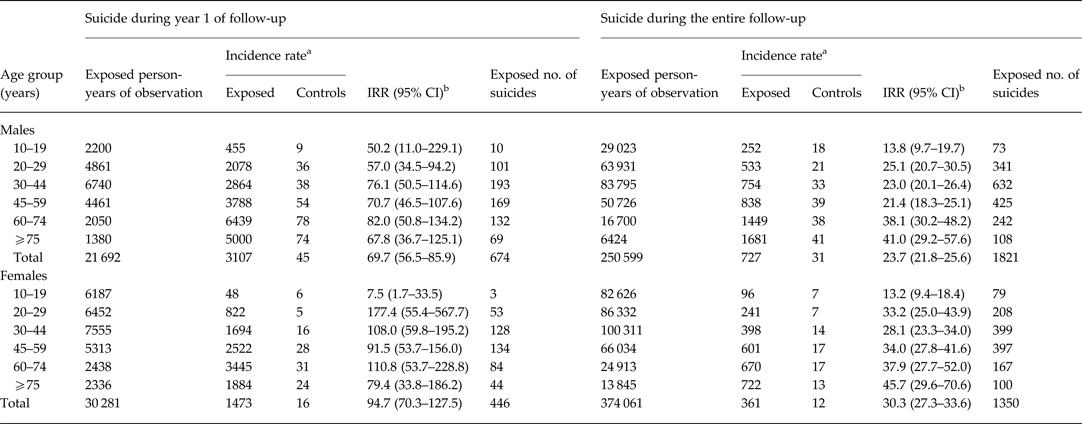
In the cohort of exposed (n = 53 843), 3.0% of the males and 1.4% of the females had died by suicide within 1 year of follow-up. Table 1 shows that this corresponds to an IRR compared to population controls of 69.7 (95% CI 56.5–85.9) for males and 94.7 (95% CI 70.3–127.5) for females. The 1-year IRRs ranged between 50.2 and 82.0 for males and between 7.5 and 177.4 for females across the different age groups. Over the entire follow-up of up to 19 years, the proportion of suicide was 8.0% for males and 4.3% for females (males: IRR 23.7, 95% CI 21.8–25.6; females: IRR 30.3, 95% CI 27.3–33.6) (Table 1). The IRRs ranged between 13.8 and 41.0 for males and between 13.2 and 45.7 for females across age groups over the entire follow-up period.
Age at index self-harm episode and incidence rates of later completed suicide among 53 843 individuals (exposed), treated for self-harm in Sweden 1990–1999 and followed to 2008, and 538 393 population controls

IRR, Incidence rate ratio; CI, confidence interval.
a Incidence rate per 100 000 person-years, i.e. the number of completed suicides divided by the number of person-years and multiplied by 100 000 in each age group.
b Incidence rate ratio, exposed compared to controls matched for age (month and year of birth), gender, and period under risk (each control was alive and had not emigrated at the corresponding exposed individual's inclusion date).
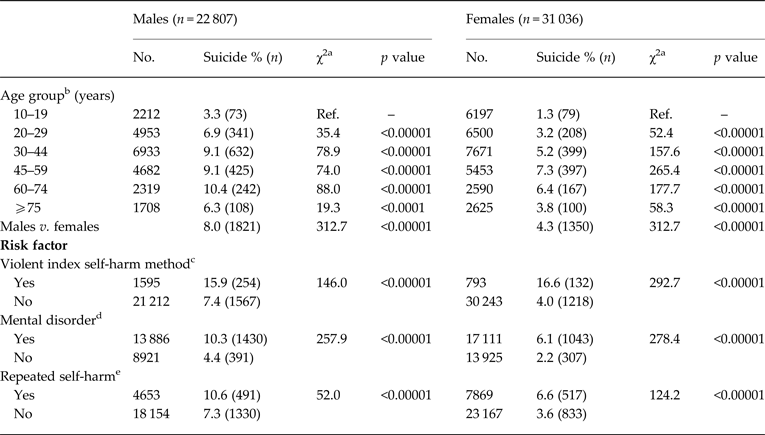
Table 2 shows crude risks and descriptive statistics for completed suicide over the entire follow-up period according to patient's age at index self-harm event (and risk according to presumed additive risk factors). There were more female than male self-harm patients in all age groups and especially among those aged 10–19 years (74% of which were females). In the other age groups, the proportion of females ranged between 53% and 61% (data not shown). Proportions of suicide were significantly higher in all age groups aged ⩾20 years than in those aged 10–19 years, with p values ranging from <0.00001 to <0.0001. The three potential risk factors all increased the long-term risk of suicide for both genders (p values <0.00001).
Crude risks of completed suicide by age group and risk factors among 53 843 individuals treated for a first self-harm episode in Sweden 1990–1999 and followed to 2008

a χ2 values derived from 2 × 2 tables, hence df = 1.
b Age at index self-harm episode; the 10–19 years age group was the reference category in pairwise χ2 tests.
c Gassing; hanging, strangulation, or suffocation; drowning; firearm or explosive; and jumping from a height.
d Any psychiatric in-patient diagnosis (ICD-8 and ICD-9 codes 290–319; ICD-10 codes F00–99) before or up to 1 week after the inclusion date.
e At least one non-fatal self-harm episode during follow-up after the index self-harm episode.
Adjusted HRs showed significant average effects of increasing age as continuous variable on risk of completed suicide within 1 year (males: HR 1.02, 95% CI 1.02–1.02; females: HR 1.02, 95% CI 1.02–1.03) and during years 2–9 of follow-up (males: HR 1.01, 95% CI 1.01–1.02; females: HR 1.02, 95% CI 1.01–1.02) (data not shown in table).
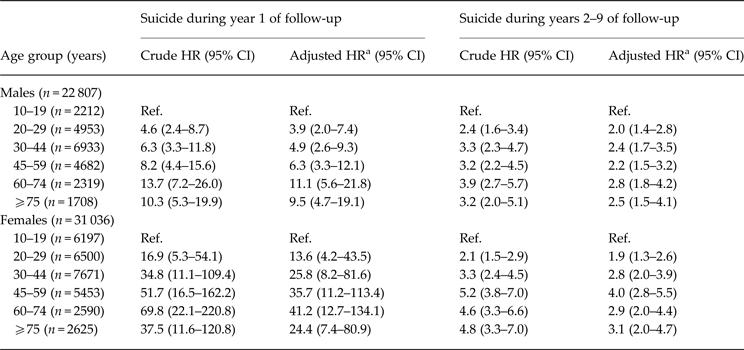
Table 3 shows comparisons of risk of suicide by age group with the youngest (10–19 years) as reference group. All age groups aged ⩾20 years had higher 1-year suicide mortality compared to the reference group in both genders; the adjusted HRs were significantly higher than 1, varying from 3.9 to 11.1 in males and from 13.6 to 41.2 in females. The 1-year suicide mortality peaked in the 60–74 years age group in both males (5.7%) and females (3.2%), whereas that in the oldest (⩾75 years) was somewhat lower (percentages not shown in table). Additional analyses showed that the potentially confounding 1-year mortality rates from other causes than suicide were higher in those aged ⩾75 years than in those aged 60–74 years (males: χ2 = 124.5, df = 1, p < 0.001; females: χ2 = 140.2, df = 1, p < 0.001; data not shown). Long-term suicide mortality (years 2–9) was higher across all ages for individuals aged ⩾20 years than in the youngest age group, for both males (adjusted HRs ranged from 2.0 to 2.8) and females (1.9–4.0).
Hazard ratio (HR) and 95% confidence interval (95% CI) for completed suicide during follow-up 1990–2008 by age group at index self-harm episode (n = 53 843)

a Adjusted for origin of birth, parents’ highest education level, violent index self-harm method, and mental disorder.
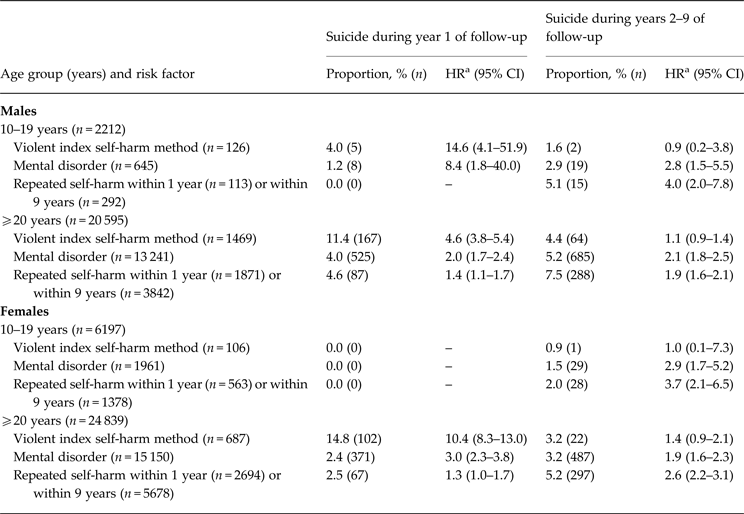
Table 4 shows adjusted HRs for completed suicide by violent self-harm method, mental disorder, and repetition of self-harm. Due to the marked difference in suicide mortality between the youngest and all other age groups (Table 3) and to increase statistical power, we compared those aged 10–19 years with all aged ⩾20 years. In the 10–19 years age group, a violent self-harm method (HR 14.6, 95% CI 4.1–51.9) and presence of mental disorder (HR 8.4, 95% CI 1.8–40.0) increased the risk of suicide within 1 year in males. None of the potential risk factors increased the 1-year risk in the youngest females; as shown in Table 1, there were a total of three suicides within 1 year in this category. In patients aged ⩾20 years, all three factors increased the 1-year risk of suicide for both genders; the HRs were highest for use of a violent index self-harm method (males: HR 4.6, 95% CI 3.8–5.4; females: HR 10.4, 95% CI 8.3–13.0). During years 2–9 of follow-up, mental disorder and repeated non-fatal self-harm increased the risk of suicide in all gender and age groups. Repetition of self-harm increased the risk more in the youngest, with similar HRs in both genders (males: HR 4.0, 95% CI 2.0–7.8; females: HR 3.7, 95% CI 2.1–6.5) (Table 4). Additional analyses showed no significant differences between HRs for the risk increasing factors across age groups in the range 20–29 years to ⩾75 years (data not shown).
Violent index self-harm method, mental disorder, and repeated self-harm as risk factors of completed suicide among individuals treated for self-harm in Sweden 1990–1999 and followed to 2008

HR, Hazard ratio; CI, confidence interval.
a Adjusted hazard ratios from multiple Cox regression models. When violent index self-harm method and mental disorder were the explanatory variables, the model included violent index attempt method, mental disorder, origin of birth, and parents’ highest education level. When repeated self-harm was the explanatory variable, the model included repeated self-harm, violent index self-harm method, mental disorder, origin of birth, and parents’ highest education level. Thus, repeated self-harm was not viewed as a potential confounder in the models, since it may be in the causal pathway from an index self-harm episode to a completed suicide.
Discussion
We linked nationwide longitudinal registers and conducted a large case cohort study to follow 53843 self-harm patients in Sweden for 9–19 years. Our overall finding was distinct age-related differences in levels and patterns of short- and long-term suicide mortality, with generally large effect sizes (adjusted HRs) for the first year of follow-up and medium to large effect sizes for years 2–9. There were four specific findings. First, the youngest age group (10–19 years), particularly females, had lower risks compared to those aged ⩾20 years, especially within 1 year of follow-up. Second, the 1-year risk was substantially increased in the youngest males by a violent method and mental disorder at the index self-harm episode, but not by repetition, whereas in females none of these factors were associated with suicide within 1 year. Third, during the first year of follow up, a violent index self-harm method provided the strongest risk for completed suicide in patients aged ⩾20 years, particularly females. As expected, long-term suicide risk among self-harm patients was increased across all age groups by mental disorder and repeated self-harm. Long-term risks were not significantly increased by violent index method, but these results are difficult to evaluate due to small sizes of subgroups. Fourth, another non-fatal self-harm episode following the index occasion had greater impact on long-term risk of completed suicide in the youngest patients compared to those aged ⩾20 years. Suicide mortality for the three risk factors did not differ significantly across age groups 20–29 to ⩾75 years.
Other studies found that risks of later suicide after non-fatal self-harm were increasing with age at the initial self-harm episode (Hawton et al. Reference Hawton, Zahl and Weatherall2003; Haukka et al. Reference Haukka, Suominen, Partonen and Lönnqvist2008; Hawton & Harriss, Reference Hawton and Harriss2008). In the present study, however, we did not find the highest suicide mortality in the oldest age group (⩾75 years). However, 1-year mortality from other causes than suicide was considerably higher in those aged ⩾75 years than in those aged 60–74 years. Therefore, a relative increase in suicide risk might have been underestimated in the oldest age group resulting from a larger proportion of potentially suicidal individuals dying from other causes before they had attempted suicide again. Thus, our results are neither inconsistent with nor strongly supportive of the prior observation of escalation in suicide risk with increasing age.
As expected, suicide risks compared to population controls were high for self-harm patients of both genders and across age groups, primarily in the first year but also throughout follow-up. Suicide risk levels were roughly similar to those reported in previous studies (Hawton et al. Reference Hawton, Zahl and Weatherall2003; Cooper et al. Reference Cooper, Kapur, Webb, Lawlor, Guthrie, Mackway-Jones and Appleby2005; Haukka et al. Reference Haukka, Suominen, Partonen and Lönnqvist2008). The prevalence of females in this self-harm cohort was high; thus a large proportion of the suicide victims were females, despite the considerably higher proportions of suicide in males. Consistent with the findings of a previous smaller study (Zahl & Hawton, Reference Zahl and Hawton2004), we found that repetition was strongly associated with suicide among the youngest patients. Unlike the results of the previously mentioned study (Zahl & Hawton, Reference Zahl and Hawton2004), however, our results suggest similar impact across gender of repetition on long-term suicide mortality. Moreover, the point estimate for repetition in the youngest females was higher in the previous study. These differing results could be due to the somewhat different definitions of repetition in the two studies. Unlike the present study, the previous study included self-harm episodes prior to the index episode (Zahl & Hawton, Reference Zahl and Hawton2004).
Strengths and limitations
To our knowledge, this study is the largest so far of suicide risk following non-fatal self-harm according to age (Hawton et al. Reference Hawton, Zahl and Weatherall2003; Zahl & Hawton, Reference Zahl and Hawton2004; Haukka et al. Reference Haukka, Suominen, Partonen and Lönnqvist2008). Higher statistical power enabled more detailed age-related comparisons than previous studies, including reliable estimates of the clinically important 1-year suicide mortality and the adjusting for relevant covariates and known risk factors. Further, it facilitated comparison of short- and long-term impact of risk factors by gender and different age groups. In addition, we used matched controls to calculate IRRs compared to the general population. Those with any hospitalization after self-harm within 15 years before the inclusion period were excluded. The cohort was thus, in effect, an inception cohort of hospitalized self-harm patients. Loss of information on suicide in the cohort was minimal, since the Cause of Death Register covers more than 99% of all deaths in Swedish residents, including those occurring abroad (National Board of Health and Welfare, 2010). Further, since all included exposed individuals had been treated in hospital due to the index self-harm episode, the cohort was not particularly heterogeneous in terms of severity of self-harm.
Some important limitations should also be considered. First, register data of the kind used in this study generally lack in-depth information, for instance on suicidal intent, hopelessness, interpersonal problems, exposure to trauma, access to services, and details about treatment efforts. More detailed data could also have indicated bias caused by possible differences across genders or age groups in the coding of self-harm and suicide. Further, our results do not give information about the relative impact in different age groups of, for instance, physical illness, substance use, or bereavement. Further, previous findings in the field may have been influenced by differing patterns of self-harm behaviour in different countries and by differences in studied outcomes (e.g. completed suicide, non-fatal self-harm). This should be borne in mind when comparing our results with those from other countries. Finally, the study included only self-harm severe enough to warrant in-patient care; thus our results might not apply to less severe self-harm.
Clinical implications
Our finding of age-related differences in suicide mortality among self-harm patients should inform clinical practice and prevention strategies. First, a violent index self-harm method and mental disorder increase the risk of suicide within 1 year in the youngest (10–19 years) males. Second, a violent method increases the risk of suicide within 1 year in all age and gender groups except the youngest females. Third, repeated non-fatal self-harm seems to increase the long-term risk more in the youngest patients. Finally, the difference in suicide risk between the youngest and other age groups seems more important than a generally increasing risk with age.
Acknowledgements
This work was supported by the Söderström-Königska Foundation (D.T., grant no. SLS-221471).
Declaration of Interest
None.