Upon request of King João V (1706–1750) a golden bull – In supremo apostolatus solio – issued by Pope Clement XI on 7 November 1716 elevated the Portuguese Royal Chapel to the rank of Patriarchal Church. The Patriarch himself, who was at the same time Head Chaplain (Capelão-Mor) of the Royal Chapel (and hence remained in the service of the king), held spiritual and temporal jurisdiction over the newly created diocese of Lisbon West and the members of the royal family.Footnote 1
The creation of the Patriarchal Church was the first major achievement in a long-standing and complex political and diplomatic project designed to legitimize the Portuguese crown and the Bragança dynasty both internally and on the international stage – a pressing concern after Portugal's separation from the Spanish Habsburgs in 1640 and the restoration of independence and the establishment of the Treaty of Lisbon in 1668, which finally brought the twenty-eight-year war with Spain to an end. A number of hard-won symbolic accomplishments were added during the early eighteenth century, including such theologically and politically fraught matters of protocol as the Portuguese sovereign's right to use the title of ‘Rei Fidelíssimo’ (Most Faithful King) after 1749.Footnote 2 To seek legitimacy for the new Portuguese dynasty in this way was a project of considerable diplomatic ambition, costing huge sums of money – even to the point of financing the ballooning deficits of the Papal States.Footnote 3 But the political benefits of gaining the endorsement of Rome were plain: the church was a vital instrument of social control once its symbolic resources were placed in the service of an absolutist power; in practice, though, this meant disrupting historic court hierarchies and – especially important for our purposes – transforming the rituals by which the monarchy was legitimized, in part by confounding these rituals with newly adopted ceremonial practices derived from the Roman church.
The elevation of the Royal Chapel required the adoption of the liturgy, ritual and ceremonial of the Papal Chapels. This amounted, then, to a process of ‘Romanization’ – that is, of assimilation and adaptation of Roman models by Portuguese culture – that lasted for several years. While this ‘Romanizing’ process is often conceived by historians as a direct transplantation of power and symbolic resources from the ‘centre’ to the ‘margins’, the sources I examine below reveal a more complex picture: ‘Roman’ musical culture was transformed and adapted by its Portuguese hosts in a number of interesting ways – as had long been the case with the Portuguese reception of Italian music in the period of around 150 years leading up to the most intensive phase of self-conscious Romanization, in the early eighteenth century.
The Romanization of the Portuguese church involved importing Roman chant books and training, besides many chaplain-singers, three young Portuguese composers in Rome at the expense of the crown: António Teixeira from 1716 to 1728, João Rodrigues Esteves from 1719 to 1726 and Francisco António de Almeida from 1722 to 1726.Footnote 4 In addition, several senior musical and ceremonial roles came to be carried out by people imported from Rome, among whom were numbered many singers (especially from late 1719 onwards), the principal master of ceremonies, Dom Gabrielle de Cimballi, and even the maestro di cappella of the Cappella Giulia, Domenico Scarlatti, who arrived in Lisbon by land via Madrid on 29 November 1719.Footnote 5
According to the official reports of the papal nuncio to Portugal (at that time Monsignor Vincenzo Bichi), Cimballi – who came from the Pontifical Chapel – entered service as First Master of Ceremonies of the Patriarchal Church in November 1718, attending the Patriarch for the first time at Mass on the First Sunday of Advent that year.Footnote 6 He was responsible for introducing the ceremonial of the Papal Chapels to the Patriarchal Church (though it is not certain which ceremonial exemplars he usedFootnote 7), by directing the Portuguese chaplain-singers in the performance of Roman chant.Footnote 8 Domenico Scarlatti was hired not as maestro di cappella (as is commonly statedFootnote 9) but as composer of Italian music, or composer to the king, and then (along with tenor Gaetano Mossi, who was granted the title of Virtuoso) placed in the service of Prince António, the king's brother, with the title of ‘maestro’. Scarlatti probably had a responsibility parallel to that of Cimballi – to introduce the Roman polyphonic repertory to the Patriarchal Church,Footnote 10 and João V accordingly awaited him ‘con impazienza’ to be ‘the head and director of all his music within the Patriarchal’ (il Capo, e direttore di tutta la sua musica della Patriarcale).Footnote 11 Soon after his arrival – and this might account for the elusive twists and turns of his career and biography – Scarlatti apparently began to act as a kind of agent for the Portuguese king; traces of most of his known voyages are recorded only in diaries and diplomatic correspondence.Footnote 12
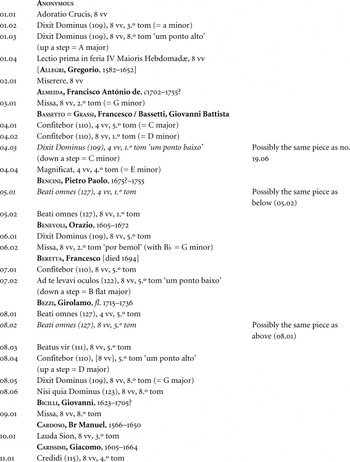
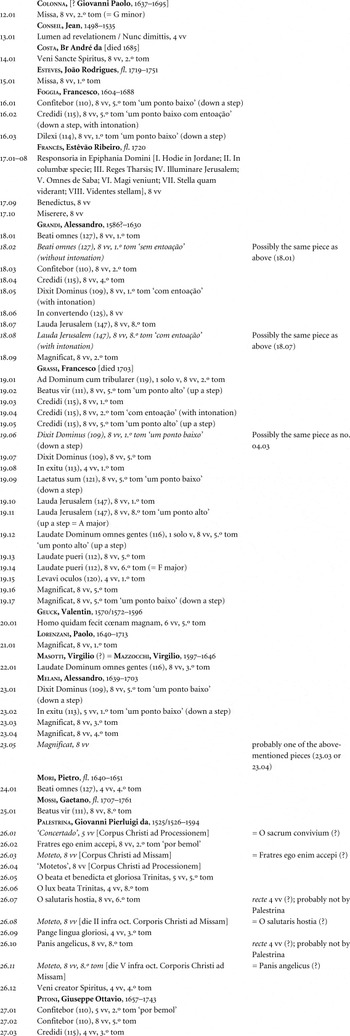
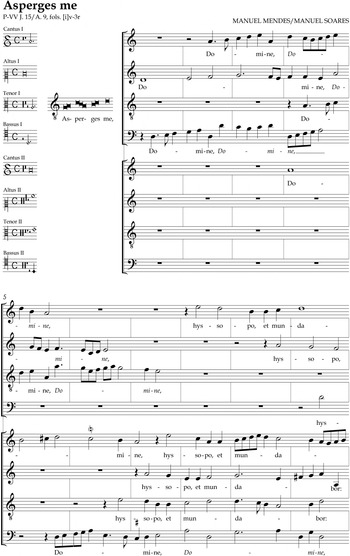
The repertory in use in the Patriarchal Church and Royal Chapel after 1719 is reported in the anonymous forty-six-folio manuscript ‘Breve rezume de tudo o que se canta en cantochaõ, e canto de orgaõ pellos cantores na santa igreja patriarchal’ (Brief summary of all that is sung in plainchant and polyphony by the singers at the holy Patriarchal Church).Footnote 13 This document, in all probability written by order of a dignitary for his own record, constitutes a kind of ceremonial diary, dealing with such important matters as the order of rituals, the methods of performance, the distribution of parts for the ministers and singers, the participation of the organ and which chants and polyphonic pieces were to be sung on the so-called ‘chapel days’ and other feast days.Footnote 14 It records a single liturgical year, most probably one between the First Sunday in Advent 1721 and the Feast of All Saints 1724 (the last major feast recorded in the document). Among the clues as to this time frame is mention of a ‘Missa de 1.º tom’ for eight voices by João Rodrigues Esteves (no. 15.01 in Appendix 1), performed on the Second Octave of PentecostFootnote 15 (the last Sunday in May or the first in June, depending on the year), which may well be the mass by Esteves dated ‘Roma 1721: 8 de 7.bro’ (Rome 1721, 8 September).Footnote 16 Further, the document contains no reference to compositions by Giovanni Giorgi, who arrived in Lisbon early in 1725. While the ‘Breve rezume’ would thus seem to date to some point between 1722 and 1724, the earlier date, soon after local forms of plainsong had been abandoned,Footnote 17 is perhaps most likely, since the Rituale romanum Pauli Quinti, used for the singing of antiphons in the Candlemas procession, is mentioned as something of a novelty.Footnote 18 Giorgi, who in September 1719 had succeeded Pitoni as maestro di cappella of San Giovanni in Laterano, began working as composer of Italian music of the Patriarchal Church and Royal Chapel in Lisbon and as teacher in the Patriarchal SeminaryFootnote 19 soon after he left Rome in January 1725. That he was hired was perhaps a result of Domenico Scarlatti's trip to Rome in the second half of 1724 and the first half of 1725.Footnote 20
The repertory in the ‘Breve rezume’ displays a fascinating mixture of works by thirty-two identified composers, from a period ranging from the sixteenth to the early eighteenth century (see Appendix 1). There are, for example, works said to be exclusive to the Papal Choir, presumably coming from the manuscripts of the Sistine Chapel, such as Jean Conseil's Lumen ad revelationem and Nunc dimittis (no. 13.01). Gregorio Allegri's Miserere (no. 02.01) also features, referred to as ‘o que se costuma cantar na Cappella pontifisia’Footnote 21 (the one that is usually sung in the Papal Chapel); a late eighteenth-century set of parts for this work from the Royal Chapel exists in Lisbon's Biblioteca da Ajuda.Footnote 22 Then there are works in the Roman stile antico, which Girolamo Chiti, Giorgi's successor at San Giovanni in Laterano, labelled the vero stile – that is, the style that is both ‘proper’ and ‘true’, recognized as liturgically appropriate and faithful to Palestrinian models.Footnote 23 Some of these compositions, such as Palestrina's motets Fratres ego enim accepi (no. 26.02) and O beata et benedicta et gloriosa Trinitas (no. 26.05), are referred to in Andrea Adami's 1711 Osservazioni Footnote 24 and so were also part of the repertory of the Sistine Chapel. Roughly half of the pieces mentioned in the ‘Breve rezume’ are seventeenth- and early eighteenth-century Italian works – responsories, psalms and masses – that mostly pertain to the repertory of the Cappella Giulia; the best-represented composer in this category is Francesco Grassi, with at least seventeen works. Yet there are also late sixteenth-century and seventeenth-century Portuguese and Spanish works, such as the sequences by Manuel Cardoso, André da Costa and Mateo Romero (nos 10.01, 14.01 and 28.01), that remained in the repertory, almost certainly deriving from the Royal Library of Music.Footnote 25 Alongside these are new works by Portuguese composers then studying in Rome – examples being the masses by Francisco António de Almeida and João Rodrigues Esteves (nos 03.01 and 15.01) – and by both Portuguese and Italian composers active in Lisbon in the 1720s: Girolamo Bezzi, Estêvão Ribeiro Francês, Gaetano Mossi, Manuel dos Santos and Domenico Scarlatti.Footnote 26 All in all, these make up about one third of the pieces in the repertory.
The important corpus of Italian seventeenth-century and early eighteenth-century music in the ‘Breve rezume’ includes works by Giovanni Battista Bassetti, Pietro Paolo Bencini, Orazio Benevoli, Francesco Beretta, Giovanni Bicilli, Giacomo Carissimi, Giovanni Paolo Colonna, Francesco Foggia, Alessandro Grandi, Francesco Grassi, Paolo Lorenzani, Virgilio Mazzocchi, Alessandro Melani, Pietro Mori, Giuseppe Ottavio Pitoni, Baldassare Sartori and Agostino Steffani. All of these composers, save Alessandro Grandi and possibly Pietro Mori, had been active in Rome for at least some of their careers, and a significant number of their works still exist in the collection of the Cappella Giulia now housed in the Vatican Library. Meanwhile, the works by Grandi in the ‘Breve rezume’ seem to match at least part of the contents of his eight-voice Salmi brevi, published in Venice in 1629, of which the Royal Library of Music held a copy.Footnote 27 Works by Mori also existed in the Royal Library.Footnote 28 This must have been repertory familiar to Domenico Scarlatti when he was assistant and then maestro di cappella at the Basilica di San Pietro in Rome – music that he presumably brought with him subsequently to Lisbon. The rest of the older repertory was already available there, in the huge collection of music started in the mid-sixteenth century by King João IV's great-grandfather, Teodósio I, Fifth Duke of Bragança (died 1563).
Judging from the ‘Breve rezume’, after 1719 there was a preference in the Patriarchal Church for the stile pieno over the more modern concertato and a clear prevalence of polychoral works in the repertory. Of the 127 individually identified pieces, 104 are for eight voices (but only two with a concerted solo voice), one is for six, three are for five and nineteen are for four voices.Footnote 29 These nonetheless involved a variety of performance practices, from a cappella and a cappella reale polyphony (that is, polyphony without accompaniment and polyphony with organ accompaniment)Footnote 30 to falsobordone and improvised counterpoint over plainchant, alternatim in various combinations.Footnote 31 Indeed, most of the unambiguously identifiable extant works besides those in vero stile – such as Benevoli's Missa ‘Paradisi portas’ in G minor (no. 06.02 in Appendix 1), Domenico Scarlatti's Te Deum in C major (no. 31.17),Footnote 32 André da Costa's Veni Sancte Spiritus (no. 14.01) and Estêvão Ribeiro Francês's Miserere (no. 17.10)Footnote 33 – are eight-voice, stile pieno, a cappella reale pieces. Most of the handful of works for four voices, such as Girolamo Bezzi's Beati omnes in C major (no. 08.01) and Pitoni's Credidi in A minor (no. 27.03), are also in stile pieno, while a small minority, like Giovanni Battista Bassetti's Dixit Dominus in C minor (no. 04.03) and Francesco Grassi's In exitu in D minor (no. 19.08),Footnote 34 are concertato pieces.
The ‘Breve rezume’ records just a few polyphonic pieces for Holy Week, since in the year to which it refers Palm Sunday offices, the Triduum responsories and lessons 2 and 3 at Matins were sung entirely in plainchant,Footnote 35 doubtless following its ‘long-established use in the Papal Chapel’ (‘l'uso inveterato della Cappella Pontificia’)Footnote 36 and perhaps also because the king derived special pleasure from hearing the chant sung in the manner of the Papal Chapel (‘nel modo della Cappella Pontificia’), as the nunciature reports note.Footnote 37 However, a portion of the a cappella, vero stile Holy Week repertory survives in three large choirbooks prepared by a copyist associated with the Patriarchal Church, Vicente Perez Petroch Valentino; these books were for the special use of the Royal Chapel at the Ducal Palace in Vila Viçosa (see the inventories in Appendix 2).Footnote 38 The earliest of these choirbooks, dated 1735, includes late sixteenth-century and seventeenth-century compositions mostly for four voices, collected, as the title page states, from exemplars in the Royal Library of Music; only a few ‘modern’ compositions were added to the collection.Footnote 39
The following year the same scribe completed a splendid two-volume collection with a similar purpose and content, but this time including works for four, five, six and eight voices.Footnote 40 The bulk of these 1736 choirbooks consists of works by the almost unknown mid-seventeenth-century composer Fernando de Almeida, a friar of the Order of Christ, which, according to Diogo Barbosa Machado in his Bibliotheca Lusitana, ‘His Majesty King João the Fifth, Our Lord, ordered to be copied when he attended the Convent in Tomar, in order to have them sung in his Royal Chapel’ (‘mandou copiar a Magestade d'ElRey D. João o V. Nosso Senhor quando assistio no Convento de Thomar para que se cantasse na sua Capella Real’).Footnote 41 Thus was the apparently more common, post-Tridentine practice of singing the Triduum responsories in polyphony reinstated.
The ‘modern’ compositions referred to on the title page of the 1735 choirbook – compositions that nonetheless follow the conventions of vero stile – comprise a long-winded motet by Giovanni Giorgi (Clarifica me Pater, no. 11 in the inventory of MS A), ten responsories and a psalm setting by Manuel Soares (MS A, nos 17, 19–21, 33–35, 46–48 and 58),Footnote 42 a psalm setting by Francisco António de Almeida (MS A, no. 56),Footnote 43 a secunda pars to Juan de Esquivel Barahona's motet O vos omnes (MS A, no. 7) and several additional verses to existing works: to an anonymous Gloria, laus (MS A, no. 5) and to the Lamentations by Victoria and Fernando de Almeida (MS A, nos 16 and 45, and MS A, no. 18, respectively). The two 1736 choirbooks contain similarly ‘modern’ additions to Fernando de Almeida's Gloria, laus (MS B1, no. 5) and Lamentations (MS B1, no. 14; MS B2, nos 1 and 14).
The additions in the three choirbooks are attributed in the original indices to Francisco António de Almeida (MS A, no. 5), Girolamo Bezzi (MS A, no. 18, and MS B1, no. 5) and Manuel Soares.Footnote 44 Francisco António de Almeida, as mentioned above, had been sent to Rome in 1722 (or possibly earlier) to study composition in the Italian manner. In the caption of a caricature of him by Pier Leone Ghezzi from 1724 he is described as ‘an excellent composer of concertos and church music, and, being young, he is a wonder and sings with incomparable taste’ (un bravissimo compositore di Concerti, e di musica da Chiesa, e per essere Giovane è uno stupore e canta con gusto inarrivabile).Footnote 45 On his return to Lisbon in 1726 Almeida became organist of the Patriarchal Church and was probably among the victims of the 1 November 1755 Lisbon earthquake. Thirty-seven works by him – twelve secular (including a sinfonia in F majorFootnote 46 and the first opera in Italian to be sung in Portugal, La pazienza di Socrate of 1733Footnote 47) and twenty-five sacred – survive in Portuguese, German, French and Italian collections.Footnote 48 Bezzi was an alto singer from the Cappella Giulia, where he was employed from 1715 to 1719,Footnote 49 before he left for Lisbon in late 1719 with the first group of Italians engaged by the Patriarchal Church.Footnote 50 In the ‘Breve rezume’ there are references to six psalm settings by him; at least seventeen of his works survive complete in Portuguese archives.Footnote 51 Manuel Soares (died 1756) was a member of the Order of St Peter and organist of the Royal Chapel in Lisbon; according to the biographer Machado, ‘the works he composed to be sung in the Holy Patriarchal Church of Lisbon … deserved applause and admiration from great Masters … which from Italy His Most Faithful Majesty, King João V of fond memory, ordered to be led to this Court’ (‘as obras, que compoz para se cantarem na Santa Igreja Patriarchal de Lisboa … mereceram applausos, e admirações de grandes Mestres … que de Itália mandou conduzir para esta Corte a Magestade Fidelissima, e sempre saudosa de ElRey D. Joaõ V’).Footnote 52 Soares is not named in the ‘Breve rezume’, but he is the composer of most of the ‘modern’ works and additions in the Vila Viçosa choirbooks (MS A, nos 7, 16, 32 and 45; MS B1, nos 1 and 14; MS B2, nos 1 and 14).
The musical additions in the three choirbooks tend to imitate their exemplars in their style and technique and were apparently intended to extend them and so to provide polyphonic music for the entire Gloria, laus – that is, the refrain and the first five strophes out of the ten that appeared in the 1570 Missale Romanum, as set in the 1604 revision of the Missal by Pope Clement VII – and likewise for the Lamentations, according to the text division in the Breviary of Pius V (but with one verse less in each lesson, as became usual in most post-Tridentine liturgical books). Manuel Soares's responsories were certainly planned to complete Victoria's own set, which comprises only the second and third nocturn in each Triduum day.
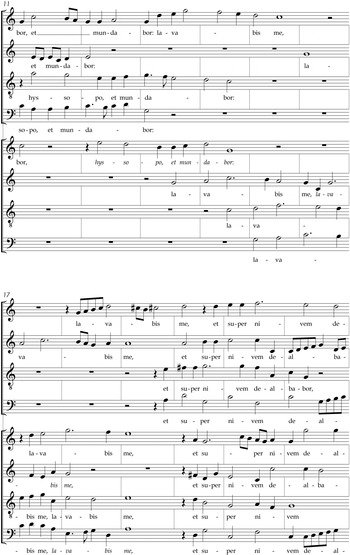
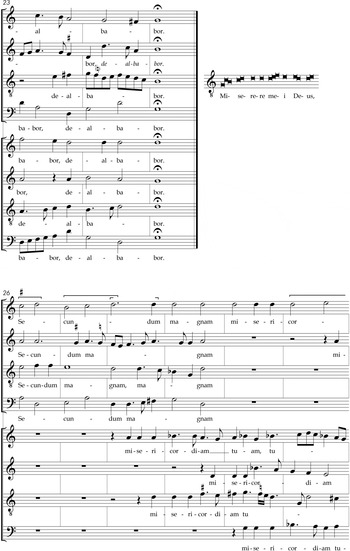
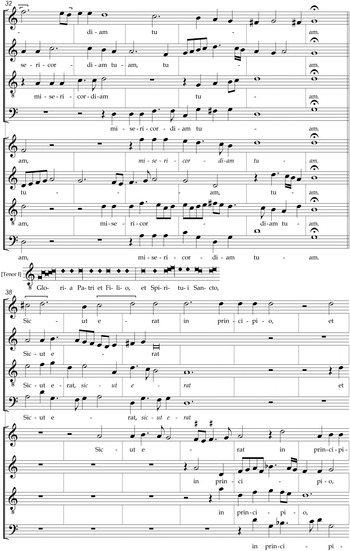
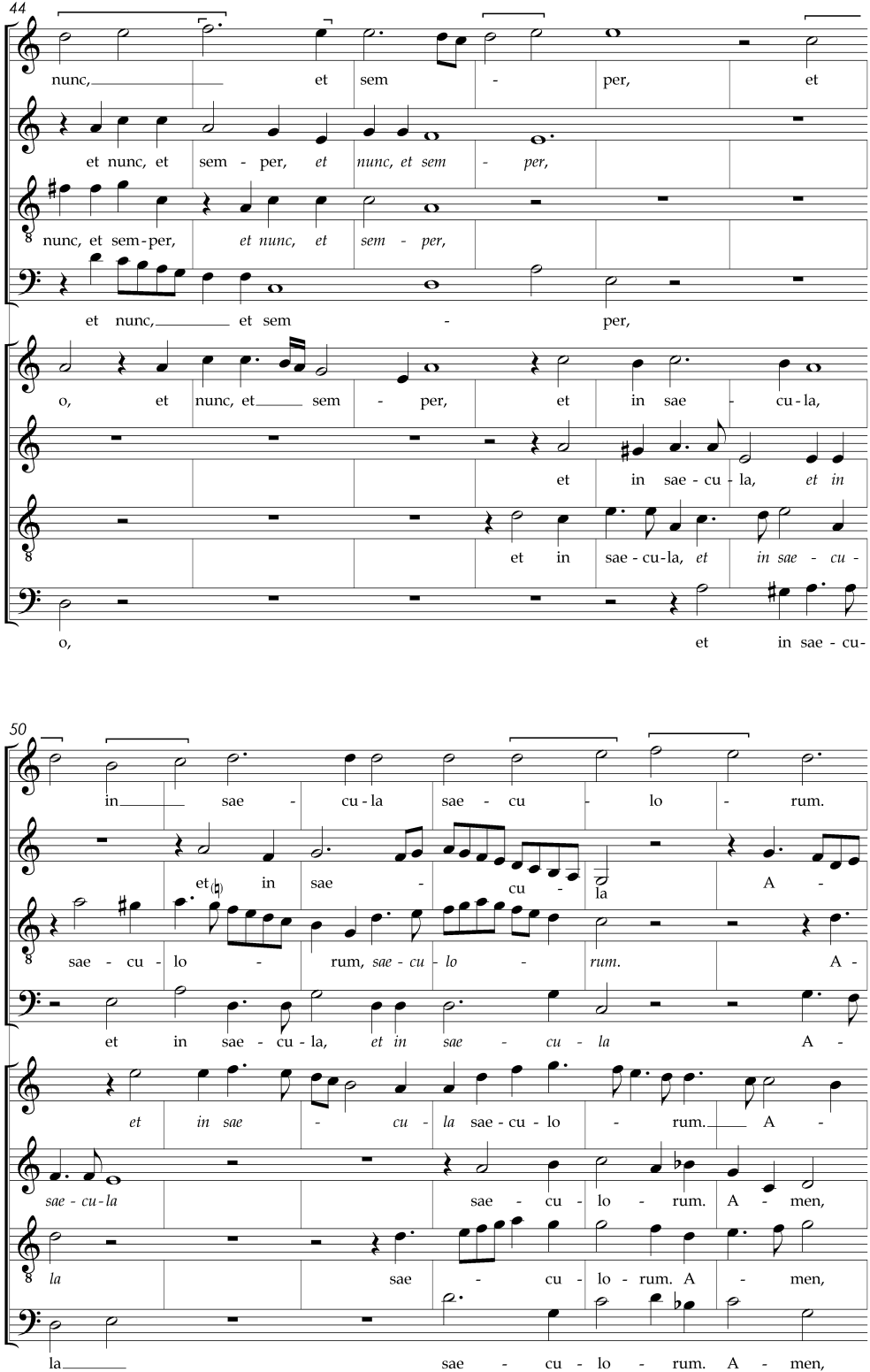
Manuel Soares's eight-voice reworking of Manuel Mendes's five-voice Asperges me in P-VV J. 15 / A. 9, fols [i]v–1r. Museu-Biblioteca da Casa de Bragança. Used by permission

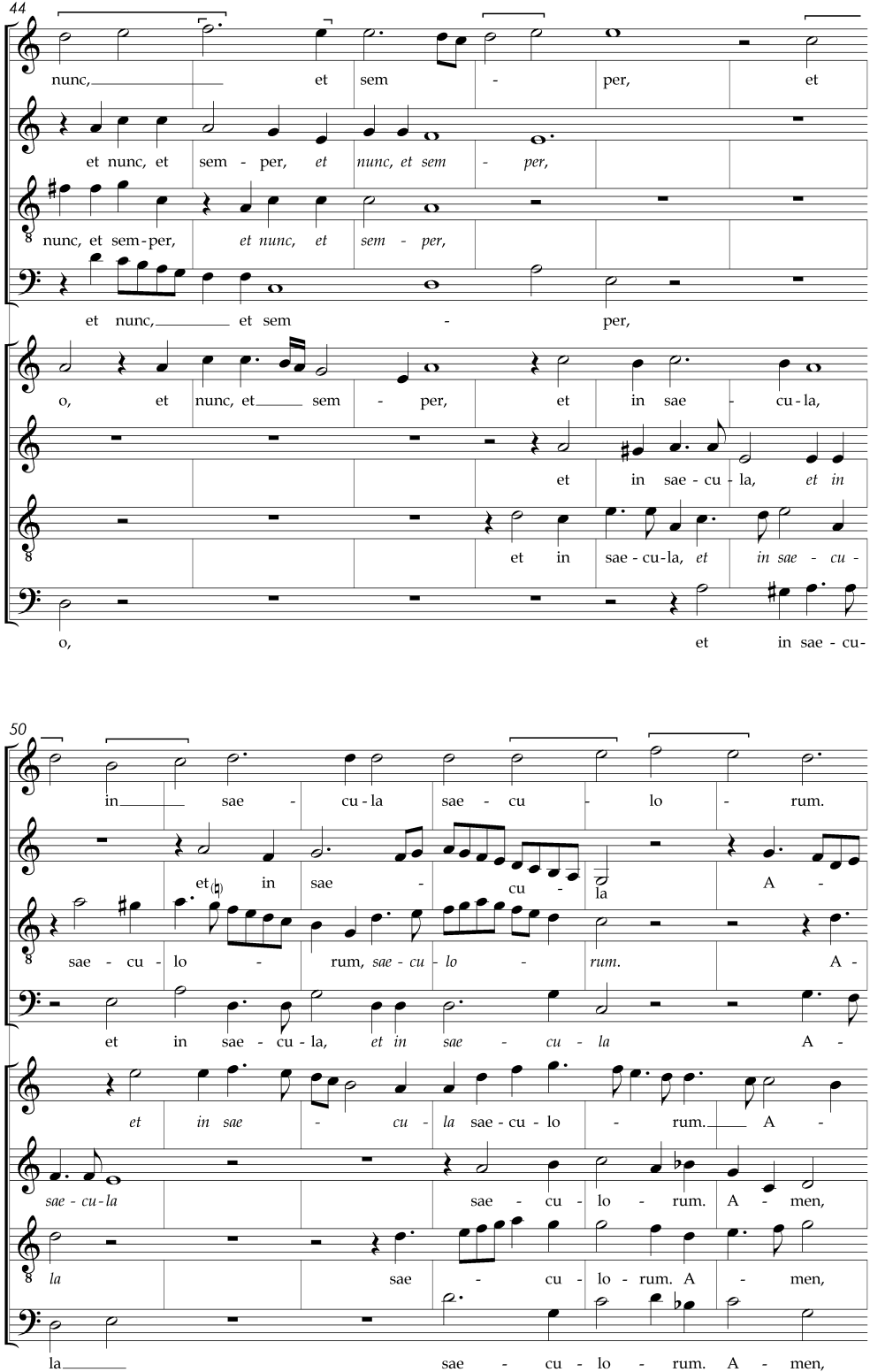
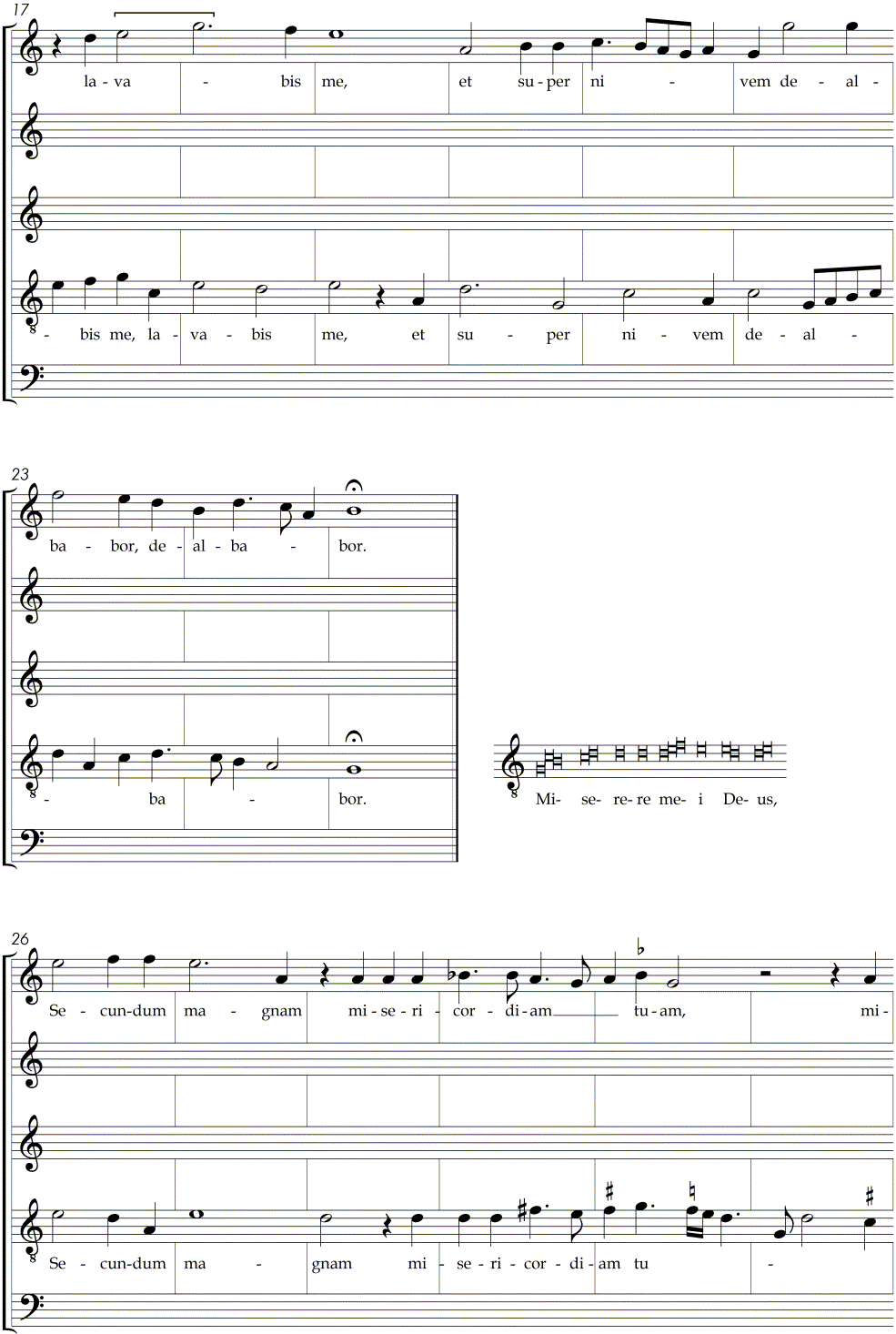
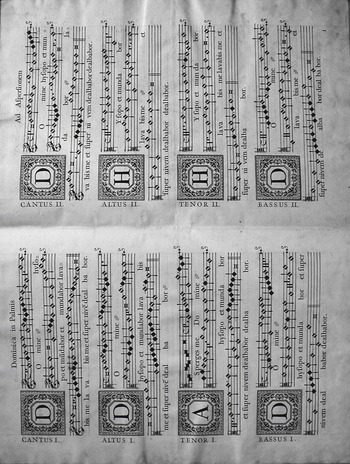
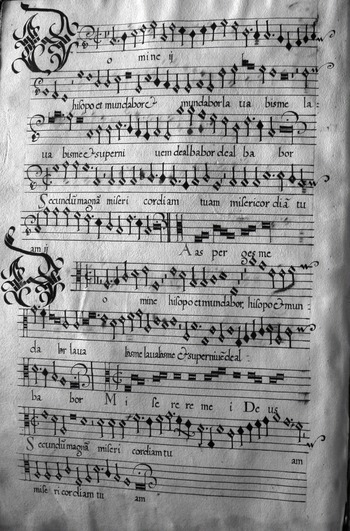
The opening item in the first 1736 choirbook, an alternatim setting of the Asperges me for eight voices, is a different case, however (see Figure 1 and the edition in Appendix 3Footnote 53). A note by the copyist in the index of the volume states that ‘only five voices were composed by Manuel Mendes, Portuguese, as it is contained in an old manuscript: the remaining three voices were added by Father Manuel Soares’ (‘Quinque tantum vocibus cõpositum ab Emmanuele Mendes Lusitano, ut in vetusto Manuscripto continetur: reliquas tres addidit Pater Emmanuel Soares’).Footnote 54 Manuel Mendes (died 1605) was maestro di cappella of the private chapel of Cardinal Infante Dom Henrique when the latter was made Archbishop of Évora in 1575.Footnote 55 In that same year, when he entered the priesthood, Mendes was presumably made maestro di cappella in the Collegiate Church of Santo Antão in Évora, where he held a benefice, and finally became a bachelor in the Cathedral there in 1585. Some of his works are among the most widely circulated pieces in Portuguese and American colonial manuscript sources in the years around 1600,Footnote 56 but his considerable reputation rested largely on his abilities as a teacher: for example, in a letter from Tomé Álvares to the Antwerpian printer Balthasar Moretus from 1610, he is said to have been the ‘master … of all good music in this Kingdom’, having apparently instructed some of the most noted late sixteenth-century Portuguese composers.Footnote 57
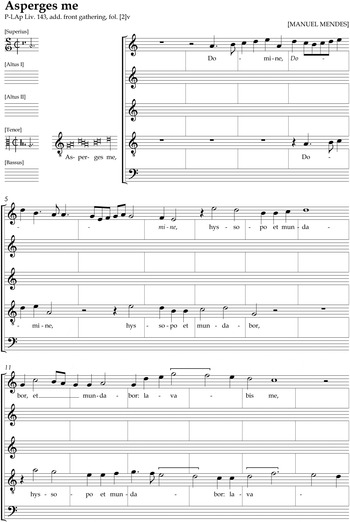
Remaining parts of Manuel Mendes's five-voice Asperges me in P-LAp Lv. 143, additional front gathering, f. [2]v. Centro de Estudos de Sociologia e Estética Musical. Used by permission

Part of Mendes's original five-voice setting survives in a manuscript quire appended to the front of the copy of the 1551 Jacques Moderne printing of Cristóbal de Morales's Missarum liber secundus, once in Lamego Cathedral.Footnote 58 Given that only the central bifolium and the last folio of this additional gathering (most certainly a quaternion) are still extant, just the Superius and the Tenor parts are complete up to the end of the psalm verse. Judging from the arrangement of voices in the preceding Vidi aquam (quite probably also by Mendes), Altus primus and secundus and Bassus are missing (see Figure 2 and the edition in Appendix 3). Even so, it is possible to observe that Manuel Soares's work consisted not of the simple addition of three contrapuntal parts, but of a complete reworking of the polyphonic texture of Mendes's piece (contrary to what we can assume from the scribe's note in the Vila Viçosa choirbook), each of the original voices providing material for more than one of the voices in the ‘modern’ eight-part version. For example, in the antiphon section Mendes's original Superius part is redistributed in Soares's Cantus I (bars 1–5), Tenor I (bars 5–7), Cantus I (bars 8–16), Cantus II (bars 17–19), Altus I (bars 20–21), Cantus II (bars 21–23) and Altus I (bars 24–25). Similarly, the original Tenor part is the source for Soares's Tenor I (bars 1–5), Tenor II (bars 6–8), Tenor I (bars 11–14), Tenor II (bars 14–19), Bassus I (bars 19–23) and Tenor II (bars 23–24). In the psalm verse section Soares entrusts the psalm tone to Cantus I in the way of a cantus firmus, dividing the original Superius part between his Cantus II (bars 28–30), Altus I (bars 31–34) and again Cantus II (bars 34–35). Nothing in terms of formal outlines or tonality is changed in the broader structure of the original piece (even the floating use of F sharp against the final G is retained), and a basically five-part texture and distribution of motivic imitation is palpable until the concluding cadence of each section and the very last segment of the piece, where something like a full eight-part texture creates a cumulative crescendo effect. These features, while retaining the substance of Mendes's setting, seem consistent with the repertory apparently favoured in the Patriarchal Church in its earliest years, judging by the ‘Breve rezume’: pieno, vero stile polyphony drawn in bold musical textures.
The picture that emerges from the ‘Breve rezume’ and the Vila Viçosa choirbooks is not of a static repertory simply imported, but rather of a more subtle process of acculturation and adaptation. This process involved a considerable degree of historical awareness, of course, as the new dynasty navigated between the poles of tradition and novelty, foreign models and domestic cultural production (a balancing act that has been a common thread in the history of Portugal, shaping its distinctively plural and syncretic culture). Indeed, many of João V's policies were rooted in historical consciousness and cultural emulation. Seeking to validate the dynasty established by his grandfather, he did what all founders of dynasties had tended to do and ordered the building of an imposing, symbolic monument: the Royal Palace and Convent in Mafra. Started in 1717 on a neoclassical plan by the Roman-trained architect Johann Friedrich Ludwig and dedicated in 1730, the palace and convent are said to have virtually exhausted the gold from Minas Gerais in Brazil.Footnote 59 João V also established the Royal Academy of Portuguese History in 1720, along with a private printing press; significantly, one of the major works produced by the Academy was the Historia Genealogica da Casa Real Portugueza (Genealogical History of the Portuguese Royal House) in fourteen volumes, supported by six additional volumes of Provas (Evidences).Footnote 60 And he even published a law for the protection of architectural heritage in 1721.
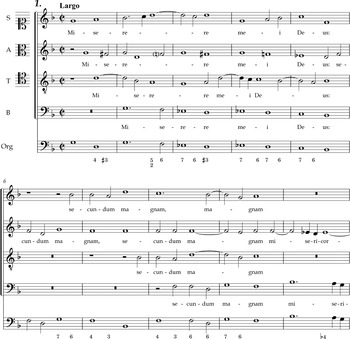
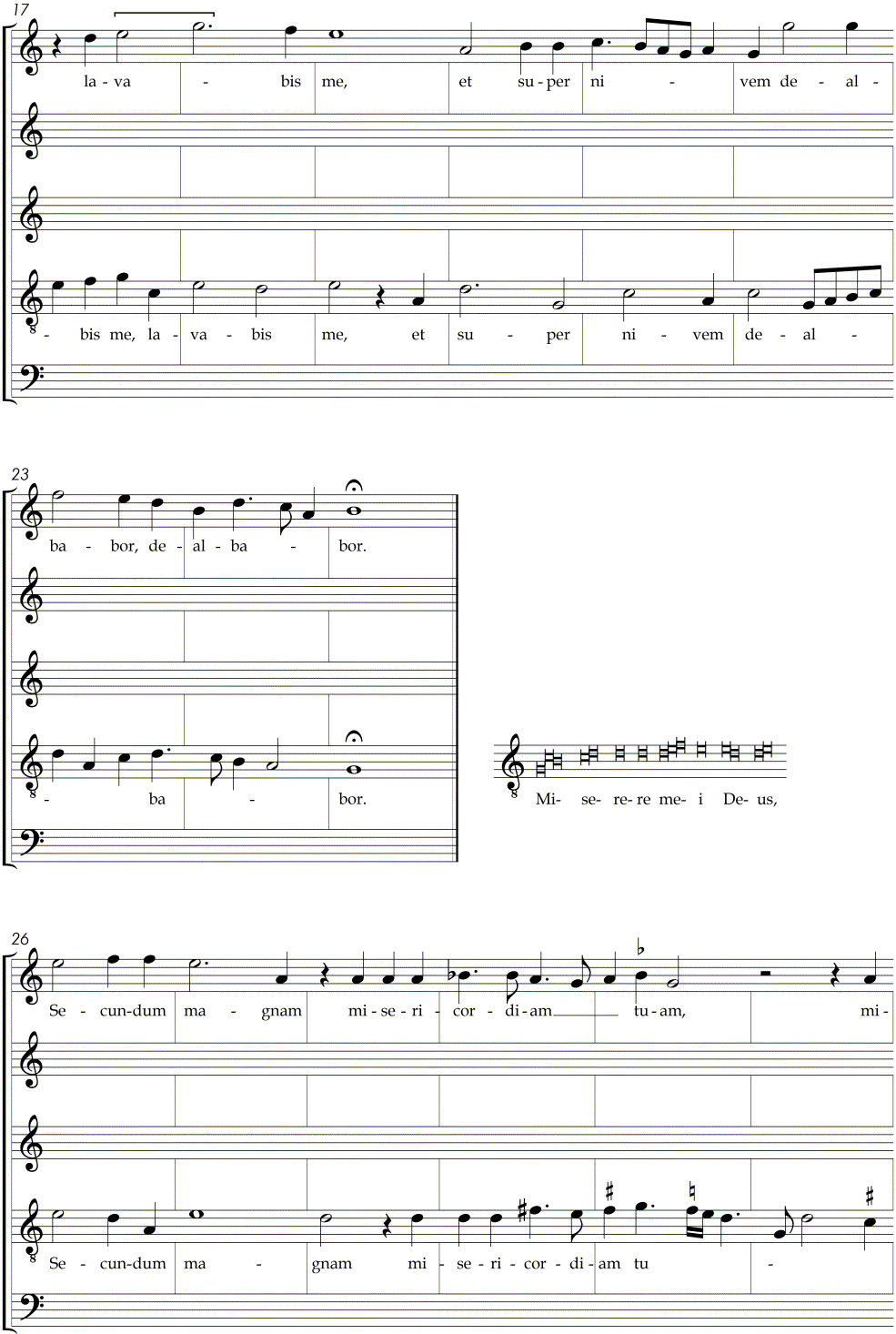
Francisco António de Almeida, Miserere, version with organ continuo, bars 1–10

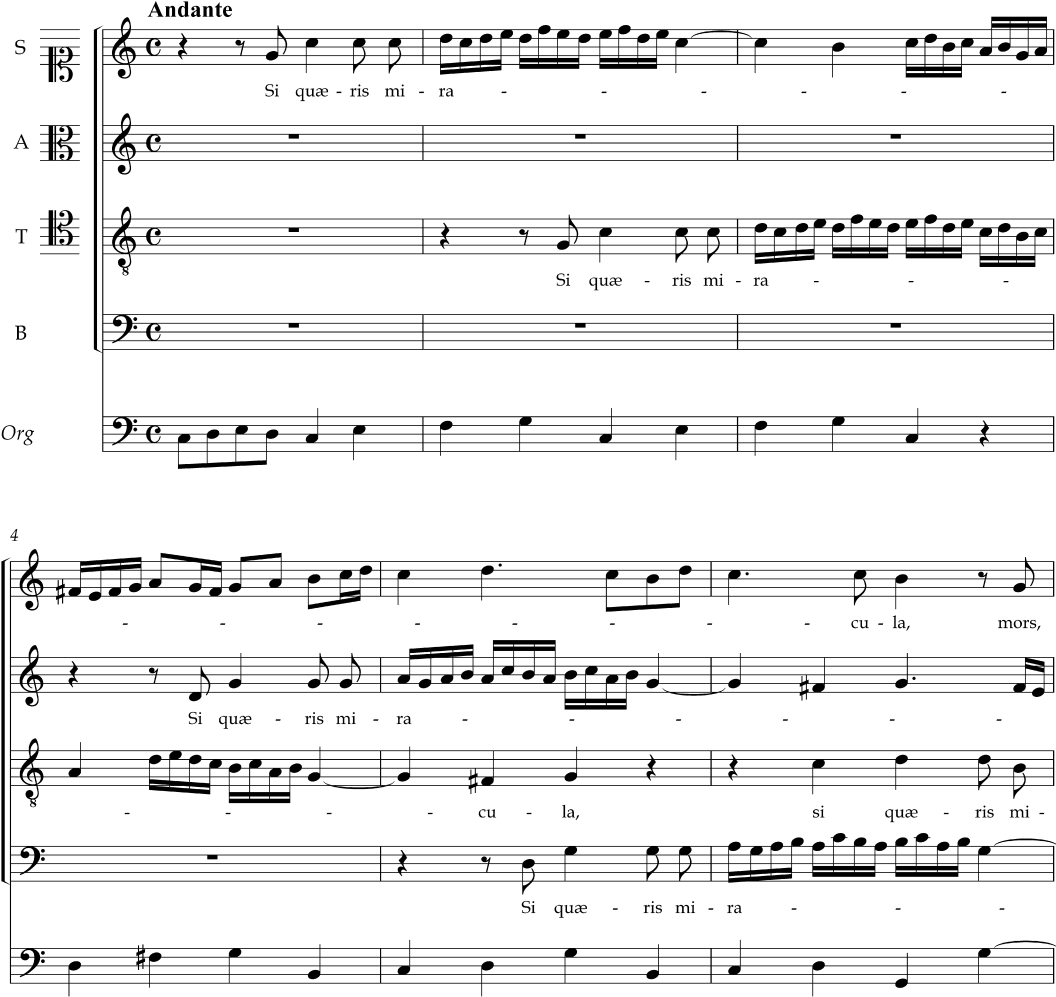
Francisco António de Almeida, Si quaeris miracula, bars 1–6
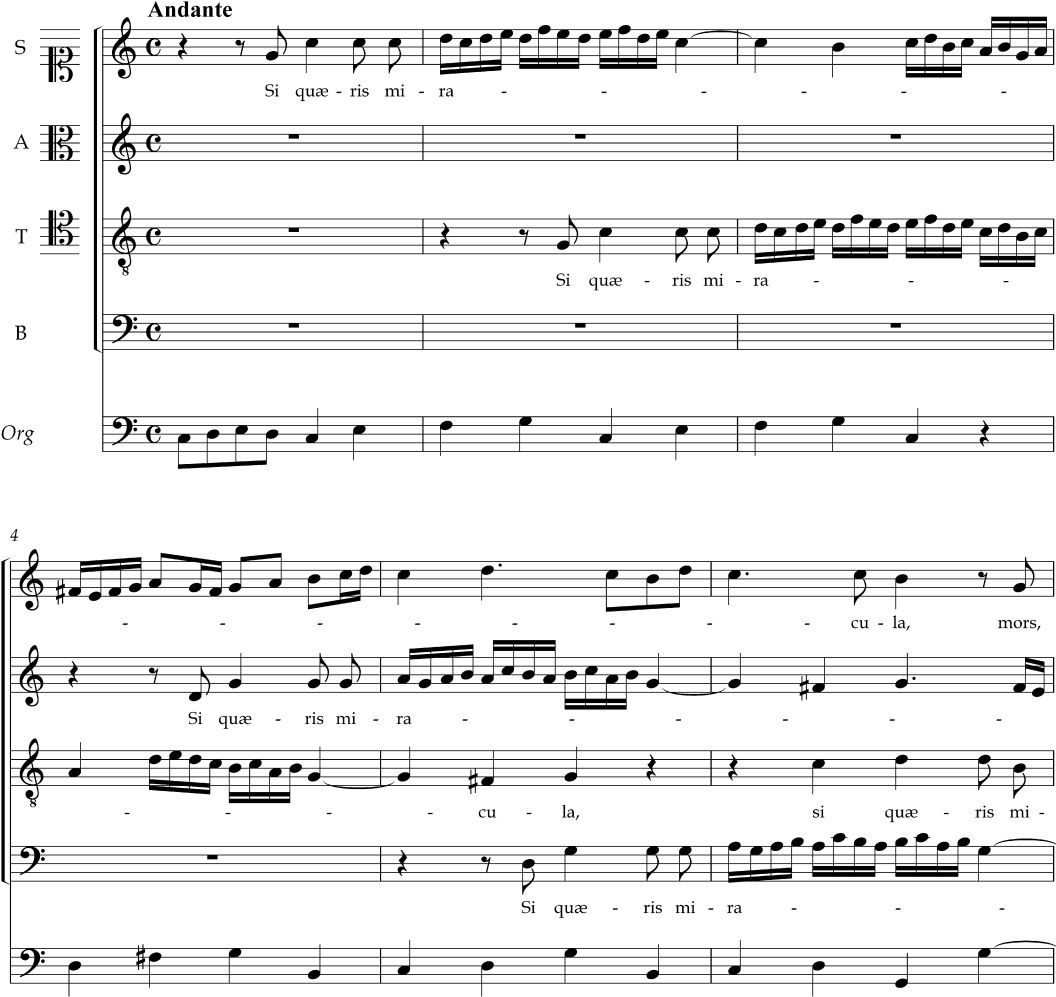
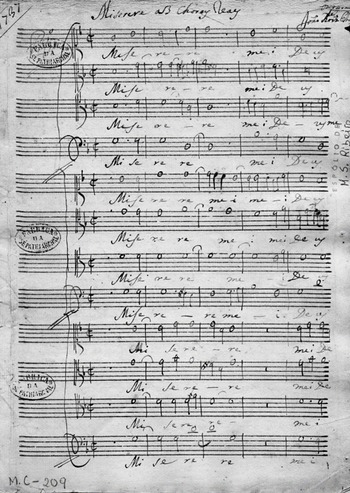
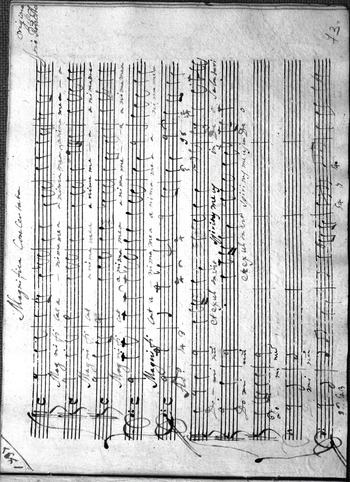
Within the music for the Patriarchal Church and related institutions, such as the Royal Chapel at the Ducal Palace in Vila Viçosa, this sort of historical awareness can of course be seen in the recourse to older repertories and the imitation of older styles, with some ancient pieces reworked in order to adjust them to the values and performing conditions of the more austere Roman ceremonial. But one can also detect a historical sensibility in the composition of new works that assimilated the Italianiate manner. In this respect, a historical perspective is apparent in the way that composers generally kept their rendering of the vero stile in marked opposition to their modern idiom (an opposition that was even marked visually, through the use of different notational styles). This can be seen clearly when comparing individual works, such as Francisco António de Almeida's Miserere in the Vila Viçosa MS A and his four-voice responsory for St Anthony, Si quaeris miracula (see Examples 1 and 2),Footnote 61 or João Rodrigues Esteves's twelve-voice Miserere and the four-voice Magnificat in F major from his Psalmi brevi a 4, both dated 1737 (see Figures 3 and 4).Footnote 62 But artful combinations did exist in this polarized stylistic context: António Teixeira's twenty-voice Te Deum of 1734, composed for the thanksgiving office at the year's end in the Jesuit Church of St Roque in Lisbon, adopts two contrasting styles in seamless succession for its opening movement: retrospective, contrapuntal stile pieno with no accompaniment except the organ leads to a modern, melodic concertato with full orchestra.Footnote 63
João Rodrigues Esteves, Miserere for twelve voices (1737), first page of the autograph score, P-Ln Espólio de M. S. Ribeiro 209. Biblioteca Nacional de Portugal. Used by permission

João Rodrigues Esteves, Magnificat in F major (1737), first page of the autograph score, P-Lf/MS 72/85. Fábrica da Sé Patriarcal de Lisboa. Used by permission

Several abrupt changes arising from the new dynastic regime would shape the eighteenth-century (and, indeed, nineteenth-century) Portuguese musical scene, such as the abandonment (though not the banning) of the vernacular villancicos after the establishment of the Patriarchal Church in 1716 and the subsequent adoption (at least nominally, until late 1718) of Roman ceremonial,Footnote 64 not to mention the drastic changes in the range, vocal technique and timbre of the choirs, largely because of the presence of castratos, whom the inhabitants of Lisbon heard to their amazement for the first time on 21 September 1719.Footnote 65 Despite all this, ‘Romanization’ was but one episode of a much longer and slower process of Portuguese ‘Italianization’ – that is, the process whereby Italian models that gradually merged into local musical production and performance were assimilated, processed and adapted. What had begun in the late sixteenth century as a cultural undercurrent emerged strongly and suddenly in the early 1720s as an immediate consequence of João V's reforms, but became dominant in musical culture at large only from around 1750, with the more decisive involvement of the crown in opera seria, which, although being emblematic of Italian baroque culture, had scarcely existed in Portugal until then.Footnote 66 Actually, on the orders of King João V's son, José I (1750–1777) – who, in the words of his wife, ‘didn't like the Patriarchal much’ (‘n'aime pas tant la patriarchal’)Footnote 67 – diplomatic efforts were made, involving secret negotiations and enormous sums of money, in order to hire the best opera singers then available in Italy (including the noted castratos Gizziello, Manzuoli and Caffarelli and the tenor Anton Raaf). In 1752 Davide Perez was appointed composer to the king, teacher in the Patriarchal Seminary and master of music to the Princess of Brazil (the future Queen Maria I), and Giovanni Carlo Sicini Galli-Bibiena came to Lisbon to design new theatres and scenery for opera: a small theatre at the Palace of Salvaterra de Magos, which was already completed for the 1753 Carnival season, and another one in Lisbon on the east side of the Ribeira Palace next to the Patriarchal Church, known today as Ópera do Tejo (Tagus Opera House). The latter theatre was then thought to be one of the largest in Europe, even though it lasted for just seven months after the opening on 31 March 1755, the Queen's birthday, with a lavish production of a new version of Perez's 1752 Alessandro nell'Indie.Footnote 68 In the meantime, as the stylistic changes in the voluminous extant works of João Rodrigues Esteves and Giovanni Giorgi suggest,Footnote 69 Neapolitan models and a broadly ‘galant’ style gradually came to supplant Roman models in the repertory of the Patriarchal Church. The stile concertato became the dominant musical register in church, restricting the vero stile to the penitential liturgy – or, beyond this, to a topic of musical expression.
Appendices
Polyphonic repertory in the ‘Breve rezume’, P-La MS 49-i-59

NB Italics indicate possible duplications.
Inventories of Vila Viçosa choirbooks

Appendix 3 A setting of the Asperges me for eight voices from the first 1736 choirbook