Introduction
Surrogate decision-making researchers (e.g., Shapiro, Reference Shapiro2007; Torke et al., Reference Torke, Alexander and Lantos2008) have begun to urge for examinations that focus more on the process by which surrogates make decisions. Research on the process of surrogate decision making has examined the degree to which surrogates seek to communicate and collaborate with patient's physicians when making decisions (Torke et al., Reference Torke, Alexander and Lantos2008; Spalding and Edelstein, Reference Spalding and Edelstein2019), and factors that surrogates report as impeding or facilitating their ability to make informed decisions (e.g., Visser et al., Reference Visser, Deliens and Houttekier2014; Lord et al., Reference Lord, Livingston and Cooper2015). Two key points in the surrogate decision-making process — the initial choice to serve as a surrogate and surrogates’ selection of end-of-life treatments for patients— have not been addressed. In the current study, we used hypothetical surrogate decision-making scenarios to investigate associations among socio-contextual and intrapersonal factors and these two points in the decision-making process because they arguably mark the beginning and end of the surrogate decision-making process.
To serve as a surrogate, a person must not only be available but also must be willing to serve (Tejwani et al., Reference Tejwani, Wu and Serrano2013). Surrogates may vary in the degree to which they desire to hold the position. In the United States, persons who lack familiarity with a patient's preferences may be appointed according to a state's legal hierarchy, which varies by jurisdiction. Close relatives, such as siblings or adult children, are most commonly appointed according to these hierarchies (Kohn, Reference Kohn2015). However, if a patient has no living immediate family members, a more distant relative or someone unfamiliar with the patient may be appointed to serve as surrogate (Torke et al., Reference Torke, Alexander and Lantos2008). Patients and their family members vary in the degree to wish they wish to be actively involved in medical decision making (Zhang et al., Reference Zhang, Yang and Deng2015) Surrogates who find themselves in the role but lack a strong desire to serve may experience emotional distress. Emotional distress has been shown to impede individuals’ abilities to comprehend decision-relevant information, such as patients’ values, treatment details, and risks and benefits (Ganzini et al., Reference Ganzini, Lee and Heintz1994; Grisso and Appelbaum, Reference Grisso and Appelbaum1995). Decisions made by such surrogates may poorly reflect the preferences of the patients whom they serve, which is problematic considering that surrogates predict patient preferences with 68% accuracy, in general (Shalowitz et al., Reference Shalowitz, Garrett-Mayer and Wendler2006).
As much as 25% of medical expenses across patients in the United States are spent during the last year of life (Angus et al., Reference Angus, Barnato and Linde-Zwirble2004; Riley and Lubitz, Reference Riley and Lubitz2010) and there is a known tendency for surrogates to “overtreat” and select a more invasive, life-sustaining treatment than what the patient would want (e.g., Suhl et al., Reference Suhl, Simons and Reedy1994; Ditto et al., Reference Ditto, Danks and Smucker2001; Li et al., Reference Li, Fei and Irwin2007). However, surrogate decision making is still a developing research area and little attention has been given to factors that may shape surrogates’ decisions. Treatment selection is ultimately the final stage of the surrogate decision-making process, unless the patient dies before a decision can be made or regains capacity to make his or her own decisions.
In the United States, if an incapacitated patient is estimated to have less than one year to live, a surrogate may be asked to indicate the patient's medical treatment preferences on the Physician Order for Scope of Treatment (POST). Three states (California, Oregon, and West Virginia) have formally designated the POST as a “standard” method of end-of-life care planning and 43 states have adopted or are currently developing versions of POST forms (National POLST Paradigm, 2018). The POST and its variants travel with a patient's medical record and outline one's preferences for end-of-life care, generally in three areas: cardiopulmonary resuscitation (CPR), level of care provided (ranging from comfort measures only to full interventions), and provision of artificial fluids and nutrition. To complete the POST, the decision-maker (the patient or surrogate) and a healthcare professional collaborate to identify the best options for the patient (National POLST Paradigm, 2018). Currently, little is known about how individuals make decisions on the POST, despite the fact that the POST is perhaps one of the most important documents a patient can complete.
Variables influencing willingness to serve and end-of-life treatment selection
When selecting potential factors to explore in relation to this process, we drew from the decision-making literature to identify social-contextual and intrapersonal variables. Copious research in the decision-making literature reveals that social-contextual variables, such as perceived norms surrounding various choices, can shape individuals’ own decisions (Bettenhausen and Murnighan, Reference Bettenhausen and Murnighan1985; Postmes et al., Reference Postmes, Spears and Cihangir2001), consistent with theories of social influence such as that proposed by Turner (Reference Turner1991). For medical decisions, in particular, research reveals that providing individuals with information regarding normative treatment decisions (what most people would have selected) can have considerable bearing on the decisions they make for themselves in hypothetical scenarios (Washington et al., Reference Washington, Burke and Joseph2009; Zikmund-Fisher et al., Reference Zikmund-Fisher, Windschitl and Exe2011). These norms may also guide an individual's decision to serve as a surrogate, although no research to date has evaluated this effect.
In addition to social-contextual variables, the present study also investigated factors at an intrapersonal trait level. The selected intrapersonal traits include intolerance of uncertainty, trait-level anxiety, experiential avoidance, consideration of future consequences, and decision-making confidence. These variables were drawn from the decision-making literature and all except experiential avoidance have been shown to relate to the decision-making process (e.g., Carleton et al., Reference Carleton, Norton and Asmundson2007; Joireman et al., Reference Joireman, Shaffer and Balliet2012; Howell and Shepperd, Reference Howell and Shepperd2016). Experiential avoidance (Gámez et al., Reference Gámez, Chmielewski and Kotov2014) was included to capture avoidance of the potential negative experiences associated with participation in the decision-making process. Three additional intrapersonal characteristics pertaining to the hypothetical scenarios were also included in this study: willingness to collaborate with the patient's physicians on the decisions, willingness to take primary responsibility for the decisions, and willingness to defer decision-making responsibility. These variables were included based on their demonstrated relevance to surrogate decision-making behaviors in previous research (Spalding and Edelstein, Reference Spalding and Edelstein2019).
The present study investigated hypothetical surrogate decision making regarding medical decisions about advance directives on the West Virginia version of the Physician Order for Scope of Treatment (POST). We used a community-dwelling sample and excluded people who had prior experience. People who have served as a surrogate report greater ease with the process (Majesko et al., Reference Majesko, Hong and Weissfeld2012) and we aimed to understand individuals’ approach to surrogate decision making when confronting them for the first time. Moreover, this study focused on a person's willingness to serve as surrogate at some point in the future; thus, data from those who had already demonstrated such willingness were considered irrelevant. Our study had two specific aims. First, we sought to investigate the extent to which certain intrapersonal and social-contextual factors predicted one's willingness to serve as a surrogate. Second, we explored the degree to which these factors predicted surrogates’ end-of-life treatment decisions in hypothetical decision-making scenarios.
Method
Participants
Participants were recruited through Amazon Mechanical Turk and were compensated $1 for their participation. This payment rate is consistent with what is typically offered for service through Mechanical Turk (Buhrmester et al., Reference Buhrmester, Kwang and Gosling2011). Participants completed the survey through Qualtrics, an online survey tool.
Five-hundred-and-ten individuals initially responded to the survey advertisement. Individuals under age 18 (N = 1) or who had prior experience serving in a formal surrogate decision-making capacity (N = 327) were excluded. Individuals who indicated that they had formal experience with serving as a surrogate did not demographically differ from those who denied any prior experience. Three validity check items (e.g., “Please select ‘somewhat uncertain’ for this item”) were used in the questionnaire to screen participants who were not completing the survey with appropriate care and attention. Respondents who failed to accurately respond to at least one of the three validity check items (N = 10) were therefore excluded. A final sample of 172 respondents remained (M age = 49 years, SD = 15.05 years). All respondents resided in the United States.
Measures
Decision scenarios
Prior to completing the decision scenarios, participants nominated the person they would consider as the patient in the subsequent decision scenarios and selected their relationship to this person from the following options: spouse, parent, sibling, adult child, grandparent, other family member, and close friend. To reduce variability in the health status of the imagined patient and mirror real situations in which POST forms are completed, participants were asked to imagine that the patient was estimated to have less than one year to live.
After identifying an individual to imagine as the “patient,” participants were presented with a series of hypothetical decision scenarios corresponding to the types of treatment interventions covered by the POST (indicating preferences for CPR, levels of care, artificial fluids, and artificial nutrition; see Part C in Appendix 1). The decision scenarios were presented in the order they appear on the West Virginia POST using a vignette style modeled from Hare et al. (Reference Hare, Pratt and Nelson1992). The scenarios first explained the type of intervention and then asked participants to indicate whether they would choose to administer the intervention if asked to decide on behalf of the patient they nominated.
End-of-life treatment decisions
Decisions regarding the types of end-of-life treatments covered by the POST were numerically coded such that greater values indicated more intensive intervention decisions. For instance, responding affirmatively with regard to CPR provision was coded as “2,” whereas refusal of the intervention was coded as “1.” Scores were summed across the decision tasks, thus producing a total score where higher scores indicated choosing more intensive, life-sustaining interventions.
Willingness to serve as surrogate
Participants responded to the following item: “How willing would you be to serve in a position where you may be asked to make important medical decisions on behalf of another adult (such as a spouse, parent, sibling, adult child, or close friend)?” using on a 4-point Likert-type scale, ranging from “1 = not at all willing” to “4 = very willing.”
Perceived typicality of patient-provider collaboration
Participants also responded to the following item: “To what extent do you think that people typically collaborate with their healthcare providers on medical decisions?” using a 4-point Likert-type scale, ranging from “1 = not at all” to “4 = very much.”
Social norms surrounding end-of-life treatment decisions
The method of assessing perceived norms among one's family and friends was adapted from work by Stone et al. (Reference Stone, Choi and Bruine de Bruin2013). For each of the four treatment decisions (CPR, levels of care, artificial fluid provision, and artificial nutrition provision), participants rated out of a possible 100% the percentage of their family and friends who they felt would choose the most intensive option (e.g., CPR provision, full interventions, etc.; see Appendix 1). Scores on these items were summed to compute a total score out of 400 points, with higher scores reflecting greater perceived preferences for intensive treatments among friends and family members.
Decision-making confidence
For each POST decision scenario, participants responded to the following item: “How confident do you feel in this decision?” using a 4-point Likert-type scale, ranging from “1 = very little” to “4 = very much.” Ratings across the decisions were summed to produce a total confidence score, α = 0.69.
Willingness to collaborate
For each POST decision scenario, participants used the same 4-point Likert-type scale to rate the extent to which they would be willing to collaborate with the patient's healthcare provider(s) on the decision. “Collaboration” was defined as “the act of working with others to reach a shared decision or goal.” Ratings were summed across the decisions to create a total collaborative willingness score, α = 0.74.
Willingness to defer or take primary responsibility for decision
For each POST decision, participants used a 4-point Likert-type scale ranging from “1 = not at all willing” to “4 = very willing” for two additional items. For one item, they rated their willingness to defer the decision to the patient's healthcare providers. For the second item, they indicated how willing they would be to assume full personal responsibility for the decision. Ratings on these items were summed across the decisions to calculate two scores: one representing participants’ willingness to defer to providers (α = 0.80) and one indicating their willingness to take primary responsibility for the decisions (α = 0.82).
Intolerance of Uncertainty Scale — short version (IUS; Carleton et al., Reference Carleton, Norton and Asmundson2007)
The IUS is a 12-item self-report measure using a 5-point Likert-type scale. Scores range from 0 to 60, with higher scores indicating greater intolerance of uncertainty. This shortened version of the original Intolerance of Uncertainty Scale (Freeston et al., Reference Freeston, Rhéaume and Letarte1994) demonstrates strong psychometric properties, with high internal consistency reliability (α = 0.94) and strong convergent validity with related measures of anxiety. The internal consistency estimate was good for the current sample: α = 0.94.
State-Trait Anxiety Inventory — Trait Subscale (STAI-T; Speilberger et al., Reference Speilberger, Gorsuch and Lushene1983)
The STAI-T is a 20-item instrument using a 4-point Likert-type scale. Scores range from 0 to 80, with higher scores indicating greater levels of trait-level anxiety. The measure has high test–retest reliability, ranging from 0.73 to 86. Strong concurrent validity evidence with other measures of anxiety has been reported (Speilberger et al., Reference Speilberger, Gorsuch and Lushene1983). Good internal consistency was demonstrated among the current sample, α = 0.91.
Consideration of Future Consequences Scale (CFC; Strathman et al., Reference Strathman, Gleicher and Boninger1994)
The CFC is a 12-item measure using a 5-point Likert-type scale. Scores range from 0 to 60, with higher scores indicating greater consideration of future consequences. The measure has strong psychometric evidence, including good internal consistency reliability (α = 0.82) and test–retest reliability (r = 0.76, p < 0.001). Validity evidence includes moderate relations with other measures of future orientation (Strathman et al., Reference Strathman, Gleicher and Boninger1994). Internal consistency was acceptable among the current sample: α = 0.77.
Brief Experiential Avoidance Questionnaire (BEAQ; Gámez et al., Reference Gámez, Chmielewski and Kotov2014)
The BEAQ is a 15-item shortened version of the Multidimensional Experiential Avoidance Scale (Gámez et al., Reference Gámez, Chmielewski and Kotov2011) using a 6-point Likert-type scale. Scores range from 0 to 90, with higher scores indicating greater levels of experiential avoidance. Strong psychometric evidence supports the use of the instrument, including high internal consistency reliability (ranging from 0.80 to 0.86) and strong convergent validity evidence with other measures of experiential avoidance. Good internal consistency was demonstrated among the current sample, α = 0.92.
Demographic questionnaire
All participants completed a demographic questionnaire to begin the survey. Questions included age, gender, ethnicity/race, marital status, and years of education.
Procedure
All procedures were approved by the West Virginia University Institutional Review Board.
Order of measures
All participants completed all questionnaires. Participants first read an informational page and indicated consent by proceeding to the demographic questionnaire. As part of the demographic questionnaire, participants were asked if they had ever served as a surrogate and those who indicated “Yes” were not permitted to proceed. The demographic questionnaire was followed by the POST decision scenarios. The order of the self-report measures of the intrapersonal variables was randomized to minimize order effects.
Statistical analyses
First, correlation analyses were conducted to identify which of the intrapersonal variables to use in regression analyses that addressed the primary research questions. Based on the results of the preliminary correlation analyses, significant correlates were entered as predictors in two multiple linear regression analyses in which willingness to serve as surrogate and end-of-life treatment decisions were the criterion variables. All analyses were conducted using IBM Statistical Package for the Social Sciences Version 24 (SPSS 24.0).
Results
Demographic characteristics
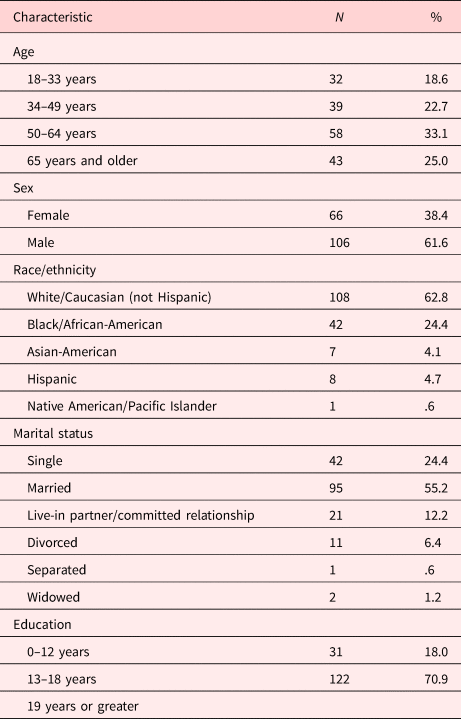
Demographic information for this sample appears in Table 1. The majority of the sample identified as male and reported higher levels of educational attainment than the general population, relative to 2017 US Census data. A racially diverse sample was recruited in proportions generally representative of the 2017 US Census (United States Census Quick Facts, 2017). However, the sample likely ethnically underrepresents of the United States Hispanic population, as 18.1% of the population identifies as Hispanic or Latino, while only 4.7% of the current sample identified as such. For the decision scenarios, 27.9% of participants selected a parent, 34.3% selected a spouse, 11.0% selected a sibling, 5.8% selected an adult child, 5.8% selected a grandparent, 2.9% selected another family member, and 12.2% selected a close friend.
Demographics

Preliminary analyses
Overall, 3.2% of the responses across all items were missing, meeting the minimal missingness criterion for the use of simple imputation (Field, Reference Field2013). Simple imputation was used for missing data that were not excluded whereby the sample mean for the measure was imputed for the missing item. If a respondent skipped an entire measure or otherwise did not respond to more than 25% of the questions across the entire survey, their responses were excluded from all analyses.
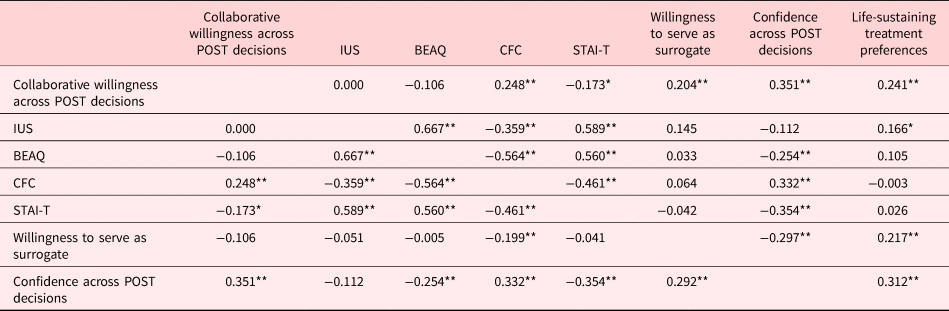
For all measures, no problematic skew or kurtosis was indicated. Correlations between all predictor and criterion measures were examined (see Table 2), indicating significant correlations between many of the variables. However, none of the correlations among psychological characteristics suggested problematic multicollinearity. Furthermore, multicollinearity diagnostics were examined in the following regression analyses. For all analyses, tolerance, variance inflation values, eigenvalues, and condition analyses were acceptable according to recommended statistical guidelines (Maxwell et al., Reference Maxwell, Kelley and Rausch2008; Field, Reference Field2013). The four main assumptions of multiple linear regression analysis (Maxwell et al., Reference Maxwell, Kelley and Rausch2008) were considered. A conditioning plot confirmed linearity between predictors and a p-p plot supported the assumption of homogeneity of variance.
Preliminary correlations involving intrapersonal variables

* p < .01 (two-tailed).
** p < .05 (two-tailed).
IUS, Intolerance of Uncertainty Scale. Higher scores indicate greater intolerance of uncertainty.
BEAQ, Brief Experiential Avoidance Questionnaire. Higher scores indicate greater experiential avoidance.
CFC, Consideration of Future Consequences Scale. Higher scores indicate greater consideration of future consequences.
STAI-T, State-Trait Anxiety Inventory-Trait Subscale. Higher scores indicate greater trait-level anxiety.
Descriptive statistics
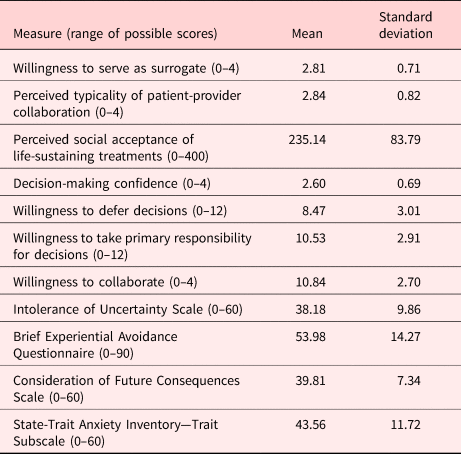
No intrapersonal variables demonstrated problematic skew or kurtosis. Table 3 provides means and standard deviations. The distribution of scores for the sample was consistent with trends reported in research with similar samples.
Descriptive statistics for intrapersonal trait variables

Correlation analyses
Greater willingness to serve as a surrogate was positively associated with the following intrapersonal variables: greater decision-making confidence, r (172) = 0.29, p < 0.001, greater desire to take primary responsibility for one's decisions, r (171) = 0.32, p < 0.001, and greater willingness to collaborate with healthcare providers on these decisions, r (172) = 0.20, p < 0.01. In terms of social-contextual variables, greater willingness to serve as a surrogate was positively associated with viewing patient-provider collaboration as more typical and perceiving that family and friends would select intensive end-of-life treatments, r (169) = 0.40, p < 0.001; r (169) = 0.20, p < 0.01.
Selection of more intensive end-of-life treatments was associated with the following intrapersonal variables: greater willingness to serve as surrogate, r (170) = 0.22, p = 0.005 and greater willingness to take full responsibility for POST decisions, r (170) = 0.21, p < 0.001. Regarding social-contextual variables, more intensive end-of-life treatment choices were positively associated with perceiving that family and friends would choose these treatments, r (169) = 0.48, p < 0.001, and also with viewing patient-provider collaboration as more typical r (169) = 0.17, p < 0.05.
Regression analyses
Significant correlates identified in the correlation analyses were entered in a multiple regression analysis predicting willingness to serve as surrogate. The overall model was significant, F (4, 166) = 10.78, R 2 = 0.21, p < 0.001. Perceived typicality of patient-provider collaboration was the only significant unique predictor, β = 0.32, p < 0.005.
Significant correlates identified in the correlation analyses were entered in a multiple regression analysis predicting more intensive, life-sustaining treatment decisions. The overall model was significant, F (7,158) = 10.43, p < 0.001, R 2 = 0.32. Decisions favoring more intensive end-of-life treatments were uniquely predicted by perceiving that family and friends would select life-sustaining treatments (β = 0.42, p < 0.005), greater collaborative willingness (β = 0.17, p < 0.005), and greater confidence (β = 0.21, p < 0.005).
Discussion
Findings of the current study reveal how two pivotal components of the surrogate decision-making process — one's initial decision to serve as surrogate and the types of end-of-life treatments one selects in the role — can be shaped by intrapersonal and social-contextual characteristics. With regard to one's willingness to serve as surrogate, perceived typicality of patient-provider collaboration was a unique predictor, even after taking intrapersonal and other social-contextual variables into account. With regard to end-of-life treatment decisions, individuals were more likely to select intensive end-of-life treatments when they believed that their family and friends would also choose these options. Thus, among the variables we examined, individuals’ views of what other people think appear to play a significant role in the surrogate decision-making process.
Our findings are consistent with theories of social influence (e.g., Turner, Reference Turner1991) and related research suggesting that interventions employing descriptive norms (statements indicating that the majority of other people identify with a certain attitude or behavior) are often more powerful than traditional appeals solely focused on building a rationale or reason (Goldstein et al., Reference Goldstein, Cialdini and Griskevicius2008). For surrogate decision-making in particular, the complex interplay between the values of surrogates’ cultural groups and their own personal experiences, including what one considers to be a “good death,” can affect their decisions (Allen-Burge and Haley, Reference Allen-Burge and Haley1997). In the context of surrogate decision-making at end-of-life, norms about treatments may be particularly powerful since not selecting a life-sustaining intervention means that the patient will likely die, an outcome clearly steeped in moral and value-based implications.
Regarding the role of intrapersonal characteristics, decision-making confidence and collaborative willingness were associated with surrogates’ treatment decisions. Individuals who selected more intensive end-of-life treatments tended to be more confident in their decisions and more willing to collaborate with patients’ providers. These findings may reflect the broader construct of approach orientation. Researchers have historically conceptualized the approach-avoidance dynamic as associated with how individuals cope with stress (Roth and Cohen, Reference Roth and Cohen1986). This approach-avoidance dynamic could translate into how a surrogate navigates making a medical decision on behalf of another person, a task which many surrogates report as being highly stressful (e.g., Azoulay et al., Reference Azoulay, Pochard and Chevret2003). Those who are more willing to engage with this process, and with healthcare decisions in general, may be less avoidant. Lesser avoidance may be associated with greater confidence and willingness to collaborate. This notion is supported by the inverse relations observed between experiential avoidance and both collaborative willingness and confidence in this study.
Limitations
As is the case for all studies, ours has limitations. Hypothetical scenarios like the ones we used are unlikely to elicit anxiety and other emotional processes that could influence surrogate's real-life decisions. Yet, hypothetical scenarios are the primary means by which surrogate decision making has been examined due to the practical difficulty of assessing actual surrogate decision-making situations (e.g., Libbus and Russel, Reference Libbus and Russell1995; Marks and Arkes, Reference Marks and Arkes2008). The extent to which these findings can be generalized to surrogates encountered in clinical practice may be limited by characteristics of this sample, which was largely male and well-educated. Participants also may have responded as if they were making their own medical decisions, which is also a concern in actual surrogate decision-making contexts (Vig et al., Reference Vig, Taylor and Starks2006). While participants were reminded to consider decisions on behalf of the patient, this type of perspective taking may not be intuitive to all individuals (Torke et al., Reference Torke, Alexander and Lantos2008). Finally, all measures were completed using individual self-report. A multi-method approach (e.g., Eid and Deiner, Reference Eid and Diener2006) may have more fully captured facets of the variables that were measured. For instance, social-contextual factors could have been measured using indicators other than the individual's perceptions of social norms. However, our method of measuring these factors was appropriate since individuals’ perceptions of social norms can ultimately drive their behavior (e.g., Reno et al., Reference Reno, Cialdini and Kallgren1993).
Finally, it is important to note that our sample, collected through Amazon MTurk, may be limited in terms of generalizability. Although research supports the use of MTurk to recruit samples that are more demographically diverse than those recruited through community samples or traditional web-based methods (Burhmester et al., Reference Buhrmester, Kwang and Gosling2011; Goodman et al., Reference Goodman, Cryder and Cheema2013), certain characteristics of MTurk workers (e.g., generally well-educated with convenient access to technology) could affect the degree to which they can be considered representative. With regard to ethnic and racial diversity, the majority of participants identified as White/Caucasian. Therefore, the multicultural background of patients who present in North American medical centers may not be fully represented by our sample and could be considered by future studies when recruiting patient samples.
Future directions and conclusions
Overall, our study highlights the importance of social-contextual factors in the surrogate decision- making process. Since the current study focused on intrapersonal and social-contextual spheres, future work on the surrogate decision-making process could investigate interpersonal levels of analysis such as the influence of family members and provider characteristics (e.g., warmth, demonstrated empathy and emotional supportiveness). Given the general lack of theoretical frameworks to guide research in the area of surrogate decision making, results from future studies could encourage the development of conceptual and theoretical models.
Future cross-cultural research is also necessary. The current study conceptualized collaborative and surrogate decision-making in the manner advocated for by the United States healthcare system (Patient Protection and Affordable Care Act, 2010), which may not be similarly emphasized in healthcare settings in other cultures. Given that surrogate decision-making behaviors and choice of treatment interventions can vary across ethnic and racial groups (Allen-Burge and Haley, Reference Allen-Burge and Haley1997), investigations may explore differences in surrogate decision-making behaviors among different populations, within other healthcare contexts (e.g., community health settings that provide care to individuals of predominantly minority or lower-income backgrounds). The effects of religiosity and religious affiliation on end-of-life decision making could also be explored, as religious affiliation can certainly affect beliefs surrounding these types of decisions. Norms regarding the acceptability of intensive end-of-life treatment likely vary across groups; for example, individuals with more conservative religious views may be less permissive of withholding life-sustaining treatment (e.g., Van Ness et al., Reference Van Ness, Towle and O'Leary2008).
With regard to practical implications, drawing attention to factors that could influence surrogate decision making may help providers engage with surrogates in a manner that facilitates their decision making. For instance, providers could be encouraged to employ decision aid interventions, which are helpful for reducing immediate decisional conflict among patients and surrogates (Garvelink et al., Reference Garvelink, Boland and Klein2019). Our findings suggest such interventions could focus on improving surrogates’ confidence, for example, through the provision of relevant knowledge and reduction of uncertainty. In turn, these decision aids may lead to more informed decisions (Stacey et al., Reference Stacey, Légaré and Lewis2017). Given the demonstrated relevance of social norms to surrogate decision making, providers could also work with surrogates to identify and address any socially reinforced expectations and misconceptions they may hold concerning the role of a medical surrogate and various end-of-life treatment options.
Providers may benefit from having knowledge of individual differences in willingness to serve as a surrogate and treatment selection tendencies. For example, surrogates and patients who score highly in the construct of reluctance to burden others, or who express strong concerns for maintaining personal independence, tend to choose less intensive life-sustaining treatments (Parks et al., Reference Parks, Winter and Santana2011). Therefore, intrapersonal constructs such as reluctance to burden others could moderate the relation between social-contextual variables and end-of-life treatment decisions demonstrated in this study. Moreover, individuals are known to differ in the extent to which they prefer active versus passive roles in medical decision making (e.g., Arora and McHorney, Reference Arora and McHorney2000), which may translate to involvement preferences when serving as surrogates. This information can help providers foster productive communication, interactions, and relationships with surrogates and ultimately, facilitate decisions that align with patients’ preferences.
Disclosures
All recruitment, consent, and experimental procedures were approved by the West Virginia University Institutional Review Board (IRB Protocol #: 1803051181). The datasets generated during and/or analyzed during the current study, as well as materials used in study procedures, are available from the corresponding author on reasonable request. The authors declare they have no competing interests.
Funding
Funding for the current study was provided through the West Virginia University Department of Psychology.
Appendix A.
Decision scenarios (parts A and C adapted from Hare et al., 1992)
Part A: Cardiopulmonary resuscitation
If a patient's heart or breathing stops while in the hospital, an emergency team will be called to try to get the heart and lungs started again. This is called CPR (resuscitation).
Suppose the doctor wants to know whether to try to resuscitate the patient if her/his heart stopped beating. Would you instruct the doctor to attempt CPR?
Yes (1) No (0)
How confident do you feel in this decision?
1 2 3 4 5
(not at all confident) (slightly confident) (moderately confident) (confident) (very confident)
If you were making this decision in real life, how willing would you be to collaborate with the patient's doctors to make the decision? Please consider collaborate as “to work with others to reach a shared decision or goal.”
1 2 3 4 5
(not at all willing) (slightly willing) (moderately willing) (willing) (very willing)
If you were making this decision in real life, how willing would you be to defer the decision to the patient's doctors (i.e. let the doctors make the decision)?
1 2 3 4 5
(not at all willing) (slightly willing) (moderately willing) (willing) (very willing)
If you were making this decision in real life, how willing would you be to take primary responsibility for the decision?
1 2 3 4 5
(not at all willing) (slightly willing) (moderately willing) (willing) (very willing)
Part B: Medical interventions/levels of care
When a patient has a pulse and/or is still breathing, there are different levels of care that can be provided. All levels require that patients be treated with dignity and respect and kept warm, clean, and dry. Comfort Measures allow for the use of medication, wound care, and other measures to relieve pain and suffering. No life-sustaining treatment is provided and hospital transfers occur only if comfort needs cannot be met at the current location. Limited Additional Interventions include the previously described care and allow medical treatment, antibiotics, intravenous (IV) fluids, and cardiac monitoring as indicated. Hospital transfers occur as needed, but the intensive care unit is to be avoided. Intubation and mechanical ventilation are not used. Full Intervention includes the previously described care and allows the use of intubation, mechanical ventilation, advanced airway interventions, and cardioversion. Hospital transfers occur as needed, including to the intensive care unit.
If this were the patient, what level of care would you indicate should be followed? (choose one)
Comfort Measures (0) Limited Additional Interventions (1) Full Interventions (2)
How confident do you feel in this decision?
1 2 3 4 5
(not at all confident) (slightly confident) (moderately confident) (confident) (very confident)
If you were making this decision in real life, how willing would you be to collaborate with the patient's doctors to make the decision? Please consider collaborate as “to work with others to reach a shared decision or goal.”
1 2 3 4 5
(not at all willing) (slightly willing) (moderately willing) (willing) (very willing)
If you were making this decision in real life, how willing would you be to defer the decision to the patient's doctors (i.e. let the doctors make the decision)?
1 2 3 4 5
(not at all willing) (slightly willing) (moderately willing) (willing) (very willing)
If you were making this decision in real life, how willing would you be to take primary responsibility for the decision?
1 2 3 4 5
(not at all willing) (slightly willing) (moderately willing) (willing) (very willing)
Part C: Medically administered fluids and nutrition
A patient who cannot eat can be fed through a nasogastric tube. This tube is placed down the nose and through the esophagus into the stomach. Often the patient has some diarrhea for the first week or two because of the different type of food that is being digested. Other types of artificial feeding methods that can be used are IV lines or a tube placed through the belly wall into the stomach.
If the patient were no longer able to eat or drink, would you have the feeding tube placed long term, for a trial period, or not at all? (choose one)
Long term (2) Trial period (1) Not at all (0)
Would you have IV fluids administered long term, for a trial period, or not at all? (choose one)
Long term (2) Trial period (1) Not at all (0)
How confident do you feel in this decision?
1 2 3 4 5
(not at all confident) (slightly confident) (moderately confident) (confident) (very confident)
If you were making this decision in real life, how willing would you be to collaborate with the patient's doctors to make the decision? Please consider collaborate as “to work with others to reach a shared decision or goal.”
1 2 3 4 5
(not at all willing) (slightly willing) (moderately willing) (willing) (very willing)
If you were making this decision in real life, how willing would you be to defer the decision to the patient's doctors (i.e. let the doctors make the decision)?
1 2 3 4 5
(not at all willing) (slightly willing) (moderately willing) (willing) (very willing)
If you were making this decision in real life, how willing would you be to take primary responsibility for the decision?
1 2 3 4 5
(not at all willing) (slightly willing) (moderately willing) (willing) (very willing)