1 Introduction
The growth in online reading material has shifted readers’ paper-based reading activities to web-based ones. The affordances of Web 2.0 technology, such as cross-platform connections, collaborative content creation, and (a)synchronous communication, have further provided readers with opportunities for processing information through active interactions with others (Greenhow, Robelia & Hughes, Reference Greenhow, Robelia and Hughes2009). As a means of enhancing online reading activities, many online annotation systems have been developed, such as Diigo (Kawase, Herder & Nejdl, Reference Kawase, Herder and Nejdl2009), Annotea (Hwang, Wang & Sharples, Reference Hwang, Wang and Sharples2007), and EDUCOSM (Nokelainen, Miettinen, Kurhila, Floréen & Tirri, Reference Nokelainen, Miettinen, Kurhila, Floréen and Tirri2005). These systems provide mechanisms that allow readers to annotate and discuss online texts synchronously or asynchronously, fostering new levels of knowledge by accumulating information from many users to facilitate deeper reading (Glover, Xu & Hardaker, Reference Glover, Xu and Hardaker2007; Kawase et al., Reference Kawase, Herder and Nejdl2009).
Although a number of studies on the use of online annotations in language classes have shown that such usage can improve comprehension, they tend to only report students’ reading performance using quantitative approaches, and much less is revealed about the actual processes of how students use online annotations to enhance reading comprehension. To address this issue, the current study not only examined students’ progress in reading comprehension, but also explored the processes of how they used online annotations in a collaborative learning environment. Specifically, the following two research questions were addressed:
-
1. Did the students make progress in their reading comprehension via online annotations?
-
2. What processes emerged to characterize how online annotations lead to students’ reading comprehension?
2 Literature review
2.1 Problems of English as a foreign language (EFL) reading instruction in Taiwan
Reading and comprehending English academic texts is crucial for EFL students, as it enables them to obtain domain knowledge in their respective disciplines (Liu, Chen & Chang, Reference Liu, Chen and Chang2010; Salinger, Reference Salinger2003). However, Shen and Huang (Reference Shen and Huang2007) noted that many college students in Taiwan do not have the level of English proficiency required to comprehend English textbooks. According to Yang (Reference Yang2010), up to 70% of EFL students are unable to read as effectively as they should. Moreover, when reading in a foreign language, few students are able to select effective strategies because they lack the related knowledge and metacognitive practices (Yang, Reference Yang2010; Yeh & Yang, Reference Yeh and Yang2011). That is, if EFL students do not have the cognitive and metacognitive strategies needed to remedy their comprehension breakdowns, then they are likely to face many difficulties when reading English texts.
There are several factors that can account for the poor reading abilities among EFL students in Taiwan, including high student–teacher ratios, limited reading instruction, lack of engagement in reading comprehension processes, and insufficient reading strategy training. Firstly, the high student–teacher ratios prevent teachers from dealing with students’ individual differences, and since the students thus receive little teacher feedback, they have few opportunities to resolve their comprehension problems (Yang, Reference Yang2010). Secondly, the limited instructional time available for English classes does not provide enough opportunities for students to read in English (Lan, Sung & Chang, Reference Lan, Sung and Chang2007). Thirdly, EFL students are often not trained to become active readers who are able to interact with the texts and monitor their comprehension. Many studies have also shown that students who rarely engage in reading processes often have difficulty in comprehending texts (Dreyer & Nel, Reference Dreyer and Nel2003; Nation & Norbury, Reference Nation and Norbury2005; Yeh & Yang, Reference Yeh and Yang2011). Finally, the majority of EFL reading instruction in Taiwan focuses mainly on grammar rules and vocabulary knowledge, rather than on teaching how to take an active role in reading processes (Liu et al., Reference Liu, Chen and Chang2010). Many studies have shown that students who use reading strategies have better reading comprehension than those who do not (Brantmeier, Reference Brantmeier2002; Singhal, Reference Singhal2001). Consequently, most college students in Taiwan may have difficulty in comprehending their English reading texts due to a lack of knowledge of reading strategies.
2.2 Online annotations in reading instruction
One possible solution to resolving the above-mentioned problems in EFL reading instruction is to incorporate the use of annotations. Annotations refer to “any additional content that is directly attached to a resource and that adds some implicit or explicit information in many different forms” (Nunes, Kawase, Dietze, de Campos & Nejdl, Reference Nunes, Kawase, Dietze, de Campos and Nejdl2012: 52), such as underlines, circles, highlights, glossaries, or explanatory notes. These different types of annotation have been proposed to facilitate EFL students’ reading, as they can help readers to: (a) learn new vocabulary, (b) reduce their cognitive load in reading, (c) understand the relations that exist among various pieces of textual information, and (d) better reflect on the textual information (e.g., AbuSeileek, Reference AbuSeileek2011; Johnson, Archibald & Tenenbaum, Reference Johnson, Archibald and Tenenbaum2010; Nunes et al., Reference Nunes, Kawase, Dietze, de Campos and Nejdl2012; Tseng, Yeh & Yang, Reference Tseng, Yeh and Yang2015). In short, annotations can help students take appropriate actions to deepen their reading through constant monitoring of their comprehension (Kawase et al., Reference Kawase, Herder and Nejdl2009).
In recent years a growing number of printed texts have been published electronically, and Web 2.0 technologies have made annotating online texts more feasible for readers. Scholars have thus indicated that online annotations can help second language (L2) learners read in various ways due to their characteristics of accessibility, availability, and shareability (Chen, Hwang & Wang, Reference Chen, Hwang and Wang2012; Glover et al., Reference Glover, Xu and Hardaker2007). Among these, the shareability function allows users to share their annotated texts or comments with other members in a group, who can then respond to each other’s work (Gao, Reference Gao2013). This sharing and responding feature also encourages readers to discuss the focal text in a collaborative learning environment. Therefore, the use of online annotations can help learners to learn from their peers in a collaborative context through sharing experiences and constructing knowledge (Robert, Reference Robert2009).
Several researchers have concluded that online annotations have a positive impact on reading comprehension (AbuSeileek, Reference AbuSeileek2011; Johnson et al., Reference Johnson, Archibald and Tenenbaum2010; Tseng et al., Reference Tseng, Yeh and Yang2015). For example, AbuSeileek (Reference AbuSeileek2011) conducted an experiment to investigate the effects of reading EFL texts using different forms of online annotation in a hypermedia environment. A total of 78 undergraduate EFL learners were recruited to read and summarize seven texts and then take a vocabulary test. The post-tests results revealed that those who read the texts with online annotations outperformed those who did not, in terms of text memory and vocabulary acquisition. Johnson et al. (Reference Johnson, Archibald and Tenenbaum2010) conducted two experiments to investigate student learning outcomes with and without an online annotation system, SAM-LS. One of the experimental results showed that 267 college students who used the online annotation system improved their reading comprehension and metacognitive skills in both individual and group modes. They also indicated that the group mode improved students’ learning outcomes better than in the individual mode when both used the online annotation system. Similarly, Tseng et al. (Reference Tseng, Yeh and Yang2015) reported the positive effects that an online annotation system, A.nnotate, had on reading comprehension. They probed into how different usages of online annotations led to higher levels of reading comprehension in EFL students, at surface-based, text-based, and situation-based levels respectively. The findings from the studies mentioned above all pointed to the positive impact of reading with online annotations.
While many studies have reported the positive effects of online annotations on reading comprehension, some gaps can be identified in the literature. First, the effect of online annotations on reading comprehension research was often evaluated through reading comprehension tests, ignoring the actual processes of how students used online annotations to facilitate their reading comprehension. Without this information, teachers cannot understand to what extent online annotations are useful in this context, and thus cannot provide suggestions about how to integrate online annotations to scaffold students’ reading. In addition, the issue of careful instructional design in combination with online annotations still remains underexplored in tertiary EFL education. One such instructional design which may train students to strategically make the optimum use of online annotations is the framework of reciprocal teaching.
2.3 Related studies on reciprocal teaching (RT) and reading comprehension
RT is a teaching approach which encourages students to alternate “leading a dialogue centered on pertinent features of the text” (Palincsar & Brown, Reference Palincsar and Brown1984: 117). Palincsar and Brown (Reference Palincsar and Brown1984) claim that RT can enhance students’ reading comprehension significantly via the four strategies of predicting, clarifying, questioning, and summarizing. Firstly, predicting involves readers confirming or rejecting prior hypotheses based on the text. Secondly, readers are encouraged to clarify any confusion they encounter by using external resources and repeated reading. Next, questioning provides readers with the opportunity to make and negotiate meanings, by actively constructing question items for better comprehension. Finally, by summarizing the text, readers are engaged in distinguishing the important content from the less important parts, in order to integrate the former in their summaries (Doolittle, Hicks, Triplett, Nichols & Young, Reference Doolittle, Hicks, Triplett, Nichols and Young2006).
Incorporation of RT into reading classes has been deemed an effective teaching approach with regard to various outcomes, such as improved reading comprehension (Fung, Wilkinson & Moore, Reference Fung, Wilkinson and Moore2003; Spörer, Brunstein & Kieschke, Reference Spörer, Brunstein and Kieschke2009; Yang, Reference Yang2010), peer support and encouragement (Yang, Reference Yang2010), metacognition enhancement (Fung et al., Reference Fung, Wilkinson and Moore2003), and strategy acquisition (Spörer et al., Reference Spörer, Brunstein and Kieschke2009). For example, Yang (Reference Yang2010) designed an online RT system to monitor the reading processes of 129 Taiwanese college students, and also investigated their reading comprehension. The system aimed to record students’ reading processes via four functions supporting the four strategies of RT. The results showed that the online RT system not only helped the EFL learners improve their reading comprehension and gain peer support, but also helped the teacher better understand the students’ learning difficulties to provide necessary scaffolding. In another study, Fung et al. (Reference Fung, Wilkinson and Moore2003) used RT as an instructional design to investigate how English as a second language (ESL) 6th and 7th graders, who had recently migrated from Taiwan to New Zealand, comprehended an English expository text. The results indicated that RT improved not only the English reading competence of the Mandarin-speaking ESL students, but also their metacognition. In a similar vein, Spörer et al. (Reference Spörer, Brunstein and Kieschke2009) conducted an experimental study to compare RT strategy instruction with traditional instruction to measure the effects of the former on ESL elementary students’ reading comprehension in German. The results revealed that the students who experienced RT in small groups and pairs gained higher reading scores and strategy acquisition in the post-test than those who were in the control group. In conclusion, with much research showing the positive influences of RT on learners with different school levels and learning backgrounds, this study was designed to understand if RT can serve as an appropriate instructional design to frame the incorporation of online annotations in a reading class.
3 Method
3.1 Participants
This study involved 54 non-English majors who registered in a freshman English course, Vocabulary and Reading, at a university in Taiwan. As EFL learners, they had limited English instruction, and the course under investigation was the only English-related course they took during the semester. Although the participants had been learning English for more than ten years, their English reading ability was regarded as low-intermediate based on the average score of 238 in the reading section of the Test of English for International Communication (TOEIC).
3.2 Research design
The reading class comprised weekly two-hour sessions over eighteen weeks. Before the reading instruction, the 54 participating students took the simulated TOEIC reading test as a pre-test in the first week. The students were also asked to annotate an assigned text with no instructional guidance. During the following two weeks, they were then introduced to the role of annotation in reading and how to effectively annotate a text using the RT procedure, involving the predicting, clarifying, questioning, and summarizing tasks. In the predicting task, the students had to add notes in the margins to write down their own predictions. In the clarifying task, they needed to mark and annotate unknown vocabulary with definitions, or derive the meanings of difficult concepts through group discussions. In the questioning task, they had to underline important sentences and add notes to generate possible comprehension questions for each other. In the summarizing task, they were asked to highlight key words and topic sentences, and then add notes in the margins to write down their summaries of the reading text.
In completing the four RT tasks, the students were divided into groups of three (eighteen groups in total), and asked to annotate six assigned articles (one per week) using Google Docs. In addition, they were encouraged to review their peers’ work, ask for help, and engage in discussions with their peers or instructor in the online learning environment enabled by Google Docs. After completing annotations on each article, following the RT procedure, the students were required to share links to their work via a classroom management system on a weekly basis. At the end of the research intervention, all the students took another set of simulated TOEIC reading tests as the post-test to evaluate their reading progress.
3.3 Using Google Docs for online reading and annotations
Google Docs provided the collaborative learning context for this study through its various embedded functions, such as the annotation tool, document-sharing mechanism, and online chat rooms. Each function is briefly described below. The interface of Google Docs is available in many languages, such as English and Spanish, and users can select their preferred one.
The annotation tool is the main function the students use when undertaking the RT tasks. Students can annotate the title for prediction, annotate the unknown words or concepts with explanations for clarification, ask questions for peers to answer, and annotate the main ideas of each paragraph for summarizing. In this online setting, they can independently or collaboratively annotate the texts based on the RT procedure. The document-sharing mechanism allows students to share their notes, and invite others to collaboratively read and annotate the texts. In this online setting, students can observe their peers’ work, have discussions with them, comment on their annotations, and respond to their comments. Students can use the online chat room function to clarify unknown words or concepts, and create different discussion threads with their peers. This function also allows the instructor to provide immediate feedback and assist the students if they encounter any reading difficulties.
3.4 Data collection and analysis
This study collected both quantitative and qualitative data, including the pre- and post-tests, and the students’ participation records from Google Docs. With regard to the quantitative data, the students’ scores in the pre- and post-tests were used to investigate any changes in their reading comprehension after using online annotations during the RT. Paired-samples t-tests were adopted to examine the students’ progress between the pre- and post-tests, and the scores were used to divide them into two groups: (1) the “more progress” (MP) group of fourteen students with gain scores in the top 25% of the class; (2) the “less progress” (LP) group of thirteen students with gain scores in the bottom 25% of the class. Both the MP and LP groups’ reading performances and processes were closely analyzed to identify any similarities and differences between them. Furthermore, one representative case was chosen from each group, using a typical case sampling technique, to delineate the salient features of their reading processes. As Bamberger, Rugh and Mabry (Reference Bamberger, Rugh and Mabry2011) stated, typical case sampling is a type of purposeful sampling in which, “subjects are selected who are likely to behave as most of their counterparts would” (p. 358). Accordingly, the two typical cases in this study (S1 from the MP group and S2 from the LP group) were purposefully selected based on the following criteria: (1) their pre-test scores were close to the class average, and (2) their gain scores from the pre- to the post-tests were close to the group average.
The qualitative data consisted of students’ participation records from Google Docs, which were used to examine the processes of how they used annotations to support their reading comprehension. This study adopted Patton’s (Reference Patton2002) four procedures of content analysis, namely coding, categorization, description, and interpretation, to analyze the students’ reading processes with online annotations. Based on the participation records in Google Docs, the research team first coded meaningful statements from the participants by reading all the participation records (coding). The meaningful statements were grouped into categories in terms of the students’ use of online annotations during the RT in the predicting, clarifying, questioning, and summarizing tasks (categorization). The researchers further described the students’ reading progress and processes with examples and illustrations (description). Finally, the researchers interpreted the students’ reading processes by providing explanations, making inferences, and drawing conclusions regarding how they used online annotations during the RT in each task (interpretation). Any disagreements about the coding that arose among the research team were resolved by discussion. The mean inter-rater reliability was .87, which was calculated based on percent agreement of all the participation records across different data sets.
4 Results
4.1 Students’ progress in their reading comprehension after using online annotations
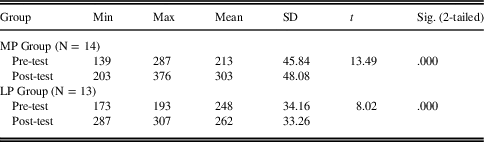
The learning outcomes in the pre- and post-tests are presented in Table 1. Most of the 54 participants made satisfactory progress, with a significant difference (t=6.799, p<.001) between the pre-test (M=238, SD=44.481) and post-test (M=276, SD=51.340). The effect size for Cohen’s d was .79, which indicated small to medium practical significance according to Plonsky and Oswald’s (Reference Plonsky and Oswald2014) empirically-derived benchmarks for second language acquisition. Paired-samples t-tests were conducted to examine the progress made by the MP and LP groups. As shown in Table 2, a significant difference (t=13.491, p<.001) between the pre-test (M=213, SD=45.84) and post-test (M=303, SD=48.08) was found for the MP group, with a very large effect size of 1.92. Moreover, there was also a significant difference (t=8.02, p<.001) between the pre-test (M=248, SD=34.16) and post-test (M=262, SD=33.26) for the LP group, though with a negligible effect size of .42. These results indicated that both groups significantly improved their reading comprehension after using online annotations while reading, though the analysis demonstrated much higher statistical power for the MP group. Since both groups had similar levels of proficiency before the intervention, the difference in their learning outcomes can be attributed to the use of online annotations in their reading processes.
Statistical results of the pre- and post-tests for all the students

Statistical results of the pre- and post-tests for the MP and LP groups

4.2 Representative cases: Reading processes with online annotations
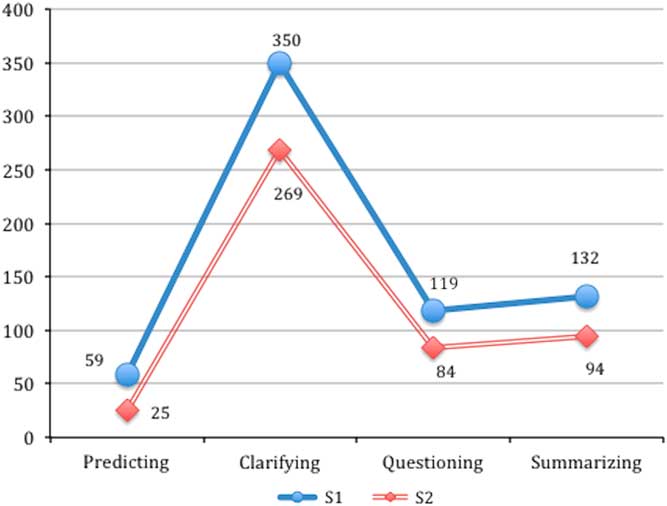
In this study, one student from each of the MP and LP groups was chosen as a case study based on typical case sampling in order to gain more in-depth information about the reading processes involved. These students were labelled S1 and S2, respectively, in the following discussion. As shown in Figure 1, S1 took more actions in each RT task than S2: 34 more actions in predicting, 81 more actions in clarifying, 35 more actions in questioning, and 38 more actions in summarizing.
S1’s and S2’s frequency of actions in each RT task

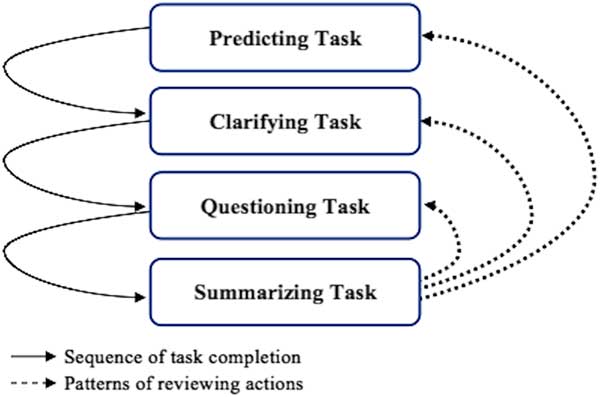
Overall, S1 and S2 underwent similar sequences in task completion during the RT, from predicting, clarifying, and questioning to summarizing. However, the key difference between S1 and S2 lies in the reviewing actions. As shown in Figure 2, when S1 completed the summarizing tasks, it was found that she often undertook recursive actions to revisit previous tasks and further revised previously generated predictions, clarifications, questions, and summaries. In contrast, S2 demonstrated less reviewing actions in task completion of RT.
S1’s task completion sequence and reviewing actions in RT

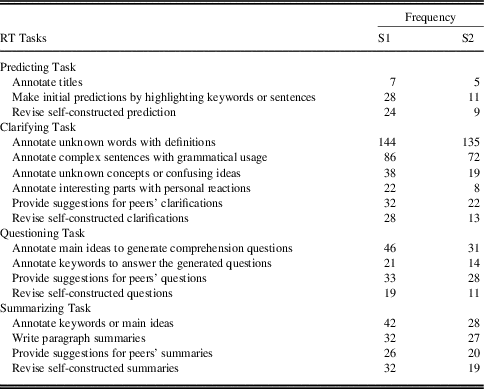
Table 3 presents the frequency difference between the two students’ use of online annotation actions in the four RT tasks. In the predicting task, S1 annotated the titles and highlighted key words or sentences more frequently to make initial predictions than S2 did. S1 also took many more actions to revise her previously self-constructed predictions. In the clarifying task, S1 undertook more annotation actions in terms of vocabulary items, complex sentences, confusing ideas, and interesting parts with personal reactions to interact and clarify with her peers. In the questioning task, S1 generated more comprehension questions for peer interactions, and in turn annotated more key words and main ideas in response to her generated questions. In the summarizing task, S1 exerted more effort in annotating the key words or main ideas in order to compose paragraph summaries, and further revised her previous versions of summary. In sum, comparing the frequency of actions between S1 and S2, the results show that S1 was more actively engaged in the online reading processes with online annotations than S2.
S1’s and S2’s frequency of actions in RT

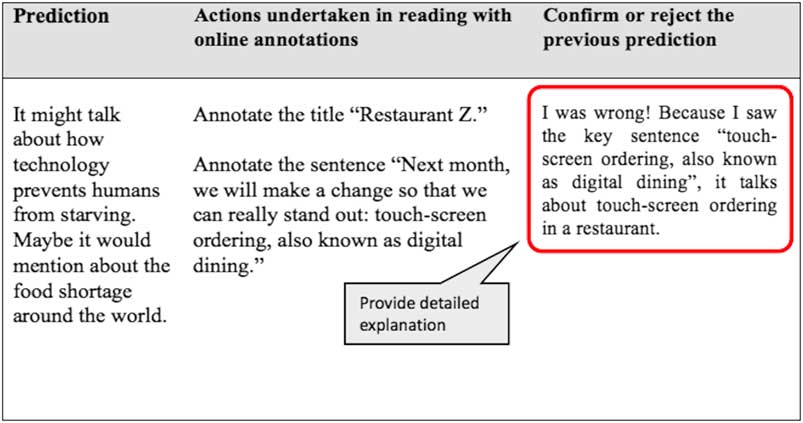
The participation records from Google Docs enable further analysis of the processes of how S1 utilized online annotations to enhance her reading comprehension in these four RT tasks. In the predicting task, S1 first read the title “Restaurant Z” and then made a prediction about the text: “It might talk about how technology prevents humans from starving” (Figure 3). After reading the first paragraph, she went back on her previous prediction, stating: “I was wrong!” In making predictions, S1 marked the key words to monitor her own reading process with her own predictions. She then clarified her understanding of word meanings and discussed her prediction with peers.
Summary illustration of S1’s predicting task recorded in Google Docs

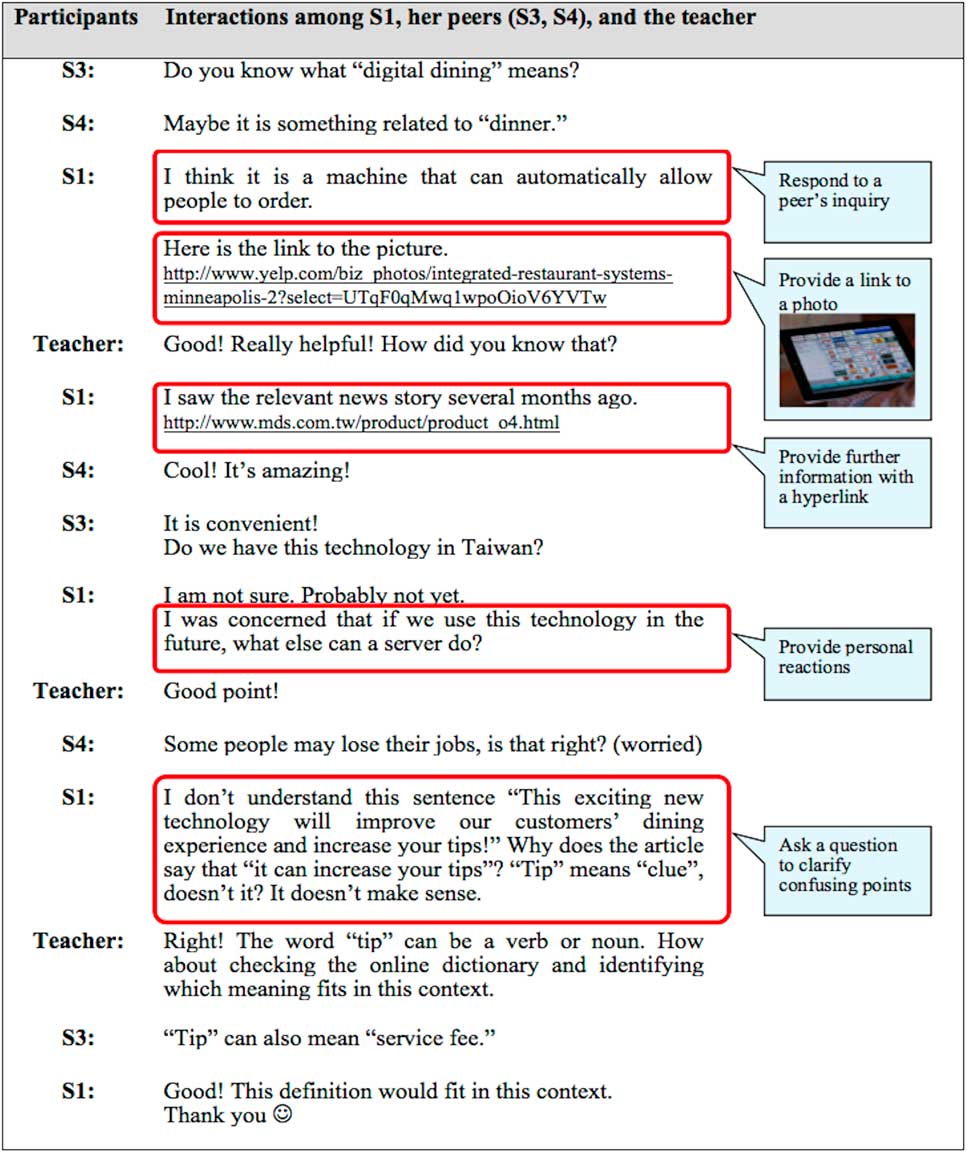
In the clarifying task, S1 used the online chat room to answer her peers’ questions by clarifying the meaning of “digital dining” (Figure 4). To help her peers gain more information, she responded to their inquiries and then posted a link to the photo and further explained the new concept. In addition, S1 frequently used the online chat room to clarify confusing words, phrases, or concepts with her peers and thus improve her reading comprehension, as well as to provide additional external sources for them. She further provided her personal concerns over the issue. Next, she clarified her puzzle over the meaning of the word tip with the instructor and peer. From their responses she learned the meaning of the sentence, and became aware that the word tip has different meanings among the peer responses. With the ongoing discussions, S1 constantly used the online chat room to clarify those comprehension questions and also obtained feedback from her peers and the instructor.
1. Summary illustration of S1’s clarifying task recorded in Google Docs

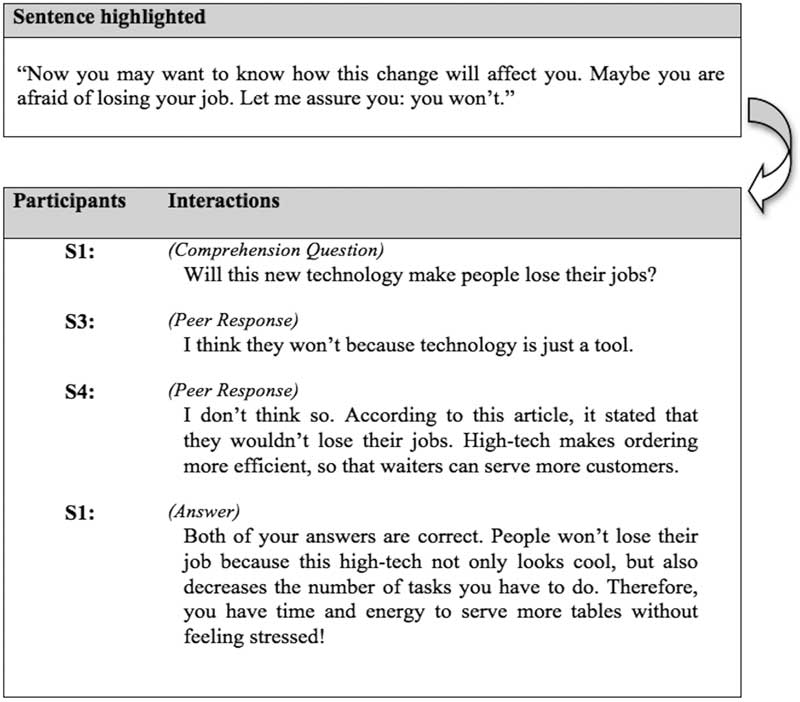
In the questioning task, after S1 had read the fourth paragraph she highlighted the extract: “Now you may want to know how this change will affect you. Maybe you are afraid of losing your job. Let me assure you, you won’t.” Then she generated a question: “Will this new technology make people lose their jobs?” for her peers to answer, and provided a specific answer to double check whether her own response was consistent with those of her peers. Figure 5 illustrates this process. During the process of question generation and answer explanation, S1 not only highlighted the possible sentences for generating a question, but also went over the previously annotated information to propose a correct answer. By comparing her peers’ responses with her own, S1 could further evaluate her understanding of the reading text.
Summary illustration of S1’s questioning task recorded in Google Docs

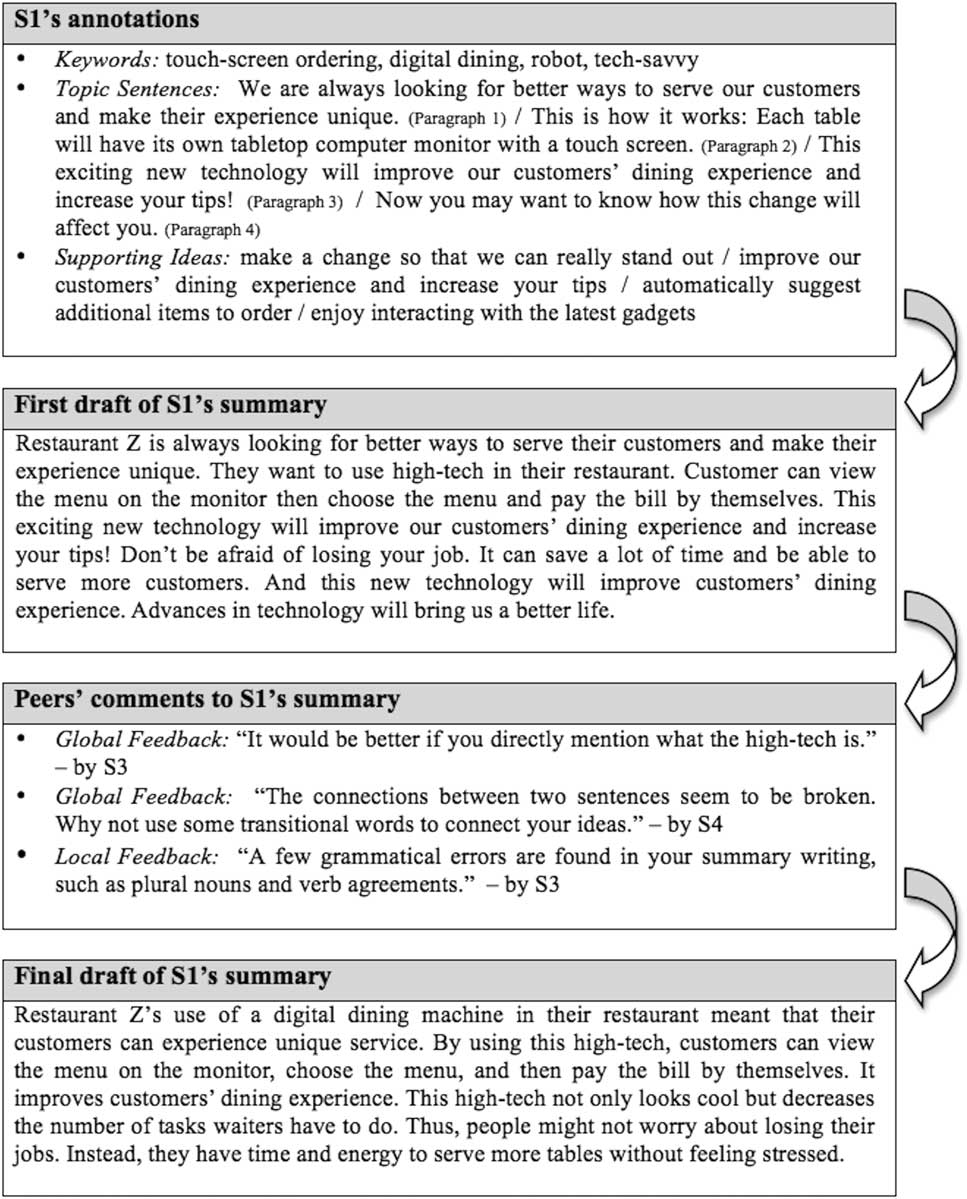
In the summarizing task, S1’s own annotations served as clues when she wrote her summary (Figure 6). After posting her summary, S1 received peer feedback both on local errors (e.g., plural nouns or verb agreements) and on global suggestions (e.g., coherence). S1 then reviewed her previous annotations and took her peers’ suggestions to revise her first summary draft by correcting grammatical errors and adding the key concept (e.g., a digital dining machine) and transitional words like thus and instead into the final draft of her summary. In short, S1 not only frequently retrieved previous annotated sentences to revise her summary, but also benefited from her peers’ suggestions, which helped her pinpoint problems in her writing. By revising the summary, S1 obtained another chance to monitor and evaluate her understanding of the reading text through a process of repeated reviewing actions.
Summary illustration of S1’s summarizing task recorded in Google Docs

Although S1 and S2 shared similar tendencies when undertaking the four RT tasks with online annotations, there were still notable differences. In the predicting task, when S2 rejected the previous predictions, he seldom further revised his previous incorrect prediction like S1 did. He would simply note: “I made a wrong prediction!” without providing any further explanation. Similarly, in the clarifying task, S2 seldom annotated unknown words, sentences, concepts, or confusing ideas with peers about the text as S1 did, but instead paid more attention to clarifying word meanings and grammar rules. For example, when reading the sentence: “All you have to do is bring the food to the table”, S2 used the online chat room to ask his peers: “Is this sentence grammatically correct? I think the verb should be are.” The above example shows that S2 mainly used this task to deal with the text at the micro-level. S2 also took fewer actions to annotate interesting parts with personal reactions in the text than S1 did. In the questioning task, after generating questions S2 did not annotate key words or main ideas to answer them, but instead only provided his peers with simple answers, which failed to convince them. For instance, he generated the comprehension question: “Why is Restaurant Z so popular?” After his answer “Because they have a new high-tech” was posted, one of his peers replied: “The real reason is that they have a digital dining machine.” That is, since S2 marked fewer key words and main ideas for answers, he was not able to answer his self-constructed comprehension questions as precisely as S1. With regard to the summarizing task, the results showed that S2 exerted less effort in reviewing his previous annotated key words and main ideas for summary writing than S1 did. After receiving peer feedback, S2 simply corrected local errors even though his peers pointed out some logical problems in his summary.
With regard to the teacher–student and student–student interactions within the collaborative learning environment of Google Docs, S1 and S2 both undertook the four RT tasks with online annotations collaboratively with the others in their groups, and the instructor could provide appropriate assistance if needed. S1 and S2 were thus able to improve their reading comprehension by giving/receiving feedback to/from peers and based on the instructor’s adaptive scaffolding while completing the tasks given to them. The instructor also served as a facilitator to make sure that the students undertook the tasks properly, helped them solve any reading difficulties that arose, and provided scaffolding so that they could attain a higher level of reading comprehension.
5 Discussion and conclusion
This study illustrated how the instructional design of RT (consisting of predicting, clarifying, questioning, and summarizing tasks) was integrated into a reading class with the use of online annotations, with the overall aim of enhancing the students’ reading comprehension and reading processes. The results of the pre- and post-tests indicated that all of the students significantly improved their reading comprehension with the support of online annotations. This finding is consistent with previous studies (e.g., AbuSeileek, Reference AbuSeileek2011; Johnson et al., Reference Johnson, Archibald and Tenenbaum2010) which suggest that online annotations have positive effects on reading comprehension. Some significant differences were found in the reading processes of the more and less progress groups. The MP group performed many more actions in each RT task when annotating reading texts. Additionally, they revisited previously generated predictions, clarifications, and questions while completing summaries compared to the LP group. As a result, the use of these RT tasks, coupled with the use of online annotations, was able to enhance the students’ reading comprehension to different extents.
In order to delve into these EFL students’ reading processes through online annotations, S1 and S2 were selected from the MP and LP groups, respectively, to gain insights into how the two groups carried out online reading in the four RT tasks. In the predicting task, although both students activated their prior knowledge to make predictions before reading, S1 made more effort in verifying her predictions by repeatedly comparing them with the texts and providing more details to correct her wrong predictions after reading. As Duke and Pearson (Reference Duke and Pearson2002) note, good readers are those who “draw from, compare, and integrate their prior knowledge with material in the text” (p. 206). Fielding, Anderson and Pearson (Reference Fielding, Anderson and Pearson1990) further suggest that the process of explicit comparison and verification after prediction is a determining factor that facilitates participants’ understanding of a text. That is, better reading comprehension can be achieved when students make frequent comparisons between their existing knowledge and the text, and then assess their previous predictions based on this.
In the clarifying task, S1 demonstrated greater involvement in annotating words, sentences, and confusing concepts as well as providing personal reactions than S2, who merely attempted to understand unknown words. This corresponds to findings from Tseng et al. (Reference Tseng, Yeh and Yang2015), in which deep readers among EFL students tended to mark the main ideas and add notes to reflect on the reading texts using in-depth analysis and interpretations. Furthermore, S1 had a higher frequency of annotating interesting parts with personal reactions and responding to peers’ inquiries than S2 did. By clarifying the information that causes comprehension problems, students can not only receive peer support but also answer each other’s inquiries, and thus students can monitor and improve their own reading comprehension (Yang, Reference Yang2010).
In the questioning task, S1 showed greater engagement in generating questions and responding to questions from peers. This suggests that the level of engagement in producing and responding to questions can trigger deeper reading comprehension. In this task, the students needed to fully understand the text before they were able to produce comprehension questions in the online chat room with their peers. In order to answer their peers’ questions, they had to read the text repeatedly, search for information related to the question, and then engage in deep thinking about the information in the text (Yang, Reference Yang2010). Moreover, disagreements on peers’ questions or answers could also prompt students to go over the text to re-evaluate their understanding (Yeh & Yang, Reference Yeh and Yang2011). By actively engaging in the process of question generation, students can monitor their own comprehension of the texts with their peers, thus enhancing their reading comprehension (Spires & Donley, Reference Spires and Donley1998).
In the summarizing task, S1 was found to be more active in revising her work after receiving peer feedback and undertook more reviewing actions than S2. This suggests that a greater frequency of reviewing the summaries offered more chances for students to absorb what they read, thus enhancing their reading comprehension. As claimed by some researchers (e.g., Brown, Day & Jones, Reference Brown, Day and Jones1983; Duke & Pearson, Reference Duke and Pearson2002), students who frequently participate in constructing and revising summaries can improve their reading by monitoring and verifying their comprehension of the focal texts during the processes of summary writing. Taken together, the reviewing action in the four RT tasks was a pivotal factor contributing to students’ improved reading comprehension when undertaking online annotations. This result confirms previous studies, in that when students consistently monitor, evaluate, and self-regulate during the reading processes, their comprehension is likely to be enhanced (e.g., Dreyer & Nel, Reference Dreyer and Nel2003; Spörer et al., Reference Spörer, Brunstein and Kieschke2009).
As previous studies have noted, computer-supported collaborative learning maximizes learning processes and performance, since these technologies can help students to actively engage with peers whose opinions they deem valuable. The affordances of Google Docs used in this study enabled the students to read each other’s thoughts in the form of annotations, and give each other feedback without the usual classroom constraints of time and space. That is, students could learn the reading texts and explore new knowledge collaboratively in the collaborative learning environment of Google Docs. The participation records related to the online annotations allowed the students to monitor and compare their reading processes with those of their peers, which in turn helped them become more aware of their own misunderstanding of the texts. Moreover, the use of the online chat room also served as a collaborative learning forum where students could generate discussion threads for social constructive feedback, thus exchanging their learning experiences, clarifying confusing parts, and generating solutions to any problems that arose. In addition, the sharing mechanism of Google Docs permitted the teacher to provide students with appropriate scaffolding by identifying and solving reading problems through discussion. If any ineffective use is found, then the teacher should clarify or modify the instructional approach to make the learning more effective (Duke & Pearson, Reference Duke and Pearson2002). Overall, this study supports the idea that providing students with opportunities to use online annotations in a collaborative learning environment can help them engage in reading and improve their comprehension with reciprocal efforts.
This study has several implications for reading instruction and research. Firstly, since students’ reading comprehension significantly improved after reading instruction with online annotations, language teachers might be encouraged to apply an appropriate instructional design such as RT in this study, to guide and scaffold students’ use of online annotations in their reading processes. With the caveat in this study that technology might not be the sole variable accounting for the difference in learning, the use of online annotations should be coupled with carefully designed reading instruction. Secondly, to help students gain a better understanding of the text, teachers should encourage them to annotate the text collaboratively not only at word level, but also at higher-order levels. In addition, teaching students to provide more effective comments is important, since constructive feedback can also help them to achieve better reading comprehension through the process of constructing and reviewing their summaries. Thirdly, it is suggested that language teachers prompt students to play more active roles in revising their previously generated predictions, clarifications, questions, and summaries, since taking reviewing action appears to play a pivotal role in augmenting reading comprehension. This can also be done even in a large class, with an appropriate instructional design that engages students in a collaborative learning environment. To conclude, the overall results of this study have shown that the reciprocal nature of collaborative dialogues that occurs through online annotations serves to support students’ reading process, which in turn leads to their improved comprehension. Future studies should thus build on this understanding when implementing reading instruction with online annotations.
Acknowledgements
This research was sponsored by the Ministry of Science and Technology in Taiwan (Grant Numbers: MOST-103-2410-H-224-013 and MOST-102-2511-S327-001-MY2).