Introduction
Flavescence dorée (FD), caused by EY phytoplasmas (16SrV, subgroups C and D) is a serious disease of grapevine that occurs in Italy, France, Spain, Serbia, Switzerland and Slovenia (Boudon-Padieu, Reference Boudon-Padieu2003; Duduk et al., Reference Duduk, Botti, Ivanović, Krstić, Dukić and Bertaccini2004; Schaerer et al., Reference Schaerer, Johston, Gugerli, Linder, Shaub and Colombi2007; Seljak, Reference Seljak2008). It is transmitted by Scaphoideus titanus Ball (Hemiptera: Cicadellidae), a nearctic species introduced into Europe in the 1950s and now present in France, Italy, Spain, Switzerland, Croatia, Slovenia, Serbia, Portugal (Alma, Reference Alma2004), Austria (Zeisner, Reference Zeisner2005), Bosnia-Herzegovina (Delić et al., Reference Delić, Seljak, Martini, Ermacora, Carraio, Myrta and Durić2007) and Hungary (Dér et al., Reference Dér, Koczor, Zsolnai, Ember, Kölber, Bertaccini and Alma2007). This leafhopper is monophagous on Vitis spp., including European (V. vinifera L.) and American (e.g. V. rupestris Scheele and V. cordifolia Michx) grapevine (Maixner et al., Reference Maixner, Pearson, Boudon-Padieu and Caudwell1993; Beanland et al., Reference Beanland, Noble and Wolf2006). Overwintering occurs as eggs laid beneath the bark (Vidano, Reference Vidano1964) and nymphs can acquire phytoplasmas by feeding on infected plants, whereas adults are responsible for the transmission of the disease, as they become infective after a 5–6 week latency period from the time of exposure of leafhopper to infected plants (Bressan et al., Reference Bressan, Larrue and Boudon-Padieu2006). Adults usually appear at the beginning of July and can be observed until the middle of October (Vidano, Reference Vidano1964); the flight activity is mainly crepuscular (Lessio & Alma, Reference Lessio and Alma2004a) and is restricted to the grapevine's canopy (Lessio & Alma, Reference Lessio and Alma2004b). Previous research has proven that the highest infection rate occurs in the second part of the summer, that is, during September and October (Bressan et al., Reference Bressan, Larrue and Boudon-Padieu2006). On the whole, sticky traps tend to catch more males (Lessio & Alma, Reference Lessio and Alma2004b), but it is not clear if this is due to differences in behavior between genders or reflects the effective sex ratio. This research focuses on the seasonal presence of S. titanus males and females, and on its consequences on the risk of transmitting FD phytoplasmas during the season.
Materials and methods
Field collections
Data were collected during 2006 in three vineyards of the province of Asti (Piedmont, NW Italy). The vineyards were planted with the ‘Barbera’ grapevine variety. They were approximately 30 years old and pruned per the Guyot method. Their size was approximately 2000 m2, and they were isolated from other vineyards. They presented a high incidence of FD, and no insecticides were used.
Adults were obtained in three different ways: rearing of adults from field-collected eggs, sweep-net samplings and yellow sticky traps.
Egg sampling was accomplished by collecting pruned grapevine canes of at least two-year-old wood, which is chosen by S. titanus for egg laying. Samples were collected during the winter from the middle of January to the end of February. In each vineyard, approximately 12 kg of wood were randomly collected. Canes were cut into 20–40 cm long pieces, stored in plastic crates and brought to the laboratory. Here, they were kept outdoors at the same environmental conditions (temperature and relative humidity) as the investigated vineyards until the end of April, so to complete the degree days for egg hatching, and they were periodically sprinkled with water to avoid the dehydration of the eggs. Afterwards, canes were put into a mass rearing cage (120×120×100 cm) made of a metal frame covered with an insect-proof mesh that contains a zip opening. Healthy vine plants, approximately 50 cm high and potted in 20 cm diameter pots, were put inside the cage and periodically sprinkled. The mass rearing was kept outside, in the same conditions as the stored canes. After hatching, S. titanus nymphs immediately jumped onto vine leaves and started to feed and molt. Plants were changed every two weeks, or when too many nymphs were present. When nymphs reached the 5th instar, they were collected with an aspirator and moved into smaller cages (20×20×40 cm) made of Plexiglas and insect-proof mesh, with a sleeve to introduce and remove insects, a square lid and a hole in the base in which a potted healthy vine plant was introduced. Ten cages were used, and each cage hosted up to 30 S. titanus nymphs. Adults were picked up 48 h after their emergence and frozen (−20°C) before sexing.
For field sampling, we used yellow sticky traps (Glutor®), 20×30 cm, coated with glue on both sides. Traps were placed into the vineyards by fastening them to the wires within the grapevine canopy at a 150 cm height from ground level. Traps were arranged, three per vineyard, along a diagonal pattern from one edge to another, in order to cover the whole vineyard size, and were changed every 10–20 days from the beginning of July to the middle of October. Removed traps were wrapped in a transparent plastic film, labeled and brought to the laboratory where they were stored inside a freezer (−20°C). S. titanus adults were also sampled by means of a sweep net (40 cm dia.) directly on the vine canopy; samplings were carried out every 5–10 days during the morning (9:00–11:00 am) and lasted approximately 60 min per sampling unit. During this period of time, up to 15 vine rows, 50 m long, were sampled in each vineyard; adults were collected from the sweep net with an aspirator and kept in glass test-tubes inside a cool bag (+5°C) before they were brought to the laboratory.
In the laboratory, the S. titanus adults, collected with different sampling methods, were counted and sexed by observing the external gonapophises with a 20× stereomicroscope. Leafhoppers were detached from sticky traps with a drop of Bio-Clear (Bio-Optica, Milano, Italy).
Laboratory analyses
In order to study the influence of time and gender on FD infection rates, S. titanus adults were analyzed by means of molecular techniques to detect the presence of FD phytoplasmas (16SrV). Total DNA was extracted, following a procedure previously described for leafhoppers (Marzachì et al., Reference Marzachì, Veratti and Bosco1998), from single S. titanus individuals collected by mean of sticky traps or sweep net and analyzed. Only individuals that seemed to be recently captured on sticky traps were analyzed. Adults obtained via rearing of eggs were not analyzed, since 16SrV phytoplasmas are not transmitted to the progeny (Alma et al., Reference Alma, Bosco, Danielli, Bertaccini, Vibio and Arzone1997). Samples were amplified in direct PCR with the group specific ribosomal primer pair fAY/rEY (Marcone et al., Reference Marcone, Ragozzino, Schneider, Lauer, Smart and Seemüller1996; Marzachì et al., Reference Marzachì, Palermo, Boarino, Veratti, d'Aquilio, Loria and Boccardo2001). PCR products were analyzed by eletrophoresis through 1% agarose gel, stained with ethidium bromide and visualized on a UV transilluminator.
Statistical analyses
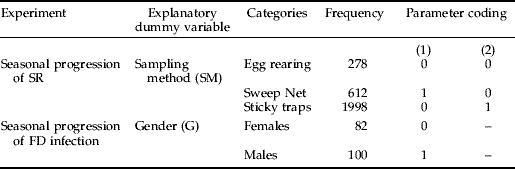
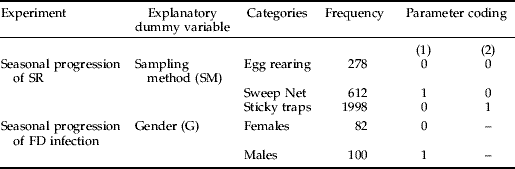
The null hypotheses were stated as follows: sex ratio (SR) of S. titanus is independent from the sampling method and from the seasonal period of collection; and FD infection is not dependent from S. titanus gender and seasonal period of collection. Data were analyzed via binary logistic regression (Forthofer et al., Reference Forthofer, Lee and Hernandez2007). For testing the first two hypotheses, S. titanus gender was used as the binary dependent variable (male=1; female=0), while as explanatory variables we considered: the sampling method (sticky traps, sweep net sampling and pruned canes) as a categorical (dummy) variable, fixing pruned canes as the reference variable; and the period of adults' emergence (i.e. days after the emergence of the first adults) as a continuous variable. For testing the last two hypotheses, FD infection of leafhoppers was considered as the dependent variable (infected=1; healthy=0), whereas the period of adults' emergence and leafhoppers' gender (male=1; female=0) were the explanatory variables. In both cases, the interaction between the independent variables was also calculated. Variables were inserted into the model via a backwards stepwise likelihood ratio method. Coding of dummy variables is represented in table 1. Overall significance of the model was tested via a Hosmer-Lemeshov test. All data were analyzed with the SPSS® 12.0 statistical package.
Parameter coding of explanatory dummy variables used in logistic regression.
Results
Seasonal trend of sex ratio
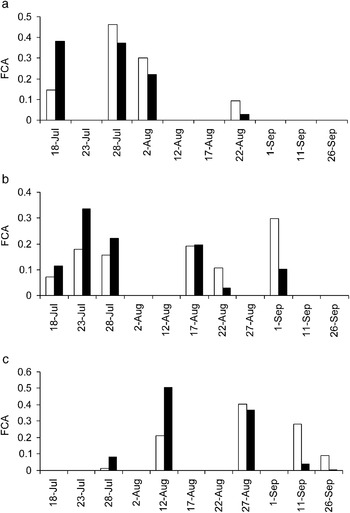
S. titanus eggs started to hatch on 15th May and hatching kept going on for almost 30 days. The first adults emerged from the rearing on the 18th of July when the peak of males was also reached, whereas the peak of females was recorded ten days later. No adults emerged from the rearing after the 22nd of August. A total of 278 adults was reared, the SR being 0.60:1 (105 males and 173 females); this value was comparable with the SR obtained via net sweeping, 0.62:1 (235 males, 377 females), whereas the SR obtained with yellow sticky traps was much more male biased, being 1.99:1 (1331 males, 667 females). Field captures of S. titanus adults with sticky traps started on the 28th of July and ended on the 26th of September, whereas no captures by means of a sweep net were obtained after the beginning of September. The flight peak was detected with yellow sticky traps on the 12th of August for males, and on the 27th of August for females. On the other hand, the maximum presence of S. titanus adults caught using the sweep net was detected on the 23rd of July for males, and on the 1st of September for females (fig. 1).
Seasonal frequency of S. titanus adults obtained with different sampling methods: (a) egg rearing, (b) sweep net and (c) sticky traps. FCA, frequency of captured adults (adults captured per sampling date/total adults captured) (□, females; ▪, males).

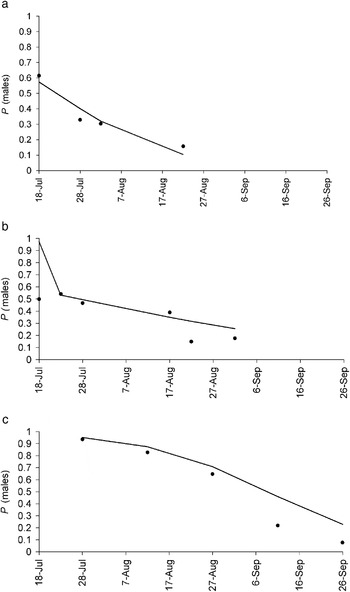
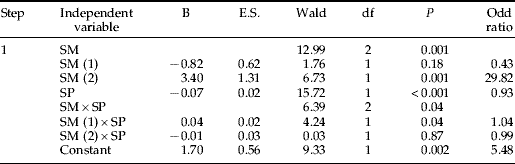
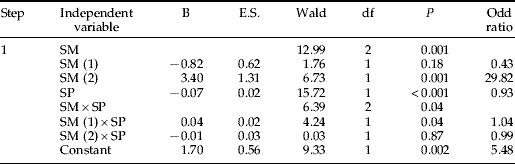
The maximum bias in favor of males was observed on the 18th of July in egg rearing (1.5:1) and in sweep net samplings (1:1) and on the 28th of July on sticky traps (9:1), whereas the maximum bias in favor of females was recorded on the 22nd of August in laboratory rearing (0.17:1) and sweep net sampling (0.16:1), and on the 26th of September on sticky traps (0.07:1) (fig. 2). Binary logistic regression equation provided a good fit with the observed data of SR of S. titanus (Hosmer-Lemeshov test, χ2=4.58, 6 df, P=0.60). The model classified correctly 74.0% of the observations (54.3% for females, 84.5% for males) vs. 65.1% classified from the model with intercept only (χ2=386.02, 5 df, P<0.001). The relationship was significant (Wald test, P<0.05) for the sampling period and sampling with sticky traps, SM (2), but not for sampling with the sweep net, SM (1) (table 2, fig. 2). The interaction between sampling period and sampling method was significant for SM (1) but not for SM (2). Therefore, the final model included as explanatory variables SM (2), SP and SP×SM (1). The SR of S. titanus is significantly related to the seasonal period of sampling (the odd ratio of having a male is 0.93 per day of sampling) and is more male biased in sticky traps captures than in sweep net captures and egg rearing (the odd ratio of having a male is 29.82 in sticky traps), and the decrease of males during the season is less evident in sweep net captures than in sticky traps captures and egg rearing (the odd of having a male is 1.04 per day if sampling is done with sweep net rather than egg rearing or sticky traps).
Sex ratios of S. titanus observed at different periods fitted with those predicted by binary logistic regression equations for (a) egg rearing, (b) sweep net and (c) sticky traps. P (males), probability of having males (—, predicted; •, observed).

Logistic regression of sex ratio of S. titanus on sampling method (SM) and sampling period (SP). Explanatory variables were inserted into the model via a likelihood ratio stepwise method. Coding of dummy variables: (1), sweep net; (2), sticky traps; given egg rearing as the reference category (see also table 1 for details).
Seasonal trend of phytoplasma infection
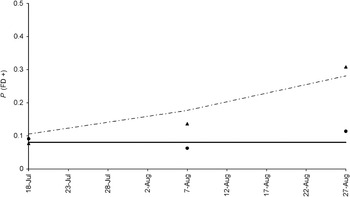
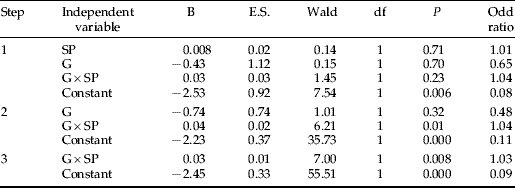
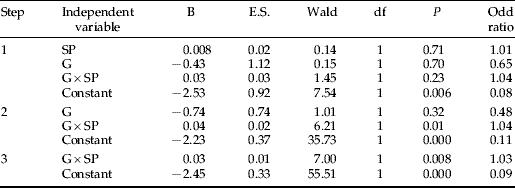
On the whole, 182 S. titanus adults were tested for the presence of phytoplasmas (100 males and 82 females). Overall infection rate with FD phytoplasma was 15.3% in males and 9.7% in females; the highest rate was recorded at the end of August when 35% of males and 11% females were found FD positive. Binary logistic regression provided a good fit with observed data (Hosmer-Lemeshov test, χ2=2.01, 4 df, P=0.73). However, only the interaction between the two explanatory variables provided a significant relationship with FD infection; the odds of having a FD positive S. titanus male is increased by a coefficient of 1.03 per day (table 3, fig. 3). The model that included the explanatory variables (gender and sampling period, and the interaction between gender and sampling period) predicted correctly the status of FD phytoplasma infection (positive or negative) in 87% of S. titanus individuals included in the data set; however, the same result was obtained from the model without the explanatory variables and with the intercept only (i.e. a model that classifies all the 182 subjects of the data set as not infected from FD independently from gender and sampling period) (χ2=6.71, 1 df, P=0.01). In conclusion, FD infection seems to increase during the season only in males, but these data must be considered with caution.
Progression of FD infection in S. titanus observed at different sampling dates fitted with those predicted by binary logistic regression equations. P (FD+), probability of having FD positive individuals [—, females (predicted); •, females (observed); –. –. –, males (predicted); ▴, males (observed)].

Logistic regression of FD infection of S. titanus on gender (G) and sampling period (SP). Explanatory variables were inserted into the model via a likelihood ratio stepwise method. Coding of dummy variable G: females were chosen as the reference category (see also table 1 for details).
Discussion
Data obtained from laboratory rearing showed a 0.6:1 SR for S. titanus that should reflect the real SR of the species. The SR calculated with net sweeping was not significantly different. On the other hand, yellow sticky traps caught significantly more males; this is probably due to an overall higher mobility of males, in order to mate. It is known that S. titanus females mate only once, whereas this is not clear for males, which might move on to mate again (Mazzoni et al., Reference Mazzoni, Lucchi, Prešern and Doberlet2008), and this could explain a female biased SR on a egg rearing basis. Concerning the SR calculated in different periods of the year, a decrease of males' percentage is always evident; males seem to hatch earlier than females. The trend of sticky traps is not different from that detected with egg rearing; on the other hand, the probability of having males decreases significantly in egg rearing from that detected with sweep net samplings. According to Vidano (Reference Vidano1964), adults live, at most, a month. However, some individuals might live longer, in which case sweep net samplings made in the late part of the season may catch older males, too; whereas the emergence peak of males might coincide with their flight peak, resulting in no difference between seasonal trend of SR calculated via egg rearing and sticky traps. On the other hand, females might be more active at the end of the season due to their need to find ovoposition sites, and this could result in a female biased SR on stick traps. Females might also have a longer lifespan than males, and this could explain why few males are caught at the end of the season.
Many leafhoppers are known to present an overall male biased SR calculated on a trap catch basis, compared to a 1:1 SR on plants, and this is often indicated as local movement rather than migration. Spissistilus festinus (Say) (Membracidae) showed a male rate of 89–96% on sticky traps and of 58–67% in sweep net samplings (Johnson & Mueller, Reference Johnson and Mueller1990). The same behavior was found in Graminella nigrifrons Forbes, whose males were more abundant in sticky traps (Rodriguez et al., Reference Rodriguez, Madden and Nault1992). Circulifer haematoceps (Mulsant & Rey) showed a male rate of 85% on sticky traps and only 26% in D-Vac samplings. However, this species is considered a nocturnal migrant and unmated females might not have been caught during daytime samplings (Kersting & Baspinar, Reference Kersting and Baspinar1995). Males of Macrosteles quadrilineatus Forbes were also more engaged in local movements, and SR was 3:1 on sticky traps and 1:1 on plants. Moreover, laboratory experiments demonstrated how in this species' vertical flights were performed mainly by unmated females, whereas mated females were more sedentary, in which case a real migratory syndrome is likely (Hoy et al., Reference Hoy, Zhou, Nault, Miller and Styrer1999).
These last two studies are consistent with the oogenesis and migration syndrome theory that tells how movement is regulated by the juvenile hormone (Dingle, Reference Dingle, Woiwood, Reynolds and Thomas2000). Differences in flight behavior between genders can, therefore, suggest the existence of a migratory syndrome. For instance, it has been demonstrated how females of some Dalbulus species are more likely to fly in daytime during autumn and winter because they rely on prevailing winds for migration, whereas during the remaining part of the season, when they are more sedentary, their flight activity is strongly crepuscular (Taylor et al., Reference Taylor, Nault and Styer1993). A female-biased SR at the beginning of the growth cycle, due to the presence of immigrant females, was also demonstrated for the potato leafhopper, Empoasca fabae (Harris), another migratory species (Emmen et al., Reference Emmen, Fleischer and Hower2004). Consistently, M. quadrilineatus, another migrant species, present a female-biased SR at the beginning of the season on lettuce (Beanland et al., Reference Beanland, Hoy, Miller and Nault2005). On the contrary, both genders of S. titanus have a strongly crepuscular flight activity, and they are therefore unlikely to be carried by the wind (Lessio & Alma, Reference Lessio and Alma2004a); moreover, although S. titanus adults are tightly bound to the vine's canopy, males seem more likely than females to perform a vertical flight outside the boundary layer (Lessio & Alma, Reference Lessio and Alma2004b). This aspect suggests that the dispersal of S. titanus is not due to a migratory syndrome but to local movements that seem to occur earlier for males and later for females; whereas a real peak of emergence can be detected at the beginning of the season, both for males and females. Concerning S. titanus, it may be concluded that males are more likely to perform local movements, particularly at the beginning of the season when they are also more abundant. Higher female captures at the end of the season also may be due to local movements; and a migratory syndrome is unlikely, considering that this species is bound to a highly persistent host, such as grapevine, and does not need to look for new host plants during the season (Denno et al., Reference Denno, Gratton, Langellotto, Woiwood, Reynolds and Thomas2000).
FD infection of S. titanus adults increased in males during the season. A similar pattern was found in New York (Maixner et al., Reference Maixner, Pearson, Boudon-Padieu and Caudwell1993), but the phytoplasmas detected were the agents North American Grapevine Yellows (NAGY), belonging to the groups of the Aster yellows (16Sr I, subgroup A), and of the X disease (16Sr III, subgroup I) (Beanland et al., Reference Beanland, Noble and Wolf2006). Our results should also be considered with caution since fewer males were found and tested at the end of the season. Phytoplasma acquisition in S. titanus occurs in the 3rd nymphal instar (Bressan et al., Reference Bressan, Larrue and Boudon-Padieu2006) and, therefore, should not be influenced by gender. Therefore, the movement of both sexes might be the major aspect influencing disease transmission. In the early part of the season, males are more likely to transmit the disease as they are more engaged in local movements, whereas females seem to be more sedentary and seldom move to other vine plants. On the other hand, at the end of the season, females are more active and are, therefore, more likely to transmit FD phytoplasmas. Since the phytoplasma concentration in vine plants is higher at the end of the season, a higher percentage of leafhoppers is likely to be infective in this period, when residual effect of insecticides might also be over. It has been proved that, in laboratory conditions, neonicotinoids are more effective than organophosphates in long-term prevention from the infection of daisy plant with Chrysanthemum yellows phytoplasma by means of Macrosteles quadripunctulatus (Kirschbaum) (Saracco et al., Reference Saracco, Marzachì and Bosco2008). Since the second treatment of grapevine against S. titanus is generally performed with organophosphates, the same results may be obtained. Finally, it has yet to be proved if a difference in the transmission efficiency is present between S. titanus males and females. For instance, such a difference was proved in M. quadrilineatus, where it was found that the females were more infective (Beanland et al., Reference Beanland, Madden, Hoy, Miller and Nault1999).
Acknowledgements
This research was funded by ‘Regione Piemonte-Assessorato Agricoltura, Programma Regionale dei Servizi di Sviluppo Agricolo’ and by ‘Ministero delle Politiche Agricole, Ambientali e Forestali’ within the ‘Gia.Vi’.