Introduction
Marga LammersFootnote 1 is showing us around a Regional Sheltered Housing Institution (in Dutch: Regionale Instelling Beschermd Wonen or RIBW), at a location in the west of the Netherlands. Lammers works as a site manager at the institution, which provides care to clients who have a mental impairment or multiple disabilities. The site is wedged between a centre of urban growth and a suburban residential neighbourhood. Around 400 clients live and take part in leisure activities here. They include young people, adults and elderly people with mild to severe mental disabilities, behavioural disorders or psychiatric problems. Lammers describes the RIBW institution as a ‘private site with an open character’. Residents of the neighbouring suburb have free access to the area. Visitors to the site gain the impression that they have entered a village for the mentally impaired: the asphalt roads are lined with group apartments with coloured drawings displayed at the windows, minibus taxis carrying disabled people drive up and down and everywhere there are clients tearing around in go-carts.
We interview Marga Lammers about the ideal of the ‘socialisation’ of vulnerable groups in society, that is people who either have a severe mental disability or psychiatric disorder or who live in extreme social isolation (e.g. socially isolated elderly people, drug addicts). As a result of the Social Support Act, which was introduced in 2007, these vulnerable groups in the Netherlands are increasingly required to ‘integrate with the community’ in order to participate ‘amongst the people’ (Verplanke and Duyvendak, Reference Verplanke and Duyvendak2010). For the RIBW institution where Marga works, this implies severe changes in the near future. A large number of the clients will be housed outside of the care site, in apartments amongst ordinary residents. The housing blocks are already under construction. Lammers is concerned about the imminent move:
Soon it will be much harder for us to monitor how people are coping. For instance, we have to insulate bedrooms and shut clients in due to excessive noise levels. We have a girl who suddenly starts screaming at five o'clock in the morning. What's more, they can't cross the street on their own. Most clients don't know what traffic is, let alone being able to watch out for it. In the new situation, they must always be accompanied by a professional attendant at set times if they want to go for a walk. Whereas at the moment, they are able to move around the care site relatively safely. [1]
With the help of concerned family members, it was only just possible to avoid the relocation of the most vulnerable group of clients – those with an extremely low mental capacity – to individual apartments in the district. The site manager has few illusions as to the involvement of local residents when the clients are moved to the neighbouring residential area:
We are doing everything we can to inform residents about the arrival of mentally disabled people in their environment: distributing leaflets, organising information evenings and events. But only one or two people have shown an interest. [2]
The Dutch Social Support Act and research questions
Promoting the social participation of citizens has been one of the Dutch government's central policy objectives for a number of years. All citizens need to ‘participate’ more, including the socially vulnerable. From a social standpoint, this objective gained new momentum as a result of the Social Support Act (in Dutch: Wet maatschappelijke ondersteuning or Wmo). It is for this reason that in the Netherlands the Wmo – introduced in 2007 – is also referred to as the ‘Participation Act’ (see MOgroep, 2007; VNG, 2008). It encompasses the former Disabled Act (WVG), the Social Welfare Act and parts of the Exceptional Medical Expenses Act (AWBZ). In this article, we discuss its two main objectives. On the one hand, the Wmo aims to promote the participation and active involvement of vulnerable groups within society – for instance via active (re-)housing programs to relocate mentally disabled people to residential areas, as in the case of Marga Lammers’ client groups. On the other hand, the Wmo focuses on promoting active citizenship: the participation of able-bodied citizens and their associations in the development and implementation of local social policy. Examples include residents’ associations who keep an eye on isolated elderly people, sports clubs that allow young people with a disability to take part in sports or grass roots organisations providing the municipality with advice by taking part in local Wmo meetings.
The Wmo reflects the current European political trend in the interpretation of citizenship: stressing self-responsibility in one's personal life, fighting against elements of the welfare state that are believed to be invasive and implying a shared responsibility of government and civil society in the care and welfare for vulnerable groups (see Van Ewijk, Reference Van Ewijk2010). In short, the Wmo makes a strong appeal for the revitalisation of civil society in the Netherlands (Hortulanus, Reference Hortulanus2004; Tonkens, Reference Tonkens2010). It is clear that the two participation objectives of the Wmo are closely interrelated: in order to allow vulnerable groups to take part in society, it is essential for organisations that operate in citizens’ immediate living environment – such as associations, companies and voluntary organisations – to ensure that socially vulnerable groups have more opportunities to take part. Primary responsibility for implementing the Wmo lies with the municipalities. The process of decentralisation is designed to bring social policy closer to citizens. Dutch municipalities are to assess which resources, facilities and manpower are required to meet the needs for support of their citizens. Municipalities therefore act as coordinators of the Wmo: they need to mobilise their local civil society.
Four years have passed since the introduction of the Wmo. At the local level, the Social Support Act is beginning to be implemented. To assess its impact, we examine the following questions:
1. To what extent is it possible to raise enthusiasm amongst able-bodied citizens for the objectives of the new Act?
2. How do civil society organisations value their expected greater contribution to social goals and policies?
3. What impact do the Wmo and its associated measures have on socially vulnerable groups?
4. How tolerant is the receiving community (in neighbourhoods, civic associations and in the workplace) when it comes to the inclusion of people with mental disabilities?
Based on two studies we carried out since the introduction of the Act, we claim that the Wmo is perhaps too dogmatic in its approach to increase the participation of both able-bodied and vulnerable citizens. As a result, it may produce paradoxical policy outcomes. We distinguish between three participation paradoxes. The first paradox manifests itself on an institutional level. It refers to the relationship between professional and non-professional organisations. The goal of the Wmo is to revitalise civil society, however our research shows that up until now the main parties to profit from the Act are professional care and welfare organisations. The second, more profound research outcome deals with the psychological vulnerability, participation and inclusion of vulnerable groups in society. The paradox that emerges relates to the socialisation policy that is applied to people with a severe mental disability or behavioural disorder – as outlined in the introduction to this article. In theory, the participation of these groups increases when they are housed in residential areas, due to a supposed increase in social contact. In reality, this policy has an ironic impact, for to allow them to live ‘among the community’ means that their freedom of movement must in fact be restricted. The third paradox relates to the principle of needs-based management in the care for vulnerable groups, on which the Wmo is based. Many of the people who drop out of society – for instance mental healthcare clients, addicts and socially isolated people – do not or only barely see or understand their own problems, let alone being articulate enough to express their own care needs. As is the case with those with a severe mental disability, their mental state is not sufficient for this to be possible. This can mean that they are not provided with the right care, support or incentives to take part, causing their situation to deteriorate further.
State-promoted civic engagement and participation of vulnerable groups
To expand the logic of our empirical findings, we briefly discuss some key issues regarding state-promoted civic engagement and participation of vulnerable groups. The premises of the Wmo and its objectives can be traced back to the 1980s. In Anglo-Saxon countries such as the United States, Canada, the United Kingdom and Australia, a neo-liberal politics emerged, which focused on reduced government provision, stimulated market-based strategies in public services and emphasised the self-responsibility of citizens (Marinetto, Reference Marrinetto2003; Fletcher-Morgan and Leyland, Reference Fletcher-Morgan and Leyland2010). In the Netherlands, a similar process occurred in the 1990s, which resulted in significant cuts in the welfare state and a withdrawal of government out of many public spheres. The neo-liberal strategy of the Dutch government also comprised a more instrumental (or functional) approach to citizenship. Promoting active citizenship became a means to achieve a political policy end. Previously, the government occupied a limited role in shaping citizenship, but in recent years it increasingly behaves as a gatekeeper that determines which forms of behaviour can be labelled as ‘good citizenship’ and which cannot (Prior and Barnes, Reference Prior, Barnes, Barnes and Prior2009). The new political discourse implied a concrete interpretation of ‘social citizenship’ (Roche, Reference Roche, Isin and Turner2002) and a stronger appeal to the civil society to include and care for vulnerable groups. As a result, voluntary organizations in the Netherlands were encouraged to support people who found themselves at the fringes of society.
Some authors have raised questions whether active citizenship can be utilised for the instrumental logic of government policy (cf. Verhoeven and Ham, Reference Verhoeven, Ham, Verhoeven and Ham2010). Ostrom (Reference Ostrom2000) points to the phenomenon of ‘crowding out citizenship’: if citizens experience government interventions as too controlling or compelling, it will impede their intrinsic motivation to contribute in the service for the public good. Also, a process of ‘institutional isomorphism’ comes to mind whereby a transfer of rationalisation and bureaucratisation processes from the competitive market place to the state makes organisations increasingly similar in their objectives and structuration (DiMaggio and Powell, Reference DiMaggio and Powell1983). Deakin (Reference Deakin1996) explored the particular concerns of voluntary organisations in the United Kingdom in the face of new responsibilities in community and social care policy. Bestowed upon them by the government, many voluntary organisations saw themselves confronted with new legislation and even contracting procedures, stemming from the New Public Management model (Boston et al., Reference Boston, Pallot and Walsh1996). One of Deakin's findings was that voluntary sector providers were sceptical about the potential benefits of this approach to end-users and the change in intrinsic values it implied for the organisations themselves.
A second key issue is the active involvement and inclusion of vulnerable groups within society. In Western countries, mental disability-related public policy predominantly emphasises reducing the number of people experiencing exclusion from the spaces of the social majority as being the pre-eminent indicator of inclusion (Milner and Kelly, Reference Milner and Kelly2009). In many countries, the policy aimed at people with long-term limitations has been dominated by efforts to retain and, where possible, restore independent functioning and participation in society. Hall (Reference Hall2004) has even argued that reducing the number of people experiencing exclusion from mainstream society is the unifying principle of social policy in the UK. In the Netherlands, the Dutch term vermaatschappelijking (‘socialisation’) is gaining currency as a means of describing a whole series of changes needed to make realisation of these aims possible (Kwekkeboom and Koops, Reference Kwekkeboom and Koops2005), of which the Wmo is the most recent and far-reaching addition. In many cases, these socialisation policies result in random de-institutionalisation, whereby care institutes take clients out of their own community and transfer them to unknown residential areas.
From an ideological standpoint, the socialisation of people with mental impairments is worth pursuing. Promoting participation in society seems a prerequisite to social inclusion. However, there are some caveats that question absolute interpretations of this view. Milner and Kelly (Reference Milner and Kelly2009) challenge the assumption that the path to social inclusion is unidirectional, that is involving people with disabilities making a journey to mainstream contexts, without any expectation that non-disabled people need to make the return journey. They argue that community participation for people with mental disabilities almost invariably involves a migration away from places where they feel known and secure to spaces in which they occupy positions of inferior knowledge, expertise or social capital. According to Milner and Kelly, services that have inverted the conventional route to participation by inviting the community to engage with people with disabilities within the spaces they feel safe are worth contemplating. Moreover, the ways in which location may affect social participation and access to social support among people with disabilities are still unclear (McPhedran, Reference McPhedran2011). The assumption that increased mainstream socialisation – irrespective of the locality or context – improves the overall well-being and life satisfaction of people with disability might be too one-sided. Verplanke and Duyvendak (Reference Verplanke and Duyvendak2010) conclude that when Dutch psychiatric patients and mentally disabled people live on their own, they often receive very little care or support from the neighbourhood. Although some ex-mental healthcare clients are happy with the freedom that independent living provides them, they rarely manage to have a social life within the neighbourhood.
Methodology and data
In 2007 – the year that saw the introduction of the Wmo – we carried out the first study into the Wmo's impact in the welfare, care and civil society sectors. This study can be viewed as a benchmark for the involvement of professional and civil society organisations in the Wmo, and how these organisations assess its impact. In this first study, the central research question was to what extent the services, policies, structure and the operational management changed for organisations as a result of the introduction of the Act, and what impact the Act had on staff, volunteers and clients of the organisations involved. Both quantitative and qualitative research was carried out in order to answer these questions. In 2007, a questionnaire (Wmo monitor) was distributed to implementing bodies (N = 383). An interview cycle (N = 25) with representatives of sector organisations was also linked to the Wmo monitor.
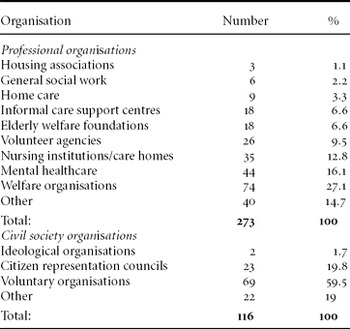
A second study was conducted in 2009 and 2010. This study focused more directly on the involvement of the civil society with the Wmo – in terms of a stronger contribution to social goals and policies – and the consequences of Wmo-associated socialisation measures for vulnerable groups. Again, questionnaires were distributed in 2009 (Wmo monitor) and in-depth interviews (N = 30) were held in the course of 2009 and 2010. The survey was carried out amongst professional organisations in social care and welfare (e.g. general social work organisations, homecare facilities, mental healthcare institutions and welfare organisations) as well as civil society organisations such as voluntary organisations (e.g. charity work, social support associations, scout clubs), grassroots initiatives, citizens representative councils (e.g. neighbourhood platforms) and sports clubs (N = 389, see Table 1). Qualitative data were gathered through on-site interviews with representatives of organisations and from case studies of people with mental disabilities, behavioural disorders or psychiatric problems. These case studies were provided by a municipality official who collaborated in the research. For this article, we selected the case that most clearly illustrates the paradoxical outcomes of care avoiders, which will be discussed below in the section on paradox 3. In addition, the study involved analysing fifty municipal Wmo policy plans. This article mainly uses data from the second study into the effects of the Wmo.
Distribution of organisations in the 2009 Wmo monitor sample (N = 389)

Results
Paradox 1: Civil society at the sidelines
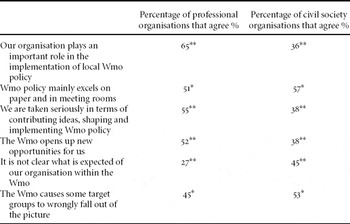
The first study in 2007 revealed that the introduction of the Wmo had caused a great deal of commotion within the professional field. Professional care and welfare organisations extended their own professional networks and sought to coordinate with strategic partners and the municipality (Lub et al., Reference Lub, Sprinkhuizen and Alblas2008). However, the Act in 2007 largely passed over civil society organisations. An important sign in the response from the civil society organisations was that they did not recognise the Wmo as an Act that had anything to do with them. The follow-up study in 2009 and 2010 shows that more than two years later, the involvement of civil society organisations was still as limited as it was when the Act was first introduced. Moreover, there are signs of a rift between civil society organisations and professional organisations in terms of their assessment of the Wmo. The second survey in particular reveals strong evidence of this. Table 2 illustrates the distance between the professional sector and civil society based on response percentages to a number of assertions presented in the Wmo monitor 2009.
Responses to assertions in the Wmo monitor: differences between professional and civil society organisations

* Note: Difference between mean score of professional and c.s. organisations significant at 5% (ANOVA).
** Difference between mean score of professional and c.s. organisations significant at 1% (ANOVA).
It is clear that professional organisations feel that they are taken considerably more seriously in terms of contributing ideas about the Wmo and shaping and implementing Wmo policy than civil society organisations. Also when it comes to new opportunities perceived by organisations from civil society as a result of the Wmo, professional institutions are significantly more positive. The Wmo evidently creates more opportunities for professional organisations than for civil society organisations. Civil society organisations also generally have a more negative attitude towards the Wmo as a system reform. They have a greater tendency than professionals to believe that the Act mainly excels on paper and in meeting rooms, whilst, in their view, the Wmo causes some target groups to wrongly fall out of the picture.
An initial explanation for the limited involvement of civil society is that municipalities do not have sufficient insight into the spectrum of civil organisations in their jurisdictions and are occasionally lax in involving their citizens in policy making. The case studies reveal that many municipalities are still trying to identify a proper way to meet their relatively new responsibilities as coordinators of the Wmo, and the civic partners that could support them in this task. This means that they are less able to clarify to civil parties what they expect from them. Although most municipalities state in their Wmo policy plan that they are making efforts to involve civil society, specific organisations are rarely mentioned. In other words, the intention is there, but not the ideas for realisation (see also Van Marissing and De Meere, Reference Van Marissing and Meere2009). All of this means that Wmo policy is still something that primarily affects the professional sector. Metz (Reference Metz2010) lucidly illustrated this on the basis of a local case study into Wmo policy in the Dutch municipality of Dordrecht: pressure from government agencies and professional institutions left no scope for input from civil society organisations.
However, the limited involvement of civil society organisation in the Wmo cannot be solely attributed to a wait-and-see approach by municipalities or to ‘crowding out citizenship’. A second explanation relates to the fact that many voluntary organisations and associations feel that they have a limited involvement in the Act because they themselves do not (want to) label themselves as ‘care organisations’. A significant obstacle is that part of civil society is not jumping at the prospect of being formally addressed about the results of social policy objectives, such as including vulnerable groups in their regular activities. For instance, can a scout club be expected to be able to adequately cope with children with a disability? And who is responsible if something happens to them? As a result, voluntary citizen associations are often reluctant when it comes to placing a greater focus on typical Wmo policy in their activities, such as the inclusion of groups of people who need support, or forming ties with the municipalities and professional institutions from the realm of care and welfare. This is further illustrated by the fact that only a limited proportion of civil society organisations in the Wmo monitor describes themselves as an important entity in the implementation of local Wmo policy (see Table 2).
Paradox 2: how socialisation can lead to isolation
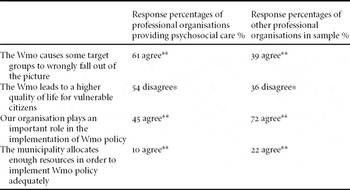
A salient outcome of the study in 2009–10 is that professional organisations that are involved in supporting people with a mental disability, psychosocial care and addiction services (such as public mental healthcare organisations and care institutions, N = 72) have a significantly more negative attitude towards the impact of the Wmo than other professional respondents in the sample. For example, 61 per cent of these institutions agree with the assertion that the Wmo causes target groups to wrongly fall out of the picture, as opposed to 39 per cent of the other professional organisations (see Table 3). Table 3 further illustrates that results on assertions concerning the positioning and allocation of resources in Wmo policy point in the same direction.
Responses to assertions in the Wmo monitor: differences between professional organisations providing psychosocial care (N = 72) and other professional organisations in sample

* Notes: Difference between mean score of psychosocial and other professional organisations in sample significant at 5% (ANOVA).
** Difference between mean score of psychosocial and other professional organisations in sample significant at 1% (ANOVA).
Just as in the introductory year of the Wmo, there is uncertainty in the field of mental health services about the loss of professional support for vulnerable groups, the associated socialisation measures and how the situation of clients will turn out under the new regime of the Wmo. Although socialisation policies in the Netherlands stem from long before the introduction of the Wmo, they did receive an extra boost with the advent of the Wmo. The fifth performance indicator of the Act explicitly states the objective of promoting the social participation of people with disabilities and persons with chronic mental or psychosocial problems.
At the start of this article, we outlined the experiences of Marga Lammers who, as the Site Manager of a RIBW institution, experiences daily the implementation problems associated with the policy ambition to allow people with psychological problems to function independently in society. Staff at the institution have strong objections to the relocation of mentally disabled client groups to the neighbouring residential area. This deinstitutionalisation – that is relocating clients out of institutional care facilities − could have undesired consequences for clients’ personal integrity and safety. Parents and family members are also concerned. The neighbourhood has problems with loitering teens and the question is how this will affect the safety of the clients. Family members are afraid clients will be harassed by young people or that people will laugh and stare. The bullying of disabled persons in the area by street youths is not a rare occurrence. For the RIBW institution, the socialisation process leads to a number of complications. The site formally belongs to the care institution, but anyone is free to access the grounds. Staff at the care institution are therefore faced with a dilemma:
We can only approach residents to a limited extent. This will soon become even more difficult when our clients move into the neighbourhood. In their own living environment, residents might be even less tolerant of people with a disability. [3]
One of the attendants regularly accompanies clients to the riding stables and the vegetable garden on the care site. Some local residents let their dogs out in these areas, while some clients are terrified of dogs. According to the attendant:
If I ask the dog owner to keep the dog on the lead, I usually get the response that ‘it is a very friendly dog’. But clients cannot make this distinction and I can't get the owner to understand this. There is also regularly dog dirt lying around. People don't clean it up, but some clients will put it in their mouths. It is not simply the case that the clients need to get out into the neighbourhood more, the neighbourhood also comes to us. [4]
The rehousing of the clients not only places greater demands on the professional supervision of clients. It also has a paradoxical impact on their freedom of movement, personal integrity and safety. In their new living environment, homes need to be insulated to prevent excessive noise levels, clients can no longer cross the road without professional assistance and a vital question is whether the interaction in the public space between residents and professionals and between residents and clients will go smoothly – which could lead to a further deterioration in the problems of clients. As becomes clear from the citations above [3, 4], the current interaction with residents on the protected care site does not hold out great prospects. Based on the information we gathered on individual cases and the results of the questionnaires as part of the Wmo study, we can conclude that care institutions are experiencing diminishing tolerance within society for ‘people with difficulties’. Plans in the Netherlands to locate facilities for addicts or people with psychosocial problems in residential areas often lead to protest, as two regional managers of a care facility for drug addicts [5] and psychiatric care [6] explain:
Citizens do not automatically accept their ‘fellow-citizens’ in their direct surroundings – especially when these fellow-citizens display odd behaviour, are prone to addiction or possess mental handicaps. It is very important to realise that at any time and in any area, there are opposing forces that can stir up the whole neighbourhood. [5]
Some housing associations are reluctant to house psychiatric patients, because people don't want them in their neighbourhood. Our clients are very stigmatised. The housing association will say: ‘hey, that's a guy from the psychiatric care facility, we don't want those nutcases’. Believe me, it's true, people just don't want them. [6]
Case studies of Verplanke and Duyvendak (Reference Verplanke and Duyvendak2010) indeed show that Dutch clients with psychosocial problems who are housed individually are rarely received with open arms by local residents. This means that by living in an ordinary neighbourhood they run the risk of becoming socially isolated.
Paradox 3: the lack of demand for care from care avoiders
To encourage employment amongst socially vulnerable groups, many Dutch municipalities establish a link between the Wmo and the Work and Social Assistance Act (Wwb). A similar socialisation paradox can occur within this group as the one emerging in the context of the living environment of mental healthcare clients. As the problems encountered by this group often extend beyond a lack of employment skills, aiming to achieve social mobilisation often does not lead to participation in society. Worse still, instead of reducing the gap between this group and ‘mainstream’ society, this can actually serve to reinforce the position that these people occupy on the fringes of society, leading to a relatively high risk that they will slip through the net. It is not rare for them to actively seek to avoid care. In other words, they no longer accept assistance or refuse to cooperate where assistance is provided. Care avoiders tend to ‘withdraw’ or ‘give up’ to a certain extent (see e.g. Schout, Reference Schout2007; Linders, Reference Linders2010). This brings us to the discussion of the third participation paradox: the lack of demand for care from care avoiders.
Peter Dijkstra (age twenty-four) meets the above profile. Since his youth, Peter has experienced problems with severe mood swings and he tries to suppress his emotions by smoking weed. As a result he is often tired and listless, and constantly depressed. His parents receive benefits, as do many of his family members. As a young person, he lived on the street for a number of years. He finally accepted help from the housing association and was assigned a flat. He is often mistrustful of others and becomes aggressive when he feels he is being placed under pressure. He also becomes stressed when he is required to do something. He did not finish school and was dismissed from the few jobs that he has held because he failed to turn up.
Under political pressure, social services of Peter's municipality have initiated a mass review of their client base. All social assistance clients are being screened to determine their ability to participate. Although Peter was rejected a few years ago due to psychological problems, he is also being called up. His diagnosis was ‘provisional’, which means that according to the municipality there is a chance that he may now once again be able to make a partial or full contribution towards society – for example, through employment. He is receiving support from an organisation that provides addiction services, however his case manager at social services does not consider it necessary to contact his care provider. Peter is signed up for a work−study programme to become a welder, which will enable him to obtain a welding diploma in one year, funded by the municipality. This will make him more attractive to employers. Following an initial interview with the company carrying out the project, Peter is admitted. The municipality invests €17,500 in Peter's training and education.
The first week everything goes well. Peter turns up in a presentable manner and pays attention during the classes. He has little contact with the teacher and fellow students, and during breaks he regularly stands outside smoking a joint. In the second week, Peter is required to carry out an assignment with another student. The two get into an argument and Peter becomes aggressive. The supervisor is used to ‘difficult’ students, but he is unable to get Peter under control. Eventually the police are called. Once at home, Peter decides to give up. He no longer leaves his house. On Monday, he fails to turn up again. After some investigation, the case manager contacts Peter's care provider at the addiction services. They visit his home on a number of occasions, but the curtains are shut and they can see no movement. They decide to push a letter in the letterbox, which they leave hanging out. A day later the letter has disappeared, indicating that Peter is at home. After five weeks, the training centre decides to abandon the course in consultation with the municipality. When his care provider finally manages to contact Peter weeks later, it emerges that he became stressed as a result of the course and the people around him. He wasn't able to cope, he said, and he wanted to commit suicide. The care provider eventually arranges for him to be admitted in a psychiatric institution, because of his extremely filthy home and his continuous threats to take his own life if the municipality pressures him to do anything outside of his home.
Peter Dijkstra's case exposes a number of unintended effects. It shows that the principle of needs-based management, which forms the basis for current theory regarding participation, can turn out to be very problematic for some target groups. Many socially vulnerable people are unable or barely able to manage their own lives, let alone express their own need for care. The question arises whether government officials and social professionals are able to identify the support needs of such clients adequately (see also Van Rooyen, Reference Van Rooijen2004). Peter's case shows that when professionals decide on their own what is good for them, this could backfire. The result is often a very difficult relationship with organisations that provide care, mistrust of care providers and sometimes even the complete avoidance of care and support (see also Schout, Reference Schout2007; Linders, Reference Linders2010). Encouraging employment amongst people with psychosocial problems can in fact cause clients to run into even greater difficulties. When Peter got stuck in the work−study programme, he completely withdrew into his own world.
Conclusions
The first participation paradox illustrates that, contrary to the objectives of the Wmo, a ‘revitalisation’ of the civil society remains problematic whilst professional entities thrive under the new governmental élan. Since the introduction of the Act, limited progress has been made in mobilising informal civil society in terms of a stronger contribution to social goals and policies. The Wmo expects a great deal from these mainstream civil society organizations (e.g. sports associations, voluntary clubs and religious organizations) that operate in the immediate living environment of citizens. Despite the appeal the Wmo makes for more social citizenship (inclusion of vulnerable groups, contributing to social policy making, linking care and welfare, etc.), they feel very little involvement in the new Act. As we have outlined, the two participation objectives of the Wmo are closely interrelated: in order to allow vulnerable groups to take part in society, it is essential for civic organisations to ensure that socially vulnerable groups have more opportunities to take part. In this respect, our study exposes a number of barriers:
1. A wait-and-see approach by municipalities to actively involve civil society.
2. ‘Crowding-out’ citizenship by government bodies and professional institutions.
3. Restraint and inability of civic organisations to include and share responsibility for vulnerable groups.
Further research will have to clarify other possible dilemmas for volunteer organisations and citizen associations, and how these can be made more manageable. This may provide clues as to how the ‘social return’ of ordinary citizen associations can be increased, without having to sacrifice their core activities or be held unduly responsible for formal social policy objectives.
The second and third participation paradox illustrate that a too-dogmatic approach to the social participation of vulnerable groups through mandatory measures can actually increase their isolation. The bottleneck lies in the assumption that increased socialisation into mainstream contexts, irrespective of the locality, improves the overall well-being and life satisfaction of people with mental impairments and disorders. The experiences of Marga Lammers and the case of Peter Dijkstra show that the causal relationship is not so clear-cut. It can even be counterproductive, sending clients further into a downward spiral.
The assumption that the number of people who end up dropping out of society can be reduced by promoting their participation is in fact a circular argument: some people do not participate enough because they cannot participate enough. Kunneman (Reference Kunneman2000) states that modern society can be seen as a ‘technopolis’, in which inevitably people live who ‘have nothing to offer’. They cannot keep up with the high pace of life and therefore lag behind. For them, society has become too complex to order their life by means of the resources available to them from society. Rauch and Dornette (Reference Rauch and Dornette2009) for instance show that when it comes to entering the labour market, simply applying the same rights to people with disabilities and to non-disabled persons does not help to resolve the problems faced by people with disabilities regarding their labour market integration. In light of this view, Bauman (Reference Bauman2004) states that it is a natural characteristic of technologically developed and modern societies to produce ‘waste’: people who cannot keep up fall by the wayside. Of course, this does not imply that vulnerable groups should be marginalised. But it does challenges the notion of ‘normalisation’, the ideal that people with mental impairments should enjoy patterns and conditions of everyday living as close as possible to the norms and patterns of the mainstream society (Nirje, Reference Nirje, Kugel and Wolfensberger1969; Yates et al., Reference Yates, Dyson and Hiles2008). Normalisation de facto starts from the assumption that being ‘different’ is less desirable than being ‘normal’ and that disabled people should therefore strive to be something other than what they are (Morris, Reference Morris1991).
Discussion
It should be noted that our findings do not argue against promoting a certain level of participation of socially vulnerable people. Neither do they imply a renunciation of the Dutch government's encouragement of active citizenship. We do propose that the underlying assumptions of state-promoted participation should take a more nuanced and differentiated approach. The mental healthcare workers we interviewed emphasised that they do not a priori oppose socialisation. On the contrary, they would like nothing better than for ordinary citizens to learn to understand what it is like to have a mental disability or to live with a psychological disorder. These professionals are concerned that politicians and the public administration are failing to distinguish between target groups. Therefore, we advocate a differentiated approach to participation.
First, a differentiated approach takes the divergent capacities of various vulnerable groups into account. Not all vulnerable groups are prone to paradoxical effects of participation policy. With certain adjustments, young people with a mild mental disability are usually able to live ‘a normal life’ in a residential area. And for elderly people in need of support, daily activities can often be helpful to take part in the community. But as we have seen in the case of the client groups of Marga Lammers, people with very limited mental capacities or severe psychological problems tend to fare better in a safe and specially created environment. Simply transferring these groups to residential areas is trying to cut too many corners at once. In this respect, our findings are at odds with recent Australian research of Muir et al. (Reference Muir, Fisher, Abello and Dadich2010), which suggests that meaningful participation in the community is possible, even for people with high levels of psychiatric disability (if a certain level of housing support is available). We purport that this is only possible for people with low levels of psychiatric disability, and, even then, the outcomes are not exclusively positive (see the case of Peter Dijkstra).
Second, a differentiated approach prioritises the psychological safety of clients over the objectives of participation policy. Dutch Wmo policy appears to be primarily the domain of politicians and civil servants who are attempting to tackle inactivity starting from a particular political discourse. Whether the associated measures are in the interest of the groups in question is often ignored. The potential of the ‘inverted route to participation’, as an alternative to the unidirectional approach of socialisation is challenged by some of our findings (see e.g. citation [4]). Social contact between ordinary citizens and people with mental disabilities might allow people without disabilities to ‘see reflections of their shared humanity’ (Milner and Kelly, Reference Milner and Kelly2009: 60), but on a more mundane level it can also lead to tense interactions in the public space. The question is whether Dutch policy-makers and implementing bodies sufficiently take the negative dynamics of perceptions on mental disability into account. Instead of requiring mentally disabled persons to adapt to a potentially hostile social environment, targeting public opinions and policies that contribute to negative or ignorant perceptions of the mentally disabled might be a more fruitful route (Culham and Nind, Reference Culham and Nind2003). Although expectations of increasing the understanding of the general public should not be too rosy (see e.g. citation [2]), more awareness can be created through education, for example encouraging children to fulfil school internships at institutions that provide psychosocial care, or providing government information campaigns that show how to deal with mentally impaired persons in the workplace or the neighbourhood.
In any case, the present study indicates that state-promoted civic engagement and participation of people with severe mental disabilities must extend beyond views that are too dogmatic. If not, the very policies that aim to improve the quality of life of vulnerable citizens are at risk of causing the opposite effect.
Acknowledgement
The authors are grateful to Liesbeth Schotanus for contributions to an earlier version of this article. Both authors formerly at MOVISIE, The Netherlands Centre for Social Development.