Central-line–associated bloodstream infections (CLABSIs) are a major health burden within the pediatric oncology and hematology population, with CLABSI rates of 0.65 and 2.2 per 1,000 central-line days for ambulatory patients and inpatients, respectively.Reference Rinke, Milstone and Chen1,Reference Hord, Lawlor and Werner2 Prevention bundles, as a systematic prevention policy or as a response to an infection outbreak, have led to significant improvements in patient management, reducing CLABSI rate within the inpatient pediatric oncology and hematology population.Reference Rinke, Chen and Bundy3
In our institution, inpatients are cared for in either conventional units or protected units if they undergo hematopoietic stem cell transplant (HSCT, allogenic and autologous), intensive chemotherapy for acute myeloid leukemia or for refractory or relapsing acute lymphoblastic leukemia. In 2006, we launched a dedicated hospital-at-home (HAH) program covering the entire Auvergne-Rhone-Alpes region (recognized as an independent hospitalization department in 2009), which allowed the administration of chemotherapy at home.Reference Bertrand, Favier and Devaux4 The development of individual HAH programs follows families’ wishes for fewer hospital visits,Reference Lippert, Semmens and Tacey5 and HAH has been shown to improve both physical and mental health for patients and their caregivers.Reference Hansson, Kjaergaard and Johansen6
Our HAH patients receive substantial care from a team of home healthcare nurses, the number and training of whom vary widely from those of inpatients. The regional general nurses, who do not have specialized experience in pediatric oncology and hematology, are registered by our institution. They are given specific training by our coordinating team of pediatricians to deal with more complex situations, including chemotherapy, palliative care, or specific care, working in close collaboration with home healthcare services.Reference Rinke, Chen and Milstone7 In our HAH program, central lines are managed only by healthcare professionals; parents do not access their child’s line.
Given the level of care of patients in our HAH programs, with intensive chemotherapy courses causing a greater immunosuppression and frequent central line handling, we sought to determine whether they were at a greater risk of developing CLABSI compared to inpatients in our institution. We conducted a monocentric retrospective study based on medical files describing CLABSIs occurring during HAH in terms of infection rates, microbiology, and clinical consequences (eg, treatment modifications) to obtain precise knowledge of CLABSI rates and feedback on the efficacy of our HAH practice.
Methods
Design
We conducted a retrospective monocentric study based on samples and data collected by our pediatric, oncology-hematology, French referral center between January 1 and December the 31, 2016. Yearly, our institution cares for 250 new pediatric patients and performs, on average, 50 HSCTs. Patients displaying fever are systematically admitted and hospitalized within 24 hours, providing us with large archives of blood samples and blood cultures. In accordance with current legislations, and given the retrospective nature of our study, no approval from an institutional review board for ethics was required. Nevertheless, data collection was conducted according to the MR004 reference methodology of the French data protection agency (“Commission Nationale de l’Informatique et des Libertés”). This study was registered with the National Commission for Information and Civil Liberties (CNIL). The data were anonymized, and publication of the results should not result in the patients being identifiable.
Data collection and definitions
Over the 12-month study period, our bacteriology laboratory provided us with every positive blood culture recorded. For each positive bacteremia case, we verified the situation of patients at the onset of infection: inpatient (hospitalized within the institution), HAH, or outpatient (ambulatory care not requiring hospitalization). We then extracted similar data from our files for each HAH stay as a continuous period with daily care, regardless of duration: age, sex, oncologic diagnosis, catheter type, number of days of the stay, treatment given through the central line, use of parenteral nutrition, absolute neutrophil count, treatment, catheter salvage or removal, clinical outcome. A central-line day was defined as 1 day spent in hospitalization (HAH or conventional) for 1 patient. Following the CDC guidelines,Reference Horan, Andrus and Dudeck8 we defined an HAH-related CLABSI as a febrile episode with a positive blood culture for a pathogenic organism without evidence of another infectious source for patients with central-line manipulation in HAH following 48 hours. If the patient had been admitted at the hospital (conventional hospitalization or daycare) within 48 hours of central-line manipulation, the bacteremia was not considered an HAH-related CLABSI. Infections with common skin contaminant, such as coagulase-negative staphylococci (CONS), were considered only when 2 or more blood cultures drawn on separate occasions were positive. Aplasia was defined as an absolute count of granulocytes <500 cells per mmReference Rinke, Chen and Bundy3. From these data, we were able to calculate the rates of CLABSI per 1,000 central-line days in HAH patients and inpatients.
Statistical analyses
Data analysis was performed using R software for Windows, version 3.1.0. i386 (R Foundation for Statistical Computing, Vienna, Austria). Patients were separated according to their status as CLABSI or non-CLABSI. Qualitative data were presented in terms of associated frequencies and percentages, and quantitative data were described by median and interquartile range (IQR). We used the Pearson χ2 test (or Fisher exact test when needed) for qualitative data comparison. For quantitative data, we used the Mann-Whitney test for 2-group comparisons or the Kruskal-Wallis test for multiple-group comparisons. To investigate the interaction between factors associated with CLASBI, we performed a multivariate analysis using a regression model. We included in the model every parameter significantly associated with CLABSI in the univariate analysis. Statistical significance was defined as P <.05.
Results
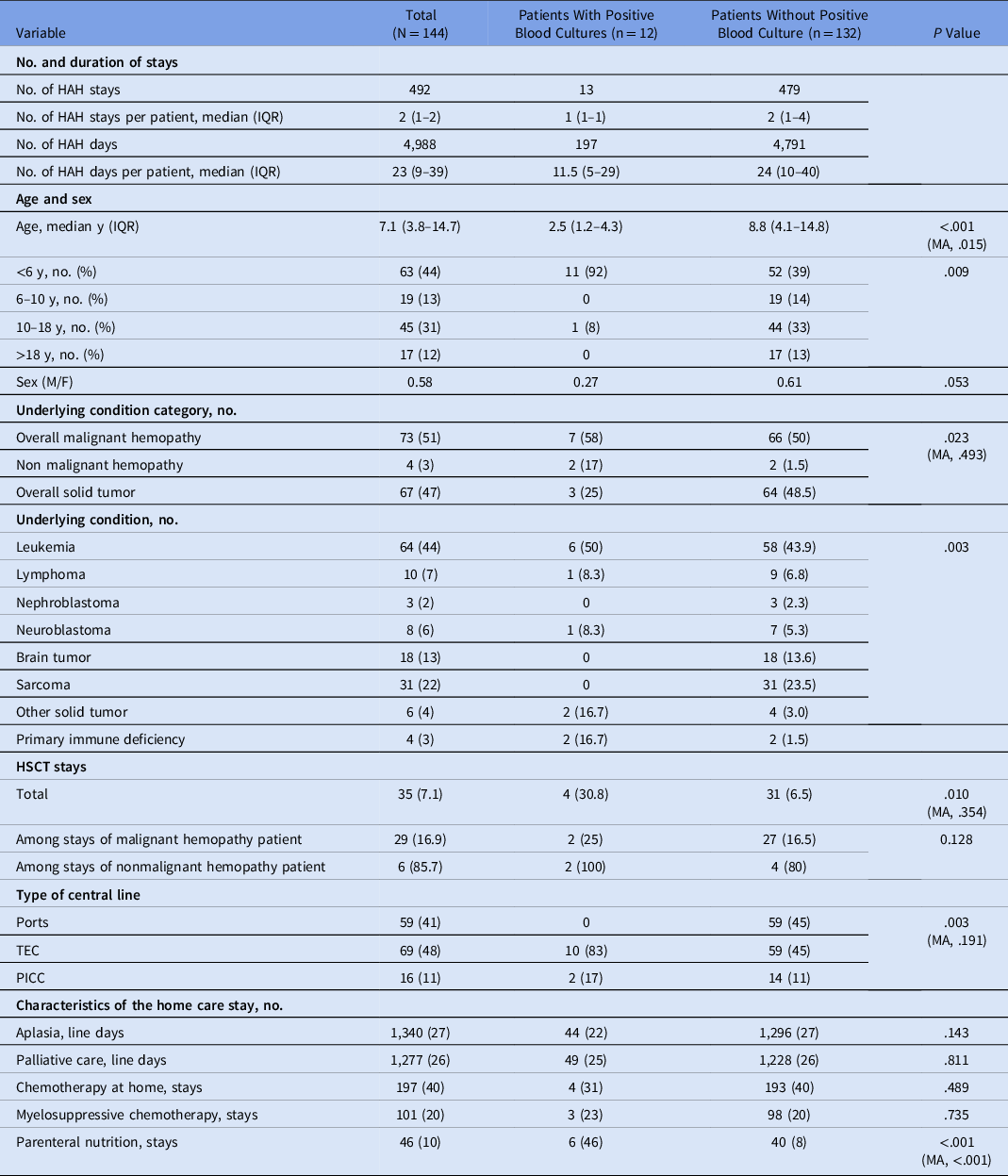
In 2016, 144 patients were included in our HAH program, with 4,988 cumulative central-line days (Table 1). In total, 492 HAH stays were recorded, with a mean duration of 5 days. In comparison, conventional and protected units accounted for >11,000 days of hospitalization and 3,300 day visits in 2016.
Comparison Between HAH Patients With or Without Positive Blood Cultures

Note. HAH, hospital at home; M/F, male-to-female ratio; TEC, totally externalized catheter; PICC, peripheral-inserted central catheter; MA, multivariate analysis; HSCT, hematopoietic stem cell transplant. The multivariate regression model included factors with a significant association in univariate analysis.
General characteristics of HAH patients
HAH stays ranged from 1 day (repeated, mostly weekly administration of chemotherapy) to 156 days, with 194 (39%) stays lasting >1 week. The median age was 7.1 years and the male-to-female sex ratio was 0.58. Most patients were treated for leukemia (n = 64, 44%), followed by sarcoma (n = 31, 22%), and brain tumor (n = 18, 13%). Also, 4 patients (3%) suffered from nonmalignant hemopathies (primary immune deficiency). Among the 492 HAH stays, 35 (7.1%) were patients with an HSCT; 29 were patients with malignant hemopathies and 6 were patients with nonmalignant hemopathies. Each patient had a central-venous access, primarily tunnelled external catheter (TEC; n = 69, 48%) and totally internalized catheters (ie, ports; n = 59, 41%). Also, 40% of HAH stays included intravenous (IV) chemotherapy, half of which was myelosuppressive (20% of stays). During a total of 1,340 (27%) central-line days, children were aplastic. Parenteral nutrition was part of the treatment in 46 (10%) stays, either as continuous infusion over 24 hours or overnight for 12 hours. Moreover, 26% of central-line days spent in HAH were for patients in palliative care, which corresponded to 22 patients (15%). Palliative-care patients had longer stays: median duration of 12 days (IQR, 5–28) versus 5 (IQR, 2–10) for nonpalliative patients (P < .001) (Table 1).
Characteristics of HAH patient malignancies
Significant differences were observed between patients with different types of malignancies. Age distribution was significantly different between groups: patients with nonmalignant hemopathies were younger than those with malignant hemopathies or solid cancers (P = .026), and those with malignant hemopathies tended to be younger than children with solid cancers (P = .059). The latter 2 groups had comparable rates of parenteral nutrition days (P = .65), in contrast to children with nonmalignant hemopathies who received parenteral nutrition more frequently: 248 days per 1,000 patient days, compared to 104 and 99 for solid cancers and malignant hemopathies, respectively (P < .001) (Table 2). Compared to children who did not receive parenteral nutrition, there was no significant difference in the age of patients with parenteral nutrition (median, 4.1 vs 8.8; P = 0.226); however, their distribution across age groups differed significantly (P < .001) (Supplementary Table SI-1 online). Indeed, parenteral nutrition was more frequent for patients aged <5 years or >18 years, with 163.7 and 204.8 parenteral nutrition days per 1,000 central-line days, respectively, whereas parenteral nutrition was limited for children aged 6–18 years. Following our local protocols, patients with solid tumors mostly had ports (n = 56, 83.6%), in contrast to patients with malignant hemopathies who mainly had TECs (n = 61, 83.6%). A PICC was placed in 9 patients (12.3%) with malignant hemopathies and 6 patients (9 %) with solid tumors (Table 2). The use of parenteral nutrition also differed according to the type of central line: parenteral nutrition use was more frequent with PICCs and TECs than with ports: 175.4, 133.1, and 58.5 parenteral nutrition days per 1,000 central-line days, respectively (P < .001) (Supplementary Table SI-2 online).
Age, Parenteral Nutrition, and Catheter Type According to the Type of Malignancy HAD Population

Note. PICC, peripheral-inserted central catheter; TEC, tunnelled external catheter.
Characteristics of patients with CLABSI
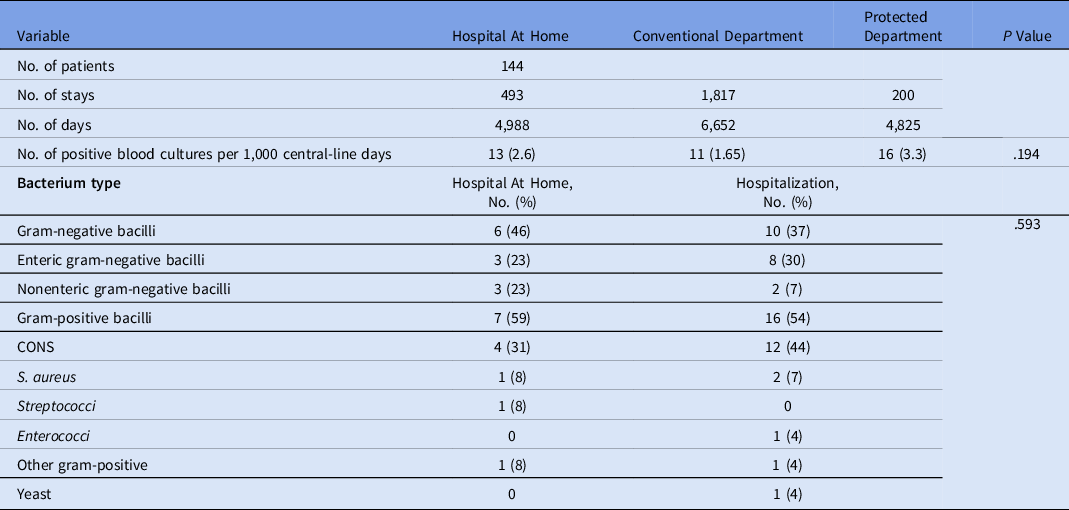
In total, 13 episodes of bacteremia occurred in 2016, to 12 patients during the 4,988 central-line days of HAH. During 2016, 27 episodes of bacteremia occurred among inpatients: 11 in the conventional unit (for 6,652 hospital days) and 16 in the protected unit (for 4,825 hospital days) (Table 3). The overall rates of CLABSI were 2.6, 1.65, and 3.3 per 1,000 central-line days for HAH, conventional units, and protected units, respectively (P = .194).
Comparison Between HAH Patients and Inpatients

Note. CONS, coagulase-negative staphylococci.
Our patients with HAH-related CLABSIs were significantly younger than the total HAH population, with a median age of 2.5 years versus 8.8 years (P < .001). We detected a significant difference in the underlying conditions for HAH-related CLABSI, with more frequent malignant or nonmalignant hemopathy and fewer solid tumors (P = .023). HSCT recipients suffered more CLABSI than non-HSCT patients, with 4 HSCT patients (30.8%) in the CLABSI group versus 31 (6.5%) in the non-CLABSI group (P = .01). Infected patients were more likely to have a TEC than uninfected patients (83% compared to 45%; P = .006) and none had a port. The 2 groups had similar rates of aplasia (22% vs 27% in the infected group; P = .143), and the proportion of patients in palliative care did not differ (25% vs 26% in the infected group; P = .811). Likewise, there was no difference in the proportion of stays that included chemotherapy between the groups (23% vs 20%; P = .735). More patients in the infected group had parenteral nutrition (46%), compared to 8% in the noninfected group (P < .001). Importantly, with 6 HAH-related bacteremia cases occurring during the cumulated 533 days of patients with parenteral nutrition, their specific rate of CLABSI was 11.3 per 1,000 line days. Conversely, the CLABSI rate of HAH patients without parenteral nutrition was 1.6 per 1,000 line days (P = .001). Multivariate analysis of factors associated with HAH-related bacteremia showed a significant correlation between infection and age (P = .015) and the use of parenteral nutrition (P < .001), but it was not significantly correlated with central-line type, with the underlying condition, or HSCT receipt (respectively, P = .191, P = .493 and P = .354) (Table 1).
Characteristics of CLABSI infections between HAH patients and inpatients
The type of bacterial infection did not differ between inpatients and HAH patients; most had gram-positive bacteria (n = 7, 59% for HAH patients; n = 16, 54% for inpatients), mainly CONS (4 and 12 episodes, respectively, representing 31% and 44% of all CLABSI). Staphylococcus aureus represented 13% of gram-positive infections, in similar proportions between the 2 groups. Gram-negative bacilli were documented in 46% and 37% CLABSI episodes for HAH patients and inpatients, respectively. We detected a trend toward more frequent nonenteric gram-negative bacilli among gram-negative bacteria, although the difference was not significant (50% for HAH patients vs 20% for inpatients; P = .30). Among inpatients, 1 fungal infection with Candida albicans occurred, and none occurred in HAH patients (Table 3). No polymicrobial infection was documented. The median duration between the start of HAH stay and the day of infection was 11 days (IQR, 5–29). HAH-related bacteremia occurred within a median time of 192 days following central-line insertion (IQR, 70–228). The only patient who suffered from 2 infections during the study period was a 2-year-old child in palliative care for refractory acute myeloid leukemia who had S. aureus bacteremia and the central line was removed. He presented with Enterobacter cloacae bacteremia 1 month later and was successfully treated with antibiotics.
CLABSI treatment
For 12 cases, the patients were hospitalized for IV antibiotherapy and closer monitoring, 4 of whom were discharged to HAH 3–6 days later. One patient remained in HAH. The empiric antibiotic therapy was appropriate in all cases of HAH-related bacteremia, except 1 patient with a resistant Enterobacteriaceae for whom treatment had to be escalated. The central line was removed in 3 of these cases because of CLABSI. For the other 10 cases, the antibiotic therapy was sufficient to cure the infection. No fatality or case of septic shock was reported following the infections. Among enteric gram-negative bacteria, 1 isolate (33%) had a multidrug-resistant profile, with extended-spectrum β-lactamase (ESBL) production, resistance to fluoroquinolones and ertapenem but conserved sensitivity to other carbapenems. Pseudomonas strains (n = 3) were all sensitive to piperacillin, ciprofloxacin, and carbapenems. The 1 S. aureus strain was methicillin sensitive, and all of the Staphylococcus spp were glycopeptide sensitive.
Discussion
Our study highlighted some characteristics that are overrepresented in the HAH-related bacteremia group; we identified increased risk among children with malignant hemopathies, HSCT recipients, and patients with TECs. Data vary between similar studies regarding the association of CLABSI with age: age did not differ between children with and without CLABSIs for some,Reference Rinke, Milstone and Chen1,Reference Ammann, Laws and Schrey9–Reference Shah, Manning, Leahy, Magnusson, Rheingold and Bell11 but a difference was seen in others, with younger children being at higher risk,Reference Simon, Ammann and Bode12,Reference Shenep, Tanner and Sun13 as in our cohort. This finding may be due to more difficult compliance with dressing protocols in younger children and an increased risk of accidental dressing removal by the child. Similarly, whereas previous similar research has highlighted the greater risk of TEC,Reference Hord, Lawlor and Werner2,Reference Ammann, Laws and Schrey9,Reference Smith, Pullen, Crouse, Rosenberg and Jarvis10,Reference Simon, Ammann and Bode12,Reference Kelly, Conway, Wirth, Potter-Bynoe, Billett and Sandora14 data concerning other pediatric populations concerned with the risk of CLABSI, such as children with long-term parenteral nutrition for intestinal failure, do not yield similar results. They show either comparable risk between TECs versus ports or fewer infections with TECs.Reference Nassar, Hazan and Leibovitz15,Reference Moon, Kim and Yun16 The greater risk for CLABSI in patients with parenteral nutrition has been documented in previous studiesReference Shenep, Tanner and Sun13,Reference Christensen, Hancock and Gattuso17 ; however, disease severity and/or chronic malnutrition may be confounding factors.Reference Viana Taveira, Lima, de Araújo and de Mello18 Whether parenteral nutrition constitutes a risk factor for inpatients as well needs to be explored in a prospective study.
The increased incidence of CLABSI among children with malignant or nonmalignant hemopathies is consistent with previous studies,Reference Ammann, Laws and Schrey9,Reference Christensen, Hancock and Gattuso17 but others have found a lower rate of CLABSI in children with a diagnosis of primary immune deficiency.Reference Moon, Kim and Yun16 In the latter study, which included 251,244 catheter days in 499 children with various conditions (ie, including hemato-oncological, gastrointestinal or renal diseases), the only risk factor for CLABSI was prior bloodstream infection. However, age, underlying pathology, catheter type, number of lumens, and insertion site did not differ between children with or without prior bloodstream infection.
Notably, the various risk factors outlined in the present study tend to overlap. Patients with hemopathies tend to be younger than those with solid cancer and to have a TEC more frequently than a port. However, the frequency of parenteral nutrition was similar in both groups and therefore seems to be independent from the other factors identified here.
In terms of CLABSI rate, our cohort was closer to hospitalized than ambulatory patients: rates for inpatients varied between 1.79 per 1, 000 central-line daysReference Rinke, Chen and Bundy3 after implementation of central-line maintenance care bundles and 7.4 per 1,000 central-line days.Reference Celebi, Sezgin and Cakır19 Rates for ambulatory patients as low as 0.32 per 1,000 central-line daysReference Rinke, Bundy and Chen20 have been reported. Indeed, our HAH patients do not represent children treated for cancer with a central line at home, but patients with daily active care and treatment. In most cases, patients do not have their central-lines connected at all times because treatments are being given once or twice a day (eg, parenteral nutrition administered in the evening and removed in the morning), resulting in a higher risk for CLABSI. Although treatments were delivered by nurses and not dedicated pediatric hematology-oncology nurses, CLABSI rates in the HAH population were not significantly different than those of inpatients.
We did not detect a significant difference in causal bacterial strains between HAH and hospitalized patients. This finding contrasts with another study that reported an increased proportion of nonenteric gram-negative infections among outpatients.Reference Kelly, Conway, Wirth, Potter-Bynoe, Billett and Sandora14 However, our data agree with previous studies showing that most infections are caused by gram-positive bacteria.Reference Simon, Ammann and Bode12,Reference Miedema, Winter and Ammann21 This predominance of gram-positive strains, especially CONS, has also been documented in children with long-term parenteral nutrition for gastrointestinal conditions.Reference Nassar, Hazan and Leibovitz15 The prevalence of infections with multidrug-resistant bacteria was low in HAH-related CLABSIs, with only 1 ESBL-producing Enterobacteriaceae and no glycopeptide-resistant gram-positive strain, despite the wide use of vancomycin for all suspected CLABSIs. The predominance of Staphylococcus spp points out possible flaws in hygiene and central-line management at home.
Although home care is rapidly developing, few studies have analyzed the impact of central-line management outside the hospital setting. Our research provides a detailed and unique description of both CLABSI episodes and their consequences as well as the variety of care provided to our patients. However, this study had some limitations. The retrospective nature of the study may have led to some bias of misclassification. For instance, patients were considered in aplasia during the days between 2 low granulocyte counts (<500 cells per mmReference Rinke, Chen and Bundy3). Also, patients did not have daily blood samples; thus, the aplasia period could have been underestimated. However, using a pre-established definition for CLABSI enabled a standardized diagnosis. Misclassification may have influenced the various factors presented here because we relied on clinical data. Finally, the relatively small size of the cohort may have prevented the detection of significant associations and did not allow subgroup analyses to better elucidate critical mechanisms associated with CLABSI among HAH children.
Our study focused on CLABSIs in a population that has been poorly investigated previously: children with oncology and hematology diseases with active care at home. We hope to show with our data that IV chemotherapy, parenteral nutrition, and twice-daily IV treatments can be administered at home, including in children with aplasia. However, special care should be given to those at higher risk: younger children aged <6 years, bone-marrow graft recipients, children with parenteral nutrition, and those with an external central line. To provide specific training on central-line maintenance and dressing change, we are launching an e-learning program to teach and train nurses involved in pediatric hematology-oncology patient care to improve their knowledge and skills regarding central-line maintenance. Indeed, this will allow efforts that have been successfully used to reduce CLABSIs in inpatient units to be implemented in HAH programs providing similar levels of care.
Supplementary material
To view supplementary material for this article, please visit https://doi.org/10.1017/ice.2022.184
Acknowledgments
We warmly thank Dr Manship for her careful proofreading of our manuscript.
Financial support
This research was supported by the institution employing the authors, as part of their usual duties.
Conflicts of interest
The authors have no conflict of interest to disclose.