Introduction
Non-melanoma skin cancers are the most common malignancy in Australia. Standard risk factors include excess ultraviolet light, Caucasian ethnicity, age, male gender and immunosuppression. The majority (75–80 per cent) of non-melanoma skin cancers arise on sun-exposed regions of the head and neck. Basal cell carcinoma and squamous cell carcinoma (SCC) account for approximately 80 and 15 per cent of non-melanoma skin cancers, respectively. A minority (2–3 per cent) of patients with a cutaneous head and neck SCC will develop nodal metastases to the parotid and/or upper cervical nodes (levels I–V).Reference Veness, Porceddu, Palme and Morgan1
In patients with parotid and/or cervical nodal metastases, standard treatment comprises surgery plus adjuvant radiotherapy. Surgery involves parotidectomy and/or neck dissection. There is ample evidence in the literature that this approach is associated with improved locoregional control and survival.Reference Ebrahimi, Moncrieff, Clark, Shannon, Gao and Milross2, Reference O'Hara, Ferlito, Takes, Rinaldo, Strojan and Shaha3
Patients with clinically node (N) stage 0 disease are generally managed with a selective neck dissection, while those presenting with involved cervical lymph nodes are generally treated with a modified radical neck dissection. There has been a trend towards selective neck dissection in patients with low nodal staging (i.e. N1 and N2). There is published evidence on the use of this approach when treating patients with mucosal head and neck cancer with the aim of decreasing surgery related morbidity.Reference Shepard, Olson, Harari, Leverson and Hartig4–Reference Ambrosch, Kron, Pradier and Steiner7 However, there is a lack of consensus regarding the optimal extent and type of neck dissection in patients with metastatic cutaneous head and neck SCC; furthermore, to our current knowledge, no evidence exists on this topic.
The present study aimed to compare and contrast recurrence, overall survival and disease-free survival in patients undergoing selective neck dissection versus modified radical neck dissection for metastatic cutaneous head and neck SCC involving the cervical lymph nodes (level I–V) only.
Methods
The Head and Neck Cancer Service at Westmead Hospital, Sydney, Australia, maintains a prospective computer database. A search identified patients undergoing neck dissection for metastatic cutaneous head and neck SCC between 1980 and 2008. Data on patient demographics, clinical details, tumour details and treatment were extracted.
All patients with biopsy-proven metastatic cutaneous SCC involving the cervical lymph nodes (levels I–V), who had received no previous treatment, were included. Patients with a mucosal primary cancer were excluded.
All patients were managed in the multidisciplinary head and neck clinic, and underwent a thorough history and comprehensive physical examination including fibre-optic nasendoscopic evaluation of the upper aerodigestive tract. Computed tomography with contrast was routinely used to evaluate the head, neck and chest. All patients were staged according to the American Joint Committee on Cancer 2009 staging system (7th edition).Reference Edge, Byrd, Compton, Fritz, Greene and Trotti8 Patients were eligible if they had undergone a selective neck dissection or modified radical neck dissection, with or without adjuvant radiotherapy, and had attended a minimum of 24 months' follow up.
Neck dissections were classified according to the criteria of the American Academy of Otolaryngology – Head and Neck Surgery's Committee for Head and Neck Surgery and Oncology.Reference Ferlito, Rinaldo, Silver, Shah, Suárez and Medina9 In summary, modified radical neck dissection was defined as removal of lymph nodes in levels I–V, with preservation of at least one of the non-lymphatic structures (i.e. sternocleidomastoid muscle, spinal accessory nerve and internal jugular vein). Selective neck dissection was defined as any neck dissection less than levels I–V, most often a supraomohyoid neck dissection (levels I–III). Radical neck dissection involves removal of the lymph nodes in levels I–V, sternocleidomastoid muscle, spinal accessory nerve and internal jugular vein. Comprehensive neck dissection comprises either radical neck dissection or modified radical neck dissection.
Data were collated using the Statistical Package for the Social Sciences version 17.0 software program (SPSS Inc, Chicago, Illinois, USA). The endpoints for analysis included recurrence, overall survival and disease-free survival, which were compared between patients undergoing selective neck dissection versus modified radical neck dissection. Cox regression analysis was undertaken for multivariate analysis. Kaplan–Meier survival curves were used to calculate overall survival and disease-free survival. The chi-square test was used to compare proportions. A p value of less than 0.05 was deemed statistically significant.
Results
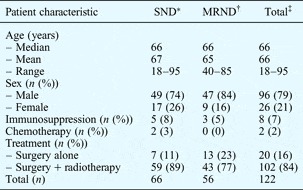
One hundred and twenty-two patients fulfilling the inclusion criteria were identified: 96 men and 26 women. The median age at diagnosis was 66 years (range, 18–95 years). Patients were divided into two groups according the extent of neck dissection (selective neck dissection versus modified radical neck dissection). Patient demographics and treatment details are summarised in Table I. Eight patients (7 per cent) were immunosuppressed secondary to transplantation or haematological disease. All patients had a minimum follow up of 24 months, with a median follow up duration of 57 months.
Patients and treatment

* n = 66;
† n = 56;
‡ n = 122. SND = selective neck dissection; MRND = modified radical neck dissection
Index lesion
The majority of the 122 patients (n = 95; 78 per cent) had an index lesion which had presented before or concomitant with the metastatic nodal disease. In 27 patients (22 per cent), it was not possible to identify an obvious index lesion. The primary tumour was recurrent in 13 of the 122 patients (11 per cent). The majority of patients (80 per cent) developed nodal disease after treatment of the primary tumour, with a median time to nodal metastases of nine months. The lip was the most common primary site, seen in 33 patients (27 per cent), followed by the posterior scalp (9 per cent), cheek (9 per cent), nose (9 per cent) and ear (9 per cent).
Cervical nodal metastasis
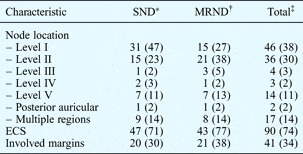
The location of the lymph nodes, presence of extracapsular spread and margin status are detailed in Table II. The median metastatic nodal size was 25 mm and the median number of involved nodes was one.
Cervical nodal metastasis

Data represent patients (n (%)).
* n = 66;
† n = 56;
‡ n = 122. SND = selective neck dissection; MRND = modified radical neck dissection; pts = patients; ECS = extracapsular spread
Extent of nodal disease
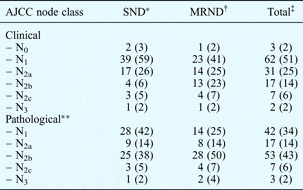
Seventy-seven of the 122 patients (63 per cent) had an American Joint Committee on Cancer nodal classification of pathological N2 disease (Table III). Patients undergoing modified radical neck dissection had slightly more advanced disease, with 28 of these 56 patients (50 per cent) having pathological N2b disease, whereas 28 of the 66 patients (42 per cent) undergoing selective neck dissection were pathologically classified as N1. However, there was no statistically significant difference in the extent of nodal disease between patients undergoing selective neck dissection and modified radical neck dissection (p = 0.16).
Extent of nodal disease

Data represent patients (n (%)).
* n = 66;
† n = 56;
‡ n = 122.
** p = 0.16, pathological extent of nodal disease in selective neck dissection (SND) patients vs modified radical neck dissection (MRND) patients. AJCC node class = American Joint Committee on Cancer nodal classification; pts = patients; N = node
Three patients presented with a clinical N0 neck but were reported to have higher pathological nodal classifications (of N1, N2a and N3, variously) following neck dissection (Table III). Sixty-two patients (51 per cent) had a clinical N1 neck at diagnosis, of whom 39 (63 per cent) underwent selective neck dissection and 23 (37 per cent) modified radical neck dissection. Following surgery, 27 of these 62 patients (44 per cent) were subsequently reported to have a higher pathological classification of N2.
Fifty-five patients (45 per cent) had a clinical N2 neck, with 47 of these 55 (85 per cent) also having a pathological N2 classification. Of these 55 patients, only eight (15 per cent) had a lower pathological classification of N1 following surgery, and none were pathologically classified as N3. The two patients with a clinical N3 neck had a pathological classification of N2.
Hence, clinical nodal classification (including radiological findings) at diagnosis is not an accurate measure of pathological disease extent. Many patients will be ‘upstaged’ following neck dissection: we noted that over 40 per cent of our patients with a clinical N1 neck at diagnosis had a pathological N2 classification after surgery.
Treatment
All patients underwent neck dissection. One hundred and two patients (84 per cent) underwent surgery plus adjuvant radiotherapy and 20 patients (16 per cent) underwent surgery alone.
Surgery
In total, 122 neck dissections were performed. Sixty-six patients (54 per cent) underwent selective neck dissection and 56 patients (46 per cent) underwent modified radical neck dissection. Of the 66 patients undergoing selective neck dissection, 7 (11 per cent) had surgery alone and 59 (89 per cent) had surgery plus adjuvant radiotherapy. Of the 56 patients undergoing modified radical neck dissection, 13 (23 per cent) had surgery alone and 43 (77 per cent) had surgery plus adjuvant radiotherapy.
Radiotherapy
One hundred and two patients (84 per cent) underwent adjuvant hemi-neck radiotherapy. Eighty-one patients (79 per cent) were treated with megavoltage photons, 11 (11 per cent) were treated with electrons, and 10 (10 per cent) received a combination of both. The median radiotherapy dose delivered was 60 Gy in 2-Gy daily fractions to dissected necks, and 50 Gy in 2-Gy daily fractions to undissected, usually lower, necks.
Recurrence
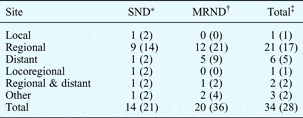
A total of 34 patients (28 per cent) experienced recurrence (Table IV): 14 (21 per cent) after selective neck dissection and 20 (36 per cent) after modified radical neck dissection. Most patients (24 of 34; 71 per cent) experienced regional recurrence as their first recurrence, either alone or in combination with recurrence at other sites. Regional recurrence developed in 11 of the 66 patients (17 per cent) undergoing selective neck dissection, and in 13 of the 56 patients (23 per cent) undergoing modified radical neck dissection. The median time to recurrence was 15 months.
Site of first recurrence

Data represent patients (n(%)).
* n = 66;
† n = 56;
‡ n = 122. SND = selective neck dissection; MRND = modified radical neck dissection
Eight of the 122 patients (7 per cent) developed distant recurrence, mainly in the lung (2 of 8), either as the only site of first recurrence (6 of 8) or in conjunction with regional recurrence (2 of 8).
Survival
On multivariate analysis, there was no statistically significant difference in overall survival and disease-free survival, comparing patients undergoing selective neck dissection versus modified radical neck dissection.
The following variables were significantly associated with overall survival: age (hazard ratio, 1.06; 95 per cent confidence interval (CI), 1.03–1.09; p = 0.001); immunosuppression (yes vs no: hazard ratio, 6.87; 95 per cent CI, 2.46–19.22; p < 0.001); and treatment modality (surgery alone vs surgery plus radiotherapy: hazard ratio, 0.49; 95 per cent CI, 0.25–0.96; p = 0.03).
The following variables were significantly associated with disease-free survival: immunosuppression (yes vs no: hazard ratio, 4.41; 95 per cent CI, 1.75–11.11; p = 0.002); treatment modality (surgery alone vs surgery plus radiotherapy: hazard ratio, 0.14; 95 per cent CI, 0.06–0.32; p < 0.001); extracapsular spread (yes vs no: hazard ratio, 5.12; 95 per cent CI, 1.50–17.47; p = 0.009); and pathological American Joint Committee on Cancer nodal staging (N1vs others: hazard ratio, 2.28; 95 per cent CI, 1.01–5.13; p = 0.04).
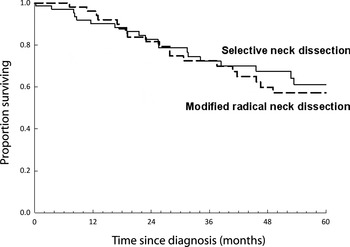
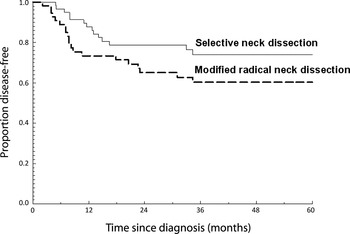
The five-year overall survival rate was 59 per cent. Analysis by the extent of neck dissection revealed no difference in overall survival or disease-free survival, comparing patients undergoing selective neck dissection versus modified radical neck dissection. The five-year overall survival rate was 61 per cent for patients undergoing selective neck dissection, compared with 57 per cent for those undergoing modified radical neck dissection (p = 0.86) (Figure 1). The five-year disease-free survival rate was 74 per cent in patients undergoing selective neck dissection, compared with 60 per cent in those undergoing modified radical neck dissection (p = 0.102) (Figure 2).
Kaplan–Meier survival curves indicating no statistically significant difference in five-year overall survival, comparing patients undergoing selective neck dissection versus modified radical neck dissection (p = 0.86).

Kaplan–Meier survival curves indicating no statistically significant difference in five-year disease-free survival, comparing patients undergoing selective neck dissection or modified radical neck dissection (p = 0.102).

Discussion
There is limited information on the optimal neck dissection in patients with metastatic cutaneous head and neck SCC involving the cervical lymph nodes. The majority of patients will also require adjuvant radiotherapy as a result of unfavourable nodal features such as close margins or extracapsular spread. Radiotherapy fields invariably encompass the entire hemi-neck, and therefore the benefit of electively dissecting uninvolved lower nodal levels is questionable.
Most patients in our study had a single metastatic node located at level I or II. The rationale behind treating clinically uninvolved neck nodes is that subclinical nodal metastases are concurrently treated. Veness et al. documented subclinical metastasis in 35 per cent of patients with dissected, clinically negative neck nodes.Reference Veness, Morgan, Palme and Gebski10 Similarly, in O'Brien and colleagues' study of 73 patients with metastatic cutaneous head and neck SCC, 35 per cent had occult neck disease.Reference O'Brien, McNeil, McMahon, Pathak and Lauer11 Ebrahimi et al. reported subclinical involvement of cervical lymph nodes in 21 per cent of patients with metastatic parotid SCC and a clinically negative upper neck.Reference Ebrahimi, Moncrieff, Clark, Shannon, Gao and Milross2 Gooris et al. studied 44 patients with metastatic lip SCC to level I lymph nodes, and found a low regional recurrence rate of 4 per cent and an excellent regional control rate of 90 per cent in patients undergoing supraomohyoid neck dissection and adjuvant radiotherapy to the clinically negative, undissected lower neck.Reference Gooris, Vermey, de Visscher, Burlage and Roodenburg12
A more selective approach to the performance of a neck dissection may help avoid the morbidity associated with more comprehensive dissections involving levels IV and V. Chyle leakage occurred in 2.7 per cent of patients undergoing a level IV dissection in one study, almost all of whom had pathologically negative level IV nodes.Reference Ebrahimi, Moncrieff, Clark, Shannon, Gao and Milross2 Accessory nerve dysfunction is not a frequently reported problem, but when encountered it is likely to reflect under-reporting and delayed recognition. Shoulder dysfunction has been demonstrated in approximately 30 per cent of patients undergoing level V dissection, and has a negative impact on quality of life and activities of daily living.Reference Cappiello, Piazza, Giudice, De Maria and Nicolai13, Reference Stuiver, van Wilgen, de Boer, de Goede, Koolstra and van Opzeeland14 Furthermore, Chepeha and colleagues' study assessing factors contributing to shoulder dysfunction after neck dissection in head and neck cancer patients, using Constant's Shoulder Scale, found that patients undergoing modified radical neck dissection had significantly worse shoulder function compared with those undergoing selective neck dissection (p = 0.0007).Reference Chepeha, Taylor, Chepeha, Teknos, Bradford and Sharma15
The type of neck dissection has a substantial impact on patients' post-dissection quality of life. Taylor et al. found that patients treated with modified radical neck dissection had worse quality of life scores than those treated with selective neck dissection.Reference Taylor, Chepeha, Teknos, Bradford, Sharma and Terrell16 A study by Ambrosch et al. involving 503 patients undergoing selective neck dissection for SCC of the upper aerodigestive tract found that the main advantage of selective neck dissection over modified radical neck dissection was a reduction in post-operative disfigurement and dysfunction.Reference Ambrosch, Kron, Pradier and Steiner7 This study also suggested that, when performed in carefully selected patients, selective neck dissection was less invasive and offered functional and aesthetic advantages without oncological compromise. Gooris et al. found that patients undergoing a supraomohyoid neck dissection had less long-term functional shoulder disability, minimal cosmetic deformity and better preservation of neck volume, compared with modified radical neck dissection.Reference Gooris, Vermey, de Visscher, Burlage and Roodenburg12
There is analogous published evidence in the setting of mucosal head and neck SCC, showing similar outcomes for selective neck dissection versus modified radical neck dissection. Shepard et al. compared the outcomes of patients with mucosal head and neck SCC (including the oral cavity, oropharynx, hypopharynx, larynx, nasopharynx and paranasal sinuses) undergoing selective versus comprehensive neck dissection, and found higher rates of regional control (96 per cent) in patients with positive nodes undergoing selective neck dissection and radiotherapy.Reference Shepard, Olson, Harari, Leverson and Hartig4 Patel et al. investigated whether 232 patients treated with selective neck dissection were oncologically disadvantaged compared with those undergoing comprehensive neck dissection; they concluded that selective neck dissection followed by adjuvant radiotherapy was effective in treating clinically positive nodal disease in selected patients.Reference Patel, Clark, Gao and O'Brien5 Chepeha et al. documented regional control in 94 per cent of 52 patients undergoing selective neck dissection, which was comparable to control rates obtained with modified radical neck dissection.Reference Chepeha, Hoff, Taylor, Bradford, Teknos and Esclamado6 Similarly, Ambrosch et al. reported that regional control rates achieved with selective neck dissection, with or without post-operative radiotherapy, compared favourably with those for modified radical neck dissection and radical neck dissection with or without post-operative radiotherapy.Reference Ambrosch, Kron, Pradier and Steiner7
In our study, comparison of patients with metastatic cutaneous head and neck SCC undergoing selective neck dissection versus modified radical neck dissection showed no statistically significant difference in five-year overall survival (61 vs 57 per cent, respectively) or five-year disease-free survival (74 vs 60 per cent, respectively). The observed, non-significant difference in regional control, overall survival and disease-free survival between patients (with comparable radiotherapy indications) treated with selective versus modified radical neck dissection adds strength to the hypothesis that the outcome of patients with cervical metastasis are not compromised when dissection of all five node levels is not routinely performed.
The benefit of adjuvant radiotherapy in improving outcome has been reported elsewhere, and is further supported by our current results.
• Patients with metastatic cutaneous head and neck squamous cell carcinoma (SCC) to the parotid and/or cervical nodes do best after surgery plus radiotherapy
• This study assessed the effect of type of neck dissection in these patients
• Outcome was the same for selective neck dissection and modified radical neck dissection
• Adjuvant radiotherapy was associated with a better outcome
We acknowledge the possibility that the low power of this study may have contributed to the lack of a statistically significant difference between the survival rates of patients treated with selective versus modified radical neck dissection. There was a 77 per cent increase in the risk of disease progression for patients undergoing modified radical neck dissection compared with selective neck dissection, which corresponds to a hazard ratio of 1.77. For a study to detect this hazard ratio with 95 per cent confidence and 80 per cent power, a total of 332 patients would be required (with 3 years' accrual and 3 years' follow up), and an expected 103 recurrences would occur. Alternatively, if the study follow up were to continue for a further 10 years, approximately 105 recurrences would occur, based on the current sample size and an 80 per cent power to detect a 77 per cent increase in the risk of disease progression. Hence, our study was under-powered to statistically detect this difference based on its actual follow-up time and sample size.
We also acknowledge that our study was limited by its retrospective design and by the heterogeneity of patients undergoing selective neck dissection and modified radical neck dissection. We were not surprised to see lower overall and regional recurrence rates in patients who underwent selective neck dissection, since these patients had less nodal disease and extracapsular spread overall. The efficacy of therapeutic selective neck dissection should ideally be confirmed within the context of a randomised, controlled trial. Nevertheless, the effectiveness of selective neck dissection and adjuvant radiotherapy for the control of regional nodal disease is supported by the current study.
Conclusion
We report no statistically significant difference in outcome for patients with metastatic cutaneous head and neck SCC, based on the extent of neck surgery. Our data support the concept that not all neck levels need to be dissected to achieve high regional control rates, and provide evidence that selective neck dissection with adjuvant radiotherapy is an oncologically efficacious approach.