In Brittany, as with most European coastal waters, records of non-indigenous species have recently increased, mainly due to their introduction through aquaculture (Naylor et al., Reference Naylor, Williams and Strong2001). Amongst invasive molluscs, the slipper limpet Crepidula fornicata (Linnaeus, 1758) and the oyster Crassostrea gigas (Thunberg, 1793) are famous pests, as they disturb ecosystem functioning as well as commercial fishing (Blanchard, Reference Blanchard1997). Brittany harbours other alien mollusc species, such as the bivalves Mya arenaria (Linnaeus, 1758), Tapes philippinarum (Adams & Reeve, 1850), Mercenaria mercenaria (Linnaeus, 1758), and the gastropods Ocinebrellus inornatus (Récluz, 1851), Rapana venosa (Valenciennes, 1846), Cyclope neritea (Linnaeus, 1758) and Gibbula albida (Gmelin, 1791). Most of these gastropod species (if not all) have been presumably brought to Breton ecosystems by way of oyster cultivation (Bachelet et al., Reference Bachelet, Labourg and Madani1990; Delemarre & Neuthiec, Reference Delemarre and Le Neuthiec1995; Blanchard, Reference Blanchard1997; Goulletquer, Reference Goulletquer1999), while the bivalves were all introduced for aquaculture purposes.
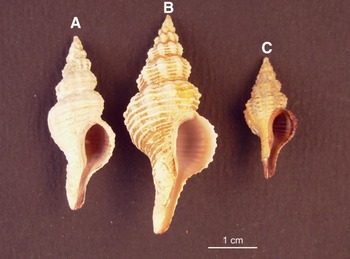
In October 2007, six specimens of the gastropod Fusinus rostratus (Olivi, 1792) were caught in beam-trawl samples (2 m opening, 1 cm mesh-size) during routine fish monitoring for the EC Water Framework Directive in the bay of Morlaix (see Figure 1). The area sampled was approximately 900 m2 as the six specimens were caught between 48°39.385′N 3°52.563′W and 48°38.988′N 3°52.103′W. Sampling occurred on a heterogeneous-mud bottom (composed of dead Crepidula fornicata and dead maerl fragments mixed with mud) at 9–10 m depth. Another specimen, caught one nautical mile north from the beam trawl tow (48°40.555′N 3°52.783′W) was kindly provided to us by Franck Gentil from the Marine Biological Station of Roscoff. This specimen (Figure 2A) was dredged from 7 m depth (chart datum) on muddy maerl, spring 2007. Two specimens, after species determination confirmation by Professor Philippe Bouchet (MNHN Paris), were deposited at the Molluscan Collection of the Muséum National d'Histoire Naturelle (Paris) under registration numbers MNHN 20973 and MNHN 20974.
Map of the sampling site. Point A is the site where the specimen from the biological station of Roscoff was sampled. Points B and C are respectively the beginning and end points of the trawling haul in which the two other specimens were sampled. See text for explanation.

Fusinus rostratus is distributed throughout the Mediterranean, Morocco, Portugal, and Galicia and was previously known to reach its northern limit of distribution on the coasts of the Cantabria (Serrano et al., Reference Serrano, Sanchez and Garcia-Castrillo2006). It was reported to live around 20 m deep on heterogeneous mud in the northern Adriatic (Hall-Spencer et al., Reference Hall-Spencer, Froglia, Atkinson and Moore1999) and can occur down to 100 m (Serrano et al., Reference Serrano, Sanchez and Garcia-Castrillo2006) in Cantabria and to 500 m depth in the Atlantic (Piepenburg & Müller, Reference Piepenburg and Müller2004).
This find increases the geographical range of the species in the Atlantic. We hypothesize that F. rostratus may have been introduced in the ecosystem via oyster translocation. The bay of Morlaix is a major site for oyster culture in Brittany, covering more than 700 ha for an annual production of about 3000 tons. Most oyster cultivation method in the bay is subtidal. Therefore, although F. rostratus is known to live under 10 m depth in its natural environment, we hypothesize that it found suitable conditions to survive after introduction, and managed to get down to 20 m depth. Such an invasion process also happened in the bay of Brest for Crepidula fornicata, a subtidal species that was introduced on intertidal oyster cultures and managed to get down to deeper species to settle and spread in the ecosystem (Chauvaud et al., Reference Chauvaud, Jean, Ragueneau and Thouzeau2000; de Montaudouin et al., Reference Montaudouin, Labarraque, Giraud and Bachelet2001). Another argument for introduction via aquaculture is that the alien gastropods were sampled less than a few hundred metres away from the oyster cultures, but were absent from other samples performed within the bay, away from oyster culture.
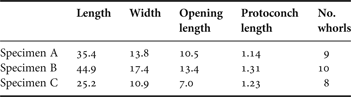
The biometric measures given in Table 1 suggest that at least two cohorts were simultaneously present at the site, with two large specimens (Figure 2A, B) and a much smaller one (see Figure 2C; Table 1). This suggests that: (i) either F. rostratus reproduces in the bay of Morlaix with success and that juveniles manage to grow and reach an adult size; or (ii) that repeated introduction events have occurred (as has happened with the introduction of Cyclope neritea on the Atlantic coasts of France; see Simon-Bouhet et al., Reference Simon-Bouhet, Garcia-Meunier and Viard2006).
Photograph of the collected specimens. Specimen A was dredged at point A by Frank Gentil (Station Biologique de Roscoff); B and C were sampled in the trawl haul between points B and C.

Biometric measures (in mm) of the total length, largest width, length of the opening, length of the protoconch and total number of whorls of the collected specimens.

We hypothesize that F. rostratus, a warm water species, may settle durably in the Channel and, in a context of global warming, may in the future extend its northern limit of distribution from the bay of Morlaix, as has been observed for the gastropod species Osilinus lineatus (see Mieszkowska et al., Reference Mieszkowska, Hawkins, Burrows and Kendall2007). Considering that the mean western English Channel temperature is likely to keep on rising during this century (Mieszkowska et al., Reference Mieszkowska, Kendall, Hawkins, Leaper, Williamson, Hardman-Mountford and Southward2006), F. rostratus is likely to find the future environmental conditions favourable for an extension of its distribution northwards as its reproductive success would increase.
According to Williamson & Fitter (Reference Williamson and Fitter1996), about 10% of introduced species are expected to establish and spread into an ecosystem, while only a small fraction may then cause changes to ecosystem functioning. Since Fusinus rostratus is a carnivore (Mancinelli et al., Reference Mancinelli, Fazi and Rossi1998) feeding mainly on gastropods, polychaetes and bivalves (although it lacks shell-drilling capabilities), it could impair the ecosystem functioning through enhanced predation on native invertebrates (Carlton, Reference Carlton1996). The presence of this introduced gastropod on fragile and species rich habitats such as maerl beds (Grall & Hall-Spencer, Reference Grall and Hall-Spencer2003) suggests that the monitoring of the F. rostratus population should be implemented in the ecosystem, in order to manage (if possible) the spread of the species. Also, genetic studies could help the understanding of the introduction process of the species in Brittany, in helping to identify its geographical origin and the number of introduction events (Simon-Bouhet et al., Reference Simon-Bouhet, Garcia-Meunier and Viard2006).
Furthermore, the recent appearance of F. rostratus in Brittany shows that species introduction is an on-going process, especially through mariculture. Control efforts should be focused on preventing the spread of species associated with oyster aquaculture to new ecosystems by applying strict controls and removal of species other than oysters, as well as adequate quarantine before shellfish translocations.
ACKNOWLEDGEMENTS
The authors wish to thank Franck Gentil (Station Biologique de Roscoff) for providing a Fusinus rostratus specimen. We are also grateful to Alphonse Tram, as ever, and to the staff of the Aquascop Company (Angers, France) for their help during the sampling cruise.