“Science is made up with facts as a house is made from stones. But a collection of facts is no more a science than a pile of stones is a house.”
—Poincaré, Hypotheses in Physics (Reference Poincaré1952)1. Introduction
Over a century of research and understanding in the field of taste has been largely contained within a four-taste model, now referred to as the “basic tastes,” using the words sweet, salty, sour, and bitter, or stimuli representing these words. This model holds that there are only these few tastes, and each taste has receptor and neuron types specifically serving it. At the neural level this model is equated with the “labeled-line” idea that each taste has its own dedicated neural line into the brain. There is a very different approach that does not involve basics, but posits a continuum of tastes served by “across-fiber patterns” of activity over populations of neurons.
There has been a long-standing controversy between the basic tastes and the across-fiber pattern positions. Why has it lasted so long rather than being resolved by a few experiments early on? The position is taken in this article that the concept of “basic tastes” is not a proper scientific model because it is not potentially falsifiable. This model has been convenient enough to be easily adapted to any experimental situation, receptor, neural, or psychophysical. But the vagueness and flexibility that provide this convenience prevent it from being adequately defined, which is a fundamental fault in science. A proper definition of the idea is taken here to mean that it is based on an underlying data-based and rational hypothesis that generates precise definitions of the terms used, and thus provides the context for tests that could possibly falsify the idea (Popper Reference Popper1963). The basic tastes model does not include these provisions, and therefore such tests have not been carried out. Under these conditions, there can be no resolution of the controversy. On the other hand, the across-fiber pattern model meets these two requirements of science, a rational data-based definition and testability. This model has been supported in a variety of attempts at falsification.
The major thrust of this article is to critically examine the across-fiber pattern and basic tastes models of the organization of taste. The across-fiber pattern model will be cast in the format of Young's theory of color perception, and the basic tastes model will be drawn on the backdrop of Hanig's famous experiment on the distribution of taste sensitivities across the tongue.
The argument will be made that, although the idea of basic tastes has directed our research for over a century, we do not know what basic tastes are; we do not know the origins, rationale, or definition of this idea, and thus we do not explicitly know how to test it.
2. “Basic Tastes”
2.1. Background
The origins of the idea that there are a few basic tastes predate modern science by at least two millennia. The evolution of the concept is rooted in ancient cultural and philosophical thought long before the advent of the scientific method. It also appears to be derived from the characteristics of our cognitive abilities. These may be the primary root reasons for the development of the idea of basic tastes, but it is clear that this model has never been construed as a scientific hypothesis to be tested.
2.2. Basic tastes from antiquity
In China during the early Han dynasty, the first two or three centuries B.C., two ways of organizing experience were formalized. These were the Yin–Yang dichotomy, and the five ways of wu xing (Unschuld Reference Unschuld1993). Prominent in the latter were the five tastes, sweet, sour, salty, bitter, and acrid. Both of these aspects of knowledge are evident in modern thought.
The Yin–Yang idea points to the importance of differences, meaning that a concept cannot exist without something different from it; “day” would not exist without “night,” “high tide” needs “low tide,” good and bad depend on each other, male and female, red depends on green, and there would be no “salty” if there were no other taste. This differentiation provides the logical basis for taste discrimination and its quantification in the across-fiber pattern theory (see Sect. 6.4 on Quantification).
2.3. Basic tastes and information theory
But why did the Chinese create the idea of five tastes? The reason is not immediately obvious. Perhaps it is clear from simple sensory experience that five tastes are distinct perceptual entities, like pigs, pineapples, and planets. Or it may be that the ancient Chinese had jars of spices on the table that included a sugar and a salt, a citrus juice, bitters, and something acrid (pepper?); they needed – and we need – words to communicate about these important substances. Still the main reason for the idea of five tastes may have been that the traditional Chinese method of organizing experiences, the “five ways” demanded by wu xing. But then where did these five ways come from?
By the 20th century the idea of basic tastes had not evolved much beyond asking how many there are. Boring (Reference Boring1942) stated that the general consensus was that there are four. Of relevance here, in an information theory approach, Miller (Reference Miller1956) showed that human memory limits the contents of facile categorizations to about seven members each. His research provides one very practical rationale both for the invention of the five ways of Chinese thought, and for our four or five basic tastes. Our limited ability to remember the contents of a category containing more than “the magical number seven plus or minus two” of unrelated items certainly could have influenced our understanding in the field of taste, as it does in many other aspects of our description of the world.
As examples of the ubiquity of such categorizations, we have seven days in the week, seven sins and seven virtues, and Newton's seven colors – all arbitrary man-made rubrics. The many geological time periods are packaged into groupings and subgroupings of seven or less each. The standard format of scientific papers also has about six sections – Introduction, Methods, Results, Discussion, Summary, and Conclusions – which is very useful. But why is this format so useful? We have not been able to deal with the 365 days of the year without dividing that number into small categories; four seasons of three months each, each month consisting of about four weeks, each week of seven days. The year is a natural phenomenon – once around the sun – but these other terms are not. Aristotle, the great classifier of all things into short lists, proposed seven tastes. These short lists seem to make good intuitive sense. But are there really seven seas and seven continents? And is the Mediterranean Sea really made up of seven mini-seas? Should we anticipate seven tastes?
3. Hanig and basic tastes
3.1. Hanig sets the stage
The modern empirical history of basic tastes is herein taken rather arbitrarily as starting with a seminal experiment by Hanig (Reference Hanig1901). He demonstrated that the areas of sensitivity of the tongue to the basic tastes differ, with sweet largely in the front, bitter in the back, and salty and sour on the sides. Although their points of maximum sensitivity differ, their total distributions overlap greatly. It has been data of this sort that has supported the idea that we can sense only these “basic” tastes – the main assumption of the basic tastes doctrine. Subsequent research in taste largely followed his format. In the present article Hanig's work is used as a short-hand rubric for the idea of basic tastes.
An attempt to define the idea of basic tastes would be helpful here, although it will become clear throughout this article how nebulous and indefinable this idea is. But at this point, the idea of basic tastes may be put simply: The basic tastes are all we can sense, thus all tastes are reducible to only these few separate and distinctly different sensations.
3.2. Following Hanig
The idea of four basic tastes gave us a very convenient structure for research. The job then was just to find evidence for them. And we did.
3.2.1. Psychophysics
The field of psychophysics followed Hanig in general form; subjects can describe tastes in the terms of the basic words (Halpern Reference Halpern, Pashler and Yantis2002a). Textbook treatments often state that it is generally accepted, or that it is a fact, that there are only four tastes for humans (e.g., Bartoshuk Reference Bartoshuk, Atkinson, Herrnstein, Lindzey and Luce1988; Bernstein et al. Reference Bernstein, Pener, Clarke-Stewart and Roy2006; Geldard Reference Geldard1964; Graham Reference Graham1990; Kandel et al. Reference Kandel, Schwartz, Jessell, Dodd and Castellucci1991; Moncrieff Reference Moncrieff1956; Osgood Reference Osgood1956; Pfaffmann Reference Pfaffmann and Stevens1951, Reference Pfaffmann, Woodworth and Schlosberg1954; Shepherd Reference Shepherd1994; Smith & Davis Reference Smith, Davis, Finger, Silver and Restrepo2000; Smith & Scott Reference Smith and Scott2001; Steward Reference Steward2000). Throughout these texts, definitions of “basic tastes” are notably absent. But the influence of the idea of a few basic tastes has been so strong that Hanig's broadly overlapping areas of sensitivity have sometimes been redrawn into four discrete and nonoverlapping areas on each side of the tongue, and these drawings make excellent illustrations for text books (e.g., Bear et al. Reference Bear, Connors and Paradiso1996; Graham Reference Graham1990; Kandel et al. Reference Kandel, Schwartz, Jessell, Dodd and Castellucci1991; Shepherd Reference Shepherd1994; Steward Reference Steward2000). It should be pointed out that Hanig's data have been reproduced accurately in some cases (e.g., Geldard Reference Geldard1964; Purves et al. Reference Purves, Augustine, Firzpatrick, Katz, La Mantia, McNamara and Williams2001), and properly corrected in another (Smith & Margolskee Reference Smith and Margolskee2001).
3.2.2. Receptor organization
Much research on taste receptors has been presented in tacit or explicit support of the basic tastes idea; experiments have been routinely designed and interpreted in terms of a small number of “basic” typologies. For example, when appropriate techniques had been devised, there began a protracted search for the basic taste receptor mechanisms or cells, such as for “sweet” (Birch Reference Birch, Le Magnen and Mac Leod1977; Eggers et al. Reference Eggers, Acree and Shallenberger2000; Shallenberger & Acree Reference Shallenberger and Acree1967, Reference Shallenberger, Acree and Beidler1971; Tateda Reference Tateda and Hayashi1965). Current data on receptors using molecular genetic techniques (Chandrashekar et al. Reference Chandrashekar, Hoon, Ryba and Zucker2006; Zhang et al. Reference Zhang, Hoon, Chandrashekar, Mueller, Cook, Wu, Zuker and Ryba2003) have been taken to support basic tastes in that there are receptor mechanisms that are described as specific to two of the basic tastes, sweet and bitter (Zhang et al. Reference Zhang, Hoon, Chandrashekar, Mueller, Cook, Wu, Zuker and Ryba2003; Zhao et al. Reference Zhao, Zhang, Hoon, Chandrashekar, Erlenbach, Ryba and Zuker2003), with similarly specific neural pathways (Sugita & Shiba, Reference Sugita and Shiba2005) and behaviors related to these receptors and pathways (Mueller et al. Reference Mueller, Hoon, Erlenbach, Chandrashekar, Zuker and Ryba2005; Zhang et al. Reference Zhang, Hoon, Chandrashekar, Mueller, Cook, Wu, Zuker and Ryba2003; Zhao et al. Reference Zhao, Zhang, Hoon, Chandrashekar, Erlenbach, Ryba and Zuker2003). A neutral search without the bias to find basic receptors would have been preferable. It might be that with at least 40 years of research directed toward finding the receptors for the basic tastes, acceptable receptors for each would eventually be found.
3.2.3. Neural organization
The history of the search for neuron typologies to correspond with the basic tastes began with the first recordings from individual taste neurons over 60 years ago (Pfaffmann Reference Pfaffmann1941) and continues to the present (e.g., Boughter & Smith Reference Boughter and Smith1998; Boughter et al. Reference Boughter, St. John and Smith1999; Lemon & Smith Reference Lemon and Smith2005, Reference Lemon and Smith2006; Scott & Giza Reference Scott and Giza2000; Smith & Scott Reference Smith and Scott2001; Smith et al. Reference Smith, St. John and Boughter2000; St. John & Smith Reference St. John and Smith1999). The “labeled-line” coding idea in taste holds that each neuron represents only the basic taste to which it responds best, giving us four groups of neurons (Frank Reference Frank1974, Reference Frank2000). Mathematical techniques have been used to categorize data on neural responsiveness into a few types to support this position (Scott & Giza Reference Scott and Giza2000; Smith & Davis Reference Smith, Davis, Finger, Silver and Restrepo2000; Smith & Margolskee Reference Smith and Margolskee2001; Smith & Scott Reference Smith and Scott2001; Smith & St. John Reference Smith and St. John1999; Smith & Vogt Reference Smith and Vogt1997; Smith et al. Reference Smith, St. John and Boughter2000). As with basic taste receptors, there is a lack of an a priori rationale, a rational definition of what neuron groups are, and critical testing with control groups.
3.2.4. Summary
For about a century the field of taste has rather uncritically been guided by the idea of four basic tastes. We went in with Hanig's orientation, and then showed that there were indeed four basic tastes. It is not easy to estimate the degree of bias that this assumption may have brought to the field of taste, and the corollary degree of bypassing of data and theory to the contrary.
3.3. Hanig omitted control groups
Unfortunately, Hanig's format did not provide the essential perspective of control tests demanded by science. If his findings were to have any relevance to the basic tastes model, it would have been necessary to learn if other tastants, for example KCl and CaCl2, proline, and lysine, also had differentially distributed sensitivities across the tongue. If they were distributed in this way, the implications of his data for the basic tastes idea would have been nullified. No one has completed his research with the required control studies. Why not?
Since Hanig, there has been a routine omission of control groups in research using the basic tastes for its organization. This omission is notable in the three areas of research just noted: psychophysics, and receptor and neural organization. The effect of omitting control groups is to support the basic tastes model, rather than to question it. This format is not helpful in science.
4. Extra-curricular support for Hanig
Two of our approaches to knowledge – our language and our experimental methods – have guided us toward Hanig's position.
4.1. Language
4.1.1. Cognitive characteristics of humans
The limits of human cognition mentioned earlier (Miller Reference Miller1956) give a logic to the idea that there would be just a few named tastes, up to six or seven, but not 20. If there were indeed these higher numbers of basic tastes of some sort, they might be too many for us to be aware of them – or even to know to look for them. The five rather than 105 ways of Chinese thought might have derived in part from this cognitive constraint. We cut up reality into a few words in order to understand and communicate. To follow such an arbitrary linguistic force in science is a problem worth study.
4.1.2. Words as hypotheses?
The taste words have served as scientific formats in that we follow them. The Eskimos have multiple words to communicate about snow. But these important words do not necessarily invoke a science about multiple kinds of snow. Analogously, our use of a few basic taste names does not indicate more than that we need such words to communicate about taste. Although necessary for communication, there is no reason that these words should have served as meaningful hypotheses about the nature of taste.
4.1.3. Words versus reality
There is the very strong problem that we tend to believe in the reality and validity of our words. Our language is necessarily limited to discrete words that usually seem to have clear and straightforward meanings. May we assume that the words “liberal,” “love,” “intelligence,” “clear,” “understand,” “define,” or “reality” are clearly understood and defined, and are accurate representations of reality? And “salty” or “basic taste?” Our words are designed to serve us, but are not necessarily the best scientific representations of the nature of things. We may think that we get words from the dictionaries, but they are merely compendiums of the words we use, such as the taste words. Allowing scientific theory to be constrained or led by the terminology in common use would have made our current understanding of mathematics or physics impossible.
Many scientists have been critical of the influence of our words on our understanding. Speaking about geological time periods, S. J. Gould (Reference Gould1994) discussed words used to invent categories:
The human mind seems to work as a categorizing device… . This deeply (perhaps innately) ingrained habit of thought causes us particular trouble when we need to analyze the many continua that form so conspicuous a part of our surrounding world. Continua are rarely so smooth and gradual in their flux that we cannot specify certain points or episodes as decidedly more interesting, or more tumultuous in their rates of change, than the vast majority of moments along the sequence. We therefore falsely choose these crucial episodes as boundaries for fixed categories, and we veil nature's continuity in the wrappings of our mental habits… . We must also remember another insidious aspect of our tendency to divide continua into fixed categories. These divisions are not neutral; they are established for definite purposes by partisans of particular viewpoints.
The close correspondence between Gould's comments and the probable continua in taste, including inflection points as the corners of Henning's tetrahedron (1916) is of note. Henning described the world of gustation as a continuum of tastes in three dimensions – a tetrahedron, defined by “sweet, sour, salty, and bitter” at its four corners.
Gould could have been writing about Aristotle, the great categorizer. In addition to his seven tastes, Aristotle wrote that there are five elements, earth, air, water, fire, and aether; this was a good beginning as he identified the major forms of matter – solids, gases, liquids – and energy. Aether was the astronomical material. He even categorized categories into ten kinds, such as substance, quality, quantity, relations, etc.
Another critic of the uncritical belief in words, G. Kimble, wrote (Reference Kimble1996):
Language is the agent of cognition, the currency of thinking, the tool-box of communication and the custodian of culture. To be useful, it must map onto the world with some precision. Unfortunately, however, the fact that it does so encourages the faith that the fit is perfect and that truth is in the dictionary: If there is a word for it, there must be a corresponding item of reality. If there are two words, there must be two realities and they must be different.
William James (a foundational psychologist and brother of the author Henry James, who may have been a greater but less systematic psychologist than William) recognized the problem (Reference James1890): “Whenever we have made a word … to denote a certain group of phenomena, we are prone to suppose a substantive entity existing beyond the phenomena. (And) the lack of a word quite often leads (to the idea) that no entity can be there …” The relevance of these comments for the naming of tastes is clear.
Proper concern has occasionally been voiced over the problematic adequacy of the “basic” words to represent tastes (Beidler Reference Beidler and Mountcastle1974; Purves et al. Reference Purves, Augustine, Firzpatrick, Katz, La Mantia, McNamara and Williams2001). And eloquently presaging the words of Henning (Reference Henning1916), Brillat-Savarin (Reference Brillat-Savarin and Fisher1886) pointed out that the four basic tastes “are only a convenient way to talk about a much larger array of taste sensations.”
It is interesting to note that Richard Feynman did not discover certain revolutionary aspects of quantum mechanics in terms of words, and then decide how to interpret the words. He just imagined the atom, and “watched” its behavior. But he did have to translate these discoveries into words – although they were clearer in graphs. We may well follow his direction in taste, that is, to lead, not to follow, the words. In the field of physics it has been realized that our common words are not always reliable or sufficient, and may be misleading, so neutral words such as “quark” are sometimes invented.
Beyond these, it might be useful to consider that even our most basic and secure word-concepts, mass, time, distance, and energy, are based on man's conception of the nature of things. They seem too good to be less than totally true in their general or particular usages, and quite real independent of our naming them. But they are only our words, rubrics facilitating our understanding, and our communications (or miscommunications) with each other. Our understanding of even these “basic” physical concepts is changing; they are not as simple and real as these distinct words make them seem.
In summary, it might be helpful to worry about allowing common usage words such as “sweet” and “sour” guide our research and understanding. These words could provide a problem rather than the solution.
4.1.4. Why these taste words?
Imagine the wordsmiths of ancient China developing a communication system for the tastes of things; what words would they choose? Which foods would they name? They might devise names for the good things to distinguish them from the bad: sweet versus sour or bitter. And names for that all-important substance, salt; wars have been fought over the possession of salt as a seasoning and as a preservative. These four would very probably be at the top of any culture's list of taste words. Other words might be invented by culture, depending on the local foods available.
In fact, words for the four “basics” appear to be found quite uniformly in all languages – and are evident in English as well as foreign dictionaries. These include, at least, Afrikaans, Arabic, Albanian, Chinese, Danish, Dutch, English, French, German, Greek, Hebrew, Hindi, Hungarian, Indonesian, Irish, Italian, Japanese, Latin, Maori, Nepali, Oromo, Papua, Persian, Polish, Portuguese, Russian, Samoan, Sanskrit, Scotch, Serbo-Croatian, Slovak, Spanish, Swahili, Swedish, Tagalog, Urdu, Vietnamese, and Yiddish. There are some exceptions, such as omissions of “salty,” even in the presence of the noun “salt” and the verb “to salt,” and sometimes confusions between “sour” and “bitter;” but these may be errors in the editing of the dictionaries. And, as in English, there are very many culturally idiosyncratic taste words beyond the basic four in each language. In Korean there are words for bland and spicy. In Basque there is one word for bitter/sour. The Indonesians have the word “pahit,” which has no translation in English. A thorough cross-cultural study of taste words and their meanings might prove useful.
Does this apparent ubiquity of usage of the four basic taste words indicate something very obviously true, four separate sensations that sum up all tastes? Or could they represent four specialized physiological processes? These propositions lack testable rationales that are independent from the invention of words for communication. It might be doubted that scientists in each of these cultures independently proposed these words as scientific hypotheses.
4.2. Our methods fit Hanig's orientation
Of course, all of our knowledge comes in terms of what we can measure, and thus what we can measure can determine how we think. What we measure depends on our techniques of measurement. Thus the techniques of measurement that are available can set the arena into which our discourse falls. These techniques include the biological and mathematical methods at hand. Then the characteristics of our language bias our understanding of the data.
4.2.1. Biological techniques
All of our biological techniques have forced our thinking into a search for a neural structure for a named function; we can scarcely avoid taking this position (Erickson Reference Erickson and Masterton1978). As examples of the techniques at hand, the earliest of the modern biological techniques were those of Gall and Flourens at the beginning of the 19th century (Erickson Reference Erickson2001). Gall, a comparative neuroanatomist, attempted to measure variations in the relative sizes of human brain areas in relation to the talents of these individuals. His contemporary, Flourens, ablated various parts of animal brains to assay the function of each. Because of the nature of their techniques, their answers were necessarily in terms of what “word-as-function” existed in which “word-as-structure.” Gall opted for a strict localization of many functions: math, language, sex, avarice, and memory as examples. Flourens won that argument for the time, stating that, on the contrary, the brain was something of a bowl of relatively homogeneous soup. Both were probably correct in part, Gall presaging the labeled-line point of view, and Flourens the distributed models. Later, section of the dorsal and ventral roots showed that the former had a sensory function, and the latter were motor. Then electrical stimulation of the brain also dictated locations for functions, for example, that the various muscles or movements were represented in different points in the brain. The electrical recording methods – gross and microelectrode – were, again, necessarily locationist in their conclusions. Brain imaging, borrowing a clinical tool that favors locationist data, shows that the various searched-for functions are relegated to differing named brain structures. But why not search for avarice or patriotism or fishing? Why expect worded functions to be in circumscribed and easily namable localized structures? Chemical tracing of neural pathways is also locationist with the pathways being the structures considered. In the labeled-line model, the basic tastes become the functions to be identified with the structures that are individual receptors or neurons.
It is probable that none of these new localizing techniques produced false or trivial data. But the proper interpretation of each species of data turned out to be more complicated than had been acknowledged. Does each new technique, now the molecular/genetic studies, show us a new reality? The position taken here is that any of these techniques might have given us a very advanced answer if we had known exactly what the question was. Otherwise the techniques may at least temporarily direct our ideas rather than vice versa. We cannot know the best technique, or even an appropriate one, until we know what we are looking for.
In physics on the other hand, techniques are continually being developed to meet the explicit issues raised by their formal hypotheses. Particle accelerators were invented to address very specific issues, topics such as the structure and mechanics of atoms and their components. Scientific physics, although not clearly older than the science of taste, might be considered more advanced.
4.2.2. Mathematical techniques
Various mathematical methods have been used to provide support for the basic tastes idea, rather than test it. Prominent among these has been multidimensional scaling, cluster analysis, and factor analysis. Although these techniques can be used to suggest directions for further hypotheses and research (Uslander, in Kruskal & Wish Reference Kruskal, Wish and Uslander1978), they cannot prove or disprove the reality of any groupings, including those used to support the basic tastes model (Aldenderfer & Blashfield Reference Aldenderfer, Blashfield, Sullivan and Niemi1984; Sarle Reference Sarle, Luginbuhl, Schlotzhauer and Parker1987; Sokal & Sneath Reference Sokal and Sneath1963). This issue depends on a prior formal definition of what groups are (Erickson et al. Reference Erickson, Rodgers and Sarle1993) that might then be tested by these mathematical techniques. To use these techniques to determine if groups exist is like asking a road map to tell us where we are going, which they cannot do, rather than to legitimately ask it about the lay of the land for our consideration.
The exemplary presentation for the use of multidimensional scaling uses linear distances between cities to recover a correct map; importantly, this provides no conclusions about groups of cities, such as the Washington, DC–Boston corridor. Such linear distances are also possible in handling taste data in multidimensional spaces (Erickson Reference Erickson1986; Erickson et al. Reference Erickson, Rodgers and Sarle1993; Schiffman & Erickson Reference Schiffman, Erickson, Simon and Roper1993). Factor analysis, although used to support the idea of groupings, is not relevant to this issue; this technique only indicates the number of factors underlying the data – for example, three strong factors might be used to successfully represent data of no groupings, or of many groupings.
But correlations have been routinely used (e.g., Geran & Travers Reference Geran and Travers2006; Gilbertson et al. Reference Gilbertson, Boughter, Zhang and Smith2001; Lemon & Smith Reference Lemon and Smith2005; Scott & Giza Reference Scott and Giza2000; Smith & St. John Reference Smith and St. John1999) instead of the linear distances between objects for which multidimensional scaling methods were devised. Correlations are indicative of nonlinear degrees of relationships, incorrectly displacing the points into a “groupy” appearance towards the edges of the now nonlinear space (Erickson et al. Reference Erickson, Rodgers and Sarle1993). Correlations are completely inappropriate for multidimensional scaling, but still they are used to support the basic tastes model. This adds to the previous problem that these plots are incorrectly used to provide conclusions about groupings.
Even random data sets will always contain apparent structure, appearing as grouped in both multidimensional scaling and cluster analyses, whether based on linear distances or correlations (Erickson et al. Reference Erickson, Rodgers and Sarle1993). Indeed, the published graphs purporting to establish the presence of groups with these methods could just as well be representing random or regularly arranged “checkerboard” data. These groupings are only in the eye of the beholder.
In summary, basic taste “groupings” or “typologies” derived from these mathematical methods are completely unfounded (Erickson et al. Reference Erickson, Rodgers and Sarle1993), but have been used as key support for the basic tastes doctrine. Why?
5. Following Hanig has been problematic
A variety of problems attendant on following Hanig's lead are evident, but ignored.
5.1. Lack of controls
As mentioned in Section 3.3, Hanig set the stage for omitting control groups. This, in itself, disqualifies most data since then used to support the basic tastes position.
5.2. Undefended assertions
There is a general uncritical acceptance of the reality of basic tastes (Sect. 3.2.1). The many textbook statements that there are four basic tastes do not define what a basic taste is. They do not discuss the lack of the necessary underlying testable hypotheses or the absence of controls, although ad hoc reasons, such as control of food intake, may be offered in support of the idea. This procedure of only supporting the basic tastes position has become routine (Amrein & Bray Reference Amrein and Bray2003; McBurney Reference McBurney1974, Reference McBurney, Carterette and Friedman1978; McBurney & Gent Reference McBurney and Gent1979; Scott Reference Scott2004) instead of fairly testing it. When both sides of this issue are represented, the lack of support for the basic tastes position becomes evident (Schiffman & Erickson Reference Schiffman and Erickson1980).
By contrast, in the field of physics, some textbooks, and certainly discussions of the history of physics, point out where the idea of atoms came from, what data support that idea, how falsifications were attempted, and in what ways it is a heuristic idea. Could that be done in taste? Probably not within the present structure in this field.
5.3. Data are ignored
In order to follow Hanig, much data and logic contrary to the basic tastes position have had to be jettisoned.
5.3.1. Receptors and neurons
In studies supporting the few basic tastes position, the data that falsify that position are often not addressed. As a recent example, data from molecular studies define several receptor mechanisms. Conclusions were drawn that taste receptor cells and neurons are not broadly sensitive to a variety of tastants (Chandrashekar et al. Reference Chandrashekar, Hoon, Ryba and Zucker2006; Zhang et al. Reference Zhang, Hoon, Chandrashekar, Mueller, Cook, Wu, Zuker and Ryba2003; Zhao et al. Reference Zhao, Zhang, Hoon, Chandrashekar, Erlenbach, Ryba and Zuker2003). Without denying the data about taste receptors, the conclusion of narrow tuning is clearly falsified. That receptor cells and neurons are broadly responsive constitutes one of the clearest and most substantial arrays of data in taste stretching over 50 years (e.g., Brasser et al. Reference Brasser, Mozhui and Smith2005; Caicedo & Roper Reference Caicedo and Roper2001; Caicedo et al. Reference Caicedo, Kim and Roper2002; Dahl et al. Reference Dahl, Erickson and Simon1997; Erickson Reference Erickson and Zotterman1963, Reference Erickson2000, Reference Erickson2001; Gilbertson et al. Reference Gilbertson, Boughter, Zhang and Smith2001; Herness Reference Herness2000; Lemon & Smith Reference Lemon and Smith2005, Reference Lemon and Smith2006; Pfaffmann Reference Pfaffmann1941, Reference Pfaffmann1955; Rolls Reference Rolls2005; Stapelton et al. Reference Stapelton, Lavine, Wolpert, Nicolelis and Simon2006). In an important analogy, color vision receptors may be described in terms of single photo-chemicals, but they each respond to very broad arrays of wavelengths; likewise, that chemoreceptor mechanisms exist does not indicate that the receptors and neurons each respond only to one taste. It would be useful if these molecular data were rationalized with what is known about taste. When such important and relevant data are ignored (e.g., Amrein & Bray Reference Amrein and Bray2003; Scott Reference Scott2004), the analysis in support of basic tastes does not fail – and perhaps cannot fail.
One issue should remain clear. The molecular data show that there are at least two types of taste receptors, and this is to be expected. The breadth of responsiveness of receptor cells and taste neurons is a different issue.
5.3.2. Psychophysics: How many tastes?
That there are only four tastes, and that these four will completely account for all other tastes, has been stipulated as the core assertions of the basic taste model. This model, seldom defined, is perhaps given its most articulate presentation by Halpern (Reference Halpern, Pashler and Yantis2002a). There may be no more, or other, than these four tastes. But if these untested assumptions are removed, any taste has equivalent opportunity to serve as a basic. In English there are at least 31 words used to describe tastes without resorting to nontaste adjectives. These words are all potential candidates for basic tastes in that several of them might account for other tastants as efficiently as do the basics. But such tests with other than the basics have not been performed. A preliminary example showing how such tests could be done is presented in Section 7.
And there is evidence that there are other than the four basic tastes, or that the four basics will not account for all tastes. Umami is the foremost example. Metallic (Critchtey & Rolls Reference Critchtey and Rolls1996; Lawless et al. Reference Lawless, Stevens, Chapman and Kurtz2005) and fat (Chale-Rush et al. Reference Chale-Rush, Burgess and Mattes2007; Gilbertson et al. Reference Gilbertson, Fontenot, Liu, Zhang and Monroe1997; Mattes Reference Mattes2005; McCormack et al. (Reference McCormack, Clyburn and Pittman2006) are possible candidates as tastes separate from the basics. However, because of the lack of a definition of what a taste is, fat may serve only as a flavorant (Pittman et al. Reference Pittman, Labban, Anderson and O'Connor2006) for the reasons given by Halpern for umami (Reference Halpern2002b). That water might be a separate taste has a long history, now with some empirical support (Gilbertson Reference Gilbertson2002). Di Lorenzo et al. (Reference Di Lorenzo1986) showed that in rats a conditioned taste aversion to ethanol (EtOH) did not generalize to any of the basic tastants or combinations of any two of these, except that it did generalize to a mixture of sucrose and quinine (QHCl); thus EtOH appears to be a separate nonbasic taste, and the taste of a sucrose/quinine mixture is not clearly reducible to the basics. If a continuation of such findings are readily absorbed into the basic tastes model, it will be a negation of its major raison d'etre – that there is a defined and limited set of basic tastes.
Spurious suggestions for new basic tastes might occur as a result of the lack of a clear definition of what a basic taste is. To be noted here is Halpern's cogent argument that umami is not a taste, but a flavorant (2002b) importantly affecting the tastes of other stimuli. Although monosodium glutamate (MSG) has a taste – disagreeable and not clearly a combination of the basics – umami is a flavor that only appears when small amounts of MSG are added to foods. What exactly is a taste, or even a basic taste?
It should also be noted that although Boring (Reference Boring1942) did not touch on the lack of a definition for basic tastes, he did correctly comment that Hanig's data did not limit the number of tastes, for example to four.
5.4. Logic is ignored
The primary logical fault with the basic tastes position is that – as previously mentioned – it does not have a rational and testable definition. We do not know what “basic tastes” are, but that does not appear to be a topic of concern. This fault runs through the following discussion.
In addition to not addressing contrary data, articles supporting the basic taste idea do not address the logical strength of coding in populations (e.g., the across-fiber pattern theory) and the corresponding logical weaknesses of the labeled-line basic tastes position (Erickson Reference Erickson1968, Reference Erickson, Le Magnen and MacLeod1977, Reference Erickson1982a, Reference Erickson and Neff1982b, Reference Erickson1984b, Reference Erickson and Pfaff1985a, Reference Erickson2000, Reference Erickson2001; Erickson et al. Reference Erickson, Priolo, Warwick and Schiffman1990; Erickson & Covey Reference Erickson and Covey1980; Erickson et al. Reference Erickson, Covey and Doetsch1980; Ishii & O'Mahoney Reference Ishii and O'Mahoney1987; O'Mahoney & Ishii Reference O'Mahony, Ishii, Kawamura and Kare1987; Schiffman & Erickson Reference Schiffman and Erickson1980, Reference Schiffman, Erickson, Simon and Roper1993). It is to be noted next that there is a general acceptance of some form of population coding throughout the field of neurobiology (see Erickson Reference Erickson2000, Reference Erickson2001).
The evidence for receptor or neuron types is held as a falsification of, or at least awkward for, across-fiber patterning (Scott & Giza Reference Scott and Giza2000). However, the original presentation of across-fiber patterning was in terms of a few receptor and neuron types (Erickson Reference Erickson and Zotterman1963). This model requires receptor types in nontopographic sensory systems such as color vision and taste (Erickson Reference Erickson1968). It is odd that groupings have been used as an argument against this theory (Smith & Scott Reference Smith and Scott2001).
The basic tastes assumption has provided an illogical format for neuron categorization. The fact that each taste neuron or receptor is more sensitive to one of the basic tastants than others (Frank Reference Frank1974, Reference Frank2000) is logically inescapable; how could a neuron not be more sensitive to one tastant than others? And this must be as true for any other set of tastants as for the four basics, qualifying any set of four stimuli as basics; but, again, these control studies of trying other tastants are absent. And in Frank's model the side-band responses to the non-“best” stimuli are considered to be noise, or the tastes of the basic stimuli must be assumed to be a combination of several tastes (Bartoshuk Reference Bartoshuk, Atkinson, Herrnstein, Lindzey and Luce1988) – both unparsimonious ad hoc assumptions apparently devised to support the basic tastes model. The fact that larger amounts of data, from more than the four basic stimuli, can be expressed along a continuum in the same form as Frank's plots (Erickson Reference Erickson, Kare and Maller1967; Scott & Erickson Reference Scott and Erickson1971) is not addressed in the basic tastes model.
Although both the rationale and control experiments are missing, Frank's data have been cited as strong support for the idea of labeled lines, and thus basic tastes. Other methods of obtaining data in support of neuron types or groupings have been undertaken, also without independent rationale and definition (e.g., Smith et al. Reference Smith, St. John and Boughter2000; St. John & Smith Reference St. John and Smith1999).
The similarity of the specific taste receptor data to the characteristics of color vision provides another area for an unbiased critique of the basic taste model. Adaptation, or the genetic absence, of the long-wavelength visual receptors, results in a strong diminution or absence of responsiveness to a range of “reds,” analogous to the taste effects seen in mice missing a taste receptor (Zhang et al. Reference Zhang, Hoon, Chandrashekar, Mueller, Cook, Wu, Zuker and Ryba2003; Zhao et al. Reference Zhao, Zhang, Hoon, Chandrashekar, Erlenbach, Ryba and Zuker2003). In this situation, responses of cells to other wavelengths may vary from not affected to very affected depending on their wavelength. The across-fiber pattern model would accommodate increases in saturation in the perception of shorter wavelength stimuli along with decreases in saturation in longer wavelengths. Similar effects in taste are evident, and not surprising. Resolution of this issue in taste would require close attention to the responses to systematically varied stimuli other than the basics (analogous to variations in wavelength), and a rationalization of the conclusions of specificity in taste with the contradictory historical findings.
The assumption that there are only four tastes has a strong but illogical effect on psychophysical data collection (Erickson et al. Reference Erickson, Priolo, Warwick and Schiffman1990). The finding of “suppression” between tastes (Bartoshuk Reference Bartoshuk, Atkinson, Herrnstein, Lindzey and Luce1988) required the prior assumption of the existence of a few perceptually distinct basic tastes that cannot each be modified in mixtures. In that idea, only the basics should be sensed, so only changes in the strength of the basic tastes in the mixtures could be accepted as data. Any change in taste quality, such as synthesis of different tastes (Erickson et al. Reference Erickson, Priolo, Warwick and Schiffman1990; Schiffman & Erickson Reference Schiffman and Erickson1980), was not admissible. If the subjects are only given the basics for use, then they can respond only in terms of the basics. But given other standards for use, they possibly would have used those – there was an omission of this key control group. But if the doctrine of basic tastes is not assumed, then mixtures of “basic” or other tastants could be understood to produce a changed across-fiber pattern with some similarity to, or correlation with, each of the components. A new and intermediate taste, no longer a basic taste, should be sensed, usually similar to both components, but not just suppressed versions of basics. For perspective, if the descriptions of colors are limited to only a few basic terms or color samples, then the ratings for colors intermediate to these “basic” colors are reduced (Erickson Reference Erickson, Le Magnen and MacLeod1977); these could be inappropriately considered “suppressed.”
So in addition to the prior assumption of basic tastes, the idea of suppression requires an additional assumption that these tastes are somehow related while also being distinct and separate. No additional assumptions are required in the across-fiber model, as the continuum requires that tastes be related. Parsimony has proven useful in science.
The lack of linking hypotheses is one of the most serious of the problems with the logic of basic tastes. This model encompasses four unrelated events at various levels of meaning. First, it holds that only four tastes are perceivable. This is extended without explanation to the neural level, where four different sets of sensory neurons each exclusively represent one of these tastes. It is also held for the receptors, and then receptor mechanisms, as well as for stimuli, without articulating the relationships between these levels.
5.5. Convenience
It may be that the most generally persuasive drawing power of the basic tastes model is that without a formal restraining definition, this model is very convenient in designing experiments, and it easily categorizes any data – especially from experiments cast in the four tastes format. The design is thus very straightforward and is supported by our words and techniques. And this procedure, as Hanig's, seems to validate the basic tastes idea without test. Arguments in favor of the basics position flow easily from this context, encouraging a lack of attention to contrary matters of data and logic. It is certainly hard to think of a simple model different from that provided by the basic tastes to guide our research and understanding – and against which the basic model might finally be tested. It is improbable that an ultimately successful science was ever built on convenience.
5.6. Formality and science
In the remainder of this article the term “formal” will refer to the use of data-based, rational and heuristic hypotheses that provide clear enough definitions of their terms to be potentially falsifiable. Hanig's work does not fit into this definition. The core orientation herein is that formal definitions are required for taste to qualify as a science, just as they are in physics. One aspect of this process is that it provides the essential groundwork for control experiments, as illustrated in Section 7. But first, some previous experiments with controls will be discussed.
6. Previous control tests of taste models
The major tenet of this article is that models of taste must be testable, which means potentially falsifiable. There have been a few unbiased tests of differential predictions between the basic tastes and across-fiber pattern models. The topics are the required singularity of basic tastes, the presence of tastes other than the basics, taste as a continuum rather than four separate tastes, and the possibility of quantification. The findings uniformly falsified the basic taste model and/or supported the across-fiber pattern model. A brief discussion of these will lead to an illustrated proposal (Sect. 7) for a test of more generally accepted aspects of the basic taste model, the ability held for only the basics to account for other tastes, and that only the basics are perceived in other tastes (Halpern Reference Halpern, Pashler and Yantis2002a).
6.1. Singularity of tastes
If there are only four (or a few more) basic tastes, then each should be sensed as being singular because each is not more than one taste (Erickson Reference Erickson2000; Erickson & Covey Reference Erickson and Covey1980; Erickson et al. Reference Erickson, Priolo, Warwick and Schiffman1990; O'Mahoney et al. Reference O'Mahony, Atassi-Sheldon, Rothman and Murphy-Ellison1983). On the other hand, if each stimulus that was not basic were composed of several of the basics, it should be perceived as “more-than-one” taste. The across-fiber pattern model indicates that any tastant, basic or nonbasic, might be sensed as singular (Erickson Reference Erickson2000; Erickson & Covey Reference Erickson and Covey1980; Erickson et al. Reference Erickson, Priolo, Warwick and Schiffman1990; O'Mahoney et al. Reference O'Mahony, Atassi-Sheldon, Rothman and Murphy-Ellison1983). This is testable. Previous studies (Erickson & Covey Reference Erickson and Covey1980) have demonstrated that the basic tastes are judged as only relatively singular (by around 80% of the subjects). This research also showed that the nonbasics are somewhat less singular than the basics (about 50% of the subjects reporting singularity), but not clearly “more-than-one” as would be predicted in the basic tastes model.
And certainly mixtures of tastes should contain more than one basic taste, and thus be rated as more-than-one. However, it was shown that mixtures of several tastants can be perceived as being relatively singular (Erickson Reference Erickson1982a; Erickson & Covey Reference Erickson and Covey1980; O'Mahoney et al. Reference O'Mahony, Atassi-Sheldon, Rothman and Murphy-Ellison1983; Schiffman & Erickson Reference Schiffman and Erickson1980). Indeed, mixtures of two basics can appear to be as singular as the individual basic components of that mixture; for example, the singularity of mixtures of HCl with either NaCl or Q2SO4 were equivalent to the singularity of those basics when tasted alone.
As controls on these methods (Erickson Reference Erickson1982a), individual tones were routinely rated as one stimulus, and multiple tones were rated as more-than-one; this complexity increased with the number of tones in the “mixture.” That is, the tonal stimulus appeared to be “analyzed” into its components, all components remaining clear and unchanged as predicted for tastes in the basic model. However, increasing the number of components of a taste mixture does not show this increase in complexity. Instead of being analyzed into its components, a new somewhat singular but nonbasic taste was “synthesized” in mixtures of two, three, or four components. Like taste, a nonbasic color resulting from the combination of two “basic” colors (Erickson Reference Erickson, Le Magnen and MacLeod1977; Erickson & Covey Reference Erickson and Covey1980), such as a blue-green, was also rated as singular – this being an example of the synthesis of a sensation different from either of the “basic” components (Erickson et al. Reference Erickson, Priolo, Warwick and Schiffman1990). “Analysis” is predicted for topographic systems such as auditory tones, and location on the skin or retina. “Synthesis” is predicted for the nontopographic systems such as color, taste, the vestibular sense, kinesthesis, and olfaction. These unbiased methods could have falsified the across-fiber pattern theory, but instead supported it and falsified this aspect of the basic tastes position.
On the other hand, and in partial support of the basic tastes model, mixtures of sucrose or fructose with any one of the other three basic stimuli were rated as strongly less singular (around 39% to 64%) than either of the components alone (about 85% each for the sugars), suggesting that these sensations do indeed remain somewhat independent and singular. Also, when these sugars were mixed with any nonbasic stimulus, the combinations were rated as less singular than either component, an indication of semi-independence. Also, quinine behaved somewhat like the sugars in that, in mixtures with sucrose or NaCl, the singularity of the mixture was greatly reduced – as it should be in the basic tastes doctrine; however, the combination of QHCl with HCl remained singular. These data are suggestive of the receptor specificity claimed for sweet and bitter (Zhang et al. Reference Zhang, Hoon, Chandrashekar, Mueller, Cook, Wu, Zuker and Ryba2003). It was concluded that although NaCl, HCl, and QHCl were interrelated, sucrose might well stand further apart, perhaps not being on the same dimension as the others (Erickson & Covey Reference Erickson and Covey1980). That sucrose and quinine might lie outside the continua of the other tastants had been suggested (Erickson et al. Reference Erickson, Doetsch and Marshall1965). Further control studies could provide clarity here.
6.2. Tastes other than the basics
The singularity of nonbasic tastes and mixtures, just noted, is indicative of the synthesis of a different taste, this taste necessarily being something other than and in addition to the basics (Erickson Reference Erickson, Le Magnen and MacLeod1977; Erickson et al. Reference Erickson, Priolo, Warwick and Schiffman1990; O'Mahoney et al. Reference O'Mahony, Atassi-Sheldon, Rothman and Murphy-Ellison1983; Schiffman & Erickson Reference Schiffman and Erickson1980).
The question of whether the basic tastes are the only tastes perceived in mixtures, as held in the basic tastes model, has also been tested (Erickson Reference Erickson1982a; Erickson et al. Reference Erickson, Priolo, Warwick and Schiffman1990). Subjects very rarely fail when asked to identify one of the four basic tastes alone. But when mixed with another basic taste, the failure rate in identifying a stimulus increased dramatically, indicating that that basic was not clearly and separately experienced in the mixture. In a control study, a simultaneous “mixture” tone did not generate this confusion in the identification of a given tone.
These findings together suggest that there are more than just the four basic tastes.
6.3. A continuum of tastes, not just four
As proposed by Henning (Reference Henning1916), many tastes comprise a continuum in the shape of a tetrahedron defined at its four corners by sweet, sour, salty, and bitter; this continuum is explicitly composed of many singular tastes, not just those tastes at the four corners. But the four corner-tastes were later held to be the only tastes possible, and called the “basics” (Bartoshuk Reference Bartoshuk, Atkinson, Herrnstein, Lindzey and Luce1988). Henning's continuum is a clear contradiction of the basic tastes position, while being a core aspect of the across-fiber pattern theory.
That multidimensional scaling solutions are possible indicates that the spaces are continuous. If the data were unrelated, solutions of low dimensionality would be impossible. This invalidates the basic tastes idea that the few tastes are independent of each other. Interrelatedness along a continuum is a core part of the across-fiber pattern model.
That taste is probably organized as a continuum also shows up in reports of neural activity. For example, Frank's data (1974, 2000) on the responses of individual neurons to the various basic tastes derives from a continuous organization presented as her baseline (Woolston & Erickson Reference Woolston and Erickson1979); she demonstrates that neurons will show decreasing responsiveness with increasing distance from the “best stimulus,” a “neural response function” along these continua (Doetsch & Erickson Reference Doetsch and Erickson1970; Erickson Reference Erickson, Kare and Maller1967, Reference Erickson1968, Reference Erickson, Schmitt and Worden1974, Reference Erickson and Masterton1978, 1982, Reference Erickson1984b, Reference Erickson1985b, Reference Erickson1986; Erickson et al. Reference Erickson, Doetsch and Marshall1965). This is contrary to the basic tastes position and in accord with the across-fiber pattern theory (Erickson Reference Erickson, Kare and Maller1967; Erickson et al. Reference Erickson, Doetsch and Marshall1965; Scott & Erickson Reference Scott and Erickson1971. But her data have been accepted as strong support for the basic tastes position instead. Why?
In this basic tastes orientation, the fact that many of these neurons respond best to stimuli other than the basics is not considered because the topic is restricted to basic stimuli. The desired results are on the whole mathematically assured once the best stimulus of these four is found; that the other three stimuli are less effective is therefore not surprising. However, this relatedness may be extended to provide the same coherent organization for at least 16 stimuli across a continuum when the requirement is dropped that only the four basic stimuli be considered (Doetsch & Erickson Reference Doetsch and Erickson1970; Erickson et al. Reference Erickson, Doetsch and Marshall1965, 1967, 1968; Erickson et al. Reference Erickson, Doetsch and Marshall1965; Scott & Erickson Reference Scott and Erickson1971). Plots similar in form to Frank's were obtained, but for many stimuli. These are the smooth, bell-shaped neural response functions that describe the responses of individual neurons along the taste continua, as they appear for color vision receptors and neurons. These much more extensive and powerful neural response functions are neither expected nor checked for in the quadripartite logic.
It is important to note that even Hanig's data are what would be expected from a continuum (Schiffman & Erickson Reference Schiffman and Erickson1980), as would Frank's groupings (Schiffman et al. Reference Schiffman, Orlandi, Erickson, Ordy and Brizzee1979; Woolston & Erickson Reference Woolston and Erickson1979).
6.4. Quantification of neural information
There has been no definitive attempt to quantify taste information in the quadripartite model. On the other hand, the across-fiber pattern theory has provided a testable method to quantify the differences or similarities between any stimuli, including tastants. The general idea for the representation of the differences in quality and intensity for any two discriminable tastants is that they must provide neural responses that are somehow different from each other. This is the meaning of the Chinese Yin/Yang differentiation required for our understanding of any concept; to exist, “sweetness” must have another taste different from it. People with only the “red” receptors can see no colors at all. So as to create the most bias-free measure (no prior assumption of what constitutes the difference, such as groupings) the different across-fiber patterns set up by two tastants are superimposed, and the absolute difference between them, say in impulses/second, is measured.
The quantification given in the across-fiber pattern model may be best presented first by example, and then formalized. The across-fiber patterns shown by Lemon and Smith (Reference Lemon and Smith2005) provide the first demonstration. In their Figure 3, the basis for the quantitative differences between two stimuli is given by the differences between the pairs of curves. The difference between sucrose and fructose is small, as would be the difference between KCl and HCl. The difference between HCl and sucrose is large. As absolute differences in impulses/time, these would be linear distances, and could be appropriately used for multidimensional scaling. Other examples that could be analyzed this way may be seen in the across-fiber patterns presented by Boughter and Smith (Reference Boughter and Smith1998), Boughter et al. (Reference Boughter, St. John and Smith1999), Dahl et al. (Reference Dahl, Erickson and Simon1997), Schiffman et al. (Reference Schiffman, Orlandi, Erickson, Ordy and Brizzee1979), Smith & Li (Reference Smith and Li1998, Reference Smith and Li2000), and Smith et al. Figure 2 (2000). This approach has been found to be a useful heuristic (Dahl et al. Reference Dahl, Erickson and Simon1997; Erickson Reference Erickson and Neff1982b, Reference Erickson1986; Ganchrow & Erickson Reference Ganchrow and Erickson1970; Schiffman et al. Reference Schiffman, Orlandi, Erickson, Ordy and Brizzee1979).
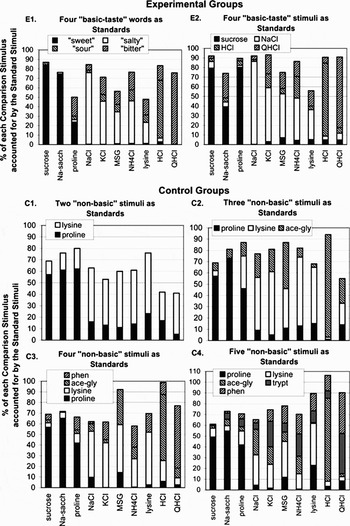
Accounting for ten Comparison taste stimuli with basic and nonbasic Standard tastes; the experimental design and results. In the six panels, the first two, E 1–2, give the results from the two experimental “basic tastes” groups, and C 1–4 each give the results from one of the four “nonbasic tastes” control groups. In panels E 1 and E 2 the four basic words (sweet, sour, salty, and bitter) and stimuli (QHCl, HCl, NaCl, and sucrose) were used as Standards to describe the tastes of the ten Comparison stimuli. In the rest of the panels (C 1–4), from two to five stimuli not considered to be basic were used in the same role as Standards.

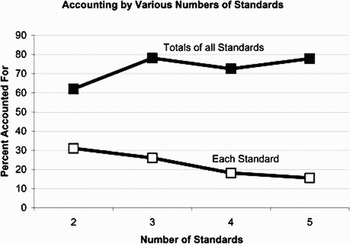
The degree to which each nonbasic Standard stimulus accounted for the Comparison stimuli depends on how many Standards were used (from Fig. 1, C 1–4). The lower curve shows that each Standard's account was not constant but decreased (averages) as the number of Standards increased. The upper curve shows that the total amount accounted for by all Standards may be approaching an asymptote of somewhat less than 100% as the number of Standards increases. The upper curve equals the lower curve times the number of Standards.

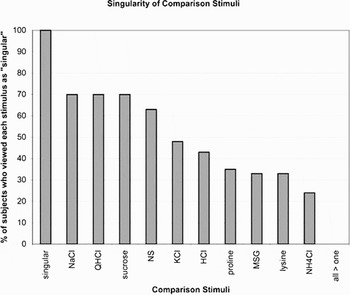
Comparison stimuli rated as “singular” or “morethan-one;” data from the basic tastes protocols (Fig. 1, E1, E2). The left column indicates how the ratings would appear for a hypothetical stimulus that was rated as singular by all subjects, and the right column illustrates the data for a stimulus that was always rated as more-than-one. No stimulus is completely either singular or more-than-one, the only two outcomes that would be predicted in the basic tastes model.

Stated in general terms, the total amount of activity set up by a given stimulus, here a tastant, is its neural mass. These are the areas under each across-fiber pattern curve discussed above. (Lashley [Reference Lashley1931] noted the importance of “neural mass” in the handling of high levels of information of importance to a species.) The absolute difference in impulses/second (or some other measure) between this profile and the profile set up by a second stimulus is called the neural mass difference (Erickson Reference Erickson1986). In the across-fiber pattern theory, the prediction is made that the perceived differences between two stimuli is a positive function of the amount of this neural mass difference. As an example, two sodium salts of similar concentration would produce small neural mass differences, and would thus be predicted to be poorly discriminable from each other.
The total neural mass produced by a stimulus is taken to be indicative of intensity. If the neural masses produced by two stimuli are different, that indicates a difference in intensity. Both intensity and quality give neural mass differences information about discrimination between stimuli. If it is desired to inspect only taste quality differences, leaving out intensity differences, the neural masses – representing intensity – can be brought to the same level by multiplication through one of them.
As examples, just noticeable differences in the color of a stimulus, or the location of a visual or somesthetic stimulus, would require the same neural mass differences. In the topographic systems (Erickson Reference Erickson1968), such as visual or somesthetic location, very many neurons are available; therefore they may be narrowly tuned and still evoke enough neural mass to differentially define the event. For usable events in nontopographic systems such as taste or color, few neurons are available, so to produce sufficient neural masses with their concomitant neural mass differences, they must be broadly tuned. This broad tuning would bring many neurons into play to provide the necessary neural mass (Erickson Reference Erickson1968, Figures 2 & 3).
7. A more definitive control?
7.1. A proposed control experiment
A model might be evaluated by the degrees to which it can encompass and predict large amounts of useful data. Such tests, described in Section 6, appear to controvert the basic tastes doctrine. An even stronger test would be to inspect the standard textbook definition of the basic tastes. Are the “basics” the only ones that can account for other tastes (Pfaffmann Reference Pfaffmann and Stevens1951, Reference Pfaffmann, Woodworth and Schlosberg1954), or might they be more efficient at this than other tastants or words? And are the basic tastes the only tastes perceivable in other tastants and mixtures (Bartoshuk Reference Bartoshuk, Atkinson, Herrnstein, Lindzey and Luce1988; Halpern Reference Halpern, Pashler and Yantis2002a)? The following sketch, an example extended from the control formats in Section 6, is presented as a tentative illustration of how such an experiment might be done, and the rich vein of information to be expected from such experiments.
7.2. Introduction to the illustration
The key aspect of this demonstration was that control groups composed of tastants not considered to be basics were included to compare with the performance of the basic tastes. If the few-basic tastes position is correct, then the experimental basic words and stimuli should account very strongly or completely for various other taste stimuli, and the four controls using nonbasic stimuli should completely fail, or nearly so. If there were no clear differences between the experimental and control groups in effectiveness in accounting for other stimuli, the basic tastes position in this definition would be considered falsified – and this is how the results came out.
7.3. Materials and methods
Two experimental groups of subjects used the basic taste words and stimuli as “Standards” to account for the “Comparison” stimuli (Fig. 1, panels E1 and E2), and four control groups used from two to five “Standard” stimuli not considered to be basic (Fig. 1, panels C1 to C4) to account for the same Comparison stimuli.
The subjects were Duke University undergraduate students earning experimental credit in a course. Each subject participated in only one of the six groups. There were 31 subjects in the basic words (Fig. 1, E1) and 26 in the basic stimuli (E2) groups, and 22, 18, 12, and 13 in the 2, 3, 4, and 5 nonbasic controls (C1–4). Using these Standards, each subject was asked to account for the tastes of the 10 Comparison stimuli (Fig. 1 abscissae). To avoid biasing the subjects towards use of the basic tastes model, it was expressed only in the first control (E1) in which the subjects were asked, but not taught, to use the words sweet, sour, salty, and bitter as Standards. The sip and spit method was used with partially filled 3 oz. paper cups, and distilled water rinses. The subjects were instructed to taste each Standard and Comparison stimulus – with rinses – as many times before and during the experiment as necessary to remain familiar with them. They recorded the percent to which each Standard word or tastant accounted for the tastes of the Comparison stimuli.
The stimuli were: 0.002 M quinine HCl (QHCl), 0.0025 M sodium saccharine (Na-sacch), 0.01 M monosodium glutamate (MSG), 0.03 M HCl; 0.03 M l-phenylalanine (phen), 0.05 M l-tryptophan (trypt), 0.1 M l-lysine, 0.1 M n-acetylglycine (ace-gly), 0.1 M NH4Cl, 0.2 M NaCl, 0.3 M KCl, 0.6 M sucrose, and 0.6 M l-proline.
7.4. Main results
The main issue was to compare the performance of the two experimental basic taste groups (Fig. 1, panels E1–2) with the four control nonbasic taste groups (C1–4). Contrary to the basic tastes idea, the data for the control groups overlap those of the experimental groups.
As examples of the data, the subjects rated the taste of NaCl (Fig. 1, E1, fourth column) as 0.3% sweet, 75.6% salty, 2.8% sour, and 5.8% bitter for a total of 84.5%, leaving 15.5% of its taste not accounted for. On the other hand, the four basic taste stimuli (E2) accounted for a total of 93.7% of the taste of NaCl.
Averaged over all the Comparison stimuli, the basic words (Fig. 1, E1) were relatively ineffective as Standards, accounting for 69% of the Comparison stimuli, and the basic stimuli (Fig. 1, E2) were relatively effective, accounting for 84%. Although the nonbasic Standards should not have accounted for the Comparison stimuli, they were competitive with the basics; the 2 nonbasic stimuli accounted for 62% of the Comparison stimuli (Fig. 1, C1), the 3 nonbasics for 81% (C2), the 4 nonbasics for 73% (C3), and the 5 nonbasics for 78% (C4).
To be noted is the overlap in effectiveness between the basic (E1–2) and nonbasic (C1–4) Standards, and the general increase in effectiveness as the number of nonbasic Standards was increased from two (C1) to five (C4).
Individual subjects occasionally accounted for more than 100% of a Comparison stimulus. For example, one subject rated KCl as 30% accounted for by lysine, 50% by tryptophan, and 50% by phenylalanine (total=130%), and another rated MSG as 30% lysine, 10% tryptophan, and 80% phenylalanine (120%). These aspects of the data are hidden within the averaged data in Figure 1, but were strong enough to appear in the averaged data as 109% of HCl accounted for in Figure 1, C 4. This is discussed further in “A Completion Effect,” Section 7.8.
7.5. This psychophysical definition of basic tastes was falsified
The definition that basic tastes (Fig. 1, E 1–2) will account for the tastes of a variety of taste stimuli, and that nonbasic controls (C 1–4) cannot, was falsified; each of the experimental and control groups accounted for considerable and overlapping proportions of the Comparison stimuli. This is illustrated in Figure 1 in that the columns have substantial height in both the experimental and control groups; no basic group (E1–2) achieves 100% in accounting for any Comparison stimulus, and no nonbasic group (C 1–4) completely fails with columns at 0%. For this finding of broad overlap no statistical assay was needed. If a rational statistical definition of basic tastes were offered, for example, if a reason was given why basic tastes should do better than nonbasics at p<.01, or that the basics should be at 100% and the nonbasics at 0%, those predictions might be testable. At any rate, it is doubtful that the basic words could be found more efficient than the 3, 4, or 5 nonbasic stimuli, as the latter have higher raw data averages.
The present format is different from Hang's (1901) and those in other psychophysical articles supporting this model that followed him, in that it used controls, and could have supported or falsified the basic tastes model.
7.6. An inconvenient truth
After the experiments it became disconcertingly clear that the subjects were biased towards the idea that the four basic tastes should account for the Comparison stimuli! We failed in our efforts to keep this issue balanced between the experimental and control groups, and so the data are probably skewed in favor of basic tastes. Many of the subjects commented on this issue in debriefing, such as “Aren't there just four tastes?” They reported that they had learned from textbooks, in middle school through college, that there are four basic tastes. This unexamined bias may be unavoidable in all psychophysical studies involving the basic tastes. The future researchers in the field of taste will be drawn from such students.
This bias could account in part for the use of basic words and stimuli herein, and the relative singularity of the basics, and would raise the issue of whether the use of basic words is learned, or a sensory verity. These questions might be approached experimentally, but the cultural “common truth” of basic tastes would be hard to null out.
7.7. Further tests of the basic tastes model
7.7.1. A definition of “basic tastes.”
To test the four tastes model in somewhat more detail, as clear a statement as possible of the idea was sought. Two relevant tenets of the model at the psychophysical level, as cogently summarized by Halpern (Reference Halpern, Pashler and Yantis2002a), are (a) that the four basic tastes completely account for all tastes, and (b) that the basics are clearly and separately perceivable, unchanged, as the only components of mixtures and other stimuli. (He also points out that in this model each receptor and neuron is specifically tied to only one of these tastes). It is clear from his article that the terms “taste” and “basic tastes” have not been formalized beyond functions (a) and (b), and no control experiments have been done to test other words or stimuli as basics, other numbers of nominee basic tastes, or whether they are indeed clearly discernable in mixtures or other stimuli. To the extent that Halpern's two statements might be taken as possible tests of the model, it is further falsified as follows.
7.7.2. The accounting was not total
In regard to Halpern's tenet (a)., first, the basic tastes did not completely account for the Comparison stimuli. But must the basic tastes be held to exactly a 100% accounting of other tastes in the present format? Would 95% do? It could easily be that there is an inherent lack of clarity of tastes, say in comparison with our abilities to report that a shape is a square, a straight line, or a point, that would somewhat degrade the subjects' acuity in tasting. Perhaps the performance of the basic tastes herein is the best the subjects could be expected to do, and that these data are equivalent to a perfect accounting. But the nonbasic Standards accounted for the Comparison stimuli at about the same level as the basics; either way, the control and experimental groups are roughly equivalent in this limited set of data.
7.7.3. Tastes other than the basics were perceived
In regard to Halpern's tenet (b), the psychophysical basic tastes model holds that the basic tastes are clearly and separately perceivable, unchanged, as the only components of other taste stimuli and mixtures. This did not hold in the present data. After the experiment proper, the subjects in the four and five nonbasic controls (Fig. 1, C 3–4) were asked to describe their nonbasic Standard stimuli freely, that is without the instructions to use the basic words. In the basic tastes model, only the basic words should have been used – but only 65 % of the words used were basic, and 35% were not. These nonbasic words included alcohol, alkaline, aspirin, bad, bad soda, baking soda, bland, cottony, chalk, citrus, crap, dentist work, fresh, ginger ale, medicine, metally, milky, mineral, mouth wash, nasty, not good, Nutra Sweet, old, pastry, plastic, spicy, Sweet ‘n Low, and tangy. Acid, lemon, and vinegar were counted as basic words for sour. The fact that words other than the basics can account for tastes has been shown (Schiffman & Erickson Reference Schiffman and Erickson1971; Schiffman & Dakis Reference Schiffman and Dakis1975). A more complete treatment of this issue would be interesting, perhaps using some nonbasic words; and such a procedure would provide a reasonable control for the basic words protocol (Fig. 1, E1). The present data suggest that the basic tastes do not come naturally as the only verbal descriptors subjects find appropriate; and this in turn suggests that their exclusive use in psychophysical studies may have resulted, to some degree, from directions to use only these words, guaranteeing a successful outcome in terms of basic tastes.
7.7.4. Inconstant accountings
And, as was true in describing the nonbasic Standard stimuli with words (7.7.2), the Comparison stimuli did not appear to be perceptually made up of the basic stimuli. The basic tastes model requires that the non-basic stimuli should be completely describable in terms of the basic stimuli (Halpern's tenet (a). For example, the taste of proline should be composed of the basic tastes, mostly sweet and bitter (Fig. 1, E1, column 3). Furthermore, the amounts of each basic taste in proline should be definite to unequivocally define the taste of proline (Halpern's tenet b). If this is so, then accountings for Comparison stimuli by proline should also be definite, or fixed, because it represents fixed amounts of the basic stimuli. When used only with lysine, proline accounts for an average of 33% of each Comparison stimulus (Fig. 1, C3). If proline is composed of definite and fixed amounts of the basics, it should continue at 33% no matter how many Standards are used along with it. But this accounting drops progressively from 33% when there are only two Standards to 24%, 20%, and 20% of each Comparison stimulus when more Standards were added (not illustrated independently, but discussed next with reference to Fig. 2). Lysine also drops progressively in this series from an average of 28% to 30%, 25%, and 16% when used with one to four other Standard stimuli (Fig. 1, C1–4). So proline and lysine, as examples, are evidently not perceptually composed of definite amounts of the basic tastes as required in the basic tastes doctrine.
A similar effect might be found using various numbers of the five basic stimuli. For example, the degree to which NaCl accounts for another stimulus or mixture might depend on whether it was used alone, or along with one to four other basics. If the accountings by NaCl decreased in this series, both of the basic taste's primary definitions (Halpern's tenets a and b) would be negated. Such control experiments have not been done.
7.8. A “completion” effect
This failure to find fixed amounts of accounting for the Comparison stimuli by individual Standards is not in line with the basic tastes model. A reason for this failure may be provided by a look at the overall averages for the nonbasic Standards shown in Figure 2. The average decreasing effectiveness of each of the individual Standards as the number of Standards increases from 2 to 5, appears in the lower curve. On average, when two Standards were used they each accounted for about 31% of the taste of the Comparison stimuli; but with three Standards this decreased to 26% each, with four to 18% each, and decreased to 16% for each of five Standards. But this curve should be level if each nonbasic Standard was indeed made up of definite and fixed amounts of four basic tastes as held in the basic tastes doctrine.
The reason for this steady decline (lower curve, Fig. 2) may be seen in the totals accounted for with each set of Standards (top curve). The implication is that these totals may be rising towards “completion,” which would be close to 100%. With only two Standards, the total amount of a Comparison stimulus accounted for is 62%; this rises to 78% with three Standards, 72% with four, and 80% with five Standards. It might be concluded that completely accounting for the taste of a Comparison stimulus was an implicit objective for the subjects. To do this, they would have to reduce the value given for each Standard when there were more of them; otherwise, the total could quickly rise to more than 100%. If each Standard were held to the 31% seen for two Standards, then when 5 standards were used, 155% of the Comparison stimulus would be accounted for. This might be perceived by the subjects as an excess to be avoided, a potentially strong effect in previous research of this nature. Those controls were missing.
In summary, subjects in psychophysical procedures may take on two conflicting goals; to veridically report how well each Standard accounts for a Comparison stimulus, and to completely account for the Comparison stimulus with whatever Standards are available. The direction the subjects take in these kinds of experiments might depend heavily on the nature of the instructions given to them. Because the subjects were clearly aware of the idea and role of basic tastes before the experiment, their reports could be biased towards the completion usually required in studies of this sort (sect. 7.6). Support for this idea is seen in that subjects very rarely go over 100% in accounting for a Comparison stimulus (Fig. 1 C4, HCl). Further discussion and testable speculations on the “completion” effect are contained in the Appendix.
This problem may be summarized thus: If the subjects believe in four (or five etc.) basic tastes, and are given this number of stimuli to use, then they might for this reason complete the accountings with four (or five etc.) stimuli.
7.9. Singularity, or what is A taste?
As found in previous tests of singularity (sect. 6.1), neither were the basics singular (one taste) nor the nonbasics more-than-one (of the basic tastes), as required in the basic tastes doctrine. This was confirmed in the present data.
The perceived singularity of each of the 10 Comparison stimuli was determined in the basic words and stimuli controls (Fig. 1, E1 and E2) after the experiment proper. It is seen in Figure 3 that only 70% of the subjects found the basics NaCl, QHCl, and sucrose to be singular. The taste of the basic stimulus HCl was rated as less singular (43%) than the other basics, and also less singular than some of the nonbasic stimuli. The nonbasics were rated as singular to some degree; for example, KCl was rated as singular by 48% of the subjects. To the extent that the basic tastes model requires singularity (the model is not clear on this), these data falsify the model.
These are not statistical statements; as for Figure 1, the point of Figure 3 is not that one stimulus is statistically more singular than another, but that the data are intermingled between basic stimuli and the nonbasics. Also it seems clear, as nonstatistical statements, that the basics do not rest at complete singularity (left column) and the nonbasics do not rest at completely more-than-one (right column), as might be held in the basic tastes doctrine. It is hoped that this conclusion will be tested in future studies.
Some of the singular ratings of the basics may be accounted for by the fact that the subjects were biased towards the verity of basic tastes, as mentioned in Section 7.6.
7.10. Other comments on the experiment
It could be argued from the basic tastes model that the nonbasic stimuli could account for the Comparison stimuli because each was composed of set amounts of basic tastes. If this argument were made, it must equally be argued that the basic tastes might function because they were composed of various amounts of the tastes of the nonbasics. To remain unbiased, the argument cannot be made in one direction only, in support of the idea of basic tastes. The basic tastes position may not be assumed valid while testing its validity.
If words are not trustworthy vehicles of communication between what we perceive and what we report, should less than the expected basic tastes outcomes be taken very seriously? Might nonverbal methods, not using the basic words, give different, more valid results?
Were the protocols appropriate for the questions asked? It could be argued that the present procedures did not properly examine the basic taste model – but it must be admitted that the effort was made. This then raises the good question of how this idea might be more properly tested. This is not as clear as it should be. It is hoped that other more substantial and appropriate experimental protocols will be pursued.
The present data are not as forceful as the previous findings in other psychophysical studies in supporting the basics view. This may be because herein the subjects were not instructed on how to use the basics. That the data are as supportive as they are may result in part from the fact, mentioned in Section 7.6, that the subjects expected that their responses should be in terms of the basic tastes. This issue could be tested.
7.11. Do these data falsify the Basic Tastes model?
These data and discussion falsify the basic tastes model as it has been presented thus far. But, strictly speaking, without a clear rationale and definition of what “basic tastes” are, the model can neither be falsified nor supported. It is in a fatal limbo. This may be seen as a serious problem by some in the field of taste and by others from various fields, as well. It is hoped that a clear and testable underlying hypothesis and the resulting definitions will be elaborated and tested. These could lead to a clearer view of the nature of taste.
8. A promising alternative to basic tastes: Thomas Young
The previous sections of this article have addressed the many serious shortcomings of labeled-line models of neural information, and the basic taste model in particular. What would be a more substantial alternative of broader applicability? The present section presents such a model based on Young's theory of color vision.
8.1. A definition of “theory”
In this article it is held as an essential part of investigating the basic tastes that there must be a rational, data-based hypothesis from which the basic terms are derived, and that makes the hypothesis and its terms testable. The term “formal” was used to introduce this idea in Section 5.5. The following quote from Young's theory of color vision, first presented in Reference Young1802 and Reference Young, Teevan and Birney1807, meets these requirements in brief, forceful and elegant fashion. Because it meets these requirements, Young's statement is classed as a “theory” in this article.
8.2. Young's theory
Young's is a model of scientific thinking in the neurosciences that has seldom, if ever, been equaled; perhaps it had something to do with the fact that he was a polymath linguist who knew the vagaries of words. His interpretation of the Rosetta stone, although incorrect in detail, showed that he understood both the “labeled-line” and “population” implications of the symbols encountered (Erickson Reference Erickson2001). Here the “labeled-line” idea means that each of a limited number of symbols of determinate meaning will represent an equally limited number of events; three color receptors could signal only three colors. “Cleopatra” would be represented by one dedicated symbol, as the $ sign. The “population” idea means that a limited number of symbols (individual letters), each of indeterminate meaning but taken in combination, can represent an enormous number of different events; three color receptors could represent a continuum of colors. “Cleopatra” would be spelled out.
In the 1802 passage we will quote, note that Young first presents the rationale for the hypothesis – its economic necessity, that there cannot be enough color-coded private “labeled lines” to have one for each perceivable color from each point on the retina. The words in parentheses are by the present writer. Then he proposes the testable solution to this problem: If each of a very few (three) receptor types are relatively responsive to many wavelengths, each different from the other two in the placement of this responsiveness along the continuum, an unequivocal code in the pattern of activity across these receptor types for each color will result. Illustrations of Young's theory are given by Helmholtz (Reference von Helmholtz and Southall1924) and are found in many other texts (relevant discussion is provided by Erickson Reference Erickson1968, Reference Erickson, Schmitt and Worden1974, Reference Erickson and Neff1982b, Reference Erickson2001; Erickson & Schiffman Reference Erickson, Schiffman, Gazzaniga and Blakemore1975). In the 1807 quote, Young states that his economical logic would give the receptor types the ability to represent very many different colors at each point on the retina, a continuum.
His hypothesis for the encoding of color is succinctly put in what are arguably the two most powerful sentences in the history of neurobiology.
“Now, as it is almost impossible to conceive each sensitive point of the retina to contain an infinite number of particles (receptors), each capable of vibrating in perfect unison (responding) with every possible undulation (wavelength), it becomes necessary to suppose the number limited, for instance (to three); and that each of the particles is capable of being put in motion less or more forcibly, by undulations differing less or more from a perfect unison; for instance, the undulations of green light will affect equally the particles in unison with yellow and blue, and produce the same effect as a light composed of those two species; …” (1802).
“the different proportions, in which (the motions) may be combined, afford a variety of traits beyond all calculation.” (1807).
8.3. The implications of Young's theory
Young's was an unusual mode of thinking, not common since, in that it did not depend on available techniques or words of problematic meaning. His idea was driven by a precisely defined logical problem, given a straightforward solution, and the complete theory can best be conceptualized graphically, without words. His entire comment sets in its most elemental form the rationale of across-fiber pattern coding throughout the brain, to provide the means for the immense power of the brain to handle extremely large amounts of information (Erickson Reference Erickson2001). This model is particularly applicable for the most complex of the brain's functions where the amount of information far outweighs the number of basic “labeled” neurons available (Erickson Reference Erickson2001). And it is nicely testable.
His idea solves these problems by letting the information remain in the population form from its “first representation” to its “destination,” unchanged in general across-fiber pattern format, such as from sensory input to behavioral output. Very few transforms would be required, even into the level of motor responses (e.g., the problem of the “binding” together of the various aspects of a stimulus is eliminated) (Erickson Reference Erickson, Schmitt and Worden1974, Reference Erickson and Masterton1978, Reference Erickson1982a, Reference Erickson1984b, Reference Erickson1986, Reference Erickson2000, Reference Erickson2001). The data in all neural systems, including taste, fit this model. But the solution to this problem would be impeded by linear gatherings of information reduced to bits traveling along many labeled axons and across many synapses to a final neuron labeled “grandmother,” which is the general tenor of the basic tastes position.
Young's theory not only predicted the general broad form of the response characteristics of the receptors and neurons across wavelengths (“neural response functions,” Doetsch & Erickson Reference Doetsch and Erickson1970; Erickson Reference Erickson1968, Reference Erickson2000, Reference Erickson2001; Erickson et al. Reference Erickson, Doetsch and Marshall1965), but also their broadly-tuned character at more central levels; at no place in the brain could they return to “labeled-lines,” as that would destroy Young's economic ability to represent large amounts of information.
This economic statement provides perhaps the most important, or only, rational and testable hypothesis of sensory coding, and neural functioning in general. Very many colors can then be represented in the across-fiber pattern of activity across only three receptor types, just as a 3-digit number (base 10) can represent 1000 different events, and 1011, even more. This model thus presents the heuristic question of how many different levels of activity may be represented in the firing of a neuron, or a population of neurons. In this model, a relatively small number of neurons could hold massive amounts of information with redundancy, even in the presence of noise (Erickson Reference Erickson1985b, Reference Erickson2001).
But the simplicity of the model, which Young set in the context of three neurons, while making the idea altogether clear and generalizable to other more complex situations, also makes it easy to ignore when considering larger issues.
The across-fiber pattern idea of the neural representation of information closely parallels Young's theory. The rationale and successfully predicted data are of the same nature in both color vision and taste. The quotes we cited could well be used in taste, exchanging taste terms for visual terms.
8.4. Across-fiber patterning and Young
8.4.1. The across-fiber pattern model
Although this model has been presented a number of times (Erickson Reference Erickson and Zotterman1963, Reference Erickson1968, Reference Erickson, Schmitt and Worden1974, Reference Erickson and Masterton1978, Reference Erickson and Neff1982b, Reference Erickson1984b, Reference Erickson2001), it might best be summarized here as an extension and detailed elaboration of Young's theory. It is based first on Young's concern for an economy of neural resources, and also on an economy of neural principles.
Concerning an economy of neural resources, Young's idea is that a continuum of wavelengths may be represented most economically in the pattern of activity across three broadly tuned color receptors. In the across-fiber pattern model, this idea is generalized to all neural systems, sensory, motor, and probably most others in which an efficient economy in the representation of sometimes great amounts of information is required.
Concerning an economy of principles, it seems probable – at least as a first approximation – that once the nervous system found an efficient way to represent information, it would conserve that method across systems to whatever extent is possible – or reinvent it. The across-fiber pattern model is applicable to all systems thus far considered.
8.4.2. Generality of across-fiber patterning
This possibility of the great generality of the across-fiber pattern model is not always immediately obvious. Some of the continua are laid out as maps across neural tissue, such as across the skin surface, retinal location and muscle location (which muscle?), and in other systems the continua are not laid out spatially, such as color, temperature, taste, flexion and extension, and vestibular sensitivity; the entire continua are to be found at each point in a spatial map. The former have been termed “topographic” systems, and the latter “nontopographic” systems (Erickson Reference Erickson1968). As examples, the entire nontopographic color continuum is found at each point in the topographic retinal maps, and the taste continuum at each point on the tongue and its projections in the skin maps. But in both cases, the neural information is in the form of across-fiber patterns.
As another point where the neural systems appear to require different mechanisms, the tuning of the neurons in spatial maps appear to be narrow with respect to the total continuum, whereas for the nonspatial codes imbedded therein the neurons must be broadly tuned to complete the continuum with the few neurons available at that point – Young's point. Relatively narrowly tuned spatial somesthetic and visual neurons are broadly enough tuned to provide a continuous and economical representation of those spaces, finer than the distances between receptors. In a two-dimensional sheet such as skin or retinal location, as few as three neurons could provide the information about the location of many different stimuli within their areas of sensitivity by the unique pattern of activity across them, as the location of a ship can be determined by distances from three known points. Population coding applies identically in both spatial and nonspatial situations.
Such population coding, of which the “across-fiber pattern” theory is an explicit and highly detailed example, has been widely advocated in all sensory systems, including the chemical senses. It has been widely accepted in olfaction (Buck Reference Buck2004; Malnic et al. Reference Malnic, Hirono, Sato and Buck1999) for at least 50 years (Adrian Reference Adrian1955), and in taste for over 40 years (e.g., Erickson Reference Erickson and Zotterman1963, Reference Erickson1968, Reference Erickson2000; Scott & Giza Reference Scott and Giza2000; Smith et al. Reference Smith, St. John and Boughter2000). It is also appropriate for most other sensory, motor, and molar neural functions (Covey Reference Covey2000; Erickson Reference Erickson1968, Reference Erickson, Schmitt and Worden1974, Reference Erickson and Masterton1978, Reference Erickson1984b, Reference Erickson2001). The great utility of Young's idea has been rediscovered independently by many investigators (see Erickson Reference Erickson, Schmitt and Worden1974, Reference Erickson and Masterton1978, Reference Erickson and Neff1982b, Reference Erickson1984b, Reference Erickson and Pfaff1985a). As they were not aware of Young's work and others, they independently invented various words to name it. These names include, at least, the following: distributed, combinatorial, ensemble, parallel, and population coding. Some used the population idea without naming it, including Adrian, Doetsch, Hartline, Johansson, Llinas, Merzenich, Mountcastle, Nafe, Sperry, and Tower in sensory systems, and Georgopoulos, Law, Lee, and McIlwain in motor systems. Among others, Goldman-Rakic, Hebb, and Lashley utilized this general idea for broader brain functions (Erickson Reference Erickson2001). The across-fiber pattern term was first introduced by Erickson (Reference Erickson and Zotterman1963, Reference Erickson1968). In that there are no clear and substantively different definitions of the other terms, they are assumed to be similar to across-fiber patterning. However, across-fiber pattern coding is more precise in that it states exactly how the individual neurons contribute to the overall code, whereas the other terms simply state that the code is distributed over a population of neurons. Definitions of these other terms would be extremely salutary, including how they differ from across-fiber patterning and from each other. To the extent that there is one idea, the use of one term would be simplifying and clarifying.
This model also addresses some important molar issues that are rarely touched on because they are hard to address. These issues include the neural representation of “concepts” or “equivalence,” as well as “memory” and “readout,” and a solution to the binding problem (Erickson Reference Erickson, Schmitt and Worden1974, Reference Erickson and Neff1982b, Reference Erickson1984b, Reference Erickson2001).
Whatever the reasons for this ubiquitous neural commonality of proposed strategies in representing information, it would be surprising and unparsimonious if an entirely separate mechanism had evolved for taste (Erickson Reference Erickson1968, Reference Erickson and Masterton1978, Reference Erickson1984b, Reference Erickson1986, Reference Erickson2000, Reference Erickson2001). Across-fiber patterns are appropriate for very high to low levels of information (input-output variance). The neural strategies for yes/no situations could require only labeled-lines, an across-fiber pattern reduced to one neuron, each neuron having one designated function, as in pheromone-based behavior, the giant axon escape reactions in crustaceans (Erickson Reference Erickson2001), or the specificity for l-arginine of neurons in the channel catfish (Caprio Reference Caprio1978). This would be equivalent in Young's model of language for one determinate symbol to represent Cleopatra. Such possibilities are not in conflict with the across-fiber patterning model, wherein individual neurons may be entirely “specific” where the level of information becomes minimal, one bit, as discussed in Section 6.4 (Erickson Reference Erickson1968).
8.5. Across-fiber patterning and taste
The original datum driving the “across-fiber pattern” theory (Erickson Reference Erickson and Zotterman1963, Reference Erickson1968) was the broad responsiveness of individual taste neurons (Erickson Reference Erickson and Zotterman1963; Pfaffmann Reference Pfaffmann1941, Reference Pfaffmann and Stevens1951, Reference Pfaffmann, Woodworth and Schlosberg1954, Reference Pfaffmann1955). This has been elaborated extensively, both empirically and logically (e.g., Boughter et al. Reference Boughter, St. John and Smith1999; Erickson Reference Erickson2000; Scott & Giza Reference Scott and Giza2000; Smith et al. Reference Smith, St. John and Boughter2000). With this broad sensitivity, the stage is set for the encoding of many tastes with few neurons – and the taste neurons are notoriously few.
8.5.1. Across-fiber patterning requires receptor and neuron typologies
The original presentation of across-fiber patterning was in terms of Young's typologies (Erickson Reference Erickson and Zotterman1963). All data on receptor types are predicted or accommodated by the across-fiber pattern model on logical and economic grounds (Erickson Reference Erickson1968, Reference Erickson2000, Reference Erickson2001). For example, receptor and neuron types are required for nontopographic sensory systems such as color vision and taste, for Young's economic reasons (Erickson Reference Erickson and Zotterman1963, Reference Erickson1968). The necessity for types here lies in the paucity of neurons available at each point on the tongue. On the other hand, topographic systems, such as skin or retinal location, although fully using across-fiber pattern codes, do not find broadly tuned typologies necessary because, with the abundance of receptor surface and neuron quantity, Young's economy is not as strong an issue (Erickson Reference Erickson1968).
As discussed earlier (sect. 4.2, techniques) the existence of groups or types of taste receptors or neurons has not been established. This lack does not disqualify the idea of typologies, but only makes the point that they have not been formally defined, and so the issue has not been resolved.
8.5.2. Fuzzy set types
Young's idea exists in a somewhat different approach to typologies, that of “fuzzy sets.” This idea presents a logic for a few underlying processes rather than a few cell types. These processes are shared in various “fuzzy” degrees by all cells, allowing for idiosyncrasy between cells without losing the advantage of typologies. They have been presented as mathematical abstractions that account for the amount and time course of taste responses (Buhusi Reference Buhusi2000; Erickson et al. Reference Erickson, Di Lorenzo and Woodbury1994, Reference Erickson, Schiffman, Doetsch, Di Lorenzo and Woodbury1995, Reference Erickson, Woodbury and Doetsch1996). This procedure assigns relative values in each of these few time course and amplitude sets to describe each cell's response. The success of this approach in accounting for the amount and time course of each cell's responses suggests that further investigation in this line might be useful. This approach could clarify the problematic issue of the labeling of types of cells as a different issue from that of the labeling types of underlying processes.
8.5.3. Breadth of tuning of receptors and neurons
The across-fiber pattern theory proposes broad tuning of receptors and neurons. There is a long and detailed history showing the multiple sensitivities of taste receptors (Herness Reference Herness2000), and the clearly validated multiple sensitivity of afferent taste neurons (Erickson Reference Erickson2000; Gilbertson et al. Reference Gilbertson, Boughter, Zhang and Smith2001; Lemon & Smith Reference Lemon and Smith2005, Reference Lemon and Smith2006). That the breadth of sensitivities of individual cells, or their participation in the various sets of underlying processes, vary from only one to all the stimuli used is not a problem for this theory; there is breadth in each cell, but it appears to be variable between cells within the very limited range of stimuli tried thus far.
8.5.4. Developments in across-fiber pattern coding
Erickson (Reference Erickson2000, 2001) pointed out that the across-fiber pattern model would find its most important application in more molar functions of the nervous system where information demands are very high, and rapidity of handing of this information is very important (Erickson Reference Erickson, Schmitt and Worden1974, Reference Erickson and Neff1982b, Reference Erickson1984b). Simon and his coworkers (Reference Simon, de Araujo, Gutierrez and Nicolelis2006) are taking a broader look at food intake as a “distributed” code. They describe not just the encoding of tastants, but the whole distributed oral input during ingestion in parallel and simultaneous with postingestive properties of tastants. This population approach will certainly be expanded to include all the sensory input and motor output necessary for ingestion, and similarly on to other large behavioral issues such as decision-making, memory, and language. A basic-taste, labeled-line direction would prevent access to these ultimately unavoidable molar issues. On the other hand, population codes represent large amounts of information simultaneously at all neural levels (Erickson Reference Erickson2001). This is the current issue of reductionistic versus systems biology.
9. Summary statements
The basic taste model has been entrenched in our culture and thought since before the dawn of the scientific method. It appears to have been “grandfathered” into our current scientific thinking without being subjected to the same rigorous standards of testing that we would apply to any novel model used to explain available data. We seem to have found the right answer without having asked the right question, or any question at all. The ongoing wide acceptance of and compliance with this model has probably resulted in a distortion and restriction of our scientific understanding. The effect of this broad acceptance on our understanding of taste is hard to estimate.
A preliminary demonstration of a test of a psychophysical use of this model found it to be false within the limits of this definition and protocol. More complete tests of this model are encouraged in all areas of taste – receptor, neural, and psychophysical – as a part of normal scientific procedure. An essential part of these tests would be the inclusion of control groups.
The across-fiber pattern model meets the requirements of definition and testability demanded by science. It has proven to be heuristic, and to be applicable to broad ranges of neural systems. This great breadth of relevance speaks to the validity of this model.
10. Conclusions
In its most general sense, this article is a search for the necessary systematic approach to the study of taste that will usefully inform and coordinate all its parts. This broad view suggests that it would be essential to consider venues other than the basic tastes model.
Certainly the basic taste words will never be lost to familiar conversation; we need them. But the cultural truth and convenience of a few taste words appears to have overridden their scientific inspection. How could we proceed in science if we were denied these words? But the need for common taste labels does not validate the basic taste idea as a guiding scientific model.
This review of the concept of basic tastes calls for control experiments based on rational and heuristic hypotheses from which are drawn clear and testable definitions of the major concepts (e.g., basic tastes, population models, or other hypotheses). The great leaps in knowledge in physics have required the strong understanding that it is essential to continuously examine by testing and, if necessary, to be willing to modify or even delete their most basic concepts. We might well emulate that vigorous science.
ACKNOWLEDGMENTS
Support from the Duke University Office of Research Support is acknowledged. Helpful readings by the Erickson family and my wife Marilyn Frey are gratefully appreciated.
APPENDIX A: “COMPLETION EFFECT” AND “OVER-ACCOUNTING” IN TASTE PSYCHOPHYSICS (SEE SECT. 7.8)
Although not set forth formally, it appears that an assumption of the basic tastes position is that each basic taste is perceptually nonoverlapping with the others, and that together they must exactly add up to the whole (100%) of any taste. There are many reports to support these ideas.
However, a “completion” effect as described herein points to the fact that in accounting for the taste of a Comparison stimulus with several Standards, the subjects appear to be trying to completely account for the tastant rather than, or in addition to, giving perceptually veridical descriptions of the Comparison stimuli in terms of the Standards. This is suggested by the present data; with increasing numbers of Standard stimuli, the value given each stimulus decreases, with the result that, or perhaps so that, a 100% accounting is approached. If this is even partly correct, it would have an obscure but very fundamental impact on the historical and modern conceptualization of the nature of taste.
Then the fact that some of the accountings in the 4 and 5 nonbasic controls were somewhat greater than 100% might be expected on the grounds that the amounts of the Standard stimuli contained in the Comparison stimuli indeed summed to more than 100%. For example, this was seen in the group data average of 105% accounting for HCl with 5 nonbasic Standards (Fig. 1, C-4). This over-accounting effect also was occasionally obtained by individuals when using the basic stimuli and words.
But suppose there were overlap between tastes (for example with “sour” and “bitter,” or HCl and QHCl), and three Standards each accounted for 40% of a Comparison stimulus. If summed linearly (as if they did not overlap in their tastes) they would then account for 120% of a Comparison stimulus; this was apparently sometimes the case, especially with larger numbers of Standard stimuli. On the other hand, with overlap between the tastes of these three Standards, each partly accounting for the same aspects of a taste, these three together might actually have accounted for a total of only perhaps 70%, leaving 30% unaccounted for. This means that an assumption of linear summations seen in the literature (sweet+sour+salty+bitter=100% of a tastant, Bartoshuk Reference Bartoshuk, Atkinson, Herrnstein, Lindzey and Luce1988) may be invalid.
The “distinct and nonoverlapping tastes” aspect of the basic tastes idea represents “crisp” sets of tastes wherein a linear summation to exactly 100% is expected in that model. But with overlapping or “fuzzy” taste sets, a linear summation in the analysis of the data values could inappropriately amount to the more than 100% – as in the present research.