Many studies were published in recent years about the effects of Marine Protected Areas (MPAs) in: (1) directly protecting fish species targeted by fisheries (thus causing an increase in population density and individual size; Halpern, Reference Halpern2003; Guidetti & Sala, Reference Guidetti and Sala2007 and references therein); and (2) indirectly influencing entire fish and/or benthic communities through trophic interactions (Sala et al., Reference Sala, Boudouresque and Harmelin-Vivien1998; Micheli et al., Reference Micheli, Halpern, Botsford and Warner2004; Guidetti, Reference Guidetti2006). Little attention, instead, was paid to the potential changes in behavioural patterns of fish caused by human activities, including fishing, especially in the Mediterranean Sea. At Medes Islands Marine Reserve (Spain) the decrease of the dusky grouper (Epinephelus marginatus) population density caused by human pressure was found to affect the socio-behavioural structure related to reproduction (Zabala et al., Reference Zabala, Louisy, Garcia-Rubies and Garcia1997). A human-oriented attraction was observed in some Mediterranean MPAs, especially when fish feeding is practised, an activity that alters fish aggregation and patterns of predation (Harmelin et al., Reference Harmelin, Bachet and Garcia1995; Milazzo et al., Reference Milazzo, Badalamenti, Fernàndez and Chemello2005, 2006).
Spear-fishing is a very popular activity in tropical and temperate seas, including the Mediterranean basin (Kulbicki, Reference Kulbicki1998; Coll et al., Reference Coll, Linde, Garcia-Rubies, Riera and Grau2004; Lowry & Suthers, Reference Lowry and Suthers2004). In some MPAs, old big fish like groupers were found to re-colonize shallow habitats from where they escaped to avoid spear-fishermen (Harmelin et al., Reference Harmelin, Bachet and Garcia1995; Vacchi et al., Reference Vacchi, Bussotti, Guidetti and La Mesa1998). Anecdotal information also suggests that target species at locations historically impacted by intense spear-fishing change their behaviour in the presence of humans (including divers with SCUBA), but quantitative data are scarce. This study is aimed at assessing possible changes in the behaviour of two sea breams (i.e. Diplodus sargus and D. vulgaris; both targeted by spear-fishing; Harmelin et al., Reference Harmelin, Bachet and Garcia1995; Coll et al., Reference Coll, Linde, Garcia-Rubies, Riera and Grau2004) within an MPA (where spear-fishing is forbidden) and outside. The hypothesis is that sea breams change their anti-predatory behaviour depending on the most frequent predator they have to escape: (a) natural predators such as large-sized and good-swimmer fish species and dolphins; and (b) spear-fishermen.
Sampling was done in spring–summer 2005 at two protected locations within the no-take/no-access zones of the Torre Guaceto MPA (south-eastern Adriatic Sea, Italy), where enforcement is effective (Guidetti, Reference Guidetti2006), and at two fished locations outside the northern and southern reserve boundaries. Six visual censuses (replicates) were carried out using SCUBA divers along 25 × 5 m transects randomly placed at 4–8 m depth at two sites (100s of metres away from each other) at each of the four locations. Fish behaviour was sampled in terms of: (1) frequency of positive/negative response in the presence of the diver; and (2) frequency of patterns of negative response, i.e. refuge into close shelters or escape into open water. Fish response is intended as the immediate response of fish seeing the diver. Considering that spear-fishing mostly targets large-sized sea breams, only adult fish were considered. Analysis of variance (ANOVA) was used to assess differences in average proportions of negative responses in relation to the factors ‘protection’ (‘P’, fixed, 2 levels: present vs absent); ‘location’ (‘L’, 2 levels, random and nested in ‘P’); and ‘site’ (‘S’, 2 levels, random and nested in ‘L’). Cochran's test was employed to assess the homogeneity of variances (Underwood, Reference Underwood1997).
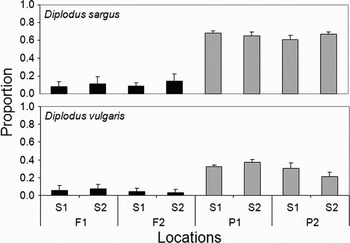
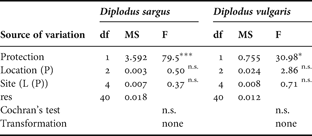
In both protected and fished reefs ~80% and ~70% of D. sargus (N = 448 observations) and D. vulgaris (N = 485), respectively, displayed a negative reaction in the presence of divers. The distance at which fish mostly reacted to the divers was variable, but anyway never lower than ~5 – 6 m. In the remaining cases, behaviour was mostly neutral (i.e. the specimen kept doing the same thing after having seen the diver), except for some rare fish attracted towards the divers. The specific patterns of escape differed between protected and fished reefs. Both sea breams displayed higher proportions of individuals that escaped into the shelters at protected than at fished reefs. Conversely, escape in open water was more frequent in fished than protected reefs for both species (Figure 1). No significant variability was detected at the scales of locations or sites (Table 1).
Mean proportion (±SE) of the two sea breams displaying a pattern of escape into the closest shelters, at the studied locations (F1, F2, P1 and P2) and sites (S1 and S2) in fished (F, dark bars) and protected (P, grey bars) rocky reefs.

Summaries of analyses of variance testing for effects of protection (P) and spatial differences at scales of locations (L) and sites (S) in average proportions of the two sea breams showing a pattern of escape into the closest shelters (see Methods for details).
Probability levels: n.s., not significant; *, P < 0.05; ***, P < 0.001.
Behaviour patterns of sea breams differed in terms of response to the presence of divers between fished and protected rocky reefs. Most of the previous studies about spear-fishing investigated the catch composition and the impact on fish density and size (Jouvenel & Pollard, Reference Jouvenel and Pollard2001; Coll et al., Reference Coll, Linde, Garcia-Rubies, Riera and Grau2004; Lowry & Suthers, Reference Lowry and Suthers2004). As regards the possible influence on fish behaviour, some authors did not observe any dramatic effects of spear-fishing in the aggregation patterns or home range use (Lowry & Suthers, Reference Lowry and Suthers2004), whereas others found significant changes in habitat use (Harmelin et al., Reference Harmelin, Bachet and Garcia1995) or reported that acquired behaviour of fish could be so different to bias fish visual census studies (Kulbicki, Reference Kulbicki1998). From a methodological point of view, in this study we used breathing apparatus whose noise is reported to potentially affect fish behaviour (Radford et al., Reference Radford, Jeffs, Tindle, Cole and Montgomery2005), whereas spear-fishermen do not use them. However, SCUBA divers well know that fish are not confident at all in those places where spear-fishing is intense, which means that fish stay far away from humans (with or without breathing apparatus) to avoid the risk of being speared. These results and literature data suggest that spear-fishing may alter fish behaviour in terms of anti-predator escape response, a behavioural pattern generally controlled by complex processes (Domenici, Reference Domenici2002). Taking refuge into crevices or under-surface of boulders seems to be effective to combat the attacks by large good-swimmer predators. Conversely, outside the protected area where spear-fishing is permitted, quick escape into open water seems to be the most suitable strategy to escape human predators (spear-fishermen). From this perspective, field observations support our results: many large and good-swimmer fish predators, such as the leerfish Lichia amia, the greater amberjack Seriola dumerili and the bluefish Pomatomus saltatrix, were seen to attempt to or successfully attack other fish (especially mugilids) that usually swam fast in very shallow waters or escaped quickly into crevices or under-surfaces of boulders. In addition, information was gathered from local fishermen who confirmed the occasional presence of dolphins feeding on fish.
All the above issues suggest that: (1) fish may adopt the optimal behavioural strategy to reduce predation risk relative to the most probable predator they encounter in fished and protected areas; and (2) that a fishing ban within MPAs may re-establish natural behavioural patterns of fish.
ACKNOWLEDGEMENTS
The research was funded by the PADI AWARE Project. Many thanks are also due to the Director (A. Ciccolella) and the staff of the Torre Guaceto MPA that made possible this research.