Implications
We observed that beef cows consuming excess rumen undegradable protein (RUP) had enhanced dominant follicle growth and ovulatory follicle parameters, but had decreased circulating progesterone concentrations post ovulation when compared with cows consuming excess rumen degradable protein. Based on these data, source of CP when fed to excess may have differential impacts on reproductive function in mature beef cows. It is likely that differences in reproductive function are a result of shifts in circulating amino acids (AA); however, application of this knowledge in a production setting is likely limited until specific effects of individual AA can be identified.
Introduction
Low-quality forages can be commonly paired with coproducts from the corn ethanol industry to provide rations to beef cows that often meet energy but exceed CP requirements. Such diets have been shown to improve ovarian function (Gunn et al., Reference Gunn, Lemenager and Bridges2014b) and pregnancy rates in yearling heifers (Engel et al., Reference Engel, Patterson and Perry2008) compared with diets adequate in CP. However, it is unclear if reproductive improvements are due to unsaturated fat or excess RUP from the coproducts.
Unsaturated fatty acids have been reported to improve ovarian function in dairy cattle (Robinson et al., Reference Robinson, Pushpakumara, Cheng, Peters, Abayasekara and Wathes2002); and while it is commonly accepted that a negative relationship exists between excess dietary CP and fertility in dairy cows (Elrod and Butler, Reference Elrod and Butler1993; Butler et al., Reference Butler, Calaman and Beam1996), the relationship between excess dietary CP, and in particular RUP, on reproductive performance in beef cows is still largely unknown. However, previous studies have reported enhanced ovarian follicular growth (Gunn et al., Reference Gunn, Schoonmaker, Lemenager and Bridges2014a and Reference Gunn, Lemenager and Bridges2014b) and uncompromised fertility (Rusche et al., Reference Rusche, Cochran, Corah, Stevenson, Harmon, Brandt and Minton1993) when beef cows were fed diets that contained excess CP from supplements primarily comprised of RUP.
Given the disconnect between aforementioned dairy and beef data in regards to excess protein and reproductive function, questions remain as to whether source of protein and degradability of that protein, when fed in excess, may differentially impact ovarian function of beef cows. Therefore, the objective of this study was to evaluate the effect of diets containing 150% of metabolizable protein (MP) requirements with supplements comprised of primarily RUP or rumen degradable protein on ovarian function and AA concentrations of beef cows nearing ovulation. We hypothesized that excess MP from a primarily rumen undegradable source would improve ovulatory follicle growth, as well as increase circulating hormone concentrations and alter AA profile compared with excess MP from a primarily rumen degradable feedstuff.
Materials and methods
Animals and diets
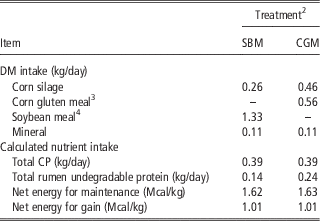
All cows were handled in accordance with procedures and protocols approved by the Iowa State University Institutional Animal Care and Use Committee. Research was conducted at Iowa State University Zumwalt Station Research Center in Ames, Iowa from January 2014 to March 2014. Non-pregnant, non-lactating, Angus and Angus-Simmental multiparous beef cows were allocated by breed, age, BW and body condition score (BCS) (n=18; age=6.4±3.4 years; BW=502±78 kg; BCS=4.5±0.4 according to Wagner et al. (Reference Wagner, Lusby, Oltjen, Kakestraw, Wettermann and Walters1988)), to 1 of 2, isonitrogenous supplements differing in degradability of protein (Table 1) and designed to maintain similar BW and BCS between treatments.
Supplement provided to beef cows consuming ad libitum corn stalksFootnote 1

DM=dry matter; SBM=soybean meal; CGM=corn gluten meal.
1 Corn stalk nutrient analysis (% DM basis): 51% total digestible nutrients (TDN), 6% CP, 50% ADF, 80% NDF. When combined with estimated corn stalk intake, total dietary metabolizable protein intake=700 g/day. Requirement for 613 kg cow (average starting weight of cows enrolled in study)=470 g/day for maintenance (NRC, 2000).
2 Treatment included ad libitum access to corn stalks combined with daily supplementation of either SBM or CGM to equal 150% of dietary metabolizable protein requirements.
3 CGM Nutrient analysis (% DM basis): 67% CP, 62% rumen undegradable protein (RUP), 2.4% Fat.
4 SBM Nutrient analysis (% DM basis): 50% CP, 36% RUP, 1.6% Fat.
Supplements were as follows: (1) a corn gluten meal-based (CGM) or (2) a soybean meal-based (SBM) supplement. When combined with ad libitum intake of corn stalks, diets were formulated to target an average daily gain (ADG) of 0.45 kg/day and equal 150% of MP requirements (National Research Council (NRC), 2000). Diet formulation was based on near-infrared spectroscopy feedstuff analysis before study initiation (Dairyland Laboratories Inc., Arcadia, WI, USA).
Cows were allowed ad libitum access to processed corn stalks (51% TDN, 50% ADF, 80% NDF and 6% CP) in a pen setting (n=6 cows/pen; mixed between treatments). Corn stalk intake was estimated using the following formula (NRC, 2000) for non-pregnant beef cows:
Dry matter intake=((Shrunk BW0.75×(0.04997×net energy for maintenance2+0.03840)/net energy for maintenance)×(temperature adjustment)×(mud adjustment)), where adjustments for temperature and mud were 0.90 and 0.85, respectively. Although corn stalk refusal was unable to be accurately quantified due to feeding system, corn stalk delivery was similar across all pens and exceeded estimated intake.
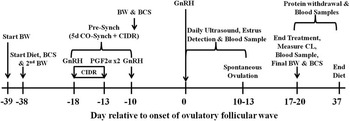
Individual supplementation occurred at 0800 h daily inside a facility where 10 side-by-side stanchions were located. All cows from one treatment were restrained in stanchions and delivered individual supplement. Cows remained in stanchions for <1 h until supplement was consumed and daily measurements and observations had been recorded. After one treatment group consumed supplement, cows were released from stanchions and the next treatment group was brought into the stanchions for individual supplement delivery. Supplement was provided for the first 58 days of the study and ad libitum corn stalks were offered for a total of 76 days (Figure 1).
Experimental design for treatments (corn gluten meal supplement, high rumen undegradable protein (RUP) source, soybean meal supplement, low RUP source) outlining treatments and data collection relative to onset of ovulatory follicular wave in beef cows. Protein was supplemented from day −38 to day 19 and corn stalks were supplemented from day −38 to day 37. BCS=body condition score; CIDR=controlled intravaginal drug releasing device; CL=corpus luteum; GnRH=gonadotropin releasing hormone; PGF2α =prostaglandin F2α .

Performance characterization
Initial BCS (Wagner et al., Reference Wagner, Lusby, Oltjen, Kakestraw, Wettermann and Walters1988) was recorded on the day before treatment initiation, and initial BW was the average of BW taken on the day before and the first day of the study before supplement delivery. Final BCS was recorded at the end of supplementation and final BW was the average of BW taken on the last day and day after supplement termination, before the 18-day period where ad libitum corn stalks were the only allotted feedstuff. To minimize differences in gut fill, animals had restricted access to corn stalks for 12-h before mornings in which BW were recorded. BCS were the average of scores assessed by the same two trained investigators at each time point.
Presynchronization
The experimental design is illustrated in Figure 1. Following a 20-day dietary adaptation period, cows were synchronized for ovulation using the 5-day CO-Synch+controlled intravaginal drug release (CIDR) protocol. At synchronization initiation cows were administered 100 µg of gonadotropin releasing hormone (GnRH, Cystorelin; Merial Limited, Duluth, GA, USA) and received a CIDR (Zoetis Animal Health, Florham Park, NJ, USA). After 5 days, the CIDR was removed, 25 mg prostaglandin F2α (PGF2α, Lutalyse; Zoetis Animal Health, New York, NY, USA) was administered and an Estrotect heat detection aid (Rockway Inc., Spring Valley, WI, USA) was placed on the tailhead of each cow. A second 25-mg dose of PGF2α was administered 8 h after CIDR removal to ensure complete luteolysis of the young, accessory CL induced by the first administration of GnRH (Bridges et al., Reference Bridges, Mussard, Burke and Day2012). Estrus detection was performed for 72 h following CIDR removal by trained personnel. Cows were monitored for visual estrus twice daily for 30 min each at 0630 and 1700 h. After 72 h of CIDR removal and initial PGF2α injection, all cows received 100 µg GnRH, and heat detection aid activity was recorded and removed.
Ovulatory follicle wave characterization
After 10 days of completion of the synchronization protocol, 100 µg GnRH was administered to force development of a new ovarian follicular wave. Starting at GnRH administration and daily thereafter at 0800 h, cows were subject to transrectal ultrasonography (Ibex Portable Ultrasound, variable MHz linear array transducer; E.I. Medical Imaging, Loveland, CO, USA) for characterization of the ovulatory follicular wave. Ultrasound examinations were performed by the same investigator throughout, and estrus detection was visually observed twice daily at 0630 and 1700 h by trained personal with the aid of heat detection patches. The location and size of all antral follicles ⩾3 mm in diameter were recorded by drawing representative sketches of each ovary. Follicles were measured using the caliper function of the ultrasound to determine the diameter of a given follicle using the average of the greatest cross-sectional perpendicular measurements.
The dominant follicle was documented as the largest growing follicle of the wave and the secondary follicle was the second largest growing follicle in the same wave. Day of dominance was categorized as the day on which the largest growing follicle was at least 8 mm in diameter and at least 1 mm greater in diameter than any other growing follicle of the same wave (Ginther et al., Reference Ginther1997). The duration of dominance was defined as the number of days from attainment of dominance until ovulation. Daily ultrasonography continued until ovulation was observed as confirmed by disappearance of the dominant follicle when precluded by visual estrus expression.
Once estrus was detected and subsequent ovulation was confirmed, ultrasound measurements ceased until 7 days post-estrus, when ultrasound was performed to measure the corpus luteum (CL) at the site of ovulation. Total CL volume was calculated using the caliper function of the ultrasound and formula for a rotary ellipsoid V=4/3 Π ab 2 (where a is the longitudinal axis and b the transverse axis). If the CL contained a lacuna, the volume of the lacuna was also calculated using the rotary ellipsoid equation and subtracted from the total CL volume to determine total volume of luteal tissue.
Day of spontaneous luteolysis during the ovulatory follicle wave was retrospectively determined via radioimmunoassay (RIA) and defined as the day on which circulating progesterone concentrations were <50% of the concentration on the previous day (Ginther et al., Reference Ginther, Silva, Araujo and Beg2007). This allowed for dominant follicle size at luteolysis and follicle growth from luteolysis to ovulation to be determined. After conclusion of the ultrasound period, day of ovulatory follicle wave emergence was tracked retrospectively to a cohort of follicles from which the dominant follicle originated (3–4 mm in diameter). Wavelength was defined as the number of days from emergence to ovulation. Antral follicle count (AFC) was totaled across both ovaries daily and averaged for the entirety of the wavelength to determine the daily AFC average.
Plasma analyses
Starting at study initiation, coccygeal blood samples were collected every other day until the beginning of ultrasound period for evaluation of plasma urea nitrogen (PUN) concentrations. During the ultrasound period until final CL measurement, blood samples were collected daily. One blood sample was collected 8 days after onset of the ovulatory follicular wave to determine circulating AA concentrations around the time of ovulation. After CL measurement and protein supplement termination, blood sample collection continued twice weekly for 18 days to characterize the return of circulating PUN concentrations to baseline. Blood samples were collected via coccygeal venipuncture in 6 ml ethylenediaminetetraacetic acid (EDTA) vacutainer (10.8 mg EDTA; BD Vacutainer; Becton, Dickinson and Co., Franklin Lakes, NJ, USA) and immediately placed on ice. Samples were centrifuged at 1750×g for 25 min at 4°C. Plasma was recovered and aliquoted into 5 ml polystyrene tubes and frozen at −20°C until hormone, metabolite and AA analyses were conducted.
Plasma samples collected on the day of luteolysis through the day of ovulation were analyzed to determine peak circulating concentrations of estradiol-17β via RIA at South Dakota State University using the methodology described by Perry and Perry (Reference Perry, Smith, Roberts, MacNeil and Geary2008). Across two assays, the average intra-assay CV was 4.4% and the inter-assay CV for a pooled serum sample containing 8±0.8 pg/ml was 10%. The average sensitivity across assays was 0.45 pg/ml (95% confidence interval). Plasma collected during the ultrasound period was analyzed for progesterone concentration to determine when luteolysis occurred, as well as to track function of the CL that resulted from spontaneous ovulation of the ovulatory follicle of interest. Progesterone concentration was analyzed via a commercially available RIA kit (Coat-A-Count; Siemens Healthcare Diagnostics Inc., Los Angeles, CA, USA). Across three assays, the average intra-assay CV was 1.3%, with the inter-assay CVs for pooled samples containing 0.54 and 5.69 ng/ml of progesterone, were 8.0% and 3.33%, respectively. The average sensitivity across assays was 0.15 ng/ml (95% confidence interval).
Plasma samples were analyzed for PUN with a commercially available kit (Urea Nitrogen Procedure No. 0580; Stanbio Laboratory, Boerne, TX, USA). Samples were prepared and loaded into 96-well plates to be read at 520 nm in an Eon Microplate Spectrophotometer (BioTek Instruments Inc., Winooski, VT, USA). Across 24 assays, the average intra-assay CV was 4.7%, and the inter-assay CV for the pooled serum sample containing 3.94 mg/dl of urea nitrogen was 19.5%. Plasma collected 8 days after onset of the ovulatory follicular wave was analyzed for circulating AA concentrations at North Dakota State University via ultra performance liquid chromatography (Lemley et al., Reference Lemley, Camacho, Meyer, Kapphahn, Caton and Vonnahme2013).
Statistical analysis
Data were analyzed using the MIXED procedure of SAS 9.3 (SAS Institute Inc., Cary, NC, USA), with animal as the experimental unit and the main fixed effect of treatment. For all follicular wave characteristics, hormones, and metabolite analyses, cow age, individual initial BW, and individual change in BW were included in the model as covariates. Follicular growth, PUN, estradiol and post-ovulatory progesterone concentrations were analyzed with the MIXED procedure of SAS for REPEATED measures. For all variables, the covariance structures of compound symmetry, heterogeneous compound symmetry, first order autoregressive, unstructured and ante-dependence were compared. The covariance structure with the smallest Bayesian information criterion result was used for the final analysis. The model included the fixed effects of treatment and day, as well as the treatment by day interaction. The slice function of SAS was used to generate simple effects within day. There was no treatment×day interaction for estradiol (P>0.15), and thus these data are not presented.
Significance for all variables was declared at a P⩽0.05 and tendencies were identified at a P>0.05 and ⩽0.10. It should be noted that two cows from the SBM treatment and one cow from the CGM treatment, based on estrus detection, failed to respond to the presynchronization, and also failed to ovulate within 18 days of forced follicle turnover. Therefore, data from those three cows were excluded from the data set.
Results
Performance and ovulatory follicle wave characteristics
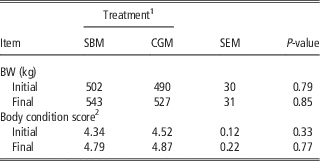
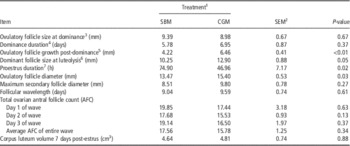
As designed, cow BW and BCS did not differ (P⩾0.33; Table 2) at treatment initiation or at the conclusion of the supplementation period. Ovulatory follicles of CGM cows experienced increased growth (P<0.01; Table 3) after attainment of dominance and had larger follicles at luteolysis (P=0.05) when compared with SBM cows. Furthermore, CGM cows had a shorter proestrus interval (P=0.02), yet larger (P=0.03) follicles at the time of ovulation than SBM cows. However, no differences (P⩾0.13) in wavelength, day of luteolysis, AFC or CL volume were observed between treatments.
Effects of excess metabolizable protein supplementation on BW and body condition score in beef cows

SBM=soybean meal; CGM=corn gluten meal.
1 Treatment included ad libitum access to corn stalks combined with daily supplementation of either SBM (n=9) or CGM (n=9) to equal 150% of dietary metabolizable protein requirements.
2 Scale of 1=emaciated to 9=obese, Wagner et al. (Reference Wagner, Lusby, Oltjen, Kakestraw, Wettermann and Walters1988).
Effects of excess metabolizable protein supplementation on ovulatory follicle wave and corpus luteum characteristics in beef cows

SBM=soybean meal; CGM=corn gluten meal.
1 Treatment included ad libitum access to corn stalks combined with daily supplementation of either SBM (n=7) or CGM (n=8) to equal 150% of dietary metabolizable protein requirements.
2 Greater SEM presented.
3 Dominance obtained when largest growing follicle was at least 1 mm larger than any other growing follicle and at least 8 mm in diameter.
4 Period between attainment of dominance and ovulation.
5 Growth of ovulatory follicle between dominance and ovulation.
6 Luteolysis defined as first day on which circulating progesterone concentrations were <50% of previous day concentration.
7 Period between luteolysis and expression of estrus.
Plasma analyses
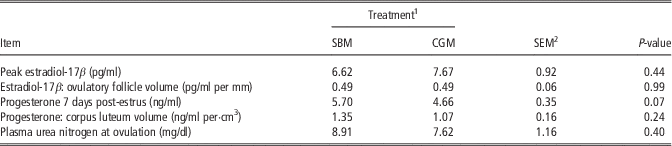
Peak estradiol concentrations at ovulation and the ratio of estradiol to ovulatory follicle size were not affected (P⩾0.24; Table 4) by treatment. While no difference in progesterone concentrations existed from days 1 to 6 post-estrus (P>0.10; data not shown), on day 7 post-estrus circulating progesterone concentrations tended to be decreased (P=0.07) in CGM compared with SBM cows. However, the ratio of circulating progesterone to CL volume 7 days post-estrus remained similar (P=0.24) between treatments. There were no differences in PUN due to treatment (P=0.92), nor were there any treatment×day interactions (P=0.36; repeated model data not presented in figure format due to insignificance). Moreover, PUN on the day of ovulation did not differ between CGM and SBM cows (P=0.40; Table 4).
Effect of source of excess metabolizable protein supplementation on circulating hormone and plasma urea nitrogen concentrations in beef cows

SBM=soybean meal; CGM=corn gluten meal.
1 Treatment included ad libitum access to corn stalks combined with daily supplementation of either SBM or CGM to equal 150% of dietary metabolizable protein requirements.
2 SEM (estradiol and progesterone: SBM n=7, CGM n=8; plasma urea nitrogen: SBM n=9, CGM n=9).
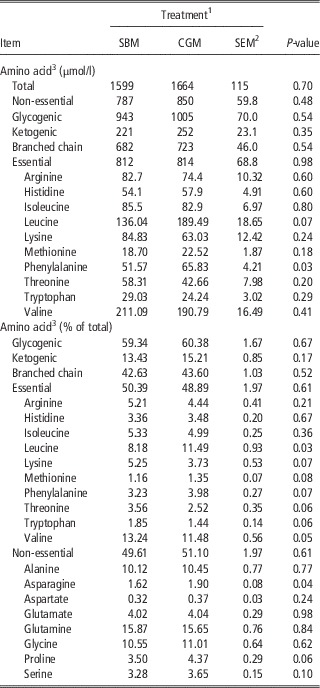
Total AA concentrations, as well as total essential AA, non-essential AA, glycogenic AA and branched-chain AA concentrations did not differ (P⩾0.48; Table 5) due to dietary treatment at day 8 after onset of the ovulatory follicular wave. Total phenylalanine was greater (P=0.03) and leucine tended to be greater (P=0.07) in circulation of CGM than SBM supplemented cows. When analyzed as percent of total AA, excess MP supplementation with SBM increased (P=0.05) concentrations of valine and tended to increase (P⩽0.07) concentrations of tryptophan, threonine and lysine compared with CGM; while excess MP supplementation with CGM increased (P⩽0.04) concentrations of leucine and asparagine and tended to increase (P⩽0.10) methionine, phenylalanine, serine and proline compared with SBM.
Effects of excess metabolizable protein supplementation on plasma amino acid concentrations in beef cows

SBM=soybean meal; CGM=corn gluten meal.
1 Treatment included ad libitum access to corn stalks combined with daily supplementation of either SBM or CGM to equal 150% of dietary metabolizable protein requirements.
2 SEM: SBM n=9, CGM n=9.
3 Cysteine and tyrosine were not present at detectable concentrations.
Discussion
The objective of this study was to evaluate the effects of excess MP supplementation from feedstuffs differing in rumen degradability on ovarian function of multiparous beef cows during the periovulatory period. To minimize confounding factors of BW and BCS on ovarian function, isonitrogenous supplements were designed to maintain similar BW and BCS across treatments throughout the study. Data from this study indicate these goals were met, allowing for direct comparison between sources of excess dietary protein on ovarian function. Similar PUN concentrations during the preovulatory period, coupled with similar BW and BCS between treatments allowed for the unique opportunity to directly study the effects of pathways other than PUN that may alter ovarian function.
Previous studies conducted in dairy cattle have routinely associated excess dietary protein, resulting in PUN concentrations above 19 mg/dl, with decreased pregnancy rates (Elrod and Butler, Reference Elrod and Butler1993; Butler et al., Reference Butler, Calaman and Beam1996). Yet, as the previously mentioned studies utilized diets comprised of feedstuffs with substantial rumen degradable protein fractions, it is somewhat unclear if amount or source of dietary protein, or both, was the underlying cause of these associations. While few studies have explored the relationship between excess dietary protein and reproductive parameters in beef cattle, it has been widely assumed that reproductive impacts would be synonymous with dairy literature. However, when CP was fed at 150% of NRC requirements to primiparous beef females, PUN concentrations were increased to 16 (Rusche et al., Reference Rusche, Cochran, Corah, Stevenson, Harmon, Brandt and Minton1993) and 17 (Gunn et al., Reference Gunn, Lemenager and Bridges2014b) mg/dl, but no negative effects on reproductive function or pregnancy rates were noted. Furthermore, in both of these studies, conception to artificial insemination was similar or improved in females consuming excess dietary CP when compared with those consuming 100% of CP requirements. Thus, as PUN in the current study did not reach 19 mg/dl after excess CP consumption from differing degradability feedstuffs, we were able to evaluate how source of excess protein affects ovarian function during the periovulatory period without confounding PUN concentrations.
Ovulatory follicle wave characteristics
Length of estrus cycle and number of follicular waves during the cycle have been reported to affect beef cattle reproduction by influencing size and age of developing follicles (Cushman et al., Reference Cushman, Allan, Thallman and Cundiff2007). However, as we observed no differences in duration of dominance or wavelength between treatment groups, diameter deviation in follicle size post-attainment of dominance and larger ovulatory follicles in the CGM treatment was likely a direct effect of diet. Similarly, Gunn et al. (Reference Gunn, Schoonmaker, Lemenager and Bridges2014a) reported that excess RUP supplementation to non-lactating beef cows increased ovulatory follicle growth rate post-ovulatory follicle wave emergence compared with cows consuming the lesser RUP diet.
It has been demonstrated previously that excess dietary CP supplementation yields larger dominant follicles in first-calf beef heifers (Gunn et al., Reference Gunn, Lemenager and Bridges2014b), as well as lactating cows (Lents et al., Reference Lents, White, Ciccioli, Wettemann, Spicer and Lalman2008). More specifically, when excess CP from CBM, a feedstuff moderate in RUP, was fed to non-lactating mature beef cows, larger ovulatory follicles were noted when compared with cows fed 100% of CP requirements (Gunn et al., Reference Gunn, Schoonmaker, Lemenager and Bridges2014a). It should be noted that these previous studies examined the effects of increased dietary CP compared with a control that only met CP requirements. The current study compared similar excess dietary MP concentrations from individually supplemented sources and still noted differences in ovulatory follicle growth. Larger ovulatory follicles observed in this and previous studies in which RUP was fed in excess may result in greater embryo competency (Arlotto et al. Reference Arlotto, Schwartz, First and Leibfried-Rutledge1996) and pregnancy success in beef heifers (Perry et al., Reference Perry, Smith, Lucy, Green, Parks, MacNeil, Roberts and Geary2007) and cows (Perry et al., Reference Perry and Perry2005), compared with smaller follicles. However, there may be a threshold to the ‘larger is better’ theory, as beef heifers ovulating follicles >15.7 mm in diameter had a decreased probability of establishing a successful pregnancy (Perry et al., Reference Perry, Smith, Lucy, Green, Parks, MacNeil, Roberts and Geary2007). Ovulatory follicles of CGM cows in the present study are near this threshold, and thus, further research may be warranted to determine ultimate effects of these diets on pregnancy success.
Given that cows consuming SBM in the present study had smaller ovulatory follicles, it was not surprising that they also had a longer duration of proestrus, based on previous research demonstrating smaller dominant follicles tend to have lesser concentrations of estradiol driving growth (Vasconcelos et al., Reference Vasconcelos, Sartori, Oliveira, Guenther and Wiltbank2001). However, this was not the case in the present study as we did not observe differences in peak estradiol concentrations between treatments despite the smaller ovulatory follicles. We speculate that these smaller follicles may have initially been less responsive to gonadotropins, requiring more time to increase estradiol and reach ovulatory capacity, therefore lengthening proestrus (Perry et al., Reference Perry, Swanson, Larimore, Perry, Djira and Cushman2014). Conversely, Bridges et al. (Reference Bridges, Ahola, Brauner, Cruppe, Currin, Day, Gunn, Jaeger, Lake, Lamb, Marquezini, Peel, Radunz, Stevenson and Whittier2010) reported that regardless of follicle size, beef cows exhibiting longer proestrus (2.2 days) resulted in greater preovulatory estradiol concentrations compared with short proestrus (1.2 days). However, we also failed to see a similar pattern between estradiol concentrations and proestrus length in the SBM treatment; therefore, data is insufficient to conclude which mechanism was controlling length of proestrus in the present study and warrants further research with more animals.
Hormones, plasma urea nitrogen and amino acids
Hormones
As previously mentioned, large ovulatory follicles have been reported to produce more estrogen than their small counterparts (Vasconcelos et al., Reference Vasconcelos, Sartori, Oliveira, Guenther and Wiltbank2001; Perry et al., Reference Perry, Swanson, Larimore, Perry, Djira and Cushman2014); potentially due to smaller follicles having fewer granulosa cells converting androgens to estrogen (Vasconcelos et al., Reference Vasconcelos, Sartori, Oliveira, Guenther and Wiltbank2001). However, similar to Lents et al. (Reference Lents, White, Ciccioli, Wettemann, Spicer and Lalman2008) there was not a difference in preovulatory estradiol concentrations regardless of ovulatory follicle size after excess protein supplementation in the present study. Therefore, ovulatory follicles from both treatments may be of similar competency due to similar peak estradiol concentrations (Perry et al., Reference Perry and Perry2005).
Several authors have reported concentrations of progesterone circulating 7 days post-estrus to be positively correlated with size of ovulatory follicle (Atkins et al., Reference Atkins, Smith, Wells and Geary2010) and subsequent CL size (Vasconcelos et al., Reference Vasconcelos, Sartori, Oliveira, Guenther and Wiltbank2001), where larger follicles with more granulosa cells result in greater CL volume and progesterone secretion (Jinks et al., Reference Jinks, Smith, Atkins, Pohler, Perry, MacNeil, Roberts, Waterman, Alexander and Gear2012). However, disconnect between ovulatory follicle volume, CL volume and progesterone concentrations after spontaneous ovulation in beef cows has been reported previously (Perry et al., Reference Perry and Perry2005). The mechanism by which CGM tended to decrease post-ovulatory progesterone is not clear, but may be associated with altered AA profiles. The tendency for increased ketogenic AA in CGM treated cows may be indicative of altered liver function, and perhaps increased catabolism of not only progesterone, but also estradiol which may explain why increased ovulatory follicle size was not associated with increased estradiol concentrations. It should be noted that although progesterone concentrations tended to be different in the current study, concentrations were still sufficient to support pregnancy (Busch et al., Reference Busch, Atkins, Bader, Schafer, Patterson, Geary and Smith2008).
Plasma urea nitrogen
We acknowledge that PUN concentrations are lower than what might be expected for diets exceeding protein requirements. This is likely due to preprandial collection of blood samples for PUN analysis. However, it should be noted that PUN concentrations at ovulation were threefold greater than those taken before treatment initiation. More importantly, diets were formulated for cows to consume the same amount of protein each day, and thus similar PUN concentrations throughout the study were expected. It should be noted that PUN concentrations peaked between spontaneous ovulation and the final day of treatment, but the mechanism driving this observation is not known. Further research is warranted to determine how PUN concentrations may be affected by stage of the estrus cycle and if these shifts in metabolites have reproductive significance.
Amino acids
Research in dairy cows has evaluated protein degradability (Mjoun et al., Reference Mjoun, Kalscheur, Hippen and Schingoethe2010a) and AA circulation post supplementation (Mjoun et al., Reference Mjoun, Kalscheur, Hippen and Schingoethe2010b); however, in what manner circulating AA concentrations may impact ovarian function remains widely unknown. In the present study, total AA, as well as total essential, and non-essential AA were not different between treatments, yet a shift in several individual circulating AA concentrations was noted. However, given the relative differences in AA profile of RUP fraction of CBM and SBM (NRC, 2000), the differences in individual AA concentrations is not surprising.
Kuhara et al. (Reference Kuhara, Ikeda, Ohneda and Sasaki1991) reported increased concentrations of metabolites and metabolic hormones in response to infusion of various AA in sheep, including effects of leucine, asparagine and phenylalanine and glycine on insulin, GH and glucose, respectively. The increased circulation of these metabolites and leucine may also function to increase growth rate of preovulatory follicles through pathways associated with IGF-1 (Ginther, Reference Ginther, Kot, Kulick and Wiltbank2000) or mammalian target of rapamycin activation pathway (Herman et al., Reference Herman, She, Peroni, Lynch and Kahn2010).
Arginine has been shown to impact ovarian function via increasing hormone and LH secretion in dairy cattle (Chew et al., Reference Chew, Eisenman and Tanaka1984). However, arginine was not different between treatments in this study. The combination of these points highlights the need for future research to determine if total circulating arginine or the ratio of arginine to other circulating AA, is more closely associated with changes in reproductive function. Given similarities in BCS, BW, MP and PUN in the current study, it is likely that differences noted in preovulatory follicle growth is a result of altered circulating AA ratios; however, further research is needed to fully understand which AA may have the largest impact not only on ovarian function, but general fertility in females.
Conclusion
Based on these data, source of CP when fed to 150% of MP requirements has differential impacts on ovarian function in mature beef cows. The larger ovulatory follicles observed from excess RUP supplementation was expected based on previous research; however, differences in progesterone circulation were not. Still, progesterone at these concentrations were adequate to support reproductive functions in these cows, but may become a concern in cows with hormone imbalances. As ovarian function plays only a partial role in general fertility, further research is warranted to elucidate the exact mechanisms by which excess dietary RUP, when supplemented with low quality forage-based diets may impact ovarian function and fertility.
Acknowledgments
The authors wish to thank David Bruene, Sam Lei, Marsha Kapphahn, Patrick Frank, Ethan Lambert, Jenna Lansing and Allie Lundberg for their assistance with animal care, data collection and lab analyses.