Most research on cranial modification may be classified under one of four headings (after Torres-Rouff Reference Torres-Rouff2003): (1) description and classification; (2) the impact of the practice on health; (3) assessment of the morphological repercussions of cranial modification; and, (4) attempts to understand the practice as one aspect of embodiment. The last approach has proved the most fruitful in advancing our understanding of the meaning of cranial modification. Authors working in the Maya area, such as Tiesler (Reference Tiesler Blos1999), have suggested that cranial modification was an important part of the social construction and lived experience of the body. Indeed in many cultures, continual modification of different aspects of the body ranging from cranial modification, to scarification, to less permanent forms, such as cutting the hair in a certain style, helps mark realization of certain social roles or statuses (Joyce Reference Joyce2000, Reference Joyce and Klein2001). We agree with these arguments, and believe that the next question to be asked about cranial modification is: “Why the head?” Why was the head a locus of modification? There are surely different answers for different cultures, and this paper focuses primarily on the area in which we work, Mesoamerica, and the Maya in particular. This paper has four parts and reflects a four-field anthropological approach to the problem. First, we review the study of cranial modification, paying particular attention to Mesoamerica and the Maya area. Second, we compare colonial Yukatek, modern Yukatek, and modern Tzotzil practices associated with childbirth and socialization. This agrees with the aforementioned studies and strongly suggests that in pre-Columbian times head shaping was a normal part of rituals designed to help embody social roles into which children would grow. Third, we provide evidence from Mexican colonial documents and contemporary midwifery studies suggesting that the head was targeted because it was at risk for soul loss and injury from evil winds. Animating essences were located in the head, and young children in particular were at risk for losing those substances or having them harmed. Finally we consider metaphoric polysemic associations between the human body and architecture among the Maya. The polysemic associations suggest that both buildings and children needed to be ensouled and have those animating essences protected or risk losing them. We argue that this has implications for Maya archaeology because it reflects one motivation for temple dedications with fire rituals and the subsequent use of vaulted roofs with capstones.
PREVIOUS STUDIES
Descriptive and Classificatory Works
Prior to the first half of the twentieth century the majority of the works on cranial modification asked a variety of basic questions concerning how and why it was done, and as such were generally descriptive and or classificatory (see Torres-Rouff [Reference Torres-Rouff2003]; Gerszten and Gerszten [Reference Gerszten and Gerstzen1995]; Goodrich and Tutino [Reference Goodrich and Tutino2001]; or Tubbs et al. [Reference Tubbs, Salter and Oakes2006] for general reviews). At roughly 400 B.C., Hippocrates (Hutchins Reference Hutchins and Adams1952) was among the earliest to describe the practice, noting that a group he calls the Macrocephali used bandages to shape children's heads. Similar isolated descriptive reports were made by Herodotus, Aristotle, and Pliny (McGibbon Reference McGibbon1912), and continued through to relatively recent times (Blackwood Reference Blackwood1939; Goldstein Reference Goldstein1940; Hewitt and Lawrence Reference Hewitt and Lawrence1911; Wilson Reference Wilson1876). With the exception of Girolamo Cardono's attempts in 1557 though (Gerszten and Gerszten Reference Gerszten and Gerstzen1995; sometimes spelled Cardano [Dingwall Reference Dingwall1931]), comparative analyses would have to wait until the 1800s when a number of authors attempted to categorize different types of cranial modification. Gosse (1855, cited in Dingwall [Reference Dingwall1931]) created 16 categories. Lunier (1869, cited in Dingwall [Reference Dingwall1931]) and Magitot (Reference Magitot1885) each separately made classifications of 10 types. Topinard (Reference Topinard1879) argued that there were four primary types with subtypes for a total of nine categories. Researchers have continued attempts to categorize or assess types of cranial modification into the 1900s (Allison et al. Reference Allison, Gerszten, Munizaga, Santoro and Focacci1981; Comas Reference Comas1960; Hrdlička Reference Hrdlička and Lehmann-Nitsche1912; Neumann Reference Neumann1942; Stewart Reference Stewart1948), however the most frequently cited early work of this type among Mesoamerican researchers is that of Dembo and Imbelloni (Reference Dembo and Imbelloni1938). The goal of all of these classifications and descriptions is to identify differences in shape and the techniques that would have caused them (Buikstra and Ubelaker Reference Buikstra and Ubelaker1994).
The earliest works on the subject in Mesoamerica were also descriptive. The first known observations of cranial modification in Mexico were from the 1830s, from Mitla, Oaxaca (Romano Reference Romano Pacheco and Molina1974). Soon thereafter, in 1843, Stephens described a modified cranium from Ticul in Yucatan. Romano (Reference Romano Pacheco and Molina1974:202) notes that other publications describing isolated finds continued through the 1800s from elsewhere in Yucatan. The description of isolated finds and calculation of frequencies for assemblages continued throughout the 1900s (e.g., Dávalos Reference Dávalos Hurtado1944, Reference Dávalos Hurtado and Vivó1946, Reference Dávalos Hurtado1965). Given the considerable time depth for the practice in Mesoamerica—as far back as 7,000 years ago at Tehuacan (Tiesler Reference Tiesler Blos1998)—authors were also interested in documenting spatial, temporal, and demographic trends in the use of different types of modification (e.g., Alva et al. Reference Alva R., Gabriel, Josefina Bautista M., Mario Ceja M., Luis García N., Emma Limón C., Miguel A. Murillo M., José Luis del Olmo C., Carmen Maria Pijoan A. and Dolores Saavedra O1987; Peña Gomez and Lopez Wario Reference Peña G., Rosa M. and Luis A. Lopez W1989; Romano Reference Romano Pacheco, Litvak and Castillo1972, Reference Romano Pacheco1973a, Reference Romano Pacheco1973b). Romano (Reference Romano Pacheco and Molina1974) found that the tabular erect form was the most common prior to contact in Mexico overall, with oscillations rising in frequency during the Preclassic (2500–300 b.c.) and Postclassic (a.d. 900–1500) periods relative to the Classic (a.d. 300–900) (Romero Molina Reference Romero Molina and Stewart1970). Annular forms of modification appear in Oaxaca, Mexico, in the Middle Preclassic period (which Romero Molina [Reference Romero Molina and Stewart1970] dates to 1200–300 b.c.). More recent works have considered similar questions. Tiesler (Reference Tiesler Blos1998, Reference Tiesler Blos1999) found multiple varieties of modification present from the Preclassic through the Classic periods, although tabular oblique modification appears to have been discontinued in the Postclassic.
Implications for Health
The second line of inquiry for researchers interested in cranial modification was whether cranial modification influences health, intelligence, or psychology. In their review of early works, Dembo and Imebelloni (Reference Dembo and Imbelloni1938) noted that there was an initial association between culturally modified crania and pathological ones—such as those exhibiting microcephaly. This line of thought likely gave rise to opinions, such as that of French physician Achille-Louis-Francois Foville, who argued that cranial modification caused ailments ranging from meningitis to epilepsy to insanity (Dembo and Imbelloni Reference Dembo and Imbelloni1938). Others, such as Gustav Retzius (Dembo and Imbelloni Reference Dembo and Imbelloni1938) and Hrdlička (Reference Hrdlička and Lehmann-Nitsche1912) argued that there was no difference in intelligence between individuals with modified and unmodified skulls. Hunt (Reference Hunt1965) found that the degree of cranial modification does not seem to influence the length of the femur in infants.
The debate has continued for some time with varying arguments and cases for and against the negative impact of modification, although the most recent papers on the subject found no evidence for increased osteological (Allison et al. Reference Allison, Gerszten, Munizaga, Santoro and Focacci1981; Gerszten Reference Gerszten1993) or neurological pathology among individuals with modification (Blackwood and Danby Reference Blackwood and Danby1955; for reviews in different time periods see also Dembo and Imbelloni Reference Dembo and Imbelloni1938; Flower Reference Flower1882; Tommaseo and Drusini Reference Tommaseo and Drusini1984; Torres-Rouff Reference Torres-Rouff2003). The notion that cranial modification might have pathological repercussions is only marginally relevant to the Maya, though Feindel (Reference Feindel1988:218) speculated that resulting brain damage could have contributed to the Maya collapse.
Morphological Effects
A third line of inquiry has been to assess how cranial modification influences skull morphology. Some studies have discussed the general biological impact of cranial modification on the skull as a whole (Björk and Björk Reference Björk and Björk1964; Moss Reference Moss1958; Rogers Reference Rogers1975; Tiesler Reference Tiesler Blos1995). Other researchers have focused on specific aspects of growth and development in the context of modification. Early studies by McGibbon (Reference McGibbon1912), Otteking (Reference Otteking1924), and McNeill and Newton (Reference McNeill and Newton1965) considered how the temporal bone and cranial base were influenced in particular by the practice. Later studies have followed up on these works (Antón Reference Antón1989; Schendel et al. Reference Schendel, Walker and Kamisugi1980). Cranial modification's influence on cranial suture closure, complexity and wormian bone frequency (Antón et al. Reference Antón, Jaslow and Swartz1992; Bennett Reference Bennett1965; Gottlieb Reference Gottlieb1978; O'Loughlin Reference O'Loughlin2004; White Reference White1996), discrete traits (Ossenberg Reference Ossenberg1970), and endocranial vascular pattern (Dean Reference Dean1995; O'Loughlin Reference O'Loughlin1996) have all been examined. Other studies considered the effects of cranial modification experimentally in animals (Pucciarelli Reference Pucciarelli1978) and craniometrically (Falkenburger Reference Falkenburger1938). This topic was pursued in Mesoamerica in particular by Comas and colleagues (Comas Reference Comas1966, Reference Comas1969; Comas and Marquer Reference Comas and Marquer1969; Tiesler Reference Tiesler Blos1998). More recent inquiries into the morphological repercussions of cranial modification by Cheverud (Cheverud et al. Reference Cheverud, Kohn, Konigsberg and Leigh1992; Cheverud and Midkiff Reference Cheverud and Midkiff1992) and Kohn and colleagues (Kohn et al. Reference Kohn, Leigh, Jacobs and Cheverud1993; Konigsberg et al. Reference Konigsberg, Kohn and Cheverud1993; see also Frieβ and Baylac [Reference Frieβ and Baylac2003]) have applied more sophisticated mathematical analyses to determine how different styles of cranial modification influence the overall growth of the skull, including the face and mandible.
Embodiment
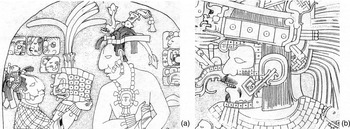
Although all three of the aforementioned lines of inquiry have shed light on various aspects of cranial modification, we still do not fully understand the motivation behind the practice for most areas, including Mesoamerica (Buikstra Reference Buikstra, Whittington and Reed1997). Historically, the two most common answers are for aesthetics and for vertical and horizontal social differentiation. Torquemada (Reference Torquemada and Hayhoe1943:581, 583), commenting on this practice among various indigenous groups of the New World, reported that it is associated with nobility, suggesting that variation may have reflected social status—at least in some contexts. Landa reported the custom of head-binding was widespread, and at pre-contact Chichen Itza, Mayas with flattened foreheads were distinguished from Mexicans without this trait (Tozzer Reference Tozzer1941:88). This is supported by iconography in which Maya figures (seen, for example, in the Oval Palace Tablet from Palenque in Figure 1a) have differently shaped heads than outsiders (seen, for example, in Stela 11 from Seibal in Figure 1b). Tiesler (Reference Tiesler Blos1998, Reference Tiesler Blos1999) also considered intrasite variability in terms of social factors. She found that individuals buried in what are thought to be elite burials exhibited no erect varieties of cranial modification at Copan. Burials on the periphery of the site were much more likely to exhibit erect varieties. In Patio D in the 9N-8 group of the Las Sepulturas residential district of the city, an area thought to have been inhabited by outsiders (Lenca speakers) (Gerstle Reference Gerstle1988), only one of 14 crania were modified in a fashion similar to burials elsewhere in the patios (Tiesler Reference Tiesler Blos1999).
(1a) Maya figures seen in the Oval Palace Tablet from Palenque (after Schele and Freidel Reference Schele and Freidel1990:Figures 6 and 7); (1b) Non-Maya figures represented in Stela 11 from Seibal. Contrast the different representations of the Maya and non-Maya individuals' head shapes (after Graham Reference Graham1996:34).

Such intrasite patterns, along with the high percentage of modified crania throughout the Maya area and absence of sex-based differences, led Tiesler (Reference Tiesler Blos1999) to several conclusions. There was no clear pan-Maya association between cranial modification and hierarchical social status, although within some sites the type of modification reflected social status (Tiesler Reference Tiesler Blos1999). However, cranial modification reflected and drew horizontal social lines, such as those between different ethnic groups. In light of the absence of sex-based differences and, since cranial modification must occur in infancy, it was likely performed exclusively by females. Finally, head shaping was a common part of growing up in Maya society. Cranial modification was a way of influencing the individual's body and lived experience to embody and display all of the appropriate messages that were part of being Maya. This last point is important because it is one more grounded in cultural theory than earlier avenues of inquiry and thus opens up the discussion to the full range of possibilities that may be relevant to the causes and effects of cranial modification.
Changing the biological body (in the largest sense including all forms of covering and altering) is done for a variety of reasons cross-culturally, including “propriety, sacrality, beauty, or status” (Turner Reference Turner, Cherfas and Lewin1980:112). As Turner (Reference Turner, Cherfas and Lewin1980:112) notes “the body, as the common frontier of society, the social self, and the psycho-biological individual, becomes the symbolic stage upon which the drama of socialisation is enacted.” Body modification not only reflects but also creates aspects of an individual's identity, whether they are related to age, gender, or horizontal or vertical social status within or between groups. Indeed Turner's (Reference Turner, Cherfas and Lewin1980) description of divisions in Kayapo society between the sacred and secular, more and less prestige, the social and the natural are all created (“played out” in Turner's words [1980:139]), in part, by dress and body modification. Thus, the lived experience and development of bodies is so fundamentally social that bodies cannot simply be regarded as a biological canvas on and through which social realities are constructed. Rather, some authors have argued that that bodies only exist as current potentialities of a constituting social ‘labor’ (Haraway Reference Haraway1991:10; see also Csordas Reference Csordas and Csordas1994; Sofaer Reference Sofaer2006:23–29). The open-endedness of this view makes constructing and testing comparative statements about body modification difficult, but Scheper-Hughes and Lock (Reference Scheper-Hughes and Lock1987:6) identify three common perspectives: (1) the body as individual experience; (2) the body as a social canvas and symbol; and, (3) the body as a political “artifact.” These divisions may or may not reflect emic realities depending on the cultural context, but heuristically the schema is useful. Archaeologists interested in mortuary practices have increasingly begun to take advantage of these viewpoints (see Hollimon Reference Hollimon and Chesson2001; Meskell Reference Meskell1994, Reference Meskell and Chesson2001; and Raharijaona and Kus Reference Raharijaona, Kus and Chesson2001 for commentary on the respective foci) including those studying cranial modification. Geller's (Reference Geller2004:387) suggestion that cranial modification may have been used to mold individuals for gender and later occupational roles in northern Belize, by placing “the modifiee down a path of social identification predetermined by the modifier,” is one such example. Joyce's (Reference Joyce2000:474–475) view that Aztec children were “[p]resented at birth as raw materials … that were shaped into body ornaments,” is another such example.
The notion that the body is always in a dynamic state of potential is relevant to questions about cranial modification because there were no universal patterns across the Maya area. Tiesler's work in particular indicates that cranial modification was used to create and transmit multiple messages at different times and spaces in the Maya area. Each of the aforementioned social reasons identified as motivations for cranial modification have data to support them. Thus in addition to social reasons, there may be a host of other possible motivations for the practice. Houston and colleagues (Reference Houston, Stuart and Taube2006:45; see also Taube Reference Taube, Clark and Pye2000) recently suggested that the head was shaped to make it look like corn, reflecting the fact that the human body was made of maize. It is easy to envision a scenario in which a child of ascribed rank had his or her head modified to make it look like corn, to place a headdress and diadem on it at the time of accession (Houston et al. Reference Houston, Stuart and Taube2006), and to make it symbolically easier to wear a tumpline (tumplines were used by gods to carry time, which is one of the burdens of rulers) (Rice Reference Rice2004:53, 60–63, 149). This would also, then, involve an attempt to reflect social status and mold an individual for an occupation later in life. It would also be difficult to discern attempts to influence occupation and gender as described by Geller (Reference Geller2004) in northern Belize since they are both part of an individual's social development. Each of these scenarios has merit, but they also fail to explore why the head was used in the first place. Comparing ethnohistoric and modern descriptions of childbirth and socialization sheds light on why the head was targeted for modification. The notion that children were vulnerable and needed to be protected from soul loss and evil winds is not exclusive to any of the aforementioned scenarios, but it does provide insight as to why the head was initially targeted for manipulation.
CHILDBIRTH AND SOCIALIZATION
Descendents of the lowland Maya speak languages of the Yukatekan and Ch'olan-Tzeltalan branches of the Mayan language family. Therefore ethnohistoric and ethnographic documentation of these groups is especially relevant for interpreting archaeological data relating to their ancestors. From Diego de Landa's early colonial accounts of the Maya Indians of Yucatan, we learn that midwives (female shamans) assisted in childbirth and babies were washed immediately after birth (Landa Reference Landa and Kintana1959:58; Tozzer Reference Tozzer1941:129). He further states that four or five days after they were born, the mother put the baby's “head between two small boards, one on the back of the head and the other on the forehead, between which they compressed the head tightly,” until “the head remained flat and molded, as was the custom of all of them” (Landa Reference Landa and Kintana1959:54; Tozzer Reference Tozzer1941:125; see also von Winning Reference von Winning1968). Tiesler (Reference Tiesler Blos1998:30–31) noted that a pre-contact Mayan clay whistle appears to represent a child with head boards straddling its mother's hip, a position called héetz-méek’ in modern Yukatek. After the head was molded, the children were taken to a priest in order to determine the child's destiny and future profession, as well as to receive its childhood name (Landa Reference Landa and Kintana1959:54; Tozzer Reference Tozzer1941:129). Mayas received different names later in life, after a rite similar to baptism was performed between ages 3–12 for girls and perhaps at roughly the same ages for boys (Tozzer Reference Tozzer1941:102). After baptism they could be married (Landa Reference Landa and Kintana1959:54; Tozzer Reference Tozzer1941:102, 129; Roys Reference Roys1940). Boys wore a white bead stuck to the hair on the top of their head until the baptism ceremony, when it was cut off by the priest (Tozzer Reference Tozzer1941:102). Baptism was an important ceremony involving a priest and four old male assistants called Chaks, as well as godparents. Baptism took place in a sponsor's house, which was ritually purified with sweeping and offerings of maize and incense (Tozzer Reference Tozzer1941:102–106). During the ceremony the Chaks put a piece of white cloth on top of the children's heads, their foreheads were anointed with sacred water, and then the priest removed the cloth.
Twentieth-century accounts of childbirth and socialization among the Yukatek Maya are similar in many respects (Redfield and Villa Rojas Reference Redfield and Rojas1934:182; Villa Rojas Reference Villa Rojas1945:140). Midwives assisted the mother at childbirth, after which the child was immediately washed and clothed. Next, the child was named after the patron saint of its birthday according to the Catholic calendar (Redfield and Villa Rojas Reference Redfield and Rojas1934:182; Villa Rojas Reference Villa Rojas1945:140). In Quintana Roo, it was the godparents' duty to consult the town scribe to determine the child's name. Baptism was an extremely important rite performed during infancy by a priest with the assistance of godparents. In Quintana Roo, baptism occurred at the age of one month (Villa Rojas Reference Villa Rojas1945:144). Special care was taken to protect newborns and their mothers from sickness-bearing evil winds. Babies were carried across the arms for the first three or four months of life, after which a ceremony called héetz-méek’, occurred, in which the child was handed to its godparent of the same sex, who placed the child straddling one hip. The godparent then placed different objects associated with adult gendered work roles in the child's hand to encourage its future aptitudes. For example, a machete was placed touching the hands of a boy, and a grinding stone in the hand of a girl. After the héetz-méek’ ceremony the child was carried straddling the mother's hip. Marriage occurred after puberty.
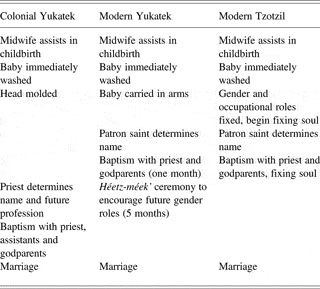
Tzotzil Maya children of Chiapas underwent a very similar sequence of events. Midwives assisted in childbirth, after which the child was immediately bathed, censed, and dressed in clean clothes (Vogt Reference Vogt1993:20). The rite that followed established the gender identity of the child, initiated the socialization process, and helped fix the innate soul into the new body. The midwife rubbed salt twice on the top of the baby's mouth, and presented the child with three red chilies, giving much needed "heat" to the still "cold" body (emphasis added; Vogt Reference Vogt1993:20). Stross (Reference Stross and Mock1998:35) mentions that the closely related Tenejapa Tzeltal Maya placed a bit of beeswax on the top of a newborn's head soon after birth so that evil spirits would not bother it. The Tzotzil next performed a rite similar to héetz-méek', in which tools associated with gender roles are touched to the infant's hands in order to establish gender identity and begin socialization and the fixing of the child's soul in the body. Baptism, the most important childhood ceremony, was performed by a priest and involved godparents. Baptism was believed to fix the innate soul in the infant's body. The three systems are compared in Table 1.
Comparison between colonial and modern Maya childbirth and socialization practices.

Table 1 demonstrates strong parallels within these systems which involve purification, ensoulment and socialization of children as the beginning of embodiment in Maya society. Head molding occurs at a period early in the child's life when the child's soul is not firmly fixed in its body and before the child is a full social being. It is only after head binding that the child is named by the priest, marking a rite of passage in Mayan personhood. Bonavides Mateos (Reference Bonavides Mateos1992:404) also interprets head molding as a rite of passage. However, the strongest parallel among modern Maya appears to be the Yukatek héetz-méek’ ceremony, which marks a transition from a relatively unformed social being in infancy, to the fixing of gender and occupational roles. Development of gender and work roles continues to be emphasized throughout the Maya area. Among contemporary Tzutujil for girls, sticks from a loom are placed over the child's head. Also after birth, mothers wrap their newborns tightly “with arms at the sides and legs stretched out” to make them strong for work (Paul Reference Paul, Rosaldo and Lamphere1974:284). The question remains, though, as to why the head needed to be shaped in order to carry the appropriate messages.
PROTECTION FROM SOUL LOSS AND EVIL WINDS
There are a variety of reasons that the head could have been and likely was targeted for manipulation (see above). One reason that has not received very much attention is the need to protect recently ensouled newborns. The Mesoamerican worldview was constantly in motion, in cycles of birth and death, termination and regeneration (Mock Reference Mock1998). Everything that came to be needed to be animated or ensouled, and would eventually be terminated. This includes individuals, caves, mountains, houses, some ceramics, etc. (Mock Reference Mock1998). Stross (Reference Stross and Mock1998) notes that when buildings were constructed, one of the last things that occurred prior to building the roof was killing a chicken and placing it in the hole under the center pole for the roof. This animated or ensouled the building, after which the roof was placed on the building. Humans were no different in their need for ensoulment.
For the Maya, and indeed across Mesoamerica, the head was the seat of some portion or aspect of what we might call a soul (Furst Reference Furst1995). Mesoamericans did not have one specific concept that corresponds to the Western notion of the soul (Furst Reference Furst1995; Geller Reference Geller2004; Hinojosa Reference Hinojosa1999; for specific case descriptions in the Maya area see Guiteras Holmes Reference Guiteras Holmes1961; Vogt Reference Vogt1965; Watanabe Reference Watanabe, Bricker and Gossen1989). Rather there were a number of soul-related substances involved in animation (Duncan Reference Duncan2005). Houston and Stuart (Reference Houston and Stuart1998; Houston et al. Reference Houston, Stuart and Taube2006) have argued that the translation for the Maya b'a(h) or baah glyph can mean ‘self’, ‘person’, or ‘head.’ Baah can literally refer to the body or head; it can refer to the highest ranking status individual in an organization; or it can be used as a signifier of the “essential identity” of a person in Maya society (Houston et al. Reference Houston, Stuart and Taube2006:58–72). The last sense is most important here because it relates to the larger point that this animating essence or essential identity may be harmed, lost, or even taken and manipulated (Furst Reference Furst1995; Read Reference Read1998).
A clear example of the potential for manipulation of animating essences and need to protect newly ensouled infants is found among the Mexica. The Mexica have a concept called tonalli, a substance which resides in the head. Tonalli does not translate directly into Spanish concepts for soul (la alma or la ánima), but rather is associated with heat and destiny (Furst Reference Furst1995; see also López Austin 1988). For example, hot wind is called tonal ehecatl (Furst Reference Furst1995). Furst (Reference Furst1995) makes the significance of the relationship between heat, destiny and newborns clear in her description of the manner in which Nahuatl children are animated. When Nahuatl children are born, the gods:
[s]imultaneously breathed the tonalli into the child and ignited a fire in its chest in an action analogous to making fire with a drill. This implement consists of an upright wooden piece twirled rapidly on a flat base …. It produces heat through friction, although this seemingly simple instrument requires considerable skill to make anything but smoke. As a fire maker blows on an ignited spark to fan it into a vigorous flame while whirling the upright, both breath and friction in the chest animate an infant. [Furst Reference Furst1995:65]
When the child drops significantly in the womb (which is normally the day of birth), the animation is said to have occurred. This was significant enough that children are named for that day (Furst Reference Furst1995). Since days and day names have particular meanings, on the day of animation, when the child gained tonalli, a part of the child's destiny is also created—ranging from potential for authority, to wealth or health (Furst Reference Furst1995). Ultimately it is difficult to demonstrate the pre-Columbian origin of concepts like evil winds. However, the parallels between the human head and architectural components as portals for animating essences as well as related fire-drilling ritual in architecture have clear antecedents in the pre-Columbian record (Grube Reference Grube, Colas, Delvendahl, Kuhnert and Schubart2000; Stuart Reference Stuart and Houston1998). These strongly suggest that Mesoamerican concepts of heat precede European contact, at least in part. Similarly, ideas concerning the deleterious effect of evil winds have non-European roots, as indicated their presence among traditional shamans throughout Mesoamerica, which is not to deny syncretism with European humoral medicine (Dow Reference Dow, Huber and Sandstrom2001:74–76).
Another characteristic of tonalli though, is that it could be manipulated or diminished. Furst (Reference Furst1995) and López Austin (Reference López Austin1988) demonstrate how newborns in particular were at risk for loss of tonalli through the top of the head. This may stem from the fontanelle being open in newborns. After birth, newborns were kept near a torch to add to their heat. Lighting something from this torch would have had the effect of diminishing the tonalli of the child (Furst Reference Furst1995). López Austin (Reference López Austin1988:221) also notes that “[t]he hair of sick children was allowed to grow as a head cover to avoid the tonalli's departure … [i]n a similar way, one of the severest punishments meted out to delinquents was to cut off their hair, thus exposing them to a loss of tonalli.” When the tonalli left, it “produced an empty space they thought could be observed in a cranial depression” (López Austin Reference López Austin1988:227). This was rectified in part by pushing up on the roof of the mouth, a practice which is still done by some immigrants from Guatemala and Honduras in the United States today (FitzSimmons et al. Reference FitzSimmons, Proust and Peniston1998).
Do the Maya have exactly the same concept as the Mexica tonalli? Perhaps not, as Geller (Reference Geller2004:240) notes; however, there are clear similarities between tonalli and Maya soul concepts. The head was often used as a signifier for the animating essences or essential identity of an individual. Maya souls could also leave the body or be diminished. The soul leaves Totzil speakers through the tongue after death (Nash Reference Nash1985:131). Ch'ulel, or “indestructible soul” (Houston et al. Reference Houston, Stuart and Taube2006:35; Plank Reference Plank2004:138) leaving the body was associated with sickness (Guiteras Holmes Reference Guiteras Holmes1961). Similarly way, a co-essence that may be associated with disease, left the body during sleep (Houston et al. Reference Houston, Stuart and Taube2006). In Comalapa, in the Guatemalan highlands, boys' hair could not be cut before their first birthday (girls' hair was not to be cut), lest “they become mute,” and even then the hair must be collected and saved (Hinojosa Reference Hinojosa1999:186). In nearby Iximche, others argued that cutting the hair of a boy prematurely would diminish “knowledge and reason” (Hinojosa Reference Hinojosa1999:186). Thus the head was a potent symbol in a variety of iconographic and archaeological contexts (for relevant discussions of skull iconography see also Houtson et al. Reference Houston, Stuart and Taube2006; Miller Reference Miller and Kowalski1999; Moser Reference Moser1973).
Tzompantli skull racks were a common example of this. These are most well known among the Mexica and in Oaxaca (Wilkinson Reference Wilkinson, Spencer and Redmond1997), however they are found in iconography in the Maya area at sites like Chichen Itza, and actual skull rows are known from the site of Ixlu (Duncan Reference Duncan2012), as well as skull deposits from Iximche (Whittington Reference Whittington, Nance, Whittington and Borg2003), Colha (Massey and Steele Reference Massey, Steele, Whittington and Reed1997) and other sites (see Mendoza Reference Mendoza, Chacon and Dye2007 for a recent review). The tzompantli were frequently juxtaposed with ball courts because they were both cosmic portals (Mendoza Reference Mendoza, Chacon and Dye2007). The ball courts were associated with passage to the underworld, while the tzompantli were associated with passage to the heavens. The skull row at Ixlu is telling because it consisted of adolescent and adult males buried immediately prior to constructing a floor and a small temple (Duncan Reference Duncan2012) and appears to be an attempt to ensoul the building in a way similar to that found in Tenejapa. As Houston et al. (Reference Houston, Stuart and Taube2006:72) note, the severed heads “contained the … essences of the way, or companion spirits.” However, skulls were not only used in attempts to violate enemies. Landa (Tozzer Reference Tozzer1941) noted that among the Cocom lineage, the face would be cut off from the deceased relatives' skulls and the ashes from the postcranium placed inside the skull. The face would then be built up again with bitumen and therefore preserved. Thus the animating essences associated with the skull could be manipulated in a variety of ways.
Pregnant women and newborn babies were particularly vulnerable to soul loss and evil winds (Hinojosa Reference Hinojosa1999:71–75; Kunow Reference Kunow1996:90). Winds have beneficial and harmful properties in Mayan languages and cultures. In its positive sense, ik' may be glossed as ‘wind’, ‘breath’, ‘animacy’ (see Hofling and Tesucún [1997:251] on Itzaj Maya; Wisdom [Reference Wisdom1940:317] on Ch'orti'; Hanks [Reference Hanks1996:250] on Yukatek) and is an animating force, entering infants at birth. Tedlock (Reference Tedlock2005:214, 320) citing Taube (Reference Taube and Kerr1994) notes that birthing ropes used by midwives to help the mother with childbirth were hung from house rafters and represent the passage of a child's spirit from the sky into the child's body (see also Paul and Paul Reference Paul and Paul1975:709). Jordan (Reference Jordan1993:37) notes that in Yucatan someone will blow onto the top of the pregnant woman's head to give her strength. As a negative force, evil winds are primary causes of disease. Consequently in Yucatan, all doors and openings in the house are closed or sealed by stuffing them with rags during birth (Jordan Reference Jordan1993:42; Sargent and Bascope Reference Sargeant and Bascope1996:219). Also in Yucatan, people hang certain plants over doorways, to combat dangers to pregnant women posed by witches (Kunow Reference Kunow1996:69). It is worth noting that this need to seal houses for protection clearly has pre-Columbian roots. Plank (Reference Plank2004:46) notes that lintels over doorways at the sites of Chichen Itza and Xkalumkin often include the verb k'al, which means “to bind, fasten, [or] enclose” for protection after animation. Additionally, the mother's pelvis and head are tied to return them to their original state because of the need “to close up the bones that opened during childbirth” (Jordan Reference Jordan1993:22). Sargent and Bascope (Reference Sargeant and Bascope1996:221) note that among Maya in Yucatan, after cutting the umbilical cord the midwife “molded the baby's head until she approved of its shape.” Among Tzutujil speakers in the Guatemalan highlands children are bathed “with a protective infusion of rue” and fennel eight days after birth (Cosminsky Reference Cosminsky, Huber and Sandstrom2001; Paul Reference Paul, Rosaldo and Lamphere1974:284). Similarly the Tzeltal believe that swaddling newborns for 15 days and avoiding contact with outsiders for 20 days limits the potential of soul loss as well as wind and heat-related illnesses (Cosminsky Reference Cosminsky and Kay1982:244, Reference Cosminsky, Huber and Sandstrom2001:196). Such attempts to guard against soul loss and illness among newborns are widespread throughout the Maya region.
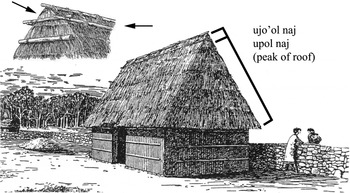
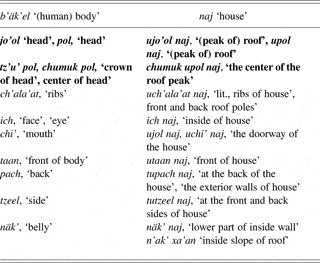
Considering metaphoric polysemy between the human body and houses is a final link suggesting that cranial modification is analogous to placing the roof on a building. It seals the newly animated construction, and likely relates to the desire to maintain the levels of this soul-stuff for newborns, thereby keeping them from harm. As Stross (Reference Stross and Mock1998) and Vogt (Reference Vogt1993, Reference Vogt and Mock1998) have pointed out for Tzeltal and Tzotzil Maya, respectively, the birth and socialization of infants have strong parallels with the construction and dedication of houses. Houses have parts much like human bodies have parts, and humans are shaped much like houses are built. The metaphorical use of body part terms for house parts is extensive. Itzaj Maya terms (Hofling Reference Hofling and Tesucún1997, Reference Hofling2004) indicative of this parallelism are shown in Table 2 and Figure 2. Moreover, new house dedications share a number of features with the early childhood practices described above. Information on house ceremony practices in colonial Yucatan is sketchy, but Cogolludo (Reference Cogolludo1957 [1688]:IV:184) mentions that new houses could not be occupied until they were blessed by a shaman. Landa's (Tozzer Reference Tozzer1941:103–105) description of purifying the house for baptismal rites by driving out an evil spirit also shows many similarities to modern new house ceremonies. The twentieth-century New House Ceremony at Chan Kom, Yucatan, was performed by a shaman to make the house safe for its future occupants, keeping evil winds out (Redfield and Villa Rojas Reference Redfield and Rojas1934:146–147). The shaman hung gourds with food offerings to the house from each corner-post and put food offerings on an altar in the center. A live hen, candles, rum, tortillas, and other foods were also offered. Thompson (Reference Thompson1930:69) describes a very similar New House Ceremony performed by the Mopan Maya of Belize. Candles were lit at each corner post and in the center, and food offerings were made for the spirits of the corner-posts and for the Forest spirit to repay it for the house materials. Vogt (Reference Vogt1993:52–55) offers an elaborate description of the New House Ceremony of the Tzotzil Maya of Zinacantan. The ceremony was called hol chuk, literally “binding the head of the roof” (Vogt Reference Vogt1993:52), or ridge pole ceremony and was conducted after the ridge pole is in place at the peak of the roof (Laughlin Reference Laughlin1975:157). Four chickens, one for each corner post, were suspended by a rope tied to the ridge pole in the center of the house. After the chickens were sacrificed and made into broth, the house builders offered the broth and liquor to the four corners and the head (peak) of the roof. Stross (Reference Stross and Mock1998:32–33) explains that sacrificial offerings were made to animate the house and that continued feeding maintained animacy. After the completion of the house, a shaman performed a second rite offering candles (symbolic food) to the Earth Lord to summon ancestral gods to ensoul the house. The house was ritually purified and carefully attended for the next three days because it now had an innate soul, just as infants and the sick were attended.
Parts of a Maya roof that correspond to words for head (after Wauchope Reference Wauchope1938:Figures 10a and 41a).

Polysemic associations between the human body and houses among the Maya.

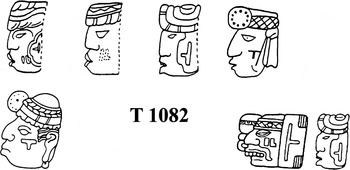
Additional possible evidence of the antiquity of beliefs linking winds and roof peaks is found in the hieroglyphs. The hieroglyph for the number three, also the patron of the month Mak has an interesting head variant (T1082) (Figure 3). The head sign has several diagnostic features. He has a tau or ik' sign, usually on his cheek or at his ear. There is some agreement that the god of the number three is a wind god (Macri and Looper Reference Macri and Looper2003:146; Taube Reference Taube1992:58–60; Thompson Reference Thompson1971:132–133). The link between the number three and wind might be based on the homophony or near homophony of the words for ‘three’ and ‘steam’ (ox and oox respectively in Itzaj Maya). The portrait of this god has a unique woven binding around his head which, as Montgomery (Reference Montgomery2002:60) has noted, resembles the glyphic sign for thatch on the roof of a house (Figure 4). Thus there seems to be parallel treatment of the top of the wind god's head and the top of a thatched roof, both of which are bound to prevent harm to a newly formed being.
Number 3, Ik' glyph (after Thompson Reference Thompson1971:Figure 24; see also Macri and Looper Reference Macri and Looper2003:146).

Maya house glyph (after Montgomery Reference Montgomery2002:Figures 1214a; see also Macri and Looper Reference Macri and Looper2003:253).

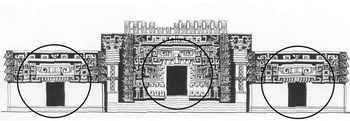
Generalizing meaning between architectural features across space and time is difficult because a given building may be conceptualized and used in multiple ways (McAnany and Plank Reference McAnany, Plank, Inomata and Houston2001). Additionally, emic categories associated with architecture may be extended to non-architectural fields (Houston Reference Houston and Houston1998; Plank Reference Plank2004:236–237). That said, the conceptualization of the house as described above may have implications for interpreting Classic Maya architecture and suggests that the idea of soul loss and the need to protect against it was in fact pre-Columbian. That the relationship between the human body and architecture can be extended to the past is well documented. The doors of buildings are often portrayed as mouths (often of monster's), especially in the Rio Bec, Chenes, and Puuc regions (Figure 5) (Plank Reference Plank2004:222; Schele Reference Schele and Houston1998:482). In the Codex Mendoza an Aztec lord's house and administrative center is depicted with a headdress (Evans Reference Evans, Kepecs and Alexander2005). Also, like modern house roofs, corbelled vaults with capstones at their peaks appear to be analogs of heads. Doorway lintels may be considered to be the “door's roof” (Plank Reference Plank2004:206). These parallels between specific architectural elements and heads do not diminish the analogy between a house and a body. Rather, they highlight the point that each of these elements was a potential portal through which animating essences could pass and in each case care needed to be taken to ensure that did not happen.
Hochob, Structure 2. Stylized mouths encircled (after Andrews Reference Andrews, Evans and Webster2001:348).

Recent discussions of temple dedication and fire rituals has bolstered this point, strongly suggesting that part of the dedication of temples also involved animation through a fire ritual (Rice Reference Rice2004 246–251; Stuart Reference Stuart and Houston1998:373–425). (Although we note that the category of “temple” is likely an etic category [Plank Reference Plank2004].) As part of the ritual dedication "fire entered" or "was drilled" in the structures, which Stuart (Reference Stuart and Houston1998) interprets as "ritual activation", animation, or ensoulment of the structure, based on much of the same ethnographic evidence discussed above. The rulers performing these fire rituals are associated with the Jaguar God of the Underworld, who is also prominent in censer iconography and perhaps the patron of fire (Stuart Reference Stuart and Houston1998:407–408).
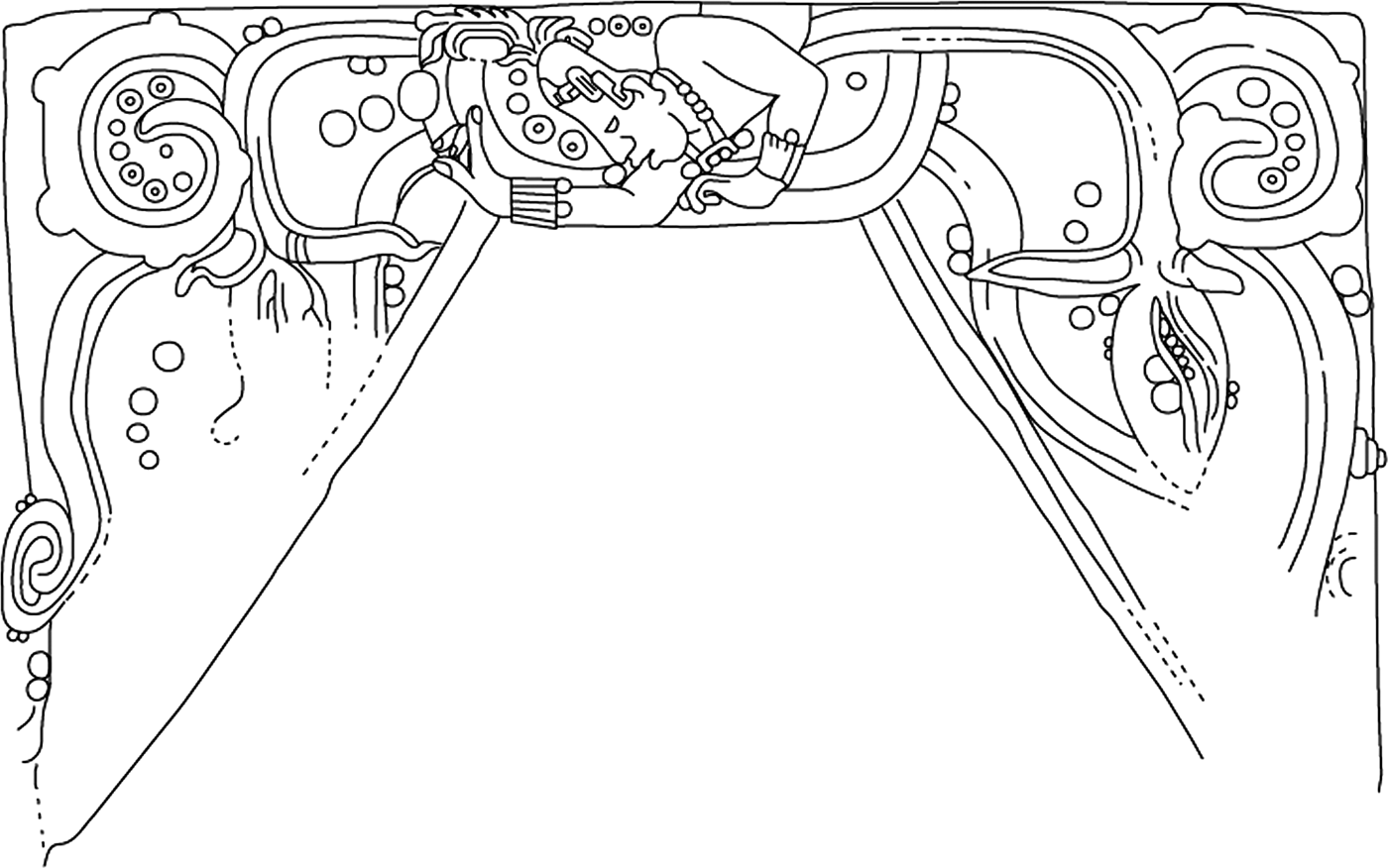
Capstones at multiple sites, such as Ek Balam and Chichen Itza (Carrasco and Hull Reference Carrasco and Hull2002), include statements associated with the verb k'al, which means to close or bind and is associated with protection after animation. Carrasco and Hull (Reference Carrasco and Hull2002) use iconographic, epigraphic and archaeological data to argue that the capstone of corbelled vaults was a portal oftentimes associated with a turtle carapace. Such iconography is seen at multiple locations at Chichen Itza (Plank Reference Plank2004), as well as in the Madrid Codex (Carrasco and Hull Reference Carrasco and Hull2002), Dresden Codex, and the Borgia Codex (Plank Reference Plank2004). Examples of the maize god and or other deities moving through this portal are seen at Palenque and Uxmal (Figure 6) (Carrasco and Hull Reference Carrasco and Hull2002). In some cases the way (or co-essence) of the maize god passes through the capstone mimicking a larger creation story in which the maize god is born and emerges through a crack in a roof caused by Chaak, the rain god (Carrasco and Hull Reference Carrasco and Hull2002). The same phenomenon has been pointed out for the capstones of tombs (Fitzsimmons Reference Fitzsimmons, Colas, LeFort and Persson2006), and Gillespie (Reference Gillespie, Silverman and Small2002) notes that the tubes above the two tombs in Palenque have been interpreted as “psychoducts” for the soul to leave. This kind of function may not be true for all capstones but minimally those that have references to carapaces appear to have been conceptualized as a portal that needed to be sealed. Thus it appears that at least some vault peaks and capstones, like modern house roof peaks, were loci for the potential passage of animating essences or winds into or out of the structure.
Corbelled vault from Palenque (House K of the Palace) with capstone showing the maize god passing through it (redrawn from Carrasco and Hull Reference Carrasco and Hull2002:29).

CONCLUSION
Comparing child-rearing practices among different Maya groups supports earlier authors' assertions that cranial modification was a part of embodiment and socialization among the Maya. We have argued that modifying the head was necessary because newborns and infants were at risk for soul loss through their heads. Polysemic associations between Maya bodies and houses suggest that both need to be animated and that cranial modification was tantamount to building a roof on a new building—both help seal up the animating essences and prevent soul loss. This is relevant for archaeologists because vaulted roofs, capstones, and cranial modification have roots stretching back into the Preclassic period and their construction and associated rituals may reflect at least some overlapping motivations.
RESUMEN
En este artículo se analiza la importancia de la modificación craneal en el proceso de socialización entre los mayas. Sugerimos que entre los mayas la modificación craneal es un elemento central en la constitución de los individuos. Estas modificaciones están relacionadas no solo con la constitución corporal del individuo sino también con a la protección contra fuerzas sobrenaturales (en especial aires malignos). La modificación craneal es parte de la protección necesaria para garantizar que el individuo mantenga su alma o fuerza vital. Basándonos en documentos coloniales y observaciones etnográficas, sugerimos que la cabeza es el lugar donde residen las esencias de animación del individuo. Por eso su modificación es necesaria para garantizar la protección del alma. Por último, argumentamos que existe una relación metaforico-polisémica entre el cuerpo humano y las casas recién construidas. Las casas recién construidas requieren ser ensalmadas para prevenir la pérdida de su esencia vital. Estos es un proceso que se puede vincular con la modificación craneal a nivel metafórico pues ambos son procesos de modificación destinados a la protección y contención del alma. En este sentido, la modificación craneal actúa como la construcción del techo de una casa encapsulando el alma dentro de la casa y el cuerpo y evitando que esta se escape.
Este artículo presenta un resumen de las investigaciones en el estudio de la modificación craneal. Las corrientes que se analizan son la descriptivo-clasificatoria, los estudios sobre las implicaciones de salud, los efectos morfológicos y las razones sociales. Privilegiamos esta última forma de estudio y se concentra en las razones simbólicas y sociales sin menospreciar los aportes de las otras aproximaciones. El estudio simbólico y social es apoyado por evidencias históricas, etnográficas, arqueológicas y lingüísticas. A través de estas evidencias se establece la importancia generalizada de la cabeza en el contexto general de las prácticas de socialización de diversos grupos mayas. Esta comparación establece que la idea que la cabeza de un infante es el lugar por el cual el alma puede escaparse es ampliamente reconocida por diversos grupos mayas. El individuo necesita cerrar el espacio de su cabeza en una forma específica para evitar la pérdida de su alma. Esto implica una conexión metafórica y polisémica entre entidades que deben ser encapsuladas para no perder la fuerza vital. Es por tanto evidente que la modificación craneal es el reflejo de un concepto básico en la cosmología maya que afecta la construcción de casas así como la constitución de individuos.
ACKNOWLEDGEMENTS
Juan Rodriguez, Martha Black, and Dr. Kathleen Costello kindly provided input on the Spanish translation of the abstract. Yuki Tanaka provided assistance in redrawing figures. Dr. Joel Palka and our reviewers provided particularly cogent criticisms and comments for which we are very grateful. Dr. Steve Whittington also provided clarification on points in the article and Dr. Anthony Cavender kindly provided editorial comments and feedback. All remaining errors remain entirely the authors' responsibility.