As a field of inquiry, written corrective feedback (CF) has been approached from two different theoretical and methodological perspectives: one set found within the field of second language (L2) writing and another within the field of SLA (cf. Ellis, Reference Ellis2010; Ferris, Reference Ferris2010). Whereas CF within the area of L2 writing is conceived of as a means of helping learners improve the overall quality and efficiency of their texts, SLA-oriented CF is usually viewed as error correction (EC) and regarded as a potential contributor to learners’ linguistic development. This strand of research, oriented toward a writing-to-learn perspective (Manchón, Reference Manchón and Manchón2009, Reference Manchón and Manchón2011b; Ortega, Reference Ortega and Manchón2009), is based on the assumption that learners need to be made aware of and receive information on their errors (Ferris, Reference Ferris2010) and has sought to investigate whether CF has any effect on L2 learning (Bitchener, Reference Bitchener2012; Hyland, Reference Hyland2010; Polio, Reference Polio2012). The present study, framed within the growing body of SLA-oriented L2 writing studies, attempts to contribute to the debate surrounding the potential of written output and CF for fostering interlanguage development with a population that has been underrepresented in SLA research. Specifically, it aims to compare the effects of two feedback strategies on learners’ processing and uptake of linguistic elements in the completion of a writing task. In doing so, we address core issues in emerging SLA-L2 writing interfaces (Manchón, Reference Manchón and Manchón2011b; Ortega, Reference Ortega2012; Williams, Reference Williams2012), including the role of written output as a catalyst for language learning, the distribution of learners’ attentional resources during output tasks, and the role of EC in instructed L2 acquisition. In this sense, our study falls within the SLA strand of research.
Within the field of SLA, the effectiveness of EC as a feedback strategy has been the subject of some controversy, both theoretical and empirical (Ferris, Reference Ferris1999; Truscott, Reference Truscott1996, Reference Truscott2004, Reference Truscott2007; see also Polio, Reference Polio2012; van Beuningen, Reference van Beuningen2010, for reviews). Theoretically, feedback on language errors has been linked to processes of noticing and attention to form, both of which are considered crucial for L2 acquisition (Doughty & Williams, Reference Doughty, Williams, Doughty and Williams1998; Norris & Ortega, Reference Norris and Ortega2000; Schmidt, Reference Schmidt1990, Reference Schmidt1994, Reference Schmidt and Robinson2001). Feedback provided on output production is thought to foster these processes in different ways: by raising learners’ awareness of gaps in their interlanguage, by forcing them to reassess their L2 knowledge in the form of new hypotheses, and by encouraging them to engage in metalinguistic reflection (Swain, Reference Swain, Gass and Madden1985, Reference Swain, Cook and Seidlhofer1995, Reference Swain, Doughty and Williams1998, Reference Swain and Lantolf2000). Empirically, differences of opinion remain as to how feedback actually impacts learning, the type and quantity of errors that should be corrected (e.g., Ellis, Reference Ellis2009), and, particularly, the relative merits of different feedback strategies with respect to their degree of explicitness and their focus (Bitchener, Reference Bitchener2012; Polio, Reference Polio2012; van Beuningen, Reference van Beuningen2010). In what follows, we consider how written CF has been investigated empirically across different learning contexts and with different feedback strategies or combinations of strategies including EC, reformulations, and models.Footnote 1
BACKGROUND
Error Correction
A considerable number of studies have tended to equate the provision of feedback on learners’ writing with EC (i.e., the correction of learners’ linguistic errors; Ellis, Reference Ellis2009). In doing so, researchers have compared the degree of effectiveness of direct and indirect feedback strategies on learners’ active processing of the corrections provided (Bitchener & Knoch, Reference Bitchener and Knoch2008, Reference Bitchener and Knoch2010; Chandler, Reference Chandler2003; Ferris & Helte, 2000). These reports have, in some cases, produced conflicting evidence in favor of one strategy or another, whereas other researchers have reported finding no differences between them (Robb, Ross, & Shortreed, Reference Robb, Ross and Shortreed1986; Semke, Reference Semke1984). Despite the positive results obtained with a limited number of linguistic structures, such as the English article system and the simple past tense (Bitchener, Reference Bitchener2008; Sheen, Reference Sheen2007), some researchers have criticized the usefulness of EC on a number of accounts, including the lack of clarity, precision, and consistency with which it has been used (Ellis, Reference Ellis2009; Lee, Reference Lee2004); the sense of discouragement or confusion it can cause among learners (Hyland, Reference Hyland1998); and the fact that it may lead to passive reception (Adams, Reference Adams2003) or superficial processing of the errors corrected, with learners failing to internalize and retain the linguistic evidence over time (Truscott, Reference Truscott1996). As a result, the value of EC for interlanguage development still remains an open question (Polio & Williams, Reference Polio, Williams, Long and Doughty2009).
Reformulations and Models as Feedback Strategies
Given the inconclusive findings reported with EC, several researchers have proposed alternative methods of feedback, which, in contrast with the itemized nature of EC, are markedly textual in orientation. These include the reformulation of students’ written texts (e.g., Adams, Reference Adams2003; Qi & Lapkin, Reference Qi and Lapkin2001; Yang & Zhang, Reference Yang and Zhang2010) or the use of model texts against which students compare their original output (e.g., Hanaoka, Reference Hanaoka2006, Reference Hanaoka2007a, Reference Hanaoka2007b; Hanaoka & Izumi, Reference Hanaoka and Izumi2012). Reformulation involves rewriting a learner’s text, preserving all its ideas but removing lexical inadequacies, grammatical errors, and ambiguities, so that it appears as nativelike as possible (Levenston, 1978, cited in Qi & Lapkin, Reference Qi and Lapkin2001), whereas, in the case of modeling, learners are provided with model texts that are tailored to the learners’ age and proficiency level as well as to the content and the genre of the writing task at hand. It is claimed that both reformulations and models provide learners with a wide range of lexical, syntactic, and discursive alternatives that, when learners contrast them with their own writing, can lead learners to engage in deeper processing than with more traditional CF strategies such as EC (Hanaoka, Reference Hanaoka2007a; Hanaoka & Izumi, Reference Hanaoka and Izumi2012; Qi & Lapkin, Reference Qi and Lapkin2001). Such assertions obviously assume that learners will be able to engage with feedback (Kormos, Reference Kormos2012; Wigglesworth & Storch, Reference Wigglesworth and Storch2012), to notice the alternatives to their own writing included in reformulations and models, and to perceive them as attainable (Lázaro Ibarrola, 2009).
The effects of these alternative feedback approaches have been tested empirically in a variety of studies. So far, researchers have explored the use of (a) reformulation with English as a second language (ESL) Mandarin speakers (Qi & Lapkin, Reference Qi and Lapkin2001), French immersion students (Lapkin, Swain, & Smith, Reference Lapkin, Swain and Smith2002; Swain & Lapkin, Reference Swain and Lapkin2002), L2 Spanish university students in the United States (Adams, Reference Adams2003), and Spanish children learning English as a foreign language (EFL) (García, Reference García2011) and (b) models with adult learners of English in Japanese universities (Hanaoka, Reference Hanaoka2007b), Spanish EFL high school students (Martínez & Roca de Larios, 2010), and Spanish EFL primary school children (Cánovas Guirao, 2011); or, alternatively, they have compared (c) the use of models and reformulations with Japanese university EFL students (Hanaoka, Reference Hanaoka2006; Hanaoka & Izumi, Reference Hanaoka and Izumi2012; Yang & Zhang, Reference Yang and Zhang2010) or (d) traditional EC and reformulations with adult learners of English in American universities (Sachs & Polio, Reference Sachs and Polio2007) and with adolescent learners in high schools in Spain (Santos, López Serrano, & Manchón, 2010).
Regarding the use of reformulation as a feedback strategy, research carried out to date has highlighted its potential benefits for language learners of different ages and proficiency levels, working either individually (Qi & Lapkin, Reference Qi and Lapkin2001) or on collaborative writing tasks (Adams, Reference Adams2003; García, Reference García2011; Lapkin & Swain, Reference Lapkin and Swain2004; Lapkin et al., Reference Lapkin, Swain and Smith2002; Swain & Lapkin, Reference Swain and Lapkin2002; Tocalli-Beller & Swain, Reference Tocalli-Beller and Swain2005). In these studies, learners who compared their original writing to reformulated versions of their texts were seen to improve the accuracy of their written output to varying degrees after incorporating lexical and grammatical features they had noticed in the feedback.
Similarly, advantages have also been uncovered for the use of model texts in promoting noticing and language learning. Research reported by Hanaoka (Reference Hanaoka2006, Reference Hanaoka2007b), Martínez and Roca de Larios (2010), and Cánovas Guirao (2011) across different age groups and proficiency levels has coincided in pointing to the usefulness of models in drawing learners’ attention especially to the lexical features in the feedback as well as to propositional content.
Other studies that have compared the use of reformulation and modeling (e.g., Hanaoka, Reference Hanaoka2007a; Hanaoka & Izumi, Reference Hanaoka and Izumi2012; Yang & Zhang, Reference Yang and Zhang2010) have highlighted the fact that each feedback strategy activates different but complementary attentional processes in learners. Whereas reformulations can help learners identify linguistic inadequacies in their own texts when they compare their writing with a more targetlike version, models appear to be useful not only for focusing learners’ attention on new vocabulary and expressions but also for helping them to extend their original meanings by providing alternative ideas and content. In this respect, Yang and Zhang (Reference Yang and Zhang2010) conclude that reformulations may provide learners with samples of good writing on particular sentences, whereas model texts can offer them “a good sample of native writing for not just the specific sentence but the whole discourse as well” (p. 480). Models as a feedback strategy, then, may prove beneficial for learners in that they have the potential to provide solutions for problems (a) that do not always manifest themselves in the learners’ original texts (Hanaoka, Reference Hanaoka2007a) or (b) for which learners have not yet developed solid representations to express their intended message (Hanaoka & Izumi, Reference Hanaoka and Izumi2012).
Reformulations have also been compared to more traditional methods of CF. In two separate studies described in Sachs and Polio (Reference Sachs and Polio2007), EC was found to be more beneficial than reformulations in promoting accuracy gains in the revised written output of university students. The authors argue that the saliency of the corrected errors in the original texts led the learners to memorize the linguistic changes in the feedback, rather than to search for differences in the reformulated versions. Similar results were found by Santos et al. (Reference Santos, López Serrano and Manchón2010) with high school students. Their findings confirmed the superiority of EC over reformulations with regard to the uptake of grammar, lexis, and discourse, with reformulations giving rise to mainly lexical revisions. Both of these studies have provided evidence of the effectiveness of EC for developing learners’ accuracy in essay revisions and offer support, therefore, for the potential of this feedback strategy for developing language learning. However, more robust evidence is required before stronger claims can be made in this direction. Without further investigation into the variables—such as age, proficiency level, error types, and learning conditions, among others—that mediate learners’ use and retention of feedback, it is still not clear how extensive this potential actually is (Bitchener, Reference Bitchener2012).
The studies reviewed so far share a number of characteristics in relation to the type of populations and feedback strategies analyzed, the learner-internal variables contemplated, and the methodological procedures employed that, collectively considered, suggest a number of issues that need to be addressed in further research. First, it would seem both theoretically and pedagogically relevant to compare how children’s noticing and uptake processes are mediated by EC versus model texts given that (a) the results reported in the literature have indicated the superiority of EC over reformulation with both adults (Sachs & Polio, Reference Sachs and Polio2007) and adolescents (Santos et al., Reference Santos, López Serrano and Manchón2010); (b) reformulations and models have been explored with younger learners in comparison to a control group (Cánovas Guirao, 2011; García, Reference García2011) or comparatively with adults (Hanaoka & Izumi, Reference Hanaoka and Izumi2012); (c) reformulations as employed in this area of research, in comparison with models, do not always provide more sophisticated or appropriate language use beyond what is already correct in the learners’ original texts (Hanaoka, Reference Hanaoka2007a); (d) the use of reformulation as a feedback technique with large class sizes can prove to be impractical (Ferris, Reference Ferris2010); and (e) very few studies have looked at how young learners process feedback on their L2 writing, especially within a formal classroom context.Footnote 2
Second, although it is generally accepted that writing enhances linguistic processing, individual differences are also thought to play a crucial role in determining what learners pay attention to during output production (Kormos, Reference Kormos2012; Manchón, Reference Manchón, Reichelt and Chimasko2011a). Identifying the focus of this attention in learners of varying proficiency levels has been an ongoing concern in several of the studies mentioned previously, which, for the most part, coincide in reporting that proficiency plays a relevant role in the activation of learners’ noticing processes (Hanaoka, Reference Hanaoka2007a, Reference Hanaoka2007b; Qi & Lapkin, Reference Qi and Lapkin2001).Footnote 3 More specifically, it has been found that although low-proficiency learners notice gaps in their knowledge from the feedback provided to them, they may not be capable of understanding the precise nature of those gaps (Qi & Lapkin, Reference Qi and Lapkin2001) or may struggle to grasp the meanings contained in texts when the language used is overly complex and beyond their linguistic capabilities (Hanaoka, Reference Hanaoka2007a). In these cases, the low quality of the learners’ noticing may lead to no changes in their revised output or to changes that do not represent an improvement in the written product (Qi & Lapkin, Reference Qi and Lapkin2001). However, it is important to note that the findings reported by Qi and Lapkin (Reference Qi and Lapkin2001) and Hanaoka (Reference Hanaoka2007a) are based on the data of only two learners and, as such, should be treated with some caution. Further research to determine the role of proficiency in relation to noticing should thus contemplate the analysis of larger sample sizes. To broaden the scope of the population and proficiency levels analyzed so far, these samples might include younger EFL learners whose cognitive development and mastery of the L2 is, by definition, much lower than that of the adults participating in the previously mentioned studies. It would seem relevant, then, to investigate whether proficiency plays a differential role in mediating the noticing processes and responses to feedback of this understudied population.
Third, as suggested by Leow (Reference Leow, Gutiérrez-Rexach and Martínez-Gil1999), any research based on the relevance of attentional processes should aim to measure them directly. In consonance with this contention, most of the studies reviewed above have used online measures such as verbal reports to tap into learners’ thought processes while composing and analyzing feedback, either exclusively (Hanaoka, Reference Hanaoka2007a; Sachs & Polio, Reference Sachs and Polio2007; Yang & Zhang, Reference Yang and Zhang2010) or in combination with additional follow-up measures including stimulated recall (Adams, Reference Adams2003; Swain & Lapkin, Reference Swain and Lapkin2002) or immediate retrospective interviews (Qi & Lapkin, Reference Qi and Lapkin2001).
As a methodological tool, verbal reports have the advantage of providing the researcher with firsthand evidence of the linguistic features consciously noticed by learners while on task. However, they also entail important drawbacks that have been documented in the literature, including (a) reactivity, as the act of reporting their thoughts could lead learners to either pay increased attention to language and thus process feedback more deeply (Jourdenais, Reference Jourdenais and Robinson2001) or, on the contrary, spend less time analyzing feedback as extra time and effort is required on task to verbalize their thoughts aloud (Sachs & Polio, Reference Sachs and Polio2007), and (b) nonveridicality, as, under communicative pressure, learners may either fail to verbalize everything they notice, or they may report noticing that has not actually taken place (Jourdenais, Reference Jourdenais and Robinson2001; Mackey, Reference Mackey2006). In addition to these methodological caveats, the collection of data in the studies reviewed was conducted, in most cases, by having participants meet separately with the researcher outside regular classroom settings (but see Yang & Zhang, Reference Yang and Zhang2010) thus diminishing, in principle, the ecological validity of the studies and, hence, the applicability of their results to formal learning environments.
Given these issues, other researchers have employed alternative online measures of learners’ noticing, including note-taking (Hanaoka, Reference Hanaoka2007b; Hanaoka & Izumi, Reference Hanaoka and Izumi2012) and guided note-taking (Santos et al., Reference Santos, López Serrano and Manchón2010) in real classroom settings. In spite of the physical demands involved in having learners engage simultaneously in two writing tasks, descriptive notes have been regarded as advantageous both in providing researchers with insights into the nature of learners’ awareness (Hanaoka, Reference Hanaoka2007b) and in actively promoting noticing among learners by guiding them in the identification of errors in their written output after comparison with feedback (Santos et al., Reference Santos, López Serrano and Manchón2010). It would seem worthwhile, then, for our research to look further into the possibilities afforded by note-taking as a methodological tool by having child learners in a formal learning context produce written reports of their noticing processes.
Bearing in mind all of the above considerations, and in an attempt to contribute to existing research on written CF and its potential for furthering language learning, the present study, which is exploratory in nature, was intended as a comparison of the role played by two feedback strategies—explicit EC and the use of model texts—on children’s written output and noticing processes in an EFL classroom setting. The following research questions were formulated:
1. What features of language do child EFL learners of different proficiency levels notice spontaneously when composing a narrative text?
2. What do children of different proficiency levels notice when comparing their written texts with either EC provided by the teacher or model texts?
3. How is the children’s reported noticing at the composition and comparison stages related to their revised texts? To what extent is this relationship related to their proficiency levels?
4. What differences in terms of linguistic acceptability and comprehensibility can be observed in the written output of children in each feedback condition and as a function of their different proficiency levels?
METHOD
Participants
The participants in the study were 23 child pairs, 26 boys and 20 girls, aged 10–12 from two EFL classes in a primary school situated in a city in southeast Spain. The children had been learning English for 4 or 5 years, receiving, on average, 3 hr of English classes per week. In class, they followed communicative English language teaching textbooks designed for younger learners. The children were unaccustomed to writing freely and had never produced a piece of collaborative writing before the study. The decision to have the children write a text collaboratively was motivated by research that has argued that writing in pairs can lead to gains in accuracy while also creating a context for language learning (e.g., Storch, Reference Storch2005, Reference Storch2007; Storch & Wigglesworth, Reference Storch, Wigglesworth and García Mayo2007).
The children were placed in proficiency-matched pairs determined by their performance on English tests administered in class at regular intervals throughout the year. These tests consisted of discrete-item vocabulary exercises together with reading and listening comprehension tasks based on lesson content. Although standardized tests have often been used to place learners, previous research has also acknowledged that, in ordinary classrooms, it is the teacher’s ratings that are generally used to pair pupils (Leeser, Reference Leeser2004). Seven high-, nine medium-, and seven low-proficiency pairs were formed. In total there were 12 male, 9 female, and 2 mixed-gender pairs.
Data Collection
Data for the study were collected over a period of 4 weeks.Footnote 4 To ensure that classroom conditions remained as natural as possible, it was decided that the class teacher, rather than the researchers, should deliver the intervention. An initial training session was held with the teacher prior to beginning the study to familiarize her with the procedures to be followed at the various stages. The teacher then trained the children for the joint story-writing task (Stage 1) using an adapted version of the paired writing system described by Yarrow and Topping (Reference Yarrow and Topping2001), which was originally designed to promote collaborative writing and peer interaction with mixed-ability primary school children in England. Borrowing their concept of writers and helpers, in each class the teacher and a child demonstrated the type of interaction in which the pairs were expected to engage, with one member of the pair acting as story writer and the other responsible for making a note of any difficulties encountered by either of the two during the composing process. The learners decided themselves which role they preferred to play, and these were maintained in the final rewriting stage.
The study consisted of three stages that were implemented during normal 50-min lesson slots.Footnote 5 In Stage 1, a simple four-frame picture story prompt was given to each pair, who were asked to jointly compose their text (recorded on the original story sheet), noting down (on the initial problem sheet) any linguistic difficulties they experienced while doing so. Given the limitations that children of this age can have in using their metacognitive knowledge appropriately (Englert & Raphael, 1988, cited in Yarrow & Topping, Reference Yarrow and Topping2001), it was hypothesized that peer collaboration might provide the support needed to address these difficulties together. The following week, in Stage 2, half of the pairs had their stories returned to them with the teacher’s explicit EC, whereas the remaining pairs were given two model texts of the story, one of which had been written by one of the researchers (a native speaker of English) and the other by the teacher. Two model texts were used, following Hanaoka (Reference Hanaoka2007b), “to reduce the chance of participants’ mindless copying from a single model text, and to increase the chance of providing solutions to the problems that the participants incidentally noticed” (p. 462). There was, however, an imbalance in the final numbers of pairs assigned to each feedback condition, as we were forced to discard the data of three pairs—one medium- and two low-proficiency learner pairs, assigned to the modeling (medium) and EC (low) conditions, respectively—who were absent at either Stage 2 or 3 of the study. The remaining 20 pairs participating in the study were distributed as follows: EC treatment: three high-, five medium-, and one low-proficiency pair; modeling condition: four high-, three medium-, and four low-proficiency pairs. Using the initial problem sheet as a checklist to help focus their attention, the pairs identified and noted any differences they observed between their story and the teacher’s corrections or the model texts (recorded on the feedback comparison sheet). In the third and final stage, 1 week later, the pairs were given the picture prompt again and were asked to rewrite the story (on the revised story sheet).
The picture story used in Stages 1 and 3 was taken from sample materials from the Cambridge Young Learners English language Movers speaking test (Cambridge ESOL, 2012), a standardized test specifically designed for young learners between the ages of 7 and 12 with a basic level of spoken and written English. Although the story-writing task was not something that the participants were familiar with, it was thought that providing a framework for their writing within a format that they could all recognize (i.e., a story) and controlling the propositional content (i.e., a baby painting on the wall) would facilitate the task and enable the collection of comparative data for analysis. Note-taking (Hanaoka, Reference Hanaoka2007b; Hanaoka & Izumi, Reference Hanaoka and Izumi2012) was used as the main source of data collection for several reasons. First, due to practical concerns, we were unable to collect data that would have allowed us to tap into the participants’ internal thought processes in a noisy classroom setting where the recording of think-aloud protocols or alternative methods were not viable options. Second, it was also thought that written data would give us a good indication of the main focus of the children’s attention and highlight differences between proficiency levels with regard to the quantity and quality of the notes produced. Furthermore, by distributing the roles of writer and notetaker within the pairs, we hoped to reduce the cognitive demands involved in simultaneous note-taking and writing when performed individually, which, as Hanaoka (Reference Hanaoka2007b) suggests, may lead to omissions in the information reported.
At the end of Stage 1, the children’s stories and pictures were collected. The stories by the learners assigned to the EC condition were corrected by the teacher using direct CF; the teacher took care to avoid the lack of clarity and consistency sometimes found in this type of correction (Ellis, Reference Ellis2009; Lee, Reference Lee2004). ErrorsFootnote 6 involving incorrect grammar (e.g., errors in subject-verb agreement, verb forms, choice of prepositions, etc.) or inaccurate spelling, punctuation, and vocabulary were crossed out and the correction written in red pen close to the child’s mistake. The teacher also inserted missing words or morphemes when the learners left blank spaces in their texts, as in Figure 1. The two model texts (see the Appendix) were typed and presented to the children on the same sheet of paper. Both texts were six lines long and narrated the story using past tense verb forms and a combination of simple and complex sentences, both of which the learners were familiar with.
Sample of the teacher’s direct CF on a learner story in the EC condition.

Data Analysis
The primary data source in the study consisted of (a) 20 original stories written by the children, (b) 20 sets of notes made during the composing process, (c) the notes made during the feedback comparison stage, and (d) 20 revised story texts. Both quantitative and qualitative analyses were conducted with the data.
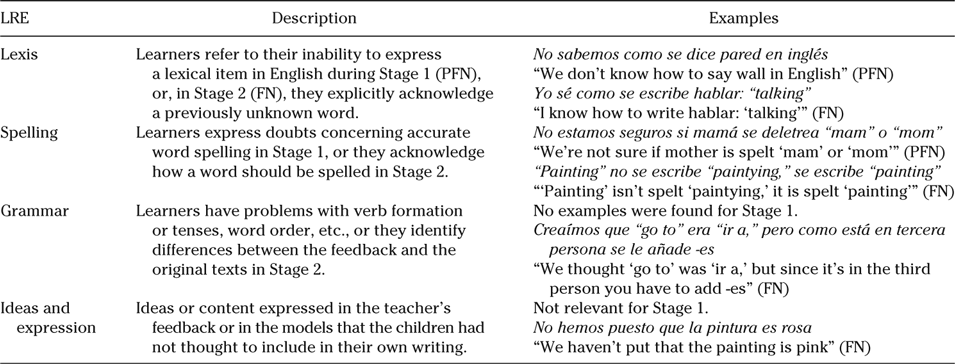
For Research Questions 1 and 2, noticing was defined as the number and type of language-related episodes (LREs) identified in the children’s notes. An LRE was originally defined by Swain and Lapkin (Reference Swain and Lapkin1995) as “any segment of the protocol in which a learner spoke about a language problem he/she encountered while writing” (p. 378). For the purposes of this study, we expanded this definition, following Hanaoka (Reference Hanaoka2007b), to include any aspects of the language that learners wrote about in their notes. The LREs were assigned to one of four categories: lexis, spelling, grammar, or ideas and expression and were coded as either (a) the problematic features noticed (PFNs) by the learners at the composing stage (Stage 1) or (b) the features noticed (FNs) from comparison with the feedback (Stage 2), as illustrated in Table 1. It should be noted that the term noticing is used here in a nontechnical way to refer to the children’s perception of surface features in their output or in the feedback.
Coding scheme for language-related episodes as problematic features noticed and features noticed
To analyze the relationship between the children’s initial noticing and their noticing in response to feedback (Research Question 3), the total frequencies of PFNs and FNs were tallied for each of the four linguistic categories for each pair of children. Frequencies were also tallied separately for each treatment and then again for each proficiency level. The features noticed by the children at both stages were also recorded qualitatively, which enabled us to identify when the children first reported noticing particular items and then to trace them across the stages and into the revised texts, if necessary.
Research Question 4 was concerned with identifying potential improvements in the degree of linguistic acceptability and comprehensibility of the children’s written output from their original to their revised texts as well as establishing possible connections with feedback conditions and proficiency levels. For this purpose, an adapted version of Torras’s (Reference Torras2005) coding scheme for analyzing the written output of child EFL learners was applied to the data. The pairs’ revised texts were coded into clausal or subclausal linguistic units according to their degree of grammaticality. Three units were identified: preclause, protoclause, and clause.Footnote 7 These are defined and exemplified as follows:
1. Preclauses refer to grammatically incorrect units of language consisting of fragmented or distorted strings of words, at times incomplete, in which the meaning intention is not always apparent.
The mother sbeken _____the_________
And modher and sister walking a broder
2. Protoclauses describe linguistic units in which the children’s meaning intention is clear but that contain grammatical inaccuracies or have gaps in the clausal unit.
The baby paint and pink the wall
The mother and sister’s is paiting in the table
3. Clauses refer to grammatically accurate units of language; these may present slight inaccuracies in spelling, lexis, grammar, or concordance.
The girls and the boys are paintying
The two girls is painting flowers
The transcripts of the children’s writing were coded collaboratively by two raters drawing on the procedures suggested by Smagorinsky (Reference Smagorinsky2008). A third rater was later asked to code the whole set of data independently. Interrater agreement was found to be 96% for the total number of units, 84% for preclauses, 83% for protoclauses, and 92% for clauses. For the quantitative analysis, given the limited sample size and the nonnormal distribution of the data, nonparametric statistics were used. For Research Questions 1, 2, and 3, Kruskal-Wallis tests (a nonparametric equivalent of one-way ANOVAs) were conducted to check for significant differences in the amount of noticing and textual revisions made by children of different levels of proficiency. Additionally, Mann-Whitney tests (an alternative to the parametric t test) were used to check for significant differences between the two feedback conditions at each stage (i.e., composition, comparison, and revision). Finally, for Research Question 4, a series of Mann-Whitney tests was used to explore possible differences between the feedback conditions for the learners’ production of the four categories of unit types: total number of units, preclauses, protoclauses, and clauses. Wilcoxon signed-rank tests (equivalent to a repeated-measures t test) were then run on the data for each feedback condition separately to compare the mean ranks of each unit type from the children’s original stories to their revised versions. As for proficiency levels, two further analyses were conducted. Kruskal-Wallis tests were used to check for significant differences, first in the original texts and then in the revised versions, on each of the dependent variables (i.e., total number of units, preclauses, protoclauses, and clauses). Wilcoxon signed-rank tests, in turn, allowed us to analyze each proficiency level independently by comparing the original and the revised texts in terms of each category of unit type.
RESULTS
Research Question 1
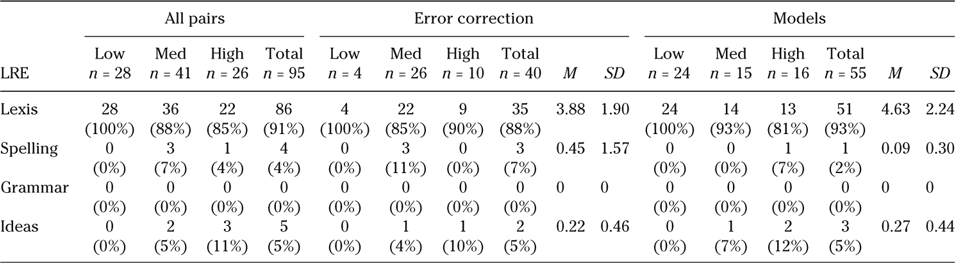
Research Question 1 asked about the features of language that child EFL learners of different proficiency levels notice spontaneously when composing a narrative text. As shown in Table 2, all of the learner pairs, regardless of the feedback condition they were assigned to, noticed mostly lexical problems. The fact that 91% of the PFNs at Stage 1 were lexical, together with the failure of the pairs to report any grammatical problems, suggests that their attention at this stage of the writing process was focused primarily on finding the words to express their intended meanings. Difficulties in spelling and in expressing ideas accounted for 4% and 5% of the total PFNs, respectively. Mann-Whitney tests showed no significant differences across treatments for the language categories analyzed, which indicates that, at least initially, the different learner pairs assigned to either of the two feedback types, EC or models, were similar insofar as the focus of their attention. Although low-proficiency learners noticed lexical problems only, Kruskal-Wallis tests failed to show any significant differences across proficiency levels for each of the language categories considered.
Problematic features noticed at Stage 1 across proficiency levels and treatment types
Note.
M = mean frequencies per pair.
Research Question 2
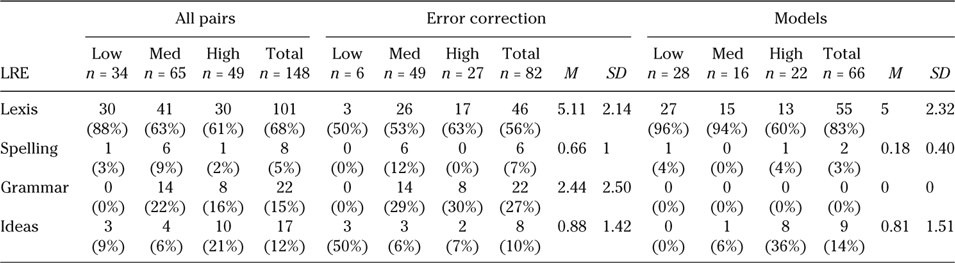
Research Question 2 asked about what children at different proficiency levels notice when comparing their written texts with either EC provided by the teacher or with model texts. The frequencies and percentages of the FNs at Stage 2 of the writing process are shown in Table 3. The total number of FNs at Stage 2 (n = 148) was higher than at Stage 1 (n = 95), with both feedback groups predominantly noticing lexical features (68%). This overall percentage was unequally distributed (56% for EC and 83% for models), although the difference was not found to be statistically significant. There was also an increase in the overall proportion of grammatical items noticed (from 0% to 15%) and of aspects related to the story content noticed (from 0% to 12%). Further analysis revealed that the distribution of grammatical features between the two feedback types was 27% for EC and 0% for models. A Mann-Whitney test revealed this difference to be significant (z = −2,301; p = .02), with EC giving rise to a greater number of grammatical FNs (M = 2.44, SD = 2.50) than the model texts (M = 0.00, SD = 0.00).
Features noticed at the Stage 2 comparison task across proficiency levels and treatment types
Note.
M = mean frequencies per pair.
A qualitative analysis of the data reported by the learners in their written notes showed that the types of grammatical features noticed by the children in the EC group were related mainly to the correct formation of verb tenses (e.g., The telephone is ring ing) as well as morphological features such as subject-verb agreement (e.g., go es, paint s, ring s), plural nouns (e.g., girl s, sister s), or the use of prepositions (e.g., look at, onthe telephone). Other morphological or orthographical aspects corrected by the teacher were not reported in the note-taking. These included instances such as theboy, isputting, or m other, which were specific to particular learners.
A closer look at the FNs reported by pairs assigned to the model condition produced some interesting results involving learners’ misinterpretations of the language, which differed in certain ways according to proficiency level. It was found that low-proficiency pairs reported lexical items and chunks of vocabulary and structures, which they had copied literally from the models but which they had interpreted inaccurately. Examples of their misinterpretation of meaning included:
(1) “Coger el telefono” se escribe “Suddenly the telephone”
“‘Answer the telephone’ is written as ‘Suddenly the telephone’”
(2) Nosotras pusimos que “hermano pequeño” era “boy” y es “mummy”
“We wrote that ‘little brother’ was ‘boy’ and it is ‘mummy’”
(3) “Chillar” se escribe “picture”
“‘Shout’ is written ‘picture’”
Also among the reported data were highly idiosyncratic chunks of language that the children had noticed and recombined themselves. For example, one medium-proficiency pair had written Crawled to the wall as Wall on the starded, a combination taken inaccurately from the following sentence in one of the model texts: The baby crawled to the wall and started to paint. Similarly, a high-proficiency pair was found to have shortened a sentence from the model in a seemingly random fashion in such a way that the sentence The baby is painting the wall was reported as The little brother took the pink: a compressed version of the model sentence The little brother took the pink colour and went crawling to the wall and started to paint it. With some of the lower proficiency pairs, the models served to draw their attention to lexis, which they reported without understanding (as in the example in [4]). One pair reported not having understood seven of the nine lexical items they had noticed in the feedback. Another low-proficiency pair noted that they were unable to find the solutions in the models for the PFNs identified at Stage 1 (as in the example in [5]):
(4) No sabemos cómo es “crawled,” y tampoco sabemos lo que es “shouted” y “started” y “nobody” y “him” y “any” y “saw”
“We don’t know how to say ‘crawled,’ nor do we know ‘shouted’ and ‘started’ and ‘nobody’ and ‘him’ and ‘any’ and ‘saw’”
(5) No sabemos cómo se escribe “sus hijos,” “cinta,” “pared,” “están,” “terminan.”
“We don’t know how to write ‘her children,’ ‘tape,’ ‘wall,’ ‘they are,’ ‘they finish.’”
Analysis of the FNs at Stage 2 revealed that for the low-proficiency learners, 65% of the lexical items identified in the models were either inaccurate or unknown to them. In contrast, the proportion of inaccurate FNs of a lexical nature was lower for both medium- and high-proficiency learners, at 22% and 14%, respectively. Misinterpretations of this kind were rare in the EC condition.
In spite of these qualitative differences between learners of different proficiency levels, in general terms, the quantitative distribution of the features noticed by the children in both feedback conditions at the comparison stage was fairly evenly spread across proficiency levels (as shown on the left of Table 3). Although medium-proficiency pairs reported noticing more features (i.e., 65) than both higher (i.e., 49) and lower proficiency (i.e., 34) children, if we divide those tallies by the number of pairs at each proficiency level (34 features for 5 pairs; 65 features over 8 pairs; 49 features for 7 pairs), the differences are minimal, hence the lack of significant differences shown by the Kruskal-Wallis tests.
Research Question 3
The third research question addressed the types of revisions made by the children to their original texts and the relationship of these changes to both the spontaneous noticing (Stage 1) and comparison (Stage 2) tasks. Accordingly, changes identified in the children’s writing were classified as (a) those that originated as a Stage 1 PFN only, (b) those that emerged at Stage 2 from comparison with either the teacher’s EC or the models, (c) those noticed by the pairs at both Stages 1 and 2, and (d) previously unreported features that had not appeared in the children’s note-taking but that could be traced to one of the feedback texts they had received.
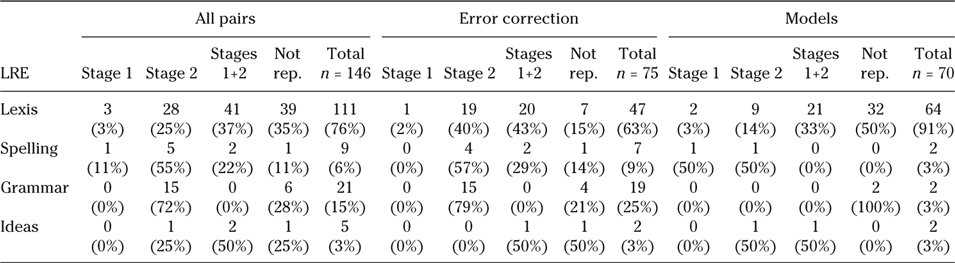
Table 4 represents the frequencies and proportions of the revisions made to the children’s writing in relation to the stage or stages in which they were noticed, together with a breakdown of the data for each of the feedback strategies. Overall, the changes made by all pairs were mostly lexical (76%). Lexical revisions accounted for 91% of all the features incorporated by learners in the modeling condition, as compared to 63% in the EC group. Most of the lexical items incorporated from the models either had not been previously reported (i.e., 50%) or had been identified at Stages 1 and 2 (i.e., 33%). Learners in the EC group also incorporated features mainly from Stages 1 and 2 (43%) and Stage 2 only (40%). Changes to grammar accounted for 15% of the total revisions made, originating mainly at the comparison stage, Stage 2 (72%). The majority of the grammatical revisions corresponded to the EC group (25%) in comparison to the model group (3%). In general, only small percentages of spelling features (6%) and ideas and expressions (3%) were incorporated into the final texts.
Frequency and proportion of features incorporated into the revised texts across stages and feedback types
Note.
Not rep. = not reported.
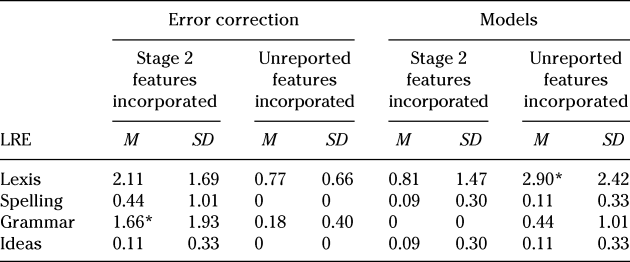
Because no significant differences between the feedback conditions were found for the incorporation of PFNs at Stage 1 or for FNs at both Stages 1 and 2, Table 5 shows the means of those features, which exhibited significant differences between feedback conditions. A Mann-Whitney test revealed that the children incorporated significantly more grammatical features noticed at the comparison stage in the EC condition than in the model condition (z = −2,746; p = .00). A significant difference was also found (z = −2,078; p = .04) in favor of the models for the incorporation in the revised texts of previously unreported lexical items.
Features from Stage 2 and previously unreported features incorporated into the revised texts across treatments
Note.
* indicates that the incorporations made to the revised texts were statistically significant.
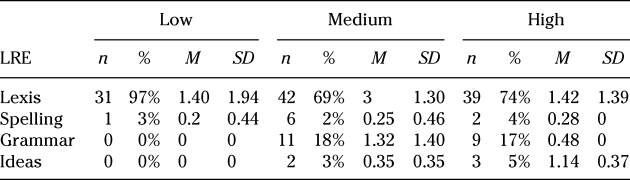
The overall relationship between the proficiency level of the pairs and the changes made to their revised texts is illustrated in Table 6. The frequency counts confirm an almost exclusive focus by pairs of all proficiency levels on lexis. Considering each language category separately, a series of Kruskal-Wallis tests showed no significant differences between the three groups.
Features incorporated into the revised texts across proficiency levels
Research Question 4
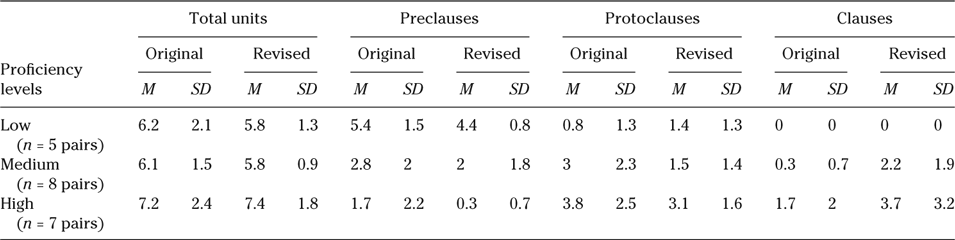
The fourth research question investigated the differences in terms of linguistic acceptability and comprehensibility in the written output of children in each feedback condition and as a function of their different proficiency levels. As such, the children’s original stories were compared with their revised versions to identify possible gains in the degree of linguistic acceptability and comprehensibility achieved across proficiency levels and feedback conditions. The results are presented in Table 7.
Means and standard deviations of the different unit types in the original and revised texts across proficiency levels
A Kruskal-Wallis test showed significant differences across proficiency levels in the number of preclauses produced both in the original texts (z = 7.25; p = .03) and in the revised versions (z = 11.72; p = .00), with the low-proficiency pairs showing more units of this type in both conditions (original texts: M = 5.40, SD = 1. 51; revised texts: M = 4.40, SD = .89) than the medium-proficiency group (original texts: M = 2.88, SD = 2.03; revised texts: M = 2, SD = 1.85) and the high-proficiency group (original texts: M = 1.71, SD = 2.21; revised texts: M = .29, SD = .75). Significant differences across levels were also found in the number of clauses produced in the revised texts (z = 10.43; p = .00), but, in this case, both medium- (revised texts: M = 2.25, SD = 1.98) and high-proficiency pairs (revised texts: M = 3.7, SD = 3.25) showed more units of this type than the low-proficiency group, who failed to produce a single correct clause, although they showed a slight decrease in the number of preclauses and an increase in the number of protoclauses.
Within proficiency levels, both medium- (z = −2.41; p = .02) and high-proficiency pairs (z = −2.26; p = .03) significantly improved the production of clauses in their revised texts (medium-proficiency group: M = 2.25, SD = 1.98; high-proficiency group: M = 3.71, SD = 3.25) as compared to that in their original texts (medium-proficiency group: M = .38, SD = .74; high-proficiency group: M = 1.71, SD = 2.05).
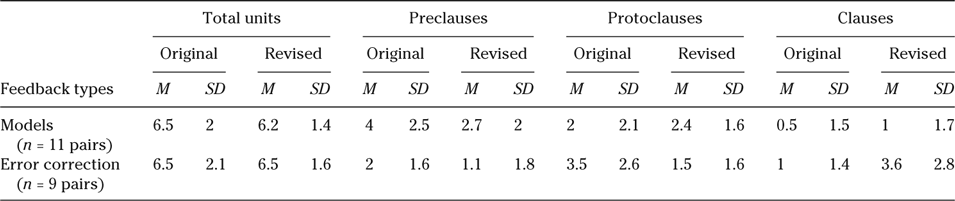
Within each feedback treatment (see Table 8), Wilcoxon signed-rank tests indicated an increase in the production of clauses from the initial to the revised versions of the texts for both the EC (original texts: M = 1, SD = 1.41; revised versions: M = 3.67, SD = 2.87; z = −2.52; p = .01) and the models (original versions: M = .55, SD = 1.50; revised versions: M = 1, SD = 1.73; z = −2.23; p = .02). However, in the revised versions, the EC condition gave rise to a significantly higher number of clauses than the models (EC: M = 3.67, SD = 2.87; models: M = 1, SD = 1.73), as shown by a Mann-Whitney test (z = −2.52; p = .01). In contrast, it was found that the models were associated with a marginally significant greater production of preclauses (z = −1.96; p = .06) in the original texts (EC: M = 2, SD = 1.65; models: M = 4, SD = 2.56).
Means and standard deviation of the different unit types in the original and revised texts across feedback strategies
DISCUSSION
The present study attempts to shed light on what Manchón (Reference Manchón and Manchón2009) referred to as “the language-learning potential of writing” (p. 61) by analyzing the focus of children’s attentional processes and subsequent uptake of feedback from EC and models during a written output task. The principal findings can be summarized as follows: (a) Writing tasks provided children of all ability levels with opportunities for self-initiated noticing, which was mainly lexically driven; (b) learners’ attention to language was mediated differently by different types of CF, with EC fostering increased noticing of grammatical errors and models directing attention toward lexis and language chunks; (c) learners’ textual revisions were mostly lexical, although EC encouraged more grammatical revisions than models; and (d) the EC condition led to the production of more acceptable and comprehensible output. In view of the theoretical framework within which our research is situated, these results provide further empirical evidence to suggest a link between writing, the provision and processing of feedback, and L2 learning, at least in the short term.
Self-Initiated Noticing During the Writing Process
The findings suggest that children can and do notice gaps in their linguistic knowledge during the production of written output and that the overwhelming majority of this noticing is lexically driven. The lexical gaps were often formulated by the children in terms of their inability to access relevant knowledge or by generating alternative solutions to the difficulties encountered. The children’s concern with lexis is consistent with the data reported in some of the studies that have looked at the original writing of participants engaged in multistaged writing tasks (García, Reference García2011; Hanaoka, Reference Hanaoka2007a, Reference Hanaoka2007b; Hanaoka & Izumi, Reference Hanaoka and Izumi2012; Martínez & Roca de Larios, 2010; Qi & Lapkin, Reference Qi and Lapkin2001). It is also illustrative of the pervasiveness of lexical access and retrieval problems in L2 writing (Manchón, Murphy, & Roca de Larios, Reference Manchón, Murphy and Roca de Larios2007) and of the prevalence of lexical issues over grammar when attention to form is self-initiated by the learners (Ellis, Reference Ellis2001; Swain & Lapkin, Reference Swain and Lapkin1995; Williams, Reference Williams and Ellis2001).
However, the differences found here between children of different proficiency levels suggest that there may not be a straightforward relationship between noticing of lexical gaps and L2 proficiency. Although more proficient children might be expected to display heightened awareness of gaps in their linguistic knowledge, it was the lower proficiency children in this study who identified a greater number of lexical problems, most likely because they had greater difficulty in finding the words to express their intended meanings. Our failure to identify a clear link between proficiency levels and frequency rates of the language categories noticed is in line with the results reported by Hanaoka (Reference Hanaoka2007a) for two university students of different proficiencies who noticed a similar number of gaps during writing. However, our findings contradict research on the processing of reformulations by primary school children in Spain (García, Reference García2011), whose noticing of difficulties at the composing stage was found to be linked to their level of proficiency. The correspondence between noticing and the children’s L2 proficiency was interpreted by the author as confirmation of Qi and Lapkin’s (Reference Qi and Lapkin2001) claim that learners with a higher level of L2 proficiency “may be able to conduct more language-related noticing while composing alone than learners with a lower level of L2 proficiency” (p. 295). It should be recalled, however, that both Hanaoka (Reference Hanaoka2007a) and Qi and Lapkin (Reference Qi and Lapkin2001) investigated only two learners, making it difficult to confirm that proficiency, and not some other individual difference, was responsible for the results.
The apparent contradiction between the findings of these researchers and our own, in which differences between learners at different proficiency levels were nonsignificant, may be related to the different data-collection procedures used in each of the studies. Whereas García (Reference García2011) and Qi and Lapkin (Reference Qi and Lapkin2001) relied on the verbalizations of pairs and individuals for their data, note-taking was adopted in this study as a self-report technique. It may be the case in our research, as with other studies that have used this methodological measure (Hanaoka, Reference Hanaoka2007b; Hanaoka & Izumi, Reference Hanaoka and Izumi2012), that the children’s note-taking was, at times, incomplete due to the increased task demands. It is also possible that the higher proficiency pairs, who were better at writing in the first place, found the task straightforward and had fewer problems to report, whereas the low-proficiency children, for whom the composing process was more linguistically demanding, may have concentrated more on the easier task of identifying (in their L1) the problems they experienced while attempting to produce L2 output. It may be that the reporting of noticing depends on the methods used by researchers to access learners’ attentional processes as well as on the participants themselves and the ways in which they perceive the task goals (Egi, Reference Egi2004; Mackey, Reference Mackey2006).
Noticing as a Result of Comparison with Error Correction and Models
The Stage 2 comparison task led to the noticing of a greater number of linguistic features overall. Lexis remained the principal focus of the children’s attention regardless of the feedback strategy they were exposed to, although increased attention was also paid to grammar. Error correction, in particular, was found to be effective for focusing children’s attention on the linguistic forms in their output. Given this “priming” effect of output (Izumi, Reference Izumi2003), the predominance of lexical features across feedback types and stages comes as no surprise. Of course, this result may have been influenced by the fact that the learners were instructed to use their initial problem sheets in the comparison stage to check for how the problems they had identified while writing were solved in the feedback. The increase in attention to features other than lexis corroborates a similar trend reported by Hanaoka (Reference Hanaoka2007b) and Martínez and Roca de Larios (2010) and suggests a useful role for both EC and models in promoting noticing among children and in helping them diversify their linguistic concerns.
The increased noticing of grammatical features by pairs in the EC condition leads us to assume that their attention was more readily directed to linguistic features in the feedback, which were more directly relevant to the errors they had committed. Because the teacher’s EC was tailored specifically to errors in the original texts and was also perceptually more salient, the children were not required to deploy search and interpretative procedures to locate differences between the feedback and their output, as they were with the model texts, and so might have been better able to devote their cognitive resources to the perception and reporting of the changes observed (Sachs & Polio, Reference Sachs and Polio2007; Santos et al., Reference Santos, López Serrano and Manchón2010). The children’s attention to syntactic and morphological features can be linked to the notion of integrative processing (Izumi, Reference Izumi2002), understood as the perception of not only the individual elements comprising a linguistic chunk but also the relationships between those elements, which connect them into a coherent whole. In line with our findings, it might be argued that this cognitive process of integration is more likely to be activated by EC than by models, at least among children of the age and ability of the participants in this study. However, their failure to report having noticed all of the corrections made to their texts also suggests that the noticing process, at least in younger learners, is not always consistent. Certain grammatical features could have been regarded as peripheral once attention to content words had been secured (García, Reference García2011). It may be that EC as a feedback strategy does not always guarantee the type of quality noticing that is thought to foster language learning (Adams, Reference Adams2003; Hanaoka, Reference Hanaoka2007a, Reference Hanaoka2007b; Yang & Zhang, Reference Yang and Zhang2010). In this sense, we concur with Sachs and Polio (Reference Sachs and Polio2007) that further research that specifically isolates perceptual saliency as an independent variable is needed to draw more convincing conclusions on the learning outcomes afforded by EC.
The use of model texts as a feedback strategy entails issues that require careful interpretation. Although, in the present study, they promoted the children’s noticing of lexical and content-related features, it is also true that the gap between the language of the models and the children’s L2 knowledge was such that grammatical features were largely ignored and many lexical items were misunderstood. For some learners, the model texts appeared to be used as source material for borrowing purposes (as in Martínez & Roca de Larios, 2010) and then mined (Hirvela, Reference Hirvela2004; Plakans, Reference Plakans2009) for those chunks that matched the children’s intended meaning. Once identified, perhaps on the basis of intuition, the chunks were simplified idiosyncratically, or their elements were recombined into written text. This would explain the appearance in the children’s output of unique clauses formed by misinterpreting elements that were noticed but only partially understood. The pedagogical implications clearly point to the importance of tailoring model texts more closely to learners’ needs to encourage understanding with accuracy. When the language contained in the model is overly complex, its usefulness as a feedback strategy is diminished. Whether such misinterpretations of meaning or inaccurate simplifications are unique to low-proficiency children is an issue that requires further investigation. Different results might have been obtained if more medium- or high-proficiency pairs had been assigned to this condition. The imbalance of proficiency pairs across feedback conditions is a limitation of the study that we have previously acknowledged.
The Effects of Noticing and Feedback on the Children’s Revised L2 Writing
The noticing of gaps while engaged in collaborative writing in the L2 appeared to have a facilitating effect on the children’s processing and retention of information obtained from feedback. The majority of the textual changes made by the children were lexical, most of which had been identified at Stage 1 and again at Stage 2. This result is consistent with the idea that the noticing of gaps as a result of output production may push children not only “to look out for any relevant information available that . . . might help solve the problems in a better way” (Qi & Lapkin, Reference Qi and Lapkin2001, p. 289) but also to “use the solutions upon noticing them” (Hanaoka, Reference Hanaoka2007b, p. 471), which may eventually lead to their retention. Retention, in turn, might also have been facilitated in this particular case by the combination of collaborative dialogue and writing involved in the tasks as noted in previous studies (Martínez & Roca de Larios, 2010; Niu, Reference Niu2009).
It is interesting to note that about a third of the children’s lexical revisions were found to correspond to items that had not been explicitly reported at previous stages but that later appeared in their revised texts. This was particularly true in the case of models. A possible explanation for the apparent emergence of these features may lie in the limitations of note-taking (Hanaoka, Reference Hanaoka2007b; Hanaoka & Izumi, Reference Hanaoka and Izumi2012). As suggested by Jourdenais (Reference Jourdenais and Robinson2001), this data-collection technique, together with other introspective methods, provides incomplete coverage of what is noticed by learners and may also suffer from reactivity (i.e., change in the nature of the cognitive processes it is supposed to bring to light; Bowles, Reference Bowles2008, Reference Bowles2010; Bowles & Leow, Reference Bowles and Leow2005; Sachs & Polio, Reference Sachs and Polio2007). We suggest that, as feedback strategies, models and EC can play complementary roles. Error correction helped the children to identify linguistic inadequacies in their output but did not provide them with alternatives to what was already correct in their original texts. The models, in contrast, seemed to have offered the children a set of L2 words beyond what they had written and content that they could draw on to express new meanings. Error correction, however, did further the incorporation of grammatical features to a greater extent than models. So far, as a feedback strategy, EC has been shown to be advantageous, both with university students in L2 contexts (Sachs & Polio, Reference Sachs and Polio2007) and with secondary school students in a foreign language context (Santos et al., Reference Santos, López Serrano and Manchón2010). Our data seem to confirm, at least partially, the positive impact of this type of feedback, by extending it to the noticing and incorporation of grammar by primary school children in a foreign language context. Although lexical incorporations were foremost for all the children, and especially for the lower proficiency pairs, the data also suggest the existence of a threshold beyond which these less proficient learners might begin to move away from lexis and to diversify their linguistic concerns. This is an area that merits further inquiry.
The Effects of Feedback and Proficiency on the Linguistic Acceptability and Complexity of Revised Output
Our data indicate that the low-proficiency children continued to make use of preclauses to complete their stories and failed to produce a single acceptable clause. They showed, however, a slight decrease in their production of preclauses with a corresponding increase in the number of protoclauses, which could be interpreted as some evidence of improvement. The data also show an increase in the production of acceptable clauses by the learners, especially in the EC condition. This may be taken as an indication that EC is potentially useful, through its direct relevance to their linguistic needs and its perceptual salience, in helping primary school learners draw on their explicit knowledge (Williams, Reference Williams, Belcher and Hirvela2008) and analyze their output, albeit in a limited way (Torras, Reference Torras2005). Evidence to this effect emerged from the notes the children took while analyzing the EC feedback. In contrast, the smaller increase in the production of clauses in the modeling condition may speak to the difficulties the children experienced in integrating the chunks they had drawn from the models in syntactically acceptable ways. This, together with the higher proportion of preclauses also prompted by the models, could be related to the fact that four of the pairs in this condition were low proficiency. Finally, the similarity in the total language units produced before and after exposure to the two feedback strategies seems to indicate that neither feedback type has much effect, at least in the short term, on the number of words produced. It could also be related, however, to the type of text the learners were asked to produce (a four-framed picture story), which was necessarily brief.
CONCLUSIONS
The present study offers insights into the noticing and composing processes of a group of language learners who have generally been overlooked by researchers of L2 writing. The findings reported here with young language learners in an instructional setting have largely coincided with those of empirical studies carried out with adult learners but have also provided points of contrast as well as unique insights into children’s processing of CF, all of which contribute to strengthening our knowledge of the language-learning potential of different feedback strategies. The results of our study have provided evidence that explicit knowledge promoted through written feedback can have an impact, at least, on improving accuracy in writing. Whether that impact can tap into implicit knowledge and endure in time is a major question facing researchers working within a cognitively oriented framework of L2 writing. It is an issue that theorists have acknowledged and that research is actively seeking to address. However, because language acquisition has been seen to occur in a nonlinear fashion, the importance of progress made in improving explicit knowledge through writing tasks should not be neglected. There is no reason for us not to be optimistic that L2 writing may activate processes that will ultimately contribute to the restructuring of implicit knowledge. This has yet to be demonstrated and is a daunting task, but it is one that constitutes a key issue in the interface between the SLA and L2 writing communities. Further work in this direction would most certainly help to “build better bridges” (Ortega, Reference Ortega2012, p. 404) between both fields.
The pedagogical implications of the study point to the usefulness of both types of feedback for the classroom, as EC and model texts were found to promote the noticing of different features of language—lexical, grammatical, and content related—all of which are important for developing children’s L2 writing. Error correction may be more important for directing attention to grammatical features, whereas the strength of models lies in their potential to provide lexis and expressions beyond learners’ current repertoires. Similarly, the children’s ability to work together to identify gaps in their L2 knowledge and then to attempt to use this metacognitive knowledge to improve their output in the L2 points to the usefulness of collaborative writing as a site for learning in the L2 classroom.
The study has certain limitations that need to be taken into consideration for future research. With regard to the research methodology, a larger sample together with a more even distribution of pairs of different proficiency levels in each of the feedback conditions is important to ensure more representative results. Also, given the difficulties the children experienced in understanding and internalizing the language contained in the model texts, future studies could use model texts that are more closely matched to learners’ levels of competence to increase the possibilities of noticing with understanding (Qi & Lapkin, Reference Qi and Lapkin2001). Furthermore, as the children had had regular English classes during the 3 weeks of the test period, it is not fully clear if the differences between treatments can be attributed to the type of feedback provided or to other factors. Thus, if the comparison of feedback strategies was to be approached in future studies, the inclusion of a control group would be highly advisable. Because many features of language not explicitly reported in the children’s note-taking were later incorporated into their revised texts, complementary methods of data collection such as stimulated recall (Adams, Reference Adams2003) or verbal protocols (Qi & Lapkin, Reference Qi and Lapkin2001) might be used profitably to tap learners’ thought processes more deeply.
In the present article, we have attempted to meet Manchón’s (Reference Manchón, Reichelt and Chimasko2011a) call for a research agenda that builds on experimental laboratory type studies “to include research conducted in real classrooms, with real teachers, and real students” (p. 59). Future research could continue in this direction by expanding on the findings reported here. One issue that needs further attention is the interrelationships among the type of feedback provided; learners’ proficiency levels; and their noticing, understanding, and incorporation of feedback. Specifically, we need to determine when and why children begin to diversify their attentional resources toward aspects of language other than lexis as well as the ways in which CF might influence this shift in attention. It is also important for future research to look into how learner proficiency, the quality of children’s collaborative interaction, or the nature of the roles assigned during writing tasks (e.g., writer and notetaker) might impact the long-term retention of features noticed during comparative feedback tasks. Finally, longitudinal studies are also needed to explore the effects of different types of CF on the cognitive processes involved in noticing and on the acceptability and comprehensibility of children’s L2 writing as well as on the long-term relationship between writing and L2 learning.
APPENDIX MODEL TEXTS
One day, there were two sisters at a table painting a picture. The mum and the little brother were watching them. Suddenly the telephone rang and the mother went to answer it. Then, the little brother took the paintbrush and went crawling to the wall and started to paint it. When they realized, they started to shout at him but it was too late. The wall had big pink spots on it.
A girl and her friend were sitting at the table painting a picture while her little brother and mummy were watching them. Then the telephone rang and mummy answered it. While she was talking, the little boy crawled over to the wall. Nobody was paying him any attention. He started to paint the wall pink. Suddenly, the mummy and the girls saw him and they shouted “Stop!” But it was too late.