Introduction
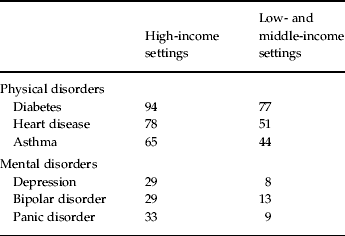
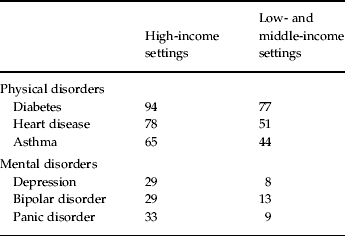
Most people in the world who have mental illnesses receive no effective treatment (Thornicroft, Reference Thornicroft2007; Wang et al. Reference Wang, Aguilar-Gaxiola, Alonso, Angermeyer, Borges, Bromet, Bruffaerts, de Girolamo, de Graaf, Gureje, Haro, Karam, Kessler, Kovess, Lane, Lee, Levinson, Ono, Petukhova, Posada-Villa, Seedat and Wells2007b; Kessler et al. Reference Kessler, Aguilar-Gaxiola, Alonso, Chatterji, Lee, Ormel, Ustun and Wang2009; Patel et al. Reference Patel, Maj, Flisher, De Silva, Koschorke and Prince2010a). For example, of all adults affected by mental illnesses, the proportion who are treated ranges from 30.5% in the USA (Kessler et al. Reference Kessler, Demler, Frank, Olfson, Pincus, Walters, Wang, Wells and Zaslavsky2005b), and 27% across Europe (Wittchen & Jacobi, Reference Wittchen and Jacobi2005; Alonso et al. Reference Alonso, Codony, Kovess, Angermeyer, Katz, Haro, De Girolamo, De Graaf, Demyttenaere, Vilagut, Almansa, Lépine and Brugha2007), to less than 1% in Nigeria (Demyttenaere et al. Reference Demyttenaere, Bruffaerts, Posada-Villa, Gasquet, Kovess, Lepine, Angermeyer, Bernert, de Girolamo, Morosini, Polidori, Kikkawa, Kawakami, Ono, Takeshima, Uda, Karam, Fayyad, Karam, Mneimneh, Medina-Mora, Borges, Lara, de Graaf, Ormel, Gureje, Shen, Huang, Zhang, Alonso, Haro, Vilagut, Bromet, Gluzman, Webb, Kessler, Merikangas, Anthony, Von Korff, Wang, Brugha, Aguilar-Gaxiola, Lee, Heeringa, Pennell, Zaslavsky, Ustun and Chatterji2004; Kohn et al. Reference Kohn, Saxena, Levav and Saraceno2004; Ormel et al. Reference Ormel, Petukhova, Chatterji, Aguilar-Gaxiola, Alonso, Angermeyer, Bromet, Burger, Demyttenaere, de Girolamo, Haro, Hwang, Karam, Kawakami, Lépine, Medina-Mora, Posada-Villa, Sampson, Scott, Ustün, Von Korff, Williams, Zhang and Kessler2008; Wang et al. Reference Wang, Angermeyer, Borges, Bruffaerts, Tat, de Girolamo, Fayyad, Gureje, Haro, Huang, Kessler, Kovess, Levinson, Nakane, Oakley Brown, Ormel, Posada-Villa, Aguilar-Gaxiola, Alonso, Lee, Heeringa, Pennell, Chatterji and Ustün2007a). This phenomenon, described by the World Health Organization (WHO) as the ‘treatment gap’ (Dua et al. Reference Dua, Barbui, Clark, Fleischmann, van Ommeren, Poznyak, Yasamy, Thornicroft and Saxena2011), is increasingly appreciated worldwide, and is seen as the difference between the true prevalence rate and the proportion who receive any kind of treatment (except for interventions by traditional, religious or similar practitioners/healers) (Chisholm et al. Reference Chisholm, Flisher, Lund, Patel, Saxena, Thornicroft and Tomlinson2007; Patel et al. Reference Patel, Araya, Chatterjee, Chisholm, Cohen, De Silva, Hosman, McGuire, Rojas and van Ommeren2007; Prince et al. Reference Prince, Patel, Saxena, Maj, Maselko, Phillips and Rahman2007; Saxena et al. Reference Saxena, Thornicroft, Knapp and Whiteford2007) (see Table 1).
Proportions (%) of people with key physical and mental disorders who are treated, by high- or low- and middle-income setting status (adapted from Ormel et al. Reference Ormel, Petukhova, Chatterji, Aguilar-Gaxiola, Alonso, Angermeyer, Bromet, Burger, Demyttenaere, de Girolamo, Haro, Hwang, Karam, Kawakami, Lépine, Medina-Mora, Posada-Villa, Sampson, Scott, Ustün, Von Korff, Williams, Zhang and Kessler2008)
In 2008 the Department of Mental Health and Substance Abuse at the WHO recognized the importance of this challenge by launching as its centrepiece the Mental Health Global Action Programme (mhGAP). The first major product of this programme is the mhGAP Intervention Guide (mhGAP IG; WHO, 2010), which contains case findings and treatment guidelines for nine important categories of mental and neurological disorders that are particularly relevant in low-income settings, and that have a major global public health impact. The conditions included are: depression, psychoses, epilepsy/seizures, developmental disorders, behaviour disorders, dementia, alcohol use disorders, drug use disorders, and self-harm/suicide (Barbui et al. Reference Barbui, Dua, van Ommeren, Yasamy, Fleischmann, Clark, Thornicroft, Hill and Saxena2010).
In this paper we propose a ‘Balanced Care Model’ (BCM) to stimulate debate about how to conceptualize the planning and delivery of services to adults with mental disorders. For the purposes of this conceptual paper we refer to services for the range of mental disorders that affect adults, excluding drug and alcohol misuse disorders, intellectual disabilities or any neurological disorders, such as epilepsy, that are commonly treated within mental health services in low-income countries, or services specifically for older adults. We have previously reviewed the evidence for hospital-based and community-based general adult mental health services, and we indicated that a comprehensive system of care should be based on a balance of both hospital and community components (Thornicroft & Tansella, Reference Thornicroft and Tansella2004). Almost a decade later, is this still relevant?
Method
To develop this conceptual model we have integrated information from two sources: (i) a literature review of relevant peer-reviewed papers and other relevant published material and (ii) a consensus exercise conducted among experts in mental health services in many countries worldwide, supplemented by additional information from data sources in low- and middle-income countries (LMICs). The rationale for this hybrid approach is that our aim is to develop a high-level conceptual model that can be applied, for example, at country, regional or district levels, and that does not only include data from clinical studies, for example from randomized clinical trials.
For the first source of data, the published material, in 2011 we updated the literature review we initially conducted in 2004 (Thornicroft & Tansella, Reference Thornicroft and Tansella2004). Primary data papers, along with review and discussion papers published in English, were examined from relevant journals and book chapters. The key search terms and combinations used were: (1) ‘delivery of health care’, (2) ‘mental health’, (3) ‘mental OR psychiatric OR psychiatry’, (4) 2 OR 3, (5) 4 AND 1. The only studies excluded were those directly concerned with children/adolescents/young people, older adults, dementia, intellectual disability, alcohol and drug misuse, prison populations or forensic psychiatry, or homeless populations. Then the combined search categories were applied to Medline, EMBASE and PsycINFO (in relation to: title, abstract, subject headings, heading word, drug trade name, original title, device manufacturer, or drug manufacturer). This general adult version of the BCM can therefore be considered as a prototype model that may be suitable, in adapted or modified forms, to these other patients groups.
To identify any pertinent missing papers we cross-referenced the results of these searches with the peer-reviewed paper references contained in the relevant review papers by international experts who contributed chapters to an international textbook on community mental health (Thornicroft et al. Reference Thornicroft, Lempp and Tansella2011c). In addition, we accessed other electronic, non-indexed sources including the World Psychiatric Association (WPA) and country-specific Ministry of Health websites for relevant literature. Google was used to search for pdf documents that contained ‘community mental health’. Other key texts were used to identify relevant papers and book chapters (Benegal et al. Reference Benegal, Chand and Obot2009; Mbuba & Newton, Reference Mbuba and Newton2009; Patel & Thornicroft, Reference Patel and Thornicroft2009; Patel et al. Reference Patel, Simon, Chowdary, Kaaya and Araya2009) along with sources from the 2007 special edition of The Lancet on Global Mental Health (Chisholm et al. Reference Chisholm, Flisher, Lund, Patel, Saxena, Thornicroft and Tomlinson2007; Jacob et al. Reference Jacob, Sharan, Mirza, Garrido-Cumbrera, Seedat, Mari, Sreenivas and Saxena2007; Patel et al. Reference Patel, Araya, Chatterjee, Chisholm, Cohen, De Silva, Hosman, McGuire, Rojas and van Ommeren2007; Prince et al. Reference Prince, Patel, Saxena, Maj, Maselko, Phillips and Rahman2007; Saraceno et al. Reference Saraceno, van Ommeren, Batniji, Cohen, Gureje, Mahoney, Sridhar and Underhill2007; Saxena et al. Reference Saxena, Thornicroft, Knapp and Whiteford2007). WHO publications that provide information on community mental health services worldwide were also sourced (WHO, 2008).
For the second source of information used in developing this conceptual model, information from experts in many countries worldwide, we first contacted colleagues from across Africa, the Americas, Asia, Australasia and Europe whom we knew to be active in mental health service design in their respective countries. Using a semi-structured questionnaire we asked them to comment on 10 key challenges that we proposed in relation to mental health service development. A more detailed account of the method used has been published previously (Thornicroft & Tansella, Reference Thornicroft and Tansella2009). To further broaden the scope of information gathered about international experience in developing mental health care, this review also drew upon the work of the WPA Task Force (2009–2010) on ‘Steps, obstacles and mistakes to avoid in the implementation of community mental health care’ (see Acknowledgements for membership). Task Force members were from seven world regions as defined by the WHO. Each member then contacted, in turn, colleagues with experience of developing mental health services within their own region of the world. To further strengthen the information contributed from LMICs, we drew upon data gathered to assess how far mental health services in LMICs have been scaled up in recent years to reduce the treatment gap (Eaton et al. Reference Eaton, McCay, Semrau, Chatterjee, Baingana, Araya, Ntulo, Thornicroft and Saxena2011). We also went further by including more specific data from the particular LMICs in sub-Saharan Africa. Within the work of the WPA Task Force, 21 experts completed a semi-structured questionnaire about their experience in implementing community mental health care in Cote d'Ivoire, Ethiopia, Kenya, Liberia, Malawi, Niger, Nigeria, South Africa, Sudan, Tanzania, Uganda and Zimbabwe (Hanlon et al. Reference Hanlon, Wondimagegn and Alem2010; Thornicroft et al. Reference Thornicroft, Szmukler, Mueser and Drake2011b). Using our pre-existing understanding of mental health systems (Thornicroft & Tansella, Reference Thornicroft and Tansella1999), we integrated data from these multiple sources to develop the BCM, framed in three sequential steps relevant to low-, medium- or high-income settings and intended to be simple enough to be widely applicable, and flexible enough to be adapted to the complexities of local circumstances.
Results
In relation to the main literature search, the initial 55211 papers identified were reduced to 118 unique records when the eligibility criteria were applied. For the information gathered from experts worldwide, the first survey drew upon detailed responses from 27 colleagues in 25 countries worldwide (Thornicroft & Tansella, Reference Thornicroft and Tansella2009), with the WPA Task Force comprising members from nine countries across seven world regions as defined by the WHO. In relation to the survey assessing progress made towards scaling up (Eaton et al. Reference Eaton, McCay, Semrau, Chatterjee, Baingana, Araya, Ntulo, Thornicroft and Saxena2011), data were contributed by 142 experts from 59 countries worldwide, of which 19 (32%) were in the WHO Africa region, 16 (27%) in the Americas region, eight (14%) in the eastern Mediterranean region, six (10%) in the western Pacific, five (8%) in South East Asia, and five (8%) in Europe. In total, therefore, more than 170 individual experts worldwide actively contributed to this data collection process.
We present the BCM in relation to three ‘levels of resources’, using the World Bank classification (World Bank, 2010). In this system economies are divided according to 2009 Gross National Income (GNI) per capita calculated using the World Bank Atlas method. The groups are: low income (⩽US$995), lower-middle income (US$996–3945), upper-middle income (US$3946–12195), and high income (⩾US$12196). For the purposes of the BCM we have combined the lower-middle and upper-middle income setting groups.
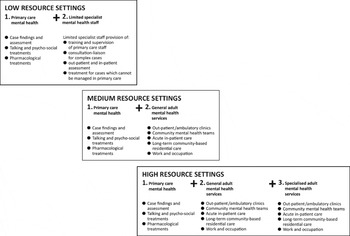
The mental health resource disparities between low- and high-income settings are vast. In low-income countries, for example, there are on average only 0.05 psychiatrists and 0.16 psychiatric nurses per 100 000 population, about 200 times less than in high-income settings (WHO, 2005). Many low-income countries in sub-Saharan Africa, for example, have on average less than one psychiatrist for every million people (e.g. Chad, Eritrea and Liberia), compared with 137 per million in the USA (Ndyanabangi et al. Reference Ndyanabangi, Basangwa, Lutakome and Mubiru2004; Miller, Reference Miller2006). Furthermore, training programmes and facilities for mental health professionals in low-income settings are often grossly inadequate (WHO, 2005; Saxena et al. Reference Saxena, Thornicroft, Knapp and Whiteford2007). The BCM therefore organizes service components separately according to low-, middle- or high-resource settings as shown in Fig. 1 (Thornicroft & Tansella, unpublished observations).
Mental health service components relevant to low-, medium- and high-resource settings.

Low-income settings
Most of the available provision in low-resource settings is by staff in primary health care and community settings (Ormel et al. Reference Ormel, Von Korff, Ustun, Pini and Korten1994; Desjarlais et al. Reference Desjarlais, Eisenberg, Good and Kleinman1995; WHO, 2001; Seloilwe & Thupayagale-Tshweneagae, Reference Seloilwe and Thupayagale-Tshweneagae2007; Deva, Reference Deva2008). The roles of these staff include: case finding and assessment, brief talking and psychosocial treatments, and pharmacological treatments (Beaglehole & Bonita, Reference Beaglehole and Bonita2008; Eaton, Reference Eaton2008). The very limited numbers of specialist mental health care staff (usually in the capital city and sometimes also in regional centres) are only able to provide: (i) training and supervision of primary care staff, (ii) consultation–liaison for complex cases, and (iii) out-patient and in-patient and assessment and treatment for cases that cannot be managed in primary care (Mubbashar, Reference Mubbashar, Tansella and Thornicroft1999; Alem, Reference Alem2002; Njenga, Reference Njenga2002; Saxena & Maulik, Reference Saxena and Maulik2003; Lund et al. Reference Lund, De Silva, Plagerson, Cooper, Chisholm, Das, Knapp and Patel2011).
Medium-income settings
For medium-income settings it is important to appreciate that there is still a requirement for a strong primary care level of provision, so as to address the high levels of prevalence of common mental disorders in the general population (in many countries estimated at 20–30% annual period prevalence rate) (Kessler et al. Reference Kessler, Chiu, Demler, Merikangas and Walters2005a; Wittchen et al. Reference Wittchen, Jacobi, Rehm, Gustavsson, Svensson, Jönsson, Olesen, Allgulander, Alonso, Faravelli, Fratiglioni, Jennum, Lieb, Maercker, van Os, Preisig, Salvador-Carulla, Simon and Steinhausen2011). The literature from such middle-income settings, for example many of the countries of Eastern Europe and South America (Knapp et al. Reference Knapp, McDaid, Mossialos and Thornicroft2007; Semrau et al. Reference Semrau, Barley, Law and Thornicroft2011; Razzouk et al., in press), indicates that modest levels of resource are usually allocated for mental health care compared with communicable and infectious diseases (Razali, Reference Razali2004; Al-Krenawi, Reference Al-Krenawi2005; Furedi et al. Reference Furedi, Mohr, Swingler, Bitter, Gheorghe, Hotujac, Jarema, Kocmur, Koychev, Mosolov, Pecenak, Rybakowski, Svestka and Sartorius2006; Akiyama et al. Reference Akiyama, Chandra, Chen, Ganesan, Koyama, Kua, Lee, Lin, Ng, Setoya, Takeshima and Zou2008; Janse van Rensburg, Reference Akiyama, Chandra, Chen, Ganesan, Koyama, Kua, Lee, Lin, Ng, Setoya, Takeshima and Zou2009; Sharifi, Reference Sharifi2009; Rodriguez, Reference Rodriguez2010). In addition, as resources allow, the BCM indicates that the five elements of ‘general adult’ mental health services are advisable, as discussed in the following sections.
Out-patient/ambulatory clinics
There is surprisingly little evidence on the effectiveness of out-patient, clinic or ambulatory care (Becker & Koesters, Reference Becker, Koesters, Thornicroft, Szmukler, Mueser and Drake2011) but there is a strong clinical consensus in many countries that they are a relatively efficient way to organize the provision of assessment and treatment, providing that the clinic sites are accessible to local populations. Nevertheless, these clinics are simply methods of arranging clinical contact between staff and patients, and so the key issue is the content of the clinical interventions, namely to deliver treatments that are effective (Roth & Fonagy, Reference Roth and Fonagy1996; Nathan & Gorman, Reference Nathan and Gorman2002; BMJ Books, 2003).
Community mental health teams (CMHTs)
CMHTs are the basic building block of community mental health services. The simplest model of provision of community care is for generic (non-specialized) CMHTs to provide the full range of interventions, staffed by multi-disciplinary personnel. These often prioritize adults with severe mental illness, for a local defined geographical catchment area (Tyrer et al. Reference Tyrer, Morgan, Van Horn, Jayakody, Evans, Brummell, White, Baldwin, Harrison-Read and Johnson1995, Reference Tyrer, Evans, Gandhi, Lamont, Harrison-Read and Johnson1998, Reference Tyrer, Coid, Simmonds, Joseph and Marriott2007; Sytema et al. Reference Sytema, Micciolo and Tansella1997; Thornicroft et al. Reference Thornicroft, Wykes, Holloway, Johnson and Szmukler1998, Reference Thornicroft, Becker, Holloway, Johnson, Leese, McCrone, Szmukler, Taylor and Wykes1999; Burns, Reference Burns, Thornicroft and Szmukler2001; Simmonds et al. Reference Simmonds, Coid, Joseph, Marriott and Tyrer2001; Department of Health, 2002). The central issue here is that CMHTs can offer case management and continuity of care (Dieterich et al. Reference Dieterich, Irving, Park and Marshall2010), in addition to mobility. In other words they can arrange appointments with patients at hospitals, clinics, community mental health centres, or at the patient's own homes. At the same time it needs to be recognized that, for patients not able or not willing to go to health facilities, this flexibility is necessary but not sufficient for proper care. Alongside the need for mobility is once again the requirement to deliver effective treatment when clinical encounters do take place (Malone et al. Reference Malone, Newron-Howes, Simmonds, Marriot and Tyrer2007).
Acute in-patient care
There continues to be relatively weak evidence about most aspects of in-patient care, and these studies are usually descriptive accounts (Holloway & Sederer, Reference Holloway, Sederer, Thornicroft, Szmukler, Mueser and Drake2011). There are few systematic reviews in this field, one of which found that there were no differences in outcomes between routine admissions and planned shorter hospital stays (Johnstone & Zolese, Reference Johnstone and Zolese1999). More generally, although there is a consensus that acute in-patient services are necessary, the number of beds provided is highly contingent upon which other services exist locally, and upon local social, economic and cultural characteristics (Thornicroft & Tansella, Reference Thornicroft and Tansella1999). Acute in-patient care commonly absorbs most of the mental health budget (Knapp et al. Reference Knapp, Chisholm, Astin, Lelliott and Audini1997), therefore reducing the average length of stay may be an important system goal, especially if the resources released in this way can be used to pay for other service components (Lasalvia & Tansella, Reference Lasalvia and Tansella2010; Lelliott & Bleksley, Reference Lelliott and Bleksley2010; Sederer, Reference Sederer2010; Totman et al. Reference Totman, Mann and Johnson2010).
A related policy issue concerns how to provide acute beds in a humane and non-institutionalized way that is acceptable to patients, for example in general hospital units (Quirk & Lelliott, Reference Quirk and Lelliott2001; Tomov, Reference Tomov, Thornicroft and Tansella2001; Totman et al. Reference Totman, Mann and Johnson2010; The ITHACA Study Group, 2011). For example, descriptive research in England has identified 131 services that are alternative to traditional acute in-patient settings. Most were hospital based and situated in deprived areas, and about half were established after 2000. This suggests that such alternatives may represent an important, but previously undocumented and unevaluated, sector of the mental health economy (Johnson et al. Reference Johnson, Gilburt, Lloyd-Evans, Osborn, Boardman, Leese, Shepherd, Thornicroft and Slade2009; Lloyd-Evans et al. Reference Lloyd-Evans, Slade, Jagielska and Johnson2009).
Long-term community-based residential care
It is important to know whether patients with severe and long-term disabilities should be cared for in larger, traditional institutions, or be transferred to long-term community-based residential care. Although there is no strong evidence on this question from low-income settings, the evidence from medium- and high-income settings is reasonably clear. When deinstitutionalization is carried out carefully, when patients who have previously received long-term in-patient care for many years are discharged to community care, then the outcomes are favourable for the majority (Shepherd & MacPherson, Reference Shepherd, MacPherson, Thornicroft, Szmukler, Mueser and Drake2011). Nevertheless, the range and capacity of community residential long-term care that will be needed in any particular area is also highly dependent upon which other services are available locally, and upon social and cultural factors, such as the amount of family care available (van Wijngaarden et al. Reference van Wijngaarden, Schene, Koeter, Becker, Knudsen, Tansella, Thornicroft and Vazquez-Barquero2003).
Work and occupation
Rates of unemployment among people with mental disorders are usually much higher than in the general population (Warner, Reference Warner2004). Traditional methods of occupation have not been shown to be effective in leading to open market employment (Shepherd, Reference Shepherd1990; Marshall et al. Reference Marshall, Crowther, Almaraz-Serrano, Creed, Sledge, Kluiter, Roberts, Hill, Wiersma, Bond, Huxley and Tyrer2001; Rosen & Barfoot, Reference Rosen, Barfoot, Thornicroft and Szmukler2001). For settings with medium levels of resources it is reasonable at this stage to make pragmatic decisions about the provision of work and day care services, especially based upon the priorities and preferences of the patient/service user and carer/family members concerned (Cleary et al. Reference Cleary, Freeman and Walter2006), where this is focusing increasingly upon the importance of personal recovery (Slade, Reference Slade2009; Slade et al. Reference de Girolamo, Dagani, Purcell, Cocchi and McGorry2012). At the same time, it is reasonable to take into account the accumulating evidence for supported employment models (Marshall et al. Reference Marshall, Crowther, Almaraz-Serrano, Creed, Sledge, Kluiter, Roberts, Hill, Wiersma, Bond, Huxley and Tyrer2001; Catty et al. Reference Catty, Burns and Comas2007; Becker et al. Reference Becker, Bond, Drake, Thornicroft, Szmukler, Mueser and Drake2011).
High-income settings
Superimposed upon a basic primary care system (Gask, Reference Gask2005), and in addition to the provision of general adult mental health services, for high-income settings the application of the BCM implies that a series of specialized services can be provided, as resources allow (see Fig. 1). In fact, however, it is often the case that specialized services are developed in the absence of the first two layers of general services. This is often because advocates for a new team or service take a ‘component view’ of treatment rather than a public health orientation, using a ‘system view’ of the wider pattern of care and how the constituent parts contribute to the whole.
Such specialized services can be developed in the same five categories described earlier for medium-income settings.
Specialized out-patient/ambulatory clinics
Specialized out-patient facilities may provide services, for example, for those with eating disorders, treatment-resistant affective disorders, people with co-morbid psychotic and substance misuse/dependence disorders, or for mentally ill mothers. Local decisions about whether to establish such specialist clinics will depend upon several factors, including their relative priority in relation to the other specialist services described below, identified services gaps, and the financial opportunities available (Becker & Koesters, Reference Becker, Koesters, Thornicroft, Szmukler, Mueser and Drake2011).
Specialized CMHTs
Although in-patient and out-patient care have rarely been evaluated, CMHTs continue to be subject to substantial research investigation.
Assertive community treatment (ACT) teams
These provide a form of specialized mobile outreach treatment for people with more disabling mental disorders (Deci et al. Reference Deci, Santos, Hiott, Schoenwald and Dias1995; Teague et al. Reference Teague, Bond and Drake1998; Killaspy & Rosen, Reference Killaspy, Rosen, Thornicroft, Szmukler, Mueser and Drake2011). There is now clear evidence that in high-income settings ACT can: reduce admissions to hospital and the use of acute beds; improve accommodation status and occupation; and increase service user satisfaction. ACT has not been shown to produce improvements in mental state or social behaviour. ACT can reduce the cost of in-patient services but does not change the overall costs of care (Latimer, Reference Latimer1999; Marshall & Lockwood, Reference Marshall and Lockwood2000; Phillips et al. Reference Phillips, Burns, Edgar, Mueser, Linkins, Rosenheck, Drake and McDonel Herr2001).
Nevertheless, it is not known how far ACT is cross-culturally relevant, and indeed there is evidence that ACT may be less effective where usual services already offer high levels of continuity of care (Burns et al. Reference Burns, Creed, Fahy, Thompson, Tyrer and White1999, Reference Burns, Fioritti, Holloway, Malm and Rossler2001; Fiander et al. Reference Fiander, Burns, McHugo and Drake2003). Indeed, data from outside the USA are somewhat equivocal about the benefits of ACT. A randomized controlled trial (RCT) in the UK (Killaspy et al. Reference Killaspy, Bebbington, Blizard, Johnson, Nolan, Pilling and King2006, Reference Killaspy, Kingett, Bebbington, Blizard, Johnson, Nolan, Pilling and King2009; McCrone et al. Reference McCrone, Killaspy, Bebbington, Johnson, Nolan, Pilling and King2009b) found no differences in any measure of in-patient service use, clinical or social functioning between ACT and standard community mental health team case management. However, patients treated by ACT were better engaged, less likely to drop out of contact and more satisfied with services. It may be that the lesser benefits from the UK studies are attributable to better functioning CMHTs in the control group than is the case in studies in the USA (Latimer, Reference Latimer2005; Burns et al. Reference Burns, Catty, Dash, Roberts, Lockwood and Marshall2007; Ghosh & Killaspy, Reference Ghosh and Killaspy2010; Killaspy & Rosen, Reference Killaspy, Rosen, Thornicroft, Szmukler, Mueser and Drake2011).
Early intervention (EI) teams
There is a growing body of research evidence on the short- to medium-term consequences of EI CMHTs in treating people with psychotic disorders (Power & McGorry, Reference Power, McGorry, Thornicroft, Szmukler, Mueser and Drake2011), and also services to treat prodromal or ultra-high-risk groups (Addington et al. Reference Addington, Coldham, Jones, Ko and Addington2003; Raune et al. Reference Raune, Kuipers and Bebbington2004; Preti & Cella, Reference Preti and Cella2010). The more recent evidence gives conflicting views on whether EI services do deliver enduring patient benefit (Killackey, Reference Killackey2011; Larsen et al. Reference Larsen, Melle, Auestad, Haahr, Joa, Johannessen, Opjordsmoen, Rund, Rossberg, Simonsen, Vaglum, Friis and McGlashan2011) or whether the advantages may only last while in contact with such relatively intense services (Bosanac et al. Reference Bosanac, Patton and Castle2010; Gafoor et al. Reference Gafoor, Nitsch, McCrone, Craig, Garety, Power and McGuire2010). The most recent Cochrane systematic review (Marshall & Rathbone, Reference Marshall and Rathbone2011) concluded that ‘There is emerging, but as yet inconclusive evidence, to suggest that people in the prodrome of psychosis can be helped by some interventions. There is some support for specialized early intervention services, but further trials would be desirable, and there is a question of whether gains are maintained’. This conclusion has been supported by some commentators (Castle, Reference Castle2012) but challenged by others as being based upon too narrow a selection of the relevant literature (Power & McGorry, Reference Power, McGorry, Thornicroft, Szmukler, Mueser and Drake2011; McGorry, Reference McGorry2012). It is therefore still too early to judge whether specialized EI teams should be seen as a priority in high-income settings (de Girolamo et al. Reference de Girolamo, Dagani, Purcell, Cocchi and McGorry2012).
Alternatives to acute in-patient care
In recent years three main alternatives to acute in-patient care have been developed: acute day hospitals, crisis houses, and home treatment/crisis resolution teams.
Acute day hospitals
These facilities offer programmes of day treatment for people with acute and severe psychiatric problems, as an alternative to admission to in-patient units. A recent systematic review found no clear difference between acute day hospital and out-patient care for the outcomes of: ‘lost to follow-up’, social functioning, or for mental state outcomes, a considerably less optimistic conclusion than previous reviews of acute day hospitals (Marshall et al. Reference Marshall, Crowther, Almaraz-Serrano, Creed, Sledge, Kluiter, Roberts, Hill, Wiersma, Bond, Huxley and Tyrer2001, Reference Marshall, Crowther, Sledge, Rathbone and Soares-Weiser2011).
Crisis houses
These are houses in community settings that are staffed by trained mental health professionals and offer admission for some patients who would otherwise be admitted acutely to hospital. A wide variety of respite houses, havens and refuges have been developed, but crisis house is used here to mean facilities that are alternatives to non-compulsory hospital admission. The limited available research evidence suggests that they are usually very acceptable to their residents (Davies et al. Reference Davies, Presilla, Strathdee and Thornicroft1994), may be able to offer an alternative to hospital admission for about a quarter of otherwise admitted patients, and may be more cost-effective than hospital admission (Sledge et al. Reference Sledge, Tebes, Rakfeldt, Davidson, Lyons and Druss1996a,Reference Sledge, Tebes, Wolff and Helminiakb; Mosher, Reference Mosher1999). Furthermore, there is emerging evidence that female patients in particular prefer non-hospital alternatives (such as single-sex crisis houses) to acute in-patient treatment, and this may reflect the lack of perceived safety in those settings (Killaspy et al. Reference Killaspy, Dalton, McNicholas and Johnson2000; Howard et al. Reference Howard, Rigon, Cole, Lawlor and Johnson2008; Howard et al. Reference Howard, Leese, Byford, Killaspy, Cole, Lawlor and Johnson2009; Lawlor et al. Reference Lawlor, Johnson, Cole and Howard2010).
Home treatment/crisis resolution teams
These are mobile community mental health teams offering assessment for patients in psychiatric crises, and providing intensive treatment and care at home (Johnson et al. Reference Johnson, Needle, Bindman and Thornicroft2008, Reference Johnson, Totman, Hobbs, Thornicroft, Szmukler, Mueser and Drake2011). A recent Cochrane systematic review (Murphy et al. Reference Murphy, Irving, Adams and Driver2012) reported that ‘care based on crisis intervention principles, with or without an ongoing home care package, appears to be a viable and acceptable way of treating people with serious mental illnesses’. Such studies have tended to find that crisis home care is more cost-effective than hospital care but data were often skewed (McCrone et al. Reference McCrone, Johnson, Nolan, Pilling, Sandor, Hoult, McKenzie, Thompson and Bebbington2009a). There were no data on staff satisfaction, carer input, compliance with medication, or the subsequent number of relapses. The authors concluded that home care crisis treatment, coupled with an ongoing home care package, is a viable and acceptable way of treating people with serious mental illnesses (Joy et al. Reference Joy, Adams and Rice2006). A more widely based review (Johnson et al. Reference Johnson, Needle, Bindman and Thornicroft2008) has come to similar conclusions, namely that such teams can reduce hospital admissions (especially voluntary admissions), may be associated with some reduction of overall treatment costs, and seem to be compatible with reasonable levels of staff morale (Johnson et al. Reference Johnson, Nolan, Hoult, White, Bebbington, Sandor, McKenzie, Patel and Pilling2005a,Reference Johnson, Nolan, Pilling, Sandor, Hoult, McKenzie, White, Thompson and Bebbingtonb; Glover et al. Reference Glover, Arts and Babu2006; Jethwa et al. Reference Jethwa, Galappathie and Hewson2007; Keown et al. Reference Keown, Tacchi, Niemiec and Hughes2007; Johnson & Thornicroft, Reference Johnson, Thornicroft, Johnson, Needle, Bindman and Thornicroft2008; McCrone et al. Reference McCrone, Johnson, Nolan, Pilling, Sandor, Hoult, McKenzie, White and Bebbington2009c; Nelson et al. Reference Nelson, Johnson and Bebbington2009).
Alternative types of long-stay community residential care
These are usually replacements for long-stay wards in psychiatric institutions (Shepherd & MacPherson, Reference Shepherd, MacPherson, Thornicroft, Szmukler, Mueser and Drake2011). Three main categories of such residential care can be identified: (i) 24-hour staffed residential care (high-staffed hostels, residential care homes or nursing homes, depending on whether the staff have professional qualifications; (ii) day-staffed residential facilities (hostels or residential homes that are staffed during the day); and (iii) lower supported accommodation (minimally supported hostels or residential homes with visiting staff). There is some evidence on the effectiveness and the cost-effectiveness of these types of residential care, but there are no systematic reviews (Thornicroft et al. Reference Thornicroft, Bebbington and Leff2005; Chilvers et al. Reference Chilvers, Macdonald and Hayes2006). It is therefore reasonable for policy makers to decide upon the need for such services with local stakeholders.
Specialized forms of work and occupation
Work represents an important goal for many people with severe mental illnesses (Lehman, Reference Lehman1995), but in high-income settings rates of unemployment among people with severe mental illness often exceed 90% (Thornicroft et al. Reference Thornicroft, Tansella, Becker, Knapp, Leese, Schene and Vazquez-Barquero2004; Marwaha & Johnson, Reference Marwaha and Johnson2005). Furthermore, consumer and carer advocacy groups usually set work/occupation as one of their highest priorities, to enhance both functional status and quality of life (Becker et al. Reference Becker, Drake, Farabaugh and Bond1996; Thornicroft et al. Reference Thornicroft, Rose, Huxley, Dale and Wykes2002). Several RCTs, predominantly in the USA, have found that supported employment using the Individual Placement and Support (IPS) model can increase rates of competitive employment to 30–60% (Priebe et al. Reference Priebe, Warner, Hubschmid and Eckle1998; Drake et al. Reference Drake, McHugo, Bebout, Becker, Harris, Bond and Quimby1999; Crowther et al. Reference Crowther, Marshall, Bond and Huxley2001; Marshall et al. Reference Marshall, Crowther, Almaraz-Serrano, Creed, Sledge, Kluiter, Roberts, Hill, Wiersma, Bond, Huxley and Tyrer2001; Lehman et al. Reference Lehman, Goldberg, Dixon, McNary, Postrado, Hackman and McDonnell2002; Rinaldi & Perkins, Reference Rinaldi and Perkins2007; Bond et al. Reference Bond, Drake and Becker2008). This model is now also often referred to as ‘supported employment’. This model was elaborated in the 1990s and includes vocational rehabilitation as part of mental health treatment, rather than a separate entity. Its aim is to achieve rapid job placement into competitive employment (i.e. in the open labour market), followed by support and necessary training obtained while in the job. Supported employment is intended to be integrated within community mental health services and to be based on patients' preferences.
RCTs in the USA have found this model of vocational rehabilitation to be more effective in gaining employment for people with severe mental illness compared with traditional vocational rehabilitation models. This has also been replicated outside the USA. One European study found favourable outcomes for IPS in countries with diverse labour markets and different welfare systems (Burns & Catty, Reference Burns and Catty2008), but IPS was not effective in all the countries studied. A further UK RCT, the Supported Work and Needs (SWAN) Trial (Howard et al. Reference Howard, Heslin, Leese, McCrone, Rice, Jarrett, Spokes, Huxley and Thornicroft2010), found that the rate of employment at the 1-year follow-up was low for both the intervention group (13%) and the control group (7%), with no significant difference between them. At the 2-year follow-up, however, the difference was significant (22% v. 11% respectively) (Heslin et al. Reference Heslin, Howard, Leese, McCrone, Rice, Jarrett, Spokes, Huxley and Thornicroft2011). It is currently unclear, therefore, whether the IPS model is effective in populations with high rates of unemployment, and with relatively generous state benefits for unemployed people with severe mental illness (Heffernan & Pilkington, Reference Heffernan and Pilkington2011). A potentially important variation of IPS is the employment of peer support workers, which shows some potential to assist patients in job finding and keeping (Nestor & Galletly, Reference Nestor and Galletly2008; Robinson et al. Reference Robinson, Bruxner, Harrigan, Bendall, Killackey, Tonin, Monson, Thurley, Francey and Yung2010; Repper & Carter, Reference Repper and Carter2011).
Discussion
In a previous paper on mental health service planning (Thornicroft & Tansella, Reference Thornicroft and Tansella2004), we described a pragmatic balance of hospital and community care. In the current paper we have extended this concept to refer also to a balance between all of the service components (e.g. clinical teams) that are present in any system, whether this is in a low-, medium- or high-resource setting (see Fig. 1).
In low-resource settings, as an illustration, the crucial resource allocation decisions will be how to balance any investment in primary and community care sites against expenditure in psychiatric hospitals. In medium-resource settings the BCM approach proposes that services are provided in all of the five categories of care. If no provision for employment, or for community-based residential care, for example, is made, then in our view this is not a comprehensive and balanced system of care. In high-resource settings, these complex choices apply to an even greater extent, as there are even more mental health teams and agencies present, and so there are a greater number of possibilities for resource investment to achieve a balanced portfolio. Another important issue in high-resource settings is that a tendency to provide more specialized teams (e.g. CMHTs) leads to a situation in which there are many more interfaces to manage between such teams, in addition to the potential for more points of overlap or dysfunction (e.g. poor referral pathways), and also a greater risk of patient experience of low continuity of care (Thornicroft et al. Reference Thornicroft, Becker, Holloway, Johnson, Leese, McCrone, Szmukler, Taylor and Wykes1999).
There are several limitations to the method used in this paper. First, because the model has been developed to apply to higher-order levels of the health service, for example across a whole district or region, it cannot be derived from evaluations of individual service components. For this reason the BCM is not based on a systematic review of RCTs, but does draw upon a wider range of relevant publications and forms of expert experience and advice. There is therefore the risk that our selection of these sources of information, and their interpretation, may be biased. We have attempted to mitigate this risk by drawing upon multiple, independent sources of validation of the model, as described in the method. We propose the BCM to generate debate about whether this conceptual model is clear and practicable, and about how it can be modified as a whole, and adapted to differing local situations.
Furthermore, this paper sets out a somewhat oversimplified and linear view of how services can be developed in an additive and sequential way, building layer upon layer of increasingly differentiated services. In many places the reality on the ground is more piecemeal and more complex than this. Influential advocates may force the creation of particular services, for example because of their own clinical, research or commercial interests, without reference to wider public mental health needs.
This model also takes no account of whether the providers of services are state funded, are from the non-governmental sector, or are services run for profit. Indeed it is notable that publications about mental health service development or evaluation rarely mention the voluntary sector or the for-profit sector. There is a palpable lack of consideration in service planning about if and how for-profit and not-for-profit services can be mutually complementary within a wider system of care (Younes et al. Reference Younes, Hardy-Bayle, Falissard, Kovess, Chaillet and Gasquet2005; Badrakalimuthu et al. Reference Badrakalimuthu, Rangasamy and Sathyavathy2009; Pollock, Reference Pollock2010; Wahlbeck et al. Reference Wahlbeck, Westman, Nordentoft, Gissler and Laursen2011).
In discussing the primary and community level of care, in this paper we have also not addressed very important questions regarding traditional, religious, alternative and complementary practitioners and healers (Ngoma et al. Reference Ngoma, Prince and Mann2003; Shankar et al. Reference Shankar, Saravanan and Jacob2006; Abbo et al. Reference Abbo, Ekblad, Waako, Okello and Musisi2009). These issues are outside the scope of this review, but several considerations need to be taken into account: (i) such practitioners are relatively common across low-, medium- and high-resource settings; (ii) there is little published evidence on the outcomes of most of these interventions; and (iii) little is known about the population-level coverage provided in aggregate by these practitioners. For this latter reason it is possible that this level of care may come to be considered as the first point of contact for people with mental illness in many settings (Raguram et al. Reference Raguram, Venkateswaran, Ramakrishna and Weiss2002; Seloilwe & Thupayagale-Tshweneagae, Reference Seloilwe and Thupayagale-Tshweneagae2007; Shibre et al. Reference Shibre, Spangeus, Henriksson, Negash and Jacobsson2008; Ae-Ngibise et al. Reference Ae-Ngibise, Cooper, Adiibokah, Akpalu, Lund and Doku2010; Campbell-Hall et al. Reference Campbell-Hall, Petersen, Bhana, Mjadu, Hosegood and Flisher2010).
A further issue that we have not addressed in this paper is whether community mental health services provide worse or better physical health care than a hospital-based system (Roberts et al. Reference Roberts, Roalfe, Wilson and Lester2007). It is now known that life expectancy for people with a wide range of mental illnesses is, even in relatively high-quality medical systems, up to 20 years less than for the general population (Amaddeo et al. Reference Amaddeo, Barbui, Perini, Biggeri and Tansella2007; Amaddeo, Reference Amaddeo2008; Grigoletti et al. Reference Grigoletti, Perini, Rossi, Biggeri, Barbui, Tansella and Amaddeo2009; Tiihonen et al. Reference Tiihonen, Lonnqvist, Wahlbeck, Klaukka, Niskanen, Tanskanen and Haukka2009; Amaddeo & Tansella, Reference Amaddeo and Tansella2010). Yet at present there are no clear data that community-orientated services are associated with better physical health outcomes, or with a decrease in such mortality disparities, although two studies have shown a reduction in suicide rates (Pirkola et al. Reference Pirkola, Sund, Sailas and Wahlbeck2009; While et al. Reference While, Bickley, Roscoe, Windfuhr, Rahman, Shaw, Appleby and Kapur2012).
A crucial structural issue in all settings is how far primary care staff see it as their responsibility to identify and treat cases of mental illness in their local communities. This approach has been assumed to be a vital initial stage of the care pathway since the Declaration of Alma-Ata (Passmore, Reference Passmore1979). Yet there is now strong evidence that primary care services in many countries provide little or no treatment to people with mental disorders (Greenhalgh, Reference Greenhalgh2008; Lawn et al. Reference Lawn, Rohde, Rifkin, Were, Paul and Chopra2008; Rohde et al. Reference Rohde, Cousens, Chopra, Tangcharoensathien, Black, Bhutta and Lawn2008; Wang et al. Reference Wang, Angermeyer, Borges, Bruffaerts, Tat, de Girolamo, Fayyad, Gureje, Haro, Huang, Kessler, Kovess, Levinson, Nakane, Oakley Brown, Ormel, Posada-Villa, Aguilar-Gaxiola, Alonso, Lee, Heeringa, Pennell, Chatterji and Ustün2007a). In this case it may now be timely to consider new ways to provide sufficient staff capacity and training at the community level to identify and treat people with common mental disorders (Patel et al. Reference Patel, Weiss, Chowdhary, Naik, Pednekar, Chatterjee, De Silva, Bhat, Araya, King, Simon, Verdeli and Kirkwood2010b), for example by using the mhGAP IG recently developed by the WHO (2010).
Conclusions
Does the BCM provide an approach to mental health service improvement that is relevant and, if so, how can it be implemented (Yamey, Reference Yamey2011)? In recent years an increasingly detailed appreciation has developed about the barriers that impede the implementation of evidence-based policies and practices (Saraceno et al. Reference Saraceno, van Ommeren, Batniji, Cohen, Gureje, Mahoney, Sridhar and Underhill2007), and about methods that can be used to successfully overcome these barriers (Institute of Medicine, 2001; Thornicroft et al. Reference Thornicroft, Tansella and Law2008, Reference Thornicroft, Alem, Antunes Dos Santos, Barley, Drake, Gregorio, Hanlon, Ito, Latimer, Law, Mari, McGeorge, Padmavati, Razzouk, Semrau, Setoya, Thara and Wondimagegn2010, Reference Thornicroft, Semrau, Alem, Drake, Ito, Mari, McGeorge and Thara2011a; Tansella & Thornicroft, Reference Tansella and Thornicroft2009; Drake & Latimer, 2011; Semrau et al. Reference Semrau, Barley, Law and Thornicroft2011; Ito et al., in press; McGeorge, in press; Razzouk et al., in press; Thara & Padvamati, in press). In the future, therefore, it will be necessary to have available not only conceptual models that guide planning but also pragmatic models that clearly guide implementation.
Acknowledgements
We thank all of the people who contributed to this paper, including A. A. Abdullah, T. Becker, C. K. Yoon, F. Crowley, C. C. Villares, N. Daumerie, I. De Coster, M. Freeman, N. Gionakis, P. G. Gökalp, S. Grozavu, L. Hansson, J. Harangozo, U. Junghan, Y. Kalakoutas, A. Latypov, B. Makenbaeva, G. Mellsop, R. Mezzina, P. Nawka, J. L. Roelandt, V. Švab, M. Taube, R. Teodorescu, R. Thom, C. Van Audenhove, J. van Weeghel, K. Wahlbeck, R. Warner and S. Weinmann, who have directly contributed to the review of experience gained in making mental health services changes. We also thank the members of the WPA Task Force (2009–2010) on ‘Steps, obstacles and mistakes to avoid in the implementation of community mental health care’, namely, A. Alem, R. A. Dos Santos, E. Barley, R. E. Drake, G. Gregorio, C. Hanlon, H. Ito, E. Latimer, A. Law, J. Mari, P. McGeorge, R. Padmavati, D. Razzouk, M. Semrau, Y. Setoya, R. Thara and D. Wondimagegn.
We also acknowledge the important contributions to this paper of E. Barley and M. Semrau. G.T. is funded by a National Institute for Health Research (NIHR) Applied Programme grant awarded to the South London and Maudsley National Health Service (NHS) Foundation Trust, and to the NIHR Specialist Mental Health Biomedical Research Centre at the Institute of Psychiatry, King's College London and the South London and Maudsley NHS Foundation Trust. All opinions expressed here are solely those of the authors.
Declaration of Interest
None.