Background
Pregnancy and the postpartum period is a time of significant change for women physically, socially and psychologically. For couples, the transition to becoming parents to a new baby can be challenging and this transition may influence many aspects of their relationship including their sexual relationship. A woman's sexual functioning is part of her psychosocial wellbeing and understanding the influences including in pregnancy and the postpartum is an important aspect of her clinical care.
Sexual functioning in women is known to be influenced by health conditions, social and cultural expectations, and mental health such as depression. Experiences of trauma in childhood, such as childhood sexual abuse, has been associated with both increased risk of depression and of sexual dysfunction (DiLillo, Reference DiLillo2001; Heim et al., Reference Heim, Newport, Mletzko, Miller and Nemeroff2008). During pregnancy and the postpartum, factors such as mode of delivery, breastfeeding and partner support have also been identified as potential influences on sexual function (Serati et al., Reference Serati, Salvatore, Siesto, Cattoni, Zanirato, Khullar, Cromi, Ghezzi and Bolis2010; Song et al., Reference Song, Ishii, Toda, Tomimatsu, Katsuyama, Nakamura, Nakai and Shimoya2014; McBride and Kwee, Reference McBride and Kwee2017; Saberi et al., Reference Saberi, Akbari, Mahmoodi and Nasiri2017).
A recent comprehensive review of pregnancy and sexual function failed to find strong evidence for a single factor to explain changes in sexual functioning across the perinatal period (Yeniel and Petri, Reference Yeniel and Petri2014). This included a clear association with personal or relationship dissatisfaction. Overall, this review found a reported decrease in sexual functioning across pregnancy and a gradual improvement by 6 months postpartum. This may reflect the expected impact physically and psychosocially of pregnancy and early parenting on sexual functioning and an improvement in sexual functioning in sync with physical recovery and adjustment to the demands of parenthood. Priorities for couples may be managing the impact of pregnancy and the demands of early parenting rather than their sexual relationship. However, within this review of 20 identified studies, only one examined depression as a risk factor for poorer sexual functioning.
While outside of the perinatal period, depression in women has been associated with lower sexual functioning and antidepressant medication can further reduce interest in sexual behavior (Cyranowski et al., Reference Cyranowski, Frank, Cherry, Houck and Kupfer2004; Fabre and Smith, Reference Fabre and Smith2012). Within pregnancy, there have been no studies to our knowledge that have examined both depression and antidepressant use and sexual functioning. For women making decisions about treatment for depression in pregnancy, understanding any effect of antidepressants on aspects of well-being including sexual functioning may be important information.
The limited studies that have examined depression and sexual functioning during pregnancy have either relied on depression symptom screening measures, only measured depression at one time-point or not consistently accounted for other important variables (De Souza et al., Reference De Souza, Dwyer, Charity, Thomas, Ferreira and Schierlitz2015; Asselmann et al., Reference Asselmann, Hoyer, Wittchen and Martini2016; Giallo et al., Reference Giallo, Pilkington, McDonald, Gartland, Woolhouse and Brown2017; Saberi et al., Reference Saberi, Akbari, Mahmoodi and Nasiri2017; Wallwiener et al., Reference Wallwiener, Müller, Doster, Kuon, Plewniok, Feller, Wallwiener, Reck, Matthies and Wallwiener2017). Despite these limitations, these studies have found a consistent relationship between depression and reduced sexual function across the perinatal period.
We build on this previously reported research to understand the relationship between perinatal depression and sexual functioning by examining longitudinal data from early pregnancy to 12 months postpartum. In addition, we use both a diagnostic measure of depression as well as repeat measurement of sexual functioning and depressive symptoms and a range of covariates potentially associated with sexual functioning. These include antidepressant use, mode of delivery, childhood trauma, breastfeeding and partner support.
Methods
This study used data obtained by the Mercy Pregnancy and Emotional Wellbeing Study (MPEWS), which has a pregnancy cohort design (Galbally et al., Reference Galbally, van, Permezel, Saffery, Lappas, Ryan, van Rossum, Johnson, Teti and Lewis2017). Inclusion criteria for participants were being less than 20 weeks pregnant and proficient in English. Exclusion criteria included bipolar or psychotic disorders, substance abuse disorder, child protection involvement, intellectual disability, serious pre-existing physical illness and psychiatric illness requiring current acute inpatient admission. Women who developed pregnancy complications were not excluded. The cohort was comparable with Australian national averages on key pregnancy and birth variables (Galbally et al., Reference Galbally, van, Permezel, Saffery, Lappas, Ryan, van Rossum, Johnson, Teti and Lewis2017). MPEWS recruitment was initially through the antenatal booking-in process and began in September 2012 with the last participant giving birth in May 2015. Data were collected via self-report questionnaires distributed by the study's research coordinator at the following waves: early pregnancy (Wave 1), third trimester (Wave 2), birth (Wave 3), 6 months postpartum (Wave 4), and 12 months postpartum (Wave 5). Mercy Health Human Research Ethics Committee approved this study and all participants provided written informed consent to participate.
Participants
For this study, participants were a sub-sample of 211 pregnant women. Not included in this study were women who reported not engaging in sexual activity during the perinatal period (i.e. early pregnancy through 12 months postpartum), women without at least one prenatal FSFI score (i.e. early pregnancy or third trimester), and women without at least one postnatal FSFI score (i.e. 6 or 12 months postpartum).
The decision to treat as missing women who reported no sexual activity was guided by recommendations made in Meyer-Bahlburg and Dolezal's (Reference Meyer-Bahlburg and Dolezal2007) critique of the FSFI, where to include these women would inflate rates of sexual dysfunction. All 211 women remained eligible at each wave and were approached for follow-up. In the third trimester, 210 out of the 211 women completed follow-up, with 204 completing follow-up at 6 months postpartum, and 196 completing follow-up at 12 months postpartum. Further information on these excluded participants is available in the online Supplementary File.
Measures
Female sexual function
Sexual function was measured using the 6-item version of the Female Sexual Function Index (FSFI; Rosen et al., Reference Rosen, Heiman, Leiblum, Meston, Shabsigh, Ferguson and D'Agostino2000; Isidori et al., Reference Isidori, Pozza, Esposito, Giugliano, Morano, Vignozzi, Corona, Lenzi and Jannini2010) in early pregnancy (<20 weeks gestation) and third trimester of pregnancy, and 6 and 12 months postpartum (Waves 1, 2, 4 and 5). The FSFI is a psychometrically validated self-report tool for measuring female sexual functioning developed by Rosen et al. (Reference Rosen, Heiman, Leiblum, Meston, Shabsigh, Ferguson and D'Agostino2000). The 6-item version of the FSFI was developed as a rapid screening measure of female sexual functioning. Each of the items represent one of the six dimensions of female sexual function (desire, arousal, lubrication, orgasm, satisfaction and pain). Higher scores indicate better sexual function (Rosen et al., Reference Rosen, Heiman, Leiblum, Meston, Shabsigh, Ferguson and D'Agostino2000; Isidori et al., Reference Isidori, Pozza, Esposito, Giugliano, Morano, Vignozzi, Corona, Lenzi and Jannini2010).
Maternal mental health
A diagnostic measure was undertaken at recruitment in early pregnancy: the Structured Clinical Interview for DSM-IV (SCID-IV), Mood Disorders Schedule (First et al., Reference First, Spitzer, Gibbon and Williams1997). Depressive symptoms were measured using the Edinburgh Postnatal Depression Scale (EPDS; Cox et al., Reference Cox, Holden and Sagovsky1987), which is a 10-item self-report tool designed to detect symptoms of depression in perinatal women. The EPDS was administered in early pregnancy and third trimester of pregnancy, and 6 and 12 months postpartum (Waves 1, 2, 4 and 5). The scale has been validated for use with Australian women during the perinatal period, where sensitivity and specificity for cut-off scores of 12.5 and 13.5 were 100 and 95.7%, respectively (Boyce et al., Reference Boyce, Stubbs and Todd1993).
Anxiety symptoms were measured using the state anxiety subscale from the State-Trait Anxiety Inventory (STAI, Y-form; Speilberger et al., Reference Speilberger, Goruch, Luchene, Vagg and Jacobs1983) at the third trimester, and at 6 and 12 months postpartum. The inventory measures situational anxiety symptoms using 20 items, each scored using a 1 (Not at all) to 4 (Very much so) Likert scale. The sum of the items ranges between 20 and 80 indicating the magnitude of situational anxiety reported by the participant at the point in time of completion, with higher scores indicating more state anxiety. Internal consistency of the STAI state scale was strong at each measurement in our data, with Cronbach's α’s ranging from 0.93 to 0.94.
Covariates of sexual function
Antidepressant use
Antidepressant use was assessed by self-report at recruitment during early pregnancy (0 = no antidepressant use; 1 = antidepressant use). While not utilised in this report, use was also reported in the third trimester and confirmed in pregnancy using hospital records. Both agent and dose were recorded at each time-point. Maternal blood and cord blood collected at delivery and drug levels were undertaken to confirm exposure; these levels were not used for this report (Galbally et al., Reference Galbally, van, Permezel, Saffery, Lappas, Ryan, van Rossum, Johnson, Teti and Lewis2017).
Parity and Mode of delivery
Parity (0 = nulliparous; 1 = primiparous) and mode of delivery (0 = vaginal birth, including assisted; 1 = cesarean section) were extracted from participants’ records and coded.
Breastfeeding
At 6 and 12 months postpartum, women self-reported whether they were breastfeeding (1) or not breastfeeding (0).
Childhood trauma
Participants completed the short-form Childhood Trauma Questionnaire (CTQ-SF; Bernstein et al., Reference Bernstein, Stein, Newcomb, Walker, Pogge, Ahluvalia, Stokes, Handelsman, Medrano, Desmond and Zule2003) to screen for histories of maltreatment. The instrument includes 28 items covering five dimensions of trauma: emotional, physical, and sexual abuse, and emotional and physical neglect. Three items can be used to gauge participants’ minimisation of their experiences. We used the total score of the remaining 25 items to indicate a continuous measure of experiences with childhood trauma. Scores ranged between 25 and 76, where higher scores denote more extreme trauma. The CTQ had been clinically validated and demonstrates strong internal consistency (Bernstein et al., Reference Bernstein, Stein, Newcomb, Walker, Pogge, Ahluvalia, Stokes, Handelsman, Medrano, Desmond and Zule2003).
Partner social support
To assess perceived effectiveness of partner social support, participants completed the Social Support Effectiveness questionnaire (Rini et al., Reference Rini, Schetter, Hobel, Glynn and Sandman2006), which asks the respondent to evaluate the quantity and quality of the support provided by her partner. We used two of the four subscales from the SSE, Task Support and Emotional Support, comprising five items each. Both subscales demonstrated acceptable reliability (Cronbach's α = 0.75 to 0.87).
Data analysis
The initial analyses were conducted using SPSS version 24 (IBM Corp., 2016). We present average FSFI scores for each Wave and test depression diagnosis as a between-groups effect within each point in time using Analysis of Variance tests. Where variances between the depression groups were heterogeneous, as indicated by a significant Levene's test, we conducted the Welch's F test. We then conducted a series of bivariate correlations between key covariates of female sexual functioning in the literature with FSFI scores at each Wave. One covariate, the total score for the CTQ, was significantly skewed, and so a natural logarithmic transformation was applied to improve the distribution. Although this improved the distribution of the total CTQ, the variable remained significantly skewed; as a result, non-parametric Spearman's ρ coefficients were conducted between FSFI for each Wave and the log-transformed total CTQ.
Longitudinal modeling was conducted using Mplus 7 (Muthén and Muthén, Reference Muthén and Muthén1998–2012). Missing data due to attrition or incomplete surveys were handled using maximum likelihood estimation and models were estimated using maximum likelihood with robust standard errors (MLR) due to multivariate non-normality in the data. A latent growth curve model was used to test several time-invariant and time-variant covariates of FSFI change during the perinatal period. To determine an appropriate model of change in FSFI, we used a sequential approach to growth modeling (Bollen and Curran, Reference Bollen and Curran2006). First, we compared models of growth for FSFI (i.e. intercept only, linear slope, and quadratic growth) using the four waves of data. The appropriate model fit was determined based on the χ2 test (p < 0.05), and fit indices, Root Mean Square Error of Approximation (RMSEA ⩽0.05) and Standardised Root Mean Square Residual (SRMR ⩽0.08; Hu and Bentler, Reference Hu and Bentler1999). The best-fitting model of growth was determined using the Satorra–Bentler χ2 Difference test (Satorra and Bentler, Reference Satorra and Bentler2010). We then examined the effects of the time-invariant covariates, diagnosed depression, antidepressant use and childhood trauma, on female sexual functioning starting values and change factors during the perinatal period. Next, we examined contemporaneous effects of depressive symptoms and perceived emotional and task support effectiveness (time-varying covariates) on female sexual functioning at the third trimester, and 6 and 12 months post-partum. These time-varying covariates allowed for modeling of change in female sexual functioning, net of the cross-sectional effects of depressive symptoms and social support effectiveness during the perinatal period. Time-varying covariates were grand-mean centered before entry into the model to improve the interpretability of their regression coefficients.
We made the decision to include depressive symptoms rather than anxiety symptoms in the final model for three reasons. First, cross-sectional zero-order bivariate correlations between the EPDS and the STAI at each wave ranged from 0.75 to 0.80 and so to avoid redundancy in the model, only depressive symptoms were used. Second, zero-order bivariate correlations between the EPDS and the FSFI were stronger than contemporaneous correlations between the STAI and the FSFI, particularly in the postpartum. Finally, the clinical focus of this study is depression.
Results
Sample characteristics
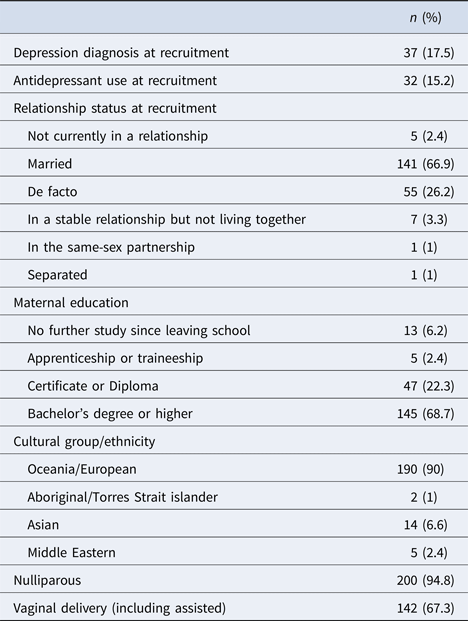
Characteristics of the sub-sample are presented in Table 1. On average, women were 31 years of age (s.d. = 4.50), ranging from 19 through 48 years of age. Most women reported their relationship status as either married or de facto (93%), had completed a post-secondary qualification (94%), identified as Oceanian or European (90%; Australian Bureau of Statistics, 2016), and were nulliparous (95%). At birth, most women had their babies via either normal or assisted vaginal delivery; the remainder delivered via cesarean section (23%).
Demographic characteristics for sample (N = 211)

Depression and sexual functioning during the perinatal period
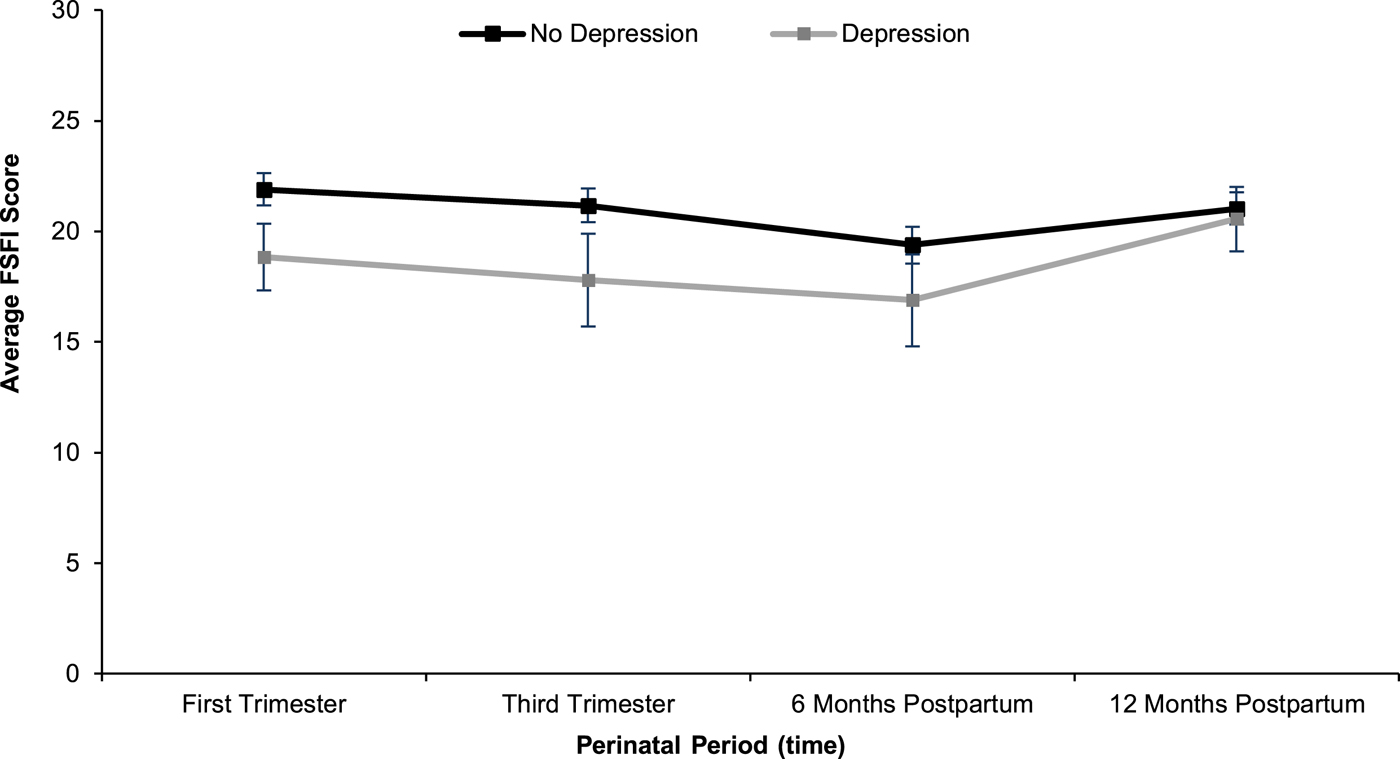
Figure 1 displays the means and 95% confidence intervals around the means for FSFI scores for depressed and non-depressed women at each Wave. The figure shows that, overall, women's FSFI scores declined from birth to 6 months postpartum, and recovered by 12 months postpartum. There were significant, small-to-large effects between average FSFI scores in early pregnancy (F (1, 199) = 12.36, p = 0.001, Hedge's g = 0.65) and third trimester (F (1, 183) = 11.65, p = 0.001, Hedge's g = 0.83), and 6 months postpartum (Welch's F (1, 44.09) = 4.80, p = 0.015, Hedge's g = 0.47). At 12 months postpartum, women in both groups reported higher FSFI scores compared with 6 months postpartum and the difference between the average scores was not significant (F (1, 181) = 0.26, p = 0.614, Hedge's g = 0.11).
Observed Female Sexual Functioning Index means and 95% confidence intervals of the mean (as error bars) during the perinatal period for the No Depression and Depressed groups.

Other covariates of female sexual functioning during the perinatal period
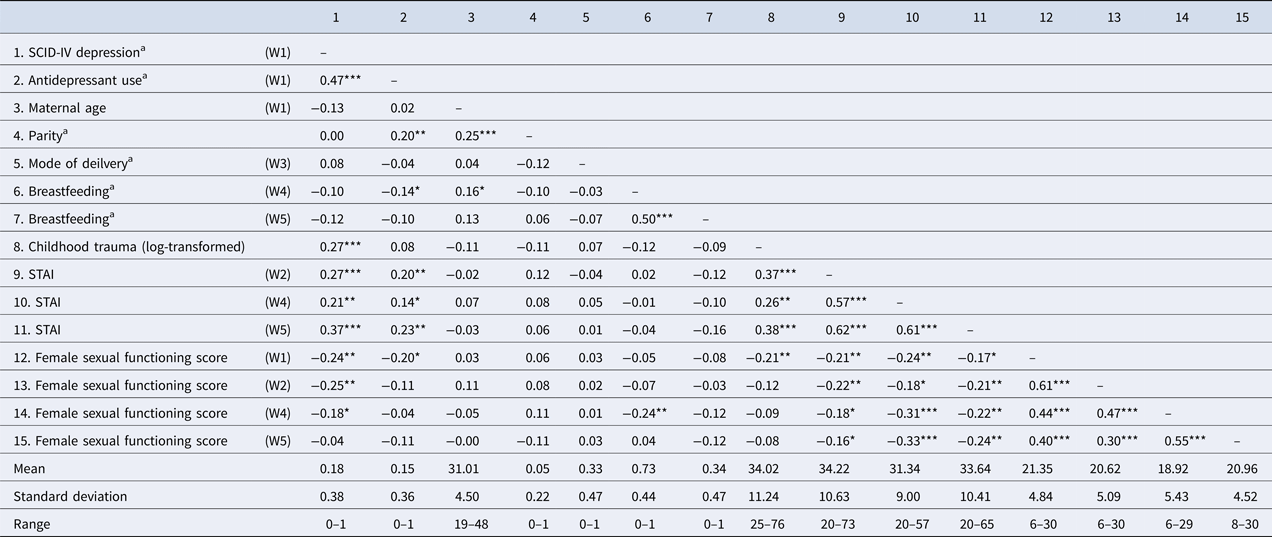
The bivariate, zero-order correlations between covariates of female sexual function and FSFI at each Wave of the study are shown in Table 2. Notably, there were no significant associations between maternal age, parity, mode of delivery, and breastfeeding at 12 months, with each of the four FSFI scores. During early pregnancy only, taking antidepressants and higher levels of childhood trauma were each associated with significantly lower FSFI scores. Also, a depression diagnosis was associated with significantly higher reports of childhood trauma. Finally, mothers who were continuing to breastfeed at 6 months reported significantly lower contemporaneous FSFI scores; however, a depression diagnosis at recruitment was not associated with breastfeeding at both 6 and 12 months postpartum. The FSFI was significantly and negatively associated with the STAI at each cross-sectional wave, such that higher state anxiety symptoms were associated with lower sexual functioning.
Descriptive statistics and zero-order bivariate correlations between female sexual functioning index scores and covariates (N = 211)

FSFI, Female Sexual Functioning Index; STAI, State-Trait Anxiety Index.
*p < 0.05; **p < 0.01; ***p < 0.001.
a Correlations with SCID-IV Depression, Antidepressant Use, Parity, Mode of Delivery and Breastfeeding represent point-biserial coefficients.
Depression and longitudinal change in perinatal female sexual functioning
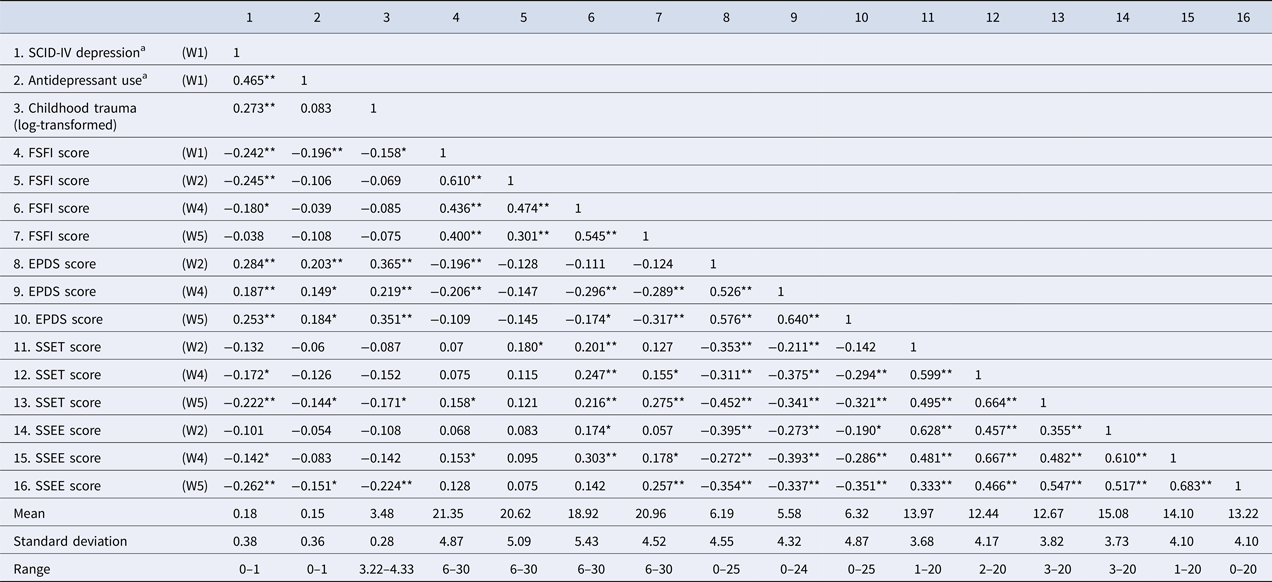
For zero-order bivariate correlations between all variables in the latent growth curve models, including univariate descriptive statistics, see Table 3. The average pattern of FSFI during the perinatal period (refer to Fig. 1) suggests a quadratic model of change would fit the data better than a linear model of change. Compared with an intercept-only model (χ2(211,8) = 66.57, p < 0.001, RMSEA = 0.19 (95% CI 0.15–0.23), SRMR = 0.16) and a linear slope model (χ2(211,5) = 50.22, p < 0.001, RMSEA = 0.21 (95% CI 0.16–0.26), SRMR = 0.11), the quadratic model of change was a better fit to the data (χ2(211, 2) = 6.95, p = 0.031, RMSEA = 0.11 (95% CI 0.03–0.20), SRMR = 0.07). The linear slope model was a significantly better fitting model than the intercept-only model (Sattora–Bentler Scaled Δχ2(Δd.f. = 3) = 14.19, p = 0.004), and the quadratic change model, with error variance in the 12 month postpartum FSFI score constrained to zero, fit significantly better than the linear slope model (Sattora–Bentler Scaled Δχ2(Δd.f. = 3) = 41.00, p < 0.001). In the quadratic model, all latent factors of change, except for linear slope variance, were significant (InterceptM = 21.48, s.e. = 0.33, p < 0.001, Interceptvar = 17.47, s.e. = 3.14, p < 0.001; LinearM = −1.69, s.e. = 0.24, p < 0.001, Linearvar = 3.95, s.e. = 2.14, p = 0.066; QuadraticM = 0.24, s.e. = 0.04, p < 0.001, Quadraticvar = 0.13, s.e. = 0.06, p = 0.037). This suggests that, on average, women in early pregnancy reported higher FSFI scores followed by an average significant decelerating reduction in functioning. However, significant variance around these growth factors suggest varying FSFI starting points and rates of change within the sample.
Descriptive statistics and zero-order bivariate correlations between all variables in the final conditional model (N = 211)

SCID-IV, Structured Clinical Interview for the DSM-IV; FSFI, Female Sexual Functioning Index; EPDS, Edinburgh Postnatal Depression Scale; SSET, Social Support Effectiveness scale, Task Support subscale; SSEE, Social Support Effectiveness scale, Emotional Support subscale.
*p < 0.05; **p < 0.01.
a Correlations with SCID-IV Depression and Antidepressant Use are point-biserial coefficients.
We built upon the unconditional model by first adding only a depression diagnosis as a time-invariant covariate to each of the three latent growth factors. This model fit the data well, (χ2(211, 3) = 7.41, p = 0.060, RMSEA = 0.08 (95% CI 0.0–0.16), SRMR = 0.05). In this model, a depression diagnosis was associated with significantly lower than average starting FSFI values (β = −0.28, s.e. = 0.07, p < 0.001); however, as depression was not predictive of the linear slope and quadratic growth factor, this model suggests that depressed women reported significantly lower starting FSFI, and remain lower over the perinatal period. When we added antidepressant use and childhood trauma as time-invariant covariates of the FSFI growth factors, the model was a poorer fit to the data (χ2(211, 7) = 21.86, p = 0.003, RMSEA = 0.10 (95% CI 0.05–0.15), SRMR = 0.06).
Other covariates of change in perinatal female sexual functioning
Childhood trauma was not related with any of the FSFI growth factors, suggesting that in the context of a depression diagnosis and antidepressant use, childhood trauma does not account for variability in the sexual functioning of women during the perinatal period. Women taking antidepressants reported similar starting values of FSFI compared with the average; however, antidepressant use was associated with a leveling of both the average negative slope and average positive quadratic latent means. This suggests that for women taking antidepressants, sexual functioning remains relatively stable across the perinatal period. Due to non-significance of childhood trauma, it was not included in subsequent modeling.
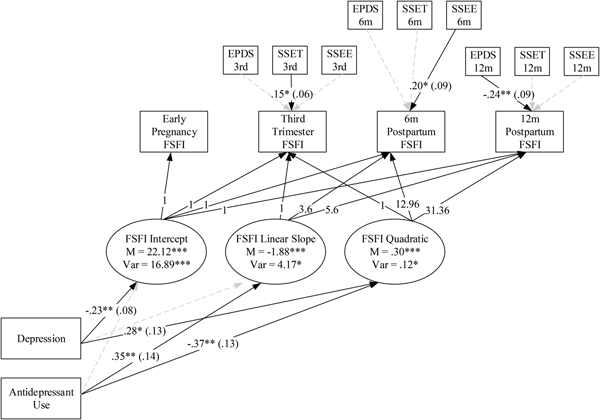
For the final model with time-varying covariates at third trimester, and 6 and 12 months postpartum, the model fit the data well (χ2(209,49) = 69.73, p = 0.027, RMSEA = 0.05 (95% CI 0.02–0.07), SRMR = 0.08). Figure 2 displays path coefficients for this final model. The pattern of significance for the time-invariant covariates, depression and antidepressant use, remained the same as previous models; this suggests that net of the time-varying effects of depressive symptoms and social support effectiveness, a depression diagnosis and antidepressant use remained a significant predictor of change in FSFI over the perinatal period. In the third trimester, only perceived task support from a partner was a significant predictor of contemporaneous female sexual functioning, such that more perceived support with tasks was associated with improved FSFI scores.
Final female sexual functioning conditional model with time-invariant and time-varying covariates during the perinatal period. Figure shows significant standardised (stdyx) regression paths and unstandardised FSFI growth factor means and variance estimates. FSFI, Female Sexual Functioning Index; EPDS, Edinburgh Postnatal Depression Scale; SSET, Social Support Effectiveness questionnaire – Task Support subscale; SSEE, Social Support Effectiveness questionnaire – Emotional Support subscale; 6 m, 6 months postpartum; 12 m, 12 months postpartum; M, Mean; Var, Variance. *p < 0.05; **p < 0.01; ***p < 0.001.

At 6 months postpartum, only perceived emotional support from a partner was a significant predictor of contemporaneous female sexual functioning, such that more perceived emotional support was associated with improved FSFI scores. By 12 months postpartum, both types of perceived support effectiveness did not significantly predict FSFI scores. However, depressive symptoms was a significant predictor of female sexual functioning, such that higher EPDS scores were associated with significantly lower FSFI scores at 12 months.
Despite the contemporaneous effects of depressive symptoms and support effectiveness, variance of the FSFI growth factors remained significant net of the time-varying covariates; this suggests that over and above the effects of depressive symptoms and perceived support effectiveness, female sexual functioning continued to vary during the perinatal period due to other variables not included in our model. Furthermore, the effect of a depression diagnosis early in pregnancy remained a significant predictor of lower FSFI starting values and change in FSFI during the perinatal period, even after controlling for antidepressant use and net of the effects of the time-varying covariates.
In order to determine any impact of anxiety symptoms, we also run the final model replacing the time-covarying EPDS scores at Wave 2, Wave 4 and Wave 5 with the state subscale of the STAI. This version of the final model was a worse fit to the data (χ2(209, 49) = 80.06, p = 0.003, RMSEA = 0.05 (95% CI 0.03–0.08), SRMR = 0.09); further, anxiety symptoms did not predict concurrent FSFI scores, including Wave 5 FSFI, which EPDS did predict in the final model reported in Fig. 2. With the STAI included, the pattern of effects of support subscales on concurrent FSFI were unchanged.
Discussion
This study reports on repeated measurement of both depression and sexual functioning across pregnancy and the postpartum. A diagnosis of a depressive disorder predicted lower female sexual functioning across the perinatal period with more women in the range of sexual dysfunction than those without a depression diagnosis. Depressive symptoms were also important, with higher than average depressive symptoms at 12 months predicting lower sexual functioning. Against prediction, antidepressants were not associated with an overall trend to lower sexual functioning across the perinatal period in this cohort. Previous studies in adult women have shown an impact from both depression and antidepressant use on domains of sexual functioning (Cooper et al., Reference Cooper, Willy, Pont and Ray2007; Bakker et al., Reference Bakker, Kolling, van den Berg, de Walle and de Jong van den Berg2008; Jimenez-Solem et al., Reference Jimenez-Solem, Andersen, Petersen, Broedbaek, Andersen, Torp-Pedersen and Poulsen2013). Our study builds on this with data to understand differences in effect on sexual functioning specifically in the perinatal period and provides reassurance for women who do require ongoing treatment for depression during the perinatal period (Cooper et al., Reference Cooper, Willy, Pont and Ray2007; Bakker et al., Reference Bakker, Kolling, van den Berg, de Walle and de Jong van den Berg2008; Jimenez-Solem et al., Reference Jimenez-Solem, Andersen, Petersen, Broedbaek, Andersen, Torp-Pedersen and Poulsen2013).
Within this study, we also attempted to account for key covariates relevant to understanding sexual functioning across pregnancy and the postpartum in women with depression. In addition to antidepressant use we also examined mode of delivery, breastfeeding, childhood trauma and partner support as variables previously associated with a women's sexual functioning but equally relevant to depression (Heim et al., Reference Heim, Newport, Mletzko, Miller and Nemeroff2008; Dias and Figueiredo, Reference Dias and Figueiredo2015; Saberi et al., Reference Saberi, Akbari, Mahmoodi and Nasiri2017; Galbally et al., Reference Galbally, Watson, Ball and Lewis2018).
For some women, the choice of mode of delivery can be influenced by perceptions of potential implications for their ongoing sexual functioning. Mode of delivery was not found to be relevant and this included cesarean section. These findings help to clarify the conflicting data on whether the mode of delivery does impact on sexual functioning (Yeniel and Petri, Reference Yeniel and Petri2014). While previously, there have been findings that cesarean section delivery may be both protective and a risk factor for poorer sexual functioning, three recent studies have shown no difference between delivery methods and sexual functioning by 6–12 months postpartum (Yeniel and Petri, Reference Yeniel and Petri2014; De Souza et al., Reference De Souza, Dwyer, Charity, Thomas, Ferreira and Schierlitz2015; Kahramanoglu et al., Reference Kahramanoglu, Baktiroglu, Hamzaoglu, Kahramanoglu, Verit and Yucel2017). Our data confirm these recent findings and can reassure women that delivery method is unlikely to have a lasting impact on their sexual function.
While breastfeeding was shown to influence woman's sexual functioning at 6 months postpartum, it was no longer relevant by 12 months postpartum. This was despite many of the women within this cohort continuing to breastfeed (Galbally et al., Reference Galbally, Watson, Ball and Lewis2018). Given the public health significance of breastfeeding, this is also a reassuring finding.
Partner support was found to be an important factor in understanding sexual functioning across the perinatal period. In particular, different types of partner support were relevant to sexual functioning at different stages of the perinatal period. In late pregnancy, partner support that took the form of assistance with tasks related most strongly to a woman's sexual functioning, but by 6 months postpartum emotional support was the stronger predictor of the woman's sexual functioning. At 12 months postpartum, both task and emotional support from the partner were important for female sexual functioning. Given the significant emotional and lifestyle upheaval that a pregnancy and new baby bring to a couple, it is not surprising that social support is an important aspect of a functioning and sexually active relationship, including aspects of sexual behavior and the enjoyment of sex. Clinical implications are that encouragement of effective social support from partners is likely to be an important protective factor for women over the perinatal period.
One of our most interesting findings was in childhood trauma, including childhood sexual abuse, which has previously been identified as a risk factor in for sexual dysfunction (DiLillo, Reference DiLillo2001). Previous studies have also found an increased likelihood of childhood trauma in women with depression (Heim et al., Reference Heim, Newport, Mletzko, Miller and Nemeroff2008). However, the role of childhood trauma has not previously been examined in the perinatal period in relation to depression and sexual dysfunction. Of note, we did find an association between childhood trauma and early pregnancy sexual functioning but this was not sustained across the perinatal period. Future research may clarify if this is relevant to the understanding of sexual functioning in the perinatal period.
Limitations of this study include unavailability of data on perineal trauma. We also did not collect any data from partners, and given fathers/partners can develop depressive symptoms in the postpartum period, this may be relevant to understanding a couple functioning at this stage of life. A further limitation is the use of the FSFI; while this is regarded as one of the most recommended measures for both its psychometrics and wide use, there are only a limited number of studies in pregnancy. Furthermore, there have been concerns about the statistical implications if women who report no sexual activity are included in the analysis. We have followed the recommendations from the literature in our final model, but have also reported on those excluded as a result (Meyer-Bahlburg and Dolezal, Reference Meyer-Bahlburg and Dolezal2007).
Conclusion
Clinical care of women across pregnancy should always include a broad psychosocial assessment and this cannot be simply the administration of a screening tool for depression such as the EPDS. Instead, clinicians are encouraged to understand the range of psychological and social factors associated with pregnancy and a new baby that may impact on a woman's life. Included in this broad assessment is the quality of her close relationships and psychosocial supports, which may also relate to her sexual functioning over the perinatal period. This data can reassure women that if they do have either a vaginal birth or a cesarean section it is unlikely to alter their sexual functioning and likewise that breastfeeding may only impact their sexual life transiently. For a woman who requires treatment with antidepressants, this also does not appear from this data to further reduce sexual functioning beyond the impact of pregnancy and the postpartum. This is reassuring for women and clinicians when making the choice to commence or continue antidepressant treatment. However, depression and ongoing symptoms of depression do reduce sexual functioning and increase the risk of sexual dysfunction and this supports clinical recommendations across many countries that highlight the importance of identification and management of perinatal depression (Howard et al., Reference Howard, Megnin-Viggars, Symington and Pilling2014).
Supplementary material
The supplementary material for this article can be found at https://doi.org/10.1017/S0033291718002040.
Acknowledgements
The authors would like to thank those who have supported the development of MPEWS including Marinus van IJzendoorn. The authors also thank staff, students and volunteers on the MPEWS study as well as study co-ordinators: Nicole Brooks and Tina Vaiano for their contribution to MPEWS. The authors are also sincerely grateful to the study participants who have contributed a substantial amount of time to participate in this study. This study is supported through the 2012 National Priority Funding Round of Beyond blue in a 3-year research grant (ID 519240) and a 2015 National Health and Medical Research Council (NHMRC) project grant for 5 years (APP1106823). Financial support has also been obtained from the Academic Research and Development Grants, Mercy Health and Centre for Mental Health and Well-Being, Deakin University.
Conflict of interest
MG has previously received an honorarium for speaking from Lundbeck. The other authors declare that they have no competing interests.
Ethical standards
Ethical approval for the project was granted by the Mercy Health Human Research Ethics Committee, Ethics Project Number: R08/22. The authors assert that all procedures contributing to this work comply with the ethical standards of the relevant national and institutional committees on human experimentation.