INTRODUCTION
Consider a situation in which an adult says to a child “Look at the blue ball”. This speaker, in choosing that particular referential description for the object of interest, is highlighting a particular perspective on the object for the listener (Clark, Reference Clark1997). That is, the speaker is conceptualizing the object as a ball of a particular colour, rather than as a toy, a ball of a particular size (e.g. a small ball), or a ball of a particular material kind (e.g. a rubber ball). When repeatedly referring to the same object, conversational partners will establish referential precedents by using the same referential description consistently (Brennan & Clark, Reference Brennan and Clark1996; Garrod & Anderson, Reference Garrod and Anderson1987). In this experiment, we examined whether four-year-olds expect speakers to use consistent referential descriptions and whether these expectations are partner-specific.
In a conversational interchange, speakers and listeners typically converge on consistent referential descriptions of objects, a phenomenon known as lexical entrainment or the establishment of a referential precedent (Brennan & Clark, Reference Brennan and Clark1996; Garrod & Anderson, Reference Garrod and Anderson1987). Research has demonstrated that conversational partners will continue to use and expect to hear the entrained expressions, even in contexts where a more minimal expression would suffice to uniquely identify the target object (Barr & Keysar, Reference Barr and Keysar2002; Brennan & Clark, Reference Brennan and Clark1996). When a speaker uses a consistent referential expression (i.e. adheres to the referential precedent), numerous studies have demonstrated that adults' comprehension is facilitated (e.g. Barr & Keysar, Reference Barr and Keysar2002; Brown-Schmidt, Reference Brown-Schmidt2009; Metzing & Brennan, Reference Metzing and Brennan2003; Shintel & Keysar, Reference Shintel and Keysar2007). In contrast, when a speaker uses a new expression to refer to an object for which a previously entrained term was used, adults are slower to identify the intended referent and often first interpret the new expression as marking a different object (Metzing & Brennan, Reference Metzing and Brennan2003). The effects of entrainment persist over a delay, with conversational partners likely to use entrained terms after delays ranging from two to five days (Markman & Makin, Reference Markman and Makin1998).
Within the adult literature, a number of accounts have been proposed to explain lexical entrainment, differing critically in their implication of the role of social–pragmatic information. At one end of this continuum of accounts, adherence to referential precedents reflects a highly collaborative pact or a type of social agreement between conversational partners regarding the particular perspective to take on an object, as indexed by a specific referring expression (Brennan & Clark, Reference Brennan and Clark1996; Brown-Schmidt, Reference Brown-Schmidt2009; Metzing & Brennan, Reference Metzing and Brennan2003; van der Wege, 2009). These specific descriptions become part of the ‘common ground’ shared by communicative partners and continued adherence to the pact reflects a commitment to cooperativeness in conversation (Brennan & Clark, Reference Brennan and Clark1996). Thus, this account draws upon the Gricean notions of cooperativeness in conversation and avoidance of obscurity of expression, as well as Clark's principle of contrast, which indicates that any change in referential expression signals a change in referential intent (Clark, Reference Clark and MacWhinney1987; 1990). At the other end of the continuum, another account proposes that continued use of a specific referential expression reflects cue-based memory mechanisms, rather than partner-specific pacts (Horton, Reference Horton2007; Shintel & Keysar, Reference Shintel and Keysar2007; 2009). On this more minimalist account, adherence to referential precedents is governed by memory representations that include episodic information, including the specific referring expression and the speaker identity. Thus, when a particular speaker is referring to an object, the speaker's identity acts as a cue aiding in the retrieval of the referring expression. Although there continues to be significant debate about the basis for the referential precedent effect, recent research indicates that adults' interpretation of a referential expression is sensitive to both the identity of a speaker and experience with a particular speaker, consistent with the notion of a conceptual pact (Brown-Schmidt, Reference Brown-Schmidt2009).
To date, only one study has examined preschoolers' expectations that conversational partners will use the same referential expression to refer to an object over time (Matthews, Lieven & Tomasello, Reference Matthews, Lieven and Tomasello2010). In this experiment, three- and five-year-olds engaged in a task that involved moving objects to different locations. During the initial naming phase, children interacted with an experimenter (E1) who established referential precedents for the objects (e.g. by using the terms car and tree to refer to particular objects). Next, either E1 or a second experimenter (E2), who was not present during the initial naming phase, first referred to one toy using the original name (e.g. car) and then referred to a different toy using a new name (e.g. bush). Examination of reaction time difference scores (RT to new name trial – original name trial) indicated that both three- and five-year-old children were slower to pick up objects when E1 used a new name versus when she used the original name. This speaker-specific effect, however, was short-lived as children were slower to react only on the first of two test trials. After the first trial, children were slower to react to a new term, regardless of conversational partner. Interestingly, some children protested the use of the new terms but did so regardless of conversational partner.
Matthews et al.'s (Reference Matthews, Lieven and Tomasello2010) findings provide suggestive evidence that young children show sensitivity to referential precedents during the preschool years, at least when these are established by the use of common, unmodified nouns. However, it would be important to know how representative these findings might be of other kinds of referring expressions; focusing on the noun may have led to either the overestimation or the underestimation of preschoolers' general sensitivity to referential pacts. That is, the switch from the original expression (i.e. tree) to a new expression (i.e. bush) signalled a shift in the fundamental identity of the object. As such, children's sensitivity to a broken precedent may have been overestimated, as this shift is so salient.
Another possibility is that children may have resisted the change in nouns regardless of the speaker, because they have expectations about the conventional use of nouns. There is evidence suggesting that children take novel nouns, for instance, to reflect conventional labels shared by a community of speakers, rather than reflecting idiosyncratic naming choices by a particular speaker (Diesendruck & Markson, 2001). In the study by Matthews et al., children may have taken the original expression (tree) to be that object's conventional name, and hence shared by a community of speakers. They may then have been surprised when either speaker departed from this convention upon using the new expression (bush). However, such constraining expectations regarding conventionality would be less pertinent when it comes to expectations about whether a speaker would use an adjectival modifier (tall tree), for example, or which particular modifier to use (tall tree versus pretty tree).
In this study, we pursued the examination of the developmental emergence of referential precedents. Here, we focus on expectations about consistency in modified noun phrases as these descriptions provide a more nuanced test of the factors underlying referential pacts. For example, a change in the use of an established phrase (e.g. from the spotted dog to the fluffy dog) does not signal a change in identity – as might occur with a switch in a common noun – but rather a change in the particular dimension of the object that is being highlighted by the speaker. Our experiment focused on the following questions: (1) Do four-year-olds establish referential pacts with conversational partners? (2) Are these pacts partner-specific or do they reflect a general expectation that the same term will always be used to refer to the same object?
We evaluated preschoolers' expectations about referential consistency using an eye-tracking paradigm to measure unconscious aspects of referential interpretation as speech unfolded in time (e.g. Tanenhaus, Spivey-Knowlton, Eberhard & Sedivy, Reference Tanenhaus, Spivey-Knowlton, Eberhard and Sedivy1995). Studies have demonstrated that eye-movement measures can reflect sensitivity to cues that may not be captured by children's final behavioural decisions (e.g. Fernald, Zangl, Portillo & Marchman, Reference Fernald, Zangl, Portillo, Marchman, Sekerina, Fernandez and Clahsen2008; Trueswell, Sekerina, Hill & Logrip, Reference Trueswell, Sekerina, Hill and Logrip1999; Snedeker & Trueswell, Reference Snedeker and Trueswell2004). In our experiment, we measured both implicit (i.e. eye-gaze) as well as explicit (i.e. pointing) behaviours in order to capture both the ongoing comprehension process as well as the outcome of children's referential decisions.
Four-year-olds were presented with arrays of objects on a computer screen in one of our between-subjects conditions. Across a number of training trials, Experimenter 1 (E1) used a target expression to identify one object (i.e. “Look at the spotted dog” to identify a dog that is both spotted and fluffy). Following this training phase, either E1 or a new conversational partner who was not present during the training phase (E2) presented children with test trials. During these test trials, the target objects were referred to using either the original expression (e.g. “the spotted dog”) or a new expression (e.g. “the fluffy dog”). If four-year-olds establish referential pacts, they should be significantly slower to locate the target object when E1 uses a new expression versus when E1 uses the original expression to refer to the target object. Moreover, if these pacts are partner-specific, the disadvantage of using a new term to refer to the target object should be much less pronounced when it is produced by a new conversational partner (E2) versus when it is produced by the original partner (E1).
METHOD
Participants
The final sample included seventy-two four-year-old children (34 males, 38 females; M = 4·66 years, SD = 0·24 years; 4·13 to 5·15 years). Children were randomly assigned to one of four between-subjects conditions (n = 18 per condition): Same speaker–original expression (M = 4·27 years, SD = 0·21); same speaker–new expression (M = 4·15 years, SD = 0·25); different speaker–original expression (M = 4·13 years, SD = 0·27); and different speaker–new expression (M = 4·30 years, SD = 0·22). An additional forty-nine children were tested, but were excluded for the following reasons: inattentive/fussy (n = 8), insufficient eye-tracking data during the critical trials, either due to failure to complete the test trials or failure to capture sufficient eye-gaze data due to movement (n = 41; see ‘Coding’ section for more details). Children were primarily Caucasian, from a large western city in Canada, from socioeconomic backgrounds that varied broadly within the more general middle class (although the latter was not formally assessed), and from homes in which English was the primary language spoken. A one-way analysis of variance (ANOVA) indicated that the there were no significant differences in children's mean age across conditions (p > 0·70).
Stimuli
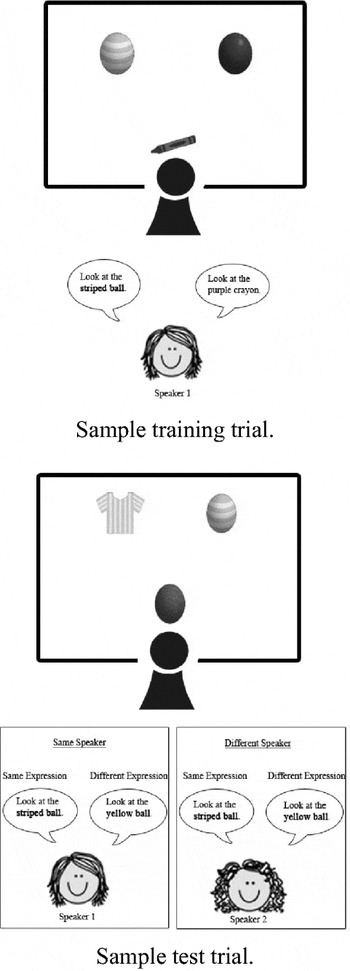
Each trial consisted of a visual display paired with a corresponding auditory instruction set spoken by a live speaker. Visual displays consisted of sixteen different picture arrays; four practice arrays, nine training arrays, and three test arrays. Each array contained three pictures, arranged within the array such that each image was equidistant from a middle fixed point. The training and test arrays contained a target object and two other objects. Target objects were characterized by two salient visual properties (e.g. a ball that is both striped and yellow), and could be described by adjectives that referred to either one of the two properties (i.e. “the striped ball” or “the yellow ball”; see Figure 1 for a sample array). The target adjectives and objects were as follows: spotted/fluffy dog; striped/yellow ball; square/fancy candle. To ensure that both adjectives were representative of the target images, a separate group of four-year-olds (n = 8) who did not participate in the present study was asked to identify the target objects from the arrays. Regardless of the adjective used (e.g. “Show me the striped ball” vs. “Show me the yellow ball”), all children correctly selected the target objects.
Example training and test trials.

The practice arrays consisted of three familiar objects (e.g. car, key, chair). The training arrays consisted of a target object (e.g. striped yellow ball) and two filler objects that either: (a) shared a property with the target (e.g. striped blue box); (b) were of the same kind as the target object (e.g. purple ball); or (c) were of the same superordinate category (e.g. toy). See Figure 1 for a sample array. Test arrays consisted of a target object (e.g. striped yellow ball), a competitor object with the same properties as the target object (e.g. striped yellow shirt), and a filler object of the same kind as the target that did not share its salient properties (e.g. green spotted ball). Three versions of each test array were created so that the target, competitor, and filler objects in a given array appeared in each potential location (top left corner, top right corner, bottom centre of the array). Participants saw only one variation of each test array.
The arrays were accompanied by instructions read from a script by a female experimenter. All instructions referred to an object present within the array (e.g. “Look at the X. Point to the X.”). The instructions paired with the practice trials referred to the objects using a simple noun phrase (e.g. “Look at the lion. Point to the lion.”). The instructions paired with the training and test arrays referred to the objects using a modified noun phrase (e.g. “Look at the purple ball. Point to the purple ball.”). For the target objects, the modified noun phrases always contained an adjective that described the object by one of its salient properties (e.g. “Look at the striped ball. Point to the striped ball.”).
Apparatus
A Tobii x50 eye-tracker, mounted on the same table as the computer monitor and positioned 40 cm away from the screen, was used to record children's eye-movements. These eye-movements were recorded in relation to specific areas of interest (AOIs) within each array, which were defined prior to data collection. The AOIs were positioned directly over each of the three objects, thus providing a highly conservative measure of children's eye-gaze direction. During testing, the number and duration of participants' fixations on the AOIs were recorded. Gaze data were logged by the recording software every 20 ms and a fixation was counted if the child gazed at the same image for more than 95 ms. The time point at which each fixation started was also recorded. Gaze position was tracked with accuracy of between 0·5–0·7 degrees within ±35 degrees of visual angle, at a rate of 50 Hz. A Sony HDR-SR8 video camera system positioned behind the child was used to record children's behaviour during the task.
Procedure
Experimenter 1 (E1) brought the child into the testing room and seated them on a small chair approximately 1·4 m away from a 46-inch computer monitor. Children's eye-movements were first calibrated to the eye-tracker using Clearview 2.7.0 software. Only the data from those children who showed accurate calibration on three out of five test fixation points were included, although for most children calibration was perfect.
Following calibration, children were presented with three practice trials during which E1 instructed them to look at and point to an object within the array (e.g. “Look at the fish. Point to the fish.”). After the children pointed, E1 pressed the ‘SPACE’ key on a keyboard to advance to the next trial. All children saw the same three practice arrays paired with the same three instruction sets. The practice trials were included to familiarize children the nature of the task. Before initiating the training trials, E1 reminded the children to sit still and to lower their hands after pointing.
Children were then presented with the training trials, which were identical across all four conditions. See Figure 1 for a sample training trial. For each of the three target objects, children saw three different training arrays. Each training array was presented twice; once paired with an instruction set that referred to the target object using the target expression (e.g. “the striped ball”), and once paired with an instruction set that referred to a different object in the array (e.g. “the purple ball”). This was done in order to diminish the expectation that the target object would always be the intended referent of the experimenter's instruction. Thus, children heard each target expression three times and saw a total of six training trials per target, yielding eighteen training trials in total. The location of the target object was counterbalanced between trials and the order of the training trials was randomized across participants, with the provision that no more than two trials containing the same target object were presented consecutively.
Following the training trials, E1 told the child that she (E1) had to leave the room. Here the procedure diverged across the four between-subjects conditions. In the same speaker conditions, E1 said, “You stay right here, I have to do something. I will be right back and I will ask you some more questions.” After 15 seconds, she returned and administered the three test trials. In the different speaker conditions, E1 said, “You stay right here, I have to do something. Someone new will come in and ask you some more questions.” After 15 seconds, a new experimenter (E2) entered the testing room and administered the three test trials. The experimenter (i.e. E1 in the same speaker conditions and E2 in the different speaker conditions) first administered a practice trial in order to re-familiarize children with the task, then proceeded with the test trials. See Figure 1 for a sample test trial. In the original expression conditions, the experimenter used the original modified noun phrase to refer to the target object (e.g. “Look at the striped ball. Point to the striped ball.”). In the new expression conditions, the experimenter used a new modified noun phrase that contained an adjective referring to the target object's other salient visual property (e.g. “Look at the yellow ball. Point to the yellow ball.”).
There was one test trial for each of the three target objects, yielding three test trials in total (see Figure 1 for a sample test array and accompanying test instructions). The order in which the test trials were administered was counterbalanced across children. Total testing time was approximately 7·2 minutes including the calibration and the running of the experiment. Following the completion of the task, parents were debriefed about the expected results of the study.
Coding
First, the eye-gaze data were scrutinized to ensure accuracy of the eye-tracker readings, using TET Server validity codes, which are provided for each eye, with every gaze data point. Recall we used highly conservative AOIs that were positioned directly over each of the three objects – thus, children had to be looking directly at the objects for their eye-movements to be registered. As a result, fixations that were ever so slightly offset from the AOI were excluded, possibly contributing to the high attrition rate. Second, the number and duration of fixations on the AOIs were unpacked to show where children were looking at each 20 ms interval. Third, the timing of eye-movements was matched to information in the speech stream. To do this, videos of the test trials were analyzed on a frame-by-frame basis (1 s = 30 frames) using FinalCut Pro 5.0.4 software, with audio and video signals fully synchronized. The start and end of each trial, as well as the onset and offset of each word were recorded. The start of the trial, as determined by the video, was then matched with the start of the trial within the eye-tracker data file for each participant. The onset and offset of each word within the test sentences, as determined by the duration of time between the onset of the trial and when the words occurred, was then marked within the participant's eye-tracker file. These individual markers to identify the start and end of each analysis interval are described below.
RESULTS
Pointing analyses
Children's pointing behaviour was coded as a measure of their explicit ability to identify the target referent after the entire sentence was heard. A trained research assistant coded all of the child's points from the videotapes while unaware of the specific trial being presented. A second assistant recoded 20% of the data (n = 15) to establish inter-rater reliability. Inter-rater reliability was high (Kappa = 0·76; p < 0·001).
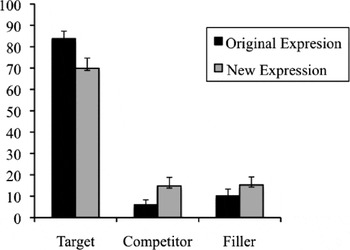
The percentage of points to the target object across trials was used as the dependent measure and these data were submitted to a 2 (Speaker) × 2 (Expression) ANOVA. This analysis yielded a significant main effect of expression (F(1, 68) = 5·8, ηp2 = 0·08, p = 0·02). The main effect of speaker and the speaker by expression interaction were not significant (ps >0·15). Figure 2 presents the percentage of points to target, competitor, and filler by expression. Children were more accurate in identifying the target referent when the original expression was used versus when a new expression was used, regardless of speaker. Comparisons to chance-level responding, using one-sample t-tests indicated that the percentage of points was greater than chance-levels in each condition (ps <0·0001), indicating that children understood the task well.
Percentage points to the target by condition.

In summary, the pointing data suggest children were sensitive to consistency in expression, but this sensitivity did not vary by speaker. It is possible, however, that implicit on-line measures of comprehension may capture sensitivities that are not reflected in off-line referential decisions.
Eye-movement analyses
The inclusion of eye-movement measures allowed us to assess how children's referential decisions unfolded across the utterance. As such, our analyses focus on the fixations that children made over the utterance, as they interpreted the referential expression. We identified four critical periods for the purpose of analysis: the pre-adjective region, the adjective region, the noun region, and the post-noun region.
First, the pre-adjective region was identified as the 200 ms following the onset of the utterance (i.e. “Look at the …” and ending 200 ms following the onset of the adjective (the 200 ms margin following the adjective onset accounts for the typical lag in eye-movements that accompanies unfolding linguistic information in this experimental paradigm). This region was used as a baseline to examine whether children exhibited any preferences for the target object, prior to the critical adjective. The average duration for this region was 602·94 ms (SD = 139·00.). The duration of this region did vary as a function of expression (F(1, 68) = 4·62, ηp2 = 0·06, p = 0·04). The mean duration of the pre-adjective interval was significantly longer when a new expression was used (M = 637·76 ms, SD = 124·99) than when the original expression was used (M = 568·14 ms, SD = 145·19).
Second, the adjective region was identified as 200 ms following the onset of the adjective and ending 200 ms following the offset of the adjective. Eye-movements within this interval reveal whether children begin to locate the target referent during the pronunciation of the critical adjective, in advance of hearing the referring noun. The average duration for this region was 578·07 ms (SD = 98·62). The duration of this region did vary as a function of expression (F(1, 68) = 14·64, ηp2 = 0·18, p = 0·001). The mean duration of the adjective interval was significantly longer when an original expression was used (M = 619·12 ms, SD = 104·01) than when the new expression was used (M = 537·04 ms, SD = 73·81).
Third, the noun region was identified as 200 ms following the onset of the noun and ending 200 ms following the offset of the noun. This region captured fixations initiated during the pronunciation of the disambiguating noun. The average duration for this region was 589·91 ms (SD = 69·30) and it did not vary significantly as a function of speaker or expression (ps >0·45). The final region, the postnoun region, began 200 ms after the offset of the noun and continued for a period of 700 ms for all groups. Fixations during the postnoun interval reveal children's final referential decisions.
Note that even though there were differences in the duration of the original versus the new pre-adjective regions and adjective regions, these differences did not impact the analyses described below. Recall that we recorded the onset and offset of each word for each participant and used those individual markers to identify the start and end of each analysis interval. Moreover, such differences are not unexpected in naturally produced speech.
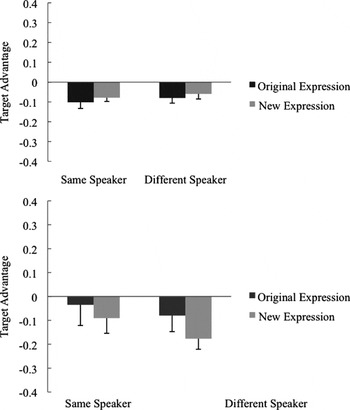
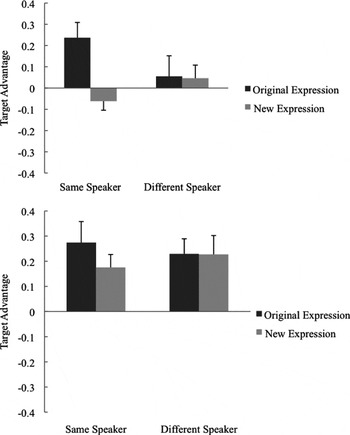
To provide a single measure of children's looking behaviours during each region, we used a target advantage score reflecting the relative tendency to fixate on the target referent over the competitor object (i.e. the other object in the display that could be described with the critical adjective) within the depicted speech interval. This was achieved by calculating a difference score (i.e. the probability of fixating the target referent minus the probability of fixating the competitor) for each participant and each condition, within the depicted time interval. Target advantage scores for each region were analysed using a series of planned 2 (Speaker: Same vs. Different) × 2 (Expression: Original vs. New) between-subjects ANOVAs. Target time advantage scores for each region are presented in Figures 3 and 4.
Target advantage during the early region (top panel) and adjective region (bottom panel).

Target advantage during the noun region (top panel) and postnoun region (bottom panel).

Analysis of the target advantage scores for the pre-adjective region indicated no significant effects of speaker or expression (all ps >0·39). This pattern of results was expected in that there was no information available to assist children in identifying the target referent at this stage in the utterance. Analysis of target advantage scores for the adjective region similarly revealed no significant effects of speaker or expression (all values for p > 0·26). Thus, children's preference for the target referent over the competitor did not vary as a function of expression or speaker as the adjective unfolded.
The predicted effects of speaker and expression become evident during the noun region (see Figure 4, top panel). Analyses here indicated a significant main effect of expression (F(1, 68) = 4·71, ηp2 = 0·07, p = 0·03), which was qualified by a significant speaker by expression interaction (F(1, 68) = 4·18, ηp2 = 0·06, p = 0·04). This interaction was due to higher target advantage scores for the same speaker when the original expression was used versus when a new expression was used (t(34) = 3·57, p = 0·001). There was no effect of expression with the different speaker (p > 0·93).
The referential advantage for the same speaker/original expression group disappeared in the region following the noun. Analysis revealed no significant effects of speaker or expression (all ps >0·46). As can be seen in Figure 4 (bottom panel), children in all four groups displayed a clear preference for the target over the competitor, reflecting their attention to the disambiguating noun.
DISCUSSION
We investigated preschoolers' expectations that speakers would adhere to referential pacts. When either the original conversational partner or a new conversational partner used the original referential expression, preschoolers were more accurate at pointing at the target object than when a new referential expression was used. Thus, findings from this measure of explicit behaviour are consistent with an expectation that consistent expressions will be used to refer to objects.
Our results, however, revealed a dissociation between preschoolers' explicit judgements and more implicit measures of sensitivity to referential precedents, namely eye-gaze measures. Here, analyses revealed a distinct referential advantage for the original expression during the noun region in the same speaker/original expression group. That is, preschoolers more quickly located the target object when the same speaker used the original expression versus when that speaker used a new expression. In contrast, there was no difference in how quickly children located the target object when the different speaker used either the original or a new referential expression. The partner-specific referential advantage for the original expression appeared as the noun unfolded. That is, it was not evident during the earliest stages of the utterance nor during the critical adjective. This contrasts somewhat with research with adults where partner-specific referential precedent effects appear during the critical adjective (e.g. Brown-Schmidt, Reference Brown-Schmidt2009). This may be due to the fact that children's processing may not be as incremental or quick as that of adults (Fernald, Thorpe & Marchman, 2010).
These results are consistent with studies with adults and preschoolers that find that referential precedents are partner-specific (Matthews et al., Reference Matthews, Lieven and Tomasello2010; Metzing & Brennan, Reference Metzing and Brennan2003). In particular, our findings extend those of Matthews et al. in a number of critical ways. First, our findings demonstrate that four-year-olds adhere to referential precedents in a task that is somewhat less collaborative in nature (i.e. children were not picking up and moving objects around as they were in the Matthews et al. study). Second, and more importantly, our findings specify when, during the utterance, partner-specific advantages for maintaining referential precedents emerge. Furthermore, our findings indicate that four-year-olds expect conversational partners to maintain referential precedents even when using modified expressions. Recall that Matthews et al. used simple unmodified nouns (i.e. car/truck) as the target referential expressions in their study. In contrast, we used modified expressions that reflect attention to a particular perspective on an object (i.e. the spotted dog) rather than the object's category membership per se. That children expected partners to maintain the referential perspective for this type of expression underscores the notion that these expectations about consistency are not simply about registering the speaker's beliefs about the identity of the object or its conventional label. Rather, the expectations extend to situations in which the speaker has chosen a particular referring expression from among a number of very plausible ways of describing the same object.
Recall that children's pointing (explicit measures) indicated a preference for the original expression, regardless of speaker, while eye-gaze (implicit measures) indicated a sensitivity to partner-specific preferences for the original expression. This finding of a dissociation between preschoolers' explicit judgements and more implicit measures of sensitivity to partner-specific referential precedents is consistent with research demonstrating that many developing abilities can be reliably identified earlier in development through implicit, rather than explicit methods, including communicative perspective taking (Nilsen, Graham, Smith & Chambers Reference Nilsen, Graham, Smith and Chambers2008; Nilsen & Graham, Reference Nilsen and Graham2009), sensitivity to vocal affect (Berman, Chambers & Graham, Reference Berman, Chambers and Graham2010), spatial ambiguity (Plumert, Reference Plumert1996), and problem-solving strategies (Siegler, Reference Siegler2000).
Finally, our findings provide novel evidence regarding Clark's principle of contrast. According to Clark (Reference Clark1988, Reference Clark1990), young children draw upon a principle of contrast when learning new words. According to this principle, children assume that different word forms contrast in meaning and thus, any difference in form signals a difference in meaning. To date, much of the research examining the principle of contrast has focused on changes in names (e.g. Diesendruck, Reference Diesendruck2005). Our study demonstrates that once a speaker has established reference to a particular object using a specific modified expression, any deviation from that expression signals a change in meaning.
In summary, our results demonstrate that four-year-olds, like adults, expect communicative partners to maintain referential consistency. These results, however, do not clearly signal whether these expectations reflect a collaborative agreement regarding the particular perspective to take on an object or a more general memory-based expectation that a particular speaker will use the same expression. One way to dissociate these explanations is to see whether expectations of referential consistency diminish if the speaker behaves anomalously by failing to adhere to typical conversational principles. If referential pacts reflect a memory-based mechanism for preschoolers, then this effect should not vary according to the speaker's pragmatic conventionality. If, however, referential pacts mark a more pragmatically based agreement, then the referential precedent effect should be moderated by the conventionality of the speaker.