INTRODUCTION
Organizational slack is one of the most important concepts in organizational theory because of its impact on organizational phenomena such as efficiency, conflicts, and innovation (Cyert & March, Reference Cyert and March1963; Nohria & Gulati, Reference Nohria and Gulati1996). The direct influence of slack on firm performance has also drawn the attention of many researchers in recent years. However, the results of these studies have been mixed. Some scholars have characterized organizational slack as a facilitator of interorganizational cooperation, increasing innovation, and buffering against external shocks (Cyert & March, Reference Cyert and March1963; Bradley, Shepherd, & Wiklund, Reference Bradley, Shepherd and Wiklund2011), which lead to better firm performance. Others have found slack to be a drag on performance because it can breed inefficiency and inhibit firms’ risk-taking behavior (Marlin & Geiger, Reference Marlin and Geiger2015). Some empirical studies have reconciled the above viewpoints by introducing a squared term that depicts the relationship between organizational slack and firm performance as being curvilinear (Tan & Peng, Reference Tan and Peng2003; Bradley, Shepherd, & Wiklund, Reference Bradley, Shepherd and Wiklund2011). Given these inconsistent conclusions, further conceptual and empirical study is necessary to explore the slack–performance relationship (Tan & Peng, Reference Tan and Peng2003).
Slack resources provide discretionary funding for a firm to pursue new projects, improve process, and develop new markets. How to use these resources effectively depends on firms’ strategic decisions. Strategic planning involves strategically important organizational decision-making processes that are vital to firm growth and performance (Simon, Reference Simon1993). Strategic planning enables a firm to increase new product development activities and crystallizes those ideas into the firm’s organizational intelligence (Nonaka, Reference Nonaka1994), thereby leading to enhanced firm performance. In contrast, some scholars argue that improvisation, or an experiential approach that lacks formal planning, may be better for firms pursuing new projects because it motivates the impromptu acquisition and application of knowledge and intelligence that are tangential to norms, rules, and regulations (Miner, Bassoff, & Moorman, Reference Miner, Bassoff and Moorman2001). From this perspective, strategic planning represents an inertial force that may impede the effective use of slack resources. Although numerous studies have considered how organizational slack and strategic planning influence firm performance, little is known about the interaction between slack and strategic planning. To fill this gap, we developed and tested a model that explores the effects of organizational slack on firm performance under different levels of strategic planning.
Based on the extant literature, we hypothesized that strategic planning moderates the relationship between organizational slack and firm performance. We empirically tested this hypothesis by using data from 183 US firms and employing hierarchical moderated regression models to examine the interaction effects. This study makes several contributions to the literature. First, it underlines the importance of taking strategic planning into account when exploring the impact of organizational slack on firm performance. In particular, we address the question of whether strategic planning can help firms transform slack resources into better firm performance. Second, we find that there is a complementary interaction effect between slack and strategic planning on firm performance, represented by different curves depending on the level of strategic planning. At low levels of strategic planning, organizational slack is positively associated with firm performance, but this linear result has a relatively low slope. At high levels of strategic planning, firm performance increases quickly as organizational slack increases from a very low level, then the slope decreases and finally becomes negative at high levels of organizational slack, representing an inverse U-shaped relationship. These findings provide a richer understanding of the impact of organizational slack on firm performance and further develop the behavioral theory of the firm. Finally, we obtained some interesting results indicating that firms with abundant slack resources can utilize strategic planning to offset the negative effects of excessive slack and allocate slack resources to achieve better performance but that firms with few slack resources may find improvised rather than planned activities are more conducive to higher performance.
This paper is organized as follows. We first provide the theoretical background and present our hypothesis with supporting arguments. We then describe the methodology we employed, including study measures, data collection, and data analysis, and follow up with the results of hypothesis testing. Finally, we discuss the contributions and practical implications of our findings, address the study’s limitations, and suggest avenues for future research.
THEORETICAL BACKGROUND AND HYPOTHESIS
Organizational slack
Scholars have proposed many different definitions for organizational slack. Cyert and March (Reference Cyert and March1963) defined slack as ‘the difference between total resources and the total necessary payments.’ Slack is also regarded as resources that firms are allowed to discretionarily use to encounter threats and exploit opportunities (Daniel, Lohrke, Fornaciari, & Turner, Reference Daniel, Lohrke, Fornaciari and Turner2004). As the literature has expanded and evolved, the general concept of slack has been refined into different types, such as absorbed and unabsorbed (Singh, Reference Singh1986); immediate and deferred (Finkelstein & Hambrick, Reference Finkelstein and Hambrick1990); and available, recoverable, and potential (Bromiley, Reference Bromiley1991). For this study, we adopt the viewpoint of Nohria and Gulati (Reference Nohria and Gulati1996) and Atuahene-Gima (Reference Atuahene-Gima2005) that organizational slack refers to firms’ excess resources that are available to exploit existing competencies, build new ones, and develop innovations.
There are many arguments about the slack–performance relationship. Some scholars hold that slack is positively linked to performance. They consider slack as resources that provide a buffer against threats and disruptions and facilitate proactive strategic choices so firms can survive and grow (Daniel et al., Reference Daniel, Lohrke, Fornaciari and Turner2004; Azadegan, Patel, & Parida, Reference Azadegan, Patel and Parida2013). Slack also allows firms to pursue innovation projects and research into new products and markets, which are beneficial in fostering an atmosphere of experimentation and innovation (Tan & Peng, Reference Tan and Peng2003; Yang, Wang, & Cheng, Reference Yang, Wang and Cheng2009; Lu & Fang, Reference Lu and Fang2013; Wang, Choi, Wan, & Dong, Reference Wang, Choi, Wan and Dong2016). But some scholars have argued that slack resources, like idle hands, result in inefficacy demons (Daniel et al., Reference Daniel, Lohrke, Fornaciari and Turner2004). Slack can insulate a firm from exogenous shocks, engendering managerial complacency or irrational optimism, which can harm performance (George, Reference George2005). Slack may also encourage managers to pursue their personal goals (e.g., power, prestige) rather than focus on economic considerations, resulting in agency problems that can impede firm performance (Yang, Wang, & Cheng, Reference Yang, Wang and Cheng2009).
Other research has advanced the discourse on organizational slack and reconciled these conflicting viewpoints by proposing that the relationship between slack and performance is curvilinear. Bromiley (Reference Bromiley1991) suggested that the slack–performance relationship is U shaped, that is, too little and too much slack benefit performance, but moderate slack hinders performance. However, there is little support for this view. Instead, Nohria and Gulati (Reference Nohria and Gulati1996) and Tan and Peng (Reference Tan and Peng2003) demonstrated an inverse U-shaped relationship between slack and innovation performance, indicating that too little and too much slack are detrimental to performance, but moderate slack is beneficial. This finding is also empirically supported by the work of Yang, Wang, and Cheng (Reference Yang, Wang and Cheng2009) and Bradley, Shepherd, and Wiklund (Reference Bradley, Shepherd and Wiklund2011). Given the mixed findings about the relationship between slack and firm performance, additional study is needed to further explore this relationship and consider other influencing factors (Bradley, Shepherd, & Wiklund, Reference Bradley, Shepherd and Wiklund2011; Azadegan, Patel, & Parida, Reference Azadegan, Patel and Parida2013).
Strategic planning, organizational slack, and firm performance
Strategic planning is defined as a formal, administrative process that calls for explicit procedures to determine specific, long-range objectives and generate alternative strategies and that requires both strict implementation and a system to monitor results (Armstrong, Reference Armstrong1982). Many studies suggest that when firms take certain planning steps in advance, their product development cycles are faster (Griffin, Reference Griffin1997), failure rates are lower (Montoya-Weiss & Calantone, Reference Montoya-Weiss and Calantone1994), innovation levels are higher (Moorman & Miner, Reference Moorman and Miner1998), and firm performance is better (Song & Parry, Reference Song and Parry1997). Strategic planning can provide a clear vision and resolve organizational conflicts (Brown & Eisenhardt, Reference Brown and Eisenhardt1995; O’ Shannassy, Reference O’ Shannassy2016). Common visions and values can help employees achieve better performance (Wolf & Floyd, Reference Wolf and Floyd2013). In addition, a carefully designed, formal plan provides details and tactics that ensure the successful implementation of the innovation strategy, which also enhances firm performance (Moorman & Miner, Reference Moorman and Miner1998).
However, some scholars have argued that strategic planning promotes a culture of inertia and rigidity within which creative ideas are often rejected (Miller & Cardinal, Reference Miller and Cardinal1994). Proponents of the rigidity hypothesis maintain that a plan channels attention and behavior to an unacceptable degree, driving out important innovations that are not part of the plan. Given that the future parameters of even relatively stable industries are difficult to predict, these theorists consider any reduction in creative thinking and action to be dysfunctional (Mintzberg, Reference Mintzberg1990). Some recent studies have also confirmed that strategic planning negatively affects innovative activity (Song, Im, Bij, & Song Reference Song, Im, Bij and Song2011; Arend, Zhao, Song, & Im, Reference Arend, Zhao, Song and Im2017). From this viewpoint, strategic planning may harm firm performance by inhibiting innovation.
Despite the debate about its impact, we regard strategic planning as a complex and enabling managerial tool that can help firms achieve better performance (Arend et al., Reference Arend, Zhao, Song and Im2017). And although there are mixed assertions about the influence of slack on firm perofrmance, we are persuaded by work that draws from both organizational theory and agency theory that finds an inverse U-shaped relationship between organizational slack and firm performance (Tan & Peng, Reference Tan and Peng2003; Yang, Wang, & Cheng, Reference Yang, Wang and Cheng2009; Bradley, Shepherd, & Wiklund, Reference Bradley, Shepherd and Wiklund2011). Specifically, following Haans, Pieters, and He (Reference Haans, Pieters and He2015), we theorize that organizational theory explains the latent function representing the benefit curve and agency theory explains the cost curve function; these two functions combine additively to depict an inverted U-shaped relationship between organizational slack and firm performance. But what impact does strategic planning have on this relationship? Even though many studies show that strategic planning and organization slack each have a strong influence on firm performance, we know little about how these factors interact with each other. We develop our hypothesis by considering how strategic planning will influence the two latent mechanisms underlying this slack–performance relationship.
Organizational theory posits that a low level of organizational slack is positively related to firm performance (Tan & Peng, Reference Tan and Peng2003). Firms can deploy slack resources to explore new opportunities and develop new products, which can lead to enhanced performance. At the same time, agency problems are not salient because a relatively low level of slack leaves few extra resources for managers to abuse. Under these conditions, a high level of strategic planning can help firms translate new opportunities into increased firm performance by providing details and tactics (Moorman & Miner, Reference Moorman and Miner1998). Strategic planning also enables firms to exploit slack resources more efficiently because it effectively controls and implements actions (Menon, Bharadwaj, Adidam, & Edison, Reference Menon, Bharadwaj, Adidam and Edison1999) and leads to more rationality in decision processes (Salomo, Weise, & Gemünden, Reference Salomo, Weise and Gemünden2007). The increased success rate (Montoya-Weiss & Calantone, Reference Montoya-Weiss and Calantone1994) can offset any damper strategic planning may put on firms’ innovativeness (Miller & Cardinal, Reference Miller and Cardinal1994). Indeed, some studies have shown that although strategic planning negatively affects innovative activity, it positively affects profitability for average firms (Benner & Tushman, Reference Benner and Tushman2002; Jansen, Van Den Bosch, & Volberda, Reference Jansen, Van Den Bosch and Volberda2006; Song et al., Reference Song, Im, Bij and Song2011; Arend et al., Reference Arend, Zhao, Song and Im2017). In other words, the benefit curve of the slack–performance relationship can be steeper when there is a higher level of strategic planning. Thus, we propose that at low levels of organizational slack, the positive relationship between organizational slack and firm performance is, in general, stronger for firms with higher levels of strategic planning.
Agency theory views the firm as a nexus of contracts between principals and agents (Jensen & Meckling, Reference Jensen and Meckling1976). From this perspective, a high level of organizational slack is negatively related to firm performance (Tan & Peng, Reference Tan and Peng2003). Managers (agents) have their own personal goals, such as power, prestige, and money, which are not always aligned with those of their firms (principals). Managers may deploy slack resources to engage in excessive diversification, empire building, and on-the-job shirking (Arthurs, Hoskisson, Busenitz, & Johnson, Reference Arthurs, Hoskisson, Busenitz and Johnson2008; Latham & Braun, Reference Latham and Braun2009; Harrison & Coombs, Reference Harrison and Coombs2012) that can increase costs and cause losses for the firm. These kinds of agency problems can breed inefficiency and impair firm performance. The cost of agency problems may outweigh the benefit of the exploration and innovation enabled by organizational slack. But such problems may be alleviated by a high level of strategic planning, which calls for explicit procedures for determining specific, long-range objectives; generating alternative strategies; and requiring both strict implementation and a system for monitoring results (Armstrong, Reference Armstrong1982). Such procedures will force managers to act more rationally when they make decisions (O’Shannassy, Reference O’ Shannassy2010) and leave little room for managers to abuse organizational slack. In other words, the cost curve of the slack–performance relationship can be flatter when there is a higher level of strategic planning. Thus, we propose that at high levels of organizational slack, the negative relationship between slack and firm performance is, in general, weaker for firms with higher levels of strategic planning. We therefore hypothesize:
Hypothesis: Strategic planning moderates the relationship between organizational slack and firm performance: At low levels of organizational slack, the positive relationship between organizational slack and firm performance is, in general, stronger for firms with higher levels of strategic planning. At high levels of organizational slack, the negative relationship between organizational slack and firm performance is, in general, weaker for firms with higher levels of strategic planning.
METHOD
Study measures
Drawing from previous research, we developed a questionnaire to measure the variables in our model (see the Appendix). We used multi-item scales to assess the constructs under analysis and reflective indicators to measure all the variables except firm performance. Participants responded to all questions using a 7-point Likert-type scale.
To check for ease of use and correct interpretation of the measurement items, we pretested a preliminary draft of the questionnaire with 30 executives from an EMBA program located in Seattle, Washington. This pretest demonstrated that all measurement items were valid and reliable in their assessment of the focal constructs.
Dependent variables
To objectively assess firm performance, we used average gross margin data from the last 3 years.
Independent variables
We measured organizational slack using five items based on Atuahene-Gima (Reference Atuahene-Gima2005). We measured strategic planning using five items based on Armstrong (Reference Armstrong1982).
Control variables
Ease of entry (ENTRY) measures the degree of difficulty of new entry into the market. Threat of substitutes (SUBS) assesses the difficulty of product substitution. Bargaining power of buyers (BPOW) measures the extent to which the customers are able to negotiate lower prices in the industry. Bargaining power of suppliers (SPOW) measures the extent to which the manufacturer is able to negotiate lower prices from its suppliers. Rivalry among the existing players (RIVAL) assesses the degree of competition between the existing players in the industry. Relative size measures a firm’s annual sales revenues relative to its largest competitor.
Data collection
The target population for this study comprised manufacturing firms listed in Ward’s Business Directory of US Private and Public Companies in three industries: computer and software, home appliances, and consumer electronics. We chose these industries because our field research has revealed that such firms often experience problems related to organizational slack and strategic planning. We collected data in two phases.
Using a randomly assigned numbering system, we chose a sample of 1,500 firms for this study. We contacted the firms to seek their participation and received 487 responses that provided a contact person willing to communicate with us. The first data set was collected by mail survey following the procedure outlined in Dillman (Reference Dillman1978). We ultimately collected 276 usable responses for the independent and control variables.
Three years later, we collected data on gross margins. This second data set was compiled in a similar manner as the first. When we merged the two data sets, there were 183 firms that had data reported in both data sets; thus our sample was limited to these firms. The industry representation was as follows: computer and software industry: 70 firms, home appliances: 42 firms, and consumer electronics: 71 firms.
Data analysis
Following existing recommendations and recent empirical studies (Aiken, West, & Reno, Reference Aiken, West and Reno1991; Hekman, Bigley, Steensma, & Hereford, Reference Hekman, Bigley, Steensma and Hereford2009; Cohen, Cohen, West, & Aiken, Reference Cohen, Cohen, West and Aiken2003), we used hierarchical moderated regression models to examine the hypothesized interaction effects. For the multi-item variables, we used the average of respondents’ ratings of the relevant items. To facilitate interpretation and estimation of the interaction effects, we centered all independent variables.
To test the hypothesized quadratic-by-linear interaction between organizational slack (X) and strategic planning (Z), the regression equation we used is:  $$\hat{Y}\,{\equals}\,b_{{\rm 1}} X{\plus}b_{{\rm 2}} X^{{\rm 2}} {\plus}b_{{\rm 3}} Z{\plus}<$>
<$>b_{{\rm 4}} XZ{\plus}b_{{\rm 5}} X^{{\rm 2}} Z{\plus}b_{{\rm 6}} C{\plus}b_{0} $$
(Aiken, West, & Reno, Reference Aiken, West and Reno1991; Cohen et al., Reference Cohen, Cohen, West and Aiken2013). The predictors were entered into the regression equation in three successive steps. In the first step, ease of entry, threat of substitutes, bargaining power of buyers, and bargaining power of suppliers were entered to control for possible confounding effects. In the second step, the linear (X) and quadratic (X 2) terms of organizational slack and a linear moderator (Z) term of strategic planning were entered. In the final step, the linear interaction between organizational slack and strategic planning (XZ) and the quadratic-by-linear (X 2Z) term were entered to test our hypothesis.
RESULTS
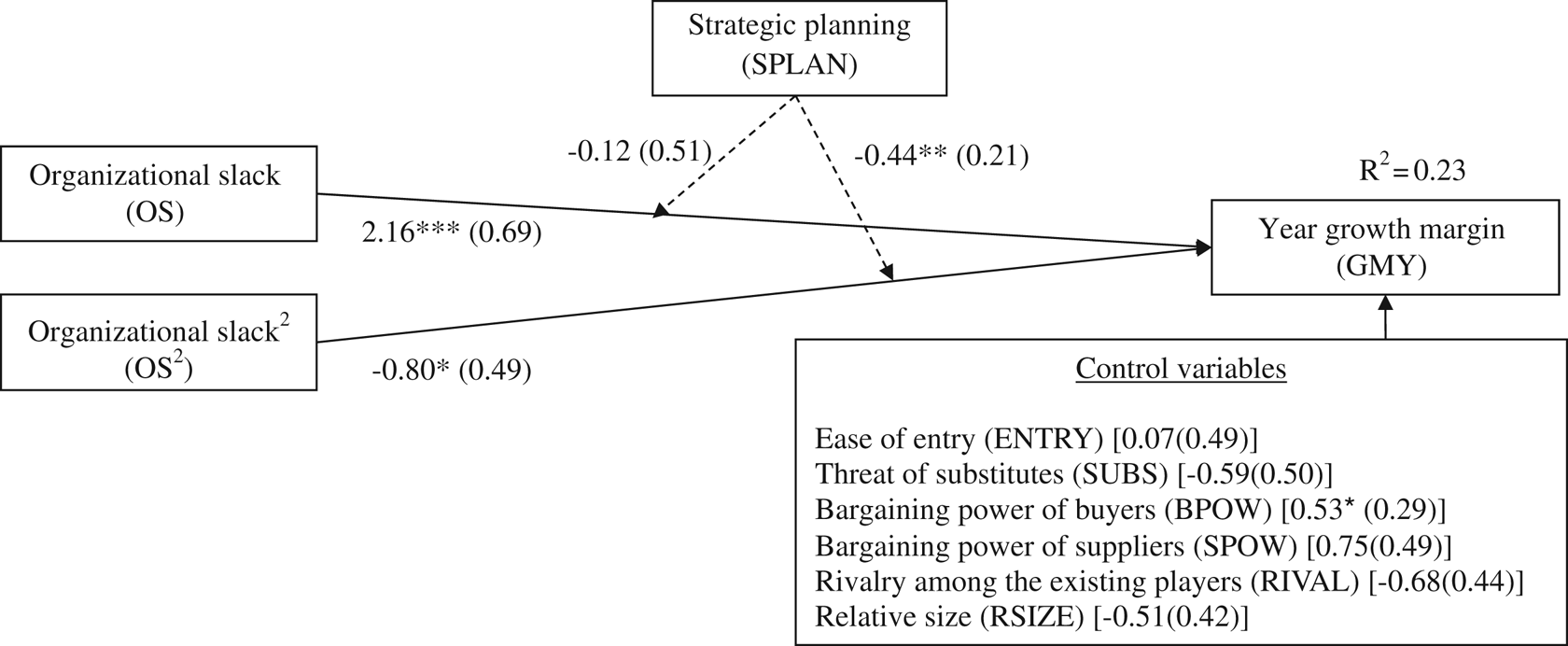
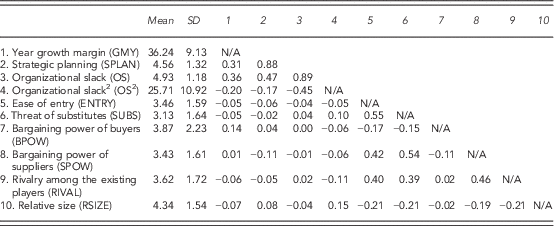
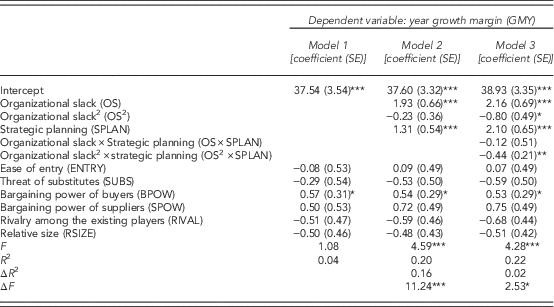
Table 1 presents the means, standard deviations, and correlations for the study measures. All multi-item constructs have good reliability, with Cronbach’s α ranging from 0.88 to 0.89. The results of the hypothesis tests are shown in Table 2 and Figure 1.
Theoretical framework of Model 3. One-tailed for hypothesized effects, two-tailed for other effects; *p<.1; **p<.05; ***p<.01

Descriptive statistics

Note. Entry on the diagonal is the construct reliability.
p<.05 when r≥|0.15|; p<.01 when r≥|0.20|.
Results from regression analyses

Notes. n=183. One-tailed for hypothesized effects, two-tailed for other effects.
*p<.1; **p<.05; ***p<.01.
We employed hierarchical regression analysis to test our hypothesis because it can be used to test moderator effects (Golden & Veiga, Reference Golden and Veiga2005). The results of Model 1, in which all the control variables were entered, show that bargaining power of buyers appears to be positively and significantly associated with year growth margin (b=0.57, p<.10). However, the regression equation is not significant (F=1.08, p>.10).
Model 2, in which strategic planning, organizational slack, the quadratic term of organizational slack, and the control variables were entered, yielded significant equations for year growth margin (F=4.59, p<.01). The relationship between strategic planning and year growth margin (b=1.31, p<.01) is significantly positive as are those of organizational slack (b=1.93, p<.01) and bargaining power of buyers (b=0.54, p<.10).
In Model 3, following procedures outlined by Cohen et al. (Reference Cohen, Cohen, West and Aiken2013) and Aiken, West, and Reno (Reference Aiken, West and Reno1991), we tested the moderator effect by computing the interaction terms between strategic planning (SPLAN) and organizational slack (OS) and organizational slack squared (OS2) and then entering them after the control variables and the direct effects. The regression equation for year growth margin is significant (F=4.28, p<.01). The coefficient of the quadratic-by-linear term (OS2×SPLAN; b=−0.44, p<.05) is statistically significant, indicating that strategic planning moderates the relationship between organizational slack and firm performance. Consistent with the approach taken by previous scholars (Wadhwa & Kotha, Reference Wadhwa and Kotha2006; Burnett, Chiaburu, Shapiro, & Li, Reference Burnett, Chiaburu, Shapiro and Li2015), there is significant incremental variance (ΔR 2=0.02, ΔF=2.53, p<.10) explained by the quadratic and linear interaction terms beyond that explained by the quadratic and linear terms. Organizational slack squared appears to be significantly negatively related to year growth margin (b=−0.80, p<.10). Organizational slack is significantly positively associated with year growth margin (b=2.16, p<.01) as are strategic planning (b=2.10, p<.01) and bargaining power of buyers (b=0.53, p<.10).
To further test our hypothesis, we calculated the regression equations at different levels of strategic planning. The original regression equation is:  $$\hat{Y}\,{\equals}\,b_{{\rm 1}} X{\plus}b_{{\rm 2}} X^{{\rm 2}} {\plus}b_{{\rm 3}} Z{\plus}b_{{\rm 4}} XZ{\rm }{\plus}{\rm }b_{{\rm 5}} X^{{\rm 2}} Z{\plus}b_{{\rm 6}} C{\plus}b_{0} $$
. We reformulated regression equations at different values of the moderator, as follows:
 $$\hat{Y}\,{\equals}\,\left( {b_{{\rm 1}} {\plus}b_{{\rm 4}} Z} \right)X{\plus}\left( {b_{{\rm 2}} {\plus}b_{{\rm 5}} Z} \right)X^{{\rm 2}} {\plus}\left( {b_{0} {\plus}b_{{\rm 3}} Z{\plus}b_{{\rm 6}} C} \right)$$
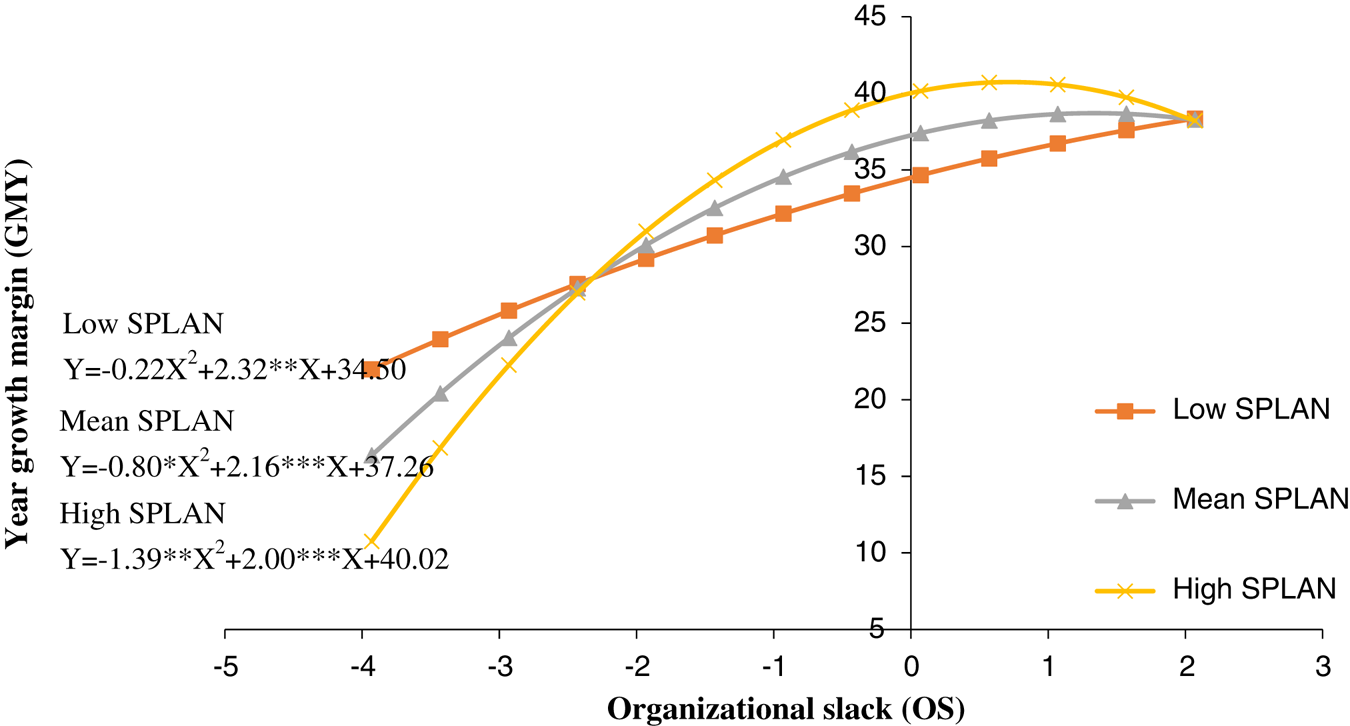
(Aiken, West, & Reno, Reference Aiken, West and Reno1991; Cohen et al., Reference Cohen, Cohen, West and Aiken2013). We plotted the regression curves corresponding to low (one standard deviation below the mean), medium (mean), and high (one standard deviation above the mean) levels of strategic planning. The results are shown in Figure 2.
Effects of organizational slack on year growth margin at different levels of strategic planning. One-tailed test; *p<.1; **p<.05; ***p<.01. SPLAN=strategic planning

At high levels of strategic planning, the relationship between organizational slack and year growth margin is an inverse U-shaped curve because the coefficient of the quadratic term in the regression equation is negative and significant (b=−1.39, p<.05) and the coefficient of the linear term is positive and significant (b=2.00, p<.01). However, at low levels of strategic planning, the relationship between organizational slack and year growth margin is linear as the coefficient of the quadratic term is insignificant (b=−0.22, p>.1) and the coefficient of the linear term is positive and significant (b=2.32, p<.05). We can therefore state that at low levels of organizational slack, the positive relationship between organizational slack and firm performance is, in general, stronger for firms with higher levels of strategic planning (see the upward-sloping curves in Figure 2). At high levels of organizational slack, although we did not find a negative relationship between slack and performance when strategic planning is low, it appears that performance in high levels of strategic planning is always superior to that in low levels of strategic planning (see the right part of Figure 2). These results thus support our hypothesis that strategic planning indeed alleviates problems caused by excessive slack.
DISCUSSION
Theoretical implications
We examined how strategic planning affects the relationship between organizational slack and firm performance. Previous research has described this relationship as being negative (Davis & Stout, Reference Davis and Stout1992), positive (Hendricks & Singhal, Reference Hendricks and Singhal2009), or inverse U shaped (Tan & Peng, Reference Tan and Peng2003; Yang, Wang, & Cheng, Reference Yang, Wang and Cheng2009) and has mainly focused on the impact of environmental conditions on this relationship (Wan & Yiu, Reference Wan and Yiu2009). We instead explored the relationship between organizational slack and firm performance under different levels of strategic planning, finding a linear relationship when there are low levels of strategic planning and an inverse U-shaped relationship when there are high levels of strategic planning. We also found that although both organizational slack and strategic planning may have adverse effects on firm performance, they can also complement each other and result in better performance. We did not observe a negative relationship between slack and performance when strategic planning is low, but there still may be agency problems under these conditions; the benefit of organizational slack may simply surpass the costs of agency issues. Organizational theory and agency theory, respectively, can explain the two latent functions of organizational slack on performance. The benefit function takes effect through exploration and innovation and the cost function through agency problems. For the benefit function, organizational slack provides additional resources that allow firms to explore new opportunities and develop new products, while strategic planning can assure the success of implementation of these new actions. For the cost function, strategic planning can mitigate the agency problems bred by excessive slack. Our findings provide a richer understanding of the impact of organizational slack on firm performance and further develop the behavioral theory of the firm.
Practical implications
The implications of our findings for practitioners and decision makers are twofold. Although we argued that strategic planning can help firms translate organizational slack into performance more efficiently, practitioners and decision makers should be aware that strategic planning does not always yield superior performance. At very low levels of organizational slack, firms with low levels of strategic planning may have better performance than those with high levels of strategic planning (see the left part of Figure 2). This could be the case for small companies that have little additional slack resources – for these firms, improvised rather than planned activities may be more conducive to higher performance. As the amount of organizational slack increases, the effects of strategic planning emerge. Firms with abundant slack resources should utilize strategic planning to offset the negative effects of excessive slack and allocate resources to achieve better performance.
Limitations and future research directions
This study has several limitations that should be considered when interpreting the findings and that also suggest opportunities for future research in this area. First, the study sample consists of companies in the United States, which constrains any generalizability of the results to other countries. In addition, the sample includes only firms in high-tech industries, thus our findings may overlook certain aspects of antecedents and outcomes that are common in other industries (e.g., service industries). Testing our model in other countries and industries would extend the applicability of these findings across geographic and industrial sectors.
Second, in this study we considered organizational slack as a single construct and did not divide it into different types, such as financial slack, recoverable slack, and potential slack. We adopted the view of Atuahene-Gima (Reference Atuahene-Gima2005) that slack reflects firms’ resources and market power to exploit existing competencies, build new ones, and develop innovations, which is a reasonable and easily applied representation of organizational slack.
Finally, our study is limited to organizational slack and its interaction with strategic planning. Some scholars have pointed out that managerial discretion afforded by resources and entrepreneurial orientation may also intercede in the relationship between slack and performance (Bradley, Shepherd, & Wiklund, Reference Bradley, Shepherd and Wiklund2011; Cheng, Chang, & Li, Reference Cheng, Chang and Li2013). Future studies should collect data on these constructs to evaluate their impact.
CONCLUSION
Slack has played an important role in organizational theories of survival, growth, and performance. However, debate still exists about the optimal level of slack to improve firm performance. In this study, we extended and reconciled these arguments by considering the effect of strategic planning. We focused on organizational slack and demonstrated that its relationship with firm performance is moderated by strategic planning. The results indicate that in low levels of strategic planning, there is a linear relationship between organizational slack and firm performance, but in high levels of strategic planning, there is an inverse U-shaped relationship. We hope our findings provide some basis for future studies to address the complex interaction of slack and other factors in the evaluation of firm performance.
Acknowledgement
All authors contributed equally to this research. The authors thank Dr. Timothy O’Shannassy and two anonymous reviewers for their valuable suggestions in two earlier versions of the article. The research was partially supported by the National Natural Science Foundation of China under Grant 71672049. The authors are solely responsible for the contents of the article.
Appendix: STUDY MEASURES
Firm performance: Year gross margin (GMY): average of gross margin over 3 years; gross margin=(total revenues−total variable costs)/total revenues×100%.
Organizational slack (OS): Adapted from Atuahene-Gima (Reference Atuahene-Gima2005) (construct reliability=0.89) (1=‘strongly disagree’; 7=‘strongly agree’).
OS1. We have a lot of resources at the discretion of top management to fund new strategic initiatives.
OS2. We have a lot of resources available in the short run to fund our strategic initiatives.
OS3. We will have no problems obtaining resources at short notice to support new strategic initiatives.
OS4. We have sufficient uncommitted resources that can be used to fund strategic initiatives at short notice.
OS5. We have a lot of duplicative resources throughout the organizationFootnote 1.
Strategic planning (SPLAN): Adapted from Armstrong (Reference Armstrong1982) (construct reliability=0.88).
SPLAN1. In our strategic business unit, our strategic planning process is (1=‘a very informal process’; 7=‘a very formal process’).
SPLAN2. In our strategic business unit, we are expected to strictly implement our strategic plan (1=‘we have flexibility in the implementation’; 7=‘we are supposed to strictly implement our strategic plan’).
SPLAN3. In our strategic business unit, our strategic planning process includes (1=‘a very vague process’; 7=‘a very explicit process’) for determining specific long-range objectives.
SPLAN4. In our strategic business unit, our strategic planning process contains (1=‘a very vague procedure’; 7=‘a very explicit procedure’) for generating alternative strategies.
SPLAN5. As part of our strategic planning process, we (1=‘do not have an explicit system’; 7=‘have an explicit system’) monitoring the results of our strategic plan.
Control variables: Adopted from Narver and Slater (Reference Narver and Slater1990) (these data were collected in the first phase of data collection).
1. Ease of entry (ENTRY). How easy is it for new entrants to start competing in this industry? (1=‘very easy’; 7=‘very difficult’).
2. Threat of substitutes (SUBS). How easy can a product or service be substituted in this industry? (1=‘very easy’; 7=‘very difficult’).
3. Bargaining power of buyers (BPOW). The extent to which our customers are able to negotiate lower prices in this industry is (1=‘very low’; 7=‘very high’).
4. Bargaining power of suppliers (SPOW). The extent to which we are able to negotiate lower prices from our suppliers in this industry (1=‘very low’; 7=‘very high’).
5. Rivalry among the existing players (RIVAL). The extent to which there is a strong competition between the existing players in this industry (1=‘very low’; 7=‘very high’).
6. Relative size (RSIZE). The size of our annual sales revenues in the principal served market segment in relation to those of our largest competitor is: (1=‘much smaller than the largest competitor’; 7=‘much larger than the largest competitor’).
7. Relative costs (RCOST). Our average total operating costs (administrative, production, marketing/sales, etc.) in relation to those of largest competitor in its principal served market segment are: (1=‘much lower than the largest competitor’; 7=‘much higher than the largest competitor’).