When Sandra Gilbert and Susan Gubar asked in 1979, “How then – since poets are priests – can women be poets?” (Madwoman in the Attic 546), they opened up to debate the predominant ideological holdover from the Victorians that “the very nature of lyric poetry is inherently incompatible with the nature or essence of femaleness” (541). More than thirty years later, while women's poetic contributions are regularly considered by literary scholarship, I would now advocate for the woman hymn writer for children – she who, as hymn writer or editor, surely enacted the role of religious “priest” for countless generations of children during and after her lifetime, but who is all but forgotten today.Footnote 1
Yet clearly women were dominant in the field of children's hymnody for over a century, some of the most famous writers of nineteenth-century children's hymns being women. These included Ann and Jane Taylor (Hymns for Infant Minds, 1809) and C. F. Alexander (Hymns for Little Children, Reference Alexander1848), as well as those who wrote individually popular hymns: Jemima Thompson Luke (“I think when I read that sweet story of old”) and Mary Lundie Duncan (“Jesus, tender Shepherd, hear me”). As poets in their own right, these women hymn writers often shared fames as great as their poet-sisters like Christina Rossetti, also a writer of hymns. Further, a large number of nineteenth-century British collections of hymns for children were compiled or edited by women, anonymous and not, such as Frances M. Yonge, who edited the Oxford Movement's The Child's Christian Year (Reference [Yonge1841) and M. A. Woods, who edited Hymns for School Worship (Reference Woods1890).Footnote 2
Children's hymns could be defined as sung religious poems, urging Christian ideals of praise, repentance, and Christian conduct upon their young audience who sang them to common tunes in day schools, Sunday Schools, or at home. Footnote 3 Using Francis C. Blessington's definition of the traditional literary hymn as exemplified in Milton's Paradise Lost as “the musical goal of all creatures, the expression of social harmony and celestial peace . . . the pure song in praise of God” (494–95), one could argue that children's hymn writers also aspired to such lofty goals, writing in utmost praise to God to achieve social harmony. But they did so by taking control of the voices of children, in effect forcing Christian ideology and even obedience on their young singers to achieve this social harmony. As the traditional hymn speaks not as the ode merely for one person but for a community and its shared values, the tradition of hymn writing is thus especially complicated by women's shared values now brought to the genre.
Beginning with Isaac Watts's influential Divine and Moral Songs for Children (1715) and further influenced by John and Charles Wesley's Hymns for Children and Others of Riper Years (1763), children's hymnody had often become a context for imposing adult songs “in praise of God” upon their youthful audience. What developed were, in fact, two divergent philosophical approaches: Watts wrote uncomplicated hymns for youthful understanding while the Wesleys appealed to a child's mature comprehension. These pillars of English hymnody together inspired generations of hymn writers, some writing saccharine hymns in Watts's style, others writing fire-and-brimstone hymns after the style of the Wesleys. Children were caught in the middle, required to sing the ideologies of competing adult views. I elaborate upon this phenomenon and suggest means of empowerment for children in hymn singing contexts elsewhere;Footnote 4 in this essay, I will focus on the altered situation when women write hymns for children. Writing from a similarly marginalized position themselves, women's voices often speak for the child at the same time that they impose upon children's hymnody a distinct feminist agenda.
Indeed, women were both accepted within the profession of hymn writing and susceptible to many social prejudices consonant with those toward other women poets. However, women hymn writers for the young had an additional challenge: to write for children while legally defined as children themselves. Successful engagement with children through childish tactics would ultimately demean the social image of the adult woman hymn writer, making it easy for an 1857 commentator on women's hymns to declare, “very few good hymns have been written by women” (qtd. in De Jong, “Theirs the Sweetest Songs” 158).
Unfortunately, scholars of hymnody still tend to devalue the work of women hymn writers: critics either ignore women's contributions, compartmentalize them in their own special chapter, or come to disparaging conclusions about their work. Consider a 1990 book, A Study of Hymn-Writing and Hymn-Singing in the Christian Church, which states, “they [women hymn writers] have not, as yet, yielded a Watts or a Wesley [which] is to be regretted” (Manwaring 123).Footnote 5 Facing such dismissive valuations then and now, women hymn writers, especially those writing for children, need scholarly reconsideration.
Following a study of hymnbooks for children,Footnote 6 my conclusions here address women's contributions to children's hymnody in three areas: their work as editors, as hymnbook writers, and as individual hymn writers. I consider a few focal texts, some famous and some just coming to light in this analysis. Recognizing women's attempts to be both sympathizer and moral authority to the young, I suggest how they could yet lose moral authority by sympathetically speaking to the young. I read women's hymns, often against those of their male counterparts, always pursuing the various challenges women faced. For instance, editors had great influence, but women editors usually had to choose anonymity to enjoy it. Hymnbook writers wrote poems to appeal to children, but often women's strategies – using first-person narration, highlighting a child's diminutive status – reflected back on themselves. Finally, writers of individual hymns could become famous for a single hymn, and yet women often unwittingly divulged private reflections to a public world in doing so. Within each of these three contexts, however, women recuperated some assertiveness and self-identity, frequently aligning themselves with the very divine figures they praise: the Mother Mary, Christ, God, the Trinity. The Trinity, especially, evoked images of anonymous omniscience (of the Father), child-like conviction (of the Son), and a personal, daily presence (of the Holy Spirit) very much paralleling a woman hymn writer's experiences. Drawing on such imagery, they defended their own tenuous situations.
I. “We are but little children weak”: Social Constraints for Women Hymn Writers
Hymn writing offered unprecedented opportunity for women in the nineteenth century. For one, women's contributions to religious life met little resistance, due to prominent cultural ideologies of women as naturally more godly and devout, Ruskin and Patmore reflecting a century's worth of adulation for holy “Queens” and “Angels in the House.” Further, the Evangelical movement of the early nineteenth century supported women's opportunities in the religious sector, resulting in greater women's leadership in Sunday Schools, charities, and missions.Footnote 7 Likewise, hymn writing offered more opportunity for women writers. June Hadden Hobbs, writing about American hymnody, suggests that in lieu of preaching and other forms of public expression for women, hymns gave “women a complex rhetorical system of figures and forms that were already associated with women and the cult of domesticity” (32).
As long as women's hymns remained private and not published, they were innocuous, but public sharing threatened male-controlled dissemination of theological truths. Susan Drain shows that, proportional to the total number of hymns written, very few women's hymns were actually anthologized in hymnbooks or used for congregational singing (264). Furthermore, women's hymns were routinely co-opted, altered, or truncated for publication.Footnote 8 Hobbs argues that once women's spirituality became public property, it became “co-opted by men who made its values their own but then silenced women” (68). Given such societal discrimination, women hymn writers like C. F. Alexander chose to publish, at least initially, anonymously or pseudonymously. Like George Eliot and the Brontё sisters, women hymn writers utilized this tactic to secure privacy and avoid prejudice.Footnote 9 It especially behooved a religious woman, writing only for the glory of God, to shun such glory herself and “shrink from publicity or praise,” as Mrs. E. R. Pitman, author of Lady Hymn Writers (Reference Pitman1892), noted in her praise of hymnwriter Charlotte Elliott (83).
Writing for children, though, gave women an advantage, made them more publishable, hymns by women flooding into Hymns Ancient & Modern (1861) when later editions began to include children's hymns (Melnyk 174). This near equivalence with women's hymn writing and children's hymnody is not surprising, as it was seen by society as an extension of women's roles as mothers and religious guides of the young: “Women – and especially women who were mothers – have excelled in the art of writing hymns for children. Somehow it needs mother-love to interpret divine love to the little ones” (Pitman 281–82).
What complicated this religious empowerment were the ideologies surrounding Victorian women in the secular world: her supposed passivity, innocence, littleness, and even sickliness, all of which mirrored that of the young. Consider Coventry Patmore's hyperbolic rhetoric about his Angel in the House (Reference Patmore1854) who grows “More infantine, auroral, mild / And still the more she lives and knows / The lovelier she's express'd a child” (52). In Sesame and Lilies (Reference Ruskin1889), John Ruskin not only urges “ye women of England” to “lead your children faithfully” (section 85, 164–65) but then refers to women's own “majestic childishness” (section 71, 149). Even Victorian scientific findings backed up society's child / woman associations: studies showed women's and children's similar “cranial structures and dimensions,” Darwin's findings compared children's bodies to women's, studies suggested women's greater susceptibility to infant diseases, while “scientists defined woman's traditional traits – intuition, fidelity, charity – as ‘infantile’” (Helsinger, Sheets, and Veeder 91). Such middle-class, secular ideologies competed with religious stances on women's authority, depicting them as children even as religious circles invested them with the role of teacher.
Even religious convention associated the woman hymn writer with child-like weakness in her frequent association with suffering and invalidism (Watson, English Hymn 424–25; Routley 204). Stories and books flourished of women hymn writers’ immense hardships – a drowned fiancé (eighteenth-century hymn writer Anne Steele), blindness (American hymn writer Fannie Cosby), and life-long illness (Adeline Sergeant) – their suffering sometimes exaggerated to highlight the association of women with weakness.Footnote 10 These tragedies presumably created a sensitivity to human adversity, inspiring their writing and even modeling Christ's own suffering and piety. Still, these portrayals diminished women's personal independence and suggested a need for care that reinforced their association with the child in the Victorian mindset. “We are but little children weak,” a hymn by C. F. Alexander addressed to children, could equally have applied to her female peers.
Strategies to overcome this association are recognizable in women's hymnody. Women editors, though usually not writers themselves, began the process of endorsing their work and that of their sisters, often using the image of God the Omnipotent to claim power in their obscurity and anonymity.
II. “O Thou, the great Unknown, Unseen”: Anonymity and Invisibility in Hymnbooks Edited by Women
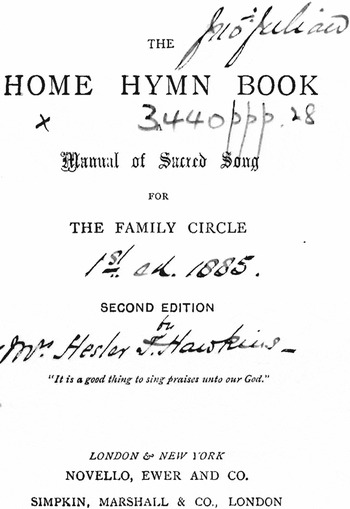
British women editors and compilers of children's hymnbooks were extremely prolific during the nineteenth century.Footnote 11 Nevertheless, they were more effaced even than their literary counterparts (who often used pseudonyms) in that they frequently worked under complete anonymity. Consider five representative collections by women editors: The Weston Hymn Book for Children (Reference [Harrison1849), The Christian Mother's Hymn Book (1855), Hymns and Rhymes for Children by the Daughter of a Clergyman (1871), The Home Hymn Book (Reference Periam Hawkins] and Moss1885), and M. A. Woods's Hymns for School Worship (Reference Woods1890). The latter is the only one to name its editor, although initials obscure her gender. Two of these women acknowledge their gender and identity only in connection to a male relation (by the Daughter of a Clergyman) or to their own domestic role (The Christian Mother's Hymn Book). These two women editors remain unidentified. In another two cases only incomplete library records hint at the true identity of the writers, the British Library listing a “Miss Harrison” as the compiler of The Weston Hymn Book. The Home Hymn Book most strikingly suggests the preferred anonymity of a woman editor compared to her male counterpart in that the compilers are listed as “H.P.H and Edwin Moss, Musical Editor.” Only because the British Library's copy is inscribed by the hymnologist, John Julian (Figure 5) can we identify “H. P. H.” as “Mrs. Hester P[eriam] Hawkins.” As exemplified here, in parallel circumstances women used initials or complete anonymity whereas men used their full names and titles, a common trend of hymnbooks.Footnote 13 Certainly women's need for anonymity relates to the double standards of publishing at the time, but their desire to be heard, not seen, also had lingering overtones of model behavior required of children (seen, not heard), reflecting modes of child effacement during much of the Victorian period.Footnote 14
H. P. H. [Hester Periam Hawkins] and Edwin Moss, musical editor. The Home Hymn Book: A Manual of Sacred Song for the Family Circle. Reference Periam Hawkins] and Moss1885. 2nd ed. London: Novello, Ewer, 1890. © British Library Board (Shelfmark #3440.ppp.28).

Behind this anonymity, however, resided great professionalism and power. Women editors were clearly in positions of control, working alongside men or without men to edit and publish large collections of children's hymns. One could claim that, as Elisabeth Jay says of translation, editing “conformed to a mid-nineteenth-century preconception of woman's literary role as necessarily better suited to providing a secondary conduit from male intellect and creative energy” (44) – in this case, further disseminating the hymns of men. Yet by selecting hymns, many original to their collections and often written by other women, women editors were allowing unknown voices to be heard.
Hymn selection also allowed women to guide the theological preference of the young for years to come. “Miss Harrison,” for instance, demonstrates Evangelical rigor in selecting hymns based on bloody biblical stories for The Weston Hymn Book. In contrast, selections by the editor of The Christian Mother's Hymn Book encourage secular, and often patriotic, sentiments as in “Hurrah! Hurrah for England.”
Careful editorial selection may be seen in M. A. Woods's Hymns for School Worship (Reference Woods1890). Despite genderless initials, she further identifies herself on the cover as “Head Mistress of the Clifton High School for Girls” to give herself more credibility. She provides hymns for school worship which are, in her words, “bright rather than sad, simple rather than complex, devotional rather than doctrinal or didactic” (preface v). She strives to have a “somewhat higher literary standard than is usual in compilations of this kind, and a large proportion of the hymns chosen are by authors (chiefly of the sixteenth and seventeenth centuries) well known as poets apart from their hymns” (vi). She achieves her goal: alongside standard hymn writers of the centuries – Thomas Ken, Isaac Watts, and the Wesleys – literary poets are included, such as George Herbert, Henry Wadsworth Longfellow, and John Milton. Taking an editor's liberty, in fact, Woods notably drops the outdated, intimidating verse in Ken's famous 1695 hymn, “Glory to thee, my God, this night” (hymn 97): “Teach me to live, that I may dread / The grave as little as my bed.” As Woods herself warned in her preface, “I have never hesitated to shorten a hymn so as to bring it within the required limits whether of length or intention” (vi). This principle also allows her judicious editing of content and theology, not unlike what male editors were known to do with women's hymns.
Consider, too, that through the label “Daughter” the editor of Hymns and Rhymes for Children, by the Daughter of a Clergyman (1871) represents herself as a modest woman working under the protection of a male, “a childlike Nobody” to her “Master / Father,” to use the words of Gilbert and Gubar about Emily Dickinson (591, 595).Footnote 15 She appropriates his title of “Clergyman” to enhance her authority. Her brief inscription after the list of contents, however, reveals her to be a very intentional professional: “The permission to reprint, which has been kindly given, thus enables the Editor to carry out her design of making this volume a comprehensive collection of ‘the Children's Favourites’” (emphasis added).
This editor is indeed comprehensive in choosing hymns by many different authors, denominations, and time periods. Eight hymns from Isaac Watts's renowned 1715 classic, Divine and Moral Songs for Children, provide stern Puritan morality, like “How doth the busy little bee,” subsequently much parodied. She has chosen three from Ann and Jane Taylor's influential 1809 Hymns for Infant Minds as well as a handful of hymns from Ann later in life (as Mrs. Gilbert), also didactic in content. As well, she features Romantic sensibilities and Broad-Church leanings by including poems by S. T. Coleridge and Charles Kingsley, respectively. Hymns and Rhymes includes a wide variety of religious denominations, from Congregationalists (the Taylors) to Anglicans (Mary Duncan), even including a song by Tractarian hymn writer Rev. J. M. Neale. Furthermore, the hymns cross an expanse of time, from Thomas Ken's “Evening Hymn” and “Morning Hymn” (1674) to very contemporary Victorian hymns, like Duncan's “Jesus, tender Shepherd, hear me” (1842), as well as “Little Drops of Water” (1848) by the American E. C. Brewer. As a result, children reading this hymnbook were exposed to disparate theologies, empowering them and their teachers to sift through and select whatever particularly appealed to them.Footnote 16
In my tally of the contents of about fifty hymnbooks for children from the nineteenth century, I observed that about 150 of the hymns in Hymns and Rhymes are not found in any other hymnbook in my study.Footnote 17 Many of these new songs, in fact, are more secular in nature. Some hymns address suffering children and abused animals, the modest anonymity of this female editor possibly carrying over into her personal attention to other “invisible” creatures around her. Woodcuts show various animals – sheep, dogs, birds – to parallel the innocence of children described in the hymns.Footnote 18 Her attention to animals is a simple reminder of God's Creation, the God who “made the pretty bird to fly” and “the cow to give nice milk” (17). At other times, humans may learn from the loyalty and duty of animals, one hymn even suggesting a parallel with a loyal dog and our loyal God: “The dog will stand and watch the sheep, / Or guard the house while men do sleep; / And so should we both watch and pray / That God would keep us night and day” (28). But notable in this hymnbook are poems which are more didactic, offering lessons of kind treatment to those more vulnerable: “I'll never hurt my little dog, / But stroke and pat his head. . . . Poor fellow! I will give him food, / And he'll love me again” (21) or “I love little pussy, her coat is so warm; / And if I don't hurt her she'll do me no harm” (29). This attention is not surprising, given the various movements for animal welfare in the nineteenth century. Bands of Mercy, extensions of the Royal Society for the Prevention of Cruelty to Animals (RSPCA), were established by Catherine Smithies in 1824 to teach children about animal welfare, often leading to actual political engagement. Clearly this was a concern of “Daughter” and she uses her hymnbook to promote a political issue of importance to her.
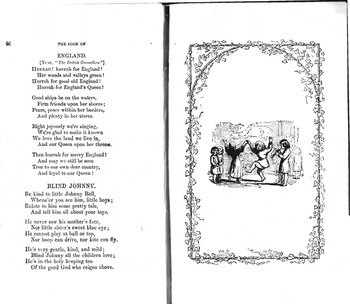
Hymns here also focus on neglected children, such as “Blind Johnny”: “Be kind to little Johnny Bell, / Whene'er you see him, little boys. . . . He cannot play at ball or top, / Nor hoop can drive, nor kite can fly” (46). However, the lesson ends with “Blind Johnny all the children love; / He's in the holy keeping too / Of the good God who reigns above” (46). God is sensitive to the infirm and the young for, through Christ, “He became / A little child like me; / A child of poor and lowly name / The Saviour deigned to be” (49). Accompanying the song “Hurrah for England,” yet set on the page opposite “Blind Johnny,” is a woodcut of children dancing, as if the editor exalts all children, blind or not (Figure 6). The editor uses other placements of hymns to reinforce animal-child connections: on page 61 the song “The Moth” (“now ’tis killed: oh, painful sight!”) is immediately followed by “The Beggar-Boy” (“A poor boy went by with his raiment all torn”). In sentimental fashion, both topics are explored for their lessons on pain and sympathy.
Hymns and Rhymes for Children: By the Daughter of a Clergyman. London: Ward, Lock, and Tyler, 1871. © British Library Board (Shelfmark #3437.cc.18).

Illustrations are frequently used in Hymns and Rhymes to depict creatures sentimentally or children sympathetically. A realistic image of a bee is placed next to Watts's moral poem of the “Busy Bee” (22). Rather than sentimentally showing a comparable “busy child,” the image of the bee appears to be from a science text of the time, encouraging children to think scientifically of the poem. As in this case, the book's images provide interpretations of the text. The reflective poem “God is Love” provides thoughtful descriptions of God's love: “All the hopes and fears that start / From the fountain of the heart / All the quiet bliss that lies, / All our human sympathies. . . . Sweetly whispering: God is love” (280). No literal image is given, however; instead an illustrator interprets the scene, as sanctioned by the editor, of a young girl sitting in a field reading a book, probably the Bible, which apparently best represents “God is Love” to them. Employing images to guide meaning empowered women editors in much the same way that Lorraine Janzen Kooistra writes of Christina Rossetti's illustrations of poems by Keble and Isaac Williams: “it was by this material means that the invisible could be made visible, just as the ineffable could be hinted at in the resonance of poetic language” (29). As women's theological discernment became visible so, too, was their anonymity obviated.
As many of these examples show, the editor did much to control the interpretation of hymns using pictures and placement. She also assigned her own titles. For instance, the popular 1832 hymn “Here we suffer grief and pain . . . In heaven we part no more! Oh, that will be joyful” (50) is a somber hymn about earthly suffering. However, “Daughter” mitigates the opening somberness by entitling the hymn “Joyful, Joyful” so as to focus attention on the “joyful” refrain about heaven. Of many other examples, Watts's poem “Let children that would fear the Lord” is renamed “Obedience” to enforce for children one of several messages in the poem (worshipping God, honoring parents, and so forth).
In short, “Miss Harrison,” “Mother,” Wood, and “Daughter” use critical judgment in editing their hymns for children. But “H. P. H.,” author of Home Hymn Book: Manual of Sacred Song for the Family Circle (Reference Periam Hawkins] and Moss1885), goes further, employing her own hymns often in direct challenge to men's hymns included in the book. “H. P. H.” – Hester Periam Hawkins – and musical editor Edwin Moss say in the preface that they have chosen hymns with “sacred associations of Home” and daily living. In an edition with accompanying tunes, Hawkins and Moss express gratitude to such composers as Sir Arthur Sullivan and C. Villiers Stanford for the tunes, but despite having worked with such notables, Hawkins nevertheless modestly identifies herself only with initials. Still, Hawkins names her sister hymnists: this collection identifies many poems by women, such as Charlotte Elliott, Frances Havergal, Dorotha Thrupp, and Jane Leeson.Footnote 19 The compilers further highlight (with asterisks in the index) twenty-four titles composed just for this book. Notably, eight of these are by “H. P. H.” herself, subtly re-inscribing her voice into the text. Hawkins then includes six more of her hymns completely anonymously. Several deductions can be made about Hawkins's inclusion of her own hymns, whether initialed or anonymous. As has already been discussed, women's hymns were very likely to be edited in accordance with patriarchal preference, but H. P. H., as writer and editor, is able to maintain control over her own lyrics.Footnote 12
Further, Hawkins had editorial reasons for writing her own hymns, often treating topics poorly represented by existing hymns. This is true of “Father of all, again we meet” (hymn 177) which is one of two hymns to complete a section on “Meetings.” Likewise, her hymn “Heavenly Father, Thou has brought us” (hymn 163) is the only one in the “Golden Weddings” section, seemingly written to address a topic that was uncommon though crucial to Hawkins, possibly portending her own fifty-plus year marriage to Joshua Hawkins (we know that Hester lived for eighty years, 1846–1926; see Claghorn 113). In this hymn, she honors not only “wedded bliss” but a shared partnership, where “our burdens were the lighter / When each bore an equal share.” Her personal beliefs about marriage refute common Ruskinian dogma.
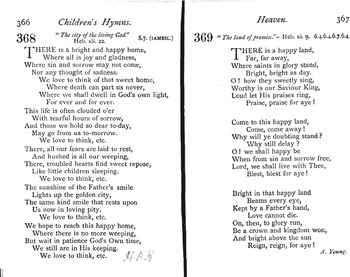
At other times, Hawkins's hymns mingle with “the great” in modest, or sometimes even brash, ways, her hymn sitting discreetly – and anonymously – next to one by a great hymn writer like Watts (hymn 300) or John Ellerton (hymn 30), the latter a noted hymnologist and editor of many hymnbooks including the 1859 Hymns for Schools and Bible Classes. She also includes her own version of Andrew Young's extremely popular “There is a happy land” (hymn 369) directly before his, titling it “There is a bright and happy home” (hymn 368) (Figure 7). In many of these cases, her mimicking of men's hymns is made more conspicuous in the tune edition, where her hymns are directly across the page from the more famous man's hymn.
H. P. H. [Hester Periam Hawkins] and Edwin Moss, musical editor. The Home Hymn Book: A Manual of Sacred Song for the Family Circle. Reference Periam Hawkins] and Moss1885. 2nd ed. London: Novello, Ewer, 1890. © British Library Board (Shelfmark #3440.ppp.28). Ewer, 1890, “with John Julian's hand-written identification of her authorship after her hymn.”

But usually Hawkins does more than just imitate; she also comments on the male perspective. This is true with her hymn on winter, “Now the days are dark and dreary” (hymn 278), which precedes Bishop Walsham How's “Winter reigneth o'er the land” (hymn 279). A prominent Anglican minister, rising to Bishop of Wakefield in 1888, How also published sermons and hymnbooks (Psalms and Hymns with Thomas Baker Morrell, 1854; Julian 540–41) and composed many notable hymns in his own right, including the well-known “For all the saints.” This hymn, number 279, attests to his literary experience, being filled with complex imagery. His stark imagery of winter – “freezing with its icy breath / Dead and bare the tall trees stand” (lines 1–2) – inspired Hawkins to imitate these images in her own hymn: “Winter, with its icy finger” and “the tall and leafless branches” (lines 7, 3). How's line “But the sleeping earth shall wake, / And the flowers shall burst in bloom” (v. 3) becomes “But the flowers are only sleeping, / Little birds will sing again” (v. 3) in Hawkins's version. One is tempted to note a simplistic and clichéd quality of Hawkins's verse until one realizes that both hymns are in the children's section of her hymnbook: the image of “Little birds” shows that she writes with a young audience in mind.
Also notable is that whereas How renders the rebirth of spring in the obvious Christian terms of the “bright awakening” of heaven, Hawkins's hymn moralizes about earthly suffering:
Including her own initials with this poem, Hawkins openly challenges How's conclusion by focusing instead on earthly affliction, which may be regarded as a woman's concern.
Other hymns also challenge the male perspective. For instance, included in a section titled “Births,” Hawkins features a hymn by the American poet W. Cullen Bryant titled “Lord, Who ordainest for mankind” (hymn 165). In third person, he thanks “Thee for the tie that binds / The mother to the child she bears,” noting the parallel with the Mother Mary:
Allusions to the Virgin Mary were common during this era,Footnote 20 though they are conspicuously missing from “H. P. H.”'s own birth poem, which follows Bryant's “To Thee the Giver of all good” (hymn 166). Also written in long meter (L. M., or iambic tetrameter) and also expressing gratitude for the birth of a child, Hawkins makes no comment on the Virgin Mary, instead using the first person to intensify her connection with this new life:
Using first-person plural to include the joy of both mother and father, Hawkins conveys the personal response of holding a new baby for the first time:
Her hymn reinterprets this “new gift” in unique terms.Footnote 21
This hymn is found in Part I, the family section. Noticeably, over half (8 of the 14) of Hawkins's own hymns are found in the section for children, Part II, of her hymnbook. Her language to children is very specific and simple, best seen when comparing two of her hymns for “Sunday,” one found in the family section, “Sweetly o'er the meadows fair” (No. 31), and the other in the section for children, “The twilight softly falling” (No. 254). The former utilizes more complex meter (trochaic tetrameter alternating with iambic trimeter), longer verses in ABAC DBDC rhyme, and more complex sentiments:
In contrast, the child version uses pedantic rhymes (ABCB) and awkwardly forced iambic meter (“On this holy Sabbath-day”) to create a hymn more sing-song and banal, filled with sweet images and references to the Divine as a friend and parent:
Interestingly, Hawkins may have underestimated her own budding poetics in the former hymn, not labeling it with her initials, though the child's hymn is initialed. This suggests that she saw her strength in the socially expected world of children's poems. Those occasions when she challenges the ideologies of known writers such as Bryant by using her own initials become significant.
Hawkins includes other anonymous writers in her collection: “E. J.,” “M. A. Y.,” and “E. C. W.”Footnote 22 In the tune edition, she and Moss also use composers anonymously, particularly with her own poems, such as “Golden Wedding” and “Meetings.” Hawkins includes a hymn text by her husband, Joshua Hawkins, notated semi-anonymously as “J. Hawkins” (Hymn Nos. 54 and 92). Her inclusion of “E. J.” (Edith Jones) is noteworthy. Jones contributed two hymns, one on travelers, “Father, Who art alone” (No. 171), and another on orphans, “Holy Father, throned on high” (No. 359), both markedly about those set apart, even as she notes that God is “alone.” Her own self-isolation was purposeful: Julian identifies her simply as “Edith J.” and notes that she intentionally desired to “remain unknown” (1635), indicating that often anonymity was a conscious choice.
In fact, “O Thou, the great Unknown, Unseen” (No. 137), perhaps Hawkins's best poem, is a particularly striking commentary about anonymity, declaring that God, too, has “Unknown, Unseen” qualities:
She shows “The human linked with the divine” (v. 3) and insists that, ultimately, “The wrong, the false, must pass away / With all things not of Thee . . . The Right must win the victory, / And God be ‘all in all’” (vv. 6 & 7). Given that she cloaks her own voice behind initials, it is arresting that she embraces “the mystery” and extols that which is “Unknown, Unseen” as truly “great.” If God embodies ultimate power even without full disclosure of identity, so too can anonymous women editors attain power from behind concealed identities.
She also inscribes the maternal in this “unseen,” utilizing womb-like metaphors of being “wrapt in Thee”:
Another image describes God's “nature pass[ing] into our own / Binding us close to Thee,” paralleling the maternal bond between mother and her unborn child. Hawkins based this poem on Phillipians 3.21, “He is able even to subdue all things unto Himself,” which posits a powerful, subduing God. Yet Hawkins emphasizes the motherly over the mighty in her portrayal of God.
“Unknown, Unseen” thus become vital tropes not only in praising the greatness of God but affirming the circumstances of the anonymous woman editor. Anonymity, rather than a restrictive posture, implies a mysterious omnipotence and omniscience, a power behind the immediate and obvious. Whether inserting one's political interests (such as animal welfare), one's interpretations of hymns (through subtitles or images), or even one's very own hymns to challenge those of famous male hymn writers, women editors certainly did seem to wield a significant amount of power through their God-like concealment.
III. “Little birds” and “Tiny wings”: Voice and Size in Women's Hymnbooks for Children
Just as Hawkins aspired to be a hymn writer, so too did other women, their hymnbooks of originally-composed hymns increasing throughout the nineteenth century. Unlike their editor-counterparts, these hymn writers often moved beyond the obscurity of anonymous authorship once their books became popular. This was true of Jane and Ann Taylor's Hymns for Infant Minds (1809, originally published as “by the authors of ‘Original Poems’”); Jane Leeson's Hymns and Scenes of Childhood (Reference Leeson1842, anonymous); and C. F. Alexander's Hymns for Little Children (Reference Alexander1848, first published as “by the author of ‘The Lord of the Forest’”). These works proclaimed to the world the writers’ intimate reflections, moving beyond privacy, domesticity, and anonymity with striking assertiveness. Indeed, as Hobbs writes, “when hymns moved out of the private sphere to become the public proclamation of doctrine and behavioral norms in evangelical churches, women's voices were heard for the first time” (28–29). Perhaps for this reason, women often used father-mentors – patrons, in the full patriarchal sense of the word – to ascribe confidence and credibility to their books. In so doing, though, they cast themselves as children – “daughters” – to these male mentors.
For instance, consider the preface to the famous Hymns by Jane and Ann Taylor, daughters of a Congregational minister, who initially published as “the authors of ‘Original Poems,’ ‘Rhymes for the Nursery,’ etc.” The Taylor sisters show their indebtedness to their mentor, Isaac Watts, whose 1715 Divine and Moral Songs for Children had been sung by children for almost a hundred years. Apologetic yet confident, the Taylors make clear the need for their book, stating that Watts's
“Divine Songs” . . . so beautiful, and so universally admired, almost discourage, by their excellence, a similar attempt, and lead the way where it appears temerity to follow: but as the narrow limits to which he confined himself excluded a number of useful subjects, the following Hymns, though with much diffidence, are presented to the Public. (Advertisement to the First Edition)
Acknowledging their literary forefather, they yet assert the need for the new book. Their apology was perhaps unwarranted, their hymnbook going through twenty-two editions by 1830, thirty-five editions by 1844, fifty-two editions by 1877. “Great God, and wilt thou condescend / To be my Father and my Friend” (Hymn No. 5) and “I thank the goodness and the grace” (Hymn No. 1) appeared in hymnbook collections throughout the century.Footnote 23
Another way women hymn writers represented themselves as daughters to their fathers was by using rhetorical strategies appealing to children, such as first-person narration and diminutive imagery. When women's hymns took the language of children, author and reader became ambiguously aligned. Penny Brown describes Evangelical women fiction-writers’ “well-founded anxieties” when “adopting a childlike voice in their narratives” for fear of undermining a “mature self-image” (186). The woman hymn writer needed to identify with but also separate herself from the object of her writings, the child. This was a difficult rhetorical maneuver to accomplish.
Hymns and Scenes of Childhood or, A Sponsor's Gift, anonymously written by Jane E. Leeson (Reference Leeson1842), was a hymnbook modestly following in the footsteps of Watts and the Taylors. Leeson dedicates her book to “Little one, whoe'er thou art / With a child's true loving heart. . . . Listening to thy mother now / With uprais'd and earnest brow, / Drinking wisdom from her speech” (xi). This dedication at once acknowledges the purity of the child and the authority of the mother who will become a consistent figure in this book of verses. From a High-Church background (late in life she would convert to Roman Catholicism), Leeson writes her book in two parts, religious “Hymns” and then more secular “Scenes of Childhood,” although both sections contain lessons of Scripture and of godly living within the family. For example, Hymn No. 1 reflects on the “Suffer the little children” verse of Matthew 18 (“Sweet the lesson Jesus taught / When to Him fond parents brought / Babes for whom they blessing sought / Little ones like me”) while Hymn No. 2 presents a domestic lesson about dutiful living (“I cannot bear Papa to frown / Upon his little child / Nor would I grieve my dear Mamma, / So gentle and so mild”).
Though not as commercially successful as the Taylors’ hymnbook, Leeson's was influential, a number of its hymns making their way into hymnbooks of the nineteenth and even twentieth centuries (Claghorn 148). Its popularity is shown by an 1849 book being mistakenly advertised as “By the Author of ‘Hymns and Scenes of Childhood’” when, in fact, it was written by another anonymous author (C. W. Chepmell). Leeson's anonymity allowed for such confusion.Footnote 24
No doubt much of the popularity of these hymns stemmed from Leeson's tactics in writing for the child: repetition of key phrases to aid young comprehension (as with Hymn No. 8, which ends every verse with “Worthy is the Lamb”); reliance on iambic meter and an ABCB rhyme scheme; and use of the natural world to which a child can relate (see Hymn No. 12, “Oh, the foxes have holes, and each bird has its nest / But I know of One who found nowhere to rest”).
One tactic in particular exemplifies the achievement and constraints of so successfully appealing to the young: Leeson's frequent use of the first person to engage the child. That is, she takes the voice of children so that they, when singing or repeating back the hymn, may be personally connected: “I am a little pilgrim / So I must watch and pray” (Hymn No. 36) or “My home, my own dear home. . . Where Parents’ arms enfold me” (Hymn No. 78). This is a fairly common rhetorical feature of children's hymnbooks (used by the Taylors and Alexander, among others), yet the hymn tradition contained strong views on the device. High-Church leader John Keble considered “first person singular” as “uncongregational” (Drain 302), while another contemporary, Bishop Christopher Wordsworth, wrote that “The pronouns I and my . . . [suggest] a spirit of sentimental selfishness” where the individual “obtrudes his own feelings concerning himself” (qtd. in Bradley 200). Melnyk shows further complications for women in that “the self-assertiveness and self-centeredness required violated women's socially-prescribed roles. . . . [so that] the communal subjectivity of the hymn tradition allowed women writers to avoid these obstacles” (152). In the larger poetic arena, poetic expression necessitated the egotistical first person, thus disenfranchising many women poets of the nineteenth century (Gilbert and Gubar 548). First person was a risky stance for women hymn writers.
However, as I have shown, children's hymns relied upon the first person voice specifically for the child to “obtrude his own feelings” in his quest for religious knowledge, allowing the writer to assume the voice of the child and lessening the tone of talking down to the child.Footnote 25 Writing for children in this way also allowed the woman writer to avoid an egotistical position since she was ostensibly speaking for the child. Leeson cleverly uses first person, shifting between child and adult in her dialogues between “a Child and Mother” (“Scenes,” No. 5) in which the child innocently asks, “How can I know that God looks upon me? / Tell me, dear Mother, O how can it be?” to which Mother replies, “My Child, His voice is a still, small sound / Whispering within us, above, and around” (153, 154), the mother notably using the plural “us.” Taking the concept a step further, Leeson writes many poems in a first person not definitively of the child's voice: “So may I be of those to whom / Thy secret is made known” (in Hymn No. 28) or “Father, Thou has heard my prayer” (Hymn No. 33). Here the “I” may apply to child, man, or woman, thus expanding Leeson's audience. The elasticity of first-person pronouns allows for such unrestricted interpretations. Leeson seems almost to revel in the personal nature of an open point of view: Hymn No. 14 encourages, by way of an instructional footnote, the substitution of the actual child's name for “Mary” in the hymn (see also Figure 8):
*Any name of two syllables can be substituted for the name of the little girl for whom these verses were first written. (20)
Like the use of open pronouns, this technique allows for suppleness of interpretation, enabling many readers to find their voices – even names – within the lines of the poem.
Jane Eliza Leeson. Hymns and Scenes of Childhood; or, a Sponsor's Gift. London: James Burns, Reference Leeson1842. © British Library Board (Shelfmark #3439.a.46).

The resulting problem for Leeson, however, is that the first-person becomes ambiguous, making uncertain the distinction between the child persona and the woman writer. Leeson makes this more confusing by consciously including poems from the mother's voice, as in the above dialogue, and poems about maternal experience as in “To a Mother and her Firstborn” (“Scenes of Childhood,” No. 1): the reader cannot assume that every hymn is from the child's perspective. The first-person “I” thus begins to slip uncomfortably back and forth between the child and the mother. No. 24 contains the lines “Such grace to little ones is given / Such grace I too may crave,” and it is not obvious whether “I” is included in the category of “little ones” or is, perhaps, the author herself. Likewise, Leeson's poem “The Darling” (No. 6) in “Scenes of Childhood” is told in first-person plural as if the siblings speak of the two year old's attributes – “We have a little Darling . . . Her cheek is like a rose” (v. 1–2), for instance – yet many of the sentiments seem to come from the mother: “When weary, in our bosoms / She nestles like a dove, / And looketh up into our face / With such confiding love!” (v. 7).
This narratorial slippage is especially egregious in No. 4 from “Scenes”: “Little Leonard's Farewell” (152). It begins as if from the mother's point of view:
Yet, as if Mother cannot accept the truth of the situation, the first-person perspective appears to shift to a child's (or another's) third-person point of view in the next lines:
It then ends in first-person plural, as if the entire family has joined the mother's grieving narration:
The anguish of the scene perhaps explains the shifting narrators, but Leeson often commingles the voice of the child and that of the parent. Such is the danger of first-person technique. In thus allying herself with the child – through ambiguous first person and narratorial slippages — she threatens to obliterate the woman's person just as her name was omitted from the title page.
But Leeson recovers some agency for the woman reader in her demonstrable focus on women of authority. She does so, in fact, by stabilizing the pronouns surrounding these very important women. In Hymn No. 3, Leeson writes,
*Mary, which also sat at Jesus’ feet and heard His words.
Unlike the footnote previously quoted, suggesting that other names may be substituted for “Mary” the child, this footnote stabilizes the meaning of Mary. Though conventional usage is to capitalize the pronouns to distinguish “Thy” as the Christ, there is no comparable convention for the Mother Mary so Leeson uses her footnote to ensure the meaning.
Hymn No. 31 extols the birth of Christ as seen through the eyes of the Virgin Mother, Leeson revealing her High-Church adoration of the Mother Mary, an adoration which would culminate in her book of hymns and reflections on the Virgin Mary, The Wreath of Lilies: A Gift for the Young (Reference Leeson1847). The use of the Madonna had become a powerful trope of the times: “Understanding the peculiar nature of Mary's glory is basic to understanding the Woman Question” of mid-century suggest Helsinger, Sheets, and Veeder (195), as society empowered Mary in pre-feminist ways.Footnote 26 The contemporary historian Charles Merivale (1866) wrote that “The Mother of Jesus is the type and pattern of them [holy women] all – the type of true female purity, loving, trusting, accepting, realizing. She receives her faith, but she makes it her own” (qtd. in Helsinger, Sheets, and Veeder, 200). His comment reflects the ideals Victorians placed upon the Madonna and the agency she assumes (“makes [faith] her own”). Leeson, too, invests Mary with agency in her various portrayals of the Madonna, as here, depicting a human mother nurturing her newborn child, in Hymn No. 31 (48):
Even the divine act of the crucifixion is cast in light of a mother's agony:
Again, the conventional usage of “Him” denotes Christ, alone, yet the use of “her” becomes so uncomfortably ambiguous that in the next stanza, Leeson attempts to stabilize it, naming Mary along with the impersonal, lower-case “thy”:
Likewise, No. 2 in “Scenes of Childhood,” on “The Baptism of the Prince of Wales . . . 25th January, 1842” in which “our country unto God / Her infant Treasure brings” (147), also draws attention to the mother and her role of nurturance through deliberate pronouns:
In both instances, the greatness of the boy-child is predicated on the nurturing goodness of the mother, and focus moves from the child to the mother. In the process, the pronouns are “fixed” to consistently formal second-person pronouns. Thus, “thy” and “thine” come to commemorate the mothers as much as their famous sons, both “Queens” in their own right.
The complexity of Leeson's approach suggests slippages between the child-reader and mother-speaker, since the mother is the audience nearly as frequently as the child. This ambiguity can demean the woman who is the “I” of child-like sentiments. Yet if the child and mother become ambiguously aligned at times, in others, the mother is clearly extolled — often above her more famous child – and given nurturing agency. In Leeson's Hymns and Scenes of Childhood, the mother is very much a part of those titular scenes of childhood, but it is not as a powerless persona: she is as glorious as the Virgin Mother and the Queen of England.
Cecil Frances Alexander published her now-famous Hymns for Little Children (Reference Alexander1848) also from a High-Church background. Perhaps because she was not yet married, Alexander (née Humphreys) not only conceals her identity, as Leeson had before her, publishing it as “by the author of ‘The Lord of the Forest,’ etc.,” but, like the Taylors, she invokes a father-mentor. She includes a prefatory note from John Keble (“J. K.”), who supported and inspired other women poets,Footnote 27 establishing her credibility via a “clerical imprimatur” (“Notice”).
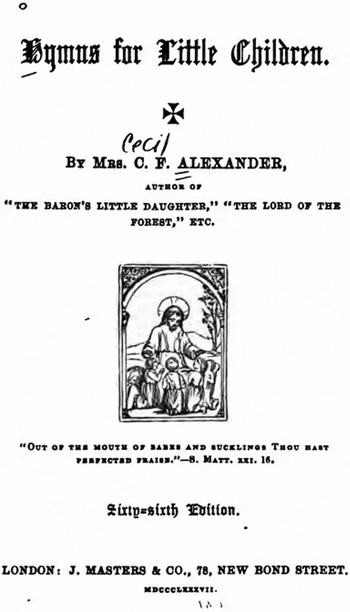
Yet Alexander did not necessarily need a patriarch to commend the book; it became an extremely popular hymnbook for children, going through more than one hundred editions (Figure 9). It also inspired composers who set its hymns to music: for instance, H. J. Gauntlett's Hymns for Little Children (Reference Alexander1858) provided tunes for every poem.Footnote 28 One reason for its popularity is the broad exploration of faith she offers for a child's comprehension. Assuming the child to be a tabula rasa, “knowing neither good nor harm” (Hymn No. 4), Alexander presents the basic tenets of the Anglican Church – the Three Promises, the Apostles’ Creed, the Lord's Prayer – for his / her edification. Some concepts are not simple; for example, in No. 3 Alexander attempts to explain the Trinity in undemanding language:
Here, the tripartite God is explained simply, invoking children with its repeated first line. The trochaic tetrameter and ABCB rhyme scheme are also straightforward. In fact, most of her poems utilize simple meter (iambic trimeter in No. 5, iambic tetrameter / long meter in No. 13, for example), most using iambic tetrameter / trimeter which aids their readability and also links them with common tunes written in “CM” (common meter). Within the scope of my survey, I note that many hymns were never very popular (for example, “Put the spade and wheel away,” No. 24, or “There are strange countries far away,” No. 22). However, three became extremely popular: “All things bright and beautiful,” “Once in royal David's city,” and “There is a green hill far away,” which I found in 15 of 50, 12 of 50, and 12 of 50 hymnbooks, respectively. The first, perhaps the most famous, was set to the simple lines from the Apostles’ Creed, “Maker of Heaven and Earth” (No. 9), which prompts Alexander's reflections upon “creatures great and small”:
As Watson writes, “Its strength comes from its unquestioning simplicity of language and idea, as the child celebrates small things of nature (flowers, the colours of birds) and the magnificent ones (sunsets, mountains)” (Anthology 283). Using simplified religious concepts, basic meters, and animal imagery, Alexander appeals to a broad audience of children.
C. F. Alexander's Hymns for Little Children (Reference Alexander1848), here in its sixty-sixth edition (1887), her name finally acknowledged. From The Internet Archive.

As this example reveals, however, Alexander perhaps appeals to children too successfully. Her title, Hymns for Little Children, and her dedication to her “little godsons” both expose an overuse of the term “little.” “Little” is not only applied to young children, it is applied to birds, flowers, and lips. In fact, seventeen of her forty hymns (Nos. 1, 3, 4, 5, 9, 11, 13, 14, 16, 20, 21, 23, 25, 27, 30, 31, and 32) use the term, most often in reference to “little children”: “Hush! little Christian child” (No. 23) and “a little orphan child” (No. 32). This raises various problems for her. For one, infantilizing children has opened her to criticism: modern hymn writer Elizabeth Cosnett has accused her of carrying “to its extreme the Victorian stress on the littleness of children” (qtd. in Bradley 133). As critic Watson also charges, “The word ‘little’ has a respectable provenance, from Matthew 18 . . . [Yet] Words such as ‘dear,’ ‘warm,’ ‘soft,’ and ‘little’ encourage a certain deliberate naïvety, a refusal to enter the grown-up world, especially when the words are spoken by children” (English Hymn 431). Appealing to children by invoking littleness indirectly reflects upon her, Alexander, as refusing to “enter the grown-up world.” Granting that “little” can simply denote young children, Alexander's use of multiple diminutives lends credence to these criticisms.
“Little” is certainly a frequent descriptor of children throughout the nineteenth century, confirmed by the Oxford English Dictionary: “used specially of young children or animals” (definition 2a, 1040). It was also used with women, however, as the OED's first definition, making “little” synonymous with “small,” implies by its illustrative quotation from Thackeray's Pendennis of 1849: those “who prefer littler women” (OED 1040). The title of Alcott's famous novel reiterates this popular rhetoric for, indeed, her “little women” are not only not small children, they are on the verge of womanhood. And certainly the definition of “inferior in rank” (OED, definition 8b, 1040) haunted women whose smallness seemed to reflect an inferiority to men in strength and wisdom. Consider Sarah Stickney Ellis's advice in Daughters of England (Reference Ellis1842), “As woman, then, the first thing of importance is to be content to be inferior to men – inferior in mental power, in the same proportion that you are inferior in bodily strength” (97). The term “little” is further problematized when considered alongside debates of the era in which the common descriptors of women as “small” and “inferior” were backed up by science: Robert Boyd (1839) and Veroidt (1847), among others, determined that the female cranium was noticeably smaller than the male's (Helsinger, Sheets, and Veeder 75). George Romanes (Reference Romanes and Rowold1887) made the next deductive leap: “Seeing that the average brain-weight of women is about five ounces less than that of men, on merely anatomical grounds we should be prepared to expect a marked inferiority of intellectual power in the former.”Footnote 29 Thus, scientific theory of the period confirmed popular assumptions that the term “little” not only applied to women, it was virtually synonymous with the term “inferior” to distinguish women's abilities from those of men.
Alexander might have become trapped in her own rhetorical conventions, children's littleness uncomfortably rubbing off on herself and women in general, as in her hymn already quoted, “We are but little children weak.” On the other hand, in many hymns she appears to challenge this ideology. For instance, Alexander reverses thoughts about bodily strength when asserting a kind of “muscular Christianity” in many of her hymns. If the audience is arguably children and women, it is noteworthy that they are often referred to as “Soldiers in our Master's host” (Hymn 4, v. 3) and are empowered to fight: “We are soldiers doing battle” against temptation (Hymn 7, v. 5). Further, children have the capacity to learn this “fight”: “Ye are new-born Christians, / Ye must learn to fight / With the bad within you, / And to do what's right” (Hymn 5, v. 6). The metaphorical fight against sin and temptation, almost invoking the struggle of David and Goliath, gives power to those considered to be “inferior in bodily strength,” child and woman alike.
Alexander frequently compares child and mother, empowering both. She reminds her audience that the same terms – “child” and “little” – can also be applied to God: “God [became] a Child on earth” (Hymn 2, v. 5); “He [Jesus] was little, weak, and helpless” (Hymn 11, v. 4). Yet He is weak no longer: “Never more a helpless Baby, / Born in poverty and pain,/But, with awful glory crowned” (Hymn 14, v. 3). Many hymns feminized the Christ throughout the century.Footnote 30 So His glory becomes not only a child's but a woman's, and, ultimately, all people's: “Parents, children, every one, / Then shall stand before His throne” (Hymn 14, v. 4).
Many of these concepts are delineated in one of Alexander's most famous hymns, often sung at Christmas time, “Once in royal David's city” (Hymn 11). Here, Jesus’ childhood is emphasized to heighten a child's understanding and confidence:
Suspense is built, especially when used with the traditional, haunting melody “Irby,” by H. J. Gauntlett (1849) already mentioned. Then lines 5 and 6 reveal the “mother” and “Baby” to be the most important mother and child in Christianity. Verse Four pursues these implications:
Emphasizing Christ as “little, weak, and helpless,” Alexander sets up these attributes only to challenge them:
The dear and gentle Christ is now “Lord in Heaven.” Further, the motif of all people as God's children is not lost upon Alexander: “And He leads His children on” does not necessarily denote youth now. In the next verse, she reiterates,
Male and female, young and old, can all be called “children” to the Child, as Alexander plays with and inverts the meaning of “child.” Ultimately, those who are termed “little” and “children” in this world shall, like the Crowned One, be empowered in the Life beyond.
In short, women writers of hymnbooks for children frequently employed rhetorical strategies that proved successful with children but counterproductive for asserting their own authority. First-person narration, regularly used by Leeson, worked to her disadvantage, as author is confused with the child “I.” Likewise, Alexander's habitual use of diminutive language to appeal to children also demeaned the woman writer. Both recoup authority, though, in engaging the human life of Christ, alluding to His human mother and His own childhood. Feminized and frail, both Mary and her Son are yet worthy of adulation by the entire Christian community. Comparable in their humble smallness and childishness, women writers’ status would rise accordingly.
IV. “Nearer My God, to Thee”: Private Hymns for Public Consumption
Not all women hymn writers were as prolific as Leeson and Alexander; most, in fact, were known only for a handful of individual hymns or became famous solely for one hymn. In a sense, theirs were the most personal works, often written for themselves or their children and, when found later, published by others. Because these were personal reflections, their privacy was intruded upon when their hymns were taken into the public realm. Furthermore, none of these women could hide behind anonymity; unlike the editors and writers just discussed, these women have become inextricably associated with their hymns and clearly credited with authorship. This often happened because of the striking stories of their personal struggles. Their vulnerability thus fueled their fame. For example, Harriet Auber, author of the popular “Our blest Redeemer, ere He breathed” (1829), living a sheltered life in Herfordshire villages as the daughter of an Anglican vicar, is said to have inscribed this hymn on a windowpane with a ring (McCutchan 225). This action suggests that the hymn was indeed of a personal nature, being cut with the ring from her own finger. But when published, it became a popular hymn throughout the century.Footnote 31 Another very popular hymn for children (in twenty-nine of fifty hymnbooks in my study), “I think when I read that sweet story of old” (1841), the only hymn of Jemima Thompson Luke to become widely known, became so because of patriarchal intervention. Inspired to write the hymn after hearing school children singing a Greek marching tune, Luke later shared it with her father who sent it himself – without her knowledge – to the Sunday School Teacher's Magazine which printed it the next month (McCutchan 440).
In general, women used hymn writing for private reflection in contrast to men's more public ambitions. This use affected their hymns’ imagery and themes. The contrast is best demonstrated by closely examining three popular hymns for children by women and pairing each with comparable, popular hymns by men. All of the hymn writers reflect on Jesus as shepherd, as the glory of heaven, and in a close relationship with God. Analyzing these six hymns suggests gender-based differences in approach to their child audience and in imagery, but little difference may be seen in the writers’ theological understanding and poetic ability.
In the first instance, both Mary Lundie Duncan and Hugh Stowall wrote hymns for children about Christ as a shepherd. Duncan was a hymn writer whose popularity rested on this one song: “Jesus, tender shepherd, hear me” (c.1830). Daughter, then wife, to Anglican ministers, she wrote twenty-three hymns for her own children with no intention of publication. Yet after she died in 1840, her mother included this hymn in a Memoir (1841) and then in Rhymes for My Children (1842) (McCutchan 447). Duncan became famous, but it was a fame she herself had avoided. In short, this is an example of personal, utilitarian hymn writing made public clearly beyond the intentions of the author. This song is, after all, an intimate bedtime hymn for a child:
The speaker is a child, “Thy little lamb,” appealing to Jesus, the Shepherd, to “Listen to my humble prayer”:
The child is not sinless (“Let my sins be all forgiven”) but innocently expresses gratitude and asks for blessings for friends. Another of the poem's Evangelical aspects is its harking back to Thomas Ken's famous Evening Prayer, which includes the line “And if I die before I wake,” asking Jesus to “Take me, when I die, to heaven,” although Duncan's hymn does not make death quite as immediately dire as Ken's does. Clearly for children, the meter is Common (4.3.4.3), making it easily set to such tunes as the simple German tune “Dijun” with its high, child-like leaps up to sixths. (See Hymn No. 203 in 282 Hymns and Melodies for School and Family Use, edited by E. W. and J. Gall Inglis [Reference Inglis and 1893], for example.)
This hymn can be compared to another about Jesus's shepherding, “Jesus is our Shepherd wiping every tear” by Hugh Stowell (1849), an Oxford graduate, rector, then Dean in the Anglican church. He was a “popular and effective preacher” and a prolific hymn writer, quite a few of which were known to children (Julian 1096–97). In this, his most famous hymn, Stowell unpacks the image of shepherd for his congregation, as the singers take on the role of nurtured lambs:
Christian doctrine is woven in, describing the passion amidst the shepherding imagery:
Invoking the twenty-third psalm (“The Lord is my shepherd”), the hymn describes the lambs’ worldly journey metaphorically:
Stowell takes the shepherd image and uses it to reflect on the Passion and the ethereal nature of Jesus, using references to the shepherd as well as to “death's valley” (the psalm's “valley of the shadow of death”). In contrast to this complex intertextuality, Duncan selects one literal moment of “gloom” for a child – the moment before sleep – and uses child-like language to comfort him. In first-person plural, Stowell's hymn is about the many sheep, while Duncan's first-person singular prose invites the child to be the sheep in a personal, prayerful outpouring. More metaphoric and image-filled, packed with doctrine and biblical allusions, Stowell's hymn speaks more to adults, an idea perhaps strengthened by the more complex, rhythmic tunes often used with it (see No. 25 in 282 Hymns and Melodies, for example). These hymns reflect their different purposes, home lullaby as opposed to congregational singing.
The heavenly reward is another common topic: “There is a happy land” by Andrew Young (1843) and “Around the throne of God in heaven” (1842) by Anne Houlditch Shepherd, both popular hymns for children, rank twenty out of fifty hymnbooks and sixteen out of fifty, respectively, in my study. Young, a teacher in Scotland, based his hymn on a rhythmic “Indian air” called “Happy Land,” which he heard a friend play on the piano. He composed a hymn to be used in his own Edinburgh school, intending it to be publicly sung, then allowed Rev. James Gall to use it in his popular Sacred Song Book (1843). According to Julian, by the turn of the century, it was “now to be heard in Sunday Schools all over the world,” having been translated by various missionary organizations (1161). Pitman tells the story in which William Makepeace Thackeray was brought to tears hearing poor children in the street singing the hymn (47). It became a very public hymn, heard in Sunday Schools and the streets, transcending class and age.
In dactylic dimeter and a 6.4.6.4.6.7.6 hymn meter, its rhythm carries the short lines, as do the unusual rhyme scheme (ABABCCCB) and refrains that “punch” the meaning:
The second stanza especially invites the reader to “Come to this happy land” and questions “Why will ye doubting stand?” The third stanza reminds the singer, “Bright is that happy land . . . Love cannot die.” By the conclusion, the narrator encourages the singers, using the rhetoric of a competitive race, “to glory run”:
The competition that ensues ends in winning a crown and a kingdom. Alliteration (bright-beams-be), reference to “a Father,” and enthusiastic encouragement make this appealing to children without once addressing them.
Similarly, Anne Shepherd's “Around the throne of God in heaven” invokes a heaven where singing and brightness are also portrayed, but where she specifically imagines children:
It was first published in her Hymns Adapted to the Comprehension of Young Minds; the date of composition is undetermined, but by 1838, Dr. Moffat had translated it for his Kuruman Collection (Julian 83), while J. M. Neale used it in his 1842 Hymns for Children (Claghorn 220), both before Shepherd finally published it in her own Hymns Adapted to the Comprehension of Young Minds (1847, Claghorn, 220). Later, “in very extensive use in America and other English-speaking countries” (Julian 83), the hymns that Shepherd writes seems always to have children in mind. Her questions are not the insistent questions of Young's (“Why will ye doubting stand?”) but are a child's questions:
The child then appears to answer: “Because the Saviour shed His blood . . . Behold [the children] white and clean!” (v. 3). Assonance (“fair-Where” and “stand-Lamb,” verse 3), alliteration (“Because-Bathed-Behold,” verse 2), and simple repetition (“Singing glory, glory, glory,” verse 1) make this hymn poetically interesting for the child, as does the correspondingly “bright” tune with runs and quarter notes (as found as Hymn No. 237 in 282 Hymns and Melodies). The final verse provides the religious moral:
Markedly in contrast to Young who enforces the work ethic of achieving heaven, of the race being won, Shepherd reverts to Christ's atonement which allows a child immediate acceptance into heaven to “see His blessed face.”
Finally, two hymns which reflect upon the presence of God during darkness and death are the most complicated because initially neither was intended for children. They might be considered “crossover hymns” in that they gradually gained favor with children's hymnbook editors and became popular inclusions in children's hymnbooks. Henry F. Lyte's “Abide with Me” (1847) was found in twenty of the fifty children's hymnbooks in my study, and Sarah Flower Adams's “Nearer, my God, to thee” (1841) was found in fifteen of fifty. I choose these hymns, not only for their popularity in children's hymnbooks, but also to suggest the fluidity between what was even considered a child's hymn and an adult hymn in this period. Child-directed hymns, such as Alexander's “All Things Bright and Beautiful,” entered common usage while Adams's “Nearer, my God,” written for adults, quickly found its way into many children's hymnals. Too, these two hymns display theological and gender differences about a common Christian theme: death.
“Abide with me! Fast falls the eventide” was based on Luke 24.29, where the disciples ask the risen Christ to stay with them as the day ends: “Abide with us: for it is toward evening, and the day is far spent.” The writer, Henry Francis Lyte, uses the verse to reflect upon the death of a friend but makes the invocation personal and individually focused: “Abide with me.”
Published shortly before Lyte's death in 1847, the hymn, with its line about “the eventide,” quickly became associated with death. As Watson writes, “The long and beautiful lines allow the reader or singer to feel the movement of the hymn slowly and carefully, and to understand the unobtrusive connection between ‘the eventide’” and death (Anthology 274). The haunting melody “Eventide,” written by William Henry Monk for Lyte's text, emphasizes the sorrow and seriousness of the poem and, as Watson notes, greatly contributed to the hymn's popularity (275). In fact, it became a powerful inspiration to those on their deathbed and for use at funerals in the late-nineteenth and early-twentieth centuries, bells tolling it at President Howard Taft's funeral (McCutchan 502–03).
Its great appeal to adults is reinforced by powerful but complex poetic devices:
In verse one, the repeated last lines (epistrophe) of “abide with me” are used as a chiasmus of “with me abide” (v.1). Similarly, syntax is cleverly inverted to describe God's intervention in human relations: “help of the helpless” and “Change and decay in all around I see / O thou who changest not” (v. 2). These poetic devices imply a more mature poetry-reading audience. Although not intended for children, it was selected by hymnbook editors throughout the century as being appropriate for children.
The message enforces a complete dependence on God, in stark contrast to concerns of this world where “helpers fail” and “comforts flee.” The narrator must refrain from dwelling on “Earth's joys” and “glories” which “pass away.” He is much concerned for the “tempter's power”:
The use of questions shows both religious doubt and confirms religious assurance by the end:
This triumph parallels Stowell's: competitively, “I” defeats the enemy, death. By the end, the narrator clings to the idea of heaven, the cross pointing the way:
Much of the poem is preoccupied with “Earth's vain shadows,” that is, concerns of this world: competition (“triumph”), pride (“Earth's . . . glories”), temporal change (“Change and decay”). Arguably, these topics also suggest typical male concerns of the period. Seeking assurance that God will indeed “abide with me” in life and death, the speaker closes the poem.
This hymn contrasts to a similar one focused on death by Sarah Flower Adams. Adams, a Unitarian, belonged to a circle of radicals which included Harriet Taylor and Harriet Martineau, a group which believed in “the importance of aesthetic emotion in religious feeling and their corresponding equation of nature and art as agents in moral life” (Hunter 6). Her “Nearer, my God, to thee” (1841) was intended by her for publication, making her atypical of her many anonymous sister-writers. It became her most famous hymn and anticipates many of Lyte's themes in looking to death after struggles here on earth:
First published in Rev. William J. Fox's Unitarian collection, Hymns and Anthems (1841), it became so popular as to be included in the first edition of Hymns Ancient and Modern (1861) where it was set to J. B. Dykes's tune “Horbury.” Many others set it to music, including Arthur Sullivan (tune “Propior Deo,” 1872) and Lowell Mason (tune “Bethany,” 1859). At least one other writer, William Walsham How already discussed, wrote his own version of it (Watson, Anthology 282). President Taft may have preferred “Abide with Me,” but President McKinley was said to have quoted the refrain of “Nearer my God” on his deathbed and it was used in his memorial services across the country (Nutter and Tillett 170). It was even said, perhaps apocryphally, to have been played by the band while the Titanic sank (Watson, Annotated 282). These, among other stories, reflect the public infatuation with this hymn.
Its rhyme scheme, ABCBDDD, is unique and emphasizes the recurring refrain, “Nearer, my God, to Thee, / Nearer to Thee.” Appearing onstage as an actress for a time, Adams can be seen taking a dramatic approach in her delineation of the story of Jacob's dream in first person:
Here, the speaker / singer is described “as a wanderer, in the darkness,” presenting “a very powerful mixture of human suffering illuminated by the practice of the presence of God” (Watson, Anthology 282). Jacob focuses on the agony of being a wanderer, lacking a home, where the only bed to lay his head is on a stone (v. 2).
This speaker / singer discusses various moments as he climbs “Nearer to Thee”: first, led by a cross, then, “in my dreams,” later beckoned by angels through “my woes,” and finally “[c]leaving the sky.” In this journey the sufferer is overcome with darkness but, being beckoned and shown “Steps unto heaven,” he wakes “Bright with Thy praise”:
Despite the sorrow alluded to, brightness overcomes the dreary: “darkness be over,” “out of my stony griefs,” and “so by my woes” are balanced by “bright with thy praise,” “in mercy given,” and “Upward I fly.”
The position of the speaker is notable in both of these hymns. They are told in the first person, but Lyte tends to emphasize the first-person subjective (I) and objective (me). He “commands” God to stay: “Lord, with me abide!” Adams's song also speaks to personal moments of loneliness, of darkness, of wandering. The predominant pronoun is “Thee,” and rather than demanding, she wishes (“dreams” of) a nearer connection with God. Never invoking concerns of this world as Lyte does, Adams is already “nearer to Thee.” The imagery – climbing, rising, then flying upward – contrasts with Lyte's, whose narrator begs God to hold “Thy cross” and “point me to the skies.” Adams's narrator actively propels himself vertically through sheer faith, a Unitarian ideal in contrast to the atonement alluded to by Lyte.
To generalize, there are not huge differences when men and women pen hymns on similar topics. They express basic tenets of Christianity in powerful poetics and imagery. In fact, the women's hymns may have influenced the men's since, without exception, within these pairs women's hymns were written prior to those of their male counterparts. However, small differences in their imagery and composition can be delineated, men's hymns being more notably outward-directed and “public.” Their socially confident attitude is reflected in the rhetoric of their hymns: insisting, almost admonishing, their singers “Why will you doubting stand?” and demarcating the allures of heaven from the social constructs (competitive ventures and “valleys”) of this world. Men use basic Christian imagery – Jesus as a shepherd – but nothing that directly relates to children, even in the first two examples written for children. Women hymn writers rarely addressed public situations, often because their original context was that of private meditations with family. This difference is reflected in the hymns: bedtime comforts, gentle questions, and rhetoric of the child show an awareness of their young audience, and hymns focused more on “Thee” than “I” model a humble faith. Women hymn writers emphasize the domestic realm; even Adams, in recounting a biblical story of wandering, focuses on the lack of the domestic, no home to rest one's head. In considering gender differences in American hymns, June Hadden Hobbs comes to similar conclusions: “But for half a century female hymnists created texts that undermined patriarchal religion by centering power in the home rather than in the church, by locating God within themselves, by separating physical intimacy from sexual submission, and by emphasizing service rather than conquest” (103).
In denoting the domestic and daily, personal and private in their hymns, then, women convey an image of the Holy Spirit stirring in the daily lives of Christians, giving more impetus to these hymns. Ultimately, the domestic imagery used in women's hymns suggests a space that is not confining but that naturally leads heavenward, “nearer, my God.”
Conclusion
Many women hymn writers and editors attained fame and influence during and after their lifetimes, their hymns and books continuing to be published many decades after their first appearance. Their interpretations of theology influenced many generations of children. They were clearly at the center of children's hymnody, but this centrality oftentimes suggested more embedded patriarchy which they came under or overcame. Men still provided the impetus for publication, either as patrons or even appropriators of their works (recall Luke's father publishing her hymn without her knowledge). And, in appealing so successfully to children, women may have worked too well and diminished the value of their own writing because of its associations with children, marginalizing it even to modern-day critics. Still, women's strategies of recuperation can be seen throughout their works. Writing anonymously, women praise The Divine Mystery; writing as children, women extol The Child and Motherhood; writing privately, women embrace the daily and domestic. The fact that they use children to then sing their feminist politics deserves more attention for children were the ones to actually mouth the words urging kindness to the weak, extolling anonymity, empowering motherhood. Yet it would not be the first time that children would sing adult-driven political and theological ideologies, beginning even with Watts's and the Wesleys’ hymns. In fact, these feminist politics raise the child up with the woman accordingly, he who was as small and she who was as unseen.
Ultimately, women writers metaphorically sought sanction from the Trinity itself: from God, the greatest of Invisible Beings; from Jesus, His child-like purity, humility, and suffering becoming a template for all; and from the Holy Spirit, who works amidst the domestic and personal. To women of faith, there could be no higher authority to claim.