


INTRODUCTION
Multiple sclerosis (MS) is a neurological disorder which affects 400,000 individuals in the US (Markowitz, Reference Markowitz2014). Persons with MS report disruptions in social/community participation, as well as the ability to engage in family life and fulfill household responsibilities (Goverover, Strober, Chiaravalloti, & DeLuca, Reference Goverover, Strober, Chiaravalloti and DeLuca2015). Of note, many of these problems have been linked with both cognitive and motor dysfunction in this population (Benedict et al., Reference Benedict, Holtzer, Motl, Foley, Kaur, Hojnacki and Weinstock-Guttman2011).
Cognitive impairment is prevalent in MS, affecting up to 70% of the population, primarily in the domains of processing speed, learning and memory, and executive function (Chiaravalloti & DeLuca, Reference Chiaravalloti and DeLuca2008). MS-related cognitive impairments are known to be associated with higher levels of unemployment (Strober, Chiaravalloti, Moore, & DeLuca, Reference Strober, Chiaravalloti, Moore and DeLuca2014), poor quality of life (Barker-Collo, Reference Barker-Collo2006), and difficulties with daily life activities (Goverover, O’Brien, Moore, & DeLuca, Reference Goverover, O’Brien, Moore and DeLuca2010). For example, impairments in processing speed, memory and executive functions also lead to difficulty with food preparation (Goverover et al., Reference Goverover, Strober, Chiaravalloti and DeLuca2015), shopping, and money management (Goverover, Haas, & DeLuca, Reference Goverover, Haas and DeLuca2016).
Similarly, motor impairments (i.e., ambulatory impairment and upper extremity motor impairment) are highly prevalent and disabling aspects of the disease. Over 90% of patients report experiencing mobility disability within 10 years of initial diagnosis (Van Asch, Reference Van Asch2011), and there is consistent evidence that persons with MS demonstrate worse walking speed, endurance, and spatiotemporal gait parameters compared with healthy controls (HCs), based on objective measures (Motl, Reference Motl2013). Furthermore, there is consistent evidence that persons with MS perform worse than HCs on tests of upper-extremity motor impairment (i.e., the 9-Hole Peg Test; Cutter et al., Reference Cutter, Baier, Rudick, Cookfair, Fischer, Petkau and Willoughby1999). As is the case with cognitive impairment, MS-related motor impairments are associated with unemployment (LaRocca, Reference LaRocca2011), reduced quality of life, and difficulties with activities of daily living (Motl, Reference Motl2013; Yozbatiran, Baskurt, Baskurt, Ozakbas, & Idiman, Reference Yozbatiran, Baskurt, Baskurt, Ozakbas and Idiman2006). Additionally, cognitive and motor impairments may co-occur in persons with MS (Benedict et al., Reference Benedict, Holtzer, Motl, Foley, Kaur, Hojnacki and Weinstock-Guttman2011).
MS symptoms may manifest differently with clinical course (or subtypes), though this area has been understudied (Lublin et al., Reference Lublin, Reingold, Cohen, Cutter, Sørensen, Thompson and Polman2014). The most common MS subtype, relapsing-remitting MS (RRMS) is characterized by clearly defined attacks of worsening neurological function, followed by partial or full recovery, with no apparent signs of major disease progression between relapses. RRMS often transitions into secondary progressive MS (SPMS), at which time the disease begins to progress more steadily, with or without relapses. Primary progressive MS (PPMS) is characterized by neurological functioning that worsens steadily from disease onset. Relapsing-Progressive MS is characterized by a steady decline since disease onset, with super-imposed attacks.
Most studies have shown that individuals with RRMS show less cognitive or motor impairment when compared with the progressive forms of MS (PMS) (Achiron et al., Reference Achiron, Chapman, Magalashvili, Dolev, Lavie, Bercovich and Barak2013; Brissart et al., Reference Brissart, Morele, Bauman, Le Perf, Leininger, Taillemite and Debouverie2013; Ruet, Deloire, Charré-Morin, Hamel, & Brochet, Reference Ruet, Deloire, Charré-Morin, Hamel and Brochet2013). However, in most studies, the RRMS group is younger, with less time post diagnosis compared to the PMS group. This represents a significant confound in the interpretation of study findings, as differences in cognitive and motor functioning between MS clinical courses might be driven by differences in demographic and clinical characteristics, rather than the disease presentation itself. This highlights the importance of improving our understanding of the impact of demographic factors and disease duration on cognitive abilities, everyday functional activities, and motor functioning in the various MS disease courses.
Disease severity (e.g., lesion load/ atrophy) is heterogeneous among persons with MS, but tends to increase with the duration of disease in all clinical disease courses (Achiron et al., Reference Achiron, Chapman, Magalashvili, Dolev, Lavie, Bercovich and Barak2013). Similarly, longitudinal studies have shown that cognitive decline, particularly decline in information processing speed (IPS), advances with increasing disease duration (Amato et al., Reference Amato, Portaccio, Goretti, Zipoli, Iudice, Della Pina and De Stefano2010). However, the association between disease severity, cognitive abilities, and everyday functional activities, when controlling for demographic factors and disease duration, has been poorly examined. For example, Huijbregts and colleagues (Reference Huijbregts, Kalkers, de Sonneville, de Groot, Reuling and Polman2004) reported significant differences in cognitive performance between disease courses; however, the RRMS group was on average 10 years younger (mean age=35.5 years; SD=8.8) than the SPMS group (mean age=45.1 years; SD=8.2), and the SPMS group was on average 9 years younger than the PPMS group (mean age=53.9 years; SD=11.6).
Thus, from such data, it remains unclear if the reported differences in cognitive function between disease courses are actually driven by MS clinical courses or differences in age. The aim of the current study was to examine whether differences between HC, RRMS and PMS on cognitive functioning, motor function, and everyday functional activities remain after controlling for age, education and time post diagnosis. It was hypothesized that impairments in cognition in MS would be associated with disease progression and severity, rather than the disease course. That is, individuals with MS would demonstrate impairments independent of the clinical disease course. To our knowledge, this is the first study assessing cognitive, motor, and everyday functional activities in a matched HC, RRMS, and PMS sample.
METHOD
Participants
The current study is a secondary analysis of previous published data (Kalmar, Gaudino, Moore, Halper, & DeLuca, Reference Kalmar, Gaudino, Moore, Halper and DeLuca2008), collected from a community sample between 2000–2004. The sample included 42 individuals with clinically definite MS diagnosed according to the diagnostic criteria generally accepted at the time of data collection (Poser et al., Reference Poser, Paty, Scheinberg, McDonald, Davis, Ebers and Tourtellotte1983), determined by board-certified neurologist with a specialization in MS. Participants were classified into two groups based on the disease course: a RRMS group (n=21) and PPMS group (n=8) and SPMS group (n=13). Participants with PPMS and SPMS did not differ significantly on all measures of cognitive and motor functioning, everyday life activities, or demographic and disease characteristics. Thus, it was decided to combine the two disease courses into one group. Additionally, 21 HCs were included. Participants from the three groups were matched (within <6 years of one another) on age, education, and disease duration, the latter only for the MS groups.
A total of 8 participants with RRMS (cane=6, walker=1, and wheelchair=1), and 20 participants with PMS (cane=11, walker=5, and wheelchair=4) used assistive devices for ambulation. As expected and similar to previous research (Goldman et al., Reference Goldman, Motl, Scagnelli, Pula, Sosnoff and Cadavid2013), participants who used assistive devices for ambulation needed more time to complete the 25-foot walk test (M=21.52; SD=12.44) than participants who did not use assistive devices (M=7.2; SD=2.2), (t(29)=−5.81; p<.01).
Participants with MS were free of exacerbations for at least 1 month before enrollment in the study. Individuals with a history of any neurological disease besides MS, significant psychiatric disorders (e.g., bipolar disorder, schizophrenia, major depressive disorder, obsessive compulsive disorder, severe anxiety disorder), substance abuse, taking medications that could have affected performance (positively or negatively), or learning disabilities were excluded from study participation. Additionally, all participants were free from treatments with steroids, benzodiazepines, and/or neuroleptics. All participants completed a consent form approved by the Kessler Foundation Institutional Review Board before enrollment in the study.
Neuropsychological Measures
The following neuropsychological tests were administered:
Pre-morbid intelligence
The Wide Range Achievement Test-Third Edition (Wilkinson, Reference Wilkinson1993) consists of 42 irregularly spelled words. The dependent variable was the total number of correctly read words.
Working memory
Digit Span (Wechsler, 1981): The task has two parts: digits forward (participant is instructed to repeat the numbers in the same order) and digits backward (participant repeats the numbers in reverse order). The dependent variable was total number of correct responses. The Paced Auditory Serial Addition Test (Miller, Rudick, Cutter, 1993) presents participants with 60 single digits one at a time at a rate of 3 s on audiotape. Participants are asked to add each digit to the digit heard immediately preceding it and report the sum aloud. The dependent variable was total number of correct responses.
Executive functions
The Wisconsin Card Sorting Test (Heaton, Chelune, Talley, Reference Heaton, Chelune, Talley, Kay and Curtiss2000) instructs participants to sort cards into categories that must be deducted from examiner feedback. Dependent measures were the number of categories achieved and the number of perseverative errors made by the participant. In the interference subtest of the Stroop Test (Golden, Reference Golden1976) participants are instructed to name the color in which the word was printed and not read the word. The measure of interest was the total number of correct responses on the interference trial.
Learning and memory
The modified Selective Reminding Test (modified SRT; Buschke & Fuld, Reference Buschke and Fuld1974): Ten semantically related words were read aloud to the participant, followed by instructions to say aloud as many of the words as they can recall. During subsequent trials, participants were reminded of the words they omitted and asked to repeat the entire list again. The task continued until all 10 words were recalled on 2 consecutive trials, or until 15 trials were administered. The dependent measure was the number of trials to reach the learning criterion.
IPS
The Symbol Digit Modalities Test (SDMT, oral version; Smith, Reference Smith1991), requires participants to pair symbols with numbers as quickly and accurately as they can. The dependent variable was the total number of correct responses in 90 s. In the Stroop Test word reading subtest, the participant is instructed to read the words (names of colors). On the color naming subtest, participants are instructed to name the color font that the letters XXXX are printed in.
Test scores for all participants were converted to Z-scores based on the means and standard deviations from HC participants. When more than one test score was used per cognitive construct, Z-scores of the individual tests were averaged and a composite Z-score for that domain was created.
Motor Function
Walking speed (i.e., lower extremity motor function) was assessed with the 25-foot walk test (Cutter et al., Reference Cutter, Baier, Rudick, Cookfair, Fischer, Petkau and Willoughby1999), in which participants were asked to walk for 25 feet as quickly as possible. The primary outcome was the average time to complete the task across two trials.
Upper extremity motor functioning was evaluated with the 9-Hole Peg Test (Cutter et al., Reference Cutter, Baier, Rudick, Cookfair, Fischer, Petkau and Willoughby1999). In this test, participants are instructed to place and remove nine pegs on a board with nine holes. The dependent variable was total time needed to complete the task.
Everyday Functional Activity
Everyday functional ability was assessed with the Executive Function Performance Test (EFPT; Baum et al., Reference Baum, Connor, Morrison, Hahn, Dromerick and Edwards2008). In this test, participants were required to perform six everyday tasks: washing hands, cooking oatmeal, cooking a casserole, using a telephone, managing medication, and paying a bill (for a complete description of tasks see Kalmar et al. (Reference Kalmar, Gaudino, Moore, Halper and DeLuca2008). Each task was divided into five procedural skills: initiation, organization, sequencing, judgment and safety, and competition. For each of the skills, behavior was scored using a scale from 0 to 5 based on the level of cuing required. Thus, functional capacity was measured through observation of the level of assistance an individual required to complete a task.
The nature and degree of cueing required by the examinee reflected the level of functional disability. The standardized cueing system used for the EFPT was a hierarchical series of verbal, gestural or physical assistance. Cueing was not provided to the participant until task execution began to fail. The cueing system was rated as follows: no cueing (0 points); verbal guidance (1 point), gestural guidance (2 points), direct verbal instruction (3 points), physical assistance (4 points), done for participant (5 points). For each of the six tasks, the five cueing skills scores were totaled, creating a summary score. Finally, these summary scores were added to compose an EFPT total score. Thus, a lower score describes functional independence while higher score indicates that more cuing was needed while performing activities of daily life (ADLs).
Test administration order was the same for all participants. The neuropsychological assessment battery and the EFPT were administered in different testing sessions, in pseudorandom manner.
Data Analysis
Scores obtained by the RRMS, PMS and, HC groups on cognitive indices, motor function, and the EFPT were analyzed using one-way analyses of variance (ANOVAs); post hoc analyses were conducted with post hoc Tukey test. Effect sizes were calculated with partial eta-square (small .01, medium .06, large .14) and Cohen’s d (small .2, moderate .5, and large .8).
To examine the influence of motor disability on cognition and everyday functional activities, as a secondary analysis, participants with MS were grouped based on their performance on the 25-foot walk test. Based on published benchmarks for clinical meaningfulness (Goldman et al., Reference Goldman, Motl, Scagnelli, Pula, Sosnoff and Cadavid2013) individuals who executed the test within 7.99 s (average of two trials) were classified into a mild-to-moderate motor disability group, whereas those who required 8 s or more to accomplish the task were classified into a severe motor disability group. To analyze group differences between the mild-to-moderate and severe group on cognitive indices and EFPT, independent samples t tests were performed.
Bonferroni correction was used to control for Type 1 error and a p value of .02 was thus considered significant.
RESULTS
Examining Differences between Disease Courses
Demographic characteristics are provided in Table 1. The three groups did not differ in mean age, years of education, or premorbid level of verbal intelligence. By design, the two groups with MS did not differ in disease duration. Twenty participants with MS were taking disease modifying medications at the time of study participation (N=6 Avonex, N=3 Betaseron, N=10 Copaxone, and N=1 Novantrone). There was a significant difference between the groups in gender (χ2(3, N=63)=6.2; p=.05); women comprised 90.5% of the RRMS group, 57.1% of the PMS group and, 76.2% of the HC group. No significant differences between groups were found in ethnicity (χ2(6, N=59)=11.06, ns); 84.7% were Caucasian, 10.2% African Americans, 3.4% Hispanics, and 1.7% Asian. Additionally, significant group differences in employment status were observed (χ2(6, N=63)=32.06; p<.01); 33.3% of participants in the PMS group were working (full or partial time), in contrast with 61.9% of the RRMS group and 100% of HC group.
Demographic characteristics by group

a WRAT 4=Wide Range Achievement Test (Wilkinson, Reference Wilkinson1993).
ns=not significant.
Cognitive Function
The scores on cognitive measures are reported in Table 2. There were significant group differences for IPS (F(2,61)=11.81; p<.01;
 $\eta _{p}^{2} $
=.29), such that the two groups with MS, the PMS (p<.01; d=1.62) and RRMS (p=.02; d=.94), showed significantly poorer performance on IPS then the HC group, both representing a large effect size. No statistical significant difference was found between the two groups with MS on IPS; however, a moderate effect size was noted (p=.17; d=.55).
Cognitive overall Z Scores in each domain by group
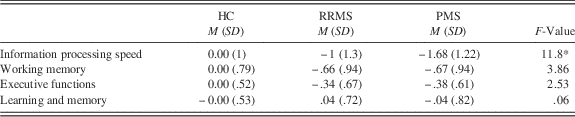
* p<.01.
No significant differences were found between the three groups on working memory (WM), executive functions, or learning and memory.
Motor Function
There were statistically significant group differences on timed 25-foot walk performance (F(2,61)=10.62; p<.01;
 $\eta _{p}^{2} $
=.27) (Table 3). The PMS group had poorer lower limb functioning (needing more time to complete a 25-foot walk on average) than RRMS (p=.01; d=4.15) and the HC (p<.01; d=6.44) groups. Performance on the 25-foot walk test was not statistically significant different between RRMS and HC groups. Similarly, significant differences between the three groups were found for the 9-Hole Peg Test (F(2,62)=11.32; p<.01;
 $\eta _{p}^{2} $
=.28), where the PMS group needed more time to accomplish the task in comparison with the RRMS (p=.02; d=.73) and HC (p<.01; d=1.44) groups. Again, performance on the 9-Hole Peg Test did not differ between RRMS and HC groups.
Performance on tests motor function and daily life activities performance by group

*p<.01.
** p<.05.
Everyday Functional Activities
Significant group differences were observed on the EFPT total score, (F(2,62)=8.09; p<.01,
 $\eta _{p}^{2} $
=.21), such that the PMS group required more cuing to complete the EFPT then the RRMS (p<.01; d=.88), and HC (p<.01; d=1.03) groups. No significant differences were found between the RRMS and HC group.
Regarding the EFPT subtests, significant group differences were found for telephone usage (F(2,62)=5.81; p<.01;
 $\eta _{p}^{2} $
=.16), medication management (F(2,62)=5.51; p<.01;
 $\eta _{p}^{2} $
=.16), and bill payment (F(2,62)=4.44; p<.02;
 $\eta _{p}^{2} $
=.13). Post hoc analysis for the telephone usage task showed that the PMS group required significantly more cues to successfully complete the task than both the RRMS (p=.03; d=.67) and HC groups (p=.01; d=.86).
The same pattern was found for medication management, where the PMS group performed worse than the RRMS (p=.03; d=.68) and HC (p=.01; d=.79) groups. Additionally, the PMS group (p=.01; d=.85) showed significantly worse performance on the EFPT bill payment subtest compared with the HC group. No statistically significant differences were found between the RRMS and HC groups on telephone usage, medication management, or bill payment.
Secondary Analysis: Examine the Influence of Motor Disability on Cognitive Functions and Everyday Life Activities
Participants with MS were grouped based on their performance on the 25-foot walk test [mild-to-moderate motor disability (n=14) and severe motor disability (n=27)]. The two groups did not differ significantly in age, gender, or disease duration. However, as expected, the two groups did differ in regard to disease course (χ2(1, N=42)=6.37; p=.01). Eleven (11) participants from the mild-to-moderate motor disability group had RRMS compared with 3 who had PMS. Ten participants from the severe motor disability group had RRMS, whereas 17 had PMS.
When comparing scores on the cognitive indices, the severe motor disability group performed significantly worse on IPS (t(38)=2.89; p<.01; d=.91) compared with the mild-to-moderate motor disability group. A significant negative correlation between walking speed and IPS was noted (r=-.34; p=.03), consistent with previous studies in MS (e.g., Sandroff et al., Reference Sandroff, Dlugonski, Pilutti, Pula, Benedict and Motl2014). No significant differences between the groups were found on WM, learning and memory, or executive functions.
The severe motor disability group performed significantly worse than the mild-to-moderate motor disability group on the total EFPT score (t(36)=−2.99; p<.01; d=.85), indicating more difficulties in daily life functioning.
DISCUSSION
After controlling for age, years of education, and disease duration across subtypes of MS, and as hypothesized, the RRMS and PMS groups did not differ on tests of WM, learning and memory, IPS, or executive functions. This contrasts with the majority of the literature showing that cognitive performance is more severely impaired in the progressive forms of MS, as compared with RRMS. Much of the existing research, however, is confounded by the fact that RRMS and PMS groups typically differ on demographic factors, thus complicating the interpretation of the group differences (Achiron et al., Reference Achiron, Chapman, Magalashvili, Dolev, Lavie, Bercovich and Barak2013; Brissart et al., Reference Brissart, Morele, Bauman, Le Perf, Leininger, Taillemite and Debouverie2013; Huijbregts et al., Reference Huijbregts, Kalkers, de Sonneville, de Groot, Reuling and Polman2004; Ruet et al., Reference Ruet, Deloire, Charré-Morin, Hamel and Brochet2013).
To that end, the results of the present study suggest that the typically observed differences in cognitive performance between relapsing and progressive presentations of MS might actually be driven by disease severity progression, rather than the clinical course itself. In line with our results, Whachowius, Talley, Silver, Heinze, and Sailer (Reference Wachowius, Talley, Silver, Heinze and Sailer2005) compared individuals with SPMS and PPMS of similar age composition, and found that the two groups did not differ on measures of attention, processing speed, memory, or executive functions. However, Whachowius and colleagues noted that the SPMS group performed better than the PPMS group on verbal learning.
Our results, and results from others highlight the importance of assessing cognitive, motor and everyday functional activities in all MS disease courses to fully understand the nature of disease progression. That is, it is often assumed by both clinicians and researchers that PMS will present with more severe and debilitating limitations across these realms of functioning, based on previous research. Such assumptions may impact the decision to pursue rehabilitation due to expectations of efficacy. Our data indicate that such conclusions may be inaccurate and may lead to less than optimal choices for rehabilitation of symptoms. Importantly, our results demonstrate the importance of considering demographic characteristics (i.e., age) and other disease related factors (i.e., duration of disease) in such decision making.
It is important to consider that, by controlling for age and disease duration, we may be reducing variability between RRMS and PMS groups inherent to the clinical course. RRMS progresses over time, eventually transitioning to SPMS (Lublin et al., Reference Lublin, Reingold, Cohen, Cutter, Sørensen, Thompson and Polman2014), thus it is expected that individuals with SPMS have a greater disease duration and age. Of note, one must consider that the transition from RRMS to SPMS is not yet clearly defined; in fact, some individuals with RRMS do not transition to a SPMS course or transition very late in disease progression.
In addition, the transition between RRMS and SPMS is dependent on decline in motor and sensorial functioning, and does not take into consideration changes in cognitive functioning. Both of these factors are highlighted by experts in the field; Lublin et al. (Reference Lublin, Reingold, Cohen, Cutter, Sørensen, Thompson and Polman2014) discusses the fact that we still lack clinical, imaging, immunological, or pathological criteria to diagnose/identify the transition between RRMS to SPMS. The transition is often diagnosed retrospectively by assessing the history of gradual increase of disability, often with a focus on sensorial and motor functions (e.g., Expanded Disability Status Scale), after the initial relapsing disease course.
In the current study, the PMS group showed significantly worse motor function than the RRMS group (as expected), but the two groups performed similarly on cognitive tasks. As shown by others (Amato et al., Reference Amato, Portaccio, Goretti, Zipoli, Iudice, Della Pina and De Stefano2010), disability increases as the disease progresses, even among individuals with RRMS. Thus, in line with the current results, cognitive impairment might be associated with other clinical variables (such as years since diagnosis, or disease progression) rather than disease course specifically. Importantly, in the current study, the two groups with MS had significantly worse cognitive function than the HC group. Thus, worse cognitive performance is present in MS, independent of disease course, and should be taken into consideration when evaluating disease progression and severity. More longitudinal studies are needed to understand the severity and progression of cognitive decline in MS as the disease progresses, as well as its relationship to biomarkers of inflammation and degenerative processes.
Motor disability and difficulties in everyday functional activities were greater in the PMS than the RRMS and HC groups. To the best of our knowledge, this is the first study to present a comparison of instrumental ADLs (IADLs) (i.e., EFPT) performance in individuals with RRMS and PMS controlling for demographic and clinical variables. Previous studies have found a discrepancy between performance of neuropsychological tests and performance of IADL tests, such that patients could perform a cognitive test similar to HCs; however, they needed substantial help to perform an IADL (Synhaeve et al., Reference Synhaeve, Schaapsmeerders, Arntz, Maaijwee, Rutten-Jacobs, Schoonderwaldt and De Leeuw2015). This phenomenon is replicated in the current study.
Secondary analysis of the present data demonstrated that those with worse motor disability had poorer performance on IPS and overall everyday functional activities, independent of age or disease duration. It is interesting to note that IPS was found to be associated with motor impairments in MS, but other aspects of cognition were not associated with motor impairments. This replicates previous work identifying relationships among SDMT scores, 25-foot walk test performance, and 9-Hole Peg Test performance in persons with MS (Benedict et al., Reference Benedict, Holtzer, Motl, Foley, Kaur, Hojnacki and Weinstock-Guttman2011). A careful examination of the tasks often used to assess IPS in MS (e.g., SDMT or Stroop word reading and color naming) reveals that these tests are visually, cognitively, and motorically (e.g., ocular-motor and speech) complex tasks. As discussed by Elahipanah, Christensen, and Reingold (Reference Elahipanah, Christensen and Reingold2011), the SDMT is a sensitive test of dysfunction, because its performance requires a set of operations often impaired in neurological disorders. However, it lacks specificity, since it is not possible to disentangle the source of the poor performance on the test (i.e., cognitive, motor, and sensorial). For a more detailed discussion, please see Costa, Genova, DeLuca, and Chiaravalloti (Reference Costa, Genova, DeLuca and Chiaravalloti2017).
Taken together, the results of the present study suggest that, in contrast to previous work, when demographic factors are controlled, RRMS and PMS do not differ significantly in cognitive performance. When comparing differences in functioning between disease course, attention should be paid to the demographic characteristics of the samples. We must similarly attend to the potential negative impact of motor dysfunction on the performance of IPS and other cognitive tasks. Future studies should seek to disentangle the impact of motor function impairments, such as eye movements, dysarthria, and upper limbs in the performance of IPS tasks. Previous research has shown that eye movements (Nygaard et al., Reference Nygaard, De Rodez Benavent, Harbo, Laeng, Sowa, Damangir and Celius2015) or dysarthria (Arnett, Smith, Barwick, Benedict, & Ahlstrom, Reference Arnett, Smith, Barwick, Benedict and Ahlstrom2008) are associated with poor performance on cognitive tests; however, more studies are needed across realms of cognition.
Although the present study adds new information on cognitive and daily life functioning in individuals with MS it has some limitations. First, there were gender differences between groups. Cognitive performance has been shown to vary across gender. Recent studies additionally suggest that disease progression might be more rapid in men versus women (Golden & Voskuhl, Reference Golden and Voskuhl2017). Thus future studies should examine the impact of gender on cognitive function and everyday functional activities in MS. A second limitation of our study is the lack of neuroimaging and neuro-immunological measures. To fully understand the relationship between demographic factors (such as age or education) and disease progression, future studies should include other measures of disease progression such as brain pathology measured with neuroimaging. Neuroimaging and immunological data, along with cognitive, daily life, and motor assessments, can increase our understanding of similarities and differences between disease courses and disease progression with significant implications for treatment development and early detection of deficits. The inclusion of such data could potentially lead to the identification of early biomarkers for disease progression and cognitive decline; this should thus be a focus of future research.
Future studies should further seek to include larger sample sizes to improve the generalizability of the observed pattern of results. Information regarding time post conversion from RRMS to SPMS at the time of data collection was unavailable. This is a prime topic for future research as the impact of years since transition from RRMS to SPMS may exert an impact on cognitive and daily life activities.
Despite these study limitations, results of the current study make an important contribution to the MS literature. Overall, we noted that, after controlling for age, years of education, and disease duration across subtypes of MS, the RRMS and PMS groups did not differ on tests of learning, memory, or executive functions. These results highlight the importance of assessing cognitive, motor, and everyday functional activities in all MS disease courses to fully understand disease progression.
Acknowledgments
The authors acknowledge grant support from the NIH Grant HD07522, the National Multiple Sclerosis Society (RG2596B2/2 and MB 0024) to J. DeLuca, and the National Institute on Disability, Independent Living and Rehabilitation Research (NIDILRR) to N.D. Chiaravalloti (H133A070037 and H133G090078) and S.L. Costa (90SF0012-01-00), Kessler Foundation and the Hearst Foundation.
NIDILRR is a Center within the Administration for Community Living (ACL), Department of Health and Human Services (HHS). The contents of this publication do not necessarily represent the policy of NIDILRR, ACL, HHS, and you should not assume endorsement by the Federal Government. Disclosure of conflicts of interest: The authors declare no conflict of interests.



