A proliferation of popular music genres flourished in post-independence Nigeria from the 1960s through the 1980s: highlife, jùjú, Afrobeat, fújì, and wákà. Distinct from the other genres, fújì grew out of Yorùbá Muslim communities. Fújì and its women-inclusive relative, Islamic, are dance music genres characterised by their Arabic-influenced vocal style, Yorùbá praise poetry (oríkì), and driving percussion.Footnote 1 Fújì’s popularity hit a peak in Nigeria and on the global stage in the late 1980s and early 1990s. Today, fújì and Islamic bands continue to record their music and perform throughout Nigeria and across the globe.
Through an analysis of aesthetics and performances, and interviews with artists, this article argues that fújì and Islamic allegorise a Yorùbá Islamic narrative of Nigerian unity—a morally charged ideology of tolerance, peaceful coexistence, and equity—emerging from these genres’ aesthetics of incorporation, flexibility, and cultural fusion.Footnote 2 The first half of this article defines the concepts of aesthetic formation and allegory in relation to the genres of fújì and Islamic during the 2010s in Nigeria. The following section is a brief analysis of a popular music video, “Stop the Violence,” by Lagos-based fújì artist, Alhaji Sulaimon Alao Adekunle Malaika (aka KS1)Footnote 3 and guest artists Oritse Femi, Cashson, and Tetsola. The final section analyses the ethnographic case of Islamic artist Alhaja Sheidat Fatimah Al-Jafariyah’sFootnote 4 performance at the University of Ìlọrin, as well as the video and lyrics of one of her original hit songs, “Kádàrá/Destiny.” An analysis of these cases suggests that there is a gap between the ideology of unity, inherent in the form and content of fújì and Islamic, and Nigerians’ struggles with everyday inequities shaped by gender and morality.
An analysis of popular music provides one lens through which to understand Nigerian artists’ and their audiences’ conversation about Nigeria’s struggles for national unity. The nation of Nigeria has been shaped by its history of Islamisation (beginning in the late 1500s in Northern Nigeria), Christian missionisation (beginning in the 1840s), British colonialism (lasting from about 1901 until 1960), industrialisation of oil (beginning in the 1950s), national independence from Great Britain (1960), civil war (1966 to 1979), and a series of local wars and struggles throughout Nigeria’s history among and between over 300 ethnic groups. Though conflict between the “Muslim North” and “Christian South” have plagued Nigeria’s struggles for national unity, most Nigerians have practised and continue to practise some form of Islam or Christianity while living peacefully together in mixed religious communities. Significantly, many Nigerians continue to incorporate some form of indigenous philosophy and religion into their worldviews and cultural practices.
This article builds on the body of Yorùbá music scholarship that documents and analyses Islamised Yorùbá musical genres (Euba Reference Euba and Wachsmann1971; Omibiyi Reference Omibiyi1975; Adegbite Reference Adegbite1989, Reference Adegbite and Omojola2016; Waterman Reference Waterman1990; Barber and Waterman Reference Barber, Waterman and Miller1995; Adeola Reference Adeola1997; Abubakre Reference Abubakre2004; Daramola Reference Daramola2007; Frishkopf Reference Frishkopf, Middleton and Miller2007; Olaniyan Reference Olaniyan2007; Danmolé Reference Danmolé, Olupona and Rey2008; Omojola Reference Omojola2012, Reference Omojola2016; Oladiti Reference Oladiti2015; Abiodun Reference Abiodun2019). It also contributes to the work of anthropologists and historians (Laitin Reference Laitin1986; Matory Reference Matory1994; Abubakre Reference Abubakre2004; Na’Allah Reference Na’Allah2009; Peel Reference Peel2016) who have documented how the interaction between Islam and indigenous Yorùbá cosmology and philosophy has strongly influenced Yorùbá cultures in predominantly Muslim cities and towns in southwestern Nigeria for at least two hundred years.Footnote 5
Part of a broader project that documents the negotiation of gender, morality, ethnicity, and nationality within the genres of fújì and Islamic, this article focuses on the predominantly Yorùbá Islamic city of Ìlọrin, rather than Lagos or Ìbàdàn, the urban hubs of fújì. Footnote 6 Perhaps lesser known for its fújì music, Ìlọrin is the home of wéré (fújì’s foundational genre), fújì, and several regional iterations, such as Islamic. A medium-sized Nigerian capital city with a population of around one million, Ìlọrin is renowned for its institutions of higher education and Qur’anic scholarship, and recognised as the home of Yorùbá handcrafts and oral culture production, such as aṣo oke (traditional hand-woven cloth) and traditional genres of praise poetry and dance, including dadakuada Footnote 7 and erée bàlúù. Footnote 8 Though Ìlọrin is predominantly Yorùbá, it is an ethnically diverse city, including people of Fulani, Hausa, and Nupe descent, as well as other minority groups.
Muslim traders from Mali and Niger brought Islam into Yorùbá regions during the late sixteenth century. When Hausa Muslims became dominant in eighteenth century Nigeria, they continued to convert Yorùbá people as far as the coast. By the early nineteenth century, the number of Yorùbá Muslims was substantial (Peel Reference Peel2000). A major turning point in Ìlọrin and Yorùbá history was in 1817 when Fulani Muslims established the first emirate in Ìlọrin and appointed its first emir (king), Abdul Salami. Becoming the most southerly emirate of Nigeria, Ìlọrin was the only Yorùbá region to be conquered in the jihad that established the Sokoto Caliphate. During the colonial period, Ìlọrin was part of Northern Nigeria, which prevented Christian missionisation and facilitated Islamisation, resulting in a Muslim majority (Peel Reference Peel2016). Thus, Ìlọrin’s unique status as the “Mecca” of southern Nigeria, the “gateway” to the Muslim North, has been the result of its two-hundred year history of the indigenisation of Islam.
As the only Yorùbá emirate (Islamic kingdom), Ìlọrin provides a singular ethnographic model for examining the fusion of northern Nigerian Islamic and Yorùbá Islamic cultures. Through an exploration of Yorùbá Islamic identity and analyses of Ìlọrin-based performances and artist life histories, my broader research suggests that Ìlọrin serves as a crossroads between southwestern and northern Nigeria, shaping fújì’s aesthetics and allegory of a peaceful, unified nation.
Yorùbá Islamised Genres
Yorùbá Islamised musical cultures consist of a range of musical genres described by scholars and artists as fusions, syntheses, or hybrids of indigenous Yorùbá and Islamic cultures (Abubakre Reference Abubakre2004; Daramola Reference Daramola2007; Danmolé Reference Danmolé, Olupona and Rey2008). Fújì and Islamic are genres of what musicologists have categorised as “socio-religious” music, having derived from “semi-religious” vocal music performed for spiritual inspiration at Muslim events such as graduations (wolimotu), sermons (waasi), and festivals (Id-al-Fitr and Id-al-Kabir). Characterised by the addition of instrumental music, and also serving as entertainment for events such as child namings, marriages, and funerals, socio-religious musicFootnote 9 genres are forms of popular culture—an historically, socially, and culturally produced realm of practices and aesthetics which have emerged from the material conditions of their production (Barber Reference Barber1987).
During the 1940s, male vocalists created wéré music to wake up their neighbours to prepare the morning meal during the annual month-long fast of Ramadan (Abubakre Reference Abubakre2004; Abubakare, interview, 29 July Reference Abubakare2012). Wéré means “quick,” referring to the music’s wake-up call function. Ajísari, an interchangeable name for wéré, means “waking up for sari.” Typical of many professional singers in Nigeria, wéré vocalists often began singing in the absence of or before pursuing formal training. An ensemble of agogo (metal gongs/bells), sákárà (round, single-skinned frame-drum), or a ṣẹ̀kẹ̀rẹ̀ (gourd rattles) accompanied wéré singers as they traveled from home to home composing songs to encourage their neighbours to wake up.
In the 1950s, fújì emerged from wéré music. Fújì artists and scholars trace fújì’s origin to Father of Fújì Music Síkírù Àyìndé Barrister’s (1948–2010) storied divine inspiration to transform wéré into a popular dance music as a new genre of Yorùbá popular music (Abiodun Reference Abiodun2011; Klein Reference Klein, Feldman, Horn, Shepherd and Kielich2019). Defined by its unique combination of vocals and percussion, fújì’s full-bodied sound was produced by a large band, including a front man, several back-up vocalists, and an orchestra of percussionists. Since the 1980s, a keyboardist, saxophonists, and electric and pedal steel guitarists have added musical elements to the sound from a range of cultures and styles, particularly disco, reggae, jùjú, Afrobeat, highlife, and hip-hop.
During the 1950s, the fusion of indigenous Yorùbá and Islamic religious music also produced gendered genres, influenced by the gender politics and belief systems of the Islamic traditions. Wákà, meaning “chanted poem” in Hausa, derived from the semi-religious women’s genre of alasalatu, meaning “owner of prayer” in Arabic (Daramola Reference Daramola2007:51–53). Wákà was commercialised and included the same instrumentation as fújì. In and around Ìlọrin, the term Islamic became an interchangeable name for the genre of wákà. The Ìlọrin branch of the Performing Musicians Association of Nigeria (PMAN) classifies its regional iteration of wákà as Islamic; the Islamic branch of PMAN is called the Islamic Music Association of Nigeria (ISMAN). While numerous labels reflect slight regional variations, these styles emerged in the 1950s and were originally performed by women vocalists for Islamic events such as weddings and celebrations for pilgrims returning from Mecca. Since the 1980s, professional Muslim women vocalists have fronted their own bands, which are identical to fújì bands in their instrumentation. While its themes and aesthetics are often more closely tied to morality than fújì, there is significant overlap between Islamic and fújì.
During the 2010s, Islamic included both women and men as lead vocalists. Fújì has only included men as lead vocalists to date, and the instrumental music of both genres has been played exclusively by men. Unlike fújì, women performers of Islamic have a dominant presence on stage and in videos. The following section details the fusion elements of the genres of fújì and Islamic.
Aesthetic Formation of the Genres of Fújì and Islamic
Anthropologist Birgit Meyer’s concept of “aesthetic formation” offers a framework for an analysis of how the Islamised genres of fújì and Islamic have the power to hone individual imaginations into shared imaginaries (Reference Meyer2015:18) and thus mediate between the personal and the social. The concept of aesthetic formation is the idea that human beings exist in relationship with material cultural forms, present in their everyday lives, a “sensory fabric” through which they experience the world. Media such as music mobilise aesthetic formations to draw us people into shared imaginaries, representations that “underpin the moral and intellectual schemes and sensory modes that govern ways of being in the world” (Reference Meyer2015:14–15). For example, Meyer illustrates how Ghanaian movies are not “just movies” with no lasting effect; the power of their aesthetic formation can be seen in their audiences’ acceptance of and belief in a narrative about Ghanaian culture’s potential danger due to its evil-invoking religious practices.
Identifying and analysing a genre’s aesthetic formation allows us to understand what is aesthetically specific about a genre and how and why that genre has an effect on our ways of being in the world. The aesthetic formation of the Islamised genres of fújì and Islamic is a fusion or synthesis of Arabic and Yorùbá musical cultures that emerged from a process of acculturation (Abubakre Reference Abubakre2004; Daramola Reference Daramola2007; Danmolé Reference Danmolé, Olupona and Rey2008) over the course of the past two hundred years in southwestern Nigeria, during which Islamic traders and merchants imported and established the religion of Islam, Islamic scholarship in the Arabic language, and Qur’anic schools. Islamised music in Nigeria can be seen as a site in which artists and audiences negotiate the indigenisation of Islam (Rasmussen Reference Rasmussen2010:167).
Musicologist Yomi Daramola defines Yorùbá Muslim musical style as a “hybrid of the Yoruba and Islamic cultures” (Reference Daramola2007:46). In his discussion of Nigerian popular music genres, ethnomusicologist Bode Omojola establishes a framework he terms “syncretic-hybridity,” a reinvention of indigenous genres while “manipulating, undermining, demystifying, minimising, and mirroring” non-indigenous elements to signify multiple meanings (Reference Omojola2012:164). Below, I describe the syncretic hybridity of Yorùbá Islamic fusions in the genres of fújì and Islamic and how these genres impact their audiences during the 2010s. After describing the fusion of Islamic and indigenous Yorùbá elements in these genres’ vocal style, song content, and performance attire, I discuss the indigenous Yorùbá element of percussion and the genres’ allegorical impact.
An Arabic vocal style is melismatic with a nasal timbre, characteristic elements of Arabic singing and Qur’anic recitation. Indigenous Yorùbá vocal aesthetics include syllabic chant-like singing, unison singing, continuous duration performance, and a nasal timbre (Olaniyan Reference Olaniyan2007:26). However, it is difficult to completely disentangle a Yorùbá vocal style from its Arabic influences. Over the course of hundreds of years, an indigenous Yorùbá vocal style has been Islamised, while a Nigerian Islamic vocal style has been indigenised, resulting in the syncretic Yorùbá Islamic vocal style characteristic of fújì and Islamic.
Both genres include Yorùbá praise poetry most commonly sung in the Yorùbá language, covering a wide range of themes, including social and political issues, morality, and audience members’ histories. Such themes emerge from the artists’ everyday lives and are stylistically rooted in ewì, a neo-traditional style of moral and topical Yorùbá poetry. Ewì songs often begin with invocations to God, the ancestors and/or the Òrìṣà (Yorùbá spirits, gods, and goddesses), and include praise songs, prayers, proverbs and stories. Common ewì, fújì, and Islamic themes include wealth and poverty, success and failure, politicians and their legacies, good versus evil, people’s sources of power, infidelity, secrecy, magic, greed, pregnancy, money, loyalty, war, and love. Fújì and Islamic artfully weave these moral and spiritual messages into popular dance music themes about having fun on and off the dance floor (Klein Reference Klein, Feldman, Horn, Shepherd and Kielich2019:147).
While the themes of Islamic are more closely tied to Muslim morality than are those of fújì, there is significant overlap of themes between the two genres. Most, if not all, Islamic songs begin with the basmala (invocation to God) and include Qur’anic recitation in the Arabic language. Depending on the time period, artist, and context, fújì songs may also include the basmala and Qur’anic recitation. In my preliminary investigation of song texts, I have found that fújì and Islamic songs draw upon both Yorùbá indigenous and Islamic worldviews, resulting in complex explorations of life expressed through a Yorùbá Islamic aesthetic formation—a fusion of philosophies, musical elements, languages, and visual representations.
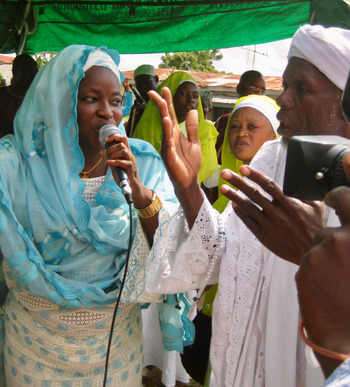
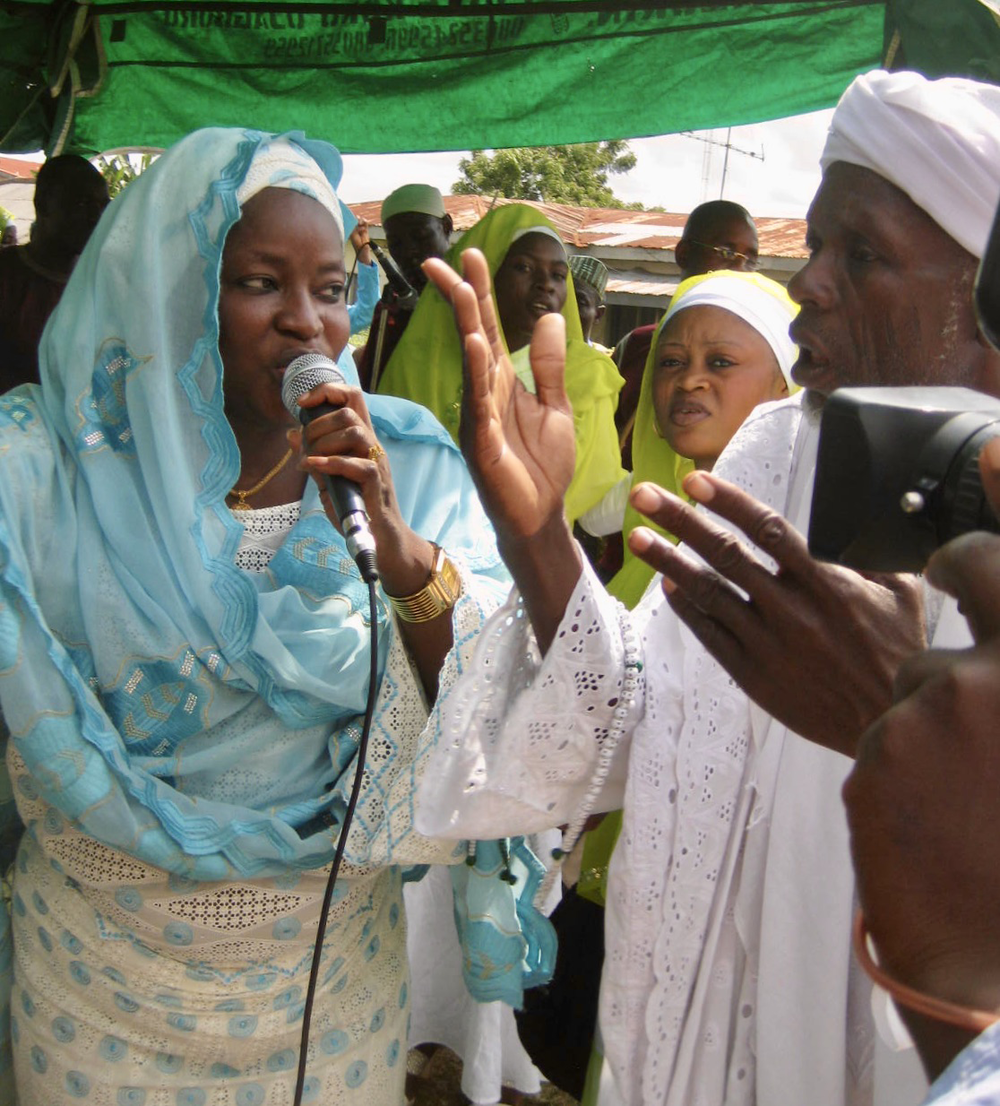
During performances, artists frequently wear the same styles of dress that they wear in everyday life. Traditional styles of Yorùbá dress have been influenced by Muslim dress over the past two hundred years, a fusion of Yorùbá and Islamic style. Yorùbá women’s dress consists of a skirt (iro), a long piece of cloth tied or tucked around the waist, a matching long-sleeved blouse (bùbá), and a matching headscarf (gèlè) tied in a range of styles. Women also wear Muslim caftans, long dresses with or without embroidery, and an additional headscarf (ibori in Yorùbá or hijab in Arabic) (see Figure 1). Men’s traditional dress consists of roomy trousers (ṣòkòtò), a long and roomy shirt (bùbá), and a wide-sleeved, flowing robe (agbáda). While older generations of artists perform in these styles—often made from fashionable, exquisite cloth—younger generations often choose Western-influenced, fashionable clothing (see Figure 2).
Sheidat Fatimah performing in traditional attire. Photo by author.
Malaika wearing traditional attire (photo by KS1 Malaika, distributed under a CC BY-SA 4.0 license in Wikipedia.)

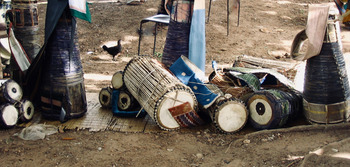
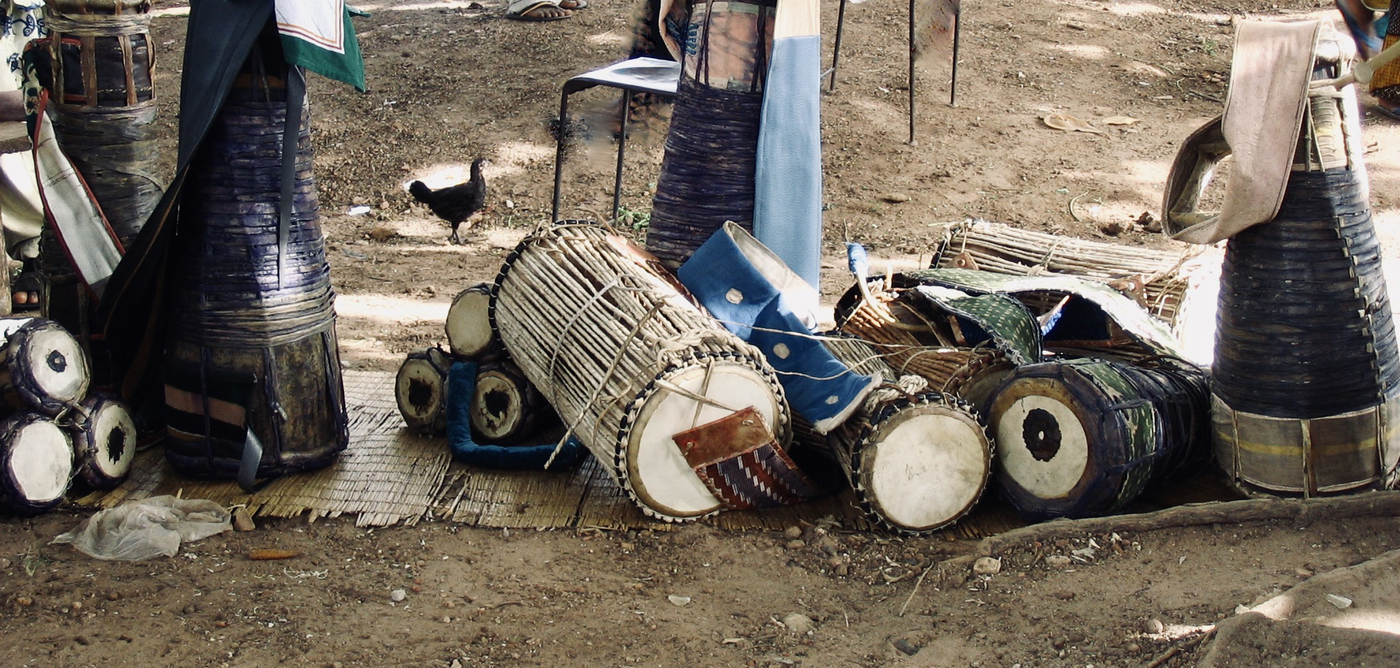
The signature indigenous Yorùbá element of fújì and Islamic is an orchestra of driving percussion ensemble. Dùndún drums are the most numerous of the percussion instruments in any ensemble, particularly the gángan, the smallest of the double-headed, hourglass-shaped drums. These are commonly known as “talking” drums, as dùndún drummers mimic the tones of the Yorùbá language by squeezing and releasing the tension straps to change the pitch of the skin. Dùndún drums primarily provide a fast-paced and constant ostinato background, while skilled drummers also intone speech as they play proverbial texts, which convey messages to the band and audiences alike (Olaniyan Reference Olaniyan2007:26). Legendary fújì star Ayinla Kollington introduced the bàtá rhythmic drum to the ensemble during the 1980s (see Figure 3).Footnote 10 Since the 1980s, drummers have also added a western-style drumset, in addition to bells and rattles used in various styles of Yorùbá music. Most bands include ṣẹ̀kẹ̀rẹ̀ (gourd rattles), and many bands include agogo (iron bells) and aro (a pair of circular iron idiophones that the musician claps together).
Bàtá and dùndún drums. Photo by author.
Many of today’s fújì and Islamic bands include instrumentation from other Nigerian and global music genres. Syncopated chords played on the synthesiser often provide hooks, which help to make fújì songs and albums recognisable and memorable. Synthesised sound effects, such as strategically placed, high-pitched glides, were perceived as modern and edgy additions in the 1980s. Fújì saxophone and guitar styles borrow from jùjú pedal steel guitar and horn arrangements recalling highlife, creating a more laid-back vibe.
The genres of fújì and Islamic allegorise a set of values—unity, peaceful coexistence, tolerance, and equity—a shared way of being in the world with which many Nigerians identify, proudly idealising these values as “Nigerian” (Danmolé Reference Danmolé, Olupona and Rey2008). Yomi Daramola further describes the meaning of Islamised genres as an “accord between Islamic and Yoruba musical cultures…born out of the peaceful coexistence between Islamic and Yoruba traditional religions” (Reference Daramola2007:54), a way of being in the world that is open-minded and accepting of difference that professional musicians model within their communities and beyond (Reference Daramola2007:48).
Since Ìlọrin became an Islamic emirate under the rule of Fulani royal élites in 1817, Ìlọrin’s governance and educational institutions have negotiated the tensions between Ìlọrin’s unique status as the only Yorùbá emirate, on the one hand, and a global Islamic city comprising a diverse ethnic and religious population, on the other. Ìlọrin’s institutions have historically embraced the city’s Yorùbá culture as “folklore” or “heritage” while denying or condemning Yorùbá Òrìṣà culture and cosmology, Abdul-Rasheed Na’Allah, a scholar of Ìlọrin oral culture, grapples with the meaning of inhabiting both Yorùbá and Islamic identities, describing an Ìlọrin identity which embraces both its Yorùbá and Islamic heritages as an “Islamicity” unique to Ìlọrin (Reference Na’Allah2009:11).
Throughout my research, my colleagues and interviewees referred to the institutionalised and religiously orthodox form of Islam in Ìlọrin as “Islamist.” Drawing from scholarship documenting Yorùbá Islamic culture and my fieldwork data, I refer to the Islamic culture lived and practised by most Yorùbá people in Ìlọrin and other Yorùbá communities as “Yorùbá Islam,” a flexible and incorporative Islamic culture rooted in indigenous Yorùbá values of tolerance and open-mindedness.
Gaps between Allegory and Everyday Life
Cultural theorist James Clifford (Reference Clifford, Clifford and Marcus1986) and anthropologist Carolyn Martin Shaw (Reference Shaw and Carolyn1995) defined and modelled the use of allegory as an analytic device for identifying broad morally charged and ideological narratives that inform or shape an ethnographic account of a culture:
Allegory (more strongly than “interpretation”) calls to mind the poetic, traditional, cosmological nature of…writing processes…. Allegory draws special attention to the narrative character of cultural representations, to the stories built into the representational process itself.
(Clifford Reference Clifford, Clifford and Marcus1986:100)Clifford’s classic article, “On Ethnographic Allegory” (Reference Clifford, Clifford and Marcus1986), contributed to the postmodernist critique of ethnographic writing that continues to remind producers of cultural analysis that cultural analysis is often informed by, or infused with, some allegory or morally charged story.Footnote 11 In my analysis of fújì and Islamic aesthetics, I have found the device of allegory an instructive way to think about how these genres work on their audiences, how they tell their stories, and how their moral stories are built into their aesthetic formation. The genres of fújì and Islamic allegorised an ideal of unity in the 2010s, reflecting an ideology of peaceful coexistence, tolerance, and equity. As with any ideology, there are gaps between the ideal and the lived reality. An analysis of fújì and Islamic reveals the gaps between narratives of an ideal Nigeria and everyday life in a nation wrought by political, economic, and gender inequities.
In the early 2000s, national political power shifted from the North to the South, exacerbating the levels of poverty in the North that led to the emergence of Boko Haram. Founded in 2002 by Ustaz Mohammed Yusuf in Borno, Boko Haram is a Hausa name that translates as “western-style education is forbidden,” referring to the education that leads to a corrupt system of Nigerian politics and business. According to Boko Haram, Nigerian corruption is un-Islamic (Last Reference Last2009:10). For the past decade, it has been almost impossible to talk about Nigeria outside of the context of Boko Haram. The last two-month period of my research in Ìlọrin was tempered by my colleagues’ fear for their and my safety in the event of a potential attack or kidnapping. During my stay, a city-wide curfew limited residents’ ability to safely leave their homes in the evenings. Although Boko Haram comprises a relatively small group of poor, unemployed Muslim youth in northeastern Nigeria, this terrorist organisation has effectively disrupted everyday life by instilling fear throughout the nation.Footnote 12
The crisis of Boko Haram’s kidnapping of over two hundred girls from their secondary school in Borno garnered global attention and inspired fújì star Malaika to co-produce and perform a hit song, “Stop the Violence,” allegorising Nigerian unity and holding the Nigerian government accountable for locating and releasing the kidnapped girls. While the world was watching, Malaika’s song offered an allegory of Nigerian unity for a local and global audience looking for an expression of moral outrage and a public critique of national leadership.
Malaika’s ideological narrative of national unity tapped into a global discourse of gender equity. By the 2010s in Nigeria, it was widely believed that education should be accessible to all girls and women, especially in the North, where colonialism and Islamist interpretations of the religion had limited such educational opportunities. Contrary to assumptions that all of northern Nigeria is perpetually “backwards” when it comes to education policy and gender, most of northern Nigeria does not adhere to an Islamist worldview, as Barbara Brown points out:
Most families in northern, Muslim Nigeria have come to terms with the inevitability, if not the desirability, of female literacy and education. Boko Haram represents a retrograde belief system and criminal enterprise that nevertheless taps into older prejudices towards secular schooling in general, and female education in particular.
(Brown Reference Brown2014:7)Boko Haram’s acts of violence targeting girls, however, reminded Nigerians and the world that Nigerian girls and women continue to suffer under conditions of inequity and violence. Analysis of artist interviews and fújì and Islamic performances reveals the gap between the aspiration for gender equity and national unity, on the one hand, and the experiences of gender inequity and national disharmony, on the other.
Stop the Violence: Fújì as Allegory of Nigerian Unity
Alhaji Sulaimon Alao Adekunle Malaika, aka KS1, was one of the most popular fújì artists in the 2010s. While his extended family is from Abeokuta and Ìbàdàn, Malaika was born and raised in Lagos. Malaika began his career singing wéré music and formed his first fújì band in 1985. Winner of several “Best Fújì Music Artist” titles, Malaika is well known for his collaborations with singer-songwriters and hip-hop artists. An ambassador for fújì, he is often quoted for his belief that fújì music is the only genre that “showcases Nigerian identity abroad” and “restores nearly forgotten Yoruba values and heritage” (Fujiipop Reference Fujiipop2015).
Malaika’s VCDFootnote 13, Stop the Violence, released in 2014 (see Figure 4), presents a series of quickly flashing scenes featuring militant Boko Haram soldiers in combat gear; the Nigerian flag; an imam giving a sermon; a Catholic priest giving a sermon; a screen shot of all Nigerian presidents’ faces; footage of Barack and Michelle Obama; and newspaper clippings about the Nigerian girls who were kidnapped. These revolving images are interspersed with footage of Malaika and guest musicians singing in English and Yorùbá, in generic recording studios with the Nigerian flag in the background. The video’s close-up shots frame the artists’ facial expressions and gestures, which communicate deep concern for Nigeria’s future. The final scene is a plea by the artists, shouting in unison, to “Stop the violence!”
Stop the Violence VCD cover.

Fújì star Malaika’s video performance exemplifies a Yorùbá Islamic aesthetic formation, incorporating rap, hip-hop, and global cultural aesthetics into a sensory fabric woven together with the following threads: an allegory of Nigerian unity, peace, and gender equity; Yorùbá and English languages; fújì instrumentation; elements from rap and hip-hop music (electronically programmed drums, rap solos, the five-minute arrangement); melismatic vocal style; praise singing; a catchy chorus; Western-influenced costuming (trousers, t-shirts, button-down shirts, hats, necklaces); and a generic studio setting with the Nigerian flag as a backdrop.
Malaika’s song effectively informed and inspired national and global dialogue and awareness. The chorus consists of the words “Stop the violence, allow peace to reign. Nigerians arise, let’s build a new nation. Let’s shun the violence and live in peace,” a call to mobilise fújì’s allegory. The song calls upon Nigerians, U.S. politicians, and religious leaders to pray for national unification and rise above the sectarian violence that has shaped Nigeria’s national struggles. In the middle of the song, the three guest artists rap in unison in the English language:
I pledge to Nigeria, my country, to be faithful, loyal, and honest…. Equal rights and justice is what we want. Elevation is all that we pray for. This is a state of emergency, something bigger than what my eyes can see. We are calling on you, religious leaders. Hausa, Igbo, and Yorùbá, let’s unite and come together. Let all Nigerians be prayerful. Unity is the key.
(Malaika Reference Malaika2014)These lyrics articulate the effect the artists intend their song to have on the world. During the rap section, the video flashes from a chief imam to a Catholic priest, urging unity across religions. This scene is followed by a plea to the three largest ethnic groups in Nigeria, urging unity across cultures.
A few scenes later, the video flashes to Boko Haram’s kidnapping of the girls and an image of Michelle Obama holding the now-iconic sign, “Bring back our girls.” “Stop the Violence” invokes the global discourse of gender equity to express solidarity with human rights movements and global citizens who are fighting for equal opportunity and respect for girls and women. Malaika’s song effectively exposed the gap between the ideal Nigeria and the lived reality, while offering a vision of a unified Nigeria across religions, ethnic groups, and genders.
The Genre of Islamic: Gaps between Allegory and Everyday Life
The career of Alhaja Sheidat Fatimah Al-Jafariyah, an Ìlọrin-born and -based artist of the Islamic genre, was on the rise in local, national, and international circles in the 2010s. During my fieldwork, Sheidat Fatimah was the most famous and prolific member of the Kwara State musicians’ union, and leader of her branch’s Islamic Music Association of Nigeria.
Born in Ìlọrin in 1972, Sheidat Fatimah was one of fifteen children raised by her father and his four wives. One of her uncles was the first of her family to join the Muslim association, Jafariyyah, a branch of Shi’a Islamic scholarship and worship. Sheidat Fatimah grew up attending Islamic prayer groups on Fridays and Jafariyyah meetings on Sundays, where she learned to sing azikir, the Yorùbá transliteration of the Arabic zikr, a form of sung poetry consisting of prayers or phrases repeated as a form of devotion to God (Frishkopf Reference Frishkopf, Middleton and Miller2007:644). Describing her enthusiasm for singing from a young age, Sheidat Fatimah said, “Everywhere I went, I hummed azikir” (Al-Jafariyah, interview, 9 August Reference Al-Jafariyah2012).
Recognising her talent, Sheidat Fatimah’s family and friends advised her to enter azikir and Qur’anic recitation competitions, which she continued to win throughout her childhood. A family friend in Lagos and others were so amazed by the sonorous quality of her voice that they continued to sponsor her early career. With the support of her family, she became a professional singer of Islamic and began to record CDs in the 1990s. For the past three decades, Sheidat Fatimah has performed at countless events throughout Nigeria and for sold-out crowds in Ghana, Dubai, and Mecca. Many of her VCDs are posted on YouTube and have received tens of thousands of hits. In demand for performances throughout Nigeria, Sheidat Fatimah does her best to balance her time between the recording studio, performing, and raising her children.
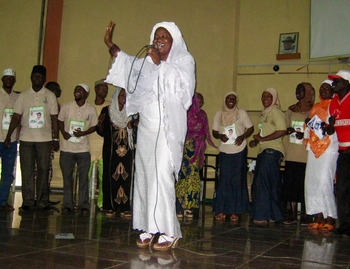
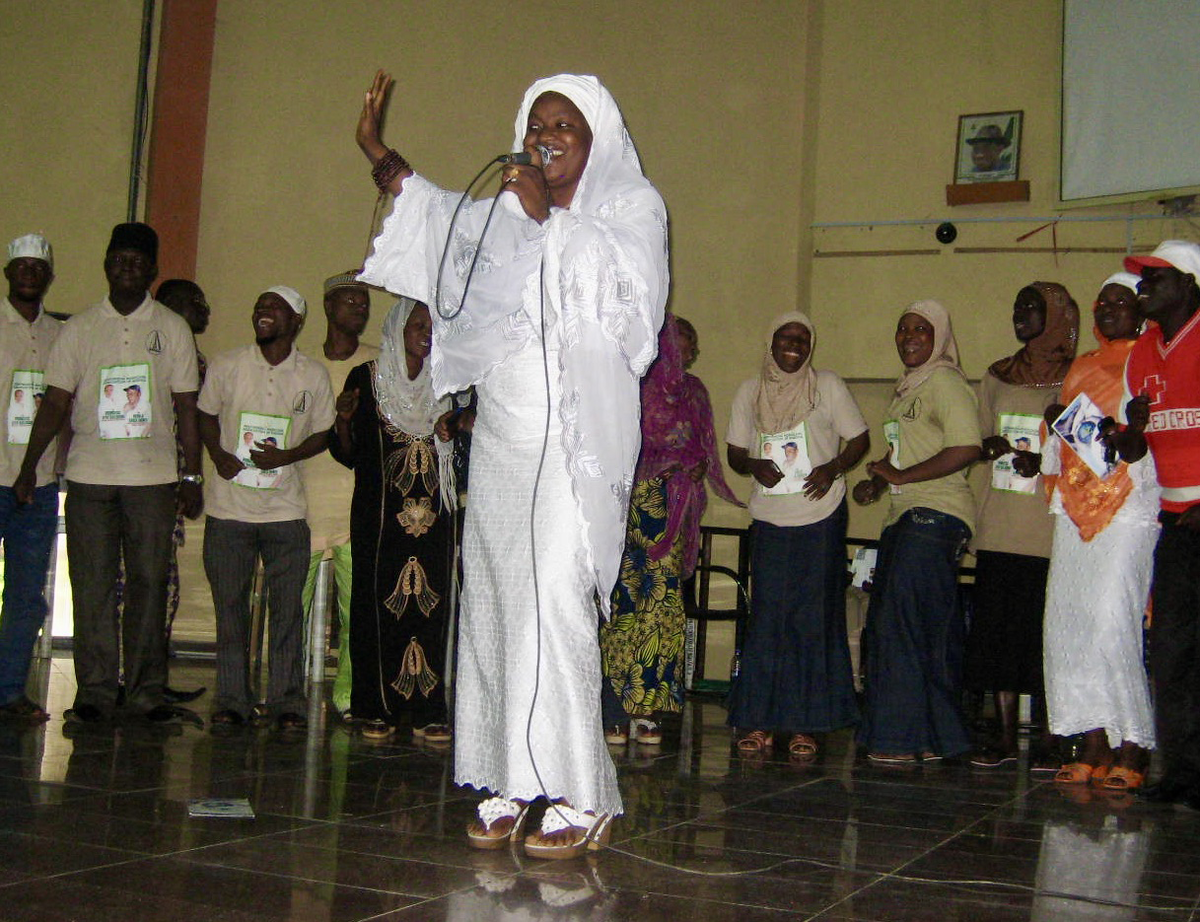
During my fieldwork, my research team planned an event featuring performances by local wéré, fújì, and Islamic artists at the University of Ìlọrin. The standout act was indeed Sheidat Fatimah, who captivated the audience with her singing and dancing, wearing a sparkling white hijab and a traditional-style skirt and blouse, sewn out of exquisite white lace cloth (see Figure 5). Our surprise guest was the renowned literary theorist Gayatri Spivak, who was the first audience member to leap to her feet, followed by a crowd of enthusiastic audience members, to spray Sheidat Fatimah with naira (Nigerian currency), acknowledging her stellar performance.Footnote 14 To close the event, a university administrator offered his remarks, during which he interrupted his light-hearted cadence with an admonition:
Sheidat’s performance is one of the things that the mallams [Qur’anic scholars] condemn. She’s praising the Prophet, singing from the Qur’an, but definitely Islam would not agree with a woman coming out to dance in such a manner. So these are the contradictions that we need to actually bring out and solve.
(University of Ìlọrin administrator, closing remarks, 22 August 2012).On the heels of the three-hour programme, this remark became one of the most buzzed-about moments of the event. Proud of her first performance at the university, Sheidat Fatimah graciously asked the media to delete the administrator’s comments from the recording so that her fans would not hear the disparaging rhetoric. After the event, audience members wondered aloud about the appropriateness of the administrator’s Islamist perspective in his criticism of Sheidat Fatimah’s performance.
Sheidat Fatimah performing at the University of Ìlọrin. Photo by author.
Sheidat Fatimah’s dance technique consisted of precise and subtle pulsing of the shoulders and buttocks, a style originating in dances for entertainment as well as dances honouring and worshipping the Òrìṣà (Àjàyí Reference Àjàyí1998; Klein Reference Klein2007). A regional variation of this style is practised in Ìlọrin as erée bàlúù, a singing and dancing genre that emerged within Yorùbá communities (Adeola Reference Adeola1997:21). Women’s dancing has long been judged as problematic by Islamists, “because dance places its central focus on the body” (Doubleday Reference Doubleday, Hellier and Koskoff2013:201), which is seen as a corruptible site associated with sensual pleasure. In contrast, indigenous Yorùbá culture values dance as “virtually indispensable in the continuity and reinforcement of a Yoruba belief system, power structure, gender dynamics, and other social values and practices” (Àjàyí Reference Àjàyí1998:222). From a Yorùbá Islamic vantage, Sheidat Fatimah’s dancing and singing are appropriate expressions of her reverence for God; moreover, Yorùbá dance is regarded as an essential form of cultural expression and pride.
In indigenous Yorùbá culture and philosophy, gender categories are multiple and flexible. “[T]he Yoruba world is not dichotomised into clearly distinct male and female sectors…. Gender classifications are not organised in a fixed schema: they are ambiguous and fluctuating” (Barber Reference Barber1991:277). Barber’s classic study of Yorùbá praise poetry in Okuku revealed that while women were free to become powerful in any realm, including the performing arts, most women chose not to compete in male arenas. However, whenever women became successful, they were seen as a self-aggrandising threat to men’s power and branded as witches (Reference Barber1991:235). Throughout Nigeria, witchcraft is understood to be an innate power, secretive and destructive, and connected with femaleness (Reference Barber1991:236).
In Yorùbá communities, the “command of oral art is a power” (Barber Reference Barber1991:290), singing and dancing go hand in hand (Àjàyí Reference Àjàyí1998), and women are respected for becoming professional oral artists. However, powerful Yorùbá women’s association with witchcraft is a pervasive example of the gap between an ideology of gender flexibility and equity, on the one hand, and the lived reality of gender inequity, on the other.
Destiny: Islamic as Allegory of Women’s Empowerment
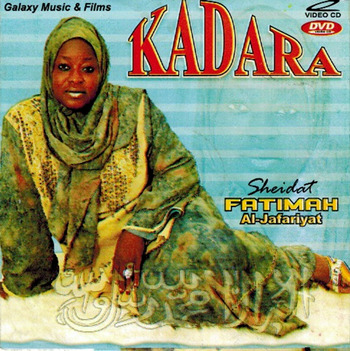
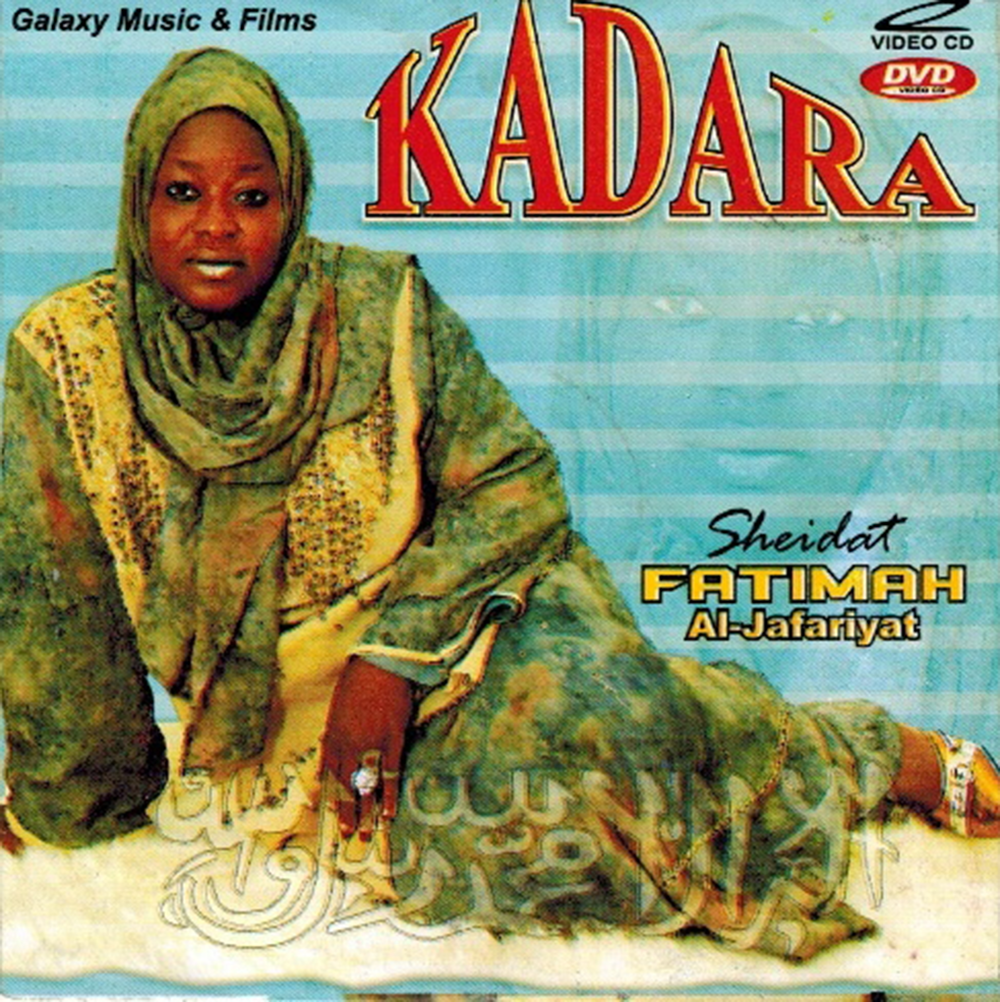
In 2003, Sheidat Fatimah gave birth to her second child, whose father is the famous and well-respected “Father of Fújì,” Síkírù Àyìndé Barrister. Because Barrister and Sheidat Fatimah were not married, the public debated Sheidat Fatimah’s morality with respect to the nature of her relationship with Barrister. While Sheidat Fatimah chooses not to speak publicly about her relationship with Barrister, she does reflect publicly on how the media speculated about and misrepresented the circumstances surrounding the birth of their child. Sheidat Fatimah’s experiences and reflections inspired her hit album, Kádàrá/Destiny, during this challenging period of her life. During our interview, Sheidat Fatimah told me that she believed Kádàrá/Destiny was one of her best-selling albums because she was able to communicate honestly about a situation many women experience, being judged by people who believe they have the moral right to judge others’ choices (Al-Jafariyah, interview, 9 August Reference Al-Jafariyah2012). Examining the Yorùbá Islamic aesthetics of Sheidat Fatimah’s performance, I will analyse the following verse within the context of her VCD (see Figure 6).
Kádàrá VCD cover.
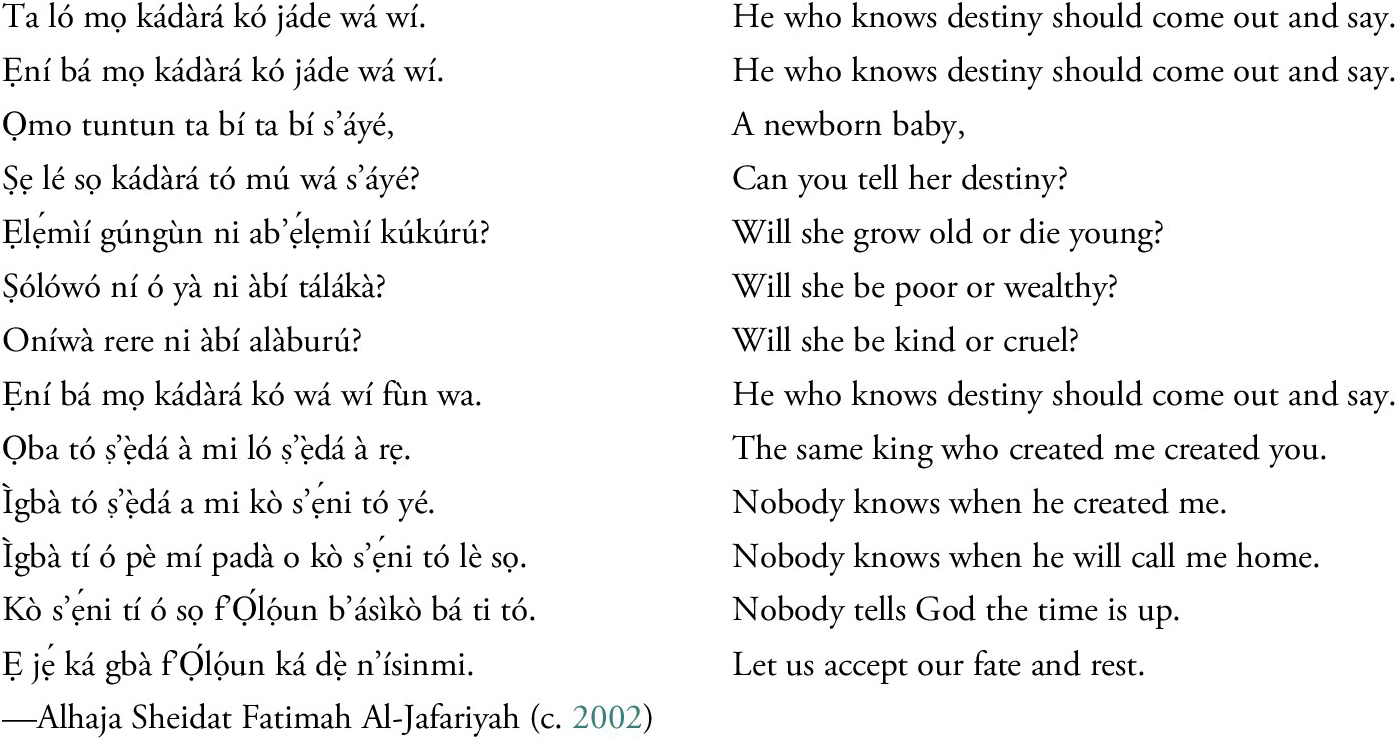
Kádàrá is the Yorùbá transliteration of the Arabic qadar, meaning “destiny.” Sheidat Fatimah’s interpretation of the Islamic concept of qadar is rooted in her belief that God, Allah, determines one’s destiny from birth. At first glance, this song may appear to lack a syncretic Yorùbá Islamic worldview. However, I suggest that the VCD’s aesthetic package—lyrics, language, costuming, dancing, and scenery—produces a Yorùbá Islamic aesthetic formation, a fusion of philosophical concepts and aesthetics that allegorises a narrative of women’s empowerment.
Examining the overlap between Islamic and indigenous Yorùbá cosmologies, I will briefly compare the Islamic concept of destiny with the Yorùbá concept of orí, a complex concept which translates as “head” and “destiny.” A significant overlap between these concepts lies in the contemplation of the role of the individual in the realisation of one’s destiny. In a lecture at the University of Ìlọrin, Chief Imam Oladosu spoke on the topic of predestination:
Believing in predestination should not make Muslims idle, lazy or relent in their life endeavors. Rather, it should make them work harder to actualize their destiny, which remains unknown until it gradually unfolds.
(Arikewuyo Reference Arikewuyo2013)Oladosu’s discussion of the individual’s role in the actualisation of one’s destiny, and his theological interpretation that that destiny “remains unknown until it gradually unfolds” overlaps with the Yorùbá concept of orí. According to Yorùbá cosmology, each person chooses an orí/head/destiny in conversation with the Òrìṣà before being born, and then one must play an active role in the realisation of one’s destiny throughout one’s life. Furthermore, through ritual processes, the Òrìṣà may enter/mount one’s “head” and actively influence one’s destiny. A syncretic Yorùbá Islamic cosmology emphasises these concepts (Apter Reference Apter1992; Abímbọ́lá Reference Abímbọ́lá2006).
Sheidat Fatimah’s decision to compose, perform, and produce a VCD exposing her vulnerability during a difficult time of her life models the Yorùbá idea that one must take an active role in shaping one’s own story, one’s own destiny, to realise one’s true self.
Orí could be understood as a person’s individual principle of being, or potential for final self-realization; ẹṣè. (feet) could be understood as the steps by which a person gets there…. But note that getting there is always an active process. You don’t simply have a “destiny” which works itself out in spite of you.
(Barber Reference Barber2000:396)A Yorùbá philosophy of destiny asks one to embark on the path to realise one’s human potential (Barber Reference Barber2000). Taking charge of her destiny, Sheidat Fatimah chose to compose a song to address the public’s judgment, asserting herself as a woman of faith capable of making her own choices.
In the video, Sheidat Fatimah sings the above verse as a solo in the span of thirty seconds, during which she changes into three different costumes—matching blouses and skirts and caftans sewn from fashionable cloth, each with matching headscarves, hijabs, and shoes. Sheidat Fatimah’s image fills the screen with her skillful, inviting, and communicative singing and dancing. In between Sheidat Fatimah’s solo scenes, a group of women performers sing in unison and call-and-response, their costumes and dance styles similar to those of Sheidat Fatimah. The video’s images, taken around and within Ìlọrin’s central mosque, further bring to life the song’s Yorùbá Islamic aesthetic formation.
Since the video does not show the instrumentalists, audiences are encouraged to focus their visual attention on the singing and dancing. As previously discussed, the combination of singing and dancing is an example of a Yorùbá Islamic aesthetic controversial among Islamists and others who have been trained to believe that Muslim women should not express their reverence for God through dance (Rasmussen Reference Rasmussen2010; Doubleday Reference Doubleday, Hellier and Koskoff2013). During a musicians’ union meeting in Ìlọrin that I attended, individual artists were showcasing their compositions and genres. When it was the turn of the women erée bàlúù dancers, several male musicians in the room covered their eyes. I later learned that they were protecting themselves from the pleasure they might experience when watching their women colleagues dance. Contrary to an Islamist interpretation of women’s dancing, Yorùbá Islamic genres embrace women’s singing and dancing as culturally appropriate and complementary forms of reverence and entertainment (Àjàyí Reference Àjàyí1998).
Sheidat Fatimah’s video performance weaves together the following threads: an allegory of women’s empowerment; Yorùbá and Islamic cosmology and philosophy; Yorùbá and Arabic languages; Islamic/fújì instrumentation; Yorùbá indigenous dance style; Yorùbá Islamic costuming; and Ìlọrin mosque imagery. Sheidat Fatimah’s performance offers a morally charged narrative of Nigerian women’s empowerment while exposing the gap between the ideology of empowerment and the reality faced by women who are not empowered to make choices about their own destinies.
Allow Peace to Reign: Closing the Gap between Aspiration and Reality
Popular performance genres in the 2010s, fújì and Islamic allegorise an ideal of Nigerian unity—rooted in an ideology of peaceful coexistence, tolerance, and equity—values that emerged within the context of Nigeria’s over 200-year-old Yorùbá Islamic history. During my fieldwork in Ìlọrin, wéré artists in their seventies and eighties identified a shift in the culture of the Ìlọrin emirate during the late 1970s, from a more flexible and tolerant Yorùbá Islam to an Islamist culture. During this shift, the emir replaced Ìlọrin’s annual wéré competition on Id-al-Fitr (the holiday celebrating the end of the Ramadan fast) with a Qur’anic recitation competition. According to my interviewees, the end of the emir’s sponsorship of their annual competition devalued their music and compromised their livelihoods, and has remained a source of deep sadness and nostalgia for more tolerant times (Abubakare, interview, 29 July Reference Abubakare2012).
In the 2010s, this trend continued among the institutions of education and governance, which valued an orthodox Islamist over a “less pure” Yorùbá Islamic worldview. Embracing Ìlọrin’s dual Yorùbá and Islamic heritage, the popular musical genres of fújì and Islamic produced a Yorùbá Islamic aesthetic formation—a fusion of Islamic and Yorùbá aesthetics, values, and narratives—that allegorised an ideal way of being Nigerian in the world during the era of Boko Haram.
Fújì star Malaika’s song “Stop the Violence” brought the aspirational message of Nigerian unity and gender equity to a global audience during a time of national crisis. Islamic star Sheidat Fatimah’s song “Kádàrá/Destiny,” and her life story, illuminated a message of women’s faith and empowerment during ongoing struggles for gender equity. Through the genres of fújì and Islamic, the performances of Malaika and Sheidat Fatimah offered the nation messages of hope and empowerment while exposing the sizable gap between the aspiration for Nigerian unity and gender equity, on the one hand, and the experiences of those whose lives are constrained by structures of intolerance, violence, and gender inequity, on the other.