INTRODUCTION
Parkinson’s disease (PD) is associated with cognitive and emotional impairments which, although not as distinctive as the motor symptoms, have been commonly observed even from early stages of the disease (Aarsland, Bronnick, & Fladby, Reference Aarsland, Bronnick and Fladby2011). Among cognitive impairments, executive dysfunction and, in particular, working memory (WM) disabilities have been frequently observed (Alonso-Recio, Martín, Carvajal, Ruiz, & Serrano, Reference Alonso-Recio, Martín, Carvajal, Ruiz and Serrano2013; Kehagia, Barker, & Robbins, Reference Kehagia, Barker and Robbins2010; Siegert, Weatherall, Taylor, & Abernethy, Reference Siegert, Weatherall, Taylor and Abernethy2008). WM refers to a basic ability for managing, maintaining, and operating with present and stored information to organize and guide behavior, and as such, seems to be necessary in many everyday activities and in social interaction (Wager & Smith, Reference Wager and Smith2003). The attempts to explain WM organization and structure have generated several psychological models, the one developed by Baddeley and Hitch (Reference Baddeley and Hitch1974) being one of the most influential. According to this model, WM consists of a central executive that controls and coordinates the operation of two subsystems: the phonological loop and the visuospatial sketchpad (Baddeley, Reference Baddeley2003; Repovs & Baddeley, Reference Repovs and Baddeley2006). While the phonological loop is responsible for the manipulation of verbal information, the visuospatial sketchpad operates with visuospatial information. Despite the development of alternative hypotheses, the distinction between spatial and non-spatial (verbal and visual) components in WM remains constant (Stuss & Knight, Reference Stuss and Knight2002; Rottschy, Langner, et al., Reference Rottschy, Langner, Dogan, Reetz, Laird, Schulz and Eickhoff2012).
In PD, WM impairments seem especially evident for visuospatial tasks (Costa et al., Reference Costa, Peppe, Dell’Agnello, Carlesimo, Murri, Bonuccelli and Catagirone2003; Lee et al., Reference Lee, Cowan, Vogel, Rolan, Valle-Inclan and Hackley2010; Possin, Filoteo, Song, & Salmon, Reference Possin, Filoteo, Song and Salmon2008; Stoffers, Berendse, Deijen, & Wolters, Reference Stoffers, Berendse, Deijen and Wolters2003), which is consistent with the suggestion that spatial and non-spatial components in WM arise from differentiated brain areas (Courtney, Reference Courtney2004; Owen, McMillan, Laird, & Bullmore, Reference Owen, McMillan, Laird and Bullmore2005). These deficits have been attributed to the characteristic loss of dopaminergic neurons in frontostriatal circuits connecting the basal ganglia and prefrontal cortex (Cools, Miyakawa, Sheridan, & D’Esposito, Reference Cools, Miyakawa, Sheridan and D’Esposito2010). Moreover, they may suggest a disconnection between prefrontal and spatial processing areas (the dorsal stream) and identity processing brain areas (the ventral stream) (Rottschy, Caspers, et al., Reference Rottschy, Caspers, Roski, Reetz, Dogan, Schultz and Eickhoff2012). However, independence of WM components and their cerebral correlates is still controversial (Nee et al., Reference Nee, Brown, Askren, Berman, Demiralp, Krawitz and Jonides2013; Postle, Reference Postle2006; Volle et al., Reference Volle, Kinkingnehun, Pochon, Mondon, Thiebaut de Schotten, Seassau and Levy2008).
Regarding emotional abilities, difficulties in facial expression and in the recognition of prosody have also been commonly described in PD (Ariatti, Benuzzi, & Nichelli, Reference Ariatti, Benuzzi and Nichelli2008; Borod et al., Reference Borod, Welkowitz, Alpert, Brozgold, Martin, Peselow and Diller1990; Dara, Monetta, & Pell, Reference Dara, Monetta and Pell2008; Schröder et al., Reference Schröder, Mobes, Schutze, Szymanowski, Nager, Bangert and Dengler2006; Simons, Ellgring, & Pasqualini, Reference Simons, Ellgring and Pasqualini2003). Nevertheless, findings regarding the recognition of emotional facial expression (EFE) have not been entirely consistent (Alonso-Recio, Serrano-Rodríguez, Carvajal-Molina, Loeches-Alonso, & Martín-Plasencia, Reference Alonso-Recio, Serrano-Rodriguez, Carvajal-Molina, Loeches-Alonso and Martin-Plasencia2012; Gray & Tickle-Degnen, Reference Gray and Tickle-Degnen2010; Peron, Dondaine, Le Jeune, Grandjean, & Verin, Reference Peron, Dondaine, Le Jeune, Grandjean and Verin2012). Some authors have reported preserved EFE recognition abilities (Adolphs, Schul, & Tranel, Reference Adolphs, Schul and Tranel1998; Borod et al., Reference Borod, Welkowitz, Alpert, Brozgold, Martin, Peselow and Diller1990; Cohen, Gagne, Hess, & Pourcher, Reference Cohen, Gagne, Hess and Pourcher2010; Pell & Leonard, Reference Pell and Leonard2005), while others have found a widespread impairment for all the EFEs studied (Beatty et al., Reference Beatty, Goodkin, Weir, Staton, Monson and Beatty1989; Breitenstein, Daum, & Ackermann, Reference Breitenstein, Daum and Ackermann1998; Dujardin et al., Reference Dujardin, Blairy, Defebvre, Duhem, Noel, Hess and Destée2004; Herrera, Cuetos, & Rodriguez-Ferreiro, Reference Herrera, Cuetos and Rodriguez-Ferreiro2011; Yip, Lee, Ho, Tsang, & Li, Reference Yip, Lee, Ho, Tsang and Li2003), and still others have reported selective problems in the recognition of only some EFEs (Assogna et al., Reference Assogna, Pontieri, Cravello, Peppe, Pierantozzi, Stefani and Spalleta2010; Kan, Kawamura, Hasegawa, Mochizuki, & Nakamura, Reference Kan, Kawamura, Hasegawa, Mochizuki and Nakamura2002; Lachenal-Chevallet et al., Reference Lachenal-Chevallet, Bediou, Bouvard, Thobois, Broussolle, Vighetto and Krolak-Salmon2006; Suzuki, Hoshino, Shigemasu, & Kawamura, Reference Suzuki, Hoshino, Shigemasu and Kawamura2006). Even when impairment has been found, varying explanations have been proposed. On the one hand, some have suggested that problems are mainly a consequence of the inability to perceive the emotional message (Dujardin et al., Reference Dujardin, Blairy, Defebvre, Duhem, Noel, Hess and Destée2004; Herrera, Cuetos, & Rodriguez-Ferreiro, Reference Herrera, Cuetos and Rodriguez-Ferreiro2011; Suzuki, Hoshino, Shigemasu, & Kawamura, Reference Suzuki, Hoshino, Shigemasu and Kawamura2006; Yip et al., Reference Yip, Lee, Ho, Tsang and Li2003). On the other hand, others have argued that problems in performance with EFE could be secondary to other cognitive deficits found in PD (e.g., executive) and involved in recognition processes (Assogna, Pontieri, Caltagirone, & Spalletta, Reference Assogna, Pontieri, Caltagirone and Spalletta2008; Gray & Tickle-Degnen, Reference Gray and Tickle-Degnen2010; Peron et al., Reference Peron, Dondaine, Le Jeune, Grandjean and Verin2012). Both cognitive and emotional dysfunctions have been related to damage in nigrostriatal and mesolimbic dopaminergic systems. The nigrostriatal circuit connects the substantia nigra (pars compacta) with several prefrontal areas and has been related to executive and motivational processes (Zgaljardic, Borod, Foldi, & Mattis, Reference Zgaljardic, Borod, Foldi and Mattis2003). The mesolimbic circuit connects the ventral tegmental area with limbic structures, and it has been frequently associated with emotional processes. In individuals with PD, brain damage resulting in emotional recognition impairments has been observed both in prefrontal and limbic areas (Harding, Stimson, Henderson, & Halliday, Reference Harding, Stimson, Henderson and Halliday2002; Ibarretxe-Bilbao et al., Reference Ibarretxe-Bilbao, Junque, Tolosa, Martí, Valldeoriola and Zarei2009). However, investigators have discovered that the nigrostriatal circuit is impaired earlier in the disease course than the mesolimbic one (Braak et al., Reference Braak, Del Tredici, Rüb, de Vos, Steur and Braak2003; Owen, Reference Owen2004). The distinct role and course of the decline in these dopaminergic systems may reflect independence between emotional and cognitive task performance in PD patients (Salgado-Pineda, Delaveau, Blin, & Nieoullon, Reference Salgado-Pineda, Delaveau, Blin and Nieoullon2005).
Therefore, discerning the nature of this possible EFE recognition deficit may be relevant from a basic as well as applied point of view. From a basic perspective, it may contribute to understanding the functional correlates of the brain damage that characterizes the disease. Relationships between emotional recognition and cognitive deficits may indicate that the frontostriatal decline associated with executive deficits in PD is also involved in emotional recognition. Alternatively, differentiable emotional and cognitive problems could indicate that additional brain circuits and areas (specifically, those used in emotional recognition) are also affected. From an applied point of view, the relevance of this question is supported by the role of emotional expressions in communication and social interaction. Thus, determining whether the problems are primarily of emotional origin or subsequent to other cognitive processes may help to better define and guide intervention programs designed for these cognitive/emotional symptoms experienced by individuals with PD.
One of the cognitive processes relevant in the recognition of emotions and other stimuli is working memory (Phillips, Channon, Tunstall, Hedenstrom, & Lyons, Reference Phillips, Channon, Tunstall, Hedenstrom and Lyons2008). In particular, EFE recognition tasks entail the management and processing of various facial features (e.g., physical configuration, identity features, the emotional message transmitted, etc.). Furthermore, the association between this facial expressive configuration and its emotional significance implies a selective recovery of information, for which WM is required (Garcia-Rodriguez, Fusari, & Ellgring, Reference Garcia-Rodriguez, Fusari and Ellgring2008; García-Rodríguez et al., Reference García-Rodríguez, Casares-Guillén, Molina, Rubio, Jurado-Barba, Morales and Ellgring2011).
One way to ascertain the extent to which WM and/or emotional recognition abilities may underlie EFE recognition in PD is to compare WM tasks with EFEs in comparison to other similar stimuli, which share most but not all of their characteristics, such as non-emotional faces. To our knowledge, no studies have investigated WM abilities in PD by comparing EFEs with this kind of similar stimuli. However, Cohen et al. (Reference Cohen, Gagne, Hess and Pourcher2010) compared EFE and object recognition with an n-back task, frequently used to observe WM abilities. They found that PD patients were as accurate as the healthy controls in the recognition of EFEs and objects, although they were slower in the most cognitively demanding condition they evaluated. However, it is noteworthy that their stimuli (i.e., animals, fruit, vegetables, tools, and items of clothing) are very distinct from EFEs in several dimensions and attributes, not only in their emotional content, but also in their physical configuration and social nature.
The present study aims to contribute to our knowledge about possible relationships between EFE recognition and WM abilities in PD. For this purpose, we used an n-back procedure, frequently used to measure WM abilities. This consists of a sequenced presentation of stimuli in which subjects must indicate whether or not the current stimulus matches the one shown from n steps earlier. We compared patients and healthy individuals’ performance in an EFE n-back task and three other non-emotional tasks: a task based on facial identity wherein subjects identified the gender of presented faces, a spatial location task, and a verbal task using non-sense syllables. By comparing PD patients’ performance on these tasks, we hoped to discern whether EFE recognition is related to WM ability in PD and, particularly, with any of the proposed components of WM (i.e., gender recognition, spatial, or verbal components). In this way, worse performance of PD patients relative to healthy individuals in all tasks may suggest a global dysfunction in WM. By contrast, worse performance only on the EFE task may suggest selective emotional recognition impairment in PD. We also hope to discern whether this impairment is related with a more general decline in other cognitive processes. For this purpose, we administered several visuospatial, language, and executive standardized tests.
METHODS
Participants
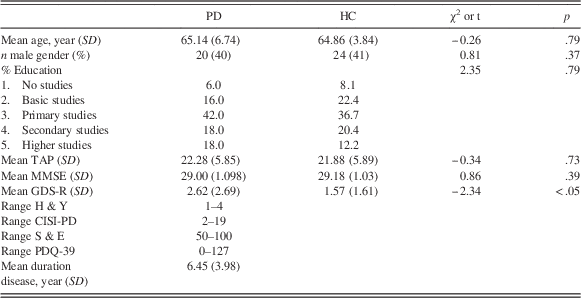
Selection criteria for participants with PD included a diagnosis of idiopathic PD by a neurologist specialized in movement disorders and according to international guidelines (Hughes, Ben-Shlomo, Daniel, & Lees, Reference Hughes, Ben-Shlomo, Daniel and Lees2001). Exclusion criteria for both the PD group and healthy controls (HC) included the presence of major medical illnesses, major psychiatric disorders, vision deficits, and suspected dementia or cognitive impairment (Mini Mental State Examination MMSE<27; Folstein, Folstein, & McHugh, Reference Folstein, Folstein and McHugh1975). Specific exclusion criteria for PD patients were the presence of an unclear history of chronic dopaminergic treatment responsiveness. Two individuals were excluded from the PD group for suspected dementia or Mild Cognitive Impairment (MMSE<27), one for a significant visual problem, and two for scoring below 2 standard deviations relative to their group in at least one of the experimental tasks. Two healthy controls were also excluded for this last reason. In total, 50 PD patients (30 females) were enrolled in the study. The control group was composed by 49 healthy individuals (25 females). The background data for the two groups are summarized in Table 1. As can be seen in Table 1, both groups were matched for sex, age, educational level, and general cognitive abilities, as estimated by the Spanish version of the National Adult Reading Test (TAP; Del Ser, Gonzalez-Montalvo, Martinez-Espinosa, Delgado-Villapalos, & Bermejo, Reference Del Ser, Gonzalez-Montalvo, Martinez-Espinosa, Delgado-Villapalos and Bermejo1997) and MMSE. A significant difference was found between groups for mood as measured by the Spanish version of the Geriatric Depression Scale (GDR-R; Izal, Montorio, Nuevo, Perez-Rojo, & Cabrera, Reference Izal, Montorio, Nuevo, Perez-Rojo and Cabrera2010). However, patients’ average score on this scale was below the cutoff for suspicion of depressed mood.
Major characteristics of 50 participants with PD and 49 HC

CISI-PD=Clinical Impression of Severity Index for Parkinson’s Disease; H & Y=Hoehn and Yahr Scale; GDS-R=Geriatric Depression Scale-Revised; MMSE=Minimental State Examination; PDQ-39=Spanish version of the Parkinson Disease Questionnaire; SD=Standard Deviation; TAP=Test de Acentuación de Palabras; S & E=Schwab and England scale.
Patients were recruited across five institutions in Madrid. Clinical information is presented in Table 2. Mode and median of PD severity on the Hoehn and Yahr Scale (Hoehn & Yahr, Reference Hoehn and Yahr1967) were both 2 (range, 1–4). On the Clinical Impression of Severity Index for Parkinson’s Disease (CISI-PD; Martinez-Martin, Forjaz, Cubo, Frades, & de Pedro Cuesta, Reference Martinez-Martin, Forjaz, Cubo, Frades and de Pedro Cuesta2006), the PD group mean score was 9.00 of a possible maximum of 24 (SD=3.40). Global functional capacity and dependence corresponded to 84.00 of a possible 100 (SD=11.78) as measured by the Schwab and England scale (Schwab & England, Reference Schwab and England1969), and to 48.98/156 (SD=28.38) on the Spanish version of the Parkinson Disease Questionnaire (PDQ-39; Martinez-Martin & Frades Payo, Reference Martinez-Martin and Frades Payo1998). The mean illness duration was 6.45 years (SD=3.98).
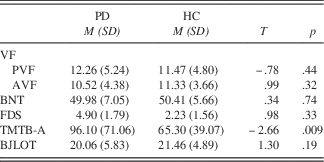
Neuropsychological features of individuals in the PD and HC groups
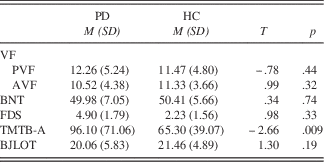
AVF=Alternative verbal fluency; BNT=Boston Naming Test; BJLOT=Benton Judgement of Line Orientation Test; FDS=Forward digit span; M=Mean; SD=Standard Deviation; PVF=Phonological verbal fluency; TMTB-A=Trail Making Test (PartB-Part A); VF=Verbal fluency.
All patients were taking anti-Parkinsonian medication with the following distribution: carbidopa/L-Dopa (44), d2 agonists (41), MAO - inhibitors (25), amantadine (3), and anticholinergics (1). Participants were informed of the confidential and anonymous treatment of their data and signed the informed consent. The study was completed in accordance with the Helsinki Declaration and approved by the Ethical Committee of the Universidad Autonoma de Madrid.
Stimuli and Tasks
Neuropsychological background
Basic visuospatial, language, and executive abilities of both groups were assessed. Visuospatial ability was estimated by means of the Benton Judgment of Line Orientation test (BJLOT; Benton, Varney, & Hamsher, Reference Benton, Varney and Hamsher1978), language skills through Boston Naming Test (BNT; Kaplan, Goodglass, and Weintraub, Reference Kaplan, Goodglass and Weintraub1983), and executive functioning by means of the Trail Making Test (TMT; Reynolds, Reference Reynolds2002), Forward Digit Span (Weschler, Reference Weschler2004), Phonemic and Alternating Word Fluency (Benton and Hamsher, Reference Benton and Hamsher1978). For BNT, Verbal fluency, TMT, and BJLOT we used Spanish Multicenter Normative Studies (NEURONORMA Project) norms.
Stimuli
Four types of stimuli were designed for the WM tasks: EFEs (happiness, sadness, anger, fear, and disgust), neutral faces of men and women, visual matrices of spatial location stimuli, and nonsense syllables. For the EFEs and neutral faces tasks, 80 pictures (6.1×9 cm) of male and female faces from different individuals (40 males and 40 females) were selected from the FACES Database (Ebner, Riediger, & Linderberger, Reference Ebner, Riediger and Linderberger2010). Half of them corresponded to EFE prototypes (4 examples of each emotion×5 emotions×2 genders), and the other half corresponded to neutral faces (20 males and 20 females). The hair and background were removed from all the pictures to reduce insignificant or extraneous information. For the spatial location stimulus, we presented a 3×3 square matrix with one blue square and 8 white squares. The location of the blue square varied systematically through all 9 possible locations in the matrix (four positions were presented five times and five positions four times). Finally, for the nonsense syllables, we used five pairs of non-sense syllables composed of three letters (consonant-vowel-consonant).
WM tasks
With these stimuli we designed four different tasks using an n-back procedure (Braver et al., Reference Braver, Cohen, Nystrom, Jonides, Smith and Noll1997). Each task consisted of 40 consecutive trials in which a stimulus, identified as the target set, was followed by the presentation of a stimulus target probe. In each task, participants were instructed to decide as quickly as possible whether or not the target probe matched the previous target set (1-back). The tasks were completed in a fixed order with the matching criteria being EFE, gender, spatial location, or syllable, respectively (see Figure 1), with 5 min of resting time between them. Stimuli were balanced to appear the same number of times throughout the 40 trials of each task.
Examples of stimuli used in the WM tasks. (A) “Facial expression 1-back”; (B) Gender 1-back”; (C) “Spatial location 1-back”; and (D) “Syllables 1-back” [Facial images were adapted, with permission, from FACES Database (Ebner et al., Reference Ebner, Riediger and Linderberger2010)].
All four tasks started with a verbal explanation about the precise nature of the experiment, and included several practice trials. Participants were instructed to respond whether the target probe matched the target set by pressing the 1 (yes) or 2 (no) button on the numeric keypad. Once the task was fully understood, the experiment began by presenting a white cross in the middle of the screen for 500 ms to fixate the participant’s attention. After this, a target set was presented until the participant pressed the spacebar. Once a response was given (or a maximum of 10,000 ms elapsed), a new stimulus appeared, and participants had to compare it with the previous target probe which now acts as a target set. This sequence was repeated until the 40 trials included in each task were completed.
Procedure
Participants were individually tested in a quiet room. The PD group was assessed at a time of day when their motor symptoms were less severe (“on-state”). The study was performed in two sessions of one hour duration each. The first began with screening for sociodemographic and general characteristics followed by the neuropsychological assessment. In the second session, participants performed the four WM tasks. For these last tasks, a high resolution computer monitor at a visual distance of 60 cm was used. E-Prime 1.2 software (43) controlled stimulus presentation, trial randomization, and recording the response.
RESULTS
Neuropsychological Background Test
Table 2 provides data on the neuropsychological tests performance of the two groups. There were no differences between the two groups in their basic visuospatial ability as assessed by BJLOT (t (97)=1.30; p=.19). Similarly, in relation to executive and language tests, no significant differences between PD and HC groups were observed in Phonemic Fluency (t (97)=−0.78; p=.44), Alternating Word Fluency (t (97)=0.99; p=.32), Forward Digit Span (t (97)=0.98; p=.33), and BNT (t (97)=0.34; p=.74). In contrast, significant differences were found in TMT performance (t (97)=−2.66; p=.01), where PD scores were lower than HC ones.
Working Memory Tasks
The performance of PD and HC groups in the four WM tasks was compared by means of a mixed 2 (group: PD patients vs. healthy controls)×4 (task: EFE, Gender, Spatial location, and Non-sense syllables) analysis of variance (ANOVA) with the number of correct responses as the dependent variable (see Table 3). Results showed a significant main effect of task (F (3,291)=103.15; p≤.01; η2=.52). The EFE recognition task (M=27.59; SD=5.71) was more difficult than Spatial Location (M=38.32; SD=2.01) and Syllables (M=37.21; SD=3.37) overall (p≤.01 for both tasks). The Gender task (M=27.35; SD=9.99) was also more difficult than Spatial Location (p≤.01) and Syllables (p≤.01). Analyses also revealed a significant group×task interaction (F (3,291)=3.40; p=.02; η2=.03). Post hoc analyses for simple effects revealed significant differences between PD and HC scores such that PD patients performed worse on the EFE (F (1,97)=10.74; p=.001; η2=.10) and Spatial Location tasks (F (1,97)=7.29; p=.001; η2=.07).
Correct responses in working memory with facial expression, gender, spatial location and syllables tasks by PD participants and Healthy controls (HC)

EFE=Emotional facial expression; M=Mean; SD=Standard deviation
Taking into account that PD patients performed significantly worse than HC on the TMT completion times (i.e., TMT-B time minus TMT-A time), we designed an additional ANCOVA including these TMT scores as a covariate. Results showed that the significant group×task interaction was maintained (F (3,288)=3.05; p=.03; η2=.03) even after covarying for TMT scores. However, further analyses for simple effects revealed that significant differences between PD and HC groups for the EFE task (F (1,96)=6.19; p=.02; η2=.06) remained, while the difference between PD and HC groups was no longer significant for the Spatial Location task (F (1,96)=3.09; p=.08; η2=.03) after covarying for TMT scores.
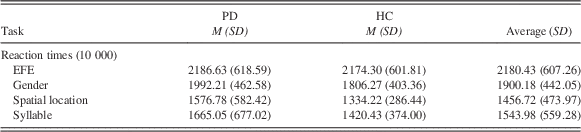
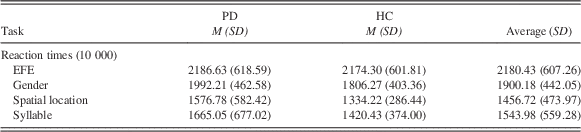
With the aim of assessing the possible influence of psychomotor speed in PD group performance, an additional mixed 2 (group: PD patients vs. healthy controls)×4 (task: EFE, gender, spatial location, and syllables) ANOVA was carried out with reaction time as the dependent variable (see Table 4). Analyses revealed a significant main effect of task (F (3,291)=77.35; p=.00; η2=.04). Differences in reaction times were found between the four tasks (p=.01 for all comparisons). For both groups, the EFE task took longer (M=2180.43 ms; SD=607.26 ms) and the Spatial location task was completed more quickly (M=1456.72 ms; SD=473.97 ms). Analyses also revealed a significant main effect of group (F (1,97)=4.51; p=.04; η2=.04), such that PD patients (M=1855.17 ms) were slower than HC (M=1683.81 ms) on all the tasks used. Statistically significant results were not found for the group×task interaction (F (3,291)=2.07; p=.10; η2=.02), indicating that differences between groups were not influenced by any of the four tasks we used. So, it is not likely that processing speed explains the differences we found for performance on the EFE and Spatial Location tasks.
Reaction times (ms) in working memory with facial expression, gender, spatial location and syllables tasks by PD participants and Healthy controls (HC)
EFE=Emotional facial expression; M=Mean; SD=Standard deviation
To assess whether PD stage (severity) influenced EFE recognition abilities, we divided patients into two groups by considering a global indicator of their motor and behavioral state (i.e., the CISI-PD scale, Martinez-Martin et al., Reference Martinez-Martin, Forjaz, Cubo, Frades and de Pedro Cuesta2006). This scale not only assesses motor decline (as the Hoehn and Yahr scale does) but also accounts for information about cognitive impairment and global disability. Then we divided patients into two groups by distinguishing CISI-PD scores above or below the percentile 50 based on percentile 50 on their CISI-PD scores, resulting in 24 patients with a high level of disability and 26 patients with a low level of disability. A one-way ANOVA was carried out to test for differences among the three groups (high disability, low disability, and HC) for the EFE task. The analyses revealed that there were significant differences among the three groups (F (2,95)=5.12; p=.01). Bonferroni LSD post hoc tests revealed that the high disability group (M=25.24; SD=7.02) scored significantly lower (p=.01) than the HC group (M=29.41; SD=5.02). No significant differences were found between the HC and low disability groups (M=26.61; SD=4.64), nor between low and high disability score groups.Footnote 1
Finally, we analyzed the possible relationship between EFE and depression in PD patients by calculating Pearson’s r statistic. No statistically significant correlations between the EFE task and GDR-S scores were found (r (49)=-0.09; p=.50).
DISCUSSION
The present study aimed to contribute to knowledge about WM and EFE recognition abilities in PD and the possible relationships between these processes. For this purpose, we used an n-back procedure to compare recognition of EFE and other stimuli in a group of PD patients compared to healthy individuals. We found that Parkinson’s patients have greater difficulty than healthy individuals in recognizing emotional facial expressions. Moreover, we found that this deficit is more pronounced in more severe PD patients. Control conditions revealed that this deficit of facial emotion recognition cannot be accounted for by worse facial recognition in general, by working memory or executive function deficits, or by depression.
Our results showed that the PD group performed worse than the HC group for the EFE and Spatial location WM tasks, but not for the Gender and Nonsense syllable tasks. Even so, when executive function performance (assessed by TMT) was covaried with spatial and EFE recognition, significant differences between groups remained for only the EFE WM task and not the Spatial Location task. Thus, as is well known, PD patients did evidence worse executive functioning and this finding seemed to underlie worse spatial localization abilities but not their deficit of recognizing emotional expression in faces. Additionally, our results indicate that these differences are more evident in patients with high motor and cognitive disability (assessed by CISI-PD) than in the less affected patients, and when compared to healthy individuals. Moreover, the fact that both the PD and HC groups performed similarly on the Gender tasks, an underlying general facial processing ability deficit cannot explain the PD patients’ deficit in emotional facial recognition. Similarly, since both groups performed similarly on the Syllables task, a general working memory deficit cannot explain the PD patients’ deficit of emotional facial recognition.
This finding of worse EFE in PD cannot be attributed simply to task difficulty. Accuracy and reaction times demonstrated that the EFE and Gender tasks were more difficult than the Spatial Location and Nonsense Syllable tasks for both PD and HC groups. However, significant differences between groups were found both in one of the difficult tasks (EFE) and in one of the easy tasks (Spatial Locations). Thus, although tasks ranged in difficulty, task difficulty cannot explain why PD patients were significantly poor at recognizing emotional faces.
The relative independence between executive function and EFE recognition deficits suggests the possible presence of an additional and specific EFE recognition impairment. This result is somewhat distinct from those of Cohen et al. (Reference Cohen, Gagne, Hess and Pourcher2010) who, with a similar n-back procedure, found a global slowing on their most complex recognition task (3-back vs. 1-back), but did not find a specific EFE deficit. In this respect, we should stress that we also found a non-specific slowing in reaction times in PD compared to HC in all the four tasks we used. Nevertheless, as we did not evaluate task complexity, and they only contrasted facial expression with other very different objects, a direct comparison between their results and ours is difficult. Thus, the most parsimonious interpretation for our results would suggest that response slowing in PD individuals is a separable characteristic that may not fully explain our EFE recognition results (Low, Miller, & Vierck, Reference Low, Miller and Vierck2002). Moreover, this specific EFE recognition impairment has also been widely observed in other studies (Dujardin et al., Reference Dujardin, Blairy, Defebvre, Duhem, Noel, Hess and Destée2004; Herrera et al., Reference Herrera, Cuetos and Rodriguez-Ferreiro2011; Lachenal-Chevallet et al., Reference Lachenal-Chevallet, Bediou, Bouvard, Thobois, Broussolle, Vighetto and Krolak-Salmon2006; Suzuki et al., Reference Suzuki, Hoshino, Shigemasu and Kawamura2006; Yip et al., Reference Yip, Lee, Ho, Tsang and Li2003). Our results agree with this set of studies, and add reasonable evidence to support that emotional recognition problems in PD are not attributable to their executive process dysfunction.
Although PD patients performed worse on a Spatial Location task, this result did not remain significant after covarying for TMT-A time minus TMT-B time. The association between visuospatial WM and TMT deficits has been observed by other authors (Miller, Price, Okin, Montijo, & Bowers, Reference Miller, Price, Okin, Montijo and Bowers2009). So, this result indicates that spatial perception and executive performance, which are both found to be frequently impaired in PD, may be explained by similar underlying mechanisms. It is also in accordance with our own, and other previous, results indicating that spatial memory, but not verbal memory, is related to executive function performance in individuals with PD (Alonso-Recio et al., 2013; Rilling, Reference Rilling2003).
It is interesting that PD patients did not show problems with the Gender WM task, which presumably also entails spatial abilities. A possible explanation is that the perception of facial emotional expression and facial identity features (such as gender) do not require similar perceptive processes and brain areas, and therefore they may be differentially impaired in PD. In this respect, neurocognitive models for face perception suggest differentiable components for the perception of identity versus emotional facial features (Bruce & Young, Reference Bruce and Young1986; Calder & Young, Reference Calder and Young2005; Haxby, Hoffman, & Gobbini, Reference Haxby, Hoffman and Gobbini2000). Related to this proposal is the suggestion of distinguishable WM components: one operating with spatial properties of stimuli and another one for object recognition (Rottschy, Caspers, et al., Reference Rottschy, Caspers, Roski, Reetz, Dogan, Schultz and Eickhoff2012). Both suggest modular or at least partially distinctive cognitive processes and brain areas for the recognition of more changeable facial features, such as those of the emotional expression, or more stable ones, such as those defining gender (Haxby & Gobbini, Reference Haxby and Gobbini2011). Relevant to this line of reasoning, our results may support this differentiation in face recognition processes, indicating that the management of spatial cues involved in EFE recognition are specifically altered in PD. Conversely, the ability to process facial features related to identity recognition, such as gender, could be preserved. In support of this hypothesis, it has also been found that the perception of emotional facial expressions and facial identity features (as gender) do not induce similar facial scanning strategies (Dakin & Watt, Reference Dakin and Watt2009; Goffaux & Dakin, Reference Goffaux and Dakin2010), and may be differentially impaired in PD (Narme, Bonnet, Dubois, & Chaby, Reference Narme, Bonnet, Dubois and Chaby2011).
Regarding the difficulty with the spatial working memory measure, this may also indicate that the PD group did not perform at a lower level on the BJLOT test. Several studies suggest that visuospatial impairment in PD is associated with executive function. In particular, such impairments have been mostly observed in the visuospatial tasks conveying sequential organization, planning, abstraction or self-monitoring (Crucian & Okun, Reference Crucian and Okun2003; Crucian et al., Reference Crucian, Barrett, Burks, Riestra, Roth, Schwartz and Heilman2000; Stella et al., Reference Stella, Gobbi, Gobbi, Oliani, Tanaka and Pieruccini-Faria2007). It is possible that BJLOT, which is a pure visuoperceptive test, may be performed without a high executive involvement, which could explain the lack of differences between the PD and HC groups.
From a neuroanatomical perspective, WM impairments in PD have been linked to the dopaminergic drop in frontostriatal circuits. Our results may further indicate that the white matter connections between the prefrontal and dorsal posterior brain areas (related to spatial perception) may be a particular region of interest for impairment in PD (Postle, Reference Postle2006; Rottschy, Caspers, et al., Reference Rottschy, Caspers, Roski, Reetz, Dogan, Schultz and Eickhoff2012). Emotional recognition impairments, at least in patients with a higher level of PD-related disability, could be related to other brain impairments that are not so evident in the initial stages of the disease. There is evidence that, in these initial stages, the mesolimbic dopaminergic and non-dopaminergic circuits tend to be preserved but that they decline as the disease progresses (Braak et al., Reference Braak, Del Tredici, Rüb, de Vos, Steur and Braak2003; Owen, Reference Owen2004). These mesolimbic pathways connect the striatum, amygdala, hippocampus, limbic and paralimbic cortex, as most of these structures play a relevant role in emotion recognition (Adolphs, Reference Adolphs2002). So, our results may indicate that EFE recognition problems are more closely associated with the progressive damage in these mesolimbic circuits and areas (Peron et al., Reference Peron, Dondaine, Le Jeune, Grandjean and Verin2012).
Our study is limited by the use of static images; future research using the use of more realistic portrayals of emotional facial expression would permit further evaluation of EFE in PD patients. We must also emphasize that our main objective was to analyze WM abilities through behavioral measures, which limits our approach to studying the neural correlates of these abilities. Studies specifically designed to compare patients’ abilities with functional neuroimaging techniques may provide relevant information to the neuroanatomical postulates above. Moreover, all of our PD patients were evaluated while undergoing dopaminergic treatment. As such, we were unable to assess the potential influence of the medication on their performance. The fact that patients show EFE recognition impairments despite treatment may implicate extradopaminergic more than dopaminergic circuits. However, comparison of patients’ abilities under different treatment conditions could help to discern this issue. Also, other factors that could be investigated as a potential influence on our results are those specific to the dominant motor symptomatology or the side of onset of the disease. So, future studies must be designed taking into consideration these disease characteristics and their relevance on PDs’ performance. Finally, we may also point out that our experimental design could possibly have been improved by using randomization among tasks. However, our results can be considered to not have been influenced by using a fixed order. In this sense, we did not observe a progressive improvement in performance (greater accuracy and/or lower reaction times) throughout tasks.
Taken in the context of the literature, our findings have important clinical implications that will be useful to consider in the neuropsychological assessment and rehabilitation of PD patients. EFE are very frequent in everyday social interaction and, as such, recognition deficits may have a greater impact on patients’ quality of life. Also, WM is a very relevant ability that helps individuals to maintain and manage information to cope with a lot of daily situations. Therefore, it is important to conduct a more detailed assessment of emotional recognition abilities to better understand their impact on PD patients’ social interactions and daily activities. Similarly, EFE may be useful to address in rehabilitation programs as a way facilitating PD patients’ interpersonal efficacy, and consequently, it will be important to train clinicians in this aspect of PD rehabilitation. It has been pointed out that one of the main problems of cognitive training programs, especially in aging, is engaging people in them, as well as generalizing the results to their daily life (Park & Bischof, Reference Park and Bischof2013). So, to design more engaging and ecologically valid rehabilitation programs, inclusion of goals to enhance EFE recognition may be useful to for facilitating the extrapolation of their improvements to common everyday settings. Exercises to improve recognition of facial emotional expression may be implemented both for basic spatial WM and affect recognition abilities. Other authors have already reported the positive effect of using relevant daily-life situations in WM training programs with PD individuals (Ranchet, Paire-Ficout, Marin-Lamellet, Bernard, & Brousolle, Reference Ranchet, Paire-Ficout, Marin-Lamellet, Bernard and Brousolle2011).
In summary, the PD patients evidenced deficits of recognizing facial emotions in the context of a working memory task. While they also exhibited a weakness for spatial localization on a working memory task, this was explained by a deficit of executive functioning. Considering that neutral faces did not elicit the same difficulties, the deficit in recognizing emotional expression seems to be specific to the affective content. Thus, the evidence from our results allows us to distinguish some of the cognitive and emotional deficits often found in PD.
ACKNOWLEDGMENTS
We thank the Parkinson Association of Alcorcon and other towns (APARKAM), the Parkinson Association of Madrid, the Parkinson Association of San Sebastián de los Reyes (ALCOSSE) and the Centro de Mayores el Soto. We also acknowledge the collaboration of Shelley Peery, editor of the Research and Editing Consulting Program (RECP) within the International Neuropsychological Society’s International Liasion Committee. This study has been funded by the Spain Ministry of Science and Innovation (PSI2009-09067) and by Universidad Autonoma de Madrid multidisciplinary projects (CEMU-2012-004).