It's a long road we have come and it's a long road we can go.
We have to walk together and talk together.
If you never listen to me, I will never listen to you. I will not follow you.
Walk side by side and let's get there. (Conrad Ratara, Reference Ratara2011)
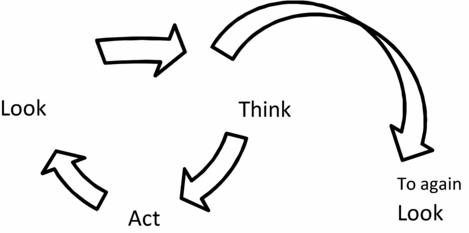
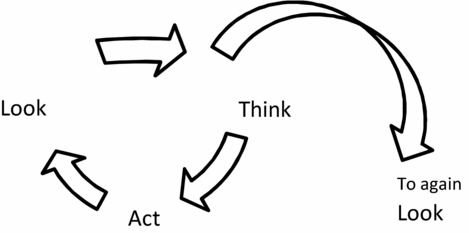
The quote above captures the essence of this article in two main ways. First, our ways of knowing and doing are subjective, and by gaining a critical understanding of how our experiences shape our worldviews and those of others, we hope to make better practice decisions, particularly in the context of working with people who are overrepresented across a range of medical and social issues. Critical reflection on self (or selves) in relation to others is essential to the work we do as health professionals. Providing facilitated learning environments that support staff and students through a process of observing (such as where we have come), reflecting (for instance, where to from here), and acting (walking and talking together) in ways that develop capacities within us and towards our overall growth as health professionals assists us when working in this richly diverse field. The second consideration relates to us being on a journey, suggesting here that practices require of us a reflection on self within context, and understanding that formulaic or fixed responses can often be ineffective across time and place. When engaged in a process of critical reflection, health professionals are, we contend, better able to address the many challenges and tensions of their work. To ‘let's get there’, as taken here, then is suggestive of new insight and ways of knowing and working —through walking, listening and talking together — that build on existing knowledges and practices in ways that lead to transformative processes. This iterative knowing on doing is illustrated as action research and learning (Figure 1), and while not formalised, describes processes often engaged in this learning space to provide a forum for Aboriginal voices that guide non-Aboriginal health professionals to working (walking) beside Aboriginal people — together — to move towards change: change from the way health professionals practise in Aboriginal contexts and change for Aboriginal people in improved quality and outcomes of health services.
Action Research and Learning Cycle.
We argue here that critical reflection is useful in facilitating students’ learning as it serves to challenge often individualistic interpretations of disadvantage and inequities by providing structural explanations. First-year students have little, incomplete or misrepresented knowledge of the complex world of Aboriginal and Torres Strait Islander peoples and in some cases are resistant to working in these settings. The disproportionate over-representation of Aboriginal and Torres Strait Islander peoples in the health system is undeniable and evidence enough to support a specialist unit that aims to prepare future health professionals in the acquisition of knowledges and skills in an intercultural space. The Indigenous Cultures and Health (ICH) Unit aims to address these issues at a beginning level by challenging dominant discourses as well as accepted historical teachings that, for a large part, remain biased, inadequate (Dumbrill & Green, Reference Dumbrill and Green2008; Duponte & Martin, Reference Duponte and Martin2010) and repeatedly neglect Indigenous perspectives (Kerwin, Reference Kerwin2011; Nakata, Reference Nakata2007; Nakata, Nakata, Keech, & Bolt, Reference Nakata, Nakata, Keech and Bolt2012). In some instances it may be the only Indigenous unit where students study.
A critical reflection diagram (Figure 2) illustrates how students are encouraged to engage with the content of the ICH Unit. The diagram represents a process of thinking and doing, and again ‘thinking on doing’, to act in ways differently at each cycle. This can be described similarly to Ife's (Reference Ife1997) conceptualising practice through critical engagement, which we refer to as contributing to a larger social justice change strategy. Within and across professions these transformative capabilities can contribute to wider structural and social policy change based on human rights and social justice (Nurenberg, Reference Nurenberg2011). Education is a vehicle and ‘central strategy for addressing serious disparities’ (Hauser, Howlett, & Matthews, Reference Hauser, Howlett and Matthews2009, p. 46) and as a political activity ‘linked intimately to the interrogation and deconstruction of colonialism’ (Mackinlay & Barney, Reference Mackinlay and Barney2012, p. 14) that shapes realities (and policies). We see critical engagement and reflection as key to what makes the ICH Unit a valuable experience for students, and overall a vital contribution to the human services sector.
Critical Reflection.

Critical reflection is not a new concept, having been adopted in various fields of practice to varying degrees and with many diverse, often divergent, interpretations. The Action Research (AR) framework (Figure 1) of Look, Think, Act (also possibly observe, learn, grow, in consideration of the proverb quoted at the beginning of this article) is used to guide students new to the ideas of critical reflection. It is important to acknowledge upfront that there are many practices and theories specific to the various disciplines represented and our aim is not to devalue these or suggest a one-size-fits-all approach. Rather, we offer a framework for health professionals that permeates the often-siloed professional disciplines.
AR (Stringer, Reference Stringer2014), as both a process of inquiry and theoretical framework, is used to structure this paper. Look, Think, Act, as one of the many variations possible in AR, guides the content of our article by reflecting on the ICH Unit and on the students’ main assessment, which is detailed later. Look initiates our discussion by detailing the teaching context, background and content of the Unit. Under Think is an outline of critical reflection as used here, as well as those guiding principles of the Unit. Act discusses some of the many processes of teaching and learning within the Unit that contribute to enhanced learning outcomes and changed students’ perspectives. These areas interweave and overlap in what we consider is a way of teaching and learning that promotes the development of lifelong learning skills and an effective means of working in a culturally and socially responsive manner. Figure 1 illustrates the cyclical motion of AR, where the process involves a constant looking in on itself and further acting in new ways that is iterative and ongoing.
The act of writing about our experiences and understandings of the ICH Unit is itself a process of AR, as we invite views from other contributors with experience and thoughts on this subject. This aids in our own critical reflection on practice, leading to reviewing what we know in relation to new and/or other considerations. This article is the outcome of the authors’ reflections on our interactions with people involved in the ICH Unit and across the various levels of management, including the strategic direction at a faculty executive level, the initial Unit development team, the Unit coordinators, the teaching team, and educator experiences of interactions with students. The authors’ reflections on processes and people form our observations of what works and why, to consider further how can we build on this evidence in an ongoing and cyclically informed way.
Look — What is in the Content of the ICH Unit?
The ICH Unit is one of the designated first-year interprofessional educational units that offer an innovative approach in its management of large student cohorts alongside provision of excellence in teaching. It includes students from social work, nursing and midwifery, physiotherapy, medical imaging, psychology, health and safety, occupational therapy and another 20 other discipline-specific courses. In 2012, staff of the ICH Unit were the runner-up for the Vice Chancellor's Awards for Excellence and Innovation in Teaching in the category of Facilitating Partnerships and Engagement. In 2013, the ICH Unit coordinators and teaching team were again nominated, and this time succeeded in the area of Programs that Enhance Learning. There are two aspects of equal importance in the teaching and learning of this Unit: the way it is taught (the processes) and the content it contains. Here is described the content, with processes discussed in Act. First, a little description of the ICH Unit is needed.
The ICH Unit operates within the School of Nursing and Midwifery in the Faculty of Health Sciences at Curtin University in Western Australia. The Unit operates in partnership with the Centre for Aboriginal Studies (CAS). Tutors are Indigenous and non-Indigenous, with many Indigenous staff employed by CAS and through the School of Nursing and Midwifery. Tutors from other schools across the Health Sciences Faculty teach into this unit, with authors of this article representing the School of Occupational Therapy and Social Work and the School of Nursing and Midwifery. The ICH Unit is one of six units for first-year students that focuses on interprofessional education, with as many as 2,000 students enrolled in the Unit in any one semester. The Unit is offered as a ‘half’ unit with a weighting of 12.5 credits, as opposed to ‘full’ units that carry 25 credits. The Unit is offered in both semesters each year. A central protocol is that the Unit is coordinated by both a non-Indigenous and Indigenous person (both are represented as authors here). Another important aspect of running the ICH Unit is the large degree of input from Aboriginal communities, both as professionals and members of the community. This input comes in a number of ways, including vodcasts, yarning, networking, tutor contributions, community member input and professionals working in the area. By embedding voices of Aboriginal and Torres Strait Islander peoples in the Unit, dominant hegemonic discourses can be challenged (Edwards & Hewtson, Reference Edwards and Hewtson2008). The 12 weekly 2-hour workshops act to provide information, often by way of vodcasts, and promote activities that explore weekly topics in some depth.
It is within the workshop space that critical and collaborative engagement within and across disciplines is facilitated. In this learning environment, students are asked to think about their skill set, knowledge base specific to their discipline, own assumptions, and values and beliefs. The aim is to build student capacities and connections across these identified differences, rather than focusing on what sets them apart. One way students explore the different ways of conceptualising and practising is in relation to the concept of ‘worldview’. This approach promotes a holistic view of working with people that can be defined as ‘those occasions when members (or students) of two or more professions learn with, from and about one another to improve collaboration and the quality of care’ (Centre for the Advancement of Interprofessional Education, 2002). For many students at least, a space to explore their own professional views and broader worldviews can, as Tilburt (Reference Tilburt2010, p. 178) states, ‘serve to transform the culture of health care professionals toward a more self-reflective, humble, and open-minded posture’. At the very least, the workshop space offers students the opportunity to explore their own views in comparison with others, towards an understanding that there are many different ways of viewing people, problems and therefore possible interventions.
The teaching material offered in the workshops is rich, diverse and demanding. The vodcasts include Aboriginal and Torres Strait Islander people sharing lived experiences. One speaker (Webb, Reference Webb2011) talks of being the product of assimilation policies — ‘a poster-child’ — with her white skin challenging many students about what it is to be ‘Aboriginal’; itself a subjective and complex area. Many of the vodcasts challenge stereotypes, assumptions and earlier educational experiences that posit British colonisation as the birth of the Australian nation. For many students, the realities of colonial ‘invasion’ over ‘settlement’ and the impacts upon Aboriginal and Torres Strait Islander peoples are new and confronting. Dr Marion Kickett (Reference Kickett2011) in her vodcast talks of being born a non-citizen until Aboriginal people were included in the census and counted as part of the population of Australia. Personal accounts offered by Kickett and other speakers present a different perspective that is an impetus for students to question earlier educational information. Students gain greater understandings of the diversity of Indigenous peoples and their cultures, and are offered detailed information about concepts, including cultural awareness, cultural understanding, cultural safety, and cultural security. Such learnings provide information and advice about ways to practise in culturally appropriate ways.
To the majority of students coming into the ICH Unit, of which at least a third of each semester's cohort are international and approximately 1% of the student group identify as Aboriginal and/or Torres Strait Islander, the material is confronting, not least because of challenging preconceived ideas, but because the material often invokes emotional responses that can come as a surprise and relate to a sense of being misguided. These expressions are explored within these learning spaces throughout the semester. This new awareness raises consciousness in profound ways, with students questioning what they know and how they know what they know. Students are further encouraged to question who are the holders of knowledge, as well as what information is imparted and through what media or structures of power.
The assessment requires students to complete a reflective journal with weekly entries and an overall summary at the end of semester, and engages them in a process of critical reflexivity (Howatson-Jones, Reference Howatson-Jones2010). The summary, encouraging students to return to their weekly entries, expects students to extract key learnings and explain why and how this informs their developing professional and personal selves. Through the reflective journalling experience, students explore and detail their learnings and ideas as these emerge and develop from week to week. It also acts as a guide to tutors as to how students are faring with the material, and guides the tutors with what issues need discussion in class. Often journals present student expressions about their distress, anger, bewilderment and other emotions, as for many this is the first time they have come to know of the atrocities, or they have known of these but from a distance. Students frequently express astonishment at the recent events that have taken place, such as the Stolen Generations and the referendum that gave Aboriginal peoples some citizenship rights within their parents’ lifetime.
Previous to their undertaking the Unit, many students expressed little understanding about events of the past, illustrating how the impact of those events upon Aboriginal and Torres Strait Islander peoples today is sketchy or not known. Common to our experiences as educators are student responses that suggest all Aboriginal and Torres Strait Islander peoples are to be feared and if ‘you see one, you are to cross to the other side of the road’. Our experiences suggest this is a common sentiment and one most frequently expressed by international students. To other non-Indigenous Australian students, Aboriginal and Torres Strait Islander peoples are generally conceived of as aggressive, alcoholics or some other deviant label who are in need of ‘fixing’ (Howe, Reference Howe1987). Such acceptance of common stereotypes confirms the need for greater understanding of the structural and historical factors impacting upon this often demonised group, also typically seen as a homogenised category.
Flexibility is a feature of the ICH Unit in its design and development. While structure and delivery of the Unit provides consistency of topics across the weeks, there is autonomy for each tutor to work with their students in ways that best suit their particular teaching styles and in ways that meet the needs of each group. This sets the Unit apart from many other units of study across the Faculty. A different yet interrelated aspect of Indigenous Culture and Health is covered each week, and while an extensive and detailed tutor's guide for activities of engagement is provided, how tutors implement learning activities on these topics is up to their discretion. Tutors are able to choose an activity of engagement that is creative and spontaneous, and often one that draws on their own particular strengths, experiences and aptitudes. Regular tutor meetings offer a forum for tutors to contribute to and share ideas on what works and what does not work, based on classroom experiences. For instance, a timeline activity using a rope that consists of tags listing specific events and dates is passed around a workshop during the second week. At one of the tutors’ meetings, a tutor shared her experience of calling out some of the tags, before handing out the rope and asking the group to estimate how long ago the event had occurred. Writing dates on the whiteboard provided students with a visual image of the timeline events estimated. This strategy enhanced the set activity, with other tutors trialling this new approach with great success. Most students were surprised to find the longest time recorded concerned the oldest living peoples — the Indigenous peoples — over other significant events such as the birth of Jesus or the building of the Egyptian pyramids. For many students, the Egyptian pyramids exceeded by far the number of years before presence of Indigenous peoples. Many teaching strategies are shared, greatly enhancing the learning spaces, when brought to the regular tutor meetings.
The content of ICH is fixed, while processes enable creativity and a rich learning space where reflection on content generates new ways of working and possible practice ideas. Materials used to aid processes of reflecting on what works well and areas that could be improved is achieved through collaborative practices where views and perspectives are shared, respected, explored and developed together similarly between students and staff. Tutors’ experiences play an important role in this change process of, first, facilitating a safe space in which students feel confident to speak out about their particular views. Tutors often stipulate from the outset that everyone's perspective and opinion is to be respected and valued: ‘there is no right or wrong answer’ and ‘there is no blame’. Fook (Reference Fook2012) emphasises that accepting the individual's story through the suspension of judgment enables the individual to make his/her own judgment rather than having one imposed. Second, tutors facilitate discussions that challenge students to question why they think as they do, what influences their thinking, and then how this transfers into action as they work towards being allied health practitioners. As first-year students, with many having come straight from high school, this is often the first experience of questioning their knowing in relation to Australia's First Peoples.
Think — How is Critical Reflection Conceptualised and How is This Congruent With the Underlying Principles of ICH?
Critical reflection, as both a theoretical construct and practice tool, is considered in this section. This assists us to work alongside students to challenge preconceived ideas towards a greater awareness and appreciation for social justice and human rights, which are two of the main principles demonstrated in the ICH Unit. While it is important to outline how critical reflection is adopted here, further theorising is best left to another paper. Alongside these broad conceptualisations sits the principle of respect for self and other, in order to engage with challenging and often controversial material, which leads to transformational learning. Here we detail our use of critical reflection and its underlying principles in the ICH Unit.
The ICH Unit sits within a broad framework of social justice and human rights. It is well known (Booth & Carroll, Reference Booth and Carroll2008; Council of Australian Governments, n.d.; Eckermann et al., Reference Eckermann, Dowd, Chong, Nixon, Gray and Johnson2010) that Aboriginal and Torres Strait Islander peoples are overrepresented in the justice and health systems, with high infant mortality rates, lower life expectancy compared with non-Indigenous peoples, and other social indicators of social and economic disadvantage (Australian Indigenous HealthInfoNet, 2013; Booth & Carroll, Reference Booth and Carroll2008; Council of Australian Governments, n.d.; Eckermann et al., Reference Eckermann, Dowd, Chong, Nixon, Gray and Johnson2010). While well known, explanations and constructions around these negative social indicators tend to allocate individual blame and/or lack of desire by Aboriginal and Torres Strait Islander peoples to help themselves out of such dire circumstances. We often hear such sentiment in our teaching spaces: ‘Why don't [Indigenous] people want to work?’ or ‘They are all drunks’ and so on. This very neoliberal, individualised perspective does not account for the significant structural inequalities and powerful systems that continue to reinforce dominant discourses of personal blame and inferiority of people of colour (Bessarab, Reference Bessarab1996). A critical reflection perspective within a critical theory paradigm challenges these assumptions and assists us as facilitators of learning to unpack the power differentials and common assumptions that students (and staff) often hold unknowingly.
The theoretical material draws on understandings of critical theory and its applications in education through initially raising awareness and integrating the significance of structural factors in relation to issues of social justice. Fook and Kellehear (Reference Fook and Kellehear2010, p. 297) define critical reflection as ‘learning from experience and it incorporates processes of unearthing deeper assumptions and a critical analysis of personal and social situations’. Early on in the Unit, students participate in an exploration with their peers and the tutor on the meaning of culture and how they might define it as a way of examining their personal perspectives. Many students respond similarly — ‘We've not given this much thought’ or ‘I don't know how to define my culture’ or ‘I didn't think I had culture’ — as though somehow this was something that others had. It is quite notable that those students who find it difficult to define culture or conceive of themselves as having or being a part of culture are predominantly white and of Anglo Saxon origin. Often, international students more readily identify as having a ‘culture’ and are able to describe such attributes as celebrations, religions, ceremony and so on. One explanation for conceiving of culture as something that ‘other’ people have — often the exotic other — is white privilege or a culture of privilege (Ferber, Reference Ferber2012; McIntosh, Reference McIntosh, Kesselman, McNair and Schneidewind1995). This theorisation considers those who experience privilege as those who are less likely to recognise their privileged position in relation to ‘other’, most notably people of colour who experience some form of oppression or discrimination.
The creation of learning spaces in which to challenge preconceived ideas as a way to develop new ideas and therefore new ways of practising is nothing new. Mezirow (Reference Mezirow1978, 1991) confirms that our socialisation shapes the meanings we ascribe to things, including values that we develop in childhood. However, new experiences cause some people to question these understandings in adulthood, which can result in critical assessments of these taken for granted perspectives. Sands and Tennant (Reference Sands and Tennant2010) consider the role of educators as that which challenges students through questioning comfortable world views. Mezirow (Reference Mezirow1978, p. 11) refers to the confusion or self-doubt that ensues as part of a ‘meaning perspective transformation’. This can be the experience for some of the students studying the ICH Unit. For example, class discussions about the impact of policies, and particularly the Stolen Generations’ narratives, encourage educators and students to engage with the emotional aspects of the Unit's content. For many non-Indigenous students and educators who may not have been brought up in Australia or had limited exposure to First Peoples’ history, this may be their first introduction to the experiences of many Aboriginal and Torres Strait Islander people. Hook (Reference Hook2013) demonstrates that Rabbit Proof Fence, as one example, is atypical and a limited yet profound reflection into the impacts of the Stolen Generations on families even today. As educators, we observe that this is a turning point for the many non-Indigenous students, possibly due to the awareness of the ramifications across the lifespan for Indigenous children and families and the realisation that the past is very much evident in current lived experiences. This seemed like the beginning understanding of the implications of policies and past practices that provide structural explanations as counter to pathologising and laying individual blame for such circumstances. It is the Unit's content, such as the Stolen Generations’ narratives and reflection on content, that shines light on the ‘educational blind spot’ (Hook, Reference Hook2013, p. 110).
Other research points to the importance of relationship building within facilitated learning environments, including trust and support, in fostering transformative learning (Sands & Tennant, Reference Sands and Tennant2010; Taylor, Reference Taylor2007). The flexibility afforded tutors is a modelling from above that allows for, and values different student groups’ and individuals’ needs to be accommodated, as well as development of trust between tutor and student group. Unit coordinators trust and nurture the abilities and strengths of tutors to deliver the prescribed material in ways meaningful to each student group, which in turn enables tutors to trust and nurture unique abilities and strengths of their student cohorts. With no two tutorial groups the same, the trust and important relationships built between Unit coordinators, teaching staff and students enables greater engagement, with often significant learning outcomes observed.
Critical theory, as it informs critical reflection, provides the analytical tools to facilitate student transformative capacity. For example, the often individualistic explanations provided as a reason for poverty and disadvantage are challenged within a critical theory tradition where an examination of the role of socio-political factors as causal factors of inequality are considered. Fook (Reference Fook2012) points to the understandings of power as the connection between the individual and the structures within society, and the transformative capacity of the operation of power. An example of structural power in this context is the impact of social policies on the community. This is considered as an authoritative use of power and influence. Fook (Reference Fook, Davies and Leonard2004) comments on the ways of challenging dominant discourses through the use of postmodernist and poststructuralist ways of thinking. Others (Fejo-King & Briskman, Reference Fejo-King, Briskman, Allan, Briskman and Pease2009; Muller, Reference Muller2007) specifically centre decolonisation as a form of challenging dominant discourses. These approaches argue that knowledge is socially constructed in ways that support dominant and privileged groups in order to uphold the status quo and existing power bases. A way of challenging the dominant discourses is the questioning of problem construction and asking who has the power to decide and in whose interests (Bacchi, Reference Bacchi2006). For example, in the case of the Western Australian government's Aborigines Act 1905 (WA), the policy was conceived of as one of protectionism, yet it is now recognised more for its discriminatory features that are clearly linked to many social issues currently pervading Aboriginal and Torres Strait Islander communities (Beresford & Omaji, Reference Beresford and Omaji1998; Howson, Reference Howson1999). Many students have only heard of the 1905 Act for the first time in the ICH Unit, yet the significance of this policy (Haebich, Reference Haebich1988) and other past policies on people living under their effects today is unprecedented. Parallels are drawn with existing polices, where students are encouraged to consider power differentials in their development and implementation. For example, the 2007 Northern Territory Emergency Intervention is seen as taking away many rights similar to those removed under the Aborigines Act 1905 (WA), also in the name of protection. It is week 5 into the semester when past policies are introduced to students. For most, this is new information, but realisation enough of the subjugation by British colonialism that still has a stronghold in the mindset of mainstream Australia today. Common to the reflections we see as educators are sentiments along the vein of ‘Why is this not something that I learnt at school?’, often followed with strong expressions of emotion signalling distress and/or anger and/or empathy.
Identification of dominant discourses through which to identify conflicts and contradictions is befitting to a critical theory (Fook, Reference Fook2002) approach to learning. A decolonising perspective assists with a challenging of dominant discourses through a process of deconstruction and accurate reconstruction (Menzies & Gilbert, Reference Menzies, Gilbert, Bennett, Green, Gilbert and Bessarab2013). This, too, involves an understanding that there are many varied experiences. Understanding discourses as being fluid and not fixed, and open to being challenged and therefore changed, often through the use of competing discourses, is part of the learnings inherent in the ICH Unit; for instance, where policies described as orchestrated by government for the people is a counter view of programs and policies developed for the people by the people who are impacted by these (i.e., from the ‘bottom up’).
A teaching tool often considered as useful and shared in the regular tutorial meetings is to present a reversal of roles. An example of role reversal is found in the 1980s video Babakiueria (Young, Reference Young and McKay1999), which confronts and challenges viewers to consider their and their families’ responses to invasion in a satirical and outwardly light-hearted yet profound way. Similarly, students are often asked to think about how they and their families or communities may feel, and would be affected, if similar policies were inflicted upon them. Critical theory then provides a theoretical base through which to challenge previously unexamined assumptions and sets the resultant actions within a social justice change strategy. This is evident, for instance, when students are seen to shift from an earlier perception, expressed in workshops of ‘government needs to fix this’, to one that suggests the inclusion of people who are impacted by policy to also, and importantly, be involved in policy planning, development and implementation. In this way, critical theory ‘involves a recognition that domination is both personally experienced and structurally created’ (Fook, Reference Fook, Davies and Leonard2004, p. 20), and analysis involves a process of interrogating taken-for-granted assumptions and meanings. This process is often described as a process of deconstruction and reconstruction (Fook, Reference Fook2002). By becoming aware of our assumptions or societal norms, as part of our everyday experiences and practices, and subjecting these to a critical lens, ways of knowing and doing can be transformed.
Critical theorist Paulo Freire (Reference Freire1972, Reference Freire1974) offers a way of conceptualising education as a process of conscientisation, or consciousness raising: as being about ‘that [which] supports human beings as active agents who change their world’ (Freire, Reference Freire1998, p. 499). Freire (Reference Freire1972) explains conscientisation as the ability to analyse our cultural contexts to realise the many inherent assumptions and implied values. To do so is to liberate our consciousness from taken-for-granted notions of the world and begin to problematise these, based on a range of ways of knowing. Similarly, Furlong and Wight (Reference Furlong and Wight2011, p. 39) talk of a critical awareness underpinned by a ‘curiosity’ and ‘informed not knowing’. When students are asked to engage in thinking about their own culture and what this means to them, it begins a process of investigation of selves in relation to other with a curiosity that opens a space of ‘not knowing’ and learning alongside others. These theoretical frameworks, including the earlier mentioned empowerment framework (Whiteside et al., Reference Whiteside, Tsey and Cadet-James2011), differ from traditional educational experiences of imparting ‘expert knowledge’ (Moreton-Robinson, Reference Moreton-Robinson2002) to those who decide, as the ‘experts’ (considered knowledge holders), who is worthy of educating (usually the middle class, white, privileged populations). Smith (Reference Smith2005) suggests that without critical reflection, the interests of dominant groups are maintained. This element is evident in the example when students are asked to consider a case study simulating an interprofessional education setting. Each student often shares how he or she would work with the people in the case study, based on their profession (i.e., nurse or social worker). As educators, we frequently observe that students who study Health and Safety or Laboratory Science often state they have no role to play as their work does not involve Aboriginal and Torres Strait Islander peoples. This represents a Whiteness positioning (Young, Reference Young and Moreton-Robinson2004) in which the unquestioned work is a world that only includes the ‘other’ as unconsciously constructed as a recipient of service and not as part of the normative construct of worlds of privileged whiteness. When challenged to consider Aboriginal and Torres Strait Islander peoples as colleagues, students are encouraged to reconstruct their preconceived views and assumptions. An individual's awareness of the inequities, injustices and incongruences of their world can be the impetus for change and further lead to a collective consciousness towards wider social action and change. This then describes what we refer to here as the social justice change strategy.
Tutors’ support is vital in validating and normalising student discomfort as part of supporting the transition process in their learning. Strategies that can assist this process include tutors presenting as facilitators of learning rather than as experts. Freire and Moch (Reference Freire and Moch1987, p. 5) refer to the educator ‘not [as] a neutral agent’ but as an active participant who is ‘compromised if they become convinced that they possess a technical expertise that is more to be defended than is the work of other[s]’. Positioning ourselves as having knowledge to share alongside the valuing of the existing knowledges of student participants allows for the sharing of perceptions, no matter how diverse and opposing. We are highlighting the idea of joining with students on the ‘long road’ to ‘walk’ and ‘talk together’ in the learning process. It also presents a positioning of the ‘other’ as a mirror image to ‘de-centre the assumption of the self as a sovereign entity’ (Furlong & Wight, Reference Furlong and Wight2011, p. 49). It is within this framing that dialogical processes of engagement assist with moving problem states into new and reconstructed possibilities (Mackinlay & Barney, Reference Mackinlay and Barney2012). This challenges main discourses of education and the role relationships of educator and educatee.
Figure 2 is a depiction of people within social systems. The concentric circles begin with self at the centre. We offer this as a visual aid for students to think about particular aspects that influence their values, beliefs and assumptions. This diagram aims to encourage an exploration of these dimensions and not be limited by these and their impacts upon how contexts shape us as well as are shaped by us. It is a visual offering to encourage ‘reflection that interrogates practice and experiences, in order to explore problems and develop knowledge’ (Howatson-Jones, Reference Howatson-Jones2010, p. 320).
Act — What are the Teaching and Learning Processes of ICH That Lead to Enhanced Student Learning and Changed Students’ Perspectives?
The transformation of students’ perspectives and overall enhanced student learning across each semester was the catalyst for writing this article. We observed at the beginning of each semester, either by way of body language and/or expressed in early journal entries, that some students were reluctant to engage with the ICH Unit. Many students enter the Unit with defensiveness and/or questions about its relevance to their course of study, and/or surprise at studying Indigenous issues when they recall its instruction in primary and secondary schooling. Many students ask why there exists a unit of study dedicated to Indigenous health with a focus on Aboriginal and Torres Strait Islander peoples rather than other cultural groupings, given the diversity of Australia's peoples. Some students were observed by the authors to express their concern that, for them, it was about white guilt. Later in the semester, many of these students revisit these earlier thoughts and reflect on how they might contribute to working in an Aboriginal and Torres Strait Islander setting and even seek further studies in this area. Some students articulate the importance of such a unit and that further information is needed to inform many more students across other faculties. Of significance to us is the evident shift for most of these previously reluctant students. It is at this point we questioned what elements of the ICH Unit led to such attitudinal changes. Based on our reflections, it is the new knowledge that enhanced their understandings of the challenges that some Aboriginal and Torres Strait Islander peoples face, coupled with a teaching and learning space that promoted candid discussions and diverse perspectives that enables what Glenn Singleton (Reference Singleton2013) names ‘Courageous Conversations about Race’.
To become aware of one's own personal beliefs, values and assumptions and the interplay of these with our social contexts (social, political, spiritual, and cultural) is that which ‘can provide a platform for transformative action’ (Fook, Reference Fook, Davies and Leonard2004, p. 17). It is the importance of critical reflection that encourages looking at the content delivered and critically engaging with this in the workshops and then considering how as future health professionals we may facilitate change that led to the development of the critical reflection diagram (Figure 2). The diagram makes key elements of critical reflection explicit for students and tutors to interrogate. By making clearer what is meant by critical reflection and posing questions that enhance students’ critical thinking, students are able to engage in and develop lifelong learning skills. The use of the diagram in Figure 2 enables students to reflect on where they have come from to where they are going, and allows for a continuous and cyclical reflection: a process of ‘becoming’ (Howatson-Jones, Reference Howatson-Jones2010) a critical reflexive practitioner, whether as a social worker, a nurse or other health professional, rather than having ‘arrived’. This contributes to more developed understandings of Aboriginal and Torres Strait Islander peoples’ lived experiences and enhances the possibility of all Australians being proactive in taking action first through an understanding of self in relation to other.
The style of management of the ICH Unit, described as collaborative, and modelling intercultural leadership, partnership and interprofessional education, is a style that is conducive to not only recognising the talents and strengths of people involved in the course, but enables sharing these in ways that enhance teaching and learning. This collaborative and reciprocal mode of teaching is shown to be effective and elaborated on elsewhere (Gomez, Reference Gomez1994; Kaur, Reference Kaur2012). It is also a creative and efficient use of human capital. Each tutor, with his or her own discipline specific skills and theories, is a valued member of the team, from which their ‘expertise’ is shared within the team to value-add to the pool of effective teaching and learning strategies. The Unit coordinators welcome ideas of what works in the classroom, with these ideas shared at fortnightly tutor meetings. For example, one tutor shared a classroom activity she found effective in demonstrating disadvantage. She stood inside a hula-hoop and explained that outside of the hoop were vital services: the essentials for life, food, clothing, and shelter, and including identity, connections to land, culture and family. The tutor's position in the middle of the hoop represented disadvantage, with the hoop representing barriers to these life essentials: employment, health, poverty, education and so on. Any attempt at reaching services from the middle of the hoop was seen as unlikely; thus, the hoop provided a visual representation of disadvantage and structural obstacles to social and economic attainment. Such activities lead to important conversations about equality and equity; and how policies are developed, for whom, by whom and to what benefit. These shared activities value-add to the skill sets of tutors and promote optimal learning in our teaching spaces. This builds on ways of knowing and practising consistent with a ‘learning with and alongside’ approach, rather than a top-down ‘expert’ positioning (Freire, Reference Freire1972; McLaren, Reference McLaren1995) that can be prescriptive and dictatorial, and often prevents people from investing in strategies that have the desired outcome. In this instance, the important process of discovery and exploration of ‘walking’, ‘talking’, and ‘listening’ together, as emphasised by Conrad Ratara in the opening quote, is the outcome intended rather than any stipulated or rigid measurement of ‘success’. This modelling of interprofessional educational practice at the level of management demonstrates an integrity and congruency that we aim for in the tutorial workshop space, one based on reciprocity and respect.
Context setting is important in establishing a safe, shared learning place that is conducive to critical dialogue. The initial stage of forming a group requires important processes. This is a time to establish ways of working and ground rules, as devised by each group, so as to cultivate trust, confidence and a space that encourages student discussion through which to explore the many challenging topics over the semester. Many tutors will request students reflect on their own what it means to them to be studying the ICH Unit. This point is often recorded and kept in confidence (in a sealed envelope) until returned to students at the end of semester. The aim of this exercise is for students to reflect on their learnings over the course of the Unit by revisiting expectations they recorded at the beginning of the Unit. Establishment of group processes around personal safety and emotions early on is important in facilitating learning spaces where people feel free to express themselves and be open to different ideas and ways of working.
Transformative learning, conducive to particular learning spaces, is demonstrated by shifts at a personal and value level. The process often involves discomfort at a personal level, with students needing ways to process information. The critical reflection diagram is designed to assist with this processing, with workshops later in the semester providing the space to engage in dialogue about how students may respond. This development happens quite naturally, with educators in the Unit recounting how students share discussions they are having with people, mostly friends and family members, about what they are learning. Social events or sitting at the dinner table are occasions where students suddenly find themselves entering into debates or ‘heated discussions’ about past treatment of Aboriginal and Torres Strait Islander peoples. Many students share this as being the first time they have realised the racist views of others, and sometimes these people are their family members. The content delivered in the course in relation to past policies and the effects on Aboriginal and Torres Strait Islands peoples is often what they raise in response to prejudiced views they encounter. For many, it is a realisation of the many factors that inform our values, beliefs and overall worldviews. Mainstream media depicting the Aboriginal youth who steals a car as contrasted with the same crime by a youth who is not culturally identified is a realisation that enables students to critically analyse and question ways of knowing and ways in which mainstream structures serve to reinforce dominant views of the ‘other’.
Conclusion
We have considered critical reflection both in relation to a process and as a concept incorporating a number of theories as a means of engaging first-year students in understanding health services work in relation to Aboriginal and Torres Strait Islander peoples. The strengths of the ICH Unit are the acceptance of a range of perspectives at the Unit coordinator and tutor levels, which we have observed over a period of two and a half years. We have sought to make critical reflection, as a framework, more explicit for students both in the workshops and in the completion of their reflective journals, and also as a means of further enhancing the team involved in the delivery of this unit of study. This process in turn has the potential to develop educators’ and students’ capacities in working ‘side by side’ towards greater social justice and human rights for Aboriginal and Torres Strait Islander peoples.
About the Authors
Antonia Hendrick is a social work educator at Curtin University in Perth, Western Australia, where she teaches community development and in the Indigenous Culture and Health unit. She has a strong background in Action Research and community practice and is a member of a research group working with remote Aboriginal education. She is currently exploring the policy dimension of the Communities for Children (CfC) strategy as it relates to the protection of children as a result of her doctoral research.
Katherine Frances Britton is currently employed as a Research Officer at the School of Dentistry, University of Western Australia, undertaking interdisciplinary qualitative research. Her research interests include the organisational responses to disadvantaged groups as users of education/training and health services. In her PhD in Anthropology/Sociology, which included the main vocational education/training stakeholders, she developed a model of employment literacy. The model incorporated a number of factors that assist young people gain and retain employment. Previously, she was Lecturer and Academic Coordinator of the Bachelor of Social Work program at Curtin University, where she taught in an Indigenous unit undertaken by Health Science students.
Julie Hoffman is an anthropologist in health, education, community, social justice, diversity and equity, as well as respecting a specific engagement in Aboriginal and community wellbeing. As a co-unit designer, developer and joint unit coordinator of the Indigenous Cultures and Health Unit in the Faculty of Health Sciences at Curtin University, Dr Hoffman formed strong consultation processes and partnerships between Aboriginal and non-Aboriginal academics and health professionals in the Centre for Aboriginal Studies, School of Nursing and Midwifery, Faculty of Health Sciences and Curtin University Teaching and Learning Centre. Continuing commitments towards valuing, respecting and being inclusive of Aboriginal and Torres Strait Islander knowledge, culture and practices is an integral part of her current position as the Dean of Teaching and Learning at the Centre for Aboriginal Studies, Curtin University.
Marion Kickett is a Ballardong Noongar woman from York in Western Australia. She grew up with her family on an Aboriginal reserve. Marion has a background in Nursing in which she worked in various contexts across Australia. For many years she was involved in health education and in 2012 was awarded her PhD for her thesis examining how resilience impacts on the physical and mental health of Aboriginal people. Given the huge disparities in Aboriginal and non-Aboriginal health, Marion is passionate about educating students and health professionals on how to improve healthcare to Aboriginal people and address factors that constrain or facilitate that. She is currently Director of the Centre of Aboriginal Studies at Curtin University.