Introduction
It is well documented that major ecological patterns and climate change affect the dynamics of vector populations and the distribution of vector-borne diseases in various settings (McMichael et al., Reference McMichael, Githeko, Akhtar, Carcavallo, Gubler, Haines, Kovats, Martens, Patz, Sasaki, Ebi, Focks, Kalkstein, Lindgren, Lindsay, Sturrock, McCarthy, Canziani, Leary, Dokken and White2001; Martens et al., Reference Martens, Kovats, Nijhof, de Vries, Livermore, Bradley, Cox and McMichael1999). The upheavals of temperature and precipitation modes observed in recent years have resulted in serious concern about the incidence of diseases transmitted by insect, tick and rodent vectors (McMichael et al., Reference McMichael, Ando, Carcavallo, McCarthy, Canziani, Leary, Dokken and White1996). However, in hot and dry savannah areas, the scarcity of rains and the incidence of severe droughts are no longer an obstacle to the survival and maintenance of An. gambiae, the main vector of malaria (Charlwood et al., Reference Charlwood, Vij and Billingsley2000). Recent studies have shown that eggs of mosquitoes do not survive beyond 15 days in the soils of regions with very high aridity (Koenraadt et al., Reference Koenraadt, Paaijmans, Githeko, Knols and Takken2003), but can be retained inside the ovaries of females in aestivation during the whole drought period (Omer and Cloudsley-Thompson, Reference Omer and Cloudsley-Thompson1970). Moreover, with the long-term absence of breeding sites (4–8 months) characterizing the unfavourable meteorological conditions in arid ecosystems, it is no longer possible for gravid females of An. gambiae to lay eggs at the end of the duration of the gonotrophic cycle (Holstein, Reference Holstein1954; Warburg and Touré, Reference Warburg and Toure2010). The report by Omer and Cloudsley-Thompson (Reference Omer and Cloudsley-Thompson1970) has shown that these gravid mosquitoes experienced a great physiological reorganization and managed to survive during the most severe drought periods and arid months. In contrast, meanwhile, these gravid females do not stop taking their usual blood meals from human hosts (Yaro et al., Reference Yaro, Traoré, Huestis, Adamou, Timbiné, Kassogué, Diallo, Dao, Traoré and Lehmann2012), therefore slowing ovarian development quite significantly (Omer and Cloudsley-Thompson, Reference Omer and Cloudsley-Thompson1970). The mechanisms through which mosquitoes adapt to peculiarly difficult micro-climatic conditions still remain unclear (Lehmann et al., Reference Lehmann, Dao, Yaro, Adamou, Kassogue, Diallo, Sekou and Coscaron-Arias2010).
In the current context of climate change, characterized by longer droughts, it is essential to anticipate the behaviour of malaria vectors for a more effective control measure in climatic conditions where aridity is expected to increase over time. This anticipation relies on a thorough understanding and knowledge of the reproductive behaviour of An. gambiae during the seasons where the conditions for its survival become critical. The effect of the delay in egg-laying, the outcome after their long retention in the ovaries, the survival mechanism involved and the slow-feeding rate of the vector need to be well understood. To explore the adaptation in the gravid females of An. gambiae to the absence of breeding sites in laboratory conditions, we studied the reproductive capacity, the life expectancy of gravid females waiting for egg-laying and the feeding activity of wild gravid female mosquitoes. These females were obtained from the larvae collected in the field, reared and blood-fed in the laboratory, and kept in netted cubical cages without nests for several weeks. Our study aims at understanding the consequences of conditions of critical scarcity or a long absence of breeding sites on the whole biology of the malaria mosquito vector An. gambiae. This could further help to produce innovative methods for effective malaria vector control.
Materials and methods
Mosquito populations
The study was performed on two populations of mosquitoes: (1) the standard susceptible laboratory strain An. gambiae s.s. KISUMU, originated from the Kisumu area in Kenya, which has been colonized at Centre de Recherche Entomologique de Cotonou (CREC) for many decades, and (2) wild populations of An. gambiae s.l. emerged from the larvae collected in breeding sites at Ladji (6°22′56.16″N, 2°26′0.00″E) and Avotrou-Gbamè (6°23′4.82″N, 2°28′40.36″E), Cotonou, Bénin. The two sites are near Lake Nokoué. The ecological factors in both sites consist of persistent puddles and stagnant pools where An. gambiae are systematically reproduced throughout the year. Recent studies have shown that only the M form of An. gambiae is dominant in Cotonou with a high Kdr frequency (Akogbéto and Yakoubou, Reference Akogbéto and Yakoubou1999; N'Guessan et al., Reference N'Guessan, Corbel, Akogbéto and Rowland2007; Yadouléton et al., Reference Yadouléton, Padonou, Asidi, Moiroux, Banganna, Corbel, N'guessan, Gbenou, Yacoubou, Gazard Kinde and Akogbeto2010; Asidi et al., Reference Asidi, N'Guessan, Akogbeto, Curtis and Rowland2012).
Both laboratory and wild larvae were reared in the CREC insectary at 29 ± 2 °C (day) and 24 ± 2 °C (night), and at a relative humidity (RH) ranging from 57 ± 4% (day) to 72 ± 5% (night). Larvae were fed daily on finely ground fish food (TetraMin Tropical Flakes; Spectrum Brands, Inc. Madison, WI, USA) (Araújo et al., 2002). Adult mosquitoes were reared in standard cubical cages with 30 × 30 × 30 cm iron frames covered with white netting. The cages were placed in the adult insectary at 27 ± 2 °C and 65–70% RH. A photoperiod of 12 h light–12 h dark covered the night and daylight times for adult mosquitoes. A cotton wool swab soaked with 10% glucose solution was placed in the cages to feed adult mosquitoes and prevent starvation.
Egg batch size of Anopheles gambiae deprived of oviposition site and blood meal
Females (5 days old) of both the wild population and the KISUMU strain were starved (the 10% glucose solution was removed from the cages) for 12 h and allowed to blood feed for a 10 min period at 18.00 h in darkness. Blood-fed females were transferred to another cage and, 48 h later, were fed a second time after digestion of the first blood meal was complete. For each population of mosquitoes, the females that effectively took the two blood meals were placed in four batches, and then isolated and set for the following individual oviposition methods:
– Batch 1: females isolated and set for individual egg-laying immediately after the second blood meal.
– Batch 2: females isolated and set for individual egg-laying 5 days after the second blood meal.
– Batch 3: females isolated and set for individual egg-laying 10 days after the second blood meal.
– Batch 4: females isolated and set for individual egg-laying 15 days after the second blood meal.
The four batches of females of An. gambiae each consisted of both the susceptible laboratory strain KISUMU and the wild population that emerged from the larvae collected at Ladji and Avotrou-Gbamè.
The oviposition material was a white cup covered with a piece of white net. A cotton wool swab (moistened with water) was placed at the bottom of the cup, with a circular piece of Whatman filter paper, radius 5 cm, on top. We placed on the netted cup a cotton swab moistened with 10% glucose solution to feed gravid females during the experiment. The feeding process was renewed and continued every day.
The duration of gonotrophic cycles related to females from batch 1 was recorded immediately and the oviposition materials removed after the mosquitoes had laid their eggs. The oviposition materials of lots 2, 3 and 4 were removed 3 days after the gravid females had been isolated and set for individual oviposition. The eggs laid by the females of each batch were separately counted under a binocular microscope (PERFEX® Edu 3.0, KYOSHO, Tokyo, Japan), including the number of embryonated eggs on each nest box. We dissected all mosquitoes that laid eggs to check whether any eggs were retained after oviposition.
Assessing the viability of eggs retained inside the ovaries of Anopheles gambiae
Each oviposition box was placed in a tray containing tap water that was used as an artificial shelter for egg-hatching. The tap water was boiled beforehand to neutralize any traces of chlorine and cooled before being used for mosquito rearing. The water volume used for the incubation of eggs was 450 ml/100 eggs. After 48 h, the larvae that issued from the hatched eggs were counted with the use of plastic pipettes and the hatching rate (HR) recorded in each case. The four retention types recorded to assess the HR were described as: (1) 0 day or no oviposition delay, (2) 5 days' retention, (3) 10 days' retention and (4) 15 days' retention. The HR was compared according to each retention type to evaluate the impact of the duration of each type of retention on the quality and viability of the eggs. The association of the rate of embryonated eggs and the HR was highlighted in each case to assess the evolution of these two parameters (HR and embryo rate).
Feeding patterns in gravid females of Anopheles gambiae
To check whether the gravid females were still taking their blood meals, we used four cages (30 × 30 × 30 cm), each with 40 females (7 days old) and blood-fed following two blood meals from guinea pigs. In addition, they were fed every other day (once in 2 days) on blood meals from guinea pigs throughout the night. Then, after each night of blood meal, all the females found unfed were removed from the cages and the feeding rate was recorded.
Life expectancy in gravid females of Anopheles gambiae
To assess the impact of oviposition-site deprivation on life expectancy in females of An. gambiae prior to egg-laying, we used four cages (30 × 30 × 30 cm), each containing 40 specimens of gravid females that were 7 days old. We monitored the survival rate of these females daily until they all died. The control batch consisted of two cages, each with 40 non-gravid females that were 7 days old (and that had never been blood-fed). The difference between the females of the control batch and those of the tested batch is that the former had never been fed on blood but the latter became gravid after having been offered two blood meals spaced 48 h apart (as described in the section ‘Egg batch size of Anopheles gambiae deprived of oviposition site and blood meal’). The females in the control cages and those in the test cages were fed daily with 10% glucose solution. Everyday, the numbers of dead females were recorded in each cage (control batch and test batch) to calculate the mortality rate.
Data analysis
The Poisson regression was performed on the egg batch size of mosquitoes, using the number of eggs laid by the females as a dependent variable and the delay in oviposition as a covariate. The data of the HR were analysed with a logistic regression. The variations in egg batch size and hatchability data following the modalities of oviposition-site deprivation were accompanied by the deviance and the likelihood ratio test. A binary logistic regression and the odds ratio were performed to assess the relationship between the numbers of hatched eggs and embryonated eggs. In addition, the feeding activity of gravid females of An. gambiae waiting for oviposition was assessed using the Kaplan–Meier rank test. The Weibull regression was used to investigate the life expectancy of gravid females.
Results
Gonotrophic cycle of Anopheles gambiae KISUMU and wild populations in laboratory conditions
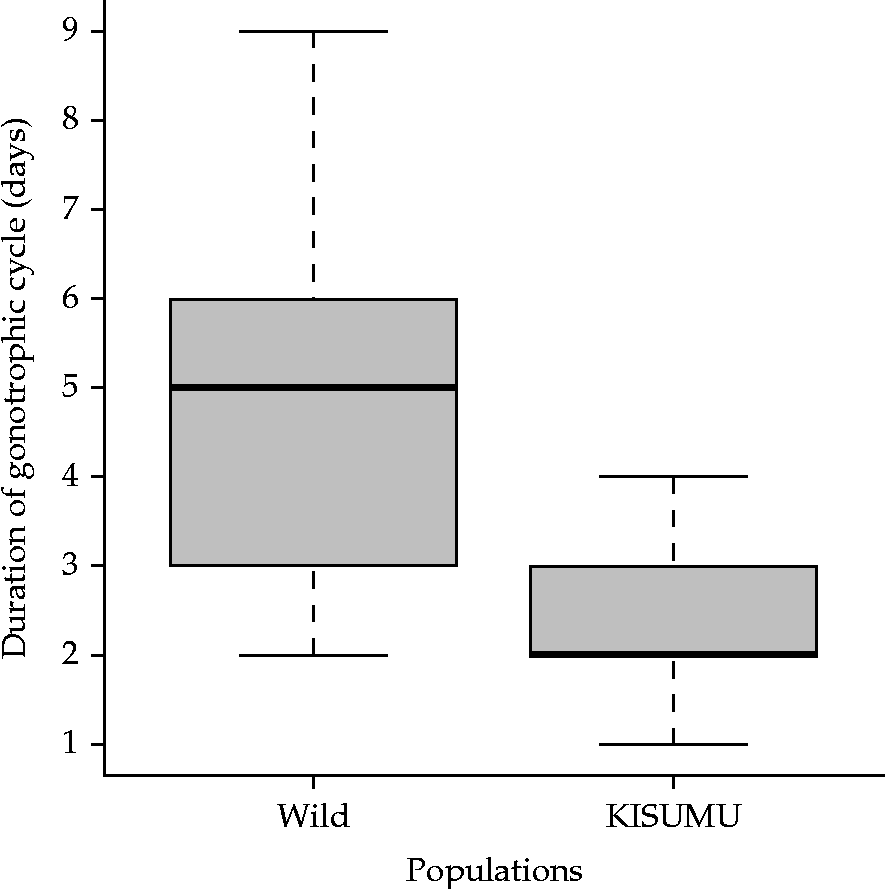
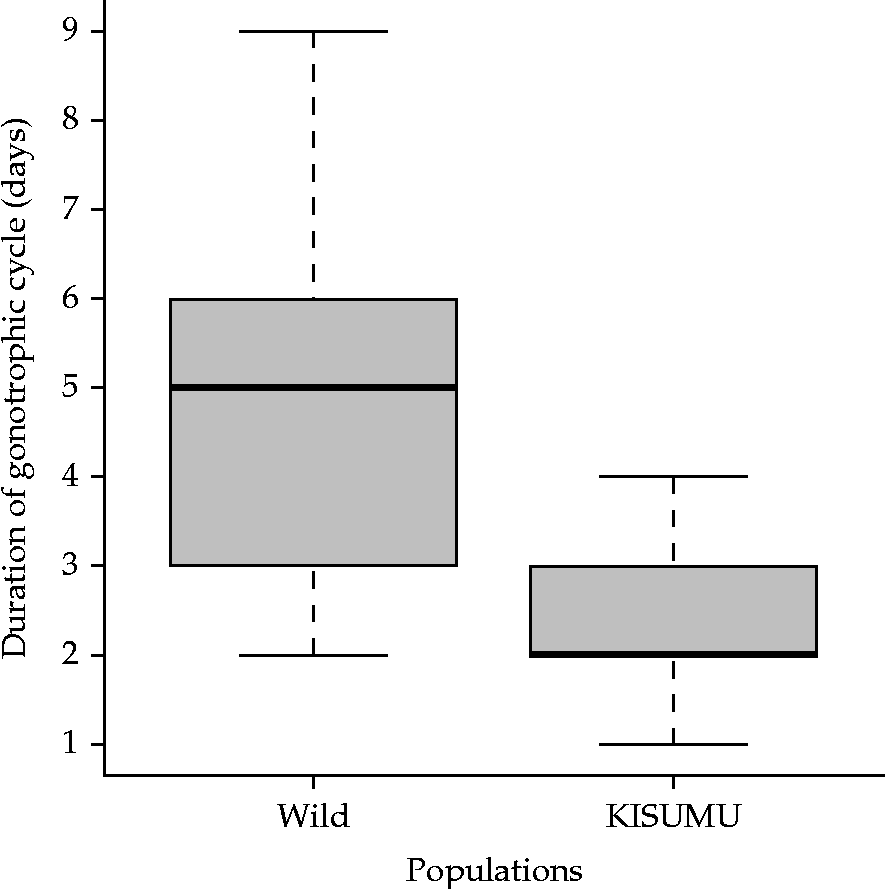
The time lapse between blood meals and oviposition was estimated in 50 nulliparous females of the KISUMU strain and 31 wild nulliparous females of An. gambiae s.l. In laboratory conditions, the mean duration of the gonotrophic cycle was 5 days in wild females. This mean was higher than that of the female KISUMU strain, with an average of 2.2 days between the blood meal and oviposition (Fig. 1). Performing the Poisson regression and the likelihood ratio test led us to conclude that the wild strain in the field has a gonotrophic cycle twice as high as that of the susceptible laboratory strain KISUMU (incidence density ratio = 2.16; 95% confidence interval [1.69–2.76], P= 0.001).
Duration of the first gonotrophic cycle in the KISUMU and wild females of Anopheles gambiae in laboratory conditions (the gonotrophic cycle is expressed in days). The wild population of Anopheles gambiae in the field has a gonotrophic cycle twice as high as that of the susceptible laboratory strain KISUMU (P< 0.05).
Egg batch size in nulliparous females of Anopheles gambiae deprived of an oviposition box and blood meal
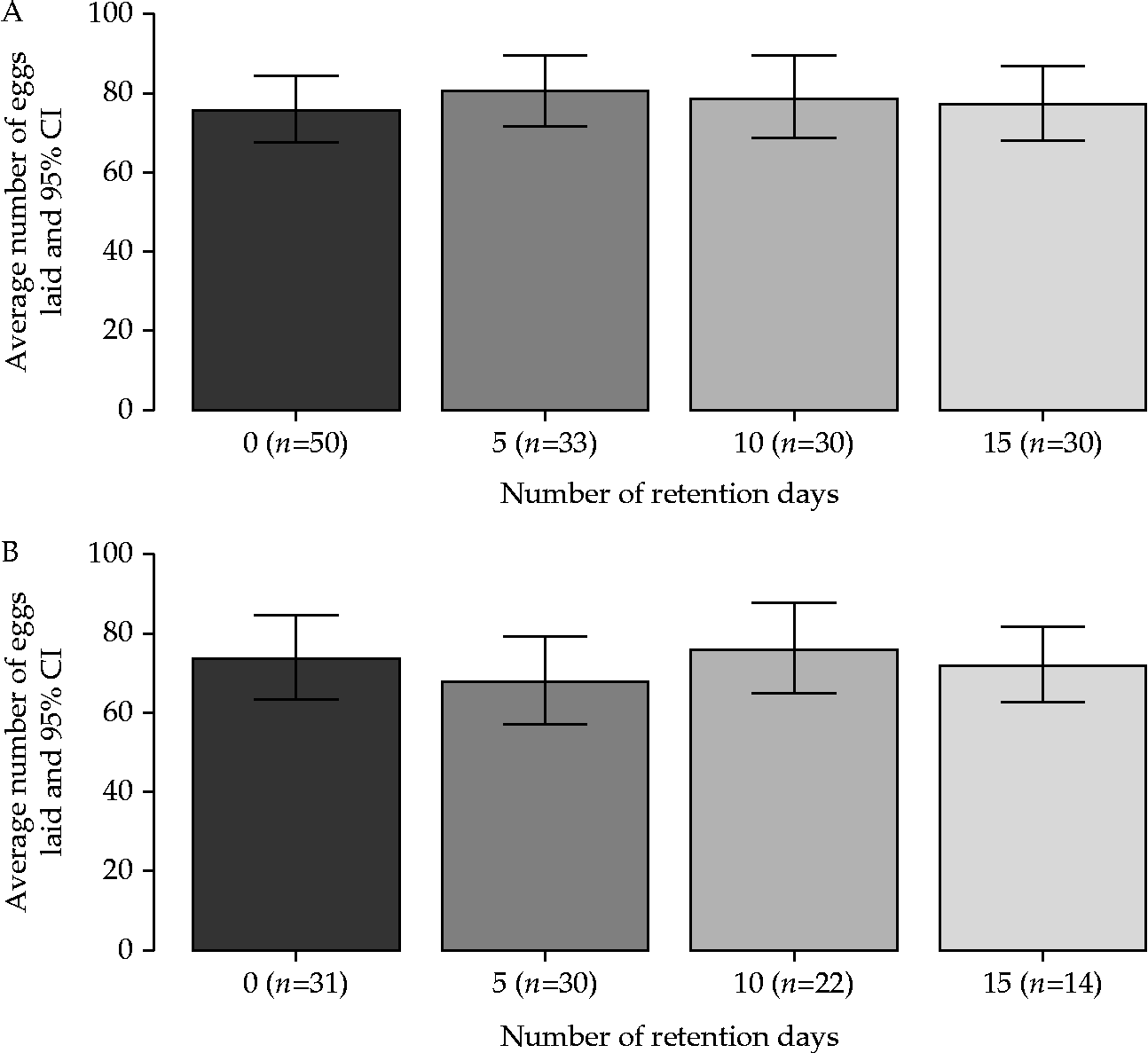
The fertility of An. gambiae in a context of oviposition-site deprivation was assessed in a total of 143 nulliparous females of the KISUMU strain and 97 wild nulliparous specimens. In laboratory conditions and without oviposition delay in gravid females, the average was 75.6 eggs/oviposition in the KISUMU strain and 75.7 eggs/oviposition in wild females. When the KISUMU females were forced to retain their eggs for 5, 10 or 15 days, the average varied between 80.4 and 77.2 eggs/oviposition. Performing the Poisson regression along with the analysis of deviance revealed a similarity between fecundity data related to KISUMU with immediate egg-laying and after 5, 10 or 15 days of oviposition-site deprivation (Fig. 2A). In wild females (from Avotrou-Gbamè and Ladji), the mean clutch size fluctuated between 70.0 and 78.5 eggs when oviposition was delayed for 5–15 days (P>0.05) (Fig. 2B). In general, it appears that oviposition-site deprivation for several days does not affect the quantity of eggs laid by An. gambiae, not only in KISUMU but also in wild mosquitoes.
Average number of eggs laid by the KISUMU (A) and wild gravid females of Anopheles gambiae (B) during oviposition-site deprivation: 0, 5, 10 and 15 days (adults emerged from larvae collected in Avotrou, Ladji). In both populations, the egg batch size is not affected by the duration of oviposition-site deprivation (P> 0.05).

Viability of Anopheles gambiae eggs following a period of oviposition-site deprivation
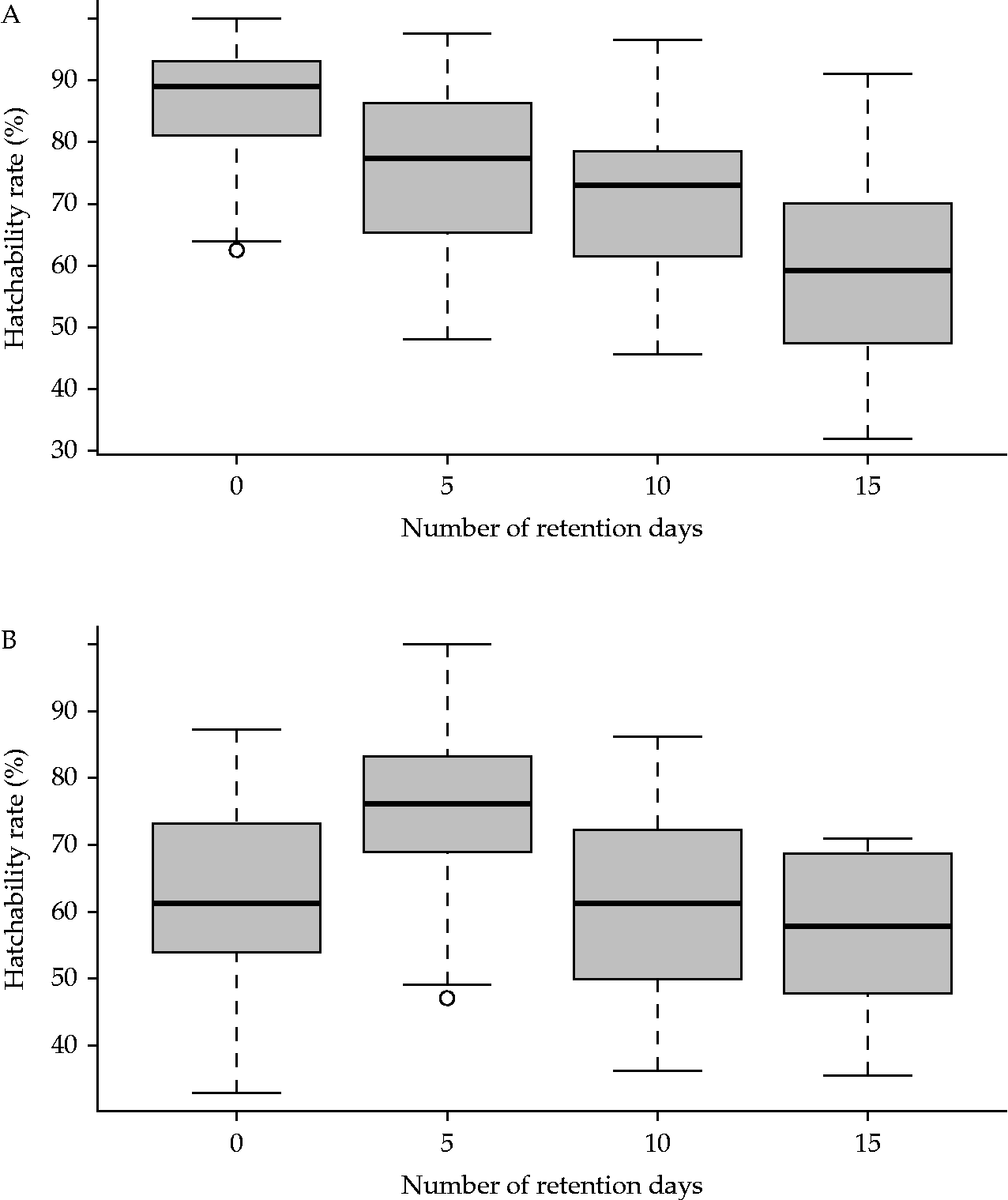
A total of 18,331 eggs were assessed, 11,119 from the KISUMU strain and 7212 from the wild females. When egg-laying was not delayed (day 0), the median HR was 89% for the KISUMU strain and 61% for the wild females. We therefore noted that the proportion of KISUMU eggs that hatched was significantly higher than that of wild females. In addition, the results obtained from the two strains showed that the HR decreases significantly in proportion to increases in the duration of oviposition-box deprivation (no retention, 5-, 10- and 15-day retention; P< 0.05). With regard to the KISUMU strain, the median HR decreased from 77% after 5 days of deprivation to 59% after 15 days of deprivation (Fig. 3A). The wild females gave a similar median HR of 76% after 5 days oviposition delay and a slightly reduced rate of 58% after 15 days of oviposition delay (Fig. 3B).
Variation in the HRs of eggs laid by the KISUMU (A) and wild strains (B) of Anopheles gambiae based on the number of days of oviposition-site deprivation. The HR decreases significantly in proportion as the duration of oviposition-box deprivation increases (P< 0.05).
Relationship between the number of hatched and embryonated eggs
Both embryo rates and the HR decreased progressively as the duration of oviposition delay increased (Table 1). It appears that the embryo rates remain above the HR, regardless of the length of oviposition-site deprivation. This implies that the embryonated status of an egg in An. gambiae at oviposition does not guarantee that it can be hatched. However, after 15 days of oviposition delay, the proportion of eggs hatched is comparable to that of eggs embryonated in both the KISUMU and wild females of An. gambiae (P>0.05). It probably means that after 15 days of oviposition-site deprivation, embryonated eggs have a good chance of being hatched.
Summary of the association between hatching and embryo rates in the KISUMU strain and wild females of Anopheles gambiae
1 Number.
2 Odds ratio.
3 Confidence interval.
4 Number of females that laid eggs.
5 Total number of eggs laid.
Feeding activity in gravid females of Anopheles gambiae
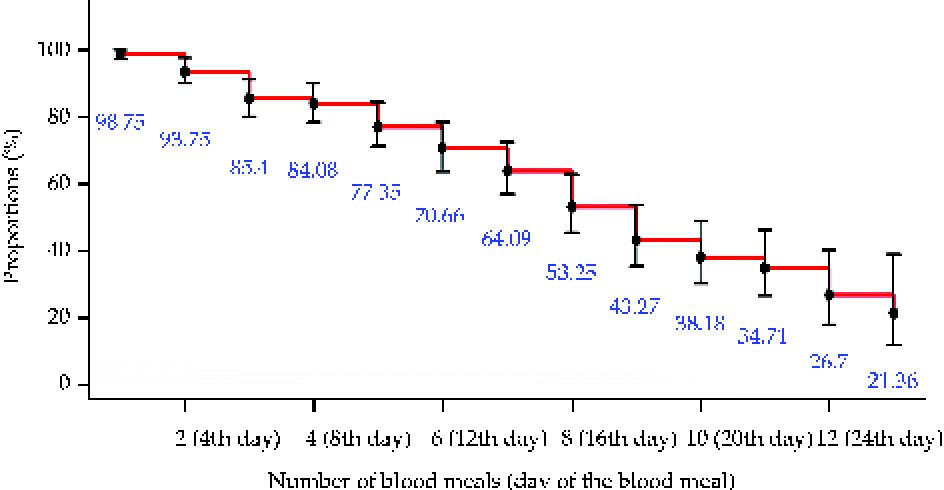
A total of 160 gravid An. gambiae were monitored to assess the ability of these females to continue taking their blood meal despite their gravid state. At the beginning of the experiment, 98.8% of the females took the first blood meal. The probability for the gravid females to take the blood meal was estimated with the Kaplan–Meier method, using as an interest event any unfed mosquitoes after each blood meal. Midway through the experiment, all dead mosquitoes were recorded. The results obtained, therefore, showed that if female mosquitoes are forced to delay oviposition in the absence of breeding sites, they are still able to take their blood meals. When deprived of the oviposition box, 53.3% of gravid females were able to take up to eight blood meals and 21.4% took 13 blood meals before dying. Our study could not give further estimation beyond 13 blood meals because of the higher mortality rate at this number (Fig. 4).
(colour online). Capacity of gravid females to take blood meals. Gravid females continued to take blood meals when oviposition was delayed.
Life expectancy in gravid females of Anopheles gambiae waiting for egg-laying
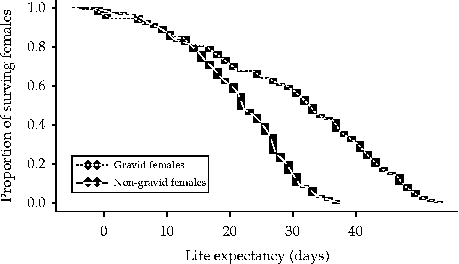
In total, 80 wild non-gravid females (used as the control) and 160 wild gravid females, all 7 days old, were kept under observation. The non-gravid females did not survive long enough and died after 34 days of observation, whereas the gravid females survived up to day 47.
Using the non-parametric method to estimate the interval-censored data survival, it appears that the gravid females and non-gravid females (control) have the same chance of survival after 15 days.
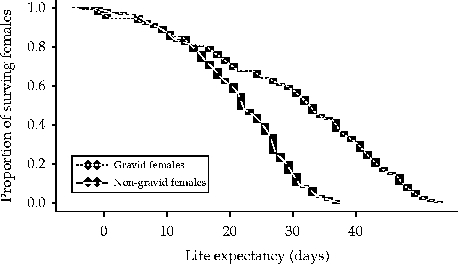
Meanwhile, 50% of the control females died on day 22 and 50% of the gravid females died on day 32 of the experiment. The analysis of the two curves through the balanced likelihood ratio test of interval-censored data revealed that gravid females have a life expectancy much higher than that of the non-gravid females (Fig. 5). Using the Weibull regression, the life expectancy of the gravid females was 1.4 times higher than that of the non-gravid controls. The difference between the survival period of gravid females and that of non-gravid females was highly significant.
Life expectancy of gravid females waiting for egg-laying. The life expectancy of the gravid females was 1.4 times higher than that of the non-gravid controls (P< 0.05).
Discussion
Ecological and climatic factors remain the major determinants of the dynamics of An. gambiae mosquitoes and their reproductive behaviour. Mosquitoes are able to retain their eggs inside the ovaries during drought periods when there is a long absence of breeding sites. In the present study, we used a number of simulations in the laboratory to explore the possible consequences of long-delayed oviposition on the reproductive capacity, life expectancy and feeding activity of An. gambiae in a context of breeding-site absence.
We first measured the gonotrophic cycle in nulliparous females of the susceptible laboratory strain KISUMU and wild nulliparous females from the larvae collected in Ladji and Avotrou-Gbamè. During this experiment, both the KISUMU and wild females were blood-fed twice. Why two blood meals? This was because in most of the nulliparous mosquitoes, there is a mandatory pre-gravid stage following the first blood meal. The stage has a direct implication on ovarian maturation and egg-laying which occur only after a second blood meal of ‘normal’ volume (Carnevale et al., Reference Carnevale, Bosseno, Molinier, Lancien, Le Pont and Zoulini1979). Our study showed that oviposition occurs much faster in the KISUMU strain (average of 2.2 days) following the second blood meal than in the wild females of An. gambiae (average of 5 days). The delay observed in oviposition in wild females could be explained by a negative impact of a mass effect. It is likely that the removal and isolation of one female (after the second blood meal) from the cage where the other mosquitoes are may cause it stress and lead to delayed oviposition. In addition, Gillies (Reference Gillies1953) pointed out that keeping mosquitoes in captivity during experimentation reduces their ability to search for oviposition sites and could delay oviposition.
The egg-laying capacity of KISUMU and wild mosquitoes was also explored in laboratory conditions after 5, 10 and 15 days of breeding-site absence. The 15-day period might seem insufficient, but during our study, there was a direct link to the longevity of females in captivity. The average recorded for the two categories of females (KISUMU and wild) was 76 eggs in the presence of an oviposition box. This result shows that populations of susceptible and wild An. gambiae that were used presented comparable fecundity in laboratory conditions. However, recent reports have shown that several factors might be involved in the reproductive capacity of mosquitoes. These include, for instance, the quantity and quality of protein reserves accumulated by the mosquito during the pre-imaginal stages (Klowden et al., Reference Klowden, Blackmer and Chambers1988; Amalraj et al., Reference Amalraj, Sivagnaname and Das2005), the temperature of larvae breeding sites (Alto and Juliano, Reference Alto and Juliano2001; de Carvalho et al., Reference de Carvalho, Martins Junior Ade, Lima and Valle2002), and the size of the mosquito, its diet and its physiological age (Gary and Foster, Reference Gary and Foster2001). In the context of our study, we provided the same diet for susceptible and wild larvae using 10 g of cat food in 450 ml of water/100 larvae. The adult mosquitoes were fed with 10% glucose solution. It was shown that oviposition-site deprivation of 5–15 days in the populations of An. gambiae studied did not significantly influence the number of eggs laid (P>0.05). In laboratory conditions and in the case of immediate egg-laying, the mean HR of eggs laid by An. gambiae KISUMU was 90% and by wild females 62%. This low HR observed in the wild population compared with the susceptible laboratory strain is in agreement with the report by Armstrong and Bransbay-Williams (Reference Armstrong and Bransbay-William1961) which finds a HR higher in the standard laboratory strain KISUMU than in the wild females of An. gambiae. Our study found that when egg-laying was delayed, the HR decreases significantly as the duration of oviposition-site deprivation increases. This decrease in the HR of eggs kept in the ovaries could be because egg retention is detrimental to embryos since the number of non-embryonated eggs grows as the duration of oviposition-box deprivation increases. Our results are in agreement with the study by Dieter et al. (Reference Dieter, Huestis and Lehmann2012) in a G3 laboratory colony of An. gambiae adults, where a drastic decrease in HR (0–2% within 7 days) has been reported. This is as if mosquito eggs could no longer remain in the ovaries beyond the duration of the gonotrophic cycle. The mathematical association made between the number of embryonated eggs and hatched eggs, following the various retention modalities, showed that where the duration of egg retention is longer, the embryonated eggs have a better chance of hatching.
Feeding activity was assessed on 160 wild gravid females of An. gambiae. The results obtained showed that the gravid status does not prevent mosquitoes from taking successive blood meals. In addition, statistical calculations performed also show that 53.3% of gravid females deprived of a nest took up to eight blood meals and 21.4% reached 13 blood meals. Naturally, it is known that female mosquitoes take a blood meal essentially to ensure the maturation of eggs in the ovaries. The blood meal taken by a gravid female mosquito from its host would certainly help to provide more energy. In addition, these meals would help in the hydration of its exo-cuticle, especially in drought periods (Hamon, Reference Hamon1963). Our results are in agreement with the study by Omer et al. (1970) in two villages of very high aridity in Sudan where permanent feeding activity has been reported in gravid An. gambiae. This feeding behaviour among mosquitoes is directly associated with the maintenance of malaria transmission during the drought periods (Hamon, Reference Hamon1963). These findings would sound an alarm to the national health authorities to encourage those who do not use methods of control, such as sleeping under mosquito nets, to comply during this period even if mosquito bites are not perceptible as the risk of malaria transmission still remains.
In this study, we also explored the life expectancy of wild gravid An. gambiae compared with a batch control of non-gravid females. The two cohorts were fed on 10% glucose solution during the experiment. A very significant difference was noted between the survival duration of gravid and non-gravid females. This lengthening of survival can be explained by the nutritive reserves accumulated by the females during the two blood meals. In laboratory conditions, we found a mean longevity of 34 days for non-gravid females and 47 days for gravid females. Nevertheless, the lifespan of each category might be higher in natural conditions than the results obtained in laboratory conditions. The diet of mosquitoes might have an important contribution to the extension of their longevity (Foster, Reference Foster2001).
Conclusion
This study helped to record data measuring the possible consequences of a prolonged gonotrophic cycle on the reproductive capacity of the female An. gambiae mosquito. It has been shown that the absence of a breeding site leads to a decrease in the HR of the eggs as retention days increase. Moreover, no change in the feeding activity was observed in gravid females waiting for egg-laying and deprived of an oviposition site for several days. The gravid females showed a better life expectancy than the non-gravid females. This experiment was based on simulations carried out in laboratory conditions. It would be necessary to repeat this experiment under natural conditions to have a better understanding of the various conditions allowing female An. gambiae to survive during the long absence of breeding sites. This would be a notable contribution to new orientations for effective malaria control in areas with long dry seasons.
Acknowledgements
This work was financially supported by the Béninoise Ministry of Higher Education and Scientific Research (Ministère de l'Enseignement Supérieur et de la Recherche Scientifique). We are grateful to the CREC team for their technical assistance during the field and laboratory work.