During his excavations at the site of Calixtlahuaca in the 1930s, José García Payón found a large number of Aztec sculptures, both Imperial Style sculptures, which are included often in publications on the Aztecs, and multiple small deity images. This article focuses, however, on the relatively unknown sculptures of the Matlatzinca corpus. These sculptures were produced mostly before Aztec arrival in the 1470s by a culture very different from that of their Nahua neighbors, the Aztecs, and other Nahuatl speakers who claimed a cultural heritage from the ancient Toltecs of central Mexico. The Matlatzinca were located geographically between the Aztecs to the east and the Tarascans to the west. Since the Aztec empire never conquered the Tarascans, their cultural differences from the Aztecs are well known and acknowledged by modern scholars. In contrast, Matlatzinca culture was conquered, and, over the next fifty years, Nahuatized to the point that knowledge of the original culture was lost. Given the lack of native chronicles in the area and the scholarly use of Aztec reports alone, the artworks left by the pre-Aztec Matlatzinca are important for what they reveal about the culture.
We briefly outline the history of the Aztec corpus in its home territory, the Basin of Mexico, in order to characterize the Aztecs’ cultural spread and influence beyond the Basin and, for the purposes of this specific project, to argue that the Aztec-style sculptures at Calixtlahuaca were not made by Matlatzinca artists, as supposed by García Payón. This is followed by an overview of García Payón's work and a critique of outdated ideas that were fundamental to his notions about style and chronology.
Sources of information that have appeared after García Payón's time allow for an updated, more informed view of Matlatzinco. These sources include early Colonial testimonies by Matlatzinca informants and archaeological discoveries and advancements in the 75 years since García Payón's excavations. These all support the visual evidence that the Matlatzinca sculptures form an independent corpus created by Matlatzinca artists, mostly before the conquest. In order to challenge García Payón's ideas, we emphasize the Matlatzinca sculptures that he used as evidence (other sculptures from the area must await further investigation).
The most interesting in terms of political iconography are reliefs featuring a distinctive bird emblem and images of supernatural figures (or men dressed as supernatural figures) with implements associated with the wind and probably other powers.
INTRODUCTION
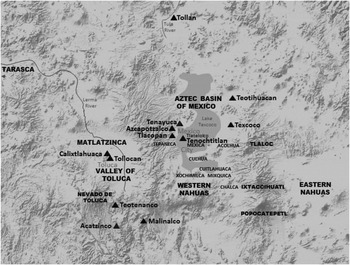
Previously, Matlatzinco had been an independent polity in the northern part of the Valley of Toluca surrounding the traditional center of government, which was also called Matlatzinco. After invading the area, the Aztecs renamed this city Calixtlahuaca and established their own provincial capital at nearby Tollocan/Toluca (Figure 1). José García Payón, the original excavator of the site of Calixtlahuaca, found a mix of Aztec and non-Aztec sculptures there and in the surrounding region. We start with what is known about Aztec sculptures, in order to distinguish them from the non-Aztec artworks.
Map of Central Mexico. Copyright ©2017 Esri. All rights reserved. Additions by Marie E. Teemant.

Beginning sometime during the Middle Postclassic period (ca. a.d. 1150–1325), the Aztec inhabitants of the Basin of Mexico, a subdivision of the Nahua cultures of central Mexico, created a large body of artworks centuries before the Spanish Conquest in 1521. Despite the great variety of styles within this Aztec corpus, shared characteristics of style and imagery unite them. The general impression is that the earliest developments were in the area around Lake Texcoco, which was dominated by people who called themselves Tepaneca, Acolhua, Xochimilca, Chalca, and other names, according to their areas of domain. The Aztecs of Tenochtitlan, who called themselves Mexica, did not arrive in the Basin until later. Having founded Tenochtitlan on an island in Lake Texcoco, they were minor political players for their first 100 years in the Basin. At the time, the whole lake area was under the dominance of Tepanec Azcapotzalco on the west shore. Azcapotzalco and other city-state capitals would have been the foci of artistic activities sequentially in their times of florescence.
The Aztec styles of the Basin of Mexico evolved from the amalgamation of two very different sources (Nicholson Reference Nicholson, Ekholm and Bernal1971:113), one three-dimensional and the other two-dimensional. These sources were the sculptures at ancient Toltec Tollan (Tula) to the north of the basin and the visual vocabulary and conventions of the Nahuas to the east and the Mixtecs further south. This visual vocabulary was developed by 1300 and became increasingly widespread in Mesoamerica in the centuries before the Spanish arrival (Boone and Smith Reference Boone, Smith, Smith and Berdan2003; also Boone Reference Boone2000, Reference Boone2007; Fields et al. Reference Fields, Pohl and Lyall2012; Nicholson and Quiñones Keber Reference Nicholson and Keber1994; Pohl Reference Pohl2007).
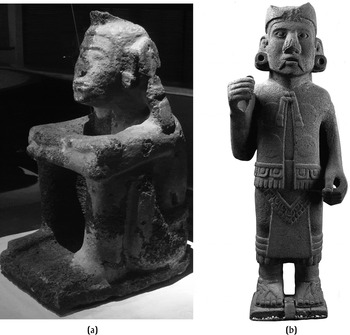
The Aztecs’ major and distinctive innovation was the rendition of the deities of the two-dimensional tradition into three-dimensional, dressed images. Also new was the multiplication of deity images for use at all levels of society. The result was a great quantity of sculptures, as well as great variety among them in quality, size, and imagery (Figure 2a).
Sculptures from the Basin of Mexico: (a) Seated Deity 5 Lizard, Aztec style but not Imperial, stone and paint, probably mid-fifteenth century, estimated height of 80 centimeters, from the Templo Mayor site (Museo del Templo Mayor). (b) Sculpture of a man wearing elite priestly garb, fangs, and the crown, nose ornament, and sandals of a lord, probably a ruler (also called Xiuhtecuhtli), Imperial Style, stone and paint, ca. 1500, height = 80 cm, found in Churubusco (Museo Nacional de Antropología e Historia). Photographs reproduced courtesy of the Instituto Nacional de Antropología e Historia, Mexico.

In 1428, the Mexica and their allies, the Acolhua of Texcoco and the Tepaneca of Tlacopan, fought a war of independence from the Tepaneca of Azcapotzalco, their mutual enemy. In 1431, having won the war, these allies founded the Aztec Triple Alliance Empire. By the 1450s, the imperial forces had gained control of the whole basin and began to conquer areas outside the basin. At the same time, the Tenochca, under the leadership of Montezuma, dominated the Alliance and established the outlines of a new social and political order centered on Tenochtitlan. The most visually impressive change was the conversion of Tenochtitlan into an imperial capital, with two monumental avenues dividing the city into four quarters and meeting at the ceremonial center, which, by this time, was the center of both the Aztec political world and sacred cosmos. The avenues met at the ceremonial precinct, a mythic landscape decorated with monuments in a new Imperial Style.
In contrast to the lack of information on the previous course of the basin's styles, a combination of archaeology and written sources dates the development of this distinctive style to the 1450s and 1460s. Although the public monuments from Tenochtitlan are its most impressive and numerous productions, the same refined aesthetic qualities are visible in smaller works (Figure 2b), made for use in more restricted settings (for Aztec sculptures, see López Luján 2006; López Luján and Chiari Reference López Luján and Chiari2012; López Luján and Fauvet-Berthelot Reference López Luján, Fauvet-Berthelot, Moctezuma and Luján2009; Matos and López Luján Reference Matos Moctezuma and Luján2009; Nicholson Reference Nicholson, Ekholm and Bernal1971; Pasztory Reference Pasztory1983).
Imperial sculptures in all sizes are beautifully carved. The proportions are well thought out and even empty spaces are considered as parts of a composition. Typically, geometrically rounded and flat surfaces contrast with organic modeling. Plain and decorated surfaces are also juxtaposed. Figural sculptures do not represent individuals but generic types. The face in Figure 2b is typical in its features and the composed expression. Some body parts were detailed—ears, hands, knees, and feet—but not others. Costume parts are also detailed, and paint is applied thinly so that the details are visible. The lines formed by hair, whiskers, feathers, water, and costume decorations are arranged in rows of parallel forms creating regular rhythms across surfaces. In the most impressive examples, there is a complex relationship between the surfaces and the shapes beneath.
In most of these respects, the two sculptures in Figure 2 differ. Especially notable differences are the crispness of the lines and thinness of paint on Figure 2b, as opposed to the thick, multiple layers of paint on Figure 2a, and the corresponding difference in the carving below the paint (visible in Figure 2b). In sculptures like Figure 2a, some details would have been painted on the surface rather than carved. Also there is no contrast between geometric and organic forms, and all examples lack the complexities of surfaces and shapes.
The Imperial Style was a style of elite power, and only elites could commission the manufacture of these sophisticated sculptures. Determining factors reflected in the quality and aesthetics of individual sculptures were: first, the social level of the patron; second, the availability of artists of corresponding levels of ability and training; and, third, the quality of the materials. Only a powerful and wealthy patron had the means to hire trained imperial artists; for large monuments and groups in prominent places, teams involving different levels and types of training were required (see Durán Reference Durán and Heyden1994:ch. 31). In addition, the patron had to be in a prominent position in society to install such monuments. If a project was too big for a group of artists skilled in the Imperial Style to complete by the ceremonial date for which it was commissioned, or if an important patron did not have access to trained imperial artists, however, sculptors of lesser skills were used. In other words, Imperial Style sculptures indicate wealthy clients of high status, while less-professionally carved sculptures were made mostly for commoners. On some occasions high status personages used lesser artists, but the reverse is not true. Members in the lower levels of society could not use imperial artists.
One final observation is necessary. Although we have only vague notions about the sequence of sculptures in the general Basin style, we know their production began well before the expansion of the empire outside the basin, that the Imperial sub-style grew out of this tradition in the 1450s, and that other Basin styles continued to be produced subsequently. At present, the only clues to objects' dates among these later non-imperial productions are distinctive traits adopted from the Imperial Style. Theoretically, given the long pre-imperial history of the Basin style, early examples could have been shared with their neighbors, especially Nahua neighbors, before imperial times. There is no real evidence that this happened, however. So, it appears that the need for both rougher and more refined sculptures travelled with Aztecs outside the basin, either as imperial officials or as colonists (Umberger Reference Umberger, Berdan, Blanton, Boone, Hodge, Smith and Umberger1996). This is in contrast to the occurrence of earlier, widespread types of architecture and the spread of Aztec style ceramics to foreign areas before Aztec incursions (see Smith Reference Smith1990, Reference Smith2008).
THE MATLATZINCA AREA
As is now well-known from local Matlatzinca documents (García Castro Reference García Castro1999; Hernández Rodríguez Reference Hernández Rodríguez and Barlow1950, Reference Hernández Rodríguez1988), the Aztec imperial administration sent thousands of Basin residents to Matlatzinco, which, upon conquest, had become the Tollocan province of the empire (Berdan et al. Reference Berdan, Blanton, Boone, Hodge, Smith and Umberger1996). Politically, this area was to provide a buffer zone and manpower for warfare against the Tarascan empire further west (Herrejón Reference Herrejón Peredo1978). Just as important, the land itself was to provide an outlet for the Basin's growing population and to provide an area of dependable agricultural support. Agriculture in the basin was typically precarious because of the lack of both exterior sources of water in dry times and outlets for excessive water during rainy periods. Despite Aztec engineering feats in hydrology, massive disasters could not be controlled. One of these, a destructive flood followed by a long dry period in the mid-fifteenth century, had led to the near-destruction of the lake area and its societies. Many Aztecs immigrated to the Gulf Coast to the east and settled there. In the 1470s, when the Aztec Empire invaded Matlatzinco, the basin was still recovering from this disaster, and the new area, which was drained by the Lerma River, promised social stability and growth.
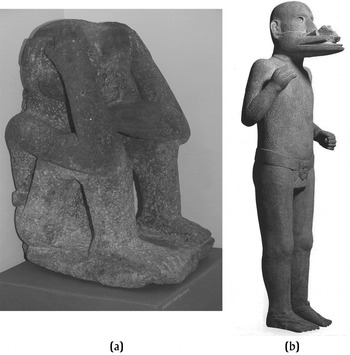
For this reason, Matlatzinco was populated with thousands of Aztec farmer-warriors, who must have brought with them the need for images of their own agricultural and nature deities. The surviving examples are numerous small images in the general Basin style, which appear to have been scattered across the landscape (Figure 3a), as well as Imperial style sculptures, like the well-known life-sized image of Ehecatl, the wind god (Figure 3b), at places of more than local significance. Although the Aztecs rarely built structures in foreign territories, as is well-known, they did honor important cities of the past and installed sculptures and shrines at sites of supernatural power, especially hills and water sources. Calixtlahuaca, a hill and the ancient center of the Matlatzinca dynasty, was such a site, and it is probably for this reason that the Aztecs built final phases over the temples there and installed Imperial style sculptures. They probably also used the palace, reportedly occupied by tax collectors in later times.
Aztec sculptures from the Matlatzinca area: (a) Seated wind god Ehecatl (ASU project inventory number SS 21), Aztec style, stone and paint, estimated height 30 centimeters, provenience unknown (SMT, see museum abbreviations in the Appendix). (b) Standing, life-size temple image of Ehecatl, made to be dressed in perishable materials (SS 1), Imperial Style, stone and paint, found buried in the terrace in front of Monument 3, Calixtlahuaca (IMC) (cover photograph from Pohl and Lyons Reference Pohl and Claire L.2016). Photographs reproduced courtesy of the Instituto Nacional de Antropología e Historia, Mexico.

According to the sixteenth century chronicler Durán (Reference Durán and Heyden1994:237, 240–241), immigrants to other Aztec colonies were directed by the ruler to settle in separate barrios according to ethnicity, meaning according to their cities and provinces of origin in the Basin of Mexico. A 1598 map of the division of lands around Tollocan (Hernández Rodríguez Reference Hernández Rodríguez and Barlow1950) reveals the same pattern, with strips of land pertaining to the Mexica, the Tepaneca, the Tlatelolca, and the Acolhua, as well as members of the Tenochca royal family. Matlatzinca and other Otomian people would have lived in places in these territories, too, but it is probable that Aztecs and indigenous inhabitants lived in separate estancias, barrios, and towns (see García Castro Reference García Castro1999:85–86; Umberger Reference Umberger, Berdan, Blanton, Boone, Hodge, Smith and Umberger1996:156–157). As a result, ethnic interactions may have been relatively infrequent among the lower classes, depending on the composition of a town and its propinquity to political centers like Tollocan and Calixtlahuaca. It was in these places that negotiations between Aztec and Matlatzinca nobles and administrators took place, and the Matlatzinca occupying government positions were somewhat Nahuatized. Zorita's (Reference de Zorita and Keen1971:264–265) mid-sixteenth century report reveals that the Matlatzinca officials were given Nahuatl titles, and it is probable that their traditional three-part division of power was altered to correspond to these Aztec titles.
That the centers of power were the loci of interethnic interactions among nobles is reported in Tezozomoc's (Reference Alvarado Tezozomoc and Berra1980:420) history. According to his text, after the initial events of the conquest of Matlatzinco, the Aztec army returned to gather its new allies for warfare against the Tarascans. While there, the Aztec ruler Axayacatl, his lords, and captains were entertained by the collaborating Matlatzinca lord, Chimaltecuhtli, and his nobles. The Aztecs were housed in noble residences and honored with feasting and the bestowal of traditional Matlatzinca weapons as gifts. One would guess that the great, sprawling palace at Calixtlahuaca was one site of the activities of this visit. These types of gatherings, which combined feasting and gift giving with political negotiations, were common among Aztec-period Mexicans (Pohl Reference Pohl1998; Smith Reference Smith1986) and, no doubt, predated the rise of the Aztecs by centuries.
It appears that the new Aztec sculptural style, the Imperial Style, was even more restricted in the Tollocan Province than it was in the Basin of Mexico—by ethnicity as well as status. Also, in addition to the separation of Matlatzinca and Aztecs in the settlement pattern, there is no evidence that the Matlatzinca practiced a Nahua-style religion, either before or after the Aztec invasion. In fact, there is no reason to think that they had the same gods, nor evidence that their commoners had anthropomorphic deity images of any sort. It is thus most plausible to see the Aztec style images in the Matlatzinca area, whatever their styles, as dating from after the Aztec invasion.
Unfortunately, there is still no way to create a chronology within or between the two Aztec styles, except to say they were contemporaneous. It is also probable that they were all made of local stones, as even the types created by imperial artists seem to be local to the Calixtlahuaca area (to what degree this is true depends on future geological studies). Artisans who came to the area as colonists probably made the non-Imperial sculptures, while the Imperial style works were probably made by travelling imperial artists, like those who worked at Malinalco, according to a document from Hispanic Mexico City (Townsend Reference Townsend and Boone1981).
GARCÍA PAYÓN'S WORK AT CALIXTLAHUACA
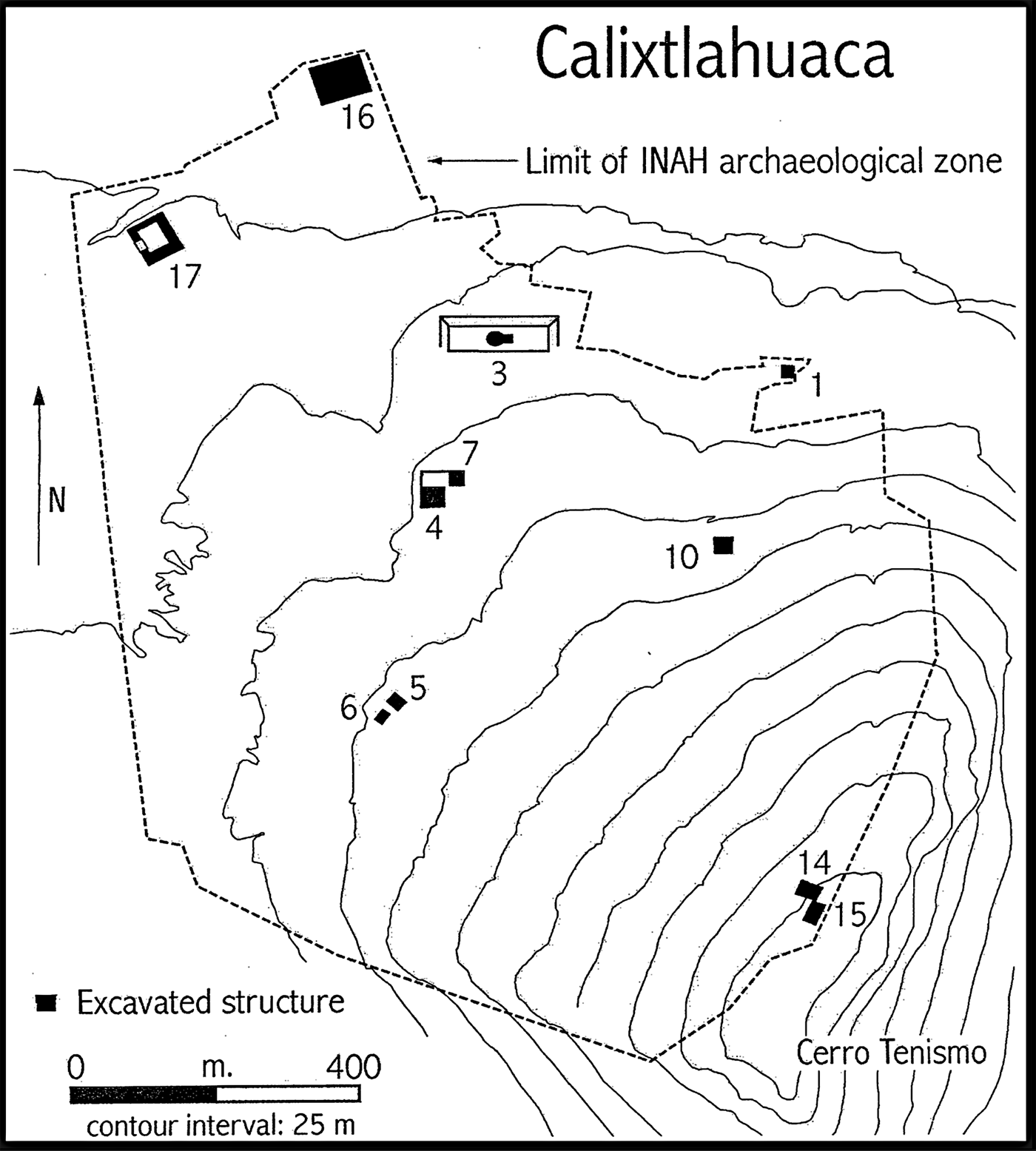
Archaeological Calixtlahuaca (Figure 4) is on Cerro Tenismo, a sizable hill adjacent to the modern town of Calixtlahuaca. Funded by the government of the State of Mexico in Toluca, García Payón conducted archaeological work at the site between the years 1930 and 1938. His best known discoveries were the circular temple, Monument 3, which his crew reconstructed, the associated Imperial-style Ehecatl image buried in the terrace at the base of the stairs (Figure 3b), and an Imperial-style cylindrical pedestal found nearby on the same terrace. Other fine Aztec sculptures from the site include a kneeling death goddess reportedly found at the top of the hill in the late-nineteenth century (García Payón Reference García Payón, de Magrelli and Castañeda1979:286) and another pedestal, almost identical to the one found at Monument 3, which now serves as the base of a container for holy water in the parish church of the modern town (the details of its discovery are not recorded).
Map of archaeological site of Calixtlahuaca, with architectural structures (monuments) indicated by numbers (drawing by Umberger after Smith Reference Smith2003:Figure 2).

Before the 1930s, Calixtlahuaca had been a relatively obscure site, not mentioned among important urban remains (García Payón Reference García Payón and Colín1974:47–50). Nevertheless, as García Payón reported (Reference García Payón, de Magrelli and Castañeda1979:286), the archaeologist Leopoldo Batres had visited it in the late nineteenth century, and took the death goddess and two other sculptures (which have not yet been identified) back to Mexico City. Batres visited many archaeological sites at the end of the century in his role as director of antiquities for the nation, but his visit to Calixtlahuaca is not mentioned in other documents and must have been brief. He was probably attracted by the townspeople's discovery of these and other sculptural remains during their removal of stone from the site for the Parish Church they were building between 1872 and 1882 (García Payón Reference García Payón, de Magrelli and Castañeda1979:207, 209; dedication stone on church).
When García Payón began excavating fifty years later, the prevalent assumption among scholars was that the remains at Calixtlahuaca were Toltec. Thus, an early photograph of the Calixtlahuaca death goddess and another from Mexico City bears the label “Civilización Tolteca y Matlatzinca” (Casanova Reference Casanova2001:9). Until the early 1940s, the term “Toltec” was used broadly to refer to all post Archaic and pre-Aztec archaeological remains in central Mexico, and more specifically to refer to the city of Teotihuacan, which was thought to be the Toltec capital, Tollan, mentioned in Aztec histories. It was in the 1940s that a smaller site near Tula, in the State of Hidalgo, was recognized as the Aztecs’ Tollan (Bernal Reference Bernal1980:ch. 8, pp. 170–172; Jiménez Moreno Reference Jiménez Moreno1941), and scholars realized that two different cultures were involved, with Teotihuacan being substantially earlier than Tollan.
These discoveries led García Payón to change his chronology at Calixtlahuaca. Throughout his studies García Payón used the four sequential structures of Monument 3 as the basis of the chronology, and dated them according to affiliations that he perceived between wares in the fill and ceramics in the Basin of Mexico. He initially used the sequence current before the 1940s (García Payón Reference García Payón, de Magrelli and Castañeda1979:211), associating the early levels with Archaic and Toltec-Teotihuacan cultures, and the latest with the Aztecs. After this Basin sequence became outdated with the separation of the Toltec and Teotihuacan cultures, García Payón's revised chronology of the levels of Monument 3 was published by Marquina (Reference Marquina1951:223–234) in his encyclopedic volume on Mesoamerican architecture. In the new scheme, Level 1 was linked to Teotihuacan, Level II to the Toltecs, Level III to Chichimec Tenayuca, and Level IV, as before, to Aztec culture. Despite this adjustment, García Payón and his contemporaries still maintained the belief that Toltec culture was a “mother culture” in central Mexico, with an empire that included the Matlatzinca area. García Payón himself believed that much of Matlatzinca culture was ultimately derived from Toltec ideas via political connections. He did not think the Toltecs lived in the province but dominated it culturally for 400 years, presumably through a hypothetical requirement that Matlatzinca royalty live in Tollan for a period of time during the year (García Payón Reference García Payón1941c:31, 37, 53, 55, 56, Reference García Payón and Colín1974:109). This idea was a projection of an Aztec practice into the Toltec past. The extent to which he maintained the idea of Toltec dominance in the area is not known. In the republication of his writings in the 1970s, he and the editors-commentators did not alter his passages on Toltec presence nor comment on them as outdated (as they did in the case of his chronology). Since the idea that the Toltecs maintained political control over this area has persisted into more recent times, we would guess that no one felt that they needed revision, after the relationship of Tula and Teotihuacan was recognized.
Recent archaeology, in the form of ceramic analysis and carbon 14 dating, however, has debunked the basis of García Payón's argument. According to Smith and colleagues (Reference Smith, Borejsza, Huster, Frederick, Lopez and Heath-Smith2013), there is no evidence of Toltec presence or influence at Calixtlahuaca. No Toltec ceramics were found at the site and radiocarbon readings suggest the establishment of the settlement in about a.d. 1100 (Smith et al. Reference Smith, Borejsza, Huster, Frederick, Lopez and Heath-Smith2013; Michael Smith, personal communication 2007), in other words, near the end of Tollan's existence (see also Sugiura Reference Sugiura2005). Even if the two cultures overlapped for a few decades, it was not the 400-year period of interaction that García Payón suggested.
Unfortunately, there are still no clues to the dating of the four architectural levels at Calixtlahuaca. This is true even of the levels of Monument 3, which, although distinct from each other, give no clues as to which were built after the Aztec invasion. The last enlargement is generally considered Aztec, but earlier versions might be also (Michael Smith, personal communication 2007). Instead, the site evidences architectural forms that were common and widespread in Mesoamerica before the rise of the Aztec state: circular temples, rectangular pyramids with stairways up one side, and sprawling palaces (see Pollock Reference Pollock1936 on circular temples; Smith Reference Smith2008:54 on palaces). That Aztec contributions are difficult to identify is actually not surprising. Aztec architecture is not considered innovative; its distinctive characteristics seem to be subtle and probably consisted of new materials, engineering, and decoration (Molina Reference Molina Montes and Boone1987:105; also Smith Reference Smith2008:54). The history of these aspects is only now being studied in the excavations of the Aztec capital itself (e.g., López Luján et al. Reference Luján, Leonardo and Montúfar2003).
At the time of the excavations, García Payón (Reference García Payón1936) published one book-length report focused on Matlatzinca ethnohistory and language as known from Spanish Colonial sources; several short articles on archaeological finds (García Payón Reference García Payón1941a, Reference García Payón1941b); and a short monographic overview of the Matlatzinca from pre-Columbian to modern times (García Payón Reference García Payón1941c). The monograph provides a good summary of his ideas and contains some illustrations lacking elsewhere, although in the form of poor photos and rough sketches.
García Payón's second lengthy manuscript about the archaeological discoveries was also written in the 1930s but not published until 1979. This manuscript includes a long section on Matlatzinca religion (García Payón Reference García Payón, de Magrelli and Castañeda1979:273–287), which he believed to have been derived from Toltec religion. Although convoluted and for the most part nonsensical, these ideas are the basis for his short interpretation later in the book of the sculptures represented in the Calixtlahuaca corpus (García Payón Reference García Payón, de Magrelli and Castañeda1979:42–112), which he identified as created by Matlatzinca artists before and after Aztec invasion.
Both of the lengthy manuscripts from the 1930s were published in a multi-volume set dedicated to García Payón's work at Calixtlahuaca. By the time it was published, between 1974 and 1981, the information was welcome, but many of the author's ideas were either out-of-date or without foundation. The set was produced by the Biblioteca Enciclopédica del Estado de México under the direction of Mario Colín, Director of Cultural Patrimony for the State of Mexico (editors’ presentation to García Payón Reference García Payón, de Magrelli and Castañeda1979:xxi). The first volume, Volume 29 (García Payón Reference García Payón and Colín1974), was a reprint of the 1936 study. The second volume, Volume 30 (García Payón Reference García Payón, de Magrelli and Castañeda1979), was the unpublished manuscript on the archaeological remains, which Colín had acquired from the author. Colín then gave it to Leonardo Manrique Castañeda and Wanda Tommasi de Magrelli to edit. These editors left the manuscript as it was written for the most part, but added notes pointing to changes in general thinking about Mesoamerican archaeology and some personal observations on the objects. Unable to consult much with García Payón at the time because of his poor health, they delivered the final manuscript to Colín in 1972. The book's 1979 publication followed García Payón's death by two years (editors’ presentation to García Payón Reference García Payón, de Magrelli and Castañeda1979:xiii). Volume 31 (García Payón Reference García Payón and Castañeda1981) was published later to accompany the volume on archaeology, and contains photos and plans of Calixtlahuaca architecture, before, during, and after excavation and restoration. The final tome, Volume 32 (García Payón Reference García Payón1980) was planned but never published. Also meant to accompany the archaeology volume, it included illustrations of the artifacts found, notably figurines and sculptures. Colín was murdered in 1983, and the manuscript disappeared sometime after that (Michael Smith, personal communication 2007). Thus, the only remaining illustrations are the few in the 1941 monograph.
The lost illustrations were large hand-colored plates, keyed to the text of Volume 30 by numbers in the text. From these, it appears that sculptures were pictured in nineteen of the plates—Plates LXXXIV–C, CIII–CIV—and that each plate contained individual objects labeled with Arabic numerals (perhaps 160 altogether). It is impossible to ascertain the actual size of the corpus discussed however, because multiple views of some objects and comparative images were among them. One can say only that his discussion clearly did not cover the entire body of sculptures—neither the objects excavated at the site nor the other sculptures found in the area.
GARCÍA PAYÓN'S INTERPRETATION OF SCULPTURES
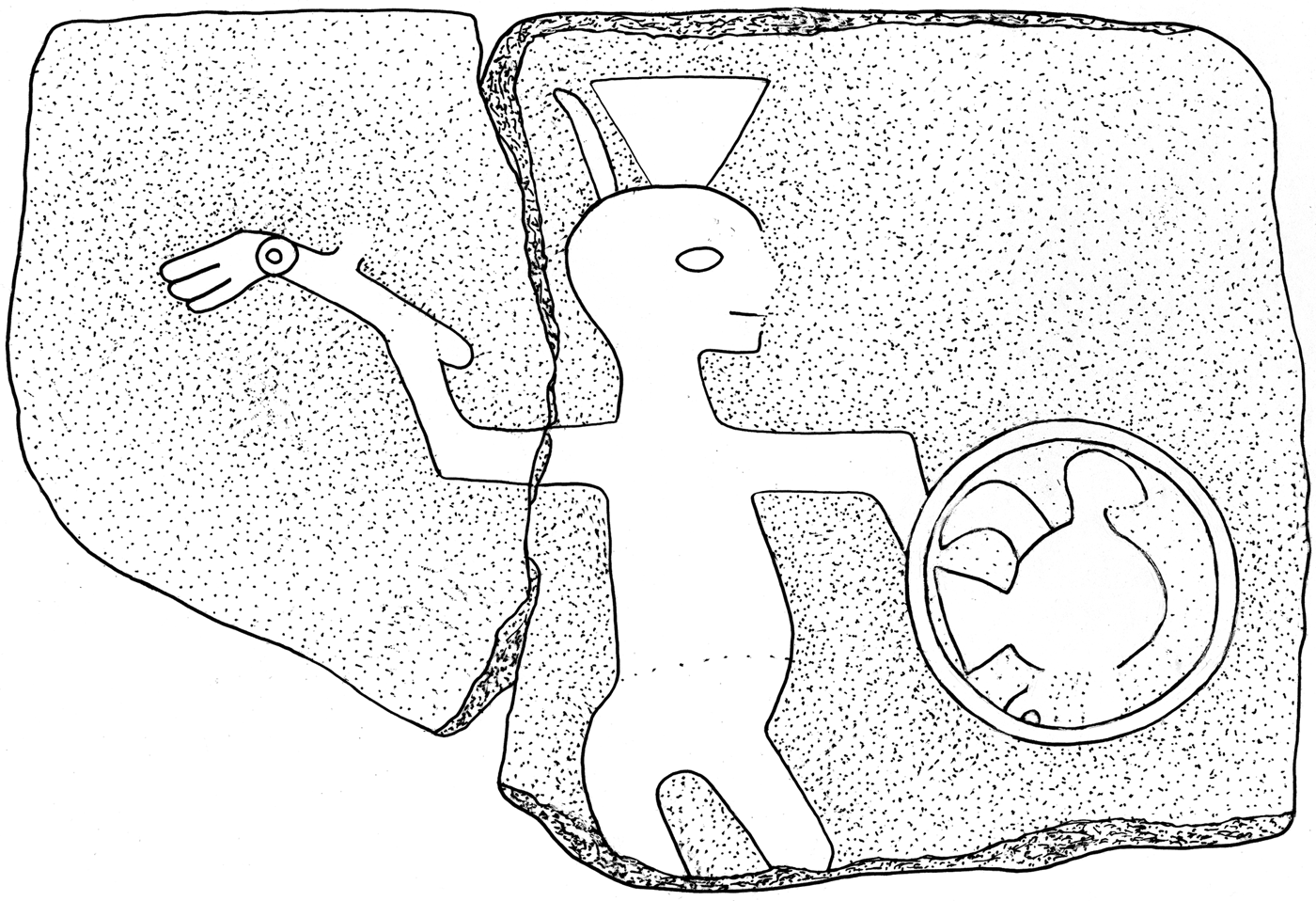
In addition to the lack of a comprehensive list, also problematic is the brevity of passages on the sculptures in his short overview, their lack of descriptive specificity, and the lack of references to provenience and archaeological contexts. This last is even apparent in the case of the well-known Ehecatl sculpture, of which the description of excavation is minimal, and buried in another section (García Payón Reference García Payón, de Magrelli and Castañeda1979:200). In his treatment of other sculptures, García Payón tended to identify their subjects without describing the characteristics that led to the identification. A number of sculptures that can be identified with information from elsewhere reveal some of these to be inaccurate (he misidentified the warrior in Figure 5, for instance, as a flayed figure, Xipe in Nahuatl), while others are given Nahuatl deity names no longer recognized. Most of the problems, of course, will remain unresolved unless further unpublished materials, like field notes and inventories, are found, not to mention the lost volume of images, where additional information may be in the captions. Although we were still able to link García Payón's text with a sufficient number of sculptures in local museum collections to make his arguments comprehensible, we could not do this with the majority of images.
Relief of warrior with bird shield and atlatl (maybe) (SS 131), width = 86.4 cm, set into the parish church wall, where it was seen in 1970 by Hanns Prem, before being transferred to a museum (IMC storage). Drawing by Umberger.

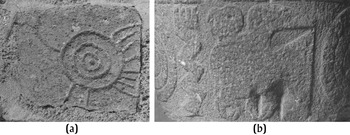
In the text, García Payón divided the corpus (of both Aztec and non-Aztec works) into three parts that he considered chronological phases in a progressive aesthetic development among Matlatzinca artists (these phases paralleled the four archaeological levels). His main criteria were surface carving traits. Phase 1 featured grooved reliefs with mostly abstract images (Figure 6a); Phase 2 consisted of positive reliefs—carvings on two levels, with flat figurative images projecting from a recessed background (Figure 6b); and Phase 3 consisted of objects with the more varied and organic modeling of Aztec art (as in Figure 3). The progression also moved from mostly relief works in the early levels to mostly sculptures-in-the-round in the Aztec-influenced period. Although acknowledging Aztec populations in the area, García Payón did not know how extensive their numbers were nor that they were permanent colonists sent to the area as part of imperial strategy, so he attributed all three phases to Matlatzinca sculptors and patrons, and he saw Phase 3 as the final qualitative development from abstract motifs to figurative naturalism, from flat to modeled surfaces, and from simple to complex imagery.
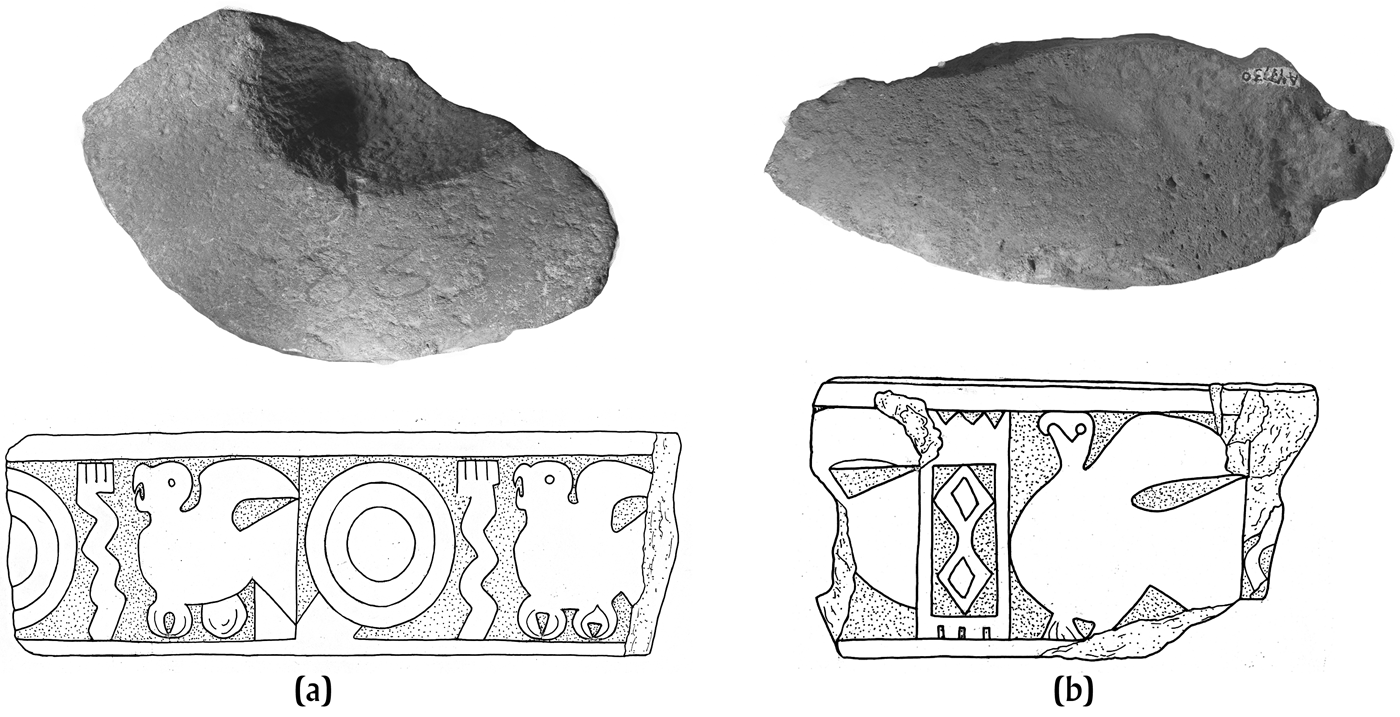
The Calixtlahuaca emblematic bird in both of García Payón's Matlatzinca relief types: (a) Grooved relief (SS 130L), found near top of hill and now set in an exterior wall of the parish church. (b) Positive relief (SS 155) on side of small stone mortar (Figure 14A), provenience unknown (IMC storage). Photographs reproduced courtesy of the Instituto Nacional de Antropología e Historia, Mexico.

Supporting their creation by the Matlatzinca, he says that the stone types were all local: “[t]hese pieces are of limestone, cantera (quarry stone?), basalt and andesite and are similar to the deposits and worked stone encountered in the archaeological zone and its surroundings, which authorizes us to affirm that these pieces were made with materials proceeding from the region” (García Payón Reference García Payón, de Magrelli and Castañeda1979:277). This is valuable information, of course, if true, but it is backed only by his personal observations, not scientific analysis and the local creation of the sculptures does not prove that the Matlatzinca created them.
The employment of local artists by conquerors is a common occurrence in imperial situations. This was the case in the Aztec corpus at Castillo de Teayo, Veracruz, as indicated by traits of the local Huastec style on the back of one sculpture (Umberger Reference Umberger, Berdan, Blanton, Boone, Hodge, Smith and Umberger1996:171–177). There is no comparable evidence of Matlatzinca sculpting traits among the Aztec sculptures in the Calixtlahuaca area, however.
Most problematic with García Payón's characterization of the course of Matlatzinca sculptural production, even within his first two pre-Aztec phases, is his perception of a progression in technical skill and aesthetics, a rather old-fashioned idea about naturalism versus abstraction. Although the sequence of grooved and positive relief styles appears to have archaeological backing in their relative locations (the small grooved reliefs are on early building levels and three positive reliefs were found near the surface), his reasoning is unconvincing for two reasons. First, although the grooved reliefs are in an early context, there are too few later walls to say definitively that their production ceased in later phases. Second, the three figural reliefs were not in their original positions. Their removal from an architectural context for use as pavement stones in plazas was likely to have been an act of disrespect on the part of the Aztecs. Pre-Conquest monuments could be removed and killed by the same culture that made them, but reuse as paving seems to have been something different. Also, the Matlatzinca could have previously removed the reliefs from lower levels for reuse themselves. In other words, they could have been contemporary with the small grooved reliefs.
Finally, García Payón's belief that the Matlatzinca beings represented were the same as those represented in the Aztec works is particularly unacceptable. In addition to the radically different carving styles, the Matlatzinca images look nothing like Nahua/Aztec gods and carry different implements. The most obvious examples of this error are the three Matlatzinca reliefs, which García Payón identified as the god Mixcoatl.
THE ARIZONA STATE UNIVERSITY CALIXTLAHUACA PROJECT
In the summer of 2006, Emily Umberger and Maёlle Sergheraert, a Ph.D. student in archaeology at the Université de Paris I, Panthéon-Sorbonne, began the survey of all regional collections of sculptures in the Valley of Toluca, under the direction of Michael Smith of Arizona State University, who had begun the restudy of the site in 2000 (see Smith Reference Smith2003a, Reference Smith2003b, Reference Smith2006, Reference Smith2016; Smith et al. Reference Smith, Borejsza, Huster, Frederick, Lopez and Heath-Smith2013; Tomaszewski and Smith Reference Tomaszewski and Smith2011). The initial assignment was to identify sculptures excavated by García Payón. It soon became obvious that the sculptures were not housed together, but in four different valley museums in the towns of Toluca, Malinalco, and Teotenango, and the site of Calixtlahuaca—to which they had been distributed for display purposes without regard to origin. Nor do museum labels and records reveal these origins. In the summer of 2007, Casandra Hernández, from the M.A. Program in Museum Anthropology at Arizona State University, joined Umberger to complete the cataloguing and photography of sculptures and to reconcile the objects with museum records and García Payón's writings.
Objects were added to the registration list that Smith had started in order of their study as they were found. Thus, Aztec and non-Aztec works are intermingled without regard to themes, styles, origins, or dates. In 2007 the catalog included 341 sculptures, dubbed Stone Sculptures 1–341 (SS 1–SS 341). Of these, the authors have linked some examples to García Payón's descriptions and have grouped others together according to commonalities in imagery and style (see Appendix and accompanying Figure 20 for details of museum research, abbreviations of museum names, and accession numbers on objects).
In the following, some significant Matlatzinca relics are presented, while the Aztec sculptures will be the subjects of later publications. The sculptures called Matlatzinca to date have in common as a group principally their lack of resemblance to Aztec art; a general description that ties them together is not yet possible.
The Small Grooved Reliefs
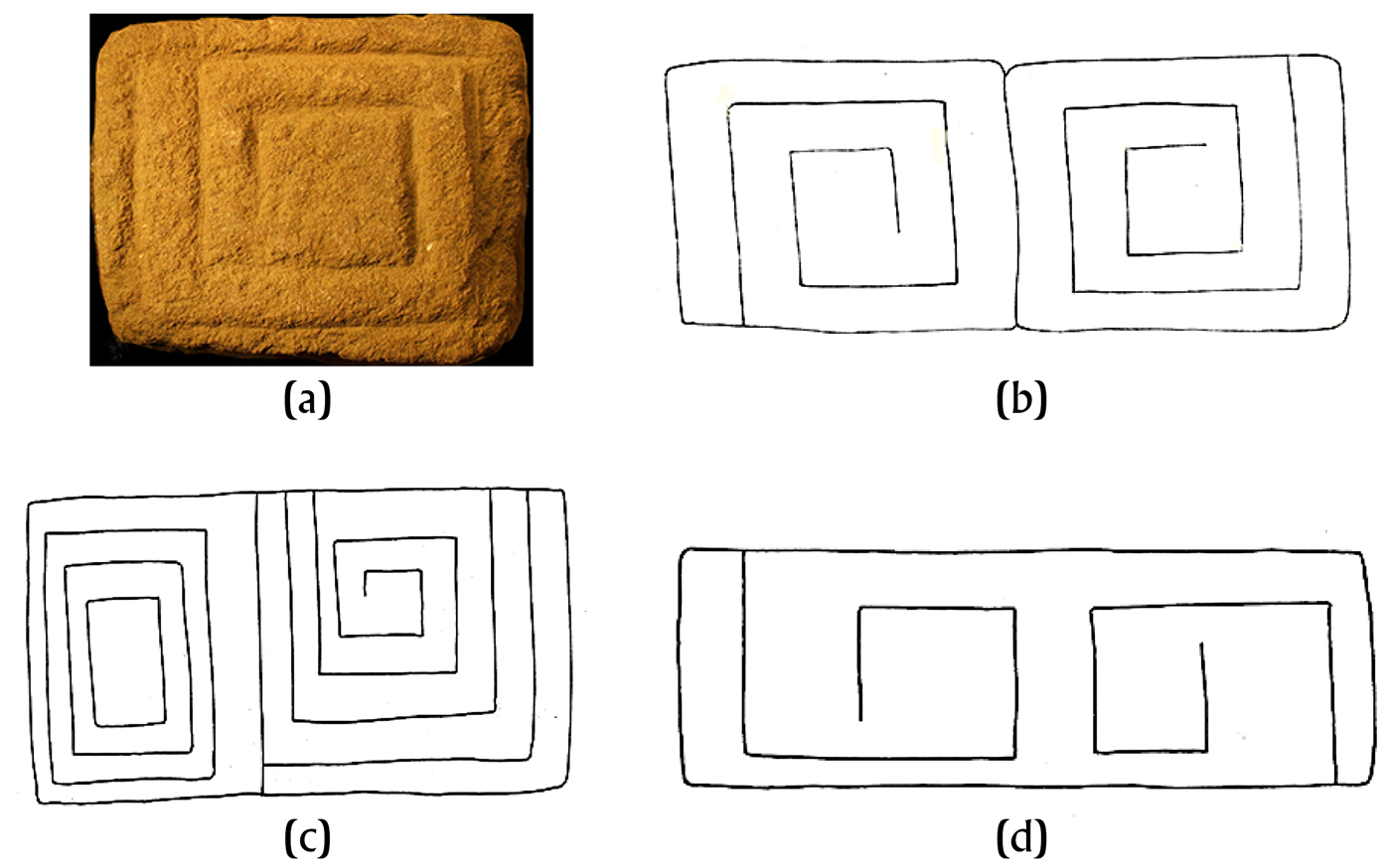
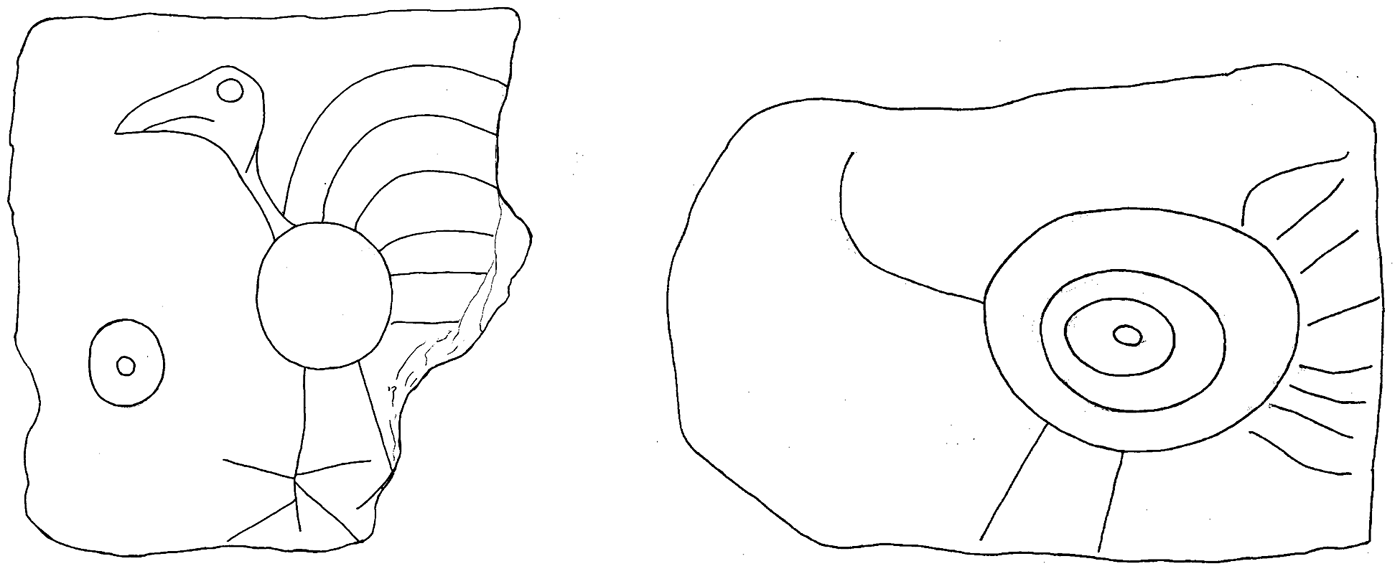
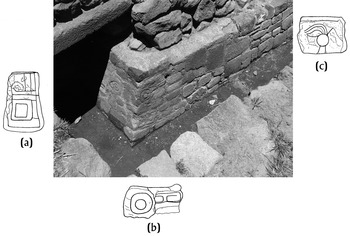
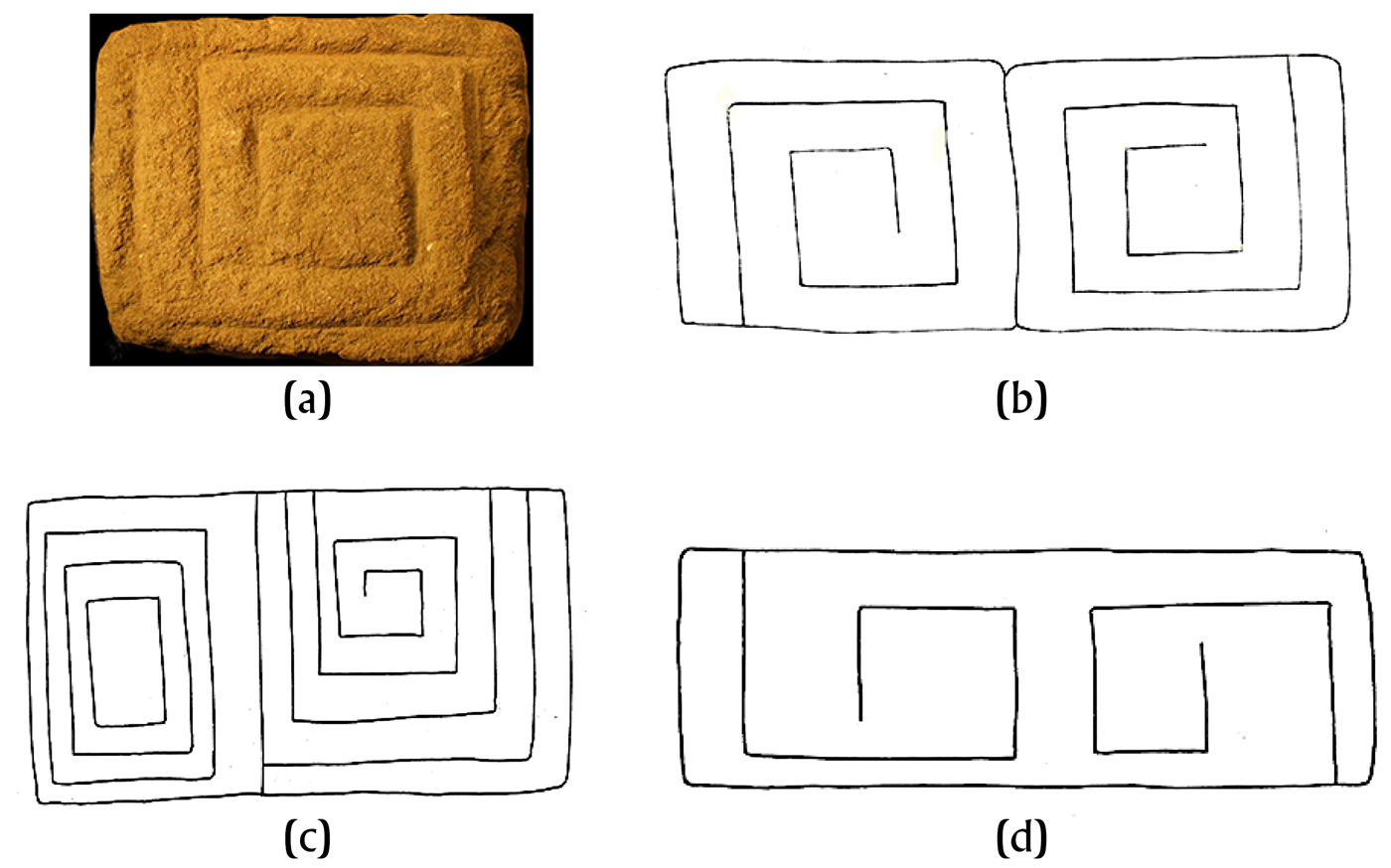
Examples from this first group were reportedly found at the site in the late nineteenth century, among the unexcavated remains of buildings on the crest of the hill; these were set into an exterior wall of the parish church. Similar blocks have been found archaeologically in original architectural contexts at the site, as mentioned above, and a few are set into house walls in the modern town or are in museums. Others have been found at sites like Tenochtitlan, Tlatelolco, and Tenayuca, but the specific patterns are usually different. A common Matlatzinca motif is a non-figurative labyrinth (Figure 7) formed by inward-facing squared volutes (see also Taube Reference Taube, Fields and Zamudio-Taylor2001:Figures 73–75, for non-Matlatzinca examples of this labyrinth). Other interesting grooved reliefs at Calixtlahuaca are birds rendered as stick figures, at least one incorporating a spiral (Figure 8). Among the blocks still set into walls at the site are similar motifs (Figure 9) and their context on inner phases indicates the antiquity of certain motifs, as García Payón noted, although not the end date of their production. These were obviously architectural decorations, and were left in their original contexts when a building was covered.
Small blocks with grooved reliefs, including concentric shapes, and a distinctive form of “labyrinth” made of squared volutes. (a) (SS 147) is in IMC storage. Photograph reproduced courtesy of the Instituto Nacional de Antropología e Historia, Mexico. (b–d) SS 130Q, SS 130P, SS 130S, and SS 130AA were found on top of the hill of Calixtlahuaca, probably set into pre-Hispanic walls, now set in the wall of the parish church. Drawings by Umberger.
Grooved stick-figure birds among the small relief blocks set in the parish church wall (SS 130A and SS 130L). Drawings by Umberger.

Similar grooved reliefs still in the wall of the innermost phase of Monument 5: (a) represents concentric squares (SS 128F), (b) has concentric circles and a “labyrinth” (SS 128C), and (c) is a bird (SS 128A). Drawings and photograph by Umberger.

Positive Reliefs with Figural Subjects
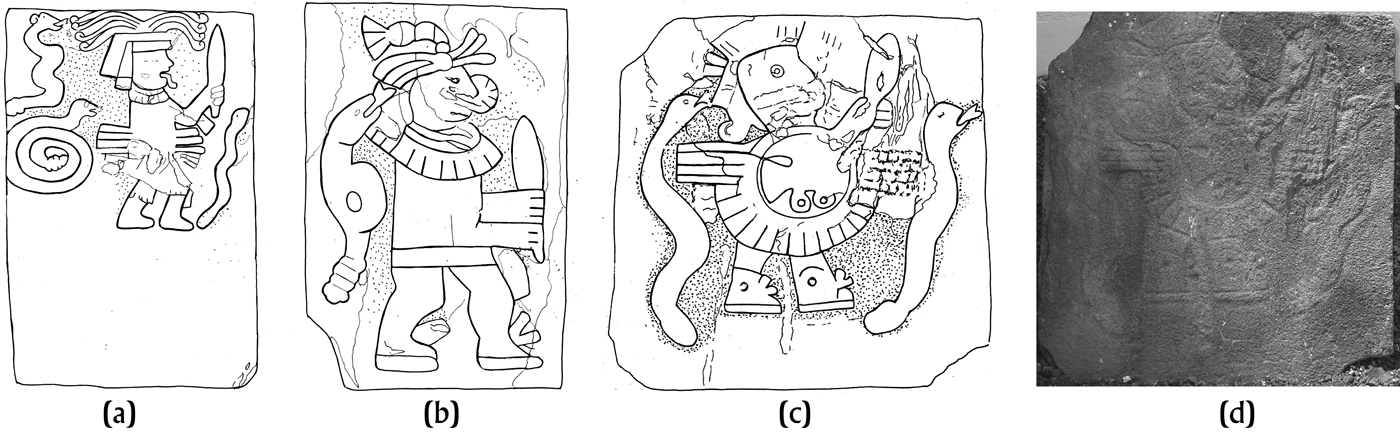
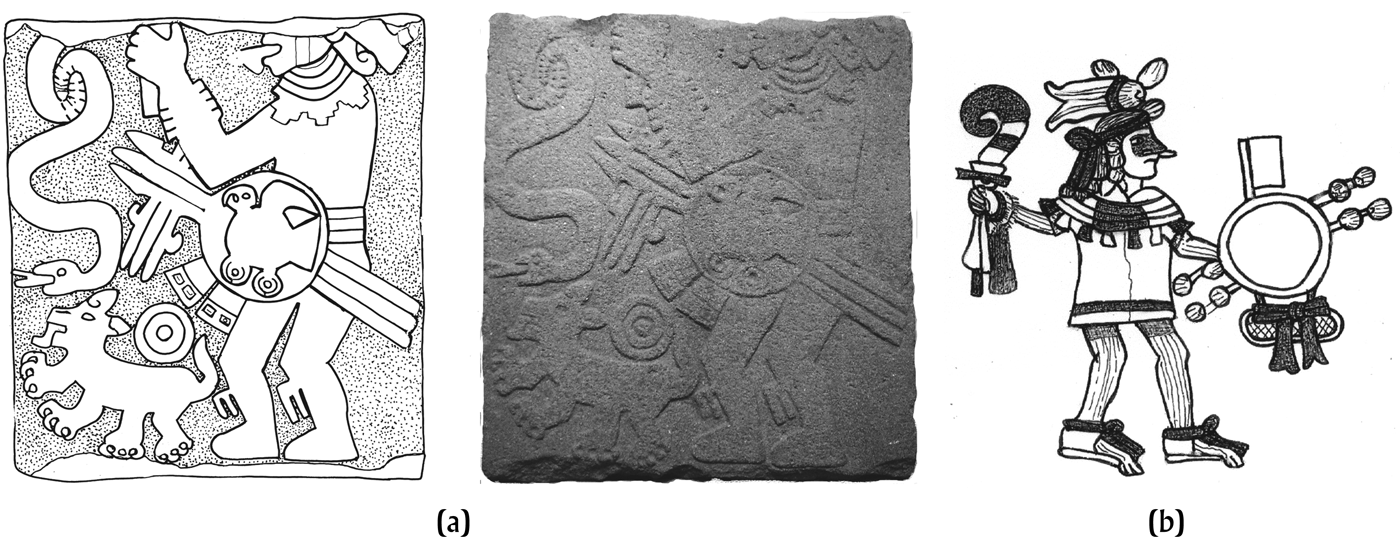
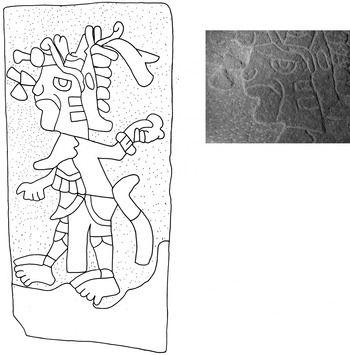
Some larger reliefs related to each other by imagery and general style give an idea of public art at Calixtlahuaca. Sergheraert and Umberger, who recognized the distinctive bird motif that unites most examples in the group, selected the following group of sculptures in 2006. Three of these reliefs are the reused patio stones found by García Payón (Figure 10). Together with a fourth example found later (Figure 11a), they represent what can be identified tentatively as men dressed as a local god among whose powers was that of the wind. It is possible that this was the being replaced by the Aztec god Ehecatl in the circular temple; but only Figure 10a was found associated with that temple. Sculptures 10b and 10c were found in the patio between Pyramids 5 and 6 (García Payón Reference García Payón, de Magrelli and Castañeda1979:279), and Hanns Prem saw them in the same areas in 1970. The fourth example (Figure 11a) was found buried upright in the cemetery of the Calixtlahuaca Pantheon, a chapel on the outskirts of the modern town (Michael Smith, personal communication 2007; information obtained from a guard at Calixtlahuaca, 2007). The discovery of comparably dressed figures in different places may indicate that the supernatural elements belonged to a principle god at the site. Being in profile, the reliefs would not have been temple idols; more likely they represent important human beings, like rulers, wielding the god's supernatural powers (Michael Smith, personal communication 2007).
Reliefs of personages in supernatural garb from Calixtlahuaca, all stone without indications of paint: (a) SS42, height unknown, found by García Payón reused as a paving stone in front of Monument 3 (the Wind God temple). It was seen set upright in front of the temple in 2006 and 2007. (b) SS 37 and (c) SS 39 were also found by García Payón reused as paving stones between Monuments 5 and 6 (both sculptures were seen in the SMC in 2006 and 2007). In the drawings the dots represent recessed areas around the carvings. The figure in (c) has the bird shield and the figure in (a) probably had one originally. (d) is a photograph of (c). Photograph reproduced courtesy of the Instituto Nacional de Antropología e Historia, Mexico. Drawings by Umberger.

(a) Relief of a similar personage (SS 81) found buried in the Calixtlahuaca pantheon church cemetery, stone, height = 88.9 cm (IMC storage), and in much better condition than the three found at the site itself. (b) The Aztec God Mixcoatl (after Codex Magliabechiano in Anders and Jansen Reference Anders and Maarten1996:f. 42r.) Photograph published courtesy of the Instituto Nacional de Antropología e Historia, Mexico. Drawings by Umberger.

Characteristic of all four reliefs are single figures with bent knees, holding weapons and surrounded by leaping or curled snakes. Shared motives are large stone knives that all four figures hold raised up before them, dart-like weapons or long staffs, the curled and leaping snakes, a “gadget” emerging from the mouth area, and a shield with the distinctive bird emblem decorating it. The bird shield is evident on two of the reliefs and there is space for a shield in the damaged part of a third relief. No shield ever existed on the fourth relief, which also lacks the spears.
The bird itself is noteworthy as being the same bird seen in the small grooved reliefs. Although the species is still unidentified, its occurrence on the shield probably indicates it as an emblem of the city. The stone knife and snakes are on all four reliefs, and an emanation from the mouth is definitely on three and possibly all four. The bird and snakes are probably symbols of the wind (see Taube Reference Taube, Fields and Zamudio-Taylor2001). The additions to the mouth should also be seen as wind related and comparable to the buccal mask of the Aztec Ehecatl in comparing the wind to breath. The ones in the reliefs are clearly different forms that are difficult to identify. The object in the mouth of the personage in Figure 11a is an L-shaped implement, while that in Figure 10a resembles the protruding tongue of the animal in Figure 11a, and that in Figure 10b looks like a flower or pinwheel. A similar form may be in front of the mouth of Figure 10c, but damage makes it difficult to decipher.
García Payón (Reference García Payón1941c:57)did not notice the bird shield motif but he did suggest wind-related connotations for the serpent images. His argument that these beings all represented the god Mixcoatl (Figure 11b), however, was based on the presence of the knife (which actually looks nothing like the Matlatzinca knife). Mixcoatl was a hunting god whose primary features were a net bag and a large feather decoration on the top of his head. From a modern point of view, the problem with this type of identification is not just a matter of using a Nahuatl name, a constant problem in the interpretations of García Payón and his contemporaries. It is also a matter of implying a total correspondence between Matlatzinca and Nahua beings that would not have existed, even if there were some connection.
There are variations among the four reliefs in degree of preservation, but also in original quality, stone types, sizes, figure styles, and proportions. In fact, none can be considered as matched. The headdresses and facial decorations seem to vary most and, unfortunately, these upper parts are so damaged in the known examples that they cannot be deciphered easily. There are a few motifs in common on some: the curved hangings seen on the back of the headdress in Figures 10c and 11a, and the multiple flaring motifs on top of the headdresses in Figures 10a and 10b, with significant variations among them.
The three reliefs found at the site, having been used as paving stones, were already in poor condition at the time of their excavation, and their continued exposure until at least the 1970s contributed to further deterioration. Still, it is apparent that in their original state these three reliefs were never as finely carved as the one reproduced in Figure 11a. This last example, having been buried away from the site, did not suffer the weathering of the others. Now in storage at the IMC, its vertical burial in the cemetery, with the top edge emerging as a base for candles, explains the destruction of the upper part. Since García Payón did not mention this relief, its disinterment must have occurred after his excavation project. It may even have been found after 1979, as it is not mentioned in the notes of Tomassi de Magrelli and Manrique Castañeda (1974). One might add that its location apart from the others and its condition may indicate a different date and separate history. Although much of the head is missing, the other motifs are clearly detailed, the carving is crisp, the proportions and arrangement are well thought out, and the relief background is deeper than in the other three, which are very shallow.
In addition, the carving of Figure 10c is preserved enough to show that the background recession is only around the carved motifs and does not extend to the edges of the stone; this seems to have been the case with Figure 10a also. In contrast, the relief in Figure 11a is clearly conceived on two flat levels with the entire background recessed. The details of the raised parts are still indicated by grooving rather than modeling, and the motifs, clothing, accouterments, and general presentation make it recognizable as related in form and theme to the other three, but it was produced by a well-trained artist and its qualitative difference is a matter of original state as much as it is of preservation.
One motif on this finer example seems to have been acquired from outside the Matlatzinca area, the date to the lower left. The carving of a date on a monument is not seen on other Matlatzinca carvings, and especially a date composed of both a sign and a number. The date is either 1 Jaguar or 1 Dog, two day-names found in the Nahua 260-day divinatory cycle. The Matlatzinca shared many of the same day signs with the Nahuas, and, according to Caso (Reference Caso1967), most had the same names. The position occupied by Jaguar in the Nahua calendar is occupied by a human figure in the Matlatzinca calendar, however, and its name is translatable as something like “face” (Caso Reference Caso1967:226–240). In the Aztec divinatory count, both 1 Jaguar and 1 Dog would have been appropriate to the date's context on the relief from the point of view of Nahua cultural associations, but 1 Jaguar might be more appropriate because of its relationship to the wind. In the tonalpohualli, 1 Jaguar is the day of the wind god Ehecatl, or Quetzalcoatl-Ehecatl (Quiñones Keber Reference Quiñones Keber1995:f. 8v, pp. 165–166), whose Aztec image the invaders installed in Monument 3 in the form of the life-size sculpture. One Dog is also an important date, being associated among the Aztecs with the installation ceremonies of a ruler; it has been found at the Templo Mayor in contexts of ruler investiture (Leonardo López Luján, personal communication 2015). Whichever date it is, its occurrence on the relief represents the combination of a Matlatzinca being with a non-Matlatzinca inscription.
The above four reliefs are the only ones where the figures have the supernatural snakes around them. A fifth relief depicts a figure carrying the bird shield (Figure 5), but the figure is in the act of flinging something (which is not visible) from an atlatl. This relief was among those set into the church wall in the late nineteenth century (García Payón Reference García Payón, de Magrelli and Castañeda1979:276, 279) and was still there in 1970 when Hanns Prem photographed it before its removal to the IMC. Presumably it represents a warrior lower in the hierarchy. The headdress too is different from those in the four reliefs and resembles a petroglyph at Teotenanco (Alvarez Reference Alvarez A. and Chan1973:Photograph 9).
Contemporaneity of the Two Relief Styles
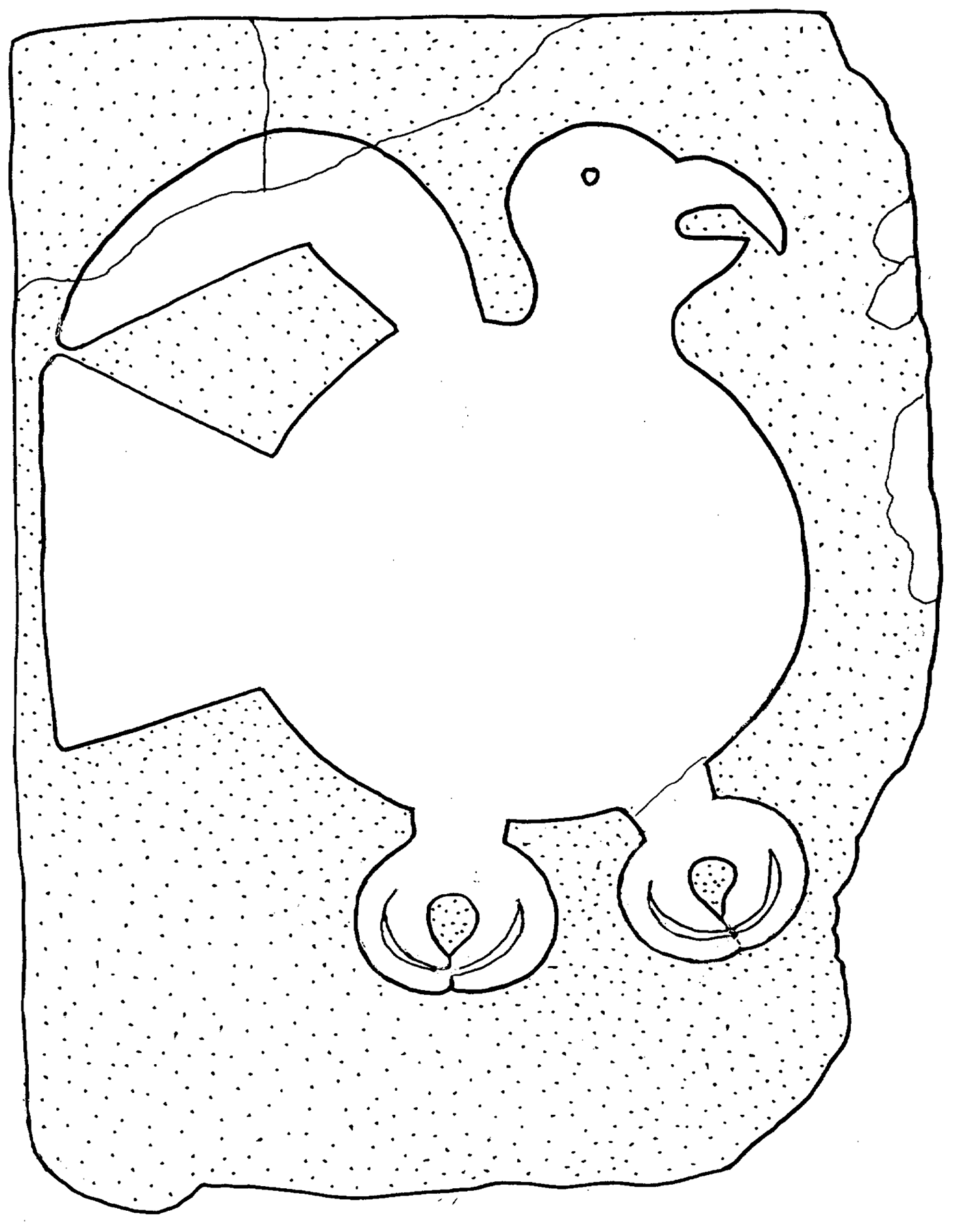
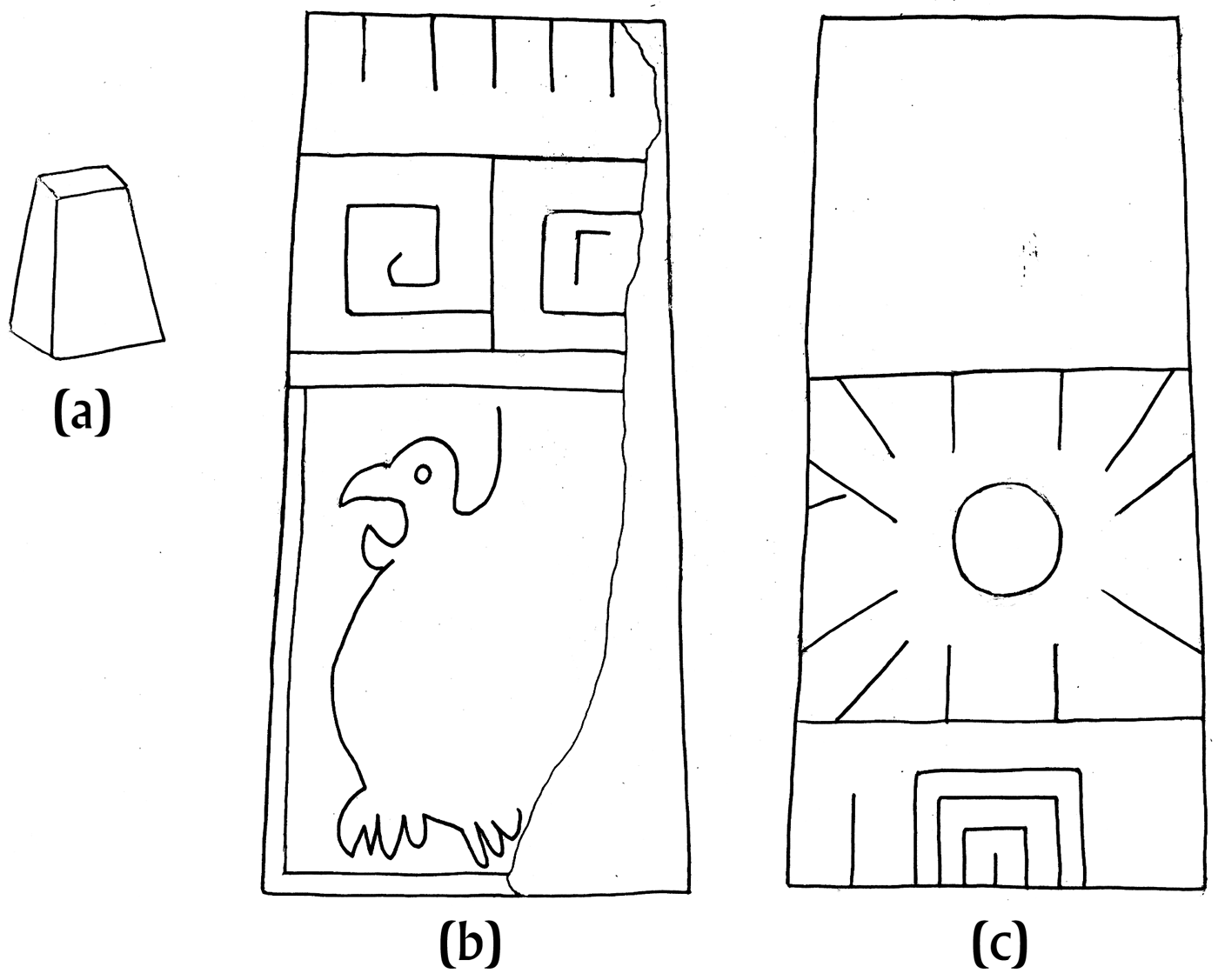
The same more “naturalistic” version of the bird featured on shields in the reliefs above is seen alone in another positive relief (Figure 12) and together with geometric motives on three freestanding geometric solids (Figures 13a–13b, 14). The two in Figure 13 are fragments, respectively, of a small cylindrical mortar and a small cylindrical platform in storage at the IMC. Both have multiple birds repeated around their perimeters, and both birds and geometric motifs are represented in positive relief. Although these, like the other works featuring the bird, pertain to the Calixtlahuaca area, the third solid with the bird in relief was found in the pavement of the Santa Monica barrio church of Malinalco. It has been identified as a sacrificial stone (Guevara Reference Guevara Sánchez1992:28–30, Figure 25), but not linked previously to the Calixtlahuaca corpus to which it must have belonged. Like Calixtlahuaca, Malinalco was conquered and appropriated by the Aztecs, who built temples on a pre-existing site (Galván Villegas Reference Galván Villegas1984; Townsend Reference Townsend and Boone1981). Besides the sculptures in the rock-cut temple, there were free standing Aztec-style sculptures at the site, including a life-size, roughly carved Ehecatl and the heads of several (Aztec) Mixcoatl figures (now in the MUM; Guevara Reference Hassig, Spores and Hassig1992:40, Figures 9, 10, 12, 53). No other sculptures at Malinalco bear carvings of the distinctive Calixtlahuaca bird and geometric motifs.
Bird Relief (SS 40), stone, height = 83.82 cm, provenience unknown (SMC). Drawing by Umberger.

Rollout drawings of sides of two stone cylindrical solids featuring positive reliefs of the bird accompanied by geometric motifs, proveniences unknown. (a) Relief on mortar (SS 156), height = 15.2 cm. (b) Relief on small platform (SS 155), height = 20.3 cm (both in IMC storage). Photographs reproduced courtesy of the Instituto Nacional de Antropología e Historia, Mexico City. Drawings by Umberger.

(a) Monument called the “Sacrificial Stone” or “Stone of the Turkey,” stone, height = 53.3 cm, found reused as pavement in front of the Chapel of Santa Monica in modern Malinalco, original location unknown. (b–c) Reliefs on the front and back of (a) similar to motifs seen in the Calixtlahuaca vicinity: a labyrinth pattern now set into the parish church wall (SS 130S) and the Bird Relief (SS40) in the SMC. Drawings by Umberger.

How this Calixtlahuaca-style sculpture ended up here is unknown. Like the other two sculptural solids from the Calixtlahuaca area, however, it is noteworthy in the co-occurrence of the naturalistic bird emblem with geometric motifs. In other words, the three sculptures combine the categories illustrated in Figures 7–9, where García Payón saw abstraction linked to grooved carving, and Figures 5 and 10–12, which he saw as later naturalistic representations co-occurring with positive carving. The mortar in the IMC combines the figurative bird with concentric circles and zigzags, and the platform combines the bird with diamond patterns. Finally, the Malinalco sculpture combines the form of the bird as depicted in positive reliefs with the labyrinth motif usually represented as a grooved relief at Calixtlahuaca (Figures 14b–14c). Unfortunately, it is not known whether the reliefs on this sculpture are grooved or positive. At any rate the combination of motifs on a single object demonstrates their contemporaneity and, presumably, the contemporaneity of grooved and positive reliefs. The two types of relief were used for different purposes, the first being used for small architectural decorations, and the latter for larger sculptures that were moved around.
Other Matlatzinca Reliefs
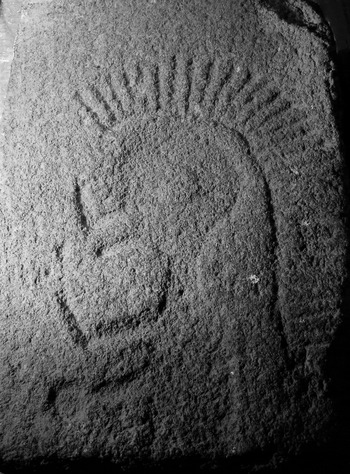
Many reliefs, often fragments, have not yet been matched to others in the Matlatzinca corpus. The relief in Figure 15 represents a standing anthropomorphic being in the form of a bird with a head decoration of regularly spaced grooved lines, sticking out like bristles in a row and extending from the top of the head down the back. Nicely carved, it combines grooving with both positive and negative relief work, and the bird differs in form, and perhaps identify, from the emblematic bird discussed above. So, it differs from those that combine flat planes and grooving in both carving style and imagery. The quality of its carving also suggests a different context of creation and a different date. Although the surface is modeled, its style is not Aztec.
Relief fragment (SS 148) of anthropomorphic bird with a head decoration extending down the back; nicely carved combination of grooving with both positive and negative relief work, stone, height is approximately 43.2 centimeters (IMC storage). Photograph reproduced courtesy of the Instituto Nacional de Antropología e Historia, Mexico City.

Sculptures In-the-Round
Many sculptures in-the-round have been found in the Calixtlahuaca area, but most are the Aztec-Nahua deity figures made for colonists. Among the non-Aztec sculptures, the known examples are crudely carved, and cannot be identified as Aztec deities. García Payón (Reference García Payón1941c:Illustration 30) illustrates sculptures from Levels 2 and 3 of Monument 3, which likewise look nothing like Aztec figures. Very unfortunate is the lack of both the pre-Aztec deity idol that must have occupied Monument 3 and the god called Coltzin from the temple in Tollocan, which was reportedly taken to Tenochtitlan at the time of the Aztec invasion (Durán Reference Durán and Heyden1994:269–270).
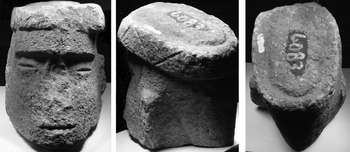
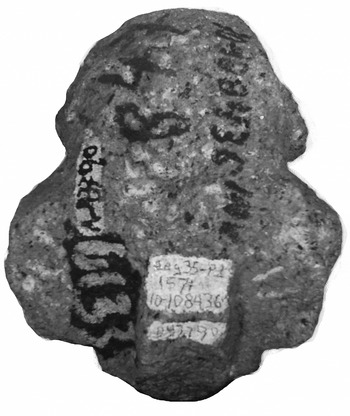
Among the non-Aztec three-dimensional sculptures are a number of heads that form a group of images (Figure 16). Although of different sizes, and, therefore, not a set of matched scale, they share common conventions in the carving of facial features and headgear. We know of some fourteen examples. They were all broken from larger sculptures but none of the bodies appear in the museum collections. These heads are in storage at the IMC, and they are given the provenience of Calixtlahuaca in the etiquetas of 2004 (Museo de Antropología e Historia del Estado de Mexico 2004). García Payón illustrates one rough example as having been found in archaeological Levels 2 or 3. No two heads are of the same size, but they share conventions. Common among them are smoothed and simplified forehead and cheek planes which meet the plane of the underside of the chin with sharp lines, oval-shaped hats with raised-band rims, long elements emanating from the back of the hat like “ponytails,” and coffee-bean or slit eyes. Some have zigzags on their headbands and/or “ponytails” and one head has crossed hatching. Zigzags on raised bands frame the upper parts of small vessels and mortars too, along with other geometric motifs. The nicely smoothed planes on some heads may indicate manufacture by professionals in a workshop. The general variations in size and quality of the heads as a group are puzzling; no two are alike in conventions and scale. In addition, even in the nicest example, the head illustrated here (Figure 16), the eyes appear not to be aligned horizontally.
Head (three views) detached from a sculpture from Calixtlahuaca (SS 187), with zigzag design on headband, height = 23 cm, width = 16 cm (IMC storage). Photographs reproduced courtesy of the Instituto Nacional de Antropología e Historia, Mexico City.

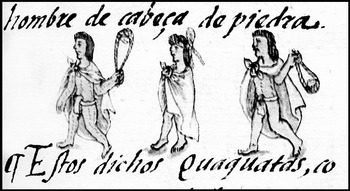
According to the text that accompanies the representation of the Matlatzinca in Sahagún's Florentine Codex (Figure 17), they wore their principle weapons, slingshots, around their heads when not using them. The central figure in the illustration wears it this way; the slingshots have net patterns and the ends trail behind the head when worn. Is it possible then that the raised bands on the decapitated sculpted heads from Calixtlahuaca are stylizations of slings, with the zigzag lines being the netting? The headgear in the Florentine Codex does not appear to include a cap and the netting of the slingshot is not visible on the sides of his head. This identification remains hypothetical.
Matlatzinca men in Sahagún’s Florentine Codex, 1575-80, Book 10, f. 133r. Two men throw objects with slings and the third wears a sling wrapped around his head (Ms. Med. Palat. 220, Biblioteca Medicea Laurenziana). Photograph courtesy of the Biblioteca Medicea Laurenziana, Florence.

Similar heads broken at the neck (Alvarez Reference Alvarez A. and Chan1973:Photographs 30–33) were found at the ancient site of Teotenanco and reunited with bodies for exhibition in the SMT. The fact that four examples unmatched in sizes can be placed together as a credible group may indicate that some of those at Calixtlahuaca might have been displayed together also. The heads from Calixtlahuaca and those from Tenancinco were obviously made by different artists but they are a rare commonality among the northern and southern Matlatzinca.
Works Showing Outside “Influences”
In contrast to the above works the following reliefs have different mixes of Matlatzinca and non-Matlatzinca traits. They are presumably late in date, and could have resulted from exposure to Nahua culture before or after the Aztec invasion, with the new traits being adopted from portable objects in the international Postclassic style that circulated in manuscripts and small objects without regard to political borders. The few reliefs illustrated here give a sense of their variety. Needless to say, situations of manufacture are unknown, and the expertise of the artists varies from amateurish to fine, but almost all are flat and none show the modeling of Aztec sculptures.
The elaborately dressed male in Figure 18 is carved in the same type of positive relief as Figure 11, and also on a grainy stone, but the grooving of details is not as smoothly done. In addition, the background cut around the figure does not extend to the edges of the stone, a convention seen in the shallow reliefs in Figure 10, and the recessed part is covered with a regularized pattern of nicks (in the drawing the dots serve both as stippling to convey depth and as a representation of the pattern). The profile figure poses as if holding an atlatl, but the object in his hand is not identifiable; it is not the stick of the atlatl, or a recognizable sling.
Sculpture of warrior (?) (SS 122), height= 85 cm, Matlatzinca relief style, but with non-Matlatzinca Nahua clothing (IMC storage). Photograph reproduced courtesy of the Instituto Nacional de Antropología e Historia, Mexico City. Drawing by Umberger.

So he is posed like a warrior, but he does not seem to hold weapons. His body features the large head, more rubbery limbs, articulated toes, and facial features of central Mexican manuscripts. In addition, his clothing is not Matlatzinca. He wears the combination of square panel loincloth and triangular hip-apron seen in both Nahua and Mixtec manuscripts and symbolizing Toltec garb in Aztec sculptures. The loincloth is represented as a panel in the front and an S-form in the back. The headdress looks like a large feathered affair. One would guess that the original model that the artist misunderstood featured an animal head, of which remains an eye and two long volutes that may have been an elongated open beak of a bird or the mouth of a reptile. This type of monster-maw headdress was common in many areas of Mesoamerica.
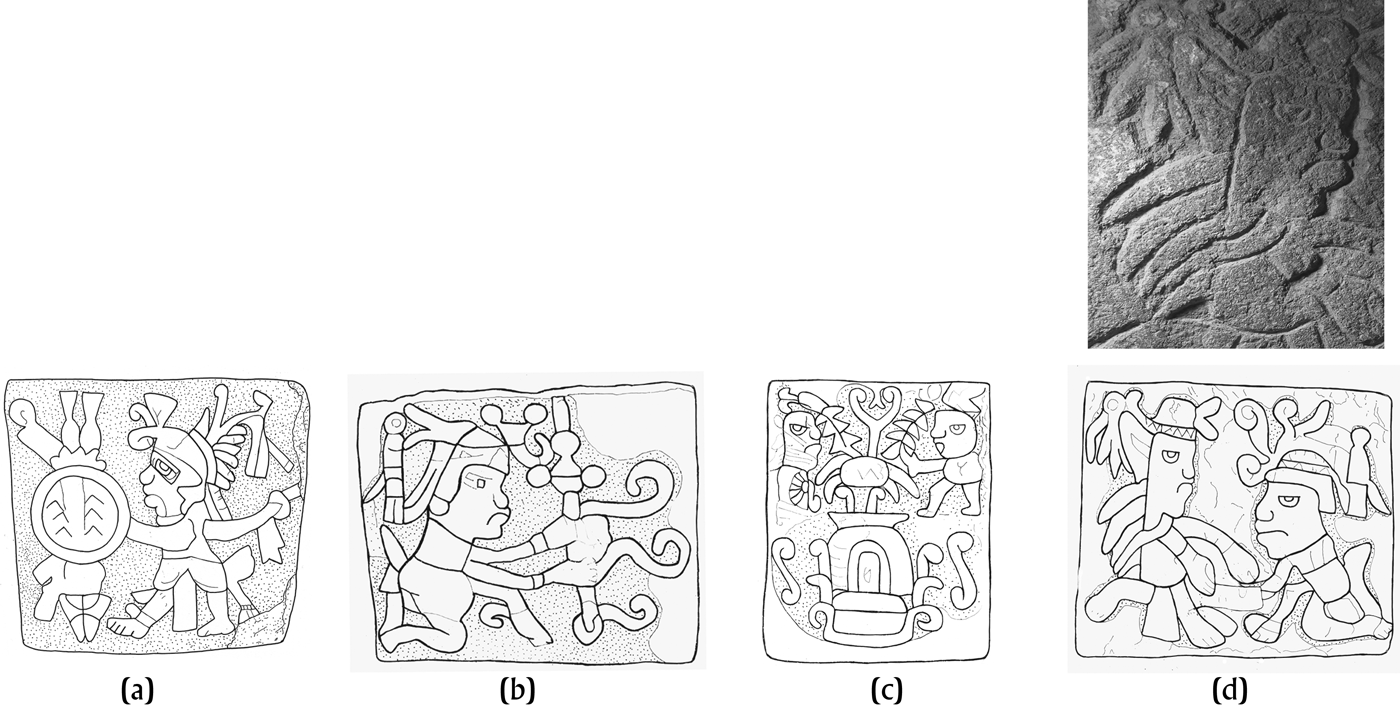
The four relief panels seen in Figure 19 appear to be a set, all roughly carved and seeming to report human events. As in the previous image, the bodies reveal exposure to the international style of manuscript art, in their proportions (large heads and small bodies), facial features (down-turned mouths), and probably in the narrative representation of activities. Also loosely related to the nicked background of Figure 18 is the rougher tool work, of which the marks remain in backgrounds and outlines of figures. The subjects are also of interest. Figure 19a is a replica of the man in Figure 18, but the addition of a shield, darts, and probable atlatl make him a warrior. He wears the same Nahua or Mixtec clothing, but the headdress has lost any resemblance to an animal.
Set of four reliefs of roughly the same size and similar crude style and carving tool marks are visible in outlines and backgrounds, with a mix of Matlatzinca and Nahua imagery. All figures have facial conventions like those in Nahua manuscripts: (a) Warrior with pose, face type, and costume parts like Figure 18, but very different stone type and tool marks (SS 124), height = 41.9 cm. (b) Man drilling fire, a subject not seen in Matlatzinca art (SS 94), height = 36.6 cm. (c) Two figures and probable Reed date (SS 123), height = 41.9 cm. (d) Facing figures with zigzags on headbands as in Matlatzinca sculptured heads (SS 95), height = 36.6 cm (all reliefs are in IMC storage). Above (d) is a close-up of the left figure showing tool marks. Photograph reproduced courtesy of the Instituto Nacional de Antropología e Historia, Mexico City. Drawings by Umberger.

Figure 19b probably represents a man drilling a new fire (Michael Smith, personal communication 2006), and the flare emitted by his forward foot may signify his identity as Tezcatlipoca, the Aztec/Nahua creator of fire. If so, the date of the ceremony would have been 2 Reed 1507, the year when the Aztecs emphasized the second year of the new 52-year cycle as the new fire year. Traditionally in Aztec monuments, 1 Rabbit, the first year had been emphasized alone as the cycle beginning year, but 1 Rabbit 1506 was a year of continued drought in the Basin of Mexico, and 2 Reed 1507, the following year, saw a return of rain and fertility. Aztec monuments from that time thus pair 1 Rabbit with 2 Reed. In Figure 19c, the crudest of this set of reliefs, the main motif appears to be an enlarged Reed date with small figures above. The date recalls Aztec carvings of enlarged emblematic dates, but it lacks the numeral to make it 2 Reed, the necessary trait of dates recorded on Aztec monuments. Other sculptures in the Matlatzinca area refer to the 1507 New Fire. At Calixtlahuaca, a relief of a Reed date (also without a numeral) was carved on a rock near the top of the hill, and an Aztec-style relief of Tezcatlipoca's smoking mirror of unknown provenience is housed in the Teotenanco site museum. Most important is an Aztec Imperial Style monument, the relief of a seated figure on a rock at Acatzinco, south of Teotenanco. This last monument commemorates the 1507 ceremony, and, as in Tenochtitlan, with the inscription of both dates marking the 1507 change, 1 Rabbit and 2 Reed, and including their numerals (Umberger Reference Umberger, Pohl and Lyons2016:135–136, Figure 4.19).
The two profile figures in Figure 19d are distinguished by headwear that resembles those on the Matlatzinca heads discussed above, in the zigzag bands and the hanging parts on the back. The figures face each other, but whether they are in a running, kneeling, or seated postures is difficult to say. The carving of all four reliefs is amateurish and differs from both Aztec and Matlatzinca professional productions. The local cap style in one relief indicates Matlatzinca participants, and the lack of numerals may be a Matlatzinca trait too. Although the Matlatzinca had, for the most part, the same day signs, whether they used numerals is in question (see Caso Reference Caso1967:226–240 for both sides of the argument). All four reliefs are fascinating and the Nahua traits point to a time after the Aztec invasion.
A similar combination of Matlatzinca and Nahua traits is seen in Figure 11, as mentioned above, but in a finely carved example. The labeling of this personage with a day sign accompanied by a numeral, a proper Aztec date, suggests creation for a high status collaborator of the invading Aztecs—perhaps the Matlatzinca ruler Chimaltecuhtli mentioned in multiple Aztec historical texts of the period.
CONCLUSION
We see the ancient Matlatzinca as having had a culture independent of that of their Nahua neighbors, contradicting García Payón's contention that both Aztecs and Matlatzinca were cultural descendants of the Toltecs. In addition to distinguishing between their respective styles, we find a different system of ideation, motifs, and supernatural symbols of power, a combination of leaping serpents, weapons, and a shield with an emblematic bird, as well as a large knife held in front and a sort of flute or other aerophone. Standing out are two finely carved sculptures, which, although rare, indicate trained artisans under elite patronage and the presence of other artworks yet to be found.
Not addressed directly in this essay are more general questions arising from the evidence of material remains in relation to cultural interaction. How does one distinguish between the creations of the original culture before conquest and creations displaying a hybrid style? In addition there are questions about differences in the nature of exchanges according to types of objects. Are all goods and ideas spread through the same mechanisms, or are different circumstances behind exchanges of architectural forms, sculptures, and ceramics? Interpretive problems are also seen in the difficulties of using archaeological evidence in placing artworks chronologically, not to mention the problems of dealing with materials in museum collections. We look forward to the expansion of studies of the remains of the Matlatzinca both before and after the Aztec conquest and to the discovery of new remains and unpublished documentary sources. At the same time, we suggest the reexamination of the Aztec sources that García Payón used, which, although already well known, should be reconsidered in relation to newer evidences and examined for ethnocentric distortions.
RESUMEN
Este artículo presenta un estudio de las esculturas del estado matlatzinca antes de la conquista azteca de mediados de 1470. Anteriormente, matlatzinco había sido una entidad política independiente en la región norte del valle de Toluca, alrededor del centro de gobierno tradicional al que también se le conocía como matlatzinco. Después de invadir el área, los aztecas renombraron a la entidad como Calixtlahuaca y establecieron su propia capital provincial en la cercana Tollocan. Conviertiendo a Calixtlahuaca en un símbolo de su control sobre la región, los aztecas erigieron nuevas fases sobre la arquitectura del antiguo centro e instalaron imágenes de deidades de estilo azteca.
Durante sus excavaciones de sitio en la década de 1930, José García Payón descubrió un gran número de esculturas aztecas de estilo imperial, como la Ehécatl de tamaño natural, las cuales son bastante conocidas en publicaciones sobre los aztecas. En mucho mayor cantidad, García Payón descubrió también figuras más pequeñas y de ejecución cruda posiblemente fabricadas para las clases sociales más bajas. A pesar de haber identificado correctamente a las esculturas de estilo azteca provenientes de la fase más tardía del sitio y de haberlas relacionado a la invasión azteca, García Payón creyó que éstas habían sido labradas por artistas matlatzincas que habrían continuado trabajando bajo influencia de los aztecas. Al igual que muchos de sus contemporáneos, García Payón creyó que todo el centro de México había existido bajo la influencia tolteca. De esta manera, propuso que los aztecas y los matlatzincas, a pesar de hablar diferentes lenguas, estaban relacionados mediante una herencia tolteca común y que compartían los mismos dioses. García Payón explicó las marcadas diferencias en apariencia de los cuerpos escultóricos aztecas y matlatzincas como resultado de distorsiones matlatzincas después de la caída de la cultura tolteca. Sin embargo, las esculturas de ambos grupos presentan demasiadas diferencias en su forma y temática como para respaldar este argumento.
El enfoque de este artículo es el cuerpo escultórico matlatzinca; sin embargo, debido a los planteamientos de García Payón ya mencionados, trazamos primero la historia del cuerpo escultórico azteca en su territorio de la Cuenca de México con el fin de separar las producciones aztecas de las matlatzincas. Seguido, presentamos un resumen del trabajo e interpretaciones artísticas de García Payón, así como una crítica de sus ideas sobre estilos y cronologías. Fuentes de información más recientes que incluyen documentos arqueológicos y de archivo (desconocidos por García Payón en su tiempo) apoyan las interpretaciones presentadas en este trabajo. La arqueología revela que los matlatzinca nunca sostuvieron relaciones significativas con los toltecas, lo cual sugiere que la cultura matlatzinca se desarrolló a partir de una herencia cultural distinta a la tolteca. Los documentos de archivo indican que una gran población azteca de la Cuenca de México, que incluía a diferentes clases sociales, se estableció en el área después de la conquista azteca. Esto explica la presencia de imágenes de deidades aztecas en gran número. Estas revelaciones facilitan la reconstrucción de un contexto histórico más plausible para el desarrollo cultural de la región matlatzinca.
De vuelta a los objetos, describimos nuestro estudio de los cuerpos escultóricos matlatzincas y aztecas del valle de Toluca, delineando las dificultades de “re-excavar” las colecciones de museo y reportes antiguos para descubrir o reconstruir las historias de los objetos. Después de separar las obras aztecas del cuerpo escultórico matlatzinca, analizamos aquellos trabajos realizado por artistas matlatzincas. Estos fueron elaborados en su mayoría antes de la conquista de los aztecas, y apenas un pequeño número de ellos muestra influencia de culturas nahuas, incluída la azteca. Desafortunadamente, el cuerpo escultórico es relativamente pequeño; además, existe la suposición de que los aztecas destruyeron muchas de las esculturas realizadas por el estado matlatzinca. No obstante, las esculturas existentes ofrecen un panorama interesante sobre la cultura matlatzinca antes de la conquista azteca y forman una base para investigaciones futuras acerca de esta cultura tan poco conocida. Los hallazgos más interesantes en cuanto a información iconográfica sobre política y poder son los relieves que representan a un emblema de ave e imágenes de figuras supernaturales (o de individuos vestidos como figuras supernaturales) con implementos asociados al viento y otras fuerzas.
ACKNOWLEDGMENTS
The authors worked together to catalogue, study, and photograph the corpus and to gather and resolve conflicting written evidences about the objects. Casandra Hernández concentrated on the coordination and recording of the information on individual pieces and the creation of computerized lists of objects, while Emily Umberger focused on their stylistic, historical, and cultural interpretation. Hernández's work is especially evident in the sections on García Payón's publications and museum records. The images were drawn and photographed by Emily Umberger, with the exception of a few noted in the captions; most photographs were set up and recorded by Casandra Hernández. We thank above all Michael Smith, the director of the Calixtlahuaca project, for involving us and for his many generous contributions to our work. We are grateful to the late Hanns Prem for sending us photographs that he shot in 1970. We also appreciate the valuable input of Maëlle Sergheraert, who worked on the sculptural project during the 2006 season, and other members of the archaeological teams at Calixtlahuaca during both 2006 and 2007 seasons. Finally, we are indebted to the members of the Instituto Nacional de Antropología e Historia in Toluca and the Instituto Mexiquense de Cultura, especially the generosity and kindness of the Director/Curator of the Museo de Antropología e Historia del Estado de México (at the IMC), Arqueólogo Víctor Osorio Ogarrio, and the daily help of Srta. Albina Vázquez Malváez, Guardián del Museo, in studying the museum's collections and records. Leonardo López Luján and two anonymous readers of the manuscript offered further valuable advice and criticism.
APPENDIX: MUSEUM RECORDS
Abbreviations for Museums Mentioned in the Text:
- IMC
-
Museo de Antropología of the Instituto Mexiquense de Cultura, Toluca, Estado de México
- INAH
-
Instituto Nacional de Antropología e Historia, Mexico City
- SMC
-
Site museum of archaeological Calixtlahuaca, Calixtlahuaca, Estado de México
- MUM
-
Museo Universitario Dr. Luis Mario Schneider (site museum of archaeological Malinalco), Malinalco, Estado de México.
- SMT
-
Museo Román Piña Chán, in Tenango del Valle, Estado de México (the site museum of archaeological Teotenanco)
Added to the problems caused by the lack of information in García Payón's publications are lacunae in museum records, plus contradictions (see also Smith et al. Reference Smith2003:40–43 on the Toluca Valley museums). Records are in the form of books of etiquetas or cédulas kept by the IMC, the official museum of the state of Mexico in Toluca. The IMC is the repository for archaeological objects found in parts of the state outside the Federal District of Mexico City. Under the aegis of INAH, it is the modern descendant of a local museum founded by García Payón at some time between 1929 and 1934 (García Payón Reference García Payón, de Magrelli and Castañeda1979:xiii–xiv). It controls the collections of all other museums in the Valley of Toluca, and shares its own collections with them. One bound set of unpublished records kept in the IMC Bodega (storage area) are referred to as Cédulas antíguas; these books contain copies of the catalog cards from the older Museo Regional de Toluca, which were delivered to the IMC in 1987 (Albina Vázquez Malváez, personal communication 2007). The objects are labeled as Aztec or Matlatzinca on the basis of style, but without places of discovery, acquisition numbers and dates, or pre-museum collection history. Sites of origin are listed for some objects, but anomalies among these cast suspicion on their accuracy. For instance, some sculptures are listed as from Calixtlahuaca (on the basis of evidence unknown to us), and other sculptures that García Payón reports he found at Calixtlahuaca are not given this provenience.
A more recent set of records (Museo de Antropología e Historia del Estado de México 2004) is in bound volumes also in the IMC Bodega; in these the objects are listed by Reg. 35 numbers, the latest system used by INAH. Here sites are regularly included, but they often differ from those in the cédulas antíguas. Whatever the sources of information in this set, the data corresponds better to what we know from other evidences.
Since objects from outside the Valley of Toluca are mostly from recent, documented archaeological projects, we are inferring that sculptures not from these projects were found at local valley sites, mostly in earlier times. There are two relatively large collections in museums in the southern part of the valley that also have objects from Calixtlahuaca: the SMT below the site of Teotenanco, and the MUM in Malinalco. These museums contain a mix of materials from the local site and from the IMC. The ancient polities of Malinalco and Teotenanco were also Matlatzinca before Aztec conquest, but were most likely politically independent of the northern Matlatzinca around Calixtlahuaca. A smaller number of sculptures are located at the SMC; since the celebrated objects from Calixtlahuaca are in the bigger museum collections, mentioned above, these are all presumably from the site, without additions from elsewhere. Unstudied in our project are small, local collections and undocumented boulder sculptures still in situ in the landscape.
The sculptures in the museums bear numerous inventory numbers. Given the limits of our present knowledge, none of these have yet proved useful in determining the dates of an object's entry into a museum collection or its earlier history. Nevertheless, we have recorded them in hopes that they may be useful in the future. The inventory numbers on the objects themselves are in a variety of styles and result from different labeling campaigns. An individual sculpture may have as many as six numbers, but more usual are two or three. Easily recognizable among the labels are those from modern IMC and INAH inventories. The other numbers must be from earlier systems.
Inventory numbers include the following, some seen on the back of the illustrated sculpture (Figure 20). Reg. 35-PJ 1571 is an early INAH number; 10-108436 is the INAH number that replaced that series; and A47790 is the number assigned by the IMC. These three numbers consist of small black ciphers on a white background. Rarer are the repetitions of the 10- and A- series in black ink (presumably preliminary to the formal inscriptions); one is on a white background, and the other is painted directly on the stone. Prominent among the labels of unknown date and significance is the large white number painted on a black background; this label always consists of a four digit number beginning with 6. The inscription of three large black numbers (here 847) on the stone itself is rare, as are labels (not seen here) painted with red letters and numbers, a series beginning with 206, followed by six numbers, and a series beginning with PIE- following by three numbers. One initial hypothesis was that the 6ooo series was García Payón's cataloguing system (Michael Smith, personal communication 2006). Our studies, however, have not revealed a clear correlation of objects bearing this inventory number and those we know to have been found at Calixtlahuaca.
Back view of Tlaloc Head (SS 229) showing inventory numbers from different cataloging campaigns, height = 15.9 cm (IMC storage). Photograph by Umberger, reproduction courtesy of INAH.

All that can be said of all the unidentified numbers is that they are from a relatively early date, quite possibly from García Payón's years at the museum. Among other rare inscriptions, the one with three large black numbers directly on the stone may also be significant. Stone Sculpture 154 bearing the number 928 is accompanied by a piece of paper that says “Payón 928,” perhaps indicating his numbering system. Again, there is not a clear correlation between the occurrences on sculptures with this style number and archaeological records.