INTRODUCTION
Emerging infectious diseases (EIDs) result from complex socio-ecological dynamics and global changes. About 60% of EIDs are zoonoses (Jones et al. Reference Jones, Patel, Levy, Storeygard, Balk, Gittleman and Daszak2008) and are due to multi-host pathogens characterized by their movement across species lines (AVMA, 2008). Moreover, approximately 75% of new emerging human infectious diseases are zoonoses (Gebreyes et al. Reference Gebreyes, Dupouy-Camet, Newport, Oliveira, Schlesinger, Saif, Saville, Wittum, Hoet, Quessy, Kazwala, Tekola, Shryock, Biesi, Patchanee, Boonmar and King2014). Thus, research on infectious diseases and their related pathogens command real cross-disciplinary work associating studies at various time and space scales, and longtime spans that could stretch over geological periods to present (Morand et al. Reference Morand, Beaudeau and Cabaret2012). EIDs biological samples associated with these studies are gathered into scientific collections or into biobanks. Nevertheless, in the context of infectious diseases, it appears crucial to have a common approach regarding biobanks or collections of pathogens and associated voucher specimens (of host or vectors animals) as EIDs are characteristics of complex ecosystems involving human, domestic animal and wildlife, as well as their environment.
There are many definitions of the term biobank depending on its finality (Parodi, Reference Parodi2015) or on the material it contains (Lajaunie et al. Reference Lajaunie, Morand and Binot2015). A group of experts of the European Commission (2004) defined biobanks as ‘the biological samples themselves, plus the related databases, allowing a certain level of accessibility, availability and exchange for scientific studies’. As such, the term ‘biobank’ can refer to a vast collection of materials or to simply a few tubes stored in a laboratory. Thus, some small collections but crucial for research would fall within the definition of ‘biobank’, even if they might not be listed as official repositories.
When speaking about biobanks, one might think only of human biobanks as animal biobanking seems at first to be a negligible activity (PubMed search in Groeneveld et al. Reference Groeneveld, Gregusson, Guldbrandtsen, Hiemstra, Hveem, Kantanen, Lohi, Stroemstedt and Berg2016). However, scientific collections of zoonotic pathogens (from domestic animal or wildlife) are pervasive, although they are not commonly referred to as biobanks. This semantic precision is of importance for the design of law and regulation as a text strictly limited to biobanks could miss its real target (Shaw et al. Reference Shaw, Elger and Colledge2014). In lieu of ‘biobank’, a broader term like ‘scientific collection’ could be considered as it refers to many kinds of materials gathered for various disciplinary objectives (SciColl).
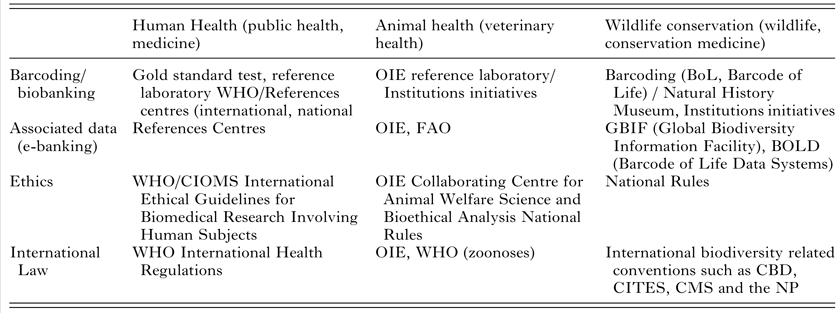
In the context of research on EIDs, the same pathogens are collected from diverse sources (i.e. human; animal-domestic or wildlife; the environment). Currently, distinct regulations apply to such research depending on whether it concerns human or animal health, wildlife or the environment. Moreover, if international law, standards and guidelines exist in relation to human medicine and public health, on the contrary, animal health and conservation medicine (wildlife conservation) rely mostly on national rules (Lajaunie et al. Reference Lajaunie, Morand and Huan2014), which is a major obstacle for a global scientific approach in EIDs research.
A common legal and ethical approach relying on the One Health concept, to deal with the various scientific collections from different disciplines is of great interest to address public health issues such as EID outbreaks or the outcome of future diseases by studying the dynamics of EIDs within its socio-ecological dimensions (Morand et al. Reference Morand, Dujardin, Lefait-Robin and Apiwathnasorn2015). The One Health approach has no legal basis but it draws the possibility to consider the animal, human and environmental pathogen under the same legal and ethical framework (Walther et al. Reference Walther, Boëte, Binot, By, Cappelle, Carrique-Mas, Chou, Furey, Kim, Lajaunie, Lek, Méral, Neang, Tan, Walton and Morand2016, box 6).
We should underline that there is currently no connexion between the Nagoya Protocol, the One Health approach and non-commercial research on EIDs. Moreover, as highlighted by Morgera (Reference Morgera, Orlando and Krämer2017) ‘International benefit-sharing obligations have arisen at different points in time in a variety of contexts, and are currently characterized by different levels of sophistication’. With this paper, we aim at bridging the One Health approach and the implementation of the Nagoya Protocol (NP) for developing a common reflection on legal and ethical issues related to pathogens and associated data sharing. We deliberately adopt the perspective of a researcher working on pathogens and confronted to various issues resulting from the absence of integration between animal-human and environmental health when it comes to pathogen study and advocate for a broadened thinking on the implementation of the Nagoya Protocol.
In Access to pathogens and related data we will examine the debate concerning the regulation of the access to pathogens prior to the NP (2010) and the content of the NP as well as the regulation of pathogen sharing in a public health context and the role of the WHO (World Health Organization).
In Big data, pathogens and their environment, we will see how Big Data related to scientific collections and biobanks of pathogens renew the approach of pathogens and voucher specimens sharing and the consequences of Big Data on legal and ethical issues.
ACCESS TO PATHOGENS AND RELATED DATA
The Convention on Biological Diversity (CBD; which came into force in 1993), acknowledged 3 objectives:
• the conservation of biological diversity;
• the sustainable use of the components of biological diversity; and
• the fair and equitable sharing of the benefits arising out of the utilization of genetic resources.
By affirming Sovereign States’ control over the utilization of their genetic resources, there was a concern that the Convention could limit access and sharing of biological samples around the world. This led to the elaboration and implementation of a practicable International Regime on Access and Benefit-sharing (ABS) with a highly contentious debate concerning the inclusion of pathogens into the international regime of ABS: while some research institutions or industries wanted to exploit microorganisms commercially and develop patents, developing countries and specific groups of countries insisted on the fact that the recipients of the viruses should provide fair and equitable benefits under mutually agreed terms and with prior informed consent.
The NP signed in 2011 and entered into force in 2014 sets out core obligations for its contracting Parties to take measures in relation to access to genetic resources and benefit-sharing.
From the exclusion of pathogens from the international regime of ABS to its acknowledgement
Access to pathogens and benefit sharing arrangements have historically been informal, and have operated on the assumption that a party with custody over the pathogens also has the right to manage their use and disposal. For these reasons, most pathogens have been shared without written documentation on appropriate management and use, or without having obtained formal approval from national authorities.
The need to formalize access and sharing arrangements arose from a number of international political and professional developments that mainly revolved around concerns over transparency, fairness and equity, and trust. In international law, fair and equitable access and benefit sharing (ABS) arrangements for primarily non-human genetic materials have been emphasized by the CBD and the NP. Where human biological or genetic materials are concerned, separate but related developments in the context of influenza prevention, countermeasures and control have underscored a similar theme. Collectively, these developments have led to a call for systematization of requirements for ABS in relation to all genetic or biological materials, whether of human or non-human origin. In the section that follows, we first consider the ABS mechanism in the CBD and in the NP and its normative impact on practices in relation to non-human genetic or biological materials. We then consider a number of specialized access and sharing practices that have emerged in relation to specific human pathogens. This section concludes with an argument for the establishment of a framework under the NP as a comprehensive system for ABS that applies to both human and non-human pathogens, whether in material or de-materialized form.
Convention on biodiversity-NP framework
The CBD sets out as a key obligation the fair and equitable sharing of benefits from the use of genetic resources. The NP expands on the provisions of the CBD concerning access to genetic resources and traditional knowledge, and sharing of benefits that arise from them. The CBD as well as the NP, apply to the use of genetic resources and related traditional knowledge, and to the benefits that arise from such use. Under the protocol, access is subject to the informed consent of the country of origin and only on the basis of mutually agreed terms that include fair and equitable sharing of benefits arising from the genetic resources utilized. In order to access genetic resources, prior informed consent must be obtained from the relevant authorities (which would in practice be the local CBD National Focal Point or NP focal point) in the country of origin, and on terms that are mutually agreed. Benefits that arise from the utilization of genetic resources could be monetary or non-monetary, and may include joint ownership of intellectual property and acknowledgement of contributions, to system-level initiatives that support public health, provide access to affordable treatments or build capacity.
Regarding EIDs and according to the great benefit that could result from the study of various scientific collections, we should consider the implications of the NP. For instance, a voucher specimen that is composed of a material of plant, animal, microbial or other origin containing functional units of heredity will fall within the NP framework. A voucher, broadly defined as a representative sample of an expertly identified organism that is deposited and stored at a facility from which researchers may later obtain for examination and further study, is clearly critical for authentication and identification. Increasingly, academic publications require the submission of vouchers as a condition for the publication of articles (Schindel et al. Reference Schindel, Miller, Trizna, Graham and Crane2016). As the voucher would usually include certain information like the name of the person who collected the specimen, the date of collection, the habitat of the collection site and locality of the site, vouchers deposited over time form a valuable database that can be used for additional research. These vouchers could also be used to build barcoding reference libraries, as they are accompanied by richer and higher quality data. Biobanking arrangements or more broadly scientific collections could also expand barcoding datasets through the addition of new barcoding markers. Molecular and DNA vouchers could help link individual studies with other studies and inferences, and thereby greatly enhance taxonomic identification. While it seems clear that a specimen or morphological voucher falls within the scope of the NP, it is less clear if an e-voucher (i.e. a digital object that serves as a voucher), a molecular voucher or a DNA voucher could be accommodated within the CBD or the NP. Regarding specifically the use of digital sequence information, the CBD requested an ad hoc technical expert group to study the implications of this type of use in relation to the objectives of the CBD and the NP (CBD COP Decision 13/16, Digital sequence information on genetic resources and corresponding NP MOP Decision 2/14).
One view is that, like pathogens, it would be at the discretion of member states to determine if the implementation legislation should be sufficiently broad to cover such entities in material or de-materialized form. Hence, while the CBD or the NP do not explicitly include pathogens in its definition of genetic resources, the European Union (EU) has included it in its implementation regulation that is binding on all its member states (EU Regulation 511/2014). A shortcoming of this approach is that it could potentially hinder legislative harmonization that is necessary to enable access and sharing of materials and data across different jurisdictions. It is for instance, unclear if a EU member state is required to observe its commitments under the NP if it is to receive a pathogen from another jurisdiction that is not a signatory to the framework. It is further unclear if a non-EU party that has not contributed to the genetic resource pool within the EU should be allowed access, and if so, at what degree of priority in comparison with other EU entities. Until and unless there is a harmonized framework with normative requirements that apply to all parties, the default position appears to be bilateral ABS agreements, the utility of which may be limited by the lack of technical capacity or competence on the part of some jurisdictions and the high transaction costs that could be entailed.
Public health context and the role of the WHO
Different ABS schemes have emerged in relation to pathogens of public health concern. These schemes are directed at infectious diseases, and emphasize ongoing surveillance, timely risk assessment, implementation of public health control measures and access to medical interventions. Among these schemes, the WHO coordinated system of laboratories known as the Global Influenza Surveillance and Response System (GISRS) is the most developed and advanced. Information and materials from this network are used by vaccines manufacturers to produce influenza vaccines. In 2011, the GISRS was strengthened by the adoption of the Pandemic Influenza Preparedness (PIP) Framework by the World Health Assembly (World Health Organization, 2011, sections 5.1.1 and 5.1.2). The PIP Framework was established to share H5N1 and other influenza viruses with human pandemic potential, alongside assurance of access to vaccines and other (therapeutic) benefits. While the legality and legitimacy of the PIP framework are premised on the International Health Regulation, it has been argued to be consistent with the requirements of the NP and should, therefore, be regarded as a specialized international access and benefit-sharing instrument under Article 4.4 of the NP. Nevertheless, it should be highlighted that the study of the WHO on the implementation of the NP was contentious at the CBD COP of 2016 (personal communication of an anonymous referee) and resulted in an intersessional process to determine the criteria to identify what constitute a specialized international access and benefit-sharing instrument (NP-MOP, Decision 2/5 Cooperation with other international organizations, conventions and initiatives, 2016, para. 3). More specifically, the sharing of influenza or non-influenza pathogen should be based on core principles that include fairness, equity and protection of global public health.
Indeed, in a study on how the implementation of the NP might affect the sharing of pathogens and the potential public health implications, the WHO Secretariat recommended improving the harmonization between the NP and existing pathogen-sharing systems (World Health Organization, 2016b). The latter includes establishing new or specialized access and benefit-sharing instruments under the NP, introducing implementing legislation that supports public health (especially under Article 8(b) in response to present or imminent emergencies of a national or international scale) and raising awareness for as well as supporting international collaboration. In addition, the creation of a code of conduct for pathogen sharing to promote access for public health purposes, particularly when use is non-commercial, was proposed.
The basis of sharing of pathogens that are not directly of public health concern remains unclear due to a number of challenges that include: (1) uncertainty regarding the scope and implementation of the NP; (2) the high transaction costs of implementing a bilateral system for access and sharing; and (3) the complexity of varying domestic ABS legislations. Even where the pathogens are of public health emergencies of international concern (PHEICs), sharing was impeded by lack of clarity over which government entity could grant access to the pathogens after transfer, whether intellectual property rights could be sought over the pathogens, and whether benefit-sharing could be linked to access.
Interestingly, the WHO Secretariat noted that although WHO has not often been directly involved in negotiating a material transfer agreement (MTA) or a memorandum of understanding (MoU) to that effect, its involvement as a coordinator has reportedly led to increased regard for equity in the negotiation of bilateral instruments and the inclusion of benefit-sharing terms (World Health Organization, 2016b, p. 21). It is difficult to reconcile this position to the challenges (like high transaction costs for instance) that it identified, as well as its proposed actions including the use of standard contractual templates, which would be supported under Article 19 of the NP. Contractual templates that are applied within one context would only be practicable if another context is sufficiently similar. Likewise, such templates will be difficult to devise if the nature of access, benefit and sharing are diverse and difficult to adequately relate to each other.
BIG DATA, PATHOGENS AND THEIR ENVIRONMENT
Many organizations recognized the need for the integration of human and animal health and the health of the environment and thus the necessity to form new partnerships supporting that integration (AVMA, 2008). Diverse initiatives all over the world intend to develop collaboration between researchers from a wide range of disciplines in sharing scientific specimens and related data (DiEuliis et al. Reference DiEuliis, Johnson, Morse and Schindel2016). For instance, stating that One Health in low-resource settings is crucial, the Veterinary Public Health and Biotechnology (VPH-Biotec) Global Consortium launched the International Congress on Pathogens at the Human–Animal Interface (ICOPHAI) in order to address important challenges and needs for capacity building (Gebreyes Reference Gebreyes, Dupouy-Camet, Newport, Oliveira, Schlesinger, Saif, Saville, Wittum, Hoet, Quessy, Kazwala, Tekola, Shryock, Biesi, Patchanee, Boonmar and King2014).
Regarding the understanding of pathogens within their environment, Scientific Collections International, in collaboration with the US Department of Health and Human Services’ and the Smithsonian Institution, should be highlighted as an initiative aiming to improve the rapid access to science collections across various disciplines (archaeology to environmental sciences, agriculture, ecology, veterinary medicine…) in the research field of infectious diseases.
This initiative calls for an engagement between the EID research community and scientific collections in several disciplines to improve cross-disciplinary integration of data provided by these collections in a One Health context (Scientific Collections International, 2015). It states the importance of scientific collections in preventing and preparing for EIDs (DiEuliis, Reference DiEuliis2015).
Three points underlined by this initiative require attention: (a) the fact that researchers have usually limited knowledge of the breadth and depth of scientific collections in other disciplines; (b) the benefits of increased awareness of and improved access to collections and their associated databases; (c) the diverse data associated with scientific collections can provide crucial knowledge on EIDs (origins, spread, transmission mode). They might be considered through a global information system that operates in the mode of Big Data, which supposes standardized data and systems inter-operability.
The PIP review group in its report (WHO, 2016a) considers that the PIP framework is a foundational model of reciprocity for global public health that could be applied to other pathogens however the PIP Framework should remain focused on pandemic influenza. The report also underlined that the lack of awareness of the NP was an issue regarding pathogen sharing.
Although there is an increasing interest, particularly with the recent outbreaks of Avian Influenza, Ebola or Zika, for considering altogether different kind of pathogens whether they are of human or non-human origin under the heading of One Health, the institutional and legal framework proposed by international organizations does not explicitly take account of the integration of human and animal health and the health of the environment in regard to pathogens sharing and to biobanks or collections of pathogens.
We first examine the issue of pathogen sharing in relation to the implementation of the NP and in the context of Big Data, due to the wide range of data coming from different disciplines and then we focus on the renewed legal and ethical issues within this context.
Pathogens sharing and associated data: implementation of the NP and issues at stake
Insisting on the fact that the PIP Framework offers helpful insights for the sharing of other pathogens that require a rapid response and for the equitable sharing of benefits, the 2016 report suggested to adopt the pragmatic approach and to use ‘the PIP Framework or similar existing agreements as a template for creating new agreements for other infectious agents that have caused, or may potentially cause public health emergencies of international concern’ (WHO, 2016b).
As we have seen in part 2, pathogens fall clearly within the scope of the NP. If there is an emphasis on access to human pathogens for public health preparedness and response purposes in NP Preamble, the Protocol does not exclude non-human pathogens.
It shows that while the debates have been intense regarding the integration of pathogens just before the adoption of the NP, the concrete implementation of the NP regarding pathogens sharing is not clearly stated yet. Moreover, while the WHO precise the public health implications of the NP, there is a little study on the specific consequences of the NP on pathogens sharing in the specific context of non-commercial research.
Interestingly, the Secretariat of the Convention on Biodiversity will use the report of the WHO on how the implementation of the NP might affect the sharing of pathogens and its potential public health implications available for further study and examination during the third meeting of the Parties to the NP in 2018 (cf. NP-MOP, Decision 2/5 Cooperation with other international organizations, conventions and initiatives, 2016).
The report (2016) distinguishes the sharing of influenza pathogens, which combines two different but supportive regimes, the Global Influenza Surveillance and Response System (for seasonal influenza) and the PIP framework (influenza viruses with human pandemic potential), and the sharing of non-influenza pathogens.
It specifies that the sharing of non-influenza pathogens can occur on an ad hoc bilateral basis between researchers: conditions of access are then agreed to by the two researchers most of the time through a formalized agreement. It can also take place through an existing network of institutions and researchers on pre-arranged terms, through MTA or MoU.
The report notices a greater awareness of the importance of involving local researchers (from the country where the fieldwork is conducted) in collaborative research projects and recognizing their contributions but it appears that there is a lack of detailed provisions regarding benefit sharing in relation to non-commercial research in the national provisions implementing NP. As we have seen in Access to pathogens and related data, the report explicitly mentions that the involvement of the WHO as a co-ordinator has led to an increased regard for equity in the negotiation of bilateral instruments, and the inclusion of benefit-sharing terms.
In a One Health perspective, it would be crucial to associate with the study on pathogens sharing other international organizations concerned by pathogen sharing such as OIE (World Organisation for Animal Health (OIE)) FAO (Food and Agriculture Organisation) or even UN Environment.
Indeed, in a Tripartite concept note FAO, OIE and WHO entitled ‘Sharing responsibilities and coordinating global activities to address health risks at the animal–human–ecosystems interfaces’ (FAO-OIE-WHO, 2010) committed to ‘working more closely together to align activities related to the animal–human ecosystems interfaces in order to support member countries’. This collaboration should include a common study on pathogen sharing and associated benefits sharing under the NP and a joint collaboration with the Secretariat of the CBD to get involved in the COP-MOP meetings (decision-making process of the NP) on those issues.
As a matter of fact, the One Health approach is acknowledged by the CBD and other conventions related to biodiversity such as the Convention on International Trade in Endangered Species of Wild Fauna and Flora and the Convention on Migratory Species. The Agreement between the OIE and the CBD signed in 2013 promotes a One Health approach to manage the risks presented by animal diseases and zoonoses at the animal–human–ecosystem interface. Moreover, in 2015 the WHO and the Secretariat of the CBD signed a MoU to strengthen their collaboration notably in raising awareness of the complex linkages between biological diversity, ecosystems and human health (Lajaunie and Mazzega, Reference Lajaunie and Mazzega2016).
The One Health approach has been described as a necessary « paradigm shift » in global health (Bousfield and Brown, Reference Bousfield and Brown2011). As such, the increasing acknowledgement of the need to coordinate activities and decision-making at the human–animal–environment interfaces is shown notably by a greater interconnection between CBD (UNEP), OIE, FAO and WHO (Lajaunie et al. Reference Lajaunie, Morand and Binot2015). It should be led further by a joint consideration of the issues related to pathogens sharing.
Furthermore, pathogens sharing go with a wide range of information related to these pathogens especially within the One Health framework: GIS (geographic information system) or geographic data, climatic data, environmental, biodiversity or socio-economic data (Walther et al. Reference Walther, Boëte, Binot, By, Cappelle, Carrique-Mas, Chou, Furey, Kim, Lajaunie, Lek, Méral, Neang, Tan, Walton and Morand2016; Webster et al. Reference Webster, Gower, Knowles, Molyneux and Fenton2016). This data collected at a large-scale, interconnecting various data systems leading to a mass production of data from various fields can be referred to as Big Data.
The numerous possibilities of interconnection of data, associating individual information when it comes to human pathogens, to a multitude of other information challenge the traditional view of legal and ethical issues related to biological samples sharing.
Regulatory paths to follow for pathogens research
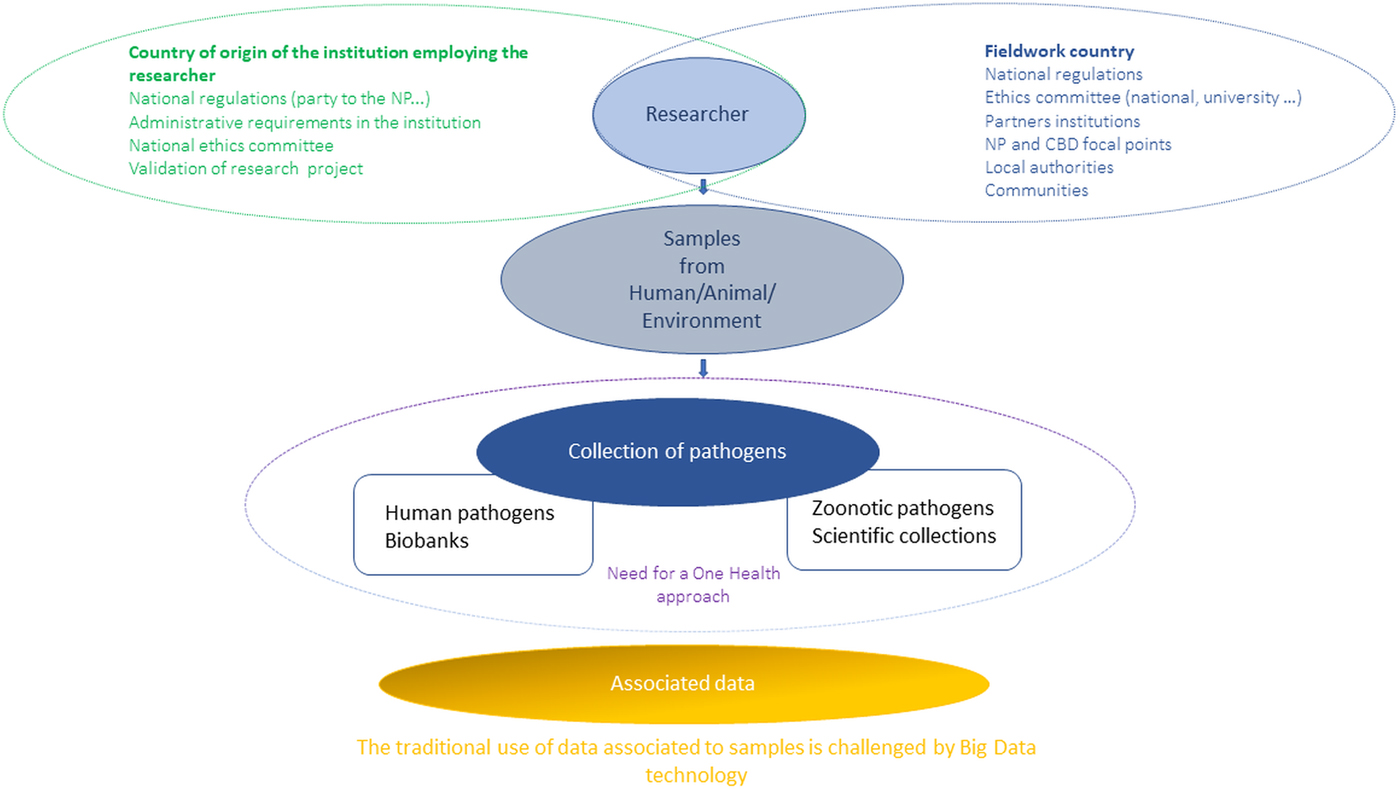
Due to the divergence of set of rules regarding human health, animal health (domestic and wildlife animals) and the health of the environment, the regulatory path to follow will highly depend on the working context (country, animal-human or environmental heath, commitment to international agreements in the country where the fieldwork is conducted …).
Legal and ethical issues through big data lenses
The issues associated with pathogens sharing at the interface between animal-human and the environment resides in the fact that different regulations frameworks apply to human health, animal health or environmental/biodiversity conservation.
Various issues should be discussed in that perspective: if the prior informed consent is quite clear for the obtaining of pathogens in human health, which institution or person should be contacted when domestic animals or wildlife are concerned? There is no common quality process when it comes to animal health or environment. Consents can limit the accessibility to pathogens so which kind of consents could be used for wildlife or animal health that would allow working on pathogens?
The three fields presented above rely on different protocols and distinct systems of the database (Lajaunie and Morand, Reference Lajaunie, Morand, Morand, Dujardin, Lefait-Robin and Apiwathnasorn2015). There is a need for clarification regarding consents and accessibility of pathogens at the interface between animal-human and the environment (see Box 1).
As we have seen, research on EIDs is already affected by Big Data (Floridi, Reference Floridi2012) and non-biomedical data are also widely used in the context of EID. The possibility given by technology to link various data from pathogens samples challenges the existing legal and ethical principles. It questions aspects of the traditional conception of samples collections or biobanks such as the notion of individual consent or the protection of personal data in human health or the failure to create standard methods of access and sharing when collections concern animals especially wildlife and the environment.
Framework of the regulatory paths to be taken by a researcher working on pathogens in an international setting depending on the research context.
Comparison of the advancements in norms regarding barcoding-biobanking and associated data (ebanking) and sets of regulation (law and ethics) in relation to public health, animal health and wildlife conservation

CITES, Convention on International Trade in Endangered Species of Wild Fauna and Flora; CMS, Convention on the Conservation of Migratory Species of Wild Animals
There are rules applying to:
• The researcher: from the validation of the research project to the field work;
• Samples and samples collections or biobanks: constitution of collections and their linked data and their storage and sharing rules;
• Associated data: while data have been collected within a specific project framework, Big Data technology challenges the fact that data remain linked to a specific project.
In human medicine, legal frameworks, governance mechanisms and ethical principles are regulating the collect and use of samples to protect individuals as research subjects and their personal information. Legal measures and ethical principles depend on national legal systems and are case specific. Nevertheless, data strictly associated with the samples are increasingly proximate especially in genomic research. Samples are distinct from data but they carry data and thus they should be considered by law as ‘data carriers’ (Hallinan and De Hert, Reference Hallinan, De Hert, Mittelstadt and Floridi2016).
Thus, as underlined by Woolley, it is time to conceive a governance system where dataflow itself is a ‘de facto framework for research’ (Woolley, Reference Woolley, Mittelstadt and Floridi2016) with a significant role given to metadata on consent. It challenges the traditional view of a framework shaped by national or institutional boundaries: this innovative approach seems the only way for law and governance on biomedical consent not to lag behind the reality of the practice driven by the possibility to aggregate or compile various data on the long term.
It questions the notion of informed consent and calls for new forms of consent in line with the explorative nature of data-driven research, which is not compatible with a well-defined single research project. It brings to light the tension (Kaye, Reference Kaye2012) existing between open access to data and the need for consent and researchers called for ‘ethical metadata’ (De Vries et al. Reference De Vries, Williams, Bojang, Kwiatkowski, Fitzpatrick and Parker2014) or for metadata procedures taking ethical, legal and social issues (ELSI) into consideration. For instance, consistent metadata standards might be a way to address the issues of Big Data research in biology. They might allow policy makers, scientists, legal researchers, ethical committees and ICT scientists working together on these issues and delineate the best practices and metadata standards for information sharing (Capua, Reference Capua2016).
DISCUSSION
When it comes to the implementation of the NP, we must underline a number of limitations. The NP framework is dependent on a functional government as it may not sufficiently empower communities that have historical or cultural control over the genetic resource or traditional knowledge. It is also unclear to what extent that benefit sharing must be with these communities or whether they should meet the requirement of social justice. For instance, the NP states a benefit-sharing obligation owed directly to indigenous and local communities, but the implementation of this obligation raises various questions: who are the communities concerned? Which benefits are shared? It implies that the States interpret the NP provisions in good faith so as to protect indigenous and local communities’ rights which might be difficult to ascertain in practice. (Morgera et al. Reference Morgera, Tsioumani and Buck2014).
Another difficulty comes from the concern of public health stated by the WHO. We can consider that if the pathogens are of public health concern, then the government entity that has custody over the pathogens must ensure that public health goals continue to be observed. This would range from biosafety concerns to allowing access based on uses that will generate the greatest public good. It does not seem relevant to invoke intellectual property rights unless its social goal of incentivizing innovation could clearly be achieved through this means. Even then, concerns of social justice must be satisfied, particularly in terms of access to prophylactic or therapeutic interventions. Linking benefit-sharing to access is practically challenging to implement, but it should be grounded in solidarity, rather than as contractual reciprocity.
The view of public health concern developed by the WHO could be broadened when it concerns pathogens, as three to four new pathogen species are detected in the human population every year (Woolhouse et al. Reference Woolhouse, Scott, Hudson, Howey and Chase-Topping2012) and most of them originate from animal species (Gortazar et al. Reference Gortazar, Reperant, Kuiken, de la Fuente, Boadella, Martínez-Lopez, Ruiz-Fons, Estrada-Peña, Drosten, Medley, Ostfeld, Peterson, VerCauteren, Menge, Artois, Schultsz, Delahay, Serra-Cobo, Poulin, Keck, Aguirre, Henttonen, Dobson, Kutz, Lubroth and Mysterud2014). Research on pathogens whether they are human or non-human should be seen as a contribution to public health and studied more closely by the WHO jointly with other international organizations.
Finally, it is interesting to pay attention to the fact that the definition of ‘Big Data’ is evolving relatively to technical and analytical capacities. It refers to data that is difficult to analyze due to its size and complexity (Mittelstadt and Floridi, Reference Mittelstadt and Floridi2016). It is particularly relevant when it comes to biomedical data, where data is increasingly intertwined with samples. Its analysis depends on technical capacities as well as on methodological innovations. In this field, analogies with methodologies already used in other disciplines such as biology and ecology can be very fruitful and creative.
CONCLUSION
As stated by the report of the WHO (2016b), the NP provides an opportunity for the Member States to establish pathogen-sharing systems that support global health equity by clarifying and harmonizing access and benefit-sharing obligations associated with the sharing of pathogens. It advocates for a code of conduct for pathogen sharing, to promote access to pathogens used for public health purposes. Capua (Reference Capua2016) champions open-access research data on pandemic viruses and suggests the development, by the United Nations and relevant stakeholders, of guidelines and codes of conduct on sharing information about emerging biological threats for scientists, institutions and governments.
By the same token, we consider it necessary to think critically about the development of a pathogen sharing framework under the NP that goes beyond present human health issues and to take into account human and non-human pathogens in application of article 8 of the NP, notably article 8b, which states that each Party shall: ‘Pay due regard to cases of present or imminent emergencies that threaten or damage human, animal or plant health, as determined nationally or internationally’. As commented by Morgera et al. (Reference Morgera, Tsioumani and Buck2014): ‘Health emergencies that trigger Article 8(b) should either already be present (‘existing’), therefore demanding immediate action, or be likely or about to occur (‘imminent’), thereby calling for preparedness and prevention’. They insisted on the fact that if an international determination of a health emergency can be that provided by the WHO on the basis of its International Health Regulations, the formulation of Article 8(b) does not exclude that other international organizations working on pathogens may also be considered relevant for the purposes of determining an international health emergency.
We could, therefore, consider non-commercial research on EIDs as means of prevention of health emergencies and thus promote the development of pathogen sharing protocols within this context.
In this perspective, we suggest developing a proposal coordinated by researchers, in an interdisciplinary setting, involved into non-commercial EID research about their needs and concerns regarding NP and pathogens sharing. The consortium involving legal scientists, virologists, ecologists, veterinarians, committed to the One Health approach and considering the opportunities given by Big Data processes would present a document to the next Meeting of the Parties of the NP identifying the gaps and issues at stake beyond the strict concern of public health, which does not impede special considerations during health emergencies.
The general aim of the pathogen sharing framework would be to balance individual protection via informed consent and social benefits of research created by Big Data processes.
Acknowledgements
This work contributes to the FutureHealthSEA project (ANR Contract N° ANR-17- CE35-0003- 02) and to the International Multidisciplinary Thematic Network ‘Biodiversity, Health and Societies in Southeast Asia,’ Thailand (PI: S. Morand, CNRS/CIRAD) supported by the Ecology and Environment Institute of the National Center for Scientific Research (InEE CNRS, France). These results have been presented during the Asian Bioethics Review Conference ‘Governance of Biobanking in Biomedical Research’ organised by Prof. Calvin Ho, and held at the Centre for Biomedical Ethics at the Yong Loo Lin School, National University of Singapore in May 2017. We are grateful to the two referees for their valuable suggestions.
FINANCIAL SUPPORT
This research received no specific grant from any funding agency, commercial or not-for-profit sectors.