

1. Introduction
1.1 Kemp & Patel (Reference Kemp and Patel2011) described the many ways in which they believed Enterprise Risk Management (ERM) makes sense for pension funds to adopt. They observe that organisations outside the pensions arena are increasingly focusing on holistic risk management recognising the value that it should bring. They conclude that “Pension funds do have some unique characteristics but non-exposure to a wide variety of interconnected risks is not one of them.”
1.2 The PPF is indeed a unique institution with an extremely valuable mission to perform. Even in global terms (see Appendix for some international comparisons), it differs in some material ways from its international comparators such as the Pension Benefit Guaranty Corporation (PBGC) in the USA, the experience of which guided much of the PPF's construction.
1.3 The PPF is itself a product of an holistic approach to risk management albeit at a governmental level. This paper, however, concerns itself with the inter-connected risk environment in which the PPF operates and the principles and practices that the Fund has established in order to manage those risks with a clear focus on the many thousands of pension scheme members that will rely on PPF for an income in retirement.
1.4 In effect this paper is a detailed case study. It is written by some of the individuals who have worked to create and implement the financial objective, funding framework, risk measurement and management, pricing and investment strategy that comprise the financial management of the Fund. Its aim is to add technical content and colour to the public policy statements and reports provided by the PPF over the years and to provide a greater understanding and possible debate from fellow professionals and other stakeholders in the years to come.
1.5 The paper sets the scene in Section 2 with a brief description of the history, role and purpose of the PPF and, in the succeeding sections, aims to provide a thorough and linked description of the main elements of the financial management process of the Fund, drawing appropriate parallels and contrasts with the commercial insurance and funded pensions sectors.
1.6 Section 3 describes the rationale for the PPF's long-term Funding Objective to be self sufficient by 2030. This necessitates a review of the Defined Benefit (DB) pensions landscape and the trends that suggest a longer-term polarisation between fully funded schemes and scheme closures.
1.7 Section 4 provides an overview of the Funding Framework which aims to capture the complete set of financial risks to which the Fund is exposed and in the context of which long-term strategic decisions are made. Examples of those decisions include strategic asset allocation and levy strategy. The section also includes examples that show how the Funding Framework can be used to inform long-term hedging strategies, including longevity risk transfers. All the examples referenced throughout this paper are to baseline runs and sensitivities as at 31 March 2011, the closing date of the Fund's latest financial year for which data is publicly available.
1.8 As a public body accountable to Parliament through the Secretary of State for Work and Pensions, the PPF is subject to public sector financial scrutiny. It is not, however, regulated by either the Financial Services Authority or the Pensions Regulator. Section 5 seeks to describe the governance process of the Fund with particular reference to financial management. It compares the PPF with best practice in pensions investment governance and with the emerging Use Test under Solvency II that will apply to financial risk management in the regulated insurance sector.
1.9 Section 6 describes the financial risk management process beginning with the PPF Board's risk appetite and progressing to the detailed identification and measurement of key financial risks. It leads to a high level description of the PPF internal stochastic model in Section 7. This latter section also includes a case study exposition of the changes made consequent upon the switch in the basis of indexation for PPF compensation from the Retail Prices Index (RPI) to the Consumer Prices Index (CPI).
1.10 Section 8 departs into the pricing of risk. The PPF sets a levy consistent with its long-term Funding Objective but has, through a distribution process, to divide this amount among 6,550 eligible pension schemes. The method by which this is done has been subject to re-development in recent months and a New Levy Framework is to apply from 2012/2013 onwards.
1.11 The origination and ongoing development of an investment strategy consistent with the Funding Framework is described at some length in Section 9. This section deals with the overall principles of a strategy which aims to meet the Funding Objective over the long term, but which also operates within a short term risk budget. In so doing, the investment strategy seeks to take a low risk overall and to make efficient use of the risk budget through diversification. Examples of the use of tactical positions to improve efficiency and protect against downside risk are described in this section, as is the process by which external managers are monitored and controlled.
1.12 The authors hope that the paper will be of value to actuaries working in the pensions and enterprise risk practice areas and indeed all those with an interest in the application of techniques and principles to new and interesting issues.
2. History and Background
2.1 The PPF was created in response to concerns about the fate of members of underfunded defined benefit (DB) pension schemes should the scheme sponsor become insolvent. During 2002 and 2003, publicity around cases such as Allied Steel and Wire highlighted the growing number of instances in which employees in these circumstances were left with very much lower levels of pension than expected. Such coverage contributed to what many described as the “pensions crisis” which was seen to be undermining public confidence in final salary pension schemes in the UK.
2.2 The idea of a Central Discontinuance Fund had been considered by the Pension Law Review Committee a decade previously but it was not considered appropriate to pursue the idea at that time.
2.3 However, in 2003 the Government decided to act, announcing its plans in a Pensions White Paper to create the PPF in order to provide compensation for members of private sector, defined benefit pension schemes which wound up on the employers’ insolvency with insufficient assets to meet their liabilities. The 2003 White Paper culminated in the Pensions Act 2004, and in April 2005 the PPF was formed.
Key Facts about the PPF (as at end March 2011)
Source: PPF Annual Reports and Accounts.

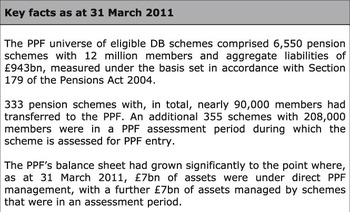
2.4 Established as a Statutory Corporation, the PPF is run by a Board that is independent of Government, see chart 1 for key facts. Powers conferred on the Board give it responsibility for managing the calculation and application of three levies (the Pension Protection Levy, the Administration Levy and the Fraud Compensation Levy) and setting the Fund's investment strategy. A primary driver for conferring these powers on the Board was to ensure that the activities of the PPF would be independent of and not have to be underwritten by the Government and ultimately taxpayers. It is not proposed to deal with the Administration Levy or Fraud Compensation Levy in this paper, but the pricing and funding aspects of the Pension Protection Levy are considered in subsequent chapters.
2.5 Broadly speaking, the PPF provides two levels of compensation. For individuals that have reached their scheme's normal pension age or, irrespective of age, are either already in receipt of survivor's pension or a pension on the grounds of ill health, the PPF will generally pay 100 per cent of the pension in payment immediately before the insolvency event.
2.6 For the majority of people aged below their scheme's normal pension age the PPF will generally pay 90 per cent of the pension an individual had accrued (including revaluation) immediately before the insolvency event. An individual's compensation is revalued in line with the increase in inflation as measured by the Consumer Prices Index (CPI) between the assessment date and the commencement of compensation payments, this revaluation being subject to a cap of 5 per cent compound per annum in respect of compensation attributable to pensionable service prior to 6 April 2009, and a cap of 2.5 per cent compound per annum in respect of compensation attributable to pensionable service on or after 6 April 2009.
2.7 Compensation for members described in 2.6 above is subject to an overall annual cap. As at April 2011 this cap equates to £29,897.42 at age 65 after application of the 90 per cent factor, with the cap being adjusted according to the age at which compensation comes into payment.
2.8 Once compensation is in payment (for either category of member), the part that derives from pensionable service on or after 6 April 1997 is indexed each year in line with CPI inflation capped at 2.5 per cent.
2.9 While the PPF has the ability to alter the Pension Protection Levy (subject to certain statutory limits) to meet its liabilities, in extreme circumstances it is also possible to reduce compensation. First, revaluation and indexation can be reduced by the PPF and secondly, levels of compensation can be reduced by the Secretary of State on the recommendation of the Board of the PPF. To date the PPF has not articulated the circumstances in which these powers might be exercised and for the purpose of its financial management and this paper such scenarios are not explicitly modelled.
2.10 In order to fulfil its broader statutory objectives, the PPF must have sufficient funds to pay compensation to the members it protects. Income currently derives from four sources; the assets of pension schemes that transfer into the Fund, recoveries from the insolvent sponsoring employers of those schemes, the annual Pension Protection Levy and returns on invested assets. Table 1 shows the development of the PPF balance sheet in the six years 2005/2006 to 2010/2011.
PPF Assets, Liabilities and Claims Experience

Source: PPF Annual Reports and Accounts. Funding ratio is based on the assets and liabilities of the Fund measured according to the PPF valuation assumptions. The figures include those of schemes in assessment that are anticipated to transfer to the Fund. Claims are measured in terms of the deficits of schemes entering an assessment period in the relevant year as measured in accordance with the actuarial basis set under the terms of Section 179 of the Pensions Act 2004.
2.11 Although short term prospects for the PPF may be challenging owing to the current global economic climate, the long term decline in private sector DB provision and the influence of regulation towards improved funding levels both tend to suggest that the risk to the PPF balance sheet is likely to diminish over time. A number of factors are likely to contribute to this, including regulatory intervention, a move to liability-driven investment and the overall decline in the number of schemes as they transfer their liabilities to the insurance regime, enter the PPF, or otherwise become ineligible for PPF protection.
2.12 Against this background, the PPF recognises that there will come a point in time when the Fund is unable to rely on surviving schemes to amortise any deficit it may have accrued. The PPF's current objective therefore is to be fully funded by 2030 with no further risk to the balance sheet at that point. This is the basis for the Financial Objective of the Fund that is discussed in more detail in Section 3.
3. Financial Objective
3.1 The PPF's financial operating model
3.1.1 The Roman orator and playwright Seneca is reputed to have said “If a man knows not to which port he is headed, then no wind is favourable”. Without a clear objective, not only is navigation haphazard but the management process can become perilously ambiguous.
3.1.2 Most financial firms have clear objectives around which business strategies are built and performance tracked. Choice of the objective, and the framework around it, define and influence the firm's business strategies. In the case of the PPF, its stated vision is “To protect peoples’ futures” and its mission is “To pay the right people the right amount at the right time”. It is possible to conceive a number of financial objectives that would be congruent with these statements. The Board of the PPF has chosen an objective that seeks to fulfil the vision and mission and which embraces the totality of the PPF financial model, namely its assets and liabilities from both past and future claims, and its levy income.
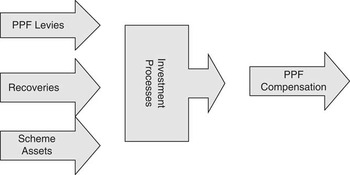
3.1.3 The PPF's financial operating model is illustrated in Figure 1. This shows the flows of money into the Fund and the outputs from the investment processes, being the compensation payable to former members of pension schemes that have transferred into the PPF.
The PPF financial operating model

3.2 PPF Financial Objective is self-sufficiency
3.2.1 It is inevitable that the PPF will continue to experience failure of scheme sponsors and consequently future claims. (A claim is quantified by the PPF as the size of the scheme's deficit as at the date of insolvency, measured according to the PPF's published Section 179 valuation guidance and assumptions. In particular, it should be noted that the Section 179 deficit is assessed by reference to PPF compensation levels rather than the full benefits under the scheme's rules). It is however likely that the impact of claims on the Fund will decline over time, because:
• The long term expectation is that pension scheme funding will improve on account of the efforts of trustees, sponsors and the Pensions Regulator;
• Schemes are expected to participate increasingly in risk mitigation strategies such as funding triggers, and interest rate and longevity hedging;
• Current activity points to growth in pensions buy-out and buy-in activity that reduces risk to the Fund. It is expected that the market capacity for liability de-risking will increase over the coming years from its present level;
• The trend towards closure of schemes to new entrants and new accrual is expected to continue, as is the increasing preference for defined contribution schemes as the solution to employer-sponsored pension provision.
3.2.2 There are, of course, scenarios where these expectations are not met and which must be included in any financial analysis of the PPF. Nevertheless, the expected decline, over a long period, in the scale of claims on the Fund is likely to lead to a point when the off-balance-sheet risks (namely the risks associated with future claims on the Fund which are described in Section 6) are much less significant than the on-balance sheet risks.
3.2.3 Any funding shortfall experienced by the PPF at that time would become a significant burden on the remaining levy payers. Furthermore, as the level of risk in the eligible defined benefit universe shrinks over time, it would be desirable for the Pension Protection Levy to reduce in proportion. Indeed, the PPF New Levy Framework introduced from 2012/2013 onwards has a “bottom up” principle in which the levy payable by an individual scheme is much more closely related to that scheme's own risk characteristics. It would be unsatisfactory if, several years hence, a large levy needed to be raised to deal with a substantial PPF shortfall at a time when the base of levy-paying schemes had shrunk considerably and almost all of them were well funded.
3.2.4 The PPF therefore believes that there needs to be a Funding Horizon by which time the PPF should be “self-sufficient”.
3.3 What is meant by self-sufficiency?
3.3.1 The use of the term “self-sufficiency” is becoming increasingly common in pensions work - see 3.6. It is important, however, that the term is carefully defined to avoid misunderstanding. In the context of its Financial Objective, the PPF has defined “self-sufficiency” to mean having sufficient assets to cover liabilities without the need to take future risk for which future levies would be required, specifically:
• Being fully funded on a reasonably risk-free measure of liabilities;
• Having removed exposure to interest rate and inflation risk as far as possible;
• Having removed exposure to financial market risk as far as possible; and
• Having acquired protection against residual risks such as longevity and residual insolvency risk.
Self-sufficiency therefore implies that the PPF will no longer need to raise levies in order to maintain its funding position. The use of the phrase “reasonably risk free” recognises that there are no truly risk free assets and means that the Fund at that point in time need not take additional investment risks. In practice this means a mark to market valuation of the liabilities by reference to a notional portfolio of assets consisting of cash plus appropriate zero-coupon interest rate swaps contracts and inflation swaps contracts plus gilt strips (or notional gilt strips).
3.3.2 In order to achieve this target, it is the PPF's intention to remove risk gradually over a period of time, using market instruments where available and cost-effective.
3.3.3 The alternative to this strategy is to allow risk to the PPF balance sheet to persist in the long term. This may lead to a potentially lower levy in the run-up to the end of the Funding Horizon but with increased probability of a sizeable deficit thereafter. This in turn could necessitate substantial levies on schemes still extant beyond the Funding Horizon, should investment, longevity or credit conditions prove adverse.
3.4 The Funding Horizon
3.4.1 The PPF has considered how it should quantify the expected decline in the risk of insolvency and at what point to draw the line in terms of setting a funding target. The deliberations of the PPF Board in 2010 concluded that 20 years was an appropriate timescale to aim for (i.e. the year 2030); although it accepted that there was an element of subjectivity in this choice.
3.4.2 The length of the Funding Horizon is important in ensuring the Pension Protection Levy follows a balanced and stable trajectory over time. A short horizon may lead to the PPF charging excessive levy over the short term as it aims for the Fund to become self-sufficient in the face of persistent financial risk. On the other hand, an extended horizon would increase the likelihood of the Fund falling short of self-sufficiency at a point where there remains little potential for continued levy.
3.4.3 It is important to note that self-sufficiency is only a target for the year 2030. During the funding period the PPF has to accept the risk of further claims and it has determined that it will assume a certain amount of investment risk during this period. This strategy serves to mitigate the impact on the Pension Protection Levy, through the expectation of investment returns in excess of the “risk-free” rate.
3.4.4 The PPF Board chose the 20-year horizon after considering the following factors:
• The maturing profile of its liabilities,
• The expected decline in its exposure to the effects of sponsor insolvencies, and
• The decreasing size of the eligible universe of levy payers.
In broad terms, the Board considered that the risk to the PPF, both within and outside the Fund, was likely to be much diminished by 2030, and this was the primary reason for the choice of 2030 as the Funding Horizon.
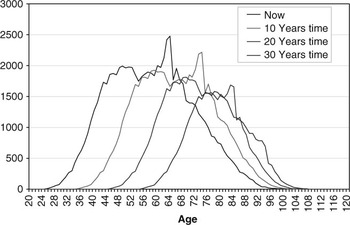
3.4.5 Owing to the closure of many schemes to new entrants and accruals and especially those schemes most likely to be candidates for PPF entry in future, the duration of PPF liabilities is expected to shorten over the same timescale. This lent further support to a strategy that aims to focus solely on matching the liabilities rather than taking investment risk after a point in time. Chart 2 shows the maturing profile of PPF liabilitiesFootnote 1. It is projected that by 2030:
Projected development of the age profile of PPF membership

• The average age of DB scheme members will have increased from 56 to 71 (pensioner average age rising from 68 to 76, non-pensioner average age moving from 47 to 59).
• Around 70 per cent of scheme members will be pensioners, up from around 40 per cent today.
3.4.6 As a result, the duration of the Fund's liabilities is expected to reduce from 21 years to 12 years. This facilitates the matching of compensation payments using conventional investment techniques, as a smaller proportion of liabilities is projected to fall outside the term of long-dated gilts.
3.4.7 Claims and scheme membership projections therefore point to a much improved risk environment for the PPF balance sheet in 2030. If the Fund arrives at this date in a sound funding position, with assets that match its liabilities as far as possible and with arrangements in place to protect it from residual risks, there should only be a low risk of the Fund failing to meet its financial obligations. A 20-year period from 2010 has therefore been set as the horizon over which the Board will seek to achieve a resilient balance sheet.
3.4.8 While the PPF has stated an intention to target self-sufficiency over a 20-year horizon, this timeframe is not considered by the Board to be immutable. A shorter time horizon than 2030 would be appropriate if risks to the PPF were much reduced at an earlier juncture. On the other hand, stressed economic conditions and persistent risk could imply an extension of the Funding Horizon beyond 2030.
3.5 Protecting against residual longevity and unexpected claims risk
3.5.1 Risk to the PPF balance sheet will not be entirely eliminated by 2030. The Fund aims to remove market, interest rate and inflation risk using appropriate investment techniques. Nevertheless, the risk of unexpectedly high claims and member longevity is likely to persist. The Fund will also need to deal with operational hazards, such as the risk of counterparty insolvency and the risk of an expense overrun. The materiality of counterparty risk undoubtedly requires further analysis and monitoring. The possibility of an expense overrun also requires monitoring and will become more material when the Fund reaches maturity.
3.5.2 It may be possible to protect against a proportion of residual longevity and unexpected claims risk. Instruments to hedge longevity, for instance, are already available. But the markets providing insurance against these residual risks remain at a relatively early stage of development compared to the pool of potentially insurable liabilities. The Fund's liabilities are expected to grow substantially to 2030 and it is unclear at the moment whether such markets will be sufficiently large and sophisticated to absorb the full extent of PPF claims and longevity risk.
3.5.3 The PPF therefore considers it prudent to target a Funding Margin above best-estimate liabilities in order to protect against these residual risks. At the same time, it recognises that it must balance the interests of different generations of levy payers and members in determining the size of this margin.
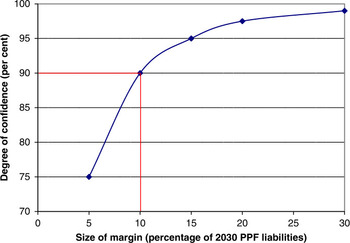
3.5.4 In order to identify a suitable margin, the Board considered stochastic modelling of longevity and claims using the PPF's own internal model (the Long-Term Risk Model which is described in Section 7). The first step was to produce an expected PPF and scheme profile at 2030 using model output, credit transition matrices and current mortality tables. A range of scenarios was then generated for insolvencies over five years and longevity over the outstanding lifetime of the Fund. This was applied to the expected PPF and scheme profile at 2030, providing a set of outcomes for claims and PPF funding. From these outcomes, it was possible to examine the protection against combined longevity and claims risk provided by various sizes of reserve. The estimated relationship between the size of margin and the extent of protection is illustrated in Chart 3.
Funding margins for combined longevity and claims risk

3.5.5 The PPF is targeting a Funding Margin equivalent to ten per cent of liabilities to protect, with 90 per cent confidence, against unexpected claims over five years and longevity over the outstanding lifetime of the Fund. This target will not be static over time, however; it will be re-evaluated against changing economic and demographic circumstances. Revision may also occur as a result of the development of more sophisticated modelling techniques.
3.5.6 The Fund is in the fairly early stages of development and has posted a reserve in the last two of its six annual valuations. Assuming that the Fund is successful in maintaining the course to its Funding Objective, it will inevitably be necessary for the Board to consider the consequences of any potential funding surplus.
3.5.7 Another possible future development would be the explicit incorporation of an illiquidity premium in the valuation basis to capture the market value of illiquid investments and liabilities. In this case the concept of a risk free investment strategy in the period after the expiry of the Funding Horizon would need to evolve to capture the premium from illiquid investment without incurring additional market risks.
3.5.8 The Funding Margin does not provide complete protection. In ten per cent of projected scenarios, unexpected increases in claims and/or longevity events are sufficient to erode PPF funding in excess of the reserve. A strengthening of the margin would reduce this risk, but at the cost of a potentially higher levy over the Funding Horizon.
3.5.9 A potential reference point, albeit from a different financial sector, is the stress test for longevity risk specified by the Financial Services Authority as part of the Solvency II framework. It is important to recognise that this framework does not apply to pension schemes or to the PPF and is instead intended to regulate the capital requirements of insurance firms, organisations with operations and incentives materially different from those of the PPF.
3.5.10 Despite this difference in subject, the results provide a useful comparison with the PPF's 10 per cent Funding Margin. A stress test being considered by the European Insurance and Occupational Pensions Authority (“EIOPA”) for Solvency II purposes involves a 25 per cent reduction in all mortality rates. An application of this test to the expected PPF member profile at 2030 suggests a margin of 11 per cent of PPF liabilities to protect against the resultant increase in longevity.
3.6 Comparison with pension funds and insurance companies
3.6.1 A self-sufficiency target at a future date is often considered by trustees and sponsors of defined benefits pension funds, particularly if:
• There is little or no new accrual, and the fund is therefore likely to be heading for buy-out over a specified timeframe; and/or
• The employer's covenant is rated as poor now or potentially poor in the future.
3.6.2 This is actually very similar to the PPF's situation. The PPF is targeting self-sufficiency at a point in time in the future when it estimates that there will be little “new accrual” (i.e. claims) and the “employer's covenant” (i.e. the levy-raising capability) is much diminished.
3.6.3 For a pension scheme, a self-sufficiency funding target might be somewhat less strict than that adopted by the PPF, especially if there is still a viable sponsor covenant to underwrite the risks. There may be some allowance for investment returns in excess of risk-free returns, and there may be rather less reserve held for longevity risk. Correspondingly the assets held to back the liabilities may be selected to achieve some outperformance by comparison with risk-free investments.
3.6.4 Insurance companies hold capital against the effect of unexpected outcomes on their balance sheets. Regulatory requirements are for minimum regulatory capital to survive a one in 200 event over a twelve month time horizon and, under Solvency II, to perform an Own Risk Solvency Assessment (ORSA) as part of the wider aim to embed risk management in the strategic decisions of the business. Compared to these requirements, the PPF has chosen a much longer Funding Horizon in view of its overall mission. It has not so far explicitly reflected as comprehensive a range of risks (most notably operational risks that might affect the Fund at that time) in the assessment of its Funding Margin as a regulated insurance entity is required to do. The PPF risk map is discussed in more detail in Section 6.
3.7 Actuarial bases used for valuation and funding purposes
3.7.1 Progress towards the target is measured using the internal model that is described in Section 7. The target itself is a funding level based on assets taken at market value and liabilities assessed using reasonably risk-free discount rates and market-consistent assumptions for inflation and compensation increases. The internal model runs a thousand economic scenarios, produced by an economic scenario generator, looking many years into the future. Under each scenario the PPF liability valuation is flexed to be consistent with the economic scenario at that point in time. Assets are valued taking into account the PPF's investment strategy and the rates of return in the scenario generator up to the point in time in question. This approach recognises the investment risk being taken by the PPF over the Funding Horizon in anticipation of investment outperformance.
3.7.2 More details of the PPF Funding Framework are given in Section 4 which describes how this framework integrates PPF's financial risks into a cohesive whole that is used to inform strategic decisions on investments, levy and risk management.
4. Funding Framework
4.1 The risk return trade off for the PPF
4.1.1 The number, size and shortfall in respect of those schemes that enter the PPF are beyond the PPF's control, but the investment strategy and the size of the levy that the PPF seeks to raise are clearly within its control. The PPF's Funding Framework is a useful tool with which a range of decisions, including those related to levy and investment strategies, can be evaluated. Such a framework also represents a rational basis for communicating with key stakeholders.
4.1.2 Development of the PPF Funding Framework has leaned heavily on the language and principles that have been applied to both pension funds and insurance undertakings. For example, Urwin et al. (Reference Urwin, Breban, Hodgson and Hunt2001) refer to the financial mission of a pension fund including key financial goals; secondary financial goals and the risk measure. And in the insurance context, Shaw et al. (Reference Shaw, Smith and Spivak2010) note the main components of economic capital to be risk measure; probability threshold and time horizon, the most well-known examples of which are the one-year 99.5% Value at Risk (VaR) found in insurance.
4.1.3 The rationale for the PPF's key financial goal of self-sufficiency and time horizon of 2030 was discussed in Section 3.
4.1.4 The PPF's probability threshold is in effect a guideline probability of reaching the Financial Objective over the Funding Horizon. This was established in 2010 when the PPF Board expressed comfort with a probability of reaching the Financial Objective over 20 years of 80 per cent, known as the probability of success. In reaching this position, which was also subject to informal stakeholder consultation and subsequent exposure through the publication of the Funding Strategy, the Board had to accept that, under a principle that the possibility of any adjustment to compensation levels or indexation would not be formally incorporated into its financial planning, success cannot be guaranteed.
4.1.5 In order to be able to express its appetite for financial risk and to provide a quantification that will facilitate analysis of risk return trade offs, the PPF has selected two risk measures:
• A downside risk measure (sometimes referred to as drawdown) being the maximum deficit reached by the Fund under the 90th percentile adverse scenario. It is a comprehensive measure that combines both the insurance risks of future claims on the Fund and the asset and liability risks of the Fund's annuity book that are discussed in Section 6.2. The measure reflects the near worst case scenario where the Fund may inherit potentially irrecoverable deficits and is used to inform the Board on strategic levy and investment decisions.
• The second risk measure is the volatility of the funding level assuming no further claims on the Fund. This measure reflects short term uncertainty in the PPF's own funding level and is used to express the Board's appetite for investment and funding risk and to inform more detailed day to day investment decisions.
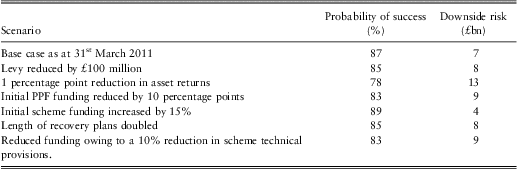
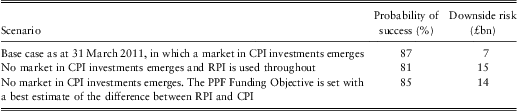
4.1.6 The sensitivity of the downside risk and probability of success measures to controllable factors such as investment strategy and levy collections, and to key assumptions such as current scheme and the PPF funding levels, is shown in Table 2.
Sensitivity of downside risk and probability of success
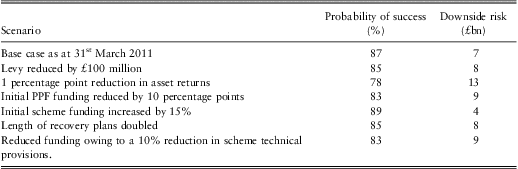
4.1.7 As noted in 4.1.1 the practical risk return trade offs that are available to the PPF centre on the investment and levy strategies of the Fund. Under a new levy policy introduced for the 2012/2013 levy year, levy parameters are now set triennially following an analysis of the Funding Framework. In addition to the quantitative outputs such as those from the internal model within the Funding Framework, the Board will also consider qualitative issues such as the balance between protection and affordability of the PPF levy.
4.1.8 Analysis of investment strategies will involve the trading off of success and downside risk measures subject to the overall investment and funding risk budget set by the Board. This process is discussed in detail in Section 9.
4.2 Applications of the Funding Framework
4.2.1 The Funding Framework is particularly useful to assess strategic decisions that are likely to apply over the Funding Horizon. Furthermore, by including both the “on-balance sheet” assets and liabilities of schemes that have already entered the PPF or that are in their assessment period and the “off-balance sheet” risks from future claims, any analysis can be better informed of:
• The effects of risk combinations such as weak funding and high insolvency rates that might be understated in less comprehensive modelling;
• The diversifying effects of risks that are not fully correlated. The funding framework can, for example, help capture the substantial credit risk exposure to sponsors of UK defined benefit pension schemes that is uncorrelated with, for example, longevity risks;
• The particular diversifying impact that occurs when the PPF adopts an investment strategy that differs in performance characteristics from the universe of pension schemes covered by the Fund.
4.2.2 Example 1: Hedging liability risks
4.2.2.1 Fulcher et al. (Reference Fulcher, Baid, Chambers, Catchpole, Tatham and Rogers2007) describe Liability Driven Investment (LDI) as “about reducing investment risk by measuring the success or otherwise of the investment strategy by reference to the funding position. It is not whether the return on the assets beat a performance target or a peer group or a benchmark but whether it keeps pace with the changing value of the liabilities”.
4.2.2.2 The PPF has adopted an LDI strategy using derivative instruments which aim to neutralise the effect of changes in interest rate and inflation expectations on the value of its liabilities.
4.2.2.3 The trade-offs in this strategy include (i) the potential return drag from assets used to provide collateral to support the derivatives programme, (ii) the frictional costs of the hedging programme and (iii) the counterparty and operational risks associated with a derivative programme.
4.2.2.4 Any under-hedged strategy would generally lead to greater dispersion of funding outcomes and larger downside risks thereby reducing the probability of success. It would also add to short term volatility of the funding level. The Funding Framework provides a means to examine, at a high level, different hedging strategies.
4.2.3 Example 2: Assessing longevity risk exchange
4.2.3.1 Longevity risk transfers of varying kinds have become more common in recent years. Blake et al. (Reference Blake, Cairns and Dowd2006) describe many of the more recent developments. However, the total size of pensions related longevity risk transactions remains fairly low compared to, for example, the aggregate liabilities of UK pension schemes. Supply and demand are driven inter alia by price and by the appetite for longevity risks of those involved in the transfer.
4.2.3.2 For the PPF the view of longevity risk changes as the Fund matures. In the current phase of evolution the major risks that the PPF faces are the credit risk of pension scheme sponsors and the funding risks of their pension schemes. Whilst the PPF is still relatively immature, these risks both dwarf and diversify the longevity risk assumed by the Fund.
4.2.3.3 At the end of the Funding Horizon it is assumed that these risks are comparatively small and the residual longevity risk will be both large and undiversified as it is not envisaged the PPF will continue to take investment risk at that stage. During this phase it is assumed that the PPF is de-risked apart from longevity risk for which a reserve is maintained.
4.2.3.4 Under these circumstances it is possible to judge the financial effects of risk transfer by comparing the price of the risk transfer with the margin that might be released. However, at earlier points in the Funding Horizon a more complex analysis is necessary to capture the diversifying effects of the credit and funding risks. Such an analysis is enabled by the Funding Framework.
4.2.3.5 Table 3 compares the base case with a scenario in which 25 per cent of the Fund's liabilities are systematically re-insured with buy-in annuities. In this scenario the assets of the Fund are reduced by the price of the risk transfer. This price is assumed for simplicity to be 7 per cent of the liabilities, being that part of the Funding Margin described in 3.5 that is attributable to longevity risk, although in practice the price will vary according to conditions prevailing at the time. The investment risk budget that is saved through fully matching 25 per cent of liabilities is re-applied to the remainder of the portfolio and the PPF's balance sheet is reduced on both sides by the value of the annuities to reflect the reinsurance arrangement. The effect is a decrease in the probability of success and an increase to the downside risk. Table 3 in effect shows that there is little value in the PPF insuring some of its longevity risk systematically throughout its funding period at the rate chosen as the funding margin for longevity in 2030.
Effect of a premature longevity risk transfer

4.2.4 Example 3: Tail risk assessments
4.2.4.1 The PPF's Funding Framework is a basis for articulating the extreme events, or combination of events, that may cause most damage to the Fund. Typically these will comprise a combination of weak economic conditions and systemic failure of UK defined benefit pension scheme sponsors or the failure of one or more very large schemes.
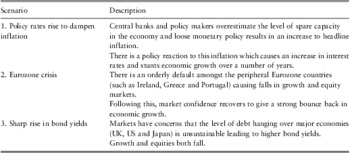
4.2.4.2 At these extremes the quantitative usefulness of the internal model can be limited. More specific modelling could be undertaken; Frankland et al. (Reference Frankland, Smith, Wilkins, Varnell, Holtham, Biffis, Eshun and Dullaway2009) describe approaches to modelling extreme market events for equity and interest rate risks. To date the PPF has used scenario testing to develop plausible, if unlikely, scenarios based on insights gained from interrogation of model outputs and on wider experience and consideration. Three examples of such scenarios that are relevant to the PPF are shown in Table 4.
Examples of adverse stress scenarios

4.2.4.3 To examine the impacts of these stresses in the context of the Funding Framework, the risk model parameters can be adjusted to more closely replicate the stressed conditions, the resultant outputs providing more insight into the specific effects of the scenario. The effect of these “tilts” to the success and risk measures is shown in Table 5. These figures include the changed impact in each scenario of projected insolvency events that occur in the baseline. No further insolvencies are assumed, despite the stressed economic conditions.
Effect of stress scenarios

4.2.4.4 It should be recognised that many of the extreme scenarios have more far-reaching effects beyond just the PPF. Their analysis can therefore inform wider policy development as well as the possible development and testing of risk mitigation strategies. In Section 9, which covers the investment strategy of the Fund, we elaborate on how specific risk protection strategies are evaluated by the PPF.
4.3 Summary
4.3.1 In the absence of any regulatory guidance on its funding objectives and the framework in which these are managed, the PPF Board has had to develop its own funding strategy. This is now published and updated annually as part of the Fund's reporting cycle.
4.3.2 This section has described that framework and sought, with some examples, to illustrate how it is being used to make effective and informed decisions. These examples illustrate how the Funding Framework helps to bring together the various components of the PPF's financial experience, linking “on-balance sheet” risks such as investment and longevity risks with “off-balance sheet” events such as future claims and levies in the holistic way that is the hallmark of Enterprise Risk Management.
4.3.3 Having established the Funding Objective in Section 3 and the Funding Framework in this section, we examine in Sections 5, 6 and 7 the Fund's governance arrangements, its risk map and risk appetite and its internal model respectively.
5. Governance
5.1 Overall mission, objectives and structure
5.1.1 As noted in Section 2, the PPF was set up under the provisions of the Pensions Act 2004 and came into being on 6 April 2005. It has responsibilities as manager of the Financial Assistance Scheme and in respect of the Fraud Compensation Fund. But its functions in respect of the Pension Protection Fund are:
• To pay compensation to members of eligible pension schemes where the sponsoring employer has become insolvent and the scheme had insufficient assets;
• To manage the assets of the Fund;
• To raise pension protection levies from eligible schemes.
5.1.2 A tripartite Memorandum of Understanding has been agreed between the PPF, Department for Work and Pensions (DWP) and the Pensions Regulator, which sets out the responsibilities of each organisation and how they work with each other. A Partnering Agreement and Memorandum of Understanding are also in place between the PPF and the regulator, and a Framework Document between the PPF and DWP which sets out a management statement and its associated financial memorandum.
5.1.3 The Board is independent of Government. It is, however, accountable to the Secretary of State for Work and Pensions and, through the Secretary of State, to Parliament.
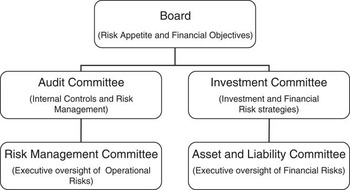
5.1.4 Figure 2 shows the Board and key PPF committees with responsibility for financial and risk management.
Board and key PPF committees with responsibility for financial and risk management

5.1.5 As required by the Pensions Act 2004, the Board has set up an Audit Committee to keep under review the Board's internal financial controls and secure the proper conduct of its financial affairs. The Audit Committee fulfils this function by, amongst other activities:
• Evaluating the effectiveness of internal controls and risk management;
• Reviewing the corporate governance arrangements;
• Being satisfied with the appropriateness and consistency of accounting policies, and with the integrity both of the accounts, and of the Annual Report;
• Receiving and considering any report from the internal or external auditors;
• Receiving and considering any report from the Actuary to the Fund;
• Reviewing the underlying assumptions made on the valuation of the Pension Protection Fund's liabilities;
• Monitoring and, when necessary, challenging the adequacy of management responses to issues identified by audit activity;
• Reviewing the arrangements for employees, or any other person, to raise concerns, in confidence, about possible wrongdoing in financial reporting or other matters.
5.1.6 In connection with its role managing investments, the Board has set up an Investment Committee and delegated to it authority for the discharge of certain functions with regard to investment risk strategies, including, in particular:
• Developing the PPF's investment principles and strategy;
• Developing and overseeing the overall approach to investment risk management, including appropriate delegations and periodic reviews;
• Overseeing the implementation of the risk and investment strategies. Maintaining and engaging in a forward-looking review of strategic risks and opportunities;
• Developing and maintaining the Fund's responsible investment policies;
• Developing the principles for dealing with the investments of schemes in assessment and subsequent transfer to the Fund;
• Approving and overseeing the framework for the appointment, retirement and contractual review of the fund managers, the investment adviser and the custodian.
5.1.7 The Audit and Investment Committees are supported at executive level by two executive committees, the Risk Management Committee and the Asset and Liability Committee, that exercise day to day oversight of non-financial and financial risks respectively. Within the management team there is a Chief Risk Officer who is responsible for the management of financial risks and who is a member of both the Asset and Liability and the Risk Management Committees.
5.1.8 Certain key responsibilities are retained at Board level including the PPF mission, vision and values and its three year management plan. In terms of governance of financial management, the Board sets the relevant risk appetites, financial objectives and, in accordance with best practice within proprietary and mutual insurance companies, retains responsibility for the assumptions used in the internal model.
5.1.9 The PPF is unique. It is neither an occupational pension scheme (as defined in relevant legislation) nor an insurance company. However, in terms of governance arrangements it may be instructive to assess the PPF against comparators from these sectors. In the following two sections the framework of governance in the investment area is compared to best practice principles of pension funds and the application of an internal model for financial risk management is compared to the Solvency II Use Test principles.
5.2 Investment governance - comparison with leading pension fund practice
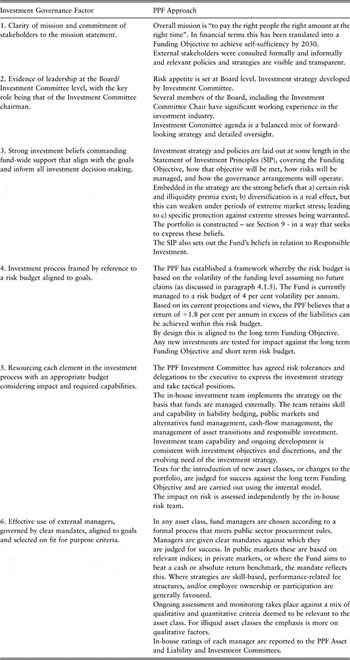
5.2.1 Clark & Urwin (Reference Clark and Urwin2007) identified a number of investment governance related factors common among leading institutional pension funds, six of which they considered to be core and within the reach of most funds. How the PPF approaches these factors is outlined in Table 6:
How the PPF meets key investment governance targets.

5.3 Financial Risk Management - comparison with regulated insurers
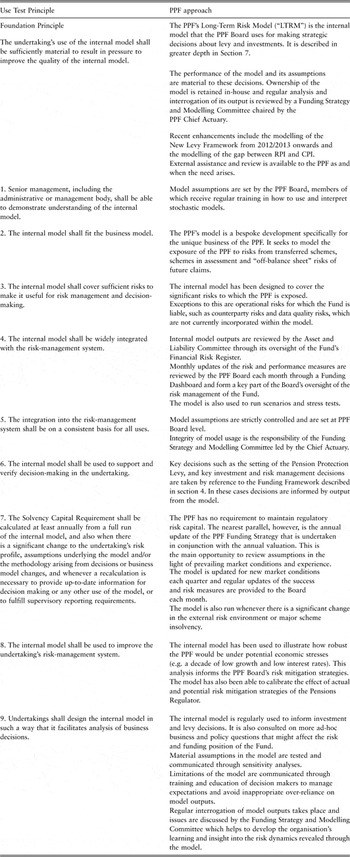
5.3.1 The assessment in 5.2 approached the issue of governance by reference to the investment process and from the perspective of a pension scheme. Insurance companies who want their Solvency II capital to be calculated using their own internal model will have to ensure that their model satisfies a “Use Test” that seeks to ensure that the model is embedded within the business. Details of this test were set out for consultation in Consultation Paper 56 produced by the Committee of European Insurance and Occupational Pensions Supervisors (“CEIOPS”) (CEIOPS, 2009). Section 3 of this consultation paper set out a foundation principle and nine subsidiary principles for determining whether an insurance company satisfies the Use Test. These principles are set out in the Table 7 alongside an explanation of how an internal model is applied in the case of the PPF.
How the PPF processes map across to the Use Test principles.

5.4 Summary
5.4.1 The PPF Board has specific powers and duties delegated to it in the Pensions Act 2004. The Act does not specify how these duties are performed although the memoranda of understanding with the Pensions Regulator and DWP set out how the institutions work together.
5.4.2 This section has sought to examine how the PPF Board has established governance arrangements that ensure the proper exercise and supervision of its functions and that seek to apply good practice from elsewhere in the financial sector.
5.4.3 As it grows in size and complexity, these arrangements will need to be refined and developed. A particular challenge from an Enterprise Risk Management perspective is to ensure the holistic view of risks is maintained and not divided into risk silos throughout the business. In Section 6 we discuss those risks (particularly financial risks) in more detail beginning with Board risk appetite statements that help ensure engagement with the risk process throughout the business.
6. Financial Risks and Risk Appetite
6.1 General principles and appetite for risk
6.1.1 Good risk management should allow the PPF to have increased confidence in achieving its objectives, effectively constrain threats to acceptable levels and take informed decisions about exploiting opportunities. It is not just about risk reduction. For example, as noted in 9.2.1, some investment risks may be considered worth taking where they offer significant upside potential. Furthermore, even if some risks are not well rewarded, it will make sense to remove them only if it is cost effective to do so.
6.1.2 In line with the general principles of Enterprise Risk Management, the PPF adopts the following cycle in the management of risks:
i. Board formulation of the strategy and risk appetite,
ii. Risk identification,
iii. Risk assessment,
iv. Risk mitigation/control,
v. Monitoring, and
vi. Reporting.
In addition, strategy reviews incorporate brainstorming activities that can identify risks (both threats and opportunities) to the strategic objectives.
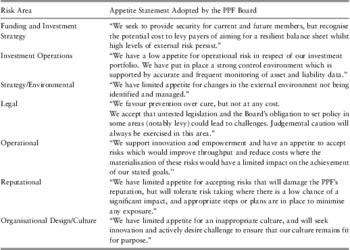
6.1.3 The PPF Board has identified seven Risk Areas in its overall management of the PPF, and has determined an appetite for each area, as set out in Table 8. It will be observed that the risk areas that are primarily financial are the first two, and these are where the remainder of this section will be focused.
The PPF's seven Risk Areas

6.1.4 The PPF sees its financial risks as those which affect the balance sheet and, more widely, those which threaten the achievement of its long-term Funding Objective as detailed in Section 3. It adopts the same principles for financial risk management as it does for the management of all its risks, as set out in paragraph 6.1.2 under the Governance arrangements described in Section 5.
6.2 Comparators from other sectors
6.2.1 PPF operations might easily be viewed as a combination of:
• A credit insurance business that would underwrite policies insuring the insolvency risk of the sponsors of DB pension schemes; and
• An annuity business that would take on the assets and liabilities of the claimant schemes.
6.2.2 With regard to the first aspect above, the PPF's major credit risk exposures are similar to the covenant risk of a typical private sector pension scheme. The aggregate credit exposure may be quantified as:
 $${\sum} \,{{(Probability}}\ {{of}}\ {{default}}\times {{Loss}}\ {{given}}\ {{default)}}$$
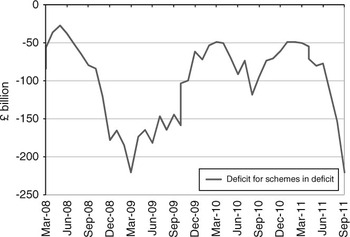
The summation is performed over the whole universe of eligible DB schemes. The “Loss given default” is defined as the scheme deficit (if any) on a Section 179 basis, net of recovery from the insolvent sponsor(s). This measure is highly variable over time, as pension scheme funding levels fluctuate according to the value of both their liabilities and assets (which may not be positively correlated). The PPF's “7800 index” as shown in Chart 4 tracks the movement of aggregate Section 179 deficits (ignoring potential recoveries) over recent years.
Aggregate deficit of schemes on a Section 179 basis

6.2.3 PPF protection and payment of the PPF levy is compulsory for eligible pension schemes. On the other hand, unlike a commercial insurer and some of its international counterparts (see Appendix1), the PPF must accept the credit risk of sponsor default. Furthermore, the PPF has no control over the distribution of the risk across business sectors. The portfolio of credit risks is heavily tilted towards the manufacturing and service sectors, with underweight exposure to technology and other modern industries. Credit risk has both idiosyncratic and systemic or cyclical features (for example, insolvency rates typically rise immediately following a slump in GDP growth).
6.2.4 As mentioned in paragraph 6.2.1, the second component of the PPF's operations is analogous to an annuity business. Here, the PPF is exposed to similar risks to those faced by commercial annuity providers and which are described by Telford et al. (Reference Telford, Browne, Collinge, Fulcher, Johnson, Little, Lu, Nurse, Smith and Zhang2010). These broadly comprise ALM risk (risk that assets underperform liabilities because of mismatches between assets and liabilities), longevity risks, and operational risks such as those associated with a large investment portfolio or with the maintenance of accurate annuitant data.
6.2.5 Before the assets and liabilities of a scheme are taken on and managed directly by the PPF, the scheme undergoes a period of assessment to determine whether it had sufficient assets at the assessment date to buy out benefits above PPF compensation levels on the commercial annuity market. This assessment period can typically last between one and three years, during which time the estimated Section 179 deficit of the scheme (net of any anticipated recoveries) is carried as a provision on the PPF balance sheet. However, as the scheme trustees retain ultimate responsibility for the investment strategy during the assessment period, there is a risk that the deficit at the point of transfer could be higher than if the scheme had been subject to the PPF's own strategy for controlled assets. This “pipeline risk” is peculiar to the PPF.
6.2.6 The PPF's status as a public corporation, accountable to Parliament and not subject to prudential or consumer protection legislation, means that there are other notable differences in its exposure to regulatory risk compared to that of commercial providers. For example, whereas commercial providers are constrained by prudential and consumer protection legislation, but own their pricing policy, compensation paid by the PPF is dictated by the Pensions Act. Any change to the scope of PPF protections or its compensation would have to be enacted through legislation or regulation. The change of compensation indexation from RPI to CPI is a good example of materialisation of the regulatory risk that applies to the PPF.
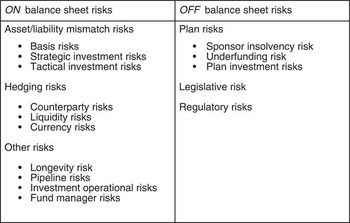
PPF Financial Risk Map

6.3 The PPF Risk Map
6.3.1 The financial risks, which are listed in Figure 3, of the PPF are split between “on balance sheet” risks (the risks related to the current balance sheet) and “off balance sheet” risks, i.e. the risks associated with future claims made on the PPF. The current balance sheet can also be broken down into a controlled balance sheet, i.e. the accumulated levies and the assets and liabilities relating to schemes that have already transferred, and the assets and liabilities of schemes in assessment which have made a claim on the PPF but not yet transferred.
6.3.2 The risks affecting the controlled balance sheet of the PPF are by-and-large related to its investment operations. The PPF Board has a low appetite for these risks and they are strictly monitored. The main risk attached to the controlled balance sheet is that the assets under-perform the liabilities over the Funding Horizon. This risk may materialise if the investment strategy fails to deliver the expected return (which is part of the “Funding and Investment Strategy” risk described in 6.1.3) or is not correctly implemented (“Investment Operations” risk). The risk of assets under-performing the liabilities is often referred to as Asset-Liability Mismatch (ALM) risk, which can be broken down as illustrated in the following paragraphs.
6.3.3 First, it is not possible to perfectly replicate the liability cash flows with financial instruments. The liability benchmark is a replicating portfolio of reasonably risk-free assets (cash, conventional gilts, interest rate swaps, index-linked gilts and inflation swaps) that most closely (but not perfectly) match the liability. The mismatch between the liability benchmark and the liabilities is the basis risk. The sources of this basis risk currently include the absence of assets with maturity terms in excess of 50 years and the absence of assets indexed to CPI rather than RPI.
6.3.4 It should be noted that the basis for the PPF annual valuation included within the annual report and accounts is also determined by reference to a replicating portfolio of low risk assets. However the published valuation makes no adjustment for the switch to CPI compensation increases as a liquid market in CPI-linked investments has not yet evolved. This approach would not be appropriate for the liability benchmark which does incorporate an adjustment for CPI. Thus there is an additional basis risk between the replicating portfolio for investment purposes and the basis of the published valuation. This difference is tracked and separately identified in management reporting.
6.3.5 The extent to which the adopted investment strategy departs from the liability benchmark leads to further risks. The PPF investment strategy which is described in Section 9 seeks to outperform the liability benchmark. The mismatch between the liability benchmark and the strategic asset allocation (as agreed by the Investment Committee and described in the Statement of Investment Principles) results in strategic investment risk. Moreover, deviations from the strategic asset allocation are permitted within tolerance limits agreed with the Investment Committee. This deviation is termed tactical investment risk.
6.3.6 Inflation and interest rate risks would ordinarily be considered to also form part of ALM risk. However, one of the investment beliefs of the PPF, based on historical experience, is that these two risks are not well rewarded. Furthermore, unhedged liability risk could result in considerable damage during a period of heightened claims on the Fund. These risks are therefore hedged as much as possible using a derivative overlay. Although this hedging strategy largely removes interest rate and inflation risks, the associated extensive use of derivatives introduces counterparty risk and liquidity risk that may materialise as a result of collateral requirements. The management of liquidity risk is described in Section 9.6. Finally, because of its international investments, the PPF has a degree of exposure to currency risk.
6.3.7 The controlled balance sheet is also subject to longevity risk, i.e. the risk that pensioners live longer than expected, thus rendering the level of funding insufficient to cover the cost of the liability. Longevity risk is currently tolerated by the PPF as it is well-diversified by the off balance sheet risks (see 4.2.3). However this risk will become much more significant as the PPF matures and thus the Fund's Financial Objective includes a margin to cover this risk.
6.3.8 With the exception of longevity risk (which is monitored but not currently controlled), all risks affecting the controlled balance sheet of the PPF are monitored and controlled. It is not possible to exercise the same level of control over the risks relating to schemes in assessment, although trustees of these schemes are encouraged to reduce their level of investment risk. The residual risk is monitored by the PPF and mitigated under its programme of interest rate and inflation hedging where this is appropriate.Footnote 2 Another pipeline risk is the potential inaccuracy of the data of schemes in assessment. The assessment process seeks to clarify these inaccuracies but, in the interim, PPF asset allocation and hedging must be based on provisional data.
6.3.9 The main risk that affects the long-term prospects of the PPF is that the value of the accumulated claims outgrows the value of the accumulated levies. Scenarios where this might occur correspond to economic circumstances leading to an increase in the number of claims, in combination with deterioration in scheme funding and large unexpected claims made on the PPF. Three risk factors drive the off-balance-sheet risk: sponsor insolvency risk, scheme under-funding risk and scheme investment risk. These three risk-factors are taken into account in the New Levy Framework that will be applied from 2012/2013 onwards.
6.3.10 In addition to these economic risks, claims frequency and size are affected by risks related to the general state and regulation of the pension industry, over which the PPF has no specific direct control. In particular, the future claims experience of the PPF will be determined in part by the effectiveness of the Pensions Regulator's funding regime. It will also depend on the policy of the Government towards the PPF and the legislative environment including any influence from Europe.
6.3.11 Over time, as claims and levies accumulate, the share of the controlled balance sheet as a contributor to the long-term funding position will grow relative to the off-balance sheet elements. This feature is one of the factors in determining the Financial Objective to be self-sufficient by 2030 which was discussed in more detail in Section 3.
6.4 Interactions between risks
6.4.1 Risks interact at several levels. First, the diversification between the two notional business units (sponsor credit risk insurance and annuity business) is far from perfect. When return seeking assets perform badly, scheme funding deteriorates and leads to an increase in the impact of potential claims. Assets of the PPF also tend to underperform in these circumstances, despite the care taken to minimise the correlation between the assets of the PPF and those of UK DB pension funds.
6.4.2 Secondly, in scenarios of underperforming assets, credit risk itself tends to increase. This assertion is supported by economic theory (Merton's model of default risk) and historical evidence. This “wrong-way risk” is captured by the PPF's internal model, which assumes a negative correlation of 0.5 between equity market returns and the credit risk factors of the 15 industry sectors that are modelled.
6.4.3 Thirdly, although there is no reason for longevity risk to be correlated with market risks, it does interact with other risks associated with the two business components. When unexpected longevity improvements occur, the liability of DB pension schemes increases. This in turn increases exposure to sponsors’ credit risk and can increase the credit risk itself and also increases the value of the PPF's liabilities. Moreover, unexpected improvements in longevity serve to lengthen the duration of liabilities, with a consequent increase in exposure to falling interest rates and rising inflation.
6.5 Measuring risk
6.5.1 The main tool used by the PPF to measure risk is the Fund's internal model which is described in Section 7.
6.5.2 The internal model outputs are used to measure risk over the long term and at an aggregate level. Additionally, the PPF also measures ALM risks over the short term at a much more granular level. In this case the risk metrics used are downside risk measures such as Value-at-Risk (VaR) or Tail Value-at-Risk (TVaR), or symmetric risk measures such as tracking error and volatility. Exposures to interest rate and inflation risks are measured by sensitivities to one basis point moves – PV01 and IE01 respectively.
6.5.3 Exposure to counterparty risk is also measured on a short-term basis. As derivative contracts are collateralised, in the event of a default of a counterparty the loss would be the difference between the value of the collateral and the cost of reinstating the contracts. The PPF measures this exposure by the VaR of this difference over the expected time to reinstate the position. The bigger the notional size of the contracts the longer it takes to reinstate the positions.
6.5.4 Liquidity risk, which in the case of the PPF manifests itself by collateral requirements arising from derivative positions, is measured by the short-term VaR of the sum of the value of the derivative contracts and the value of the collateral.
6.6 Making investment and risk mitigation decisions on a risk-adjusted basis
6.6.1 The PPF investment strategy incorporates a specific risk budget allocated to tactical investments or risk mitigations. Tactical decisions are made provided:
• The risk of under-performing the strategic benchmark does not exceed a preset limit consistent with the preset tolerance for tactical positions;
• The position is expected to add value to the portfolio on a risk-adjusted basis.
6.6.2 Prior to a tactical decision being made the following questions are addressed:
• Does the proposed transaction increase the expected return on the portfolio?
• If yes, does it increase risk and if risk is increased, is the expected increase in return worth the increase in risk?
• If not, does it reduce risk and if risk is reduced, is the risk reduction worth the expected reduction in return?
6.6.3 The most natural risk-adjusted performance measurement is the Sharpe ratio. The PPF also uses a measure of Risk-Adjusted Return on Capital (RAROC) to deal with asymmetrical distributions of returns. The RAROC is calculated as the expected excess return of the portfolio over the risk-free rate divided by the downside risk measured by the VaR of the portfolio return. For the purpose of tactical decision making, investment risk is measured over the short-term by a VaR:
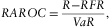 $$RAROC\: = \:\frac{{R{\rm{ - }}RFR}}{{VaR}},$$
where  $$$R$$$ is the expected rate of return and
 $$$RFR$$$ the risk free rate.
6.6.4 A new transaction adds value if it improves the RAROC of the overall portfolio. An Economic Value Added (EVA) is calculated. This is defined as the difference between the expected added return and the unit cost of risk multiplied by the increase in VaR The unit cost of risk is the RAROC of the strategic benchmark which is what the portfolio of the PPF would be in the absence of any tactical deviation:
 $$EVA\: = \:{{R}_{After}}\,{\rm{ - }}\,{{R}_{Before}}\,{\rm{ - }}\,c\:\times \:\left( {Va{{R}_{After}}\,{\rm{ - }}\,Va{{R}_{Before}}} \right),$$
where  $$${{R}_{After}}/{{R}_{Before}}$$$ is the expected return of the portfolio once/before the tactical position is in place,
 $$$Va{{R}_{After}}/Va{{R}_{Before}}$$$ the VaR once/before the tactical position is in place, and
 $$$c$$$, the unit cost of risk.
6.6.5 A positive EVA simply means that the RAROC of the portfolio would increase with the tactical position in place. Ex-post, PPF measures performance on a risk-adjusted basis by a Value-Added Profit (VAP). This is the ex-post EVA:
 $$VAP\: = \:{{R}_{with}}\,{\rm{ - }}\,{{R}_{without}}\,{\rm{ - }}\,c\:\times \:\left( {Va{{R}_{with}}\,{\rm{ - }}\,Va{{R}_{without}}} \right)$$
Rwith: realised return.  $$${{R}_{without}}$$$: return that would have been realised in the absence of the tactical position.
 $$$Va{{R}_{with}}$$$: ex-ante VaR with the tactical position in place.
 $$$Va{{R}_{without}}$$$: ex-ante VaR in the absence of the tactical position.
6.7 Summary
6.7.1 As noted in Section 4, the long-term Funding Framework is helpful in making some decisions of a more strategic nature. However the risk measurement toolkit also requires some shorter term measures and policies to inform and control, in particular, the implementation of a complex strategy involving the use of Over the Counter derivatives and other tactical positions held over a much shorter timescale.
7. The PPF's Internal Model
7.1 The PPF's Long-Term Risk Model
7.1.1 Internal models are more commonly associated with risk capital assessments within insurance entities. Although the PPF is not a capitalised entity like an insurance company, an internal model can nevertheless help to assess the full extent and range of risk that the PPF faces. Such assessments are vital to a number of core PPF decisions, most notably those on the total Pension Protection Levy and on the design of an appropriate investment strategy. These two particular aspects are covered in more detail in, respectively, Sections 8 and 9.
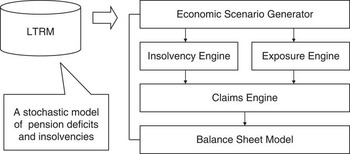
7.1.2 The PPF has developed a model capable of capturing, quantifying and expressing the potential impact of all primary risks to the PPF balance sheet: the so-called Long-Term Risk Model (LTRM). See Figure 4. The LTRM is a stochastic claims and balance sheet model that generates an extensive range of asset return, insolvency and longevity scenarios over a chosen time horizon, and on this basis projects a distribution of possible PPF balance sheet outcomes.
7.1.3 The projection process begins with the generation of 1,000 economic scenarios. Each economic scenario is a set of projected paths for relevant asset prices (including bond yields, equity prices and risk-free rates). These are obtained from a third party supplied Economic Scenario Generator (ESG).
7.1.4 The largest of the PPF-eligible pension schemes are modelled individually, with the remaining schemes pooled into groups according to demographic and risk similarities.
7.1.5 To capture insolvency risk, the PPF models pension scheme sponsors transitioning each year between eight different credit ratings ranging from AA to D, where D constitutes a default. The probability of transitioning to a given credit rating will depend on the sponsor's current rating, its industry sector, the current state of the economy and the company's own idiosyncratic risk. This latter element reflects the fact that companies face their own unique risks that are uncorrelated with their industry and the wider economy. The PPF uses 500 different scenarios of idiosyncratic risk.
7.1.6 Each of the 500 risk scenarios is mapped to each of the 1,000 economic scenarios (providing 500,000 scenarios in all), with the insolvency dynamics adjusted to reflect the degree of stress at play in the economy. Funding paths therefore combine with insolvency dynamics to determine the profile and size of claims on the Fund.
The Internal Model. A third party economic scenario generator feeds two sub-modules that create consistent insolvency and exposure experiences respectively, combining to form distributions of PPF claims experience and balance sheet

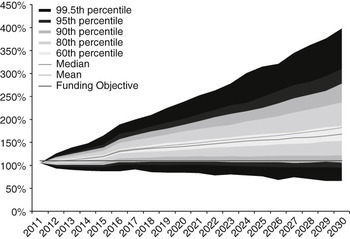
7.1.7 PPF assets and liabilities are rolled forward under each scenario, taking account of investment returns and movements in the discount rate. It is assumed that the PPF balance sheet is unaffected by changes to interest and inflation rates owing to the Fund's policy of hedging out these risks. The funding of schemes in the PPF-eligible universe is rolled forward in a similar manner. These deficits are transferred onto the PPF balance sheet at the point at which they occur. Levy collections are also modelled explicitly, taking into account the main features of the PPF's New Levy Framework, for example the way that funding risk varies under different economic scenarios. The result is a distribution of PPF balance sheet outcomes over a chosen horizon that takes account of all primary funding risks. Chart 5 shows the distribution of balance sheet outcomes from the Fund's 31 March 2011 base case.
Distribution of balance sheet outcomes from the PPF's 31 March 2011 base case

7.1.8 The value of liabilities at any particular time step is expressed in terms consistent with the contemporaneous market parameters (such as interest rates and inflation assumptions) which underlie the market value of the assets.
7.1.9 The PPF uses a stochastic mortality model that allows for rates of mortality improvement to vary in different scenarios. The table currently used is generated by the Cairns-Blake-Dowd mortality model (Reference Cairns, Blake, Dowd, Coughlan, Epstein, Ong and Balevich2007) with the cohort and curvature effects.
7.2 Modelling assumptions and limitations
7.2.1 In projecting forward the PPF balance sheet, the LTRM models the behaviour of asset returns and scheme sponsor insolvencies. Modelling techniques are insufficient, however, to capture many of the additional dynamics affecting pension scheme risk, especially those relating to “scheme behaviour”. In these cases, subjective assumptions are used, a selection of which is provided below.
• Scheme contributions are determined in accordance with current recovery plans, as reported to the Pensions Regulator.
• Schemes reduce the risk of their investments over time (migrating on average to 85 per cent allocation to long-dated bonds).
• No new schemes become eligible for PPF protection.
7.2.2 Where assumptions such as the above are material to the risk assessments or decisions being made, it is important that their choice is appropriately governed and that the effect of these choices is explored. In the case of the PPF, key model assumptions are set at Board level and their impact assessed through the use of sensitivities. Section 5 describes governance procedures in more detail.
7.2.3 The internal model is not subject to uniformly-applied assumptions regarding the risk premia for investment in equity or other return-seeking asset classes. Instead, as noted in 7.1, asset returns are generated stochastically by the ESG. Observed data and current market information inform long-term averages around which stochastic projections fluctuate. In the projections carried out at an effective date of 31 March 2011, the risk-free investment return, in this case the short-term return on cash, stabilises at a long-term average of around 5 to 5.5 per cent per annum, with an average risk premium for equity investment of 3.5 to 4 per cent per annum.
7.2.4 Sponsor insolvency probabilities are assumed to exhibit a degree of correlation with equity market conditions, as described further in paragraph 6.4.
7.2.5 Within the modelling of interest rates there is an implicit assumption of mean reversion which could disguise the exposure to extreme and historically unprecedented market scenarios. Since these seemingly unlikely scenarios may represent significant financial risks to the Fund, their effect should be explored through further analysis. Stress testing of the key risk metrics is carried out using assumptions devised from economic analysis of potential future scenarios of the world economy. These stress tests are used to study the resilience of the Fund to various shocks, identify exposures and assist with the planning of mitigations. Some of this work is described in 4.2.4.
7.2.6 As with any financial or economic model, it is important to exercise appropriate caution when analysing LTRM output. Economic models are not infallible; there is no guarantee that future outcomes will conform to dynamics observed in present and past data. In order to minimise the risk of misleading output, care must be taken to review and update the model on a regular basis and to reconcile its results to previous output and known outcomes.
7.2.7 In accordance with best practice such as TAS (M) and the requirements of Solvency IIFootnote 3 for insurance companies, the PPF maintains model documentation of sufficient detail for a technically competent person with no previous knowledge of the model to understand the matters involved and assess the judgments made.
7.2.8 Known limitations of the model and ideas for improvement which are yet to be implemented are also maintained in documented form. Examples of such known limitations include:
(i) Asset projections assume that the Fund maintains its investment strategy throughout the Funding Horizon set out in Section 3.4. It does not capture the dynamic response to changing circumstances that might in reality apply.
(ii) The model assumes that a sponsor's ability to fund scheme recovery plans is a function of its credit rating at the start of the projection. The model does not currently explicitly model the increase to probability of insolvency that results from higher deficit recovery pension contributions (and vice versa).
7.3 Case study: Measuring the impact of the switch to CPI
7.3.1 Legislation effective from April 2011 changed the basis of indexation of PPF compensation (before and after retirement) from the Retail Prices Index (RPI) to the Consumer Prices Index (CPI). A similar change was made to the legislation governing occupational defined benefit pension schemes.
7.3.2 The switch to CPI posed a number of challenges to align the parameters of the internal model accordingly, necessitating several changes. The main issues were:
• The ESG did not generate projections of CPI so assumptions about the difference between RPI and CPI would need to be made.
• Although the liabilities of the PPF would be referenced to CPI, the actuarial bases of valuations used to determine whether a scheme should be granted entry to the PPF (“Section 143” basis) and for levy purposes (“Section 179” basis) are both market-consistent. The PPF published valuation also uses assumptions that are marked-to-market. These bases, in the absence of a market in CPI-linked instruments, would continue to be linked to RPI.
• The absence of a deep and liquid market in CPI-linked investment also meant that the PPF would continue to use RPI-linked instruments to hedge liabilities, thus creating an additional source of mis-matching risk.
• The extent to which eligible pension schemes would amend benefits to reference CPI would have to be an additional behavioural assumption in the model.
7.3.3 The option of adopting a deterministic assumption about the relationship between RPI and CPI was considered but rejected as this would disguise the mis-matching risk. An econometric model which produces scenarios of CPI for use in the PPF's modelling was accordingly developed in-house. The aim was to establish a statistically and theoretically robust relationship between RPI, CPI and other relevant variables projected by the ESG (particularly property prices and interest rates). The approach adopted was to fit a linear model of the RPI – CPI gap as a function of RPI, monthly percentage changes in the house price index and the 12-month LIBOR rate. In the PPF base case as at March 2011, the annual increase in CPI is on average 1.1 percentage points lower than for RPI.
7.3.4 It is possible that the issuance of CPI-linked inflation bonds might serve to stimulate development of a wider market in CPI-linked investments during the PPF Funding Horizon but at this stage the prospects remain uncertain. In November 2011 the UK Debt Management Office issued its response to the consultation on the issuance of CPI-linked government bonds, confirming that no such instruments would be issued in the near term (before April 2013), with the issue kept under review for the medium term. The new PPF base case assumes that a market in CPI-linked investments develops over the next decade. For simplicity this is modelled in the new base case as an instantaneous emergence in five years, settling such that the market-implied gap between annual CPI and RPI is on average 20 basis points lower than the actual gap based on the difference between the published index figures. This differential reflects the anticipated higher inflation risk premium attaching to CPI-linked investments compared with RPI.
7.3.5 The effect of these assumptions upon the PPF's Funding Strategy update at 31 March 2011 is shown in Table 9 which compares the performance measures of the base case with the equivalent based solely on RPI. Note that the reduction in probability of success if no market emerges in CPI-linked investments is equivalent to a reduction in PPF Levy of £100 million per annum.
Alternative approaches to modelling the effect of the switch to CPI
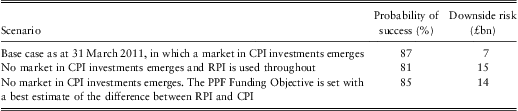
7.3.6 The second scenario in the above table allows for the PPF entry basis, levy basis and its Funding Objective to continue to be set by reference to RPI as if the switch to CPI had not occurred. The third scenario differs from this in that the Funding Objective is set by reference to a hypothetical market in CPI-linked instruments. In this sense it is a best estimate rather than a market-consistent assessment of the position in 2030.
7.4 Summary
7.4.1 The internal model is continually evolving as new market challenges emerge and as the insights it reveals in the quantification of risks lead to further investigations and analysis. The case study on CPI/RPI described in Section 7.3 is one recent area where new thinking has recently been required.
7.4.2 More detail on the PPF Long-Term Risk Model is available in an information note published on the PPF website.Footnote 4
8. Pricing the Risk
8.1 Overview of the PPF charging mechanism
8.1.1 The Pension Protection Levy is determined each year in two steps. First, the Board decides the aggregate levy (known as the levy estimate) that it wishes to collect. The levy estimate is then divided up between schemes according to their risk for the estimated Risk-Based Levy (RBL) component and according to their size for the estimated Scheme-Based Levy (SBL) component.
8.1.2 This approach is to a large extent a “top-down” charging mechanism in that an individual scheme levy is a function of the total to be collected and that scheme's risk characteristics relative to the general population. From the 2012/2013 levy year onwards the parameters of the formula will be fixed by the Board for three years. During each three-year period, therefore, the levy will be “bottom-up” whereby an individual scheme's levy depends solely on that scheme's individual risk factors and the aggregate levy will be the sum of the individual levies.
8.2 Setting the levy estimate
8.2.1 In setting the levy estimate the PPF Board is mindful of remaining on track to achieve its funding objective by the end of its chosen Funding Horizon in 2030. The Board has expressed a level of comfort for the probability of achieving this objective that was set at 80% in 2010 but which is expected to gradually increase and converge to 100% by 2030. The levy decision is informed by analysis from the internal model that was described in the previous section, together with appropriate sensitivity and scenario analyses. In particular, one of the outputs of the model is the probability of achieving the PPF's Funding Objective. In addition to the quantitative information and mindful of the limitations of models, the Board exercises considerable judgment and would also take into account a wide range of more qualitative factors in making a levy decision.
8.2.2 The Board has to estimate each year the amount that it aims to raise through the Pension Protection Levy. This levy estimate cannot, under the Act, exceed a Levy Ceiling that was initially fixed by the Secretary of State for Work and Pensions and is now indexed annually in line with National Average Earnings. The Pensions Act also specifies a 25% cap on any year-on-year increase in the levy estimate.
8.2.3 One test of reasonableness at the aggregate level is to compare the levy estimate with the equivalent levy calculated according to commercial insurance pricing principles, accepting of course that the PPF is not a commercial entity. This “economic levy” can be viewed as the sum of two items: the pure premium or expected claim amount plus the cost of economic capital. In this instance the economic capital is the amount required in excess of the expected amount to support claims over a chosen period with a prescribed degree of confidence. The economic levy has hitherto been calculated over one year but will be assessed over a three year period with effect from 2012/2013, for consistency with the corresponding cycle introduced under the New Levy Framework (NLF)Footnote 5.
8.2.4 The pure premium is assessed as the mean of the claim amounts projected by the internal model. The cost of capital is the product of the unit cost of capital and the level of economic capital assessed using claim projections of the model. Over one year, the economic capital is the difference between the 99.5th percentile of the distribution of one-year claims produced by the internal model and the mean claim amount. Over three years, it is the difference between the 98.5th percentile of the distribution of the present value of claims projected over three years and its mean value. Chart 6 shows the economic levy compared to the PPF levy estimate.
Economic levy compared to the PPF levy estimate since 2008

8.2.5 Except for the 2009/2010 levy year, the levy estimate has remained relatively close to the economic levy. The 2009/2010 economic levy was particularly high, owing to the low level of scheme funding and the weakness of scheme covenant in the automobile and banking sectors that prevailed at the beginning of the 2009/2010 levy year.
For the purpose of this illustration, the cost of capital in these calculations is assumed to be 9 per cent per annumFootnote 6.
8.3 Sharing the PPF levy among schemes
8.3.1 As stated in section 8.1.1., the Board is required each year to decide a levy estimate that is made up of an estimated “Risk-Based Levy” (RBL) and an estimated “Scheme-Based Levy” (SBL). The estimated SBL must not represent more than 20% of the estimated total levy collection. The Act broadly requires the RBL for any individual pension scheme to be proportional to the risk posed to the PPF by that scheme, whereas the SBL is to be broadly proportional to the size of the scheme. The SBL has historically been proportional to the value of a scheme's liabilities as determined on the Section 179 basis, and this approach will continue under the NLF. In effect the SBL is a cross-subsidy of the levy of small schemes by larger ones and, under the NLF, the PPF has stated that it will be set at a level to cover only the cost of any capping of the RBL that may be made on grounds of affordability.
8.3.2 The Act requires the Board to take at least two risk factors into account in the calculation of the RBL, namely underfunding and insolvency risk. The Board may also take investment risk into account and will do so from 2012/2013 under the New Levy Framework.
8.3.3 The Appendix to this paper describes the approaches to financial management adopted by the PPF's peer group of pensions insolvency insurers worldwide. A number of these bodies operate pricing mechanisms that are in part risk-based. However, the PPF is the sole such organisation to incorporate insolvency risk and, from 2012/2013 onwards, will be the only participant to factor investment risk into its levy calculation.
8.3.4 Measuring pension schemes’ risk at the individual scheme level is a challenging task. The PPF Board's initial approach to the levy from 2006/2007 to 2011/2012 inclusive consisted of apportioning the estimated RBL paid by each scheme to the product of the estimated one-year insolvency probability (provided by an independent external agency – Dun & Bradstreet) and an estimated measure of underfunding. A Levy Scaling Factor (LSF) is then applied to each individual levy bill so that the estimated total of RBL collected represented 80 per cent of the levy estimate.
8.3.5 With experience, this approach was found to have a number of shortcomings. First, it tended to over concentrate the levy payments among schemes sponsored by the weakest employers. Secondly, in times of good market conditions when aggregate underfunding is low, the “top-down” approach had a gearing effect that disproportionately shifted the bulk of the levy to even fewer pension schemes. This phenomenon occurred because the consequent increase in the LSF to target a given levy estimate served to allocate more of the levy share to the less well-funded schemes. Since the PPF charged a RBL for the first time in 2006/2007, the LSF has varied between 0.53 and 3.77.
8.3.6 Stakeholders’ views of the levy reflected dissatisfaction with this form of unpredictability and instability. Equally it was considered that the top-down approach failed to adequately reflect changes in an individual scheme's risk, the impact of individual actions to reduce risk being dominated by the effect of year-on-year movements in the LSFFootnote 7. Stakeholders expressed a desire to have the levy based more on controllable risks such as investment risks rather than those that were uncontrollable such as sponsor strength.
8.3.7 The New Levy Framework5 tries to address these issues as follows:
• Parameters of the levy formula are fixed for at least three years so that individual levies move in line with individual scheme risk;
• The impact of market volatility is reduced by a smoothing mechanism and there is an allowance for individual schemes’ investment risk in the calculation of the underfunding level;
• Emphasis is shifted away from insolvency risk towards underfunding risk, with a compression in the scale of insolvency probabilities and the number of levy bands reduced from 100 to ten; and
• The levy rates themselves include a margin to accord more closely to market pricing levels, with the result that the range in rates between strong and weak sponsors is much narrower.
8.3.8 The implementation of the New Levy Framework in 2012/2013 is designed to address the concerns of stakeholders and enable the PPF to continue to distribute its aggregate funding requirement among eligible schemes in a way that is sustainably fair and affordable.
9. Developing a Low Risk Investment Strategy
9.1 Strategic overview
9.1.1 The investments of the Fund comprise the accumulation of assets of schemes transferred into the PPF (i.e. assets derived from “claims” on the PPF), levy payments, and any investment growth achieved. The investment strategy is driven by the PPF Board's primary objective, which is to have enough money through time to ensure claimants receive their compensation in full.
9.1.2 This primary objective has been translated into a Funding Objective and Framework, which are laid out in Sections 3 and 4. This provides a language and quantitative basis for evaluating different investment strategies and in making investment decisions that apply the limited risk appetite in efficient ways. This process also recognises that the future is uncertain with outcomes that are best expressed in a probabilistic framework, and that there is a fundamental interdependence between funding and investment.
9.1.3 The current investment strategy seeks to optimise the performance and risk measures described in Section 4 within the overall funding and investment risk appetite set by the PPF Board which is described in Section 6.
9.1.4 The approach is informed by work such as that by Haberman et al (Reference Haberman, Day, Fogarty, Khorasanee, Mcwhirter, Nash, Ngwira, Wright and Yakoubov2003), drawing on stochastic techniques for optimising funding and investment decisions.
9.1.5 The PPF Board has also set a short term measure of risk, expressed in terms of the expected annual volatility of the funding level under appropriate long term assumptions and absent any future additional claims. Given the role of the PPF as a protection mechanism for UK DB schemes, the PPF Board has considered that the appropriate amount of short term risk undertaken by the Fund should be materially lower than the comparable level of risk undertaken by the schemes that are covered by its protection. The expected annual volatility was accordingly set by PPF at 4% which is currently around a third of the investment risk being run by a typical UK private sector pension scheme.
9.2 Basic principles
9.2.1 Whilst operating within the constrained risk budget, the investment strategy seeks to (i) exploit the existence of risk premia, including illiquidity premia, of a range of asset classes; (ii) exploit the diversifying effect of holding assets whose price behaviour is driven by different factors, having regard to external claims risks facing the PPF; and (iii) recognise the risk of extreme moves in asset prices, particularly under periods of stress when the usual effects of diversification can break down.
9.2.2 It is also assumed, as noted in 6.3.6, that the future level of interest rates and inflation (used to discount the liabilities) are difficult to predict, with open positions (either long or short, relative to the liabilities) generally providing a poor source of reward for the attendant risk.
9.2.3 Following from the above, the investment portfolio exhibits three main features, namely (i) the attempted elimination of interest rate and inflation risk through the use of hedging assets principally swaps, swaptions and gilt repos; (ii) the use of a broadly diversified range of return-seeking assets to generate excess returns within strict risk budgetary limits and (iii) the use of downside protection against tail risk events.
9.2.4 A description of the strategy can be found in the PPF's Statement of Investment Principles available on the PPF website. The broad asset allocation is summarised in Table 10. A proportion of the Cash and Bonds is set aside in order to provide collateral backing the liability hedging overlay.
The PPF strategic asset allocation as at November 2011
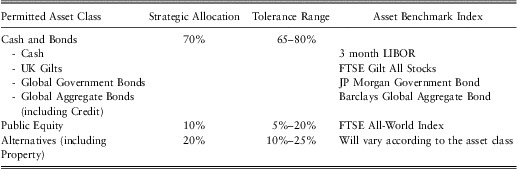
9.3 Investment strategy development
9.3.1 From outset the PPF Board recognised that as a lifeboat fund the investment strategy needed to be low risk. Initially the Fund was invested in UK bonds only. Through 2007 and into 2008 the strategy evolved, exploiting scale and opportunities for diversification of both managers and asset classes.
9.3.2 In December 2009 the PPF Board considered several possible portfolio risk profiles that sought to reflect choices for greater diversification as the Fund grew in size. The emphasis at this stage was not the specifics of the asset mix, this being left as further work for the Investment Committee, with greater representation of investment experts. Instead it was to consider options to either “spend” or “save” the risk budget created from greater diversification. The scope for diversification to improve the efficiency of the investment portfolio is discussed in more detail in 9.5.
9.3.3 The target asset allocation described in Table 10 was formally adopted in March 2010 following extensive analysis of a range of portfolio options. A structured approach to this analysis was undertaken and is set out in Table 11.
Key stages in new portfolio creation

9.3.4 Two of the above stages are worthy of further comment:
• Set and agree assumptions. Although the modelling undertaken to illustrate the effects of the investment strategies on the Fund's success criteria was comprehensive, it is important that the decision makers understand the extent to which model outputs are driven by the assumptions that are made. In particular, the return, volatility and correlation assumptions made will inevitably influence the allocations that emerge through the optimisation process. Limitations of models and the materiality of assumptions have featured on the agenda of PPF Board training days.
• Review trial portfolios and agree preference. Similarly, no matter how thorough the quantitative process is, the ability to bring the effects and conclusions of the analysis to life in a way in which the various layers of Governance – in this case the PPF Board – can usefully engage, is critical. A more detailed description of this process follows in 9.3.5 onwards.
9.3.5 Table 12 summarises the risk and performance outputs for some of the portfolios reviewed. These have been brought up to date as at March 2011 to be consistent with the other model outputs quoted in this paper. Note also that the PPF Board also considered the potential portfolio loss during the 2008/2009 fiscal year had the strategy been in force at that time (March 2009 saw the nadir of markets following the credit crunch so this was a very strong test).
Risk and return characteristics of trial portfolios
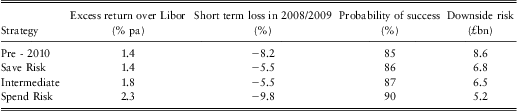
9.3.6 Table 12 illustrates the trade-offs of risk and return and the options created by a more diversified portfolio. It shows that broader diversification can produce portfolios with better performance expectations compared to the less well-diversified portfolio in operation in 2009. It could have, for example, resulted in a portfolio with very low risk indeed that still enhanced the chances of reaching the Funding Objective. The portfolio described as “Spend Risk” produced the best looking results on a purely quantitative basis, but relied on material allocation away from liquid bonds towards alternatives. This may have caused difficulty in an environment where long-dated bond yields were rising, as the Fund would have had to post ever increasing amounts of collateral on swap contracts.
9.3.7 In the event the PPF Board chose to adopt a risk appetite consistent with the “Intermediate” case as providing the best balance between saving and spending risk and, all other things being equal, a prospect of lower annual levies. In the absence of this change, projections showed that the levy would have to have increased by some £100 million per annum to have achieved the same funding objective.
9.3.8 The new strategy adopted can be thought of as initially “saving risk” through diversification, but then “spending risk” through an increased allocation to return seeking assets, thereby enhancing return potential to meet the long term funding objective. This has been achieved through halving the equity allocation (to 10 per cent), replacing it by a higher allocation to alternatives (now doubled to 20 per cent). A strategic allocation to non sovereign (i.e. investment grade) bonds was introduced for the first time. The most important implication was a higher overall return target, increased to +1.8 per cent per annum over the liabilities, but operating within the existing short term risk budget of a short term tracking error of 4 per cent per annum.
9.4 Portfolio optimisation and performance management
9.4.1 Whilst the broad strategic allocation has set the overall portfolio characteristics, there are opportunities in the detailed strategy implementation to refine and improve performance. Examples include (i) manager selection; (ii) benchmark and mandate design; (iii) weighting of asset class; and (iv) individual manager weighting.
9.4.2 Within each asset class category, the process of portfolio construction is flexible, being subject to a process of optimisation comparable to that laid out in Table 11. Any introduction of a new type of alternative asset to the Fund has to satisfy criteria consistent with that for the strategy work carried out in December 2009, albeit updated for new financial conditions and any changes in assumptions. After the addition of the new asset class, it would have to be shown that the long term criteria for success (chance of full funding by 2030, and maximum drawdown), and short term (4 per cent risk budget) were at least as good as before. The aim – for both the long and short term – is to improve the Fund's exchange rate of return per unit of risk. On this basis in 2011, a higher allocation to GTAA (Global Tactical Asset Allocation) and new investments in infrastructure, senior loans, distressed debt and mezzanine financing were made.
9.4.3 Implementation of strategy takes place via external fund managers, albeit operating within a framework of performance management. Managers are subject to a minimum of a quarterly evaluation on a qualitative and quantitative basis. Qualitative factors include Organisation, Team, Product, Risk (qualitative), and ESG factors. Quantitative factors include performance and risk. These factors are brought together in an aggregate score. Matters of concern result in a period of enhanced supervision, which must then result in resolution - for example, reversion to the previous higher grading, or corrective action, which at its most extreme, consists of replacement.
9.5 Does diversification work?
9.5.1 The case for a change in strategy presented to the PPF Board in 2009 included multiple stress tests on key assumptions, including correlations. The ability to “save” and then “spend” risk to increase return potential within the original risk budget relies on the benefits of diversification. These benefits can (and do) break down under periods of economic stress. The internal model does not have fixed correlations, rather these vary stochastically. However, the model parameters can be stressed, and a 2009 stress test assumed that the average correlation between equities and alternatives increased from 45 per cent (base case), to 80 per cent. It was found that the chance of achieving full funding after 20 years was relatively unchanged. Downside risk increased by up to £4bn, but the risk measured in this way was still lower than the comparable downside risk of the existing portfolio. Whilst the impact of diversification was reduced, it was still enough to justify a change in strategy.
9.5.2 The experience of the PPF through the 2008/2009 crisis was the subject of a further in-house study. It concluded that the correlation of equities to various alternatives was at the 75th percentile of the experienced correlations over the ten years ending March 2009, except that to Absolute Return strategies, which was observed at 19 per cent. However if the 2008/2009 experience had been a persistent long term feature, an assumption of correlation at about 80 per cent between equities and a basket of alternatives was not unreasonable as the basis for a stress test. This stress test formed part of the supplementary analysis available to the PPF Board in determining the broad portfolio characteristics and, along with other stress tests, was presented to the Board in a comparable form to Table 12.
9.6 The management of liquidity
9.6.1 On the face of it the PPF needs little liquidity as compensation outgo is very small relative to the size of the Fund. However to ensure operation within its risk budget, the Fund holds a significant portfolio of interest rate and inflation derivatives backed by a pool of collateral. This liability hedging portfolio brings potential liquidity risk based on the relative movements of interest rates.
9.6.2 When yields are falling, the mark-to-market liabilities will be rising and the Fund will be receiving collateral. However the converse is also true – rising rates result in falling liabilities but in the requirement to post collateral. If the increase in rates is significant and rapid the Fund will need excess liquidity to satisfy ever increasing collateral calls. Here, liquidity means assets which are suitable for collateral as agreed between the Fund and its counterparties, or assets which are very liquid and can be sold, reinvested to buy assets which can then be available as collateral.
9.6.3 Modelling done for the 2009 strategy review suggested that a liquidity requirement of 65 per cent of the Fund would provide an acceptable margin to satisfy collateral calls in a rapidly rising rates environment which might reasonably be regarded as a “shock”. However management of collateral requires constant vigilance and adjustment; the Fund holds a buffer of highly liquid assets such as gilts and cash immediately available for this purpose. Other liquid assets, such as equities, whilst immediately liquid, are not suitable for collateral, and would have to be sold and reinvested in suitable assets which would take time.
9.6.4 This amount is kept at a level providing sufficient cushion against an upwards short term shock in yields, measured using the volatility of interest rates, but with a floor. This ensures that in a period of unusually subdued volatility there is still a reasonable buffer, but as volatility rises, the collateral buffer also rises. This amount is calculated with reference to the higher of:
(1) 110 basis points; and
(2) 3 × VaR [1month, 95%] for the 30 year swap + 10 basis points.
Further, if rates are falling, the Fund will be receiving collateral. If rates fall markedly and this is sustained then the Fund's derivative positions will be substantively in-the-money and the Fund will have too much tied up in collateral (effectively cash). This can be expected to result in a drag on return. Measures are therefore taken to reduce excessive amounts of collateral, whilst retaining a buffer against a subsequent rise in rates. The framework uses the same reference point.
9.6.5 Having set an overall limit on liquid assets at 65 per cent of the Fund (see 9.6.3) the remainder of the portfolio is available to exploit illiquidity premia within the practical constraints of achieving diversification across a range of return seeking assets.
9.7 Tactical positions and tail risk hedging
9.7.1 Diversification works well under “normal” conditions, but it can break down under periods of abnormally high market risk. Furthermore, long term stochastic models can only tell us so much about these periods. Examples might be a very large fall in equity prices, or widening of credit spreads. The PPF follows a framework which aims to respond to such extreme threats or opportunities appropriately but in a way which does not overly dominate the long term strategic mix.
9.7.2 In addition to protection, tactical positions can be taken within an appropriate risk framework in order to express views and take advantage of short term non-strategic opportunities.
9.7.3 The philosophy and technical basis for tactical positions generally is outlined in 6.6. In this case the merit of a particular position is judged over a three year forward looking time horizon. Any position taken will be specified as:
• A long or short position on the asset class and showing the degree of conviction, degree of conviction drives the scale of the position;
• Detail of the proposal such as the instruments used, notional amount, maturity and strike price if applicable, including a stop-loss in case of unlimited downside risk (outright long or short position, options sold);
• Supported by a capital efficiency analysis using the measurement principles in 6.6, with sensitivities demonstrating that the position maximises return on capital under a base case scenario.
9.7.4 To ensure an appropriate balance between any positions taken and the strategic asset mix, each position is subject to several restrictions. The first constraint is a limit on the deviation from the strategic asset allocation. Departure from the strategic asset allocation (i.e. taking into account all tactical positions) is limited so that the risk of under-performing, in aggregation, is no greater than 15 per cent of the strategic risk. The degree of underperformance is calculated in a VaR framework.
9.7.5 For this purpose the strategic asset allocation is the asset mix set out in the Statement of Investment Principles assuming that interest rate and inflation risks are perfectly hedged. Strategic risk is the aggregate investment risk from that portfolio. Finally, risk of any particular position on a stand-alone basis is limited at 5 per cent of strategic risk if it is a position on an asset-class that forms part of the strategic asset allocation, or 2.5 per cent if it is an off-benchmark position (i.e. position on asset-classes not present in the strategic asset allocation).
9.7.6 This relatively complex set of restrictions may better be expressed by the following:
(1) Risk of (Actual assets – Strategic assets) < Risk of (Strategic assets - Liabilities) × 0.15
(2a) Risk of on-benchmark position < Risk of (Strategic assets - Liabilities) × 0.05
(2b) Risk of off-benchmark position < Risk of (Strategic assets - Liabilities) × 0.025
9.7.7 This framework generally leads to positions expressed using options baskets. Pure long or short positions taken in particular assets, either through physical or synthetic exposures have been shown to be inefficient. Downside risk can become quite large, which then limits the extent of the position. A greater magnitude of notional exposure can be achieved using options.
9.8 Case Study: Liability replicating portfolio and swap spread risk
9.8.1 The “normal” position in swap markets is for swap yields to sit above the respective gilt yield. This reflects the added risk compared to holding “risk free” government debt of being exposed to bank counterparty default, albeit collateralised. In the wake of the financial crisis, almost co-incident with the default of Lehman Brothers in September 2008, this position reversed with gilts offering a higher yield than swaps. The position was marked at longer durations, where, by way of example, the 30 year swap yield exceeded the respective gilt yield by 56 basis points on 30 July 2007, but this had become minus 75 basis points by 31 January 2009 (source: Bloomberg). Since then the swap spread at long duration has been negative (i.e. swap rates less than gilt yields) at almost all times, albeit not as extreme. The reasons offered for this have been myriad, but the most likely driver is a forced contraction of bank balance sheet capacity that caused the terms offered to counterparties on swap contracts to deteriorate.
9.8.2 Section 6.3.3 introduced the concept of a replicating portfolio of reasonably risk-free assets that most closely match the liabilities. Investing in this portfolio would minimise the asset liability mismatch. The PPF's liabilities are referenced to the higher of gilt yields and swap rates. Whilst swap yields were higher than gilt yields, the replicating portfolio was a portfolio of swaps. Before the default of Lehman Brothers in September 2008 the investment strategy had targeted swaps as the hedging instrument of choice and a substantial swap portfolio had been built up by then. After the Lehman default, the replicating portfolio became a blend of swaps and gilts. With a proportion of the PPF's liabilities now priced off higher gilt yields, this negative swap spread created extra un-hedged risk.
9.8.3 The challenge was to acquire economic exposure to gilts, whilst maintaining the Fund exposure to growth assets in a way consistent with the Board's long term return objective. Buying physical gilts only would not achieve this as capital would have been tied up. The solution was to exchange relevant swap exposure for gilt exposure using bond repurchase (or “repo”) agreements. At its maximum, the extent of the outstanding risk on the PPF's balance sheet was some £15 million per 1 basis point move in swap spread. By November 2011, virtually all of this risk had been closed down using a combination of gilts, gilt repos, and total return swaps.
9.8.4 Ultimately the PPF believes that as banks are able through time to repair their balance sheets, terms offered for swaps will improve – with the swap spread eventually becoming positive again. Based on the average price at which the Fund's repo program was transacted, upon reversion to (say) zero, then the expected return would exceed £200 million. In the meantime the Fund's liabilities are hedged.
9.8.5 A detailed comparison between the repo and swap markets is beyond the scope of this paper but the main difference is in the term of the contract (as opposed to the maturity of the underlying instrument). Swaps are typically long term, whereas repos are short term, up to 12 months but more typically three months. Unlike a swap contract, to maintain economic exposure the repo needs to be “rolled” and this creates new risks. Great care has therefore been taken to diversify across different terms, and roll dates such that the repo program can be maintained even under stress environments.
9.8.6 A further feature of swap and repo markets worthy of note is the financing cost of entering into these contracts. The relevant comparison is LIBOR (swap market) against the repo rate (repo market). Under economic stress, LIBOR tends to increase as interbank funding comes under pressure. In contrast the repo rate has stayed fairly stable. Relevant comparisons are possible from the 2008/2009 crisis period, and recent period (summer/autumn 2011) where markets have become increasingly concerned about the future of the Euro. This has again manifested itself in elevated levels of LIBOR, whilst the repo rate has remained low. In isolation this would suggest that repo, as a means of liability hedging is more robust through crisis periods, particularly if these are manifested in the banking system.
10 Conclusion
10.1 This paper has been written as a real case study of the application of Enterprise Risk Management principles to the financial management of the Pension Protection Fund.
10.2 There are, however, some conclusions that we would like to draw from our experiences:
10.2.1 Despite the risks and uncertainties inherent in the operating environment, a clear framework for decision-making with agreed financial objectives provides an effective and objective basis for making those decisions. In the absence of a firm direction within its founding legislation the Board of the PPF has developed a framework and objectives that are visibly transparent to its stakeholders.
10.2.2 The capture of, and integration into, the internal model of the comprehensive range of risks to the strategic objectives improve understanding and decision-making. In the case of the PPF it has built a model that incorporates three phases of an eligible scheme's potential journey into the PPF, including both on- and off-balance sheet risks. This has led to closer integration of funding strategy, levy and investment decisions. In our experience this enriches the analysis and decision-making process and deters the consideration of individual risks in isolation that might then lead to sub-optimal decisions being made. Such learnings are not unique to the PPF however and play across many institutions that operate in complex environments.
10.2.3 Good governance combines top-down supervision and direction linked firmly to the business strategy with bottom-up analysis and information. It also involves clear delegation of decision-making and accountability.
10.2.4 The PPF's model is built firmly on these principles but, as the Fund grows, it is still a work in progress. For example, the paper has observed that investment operational risks are not specifically built into the PPF Funding Margin and that a clearer understanding of the market pricing of illiquidity may be warranted.
10.2.5 The current global financial crisis has challenged financial institutions and whilst it has promoted risk up the agenda in many boardrooms, a truly integrated ERM system would embed risk management, interrogation and analysis at various levels within an organisation. We have illustrated in this paper how stress and scenario testing is undertaken at the PPF and presented as part of Board-level decision-making.
10.2.6 Regular updating of risk models, open discussion of model outputs, risk positions, and opportunities to improve risk and investment management are also encouraged within the Fund's executive teams. As these insights arise and as actions are taken, it is important that the risk systems keep pace with developments in a true spirit of integration and iteration.
10.2.7 Comprehensive modelling of all risk factors, though highly desirable, should not become an end in itself. At various points in this paper we have highlighted the limitations of models and the necessity to be clear and open about these. Decisions are generally taken by governing bodies that are one or two steps away from model construction, and good communication and understanding are vital in making appropriately well-informed judgements.
10.3 In this paper we have taken the opportunity to set out how the PPF approaches, in its unique setting, tasks that are more commonly undertaken in the insurance and pensions sectors of the financial services industry. We have chosen not to debate the rationale for a Fund such as the PPF but we are keen for feedback from fellow professionals on how our financial management principles and practices have been developed and applied.
PPF website links (in chronological order)
Modelling uncertainty: an introduction to the PPF Long-Term Risk Model (August 2007) http://www.pensionprotectionfund.org.uk/DocumentLibrary/Documents/ltrm_paper_aug_2007.pdf
Combined Annex for the Consultation on the future development of the pension protection levy (November 2008) http://www.pensionprotectionfund.org.uk/DocumentLibrary/Documents/future_development_consultation_nov_2008_-_annex.pdf
Consultation Document
The Pension Protection Levy: A New Framework (October 2010) http://www.pensionprotectionfund.org.uk/DocumentLibrary/Documents/levy_consultation_oct10.pdf
Statement of Investment Principles (November 2010) http://www.pensionprotectionfund.org.uk/DocumentLibrary/Documents/SIP_November_2010.pdf
Policy Statement
The Pension Protection Levy – A New Framework (May 2011) http://www.pensionprotectionfund.org.uk/DocumentLibrary/Documents/levy_policy_statement_May11.pdf
APPENDIX - International Comparisons
A.1 A number of nation states have established protection regimes for occupational pension schemes. This section provides an overview of the systems that have been established in Germany, Sweden, Switzerland, Finland and the USA.
A.2 In comparative terms, the system established in the USA is the most closely matched to that of the PPF in the UK. In both these territories the protected population comprise the members of funded defined benefit schemes rather than the “book reserve” system found in Germany for example. As a consequence, both the Pension Benefit Guaranty Corporation (PBGC) in the USA and the PPF in the UK take responsibility for the compensation payable and manage the assets of the associated schemes.
A.3 Germany: PSVaG
A.3.1 The German PSVaGFootnote 8 is a mutual insurance association founded in 1974 by the Confederation of German Employers’ Associations (BDA), the Federation of German Industries (BDI) and the Association of German Life Insurance Corporations. It is subject to supervision by the German equivalent of the Financial Services Authority, the Bundesanstalt für Finanzdienstleistungsaufsicht (BaFin).
A.3.2 If the PSVaG lost BaFin authorisation, or was unable to continue operating for some other reason its liabilities would pass to the KfW Mittelstandsbank – literally the KfWFootnote 9 SME Bank. The bank is a public body, 80 per cent owned by the Federal German government and 20 per cent by the Federation's constituent states. A “strategic partner of the economy and of politics”, it indirectly finances German SMEs by providing commercial banks with liquidity at low rates and long maturities to encourage lending. The choice of the SME bank as ultimate guarantor of PSVaG is perhaps indicative of the market that PSVaG is aimed at.
A.3.3 Prior to PSVaG's establishment, pensions lost through employer insolvency would be treated as a claim for lost wages against the employer. PSVaG covers four (of the five) types of pension schemes in Germany, totalling around €250bn assets, two-thirds of Germany's occupational pension scheme assets.
A.3.4 When an employer becomes insolvent, the PSVaG replaces the lost benefits with annuities bought from a consortium of 53 life insurance companies (the biggest being Allianz). As with the PPF in the UK, benefits are capped, at a monthly level set by reference to a notional monthly salary.
A.3.5 PSVaG charges an annual premium to its 76,000 member firms and this insurance is compulsory. The premium is based on claims during the previous 12 months and can therefore be fairly volatile: the average contribution for the last five years was 0.55 per cent of liabilities, but the required amount for 2009s claims was 1.42 per cent (a levy of €4bn), which is being evened out over four years to ease the burden on employers. The exact contribution depends on scheme type, though unfunded book reserve schemes pay a rate that is five times higher than that for funded schemes. Since 2002 all companies in Luxembourg that offer DB occupational pensions are covered by the PSVaG and are also required to pay premiums to the PSVaG.
A.3.6 Governance of the PSVaG follows the German “two boards” model with an independent Supervisory Board and a separate Board of Management. As noted above, PSVaG is a low risk model in that it funds its claims in arrears by premiums that are compulsory and unlimited. Its assets, including capital and solvency reserves are invested according to a strategy that seeks to maintain high levels of liquidity and low risk. Investments are subject to supervision through a committee separate from the Board of Management.
A.4 Sweden: PRI Pensionsgaranti
A.4.1 PRI Pensionsgaranti provides protection to members of private sector defined benefit pension schemes in the event of a company sponsor insolvency or if an insured company fails to make payments to a pension commitment. The core business of the company is the collectively agreed ITP plan covering white collar workers. Other business relates to direct pension arrangements issued by companies. A small but growing portion of the business of PRI Pensionsgaranti's relates to member company's pension plans outside of Sweden.
A.4.2 In Sweden it is the trade unions, rather than the government, that impose the requirement to have insolvency protection in place. PRI Pensionsgaranti's Board is made up of representatives from trade unions and the 1400 employers who hold policies (covering £10bn assets).
A.4.3 Sponsor insolvency insurance is a mandatory condition of providing a defined benefit pension scheme. It should be noted, however, that PRI Pensionsgaranti is not obliged to underwrite the risk and therefore only the most secure businesses in Sweden are able to sponsor defined benefit pension schemes. When employers do go bust, PRI Pensionsgaranti will buy out benefits with an insurance company.
A.4.4 PRI Pensionsgaranti is a mutual insurance company regulated by Finansinspektionen (the Swedish Financial Supervisory Authority). Swedish law and Code of Conduct of businesses, and EU law and regulation also apply in relevant areas. The Board of the Company is responsible for its financial management, agrees its risk appetite and sets its financial objectives. The Annual General Meeting is the highest decision making level comprising 20 delegates from member companies and employee representatives.
A.4.5 Annual premiums are around 0.3 per cent of liabilities for book reserve schemes and 0.1 per cent for others, raising about £27 million in 2009. If claims exceed resources, special contributions of up to two per cent of liabilities can be imposed. Policyholders of ten years standing or more can receive a bonus payment.
A.4.6 The financial objectives of PRI Pensionsgaranti are expressed as a target loss ratio over a five year period and a target own capital reserve dependent on the company's risk adjusted exposure. The investment target for own funds of around £1.3bn is to maximise returns from the chosen allocation of assets.
A.4.7 PRI Pensionsgaranti manages its risks through selective underwriting and uses reinsurance to limit concentration effects. Insurance contracts are also renewable after three years, when the company can require employers to increase funding, cease accrual or require the scheme to be wound-up within five years.
A.5 Switzerland (and Liechtenstein): LOB Guarantee Fund
A.5.1 The LOB Guarantee Fund (also known as the SicherheitsfondFootnote 10 BVG) was established in 1986 by the Swiss government. Like the PPF, benefits are capped, but unlike the PPF, LOB (Law on Occupational Benefits) mostly covers DC (the predominant scheme type in Switzerland) and benefit payments are triggered by the insolvency of the scheme, rather than the employer. LOB also pays a subsidy where a fund is financially disadvantaged as a consequence of above average longevity.
A.5.2 Upon scheme insolvency, LOB will buy out benefits with insurance companies. It is mandatory for Swiss employers with pension schemes to pay into LOB, even if they are covered by a state or municipal guarantee.
A.5.3 Annual levies, set by the LOB Board and approved by the Federal Social Insurance Office, are set at a fixed rate rather than being determined by risk. In 2010, these amounted to 0.07 per cent of payroll contributions for the longevity and 0.02 per cent of liabilities to cover insolvencies.
A.5.4 LOB maintains a surplus of about £500 million which is invested conservatively.
A.5.5 Since January 1, 2007, most of Liechtenstein's mandatory occupational pension funds have been protected by LOB. Liechtenstein has a history of entering into customs and monetary agreements with Switzerland, including adopting the Swiss franc as its official currency in 1924. At present, 24 Liechtenstein benefit schemes are affiliated to LOB, which has not so far had to deal with any insolvency from Liechtenstein.
A.6 Finland: Garantia Insurance Company
A.6.1 Garantia Insurance Company is a non-life insurance company specialising in guarantees in the Finnish domestic market. Garantia's principal product is insurance for pension loan guarantees (these being the shortfalls on the pre-funding of group pensions contracts that are treated as company debt).
A.6.2 Garantia is owned by the Central Pension Security Institute, all the pension insurance companies and most of the single and multi employer pension funds operating subject to the Finnish TEL Employment Pensions Act. It is regulated by Finnish Financial Supervisory Authority.
A.6.3 At the end of 2010 the total liabilities of Garantia's guarantee insurance exposure was €1,362 million, gross premium income over the prior year was €13.6 million and there had been 79 loss events which led to a total claims volume of €5 million. Garantia has an investment fund of about €100 million. Its overall financial target is expressed as a return on equity.
A.7 USA: Pension Benefit Guaranty Corporation (PBGC)
A.7.1 The PBGC was created by the Employee Retirement Income Security Act (ERISA) passed in 1974. It is an agency of the Federal Government with a Board made up of the Secretaries of Treasury, Labor and Commerce and day-to-day running in the hands of a Director appointed by the President.
A.7.2 The PBGC protects the retirement incomes of more than 44 million employees in more than 27,500 private sector defined benefit pension plans. These are split between two separate programmes; one covering the remaining industry wide multi-employer schemes and a larger scheme covering single employer pension plans.
A.7.3 The scheme funding regime and the PBGC premium basis (which is essentially a flat rate per member charge) are both set by Congress. This has resulted in political pressures preventing a move to risk-based premiums. Furthermore, scheme funding provisions have provided easements to precisely those firms posing most risk to the PBGC. There continues to be much discussion about reforming these aspects of the system.
A.7.4 With such limitations on its financial control measures, PBGC's objectives are focused on the maintenance of medium-term liquidity and the performance of its investment strategy. The investment policy objective is stated to be “to maximise total return within a prudent risk framework that incorporates PBGC's fixed obligations and asset composition of potential trusteed plans. The investment policy establishes a 30 per cent target asset allocation for equities and other non-fixed income assets, and a 70 per cent asset allocation or fixed income.” Footnote 11
A.7.5 The experience of the PBGC was important in shaping the development of the PPF. An emerging PBGC deficit that would grow to $28 billion by the end of the 2011 fiscal year was a substantial spur to this. The main areas where learnings from the PBGC experience were applied in the development of the PPF were around governance and the independence of the Board, the investment approach, and devolving power in the setting of levies and in the running of the scheme funding regime.