





Introduction
As Russia’s “Special Military Operation” (SMO) evolved into a brutal and sustained war of attrition, ongoing research seeks to understand the degree to which Russia’s economy, state, and society are transforming. One potential factor of change is wartime nationalism as a driving force in politics and society. Historical examples abound of how war and nationalism interact to generate new demands in society amid emotive calls to mobilize for victory and achieve national rebirth (Wimmer Reference Wimmer2013). Over the course of Russia’s invasion of Ukraine, a range of actors within the national-patriotic milieu — but largely outside of the regime (non-systemic) – have gained prominence as pro-war voices. Largely, they have done this on Telegram (Fediunin Reference Fediunin2022b), a platform that provides fertile ground for radical groups to develop a closely-knit ideological network.
The Russian authorities are aware of the platform’s threat. In August 2025, they introduced measures to bring Telegram under control, introducing a new censorship law (Sorochinskaia Reference Sorochinskaia2025), followed by the fining (TASS 2026a) and blocking of certain channels, as well as using technical measures to slow the platform’s functioning (TASS 2026b). Significant dissent was expressed among Russia’s military bloggers and systemic parliamentary opposition (Altapress 2026). Investigating Russia’s large and diverse spectrum of national-patriot Telegram channels in wartime, this article uses digital research methods — as well as classic qualitative text analysis — to study the commonalities and divergences both in their worldview and their criticism of the authorities in wartime.
Based on our findings, we argue that two terms best describe the network we analyse. The first is “critical patriotism.” Consistently more radical than the regime on policies from abortion and immigration to foreign and economic policy, national-patriot groups selectively attack the authorities on the grounds that they are not “true patriots.” Building on previous research (Clément Reference Clément2021), we examine “critical patriotism” as a form of political dissent that vents discontent via systemic and non-systemic actors in ways that are usually manageable and non-threatening for the regime. The second is “imperial nationalism,” which treats nationalism and imperialism as not mutually exclusive (Kumar Reference Kumar2015, Berger & Miller Reference Berger and Miller2015; Kolstø Reference Kolstø2019). Usually applied to 19th-century cases, we find the concept accurately describes the social imaginary advocated by the actors we study, who explicitly advocate imperial irredentism and mobilize on ethno-national grounds. Broadly united by a radical pro-war imperial-nationalist vision, the network we study articulates a more radical transformative vision of Russia’s future than presented in the Kremlin’s neo-imperial talking points (Kolstø Reference Kolstø2023; Curanović Reference Curanović2024).
Thus, we advance two concepts — critical patriotism and imperial-nationalism — which have not been commonly applied or combined in the study of contemporary autocratic politics. We show how non-systemic actors fill the space vacated by other prominent dissenters of the governmentFootnote 1 to decry the limited progress of the SMO, attack the “comprador elite,” and call for new measures to achieve the radical rebirth of Russia. Playing the role of ideological hardliners, they act as watchdogs upon the current political establishment, ready to call out “unpatriotic” actions. As the war drags on with uncertain progress on peace negotiations, the radical pro-war illiberal camp has boosted its influence and visibility in ways that they could only have dreamed of before 2022. Their radical discourses may flow “upstream” to certain regime actors or “downstream” to Russian society. However, in the absence of a common party structure, unified doctrine, or charismatic leadership, these groups do not yet resemble the powerful fascist movements of the 1920’s and 1930’s. Indeed, the network is split on how they express “critical patriotism.” Those seeking niche roles with state patronage in the new wartime Russia speak rather differently from those agitating to form an independent and critical “patriotic opposition.” Indeed, the latter employs an anti-systemic populism that aims to stir the Russian public into action. This clearly remains a red line for the regime, as seen in the arrest of Igor Strelkov in the summer of 2023.
We develop our argument firstly by interpreting the importance of nationalism and patriotism to the stability of the Putin regime. We then define the concepts of critical patriotism and imperial nationalism in Russia’s pre-war context and clarify how Telegram operates as a medium for political communication. Finally, we outline our methodological approach and present the results and analysis.
The conceptual starting points: Imperial nationalism and critical patriotism
The revival of authoritarianism in a modified 21st-century form is visible in diverse cases such as Turkey, Russia, China, India, and Iran. Rather than totalitarian ideologies, these regimes rely more on national identity, developing an illiberal and cultural “official nationalism.” The way contemporary autocratic regimes utilize national identity does not fit the classic definition of nationalism as the political aspiration to make the state and nation congruent (Gellner Reference Gellner1983). The Putin regime and the Russian state do not seek a radical transformation of the relationship between state and nation or a “national reawakening” with mass mobilization. Nationalist themes are deployed in a limited way to boost regime legitimacy and advance an assertive foreign policy vis-à-vis the West (Laruelle Reference Laruelle2019, 9).
Since 2014, the Kremlin’s “official nationalism” has been increasingly interpreted as imperialist, driven by a “cultural exceptionalism” and a “civilizing mission” (Oskanian Reference Oskanian2018). Russia’s 2022 full-scale invasion is characterized as an imperial act to subjugate Ukraine through violence, domination and — if need be — cultural and physical extermination (Oksamytna Reference Oksamytna2023). However, an ethnic “particularist nationalism” has also been observable in state discourse (Rojek Reference Rojek2022). The concept of “Russkii Mir” looks to unite those who identify as Russian; the call to protect the inhabitants of Eastern Ukraine as “our people” and to annex them to the Russian Federation resembles the dynamic of nationalist reunification. Given the presence of imperial and nationalist elements alongside each other, we view the concept of imperial nationalism (Pain Reference Pain, Kolstø and Blakkisrud2016; Kolstø Reference Kolstø2019) as a fruitful way to understand the Russian case. By this, we mean the fusion of the nationalist imperative for self-determination and national reunification with great power ambitions for imperial expansion.
It is important to note that imperial-nationalism as a post-Soviet phenomenon emerged not in the Kremlin but among a diverse and fragmented spectrum of nationalist groups (Fediunin Reference Fediunin and Gill2022a). Although a simplification, post-Soviet Russian nationalists are often demarcated into two main trajectories: (1) xenophobic pro-Western ethno-nationalists, previously led by the Movement against Illegal Immigration (DPNI) and the National-Democratic Movement (Nats-dem); (2) anti-Western imperial-nationalists ( impertsy ), including the Russian Communist Party and Zhirinovsky’s LDPR, as well as various smaller groups, all of whom call for Russia to retake its lost territory, reunify ethnic Russians into one large imperial state, and, thus, restore great power status on new foundations.
From 2012, the Kremin increasingly relied on national identity discourses to overcome domestic opposition, albeit with the assistance of co-option, electoral manipulations, and selective repression (OVD-Info 2022). As the regime became more repressive from 2012 and more reliant on conservatism and national identity discourses, a range of regime opponents were marginalized or repressed while new supporters, such as previously regime-critical imperial-nationalist groups, emerged. Having pivoted to “traditional values” and preserving the “cultural code” of Russia as a “civilization-state” (Blackburn Reference Blackburn2021 4–5), the Kremlin then decided to intervene in Ukraine’s domestic political crisis in 2013–2014, evoking ethno-nationalist tropes on the “Russian world” and Crimea as “ancient Russian lands” (Blakkisrud Reference Blakkisrud, Kolsto and Blakkisrud2016). The war in Ukraine had a huge impact on Russian nationalist groups. Some of the pro-European ethnic nationalists opposed the annexation of Crimea (Kolstø Reference Kolstø2016) and were subjected to repression (Yudina and Verkhovsky Reference Yudina and Verkhovsky2019). In stark contrast, the imperial-nationalists supported the annexation of Crimea, which they viewed as an epoch-defining struggle for the rebirth of Russia, which they dubbed the “Russian Spring.” There is evidence that imperial-nationalist actors acted without state support, crossing into Ukraine on their own initiative (Arutunyan Reference Arutunyan2022). In other words, Russia’s imperial-nationalists had agency in starting the Donbas insurrection together with local actors (Kudelia Reference Kudelia2025).
In the post-2014 context, the broader discursive space of Russian politics was clearly more conservative, illiberal, and anti-Western. As Paul Goode (Reference Goode, Kolstø and Blakkisrud2018, 265) put it: “Patriotism became the only game in town — and patriotism increasingly came to mean loyalty to Putin’s regime and anti-Westernism.” It is this context that explains the rise of what we call “critical patriotism,” which operates on two levels in Russia’s autocratic environment. Firstly, it is a form of limited political dissent that, while broadly supporting the regime’s “patriotic” stances, produces selective criticism of the authorities for failing to live up to their promises. Russian imperial-nationalists, for example, use critical patriotic dissent to raise their profile and win supporters without breaking laws, violating regime redlines, or attracting the attention of the security organs. As we will see below, this is a balancing act in which the line between critical patriotism and “unacceptable” anti-regime oppositional activity is never fully clear.
The second level of critical patriotism is societal. Although often missed in interpretations of the patriotic consolidation that occurred after 2014, support for the President often masked a significant degree of public dissatisfaction with living standards, corruption, and poor governance (Rogov and Anaev Reference Rogov, Ananyev and Treisman2018, 204). Qualitative research on political attitudes in urban Russia indicated a large stratum articulating a non-state ( negosudarstvenni ) patriotism. While professing patriotism, they are critical of the regime and its propaganda and question if the authorities are really motivated by love of the motherland (Clément Reference Clément2021). Their critical “non-state” patriotism is based on “bottom-up” discourses that criticize elite corruption and poor state performance, decry mass illegal immigration as lining the pockets of shady business elites, and oppose foreign policy adventurism in Ukraine and Syria with a “put Russia first” discourse. Alexey Navalny also tried to appeal to societal “critical patriotism” with his eclectic mix of liberalism, advocacy of foreign policy restraint, nationalism, and populism (Dollbaum et al. Reference Dollbaum, Lallouet and Noble2021). As we will see below, Russia’s imperial-nationalists do this too, although, unlike Navalny, their brand of illiberal critical patriotism is combined with vehement anti-Westernism and explicit advocacy for imperial irredentism and war.
In summary, the Putin regime appears well-aware of nationalism’s importance to its continued hold on power — both as a resource and a threat. The management of nationalism – and generation of state patriotism — is not, however, based only on co-option and repression; the regime gives nationalist actors some “space for expression, allowing it to satisfy the needs of some segments of the population and to defuse the possibility of creating a coalition of the unsatisfied” (Laruelle Reference Laruelle2019, 177). The flexible approach the regime takes to nationalism ensures that some groups are not co-opted into the regime or the state but left to operate as para- and non-state actors (Laruelle Reference Laruelle2017).
Thus, even in a context of increasing autocratization, various nationalist, populist, and geopolitical imaginaries circulate in Russian society, many of which are more radical than those used by the regime. Non-systemic actors consistently use populist framing in their critical patriotic discourse. Even in authoritarian settings, non-systemic populism can work as a political strategy (Weyland Reference Weyland, Kaltwasser, Cristobal, Paul, Espejo, Paulina and Ostiguy2017), accentuating the antagonism between elites and the “people.” However, in most cases, unable to win control of the legislature or executive and unable to ignite a mass social movement (March Reference March, Kaltwasser, Cristóbal, Paul, Espejo, Paulina and Ostiguy2017, 219–220), such non-systemic populism is rather easy for autocratic regimes to contain. Nonetheless, windows of opportunity do open for non-systemic actors to gain new prominence and recognition. One such window was Russia’s invasion of Ukraine in 2014.
From Minsk II to the Special Military Operation
The “Russian Spring” culminated in Minsk II, an anti-climax far below the ambitions of the non-systemic imperial-nationalists. The dream of a unified movement with a nationwide profile did not come to reality. Former head of the Presidential Administration Vladislav Surkov, largely hated by imperial-nationalists, was tasked with sidelining unruly radical forces and bringing order to LNR and DNR – the self-proclaimed breakaway republics of Lugansk and Donetsk. While Minsk II frustrated their most ambitious schemes, between 2015 and 2022, there were also some positive developments for these actors. The Izborsk Club made some progress in uniting red and white strands of Russian imperial-nationalism. Aleksandr Dugin’s closer collaboration with Konstantin Malofeev, who founded Tsargrad in 2015, mixed Eurasianism and ethno-nationalist russkii themes with those of political Orthodoxy (Holy Rus’) and visions of imperial restoration. A range of imperial-nationalist groups not only worked to raise funds for Donbas fighters but sent their own volunteers to man the frontlines. After 2015, the main systemic opposition, the CPRF and LDPR parties, followed this trend with their own fundraising operations. Both the concrete tasks of cooperating and the common discourses of “Novorossiya mythmaking” (Laurelle 2019, 195) helped unify an imperial-nationalist milieu in a way comparable with the impact of the 1993 shelling of Parliament on the national-patriots of that period.
Meanwhile, political developments inside Russia meant critical patriotism increasingly became the main form of political dissent. Putin’s 2020 decision to initiate constitutional amendments codified patriotic and illiberal values into law. The subsequent repressions of 2021 against liberal civil society and Aleksey Navalny’s FBK reduced further anti-systemic opposition. National-patriotic and imperial-nationalist groups “subsquently pursued their agendas with more vigour. In 2021, an anti-migrant campaign in state media spurred imperial-nationalist groups into new campaigns against workers from Central Asia and the Caucasus (Yudina Reference Yudina2024). Coordinating and mobilizing dissent on Telegram channels, discontent against planned QR code legislation to boost vaccination rates was channelled into small-scale street protests across an impressive range of locations. The protests were supported by Communist Party Duma deputies, after which the government decided not to repress the protests but to abandon the legislation (Blackburn and Hutcheson Reference Blackburn and Hutcheson2024, 6). These developments showed the potential of illiberal “critical patriotism” to successfully reshape, hijack, and resist the regime’s agenda.
The pattern of supporting the regime’s basic orientation but criticising actual implementation to call for more radical action is visible across a range of policy domains. It is argued that the “traditional values” agenda requires an abortion ban and the return of religious education. The threat of the West and Ukrainian “neo-Nazis” necessitates radical military action. Such demands often expose gaps between the rhetoric and practice of the regime. Nativist calls to expel migrants and protect ethnic Russians clash with regime discourses on multinational harmony. Attacks on a “weak” or even “treacherous” Ukraine policy and calls for imperial restoration contradict the Kremlin’s official foreign policy. These critiques implicitly and explicitly suggest that unpatriotic and corrupt elites are sabotaging Russia’s patriotic rebirth. Taken together, radical illiberal dissent can present a challenge to the regime’s legitimacy. Nonetheless, the potential of illiberal critical patriotism has been understudied as more scholarly attention has gone on Russia’s liberal opposition, the Navalny movement, and the systemic parties in the State Duma.
Putin’s February 2022 decision to launch the “Special Military Operation” was emphatically welcomed across the national-patriot spectrum. Unlike in 2014, this time, non-systemic imperial-nationalists were not instrumental in escalating the conflict and were barred from forming their own frontline units. The Russian Ministry of Defence and Private Military Contractors have run the military operations; Igor Strelkov failed to get permission to form his own volunteer battalion (Verkhovsky Reference Verkhovsky2024). Equally, in terms of fundraising and activism for the Donbas and Russia’s newly annexed regions, United Russia, Russia’s regional heads, and prominent figures in the Presidential Administration have taken centre stage.
However, over the course of the war, Russia’s national-patriots have raised their profile (Fediunin Reference Fediunin2022b). The medium they have increasingly used to coordinate their activities is Telegram, a platform, unlike Facebook, that is not banned in Russia and, unlike VKontakte, not as easily compromised by the surveillance of the security organs.
The medium and the message
Telegram’s global appeal lies in its open, uncensored, and anonymous environment, combined with minimal content moderation and resistance to removing extremist material (Urman and Katz Reference Urman and Katz2022). As a fringe platform, it enables recruitment through semi-public broadcast channels — where only administrators can post — and fosters interaction in private group settings, facilitating both top-down mobilization and horizontal engagement (Jost et al. Reference Jost, Heft, Buehling, Zehring, Schulze, Bitzmann and Domahidi2023). Unlike algorithm-driven platforms like Facebook or Twitter, Telegram delivers content via direct push notifications, bypassing algorithmic filtering and soft censorship (Schulze et al. Reference Schulze, Greipl, Hohner and Rieger2024). These dual affordances—minimal regulation and direct dissemination — make Telegram a strategic tool for radical actors and an important enabler of emergent political communities, including the rise of critical patriotic movements in wartime Russia.
Telegram experienced explosive growth following the 2022 invasion. By that year, it had surpassed WhatsApp in traffic and YouTube in daily audience size. Non-unique subscriptions to Russian-language channels doubled to over two billion (DFRLab 2024). Prominent military bloggers like Rybar and Operation Z entered the top five Russian-language political channels on Telegram, even surpassing high-profile figures such as the head of Chechnya, Ramzan Kadyrov, and state propagandist Vladimir Solovyov (DFRLab 2022). The war also propelled previously marginal imperial-nationalist channels to the centre of online political discourse; within a year, their popularity increased 310-fold (Verkhovsky Reference Verkhovsky2024). Telegram has thus become a central hub for wartime information and political commentary in Russia. While only 6 percent of Russians relied on Telegram for news before the war, that figure had risen to 28 percent by 2024, placing it on par with other major internet-based sources (Levada-Center 2024). This shift correlates with declining trust in state-controlled television and growing credibility of military bloggers ( voenkory ), who leverage their proximity to the front lines and perceived objectivity to cultivate audience trust (Belinskaya Reference Belinskaya2023). Amid rising repression and restrictions, Telegram now functions as one of the few remaining spaces in Russia for the public articulation of dissent.
Materials and methodsFootnote 2
Our research approach contained two main stages. First, we used network analysis to map communication patterns and the structural organization of digital nationalist-patriotic communities. Second, we combined qualitative in-depth reading with Natural Language Processing techniques to identify the core frames of critical patriotism and national imperialism, and to assess the relative prominence of these frames across different segments of the broader nationalist-patriotic online space.
The network analysis focused on national-patriotic Telegram channels identified through exponential discriminative snowball sampling, beginning with four high-reach seed channels exemplifying critical patriotism: Konstantin Malofeev (@kvmalofeev), Igor Strelkov (@strelkovii), Direct Action⚡Z (@adirect), and Rybar (@rybar). At this stage, reposting was treated as a proxy for ideological proximity. To improve the validity of this assumption, we applied additional exclusion criteria, omitting news aggregators, official channels affiliated with state institutions, foreign-focused channels that do not cover Russian politics, and channels reposted only irregularly (see Appendix 1). While these criteria cannot entirely rule out the possibility that some ties reflect strategic reposting or critical engagement with source content, they substantially reduce the risk of inflating network density through connections that do not represent value-based or identity-driven communicative alignment. In total, our sample included 78 national-patriotic channels (see Appendix 2), from which we collected 670, 094 messages posted between February 24, 2022, and September 1, 2025.
Next, we illustrated the interconnectedness of national-patriot Telegram channels using network analysis, where the frequency of reposts and citations represents the edges in the network graph, linking Telegram channels as nodes.Footnote 3 The resulting clusters, therefore, emerged inductively from interaction patterns within the network rather than from prior expectations about factions within the movement. We then interpreted and labeled these communities by examining the most central channels within each cluster and the dominant themes in their messaging.Footnote 4
After this, we used measures of a node’s influence to narrow the message database from national-patriot Telegram channels for an in-depth qualitative analysis. To achieve this, we first selected the most prominent channels within each cluster based on their degree — the number of direct connections that reflect the intensity of repost activity with other channels in the network — and betweenness centrality.Footnote 5 Then, we conducted a temporal analysis of the frequency of messages containing criticisms of Russian authorities, using all posts from a subsample of the five most influential Telegram channels (see Appendix 4). As a first step, we applied dependency parsing with the spaCy Python library to identify posts where keywords referring to Russian power structures were syntactically connected to terms signalling criticism (see Appendix 5).
To improve coverage of implicit criticism, such as irony and euphemisms, we trained a RuBERT-based ML classifier using the dependency parser’s output as a labelled training dataset, expanded with manually added cases of implicit criticism (see Appendix 6). This analysis enabled us to pinpoint time periods when criticism of the authorities was most intense among national-patriotic Telegram channels. Building on these findings, we selected the top 100 most critically toned messages posted by the most influential channels in each cluster. These messages were analysed through in-depth reading and manual coding, which revealed core themes of imperial-nationalist discourse and pro-war critical patriotism specific to each cluster. From this qualitative analysis, we extracted frame-specific keywords (see Appendix 7), which we then used to conduct a computational content analysis across the full corpus of messages from all Telegram channels in our sample. To compare the frequency of each framing category among different groups of critical patriots, lemmatization was applied to standardize keyword variations.Footnote 6
Results
Network analysis results
Figure 1 depicts the network of national-patriots Telegram channels, with node size proportional to each channel’s subscriber base (see Appendix 2 for the full list of channels with subscriber counts). Community detection using the Louvain algorithm identified five modular clusters. The first cluster (23.08 percent of nodes) includes Igor Strelkov, the pro-Strelkov movements that emerged following his arrest, members of the Club of Angry Patriots, and other “white” imperial-nationalist actors, united by nostalgia for the Russian Empire, monarchism, and a maximalist vision of Russian World ( Russkiy Mir ) irredentism.
Cluster-Based Network of National-Patriot Telegram Channels.

Figure 1. Long description
A network diagram displays nodes of varying sizes representing Telegram channels, connected by a dense web of thin lines indicating relationships. A legend in the top-right identifies five clusters.
* Cluster 3 (Military Bloggers, lime green): This is the largest and most central cluster, located in the upper-middle section. It contains the largest nodes, including Rybar, WarGonzo, and Kotsnews.
* Cluster 1 (White Imperial Nationalists, light blue): Positioned on the left side of the network, featuring nodes like Igor Strelkov and Zapiski Veterana.
* Cluster 2 (Anti-Systemic Nationalists, pink): Located at the bottom of the graph, showing a dense but smaller-node sub-network including Interbrigady 2022 and various regional ‘Drugaya’ channels.
* Cluster 4 (Radical Conservative-Orthodox Patriots, light orange): Situated on the right side, featuring nodes such as Tsargrad TV and Konstantin Malofeev.
* Cluster 5 (Tsargrad Network, pale yellow): Intermingled primarily with Cluster 4 on the right periphery.
Node size indicates influence or reach, with the Military Bloggers cluster showing the highest concentration of large nodes. Lines are most dense between the Military Bloggers and the other four clusters, acting as a central hub for the entire network.
The second cluster (32.05 percent of the nodes) consists primarily of anti-systemic left nationalists, particularly Telegram channels associated with the unregistered National Bolshevik Party Other Russia of E. V. Limonov, including both regional National Bolshevik digital communities (for example, Other Voronezh) and military volunteer networks (for example, Interbrigadiry 2022). Although this movement presents itself as left-wing in terms of economic policy, it shares key features with all imperial nationalists, including ethnocentrism — in particular, viewing socialism primarily to enhance the prosperity of the narod as an ethnic group—and an irredentist agenda focused on restoring the Soviet Empire (Drugaya Rossiya n.d.). However, this cluster is not limited exclusively to “red” movements: paradoxically, it also includes the most radical “white” nationalists, such as the Club of Angry Patriots and Ordinary Tsarism. This co-location of “red” and “white” nationalists indicates that when system-level radical discontent becomes the primary grievance, ideological divides recede, enabling cross-ideological amplification and coordination within the digital communities. The “white” and “red” clusters share a willingness to hold public demonstrations, which are still technically illegal in Russia. The National Bolsheviks have held several small political protests (Moscow Times 2023). The creation of the Club of Angry Patriots in April 2023 was followed by Igor Strelkov’s arrest in July 2023 for “extremism.” Most likely connected to Strelkov’s public plan to stand for political office, this was the only major arrest in the network during the SMO.
The third cluster (26.58 percent of the nodes) consists of military bloggers (voenkory), including prominent Telegram channels such as WarGonzo, Rybar, Kotsnews, and Voenkor Kotenok. These actors gained substantial followings during the full-scale invasion and positioned themselves as quasi-independent war correspondents. Their content combines front-line reporting, pro-war mobilization appeals, and sustained criticism of the Russian Ministry of Defence for inefficiency and corruption. Owing to their large audiences and credibility among soldiers and pro-war publics, this cluster constitutes the most influential and interconnected segment of the pro-war ecosystem. Russia’s military correspondents — who come from diverse backgrounds (Farbman Reference Farbman2023) — were recognized by the authorities as “brave patriots.” Alexander Kots was co-opted into the Presidential Council for Human Rights, while Alexander Sladkov entered the Government Commission on the Interaction between Authorities and Mobilized Citizens, led by then United Russia Secretary, Andrei Turchak (Pakhaliuk Reference Pakhaliuk2023).
The fourth cluster (12.82 percent of the nodes) is composed of radical Orthodox-conservative patriots, a set of groups that fuse militant nationalism, Duginist Eurasianism and Political Orthodoxy. Organizations such as Spas media (associated with the Russian Orthodox Church), Russkaya Obshchina, and the Russian Imperial Cross tie religious symbolism to battlefield mobilization, honour fallen soldiers as martyrs of “Holy Rus,” and promote monarchist ideals under the banner of “Orthodoxy, Autocracy, and National Revival.” Their core narrative presents the war not merely as a defense of the Russian state, but as a sacred civilizational mission, requiring both sacrifice and the purification of society from liberal “decadence.”
The fifth cluster (7.69 percent of the nodes) centres on the Tsargrad network, associated with oligarch Konstantin Malofeev. Tsargrad functions simultaneously as a media empire and an intellectual hub, advancing a narrative that blends Orthodox monarchism, Eurasianist geopolitics, and anti-liberalism. Although analytically distinct, the radical Orthodox-conservative patriots and the Tsargrad network share a high degree of ideological proximity, rooted in Orthodox monarchism and civilizational fundamentalism. For this reason, in subsequent analysis, these two clusters will be combined into a single category.
In dividing the channels into clusters, we can comparatively analyse in quantitative and qualitative terms how channels talk about Russia, the state, the nation, and the war. In advancing names for each cluster, we do not want to overemphasize divergence. In fact, convergence across all clusters makes it difficult to use adjectives to differentiate these actors; the national-patriot network we examine is all pro-war, imperial-nationalist, and critical patriotic to varying degrees.
Temporal analysis of critical messages
Using Natural Language Processing (NLP) techniques to identify messages criticizing the Russian authorities, we extracted a total of 5,816 such posts from a subsample of messages posted by the most influential Telegram channels. As shown in Figure 2, the share of critical content fluctuated over time and varied significantly across the four main (sub)groups. In our analysis, we calculate the share of messages classified by a fine-tuned machine-learning model (see Appendix 6) as criticizing Russian authorities relative to all posts published by a channel, rather than only those posts that explicitly mention state actors. This means that even channels producing a substantial number of critical posts may still display a relatively low proportion of criticism if their primary agenda focuses on battlefield reporting, topical news and events, or non-political content such as religious messaging. In addition, our estimates rely on a deliberately conservative definition of criticism, counting only messages that directly attribute responsibility or blame to Russian authorities, while excluding posts that describe problems or failures in domestic or foreign politics without assigning responsibility to any actor.
Share of Messages Criticizing Russian Authorities Over Time, by Subgroup.

Figure 2. Long description
The X axis represents time in months from 2022-02 to 2024-11. The Y axis represents the Percentage of Critical Messages ranging from 0 to 12 percent. Four subgroups are tracked: Anti-systemic Nationalists (blue), Military Bloggers (orange), Radical Conservative-Orthodox (green), and White Imperial Nationalists (red).
Key events are marked with vertical dashed lines and labels:
* Partial mobilization (September 2022): Shows a slight peak for Anti-systemic Nationalists at approximately 6 percent.
* Engels and Dyagilevo strikes (December 2022): Corresponds with a sharp rise for White Imperial Nationalists to 7 percent and Military Bloggers to 6 percent.
* Prigozhin mutiny and Strelkov’s arrest (June to July 2023): Marks the highest peak for White Imperial Nationalists at nearly 10 percent, followed by a sharp decline for all groups.
Post-July 2023 trends:
* White Imperial Nationalists remain the most critical group, fluctuating between 6 and 9 percent.
* Anti-systemic Nationalists and Military Bloggers show moderate volatility between 3 and 7 percent.
* Radical Conservative-Orthodox show a downward trend, ending at the lowest point of approximately 1 percent by November 2024.
At the beginning of the war, in February 2022, all four clusters expressed similar levels of criticism toward Russian authorities, with critical messages comprising roughly 3 percent of their total output. However, by the end of 2024, the tone within these clusters had clearly diverged. The White Imperial Nationalists emerged as the most critical group, with around 6 percent of their messages explicitly targeting the authorities. Both Anti-Systemic Nationalists and Military Bloggers followed closely, each maintaining a critical share of approximately 5 percent. In contrast, the proportion of critical content among Radical Conservative-Orthodox Patriots declined significantly, falling to just about 1 percent. This trend points to a growing fragmentation in critical discourse within the patriotic ecosystem, with some factions adopting a more oppositional stance, while others appear to gravitate toward loyalty.
Despite this divergence, several key events triggered synchronized spikes in criticism across all clusters. In September 2022, partial mobilization prompted backlash over its perceived chaos and ineffectiveness. In December, Ukrainian drone strikes on Engels and Ryazan airbases intensified criticism, exposing strategic vulnerabilities following Russia’s withdrawal from Kherson. A third critical peak came in June 2023, amid the shelling of Belgorod and Yevgeny Prigozhin’s Wagner mutiny. Although criticism surged across all groups, it quickly declined – likely due to the swift suppression of the rebellion and the arrest of Igor Strelkov. Afterward, only White Imperial Nationalists sustained elevated criticism, while Conservative-Orthodox Patriots became notably less vocal, possibly to signal loyalty to the regime. This divergence suggests that Prigozhin’s rebellion served as a rupture point: after it, different factions within the broader nationalist space charted diverging paths, some moving toward more open opposition, others reinforcing their alignment with state power.
Next, we selected messages that the model classified with the highest confidence as containing criticism of the authorities for in-depth qualitative reading. While these posts may not be representative of the full range of topics discussed across all channels in our sample, they provide the most relevant material for analyzing critical patriotism as one important dimension of these actors’ agendas.
Qualitative themes and computational content analysis results
Our initial codebook and lexicon development, based on exploratory qualitative analysis of these messages, identified eight key themes across the four clusters (Table 1), with categories refined through a consensus-based procedure conducted by the two authors.
Core frames of critical patriotism and imperial nationalism

Table 1. Long description
The table consists of two columns titled Frame and Description.
* Populism. Description: Criticism of elites as corrupt, incompetent, and disconnected from the people, portraying them as oligarchic and anti-national or unpatriotic.
* Anti-peace-deal conspiracies. Description: Attention to secret elite plots that render the war sacrifices in vain and betray Russia’s national interests, threatening the collapse of the state order.
* Imperial Irredentism. Description: Represents Russia as spreading beyond the current borders and justifying the war as needed to restore this Greater Russia and reunite the Russian world.
* Traditionalism. Description: Advocates preserving Russian cultural values, preserving Russia as a civilization, linking this to national strength and unity in wartime.
* Hawkish Criticism. Description: Calls for full mobilization and decisive military action, criticizing weak leadership and demanding total victory.
* Anti-immigration Sentiments. Description: Frames migrants as a cultural and security threat, advocating for stricter immigration policies and policies to reverse the de-Russification of the country.
* Religious Language. Description: Depicts war as a sacred struggle of good and evil, heaven and hell, invoking Orthodox Christianity and divine justice to justify Russia’s war.
* National Bolshevism. Description: Critiques capitalism and oligarchs, advocating for wealth redistribution, nationalization, and a neo-Soviet economic transformation.
The dominant frames — Imperial Irredentism and Religious Language — are not primarily vehicles for direct criticism of the government but instead serve to propagate an imperial-nationalist imaginary. At the same time, the relatively high prevalence of Populism signals strong anti-elite sentiment. Political grievances are tied to demands for a more aggressive prosecution of the war, such as Hawkish Criticism and Anti-Peace-Deal Conspiracies — as well as frustrations with perceived leadership failures — occupy a central position in the critical patriotic discourse. Notably, together these concerns were voiced more often than anti-immigration sentiments. Across 670,094 messages posted since the onset of Russia’s invasion of Ukraine, the presence of lemmatized keywords within eight thematic categories was quantified (Fig. 3).
Overall distribution of frames across all channels.

Figure 3. Long description
A horizontal bar chart with light blue bars. The x-axis is labeled Total Count and ranges from 0 to 14,000 in increments of 2,000. The y-axis lists eight categories from top to bottom in descending order of frequency.
* Imperial Irredentism: 12,746
* Religious Language: 10,121
* Populism: 5,807
* Traditionalism: 3,396
* Hawkish Criticism: 3,342
* Anti-immigration Sentiments: 3,083
* Anti-peace-deal Conspiratorial Thinking: 2,895
* National Bolshevism: 1,107
Figure 4 shows the normalized frequency of keyword mentions for each framing category, calculated relative to the total number of messages posted by all channels within each cluster during the examined period. While all clusters produce consistent imperial-nationalist discourse and critical patriotic stances, a deeper look reveals significant ideological divergence among them. As we will see in the next section, anti-systemic nationalists and white Imperial-nationalists deploy a radical Populism attacking the political elite’s actions, intentions, and performance in wartime. In contrast, the radical conservative-orthodox patriots and military bloggers adopt a more moderate and regime-aligned position. The rhetoric of conservative-orthodox patriots is predominantly characterized by Religious Language, Imperial Irredentism, and Traditionalism, with government-critical frames occupying a relatively minor place in their discourse. Military bloggers also tend to engage in critical patriot dissent less often and, among all subgroups, they produce the least imperial irredentist rhetoric. This may reflect their focus on military strategic and tactical reporting rather than ideological or mobilizing discourses.
Distribution of frames across clusters: Mentions per 1,000 Messages.

Figure 4. Long description
A heatmap with the Y axis labeled Category and the X axis labeled Cluster. A color scale on the right ranges from 0 in light blue to 14 in dark blue.
Clusters on the X axis from left to right are Anti-systemic Nationalists, White Imperial Nationalists, Military Bloggers, and Radical Conservative-Orthodox.
Categories on the Y axis from top to bottom with their respective values across the four clusters are
* Anti-immigration Sentiments: 5.13, 4.88, 3.39, 13.06.
* Anti-peace-deal Conspiratorial Thinking: 5.23, 8.04, 2.93, 7.44.
* Hawkish Criticism: 4.58, 7.49, 5.49, 5.59.
* National Bolshevism: 4.28, 1.81, 1.02, 3.06.
* Populism: 13.26, 12.80, 7.59, 11.79.
* Religious Language: 7.31, 8.58, 5.23, 82.80.
* Imperial Irredentism: 21.68, 22.18, 10.34, 62.93.
* Traditionalism: 4.50, 3.38, 2.24, 23.54.
The highest concentrations are found in the Radical Conservative-Orthodox cluster for Religious Language and Imperial Irredentism.
By contrast, anti-systemic nationalists, primarily composed of National Bolsheviks, advocate “national” ( narodny ) socialism and the revival of Soviet-era political principles. One might expect anti-systemic nationalists to be out of alignment with the White Imperialists and Conservative-Orthodox Patriots, who emphasize traditionalism and religious values. However, our findings suggest otherwise: National Bolshevism occupies only a marginal place in the rhetoric of the anti-systemic nationalist cluster, just as Traditionalism holds little weight in the messaging of white imperial-nationalists. Instead, the ideological profiles of the more anti-regime anti-systemic nationalists and white imperial-nationalists exhibit notable similarities, while diverging significantly from the more regime-aligned Radical Conservative-Orthodox Patriots and Military Bloggers (Fig. 4). These similarities and divergences between clusters become clearer in a deeper qualitative analysis of the four clusters.
Qualitative discourse analysis of the four clusters
A shared imperial-nationalist imaginary
Our close qualitative reading revealed a broad and shared imperial-nationalist imaginary, made up of several components that fuse together in wartime discourses. The first is imperial irredentism, which is a call to retake “historically Russian land” and either formally annex or informally control a range of regions adjacent to Russia, such as the Caucasus and Central Asia. Much of the elaboration of Russia as an empire is done in radical-conservative and Orthodox-patriot circles. A variety of terms may be used to describe this expanded neo-imperial entity, sometimes called “Historical Russia,” “Great ( Bol’shaya ) Russia,” “Holy Rus” ( Sviataya Rus’ ) or “Civilization-state” ( gosudarstvo-tsivilizatsiya ), which Dugin argues differs sharply from the standard “Westphalian nation-state” model of Europe. Only such an imperial state, it is argued, will have sufficient territory, population, resources, and economic potential to be sovereign in the contemporary world.Footnote 7 Konstantin Malofeev has a more explicitly ethno-religious slant to his imperialism: “empire is in our blood, in our Russian language, in our classical culture, in our Orthodox Church(…) Empire is the Katechon protecting the world from evil. We are the warriors of this empire.”Footnote 8 The activist wing of Malofeev’s Tsargrad, Sorok Sorokov, agitates for this imperial imaginary to become reality in Russian society: “If we don’t soon realize that we are the Russian Empire, a one-thousand-year Russian Orthodox Civilization (…) we will face degradation and extinction to the delighted applause of the Anglo-Saxons, Turks and Chinese.”Footnote 9
Anti-systemic left nationalists, such as the National Bolsheviks, also call for the “restoration of the Great Empire, uniting under the Russian standard all the lost lands, collecting Russians again into one whole” but, importantly, add the goal of “overthrowing the anti-national ( antinarodniy ) regime’”Footnote 10 Anti-systemic nationalists claim they are “defending the Russian World” ( russkii mir ) or “Russian living space” and openly call for “irredentism and making Russia a Hegemon once again.”Footnote 11 White imperial-nationalists tend to focus more on the unification of “Russia, Ukraine and Belarus into a united state” and fulfil the goal of the Russian Spring to create “one empire-state ( derzhava ), one people ( narod ), a new industrialization, a new national elite and one future.”Footnote 12 Thus, the call for Russia as an empire to be restored, overlaps with the idea of nationalist reunification, in this case, an Eastern-Slav “pan-nationalism” where, like the Serbs unifying southern Slavs into Yugoslavia, Russians unify with Ukrainians and Belarussians to create a powerful and, in their eyes, economically viable state.
Interestingly, the imperial-nationalist imaginary does not envision the breakaway of “non-Russian nationalities” from within the Russian Federation; all groups support a large multinational Russian empire. At the same time, a strong ethno-nativist discourse was present across the channels. The prominent military blogger Alexander Kots viewed the migration situation as reflecting the fact that “Russia continues to play out the boldest fantasies of the globalists, who imagine a space without a centre in which the most destructive schemes of capital are realized, such as uncontrolled and chaotic immigration, radical Islamism.”Footnote 13 Another military correspondent Roman Alekhin argued “for the native ( korennogo ) population of Russia and the state-forming people, the problem of migration and dilution of Russian civilization by peoples with alien cultural codes is no less important than the SMO.”Footnote 14 After the Crocus bombings in Moscow, Alexei Zhivov went further claiming these migrants formed the basis of a potential “army” ready to rise up and launch attacks inside Russia’s cities.Footnote 15
Founded largely with the goal of anti-migrant activism, russkaya obshchina warn of the “cultural and demographic expansion of millions of migrants” and call for the “regeneration of Russian traditions, the strengthening of Christian values, the family unit and the link between generations.Footnote 16 The group’s solution to the “invasion of an enormous aggressive horde hostile to Russia and Russians”Footnote 17 is not only to restrict immigration with the standard visa regimes and deportations, but to outlaw abortion and surrogate births as “real measures to support large families” among ethnic Russians.Footnote 18 They also promise to work with law enforcement to expose and fight “diaspora and ethnocriminal structures.”Footnote 19
The anti-systemic nationalists also strongly oppose mass immigration but place the blame more squarely on “state-capitalism and the inherent interests of big business (…) who import millions of migrants, which becomes a breeding ground for terrorism, crime, and is profitable for them. They lobby for this outcome.”Footnote 20 White imperial-nationalists like Igor Strelkov also talk of the “systematic replacement of the native population while state propaganda reports of the collapse of multiculturalism in the West.”Footnote 21 In this sense, like the anti-systemic nationalists, the focus is on a conspiracy of “the Russian elite, law enforcement and courts, ethnic criminals and diaspora organizations.” This elite-driven coalition “knowingly has been killing our motherland for forty years (…) turning Russia into a migrant dumping ground with its capital in Moskvabad.”Footnote 22 Thus, the shared imperial-nationalist imaginary combines imperial irredentism, ethno-nativism and a degree of populism in ways that challenge the regime for its lack of radical action. There is also thematic unity in dissenting from the way the SMO has been conducted.
Common stances in pro-war critical patriotism
Shared critical patriotic stances across the four clusters can be summarized in the following narrative structure: (1) the war is presented as a historically crucial existential zero-sum contest with the West (2), a more radical SMO — or fully-fledged war — is demanded involving mobilization and patriotic fervour to attain full victory. However, (3) the SMO is limited and dysfunctional due to open and hidden “traitors” within Russia – many of whom seek a “sell-out” peace deal ( dogovornyak ) — that must be overcome to win a definitive final victory. The ultimate function of this complex narrative is to clarify who the “true patriots” are in wartime Russia.
In painting the SMO as an answer to a grave existential conflict, imperial-nationalists go much further than the mainstream regime accounts, such as Putin’s September 2022 claim the West seeks the “total de-sovereignization” of Russia to render it a “colony” of “soulless slaves”Footnote 23 or his February 2023 remarks that NATO’s version of inflicting “strategic defeat” could imperil the survival of Russians as an ethnic group.Footnote 24 Imperial-nationalists diverge from the Kremlin in their rejection of any deal with a “globalist radical Washington.” Calling Russia to “stand to the end.” Dugin warned of “treason” from inside the elites by those seeking a peace deal that would lead to “the total destruction of Russia”:
After the start of the SMO, the space for compromise with the enemy has not reduced but vanished. Some of those in power don’t want to recognize this. The 6th column is ready to fight for its life [to end the war]. It’s all in vain. The SMO is irreversible. Everything is on the line. Either Russia once and for all becomes truly Russian (russkii), or Russia will not be. In any form.Footnote 25
Igor Strelkov expresses this idea in similar terms: “either Russia wins and is liberated from corrupt officials, oligarchs and the fifth column to begin a rebirth as a strong fair and law-based modern state, or we lose and Russian civilization ends.”Footnote 26 His close associate Pavel Gubarev recalled how the “disgraceful” Minsk Agreements and the “Surkov-Pushilin-Borodai” control over DNR-LNR ensured much of the blood shed by patriots was in vain. Meanwhile, as Ukraine successful built its armed forces, “the Russian state fell asleep for seven years and failed in preparations.” Gubarev called for a break from this previous approach: “now either we purge this out and win or we continue to rot, we die and Russia is dismembered into ten pieces and plundered at ten times the speed (…) the stakes in this war are just as high as in 1812 or 1941.”Footnote 27 Oleg Tsarev gave his view on why “certain highly-placed officials” want the “controlled defeat of Russia”: a limited war is easier to end in a deal where “hedonistic” economic gains can be realized by elites.Footnote 28 Due to this “treachery,” all groups approve the persecution of such unpatriotic “liberal” elites, and blocking the return to Russia of those who fled the country in 2022.Footnote 29 For Strelkov those who want to “defend those in Novorossiya that are subjected to nazi genocide, must first expose and remove those ‘well-wishers’ that are leading the country to military defeat.”Footnote 30
Diagnosing the root of the problem for a dysfunctional and limited SMO in unpatriotic elites and officials, all groups advocate the same solution: putting Russia on a real war footing to allow a massive escalation in offensive capacities. As one military blogger put it in April 2022 the key problem is Russia “has still not moved to a war footing but remains in the mode of the SMO, but without this change there will be no victory (….) a large number of politicians, officials and even military men (…) do not understand this is a real war and, in the process of deluding themselves, are committing basic errors.”Footnote 31 In June 2022 Strelkov made the same point in his detailed plan for victory, demanding the SMO be officially reclassified as a war that unambiguously aims to take all of Novorossiya.Footnote 32 The National Bolshevik channels support a move to “total war,” “mobilization of industry,” and purging the “military-political leadership of the country,” using the slogan “Russia is everything, the rest is nothing!”Footnote 33 This is based on the simple point that Russia is not just taking on Ukraine but the “entire collective West.”Footnote 34
Dugin observed the very low level of pro-war agitation inside Russia and the failure to purge liberals and those opposing the war from state bodies and civil society.Footnote 35 Malofeev demanded removing all limits on the use of force: “They must be destroyed. We should no longer spare the enemy’s cities. We must launch the most devastating strikes we can at the main centres of former Ukraine, from the Dnieper to the Polish border.”Footnote 36 One of Russia’s most prominent TV journalists, Vladimir Solovyev echoed the call in October 2022: “All this ‘playing at humanitarianism’ is seen as a sign of weakness and used to mock us. For the ‘Western world’ we are already villains. It is better for them to fear us than ridicule us. It is time to answer them with all our powers and capabilities.”Footnote 37
Key differences in stances to the regime and mobilizational frames
This brings us to the key differences between the four clusters we studied. The first area is the nature of the criticism of elites and the slow progress of SMO. The criticism of the white imperial-nationalist and anti-systemic nationalists is buttressed by an uncompromising social populism that is more radical than that of the conservative-Orthodox-military-bloggers cluster. Central to this is an appeal to Russia’s lower income groups. Igor Strelkov appeals to the “many Russian ( russkie ) people, tortured by 40 years of unbroken crisis (1985–2025), who are trapped in a feeling of hopelessness, fatigue, apathy and quiet desperation. It may seem there is nothing to that can be done or changed, that this is the era of betrayal, corruption, all-consuming degradation and dying out.” Strelkov’s call is to overturn this dark picture, unifying Russian lands to:
(…) create a new elite, carry out large-scale industrialisation, end Russia’s demographic catastrophe, improve agriculture, science and the space industry. Once again to make the professions of soldier, teacher, worker, farmer and medic revered and respected. Throw the immigrants out. Punish the raiders and the traitors. Tear up the tracks of the Trotskyist neo-globalists. To leave the WHO and WTO (…) most importantly, to restore FAIRNESSFootnote 38
The above quote clearly focuses on the poor and neglected “true people” and rails against the “impure elites,” who are seen to work within globalist structures. Anti-systemic nationalists produce a similar vision, calling for the “Russian people to remove them (elites) and strongly resist the final transformation of the country into the world’s gas station (…) don’t trust the words of capitalists, oligarchs and the officials under their control.”Footnote 39 A post from Krasnya Vesna highlights the neo-colonial aspect of the “comprador elite”:
Russia has not been sovereign for a long time, it resembles a colony (…) divisions in the elite make serious change impossible (…) Russia – as it is currently run – cannot win in the SMO and does not want victory – those in power seek a colonial “backroom deal” with the hegemon (the USA).Footnote 40
Both white and anti-systemic nationalist clusters adopt an anti-globalist discourse that is more radical than the Kremlin’s tropes on Western neo-colonialism, the “Golden Billion” and the “Global Majority.” The main difference is the repeated claim that much of the current Russian political establishment wants the country to be reintegrated into the globalist order run by the “collective West.”Footnote 41 Both clusters offered interpretations of elite factions and Putin’s positionality. The main trend is to juxtapose the elites concerned with their own “survival and stability” and access to “territory and resources,” with the Russian people who fight for “the millions of our people that are under the occupation of a Russophobic regime, for the desecrated memory of their forefathers, for the restoration of historical justice, for the rebirth of Russia as a great world power.”Footnote 42 In these critiques Putin may or may not be mentioned, but the general idea was he was unable or unwilling to take decisive action against the “rotten elites,” implying the regime was not committed to a decisive victory in Ukraine. As early as June 2022, Igor Strelkov concluded:
… the Russian state (rossiyskoye gosudarstvo) does not want the red banner to be raised over Bankova. They do not want the real de-Nazification of all Ukraine. They do not want to strangle the viper of Ukrainian Nazism (…) they want a dirty deal (dogovornyak) (…) in order to live somewhere other than Russia (….) to see their children having fun in London and Paris, living by the unspoken notion that ‘we may have grown up in the rubbish dump of the USSR-Russia but or children will grow up and study in civilized countries like white people’ (…) but we (the Russian people) unlike the comprador elites in power, have no other country other than Russia. If we lose, we die as a nation, people and country, we lose the chance to have our own stateFootnote 43
The above quote is a powerful critique of wealthy, hedonistic, and unpatriotic elites who are presented as only pretending to be loyal and are, in fact, not ready to sacrifice any of their comfort to achieve the rebirth of Russia through military struggle.
What makes the populism of these two clusters radical in a wartime context is the repeated open appeals to Russian soldiers over the head of the regime: “For the Russian soldier there is no greater enemy than the Russian bourgeoisie power elites, who care more about their own assets and profits than state interests (…) the real fifth column sits in the Kremlin (…) the feudal-oligarchic clans.”Footnote 44 With the slogans “the oligarch is the enemy of the soldier” and “the liquidation of the oligarchy = victory over the Khokhols,”Footnote 45 the National Bolsheviks are unambiguous in their presentation of traitorous elites making money from war while the brave soldiers shed their blood.Footnote 46 They do not shy away from attacking Putin for this: “the Putin regime is not just about him as much as the Oligarchy ( oligarkhat ), nepotism, corruption and a mutual protection scheme ( krugovaya poruka ).”Footnote 47
White imperial-nationalists echo this sentiment attacking the President for “forgiving those thieves who fled to the West (…) who in a normal country would be put up against a wall (…) instead Strelkov is put behind bars.”Footnote 48 Thus, Putin “dragged [the Russian people] into war not to defeat Ukro-fascists (….) but so that the ‘elites’ of the West, Russia and Ukraine could, on the sorrow, hardship and blood of the people, realize their venal and self-serving interests.”Footnote 49 The failure to deal with the elites and wage war effectively is presented as a feature not a flaw of the Putin system. For this they blame not only “liberals” or “oligarchs” but the regime loyalists “ okhraniteli ” Footnote 50 who are presented as dressing themselves in the language of patriotism disingenuously.Footnote 51 Both clusters regularly refer to a “stab-in-the-back” narrative: “if we do not soon free Strelkov and unite into one whole all the healthy elements of society, there will be a new dirty deal ( dogovornyak ) and a disgraceful ceasefire, a new betrayal of the Russian people, which will cause the collapse of the country and fratricidal civil war ( smuta ).”Footnote 52 Interestingly, channels in both clusters largely supported the President against the Prigozhin mutiny, which they explain with an elaborate conspiracy theory whereby the Wagner chief tried to ally with the West and treacherous liberal Russian elitesFootnote 53 to achieve regime change along the lines of the February 1917 revolution, perhaps even freeing NavalnyFootnote 54 to become a new Yeltsin-type President.Footnote 55
Overall, the common trend in the two clusters is to advertise the leadership mythology of both Igor Strelkov and his White imperial-nationalists, as well as Eduard Limonov and “Other Russia,” as committed patriots with impeccable credentials as consistent opponents of a “treacherous peace” in the Donbas.Footnote 56 The white-imperial and anti-systemic nationalist clusters clearly take a more openly critical stance to the Putin regime and seek a role as a patriotic opposition to open up direct participation in politics. Strelkov calls for the unification of “real patriots” into a movement that can act as a “third force” against the “ruling class” of okhraniteli and liberal-oligarchs.Footnote 57 They highlight the moribund state of patriotic opposition parties in the State Duma, such as the SR/Za Pravdu party, KPRF and LDPR, and the limited possibilities for them in the 2026 elections.Footnote 58 They are presented as a fake “patriotic opposition” wasting the protest potential of important segments of the population, in contrast to the “real patriots” ready to “give their lives” for their cause.Footnote 59 This is in stark contrast to what was observable in the radical conservative-orthodox and military blogger clusters, who take a far softer stance on the regime, showing conditional loyalty while seeking to carve out niches for themselves in the new wartime Russia.
The common view in the radical conservative-orthodox and military blogger clusters was to view the launch of the SMO as the opening of a “historic opportunity,” where “Western” or “globalist” projects such as the covid-19 “digital concentration camp” are cancelled, paving the way for “the creation of our own project that will be based on Russian history and Orthodoxy.”Footnote 60 This cluster takes a far more generous view of Putin’s leadership: “Although Putin’s reforms proceeded gradually and slowly (…) the SMO is their culmination (…) now everyone has suddenly noticed we have a patriotic revolution.”Footnote 61 Like the other two clusters, they interpret the 2022 change as breaking the status quo in Russia’s political establishment. Military blogger Wargonzo went as far as to call it “regime change,” as Putin now forces the political elite to either “give allegiance to a new truly sovereign Russia (…) or side with the liberal-oligarchic basically Western elites, who captured the country after the fall of the USSR.”Footnote 62 Alexander Dugin presented a similar vision, declaring, “the bridges are burned. Russia is now in the front row of world history and global politics (…) the old compromise to the sixth column (…) no longer operates (…) now we are all Russian ( russkie ), and we answer to each other.”Footnote 63
The main difference of this cluster is how they understand their role in supporting what they see as Putin’s “Patriotic Revolution.” Reviewing the first year of the SMO, Dugin observed “the patriotization of society is proceeding extremely slowly (…) just as slow as our Western advance (on the frontlines) (…) after a period of fluctuations and setbacks (…) the SMO has taken a more solid form (…) a methodical and reserved patriotism.” Showing loyalty to the President and regime, Dugin warned one must show “great caution in talking about traitors in the leadership of the Russian Federation” and only raise this when there is strong evidence.Footnote 64 It is clear the radical conservatives, Orthodox patriots and military bloggers all seek to assist the rebirth of Russia through a stealthy “patriotic revolution” in which they demonstrate loyalty to regime while seeking new specific niches to occupy.
In the radical conservative-orthodox cluster, channels often mirror regime discourse while carefully blending in more radical ideas and imagery. When Dugin broke wartime censorship laws by suggesting the SMO be rebranded as a “holy war” of light and darkness. This echoed sentiments articulated by Patriarch Kirill himself.Footnote 65 The more frequent use of religious language was a marked feature of the patriotic discourse of this cluster. Malofeev mirrored regime discourse at the time of the 2024 Presidential elections, claiming victory in the SMO “opens the road to a Russian ( russkoe ) future, the long pathway of Russia’s development as a sovereign civilization-state.”Footnote 66 In March 2024 Dugin summarized the approach of reusing regime discourse, using binaries close to those used by Putin in successive Valdai Forums:
With Putin the country has begun a new and correct direction: truthfulness and not treason; sovereignty and not colonial dependence on the West and being controlled from without; greatpowerness (derzhavnost’) and not the collapse of society into atoms; the unity of the country and the vertical of power, not progressive separatism; traditional values and not the imitation of Western degradation; Russian pride (gordost’), not Russophobia; constructive patriotism, not destructive toxic liberalism; strong state power (vlast’), not the all-powerful oligarchyFootnote 67
In the context of this loyalty and reproduction of regime discourse, one key endeavour in this cluster is ideological production and entrepreneurial activity with the aim of winning roles, niches and spaces. As Dugin puts it:
only the declaration of the Russian Idea and ideological mobilisation of society (….) can save us from Armageddon (…) we have almost exhausted the technical and military limits of the SMO (…) all that is left is ideology (…) that can change the course (…) the alternative to ideology today is the suicide of the regime or a nuclear apocalypse.Footnote 68
Military bloggers also see the need to “renew the state ideology (…) in place of the old okhranitel’stvo — which is defensive — comes the necessary new patriotism – an ideational offensive for the hearts and minds of our citizens.”Footnote 69 Dugin and Malofeev in particular lead the way responding to the call, working together in new platforms such as the Tsargrad FoundationFootnote 70 to provide project funding to NGOs and the Tsargrad Institute, a research centre.Footnote 71 Dugin has endorsed Malofeev’s 2022 book “Empire: the Form of the Future,”Footnote 72 which Malofeev says “describes the how the Russia of our dream looks. A Russia where large Russian (russkie) families live in spacious houses in a strong, sovereign, great country (…) a Russia completely separated from the globalist Sodom.”Footnote 73 Merging political Orthodoxy, Eurasianism and neo-traditionalism, Dugin and Malofeev are developing concrete projects to create meaning behind key nodes in state discourse, such as “traditional values” and the “Russia as the civilization-state.”
Conclusion
This study, based on a robust digital methods approach, has clarified both the interconnectedness of “imperial-nationalist” actors and established a degree of consistency and coherence in their wartime discourses. We find that there is much unity in their presentation of the themes of imperial irredentism, nationalist reunification, ethnocentrism and nativism. There is also unity in their extreme presentation of existential war and militaristic calls for escalation, as well as repeated concerns of “treacherous” peace deal. Given this relative ideological coherence and similar policy stances, there would appear to be significant basis for cooperation between the members of this diverse network. Unlike other dissenting opposition groups, the posts of these groups do not generally attract the ire of the security organs. Their pro-war critical patriotism may even have gained them credibility among Russia’s siloviki ; they have called for a variety of measures — SMO escalation, firing incompetent or corrupt officials, crackdowns on migrants — that have been belatedly adopted by the authorities. There are grounds to suggest imperial-nationalists act as hardliners exposing ideological inconsistencies in the regime’s actions. Their capacity to influence the regime may increase if alliances are built with regime insiders on specific policy issues. In the meantime, their dissent in the form of critical patriotism fractures the Kremlin’s carefully crafted wartime consensus and gives new status to actors once considered marginal. It may be for this reason that the Russian authorities are experimenting with ways to shut down Telegram for the upcoming Russia Duma Elections in 2026.
On the other hand, it could be argued the Kremlin tolerates non-systemic actors in a wartime version of “managed pluralism” (Strycharz Reference Strycharz2024). Indeed, it is easy to dismiss these actors as “useful idiots” for the regime who are largely loyal but constantly go to extremes. Permitting their dissent may offer a relatively safe venting of a dissent replete with esoteric, exotic and aggressive ideas that can make the regime look rational, pragmatic and moderate in comparison. While there is much truth to this version, we view it as only part of the story. Rather than mere puppets, these actors have agency. The decision to be more critical, expose more sensitive problems and potentially enrage the authorities is one taken by the actors themselves based on their reading of the costs, risks and benefits. In the case of Strelkov and the National Bolsheviks, they expect their more radical opposition to reap longer-term benefits after the short-term cost of repression is paid. The same is true of the conservative-Orthodox-military cluster, whose preference for establishing themselves in new niches is predicated not only on the calculation the regime is here to stay but in their own desire to author an ideology for a new autocracy or monarchy. Their decision to focus on finding niches of ideological production reflects their goal of sending their doctrines “upstream” – heard and adopted by the Kremlin – and “downstream” for the consumption of broader Russian society (Laruelle Reference Laruelle2025).
Expert opinion is divided on the prospects of Russia’s imperial-nationalists. Their ideas may or may become more relevant to regime decision-making and an emergent ideology; there are reasons to doubt they can develop into a unified and cohesive nationalist movement (Carnegie 2023). On the other hand, Russia has been transformed by war. The militarization of Russian society, the shift to a new Keynesian economic model and the return to civilian life of hundreds of thousands of SMO veterans, all point to a postwar future where patriotism and nationalism remain at the centre of political life. Further research is needed to understand the role and influence of imperial-nationalist groups in the coming years. This may involve elite network analysis to understand their interconnections and relationship with the authorities, as well as public opinion research to interrogate how far their discourses and policy stances resonate with society.
Acknowledgments
The authors would like to Ivan Fomin for his comments on an early version of the article, the reviewers for their constructive feedback, and participants at the 2025 Russia Program Conference in Washington DC for their engagement. Special thanks go to Johan Richter for his research assistance work in the early stages of the research. We also thank the support of the Ideas for Russia Programme in partnership with the Faculty of Charles University, whose January 2025 conference helped clarify the article’s scope and argument.
Financial support
Research for this article was funded by the Research Council of Norway through the WARPUT project (Ideological Production, Policy Outcomes and Practices of Wartime Putinism), project number 356315.
Disclosure
None.
Appendix 1. Sampling methods and sensitivity check
We employed an Exponential Discriminative Snowball Sampling (EDSS) procedure to identify Telegram channels constituting the “critical patriotic” segment of Russia’s pro-war infosphere. The method combined algorithmic network expansion based on repost ties with manual exclusion of nodes deemed irrelevant in terms of their communicative function or ideological alignment.
The sampling proceeded in two rounds (waves). As a starting point, we selected four high-reach “seed” Telegram channels that best fit our theoretical definition of wartime critical patriotism: Konstantin Malofeev (@kvmalofeev), Igor Strelkov (@strelkovii), Direct Action⚡Z (@adirect), and Rybar (@rybar). The time frame for sampling extended from February 24, 2022, to September 1, 2024. Inclusion thresholds were set at >5 reposts for the first wave and >10 reposts for the second wave (see sensitivity analysis below). In both waves, the same qualitative exclusion criteria were applied to prevent the inflation of network density by channels that do not contribute to the measurement of value-driven or identity-based communicative alignment:
-
(1) News aggregators, which focus exclusively on factual news dissemination (for example, RIA News)
-
(2) Official channels affiliated with government institutions or individual state officials (for example, Ministry of Defense)
-
(3) Foreign-focused channels that do not cover Russian politics or the Russia–Ukraine war and instead focus on the domestic politics of other countries (for example, Tales from the Favelas, Balkan Gossip)
-
(4) Irregularly reposted channels, defined as those appearing in fewer than three of eleven temporal quarterly, to exclude episodic, event-driven connections rather than sustained communicative ties
-
(5) Deleted, blocked, or private channels
Sampling Process.

Figure A1. Long description
The flowchart consists of six sequential boxes connected by downward-pointing arrows.
* The top blue box is titled Exponential Discriminative Snowball Sampling E D S S.
* The second box is light yellow and labeled Round 1. It describes Initial seed-based expansion with an inclusion threshold of greater than or equal to 5 reposts, resulting in 190 channels identified.
* The third box is light yellow and labeled Manual filtering R 1, resulting in 43 channels retained.
* The fourth box is light green and labeled Round 2. It describes Network expansion with an inclusion threshold of greater than or equal to 10 reposts within R 1, resulting in 547 channels identified.
* The fifth box is light green and labeled Manual filtering R 2, resulting in 78 channels retained.
* The final blue box at the bottom indicates the Final Sample of 78 channels.
To determine the appropriate repost frequency thresholds for inclusion, we conducted a sensitivity check examining how the number of unique channels in the sample changes as the repost threshold increases. In Wave 1, the number of unique reposted channels in the sample declines sharply between thresholds of 1 and 5, stabilizing afterward. (Fig. 2) Based on this inflection point (“elbow”), the threshold t ≥ 5 was chosen to balance noise reduction and network coverage, capturing the stable communicative core of the sample. In Wave 2, the sensitivity checks revealed that the rate of decline in unique channels slows considerably beyond t = 10, suggesting that the network structure becomes stable with respect to further parameter variation. (Fig.3) Thus, a stricter threshold of t ≥ 10 was applied to capture only recurrent and sustained repost relationships, ensuring that the expanded sample reflects a consolidated and resilient communicative network rather than transient or peripheral linkages.
Sensitivity of Sample Composition to the Repost Threshold, Wave 1.

Figure A2. Long description
The X axis is labeled Repost threshold greater than or equal to N, with integer values from 1 to 15. The Y axis is labeled Unique channels in the sample, ranging from 100 to 400.
A blue line with circular markers shows a steep exponential decay from threshold 1 to 5, followed by a more gradual linear decrease from threshold 6 to 15.
Specific data points labeled above the markers include:
* Threshold 1: 394 channels
* Threshold 2: 284 channels
* Threshold 3: 251 channels
* Threshold 4: 211 channels
* Threshold 5: 190 channels
* Threshold 6: 174 channels
* Threshold 7: 165 channels
* Threshold 8: 156 channels
* Threshold 9: 148 channels
* Threshold 10: 139 channels
* Threshold 11: 131 channels
* Threshold 12: 123 channels
* Threshold 13: 115 channels
* Threshold 14: 112 channels
* Threshold 15: 108 channels
A vertical dashed gray line is positioned at threshold 5, accompanied by the text Chosen cutoff greater than or equal to 5.
Sensitivity of Sample Composition to the Repost Threshold, Wave 2.

Figure A3. Long description
The x-axis is labeled Repost threshold (greater than or equal to N) with values from 1 to 30. The y-axis is labeled Unique channels in the sample with values from 200 to 1600. A blue line with circular markers shows a steep exponential decay from left to right.
Data points include:
* At threshold 1, there are 1673 channels.
* At threshold 5, there are 821 channels.
* At threshold 10, there are 574 channels.
* At threshold 15, there are 455 channels.
* At threshold 20, there are 375 channels.
* At threshold 25, there are 313 channels.
* At threshold 30, there are 277 channels.
A vertical dashed gray line is positioned at the x-axis value of 10, accompanied by the text label Chosen cutoff (greater than or equal to 10).
Appendix 2. Sample of national-patriotic telegram channels (with cluster classification and audience size)
Telegram Channels in the Sample, by Cluster and Audience Size
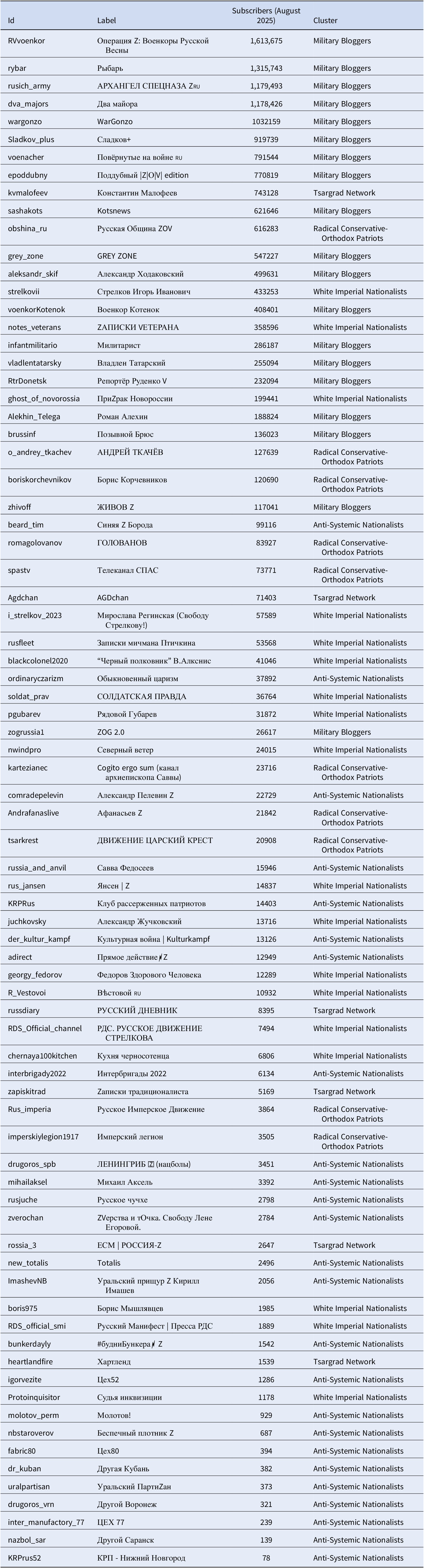
Table A1. Long description
A network graph visualizing the relationships between various Telegram channels. The nodes are color-coded by cluster: Military Bloggers in light blue, White Imperial Nationalists in orange, Radical Conservative-Orthodox Patriots in green, Tsargrad Network in purple, and Anti-Systemic Nationalists in pink.
At the center of the network is a dense core dominated by Military Bloggers, with the largest nodes being RVvoenkor, rybar, and rusich_army. These nodes have the highest degree of connectivity, shown by a thick web of gray lines connecting them to each other and to other clusters.
The White Imperial Nationalists cluster, featuring nodes like strelkovii and notes_veterans, is closely integrated with the central Military Bloggers.
To the right of the core is the Radical Conservative-Orthodox Patriots cluster, anchored by obshina_ru and o_andrey_tkachev.
The Tsargrad Network cluster, including kvmalofeev and Agdchan, occupies the upper-right periphery, connected primarily to the central bloggers and the green cluster.
The Anti-Systemic Nationalists cluster, with nodes like beard_tim and ordinaryczarizm, is located on the left and bottom-left periphery. While some nodes are connected to the core, many smaller nodes in this cluster are isolated or form small, separate chains at the far edges of the graph.
Appendix 3. Network metrics and robustness checks
All metrics were computed in Python 3.12 (NetworkX 3.2).
GWC = Giant Weak Component of the directed graph (largest subgraph in which nodes are connected when directionality is ignored). Telegram networks are typically asymmetric (information often flows one way); GWC ensures that all nodes participating in at least one repost relation are included, preserving the empirically observed communication structure without restricting the analysis to fully reciprocal ties.
LCC = Largest Connected Component of the undirected projection (used for robustness checks)
Reachability indicates the proportion of node pairs with finite shortest-path distance.
Densit:
$ D=\frac{m}{n\left(n-1\right)} $
 for directed graph and
$ D=\frac{2m}{n\left(n-1\right)} $
 for undirected graph
Average Path Length:
$ L=\frac{1}{N_r}{\sum \limits}_{i\ne j,{d}_{ij}<\infty }{d}_{ij} $
 , where
$ {N}_r $
 is the number of reachable pairs and
$ {d}_{ij} $
 is the length of the shortest directed path between
$ i $
 and
$ j $
 . Shortest paths were computed as unweighted, since each repost constitutes a single transmission event; thus, path length represents steps of diffusion, not message frequency.
Global Efficiency:
$ E=\frac{1}{n\left(1-n\right)}{\sum \limits}_{i\ne j}\frac{1}{d_{ij}} $
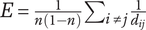 with
$ \frac{1}{\infty }=0 $
 for unreachable pairs. This measure captures the ease of information diffusion across the network, complementing
$ L $
 by incorporating disconnected pairs.
Descriptive Network Statistics for the Sampled Telegram Channels

Table A2. Long description
The table consists of eight columns: Graph, Nodes n, Edges m, Reachability, Density D, Average Path Length L, Diameter, and Global Efficiency E.
Row 1: Directed G W C graph has 78 nodes, 1,563 edges, reachability of 0.9615, density of 0.2602, average path length of 1.9020, diameter of 4, and global efficiency of 0.5836.
Row 2: Undirected Projection L C C graph has 78 nodes, 1,122 edges, reachability of 1.0000, density of 0.3736, average path length of 1.6593, diameter of 3, and global efficiency of 0.6813.
Appendix 4. The most influential telegram channels: Top-5 by weighted degree and betweenness centrality per cluster
Weighted Degree captures each channel’s overall prominence in the repost network by summing the frequency of incoming and outgoing repost ties, reflecting both visibility and activity. Betweenness Centrality measures brokerage—how often a channel connects otherwise separate parts of the network—calculated on an undirected graph (to capture reciprocal information flow between channels) with 1/weight as distance, so that stronger, more frequent repost ties represent shorter and more probable paths of information flow. For each cluster, the top-3 channels were selected based on the combination of these two metrics. Channels whose messages were used in the qualitative discourse analysis are marked in bold: these include both their own posts and reposted content, in which case references are made to the original source in qualitative analysis. The Tsargrad Network and Radical Conservative-
Most Influential Channels within Each Cluster: Top Five by Weighted Degree and Betweenness Centrality

Table A3. Long description
The table consists of four columns: Name of Cluster, Percentage of nodes, Channels with Highest Degree, and Channels with Highest Betweenness Centrality.
1. Military Bloggers: 24.36 percent of nodes. Highest degree channels are sashakots (5768), rybar (4294), epoddubny (3554), voenacher (3544), and voenkorKotenok (2810). Highest centrality channels are sashakots (0.476), wargonzo (0.433), voenkorKotenok (0.174), voenacher (0.054), and rybar (0.051).
2. White Imperial Nationalists: 23.08 percent of nodes. Highest degree channels are R D S _ Official _ channel (1726), ghost _ of _ novorossia (1555), soldat _ prav (1542), R D S _ official _ smi (1387), and notes _ veterans (1313). Highest centrality channels are ghost _ of _ novorossia (0.125), soldat _ prav (0.112), R D S _ official _ smi (0.093), R D S _ Official _ channel (0.060), and juchkovsky (0.052).
3. Anti-Systemic Nationalists: 32.05 percent of nodes. Highest degree channels are adirect (6859), bunkerdayly (2229), interbrigady2022 (2174), new _ totalis (1793), and beard _ tim (1733). Highest centrality channels are adirect (0.471), beard _ tim (0.404), new _ totalis (0.096), interbrigady2022 (0.052), and K R P Rus (0.026).
4. Tsargrad Network: 7.69 percent of nodes. Highest degree channels are Agdchan (1361), rossia _ 3 (850), kvmalofeev (466), zapiskitrad (211), and russdiary (98). Highest centrality channels are Agdchan (0.129), zapiskitrad (0.026), rossia _ 3 (0.002), heartlandfire (0.000), and kvmalofeev (0.000).
5. Radical Conservative-Orthodox Patriots: 12.82 percent of nodes. Highest degree channels are spastv (2012), Andrafanaslive (1960), boriskorchevnikov (1387), romagolovanov (1140), and obshina _ ru (730). Highest centrality channels are romagolovanov (0.076), boriskorchevnikov (0.056), Andrafanaslive (0.050), Rus _ imperia (0.026), and kartezianec (0.008).
Orthodox Patriots clusters were merged due to their ideological proximity. Consequently, three channels were selected for the combined cluster, with representation distributed proportionally to the number of nodes from each subcluster.
Appendix 5. Dependency parsing: Keywords for criticism of Russian authorities Footnote 74
Dependency-Parsing Dictionary: Keywords for criticism of Russian authorities

Table A4. Long description
The table is divided into two main categories.
* Keywords for political criticism: This section includes Russian terms and English translations such as to betray, to give away, to be cowardly, to be afraid, to drag or slow down, to remain silent, to make excuses, to surrender, to retreat, to deceive, to cover up, to interfere, to delay, to lie, to be late, to ignore, to hide, to fail, to sabotage, to hush up, to be inactive, to get greedy, cowardly, indecisive, slow, passive, weak, powerless, guilty, inadequate, detached, unresponsive, corrupt, failing, insignificant, ridiculous, pathetic, incompetent, criminal, bad, bribeable, backroom deal, failure, mistake, lie, inaction, incompetence, disgrace, inability, irresponsibility, lawlessness, corruption, betrayal, crisis, collapse, crash or failure, injustice, nepotism, mess, embezzlement, deceit, impudence, incapacity, criminal fund, idiocy, conspiracy, treason, to not be able, to not dare, to not intervene, to not take responsibility, and to not cope.
* Keywords for Russian authorities: This section includes Presidential Administration, Putin’s regime, Ministry of Defense, Duma Speaker, United Russia, Russian authorities, security apparatus, our leadership, our government, party of fear, Putin, Kremlin, M O D, Shoigu, Lavrov, Patrushev, siloviki or security forces, State Duma, Medvedev, Mishustin, F S B, M V D, United Russia members, degenerate generals, Nabiullina, Manturov, Peskov, and regime enforcers.
Appendix 6. Model card — ruBERT criticism classifier
Model
-
• Base: DeepPavlov/rubert-base-cased (Russian, cased, 12‑layer, 768‑hidden, 12‑heads, 180M parameters)
-
• Task: Binary sequence classification — criticism of Russian authorities (1) vs other (0)
-
• Framework: Hugging Face Transformers (Trainer)
Data and Labeling
-
• Corpus: Russian Telegram messages from national-patriot discourse
-
• Label definition:
-
○ Criticism (1): explicit or implicit negative evaluation of Russian authorities, leadership, or state institutions (incl. blame, calls for accountability, incompetence/lying frames)
-
○ Other (0): neutral/positive/non-political content/political content without evaluative blame/political content that assigns blame to foreign (non-domestic) authorities
-
-
• Split: stratified 80/20 (train/test)
-
• Preprocessing: whitespace trim; max_len=128; no oversampling
Training Configuration
Training Configuration of the RuBERT Criticism Classifier

Table A5. Long description
The table consists of two columns: Parameter and Value.
* Optimizer: Adam W.
* Learning rate: 2e minus 5.
* Weight decay: 0.01.
* Batch size: 8.
* Epochs: 3.
* Eval / Save: each epoch.
* Load best at end: True.
* Tokenizer: Deep Pavlov / rubert-base-cased with max length 128, padding, and truncation.
* Inference threshold: 0.5, noted as tunable via P R curve.
* Seed: 42.
Training Dynamics
-
• Selection criterion: lowest validation loss.
-
• Validation loss by epoch: E1 = 0.5302, E2 = 0.4649 (best), E3 = 0.4799.
-
• Best checkpoint: epoch 2 (used for all results).
Held-Out Test Performance
Classification Performance on the Held-Out Test Set

Table A6. Long description
The table consists of five columns: Class, Precision, Recall, F 1, and Support.
* Row 1, Class 0 (Non-criticism): Precision 0.887, Recall 0.764, F 1 0.821, Support 72.
* Row 2, Class 1 (Criticism): Precision 0.730, Recall 0.868, F 1 0.793, Support 53.
* Row 3, Accuracy: F 1 0.808, Support 125.
* Row 4, Macro average: Precision 0.809, Recall 0.816, F 1 0.807, Support 125.
* Row 5, Weighted average: Precision 0.821, Recall 0.808, F 1 0.809, Support 125.
Confusion matrix (threshold = 0.5).
Confusion Matrix of the RuBERT Criticism Classifier

Table A7. Long description
The table consists of two columns for predicted values and two rows for true values. The top header row contains Pred 0 and Pred 1. The first data row is labeled True 0 and contains T N equals 55 in the Pred 0 column and F P equals 17 in the Pred 1 column. The second data row is labeled True 1 and contains F N equals 7 in the Pred 0 column and T P equals 46 in the Pred 1 column. A footer note below the table reads F P forward slash F N Examples.
FP/FN Examples
Illustrative Misclassifications with Predicted Probabilities

Table A8. Long description
The table consists of three columns: Type, Example (R U), and Example (E N). It contains four rows of data.
* Row 1: Type is F P. Example (R U) shows p(crit) = 0.83 followed by a long paragraph in Russian. Example (E N) provides the English translation starting with ‘Relocated Russophobes have started to get squeezed’ and discussing the consequences for creative elites who fled abroad.
* Row 2: Type is F P. Example (R U) shows p(crit) = 0.71 followed by a paragraph in Russian. Example (E N) provides the English translation discussing ‘Vestoid propaganda’ and comparing it to Nazi propaganda, mentioning the concept of the ‘Absolute Other’.
* Row 3: Type is F N. Example (R U) shows p(crit) = 0.07 with a short sentence in Russian. Example (E N) translates this as ‘Vladimir Vladimirovich, are you going to keep meekly dragging your feet or will you start pushing the border back?’.
* Row 4: Type is F N. Example (R U) shows p(crit) = 0.11 with a paragraph in Russian. Example (E N) translates this as a critique of the S V O and the military-industrial complex, mentioning a lack of drones and electronic warfare components.
A note below the table explains that False Positives (F P) occur when the classifier fails to recognize rebuttals of quoted criticism, while False Negatives (F N) occur in short messages using rhetorical questions or direct address.
Note: Errors predominantly arise in two contexts. First, false positives occur when a post quotes or paraphrases criticism of Russian authorities (for example, attributed to Russian liberals or Western elites) and the author rebuts that criticism; the classifier reacts to the intense negative language but fails to recognize that the negativity is not the author’s stance toward domestic authorities. Second, false negatives concentrate in short messages where criticism is expressed primarily through rhetorical questions or direct address to officials, which provide few lexical markers of blame; as a result, the posterior for the “criticism” class is underestimated despite a clear oppositional intent.
Appendix 7. Keywords for critical patriotism and imperial nationalism frames
Frame Dictionary for Critical Patriotism and Imperial Nationalism

Table A9. Long description
The table consists of two columns: Frame and Keywords (with translation).
* Anti-immigration sentiments and Isolationism: Includes terms like incoming migrants, non-Russians, Russophobia, ethnic slurs for Central Asians, replacement of native population, and genocide of the Russian people.
* Anti-peace-deal conspiratorial thinking: Includes terms like regime loyalists, corrupt political deal, conspirators, traitors, fifth column, and shameful peace.
* Hawkish criticism: Includes terms like on a war footing, total war, complete victory, martial law, general mobilization, desk generals, incompetence, and sabotage.
* Left-wing Criticism: Includes terms like state capitalism, new national elite, de-oligarchization, comprador regime, nationalization, class struggle, and social justice.
* Populism: Includes terms like empty talk, elitists, oligarchs, clan-based oligarchy, anti-people, corrupt officials, rightlessness, and at the people’s expense.
* Religious language: Includes terms like holy war, sinful, Armageddon, apocalypse, co-religionists, Sodom, and battle of light and darkness.
* Revanchism and Exceptionalism (Russianness): Includes terms like real sovereignty, Greater Russia, ancestral lands, historical justice, Russian World, and civilizational state.
* Traditionalism: Includes terms like traditional values, Russian culture, ancestral traditions, large families, great ancestors, and historical memory.


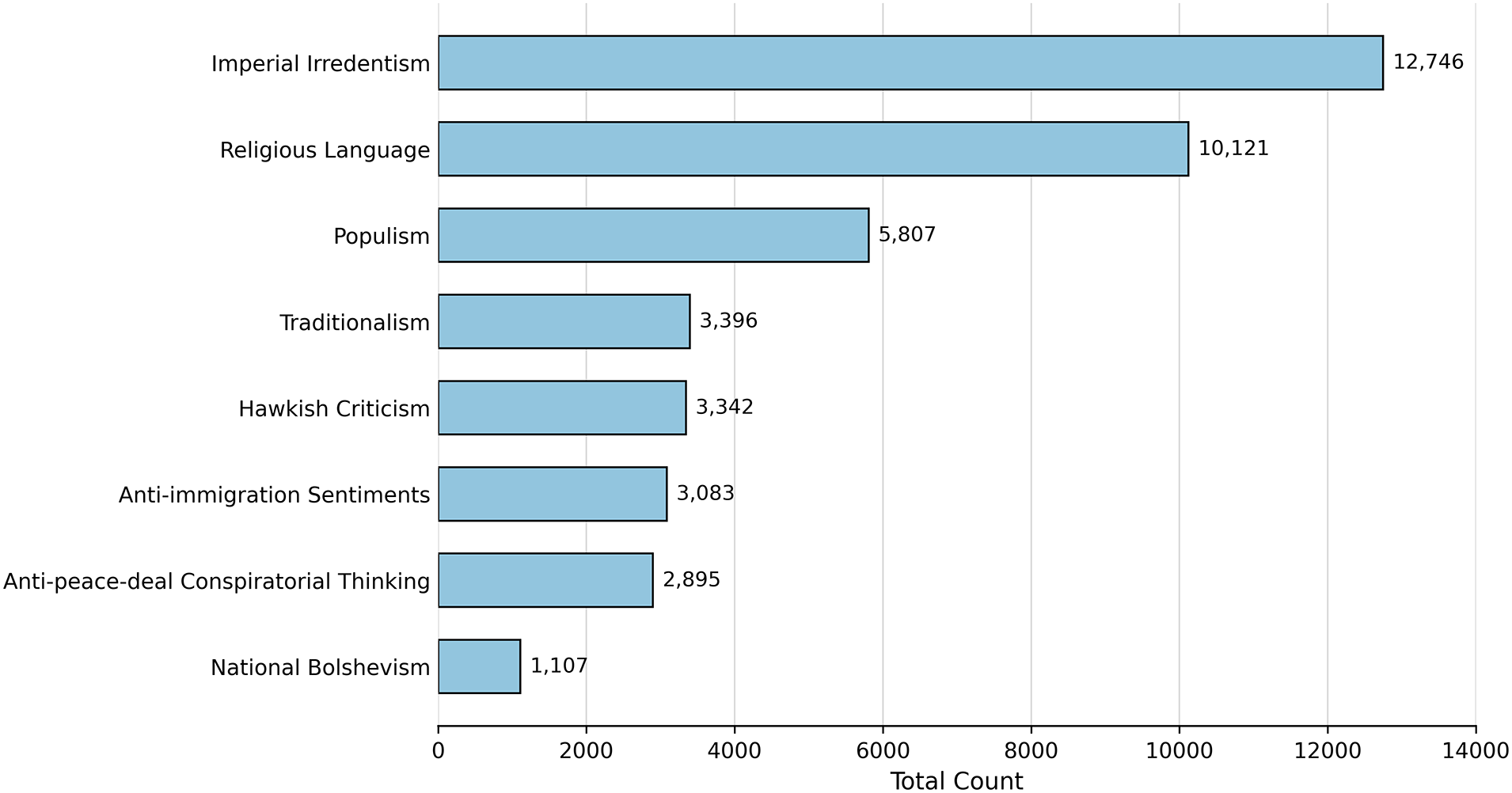
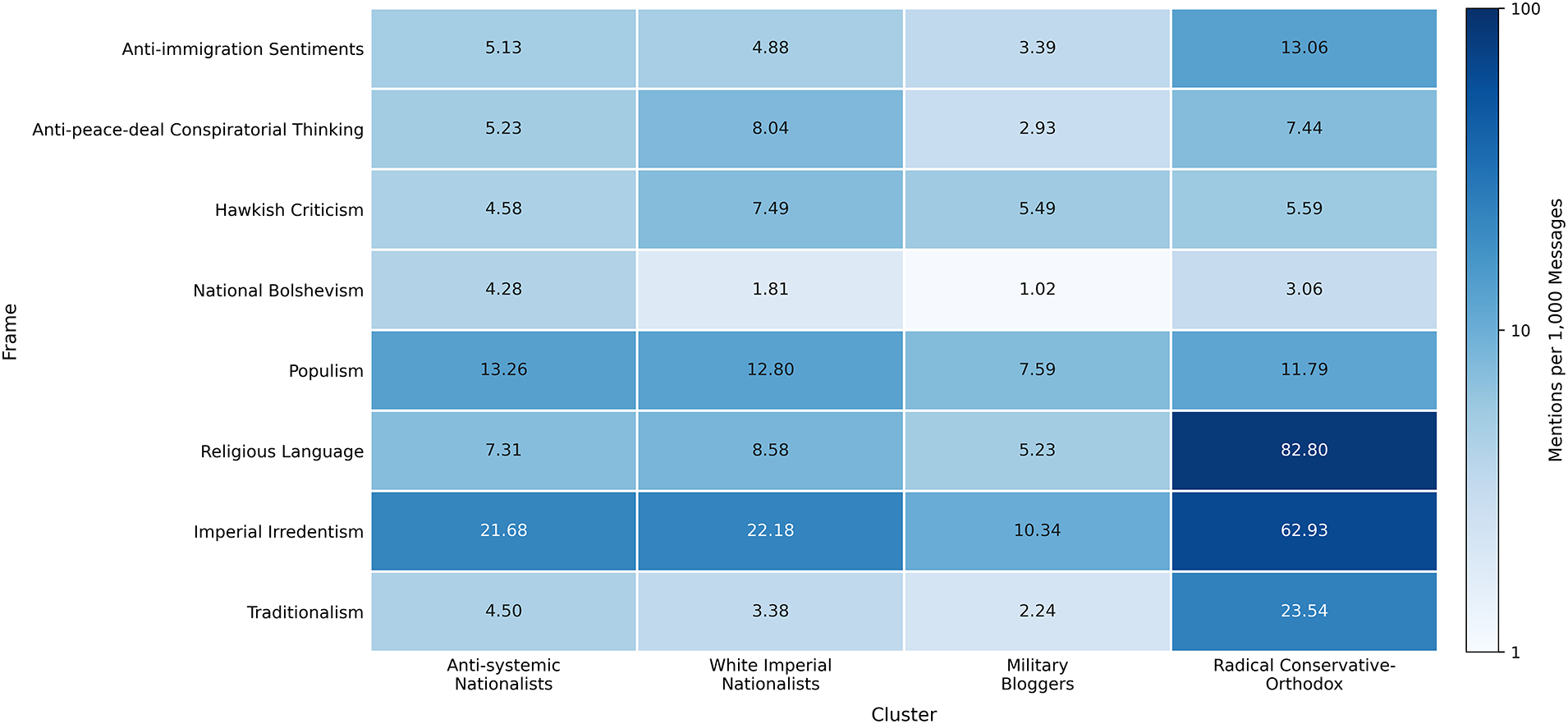


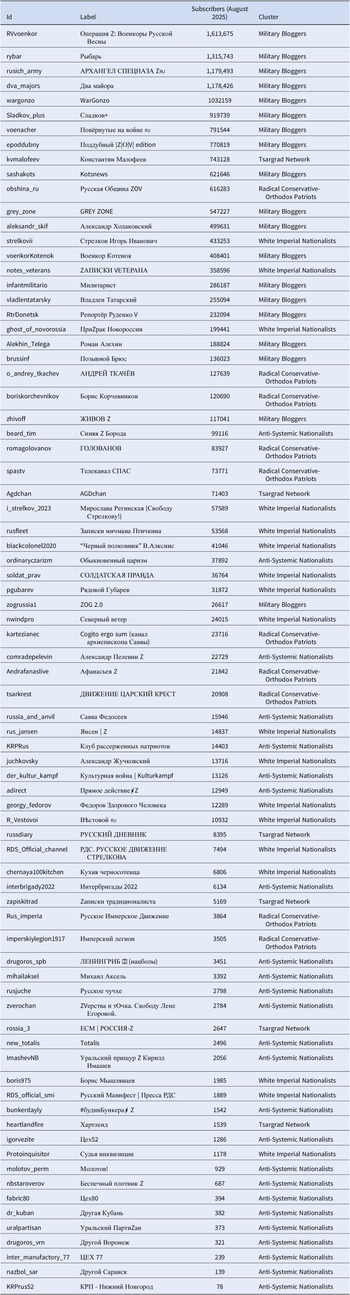

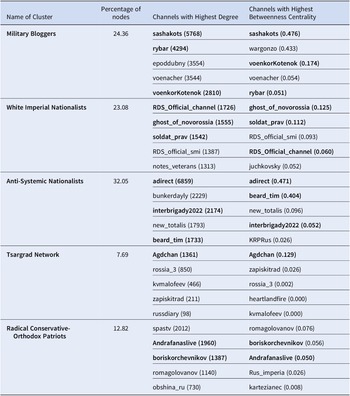


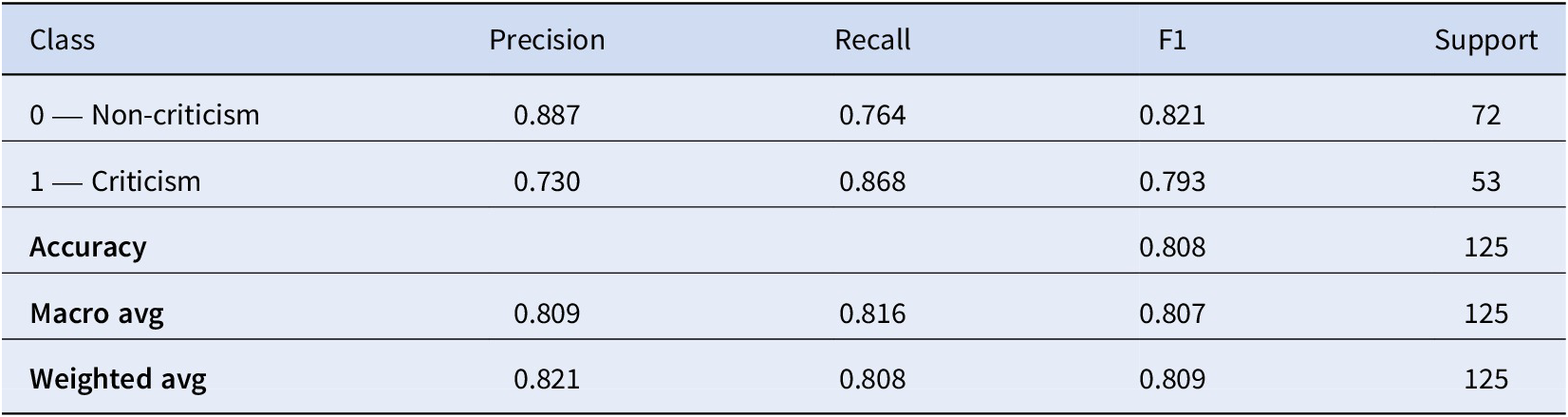



 Open access

