I Introduction
Since the BSE crisis occurred in 1996, a large number of food scares have dominated media reports across Europe, and recent trends show that alerts have not diminished, even though differences across EU Member States can be discerned. The horse meat crisis in 2013, the methanol poisoning in the Czech Republic in 2012, the E Coli in beansprouts in 2011 are just some of the crises which have recently occurred across Europe. Trends show that European consumers are increasingly concerned about food safety related issues, with a consequent perception of low protection given by regulation within this area.
Despite the institutional reform introduced by the EU since 2002, it is evident that an effectiveness problem persists within food safety regulation across EU Member States. Indeed, consumers’ perception of protection depends on food products’ safety, which in turn reflects the capacity of the food safety regulation to be effective. Protecting consumers from possible food-related risks and health consequences is today a crucial goal of any developed social statehood. Furthermore, food safety regulation has become a key factor in modern consumer policies, both at the EU level and at the state level.
Hence, effectiveness appears to play a central role within the complexity of food safety governance, and understanding how to measure it is crucial to assess what leads to effective governance and, on the other side, what hinders it.
In the attempt to give a perspective on effectiveness of regulation, some theoretical considerations are made, eventually proposing an empirical measurement.
The article is divided into five sections. In section II a preliminary definition of effectiveness is given, together with a theoretical perspective on its dimensions. Section III assesses existing operationalisations of effectiveness, distinguishing among food safety delivered and food safety perceived. In section IV an empirical measurement is proposed. Eventually, some final considerations are given.
II Theoretical perspective
Food safety regulation is particularly relevant due to the impact it exerts on public health and on businesses of the agri-food sector, and it also has to be placed within the broader framework of risk regulation. Indeed, food safety regulation has to do with many policy sectors, including consumer protection and public health, and literature suggests that its effectiveness can be identified with its two main policy goals: on one hand, the capacity to ensure consumer protection, and on the other hand, the capacity to protect producers’ interests, in order to ensure competitiveness within the market. Indeed, effectiveness can be understood as the level of success of institutional performance towards some objectives that motivated its establishment.Footnote 1 Furthermore, the capacity of consumer protection can be translated as the capacity of the regulation to minimise the risk for the consumer.
According to the wider literature on risk regulation, risk is made of two components: a component that cannot be eliminated, inherent to knowledge, and a component of deliberate risk.Footnote 2 The latter is the result of an opportunistic behaviour deployed by some actors to get a personal advantage.
An interesting perspective on success and failure of the institutional performance is the one developed by Elinor Ostrom with her Institutional Analysis and Development (IAD) framework.Footnote 3 Indeed, through the IAD framework it is possible to assess the behaviour of the actors involved in a so-called action situation, together with the opportunistic downside. According to this approach, rules introduce an element of intentionality and, insisting upon action situations, produce behaviours. Hence, opportunistic behaviour rises when rules allow that. Our hypothesis is that the institutional design is what impacts on the implementation of regulation, leading to effective governance or, alternatively, hindering it.Footnote 4 Indeed, the food safety regulatory arena is an example of a system of rules in which some behaviours are permitted and some other are forbidden, and it is possible to observe the paradoxical conflict between rationality and regulatory failure. Indeed, regulatory capture can still occur, as well as opportunistic behaviours or veto players’ interventions. Hence, understanding which rules have to be implemented to avoid opportunism is crucial. Indeed, in order to assess regulatory performance it is necessary to focus on behaviour modification. Thus, despite its application to the problem of the common resources, the IAD framework seems to be the most promising approach to assess institutions (ie rules) and the impact they exert on the regulatory outcome. Furthermore, this approach is consistent wth the concept of risk regulation regime, ie a system of rules, the institutional geography and practice associated with the regulation of a particular risk.Footnote 5 Hence, in order to assess the impact of the system of rules on the effectiveness of governance, it is crucial to understand how to measure the effectiveness of the system of rules of the food safety arena.
III Effectiveness: dimensions and measures
Within the context of food safety governance, it is possible to distinguish between safety delivered and safety perceived, and literature suggests that effectiveness of regulatory governance can be measured as both dimensions.Footnote 6
A systematic review of the empirical literature has been conducted in order to assess how the effectiveness of food regulation has been measured.
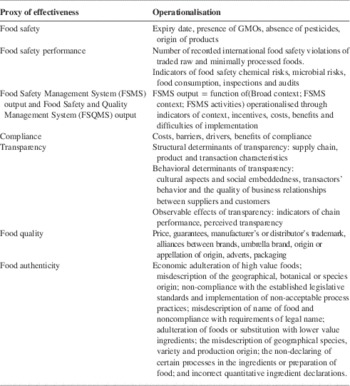
Referring to food safety delivered, our review reveals that existing measures do not seem to be satisfactory, particularly due to operationalisation gaps and data collection methods. Indeed, several studies use proxies of effectiveness which grasp only some of the dimensions of the concept, ie compliance, transparency, quality, authenticity (Table 1). Measures are incomplete, each focusing on a single dimension. Furthermore, most of the existing studies include surveys and interviews with businesses/private firms, who are the actors that have to comply with regulation, excluding completely the role both of the regulators and of the enforcement bodies (inspectors / controllers, local / national / supranational institutions).Footnote 7
Proxies of effectiveness and their operationalisation.

Source: own elaboration.
Referring to food safety perceived, literature suggests that effectiveness of regulation can be identified with its two main policy goals: the capacity to ensure consumers’ protection and the capacity to protect producers’ interests, in order to ensure competitiveness within the market. Thus, existing measures of consumers perception towards food safety governance across EU Member States have been assessed.Footnote 8 Most of the studies focus on the willingness to pay (WTP) and related concepts to food safety perceptions, together with consumer preferences and behavioural insights. However, existing studies are partial, often referring to few EU countries or comparing extra-EU countries or regions. Furthermore, most of the recent studies focus on recent debates on organic production, animal welfare, and the use of genetically modified organisms (GMOs) in food production. Referring to consumer confidence towards food safety regulation in Europe, Eurobarometer offers some insights, collected through a survey conducted in 2010.Footnote 9 However, perceptions have been measured towards European food safety regulation, without considering the national implementation and, thus, confidence towards national government and national agencies. The same considerations can be made regarding some Eurobarometer surveys on consumer perception of protection within the EU market.Footnote 10 Moreover, those surveys did not consider the safety of food products.
Therefore, there are not (yet) comparable data from EU Member States that would enable us to assess the effectiveness of food safety regulation within each country, in order to detect differences among them.
IV Towards operationalisation
We identified effectiveness of food safety governance with its capacity for protection. On one side, capacity of consumers’ protection, and thus, minimisation of risks, on the other side, capacity of protection of producers’ interests, and thus, guarantee of competitiveness within the market. Effectiveness of regulatory governance can be measured as both dimensions of safety, delivered and perceived. Thus, given that food safety regulation is particularly relevant for the impact it exerts on both consumers and producers, we intend to measure its effectiveness through the perception of protection of regulatees and of beneficiaries of the regulation.
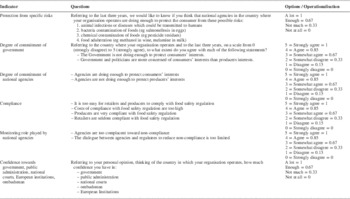
Our empirical proposal consists of a survey, that has to be conducted among the members of the most important national consumer organisations across 15 EU Member States, in order to collect data to measure the perception of protection as a proxy of effectiveness. The aim of the survey is to understand consumer perception of protection at the national level, and the role national agencies and governments play to ensure consumer protection and minimisation of risks related to food safety issues. To this end, we built a questionnaire that will lead to the construction of a perception of protection index. Several indicators have been identified, and together they will give us a measure of the level of protection perceived by consumers’ organisations across 15 EU Member States (Table 2).
Core indicators of perception of protection

Source: own elaboration.
The core indicators concern the perception of protection from specific risks related to food, and the degree of commitment of government and national agencies in ensuring both consumers’ and producers’ protection. Moreover, perception towards compliance is explored, in order to understand to what extent rules are perceived as decisive in the regulatory arena by regulatees and ultimate beneficiaries. Whether producers and retailers are perceived as very compliant with food safety regulation might indicate either that regulation is effective or that rules are too slack, but together with a severe monitoring role played by agencies can be interpreted as a high level of protection perceived and, thus, of effectiveness of regulation. Furthermore, perceptions towards compliance might indicate any capture risks.
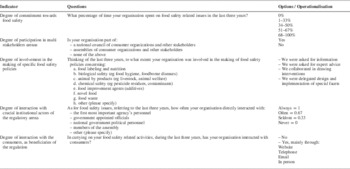
Added to core indicators, the survey includes indicators towards the consumer organisation respondents are working for, and its role within the regulatory arena.
Indicators to weight each consumer organisation

Source: own elaboration.
Thus, every consumer organisation will be weighted according to its relevance within the regulatory arena, its degree of interaction with crucial stakeholders and consumers, its degree of commitment towards food safety and its involvement in the making of specific food safety-related policies (Table 3).
Overall, the indicators will be operationalised and collapsed into an index, which will represent the measure of the effectiveness of food safety regulation across 15 EU Member States.
V Conclusions
The article aimed to review existing measures of effectiveness of food safety governance, and to give a theoretical perspective on how to operationalise effectiveness, eventually proposing an empirical measurement.
Given the scarce availability of comparable data, we proposed a new dataset, to be built through an online survey among the most important national consumers’ organisations across 15 EU Member States. Understanding how to operationalise effectiveness is crucial in order to assess the impact of the institutional design on the effectiveness of food safety governance.
Further analysis will focus on necessary and sufficient conditions associated with high and with low perception of protection, in order to detect and disclose differences among countries, and to assess under which conditions the institutional design leads to effective governance or, alternatively, hinders it.