Introduction
Nadir experience, that is, the experience of being at the lowest point of one's life, can lead to disintegration, powerlessness, emptiness, depression, anxiety and other negative outcomes. At the same time, though, negative life events are an unavoidable part of one's life. Evidence suggests that nadir experiences can lead to non-negative and even positive changes, such as an increase in spirituality, inner wisdom, compassion, a sense of meaning in life (Stagg, Reference Stagg2014), wellbeing, happiness and maturity (King, Reference King2001; Pals, Reference Pals2006; Pals Lilgendahl and McAdams, Reference Pals Lilgendahl and McAdams2011).
From the perspective of narrative gerontology (Kenyon et al., Reference Kenyon, Randall, Bohlmeijer, Kenyon, Bohlmeijer and Randall2010), autobiographic work on one's life story is the very essence of the process of life review and it can even be viewed as the key factor in reaching ego-integrity in older age (Butler, Reference Butler1963; Erikson, Reference Erikson1975; Wong and Watt, Reference Wong and Watt1991). Narrative analysis of the way nadir experiences evolve in this process suggests that positive resolution and exploratory or transformational narrative processing are highly important (Pals, Reference Pals2006; Whitehead and Bates, Reference Whitehead and Bates2016). In the present study, our aim is to describe the narrative characteristics of nadir experience processing in highly ego-integrated older adults in order to identify the ways in which nadir experiences are narratively enacted.
Ego-integrity and life review
In the last phase of Erikson's lifespan theory of human development, the main priority is to come to terms with one's life and to accept one's life history as ‘something that had to be’ and cannot be altered (Erikson, Reference Erikson1950: 268). Erikson identifies ego-integrity and despair as two forces which in this eighth stage of development play a crucial role. Reaching integrity requires ‘knowing who you are and why you are that way and still standing in favour or yourself’ (Hearn, Reference Hearn1977: 10). This process entails an honest and open recognition of the unpleasant parts of one's personal history. The force opposite to integrity is despair. In its extreme form, despair amounts to a realisation that one's life has been disappointing and one's true potential has not been realised. Despair is characterised by feelings of hopelessness, pessimism and even disgust. Lack or loss of integrity is often indicated by fear of death prompted by a realisation that one only lives once and there is not enough time to change things (Erikson, Reference Erikson1950). The life of a healthy person in the eighth stage of life entails both integrity and despair as fluctuating states, whereby integration amounts to absorbing and understanding the despair (Hearn, Reference Hearn1977). To reach a higher ego-integrity leads to the virtue of wisdom (Erikson, Reference Erikson1982).
To look back and think about the meaning of one's life can be seen as more urgent as people face the changes and losses that come with age. Erikson calls this process, which is crucial to the last developmental stage, a life review (Erikson, Reference Erikson1975). People ask questions such as ‘are my life and my self acceptable to me and the world?’ (Hearn, Reference Hearn1977: 21) and take a more reflective and evaluative retrospective look at their lives in order to integrate the present with their past experiences.
Life review has been analysed in many studies on reminiscence as a naturally occurring process of contemplating the past (Butler, Reference Butler1963). Reminiscing can help older people appreciate their personal integrity and the ways in which they managed to cope (Butler, Reference Butler1963; Wong and Watt, Reference Wong and Watt1991). As such, it can contribute to successful adaptation, especially if it integrates autobiographical memories with the identity of the reminiscing person (Wong and Watt, Reference Wong and Watt1991; Bohlmeijer et al., Reference Bohlmeijer, Roemer, Cuijpers and Smit2007). Preoccupation with the past can, however, also lead to inner conflicts, feelings of disgust and dishonesty, avoidance of the present, or inability to contemplate the future (Kenyon et al., Reference Kenyon, Randall, Bohlmeijer, Kenyon, Bohlmeijer and Randall2010), to obsessive or escapist reminiscing (Cappeliez et al., Reference Cappeliez, O'Rourke and Chaudhury2005) and other negative outcomes. Nonetheless, repeated studies have shown that reminiscence and life review can significantly improve depression and psychological wellbeing in older people (Bohlmeijer et al., Reference Bohlmeijer, Smit and Cuijpers2003, Reference Bohlmeijer, Roemer, Cuijpers and Smit2007) and have a positive effect on ego-integrity (Afonso et al., Reference Afonso, Bueno, Loureiro and Pereira2011).
Erikson's idea of life review has been further elaborated by narrative gerontology, a relatively new field in the study of ageing that is based on the life-story metaphor (Bruner, Reference Bruner1996; McAdams, Reference McAdams1996; Kenyon, Reference Kenyon, Birren, Kenyon and Ruth2004). Within narrative gerontology, understanding and interpretation of one's experience is realised through the creation of stories (Bohlmeijer et al., Reference Bohlmeijer, Westerhof, Randall, Tromp and Kenyon2011). This gives individuals a sense of predictability and control over their lives (Pennebaker and Seagal, Reference Pennebaker and Seagal1999). The process of ageing implies autobiographical work, a process of revising one's life story and its meaning. Life story is necessarily a hypothetical construct, because it is never, at no stage, quite definitive and whole (McAdams, Reference McAdams2001; Pasupathi and Mansour, Reference Pasupathi and Mansour2006). Life story is rather a selection of self-defining memories (Singer et al., Reference Singer, Blagov, Berry and Oost2013) and personally important events, of experiences that became central to a person's understanding of who they are (Fivush et al., Reference Fivush, Habermas, Waters and Zaman2011). Key self-defining memories are the peak experiences, the nadir experiences and the turning points which help describe the storyteller as a coherent and complex human, be it by demonstrating his or her consistency through time or by reflecting and explaining changes that took place (Fivush et al., Reference Fivush, Habermas, Waters and Zaman2011). Self-defining memories are integrated into the life story by an evaluative process of ‘autobiographical reasoning’ (Habermas and Kober, Reference Habermas and Kober2015), which entails the creation of connections between past and present experiences and various aspects of the self.
Nadir experiences and their integration into a life story
Kenyon et al. (Reference Kenyon, Randall, Bohlmeijer, Kenyon, Bohlmeijer and Randall2010) suggest that reviewing one's life is a natural conscious phenomenon that can take place in various tranquil forms through nostalgia, reminiscing, small regrets or storytelling with varying degree of emotion. Within this process, unresolved events which happened many years earlier resurface and are addressed. A person reviews the past to understand the present. Life review is selective, and for most people it is a combination of hard objective truths and a softer lens through which they remember their less-noble acts (Butler, Reference Butler and Doka2002). Some memories are recalled with clarity and focus, others are indistinct and blurry, and sometimes events are too painful to revisit. Some people judge themselves harshly for minor hurts they inflicted by word or deed many years earlier. Kenyon et al. (Reference Kenyon, Randall, Bohlmeijer, Kenyon, Bohlmeijer and Randall2010) suggest that some participants of their study were not introspective and presented illusory tendencies, some used preoccupation with the past to avoid contemplating the future, while others remained as detached and uncommitted as they had always been. On the other hand, however, the authors of this and another study (Vaillant, Reference Vaillant2002; Kenyon et al., Reference Kenyon, Randall, Bohlmeijer, Kenyon, Bohlmeijer and Randall2010) tried to remove the stigma associated with life review and reminiscing among older adults by arguing that life review is not triggered predominantly by pathological tendencies, such as a desire to escape the reality of the present. They present it as a normal process which emerges from a desire to enjoy, grow, cope or change.
A good life story inevitably contains negative life experiences, so-called ‘nadir experiences’ (King, Reference King2001). The concept of nadir experiences was first coined by Thorne (Reference Thorne1963) as the subjectively felt lowest points in one's life, that is, as the opposite of peak experiences (Maslow, Reference Maslow1962). People usually identify their nadir experiences with ‘death, illness, tragedy, loss, degradation or deflation of self’ (Thorne, Reference Thorne1963: 249), and typically present are strong negative emotions such as disappointment, helplessness or despair (McAdams, Reference McAdams1995). While a peak experience provides a sense of intense happiness and oneness with the world (Maslow, Reference Maslow1962), with a nadir experience a person tends to feel alone, vulnerable, may lose the sense of a ‘predictable and safe world’ (Kumar, Reference Kumar2005: 7), and often experiences a dramatic change in life (Stagg, Reference Stagg2014).
Stagg (Reference Stagg2014) investigated nadir experiences and circumstances under which they can result in a positive growth. He describes the stages and different types of nadir experience: traumatic, psychological and spiritual crises, and attendant feelings of disintegration, powerlessness and emptiness. He also emphasises the difference between reflection and rumination and the importance of reincorporation, which takes the form of focus on life after the event rather than on the loss (the contrast between moving on or becoming stuck in the episode). Reincorporation can lead to finding new ways of relating to others, to positive spiritual changes, discovery of a new meaning to one's life, inner wisdom, increased compassion and transformation of one's life priorities.
Similar observations are found also in literature on post-traumatic growth. It has been observed that traumatic events can lead to personal growth (Tedeschi and Calhoun, Reference Tedeschi and Calhoun1996, Reference Tedeschi and Calhoun2004) and persons who experienced traumatic events often report improvement in relationships, greater compassion, better appreciation of life and increased personal strength (Tedeschi and Calhoun, Reference Tedeschi and Calhoun1996). An important factor in this process is ‘event centrality’. In particular, if a traumatic event becomes central to one's sense of identity (Boals et al., Reference Boals, Steward and Schuettler2010; Lancaster et al., Reference Lancaster, Kloep, Rodriguez and Weston2013) or touches upon one's core beliefs (Tedeschi et al., Reference Tedeschi, Calhoun and Cann2007), it has the potential to lead to long-term positive changes. A successful resolution of ‘wisdom-facilitative experiences’ also plays a substantial role in achieving wisdom (Baltes et al., Reference Baltes, Staudinger, Maercker and Smith1995), which is, within Erikson's eight stages of lifecycle, viewed as a ‘virtue’. It is also crucial for gaining resilience, specifically the ability to ‘bounce back’ after adverse or traumatic events (Bonanno, Reference Bonanno2004; Randall et al., Reference Randall, Baldwin, McKenzie-Mohr, McKim and Furlong2015; Dubovská et al., Reference Dubovská, Chrz, Tavel, Poláčková Šolcová and Růžička2017).
Structuration of events and feelings into a narrative form facilitates coping, because emotions connected with negative experiences become manageable and constructed stories create a sense of resolution (Pennebaker and Seagal, Reference Pennebaker and Seagal1999). Difficult events which are not processed into a narrative may result in enduring negative thoughts and feelings (Pennebaker and Seagal, Reference Pennebaker and Seagal1999). For example, a successful assimilation of bereavement into a self-narrative can provide bereaved people with a meaningful explanation of their loss (Neimeyer, Reference Neimeyer2006). Where such an integration is impossible, the loss can invalidate the core themes and beliefs of one's life story and result in ‘protracted search for meaning’ (Neimeyer, Reference Neimeyer2006: 143) and chronic grief.
King (Reference King2001) studied the characteristics of nadir event narratives of happy and mature people. According to her findings, happiness is related to foreshadowing, that is, signs in the story which refer to an approaching tragedy or to happy endings. The strongest narrative pattern she found in mature people was accommodation, which is operationalised as a combination of a degree of paradigmatic shift, exploration viewed as a measure of how much the person struggled with change and described this struggle, and active versus passive involvement of the narrator (King, Reference King2001). Along somewhat similar lines, Pals (Reference Pals2006) identified two key characteristics of difficult event narration which can aid personality development. Firstly, she found that exploratory narrative processing, that is, the extent to which a person is in his or her narration open to exploration of negative and ambivalent thoughts and feelings, which can in turn lead to possible reinterpretations of the self, is positively linked to maturity. Secondly, she found that a coherent positive resolution, that is, the ability to find a positive meaning in the story, is positively associated with personality traits of ego-resiliency and wellbeing (Pals, Reference Pals2006). Pals Lilgendahl and McAdams (Reference Pals Lilgendahl and McAdams2011) used these concepts in another study and likewise found that exploratory processing of difficult life events is related to personal wellbeing. In another study, Whitehead and Bates (Reference Whitehead and Bates2016) described how transformational processing of peak and nadir experiences is significantly related to eudaimonic and hedonic wellbeing.
Narrative approach as the basis for understanding life stories
In our approach to narrative analysis of life stories, we follow on the work of Erik Erikson, Dan McAdams and Jerome Bruner, and understand life story as a narrative representation of the past, present and future of the person (McAdams, Reference McAdams2001), as well as an ‘internalized and permanently evolving story of the self’ (McAdams, Reference McAdams, John, Robins and Pervin2010: 242). Life stories are always fluid, never definitive and whole, and they reflect certain social and cultural contexts (Pasupathi and Mansour, Reference Pasupathi and Mansour2006; Randall et al., Reference Randall, Baldwin, McKenzie-Mohr, McKim and Furlong2015). We also reflect the less-essentialist position according to which life stories are to some extent socially constructed, the self is viewed as a ‘narrative in process’ (Polkinghorne, Reference Polkinghorne1988: 154), and there are important differences between ‘the identity story as it is lived, and the story as it is told’ (Polkinghorne, Reference Polkinghorne1996: 365). In other words, ‘the self is always more than any one narrative can hold’ (Day Sclater, Reference Day Sclater2003: 322). Narratives are ‘social encounters’ (Stanley and Temple, Reference Stanley and Temple2008), which are moreover characterised by selectivity and ‘situational pragmatic objectives of the teller’ (Lucius-Hoene and Deppermann, Reference Lucius-Hoene and Deppermann2000: 200).
When selecting our discursive means, we choose what is important for us and through narratives we construct our narrative positions (Bamberg, Reference Bamberg1997). By choosing stories which we decide to tell others, we influence not only how others perceive us but also how we perceive and understand ourselves (McLean et al., Reference McLean, Pasupathi and Pals2007). Moreover, in narratives we negotiate how we ‘want to be known’ in collaboration with real or imagined audiences (Riessman, Reference Riessman, Gubrium and Holstein2001).
Methods
The present study is part of a large cross-cultural study where tests of some psychometric measures, such as wellbeing, satisfaction, ego-integrity and generativity, were administered together with the Life Story Interview (LSI) (McAdams, Reference McAdams1995) to older adults in four countries, namely Germany, Czech Republic, Cameroon and China (Hofer et al., Reference Hofer, Busch, Au, Poláčková Šolcová, Tavel and Tsien Wong2014, Reference Hofer, Busch, Poláčková Šolcová and Tavel2017a, Reference Hofer, Busch, Raihala, Poláčková Šolcová and Tavel2017b). In the present study, we used the data of 166 Czech participants, from whom we selected for the LSI analysis a sub-sample of 42 individuals who formed the top quartile with the highest score on the ego-integrity scale, including some who achieved identical scores (Ryff and Heinke, Reference Ryff and Heincke1983).
Sampling and data collection
Older adults (65+) were contacted via flyers and notes placed in seniors’ clubs in Prague and Olomouc. All participants took part in the study voluntarily and received assurance that all information provided by them would be treated anonymously and confidentiality would be observed. All participants at the time lived independently in their own households. Instruments were administered individually. First, participants took a brief test of cognitive performance (to exclude participants with dementia), then they received questionnaires and provided information about their basic socio-demographic characteristics. Finally, the LSI was administered by experienced interviewers.
The total research sample consisted of 166 participants (mean age = 71.39 years, standard deviation (SD) = 5.77; 92 women). For the LSI analysis, we selected a sub-sample of 42 participants who formed the upper quartile of the sample (and persons with identical scores) with respect to the highest score on the ego-integrity scale (ego-integrity mean = 3.89, SD = 0.26). The average age of the sub-sample (17 men and 25 women) was 70.02 years.
Tools
Ego-integrity scale
The ego-integrity scale, developed by Ryff and Heincke (Reference Ryff and Heincke1983), is a 16-item measure based on Erikson's lifespan theory of psycho-social development. It includes statements such as ‘My life has been fulfilling, and I am not frightened by the thought of death’, ‘I wish my life were just beginning so I could avoid many of the mistakes I made earlier in my life’ (reverse coded) and ‘All in all, I am comfortable with the choices I made regarding my life's work’. Participants were asked to rate themselves using a four-point Likert-type scale ranging from ‘strongly disagree’ to ‘strongly agree’. Internal consistency of the scale measured by Cronbach's α was 0.8.
Life Story Interview
The LSI (McAdams, Reference McAdams1995, Reference McAdams2005) is a frequently used, standardised form of interview protocol which helps participants structure their life stories. The LSI guide proposed by McAdams (Reference McAdams1995, Reference McAdams2005) integrates various synchronic aspects of the individual across situations and social contexts. Older adults were interviewed with focus on several key life episodes (peak experience, nadir experience, turning point, important childhood, adolescent and adult memories), main characters (people and communities which influenced their life in positive and negative ways) and ideas (positive and negative future expectations, life theme, cultural expectations). Interviews were administered by three experienced researchers and took between 92 and 124 minutes.
LSI data were transcribed word by word and analysed independently by the first and second authors. Analysis focused primarily on the narrative construction of nadir experiences but took into account also other parts of the LSI if they were relevant for understanding of a particular nadir experience.
Analytical categories and procedure
As noted above, ageing well requires ‘narrative (autobiographical) work’ (Randall and McKim, Reference Randall and McKim2008). We approach this subject with a general assumption that one's life experience is indeed narratively structured and/or constructed. This is where Bruner's (Reference Bruner1996) thesis comes in, which states that at the core of a narrative is ‘trouble’, that is, a deviation from the expected, a disruption of the established order. As Bruner (Reference Bruner1996: 99) says, ‘trouble is the engine of narrative’. The analytical procedure used in this study uses insights from our earlier work where we defined narrative transformation of events in terms of ‘what the narrative does with a constitutive event defined as “trouble”’ (Chrz and Čermák, Reference Chrz and Čermák2015: p. 4; Chrz et al., Reference Chrz, Dubovská, Tavel, Polačková Šolcová and Čermák2016). The aim of our analysis was to identify distinctive types of narrative enactment characteristic of the ways in which highly ego-integrated older adults construct narratives of their negative experiences.
From the perspective of discriminating between various approaches to narrative analysis (Lieblich et al., Reference Lieblich, Tuval-Mashiach and Zilber1998), this is a ‘holistic-formal’ kind of analysis and a structural analysis according to Riessman (Reference Riessman2008). An example of analysis aimed at identification of a global configuration is analysis of a genre (Murray, Reference Murray1985) or a plot (Ahmed, Reference Ahmed2013).
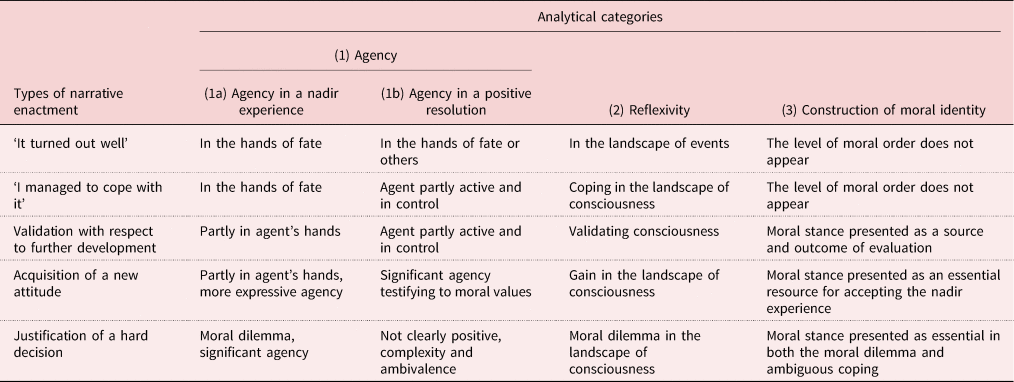
In the present study, we call these global configurations ‘types of narrative enactment’ and they all share the basic combination of negative event and positive resolution. Various types of enactment are characterised by different configurations of analytical categories: (1a) agency in a negative event, (1b) agency in a positive resolution, (2) reflexivity and (3) construction of moral identity.
Our analysis proceeded in four steps. First of all, we performed open coding and identification of ways of narrative enactment which started to emerge. Secondly, we performed a repeated bottom-up/top-down analysis characterised by movement from patterns found in the data to narrative concepts and theories, and then back to the data, with the aim of establishing a system of analytical categories. These stages of analysis were performed by the first and second author of the study separately. Their results were then compared and, with participation of the third author, a final list of categories (Table 1) was agreed on. In the third stage of the analysis, we re-analysed all data from the perspective of outlined categories and identified the actual global configurations with one of the five types of narrative enactment.
Types of narrative enactment

Within this framework, we distinguished within the process of narrative transformation (i.e. narrative and/or autobiographical work) several factors which correspond to analytical categories: (1a) agency in a nadir experience, (1b) agency in a positive resolution, (2) reflexivity and (3) construction of moral identity.
(1) Agency
Narrative enactment of trouble is constructed with a certain degree and form of agency. According to Bruner (Reference Bruner1996), a story consists of ‘an action and its reasons’. To have a reason usually involves having an intention or aim, which in turn implies a certain degree of freedom and some form of responsibility for action. People construct various kinds of agency based on perceived capacity to act under particular circumstances given their abilities and commitments. In other words, agency describes ‘a certain way and degree to which actors position themselves as active agents (Bamberg, Reference Bamberg1997) by constructing characters which have the power to achieve what is desirable and avoid what is not desirable’ (Chrz, Reference Chrz, Miovský, Čermák and Rehan2004).
When studying agency within a narrative enactment of nadir experience, we discriminate between two parts of the story: a negative event and a positive resolution. This distinction enables a finer differentiation between different forms of narrative enactment.
(1a) Agency in a negative event
In this sub-category, we analyse how and to what extent agency was narratively constructed when speaking about a negative event (e.g. ‘it just happened’ versus ‘I have done’).
(1b) Agency in a positive resolution
Although a positive resolution is a common denominator of all integrated nadir experience stories, there are different ways of constructing one's capacity to act and one's responsibility for the final resolution.
(2) Reflexivity
Narrative enactment of trouble is also characterised by some form and degree of reflexivity. This takes place within two distinct ‘landscapes’: the ‘landscape of action’ and the ‘landscape of consciousness’ (Bruner, Reference Bruner1996). In the ‘landscape of action’, events or actions are represented as if from the outside, oftentimes from the perspective of an omniscient and omnipresent observer. In this landscape, things just happen and how they are perceived is unimportant. The ‘landscape of consciousness’, on the other hand, includes everything the actors know, wish, feel, intend and strive for, as well as what they do not know, do not think or do not feel.
(3) Construction of moral identity
Autobiographical narratives explicitly or implicitly include various interpretations of ‘What goes on in life’, i.e. answers to questions such as ‘What is good?’, ‘What is worth striving for?’ or ‘What is the right action to take?’ In this way, narrators construct a system of values and beliefs (Bruner, Reference Bruner1996; McAdams, Reference McAdams1996; Gergen, Reference Gergen1997). They present themselves within the narrative as having a particular moral stance or moral identity (Gergen, Reference Gergen1997). In short, ‘Narratives are evaluative frameworks and thus to tell a personal story is to take up a moral position – it is to make a claim for a particular moral dimension for the self’ (Day Sclater, Reference Day Sclater2003: 320).
Results: types of narrative enactment of the nadir experience in highly ego-integrated seniors
A simplified outline of the five types of narrative enactment and their relation to the individual analytical categories is presented in Table 1.
‘It turned out well’
The first type of nadir experience enactment found in ego-integrated people are narratives where things at first look terrible but eventually turn out well. Compared to other types of narratives, participants construct them with a relatively small degree of agency. This is reflected in the passive grammatical constructions used: these stories tend to feature expressions such as ‘it’ looked terrible and ‘it’ worked out well. A typical example of this type of experience are stories of illness or injuries, both one's own and of a close person, as demonstrated in the following narrative. In the introductory part, the respondent, Peter, describes how he learned just before Christmas that doctors suspect his wife suffers from cancer:
It looked like a malignant tumour and I cried the whole way from the hospital to the apartment. But then it did not turn out so madly malignant. Because I had the idea that … it would be a malignant bone tumour and that in at most two years she would die, and what I would do with a baby and so on. So it was … the worst moment. It went well then, that is, she did not lose her life, she did not lose her arm, they started to operate, to treat her in all kinds of ways, the operations were three in essence, but, well, thank God, it turned out well.
What is the invariant in this type of narrative? There is a significant negative event, something that looks terrible. In most of our cases, the negative event took the form of medical complications. In the end, however, things worked out well, better than expected, so that eventually we find here – as in other types of nadir experience enactment in ego-integrated persons – a positive outcome. Neither the negative event nor the positive resolution are constructed as being due to the narrator's agency. Instead, the narrator accepts the events or actions of others. The story is driven by what takes place in the ‘landscape of events’, where experiences, thoughts and other elements of the ‘consciousness landscape’ focus on responding to the terrible event or to the fact that everything turned out well. Compared to other types of narrative enactment of nadir experience in ego-integrated seniors, these stories include very few moral identity statements: things look terrible at first and then turn out well.
‘I managed to cope with it’
In another type of narrative, the negative event is – as in the previous one – in a sense in the hands of fate rather than orchestrated by the narrator. A typical case is the loss of a close person or a miscarriage. Essential to this type of narrative is that the positive result takes the form of coping with something that did not turn out well, that is, the result is achieved in the ‘landscape of consciousness’. This can be demonstrated in the following narrative about a miscarriage where the respondent, Suzanne, speaks about how she managed to cope because she had other children:
Before I had my first baby, I had a miscarriage, and I was quite ill, a little, psychically, from that, because I lost the baby. There was a fire here at my neighbours and somehow, I got frightened and it had an effect on it, and then it was about three months after that, so somehow then it affected my health then.
And then I got out of it somehow, like I rose up from it, and then I had my first child … Well, then, I just coped with it then … I had two kids, so (laughs).
In this story and in this type of narrative in general, respondents construct the nadir experience as something that had a negative impact on them, something they did not cope with well at first. Unlike in the previous type of narrative, though, the positive result or positive resolution is not found in the ‘landscape of events’ but in the ‘landscape of consciousness’. As in the previous type of narrative, moral identity statements feature here very rarely.
Variations within the invariant described here are based on the extent to which the coping and managing of the nadir experience are presented as an active process or as something that, for example, ‘life brought’ or ‘time healed’. This is also reflected in the grammar used: we find here a variety of expressions ranging from active constructions, such as ‘I managed to coped with it’, all the way to passive constructions, such as ‘it stopped aching’.
Validation with respect to further development
In interviews with highly ego-integrated older adults, we also find narratives where a difficult time in life or a decision associated with it are narratively constructed as being in a sense validated by future developments. In some cases, such enactment of life's greatest hardships was associated with the Soviet occupation in 1968 and subsequent emigration. An example of this kind of narrative is the following story told by Charles:
I was 25. I finished my studies, I had a plan with my colleagues from Bratislava: an orchestra, we were about to travel, and then the ‘friendly allies’ came from Russia. The band was not allowed out because I had contacts with Austria and Germany. I packed one bag and my trombone. I went out and got to Vienna. I was looking for a job … I did not have money, I was hitchhiking. I was sleeping at friends’ places … You did not know what was going to happen. In Nuremberg, I met a Bratislava band. We stole potatoes and ate a soup made of a Maggi cube. We wanted to travel around Europe. Then we should have returned but if I came back, they would have immediately locked me up.
The narrator identifies the hardest period of his life with the initial period after emigrating in the aftermath of the Soviet occupation. The decision to emigrate is narratively validated by the fact that had he returned he would have faced prison. Here, however, evaluation appears also outside the description of the nadir experience itself, in parts of the interview where the respondent speaks about his teaching activities in Germany.
This type of narrative about nadir experiences typically includes a difficult period related to a decision that is ultimately validated by a positive or more favourable future development. Another variation of this pattern is found in the following narrative by Amy, which again deals with a negative experience in the totalitarian regime in Czechoslovakia and subsequent decision to emigrate:
My brother died tragically, in special circumstances, as we learned later. Well, it had a terrible impact on me, you could say, for several years. Well, when we found how it all happened, I appreciated even more where I ended up because I think – and my parents thought so too – that my brother was a victim of sabotage, of a big game where human lives are not valued … That impacted me a lot. And like I said before, I was glad I didn't live here in the Czech Republic … I had very negative feelings and opinions about the regime here in the Czech Republic and this terrible event only confirmed to me that the occupation of the Czech country had cost a lot of money, many human lives and, as far as the development of the Czech nation is concerned, it threw it back or at least it slowed it down.
Here, the respondent is telling a story about later learning something that reconfirmed her decision to emigrate and live outside Czechoslovakia. It added value not only to her decision to live elsewhere but also to the negative period, thus forming a contrast and providing an additional reason which validated future events.
From the point of view of agency, reflection and moral stance, this type of narrative about nadir experiences can be understood as follows: negative events are constructed as being in part due to ‘fate’ (totalitarian regime or Soviet occupation), but partly also the result of a decision (here, as in the first case, a decision to emigrate); the positive result is identified with a favourable turn of events which resulted from the narrator's decision (here, decision to emigrate), so that both the positive development, and in part also the negative event, are presented as being directed by the narrator. With respect to reflection, this kind of narrative is substantially represented in the ‘landscape of consciousness’, whether it be the decision to emigrate or – and that above all – the positive result. The result is identified not only with a particular way things turned out but also with ‘validating consciousness’ or awareness of validation. This is especially apparent in the second example, where the protagonist's decision was ‘confirmed’, ‘appreciated even more where she ended up’ and ‘was glad she didn't live here in the Czech Republic’.
In comparison with the previous two types of narrative, this has a more pronounced aspect of moral identity. An essential part of this narrative enactment is a belief that is based on certain values and moral standards. This belief validates a particular decision and hence also the negative experiences which resulted from that decision.
Acquisition of a new attitude
In some of the narratives of the ego-integrated older adults who participated in our study, we found a type of negative experience enactment that was similar to the two above-mentioned types but marked by a more expressed agency, reflection and moral identity statements. The common denominator of these narratives of negative experience was that the positive result took the form of a new positive attitude.
One of the respondents, Carl, spoke of occasions when he ‘refused to repent’ after the Soviet occupation in 1968 and consequently lost his job. Instead of a promisingly developing scientific career, he became a labourer:
I was laid off, almost got arrested and suffered from those political problems that would follow … I thought I would be a scientist, but I lost the job and went on to be a labourer, and an assistant labourer I remained. Interrogations by the Secret Police … it was a collapse of ideas.
In the narrative, the respondent expresses how he experienced these events as negative, speaks of his fears about whether he would manage to provide for his family and whether this would have a negative impact on them. At the same time, however, he also presents himself as having been liberated, as reaching some sense of satisfaction, and as an almost heroic figure who shook off his fears:
But at the same time, it was accompanied by a great feeling of liberation, so I cannot say that I felt it was tragic … The fear disappeared very quickly. I would not say that what followed was euphoria, but there was some satisfaction from that development. Self-satisfaction … I think it had a very positive impact on me. Well, on my attitude to life and everything, so I'm glad it turned out like that.
The respondent constructs the negative event as something that had a positive influence on his attitude to life. As with other types of narrative enactment presented here, the outcome is positive. What is the specific feature of the positive outcome in this type of nadir experience enactment? First of all, we find here a more pronounced form of agency. Negative events recounted in the narrative above are in part due to the protagonist's refusal ‘to repent and be subdued’ by the structures of the occupation regime. By adopting this stance, the narrator presents himself as having passed a moral test: he constructs a story about having faced his fate with a significant degree of personal agency, thus proving and validating his values and beliefs. The outcome was profit in the ‘landscape of consciousness’ in the form of acquisition of a new attitude, a sense of freedom and liberation from earlier fears.
Our sample of narratives of ego-integrated older adults contains several other narratives which are variations on similar patterns. In one of these narratives, the negative event is a woman's death due to a serious illness. The respondent, Stephen, describes the impact of this event (‘at that moment, it destroyed me … in a way, the world ended for me’), but the overall outcome is again constructed as positive: this experience gave him strength with which he faced its negativity and that resulted in a new attitude (‘it taught me to take things much more realistically’). In another narrative (Jane), a negative experience from a romantic relationship led to a realisation that one must forgive (‘it was my worst experience, but I know I have to forgive, not to pull it with me, throw it out of my head’).
In this type of narrative, the invariant is that a negative experience leads to the adoption of a new attitude, a new outlook on life. Narrators of these stories do not repress the negativity of events they experienced, events which are sooner or later validated in the ‘landscape of consciousness’. A new attitude which emerged in consequence of negative events is presented as a valued contribution to their lives. Variations within this type concern mainly the extent to which the negative event or events are constructed as being in the hands of ‘fate’ or in the hands of the narrator. Generally speaking, however, we find here a greater degree of agency than in the other types of nadir experience narratives. Attitudes portrayed in these narratives are full of moral identity statements (not to be afraid, to be free with respect to the occupation regime in the first example, realism and pragmatism in the second example or the need to forgive in the third example). These moral aspects are presented as an essential resource that helps the protagonist accept a negative experience.
Justification of a hard decision
The main difference between this and the previous types of narratives is in the kind of result, which does not take the form of a clearly positive or advantageous development of events. The negative experience takes the form of a moral dilemma and is presented as a necessity to take an unpleasant decision in a challenging situation that is marked by conflicting demands. In the following narrative, for example, Dan speaks about how as a young teacher he had to take a difficult decision and the decision had problematic consequences:
Dan: I remember one situation that was very unpleasant for me and where I had to take a decision against someone I knew very well, whose family I knew very well … and it was a dilemma, it was a big dilemma, and I had to go against him … As a young teacher in Náchod, I got a trainee from the faculty of education who was a son of a then still active teacher, of one of the teachers at the grammar school. And the boy was to practise, he was just supposed to teach … That boy was so impossible, he was so incompetent … to put it simply, I wrote that the person would not be fit to perform teaching duties in future … This was a decision I sometimes think of still, and I do not know what happened to him and how his life went on, but I have no doubt that my decision … influenced his future life and I think that based on that factual opinion of mine he never got to teaching.
Interviewer: And how did you feel in that situation?
Dan: Terribly miserable, terribly miserable. It would have been pretty simple to say, yes, he did complete this internship satisfactorily … it would have been very simple, but it would not be right.
The narrator presents this as a story of rejecting a simple solution (for himself and for his acquaintance) and sticking to his principles. In other words, as a story about acting in accordance with what he believes to be right. With respect to our categories of agency, reflexivity and construction of moral identity, this negative experience is presented as a moral dilemma, that is, as something that takes place essentially in the ‘landscape of consciousness’. It is a situation of having to take a hard decision. The situation is ‘directed’ by the protagonist of the narrative and characterised by a distinct form and degree of agency; and above all, the issue is moral in its nature, it is a situation where the narrator identifies and expresses his values and beliefs.
How is the positive result constructed in this case? While in the previous types of narrative enactment of nadir experiences, some kind of positive result could be identified, in this type of narrative the situation, it is not so straightforward and unambiguous. The narrator speaks of how he still thinks of the negative consequences which his decision had for the person most affected by it. Rather than speak of a positive result, one should think of the outcome in terms of acceptance or reconciliation with a decision that was perceived as unpleasant and problematic. The narrator presents himself as someone who avoided a solution that would be simple for everyone concerned and took the right decision. Moreover, he reflects on the complexity, difficulty and ambivalence of the situation, proves his moral integrity (to himself as well as to the interviewer) and resists opportunism. While in the narrative enactment types described above, negative experience yields a positive result, such as the achievement of something ‘desirable’, here the narrator goes on to maintain a degree of tension between what is simply ‘desirable’ and what is principally ‘right’. The concluding ‘would not be right’ in this narrative can be interpreted as an expression of ‘that's how it was meant to be’, which is the basic feature of ego-integrity in Erikson's concept.
Discussion
The goal of this study was to describe various types of narrative enactment of nadir experience in highly ego-integrated older adults. The analysis was based on a narrative approach, where ageing is perceived as autobiographical work and the nature of narrativity is the enactment of the constitutive trouble (Bruner, Reference Bruner1996). The main novel contribution of the study is a subtle classification of five types of narrative enactment, demonstrating that narrative construction of nadir experiences by highly ego-integrated older adults can take various forms. The number of types specified in our study is, however, by no means final. It merely reflects the types we encountered in our sample and further studies are likely to identify other types.
Many studies emphasise the role of a positive resolution or ‘constructive processing’ of a negative experience (Pennebaker and Seagal, Reference Pennebaker and Seagal1999; King, Reference King2001; Pals Lilgendahl and McAdams, Reference Pals Lilgendahl and McAdams2011; Whitehead and Bates, Reference Whitehead and Bates2016). Our study shows that construction of a positive resolution can follow a number of distinct patterns. We identified five types of narrative enactment: ‘it turned out well’, ‘I managed to cope with it’, validation with respect to further development, acquisition of a new attitude and justification of a hard decision. These types of enactment differ in the global configuration of narrative categories: agency concerning the event, agency concerning a positive resolution, reflexivity and the degree to which the constructed moral identity or presented moral stance play a role in the resolution, and new moral stance gained from the experience.
An important narrative category is agency, which we further subdivided into agency in a nadir event and agency in achieving a positive resolution. This distinction enables a subtler discrimination between various types of enactment than one finds in existing research. In her study of narrative shaping of nadir experiences, King (2011) refers to active versus passive involvement of the narrator – which could be understood as narrative agency – as one of the components of the process of accommodation. She does not, however, differentiate between agency in relation to the nadir event or in connection with the positive resolution.
It is also evident that reflexivity, values and the moral aspect of processing are all closely intertwined. In some types of narrative enactment of nadir experience we describe, values and the moral aspect are presented as the more prominent source of evaluation, of new attitude or of a moral dilemma. This partly corresponds to King's (Reference King2001: 61) findings, where the level of ‘paradigmatic shift’ – in the sense of change in how a person sees the world and himself or herself, a ‘revision of structures’ – is identified as one of the categories of accommodation in mature persons. Similarly, Stagg (Reference Stagg2014) describes a transformation of life priorities and finding of a new meaning to one's life as part of a successful reincorporation following a negative event.
Reflective contemplation of one's personal history is at the very core of the process of life review (Hearn, Reference Hearn1977). Similarly, Pals (Reference Pals2006: 1081) sees exploratory narrative processing, i.e. ‘the active, engaged effort on the part of the narrator to explore, reflect on, or analyse a difficult experience with an openness to learn from it and incorporate a sense of change into the life story’ as a precursor to constructive narration of a negative experience in mature persons. Both of these studies demonstrate that reflexivity as well as consideration of values and the moral aspect of events are characteristic of integrity in mature age. Our results show that it is not always the case, as in the first two identified types of enactment the role of both reflexivity and moral identity construction is limited.
This differentiation between various types of narrative enactment and their understanding as global configurations enables us to understand how values and moral or reflexive aspects contribute to reaching integrity. In the narrative type we call ‘I managed to cope with it’, a positive resolution is found in the ‘landscape of consciousness’. In other words, we see here a specific form of reflexivity but no involvement of moral identity statements. In the ‘acquisition of a new attitude’ type of narrative enactment, on the other hand, reflexivity is closely interconnected with moral aspect. Like in the previous type, the positive resolution is located in the ‘landscape of consciousness’, but on top of that, it involves reassessment, revaluation, a new attitude to life. Reflection and revaluation are found also in the ‘validation with respect to future development’ and ‘justification of a hard decision’ types, but in each of these types their balance is slightly different. While in the latter (‘justification’), the moral dilemma is fully reflected, in the former (‘evaluation’), the evaluative aspect is more implicit and less reflected. Our approach thus enables us to see the interconnection between evaluation and reflection in the process of reaching integrity.
When looking at the narratives and especially the parts where moral identity is constructed, we should consider some further aspects of narrative construction. Firstly, there is the performative aspect of narratives (Goffman, Reference Goffman1969; Riessman, Reference Riessman2008), according to which narrators construct their stories so as to present themselves in a particular preferred way. Secondly, there is the dialogical nature of narrative interview: narratives, and even the structured LSI, are always co-constructed and the interviewer cannot be objective (Mishler, Reference Mishler1986).
Moreover, the ‘truth’ of the narrative is always affected by its historic and social context (Ahmed, Reference Ahmed2013: 234) and ‘historical narration is inevitably linked to cultural values and morality’ (Gergen, Reference Gergen1997: 15). The narrator inevitably chooses from a range of culturally available metanarratives (Bamberg, Reference Bamberg1997), thus positioning him- or herself within wider discourse (Davies and Harré, Reference Davies and Harré1990). For example, in narrative enactment types ‘validation with respect to further development’ and ‘acquisition of a new attitude’, there is a strongly expressed certain moral stance, a feature one could see as typical of a large part of Czech population. We do not know whether this is an authentic moral stance or a culturally acquired metanarrative presented during the narrative interview because it seems to fit the situation. The only conclusion that we can draw is that some types of narratives in our sample of highly ego-integrated older adults are constructed in this way.
While according to Pals (Reference Pals2006), coherent positive resolution is a prerequisite of constructive processing of a nadir experience, King (Reference King2001) found that happy endings are crucial only in the narratives of people who score high on happiness and there is no connection between happy endings and the degree of maturity. Analogically, in the present study we found five distinctive types of positive endings, whereby the fifth type (‘justification of a hard decision’) is with respect to positivity ambivalent. It shows that not all highly ego-integrated older adults present themselves as being happy with the course of their life story and this ambivalence is shaped by the moral dilemma between what is good and what is right. Despite this dilemma, these participants justify their decision to themselves, claim that they cannot have acted differently and express no desire to reverse their decision. In a sense, therefore, we find a positive resolution here, too, albeit one that is more ambivalent and borderline than in the other types of narrative enactment.
The sequence of negative events leading to positive resolutions can be thought of as a ‘redemptive sequence’ (McAdams et al., Reference McAdams, Diamond, de St Aubin and Mansfield1997; McAdams, Reference McAdams2013). Some studies operate with the concept of redemptive sequence and use it as a category (Randall et al., Reference Randall, Baldwin, McKenzie-Mohr, McKim and Furlong2015). The present study indicates that evaluation of a negative experience can be narratively shaped in many different ways and it might be therefore possible to differentiate between various ways of redemption.
Our study has certain limitations that ought to be mentioned. First of all, our sample was relatively small (42 life stories) and our scope, focused as it was on the nadir experience, relatively narrow. Moreover, our sampling was based on a self-report ego-integrity questionnaire, which can be sensitive to effects of social desirability and pseudo-integrity. What we have thus analysed were rather participants’ beliefs about their ego-integrity, which could be consciously or unconsciously misrepresented. Small sample size, relatively high homogeneity of background and shared experience of the impact of a totalitarian regime in our sample are all factors that may have had a significant impact on what they viewed as a nadir experience. This could limit the generalisation potential of our results.
On the other hand, our study does indicate some interesting directions for future research. One could expect that types of narrative enactment of nadir experiences would be different in samples involving individuals with low ego-integration and it would be most interesting to compare narrative patterns in low versus high ego-integrity samples also in other cultural contexts. Another subject of interest for future studies are possible socio-political influences on narrative enactment, especially when it comes to acquisition of a new attitude and moral dilemmas. Some of the narratives we collected, especially those where respondents were coming to terms with the fact that they spent most of their productive life in a Communist regime, indicate that these external influences and narrative types do interact and would deserve closer attention.
Conclusion
Using narrative analysis, we investigated the nadir experiences of 42 highly ego-integrated older adults. We identified in their narratives five types of enactment which differ in the degree of agency, reflexivity and construction of moral identity. Our analysis shows that constructive processing of nadir experiences can take different forms ranging from relatively simple processing of a negative event in the form of a positive conclusion (‘it turned out well’, ‘I managed to cope with it’) all the way to highly reflective and agentive ways of narrative processing with significant involvement of moral identity statements (evaluation of further development, acquisition of a new of attitude, justification of a hard decision). The main contribution of the study is a finer differentiation of enactment types based on a detailed narrative analysis.
Acknowledgement
A sincere thank you to Anna Pilátová for her diligent proofreading of this paper.
Financial support
This work was supported by the Czech Science Foundation (grant number 17-02634S).
Ethical standards
This research was approved by the Research Ethics Committee of Olomouc Social Health Institute, Palacky University Olomouc, on 31 January 2014.