INTRODUCTION
A key goal of many scientific disciplines is the identification of general laws or principles based upon recurring and predictable patterns (Poulin, Reference Poulin2007). Such patterns can be used not only to formulate laws explaining observations in nature and their underlying mechanisms, but also as a basis for testable hypotheses (Lawton, Reference Lawton1999; Poulin, Reference Poulin2007). However, finding laws which can be applied in all cases is difficult in ecology as the complexity of natural systems results in identification of circumstantial patterns which are not applicable in all situations (Poulin, Reference Poulin2007). Many ecologists, including parasite ecologists, continue to search for repeatable patterns across time, geographical area and taxa (Poulin, Reference Poulin2007; Kennedy, Reference Kennedy2009; de Roij and MacColl, Reference de Roij and MacColl2012). There has been much uncertainty about the extent to which parasite communities are structured, as well as whether observed relationships are sustained or transient (Behnke et al. Reference Behnke, Bajer, Harris, Newington, Pidgeon, Rowlands, Sheriff, Kuliś-Malkowska, Siński and Gilbert2008a ). Identifications of patterns in parasite occurrences may provide valuable insights into the shaping of parasite communities and interactions, as well as the dynamics of host–parasite relationships (Behnke, Reference Behnke2008; de Roij and MacColl, Reference de Roij and MacColl2012).
The organization of parasite communities infecting a species is hierarchical and can be looked at on a number of levels, ranging from infracommunities, through to component communities and finally the total parasite fauna (as defined by Bush et al. Reference Bush, Lafferty, Lotz and Shostak1997). The different ecological processes acting at different levels influence how dynamic community structure is, with the lowest levels being most subject to temporal and spatial variation (Behnke et al. Reference Behnke, Bajer, Harris, Newington, Pidgeon, Rowlands, Sheriff, Kuliś-Malkowska, Siński and Gilbert2008a ). At the component community level, numerous factors, both extrinsic (location, year and season) and intrinsic (host age, sex and resistance), can be important contributors to fluctuations commonly observed (Abu-Madi et al. Reference Abu-Madi, Behnke, Lewis and Gilbert1998; Behnke et al. Reference Behnke, Bajer, Harris, Newington, Pidgeon, Rowlands, Sheriff, Kuliś-Malkowska, Siński and Gilbert2008a ). Extrinsic factors contributing to community variation have been the focus of numerous studies looking at the effects of season (Bolek and Coggins, Reference Bolek and Coggins2000), year (Kennedy et al. Reference Kennedy, Shears and Shears2001) and population heterogeneities (Calvete et al. Reference Calvete, Blanco-Aguiar, Virgós, Cabezas-Díaz and Villafuerte2004). Despite a large body of work looking at temporal and spatial variation, it has been less common for these effects to be investigated in conjunction with each other (de Roij and MacColl, Reference de Roij and MacColl2012). Patterns observed when looking at population or year/season alone provide a snapshot of community composition and, whilst they may succeed in uncovering patterns in community structure, these patterns are rarely consistent when spatially or temporally replicated communities are observed (González and Poulin, Reference González and Poulin2005). Thus, such patterns are likely to describe characteristics of a certain population at one time and place, rather than reflect the host's parasite community as a whole (Vidal-Martínez and Poulin, Reference Vidal-Martínez and Poulin2003). Kennedy (Reference Kennedy1997) emphasised the importance of long-term datasets in furthering our understanding of parasite ecology; such datasets facilitate much needed investigation of repeatability of observed patterns across space and time.
Factors affecting parasite distribution may be viewed at two levels: the host and the environment in which the host resides (Cardon et al. Reference Cardon, Loot, Grenouillet and Blanchet2011). Effects at the host level include intrinsic variables, such as age, body size, genetic susceptibility and sex (Behnke et al. Reference Behnke, Bajer, Sinski and Wakelin2001; Blanchet et al. Reference Blanchet, Rey, Berthier, Lek and Loot2009) although the relative significance of each of these factors is currently unclear (Wilson et al. Reference Wilson, Bjørnstad, Dobson, Merler, Poglayen, Randolph, Read and Skorping2002). To get a full understanding of parasite community dynamics, it is important to consider also biotic and abiotic factors correlated with observed variation, which can strongly affect community dynamics (Lively et al. Reference Lively, de Roode, Duffy, Graham and Koskella2014). These environmental contributors relate to the habitat in which hosts and parasites live: for example, host density, diet and climate (Cardon et al. Reference Cardon, Loot, Grenouillet and Blanchet2011; de Roij and MacColl, Reference de Roij and MacColl2012). These factors are suggested to play a role in shaping component communities either directly, by affecting free-living parasite stages, or indirectly, by affecting survival of intermediate hosts (Pietrock and Marcogliese, Reference Pietrock and Marcogliese2003). Previous spatial and temporal studies have incorporated abiotic factors into their work to determine whether they could explain variation in species richness, prevalence and abundance across study sites (Marcogliese and Cone, Reference Marcogliese and Cone1996; Goater et al. Reference Goater, Baldwin and Scrimgeour2005; de Roij and MacColl, Reference de Roij and MacColl2012). In this study, we use the spatiotemporal variation in parasite communities infecting three-spined sticklebacks, Gasterosteus aculeatus L. (hereafter referred to as stickleback), in 14 freshwater lochs on the Scottish island of North Uist to try to give insight into factors contributing to this variation. It continues from work started by de Roij and MacColl (Reference de Roij and MacColl2012), who found that parasite communities in 12 of these lochs remained constant over a 2-year period (2007 and 2008), but found that these patterns could not be explained by effects of limnological, physiochemical and geomorphological variation (pH, calcium concentration, chlorophyll A concentration, dissolved organic carbon and loch surface area) on occurrences of parasites.
There are numerous benefits to using the North Uist study system in assessing parasite spatiotemporal variation and environmental effects. Firstly, the island has a large network of lochs which, due to their geographic isolation, can be considered to contain separate populations of sticklebacks, typically with high population densities making it easy to collect sufficient sample sizes (de Roij and MacColl, Reference de Roij and MacColl2012). Also, unlike many studies of spatial and temporal repeatability, this system is confined to a small spatial scale. This allows comparison of a number of different populations within a small geographic area, and thus a greater focus on the impact of local factors (de Roij and MacColl, Reference de Roij and MacColl2012). Since the work of de Roij and MacColl (Reference de Roij and MacColl2012), further data have been collected from these populations in 2011, 2013 and 2014, resulting in a large dataset which will be used to investigate: (i) parasite community composition and repeatability, (ii) possible explanations behind between-year variation, based on year-to-year temperature variation and seasonal impacts, and (iii) whether environmental variables can explain between-site variation. By considering these factors in models of parasite community measures we hope to be able to identify possible mechanisms explaining patterns of variation observed when looking at spatial and temporal variation.
Mechanistic explanations of variation
Climate has been found directly to affect the rate of parasite development and survival of transmission stages (Chappell, Reference Chappell1969; Behnke et al. Reference Behnke, Gilbert, Abu-Madi and Lewis2005). Sampling point in the season can thus affect parasite occurrence, as observed by increased infection with diplostomid species in late spring (Pennycuick, Reference Pennycuick1971). Therefore the average temperature and the point in the season (Julian date) at which parasite data were collected were considered in analysis.
Six factors (geomorphological, biotic and abiotic), were included as correlates of spatial variation: loch surface area, mean depth, calcium concentration (Ca2+ conc.), pH, log Pungitius pungitius and stickleback catch rate. Previous work gives some indication that each of these factors may be of importance to parasite communities. Due to the expected species area relationship, loch surface area is of importance as larger water bodies would be expected to contain a higher parasite species richness (Connor and McCoy, Reference Connor and McCoy1979; Ebert et al. Reference Ebert, Hottinger and Pajunen2001). Mean loch depth is anticipated to be more important in determining measures of individual parasite prevalence, as habitat use by intermediate hosts affects where parasites may be found, e.g. diplostomids infect snails utilising the littoral zones and cestodes infect copepods in pelagic zones (Marcogliese and Cone, Reference Marcogliese and Cone1991). Calcium concentration, which is strongly positively correlated with pH (MacColl et al. Reference MacColl, Nagar and de Roij2013), has been found to affect the presence of diplostomids, perhaps because high calcium concentration is required to support snail intermediate hosts (Curtis and Rau, Reference Curtis and Rau1980). Similarly, in more acidic reservoirs, perch, Perca fluviatilis, have reduced species richness and an absence of all but one digenean species (Halmetoja et al. Reference Halmetoja, Valtonen and Koskenniemi2000). Pungitius pungitius (nine-spined stickleback), is a competitor of three-spined stickleback and a potential alternative host for a number of parasites, including Protecephalus filicollis and Schistocephalus solidus (Dartnall, Reference Dartnall1973). Pungitius pungitius is found in 10 of the 14 lochs investigated in this study (see supplementary data Table S2); therefore, as host density can effect parasite transmission, P. pungitius density (describing the density of nine-spined stickleback) and stickleback catch rate (a proxy for stickleback density) are also taken into consideration (Soleng et al. Reference Soleng, Jansen and Bakke1999; Arneberg, Reference Arneberg2002).
MATERIALS AND METHODS
Fish populations, sampling and parasite identification
A total of 1130 stickleback were collected from 14 geographically isolated, freshwater lochs on North Uist, Scotland. Stickleback were sampled over a two week period during the breeding season (April–May) in 5 years between 2007 and 2014 (no relevant samples were collected in 2009, 2010 or 2012). Fish were collected using minnow traps (Gee traps, Dynamic Aqua, Vancouver). In general, 20–30 traps were set overnight and lifted the following day, spread out along the shoreline of the lochs and focused on areas with vegetation: where sticklebacks are more commonly found. Samples of at least 20 fish were selected haphazardly from those caught although in some instances the samples were smaller if 20 fish were not caught.
Fish were transferred from traps into polystyrene boxes, with an air stone, for transport and were stored in these boxes in lake water for a maximum of 48 h. Within this time (and normally within 24 h), fish were killed and thoroughly inspected for macroparasites under a dissection microscope. Parasites were identified (generally to species level, using a key for parasites of freshwater fish (Bykhovskaya-Pavloskaya et al. Reference Bykhovskaya-Pavloskaya, Gusev, Dubinina, Izyumova, Smirnova, Sokolovskaya, Shtein, Shul'man and Epshtein1964)) and recorded, along with measurements of the standard length (to the nearest 0·1 mm) and weight of the whole fish (to the nearest 0·0001 g). First the caudal, dorsal and anal fins were inspected, then the rest of the body surface and the gills. The abundance of the ectoparasites present was recorded. In 2007 and 2008, only the left eye was removed and dissected: in all subsequent years, both eyes were dissected and lens and retinal tissue inspected for parasites. Data for the left eye was strongly correlated with that for both eyes combined for all three eye dwelling parasites (Apatemon gracilis R = 0·940, P < 0·001; Diplostomum gasterostei R = 0·917, P < 0·001; Diplostomum spatheceum R = 0·983, P < 0·001) so just left eye data are used in subsequent analysis. The body cavity was opened and any parasites present in the peritoneal cavity were identified and counted. Fish were labelled and preserved in 70% ethanol and dissection was completed after returning to the laboratory in Nottingham where intestines were removed and thoroughly checked. Where possible, parasites were identified to species level. Two cestodes found in the intestine, Bothriocephalus scorpii and Eubothrium crassum, were generally immature and are very difficult to differentiate at such an early stage in the life cycle (Andersen and Valtonen, Reference Andersen and Valtonen1990); thus, they were combined and recorded as a single ‘Cestoda gen. spp.’ count. It is likely that in the present analysis of freshwater populations most of the cestodes in this grouping were E. crassum, since identifiable B. scorpii were only ever found in stickleback in saltwater (A. D. C. MacColl, personal observations).
Environmental data collection
Samples of fish were collected at slightly different times each year between late April and late May and year-to-year variation (probably in winter and spring weather) meant that the season had progressed to varying extents between years. Such variation could alter the proportion of fish in breeding condition, and the state of parasitic infections. To account for the extrinsic factor of climatic variation between years the average temperature during the months before each sample was collected were obtained via publically available Met Office UK climate data (http://www.metoffice.gov.uk/climate/uk/stationdata/). Using historic station data from Stornoway Airport (located on the Isle of Lewis, Scotland, approximately 82 km from North Uist), the average temperature for March and April was calculated for each year sampled. Variation in time of the year at which data were collected was accounted for using Julian date; indicating the time elapsed since January 1st.
Two abiotic factors, representing the dominant axis of water chemistry on North Uist (Waterston et al., Reference Waterston, Holden, Campbell and Maitland1979) were measured for each loch. Measurements of pH were taken between April 2006 and May 2013 using a calibrated pH meter (Multi 340i, Semat International) and an average was taken from three to six readings. To measure calcium concentration, filtered water samples were collected in May 2011, and acidified with nitric acid before freezing and returning to the University of Nottingham for analysis using inductively coupled plasma mass spectrometry (ICP-MS, Thermo-Fisher XSeriesII). Mean stickleback catch rate was measured by ‘catch per unit effort’ (CPUE); the number of sticklebacks caught was divided by the number of traps set per night. The average of these measurements was then taken for two to 4 years between 2009 and 2013 to provide a mean stickleback catch rate. Density of the competitor species P. pungitius was calculated as the percentage of nine-spined stickleback, rather than three-spined stickleback, in a haphazard sample (minimum size = 100) of all stickleback caught. An average for these percentages was then taken from 3 years (2010, 2011 and 2013) and the natural log of these percentages was used for comparisons. Loch surface area was estimated using web-based planimeter software (http://www.freemaptools.com/area-calculator.htm) and Google Earth, and the mean depth was calculated from 30 readings of depth taken from a boat using a handheld depth sounder (Platimo Echotest II) at various locations around lochs.
Methods for statistical analysis
In analyses of the patterns in parasite occurrence, a sample of 1130 fish was used (see supplementary data Table S1 for full details of samples). Data analysis was carried out using computer programmes GenStat (15th edition, VSN international Ltd, Hemel Hempstead, UK) and Microsoft Excel, 2010 (Microsoft Corporation, Washington, USA).
Parasite communities: general patterns
The following summary statistics were calculated for each population/year combination in order to establish general patterns of community composition: species richness, abundance and prevalence of parasites [as described by Bush et al. (Reference Bush, Lafferty, Lotz and Shostak1997)]. Prevalence and abundance are used in conjunction because, although not completely independent, nevertheless the two measures contain different information about the distribution of parasites across hosts, and allow contrasting inference about the likely effect of parasites on host populations (Anderson and May, Reference Anderson and May1987). As well as calculating prevalence for individual populations, presence/absence data were used to calculate the overall prevalence across all populations and years in order to quantify how commonly parasites occur and thus, determine which should be considered for further analysis. Parasites which failed to exceed an overall prevalence of 10% were not used in further analysis (MacColl, Reference MacColl2009). Simpson's diversity index (1-D) was also used as a simple measure of diversity at the component community level (Magurran, Reference Magurran2004).
Variation in abundance and individual prevalence of parasites: (i) the individual level
Univariate generalized linear models (GLMs) were used to analyse parasite abundance, individual prevalence and species richness at the level of the individual host. The 13 dependent variables modelled were species richness, and the prevalence and abundance of each of the six key parasite groups. Species richness was modelled using normal errors and an identity link function. Parasite prevalences were modelled using binomial errors and a logit link function: (‘1’ and ‘0’ for infected and non-infected fish respectively). Parasite abundances were modelled using negative binomial errors and a logarithmic link function. Population, year and sex were included as explanatory variables for all models and standard length was fitted as a covariate. In the most complex model, a population × year interaction term was included. The deletion approach was used to reach a minimum adequate model, whereby the most complex model was tested first and non-significant terms were sequentially removed. P-values were corrected throughout using a sequential Bonferroni correction to account for multiple comparisons. Results are displayed in tables including the estimates of coefficients for continuous data.
Variation in mean abundance and prevalence of parasites: (ii) the population level
Average species richness, parasite prevalences and mean parasite abundances were modelled as dependent variables across all years and all populations studied in order to find mechanistic explanations for any variation observed. The 13 dependent variables remained the same but distributions differed when average measurements were modelled. Prevalence was normally distributed, as average prevalences approximate to a normal distribution. Average abundances are not integers; therefore, it was no longer appropriate to use negative binomial distribution so average abundance was log transformed and a normal distribution used. In all cases, the average length and sex ratio were included as explanatory variables as body length is commonly observed in nature to correlate with parasite presence, especially in fish (Poulin, Reference Poulin1997) and sex can affect parasite infection (Behnke, Reference Behnke2008).
Temporal climatic and seasonal effects
Annual averages per population were calculated for parasite community measures, temperature and Julian date. GLMs were used to model annual averages of dependent variables for each population against average temperature and Julian date to look for the effects of climate and season, respectively.
Spatial environmental effects
To identify mechanistic explanations for variation between populations, GLMs were used to model overall population averages across all years of dependent variables against environmental variables. Mean pH, calcium concentration, stickleback catch rate and log (relative density P. pungitius) were used as explanatory variables in all models and loch surface area was included for community measures (species richness), whilst mean loch depth was used for parasite measures (abundance and prevalence). These two different measures were used because the area of water bodies has previously been shown to impact the number of parasite species present (Ebert et al. Reference Ebert, Hottinger and Pajunen2001) and different parasites can be found in different depths of water (Marcogliese and Cone, Reference Marcogliese and Cone1991).
RESULTS
Parasite communities
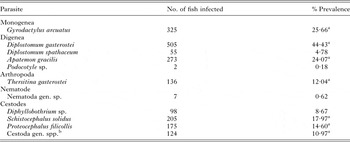
The component community of macroparasites infecting G. aculeatus consisted of 12 parasites (Table 1) with a total of 78% of fish being infected with at least one parasite (n = 878 out of 1130). Prevalence was calculated across all populations and years in order to identify commonly occurring parasites (Table 1). Seven parasite taxa were found to exceed 10% prevalence across samples: the crustacean Thersitina gasterostei, the monogenean Gyrodactylus arcuatus, the trematodes D. gasterostei and A. gracilis and the cestodes S. solidus and Proteocephalus filicollis, and the group ‘Cestoda gen. spp.’, consisting of B. scorpii and E. crassum.
Prevalence of all macroparasites of three-spined stickleback (n = 1130) identified in 14 populations on the Scottish island of North Uist across an 8-year period

a Parasites exceeding average 10% prevalence across all populations and years sampled which were considered in further analysis.
b This group consists of two species of cestodes found in the intestine E. crassum and B. scorpii which were generally too immature to differentiate. In these freshwater populations, the majority of these cestodes are likely to be E. crassum, since identifiable B. scorpii have only been found in stickleback living in saltwater on North Uist.
Most of these parasites are described as common parasites and considered for further analysis. Thersitina gasterostei only occurred in three populations and was found in fewer than 20% of 57 population samples collected from different lochs across 5 years, so was not included in further analysis.
Parasite communities: general patterns
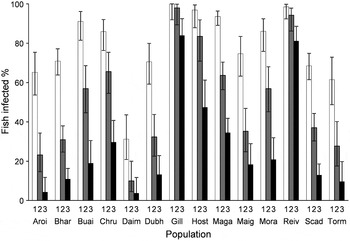
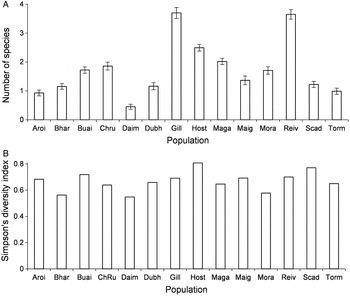
Overall infection levels calculated across all years for each individual population were generally high: seven of the 14 populations had more than 80% of fish infected with at least one parasite (Fig. 1) and only one population had fewer than 60% of fish infected (Daim, 31·25%). Furthermore, infracommunities consisting of more than one parasite were found to be very common (Fig. 1): three populations had a large proportion (>80%) of fish infected with at least two parasites (Gill, 94%; Host, 83·5% and Reiv, 94·2%) and a further four had over 50% of fish infected with multiple parasites (Buai, 57·0%; Chru, 54·8%; Maga, 63·6% and Mora, 56·9%). Two populations (Gill, 84% and Reiv, 81·2%) had a large proportion of fish infected with at least three parasites. Mean species richness, calculated for each population, ranged from 0·45 ± 0·88 (Daim) to 3·7 ± 1·17 (Gill) (Fig. 2A). Parasite diversity (1-D) did not vary significantly between years and populations (Fig. 2B, Wald F = 1·19, d.f. = 4, 39, P = 0·33; Wald F = 1·30, d.f. = 13, 39, P = 0·252, respectively).
Percentage of three-spined stickleback in 14 North Uist lochs infected with at least one (white), two (grey) and three (black) parasites (±95% confidence interval).

Variation in diversity of parasites of three-spined stickleback in 14 different lochs on North Uist. (A) Average species richness per population (±s.e.); (B) Simpson's diversity index.

Variation in abundance and individual prevalence of parasites: (i) the individual host level
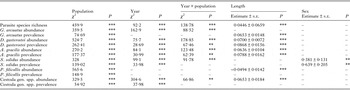
GLMs of the abundance and prevalence of parasites in individual hosts revealed some common patterns. Length had a significant effect on species richness, prevalence of all parasite species, apart from the three cestodes (S. solidus, P. filicollis and Cestoda gen. spp.) and abundance of all parasites apart from G. arcuatus and S. solidus (Table 2). Correlations were positive for all parasites, apart from P. filicollis, indicating a greater prevalence and higher abundance of parasites in larger fish (Table 2). Sex did not generally explain a significant proportion of the variance in either parasite abundance or prevalence, although it was significant in predicting the prevalence and abundance of S. solidus, both of which are greater in males than in females (Table 2). The sex ratio of samples collected ranged between 0·30 and 0·62 and all but two population samples were female biased. Buai had more males (sex ratio = 0·62) and Chru had equal numbers of males and females.
Associations between measures parasite occurrence in individual three-spined sticklebacks on North Uist, and extrinsic (year, population) and intrinsic (length, sex) factors, using GLM analysis
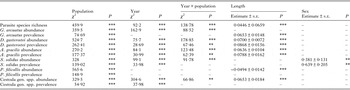
N = 1130. ‘Population’ was associated with 13 d.f., ‘year’ with 4 d.f., population × year with 39 d.f., and both ‘sex’ and ‘length’ with 1 d.f. Probability values associated with model: ***P < 0·001, **P ⩽ 0·01, *P ⩽ 0·05. ‘Estimate’ refers to (1) the estimated parameter (coefficient) of the effect of length, as given by the GLM and (2) the estimated parameter of the effect of sex, males relative to females.
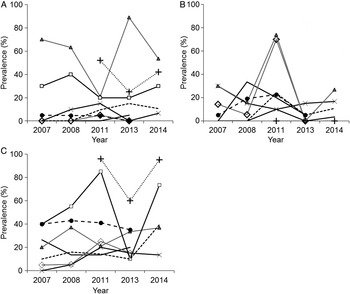
There was significant variation between populations for all response variables (Table 2). Parasite species richness, abundance and prevalence also varied between years, except for the prevalence and abundance of P. filicollis and the prevalence of G. arcuatus (Table 2). The year × population interaction term was significant in a number of models: species richness, abundance (except for P. filicollis which was consistently very low in the majority of populations, see below [Fig. 3A)] and prevalence of D. gasterostei and A. gracillis (Table 2) were all significant, indicating that variation was not completely consistent within populations across years in these instances. This makes the interpretation of patterns of spatiotemporal variation difficult, but this can be clarified through the use of figures.
Year-to-year variation in prevalence of three parasites of three-spined stickleback in eight populations from North Uist: (a) P. filicollis, (b) Cestoda gen. spp. and (c) D. gasterostei. For all figure components: Aroi  ; Bhar
 ; Chru
 ; Daim
 ; Host
 ; Maga
 ; Scad
 ; Torm
 . Only eight populations of the 14 studied are shown, to increase clarity. These eight represent the range of variation in all 14.

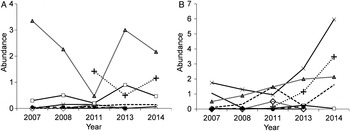
For example, the prevalence of P. filicollis was consistently below 20% in the majority of populations except Host, Chru and Maga, where, despite fluctuations, prevalence was constantly high (Fig. 3A). Trends can also be observed in the prevalence of Cestoda gen. spp. Again there are populations with consistently low prevalence (Fig. 3B), but a peak in prevalence can be observed in 2011 for multiple populations (Aroi, Daim and Scad). Aside from a drop in Maga and Chru in 2013, prevalence of D. gasterostei remains consistently low (below 50%) in numerous populations, whilst maintaining at high prevalence in a number of others (Fig. 3C). In terms of abundance, P. filicollis was rare in most populations with high counts only observed in Host (Fig. 4A). Schistocephalus solidus was rare or absent in many populations, but was consistently present in others (Bhar and Host). It showed a gradual increase across years in Host and a general trend appears to be an increase in later years samples (Fig. 4B).
Year-to-year variation in abundance of two parasites of three-spined stickleback in eight populations from North Uist illustrating: (A) consistently low abundance of P. filicollis and (B) a rise in S. solidus abundance. For all figure components: Aroi ; Bhar ; Chru ; Daim ; Host ; Maga ; Scad ; Torm . Only eight populations of the 14 studied are shown, to increase clarity. These eight represent the range of variation in all 14.

Variation in mean abundance and prevalence of parasites: (ii) the population level climatic and seasonal effects
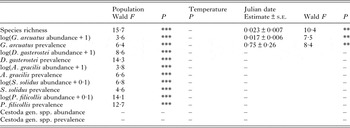
Species richness varied greatly between populations (Table 3), as did the prevalence and abundance of all species excluding Cestoda gen. spp. Temperature (in the immediately preceding March and April) had no significant effect on parasites and their overall species richness. However, species richness increased later in the year (Julian date, Table 3) as did prevalence and abundance of G. arcuatus.
Associations between measures of average annual parasite occurrence in three-spined sticklebacks on North Uist, and extrinsic (population, temperature, Julian date) and intrinsic (average length, sex ratio) factors, using GLM analysis for species richness, abundance and prevalence of G. arcuatus, D. gasterostei, A. gracilis, S. solidus, P. filicollis and Cestoda gen. spp. Sample size = 57 lake + year combinations, based on 1130 fish.
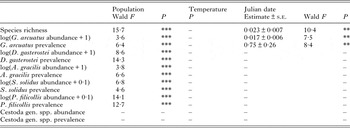
Population is associated with 13 d.f., all other variables are associated with 1 d.f. Probability values associated with model: ***P < 0·001, **P ⩽ 0·01, *P ⩽ 0·05 before correction, significance value α (P = 0·05) corrected using sequential Bonferroni correction (c = 5). ‘Estimate’ refers to the estimated parameter of the effect of mean length, temperature and Julian date as given by the GLM.
Environmental effects
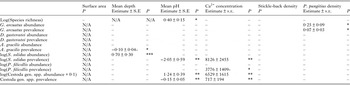
There were few significant relationships between environmental variables and overall average measures of parasite occurrence for lochs (Table 4). Prevalence and abundance of G. arcuatus was correlated with P. pungitius density. Schistocephalus solidus prevalence and both prevalence and abundance of Cestoda gen. spp. were significantly correlated with both calcium concentration and pH. All correlations with calcium concentration were positive. Abundance of Cestoda gen. spp. was positively correlated with pH, whereas S. solidus and Cestoda gen. spp. prevalence were negative correlated, indicating higher prevalence of these parasites in more acidic lochs. A greater mean abundance of P. filicollis was also observed in lochs with higher calcium levels.
Associations between annual averages of measures of parasite occurrence in three-spined sticklebacks on North Uist, and environmental factors, using GLM analysis for species richness, abundance and prevalence of G. arcuatus, D. gasterostei, A. gracilis, S. solidus, P. filicollis and Cestoda gen. spp.

Sample size = 14 populations using data from 1130 fish. All variables are associated with 1 d.f. Probability values associated with model: ***P < 0·001, **P ⩽ 0·01, *P ⩽ 0·05 before correction, significance value α (P = 0·05) corrected using sequential Bonferroni correction (c = 7). ‘Estimate’ refers to the estimated parameter of the effect of pH and calcium concentration, as given by the GLM. Shaded cells indicate comparisons absent from the model.
DISCUSSION
General (population)
Comparison of the macroparasite communities of three-spined sticklebacks collected from 14 populations across 5 years was used to look for spatiotemporal patterns in parasite occurrence and suggest possible mechanistic explanations behind observed patterns. Whilst variation occurred among populations, in general, infection levels were high: in half of the populations observed, more than 80% of fish examined were infected with at least one parasite and only one population had fewer than 60% of fish infected. Compared with other locations, North Uist sticklebacks exhibit a relatively narrow range of parasite fauna (de Roij and MacColl, Reference de Roij and MacColl2012): the average species richness in the most diverse loch was 3·7 compared with a mean species richness found to be as high as 5·3 in a study of four localities in the Baltic Sea (Zander, Reference Zander2007). Despite this, multiple infections were fairly common and in seven of the 14 populations over 50% of fish harboured more than one parasite. The most frequently encountered macroparasites were the monogenean G. arcuatus, the trematodes D. gasterostei and A. gracilis, the cestodes S. solidus and P. filicollis and the Cestoda gen. spp. group, composed of larval B. scorpii and E. crassum.
Variation in abundance and individual prevalence of parasites: (i) the individual host level
In many previous studies, little evidence was found for repeatability in parasite community patterns across space and/or time (Behnke et al. Reference Behnke, Bajer, Harris, Newington, Pidgeon, Rowlands, Sheriff, Kuliś-Malkowska, Siński and Gilbert2008b ; Kennedy, Reference Kennedy2009), although there are instances which demonstrate some extent of repeatability in measures of parasite community composition (Kennedy, Reference Kennedy1993; Carney and Dick, Reference Carney and Dick2000; de Roij and MacColl, Reference de Roij and MacColl2012). Two long-term studies have investigated parasites communities of eels (Anguilla Anguilla) in two English rivers; River Clyst (Kennedy, Reference Kennedy1993) and River Otter (Kennedy, Reference Kennedy1997). Both studies considered a range of community measures including species composition, richness, dominance and diversity. Considerable and erratic variation was observed between years in both studies, showing a lack of predictability. However, changes in community diversity and dominance in the River Clyst were small, suggesting an underlying stability in community structure. The previous study on North Uist covered 2 years and showed little change in the relative difference in parasite community measures across populations, demonstrating short-term stability in the spatial variation of macroparasite communities (de Roij and MacColl, Reference de Roij and MacColl2012). This being said, it is important to consider long-term studies in a range of locations before presuming general trends in parasite communities (Kennedy, Reference Kennedy1997).
The present investigation extends the research of de Roij and MacColl (Reference de Roij and MacColl2012) to look for longer-term repeatability, using data from five sampling years, spanning an 8-year period. The present study showed less temporal stability than de Roij and MacColl (Reference de Roij and MacColl2012); however, some measures of parasite community still exhibited substantial consistency across years (prevalence of G. arcuatus, S. solidus, P. filicollis and Cestoda gen. spp. and abundance of P. filicollis). The consistency observed in our study indicated that, whilst we were unable to identify clear and predictable patterns in parasite distribution, parasite infections are not stochastic, as concluded in Kennedy (Reference Kennedy2009). Instead certain parasites are consistently more or less persistent in different locations suggesting that the occurrence of parasites in fish lies somewhere between random and structured communities.
Fish length accounted for some variation in most parasite measures, excluding the abundance of G. arcuatus and S. solidus and prevalence of S. solidus, P. filicollis and Cestoda gen. spp. In general, length was positively correlated with measures of parasite infection, apart from P. filicollis abundance, with which it was negatively correlated. This is consistent with previous observations regarding the association between length and parasite burden. A comparison of published data comparing length and parasite species richness showed that correlations between them are usually positive (Poulin, Reference Poulin1997). Correlations have also been observed between fish length and intensity of infection with larval digenes and cestodes (Poulin, Reference Poulin2000). There are a number of potential explanations for observed correlations between body length and parasite load. Firstly, the bodies of longer fish have a greater surface area and thus a larger area for parasites to infect (Arneberg et al. Reference Arneberg, Skorping and Read1998). Secondly, length is usually associated with the age of fish, so that longer (older) fish have had more time to become infected by parasites and accumulate parasite infections (Behnke et al. Reference Behnke, Bajer, Sinski and Wakelin2001). This effect of age would be more important in some lochs than others as the age structure within populations varies across North Uist. Many of the lochs contain annual populations, but some lochs are home to individuals living up to 3 years (as observed in Reiv, Maga and Mora, A. R. Singkam, unpublished data). These lochs may therefore contain fish which have accrued parasites over a number of years, possibly resulting in greater burdens in longer, older fish.
The negative correlation observed between fish length and the abundance of P. filicollis is supported by early work looking at the seasonal changes in this parasite, which showed that smaller fish exhibited higher infection intensity (Hopkins, Reference Hopkins1959). Such variation is suggested to be as a result of different feeding habits based on the observation that smaller stomachs of fish under 1-year-old contained more zooplankton (hosts for P. filicollis), whereas larger fish, older than 1 year, tended to have stomachs containing algae and chironomid larvae, thus are less likely to become infected with P. filicollis (Hopkins, Reference Hopkins1959). Consideration of the life cycle of P. filicollis is consistent with this observation. Once mature, P. filicollis migrates to the posterior end of the host intestine in order to release eggs via the anus of the host (Hopkins, Reference Hopkins1959). After release of eggs, empty proglottids degenerate, until the entire worm is shed (Meggitt, Reference Meggitt1914). Field studies on numerous species of Proteocephalus have indicated that this maturation and degradation of parasites occurs within a year (Scholz, Reference Scholz1999) after which cestodes are lost from the host. Therefore, if the diet of smaller fish increases their chance of infection, these infections are not persistent enough to be observed in older, larger fish.
The association of parasite communities with sex of fish was less consistent, only explaining variation in abundance and prevalence of S. solidus, whereby males were more highly parasitized. This may be explained by mating characteristic of males, both behaviourally and chemically (Folstad et al. Reference Folstad, Hope, Karter and Skorping1994). Males attract females using bright red colouration, produced by carotenoids, which are acquired via consumption of carotenoid rich foods, such as copepods (Ostlund-Nilsson et al. Reference Ostlund-Nilsson, Mayer and Huntingford2010). Copepods are also an important transmitter of a number of stickleback parasites, including S. solidus and P. filicollis, thus increased secondary sexual colouration also increases exposure to parasites, possibly explaining the higher rate and level of S. solidus infection in males (Folstad et al. Reference Folstad, Hope, Karter and Skorping1994). Furthermore, altered androgen profiles result in immunocompromised males during the breeding season (Folstad and Karter, Reference Folstad and Karter1992); thus, sex can affect parasite infection and intensity.
An alternative explanation is that the higher infection observed in males could be a result of sampling bias based on the time of year samples were collected. During the non-breeding seasons, males and females move around in shoals; however, during the mating season breeding males build and defend a nest (Pressley, Reference Pressley1981). Samples were collected using minnow traps set around the borders of the lochs, which will catch only fish found in these areas. As samples were collected during the breeding season, it is likely that many breeding males would have been defending nests at the time, thus samples may be biased towards females and non-breeding males (Bagamian et al. Reference Bagamian, Heins and Baker2004). This may also explain, at least in part, the heavily female biased sex ratios observed in data samples. It is also worth noting the hypothesis proposed by Lester (Reference Lester1971) that S. solidus infected fish move into shallower waters as a result of oxygen stress, so could have an increased chance of being caught in minnow traps. However, this is unlikely to be a problem in North Uist as lochs are shallow and movement of water by the wind means the water is well oxygenated throughout (A.D.C. MacColl, personal observations).
Variation in mean abundance and prevalence of parasites: (ii) the population level:
Climatic and seasonal effects
The strong population effects observed for the majority of parasite measures (excluding abundance and prevalence of Cestoda gen. spp.) are consistent with our finding that infection with some parasites differs between populations. Although temperature variation had no effect on the parasites present, the time in the year at which samples were collected did affect the species richness and both prevalence and abundance of G. arcuatus, all of which increased when samples were collected at a later point in time between late April and late May. Gyrodactylus salaris, a gyrodactylid infecting Atlantic salmon (Salmo salar), was observed by Appleby and Mo (Reference Appleby and Mo1997) to demonstrate seasonal patterns: infection levels were lowest in winter and early spring (following low water temperatures) and increased throughout spring. This is consistent with our findings of greater G. arcuatus infection later in the season.
Environmental effects
Nine-spined stickleback density was found to be positively associated with the prevalence and abundance of G. arcuatus. This is consistent with previous findings of increased transmission of gyrodactylid species, such as G. salaris, which are able to infect both hosts when high densities of both three-spined and nine-spined stickleback are found (Soleng et al. Reference Soleng, Jansen and Bakke1999). Alternatively, it may be that presence of nine-spined stickleback is indicative of some unmeasured aspects of water chemistry, which are favourable to both Gyrodactylus and P. pungitius (MacColl et al. Reference MacColl, Nagar and de Roij2013).
Other environmental variables which correlated with parasite occurrence were pH and calcium concentration. Calcium concentration is commonly found to affect the presence of digenean parasites, for example, Curtis and Rau (Reference Curtis and Rau1980) found calcium concentration to be associated with Diplostomum sp. distribution, as their life cycle requires snail hosts which use calcium for shell production (Cribb et al. Reference Cribb, Bray, Olson, Timothy and Littlewood2003). Marcogliese and Cone (Reference Marcogliese and Cone1996) observed a similar effect of pH on digenes infecting American eels (Anguilla rostrata), which were absent from rivers with a pH too low to support their molluscan intermediate host. Therefore it is surprising that the calcium concentration and pH did not explain variation of Digenea between populations. However, calcium concentration was positively correlated with S. solidus, P. filicollis and Cestoda gen. spp. prevalence, as well as Cestoda gen. spp. abundance. There was little support for these findings in the literature, as calcium concentration is not commonly found to affect the occurrence of cestodes. We considered the possibility that calcium may be correlated with another variable which could affect the presence of cestodes, perhaps by influencing the presence of copepod intermediate hosts, but this remains an area which will require further study. The pH was positively correlated with the abundance of Cestoda gen. spp. This positive correlation for both calcium concentration and pH observed for this variable is consistent with the findings of MacColl et al. (Reference MacColl, Nagar and de Roij2013). A more surprising result was the negative correlation observed between pH and the prevalence of S. solidus and Cestoda gen. spp. Bothriocephalus claviceps and Proteocephalus microcephalus have both previously been identified in freshwater American eels (A. rostrata) living in rivers with pH 4·7–5·0, demonstrating that cestodes are suited to living in harsh aquatic environments (Marcogliese and Cone, Reference Marcogliese and Cone1996). However, these environmental results are puzzling as pH and calcium concentration are usually positively correlated due to dissolved alkaline metals increasing the pH of water (MacColl et al. Reference MacColl, Nagar and de Roij2013). Thus, one would expect calcium and pH to both be either positively or negatively correlated with parasites, rather than show an inverse relationship. A study by Fryer (Reference Fryer1980) found that more acidic lakes were associated with a decreased diversity of crustacean species. It is possible that species able to transmit these cestodes are more suited to survival in acidic lochs than other crustaceans, increasing the chance of sticklebacks consuming infected prey. This idea could be explored with analysis of zooplankton present in lochs.
This study successfully identifies some level of repeatability in parasites infecting North Uist sticklebacks. Although a number of parasites differ in relative abundance and prevalence across the years, consistency was identified with regards to differences between populations in the prevalence of G. arcuatus, S. solidus, P. filicollis and Cestoda gen. spp. and abundance of P. filicollis throughout the study, indicating that parasite occurrence is not fully stochastic. Variation in temperature and season had very little effect on parasite distributions but some correlation was identified between parasites and abiotic environmental factors.
SUPPLEMENTARY MATERIAL
The supplementary material for this article can be found at https://doi.org/10.1017/S0031182016001815.
ACKNOWLEDGEMENTS
We are grateful to North Uist Estates and the Scottish Government (SEERAD) for access to land on North Uist. We thank Job de Roij, Aliya El Nagar, Sarah Forbes, Muayad Mahmud, Mark Mainwaring, Shaun Robertson and Jim Whiting for assistance with data collection. The manuscript was improved by comments from Jerzy Behnke and Andrew Fenton.
FINANCIAL SUPPORT
The work was supported by the U.K. Natural Environment Research Council (Grant no. NE/C517525/1) and the University of Nottingham (both to A. D. C. M.).