INTRODUCTION
From the recent debate over whether religious institutions should be exempted from mandatory insurance coverage of contraceptives to ongoing disputes over issues like teacher-led prayer in public schools and the display of the Ten Commandments on public property, it is clear that controversies over the ideal relationship between church and state remain prevalent in American politics (Campbell Reference Campbell2013; Jelen Reference Jelen2010; Segers and Jelen Reference Segers and Jelen1998). However, remarkably little research has been conducted on American public opinion on church and state since the mid-1990's (e.g., Jelen and Wilcox Reference Jelen and Wilcox1995; Reference Jelen and Wilcox1997). In particular, our understanding of the sources of political attitudes on controversies over religious establishment and religious free exercise remains limited despite major improvements in our understanding of the foundations of public opinion more generally over the last two decades.
One particularly fruitful area may be examining how psychological factors such as authoritarianism affect attitudes toward church and state. Scholars of public opinion increasingly recognize that authoritarianism exerts a substantial impact on attitudes toward groups and policies throughout American politics (e.g., Hetherington and Weiler Reference Hetherington and Weiler2009; Kinder and Kam Reference Kinder and Kam2009). Authoritarianism is a personality type in which individuals see the world in black and white terms and view society as fragile and lacking in order (Kinder and Kam Reference Kinder and Kam2009, 3–4). As a response to this worldview, authoritarians naturally want to impose order and uniformity, and view groups who do not conform to the dominant social order as dangerous (Feldman Reference Feldman2003; Kinder and Kam Reference Kinder and Kam2009; Stenner Reference Stenner2005). Researchers are currently working to better understand how authoritarianism structures attitudes toward various public policy issues (Barker and Tinnick Reference Barker and Tinnick2006; Cizmar et al. Reference Cizmar, Layman, McTague, Pearson-Merkowitz and Spivey2014; Hetherington and Suhay Reference Hetherington and Suhay2011; Hetherington and Weiler Reference Hetherington and Weiler2009; Huddy et al. Reference Huddy, Feldman, Taber and Lahav2005; Mockabee Reference Mockabee2007).
In this article, I build a theory of authoritarianism's influence on attitudes toward church-state issues that emphasizes the ability of religious establishment and religious free exercise to confer benefits and impose costs on various social groups. Specifically, I argue that individuals with higher levels of authoritarianism should be more likely to take accommodationist stances on policies that involve religious establishment, such as teacher-led prayer in public schools or the display of the Ten Commandments on government property, as a means of maintaining social conformity and reinforcing the dominant, Judeo-Christian social order. Doing so provides psychological and social benefits to religious in-groups and imposes new psychological and social costs on members of religious out-groups.
In addition, those with higher levels of authoritarianism should exhibit reduced support for religious free exercise when the policies in question affect religious out-groups as a means of ensuring individual-level conformity with the dominant, Judeo-Christian social order. Banning religious practices imposes stiff costs on religious out-groups, who must choose between adhering to their faith's practices and obeying the law. However, I expect that authoritarians will not oppose free exercise for religious in-groups because here the potential to punish out-groups is missing. In fact, authoritarians might even support religious free exercise for religious in-groups, expecting that doing so confers additional psychological and social benefits on members by exempting them from otherwise applicable laws. Using data from the 2008 Cooperative Campaign Analysis Project, I find considerable evidence for my argument.
PUBLIC OPINION ON CHURCH AND STATE: WHAT WE KNOW
A natural starting place in the research on church and state is the work of Jelen and Wilcox (Reference Jelen and Wilcox1995; Reference Jelen and Wilcox1997), who find that there are two separate dimensions of attitudes on church and state (consistent with the distinction made in the First Amendment): attitudes on establishment and attitudes on free exercise.Footnote 1 Focusing first on establishment, they argue that public attitudes fall on a spectrum from those who support broad, non-preferential governmental support for religion (termed “accommodationists”) to those who strictly oppose all governmental entanglements with religion (termed “separationists”) (Jelen and Wilcox Reference Jelen and Wilcox1995; Reference Jelen and Wilcox1997). Similarly, they argue that attitudes on free exercise range from those who believe that, while the government cannot prohibit particular religions, governments can limit the behavior of certain religious groups to protect community interests (termed “communitarians”) to those who hold that religious free exercise is an absolute and inviolable right (termed “libertarians”) (Jelen and Wilcox Reference Jelen and Wilcox1995; Reference Jelen and Wilcox1997; Reichley Reference Reichley1985).
Controversies over what constitutes an acceptable establishment of religion have been prominent in American politics since the colonial years (Flowers Reference Flowers2005; Hamburger Reference Hamburger2002; Hutson Reference Hutson2007; Lambert Reference Lambert2014; Levy Reference Levy1986). One reason why the issues revolving around religious establishment have remained unsolved may be the fact that the Founders did not share a uniform understanding of the ideal relationship between religion and the state (Muñoz Reference Muñoz2009). In relatively recent times, the controversy has persisted: advocacy for a comparatively low “wall of separation” was a keystone in the New Christian Right's political agenda in the 1980s and 1990s (Jelen and Wilcox Reference Jelen and Wilcox1995; Lambert Reference Lambert2014; Martin Reference Martin1996), and preferences toward establishment policy are one of the many issues dividing the two major American parties (Castle Reference Castle2015; Hunter Reference Hunter1991; Layman Reference Layman2001; Leege et al. Reference Leege, Wald, Krueger and Mueller2002). Within the last decade, establishment controversies have included questions about whether intelligent design should be taught alongside evolution in public schools and whether states are constitutionally permitted to display religious symbols such as the Ten Commandments on public property.Footnote 2 Although establishment-related policies remain highly divisive, the American public has generally shown high levels of tolerance for accommodationist policies that reinforce Judeo-Christian norms (Elifson and Hadaway Reference Elifson and Hadaway1985; Hougland Reference Hougland1992; Jelen and Wilcox Reference Jelen and Wilcox1995, 77; Woodrum and Hoban Reference Woodrum and Hoban1992).
Likewise, claims of religious free exercise have proven controversial throughout American history. The recent battle over whether private businesses can claim religious freedom from generally applicable laws, as in the case of Burwell v. Hobby Lobby (2014), shows that public opinion toward religious free exercise remains deeply divided. The growing controversy over whether private businesses should be allowed to refuse services to Lesbian, Gay, Bisexual & Transgender couples on religious grounds suggests that controversies over free exercise are likely to continue to emerge. Despite the increasing frequency and ferocity of controversies over religious free exercise, our understanding of the sources of public opinion on these questions remains limited.
The existing literature provides several reasons why public opinion on church and state issues is politically relevant despite the fact that most church-state questions are ultimately addressed by the courts. Jelen and Wilcox provide four answers to this question: justices are appointed by presidents who may take public attitudes on church and state into account during the selection process, the Supreme Court itself is responsive to public opinion, the court's decisions raise the salience of church-state issues, and Congress can always pass a Constitutional Amendment overturning the court's rulings (Jelen and Wilcox Reference Jelen and Wilcox1995, xiii–xv). In addition, recent research suggests that attitudes on religious establishment may affect the choices voters make in elections, particularly among those who feel high levels of perceived threat (Castle Reference Castle2015).
Despite these reasons why public opinion on church-state issues might affect American politics, to date the literature on the foundations of public opinion on church-state issues is under-developed. Since Jelen and Wilcox's (Reference Jelen and Wilcox1995; Reference Jelen and Wilcox1997; Wilcox, Goldberg, and Jelen Reference Wilcox, Goldberg, Jelen and Segers2002) high-profile work in the 1990s and early 2000s, there have been few efforts to model public attitudes on church-state issues. Their model includes basic demographic variables, dummy variables for religious tradition, adherence to evangelical doctrine, religious salience, and frequency of church attendance. In the intervening twenty years, political science research has increasingly recognized the importance of psychological predispositions such as authoritarianism and ethnocentrism that originate outside of politics but exert considerable influence in the formation of political affiliations and attitudes (e.g., Hetherington and Weiler Reference Hetherington and Weiler2009; Kinder and Kam Reference Kinder and Kam2009). In particular, there are strong reasons to suspect that authoritarianism may prove to be an important predictor of attitudes on both religious establishment and religious free exercise.
AUTHORITARIANISM IN AMERICAN POLITICS
Social psychologists have long been interested in how the authoritarian predisposition toward conformity and uniformity affects social and political attitudes. Adorno et al. (Reference Adorno, Frenkel-Brunswik, Levinson and Sanford1950) initially introduced authoritarianism as an explanation for anti-Semitism as well as other forms of antidemocratic thinking. Altemeyer (Reference Altemeyer1981; Reference Altemeyer1988; Reference Altemeyer1996) further developed our understanding of authoritarianism by emphasizing authoritarian traits of submission to authority, a preference for cultural traditionalism, and strong antipathy toward cultural out-groups. Although the measures of authoritarianism have been refined over the years in an effort to deal with methodological criticisms, scholars have nonetheless remained strongly interested in authoritarianism as a means of explaining attitudes on a variety of public policies (Altemeyer Reference Altemeyer1981; Reference Altemeyer1988; Reference Altemeyer1996). Most recently, the embrace of a new scale based on preferences for child raising (i.e., Feldman and Stenner Reference Feldman and Stenner1997; Mockabee Reference Mockabee2007; Stenner Reference Stenner2005) has led to a resurgence in studies employing authoritarianism.
Research increasingly recognizes that authoritarianism is a useful predictor of attitudes on a variety of political issues, including civil rights and civil liberties, defense policy, and support for the United States' “war on terror” (e.g., Barker and Tinnick Reference Barker and Tinnick2006; Hetherington and Suhay Reference Hetherington and Suhay2011; Hetherington and Weiler Reference Hetherington and Weiler2009; Kinder and Kam Reference Kinder and Kam2009). One of the key things that these various issues hold in common is that each might threaten the established social order, and therefore each issue tends to activate a sense of threat among authoritarians. Research suggests that the presence of threat may provoke a stronger reaction among authoritarians (Feldman Reference Feldman2003; Feldman and Stenner Reference Feldman and Stenner1997; Stenner Reference Stenner2005). Hetherington and Suhay (Reference Hetherington and Suhay2011) suggest that the reverse is also true: threatening circumstances may make average citizens more susceptible to authoritarian thinking. Research also shows that an important trait of authoritarians is a desire to deal with physical and moral threats in black and white fashion through rules, laws, and force (Adorno et al. Reference Adorno, Frenkel-Brunswik, Levinson and Sanford1950; Altemeyer Reference Altemeyer1996; Hetherington and Suhay Reference Hetherington and Suhay2011; Hetherington and Weiler Reference Hetherington and Weiler2009; Lipset Reference Lipset1959). Despite our growing understanding of authoritarianism's ability to impact policy preferences, to date the academic literature has not explored the link between authoritarianism and attitudes on church and state.
AUTHORITARIANISM AND ATTITUDES ON CHURCH AND STATE
Theory suggests that authoritarianism should structure attitudes on religious establishment. The authoritarian desire to bring about conformity has led to authoritarianism impacting attitudes on a number of social issues, including gay rights, abortion, race, and immigration (Cizmar et al. Reference Cizmar, Layman, McTague, Pearson-Merkowitz and Spivey2014; Lane Reference Lane1955; Mockabee Reference Mockabee2007; Stenner Reference Stenner2005). Likewise, establishing a religion fits the natural authoritarian desire for social conformity, and the de facto banning of out-group religions fits with the authoritarian tendency to deal with threats to the existing social order in an unambiguous fashion. Not surprisingly, religious establishment has been used throughout history as a means of punishing those with non-traditional religious views. Of course, in the context of the United States, the First Amendment prohibits the establishment of religion. However, short of outright establishment, governments might adopt “accommodationist” policies that provide broad non-preferential advantages to religious groups (Jelen and Wilcox Reference Jelen and Wilcox1995). Doing so advantages religious in-groups (often Judeo-Christian groups in the United States context) by increasing the “benefits” for in-groups, including the psychological and social affirmation of their faith. Embracing accommodationist policies also increases the “costs” on religious out-groups through both psychological reminders of their out-group status and legal barriers that might make practicing their religion more difficult.
One example of a group attempting to use accommodationist policies to gain cultural supremacy is the New Christian Right. Mobilized out of a sense of threat from cultural modernism and the liberalism of the 1960s (Hunter Reference Hunter1991; Layman Reference Layman2001; Putnam and Campbell Reference Putnam and Campbell2010), the New Christian Right advocated for a number of accomodationist policies, including teacher-led prayer in public schools and teaching creationism and/or intelligent design alongside evolution (Deckman Reference Deckman2004; Dierenfield Reference Dierenfield2007; Hunter Reference Hunter1991; Jelen and Wilcox Reference Jelen and Wilcox1995; Lambert Reference Lambert2014; Lebo Reference Lebo2008). Such policies represented a means of “fighting back” against the dual threats of modernism and secularism by using the government's authority to encourage conformity with culturally traditional worldviews. This discussion leads to the hypothesis that accommodationist policies on religious establishment should appeal more to those who exhibit higher levels of authoritarianism.
Likewise, there is reason to believe that communitarian policies on free exercise might prove attractive to authoritarians. Communitarian policies are those that allow a social majority to restrict the religious behaviors of certain groups (e.g., Jelen and Wilcox Reference Jelen and Wilcox1995; Reichley Reference Reichley1985). Communitarian policies impose costs on the affected groups by making certain practices associated with the faith illegal, forcing members to choose between adhering to their religion's customs and violating the law. This makes it more likely that current adherents will leave the faith and less likely that new members will join, thereby creating a dual disadvantage in the religious marketplace for religious out-groups. Examples of communitarian policies disproportionately impacting religious out-groups in United States history include the Morrill Anti-Bigamy Act targeting polygamous Mormons in the Territory of Utah, mandatory flag pledges interfering with the practices of the Jehovah's Witnesses, and the Wisconsin Compulsory School Attendance Law restricting the Amish tradition of completing school at the end of eighth grade.Footnote 3 Given the ability of communitarian free exercise policies to punish social out-groups, we would expect that communitarian policies on religious free exercise should appeal more to those who exhibit higher levels of authoritarianism when cultural out-groups are in question.
However, restrictions on free exercise do not always involve cultural out-groups. For example, two recent controversies have erupted around whether churches that refuse to hire women should be allowed to retain their tax-exempt status and whether businesses owned by religious adherents should be allowed to refuse to serve members of the Lesbian, Gay, Bisexual & Transgender community on religious grounds.Footnote 4 When free exercise policies would impose costs on members of religious in-groups, clearly the attractiveness of the policy to authoritarians should be reduced. In fact, authoritarians might even actively oppose restrictions on large and socially dominant religious groups, as they might perceive that such restrictions could threaten the existing social order and benefit groups that seek to challenge conventional societal norms. In the case of the United States, we would expect that when policies seem targeted toward religious in-groups like evangelical Protestants, mainline Protestants, and Catholics, authoritarians will not support, and may even actively oppose, such policies.
DATA AND ANALYSIS
Assessing attitudes about religious establishment and free exercise has long been difficult because few large-N, nationally representative surveys ask questions about church-state issues. However, a recent dataset collected by David Campbell and John Green (Reference Campbell and Green2009) as part of the 2008 Cooperative Campaign Analysis Project provides an ideal opportunity to evaluate my hypotheses. CCAP is a multi-wave online survey conducted by Polimetrix, Inc. (now known as YouGov). Rivers (Reference Rivers2006) and Vavreck and Rivers (Reference Vavreck and Rivers2008) show that Polimetrix samples are representative of registered voters. The establishment and free exercise questions were asked during the October 2008 wave, and the sample size was approximately 2,580.
Church-state attitudes are measured through a series of seven statements about particular policies. Respondents were provided a statement and then asked to select a response from a four-point Likert scale, ranging from “strongly agree” to “strongly disagree.”Footnote 5 Four of the policies were centered around religious establishment:
Government officials should be allowed to post the 10 Commandments inside government buildings.
A city government should not be allowed to put a manger scene on government property at Christmas (note the reversed polarity for this item).
Teachers and other public school officials should be allowed to lead prayers in public school.
Parents should have the option of sending their children to non-public schools, including those with a religious affiliation, using vouchers or credits provided by the federal government that would pay for some or all of the costs.Footnote 6
The final three policy statements were centered around free exercise:
There should be laws against the practice of Satan worship.
Public schools should be allowed to have a policy against students wearing religious dress at school, like Muslim head scarves.
Churches should be denied their tax exemptions if they prevent women from becoming ministers or priests.
Authoritarianism is measured via the now-standard scale based on child-rearing preferences. The logic behind the scale is that it captures the authoritarian emphasis on order, obedience, control, and conformity (Feldman Reference Feldman2003; Feldman and Stenner Reference Feldman and Stenner1997; Stenner Reference Stenner2005). A major advantage of measuring authoritarianism in this way is that the child-rearing scale avoids the ideological biases of prominent alternative measures such as Altemeyer's Right-Wing Authoritarianism scale (Feldman Reference Feldman2003; Feldman and Stenner Reference Feldman and Stenner1997; Stenner Reference Stenner2005). Respondents were presented with a series of five dichotomous choices on values in a child: independence/respect for elders, self-reliance/obedience, curiosity/good manners, considerate/well behaved, and creative/disciplined (the authoritarian choice is the second in each pair). The variable authoritarianism is the mean of these five items for each respondent, re-coded to range from 0 (non-authoritarian) to 1 (authoritarian).Footnote 7
I begin the analysis by testing Jelen and Wilcox's (Reference Jelen and Wilcox1995) long-standing finding that attitudes on church and state do in fact constitute two separate dimensions, as this assumption grounds much of the subsequent analysis. A principal components factor analysis of the seven items supports Jelen and Wilcox's (Reference Jelen and Wilcox1995) choice to divide public attitudes on church and state into establishment and free exercise dimensions. The four establishment items load strongly on one factor, which explains about 41% of the total variance in the seven indicators (results in online Appendix A). The three free exercise items load onto a second factor, which explains an additional 16% of the variance. However, given that I distinguish between social in-groups and out-groups in my hypotheses on free exercise, I will treat the three indicators separately for the remainder of the analysis.
Figure 1 shows the raw responses to each of the four establishment questions for the sample as a whole. The results show that on issues of religious establishment, Americans are closely divided, but broadly tend to support at least moderate religious accommodation. Respondents seem particularly comfortable with symbolic expression of religion by the government: about 66% of respondents support the posting of the Ten Commandments inside government buildings, and about 71% of respondents support the government's ability to display a manger scene on public property. While support was less enthusiastic for cases where accommodation would require a higher level of entanglement between the government and religion, a majority of respondents still supported teacher-led prayer in schools (54% of respondents) and school voucher programs that fund private religious schools (56% of respondents).
Public Opinion on Establishment Issues by Level of Authoritarianism. Source: 2008 CCAP. Note: For the Ten Commandments, School Prayer, and Voucher Items, Strongly Disagree corresponds to the most separationist opinion and Strongly Agree corresponds to the most accommodationist opinion. Polarity was reversed for the manger item, so in this case Strongly Disagree corresponds to the most accommodationist opinion and Strongly Agree corresponds to the most separationist opinion.

As an initial test of my theory that authoritarianism is a source of attitudes on religious establishment, Figure 1 also breaks down public opinion by authoritarianism, measured in tertiles. On each of the four establishment items, a clear pattern emerges of those in the lowest tertile of authoritarianism taking the most separationist approach and those in the highest tertile of authoritarism being more likely to prefer an accommodationist stance (for all four items, Pearson's Chi-squared was statistically significant at the p < 0.001 level, indicating the presence of a relationship between authoritarianism and establishment attitudes).
In order to simplify the analysis, for the remainder of the article I will combine the four establishment items into an establishment attitudes scale.Footnote 8 As we would expect given the results above, authoritarianism is a strong predictor of establishment attitudes. Those in the lowest tertile of authoritarianism have a mean score of 0.42 on the establishment attitudes scale. In contrast, those in the highest tertile of authoritarianism have a mean score of 0.70, indicating strong support for accommodationist policies.Footnote 9 While multivariate models are still needed in order to account for the possibility of intervening factors, these preliminary results provide strong initial support for my argument that authoritarianism predisposes individuals to accommodationist stances on religious establishment.
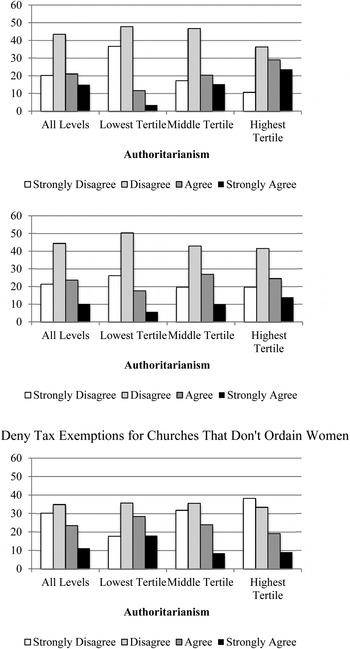
Broadly, Figure 2 suggests that Americans are less closely divided on religious free exercise. About 36% of Americans support laws against Satan worship, about 35% support denying tax exemptions to churches that won't hire female clergy, and about 34% support allowing public schools to ban Muslim headscarves. On one hand, then, there is a strong plurality of support for religious free exercise in the United States. On the other hand, there is still a substantial percentage of the American population that supports restricting free exercise in various situations.
Public Opinion on Free Exercise Issues by Level of Authoritarianism. Source: 2008 CCAP.

Figure 2 also breaks down the responses to the free exercise items by the level of authoritarianism (measured in tertiles). This provides an excellent initial opportunity to test my hypothesis that authoritarianism should be more closely related to free exercise attitudes when religious out-groups are involved in the controversy. Beginning at the top, the results show that just 15% of those in the lowest tertile of authoritarianism would support laws against Satan worship. Among the highest tertile of authoritarianism, the proportion who would favor such laws jumps to nearly 53% (Pearson's Chi-squared = 293.19, p < 0.001). Moving to the issue of public schools banning religious garments including Muslim headscarves, a similar pattern was apparent. Among the lowest tertile of authoritarianism, 23% would support such a ban. However, among the highest tertile of authoritarianism, nearly 39% would support restrictions on religious attire (Pearson's Chi-squared = 55.29, p < 0.001).
As expected, the pattern was remarkably different on the issue of denying tax breaks to churches that prevent women from being priests or pastors. In this case, nearly 47% of those in the lowest tertile of authoritarianism would support denying tax breaks to churches that oppose female clergy. In contrast, just 28% of authoritarians would support such a policy (Pearson's Chi-squared = 101.63, p < 0.001). These results suggest that authoritarians support religious free exercise in this case, as doing so favors the dominant Judeo-Christian social order. Together, the results in Figure 2 provide suggestive evidence in favor of my hypothesis that authoritarians will view free exercise as a means of potentially threatening or reinforcing the dominant social order, and their views on policies will vary accordingly.
MULTIVARIATE ANALYSIS
In order to test whether the above findings hold after accounting for a variety of alternative explanations, I turn to multivariate analysis. In this section, the dependent variables are attitudes on church and state: the establishment attitudes scale and the three individual free exercise items. In each of the models shown, I control for a variety of standard socio-demographic variables, including party identification (a seven-point scale ranging from strong Democrat to strong Republican), ideology (a five point scale ranging from very liberal to very conservative), gender (a dummy variable for females), age, southern residence, income, and education.Footnote 10
Another important set of controls is for religious tradition and religious commitment, as different religious traditions have taken dramatically different attitudes toward church and state (Jelen and Wilcox Reference Jelen and Wilcox1995). For example, while evangelical Protestants have recently favored accommodationist attitudes on establishment (Hunter Reference Hunter1991; Lambert Reference Lambert2014), maintaining a strict separation of church and state has been a key commitment of American Jews (Wald Reference Wald2015). In order to account for this alternative explanation, I include a series of dummy variables for religious tradition (evangelical Protestant, Black Protestant, Catholic, Jewish, and None, with mainline Protestant as the comparison category), a religious commitment scale, and a series of multiplicative interactions between the religious tradition dummy variables and my religious commitment scale in order to allow account for the variation in the impact of religious commitment across different religious traditions (Layman and Green Reference Layman and Green2005; Smidt, Kellstedt, and Guth Reference Smidt, Kellstedt, Guth, Smidt, Kellstedt and Guth2009).Footnote 11
Another potential explanation, particularly for the free exercise items, is ethnocentrism. The relationship between authoritarianism and ethnocentrism is widely accepted in the social science literature (Adorno et al. Reference Adorno, Frenkel-Brunswik, Levinson and Sanford1950; Kinder and Kam Reference Kinder and Kam2009). In order to help separate out the effects and provide a strict test of my hypotheses, I include a religious ethnocentrism scale comprised of favorability ratings toward three important religious out-groups in American politics: Muslims, Mormons, and Atheists.Footnote 12 Research shows that these are three of the least well-liked religious groups in American politics and that Americans continue to express hesitance toward voting for presidential candidates from these religious backgrounds (e.g., Putnam and Campbell Reference Putnam and Campbell2010). In the model for attitudes on tax exemptions for female clergy, I also control for general attitudes toward taxes, as measured through a question on whether respondents would support a tax increase on those making over $200,000 (response options included strongly favor, somewhat favor, somewhat oppose, and strongly oppose). Finally, I include my independent variable of interest: the five-item authoritarianism scale introduced earlier (Stenner Reference Stenner2005). All variables have been recoded to range from 0 to 1 in order to standardize the interpretation of the coefficients.
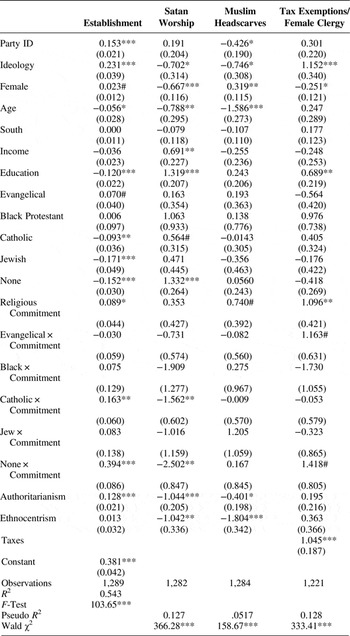
The results of my analyses are shown in Table 1. I begin my analysis with the model for religious establishment, which utilizes ordinary least squares regression because the dependent variable is the four-item scale of establishment attitudes introduced earlier. The model shows that moving from strong Democrat to strong Republican results in a 0.153 increase in accommodationist attitudes toward establishment, holding all else constant (p < 0.001). Similarly, moving from very liberal to very conservative results in a 0.231 increase in accommodationist attitudes (p < 0.001). Finally, the coefficients indicate that those with higher levels of education are significantly less likely to favor accommodationist positions on religious establishment (p < 0.001). Even after accounting for these alternative explanations, the model finds that moving from the lowest to the highest level of authoritarianism results in a 0.128 increase in accommodationist attitudes (p < 0.001).Footnote 13
The impact on authoritarianism on attitudes toward church and state

Note: 2008 Cooperative Campaign Analysis Project. Coefficients shown are OLS for establishment and ordered logit for the three individual free exercise items. Robust standard errors are in parenthesis. Cut points for the ordered logit's were omitted for space but are available on request. All independent variables have been recoded to range from 0 to 1. ***p < 0.001, **p < 0.01, *p < 0.05 (two-tailed tests).
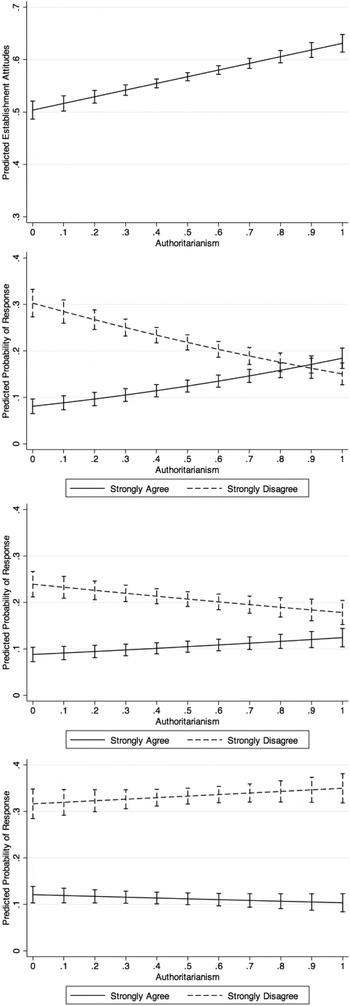
In order help visualize this effect, the top panel of Figure 3 shows the impact of changes in authoritarianism on the predicted level of establishment attitudes. Each graph shown in Figure 3 was computed by fixing all variables at their observed values for each respondent and then substituting various levels of authoritarianism, then averaging the effect size across the dataset to generate point estimates and 85% confidence intervals (e.g., Rising Reference Rising2012).Footnote 14 The establishment attitudes panel of Figure 3 shows that when authoritarianism is at 0, the predicted value on the establishment attitudes scale is 0.50. When authoritarianism is fixed at 1, the predicted value of establishment attitudes rises to 0.63, indicating a preference for a comparatively lower “wall of separation.” Together, the results from Table 1 and Figure 3 provide convincing support for my hypothesis that authoritarianism is an important factor in attitudes on religious establishment.
The Effect of Authoritarianism on Free Exercise Attitudes. Error bars represent an 85% confidence interval.

Does the link between authoritarianism and free exercise vary based on the group involved, as my hypothesis predicted? The final three columns of Table 1 present ordered logistic regression results for each of the three free exercise policies.Footnote 15 The dependent variable for each is a four-point scale ranging from strongly agree (the most communitarian or anti-free exercise response) to strongly disagree (the most libertarian or pro-free exercise response). The model shows that ideology is a strong factor in free exercise attitudes for Satan worship: moving from very liberal to very conservative results in a statistically significant decrease in support for free exercise, accounting for all other factors (p < 0.05). Likewise, increasing levels of income and education are both associated with increases in support for free exercise for Satan worshippers (p < 0.01 and p < 0.001, respectively). Not surprisingly, those with higher levels of ethnocentrism are also more likely to oppose free exercise for Satan worshipers (p < 0.01). Even after accounting for these factors, moving from the minimum to the maximum level of authoritarianism results in a significant (p < 0.001) decrease in support for free exercise for Satan worshippers.
Given that ordered logistic regression coefficients are difficult to interpret substantively, Figure 3 graphs predicted probabilities of responding “strongly agree” (the most communitarian response) or “strongly disagree” (the most libertarian response) for each of the three free exercise policies considered. The second panel of Figure 3, corresponding to the Satan worship item, shows that authoritarianism has a statistically significant impact on both the probability of strongly agreeing and strongly disagreeing with the statement. Specifically, moving from the minimum level of authoritarianism to the maximum level results in a 0.10 increase in the probability of taking the most communitarian stance and a 0.15 decrease in the probability of taking the most libertarian stance.
The same basic pattern is apparent for the question about public schools banning religious garments including Muslim headscarves. In this case, moving from strong Democrat to strong Republican (p < 0.05) and from very liberal to very conservative (p < 0.05) are again tied to significantly more communitarian attitudes toward free exercise. Women are more likely to hold libertarian attitudes toward free exercise (p < 0.01), and younger people are more likely to hold communitarian attitudes (p < 0.001). Again, those with higher levels of ethnocentrism are more likely to oppose free exercise for Muslim women (p < 0.001). After accounting for these alternative explanations, we see that authoritarianism is an important predictor of free exercise attitudes: moving from the minimum to the maximum level of authoritarianism results in a significant (p < 0.01) decrease in support for free exercise on this item. The third panel of Figure 3 helps put that effect in substantive context: moving from the minimum to the maximum level of authoritarianism results in a 0.04 increase in the probability of taking the most communitarian stance, and a 0.06 decrease in the probability of taking the most libertarian stance. Again, both of these effects are statistically significant at the p < 0.05 level, as demonstrated by the non-overlapping confidence intervals.
The results for the question about tax exemptions for churches that do not ordain women are more understated. Here, moving from very liberal to very conservative is associated with significantly more libertarian attitudes toward free exercise (p < 0.001). Not surprisingly, women are significantly more likely to hold communitarian attitudes on this issue (p < 0.01). Finally, those with higher levels of education (p < 0.01) and those who oppose tax increases in general (p < 0.001) are more likely to support free exercise for churches. After accounting for these effects, the coefficient for authoritarianism is in the positive (pro-free exercise) direction, and is not statistically significant. The bottom panel of Figure 3 suggests that the effect of authoritarianism is substantively negligible. Moving from the minimum to the maximum level of authoritarianism results in a 0.02 decrease in the probability of taking the most communitarian stance, and a 0.03 increase in the probability of taking the most libertarian stance. This result provides strong evidence for my contention that authoritarianism's impact on religious free exercise is heavily dependent on the nature of the group involved. While authoritarians will naturally oppose free exercise rights for social out-groups, their attitudes are more or less neutralized when the free exercise rights of social in-groups are in question.
DISCUSSION AND CONCLUSION
Overall, the results of the analysis strongly support my core argument that authoritarianism is an important source of attitudes on church and state. First, I showed that authoritarians tend to favor religious establishment, as establishment involves using the authority of the state to reinforce the dominant social order. The relationship between authoritarianism and free exercise is more nuanced. In cases where restricting free exercise may be perceived as reinforcing the dominant social order and imposing costs on religious out-groups, as in the case of laws banning Satan worship and schools banning religious clothing including Muslim headscarves, authoritarians tend to take a highly communitarian view. However, in cases where restricting free exercise may by perceived as challenging the dominant social order and imposing costs on religious in-groups, such as denying tax exemptions to churches that do not ordain female clergy, authoritarians take a more libertarian approach.
Recognizing this relationship between authoritarianism and church and state is important for a number of reasons. First, this research builds on the growing literature suggesting the importance of authoritarianism in structuring attitudes on a broad array of policy items (Barker and Tinnick Reference Barker and Tinnick2006; Cizmar et al. Reference Cizmar, Layman, McTague, Pearson-Merkowitz and Spivey2014; Hetherington and Suhay Reference Hetherington and Suhay2011; Hetherington and Weiler Reference Hetherington and Weiler2009; Kinder and Kam Reference Kinder and Kam2009). As social scientists continue to identify policies where authoritarianism exerts an impact, citizens and policymakers can be more conscious of how support for or opposition to policies may be driven by authoritarianism, and can act accordingly.
In addition, this research serves as a reminder of why attitudes toward church and state remain important. Much of the literature has tended to treat attitudes toward establishment and free exercise as simply an indicator of the public's attitudes on the proper relationship between church and state. As noted above, this literature has generally focused on the impact of demographic variables including gender, education, religious commitment, and religious tradition. However, the present research demonstrates that church-state policies are also about the relationship between the government and the private sector. By better recognizing how psychological factors such as authoritarianism impact attitudes toward church and state, citizens and policymakers can be aware that one motivation behind accommodationist policies and some communitarian policies may be a desire to advantage social in-groups and disadvantage social out-groups. In being more conscious of this relationship, policymakers may be able to avoid divisive policies that increase group-based social inequality and/or perpetuate the tendency toward group warfare in American politics (e.g., Kinder and Kam Reference Kinder and Kam2009).
Finally, the findings reinforce the expectation that controversies over church and state are unlikely to abate for the foreseeable future. Cizmar et al. (Reference Cizmar, Layman, McTague, Pearson-Merkowitz and Spivey2014) found that one reason for the increasing association between authoritarianism and partisanship is that strategic politicians and activists are increasingly emphasizing social issues that lend themselves to authoritarianism (see also Hunter Reference Hunter1991; Leege et al. Reference Leege, Wald, Krueger and Mueller2002). One incentive for doing so may be a desire to activate threat and mobilize authoritarian thinkers into politics on behalf of cultural traditionalism. Certainly, recent controversies over the ability of businesses to deny services on religious grounds and the resulting wave of “mini-RFRAs” fit this pattern. However, it is also important to note that the nature of these church-state controversies may change as the relationship between religion and politics itself changes. The groups that we think of as religious out-groups can quickly become religious in-groups, as exemplified by the path of Catholics in the 20th century (Prendergast Reference Prendergast1999). If nothing else, this discussion highlights the importance of continuing to improve our understanding of the underlying factors affecting public opinion on church and state.
Supplementary materials and methods
To view supplementary material for this article, please visit http://dx.doi.org/10.1017/S1755048316000432.