INTRODUCTION
In 2010, in response to national attention to the issue of bullying and to a series of suicides that implicated peer bullying, the New Jersey state legislature passed the Anti-Bullying Bill of Rights Act, often referred to by school personnel as the Harassment, Intimidation, and Bullying (HIB) Law. Governor Chris Christie signed it into law in 2011, amending the state’s 2002 anti-bullying statute. The New Jersey law fit into a national trend: in 2002, only nine states had anti-bullying laws; by 2015, all fifty had them.
The New Jersey law, considered one of the country’s most punitive anti-bullying measures (Sacco, et al. Reference Sacco, Katharine Baird, Felipe, June and Davis2012), requires schools to adopt a number of procedural measures, including creating new roles within the school to address harassment, intimidation, and bullying (HIB), taking steps to improve school climate, increasing staff and student training regarding HIB, and reporting investigations and incidents to the state. The law caused a great amount of consternation among those charged with implementing the law. School personnel balanced pressures from courts, parents, their school districts, and media about the law, with the increased administrative burden it imposed (Mooney Reference Mooney2011a; 2011b; 2011c). Personnel grappled with how to interpret the statute’s expansive, multipart definition of qualifying events while accounting for their own ideas of bullying and their sense of what was fair to students. This article examines how school personnel crafted meanings and on-the-ground practices—what we refer to as their implementation approach—in light of various interpretations parents, school district administrators and lawyers, state Department of Education staff, and private companies provided in response to the new legislation.
In order to understand how schools implement new laws, we draw on the perspective of inhabited institutionalism (Hallett and Ventresca Reference Hallett and Ventresca2006). Work on policy implementation in organizations attends to the key role of the organizational field—a community of interacting organizations that share common overarching goals and norms (Dobbin, et al. Reference Dobbin, Sutton, Meyer and Richard1993; Sutton, et al. Reference Sutton, Frank, Meyer and Richard Scott1994)—in affecting organizational behaviors and practices. Traditionally, there has been a particular focus on conformity between organizations. Inhabited institutionalism instead examines how local action and meaning-making mediates how organizations interface with their environments, often producing varied practices. This perspective assumes that the everyday work of the specific individuals tasked with implementation and how they mediate environmental pressures is key to understanding implementation (Edelman Reference Edelman1992; Hallett Reference Hallett2010). Here, we examine the extent of variation among a group of schools, as opposed to focusing on the specific practices of individual schools. In doing so, we bring together attention to the interpretive guidance of organizational field actors and the discretion of individual school officials in interpreting and responding to these messages. We examine how local actors make sense of environmental pressures and resources in articulating their implementation approaches and how their sensemaking about their environment and resources create within-field variation.
Our findings are these: in this second year of implementation, schools differed in how they implemented the HIB policy in two dimensions— when they conducted HIB investigations, and the criteria they used to establish whether an incident constituted a HIB violation. Different organizational field actors—parents, school district administrators and lawyers, state Department of Education staff, and private companies— provided a proliferation of different interpretations of the law and of the behaviors being targeted by the law. Personnel within schools used these multiple and sometimes competing interpretations to craft their implementation approach, but not in consistent ways across schools. We argue that, in contrast to more settled periods of law when field actors encourage conformity among organizations (Dobbin and Kelly Reference Dobbin and Kelly2007; Edelman, Abraham, and Erlanger Reference Edelman, Abraham and Erlanger1992), in this period, organizational field actors contributed to variation in implementation approaches between schools as school personnel at different schools were exposed to different legal interpretations and used them in different ways. We conclude by discussing how our findings help explain how organizations shape the implementation of law (see Edelman Reference Edelman2016). Specifically, these initial attempts—and variation in these attempts— at implementing a new law are particularly important since they lay the groundwork for what practices later become normatively and legally accepted. In this case, a state task force recommended, and the state Department of Education adopted, administrative rules that recognized schools’ existing practices — thus showing how varied organizational practices, even when the product of confusion, can become formalized in law.
In this article, we use implementation approach to refer to both the meanings and the practices schools develop in the implementation process rather than privileging one or the other. Our decision is both methodological, reflecting the type of evidence we have (interview and administrative data), and theoretical. We build on Ewick and Silbey’s (Reference Ewick and Silbey1998) theory of legal consciousness, which argues that what people say and what they do regarding law is intertwined and part of a reciprocal process. School personnel implemented the new anti-bullying law through finding language, meanings, and actions that would allow them to meet certain conditions while also balancing competing constraints.
The article proceeds as follows: we first discuss scholarship on how schools and other organizations respond to legal requirements. Next, we introduce our case study, describing the 2011 New Jersey Anti-bullying Bill of Rights and the data that forms the basis for our assessment of variation in implementation practices. We then describe the variation in the practices schools adopted. Using accounts of school personnel, we demonstrate, first, the proliferation of interpretations of the law from field actors, and second, how school personnel used interpretive and rhetorical resources from organizational field actors to both guide and justify their implementation practices. Finally, we discuss the contribution of our findings to theory about the implementation of law in schools and organizations.
Background
Legal Implementation in Organizations: Neoinstitutionalism and Inhabited Institutionalism
Scholars have developed a robust literature regarding the relationship between law and organizational compliance (Edelman and Suchman Reference Edelman and Suchman1997). Most of this work has focused on how businesses respond to requirements set forth in law and regulations (Parker and Nielsen Reference Parker and Vibeke2009), in particular in the domains of civil rights and anti-discrimination (Berrey Reference Berrey2015; Dobbin Reference Dobbin2009; Dobbin and Kelly Reference Dobbin and Kelly2007; Edelman, Erlanger, and Lande Reference Edelman, Erlanger and John1993; Edelman, Fuller, and Mara-Drita Reference Edelman, Sally Riggs and Iona2001; Kelly and Dobbin Reference Kelly1999), environmental protection (Borck and Coglianese 2011), consumer protection (Talesh Reference Talesh2009), and labor (Gray and Scholz Reference Gray1993; Hutter Reference Hutter2001). Laws in these areas usually lack specific mandates for organizational change and strong enforcement mechanisms (Sutton and Dobbin Reference Sutton and Dobbin1996), leaving organizations to create their own compliance measures, which courts then assess (Dobbin, et al. Reference Dobbin, Sutton, Meyer and Richard1993; Edelman Reference Edelman1992).
Scholarship contributing to neoinstitutional theory has illustrated how the environment of an organization shapes its behaviors and practices, including policy implementation. One strand of this work has focused on the actors that provide organizations with an interpretation of the organizational environment and compliance guidance—often referred to as compliance professionals. These professionals both within and external to organizations play a key role in shaping policy adoption through providing an interpretation of legal requirements (Dobbin Reference Dobbin2009; Dobbin and Kelly Reference Dobbin and Kelly2007; Edelman, et al. Reference Edelman, Erlanger and John1993; Edelman Reference Edelman2016). For example, external personnel advisors and internal personnel managers were key in shaping employers’ implementation of sexual harassment mandates; these experts create conformity in organizational practices by advocating for particular practices, in part as a way of gaining professional jurisdiction (Dobbin and Kelly Reference Dobbin and Kelly2007). While compliance professionals might initially represent different views of the legal environment based on their professional expertise and training, over time, they tend to settle into a similar framing of the legal environment (Edelman Reference Edelman2016). Consequently, we expect that in later stages of legal implementation, these professionals provide similar types of guidance to organizations.
This body of scholarship also illustrates how public sector and nonprofit organizations are particularly susceptible to normative pressures in a field (Dobbin and Sutton Reference Dobbin and Sutton1998; Edelman Reference Edelman1992; Scott and Meyer Reference Scott, Meyer, Henry and James1987) and are thus more likely to adopt compliance measures to increase their perceived legitimacy (see Edelman Reference Edelman2016). For example, government agencies were more likely to quickly adopt maternity leave policies in response to Equal Employment Opportunity mandates than were private companies (Kelly and Dobbin Reference Kelly1999).
Public schools, as institutions subject to heightened public attention, are particularly sensitive to pressures from the organizational field (Rowan Reference Rowan1982). Their organizational field includes federal and state legislative bodies, courts, state education agencies, school districts, school personnel and their organizations, parents and their organizations, organizations of compliance professionals (lawyers, technology specialists, and others that sell compliance services to schools and districts), and media organizations covering schools. Each of these types of organizations or field actors can exert influence on the schools, both through exerting pressure directly and through shaping how school personnel perceive external pressures. Although schools are susceptible to environmental and organizational pressures, the effects of organizational pressures are not uniform. For example, Diamond and colleagues (Diamond Reference Diamond2007; Diamond and Spillane Reference Diamond and James2004) show that low- and high-performing schools respond to coercive pressures from the organizational field in different ways. This indicates that, while being subjected to considerable pressure from the field, variation in implementation between schools stems from school-level conditions and processes.
“Inhabited institutionalism” contributes to understanding variation in how schools respond to organizational fields and the shared beliefs that accompany them by emphasizing the role of local actors interacting, acting, and producing shared meanings (Hallett Reference Hallett2010; Hallett and Ventresca Reference Hallett and Ventresca2006). As Binder (Reference Binder2007, 549) describes, organizational actors “combine and generate practices that are intended to satisfy multiple demands, and they do so in interaction with others” (ibid.). We adopt such a lens here to examine how the individuals tasked with implementing a new law in schools carry out that task in interaction with other field actors.
Work on inhabited institutionalism in schools and universities has documented how local actors create and transform institutional meanings and thus produce various local outcomes. For example, Hallett (Reference Hallett2010) illustrates how ideas of accountability, which have dominated the educational policy landscape in the past decades, translate into practices in a school through the actions of the principal and through everyday work activities, interactions, and meaning-making. Reyes (Reference Reyes2015) finds that ideas about Latinx political involvement are mediated through the feeling of community and the structures of incorporation colleges offer to students, allowing for different types of relationships and conversations, and thus creating different types of political activity among Latinx students. And Cobb (Reference Cobb2017) finds that school demographics, resources, and professional culture in high schools informed different local meanings regarding inequality, which mediate a general ideology of color-blind racism. In contrast to these studies of inhabited institutionalism in schools where staff respond to coherent or dominant meanings from the field, we are interested in how staff interpret and draw on multiple and varied meanings produced by field actors.
Bullying: A Surplus of Meaning
Understanding how a legal concept is translated into practice is especially challenging, and important, when the concept has a surplus of legal and social definitions (Grattet and Jenness Reference Grattet and Valerie2005). Bullying is such a concept. Meaning-making around the HIB law was difficult given that the concept of bullying is particularly susceptible to interpretive challenges. In a review, Brank, et al. (Reference Brank, Hoetger and Hazen2012) describe bullying as an especially problematic legal term that complicates the legalization and execution of anti-bullying laws. Researchers, practitioners, and students have varying perceptions of what bullying is, who is the “bully,” and who is the “victim” (Craig, Bell, and Leschied Reference Craig, David and Alan2011; Harger Reference Harger, Besen-Cassino and Lorreta2016). School personnel had to grapple with the opacity of the concept of bullying, including tension between its legal definition and lay conceptions (Migliaccio Reference Migliaccio2015). Indeed, previous work illustrates the active construction of shared understandings of peer aggression and bullying within schools (Harger Reference Harger2019), suggesting the importance of on-the-ground interpretations of the concept itself. In this case, implementing the HIB law was complicated by a surplus of both legal and nonlegal definitions of bullying that school personnel had to grapple with, adopt, or reject.
Initial Implementation and Organizational Fields
We examine how public schools from one state, subject to the same legal environment, develop varied on-the-ground practices for implementing an anti-bullying law during the second year of the law. Novel legal requirements can produce change in organizational fields along a number of dimensions. When law has been recently passed, case law that establishes accepted practices and punishments for their violation, and legal guidance that can clarify what constitutes compliance, is lacking or not aligned with organizational practices. Periods of initial implementation of law also present opportunities for organizations wishing to capitalize on uncertainty, such as companies providing legal advice or technology to schools. During these periods, norms about compliance practices among the affected organizations are not established, as it is initially unclear how other organizations are implementing the law which may disrupt the process of learning from other organizations. And, widespread and consistent interpretations and narratives of law and the behaviors the law governs are still in formation or are disrupted during a period of initial implementation. It is this last dimension of novel legal mandates in organizational fields that we focus on here.
CASE: PUBLIC MIDDLE SCHOOLS AND THE ANTI-BULLYING BILL OF RIGHTS ACT
The purpose of the 2011 New Jersey Anti-bullying Bill of Rights Act was to reduce peer harassment and to strengthen the standards and procedures for how schools report, investigate, and respond to harassment, intimidation, and bullying incidents. The law mandated that the school principal designate a guidance counselor or an individual in a similar position as the HIB specialist for the school. School administrators additionally had to convene a school safety team, provide training on their district’s anti-bullying policy, and educate staff and students about HIB. School administrators were also required to put programs in place to improve school climate with respect to HIB. Compliance with these aspects of the law was universal among the schools we studied.Footnote 1 Schools varied in their practices, however, regarding when to conduct a formal investigation into potential HIB incidents and in their criteria for determining what constituted a HIB violation.
Formal Guidance: HIB Investigations and Criteria
In investigating incidents, the law mandated that the school principal must be notified verbally the same day and in writing within two days of any reported instance of HIB, and that the school principal must then contact the parents or guardians of all students involved. The school’s HIB specialist must then conduct an investigation. The results of the investigation had to be sent to the superintendent and the board of education within ten days. School personnel had to report the results of the investigation to parents or guardians. A 2012 New Jersey Department of Education “Questions and Answers” document states that all reports must be investigated by the anti-bullying specialist in “consultation with the principal.” The document explained:
The purpose of the investigation is to determine the facts of each report, which would include assessing whether there was HIB according to the statutory definition or some other behavior of concern. Determinations on the nature of a behavior are not made prior to conducting an investigation, but are made based on the findings from an investigation. (p. 2)
The official policy was clear: all reports of HIB-related incidents were to receive the formal investigation and reporting procedures.
The law defined the criteria for establishing a HIB incident as:
… any gesture, any written, verbal or physical act, or any electronic communication whether it be a single incident or a series of incidents, that is reasonably perceived as being motivated either by any actual or perceived characteristic, such as race, color, religion, ancestry, national origin, gender, sexual orientation, gender identity and expression, or a mental, physical or sensory disability, or by any other distinguishing characteristic, that takes place on school property, at any school-sponsored function, on a school bus, or off school grounds.
According to the 2012 Department of Education document, that an event is “motivated by an actual or perceived characteristic” is necessary but not sufficient to constitute a HIB incident. The law specified that two other criteria must be met as well for an incident to qualify as a HIB incident:
[1] Substantial disruption or interference with the orderly operation of the school or the rights of other students; and [2] One or more of the following criteria – A reasonable person should know, under the circumstances, will have the effect of physically or emotionally harming a student or damaging the student’s property, or placing a student in reasonable fear of physical or emotional harm to his person or damage to his property; or – Has the effect of insulting or demeaning any student or group of students; or – Creates a hostile educational environment for the student by interfering with a student’s education or by severely or pervasively causing physical or emotional harm to the student.
This aspect of the law—how to apply the criteria for determining what constituted a HIB incident— proved most challenging for school personnel to implement.
DATA AND METHODS
The data we use for this study comes from a field experiment designed to evaluate an anti-harassment intervention program in fifty-six public middle schools in New Jersey during the 2012–13 school year, the second year in which the new state law was in effect (Paluck, Shepherd, and Aronow Reference Paluck, Hana and Aronow2016). The intervention program was a grassroots campaign led by a randomly selected group of students who developed ideas and materials for addressing peer harassment in their schools. All public middle schools in New Jersey were invited to apply for the program; schools that applied were selected for participation based on demonstrated commitment and logistical considerations. We find no relationship between experimental condition and implementation practices, so we do not discuss the intervention further below.
The characteristics of the fifty-six selected schools are approximately representative of the characteristics of public middle schools in New Jersey overall. The sample here has a smaller mean percentage of Black students and Asian American students (nine percent for this sample compared to fifteen percent in all NJ middle schools for Black students; six percent for this sample compared to nine percent in all NJ middle schools for Asian American students), but a larger mean percentage of Hispanic students (twenty-four percent for this sample compared to eighteen percent in all NJ middle schools). This sample also has slightly fewer mean suspensions than in all NJ middle schools (five vs. eight), and slightly larger student-teacher ratios and student to administrator ratios (11.3 vs. 10.8, and 338 vs. 303, respectively). Finally, this sample includes fewer of the poorest schools, more of the second-poorest schools, and more of the upper-middle class (but not the wealthiest) schools.
The main source of data for this article comes from ninety-four semi-structured interviews with administration and counselors, conducted by six members of a research team across the fifty-six schools. The research team interviewed an administrator, usually either the principal or vice principal, and a counselor or student support staff member, often the anti-bullying or HIB specialist mandated by the law, at each school about their approach to and understanding of the new law. Interviews ranged from fifteen to seventy-five minutes, depending on the time availability of the interviewee. We collected two or more interviews for most of the schools, and at least one interview from all of the schools. Where two interviews were available, we took both into consideration in evaluating implementation approaches. Below, we note where there were conflicting accounts of implementation practices from different individuals within the same school. At some schools, it was not possible to precisely characterize the implementation approach based on these interviews or observations in the schools.
Interviewers asked about how the school was “handling HIB reports” with follow- up questions regarding how many reports they had, the content of reports, the process of reporting and investigating, and who was in charge of the process. Interviewers asked about the greatest challenges and signs of progress regarding HIB, frustrations with the law, and a comparison between this year and the previous year in terms of dealing with HIB reports. The rest of the interview probed for information about the nature of student conflict at the school, differences by grade and gender, programming about conflict and HIB the school conducted, school identity, school climate in terms of student-teacher, and between-teacher interactions, and experiences with parents.
The two authors coded the ninety-four interviews using NVivo software. We conducted a multistage process to identify codes. We first examined a sample of interviews and inductively generated themes that emerged from the interviews, based on empirical and theoretical approaches in the research reviewed above regarding the implementation of law in organizations (e.g., implementation procedures, organizational roles, organizational culture, and other organizational factors like administrative capacity). We then built a set of codes and tested them against new interviews, adding or condensing codes when necessary. When new interviews failed to yield new codes, we finalized the list of codes.
To identify accounts of investigation approach and HIB criteria practices, we developed a set of dimensions (e.g., when personnel initiated an investigation, what factors they considered when evaluating whether a case constituted a HIB violation) based on the content of the interviews that suggested variation among schools. When characterizing these informal practices of schools, we assessed the content of the codes multiple times and checked the coding of the other author, discussing and resolving discrepancies. We use information from all the interviews, even when we could not precisely characterize the implementation practices based on the interviews, to inform our analysis. Because of the nature of our data, we are not able to say definitively why certain schools adopted particular implementation practices. Instead, our goal is to understand the source of variation among the schools as a whole.
We are interested in both how school personnel talk about their HIB procedures and what they do in practice, though interview data is insufficient for definitively establishing practices. As a consequence, our claims are constrained to the accounts school personnel provide of their organizational practices.
We provide context for the types of schools we describe by including information about school size—small (under 300 students), medium (300–600 students), and large (over 600 students)—racial composition, and student economic status using the percentage of students receiving free or reduced-price lunch. These numbers have been rounded to prevent the identification of specific schools. This contextual information about the schools we discuss is compiled in Appendix Table A.
FIELD-LEVEL VARIATION IN IMPLEMENTATION APPROACHES
We first describe the nature of variation in implementation approaches across the schools in terms of (1) when to conduct investigations, and (2) the breadth of criteria for HIB determinations, before turning to an examination of the interpretations provided by the organizational field and how school personnel understand and used them. While the guidance provided to schools regarding when to initiate a formal HIB investigation was relatively straightforward, requiring schools to conduct formal investigations for all reports of HIB, schools took three different approaches to investigating reports: formally investigating all reports; conducting a preliminary investigation before a formal investigation; and conducting a preliminary investigation for reports from students and a formal investigation for reports from parents (which we refer to as a hybrid approach).
Some schools reported investigating all reports of HIB, as stipulated in the law. Personnel at these schools, in describing the procedures at their school, said things like, “if you’re going to bring up the allegation, it’s something that we take rather seriously. That being the case, we’re going to conduct an investigation….” Most schools, however, instituted an informal process in order to establish whether a HIB incident might have occurred. At some of these schools, this meant talking with teachers and administrators; some schools attempted to establish whether the student understood the charge and what it entailed. An individual at a school that first spoke with the student making the charge explained:
Kids now say the word bullying like they say the word ice cream…. It’s a common word now but I think the definition has expanded to their own perception sometimes so what I’m finding out is that I said, “Okay, do you feel like you’re being bullied like these words? Let’s look at the [state] check off list.” Then when I speak to the kids or have them write it down then we think about it. I talk to the guidance counselors. We do a lot of communication before we quickly process it but they have that option to fill out the form. That’s the first thing we say. “You can fill out the HIB form and we will investigate it. It takes ten days.” (School 44; medium, ninety percent white, less than five percent poverty)
A small number of schools reported adopting a hybrid approach: they investigated all reports of HIB coming from parents but did preliminary inquiries for reports coming from students. For example, a vice principal (School 36; large, seventy percent white and twenty-five percent Latinx, twenty-five percent poverty) reported that if a student comes with a HIB complaint, they ask, “does this make you feel threatened or is this, like, a thing that has been happening repeatedly?” If the student answered yes, they proceeded with the case. This vice principal reported that some of the investigations “have been strictly because the parent comes in. So they come in. I’ll deal with my end, start looking at it from vice principal perspective but state law says if you want to start a case, you start a case. We intended to investigate it and that’s what we’ve been doing.”
In the case of investigations, the guidance from the law was clear that schools should conduct formal investigations of all reports of HIB. Schools that reported doing so (about a quarter of the schools represented here) complied more closely with the law than schools who made a preliminary investigation part of their routine.
Variation in Criteria for Establishing HIB
Schools also varied in their interpretation of the criteria for establishing HIB. Only one school cited the three criteria laid out in the 2012 Department of Education “Questions and Answers” document as their method for determining HIB. As a counselor from School 6 (medium, ninety percent white, fifteen percent poverty) put it when asked about interpreting the HIB law, “Because the HIB law is so black and white, it’s kind of easy to distinguish…. You’re kind of looking at: are there distinguishing characteristics? Is the student severely emotionally harmed? Is their education being interfered with? If you’ve got yeses on those, then yeah, it’s a HIB.” Given the rare nature of this approach to applying the law, we identify schools according to the nature and extent of the criteria they use for deciding whether an incident was HIB: narrowly focused schools used only targeted characteristics as the main criteria while broadly focused schools used multiple, diverse criteria for determining whether an incident constituted HIB. The use of multiple, diverse criteria had the effect of allowing for greater discretion in HIB determinations. The majority of schools reported using many criteria, beyond targeted characteristics, to establish whether an event constituted a HIB incident or not; about twenty percent of schools reported strictly adhering to the targeted characteristic criterion alone. (The accounts of personnel at some schools contradicted each other, where one person reported using only targeted characteristics and the others reported using a broader set of criteria.)
Narrowly focused schools exclusively discussed using the presence of “an actual or perceived characteristic” as the criterion for deciding whether an event qualified as HIB. For example, the HIB coordinator for the district (compared to the school-level HIB specialists) of School 48 (large, ninety-five percent white, ten percent poverty), asks:
“Is it motivated by a characteristic?” And that’s been a big focus this year. Most of our professional development is really focusing on, “Is this someone just being mean to someone because they’re getting back at them?” Or “Is this someone who is motivated to bully and harass and intimidate based on a characteristic or protected category?”
However, this staff member also noted the ambiguity in deciding what motivates student behavior,
The question though is, that part of the definition I’m concerned with, and this is what lawyers use in law books, is that motivated by that characteristic? Is the gesture motivated because he has red hair or that’s just something that you’re having fun with? You know what I mean? In other words, you’re not bullying them because they have red hair, they’re bullying because they don’t like them and they’re using the red hair. So I think that motivated language is making it a lot of anti-bullying specialists say, “Well, they’re not motivated to bully them because of red hair….”
The text of the law includes a provision for incidents motivated by “any other distinguishing characteristics,” in addition to the designated list of characteristics. However, personnel at some schools interpreted “characteristic” narrowly, and felt that it prevented them from taking action in situations they perceived to be HIB. For example, the counselor from School 47 (medium, ninety percent White, five percent poverty) noted:
[T]he way that it [the law] defines Bullying, Harassment and Intimidation is very minute. It’s really written for most of the protected classes. So although some of these conflicts could be seen as bullying, because it’s not because of your race, gender, ethnicity, or a protected reason, it’s not meeting that criteria.
In contrast, broadly focused schools drew on a variety of other criteria in addition to actual or perceived characteristics, including the relative balance of power between the involved students, other features of the relationship between students, whether the incident involved aggression by both parties, whether the incident was a one-time event or reflected on ongoing pattern of harassment, the targeted student’s wishes, whether the incident occurred on school grounds or not, and the extent of emotional distress caused. As an example of a school that used a broad interpretation of the criteria, the HIB specialist at School 29 (medium, sixty percent white, twenty percent Latinx, fifteen percent Asian American, fifteen percent poverty) described the process for determining what was a HIB or what was more common conflict:
To me some of it is common sense. I’m going to be honest with you. If you really read the way the law is written up, just me calling you stupid that can be considered bullying…. I ask the six graders … “Okay. If I call you stupid is that bullying?” They’re like, “Yes.” I said, “No. No. No. It’s repeated things that really have an effect on you and affect you academically. It really is bringing you down. Just to feel a little sensitive about it, no, it was a rude comment I made. That is not the same thing as bullying.” They don’t really understand that. They just think one silly comment is bullying.
Even while recognizing that the law clearly states that an incident can occur one time, this HIB specialist explicitly rejected that as a means for establishing HIB. Instead, this person emphasized the ongoing nature of bullying, and the emotional and educational distress it causes.
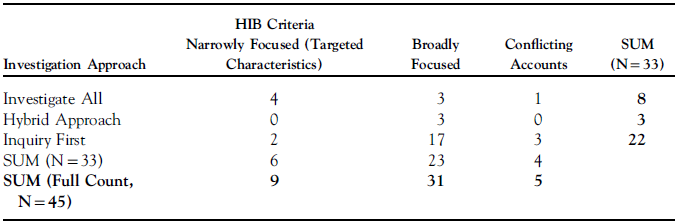
The above evidence demonstrates variation along these two dimensions among the schools in our sample. There was also variation in the combination of these two dimensions between schools. About half of the schools adopted what we might call the highest discretion approach to implementation practices: they both conducted an inquiry into the claim before doing a formal investigation and they used broadly defined criteria for determining an event. The other schools adopted combinations of practices along these two dimensions. We summarize the variation we observe (among the schools for which we could precisely identify their implementation approaches) in Table 1.
Frequency of Implementation Practices and Their Co-occurrence

Note: The number of schools for which there was adequate information about the Investigation Approach and HIB Criteria used varied (N=33 for Investigations and N=45 for HIB Criteria).
Implementation Accounts and Practices
State administrative data give us some indication of the relationship between school personnel accounts and school practices. Schools are required to report to the New Jersey Department of Education all HIB investigations and confirmed cases; we use these reports for the 2012–13 school year. To simplify the analysis, we compare the mean numbers of HIB incidents reported to the state for the highest discretion schools compared to those of all other schools. Schools that adopted the highest discretion approach (that is, that they both conducted a preliminary inquiry and used broadly focused criteria) reported both fewer investigations (5 vs. 8.2) and fewer confirmed HIB cases (5.3 vs. 8.2) to the state during 2012–13 than did all other schools. These reports, then, give us some indication that variation in accounts of implementation practices in our interviews is associated with variation in practices as recorded in bureaucratic data.
We now turn to an examination of two sources of this variation: contestation over the law’s meanings among organizational field actors; and differences in how school personnel understood and interpreted the meanings generated within the organizational field.
COMPETING INTERPRETATIONS AND SCHOOL IMPLEMENTATION
In this section, we first illustrate how, during this period of initial implementation of the anti-bullying law, field actors (specifically parents, school district personnel, and compliance professionals) disseminated often competing interpretations of the law and specific implementation practices. Consequently, these actors did not exert consistent pressure toward conformity on these schools as has been documented in other work, and instead facilitated a range of responses from schools. Second, drawing on inhabited institutionalism, we turn to evidence about how school personnel drew on the competing interpretations of other field actors to inform and justify their implementation approaches. Both of these processes produced a proliferation of implementation approaches among schools.
Competing Interpretations among Field Actors
Field actors provided varied interpretations of the law and of bullying during this period. One source of this variation was the nature and degree of involvement of parents in HIB cases. School personnel at some schools perceived that parents exerted enormous pressure on HIB-related activities by generally being concerned about HIB, reporting HIB incidents, defending children who were accused of violating HIB policies, and being vocal through the process and outcome of HIB investigations. For example, the principal in School 35 (large, seventy-five percent white, ten percent poverty), a school that adopted the highest discretion practices, reported: “I find the parents are extremely litigious when you accuse their child.… They come screaming when they’re the victim of being bullied but when you accuse their kid, then the lawyers show up.” Other schools reported different experiences with parents. The vice principal from School 2 (large, eighty percent white and ten percent Asian American, less than one percent poverty), a school that reported conducting an initial inquiry and using narrowly focused criteria, reported supportive parents:
I guess maybe because it’s a more affluent area but coming here … I feel like the parents are not so quick to say “not my child.” They want to get the whole story and they have just as much respect as I think we do of being respectful towards one another and not tolerating negative interactions with their peers.
This variation in experiences with parents informed how school personnel talked about and understood the law. However, schools with similar experiences with parents did not necessarily adopt same implementation practices, as we discuss below.
School personnel also reported differences in interactions with their school districts, including differences in the meanings of HIB that district personnel used, and noted the extent of variation in implementation approaches between schools. After attending a Department of Education training with personnel from school districts from across the state, the HIB specialist from School 2 remarked that “it was wild to see how each school district was perceiving and thinking what these laws meant.”
Furthermore, during this period, school personnel encountered an array of legal advice regarding how to do implementation. They participated in a patchwork of different training programs, some run by administrators and lawyers in school districts, regions, the New Jersey Department of Education, others run by various private companies selling compliance policies and trainings regarding compliance. As the HIB specialist at School 2 noted, “Everyone under the sun had these HIB kinds of workshops. It’s out there. [For example] Legal One [a private company] I think presented with the State [i.e., the Department of Education]….” The counselor at School 3 (small, eighty percent white and ten percent Latinx, ten percent poverty; a highest discretion school), responding to a question about how their understanding of HIB had changed, noted that they had received different messages at different training sessions.
Well, I think when we first got wind of the new law and then I think Strauss Esmay [private consultants] who is the company that does our policy as well as I think 400 other schools, I think we had a workshop with them. Everyone was stunned coming out going, “Oh my God.” Even the mere mention of the word bullying, boom: you’ve got to launch an investigation. It was almost like we couldn’t use our judgment, so to speak. Then the state explanation, the state workshops and everything didn’t come until September so they wanted us to start this in the beginning of the school year…. That did help too.
School administrators were also exposed to disagreements among legal professionals about the law. The principal of School 60 (large, eighty-five percent white, fifteen percent poverty; inquiry first, conflicting accounts of HIB criteria) noted:
The interesting thing, I think, is we went to a workshop with our board attorney, and he’s interpreting the laws, and we have a letter some place, saying that if it [HIB incident] doesn’t pertain to a protected class then it’s not bullying. I talked to my association attorney and he said he’s wrong. He said because, and he cited case law, he said “I don’t agree with him, because there’s case law.” I think he was in [a nearby district] where a student had head lice. It was bullying, and head lice is not a protected class.
The principal of School 8 (small, forty-five percent white, thirty-five percent Latinx, ten percent Black, fifty percent poverty; inquiry first, conflicting accounts of HIB criteria) noted that these competing interpretations were being worked out in the courts,
I was just reading an article yesterday in the updates that we get from the state that there are sixteen cases, I believe, that are waiting to be heard. This one law was upheld by a judge about bullying. Some kid threw a rolled up paper down a kid’s shirt and [the school administrators] tried to call that bullying. The judge said it’s just childish behavior. It’s not bullying. The law is very vague, very interpretable, so it’s hard.
School personnel experiences of these different legal interpretations from field actors were not translated into implementation practices in consistent ways. School personnel who talked about litigious parents and salient court cases still adopted highly discretionary practices, while school personnel who talked about supportive parents adopted less discretionary practices. School personnel experienced the relationship with their school district very differently, not always perceiving the district as a coercive or normative force that required them to adjust their implementation practices. And, though some school personnel heavily weighed the legal training they received, others developed practices that did not strictly follow the legal experts’ guidance.
Incorporating Interpretations from Field Actors into Implementation
We can best understand how school personnel interpreted and responded to competing interpretations from field actors in shaping their own implementation approach through the lens of inhabited institutionalism: school personnel understood the pressures and meanings from organizational actors in different ways, depending on their own context and local interactions and negotiations.
Parents
Parents were an ongoing consideration for school administrators as they worked out their HIB compliance practices. In reporting HIB incidents or challenging school designations of incidents as HIB, parents used competing meanings of bullying and harassment. The principal from School 16 (medium, eighty-five percent white, five percent poverty), also a school that adopted the highest discretion practices, reported parental push-back about HIB decisions: “I’ve had three parents basically in my office fighting me and crying and upset because I’m labeling their child as a bully. ‘My little Billy is not a bully and you got to make him a bully because of this paperwork.’” The person in charge of discipline at that same school reported attempting to reconcile parental definitions of HIB with the definition provided in the law,
We try to explain to them that this is what the law says. I had one parent tell me that the situation happened outside of school, so there’s nothing that I should be able to do about that. I said, “You need to read the law, because it clearly says it can happen outside of school.” Parents are falling back on that, sometimes they feel some these things are conflict [between students] and they’re not HIB.
Parents also actively weighed in on definitions of HIB in specific incidents. The principal and vice principal at School 21 (medium, sixty percent white, twenty percent Black, fifteen percent Latinx, twenty-five percent poverty), a school with unclear investigation practices and broadly focused HIB criteria, related a story about an incident where they had to interpret a sequence of comments between two students, including one calling the other “Honey Boo Boo” (a reference to a child beauty contestant on TV), and their reactions to these comments. They decided the comments constituted a HIB violation. The parents of the accused student disagreed. According to the principal, “His parents thought that because they were bantering before, there was conflict. Just going to a different level.” The vice principal added: “And the fact that he had called her Honey Boo Boo before, and she was not offended by it or did not stop him before, that was their complaint.”
Through disputing school evaluations of HIB incidents, parents argued for their own meanings of HIB. While school personnel sometimes explicitly rejected parents’ definitions of HIB, usually on the basis of their lack of technical familiarity with the law, they had to contend with those interpretations in their practices.
School Districts
School personnel reported that interactions with school district officials shaped their decisions about future cases. One vice principal (School 27; medium, sixty percent white, thirty-five percent Latinx, thirty-five percent poverty; inquiry first, conflicting accounts of HIB criteria) reported, “My superintendent this year really helped refine [criteria for HIB]. We really look at it from what is the intention behind the act. For example, if a student was motivated, ‘I am chasing you, I am getting you because of your ethnicity. That’s why I’m going after you,’ that’s clearly HIB.” Other schools similarly reported gratitude for the guidance of their district in setting standards for interpreting the law. The HIB specialist from School 2 (inquiry first, narrowly focused HIB criteria) said that the district coordinator “really helped us … to get to where we are. I was lucky to have her help me understand the school safety team, what the purpose was last year.…We kind of started off on the right path.”
A counselor at School 59 (medium, sixty percent Latinx and twenty percent white, seventy percent poverty; unclear investigation practices, narrowly focused HIB criteria) reported that the school superintendent interfered with the school’s efforts to assess HIB claims, pressing his own idiosyncratic approach:
[We] come to some consensus, then forward it to the superintendent and he’ll come back and say, let’s say they [the kid] was called stupid … and he’ll say, “Well, is the person stupid?” Because it has to be that defining characteristic. It is very hard to say. We had an incident where kids were calling another kid “apple,” they were used a code name apple to refer to a student. It was still vague. No one really said [it was] because she was fat. The superintendent came back to us and said, “Well, does she look like an apple?”
A similar dynamic developed at School 57 (medium, fifty percent Black and thirty percent Latinx, forty-five percent poverty), a highest discretion school. Its counselor explained:
I have a case right now that’s going on…. It was addressed outside of HIB because we had a HIB case earlier in the year, where we put it through HIB for sexual harassment, we deemed it HIB, and then it was overturned by the superintendent. We were told, “Yes, it’s sexual harassment, but don’t call it HIB.” That still grated me, because now we have another case. We handled it outside of HIB, but now he’s repeating the behaviors.
Ambiguity around the status of sexual harassment under the law led tensions between the school and the district. Varied interpretations of the meaning of HIB from school district administrators, contributed to variation in how schools implemented the law.
Compliance Professionals and State and District Officials
The proliferation of sources of HIB training programs—from the state Department of Education, districts, and private compliance professionals— exposed school personnel to even more possible interpretations of the law. Some school administrators hewed closely to recommendations from particular trainings. Returning to the HIB specialist at School 2 (initial inquiry and narrowly focused criteria), this person found the training from Legal One and the Department of Education:
helpful because they really did tackle the legal aspects of that. There were attorneys there and we were able to ask specific questions about what is “other,” what does “other” mean. That was helpful. They kind of went through the origins of it being an anti-discrimination law. That was really one of the better ones for that purpose.
On the other hand, the trainings sometimes did not provide clear guidance for school personnel to use. One principal (School 9; large, eighty percent white, twenty percent poverty) noted the contradictory guidance of the private compliance professionals and the state Department of Education. The compliance professionals explained that a HIB violation “has to be over period of time, and it shouldn’t be one incident and it should be an imbalance of power ….” State officials, by contrast, “said if someone reports it, and someone says it,” then the schools needed to following HIB reporting procedures. “A little different mindset, I guess,” concluded the principal.
For the personnel at some schools, the training programs seemed to make little impression at all. One vice principal (School 27; inquiry first, conflict accounts of HIB criteria) struggled when asked about HIB training: “Were we trained at the beginning of the year? I don’t know if we were trained. Yeah, I think we were trained by our district, and the district was trained by the state at some point.” The uneven exposure to different trainings resulted in school personnel receiving different types of information about the law.
The array of workshops and the variation in the content provided in those workshops led to diverse interpretations that school personnel used in inconsistent ways between schools. School personnel in particular struggled to reconcile the wording of the law with their previous conceptions of bullying, developed through exposure to training programs that predated the law or as a result of their own understanding of bullying. The principal at School 4 (small, sixty percent white and twenty percent Latinx, thirty percent poverty; unclear practices) noted that “There’s a definition [of HIB] that guidance counselors are more comfortable with. It has to do more with a power exchange [referring to the relative balance of power between the perpetrator and the victim]. It’s not about this [specific wording of HIB law]….” A counselor at School 57 (medium, fifty percent Black and thirty percent Latinx, forty-five percent poverty), a highest discretion school, referred explicitly to directives they received in a legal training that included taking into account a power differential between students: “We were told last year [in 2011 HIB law training] that it has to be protected class and/or power differential. Those are the two main things to look at.”
School personnel had mixed views of the training programs. They made some confident about their practices. The counselor from School 39 (small, fifty-five percent white and thirty-five percent Latinx, forty-five percent poverty; inquiry first, narrowly defined HIB criteria) reported,
I think we have a better grasp on the law, too. We’ve attended more trainings, we’ve had more meetings with our lawyers. I think we have a better idea of how to filter out what we’re investigating [under HIB] and what we’re investigating in another manner….
The training sessions proved less reassuring to others. The principal at School 21 (medium, sixty percent white, twenty percent Black, fifteen percent Latinx, twenty-five percent poverty; unclear investigation practices and broadly focused HIB criteria) reported that the trainings were often insufficient for determining ambiguous cases. “I think the state has got to do a little bit better job of telling us, you know, I guess, refining the definitions what is and what isn’t. Maybe some case studies of things. We’re hearing a lot of things. We’ve done a lot of things that are close calls.” The trainings also communicated to school personnel the existence of widespread confusion among schools, which may have provided schools with the belief that there was not yet a standard for implementation. A counselor from School 14 (medium, eighty percent white and fifteen percent Latinx, twenty percent poverty; inquiry first, conflicting accounts of HIB criteria) noted: “I’ve been to a lot of different workshops on it, and the questions that are coming out from these workshops, everybody is confused.”
The lack of standardized advice and trainings regarding the specifics of applying the law, in particular what constituted a HIB incident, meant that schools were exposed to multiple, often competing meanings from other organizational field actors. The variety of available sources of interpretations contributed to variation in how school personnel developed their own practices, and in how they justified existing implementation strategies. These various meanings also interacted with specific contexts within which school personnel operated—specifically within school negotiations among staff about meaning and practices— which we now turn to.
Within School Meanings and Negotiations
In line with existing inhabited institutionalism scholarship that illustrates the importance of interaction and negotiation between school personnel (Hallett Reference Hallett2010), we would expect that interactions and negotiations between staff members within a school about the meaning of the law and HIB implementation practices would play an important role in how schools adopted specific practices. Based on our interview evidence, we observed variation in which personnel at the school are involved in the HIB process, the nature of interactions between school personnel, who exerts the most influence over the beliefs of other school personnel about the law, and how collaborative or authoritative the process of determining implementation is. All of these conditions influence how meanings derived from the organizational field are translated into practices within schools. For example, the counselor from School 27 (medium, sixty percent white, thirty-five Latinx, thirty-five percent poverty) refers to guidance from the school principal in their discussion of HIB criteria: “Because the principal says, you need to ask yourself the question about intent and to differentiate between inappropriate adolescent or pre-adolescent behavior and HIB.” At other schools, the principal has no role in the process. At some schools, administrators and others have ongoing discussions about HIB practices. The counselor at School 43 (small, eighty-five percent White, less than five percent poverty) described a collaborative, deliberative HIB implementation process involving the counselor, the school nurse, and the principal, while the counselor at School 29 (medium, sixty percent white, twenty percent Latinx, fifteen percent Asian American, fifteen percent poverty) described the principal making unilateral decisions that this counselor did not agree with.
We also observe some school personnel taking the meanings of the law that they acquired from other organizational field actors and deploying those meanings in interactions with other school personnel to make decisions about specific cases, and whether to conduct investigations. For example, in School 2 (large, eighty percent White, less than one percent poverty), the HIB specialist used their understanding of the punitive aspects of the law derived from the trainings as a tool in conversations with other administrators at the school about what merited a HIB investigation.
There are some administrators that I have to go back and forth [with] saying, “I think that is an appropriate referral [for HIB]. You’re not to be the person to determine if it is or isn’t. That’s why you have a referral.” Coming back [they say], “No, that’s typical peer conflict.” I have to bring up, “This is an anti-discrimination law and because it’s a discrimination law people can be liable for individual damages. You, by holding up this, can become liable if this goes that direction.” Their story changes. “Okay, let’s refer them.” There’s that kind of pressure there too.
The distinctive context at each school shaped how school officials translated the varied meanings of the newly enacted law circulating among organizational field actors into specific organizational practices.
School Characteristics: Exploratory Evidence
The data we have at our disposal does not allow us to determine exactly why particular schools adopted particular implementation practices. To do this, we would need extended on-the-ground observations of school personnel as they developed their implementation practices over time (see Haedicke and Hallett Reference Haedicke, Tim, Kimberly and Roderick2016). We can, however, provide some exploratory evidence about other school-specific factors that likely interacted with these widely circulating meanings to influence why schools took particular implementation approaches. Based on previous work that has documented the relationship between particular organizational characteristics and compliance with law (Dobbin Reference Dobbin2009; Edelman Reference Edelman2016; Kelly and Dobbin Reference Kelly1999; Sutton and Dobbin Reference Sutton and Dobbin1996), we examine variation between schools in additional factors we would expect to play a role in shaping their implementation practices: resources, administrative capacity, and size.
Most school personnel saw satisfying the requirements of the law as unattainable given their resources, regardless of how favorable their overall view of the law was. School personnel largely reported feeling that the law presented a significant bureaucratic burden and expressed displeasure that the policy often disrupted the other roles of the individuals assigned as the school’s HIB specialists. A principal from School 28 (medium, eighty percent white and fifteen percent Latinx, fifteen percent poverty) described responses to the law: “Everybody hates it, every administrator hates it. They think it’s becoming bureaucratic nonsense, and the thing is now, kids [are] using it as a weapon.” As a counselor at School 34 (medium, eighty-five percent white, ten percent poverty) put it,
Frankly, we could spend almost all of our time every day on these kinds of issues if we were to follow procedures as outlined. You have to make choices about how you want to spend your day and how you want to handle situations because not everything requires the same kind of application of service.
In these conditions, variation in schools’ administrative capacity and the size of the student population likely played a role in shaping specific implementation practices. Schools with less administrative capacity in the form of the number of staff per student (ranging from about 130 students per administrator to over 900 students per administrator) presumably adopted implementation practices that were less time-intensive. Given evidence that larger organizations tend to adopt more formal and less flexible procedures (Sutton and Dobbin Reference Sutton and Dobbin1996), we would expect that schools with more students (these schools ranged in size from 230 to 1500 students, with a mean of 586 students) likely adopted practices requiring less discretion from school personnel. We find preliminary, descriptive support for this in our data; highest discretion schools are smaller than schools that do not exercise as much discretion.
DISCUSSION
In the face of novel legal mandates, organizations experience implementation challenges. This is particularly so when law is ambiguous and the process by which it might be translated into action is unclear. A common solution for organizations is to turn to legal experts and others offering guidance about the law to navigate compliance. When legal experts and others agree on how to implement law, then we expect the emergence of a shared understanding among impacted organizations about best practices for implementation. Organizations then have guidance to follow, and they navigate implementation in light of their own characteristics, position relative to other organizations, and internal dynamics. However, when experts do not agree, often because features of the law have not been clarified by statutory, administrative, or case law, then how to carry out implementation is less clear. In those instances, implementation is not only a function of organizational size, resources and capacity, degree of public scrutiny, internal structures, or support for the law, but also the variety of legal interpretations they were exposed to, how they understand those interpretations, and how they deploy those interpretations internally.
That is what we find in this case: schools implemented new legal requirements by drawing on and contending with the multiplicity of legal interpretations provided by organizational field actors. These public schools from one state, subject to the same legal environment, developed diverse approaches to implementing the anti-bullying law. Specifically, schools varied in when they conducted formal investigations and the criteria they used for determining HIB incidents. During periods of initial implementation, the proliferation of interpretations within a field, along with variation in conditions affecting how those interpretations are translated, are sources of variation in implementation practices within these organizations. We also observe here, as we would expect, that not all of the interpretations of field actors are considered equally. Generally, school personnel are less responsive (and perhaps more inclined to implement symbolic responses in response) to parents compared to district and state officials and compliance professionals.
The accounts that school personnel provided regarding the law and its implementation suggest the importance of considering the timeline of legal implementation for understanding the role of the organizational environment. Our findings suggest that in periods of initial implementation, variation in implementation is in part a product of the variety of interpretive guidance provided by various field actors. This is distinct from what previous literature has identified as the predominant role of compliance professionals in creating conformity in organizational practices during later stages of legal implementation. In this case, we would expect more consistency in legal interpretations over time from district and state actors and from compliance professionals, but not necessarily from parents, where localized interpretations of the law might persist. Thus, we might expect parents to remain a source of variation in implementation approaches among schools.
Our focus on how school personnel understood and contended with legal interpretations of other organizational field actors—one of the key features of inhabited institutionalism— provides insight into the relative importance of these factors that accounts of environmental pressures at higher levels of analysis cannot provide. This work contributes to a growing body of work on schools and inhabited institutionalism by examining on the ground interpretations during a period when field-level interpretations are not themselves coherent or standardized.
Scope of Argument
Our study centers on how specific schools interpreted their task of implementing the HIB law, and the meanings regarding HIB and the HIB law to which they were exposed, and the co-occurrence between these various interpretations and variation in implementation practices. The nature of the evidence we collected for this project limits us, however, from identifying precisely why specific schools adopted specific implementation approaches. We did not have access to consistent information on the sources of trainings by school so we do not know precisely what information personnel from each school were exposed to and how much contradictory information those personnel were exposed to. We believe it to be highly likely that a school’s set of relationships to other field actors, resources, and characteristics shape which field actors and meanings they are exposed to, but this is largely unobserved in our data. Based on our data, we cannot determine to what extent the variation in exposure to different interpretations of the law from the organizational field led to variation in implementation approaches across schools, and to what extent school conditions in interaction with those varied meanings from the field led to variation in implementation approaches. This question can be taken up in future research.
Another means by which the organizational field may have contributed to variation in implementation practices is through critical media coverage of the HIB law. While media coverage of a law can standardize perceptions within an organizational field about how to interpret a law and what the consequences are of non-compliance with a law (Kelly and Dobbin Reference Kelly1999), some coverage of the HIB law conveyed widespread dissatisfaction with the law or uncertainty regarding the status of the law. Over a quarter of the eighty-eight articles in newspapers related to the HIB law from when it was passed through July 2013 were in some way critical of the law, highlighted ambiguity in the law, or highlighted the uncertain status of the law due to a legal challenge over the funding structure for the law. This critical media coverage of the law was reflected in headlines such as “Some School Districts Are Voicing Concerns about Law’s Intractable Timelines” (New Jersey Spotlight, November 3, 2011 (Mooney Reference Mooney2011b)); “Despite New Guidelines, Anti-Bullying Law Still a Matter for the Attorneys” (New Jersey Spotlight, December 21, 2011 (Mooney Reference Mooney2011c)); and “Christie, Lawmakers Agree to Fix Anti-Bullying Law” (Associated Press, March 8, 2012). This media coverage conveyed a lack of legitimacy regarding the law itself, exacerbating dissatisfaction with the law in a way that may have enabled school personnel greater discretion in charting their own course for implementation.
The schools in this sample were drawn from those that participated in a high-intensity school climate intervention conducted by the first author and other researchers. Because these schools applied to and demonstrated capacity for the intervention, they may differ from other schools in the extent of their interest in and ability to comply with the law. As we describe above, the schools in this sample have a higher administrative capacity than the average NJ middle school, which might indicate either more ability to tailor a school-specific implementation approach or more ability to engage with recommendations from field actors. That the schools in the sample had a lower mean number of suspensions also suggests either different underlying rates of peer harassment or different administrative approaches to student discipline. These forms of sample bias leave us unable to make definitive statements regarding the extent to which schools in general adopted practices designed to signal compliance without attention to substantive compliance with the law.
Evaluating Stages of Implementation
In this article, we assume that the diverse and competing interpretations of the law in the organizational field—key to producing the variation in practices among schools that we observe and which contrast with other scholarship regarding organizational fields—were at least in part a product of the law being recently passed. When laws have recently been passed, there is often a lack of clear guidance from the courts, administrative law, or other legal experts about specific legal provisions. However, because we did not observe implementation over multiple years in these schools, we are unable to definitively conclude that the competing interpretations are a function of time. It is possible that features of the law itself, bullying as the subject of the law, or the context of the legal regulation of public schools account for competing interpretations within the field, instead of the timing of implementation specifically. These possibilities suggest the great value of additional comparative work on legal implementation within organizational fields. For example, future research might assess the relationship between variation in implementation approaches and (1) stages of legal implementation, (2) legal concepts with a surplus of meaning, and (3) fields where actors have more or less agreement about both the behaviors subject to law and the requirements of the laws themselves, regardless of the timing of implementation.
Implications for Sociolegal Scholarship
Our case adds to our understanding of how organizations implement law, and to the process of legal endogeneity—the way that organizations mediate ambiguous law that in turn shapes the nature of the law (Edelman Reference Edelman2016).Footnote 2 One school principal, in discussing the unsustainability of the bureaucratic burden of the law, stated that: “as the paperwork burns down the districts, I think the districts are making interpretations, which is going to be interesting down the line to see where that falls.” Here, this principal points to an aspect of legal endogeneity: organizations tasked with implementation make decisions about practices that are then evaluated in court and incorporated into the law itself. Variation in implementation practices when a law is new—brought about through the proliferation of interpretations in a field and through local interpretative practices— is likely greater than the variation that exists in later periods. We contend that these initial attempts at implementation of a law, and the variation in implementation between organizations itself, may be particularly important since they create the initial conditions that lead to later implementation practices in the field.
This point can be illustrated by noting administrative changes to the law that allow the most common, highest discretion approaches to qualify as fully complying with the law. For example, changes to administrative law allowed district boards of education to set HIB policies such that conducting a preliminary inquiry instead of investigating all reports of incidents qualified as compliance. Administrative law changes also required district policies to include a definition of bullying that highlighted a possible power imbalance between students, as some broadly focused schools reported doing in our study. Both of these changes were prompted by recommendations from the state Anti-Bullying Task Force (ABTF; mandated by an amendment to the Anti-Bullying Bill of Rights Act in 2012 to meet yearly until 2016) (2016 ABTF Report, Appendix L). In creating their recommendations, this task force drew heavily from feedback from school personnel about their practices and variation between schools in their practices (2016 ABTF Report).
Thus, schools adopting the highest discretion implementation approach were ahead of the curve with respect to the law, pointing toward changes in practices that became incorporated into administrative law. This case suggests a mechanism of legal endogeneity that may be particularly relevant in public organizations or organizational fields with similar logics; in some fields, initial organizational practices—and variation in those practices that both reflect and produce confusion— may influence law not only through courts but through organizational feedback to and pressure on other public bodies like task forces, state agencies, and districts, which become formalized through changes to administrative law. Examining how these public bodies understand and incorporate variation in implementation by different organizations might provide new avenues for scholarship. Additionally, future scholarship might compare the extent of variation in initial organizational practices in different fields or in response to different laws in order to better understand the role of initial variation in trajectories of legal implementation.
Acknowledgements
We are grateful to Amy Kate Bailey, Debbie Becher, Daniel Hirschman, Catherine Lee, Emily Marshall, Eunmi Mun, Christine Percheski, Michelle Phelps, Ashley Rubin, and LaTonya Trotter for their helpful comments on this project and article. We also thank participants of sessions at Law and Society Association and American Sociological Association annual meeting for their feedback. The data for this project was collected by Shepherd in collaboration with Elizabeth Levy Paluck, and funded by grants from the W.T. Grant Foundation Scholars Program, Canadian Institute for Advanced Research, Princeton Educational Research Section, Russell Sage Foundation, Rutgers Research Council, National Science Foundation, and the Spencer Foundation. Allison Bland, Jennifer Dannals, Ariel Dombroski, and Laura Spence-Ash provided exceptional research assistance.
Supplementary material
To view supplementary material for this article, please visit https://doi.org/10.1017/lsi.2021.76